By Lauren Bowes Byatt, Elena Mariani and Anish Chacko
Summary
The government's healthy food standard, announced in 2025, is one of the most ambitious policies to date to tackle obesity. It will introduce mandatory data reporting on the healthiness of food sales for all large food businesses and set mandatory targets for improvement. This policy was inspired by a Nesta proposal on health targets for supermarkets.
Under the healthy food standard, supermarkets will be required to hit a health target. Businesses can use the usual tools at their disposal to hit the target, which minimises disruption and keeps the cost of food down. That might mean putting healthier ready meals on offer, tweaking the recipes of sandwiches so they contain slightly less fat or giving more shelf space to cereals that have less sugar.
Our original analysis found that achieving our recommended health target could reduce adult obesity by around 20%. New analysis shows that this could also significantly reduce childhood obesity levels by around 23%.
Key findings and implications
- If large retailers were to achieve a health target, this could significantly reduce childhood obesity in Great Britain by 23% within five years of the target being met.
- For instance, childhood obesity prevalence could reduce from 15.4% to 11.8% following successful implementation of the healthy food standard, assuming childhood obesity rates otherwise remain stable.
- This would translate to around 400,000 fewer children living with obesity in Great Britain.
In 2024 in England, 15% of children aged 2 to 15 were living with obesity, and more than a fifth (22.2%) of children in year 6 were obese. As well as causing various health complications in children, those living with obesity are about five times more likely to live with the condition as adults, and face a higher chance of premature death and disability in adulthood as a result.
When it comes to childhood obesity, policy attention tends to focus on school food. However, this overlooks where most children's food actually comes from. Children share the same food environment as adults – from the meals their parents and guardians prepare for them, to the shops they pass on their way home from school, to the advertising they are exposed to online.
Primary school children get just 17% of their meals or snacks from school, falling to 12% for secondary school children - most of what they eat comes from outside school. Policies that improve the average healthiness of all food sold, like the healthy food standard, therefore reach children directly, raising the quality of what they and their guardians buy. To address childhood obesity, we must improve the quality of food from supermarkets and beyond without delay.
Bar chart displaying percentage of reported eating locations by age group (2008-2014)
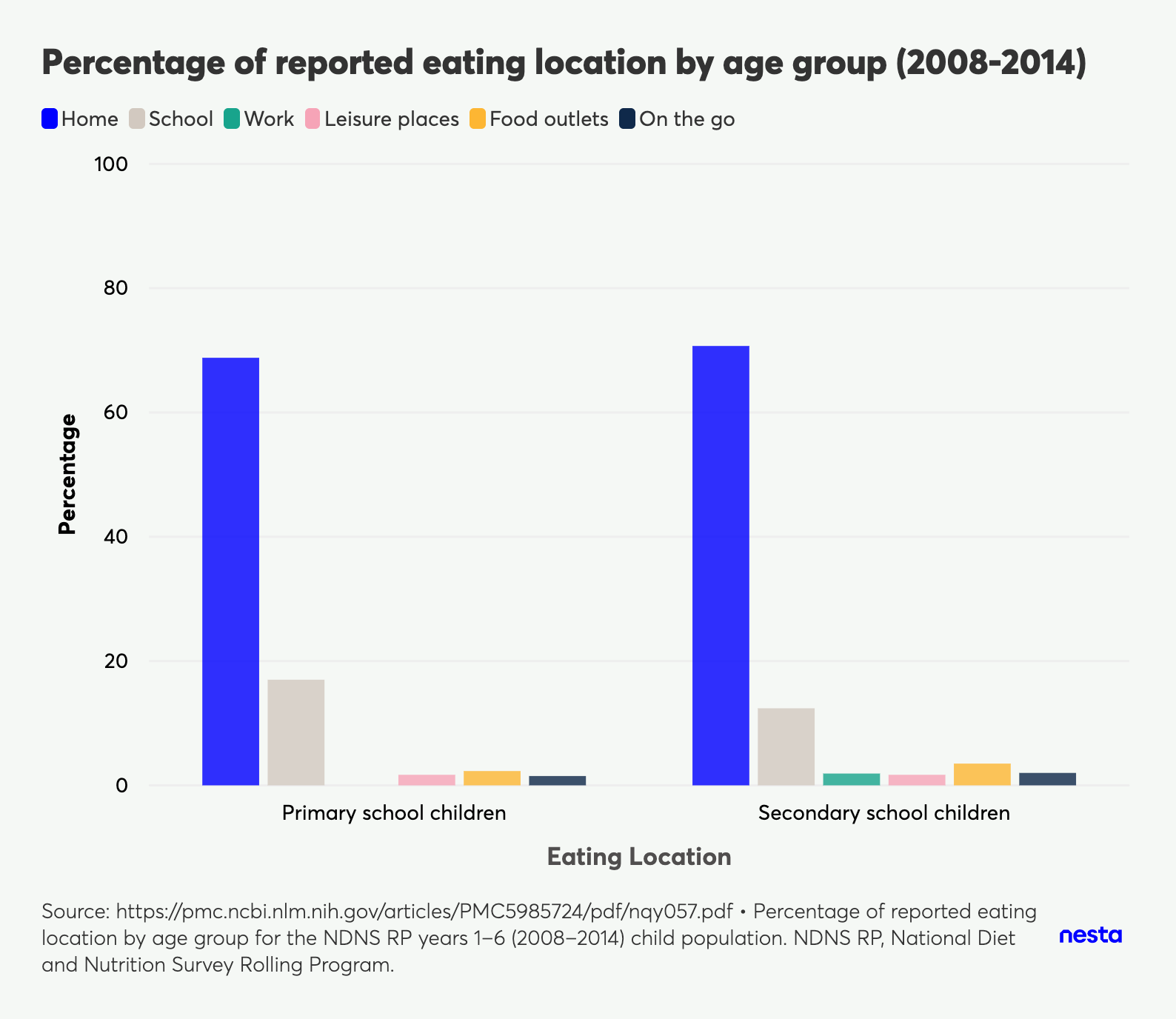
Source: https://pmc.ncbi.nlm.nih.gov/articles/PMC5985724/pdf/nqy057.pdf Percentage of reported eating location by age group for the NDNS RP years 1-6 (2008-2014) child population. NDNS RP, National Diet and Nutrition Survey Rolling Program.
Analysis and method
Our original proposal and analysis modelled the impact that supermarket targets would have on adult obesity. We are updating this analysis and will soon publish the new figures. Here, we share the estimated impact of the policy on childhood obesity ahead of the full publication.
Our analysis recommended that targets be set using a sales-weighted average (SWA) converted NPM (cNPM) score, a robust and holistic measure of the overall healthiness of product sales.
To model the impact that the healthy food standard would have on childhood obesity, we first estimated the reductions in calorie intake as a result of retailers meeting an SWA cNPM score of 69.
Then, we adjusted this reduction in calorie intake for age and gender to estimate the impact of health targets on childhood obesity in England, Scotland and also Great Britain as a whole. In the absence of suitable datasets in Wales, we make the assumption that the impact on obesity will be the same as that in England for the purpose of calculating a figure for Great Britain.
For example, our findings suggest that as a result of healthiness improvements from the 11 major retailers hitting a target of 69, the calorie reduction for an 11-year-old child living with excess weight per day would be 47 kcals. Within five years of the target being met, assuming childhood obesity rates remain otherwise stable, this would lead to 400,000 fewer children living with obesity. This is equivalent to a 23% relative reduction in the prevalence of childhood obesity in Great Britain.
This methodology is consistent with Nesta's approach to modelling the impact on calories and obesity in our blueprint for halving obesity and our existing report on health targets for supermarkets. Detailed steps can be found in the technical notes.
Further technical notes
Below is further detail on the step-by-step method we used for calculating this figure.
1. First, we estimated changes in the adult population's mean daily calorie consumption as a result of the policy.
Our modelling estimates that implementing the healthy food standard in the 11 largest retailers with a target of 69 would reduce overall calories purchased per adult per day by around 80 kcals.
2. Then we estimated changes in calorie consumption for adults living with excess weight.
Because people living with excess weight (Body Mass Index >=25) have a higher baseline calorie intake, we scaled the average calorie reduction estimates from step 1. We then applied a 23% compensation effect, as evidence suggests people substitute lowered calorie intake with additional calories from alternate sources, leading to a smaller net reduction. Note, we apply 100% compensation to healthy weight and underweight groups so that we only include impact from excess weight groups. This is an update to our analytical method that is due to be published shortly, building on the method used in our original analysis into health targets for supermarkets.
3. Next, we estimated changes in calorie consumption for children living with excess weight.
We scaled down reductions in the adult excess weight population's calorie intake based on the gender and age of the child, using the reference dietary intake of children. The effect of the policy on children is therefore assumed to be smaller than the adult reduction by a factor that is proportional to the age and sex of each child. For example, we estimate that the policy would lead to those aged between 5 and 16 years old (that are already living with excess weight) consuming between 34-68 fewer calories a day for boys and 31-55 fewer calories a day for girls, depending on their age.
4. We modelled the resulting changes in the prevalence of childhood obesity.
We used Henry equations to calculate individuals' body weight following a reduction in children's calorie intake. Henry equations are a mathematical tool to calculate the calories needed for a person to maintain their healthy weight, given their age, gender, height, baseline weight and levels of physical activity. Henry equations are regularly used by government and academia for modelling the relationship between calorie intake and body weight. In our modelling, we calculated what the resulting body weight (and BMI) for a child would be if the daily calorie intake was reduced, whilst holding all other factors constant.
We verified that childhood obesity could be reduced within a 5-year timeframe. We applied the expected calorie deficits from the healthy food standard to estimated daily calorie intakes for 4 to 10-year-olds living with obesity and we confirmed that every age group would achieve a healthy weight level within that timeframe.
We ran the above childhood obesity models for England and Scotland separately using data on age, sex, height and weight from the Health Survey for England 2019 and Scottish Health Survey 2019. In order to estimate obesity reduction for Great Britain, we took the population-weighted average of each nation's specific obesity reduction estimates. We assumed that the reduction in obesity prevalence for Wales was the same as in England, as the National Survey for Wales data was not available to us at the time of modelling.
Finally, we calculated the estimated number of children who would no longer live with obesity as a result of the policy. For this step, we took the most up-to-date 2024 estimates of childhood obesity from England, Wales and Scotland. We multiplied these prevalence percentages by the estimated total childhood population, using 2024 mid-year population estimates to estimate the number of children living with obesity. To this, we applied our estimated percentage reductions in child obesity prevalence. We then summed these figures to obtain the estimated number of children in Great Britain who would no longer live with obesity following implementation of the policy.