Foreword
Innovation is a hot topic in economic development circles around the world. Buoyed by the success of Silicon Valley, Hsinchu region, or Helsinki, innovation is seen by leading regions as the key to staying ahead; in those that lag, as an opportunity to catch up. The result has been a plethora of ambitious innovation strategies. Unfortunately, the common thread has often been under-delivery.
This failure to deliver has been blamed on many things: lack of institutions, lack of ambition, and lack of skilled policymakers. However, what has been less straightforward to understand is the extent to which such change was ever possible. In this research project, we have worked with leading researchers from Oxford Brookes and Cambridge Universities to use advanced economic techniques to uncover the extent to which 'history matters'.
The results contain important lessons for national and regional economic policymakers. Developing new 'pathways' for economic development depends considerably on a region's innovation system. However, individual policy interventions are likely to have little impact on economic development if they do not take into account previous economic structures and their legacy. Perhaps most importantly, policymakers must be patient and allow major interventions time to bear fruit.
This work feeds into a wider body of work that deals with the spatial aspects of innovation policy. Its insights underpin many of the practical programmes we have underway at NESTA and it forms the backdrop to our work with the nations, cities and regions that make up the UK. As with all of our work, we welcome your comments and your views.
Jonathan Kestenbaum
CEO, NESTA
July, 2008
NESTA is the National Endowment for Science, Technology and the Arts.
Our aim is to transform the UK's capacity for innovation. We invest in early-stage companies, inform innovation policy and encourage a culture that helps innovation to flourish.
Executive summary
History matters: A city-region's past determines what is possible while the present controls what possibilities are explored
Local economies' capacity to absorb new knowledge, grow and regenerate is developed over time. Industrial growth, decline and renewal results from historic combinations of knowledge assets and innovation. In turn, the sectoral and structural pathways followed by cities and regions determine their long-term success or failure.
The 'lagging' cities in our study - where economic development trails the national average (Middlesbrough, Newport, Norwich, Swansea and Wakefield) – are all characterised by weaknesses derived from their specific industrial histories. Conversely, 'leading' cities such as Aldershot, Cambridge, Northampton, Oxford, Reading and Warrington are all characterised by their lack of industrial heritage.
City-regional economies are interactive systems composed of four main strands
1. Sectoral development pathways.
The economic, social and institutional histories of city economies that have brought them to where they are in the present. Sometimes these can be traced back for decades if not centuries.
2. Knowledge assets.
These assets - which include universities and expenditure on research and development - have become increasingly significant as the role of knowledge in contemporary economic performance has increased.
3. Local innovation systems.
The dynamic use of knowledge to create new products and services. Here the local innovation system plays a critical role in combining local and external knowledge to inject varying degrees of novelty into local economic activities.
4. New path creation.
More radical innovations arising from the local innovation system sometimes generate new development pathways – when cities branch into new industrial or economic sectors.
New ideas and new development pathways appear more often in cities without long industrial histories
We investigated five different possibilities for the creation of new development pathways.
1. Indigenous (local).
These included the actions of 'individual stars' such as those who formed Cambridge Consultants in 1960 and the contemporary Vice Chancellor of Swansea University who inspired the Technium Programme launched in 2001. We expected to find that new firm creation played a vital role in the creation of new pathways. But new firm formation declined nationally through the 1990s and was often lowest in some of the more innovative cities. We also found that the direct role of local universities as institutions (as opposed to a few star individuals emanating from them) in new path creation appeared to be
limited. There were few university spinout companies in Swansea. Even in Cambridge the numbers of university spinouts did not pick up much before 2000. The main role of universities has been to provide a supply of highly qualified personnel.
2. Heterogeneity and diversity.
We analysed whether diversity or specialisation contributed most to innovation and found that sectoral diversity has been declining both nationally and in most of our sample of cities since at least 1981. We concluded from this that simple diversity is not necessarily a significant generator of radical innovations nor is it sufficient therefore to create new economic pathways. As a result, we argue that specialised diversity (or clustered diversity) is a more likely cause of radical innovations and new pathways of development than diversity per se.
3. Transplantation of a new industry from elsewhere.
Our major example is the electronics industry in Swansea. At the height of production, 50 per cent of televisions and 75 per cent of video cassette recorders (VCRs) produced in Europe were made in South Wales. But both these markets have now disappeared with cheaper production elsewhere and new technologies (decisions made by the overseas headquarters of the Welsh branch plants). While the transplantation of new industries from elsewhere can establish new sectoral pathways, our evidence suggests that focusing on foreign direct investment (FDI) can prove a risky development strategy without some degree of local autonomy and embedding in local supply chains and networks.
There was some evidence for this in Cambridge. Starting from developments in information technology some 40 years ago, the high-tech economy has developed in four successive waves.
5. Upgrading existing industries.
We were not able to discover significant examples of where existing industries were 'upgraded'.
Once started, new pathways tend to continue through a growth phase followed by a loss of momentum and decay unless their dynamism is renewed
We analysed five possible sources of path dependence - where firms' development is strongly influenced by their historic legacy and contemporary circumstances:
1. Serendipity (chance).
Despite frequent recourse to this concept in the path dependence literature, we have no evidence from our empirical analyses of sectoral development being determined significantly by chance.
2. Increasing returns (the more profits that can be made from the selling of a particular product or service, the more producers are inclined to produce of the same).
This leads to firms and consumers to being locked-into repetitive patterns of production and consumption and hence limiting the opportunity for new products and services to make it to the market. These are difficult to measure for entire city-regional economies. We assume that GVA per capita is an indicator of increasing returns.
3. Technological lock-in.
This is where cities are tied to existing technologies, and can either be a good or a bad thing. In Swansea, for example, there have been two waves of both growth and decline as a result of technological lock-in. In both cases, the local economy remained locked-in to technologies that were overtaken either by the discovery and exploitation of alternative sources of natural resources or by the invention of replacement technologies and their production elsewhere.
4. Institutional inertia (governmental, organisational or cultural systems that lag behind economic change).
The development of city-regional economies is not just the result of purely economic factors but also of simultaneous technological, socio-cultural and institutional developments. This was illustrated in our case studies of Cambridge and Swansea. Many of our private sector respondents in the two cities were critical of the slow pace of change in local institutions such as the local land-use planning system, and in Swansea of the grant dependency culture and an expectation of 'jobs for life'.
5. Strong local social networks.
By this we mean the relative strength of local social history and networks that form an important part of the norms and values within which local economic activities are conducted. These can be either a good or bad thing. Strong local social networks can encourage conformity and consequent path dependence. Successful innovative British* cities like Cambridge, Oxford, Warrington and Reading tend to have high levels of out-of-region and international social networks and are not limited to their regional networks.
Knowledge assets drive the ability to develop new industrial pathways
The main differences between leading and lagging cities in our sample were their historically developed knowledge assets - such as universities and R&D infrastructure and the dynamism of their local innovation systems.
Among the lagging cities in our sample:
- The development of knowledge-intensive sectors has been slower than elsewhere.
- This has had a knock-on effect on the quality of human capital with lower proportions of both knowledge-intensive occupations and those specifically engaged in R&D or university research.
- The combination of a few large private sector employers with a large public sector has not fostered a culture of enterprise.
- There exists a lack of local investment and thin venture capital markets. The commercialisation of new ideas also appears limited by the low proportions of knowledge-intensive business services in most of the least innovative city economies.
Leading cities have generally benefited from the cumulative development of their local absorptive capacity and innovation systems:
- They tended to have more people working in knowledge-intensive occupations (KIOs).
- They had more employment in R&D and university research than other cities.
- This was then reflected in higher rates of the generation of new knowledge in the form of patent applications.
- They were better able to commercialise these new ideas as a result of higher levels of knowledge-intensive business services (KIBS) in those cities.
Implications for policy
It is necessary to think large-scale and long-term using an evolutionary economics approach to understanding change and innovation
This should be reflected in setting realistic expectations, in policy analysis and in the evaluation of specific initiatives.
In leading areas like Cambridge there was widespread scepticism among the private sector firms about the relevance or efficacy of public policy on innovation
Few firms could name any policy that had made a positive and measurable difference to their innovation activities. Their development was largely based on the identification of market opportunities and organising to meet those demands. They were more concerned however with policies related to issues falling under Local Authorities jurisdiction, such as planning.
While public policies targeted specifically at local innovation had little apparent impact, several firms noted significant effects arising from the consequences of other kinds of policy
We recorded some criticism of local land use planning as being too slow, bureaucratic and unimaginative in developing transport and communications infrastructure. It was also held to place too many restrictions on the physical development of the new knowledge-based economy.
On the other hand, the large-scale town expansion schemes in both Northampton and Warrington proved to be very successful at generating innovation and creating new industrial pathways. While the promotion of innovation in itself was not one of their original objectives, much of what they have achieved has been based on the creation of an innovative set of institutional and cultural phenomena that positively encourage new economic growth and innovation (even if by accident).
*The data in this report refer mainly to Great Britain, but references to the United Kingdom are made where appropriate.
Large-scale and multi-purpose initiatives combined with policies that tolerate certain levels of redundancy have higher chances of success
Northampton and Warrington's successful town expansion plans were based on a broad set of objectives none of which were specifically targeted on innovation. The universities of Cambridge and Oxford are also large scale institutions with multiple objectives out of which innovations sometimes emerge. Successful policy needs to be able to tolerate such redundancy, and the seemingly indirect link between interventions and eventual outcomes.
In lagging cities like Swansea, firms recognised the significance of the large-scale EU cohesion funds
Few of the firms we interviewed in Swansea would have existed at all without the European Union structural funds obtained due to the area's Objective 1 and transition fund status. Some are likely to die when the transition funds run out in 2013.
Strong local social networks and ties can be a barrier to developing new relationships with outside players that are important in innovation
In Swansea, the strong local social networks embedded in generations of working in large industries with expectations of jobs for life effectively limited the search for new ideas from outside Wales. Government support for international visits, building links with new markets and establishing distributors appeared to be more effective than its efforts to encourage local Welsh business networks.
The need for international knowledge networks is paramount
Innovation is increasingly based on internationally distributed systems. Some of the firms in Cambridge said that their global networks were more important to them than any local ones. In geographical terms this world of innovation is both spiky (in that it has a small number of significant hubs) and connected. British cities that aspire to join this world class innovation club must be internationally connected and develop specialised niches.
Encouraging and enabling innovation is a long-term goal
In all our most innovative sample cities, the development of their current successes took around 30 to 40 years. Public policies that had played a role in the early years were not been based on forecasts of what emerged several decades later. Public policies for innovation should therefore be broadly enabling, allowing for policies to adapt and change over the long-term. They should provide opportunities for radical and systemic innovations to evolve and emerge in ways that cannot be foreseen today.
Acknowledgements
This report was written by James Simmie, Juliet Carpenter, and Andrew Chadwick from Oxford Brookes University, Department of Planning, and Ron Martin from Cambridge University, Department of Geography. It was produced by Maureen Millard at Oxford Brookes.
The authors would like to thank Richard Halkett and Sami Mahroum for helpful comments on an earlier draft of the report.
We should also like to thank baby Rosa for making this a report to remember for her mother Juliet Carpenter.
Part 1: Introduction
1.1 History matters
A number of authors have shown that capitalist economies evolve through long cycles of recession, recovery, growth and decline (Kondratieff 1935; Schumpeter 1939; Mensch 1979), and that these cycles develop differently in different places (Marshall 1987; Hall and Preston 1988). Such insights led attention initially to focus on whole regions such as Silicon Valley in California, Baden-Württemberg in Germany and Emilia-Romagna in Italy. It later became apparent that functional city-regions were the main geographic concentrations of economic activities. This placed them in the front line of globalisation where they had to remain competitive to survive and thrive.
As they became increasingly exposed to international competition, some cities adapted much better than others. Thus while some persisted with their traditional industries until they were overtaken by foreign competition or technological change, others seemed better able to re-invent their old industrial activities or create new ones. We are mainly concerned with the reasons underlying such long-term divergence in the fortunes of British cities.
We argue that an evolutionary economics approach is key to understanding such long-term economic change. There are four strands within a local interactive system which, for the purposes of clarity, we examine sequentially. The first strand includes the sectoral development pathways – the key industries - that developed in different cities over decades and centuries. They represent the economic, social and institutional histories of city economies that have brought them to where they are today. They determine what is immediately possible in a given city's economy. This is partly because they determine much of the second strand of analysis which includes the knowledge assets or absorptive capacity of the local economy. These assets – including higher education and R&D – have become increasingly significant as the role of knowledge in contemporary economic performance has increased. The third strand of analysis is concerned with the dynamic use of knowledge to create new products and services. Here the local innovation system plays a critical role in combining local and external knowledge to inject varying degrees of novelty into local economic activities. This system plays a key role in selecting from the historically determined range of possible pathways those that develop in the future. The more radical innovations arising from this system sometimes generate new development pathways, where new types of industry or economic sector are involved. This new path creation is the fourth strand of our analysis.
The interactions between such pathways, their knowledge assets and their local innovation system determine the long-term success or failure of their economic sectors. They therefore decide the nature of the sectoral and structural pathways followed in particular city-regional economies. In our study, cities like Leeds, Middlesbrough, Newport, Norwich, Swansea and Wakefield have experienced decline in many of their industries inherited from the Industrial Revolution. By contrast Aldershot, Cambridge, Oxford, Northampton, Reading and Warrington, relatively unencumbered by their industrial heritages by the early 1980s, have prospered.
We adopt an evolutionary economics approach to understand such long-term developments
Figure 1: Relative growth trajectories of the English core city-regions, 1980-2005 (UK=100)
(This chart displays multiple lines representing different English core city-regions, showing their relative GVA per capita (UK=100) from 1980 to 2005. London and Bristol show increasing GVA per capita, pulling ahead, while others like Leeds, Birmingham, and Liverpool fluctuate around or below the national average.)
and the dynamics of distinctive local innovation systems along with their differing abilities to absorb and use new knowledge within particular city-regions.
The importance of taking a long-term (historic or dynamic) view of the development pathways is illustrated by Figure 1. This shows the relative growth in GDP per capita for the English core city-regions from 1980 to 2005. The picture is one of increasing divergence in relative and absolute prosperity, with London and the Bristol city-region pulling ahead of the rest of the group. There are also few major shifts in relative position, suggesting that the pattern of growth across these city-regions tends to reproduce itself over time.
We argue that a key underlying reason for such differential economic growth is the aggregate ability of the different city-region economies to generate or adopt new economically valuable knowledge. This requires continual indigenous innovation combined with the ability to absorb and adopt new knowledge from elsewhere.
There are three main evolutionary approaches to analysing economic change and innovation. These are: the Darwinian-inspired biological analogy and the notion of the co-evolution of institutions with economic change; complex adaptive systems theory; and path dependence theory. These are illustrated schematically in Figure 2.
Within these three theoretical approaches, evolutionary economists have addressed issues where mainstream economics offers little theoretical explanation. Their big themes include economic growth and decline, technological change, industry life cycle studies and the importance of institutions in influencing economic change (Essletzbichler and Rigby 2006). Research in these areas includes economic growth (Nelson and Winter 1982, Nelson 1995, Verspagen 2001), technological change (Arthur 1987, 1988, David 1985, Dosi 1982, Dosi et al. 1988, Pavitt 1984, 1999), industrial evolution (Abernathy and Utterback 1978, Klepper and Graddy 1990, Klepper 2001), and the importance of institutions and regimes (Hodgson 1988, Nelson 2001, Veblen 2001). This body of work is now substantial enough for Witt (2003) to have produced a collection of classic articles in evolutionary theory, for Hodgson (1993)
Figure 2: Three perspectives on economic evolution
This diagram illustrates three interlinked perspectives on economic evolution:
- Universal Darwinism: Encompasses Variety, Novelty, Selection, Retention.
- Complex Adaptive Systems: Encompasses Self-organisation, Emergence, Adaptation.
- Path Dependence Theory: Encompasses History, Positive feedback, Lock-in.
Arrows show interconnections between these concepts, suggesting they influence each other.
to have provided a history of evolutionary theorising, and for a new evolutionary microeconomics to have emerged (Potts, 2000).
In this study of the innovative development of British cities, we draw on all three perspectives, but especially on the path dependence approach, in order to address directly the following questions:
- Why has the economic performance of British regions and cities been diverging over the long-term?
- What are the relationships between this divergence and differences in the ability to generate new economically valuable knowledge?
1.2 Thinking about the development of cities: path dependent evolution
From an evolutionary perspective, these empirical observations lead us to ask, given similar evolutionary principles in different economies: how does their historical development lead them to such divergent outcomes? The answer for many evolutionary economists is that once a particular pattern of socio-economic development is established, it can become cumulative and entrenched or 'path dependent' (Martin 2003, p. 27).
Martin and Sunley (2006, p. 402) define path dependence as "a probabilistic and contingent process (in which) at each moment in historical time the suite of possible future evolutionary trajectories (paths) of a technology, institution, firm or industry is conditioned by (is contingent on) both the past and the current states of the system in question". Put another way, economies inherit the legacy of their past development, and this partly shapes the possibilities for the future.
A four-phase model of the path dependent evolution of an industrial sector in an urban or regional economy can be hypothesised: a pre-formation stage; a path creation phase, a path lock-in phase, and a path dissolution phase (see Figure 3).
New industrial paths do not emerge in a vacuum, but always in the context of existing structures and paths of technology, and institutional arrangements. These existing structures and paths together constitute the 'pre-formation phase'. At this phase, several different alternative new technologies or industries may co-exist. Which particular technology, product or industry emerges – or is 'selected' – may simply be a chance or contingent event, for example where conditions happen to favour one alternative over another, or where it has a slight 'first-mover' advantage; but it could also be the result of deliberate and purposive (and competitive) behaviour by
Figure 3: Path dependence and the development of a new technological/industrial sector in the urban economy
This diagram illustrates the four phases of path dependent evolution:
- Pre-formation phase: Pre-existing structure and paths of technologies, industries, and institutions determine variety of local opportunities and scope for novelty and experimentation. (Leads to "Emergence of path")
- Path creation phase: Selection of path from alternatives via contingent circumstances or direct purposive action; development of momentum and critical mass. (Leads to "Path development")
- Path dependence phase: Development, 'positive lock-in' to, and evolution of selected technological, industrial, or institutional path by local cumulative and self-reinforcing (autocatalytic) processes. (Leads to "Onset of path-breaking")
- Path decay phase: Loss of momentum and development resulting from rise of external competition; decline of dynamism due to internal 'rigidification' ('negative lock-in'), or purposive abandonment of path. (Leads to "Path dissolution")
All phases are shown over a timeline, from left to right.
economic agents or institutions (such as a local university research laboratory).
This development then begins to attract other actors or acquires market influence; a critical mass around this activity begins to build up and a development path is formed (Path-Creation Phase). Once this critical mass achieves a certain size or momentum, the path gets 'locked-in', and a third phase of cumulative and self-reinforcing (catalytic) development along this path ensues (Path Dependent).
Loss of momentum and development can result for several reasons. It can arise because of the emergence of external competition, radical innovation or new technology elsewhere. It can arise because of the onset of an internal slowdown in the innovative dynamism of the sector concerned. Loss of momentum can also be the direct result of the movement of key firms and actors to other locations. As a consequence, the path will break down and dissolve.
On the other hand, if firms adapt and adjust to such processes by engaging in a renewed phase of intensive innovation and development, the path may then not dissolve but be given a further phase of growth. So while many industrial technological paths do follow a 'rise, lock-in, and decline' life cycle, others seem able to 'reinvent' themselves successfully. These two contrasting possibilities are shown schematically in Figure 4. Of course, both types of path can co-exist in an urban economy.
Some research shows that where strong local networks exist the interactions and learning between partners can constrain possible future paths of development; hence the process becomes path dependent (Lambooy 2004, p. 648). There is also some evidence that strong local networks can induce a 'lemming effect' where participants simply follow the lead of others as in the Ruhr (Grabher 1993) and Swiss mechanical watch making (Maillat 1996; Glasmeier 2000). The lesson here is that local networks need to be open to their national and the international economy in order to prevent them from becoming too parochial and inbred in their search for commercially valuable new knowledge.
While the evolution of many economic entities through history is path dependent, new pathways do also start from time to time. Thus we need both a theory of path dependence and one of path creation. While we do not as yet have a fully articulated and generally accepted theory of path dependence and how it is created (Martin and Sunley 2006, p. 408), our argument above suggests that we should be investigating the roles of human decision-making in conditions of uncertainty and the structure and extent of knowledge networks in seeking such an explanation.
Figure 4: Two alternative path dependence trajectories
This chart illustrates two trajectories (A and B) for the development of an industrial sector over time.
- Trajectory A (basic path dependence model) shows a 'Path creation phase', 'Path lock-in phase', and 'Path decay phase', indicating a decline in development after a certain point.
- Trajectory B (renewed and extended path) shows initial growth, a 'Shock' point, followed by a 'Path renewal phase' and continued growth, avoiding decay.
Both trajectories depict phases including 'Path creation phase', 'Path lock-in phase', 'Path renewal phase', and 'Path decay phase' along a timeline.
For now, however, the lack of a generally accepted theory of path dependence means that there are different conceptualisations of the term and also of the possible causes of the establishment of new pathways. Martin (2003, p. 29) has identified at least five different sources of path dependence. These are:
- Dependence on initial external chance events.
- Technological lock-in (Paul David).
- Increasing returns (Brian Arthur).
- Institutional hysteresis (Douglas North, Mark Setterfield).
- Social embeddedness.
A critical issue in explanations of path dependence is why and how new pathways get started. In much of the path dependency literature the emergence of novelty and new pathways is said to be accidental. Although new developments such as the discovery of penicillin or the inspiration for Silicon Valley were partly chance events, reliance on random chance is not generally a good enough explanation for the creation of new pathways. It offers little explanation, since after the initial chance the rest is merely descriptive history.
Martin and Sunley (2006) suggest five possible reasons for the start of new pathways in particular (urban and regional) economies. These are:
- Indigenous creation.
- Heterogeneity and diversity.
- Diversification into technologically related industries.
- Upgrading of existing industries.
- Transplantation from elsewhere (Martin and Sunley 2006, p. 420).
The first four of these meet the criteria of evolutionary systems while, strictly speaking, the transplantation of innovation and novelty from elsewhere does not.
Most work, particularly by economic geographers has focused on the first of these path creation mechanisms – indigenous creation. Here the organisation of the production and transfer of new knowledge is the key element in the establishment of new
Figure 5: Path dependence, local innovation systems and absorptive capacity
This diagram illustrates the interrelationship between Economic development, Absorptive capacity, and Local innovation system.
- Economic development is linked to both "Path dependence" and "Path creation".
- Absorptive capacity includes: Knowledge (Identification, Assimilation, Exploitation).
- Local innovation system includes: Knowledge (Creation, Adoption, Commercialisation).
Arrows indicate interactions and influences among these three main concepts and their sub-components.
pathways. Patel and Pavitt (1997) argue that the main innovation actors - firms - develop most of their new technologies in-house by modifying processes alongside contributions from other firms and the science base. Most of the time firms build and improve upon their existing technological base. Patel and Pavitt call this technological accumulation.
Branching out of existing industries into new but technologically related activities can also create new pathways. Some firms, for example 3M, are well known for pursuing such a strategy. Over the years it has developed its basic adhesive technology from producing sand paper and Post-It™ notes to plasma screens. The British motor sport industry has also developed close to areas with generic skills in the mass production car industries, particularly Birmingham, Coventry and Oxford (Pinch and Henry, 1999).
New pathways can also be created by upgrading existing industries. In this scenario, existing industries are revitalised and enhanced by the infusion of new technologies or the introduction of new products and services. This evolution is not easy. Some of the few remaining furniture manufacturers in High Wycombe have achieved such change by adding the organisation of the furnishing of entire office blocks to their manufacturing activities. Generally, however, firms can do only a few things well at one time; their learning capabilities are equally constrained (Nelson 1995, p. 79).
1.3 The application of long-term historic analysis to understanding the development of city-regional economies
The analysis of the long-term development of city-region economies requires an analysis of three interrelated phenomena. These are the structural evolution of the economy, including the decline or maintenance of old sectors and the creation of new ones; the capacity to identify, assimilate and exploit new knowledge; and the indigenous creation, adoption and commercialisation of new knowledge. Each of these phenomena has its own conceptual and measurement problems. The overall structure of the analysis is illustrated in Figure 5.
Economic development
Unless development takes place in previously underdeveloped localities, such as North West England before the Industrial Revolution or Santa Clara County before the ICT revolution, then their economic pathways are highly dependent on their previous economic histories. The structural characteristics of previous eras determine many of the possible directions of future development, making many local economic changes path dependent.
In the long-run, city-regional economies do not follow the same paths forever. Those that do not create new pathways tend to stagnate and eventually decline. The creation of new paths of technological and industrial development is critical to the continued survival and growth of urban economies. Much of this, along with the continual change and adaptation in existing pathways, is dependent on new knowledge and its commercial success in national and world markets. Thus innovation drives both path development and new path creation.
Absorptive capacity
Underlying the ability to create new knowledge in the form of innovation is the need to be able to recognise, understand and use relevant knowledge. These attributes have come to be known collectively as absorptive capacity. This concept as applied to individual firms was introduced by Cohen and Levinthal (1989). They define it as the "ability to utilize externally held knowledge through three sequential processes: (1) recognizing and understanding potentially valuable new knowledge outside the firm through exploratory learning, (2) assimilating valuable new knowledge through transformative learning, and (3) using and assimilating knowledge to create new knowledge and commercial outputs through exploitative learning". An outcome of absorptive capacity is innovation.
Firms that develop strong in-house knowledge bases have greater absorptive capacity and more incentives to search for external knowledge, as they know that they will be able to use it profitably. Such firms are also likely to be sought out by similar firms with strong in-house knowledge bases. All other things being equal, this means that such firms are probably better at developing groundbreaking ideas and of collectively using them to develop pathways of economic development.
According to Lane et al. (2006), absorptive capacity:
- builds on prior investments in absorptive capacities;
- tends to develop cumulatively and is therefore itself path dependent; and
- depends on the organisation's ability to share knowledge and communicate internally.
Innovation
Joseph Schumpeter, the founding father of evolutionary analyses of innovation, defined the activity as the "carrying out of new combinations such as a new good, a new method of production, a new market, a new source of supply, a new industrial organisation" (Schumpeter 1961). These constituted what he called the process of "creative destruction" (Schumpeter 1942). Although his analysis has inspired much of the subsequent work on technological innovation, Schumpeter himself was at pains to point out that innovation did not need to be technological. So, for example, he regarded the setting up of new production functions, new forms of organisation and the opening up of new markets as innovations. Despite his insight, much subsequent work has focused on the contribution of technological product and process innovation to economic change. This is partly because it is a key economic driver and partly because it has proved easier to measure than other forms of innovation that also play important parts.
Much of Schumpeter's analysis is echoed in the more recent definition of innovation contained in The Oslo Manual Guidelines for Collecting and Interpreting Innovation Data, where innovation is defined as "the implementation of a new or significantly improved product (good or service), or process, a new marketing method, or a new organisational method in business practices, workplace organisation or external relations" (OECD 2005, p. 46).
Innovation in the form of the creation, adoption, and commercialisation of new economically valuable knowledge within urban economies is based on complex relationships between the nature and types of economic variety present in those economies and the capacity of the local innovation systems to combine this endogenous knowledge with that drawn from other sources and locations across the international economy.
The degree of economic variety - the range of economic sectors in a city - represents another important indicator of the changing stock of knowledge in an urban economy over time. The pathways and sectoral change that emerge in city-regional economies determine the level and extent of economic variety present in those economies at any given moment. This variety determines the knowledge available for later innovations. With city economies as a whole, we are primarily concerned with aggregate variety as expressed in agglomeration economies - economies of scale and networking opportunities - that are external to individual firms in any individual local innovation system. The varieties of knowledge combined with the aggregate ability to acquire, transform and exploit that knowledge are the basis of its local innovation system. The nature of local, territorial innovation systems has been laid out by, among others, Marshall (1932), Camagni (1991), Storper and Scott (1992), Lundvall (1992) Braczyk et al. (1998), de la Mothe and Paquet (1998), Florida (1998) and Simmie (2001). They form a crucial part of the open architecture of city economies.
The main function of local innovation systems is to generate new (practical) knowledge and to commercialise it. The generation of novelty by recombining indigenous knowledge with external new knowledge provides a local economy with its evolutionary momentum. The interaction between this momentum and the external environment determines the extent to which the economy is subject to positive or negative lock-in and the rate of new path creation. In lagging city economies existing varieties of knowledge tend to decay with time, and the economy becomes locked-in to increasingly outdated activities. In leading cities where a local innovation system is constantly creating and importing new knowledge, the economy can either be positively locked-in to leading edge sectors or creating new ones.
A supposed advantage of all forms of agglomeration economies is the link between geographical proximity and knowledge spillover. Geographical proximity should facilitate intense sharing of ideas. At the same time the concentration of knowledge within cities also makes them hubs in the wider national and international distribution of knowledge (Simmie, 2003). Their internal and external connections also contribute to the relative intensity of knowledge transfers.
Networking is crucial to the creation and adoption of new forms of knowledge. Potts (2000) argues that knowledge is a structure of connections, and the various instances of knowledge - such as technology, routines, habits, competences and the like are instances of specific connections. From this perspective innovation-based economic evolution is about the emergence and evolution of multiple connections, most significantly in the form of knowledge networks. Much work in this area has not distinguished between different kinds of networks.
But there are at least two kinds of networks fulfilling significantly different functions. Business networks facilitate the co-ordination of decisions made by individuals, departments, firms or cities. Knowledge networks enable the transmission of data, information, and knowledge by using or making connections with various degrees of intensity (Lambooy 2004, p. 643). Giuliana (2006, p. 5) defines the latter as "the network that links firms through the transfer of knowledge for the solution of complex technical problems". They are especially significant for the transfer, exchange and diffusion of tacit informal knowledge, because of their ability to build trust and understanding. These are referred to as 'relational capital'.
This has spatial implications. Thus, for example, it is to be expected that different places will have different strengths and this will affect the extent to which they are connected to each other. Geographical proximity is not a necessary condition for tacit knowledge transfer. Dense social networks rather than particular regions may be effective vehicles for the creation and diffusion of knowledge (Rallet and Torre 1999, Breschi and Lissoni 2002, Boschma 2006, p.16). Indeed it is becoming clear that knowledge creation and innovation is an internationally distributed activity with different elements located in different places, with local, regional, national and international connections (DTI/ONS, 2005).
The geography of this international system is spiky and connected. It is spiky in the sense that the highest rates of innovation are concentrated in a few city-regions around the globe including:
- USA - Silicon Valley, Seattle, Austin, Raleigh, Boston.
- Europe - Stockholm, Munich, Helsinki, and also Israel.
- India - Bangalore.
- Far East - Beijing, Singapore, Seoul, Shanghai, Taiwan, Tokyo (Miles and Daniels 2007, p.15).
It is connected in the sense that these cities are also major hubs in international knowledge networks. Local innovation systems link to such cities so that, as far as possible, local businesses know the latest thinking and the local system has the capacity to absorb and combine both internal and external knowledge into new practical and commercial forms of novelty.
1.4 Outline of the study
In order to investigate these arguments empirically we used a sample frame of all 63 city-regions in Great Britain with core populations of 125,000 or more. These are shown in Map 1. We analysed their recent innovative performance on the basis of the results of the Fourth Community Innovation Survey (CIS4) covering the period 2002-2004. We contrasted cities based on this data and selected a sample of six of the most innovative and six of the least innovative cities in Great Britain for detailed analysis. We then collected long-term secondary data for these 12 cities to illustrate the relationships between their sectoral development pathways and the absorptive capacities and innovation underlying and driving them. We selected two of the most contrasting cities, Cambridge and Swansea, for more detailed historical analysis.
Our task is to explain the long-run divergence of city-regional economies in Britain. Our approach is to adopt an analysis based on the theoretical concepts of evolutionary path dependence. We argue that this is appropriate because it focuses on the dynamics underlying the long-run structural changes in spatial economies.
We argue that local innovation systems are the key driving mechanism underlying change in spatial economies because they are the primary source of new commercially valuable knowledge. Indeed, their main functions are the creation, adoption and commercialisation of such knowledge. It has also become, along with land, capital and labour, a key factor of modern economic production.
Underlying the ability to innovate is the collective absorptive capacity of the firms, institutions and organisations located in a particular city. This provides the asset base for the identification, assimilation and exploitation of new knowledge. This capacity is itself path dependent on the distinctive structures and pathways that emerge in specific urban economies.
Map 1: Travel-to-Work Areas with core populations > 125,000 in 2001
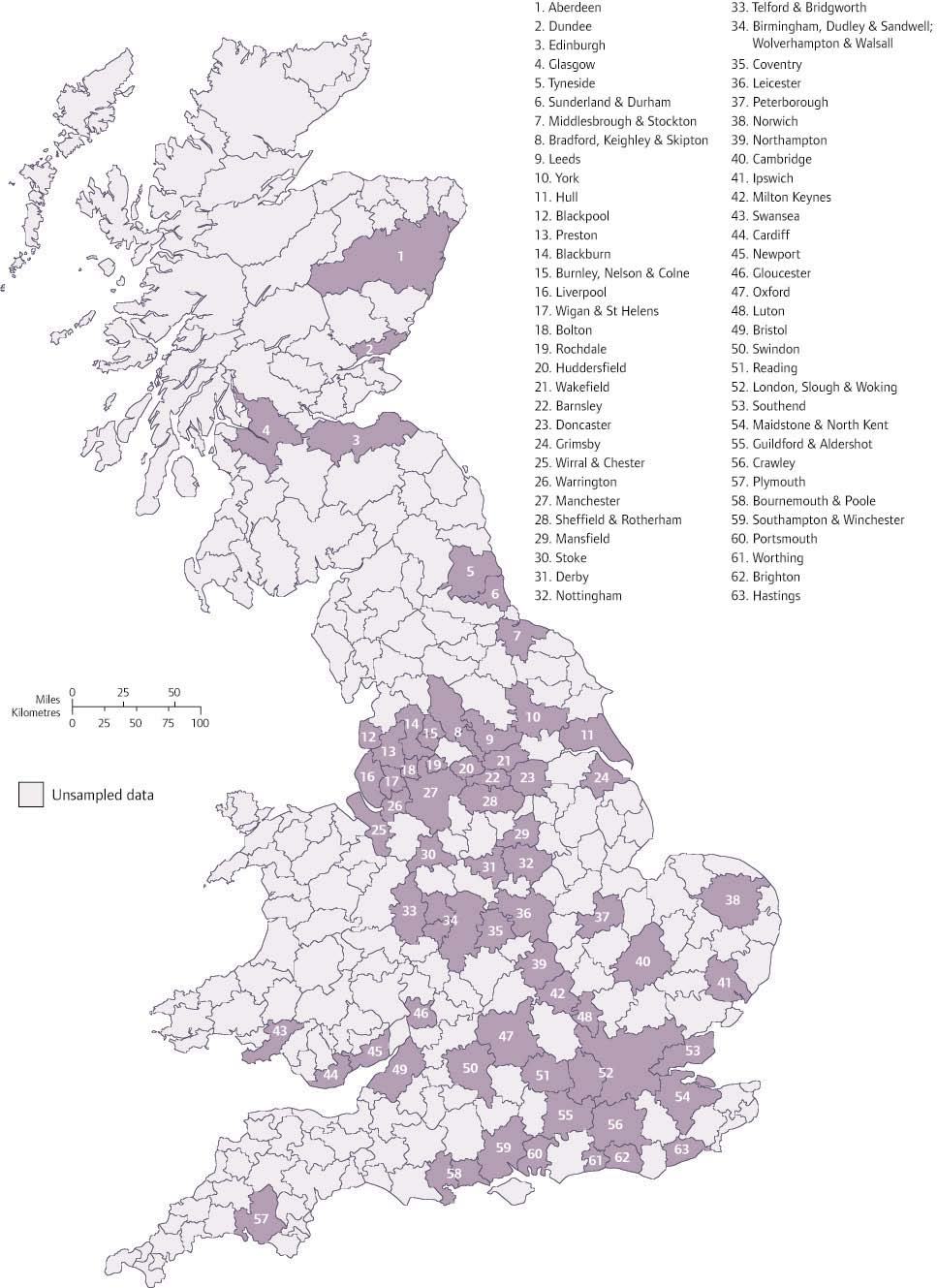
Key to Map 1:
- Aberdeen
- Dundee
- Edinburgh
- Glasgow
- Tyneside
- Sunderland & Durham
- Middlesbrough & Stockton
- Bradford, Keighley & Skipton
- Leeds
- York
- Hull
- Blackpool
- Preston
- Blackburn
- Burnley, Nelson & Colne
- Liverpool
- Wigan & St Helens
- Bolton
- Rochdale
- Huddersfield
- Wakefield
- Barnsley
- Doncaster
- Grimsby
- Wirral & Chester
- Warrington
- Manchester
- Sheffield & Rotherham
- Mansfield
- Stoke
- Derby
- Nottingham
- Telford & Bridgworth
- Birmingham, Dudley & Sandwell; Wolverhampton & Walsall
- Coventry
- Leicester
- Peterborough
- Norwich
- Northampton
- Cambridge
- Ipswich
- Milton Keynes
- Swansea
- Cardiff
- Newport
- Gloucester
- Oxford
- Luton
- Bristol
- Swindon
- Reading
- London, Slough & Woking
- Southend
- Maidstone & North Kent
- Guildford & Aldershot
- Crawley
- Plymouth
- Bournemouth & Poole
- Southampton & Winchester
- Portsmouth
- Worthing
- Brighton
- Hastings
Unsampled data
Source: Travel-to-Work Areas 1998. National Statistics.
Part 2: Path dependence and innovation across 12 British cities
2.1 The bases of path dependence and new path creation
Our basic argument is that the sectoral pathways that develop over time within city-regional economies collectively determine the relative capacities of those spatial economies to absorb new knowledge from their external environments because they determine to a large extent:
- the occupations that emerge in different sectors;
- the types of knowledge assets and infrastructures that emerge as a result of both private and collective investments in accessing and exploiting new knowledge; and
- the individual and collective capacities to interact with external sources of knowledge and to exploit them in combination with local knowledge assets.
These interactive relationships are illustrated in Figure 6.
Figure 6: Path dependent development, absorptive capacity and local innovation systems
The diagram illustrates the relationships between Path dependent development, New path creation, Absorptive capacity, and Local innovation systems.
Path dependent development
* Chance events
* Increasing returns
* Technological lock-in
* Institutional hysteresis
* Social embeddedness
New path creation
* Indigenous creation
* Heterogeneity and diversity
* Transplantation from elsewhere
* Diversification into related industries
* Upgrading existing industries
Absorptive capacity
* Knowledge:
* Identification
* Assimilation
* Exploitation
Local innovation system
* Knowledge:
* Creation
* Adoption
* Commercialisation
Figure 7: Smoothed trough to trough growth in UK GDP 1980-2005 (at constant 2003 prices)
Line chart showing smoothed trough to trough growth in UK GDP from 1980 to 2005, with 'Percentage growth' on the Y-axis (ranging from -2.5 to 2) and 'Trough years' on the X-axis (1980, 1991, 2005). The line shows an overall upward trend from below 0 in 1980 to above 1.5 in 2005.
Not all the potential sources of path dependent development or new path creation can be investigated using existing secondary sources of data. As a result, in this chapter we focus on the limited set of data sources that are available on a reasonably consistent geographic and definitional basis from the early 1980s. We would have preferred to have been able to use longer time series but in most cases these are just not available in a consistent or electronic form.
A further difficulty in tracking and interpreting long-run urban economic change is that many other factors are also changing at the same time. There are therefore issues to be dealt with surrounding the interpretation of what is significant in the urban context. One such issue is that cities are where changes in the national economy are played out. Thus there are complex interactions between what happens in individual cities and what happens in the national economy as a whole. In the analysis of the long-run development of city economies, it is also important to expose the underlying trends rather than focusing on the annual ups and downs of economic change. One way of dealing with these problems is to examine the smoothed changes taking place between the main trough years of the national economic cycle. For the practical time frame of this study these years were 1980, 1991 and 2005. Figure 8 shows the smoothed growth trends between these key years.
Following Figure 7 we should expect that, if city economies both compose and reflect the national economy, the 'normal' trajectory of their economic development between 1980 and 2005 would have followed an upward trend. Cities and sectors that did not grow relative to this overall trend could therefore be considered to have experienced relative decline while those that grew faster than this trend could be considered to have experienced relative growth.
In this chapter, we select 12 contrasting cities from among all those 63 in Great Britain with core populations greater than 125,000. We use their respective Travel-to-Work Areas (TTWAs) as our main unit of spatial analysis. In subsequent sections we use what secondary time series data are available to analyse:
- their development pathways;
- their collective absorptive capacities;
- their local innovation systems; and
- the creation of new pathways.
Map 2: Introduction of novel products in GB cities CIS4, 2002-2004
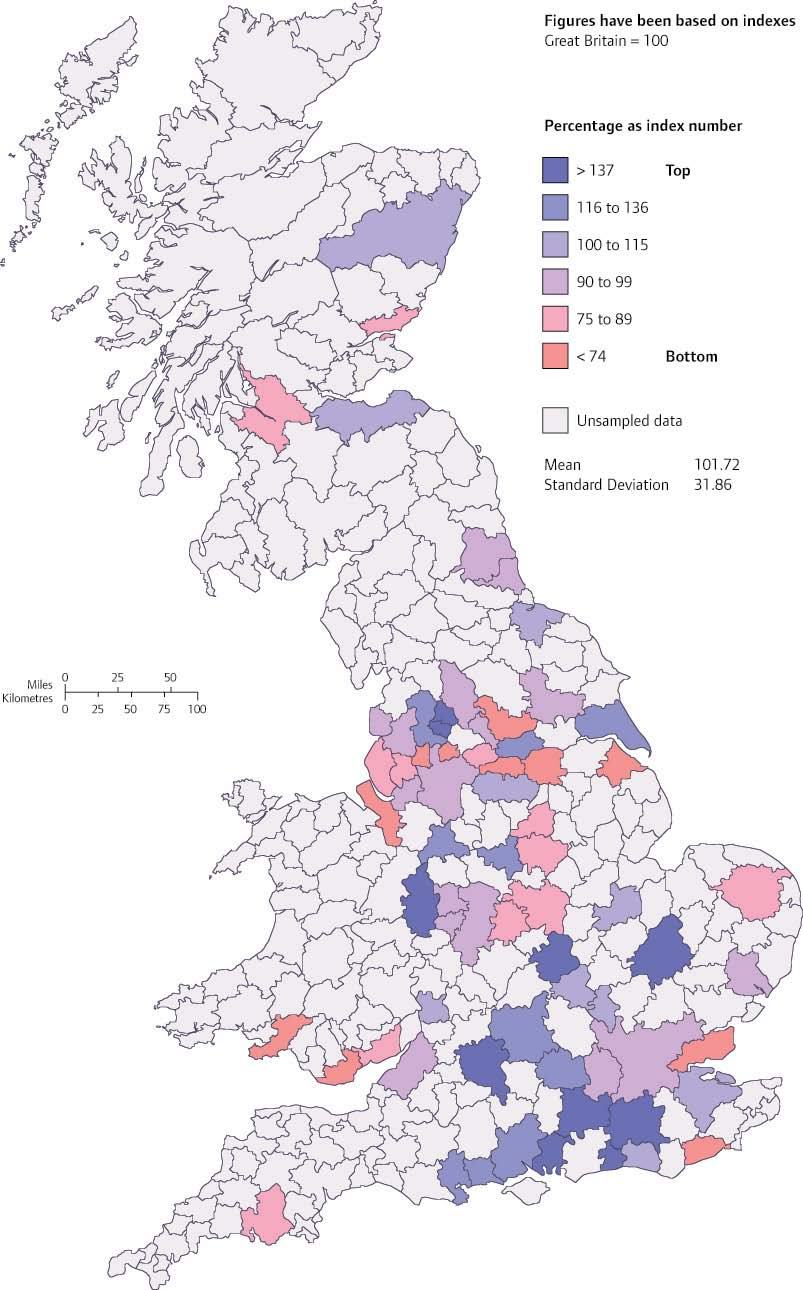
Legend for Map 2:
Figures have been based on indexes Great Britain = 100
Percentage as index number
* > 137 Top
* 116 to 136
* 100 to 115
* 90 to 99
* 75 to 89
* <74 Bottom
Unsampled data
Mean 101.72
Standard Deviation 31.86
Source: Travel-to-Work Areas 1998. National Statistics.
2.2 Selection of leading and lagging city-regions
In order to select particular cities to illustrate the nature of path dependent development and the respective roles of their collective absorptive capacities and local innovation systems in their development, we first analysed the innovation outcomes shown in the results of CIS4 for all 63 British cities with core populations greater than 125,000. Figure 10 shows the introduction of novel products between 2002 and 2004 and the wide variation in innovation outcomes between British cities. The highest rates of such innovation were located mainly in Southern England particularly around the Greater South East (GSE). The lowest rates were disproportionately concentrated in cities located around peripheral coastal areas in England and Wales and also in middle and Northern England.
In order to illustrate the historical trajectories that have led to such results we selected a sample of 12 cities for further more detailed analyses using existing data sets (mainly time series). Six were selected from the top deciles of performers on the six different measures of innovation outcome provided by CIS4. A further six were selected from the corresponding bottom deciles. Table 1 shows the results of this selection exercise.
2.3 Path dependent development in old and new industrial areas is diverging
From our selection of cities, we can see the long-term nature of the pathways followed to arrive at their positions in the early 21st century. Thus, all the cities in the lowest deciles except Norwich had experienced rapid
Table 1: Best and worst performing cities on CIS4 innovation measures