Authors
Rachel Carter and Jessica Jenkins, with contributions from Craig Johnson.
About UK 2040 Options
UK 2040 Options is a policy project led by Nesta and delivered in partnership with the Behavioural Insights Team. It seeks to address the defining issues facing the country, from tax and economic growth to health and education. It draws on a range of experts to assess the policy landscape, explore some of the most fertile areas in more depth, test and interrogate ideas and bring fresh angles and insights to the choices that policymakers will need to confront, make and implement.
About Nesta
We are Nesta. The UK's innovation agency for social good. We design, test and scale new solutions to society's biggest problems, changing millions of lives for the better.
About the Behavioural Insights Team
BIT is a global research and innovation consultancy which uses a deep understanding of human behaviour to improve people's lives.
Executive summary
Children born today will be taking their first steps into adulthood in 2040. What will life in the UK be like for them, according to current trajectories? What policy options do we have now that can influence or change that trajectory for the better?
When we started UK 2040 Options in June 2023, a year out from the General Election, we asked health and social care experts two simple questions: what are the greatest issues facing the health and social care systems; and what interventions might best help to improve them by 2040? As health is devolved, we asked experts to consider these issues in relation to England.
The results highlighted the myriad of challenges that are facing England's health and adult social care systems and sparked a year-long dialogue with experts, emerging thinkers and practitioners about both where there is established consensus on the issues and way forward, and where there is fertile ground for new ideas.
With The Health Foundation, we assessed the fundamental facts that underpin the NHS and adult social care systems. We then highlighted the big choices that the new UK Government faces as a result. This report focuses on some of the interesting, innovative policy ideas that emerged.
It is well established that between now and 2040 the UK Government will need to grapple with the funding, structures and big workforce challenges that the NHS and social care systems face. Others, such as The King's Fund, The Health Foundation, and Nuffield Trust are looking at those questions in detail. The ideas set out here are intended as additive – highlighting some policy ideas that, in a new, mission-driven government, have the potential to improve outcomes, regardless of the path taken on the big structural and funding questions. They're not a set of recommendations, and nor do they represent a 'strategy' to 'fix' the NHS, but they should serve as food for thought for policymakers looking to innovate.
The eight ideas in this report are as follows.
- Overhaul the policy approach to obesity: tackling poor diets upstream by introducing mandatory health targets for supermarkets
- Tackle alcohol-related harm head-on: through the introduction of minimum unit pricing
- Reform the Treasury's fiscal framework to prioritise prevention: introducing a new category of public spending for prevention
- Make NHS staff wellbeing a strategic priority: improving data collection and transparency, testing wellbeing interventions, and scaling the ones that work
- Pave the way for an AI health revolution: standardising patient records, and establishing a new National Data Trust
- Ramp up the use of digital mental health services: through expanding access to, and effectiveness of, internet-delivered cognitive behavioural therapy (eCBT) and other digital tools
- Stem rising demand in social care by slowing ageing: through preventing falls and improving physical activity in older people
- Proactive and streamlined support for unpaid carers: through targets and incentives
Introduction
The issues currently facing the NHS and the adult social care system are well documented. They are systems in crisis: headlines about unacceptable wait times for treatment; staff shortages and industrial action; constrained hospital capacity; low pay and poverty in the social care workforce; insufficient services and the worst access to healthcare in Europe dominated discourse in the build up to the 2024 General Election. The NHS regularly tops public polls as the biggest issue facing the country. As one of its early announcements, the UK Government commissioned an independent investigation of the NHS.
Health conditions are projected to rise dramatically
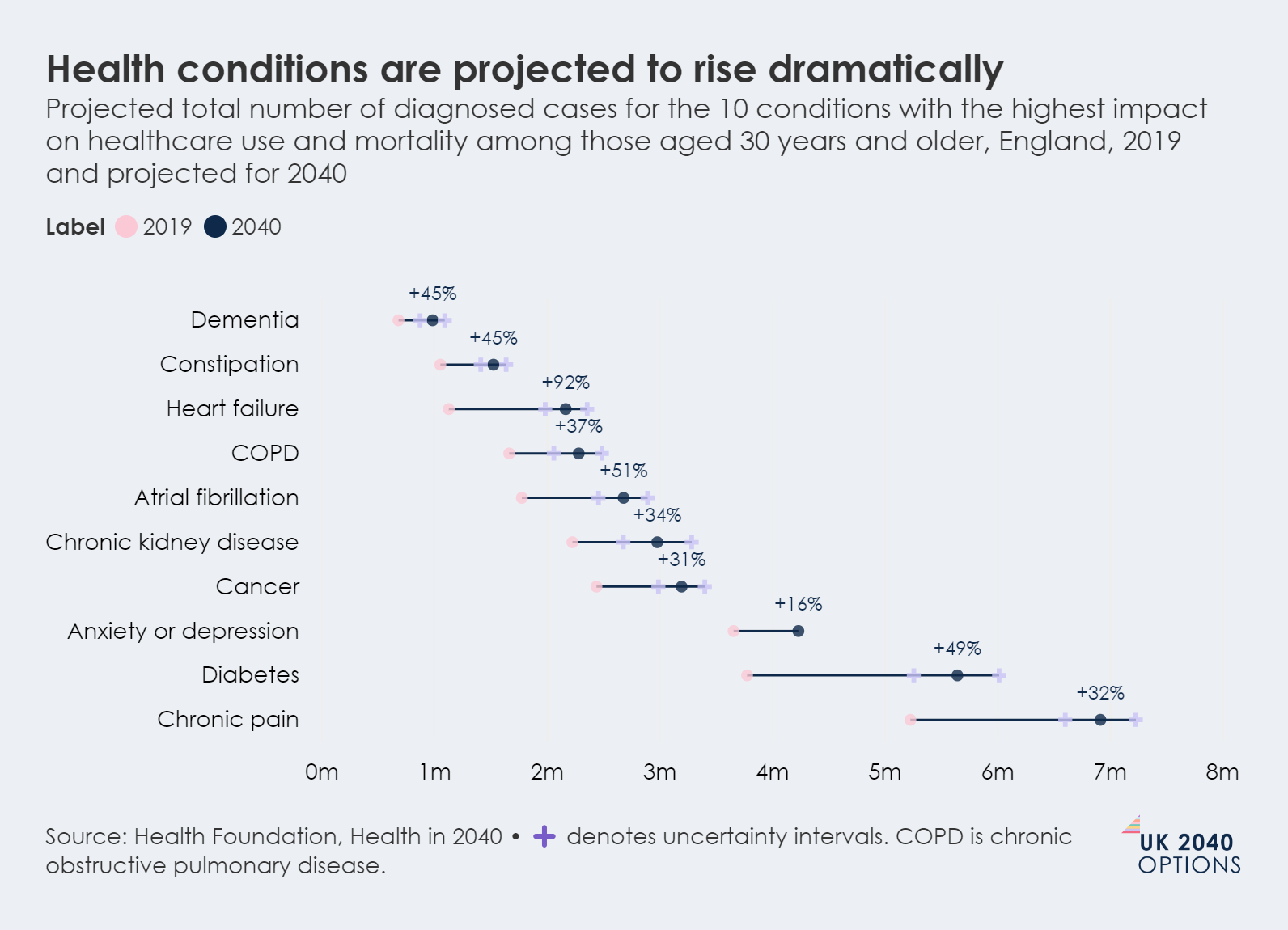
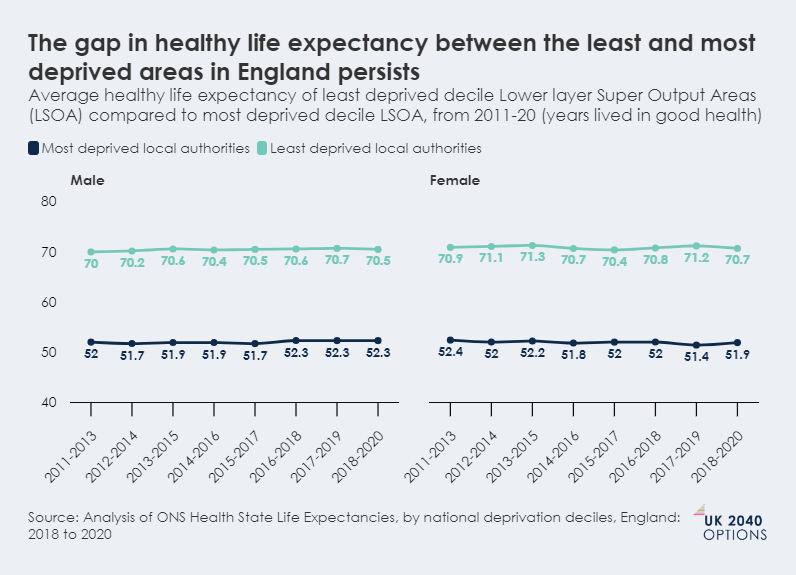
The fundamental trends, drivers and projections are heading in the wrong direction. We are currently on track for a 2040 where more people are unwell for longer, and where this burden of illness is spread more unfairly throughout the country. Unmet need for health services and social care – already high – is increasing. Over 20 million people in the UK, almost one third of the population, now have a musculoskeletal condition such as arthritis or back pain. More than 5.6 million people in the UK are living with diabetes. And more than three million people are living with cancer. Illness is projected to rise sharply: by 2040, 25% more working-age adults are likely to be living with chronic illness. And the health gap between the most and least deprived is expected to grow even wider. These projections have direct implications for social care for older adults.
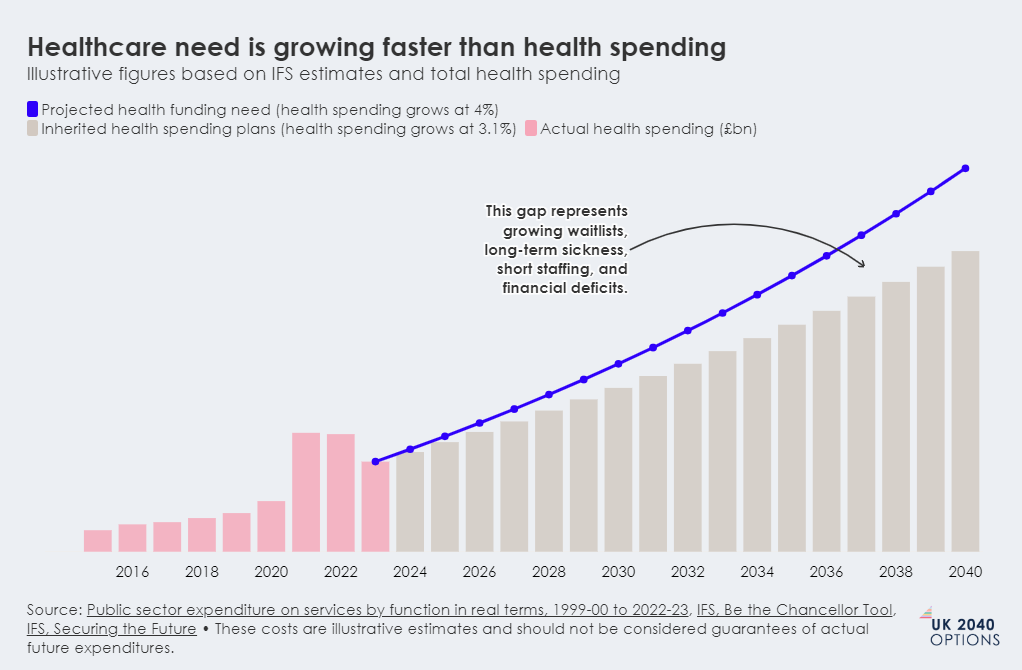
The fiscal challenge this presents is clear, with the National Audit Office recently concluding "the scale of the challenge facing the NHS today and foreseeable in the years ahead is unprecedented”. And the NHS is not in good shape to meet this challenge. As The Health Foundation set out, the UK's health system lacks capacity compared to many other comparable countries following a decade of underinvestment. Staff shortages persist, repeated industrial action – once relatively rare – has had unprecedented scale and impact, and stress and burnout in staff are high.
How do we create a healthier 2040?
These trends highlight the mammoth challenge for the UK Government when it comes to funding, workforce, and system capacity. These big structural questions are being widely discussed, including by our peers at The King's Fund, Nuffield Trust and The Health Foundation among others. Less frequently discussed are the innovative, implementable ideas that can be part of the answer.
The ideas in this report fall into three broad categories that were consistently highlighted to us by experts as key areas where progress – and crucially new ideas – are necessary to improve outcomes and to contribute to turning the tide on some of the challenges our health system faces.
1. Prioritising prevention
Reducing the strain on the NHS and social care will rely on committed efforts to improve population health: preventing and delaying sickness to see healthy life expectancy increase and unhealthy life expectancy decrease. Targeting risk factors through preventative action will provide the best bang for our buck: population-level policy action is most likely to be both effective and equitable.
2. Supercharging the NHS
While prevention must do some heavy lifting to reduce pressure on the NHS, the NHS will still need to deliver ever more value from its resources. A modernised NHS not only needs to do things better, but also do better things. This will rely on smart investments in capital, deploying effective technology, optimising system flow and developing care pathways to meet changing population needs, while retaining a central focus on service quality and workforce wellbeing. The immediate changes needed are largely foundational – getting the technical, physical, and organisational building blocks in place will act as a catalyst to cutting-edge change over time.
3. Strengthening social care
For too long, the social care system has been viewed as a bottleneck rather than as a facilitator of improved wellbeing and increased longevity. Improvements to the adult social care system will be critical, not only to alleviate avoidable pressure on the NHS, but also to ensure that adults of all ages and abilities are supported to live well for longer. The challenge is to better support individuals who need social care, the communities that care for them, and service integration and coverage, to ensure no one slips through the cracks.
We outline specific ideas under each of these themes – eight in total. While these ideas alone cannot achieve a thriving and healthy population in 2040, they do represent the types of innovations and interventions that could start to make a difference.
A mission-driven approach to improving the health of the nation
This Government has committed to being mission driven. Improving population health and reducing health inequalities are two of the most difficult tasks that this Government faces. To tackle this challenge in a mission-driven way, the Government needs to set a bold and ambitious vision for change, which should compel the system to work differently to meet the challenge. It will need to be firm on what outcomes it wants to achieve, and flexible on how it gets there. It will require innovation – fresh ideas and policies – and significant system coordination beyond central government: the NHS, local government, industry, citizens and the third sector all have a part to play.
Nesta and the Institute for Government (IfG) have together set out a roadmap for delivering missions in government. There are three roles the UK Government needs to play. It will need to:
- Drive public service innovation: Within the NHS, there is often a gap between what works and what gets done, and a vast variation in performance throughout the system. This is a variation that we can, and need, to scour the system for, continuously looking for new opportunities to improve both outcomes and productivity as new technologies emerge.
- Shape markets by thinking beyond traditional delivery silos: Delivery of the health mission will demand action beyond the Department of Health and Social Care (DHSC). It will require deliberate cross-government, and joined-up, working. It will also require intentionally drawing on business and industry, and seeing them as critical partners in achieving the UK's health goals.
- Harness intelligence: Being able to rapidly capture the data and knowledge – that, for example, has been generated by the workforce and patients within the system – will enable the UK Government to quickly solve problems, improve decision-making, and build buy-in.
At the same time, mission-driven government is enabled by firm foundations. Here, the critical enablers to continue to invest in are the health of the workforce; in data and technology; and in the structures and processes that support the delivery of the mission.
The ideas that follow throughout this report all highlight elements of what taking a mission-driven approach to health could look like.
Prioritising prevention
"If the nation fails to get serious about prevention then recent progress in healthy life expectancies will stall, health inequalities will widen, and our ability to fund beneficial new treatments will be crowded out by the need to spend billions of pounds on wholly avoidable illness."
– NHS Five Year Forward View, October 2014
This warning, made by NHS England a decade ago, has borne out. Increases to healthy life expectancies have not only stalled, but decreased. Health inequalities have widened. And we are now spending tens of billions on wholly avoidable illness. A clear consensus has emerged – including among our experts: it won't be possible to make a meaningful difference to this picture without significant improvements in preventative healthcare.
It's well established that smoking, diet, overconsumption of alcohol, and low physical activity are the leading risk factors for preventable ill health and death in the UK. NHS England spends £2.6 billion and £6 billion per year respectively on smoking and obesity, and the cost to society of smoking and obesity combined could be as high as £71 billion per year. And it is well established that reorienting the system to focus on keeping people well would pay off over time.
Here we highlight three ideas that could make a difference.
Overhaul the policy approach to obesity: tackle poor diets upstream by introducing mandatory health targets for supermarkets
What
Supermarkets hold the key levers for improving the healthiness of diets. Nesta has proposed setting mandatory health targets requiring large grocery retailers to improve the overall nutritional quality of their offers. Through smart regulation, the UK Government could compel large retailers to ensure that their food product portfolio is healthier on average – matching the level of the current best player in the market. This would also signal a shift towards government being led by its health mission: shaping markets through regulation, and viewing the food industry as an active partner in achieving the UK's health goals.
Why
Obesity in the UK has doubled since the early 1990s, overtaking smoking as the biggest cause of preventable death in England and Scotland. Two-thirds of adults in England are now living with overweight or obesity – much higher than most other European countries. And by 2040, 71% of people in the UK are projected to be living with overweight, of which 36% of adults are projected to be obese. Obesity's impact on our health system is clear: obesity increases the risk of many preventable diseases and impacts mental health and wellbeing. The annual cost of adult overweight and obesity to the UK is estimated at around £98 billion, almost 4% of our GDP, including at least £19.2 billion in costs to the NHS.
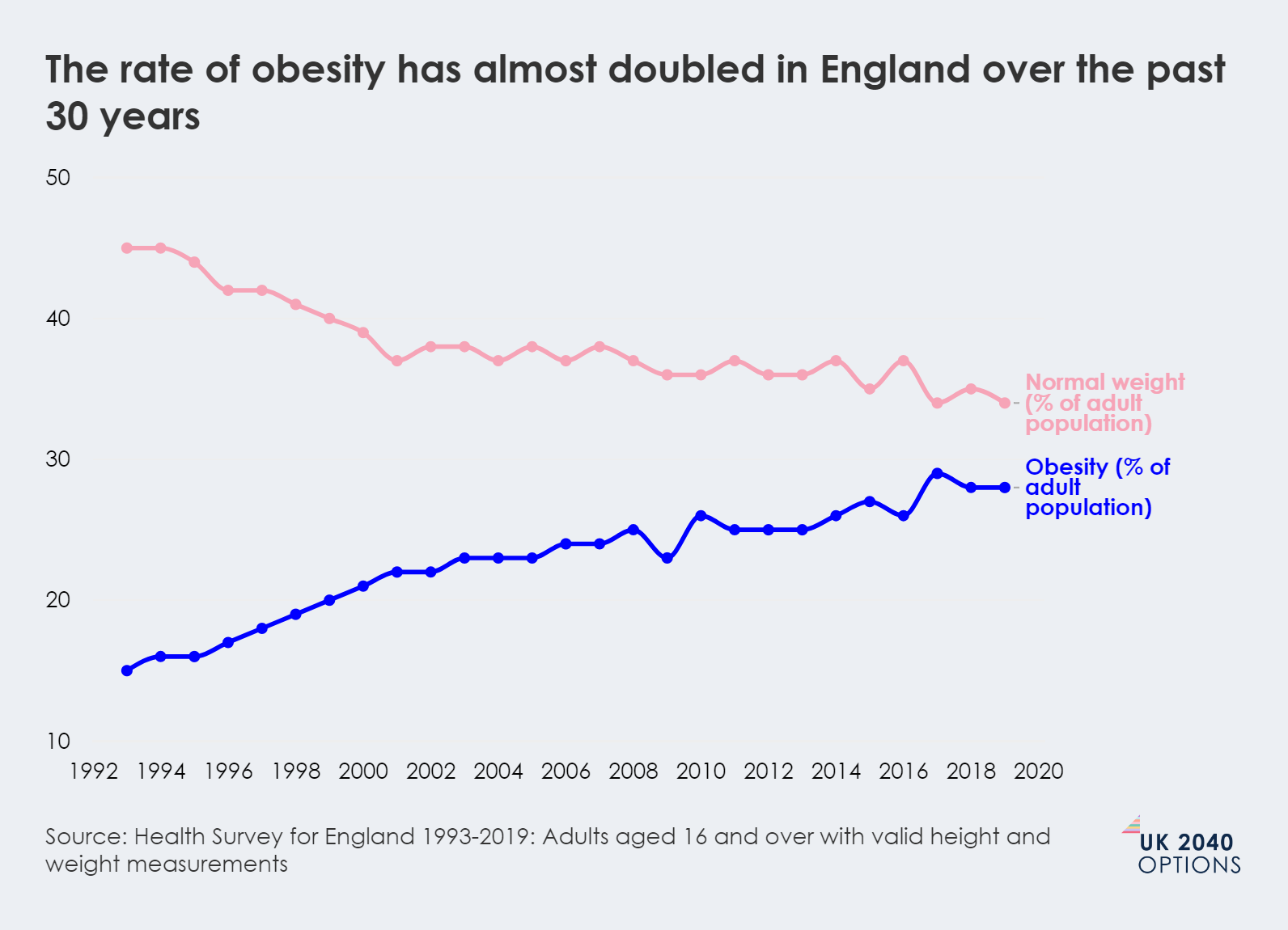
The British public is concerned about obesity, supportive of stronger government and industry action; and our experts agree, ranking poor diet and obesity third on our Delphi survey on future government priorities. The environments in which we live have a significant impact on what we eat, and the way that they are designed lead us toward unhealthy choices. The food industry plays a central role in shaping our food environment, influencing what and how much we eat.
Nesta has assessed that a significant change to our obesity rate requires only small changes to diets. To halve obesity, a person in England living with excess weight would need to reduce their calorie intake by only 8.5% (or 216 calories per day). This is a relatively small shift, but one that could have a huge pay off – the benefits that would come from halving obesity to the economy are large. But the existing policies for England are not going to achieve reductions at the scale needed to shift the dial on obesity.
How
- Set a mandatory target through primary legislation. Nesta has recommended that health targets be mandatory for all large grocery retailers in the UK. Voluntary action is unlikely to be sufficient to achieve the scale of change required to reduce obesity prevalence – most of the largest grocery retailers already have their own health targets, but they vary in ambition, scale and impact, making mandatory action critical.
-
Use a holistic measure of the health of food as the target. Using a holistic measure of the health of food such as a converted nutrient profile model (NPM) score will strike the optimal balance between impact and feasibility of implementation. The NPM score assigns an integer score to food products based on their nutritional content. The NPM is already established in legislation, and retailers are already required to calculate NPM scores for many of their products. This target would be applied across a retailer's entire food product portfolio and sales-weighted, to ensure that products that have a higher volume of sales contribute more to average scores than those that are purchased less frequently and in smaller volumes. Nesta's analysis estimates that the current average NPM score across large retailers is 67. It recommends setting the target at an NPM score of ≤69.
-
Prioritise mandatory data collection and reporting. To ensure that the targets have the teeth to shift industry behaviour in the direction required, mandatory data collection and reporting will need to be built into the legislation. This could build on existing work to establish appropriate metrics, data requirements and monitoring through the Food Data Transparency Partnership. Data collection needs to be mandatory to require business to report consistently and comprehensively.
- Allow for a phased introduction. Given that data collection and reporting mechanisms will take a while to bed in, there should be a phased introduction of targets, with enforcement occurring once mandatory reporting has been in place for sufficient time – likely a year.
Impacts and trade-offs
Mandatory retailer targets for the health of food would have several distinct advantages that could advance progress towards reducing the prevalence of obesity within the UK.
- High impact. Modelling estimates that setting these targets for the 11 largest grocery retailers could reduce calorie purchases among the population with excess weight by around 80 kcal per person per day and cut obesity prevalence by approximately 23%. This would translate to about four million fewer people living with obesity in the UK, and around £20 billion in annual cost savings to society.
-
Flexible. There are lots of ways that retailers can encourage healthier eating and meet the retailer target, and the legislation would not be prescriptive. Retailers could reformulate products (ie, reduce their salt, fat and sugar content), change product placement, adapt advertising and cull price promotions of unhealthy food. Rather than setting restrictions on each of these methods, focusing on a single measurable outcome gives businesses more flexibility to meet the objective of the policy.
-
Low cost for business and consumers. The proposed target should not have a significant impact on either the cost to retailers or the cost to consumers' shopping baskets. Business costs will be limited, because retailers have the flexibility to adopt their existing practices and operations to the most cost effective to prioritise health. Retailer targets are not expected to increase overall costs if a suitable transition period is given. Given the highly competitive nature of the grocery retailer sector, it is also unlikely that the retailer would pass on any reformulation costs (or fines) incurred to the consumer.
- Addresses the whole distribution. Regulation based on binary indicators of health (such as whether a food is high in fat, sugar or salt or not) only incentivises change in products close to the cut-off. By using NPM as the target, producers and retailers are incentivised to improve products holistically, and given the flexibility to focus on products where change is easiest.
Alternative idea: GLP-1 receptor agonists
Nesta's upcoming Blueprint to Halve Obesity highlights the interventions that have the best chance of halving the prevalence of obesity in the UK. In addition to targeting the drivers of obesity, experts highlighted the need for treatments to help people living with the health effects of obesity today.
One approach could be scaling the availability of new GLP-1 receptor agonists like semaglutide and tirzepatide. These treatments have been shown to support weight loss of around 15%-25% of total body weight, supporting people to reduce their consumption by slowing the movement of food through the digestive process and changing hunger signals in the brain.
These treatments have game-changing potential, but there remain challenges to scale in the near term. Evidence to date shows most are unable to maintain weight loss following treatment, highlighting the chronic nature of obesity. The treatments are also costly – Nesta has estimated that it would cost £16.5 billion a year to halve obesity in England by 2030 through using GLP-1s exclusively equivalent to almost the entire annual NHS England prescribing budget. The NHS is unlikely to be able to absorb this increased activity or cost without significant uplifts in funding, and although the treatment is likely to result in saved treatment costs elsewhere, there is not yet good evidence to indicate the extent of these savings.
These medicines are a promising innovation for health services that have struggled to keep pace with the level of need, and while they are expensive, there are potentially large economic gains on the table: Nesta has assessed that halving obesity prevalence would save around 300,000 QALYs every year (one QALY is one year of life in perfect health). Using the UK Government's estimate of the monetary value of a single QALY (£70,000), these QALY savings are equivalent to a monetary value of over £20 billion. The cost savings to the NHS are calculated to be around £3.25 billion per year.
But treatment alone cannot rectify the environmental and socioeconomic causes of obesity. Without targeting the causes of rising obesity trends, treatment costs could quickly become unsustainable and provision inequitable, with undesirable societal consequences.
What
Shifting towards being mission-led requires fresh policies – including being bold and implementing what we know already works, and where there is evidence about the size of the potential impact. Here, the UK Government could introduce a minimum unit price (MUP) for alcohol in England to reduce overall alcohol consumption and levels of alcohol-related harm.
MUP sets a floor price on units of alcohol, preventing retailers from selling alcohol below a specified price and stopping the sale of alcohol that is cheap relative to its strength. MUP would particularly squeeze the 'white cider' end of the alcohol market that is most associated with heavier drinkers.
Why
Despite strong policy action on alcohol in Scotland, Wales and Northern Ireland, England lags behind: it has not had a comprehensive alcohol strategy since 2012. By increasing funding for alcohol and drug treatment, a longstanding preference for investing in treatment over prevention has continued.
Harmful alcohol consumption is a leading risk factor of the global disease burden, and causes a laundry list of related health and societal harms. Alcohol has been considered to be the UK's most dangerous drug, and is a causal factor in more than 60 medical conditions. Over the past 10 years, health harms related to alcohol consumption have continued to grow, with the impact of the pandemic on alcohol consumption stark. Alcohol-specific deaths in England grew by 27% between 2019 and 2021. Recent research by the World Health Organization (WHO) has found that Great Britain has the worst rate of child alcohol consumption in the world. There are over 260,000 hospital admissions from alcohol in England every year and the estimated cost of alcohol harm in England is £27 billion per year. Government estimates of societal costs such as reduced employment, lower productivity, increased crime and harm to family and friends date back to 2003, when they were estimated as £21 billion a year. The figure today is likely to be far higher.
Recent changes to alcohol duty rates have introduced new taxation structures based on strength to improve standardisation, but cheap alcohol is still widely available. Between 2010-2020, alcohol became 14% more affordable. It is currently possible to buy the Chief Medical Officer's maximum weekly amount of alcohol (14 units per week) for as little as £3.90.
There is consistent evidence that population-level preventative approaches to tackling alcohol consumption (eg, reductions in availability, regulation of advertising and promotion) are highly effective. Limiting the availability of alcohol through an increase in price is known to lead to a reduction in consumption, leading also to a reduction in alcohol-related harm.
How
MUP has been in place in Scotland since 2018 and in Wales since 2020. The Northern Ireland Assembly Executive has also committed to bringing forward legislative proposals on MUP – so there are clear implementation frameworks to follow.
- MUP would need to be established through new primary legislation, which would also set out how it would be calculated and applied, giving powers to ministers to create orders to specify the actual price.
- The level the MUP is set at would need to be carefully considered from the outset. The WHO is clear that, to be effective, the threshold needs to be set at a level that actually affects the prices faced by consumers. This is intuitive: a price per unit that is set lower than the cheapest alcohol will have no impact. In Scotland, the MUP has recently been uprated to 65p (largely to offset the effects of inflation); in Wales it is set at 50p.
- To protect MUP from general price increases, MUP should also be indexed to inflation, as its effectiveness can be eroded over time if the price remains constant in real terms, as has been seen in Scotland.
- MUP would need to be applied across the board to all retailers, including all small businesses, microbusinesses and wholesalers who sell directly to the public. In Scotland and Wales, MUP was appended to the existing system of licensing as an additional mandatory condition of being permitted to sell alcohol, and devolved to local authorities (who have responsibility for implementing and enforcing MUP). Local licensing standards officers have responsibility for overseeing premises' compliance with MUP along with other licensing requirements.
- Consultation with retailers, good communication about the rule change and ongoing enforcement would be critical to MUP's early success. Learnings can be taken from Wales and Scotland's approach to this, which has been broadly successful. For example, Wales developed an app that enables retailers to calculate the minimum price per unit to ensure that prices set are compliant.
Impacts and trade-offs
Alcohol pricing policies are some of the most effective and cost-effective measures to reduce alcohol consumption and harms. And we can see the impact of MUP close to home: it has been successful in lowering the number of alcohol units purchased by the heaviest drinkers in Scotland. An evaluation by Public Health Scotland found that, by the end of 2020, MUP reduced deaths wholly attributable to alcohol consumption by 13.4% and was likely to have reduced hospital admissions by 4.1%.
MUP could also have a positive impact on health inequalities in England. Despite drinking less on average, people living in the most deprived communities experience the greatest harms and bear the greatest costs – the ‘alcohol harm paradox'. In Scotland, MUP has had a positive effect on deprivation-based health inequalities, as the estimated reductions in deaths wholly attributable to alcohol consumption were largest among men, those aged 65 years and over, and those living in the 40% most deprived areas of Scotland.
There are trade-offs. MUP is likely to increase the price of most alcohol sold in off-licences in England – making the implementation of MUP a more difficult sell whilst people face cost of living pressures. The introduction of MUP in Scotland led to a 3p increase in the average price per unit of alcohol sold in shops, or roughly 5%. But this average masked significant variation: some previously very cheap products saw their prices more than double, while those previously above the minimum saw no increase in their price. MUP is unlikely to increase the price of alcohol on trade, which is likely to already be priced above the minimum price, thus insulating pubs and restaurants.
Unlike a tax, MUP is not a revenue raiser for government, and its implementation could cause a loss of tax revenue if individuals drink less. And in fact, its implementation could have the effect of providing the alcohol industry with windfall profit in England, as by prohibiting the sale of alcohol priced below a particular level, the minimum price has the effect of relaxing competition in the market. Analysis of MUP in Scotland found that while it reduced overall volume sales, it had no discernible effect on the industry as a whole, as the alcohol industry was able to charge higher prices for products sold.
The alcohol industry will often mobilise against regulation that it considers to be overly interventionist. But the UK Government only needs to look to the public for support for much harder action on alcohol: recent polling by The Health Foundation found that 63% of people believe that the Government has responsibility for reducing levels of alcohol-related harm. And in Scotland, public attitudes towards MUP have become more favourable over time.
What
Delivering the UK Government's health mission to improve health and reduce health inequalities will require new ways of working within government, and innovative ideas. A new, ring-fenced category of public spending for preventative activity, known as the ‘Preventative Departmental Expenditure Limits (PDEL)', as proposed by Demos with The Health Foundation, would ensure funding is directed to critical services and protect prevention budgets from being raided without proper justification, embedding prevention-led policy and spending throughout government and signifying a serious shift in strategic direction towards a mission-aligned, prevention-first mindset.
Why
All government spending is subject to the underpinning fiscal 'rules of the game' – the prioritisation process, categories, and set of criteria that publicly-funded organisations must comply with when requesting and spending taxpayer funds. For decades, these rules have seen investment in prevention fall off the bottom of the government's spending list. But improving population health will rely on ensuring there is sustainable, secure funding for activities that prevent ill health.
UK public spending rules
Public spending in the UK is managed through centrally agreed budgets, typically spanning multiple years, overseen by the Treasury. Departments are required to stay within their yearly budget allocations, with some exceptions for demand-led services, agreed through in-year adjustments to budgets.
Categories of public spending
Public spending is divided into various categories, monitored and classified based on its purpose:
- Resource Departmental Expenditure Limits (RDEL): covers the day-to-day running costs of public services, grants and administration. It accounts for about 35% of total public spending, with major areas including health (currently £179.6 billion annually), education (£84.9 billion), and defence (£32.8 billion).
- Capital Departmental Expenditure Limits (CDEL): covers capital investments such as infrastructure (roads and buildings) and loans to businesses and individuals. CDEL makes up about 11% of total government spending.
- Annually Managed Expenditure (AME): includes spending that is less predictable and harder to control, with welfare system cash transfers being the largest component.
Spending plans
The UK Government outlines detailed spending plans for RDEL and CDEL through spending reviews. The most recent comprehensive plan was laid out in the 2021 Spending Review, which set budget allocations for all departments for the financial years from 2022-2023 to 2024-2025.
Preventative care is a small proportion of overall health spending, and has been consistently cut when governments or health organisations have faced financial challenges. This hasn't been helped by budget cycles that prioritise spending on political priorities with short-term pay-off, years of austerity resulting in massive demand for limited funds, and the challenges of accurately measuring the long-term returns on investment in prevention. Real-term cuts to the public health grant in England of 21% between 2016-2017 and 2022-2023 have had severe consequences – resulting in cuts to services like sexual health, NHS health checks and drug and alcohol services, which have since seen sharp increases in wholly preventable infections and further avoidable pressure on NHS services.
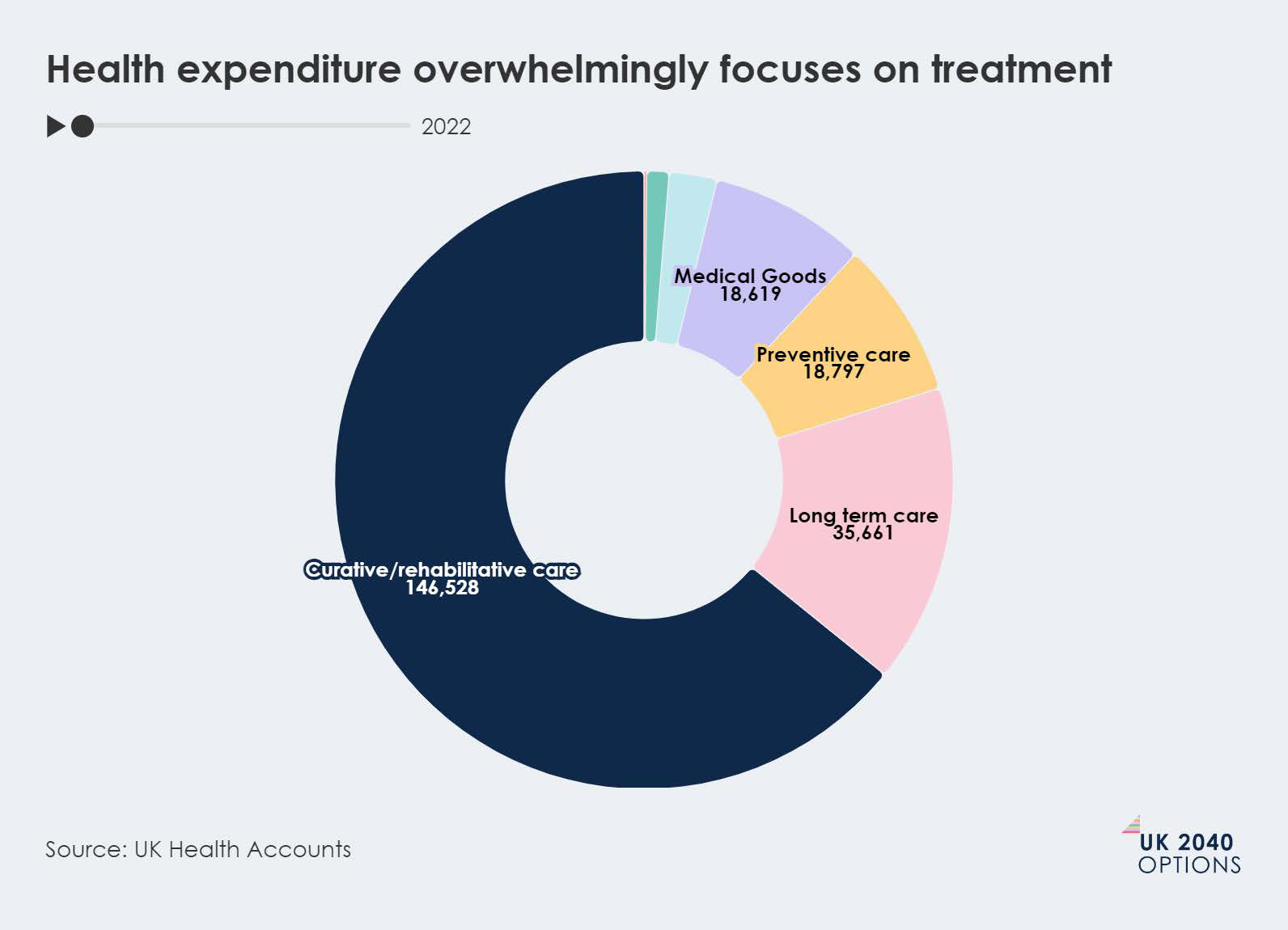
Health expenditure overwhelmingly focuses on treatment
Source: UK Health Accounts
UK 2040 OPTIONS
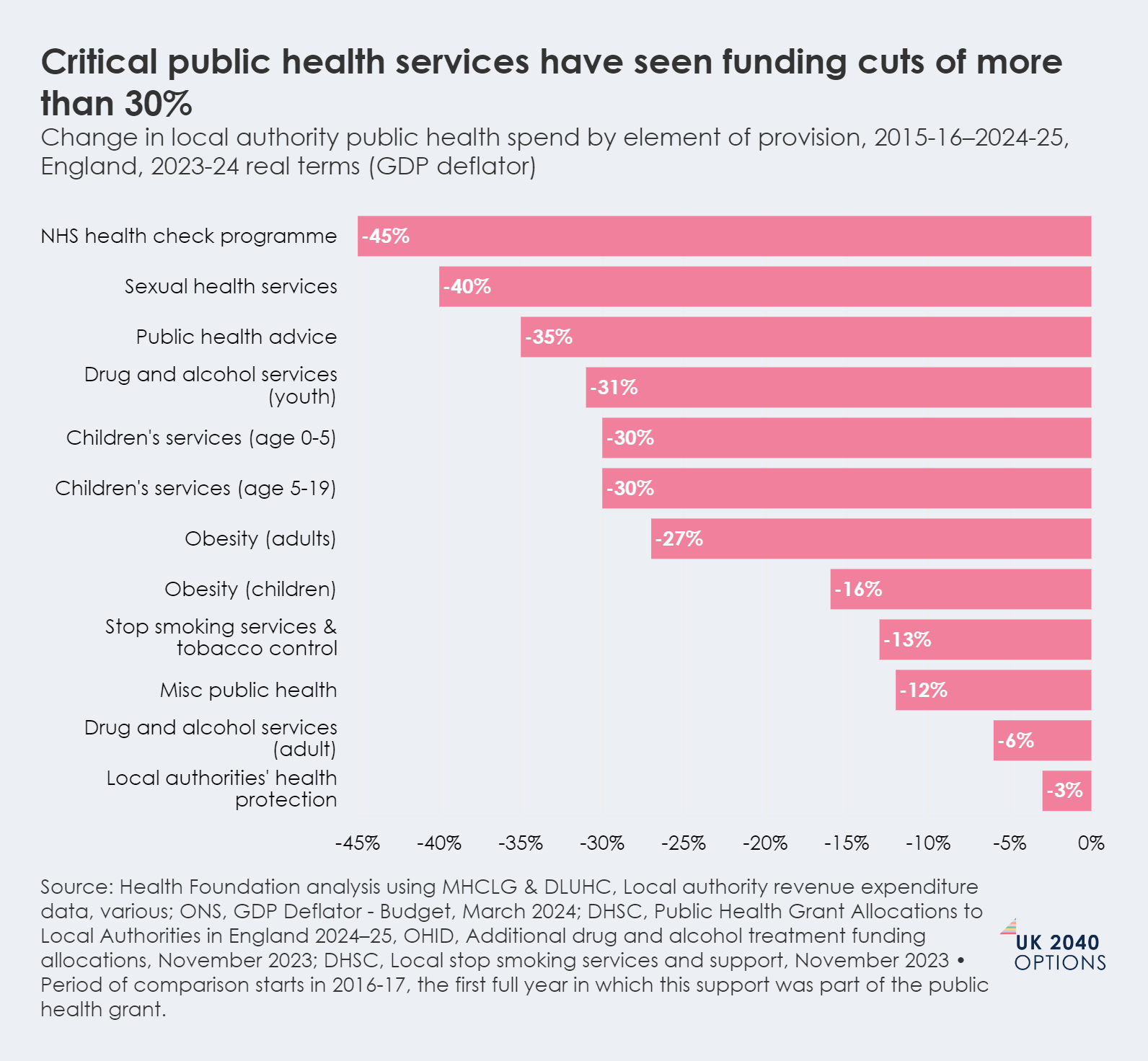
Critical public health services have seen funding cuts of more than 30%
Change in local authority public health spend by element of provision, 2015-16-2024-25, England, 2023-24 real terms (GDP deflator)
Source: Health Foundation analysis using MHCLG & DLUHC, Local authority revenue expenditure data, various; ONS, GDP Deflator - Budget, March 2024; DHSC, Public Health Grant Allocations to Local Authorities in England 2024-25, OHID, Additional drug and alcohol treatment funding allocations, November 2023; DHSC, Local stop smoking services and support, November 2023 • Period of comparison starts in 2016-17, the first full year in which this support was part of the public health grant.
UK 2040 OPTIONS
How
Demos and The Health Foundation propose that introducing PDEL would require several enabling steps:
- Set a long-term target for PDEL, over multiple parliaments, with accountability mechanisms. In line with recommendations from The Hewitt Review, PDEL would see the total share of budgets going to prevention increase year-on-year, and would see that funding spent on initiatives that will deliver quantifiable savings over the decade ahead. A ratcheting mechanism for PDEL could automatically increase the budget for prevention each year by a predefined percentage, agreed at the Spending Review, providing certainty to the sector and ensuring sustainability. For illustrative purposes, we have modelled 1pp annual increases from its 2023-2024 base of 6% of total government health spending below. To maintain commitment to the target across different governments, the target could be established in statute, and monitoring of the spending could be overseen by a parliamentary committee. Legal safeguards, such as Ministerial Letters of Notification to Parliament could also be used to ensure sustained progress.
Current trends would see prevention remain a small component of health spending
Curative/rehabilitative care Long term care Medical goods Preventive care Ancillary services Governance and health system and financing administration
But PDEL could see this balance change over time, without increasing total spending
Curative/rehabilitative care Long term care Medical goods Preventive care Ancillary services Governance and health system and financing administration
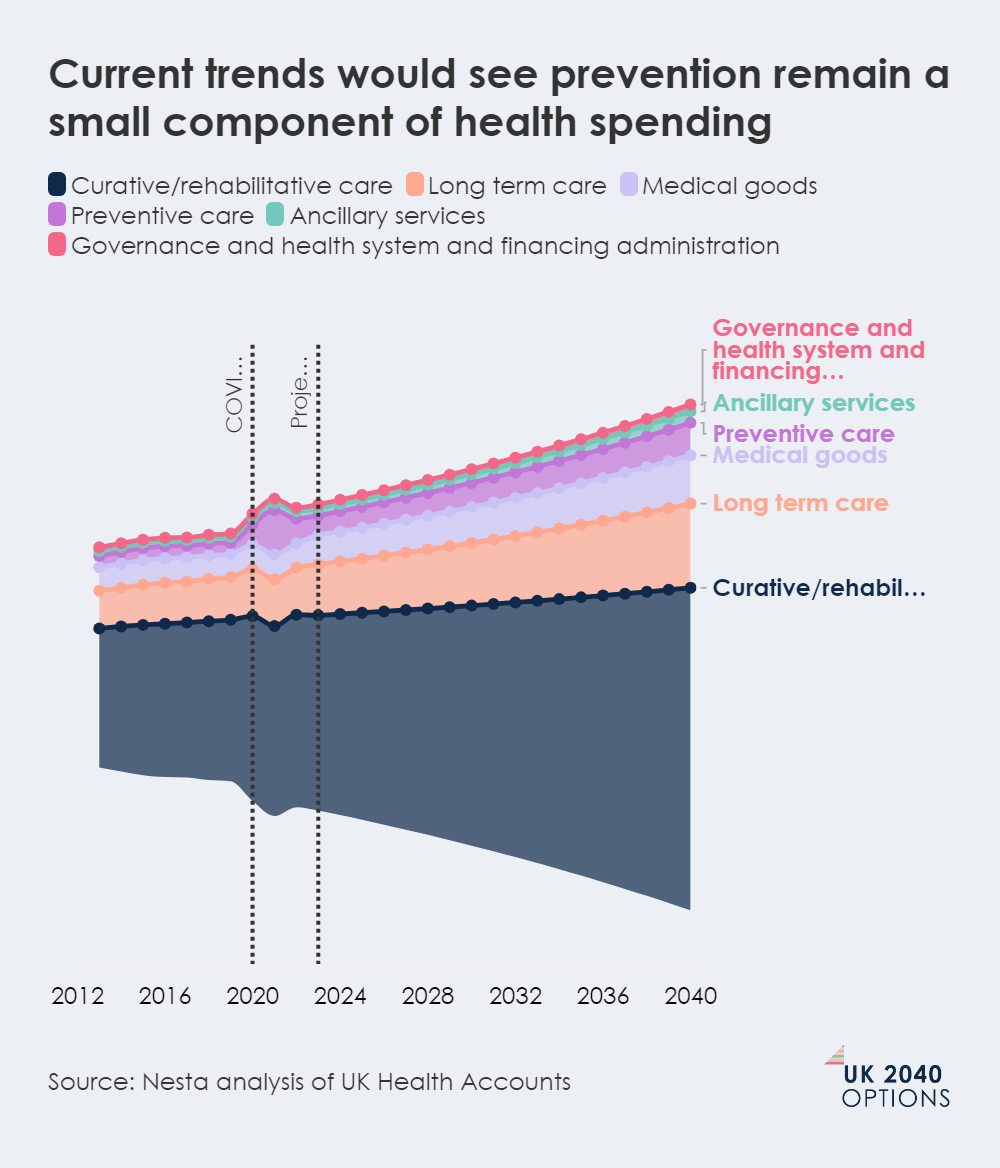
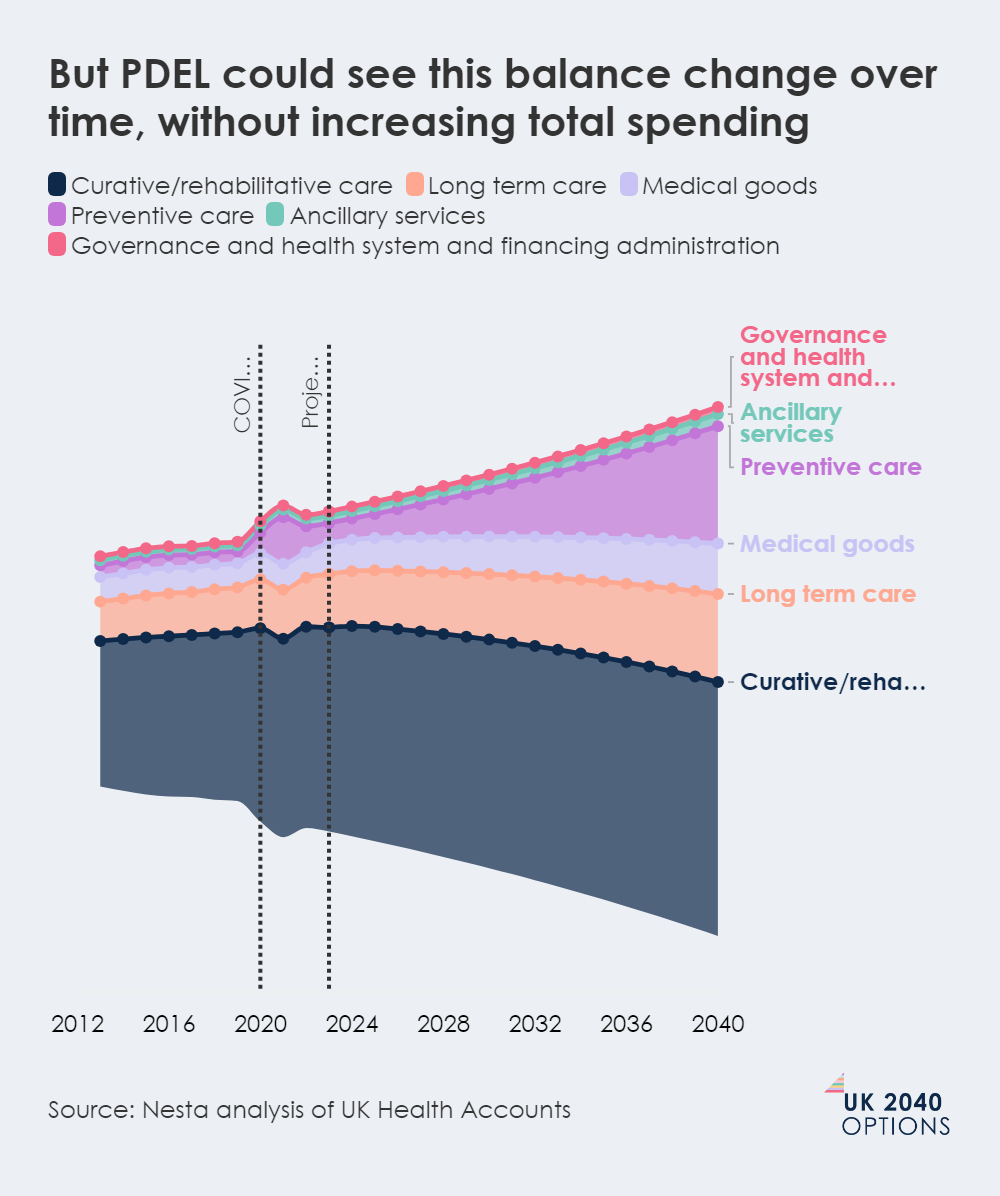
Source: Nesta analysis of UK Health Accounts
UK 2040 OPTIONS
- Establish Prevention Investment Units to define and measure current 'preventative expenditure'. Prevention encompasses a wide range of activities, including reducing the burden of disease, early diagnosis and softening the impact of chronic conditions. To establish baseline spending on prevention, an agreed definition of 'preventative activities' will be needed, followed by an audit to identify all funded preventative activities across existing budgets.
- Give providers multi-year funding certainty. A ring-fenced target will provide some level of certainty to public health providers as to the total prevention funding that will be available over a multi-year period, but may still leave some uncertainty as to the allocation of that funding from year to year.
- Generate new evidence on what works for preventative investment. Prevention funding should be directed to initiatives with the strongest evidence for preventing poor outcomes. The evidence could come from partnerships with centres such as Foundations – What Works Centre for Children and Families, as well as the National Institute for Health and Care Excellence (NICE). There is much potential to innovate and test new ideas, so a portion of the fund should be dedicated to R&D, thereby strengthening the UK evidence base and establishing the UK as a global leader in what works for prevention and early intervention.
- Agree processes for joint decision-making. Currently, there is some misalignment of incentives for prevention: local authorities are largely responsible for delivering public health activity, while the NHS is responsible for treatment services. Integrated Care Systems (ICS) have been established in order to support the two to work more closely together, but the approach to health system planning and budgeting can still be highly siloed. PDEL could be subject to 'dual key' sign-offs, whereby NHS and local authorities would together plan and agree prevention activity as part of an integrated plan to reduce acute demand and prevent illness.
Impacts and trade-offs
PDEL could significantly improve the quantity and quality of preventative services in England. Similar prevention and early intervention investment frameworks are already in place in Australia and New Zealand, including the Early Intervention Investment Framework (EIIF) in Victoria, a social services funding mechanism linking government investment with quantifiable outcomes from early intervention. Investments are already impacting the lives of both service users and their communities, as well as helping to avoid government spending due to reduced need for acute services. The EIIF is also seeing broad support across the provider sector because it has shifted the overall balance of investment towards earlier intervention, focusing on measurable impact in terms of outcomes and demand for acute services, reducing demand for, and expenditure on, intensive tertiary interventions, and achieving better collaboration. The 2024-2025 budget invested AU$1.1 billion in early intervention initiatives, taking total investment through the EIIF to date to AU$2.7 billion, with more than Au$3 billion anticipated to be generated in economic and financial benefits.
Ring-fencing budgets alone will not be sufficient to generate the shift towards prevention needed. Much of the important prevention activity needed in the UK does not actually cost any money – rather, it is either effectively free (ie, relies on changing regulation), or revenue generating (ie, involves taxing particular products). That kind of system change doesn't rely on public financing, but does rely on political will. However, taking such action does have broader non-financial costs, and having a ring-fenced prevention budget could be used to address some of them, for example through a support fund for businesses complying with new regulation.
Could a prevention investment challenge develop innovative solutions?
Challenge prizes have a track record of generating innovative ideas and creating new collaborations to solve difficult problems. Demos has proposed that a prevention investment challenge could help surface impactful prevention solutions with a key outcome in mind: achieving a target for reduced demand for acute or crisis services.
A UK prevention challenge could set a clear, measurable objective: for example, to reduce demand for crisis services by 25% by 2030. UK Research and Innovation (UKRI), or another agency, could administer this programme, meaning it would oversee the application and selection process, manage fund distribution, monitor progress, evaluate outcomes, and facilitate crucial knowledge sharing among participants.
To achieve this, NHS organisations and local public health bodies would be encouraged to collaborate and develop innovative, long-term strategies addressing key areas such as obesity, homelessness, mental health, addiction, and chronic disease prevention. Recognising that meaningful change takes time, funding could be allocated for a minimum of five years. This extended timeframe would allow for the development and implementation of comprehensive programmes with the potential to make a lasting difference.
The prevention challenge could use a hybrid funding model, combining elements of traditional bid processes and challenge prizes. Initial selection might be based on thorough proposals, ensuring participating organisations have well-thought-out plans. The inclusion of challenge prize elements for achieving specific milestones could foster ongoing innovation and adaptability. To maximise impact, the challenge could encourage participants to leverage matched-funding from various sources (for example, private philanthropists or other local or national funders like The Wellcome Trust).
Local businesses might contribute to initiatives improving community health and reducing absenteeism. Local authorities might match funds for programmes that could ultimately reduce demand on their services. This approach, inspired by the Shared Outcomes Partnership model, could ensure a wide-ranging commitment to shared goals.
Potential challenges might include: coordinating diverse stakeholders and funding sources; ensuring equitable participation across different regions; maintaining momentum and engagement over the long term; and accurately measuring and attributing outcomes to specific interventions.
Supercharging the NHS
While prevention will be critical to reduce the growing sickness burden, there will still be an increasing demand for NHS services, due to population growth and ageing. With the tide of health demand rising, a smaller working-age population to manage it, and constrained fiscal headroom, improving NHS productivity will remain one of the most important challenges for the Government.
The NHS is going to need to work differently, and productivity will be critical. The less productive the NHS is, the more the taxpayer has to spend for the same level of service. But despite recent increases in inputs (like staff hours, medical supplies, and equipment costs) we are currently seeing only small increases in outputs, leading to what has been called 'the NHS productivity puzzle'.
The NHS will need to – at minimum – recover pre-pandemic productivity trends to be able to meet the challenges it faces between now and 2040. This will rely in part on designing and scaling innovation; on improving its capital estate; on establishing the foundational blocks for technology that will enable the service to truly digitalise; and on delivering new care pathways to meet changing population needs. It will also rely on the workforce adapting to these new ways of working. The NHS has had some serious practice doing more with less in recent decades – but this has too often been at the expense of its workforce, who have borne the brunt of the impacts of austerity and the Covid-19 pandemic. Enduring perspective shifts as a result of the pandemic may explain recently observed changes in discretionary effort, and will require special consideration given their influence on future productive potential.
It is also clear that, between now and 2040, there are big choices for the UK Government to make on NHS funding levels, on its structures, and governance and on workforce strategy. Reports such as Close Enough to Care by think tank Reform, and extensive work by The Health Foundation exploring funding for the NHS, have looked at some of these questions in detail, including exploring some radical proposals. Here we have instead focused on three ideas that have emerged in our work that could help to 'supercharge' NHS productivity, irrespective of these structural questions and strategies.
How is NHS productivity calculated?
There are a number of different measures of NHS productivity. The Office of National Statistics (ONS) is responsible for official measures of public service healthcare productivity.
Public service healthcare productivity is estimated by comparing:
- the growth in the total quantity of healthcare output provided (that is, the number of healthcare services like consultations, surgeries, and hospital stays, adjusted for quality where possible), with
- the growth in the total quantity of inputs (like staff hours, medical supplies, and equipment costs) using inflation-adjusted volume measures.
Productivity increases when output growth exceeds input growth, and decreases when input growth exceeds output growth. In other words, the productivity rate shows how efficiently resources are being converted into healthcare services.
Make NHS staff wellbeing a strategic priority: transparency, testing and scaling
What
Make NHS staff wellbeing a strategic priority, by improving data collection and transparency, and testing and scaling interventions that build wellbeing. Build a public NHS Workforce Wellbeing dashboard underpinned by frequently updated and detailed workforce data to highlight barriers to wellbeing that can be targeted locally, regionally, or nationally and provide actionable insights. Alongside this, establish a ring-fenced Workforce Wellbeing Improvement Fund to scour for best practice, invest in local or national initiatives, fund pilots and evaluate novel ideas. Together, this will help to ensure that we can harness – and use – the intelligence generated by the workforce: to solve problems, improve decision-making, and build buy-in.
Why
With 1.5 million staff, the NHS in England is one of the biggest employers in the world, but the workforce is far from thriving. Poor working conditions, low morale and failure to retain staff are all issues that our experts agree need tackling if we are to deliver on the Long Term Workforce Plan, and broader NHS ambitions.
With almost half the NHS budget spent on its workforce, getting the most out of the NHS means getting the most out of its people. This workforce is famous for going above and beyond, but intrinsic motivation is not a given nor limitless – it relies on staff continuing to feel well enough and valued enough to keep showing up for patients, staying abreast of emerging best practice and innovating within their service lines and specialties. Current workforce challenges highlight the size of the task: staff shortages and pipeline issues, pay disputes and industrial action, and high levels of burnout resulting in rising resignations.
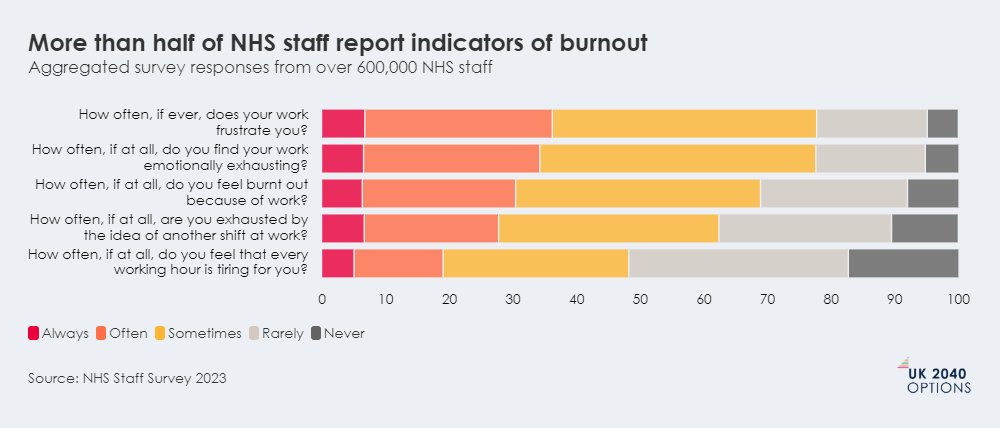
Staff wellbeing was a problem before the pandemic, but has worsened since. A 2023 survey found that the top two reasons for leaving the NHS are to improve work-life balance or because of health issues, and the number of staff leaving for these reasons has more than tripled over the past ten years. More than a quarter of staff report feeling exhausted, burnt out, and frustrated by work always or often.
Junior doctors leaving the NHS for Australia can roughly double their pay, yet they are twice as likely to cite workplace culture and work-life balance as their reason for leaving. There are also longstanding inequalities in experience for ethnic minority staff.
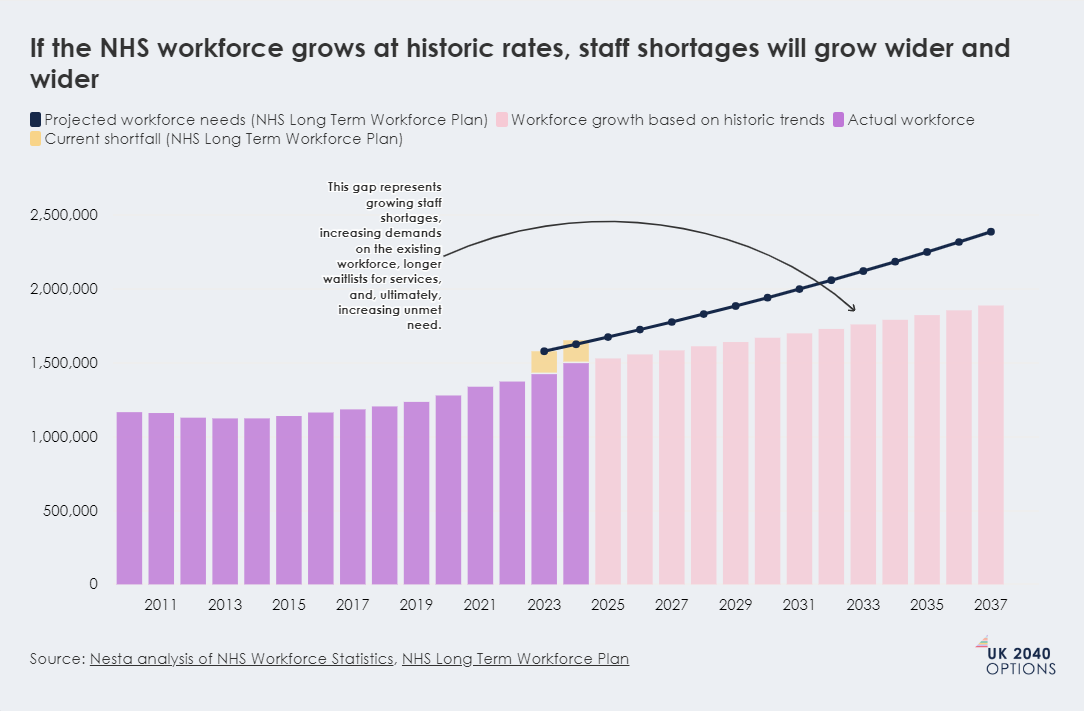
The NHS already faces staff shortages to the tune of 150,000, but workforce modelling shows that it will face a workforce gap of up to 360,000 staff by 2036-2037. No doubt pay is a critical part of the value picture – especially given real salary cuts since 2010 are as much as 15% for some staff – but pay alone won't be sufficient. To meaningfully improve retention, we need to focus as much on the day-to-day experience of the job as the salary. And broader fiscal constraints and competing demands for pay increases only add to the need to consider job quality.
There is currently neither a sufficiently timely nor actionable picture of workforce wellbeing, or a strong mandate to invest in wellbeing measures. The NHS Staff Survey takes around six months to publish results, and the more frequent People Pulse is patchy and not easily accessible. Both have important information gaps: the results may highlight that there are particular wellbeing deficits, but not why they exist in a particular organisation; and it's not clear how this information is used in workplaces.
This means discussion around workforce wellbeing is too frequently problem-focused, rather than solutions-focused, and successful initiatives are rarely scaled. Collecting accurate and timely data, is critical to de-risking decisions taken by the NHS, ensuring that it is better set up to drive and scale innovation, and critical to ensuring that a system-wide shift towards being mission-led sticks.
How
There are already the seeds of solutions at work in the NHS, demonstrating that timely information is a critical enabler to appropriately designed and targeted solutions, and that there is huge potential for impact by scaling well-evidenced best practice.
Intervention idea: ImproveWell
Enhancing healthcare through staff engagement, ImproveWell is a digital platform tackling workforce engagement and quality improvement in healthcare. It partners with various NHS trusts and overseas health systems to boost service quality and staff retention. At its core, ImproveWell combines a staff smartphone app with a leadership dashboard. The platform offers pulse surveys to gauge staff morale, a system for submitting improvement ideas, and tools for data-driven leadership decisions.
This setup aims to democratise quality improvement by:
- enabling frontline staff to suggest improvements
- giving employees a voice in solving workplace challenges
- fostering a happier workforce, leading to better patient care.
Results across health system implementation partners have been promising. Users report feeling more valued and heard. Many experience greater job satisfaction, and some organisations see reduced staff turnover. Examples include:
- improved staff retention and morale at the Southern Health and Social Care Trust in Northern Ireland, with dramatic declines in turnover and more successful recruitment
- significant jumps in the number of staff who feel they can easily share ideas (from 57% to 91%) and the number of staff who feel their ideas were listened to (from 57% to 72%) at the Burns Service, Chelsea and Westminster Hospital NHS Foundation Trust
- improved morale across the 38 teams who took part in the Royal College of Psychiatrists' Enjoying Work national programme. Weekly survey results showed a 41% improvement in the percentage of people who are experiencing no symptoms of burnout.
ImproveWell shows how digital tools can engage healthcare staff in meaningful improvement, and demonstrates that health systems can become more responsive and efficient by tapping into frontline insights.
Intervention idea: reducing nursing turnover through electronic self-rostering
In 2017, despite having a healthy recruitment pipeline for nurses and midwives, Royal Free London NHS Foundation Trust was facing intensive care unit turnover in excess of 40%. A multi-disciplinary team, headed by the Royal Free's Director of Nursing, found work-life balance to be a leading factor among the reasons for high turnover and vacancy rates. Staff focus groups said offering flexibility and choice around shifts would improve work-life balance, and electronic self-rostering was considered key to this.
Piloted at the Royal Free's ICU in January 2018, it was implemented across 32 inpatient areas from September 2018 to May 2019. Following its introduction, turnover rates significantly reduced (more than halving from 43% at their peak to 19% in 2020), showing that improving work-life balance through offering staff greater flexibility and choice supports staff retention.
Establishing an NHS Workforce Wellbeing Dashboard could complement the success of innovations like ImproveWell, to highlight the state of the workforce at a local, regional, and national level, gathering feedback directly from staff in order to diagnose the biggest barriers to improved wellbeing, and enabling the scouring of variation for best practice.
- The dashboard could be built by NHS England, initially using existing data from the Staff Survey, People Pulse, and Workforce Race Equality Standard. It would enable data visualisation at national, regional, and trust-specific levels to highlight variations and best practices, with filters to easily identify high-performing trusts or those showing significant improvement.
- Explore the development of an NHS staff app to facilitate real-time data collection for the dashboard.
- Ensure the dashboard is accessible to health system leaders, NHS staff, and the public to foster transparency and drive accountability, and is integrated with regulatory processes and inspections, for example by the Care Quality Commission.
- Include key metrics from the Dashboard in NHS bodies' annual reports to ensure attention is continually paid to wellbeing improvement, and publish NHS bodies' average ratings annually to ensure public accountability.
Simultaneously, establishing a ring-fenced Workforce Wellbeing Improvement Fund could fund the trialling of ideas and initiatives that build workforce wellbeing, evaluate their broader benefits, and enable their scaling.
- An initial allocation of £40 million would be comparable to the Labour Markets Evaluation and Pilots Fund.
- Develop clear guidelines for fund allocation, focusing on evidence-based or innovative interventions with potential for national scalability.
- Create a streamlined application process for trusts and central NHS bodies to apply for funding, including encouraging bottom-up innovation by allowing NHS employees to propose ideas via their trust.
Impacts and trade-offs
Making workforce wellbeing a strategic priority could deliver substantial efficiency gains. Improving staff wellbeing could reduce sickness absence and generate hundreds of millions in savings across the NHS, not only in avoided agency costs, but also in avoided recruitment and training costs. Beyond these quantifiable benefits, there are potential qualitative improvements in care quality, innovation adoption and operational efficiency. Research already indicates a positive correlation between employee engagement and key performance indicators such as lower patient mortality and reduced sickness levels. If successful, the approach has the potential to be scaled to other public sector workforces.
The social care workforce challenge
It isn't just the NHS workforce that requires attention. Social care struggles to recruit and retain staff, with high turnover and vacancy rates linked to low pay, competition, and poor working conditions. There is an approximate 50-50 split between full-time and part-time work in social care (this is lower than NHS comparisons, such as approximately 60-40 for nurses and midwives, and 80-20 for consultants), 22% of staff are employed on a zero-hours contract, and this figure rises to 50% among care workers in domiciliary care.
Improving recruitment and retention is essential for the sector's sustainability, and whilst improving pay is a possible, but challenging, option, initiatives to provide more training and workplace support could be more feasible and still have a positive impact. Here, again, the testing and scaling of positive interventions could make a difference.
For example, research by Timewise has shown that team-based approaches to scheduling and rotas, which provide a forum for everybody to state their priorities, give longer advanced notice of shifts and which aim to reduce unfair travel times, can stop a carer's schedule being so volatile and increase worker wellbeing. The Local Government Association has also provided a suite of supporting principles, tips and pitfalls to avoid for employers to make flexible working more available and suitable for potential workers.
A field experiment of peer support among 911 emergency dispatch staff in the United States reduced burnout and halved the rate of resignations during the measurement period. A replication of this study among unpaid carers in Essex led to an observed reduction in burnout score compared to the control group, though the results were statistically insignificant (possibly due to a small sample).
Robust data on social care workforce burnout is lacking, but these findings tentatively suggest that low-cost interventions which focus on workload support, affirmation and belonging could reduce burnout and encourage retention.
Another intervention to improve skills and development in the sector would be a job rotation model. Social care staff would attend training paid for by a public fund, while an unemployed ‘substitute' fills their place and gains employment experience. DHSC could pilot this scheme in collaboration with social care businesses, local authorities and in partnership with training providers. It could provide career routes for low-skilled workers without loss of staffing cover for essential social care services.
Pave the way for an AI health revolution: building interoperability and trust in health data
What
Mission-driven government is built on strong foundations and, here, data and technology are critical. The AI health revolution will be enabled by getting the basics right: ensuring interoperability to enhance access to data, including in the NHS App, by standardising patient records, and building public trust in the safe use of health data through institutional architecture, for example by establishing a new National Data Trust (NDT), as proposed by the Tony Blair Institute (TBI).
Why
Expectations are high for what AI will achieve for the NHS: a more predictive, preventative, personalised and participatory health service, improved population health and patient experience and lower per capita cost (the Triple Aim), and a 'learning' health system. The vision is compelling: the NHS App as the single front door to the NHS, with patient records accessible in seconds and integrated with technology for individualised advice, treatment and prevention plans, and AI-powered solutions freeing up workforce time and improving NHS productivity.
But digital transformation in the NHS has been slower than other comparable healthcare systems. Like a tangle of electrical wires, the NHS currently operates like thousands of health services behind the scenes, with each organisation controlling different patient data on different health record platforms. Some critical data doesn't exist digitally – the childhood Red Book, for example, is still largely paper-based (with Labour's 2024 manifesto explicitly committing to digitise it). This fragmentation means that where digital records are available, there is significant variation in format, storage and accessibility. Health platforms often don't 'speak to each other'. Patients can slip through the cracks or even need to ‘go into battle' to access their own data to get the services or prescriptions they need, while staff spend millions of collective hours on inefficient administrative tasks to either re-collect data or get it transferred from other organisations.
Researchers also face gaps in the NHS data landscape as a result of significant patient opt-outs due to trust concerns. Previous attempts to streamline digital architecture, such as care.data and the General Practice Data for Planning and Research programme saw millions opting out of their data being used and ultimately their cancellation.
DHSC's Data Saves Lives strategy recognises patient trust as critical to progress. The strategy aims to ensure public confidence in data security, building understanding of how data is being used for both individual care and broader health improvements, and improving access to, and control over, individuals' own data. While the most recent Centre for Data Ethics and Innovation Attitudes Survey found an overall positive shift in the public's beliefs about data use, significant improvements are still needed, with only 35% of respondents agreeing they have control over who uses their data and how. A recent NHS England data mapping exercise revealed concerning issues, including limited transparency due to multistage data flow chains, failure to adhere to best practices for safe data access, and unnecessary duplication of data assets.
When enablers are missing, or function in ways that conflict with the mission, work will be slower, and harder, than it needs to be. There has been some progress: most integrated care systems now have shared patient record systems in place, and 25 million people now have the NHS App in their pocket. But attempting a system-wide rollout of AI-powered healthcare on the current digital architecture has been described as trying to launch a hyperspeed train network on rotting tracks: the infrastructure just isn't ready, and it isn't trusted.
How
Mandate interoperability, requiring all electronic health records in use in the NHS to follow a standardised and user-friendly design. They should also comply with interoperability standards.
- Although there are frequent calls for a 'single patient record', our experts generally considered reducing the market to a single records platform to be unnecessary. Rather, what is required is standardised patient records on all health platforms, so that records are interoperable, and can be easily integrated into the NHS App (as well as other NHS platforms) as a 'single front door' for health needs.
- Health platform providers are unlikely to standardise records without being pushed to do so. Mandating technical standards that all health platform providers must comply with, including standards for data and metadata collection, is therefore likely to be required. The NHS could publish standard templates for data collection as a way to streamline various standards.
- Some of this is already underway and can be built upon: an NHS England directory for health data standards is currently in beta, an INTEROPen personal health records sub-group is now developing open standards for personal health records to support the sharing of information between individuals and professionals, and the Centre for Improving Data Collaboration has been established to provide guidance and support. Changes made by the Health and Care Act 2022, once commenced, will make information standards binding – that is, they must be complied with unless this requirement is waived.
Case study
My Health Account, New Zealand
My Health Account is New Zealand's new digital health identity service that connects citizens to their health information online and lets them securely access digital health services from anywhere. The service is available to all people in New Zealand aged 16 years and over.
My Health Account was developed to keep users' personal health information secure and private. Through My Health Account, users can gain access to essential online health services and information via a trusted, secure platform, and share that health information with the health professionals they choose. Healthcare providers can view a New Zealand Patient Summary record, allowing access to key health information nationally.
Connected Services (the umbrella for New Zealand's digital health infrastructure) is enabled and strengthened by an emerging body of standards for digital health, the Health Information Standards Organisation, which oversees the selection, development and adoption of data and digital standards for the health sector. Among others, standards exist for health records, medicines information, clinical document metadata, interoperability, information governance and security.
Ensure all aspects of the data infrastructure build patient trust – for example, through the establishment of an arms-length independent body such as a National Data Trust (NDT), as proposed by the Tony Blair Institute (TBI).
- The NDT, established in primary legislation, would be responsible for overseeing a single access point for England's health data assets, bringing together centrally held NHS data with more cutting-edge assets such as UK Biobank, Our Future Health and Clinical Practice Research Datalink (CPRD). The NDT would maintain and develop this nationwide health data asset, building public trust in its use, establishing data standards and streamlining public, private and third sector access. It would also invest in the necessary skills and workforce developments to support new data infrastructure, extending to AI and machine learning applications.
- Established by 2026, TBI has proposed that the NDT operates as an independent commercial entity, with majority ownership by the UK Government and NHS England, with a proposed public-private ownership ratio of 70:30. It would work alongside the National Data Guardian and the Information Commissioner's Office, but would operate independently – while still accountable to Parliament. It could be overseen by a diverse board of trustees, including public representatives, health professionals, and data and ethics experts.
- Public engagement would be a key priority for the NDT, which could include structures like a permanent Citizens' Council, transparent reporting of data uses, and an easy-to-use online portal for individuals to view their data usage and set preferences. The NDT could also implement clear opt-out mechanisms, allowing patients to control their data sharing preferences while being transparent about the implications of opting out.
-
TBI proposes that the NDT is co-funded, utilising both public and private funds. TBI proposes the NDT should aim to raise between £200 million and £300 million initially, with the UK Government retaining a majority stake, implying an external target of £100 million to £150 million. Over time, the entity would generate revenue by unlocking the commercial value of the UK's health data asset, protecting it from cyclical funding pressures.
-
The NDT has been proposed with international collaboration in mind, aiming to position the UK as a global leader in ethical health data governance. It could include protocols for rapid data sharing and analysis during global health crises, balancing the need for swift action with maintaining ethical standards.
On the commercial value of data
TBI's proposal recognises the huge potential for commercial value through unlocking the UK's health data asset. However, it's important to be aware of patient perspectives on profit.
The majority of the English public support the use of de-identified data for public benefit or to advance medical knowledge but are more cautious about its use for commercial profit, reflecting a similar stance to populations worldwide. It may be unrealistic to expect that patients and citizens would accept or trust any purely commercial transactions.
In response to the TBI proposal, Dr Jess Morley of the Yale Digital Ethics Center, along with her colleagues Nicola Hamilton and Luciano Floridi have suggested:
"The next government must steer away from a retail model of NHS data management and towards a more socially acceptable model. One option would be to create a tiered ‘rental' model run by a non-profit, community interest company. To operationalise this, population level, algorithm-ready (that is, cleaned, curated, etc) datasets would be kept within suitably functional trusted research environments, access to which could be rented (price tiered based on type of accessing organisation) for purposes pre-approved by a patient and citizen board according to democratically agreed access criteria. Ownership of NHS data would never change hands, access could be revoked if data were used for undesirable purposes, and strict licence agreements would be developed for any of the data derived products and services, ensuring they are used only for socially acceptable purposes."
Impacts and trade-offs
The harmonisation of NHS England health data could significantly reduce fragmentation and improve efficiency for patients and health staff, enabling the development of personalised tools for both patients and clinicians. Reducing friction when accessing patient records could markedly improve the healthcare experience and potentially save lives by ensuring timely access to critical information.
From a public health and research standpoint, improving the quality of, and access to, health data could save thousands of lives and billions in societal costs by driving discoveries that lead to better health outcomes. For policymakers, the NDT would provide a secure platform to make data-driven decisions, experiment with new approaches and test hypotheses transparently – potentially revolutionising health policy development and implementation. TBI estimates that the full integration of the NDT with clinical-trial services could drive an additional £2 billion in economic growth by 2030. By doing so, the NDT could serve as a catalyst for innovation within government and the private sector. This improved data access and infrastructure could attract substantial international R&D investment, mirroring the success seen in Nordic countries with major pharmaceutical companies.
However, there are financial, technical and political risks, given the high upfront costs and potential for budget overruns. The infamous £10 billion National Programme for IT serves as a cautionary tale for policymakers, underscoring the need for robust project management to ensure value for money. Public perception is likely to be another challenge, with benefits that may not be immediately obvious. And there will be ongoing technical challenges, particularly in terms of interoperability with legacy systems, and recruiting and retaining for specialist skills. Integrating with existing, potentially outdated NHS IT systems will be complex and costly.
Data privacy and security concerns will remain paramount. Centralising data could increase efficiency, but also potentially increase the impact of any data breaches. It also increases the risk of equity concerns. It will be vital to ensure that data standardisation and the NDT don't exacerbate existing health inequalities, but rather help to address them. This will require building equity considerations into the design and implementation phases from the outset.
Finally, balancing the UK's desire for data sovereignty with the need for international research collaboration will require careful navigation. Developing clear protocols for international data sharing that protect UK interests while fostering global health advancements will be essential.
What
Ramp up the use of digital mental health services by expanding access to, and effectiveness of, internet delivered cognitive behavioural therapy (eCBT). Measure prescribing rates, provide training in the use of digital tools for clinicians, and dedicate funds to expanding the pipeline of available AI treatments for mental health.
Why
Poor mental health is a significant and growing health challenge for the UK. Currently, one in four adults in England experiences a common mental health disorder (CMD) in any given year. Rates are now particularly acute in younger generations, with a third of 18-24 year olds estimated to experience a CMD. In addition to the wellbeing impacts for individuals, poor mental health also has a significant economic cost, estimated to be at least £117 billion a year, with some new estimates showing that the true cost could be closer to £300 billion.
The number of people prescribed antidepressants continues to climb

The NHS cannot meet current demand for mental health services. Sizeable treatment gaps exist: around 1.2 million people are waiting for community mental healthcare in England, and access to services can vary widely across the NHS. Backlogs are caused in large part by workforce-related capacity constraints: in March 2024, 10% of all mental health roles in England were vacant, the highest vacancy rate within the NHS. NHS England has yet to meet its 2023-2024 goal of 1.9 million people accessing talking therapy services, which itself has been estimated to equate to only a quarter of people with diagnosed need.
Digital mental health tools, including eCBT, continue to hold promise in expanding access to mental health services, as well as helping to optimise the human workforce. eCBT requires about 85% less therapist time than conventional CBT, while still providing effective support: two systematic reviews found that eCBT reduces both depression and anxiety in adults and young people, with some studies finding impacts equivalent to face-to-face services.
NICE guidance already includes eCBT as one of the recommended interventions for individuals with depression and anxiety. And there is a growing marketplace: NICE recently approved the use of nine digital tools for use in treating depression and anxiety, and The Hewitt Review found that digital tools and apps can play a vital role.
What is eCBT?
CBT is a talking therapy that can help an individual change the way they think and behave. It is highly structured, which means that it can be provided in different formats (including in groups, through self-help books and exercises, and online). In many instances, it can be as effective as medication in treating some mental health problems. CBT is highly resource intensive, and consequently, isn't available to many patients.
eCBT, or CBT that is delivered online, can take various forms. Programmes are normally made up of short-term, patient-guided, goal-oriented sessions. They can be made available online or via a smartphone or app, and can be either self-guided or include support from a therapist. In this way, treatments become automated and geographically independent, which can have a positive impact on patient access and therapist capacity.
Digital health tools continue to be rolled out by various NHS trusts. However, there remain barriers to ensuring that we extract maximum value from these tools. While new tools are being adopted all the time (for example, the recent announcement of four mental health digital therapies produced by Koa Health in partnership with Oxford University), digital mental health tools are still not widely available. Fragmentation within the NHS, and the NHS England commissioning structure, contribute to a postcode lottery for services. In some practice areas – especially the treatment of children, and more severe mental health issues – adoption of even eCBT remains slow. Low adherence (retention within digital mental health programmes) continues to undermine the potential impact and efficacy of digital tools.
How
- Measuring the prescribing rates of eCBT. Understanding unwarranted variations in prescribing behaviour across GPs (and accounting for self-referrals in eligible areas) has been identified as important for identifying practices that are underperforming or slow to respond to change, and for developing targeted interventions. But while extensive data is available on prescriptions of different medicines, no such data exists for therapies, including eCBT. The data must be collected and used.
- Providing additional support to clinicians and therapists to implement eCBT, and other digital tools. While there is already evidence on the efficacy of eCBT, studies still report clinician hesitancy in prescribing eCBT as an alternative to face-to-face therapy. Provision of training on eCBT tools, alongside ongoing supervision for therapists, has been shown to continue to increase acceptance of eCBT as a valid treatment option. Here, Integrated Care Boards (ICBs) have a unique opportunity to set the cultural and practical tone for digital innovation and delivery within their area. They can better empower clinicians to embrace transformation and integrate digital interventions into existing pathways, processes and systems.
- Dedicated research funding for AI-based mental health tools could expand the pipeline of available treatments. While eCBT uses just a fraction of the therapist time that conventional CBT does, it still can require substantial time depending on the mode of delivery and the type of intervention. This restricts expansion, and AI-based tools could help to overcome this.
- Boost adherence (and therefore effectiveness) to eCBT and other NICE-approved digital tools, through dedicated innovation funding or a challenge prize for eCBT providers with high retention rates. Retention is a particular challenge for eCBT: drop-out or non-completion rates vary from 3% to 47%. This has been identified as an ongoing problem for eCBT delivery, and digital tools more generally. Little is currently known about why patients drop out of e-therapies. Medical investment in eCBT and other digital tools has not been matched by investment in addressing these behavioural components. An additional lower-cost method would be to require the consistent reporting of retention rates by providers of eCBT, to help commissioners select the best services.
Impacts and trade-offs
Digital solutions could improve and broaden access to mental health therapies. Increased access to eCBT, and other digital tools, can offer an alternative way to access help, and in a way that may be more suited to an individual's personal needs, offering flexibility around both time and location of treatment. This is particularly important for hard-to-reach populations and contexts, where digital tools can help bridge existing treatment gaps. Self-guided tools can be beneficial as interventions while individuals are waiting for face-to-face psychological therapies – with emerging evidence that this may be the case even in more severe cases – providing more equitable access to mental health support, and quickening the path to recovery.
eCBT is a cost-effective intervention, and continued investment in it could have significant cost savings for the NHS, and the wider economy. Recent research has found that eCBT offered similar clinical effectiveness, but with shorter treatment times, relative to face-to-face talking therapies. It also suggested that the cost savings of eCBT were higher for depression, and for more severe presentations, due to increased associated background costs.
A focus on quality would be crucial to ensure impact. Many wellbeing and mental health apps (that are not NICE recommended, but are available to be downloaded online) are low-quality, have a paucity of research to support their claims, and often have accompanied privacy and ethical concerns. It is important to keep these digital mental health tools separate from those supported by robust efficacy studies, and also protect patient privacy and trust. Here, NICE will play a crucial role as an assessor of the marketplace.
Scaling digital mental health tools alone is not sufficient: there is no 'one size fits all' approach to mental health treatment. Ensuring the right balance between digital and face-to-face therapies is important, and an area where further research could bolster outcomes and cost effectiveness.
Strengthening adult social care
Adult social care touches the lives of over 10 million adults of all ages in England at any one time. But the current system is widely regarded as inadequate, unfair and unsustainable. There are 131,000 vacancies across the sector in England, and turnover in the workforce is high. A fragmented provider market is under immense strain. As a result, there are significant levels of unmet or under-met need for social care throughout the country, leaving individuals with social care needs more dependent on unpaid care from friends and family. The adult social care sector faces a complex web of interlinked issues, with it now providing a threadbare safety net for the most vulnerable.
And as the UK's population ages, pressures on social care will only continue to increase. Social care is intrinsically connected to the NHS: people with social care needs often have complex health needs; a lack of capacity within social care can be a cause of delayed discharge from hospital; and high levels of unmet need increase demand for other services, such as general practice and emergency.
The starting point in any conversation on adult social care is funding for the sector – which, unlike the NHS, is not free at the point of use. Unless an individual has low assets and savings (see box below), social care must be paid for by the individual or that individual must rely on their family and friends for care, or go without care. And the publicly-funded system is creaking. Extensive reviews have crystallised the issue for policymakers over the past decades, including the Dilnot Commission on Care and Support in 2011, which recommended making the means test more generous and capping the cost of care – a plan that Labour has now abandoned. There remain a number of options for the UK Government as to how it could raise the funds needed. At the same time, experts were also clear that, cash and funding aside, there is much more to be done to provide the high-quality care that we will all at some point need.
How is adult social care currently funded and delivered?
While the focus of this part of the report is primarily on the elderly, social care supports people of all ages with certain physical, cognitive or age-related conditions, to help them to live independently and to stay well. Around half of state-funded adult social care expenditure is spent on working-age adults who require support.
Adult social care is currently provided through a complex mix of public and private services. The public system is means tested – very broadly, individuals in England with assets of over £23,250 (a figure that has not risen in line with inflation since 2010) receive no financial state support and need to fund their own care – or rely on family and friends. The level and type of state support for people with assets below this threshold depends on their needs and income.
Local authorities are responsible for assessing people's needs, and if eligible, funding their care. In England, local authorities individually decide what they will spend on social care: in 2021-2022 the total expenditure on adult social care by local authorities was £26.9 billion.
Most social care services are delivered by independent sector home care providers, which are mainly for-profit companies, but also include some voluntary sector organisations. Many people will also have this private care organised and purchased by their local authority, though many people with disabilities employ individuals to provide their care and support.
As with all ideas throughout this report, this description applies solely to England. Wales and Scotland have implemented reforms through devolved administrations, which mean that they have different regimes for adult social care funding, entitlement and delivery.
Stem rising demand in social care by preventing falls and improving physical activity in older people
This idea has been contributed by the Behavioural Insights Team.
What
Faster and more substantial rollout of personalised risk assessments to identify those at risk of falls, and scaled-up physical activity interventions for older people. This would be achieved by central funding of pilots and scaling.
Why
Falls and subsequent fractures contribute to social care and NHS demand. One in three over-65s and one in two over-80s experience a fall at least once a year. They contribute to the largest cause of emergency hospital admissions for older people, and cost the NHS over £2 billion per year and over four million bed days. The cost to the broader health and care system from falls is estimated to be over £4 billion per year. Individually, they can lead to loss of independence due to inactivity, loss of strength and risk of further falls and injury.
Falls, including why and how they happen in older people, are complicated, but many are preventable. In recent decades, there have been huge improvements in research into what causes falls, and how to prevent them. For example, findings from 150 randomised trials have shown that group and home-based exercise can reduce the rate of falls and risk of falling in the elderly. There is also good evidence that supervised exercise programmes can improve the physical agility of older people, with benefits strongest for those with greater frailty. Interventions include strength and balance training, home hazard assessment, vision assessment and medication review, which are often successful in reducing the rate of falls.
How
- Rolling out personalised risk assessments and subsequent interventions to prevent falls. Recent reviews have identified that carrying out a multifactorial risk assessment which identifies a person's risk factors for falling – like balance, mobility and home hazards – in the homes of at-risk older people, followed by timely and tailored interventions, could reduce the risk of falls by 38%. A pilot of 4D imaging technology in care homes resulted in a 66% reduction in falls and around a 97.5% reduction in ambulances called or required post-fall.
- DHSC and/or the Care Quality Commission could commission audits of existing provision of risk assessment services and capacity to follow up with multifactorial interventions. This audit would identify best practice, as well as gaps and areas for improvement. Depending on the findings, funding and resources could pilot and evaluate new interventions, or best practice could be scaled.
- Implementation should be local, but in a way that ensures that areas that have not applied for funding still reap the benefits of evidence-based approaches and promising initiatives.
- Scaling physical activity interventions for older adults, building on what works. DHSC could lead efforts to ensure that devolved responsibilities come with adequate resources and support to scale the programmes that work. For example, Dorset's ICS has implemented an Ageing Well programme prioritising upstream interventions for patients with long-term conditions, which has seen significant reductions in emergency admissions. Upstream interventions could include incorporating specialist physical activity and assessment roles into neighbourhood teams. The ICS is now using data to predict which patients might be at risk of falling and intervening with self-care packages. They are also piloting the use of digital physical activity
interventions in the home. All of this could be scaled more widely, with direct intervention and support.
- There are also two evidence-based balance and functional training programmes used in pockets of England: the Otago Exercise Programme and Falls Management Exercise Programme (FaME). Local research has highlighted successful implementation in specific areas, but says commissioning is still variable. Finding a balance between local implementation and standardised approaches would be preferable.
Impacts and trade-offs
Hip fractures alone are estimated to cost NHS England and social care between £1-£2 billion each year, with approximately 250,000 falls-related emergency hospital admissions annually. Implementing personalised and community-based physical activity interventions among older adults could support reductions in the incidence of falls, and directly lead to fewer fall-related injuries, hospital admissions and emergency room visits. With fewer falls, there will be lower demand for social care services and reduced pressure on NHS resources.
The results of this would benefit older adults, caregivers and families, social care systems and the NHS. The trade-offs would include initial implementation costs, the need for volunteer recruitment, sign-up and engagement, and the resources required to ensure the consistency and quality of programmes.
Even modest improvements in fitness could have several billion pounds a year of benefit to society through reduced care burdens on local authorities and the NHS. Falls prevention should be viewed as part of a broader mission to lay the foundations of healthy ageing, such as creating easy and safe environments in which to be active, better conversations and support by health and care professionals, and interventions across society to encourage individuals to invest in their long-term health.
Proactive and streamlined support for unpaid carers through targets and incentives
What
A proactive and explicit 'no wrong door' approach to identifying unpaid carers and a strategic approach to supporting them across public services no matter where they are first identified. Achieved using targets and incentives for local authorities and healthcare providers, and better sharing of information across government.
Why
Unpaid caring is a huge, but mostly hidden, industry. Experts we spoke to throughout UK 2040 Options told us that unpaid carers are simultaneously everywhere and nowhere in the health and adult social care systems. Carers play a critical role not just for the people they care for, but also in the wider society and economy: the care that unpaid carers provide has been valued at £162 billion per year. At the last census there were at least 5.7 million unpaid carers in the UK, representing 9% of the total population. And while caring is rewarding for many, it can come at great personal cost: 44% of carers who provide 35 hours or more of care are in poverty, with caring having a direct impact on paid employment and health outcomes.
Without support, the system's current reliance on carers to prop up the shortfall in paid services is becoming unsustainable. Support provided by local authorities diminished between 2015-2016 and 2022-2023, and the Carer's Allowance, the main state benefit for carers in England and Wales, is means-tested and only received by an estimated 17% of carers. Relatively few carers are identified as having caring responsibilities until a crisis occurs: and Directors of Adult Social Services have already recently reported a steady increase in carer breakdown.
One of the fundamental problems is little accurate data on who and where carers are. While local authorities and GPs identify some unpaid carers, The Health Foundation found that even when these records were linked, there was still a significant underestimate in the total number of carers (estimates ranged between 11%-24% of carers identified in a local area). Being able to routinely identify carers before a crisis occurs enables the NHS and local authorities to provide the support that they are required to under the Care Act 2014.
How
- Create targets and incentives for healthcare providers and local authorities, to proactively identify carers and ensure that their caring status is recorded in their health records. The identification of carers across the healthcare system is currently fragmented. Estimates have found that between 71%-85% of carers come into contact with a health professional. Yet only one in ten carers is identified in a healthcare setting (and just 7% of carers by GPs). GPs and other primary care professionals are well-placed to refer carers to more specialised sources of information and advice. These incentives could add weight to the good practice guidance that is already recommended by NHS England to GP practices.
- While local authorities are already required to identify and support carers under the Care Act 2014, this is largely driven by self-identification – which is widely regarded as an insufficient mechanism to ensure that more people are getting good support. Very few carers are identified by local authorities.
- The incentives could be financial, or based on transparency and accountability, with for example the Care Quality Commission tracking and reporting on GP surgeries registering carers and effectively using their carer registers.
-
Ensure that this data is regularly collected, and shared, between local authorities and the NHS. The recent development of shared care records could assist in helping local authorities to link data, and the creation of an identification target could speed up adoption by local authorities. Shared care records enable access and cooperation across health and social care organisations, allowing carers to register once across multiple organisations and share and update records and contingency plans accordingly. To help drive the implementation of shared care records, ICBs could create clear data standards that set out the purpose of sharing unpaid carer data, clarifying the roles and responsibilities of all parties involved.
-
Improve data sharing arrangements within government, so that carers are automatically offered all entitlements and support available. Carer organisations, along with the Fabian Society and Joseph Rowntree Foundation, have also proposed improved application processes and data integration within the Department for Work and Pensions (DWP) regarding caring status. This could ensure that individuals applying for Carer's Allowance are also offered Universal Credit and vice versa. Broader data sharing within the public sector, allowing social services departments automatic access to DWP and NHS data on caring status, would also enable more proactive offers of assessment and support.
Impact and trade-offs
Better carer identification, alongside better targeted support, could have a significant impact. Evidence suggests that even low-cost interventions (such as peer support) can be highly effective at supporting carers: modelling by the New Economic Foundation found that interventions aimed at unpaid carers could generate strong social benefit-cost ratios of 4:1 and above. And better identification means better collection of data: individual-level data on the carer population could help close existing evidence gaps on how to best support different groups of carers to sustain their caring roles, and protect their own health.
However, placing additional reporting requirements on local authorities and healthcare providers could increase pressure on organisations that are already stretched thin, and which often lack the necessary data skills. There's also a risk that identification alone will be insufficient if it is not supported through signposting and increased support provision for unpaid carers. In the context of current budgetary pressures facing local authorities, equal attention needs to go towards providing support to carers once identified.
Despite these challenges, relying solely on self-identification and the current disjointed mechanisms through which unpaid carers are identified, and data on their needs are collected, will continue to paint an inaccurate picture of need, as The Health Foundation has highlighted. As they have identified, it is an inadequate basis for commissioners and services to build appropriate support offers for unpaid carers, hinders the evaluation of policy success, and prevents unpaid carers from receiving a better deal.
Conclusion
Throughout this report we have explored eight ideas. These ideas were suggested, tested and debated with us by the health and social care experts, practitioners and emerging thinkers that we spoke to throughout the course of this past year.
The ideas themselves range from the smaller and more targeted, such as incentivising the identification of unpaid carers so we are able to provide better support, through to the much bigger and much bolder: standardising patient records and increasing patient trust through the creation of an NDT. While we have explored a wide range of ideas in depth, we do not intend this report to provide a comprehensive set of recommendations to 'fix' the NHS and adult social care systems. Rather, we hope that this collection sparks interest, stimulates debate and highlights the types of innovative and positive change that could happen within our health and social care systems, if these systems embrace a shift towards being mission-led.
While the health and social care systems are dynamic, and changes, interventions, innovations and ideas (new and old) are constantly being announced, one thing has remained constant throughout this past year: the NHS and social care systems are facing significant but foreseeable challenges. Wes Streeting, one of his first announcements as Secretary of State for Health and Social Care in July 2024, described the NHS as 'broken'. Others have described social care in similar language for decades.
But rather than end on a negative, we've chosen instead to end with a call to action. After all, the projections of 2040 with which we opened this report are just that – projections. They are not immovable, nor set in stone. And there is much as the ideas in this report have shown – that can be done to shift the dial. UK 2040 Options was commenced in June 2023 – posing the question of what life in 2040 will be like for children that are born today. We hope that these collections of ideas will provide some inspiration to how we can pave the way to a better, brighter, future.
Acknowledgements
We thank Professor David Halpern for his contribution to this work and Lord Gus O'Donnell for sponsoring the UK 2040 Options project, and the following for their time and insight on these ideas throughout this project: Dr Na'eem Ahmed (ImproveWell), Dame Carol Black, Adam Briggs (The Health Foundation), Dominic Carter (Carers Trust), Anita Charlesworth (The Health Foundation), Alison Douglas (Alcohol Focus Scotland), Grace Duffy (Bridges Outcomes Partnership), Leo Ewing (The Health Foundation), Tim Gardner (The Health Foundation), Ravi Gurumurthy (Nesta & BIT), Hugo Harper (Nesta), Nancy Hey (formerly, What Works for Wellbeing), Nicole Main (Clinical Psychologist, Wysa), Dr Jessica Morley (Yale Digital Ethics Centre), Lara Mott (ImproveWell), Dr Luke Munford (University of Manchester), Andrew O'Brien (Demos), Professor Bola Owolobi (NHS England), Vic Rayner OBE (National Care Forum), Tamara Sandoul (Carers UK), Husain Taibjee (Nesta), John Tench (Wysa), Darcy Ward (Tony Blair Institute for Global Change). Please note that not all contributors will agree with all the ideas in this report.
UK 2040 OPTIONS
UK Options 2040 supports policymakers as they make choices about what to prioritise and how to deliver: setting out alternative policy options and pathways for the future, creating space for honest debate about the trade-offs and testing and interrogating ideas that take us beyond immediate crises.
58 Victoria Embankment
London EC4Y 0DS
+44 (0)20 7438 2500
[email protected]
@nesta_uk
www.nesta.org.uk
CC BY NC SA
Nesta is a registered charity in England and Wales with company number 7706036 and charity number 1144091. Registered as a charity in Scotland number SC042833.
Registered office:
58 Victoria Embankment, London EC4Y 0DS.