Acknowledgements
This report benefited greatly from comments and feedback from Isobel Roberts, Brenton Caffin, Sonia Tanna, Zosia Poulter, Helen Durham, Florence Engasser, Benjamin Reid and Ana Aulestia. Thanks to the Laboratorio de Gobierno's team.
About Laboratorio de Gobierno
Laboratorio de Gobierno's mission is to develop, coordinate, facilitate and promote innovation processes that are focused on people within public sector institutions, with the vision of creating a new relationship of trust between citizens, the state, civil servants and the private sector.
To find out more visit www.lab.gob.cl
About Nesta
Nesta is a global innovation foundation. We back new ideas to tackle the big challenges of our time. We use our knowledge, networks, funding and skills - working in partnership with others, including governments, businesses and charities. We are a UK charity but work all over the world, supported by a financial endowment.
To find out more visit www.nesta.org.uk
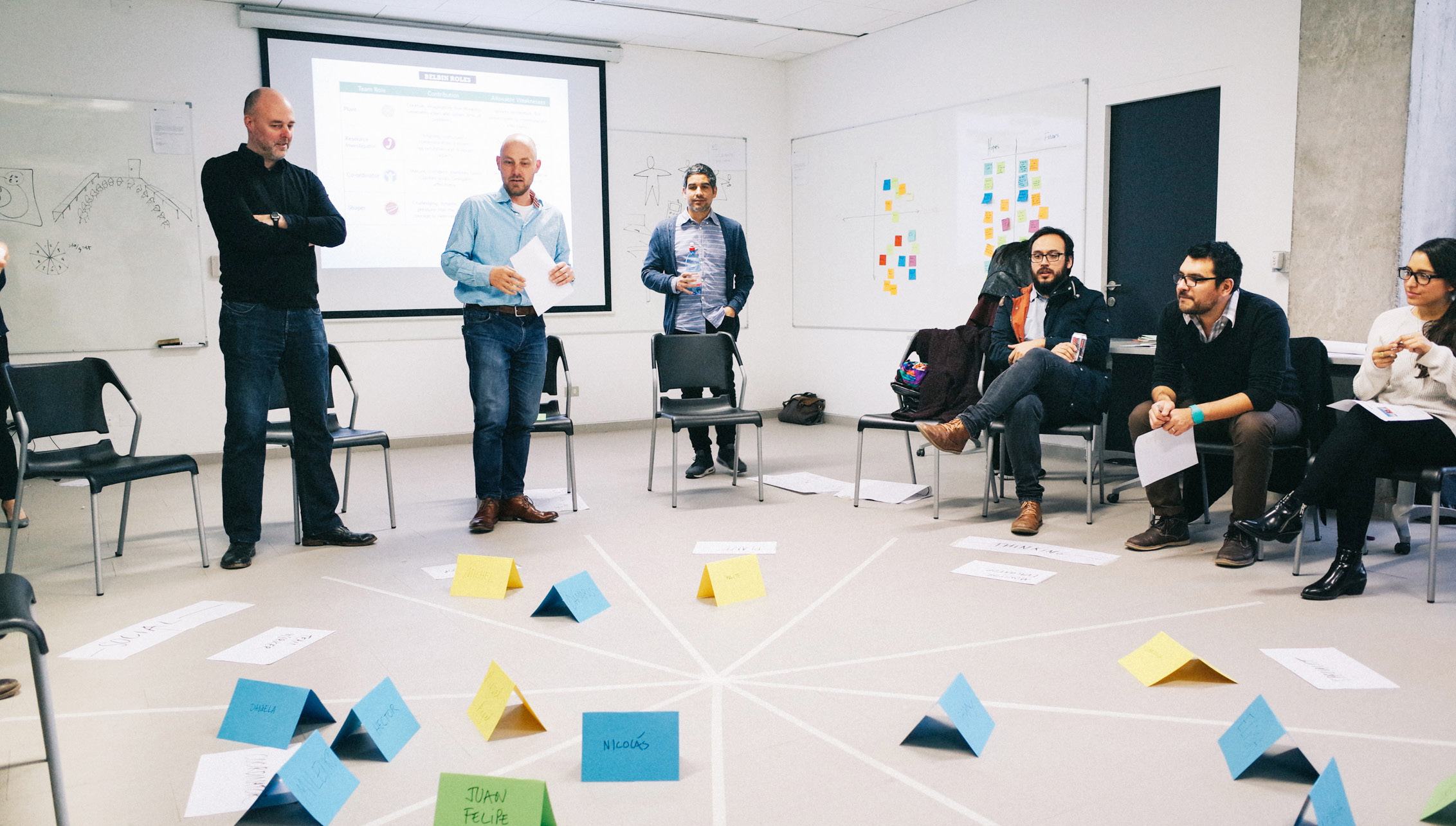
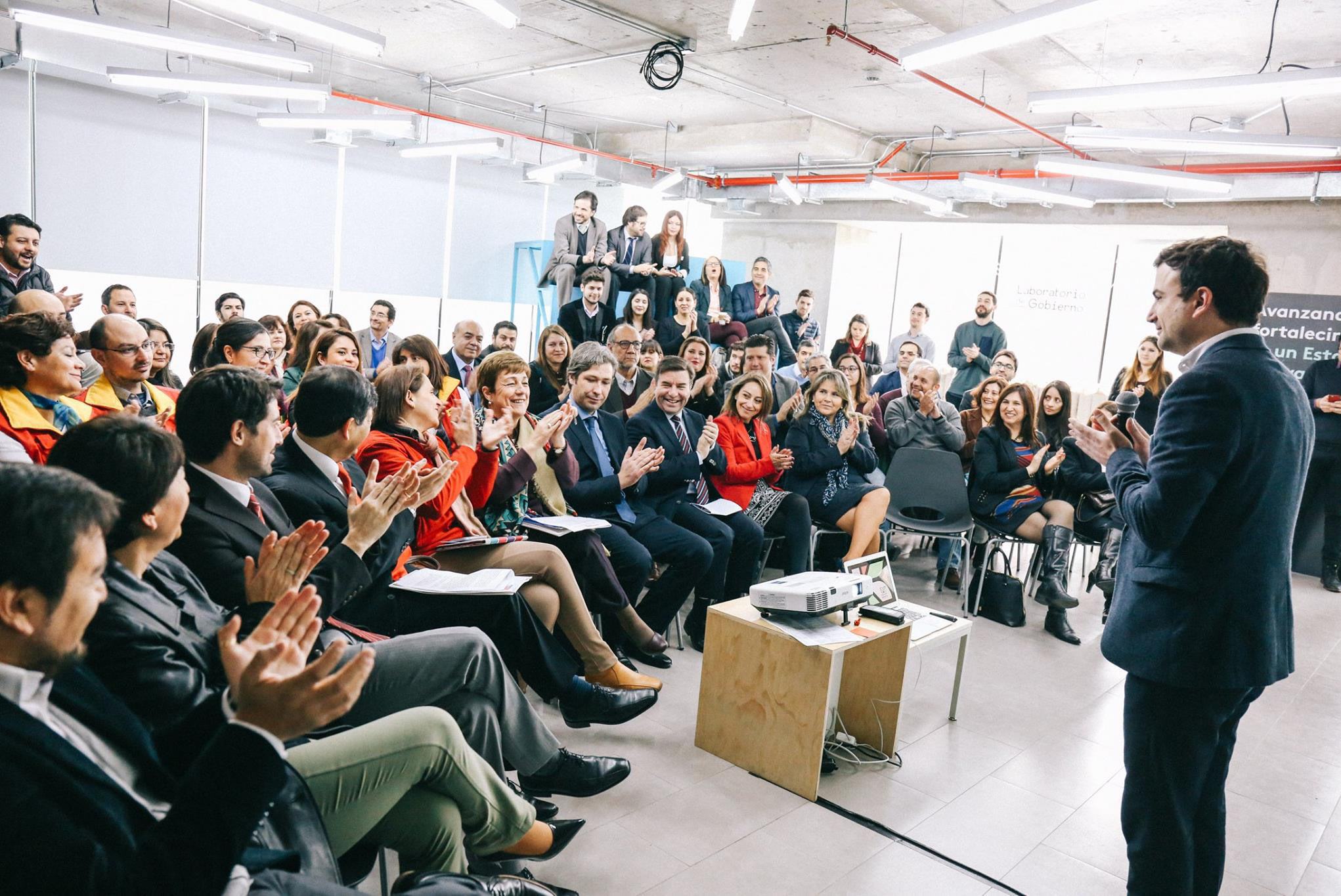
Nesta Innovation Skills team visiting Laboratorio de Gobierno in May 2015
Foreword
The journey of the Laboratorio de Gobierno over the last three years has been impressive to witness. We first met the team in May 2015 when they had just completed their initial team recruitment and were beginning the daunting process of converting their grand ambitions into reality. They had been overwhelmed with applications – several thousand people had applied to join a team of 17 – demonstrating the growing appetite for finding and adopting better ways of working across the Chilean Public Service.
In recognition of this broader demand, the lab team quickly realised that building the innovative capacity of the broader Chilean public service would be a critical part of their role, which in turn led to the Experimenta programme. From the outset, the team was determined to learn from the best examples from around the world, to commit to the highest quality of learning design, and to experiment with, iterate on and document their approach.
Three years later and the results of the Experimenta programme are both real and profound. The programme has not only equipped a sizeable cohort of civil servants with real innovation skills, but it has also demonstrated that learning these skills can go hand in hand with solving public challenges and developing an enabling environment for innovation to happen. It has created a renewed sense of belonging and community in participants, and a sustained commitment to new ways of working that will endure beyond their participation in the programme.
Governments around the world are increasingly looking for ways to be more innovative, and to give their officials the motivation, opportunity and ability to be more experimental in addressing public policy challenges. We recognise that traditional public administration education institutions have not always been quick to respond to this demand, and the task has often fallen to practitioners, such as Laboratorio de Gobierno, to simultaneously demonstrate these ways of working while building the next generation of public innovators. This indeed is the inspiration for our global learning collective, States of Change, to consolidate our shared understanding of innovation practice and to accelerate our collective efforts to spread this practice.
We are therefore indebted to the team and their commitment to documenting their approach, so that their practice can be legible to the outside world. Experimenta is an archetype of what a high quality innovation learning programme should look like. With the details contained in this report, we hope that Experimenta can be studied, imitated, replicated and even plagiarised (with due acknowledgement of course!) as we collectively move forward to integrate these approaches and mindsets into the everyday practice of governments around the world.
We are very grateful to ProChile for making this report possible. Thanks to the lab team for their help in researching and compiling this report, especially Gianncarlo Durán, Beatriz Hasbún, Juan Felipe López and Katalina Papic. Thanks also to Experimenta's participants and faculty who have helped us with our research.
My thanks finally to the Nesta team – Bas, Paulina and Diana – who have shown the same care and attention to detail in this report that the LabGob team put into the Experimenta programme in the first place.
Brenton Caffin
Nesta - Executive Director, Global Innovation Partnerships
CHAPTER 1 Introduction
In this chapter we describe the aims and structure of this report, followed by a description of how Laboratorio de Gobierno is set up and a short introduction to the lab's flagship capacity building programme Experimenta.
1.1 About this report
1.1.1 Aims
Since the start of Laboratorio de Gobierno in 2015, it has always had a strategic priority to build innovation capacity and enable innovation in Chile's public sector. As part of this strategy, Laboratorio de Gobierno developed a capacity building programme called Experimenta. Now, after almost completing two editions of the programme, the government of Chile has asked Nesta's Innovation Skills team to review the outcomes of the programme and reflect on the design of the programme to understand how it works. This report as three aims:
- Identify the outcomes and unique value created by the programme.
- Capture and codify the core elements and structures that underpin the design and implementation of the programme. It should help others who want to design and run a similar programme by giving them a model to start with.
- Provide suggestions and recommendations that help Laboratorio de Gobierno improve their programme.
1.1.2 Structure
This report is divided into three sections, which each cover one of the three aims.
- In chapter two, "The Unique Value", we focus on the key question: what are the outcomes, and what is the unique value created by the programme? We present key stats and discuss the more qualitative outcomes produced by the programme.
- In chapter three, “Principles, Elements and Structures", we focus on how these outcomes and unique value were generated. We aim to unpack the programme's underpinning elements and structures, looking at both the explicit curriculum that is described in the documentation (programme guides, facilitator guides, evaluation and progress reports, learning materials), and the implicit curriculum, which is also known as the "hidden curriculum", and includes the consensus, ideas and beliefs that is shared by the innovation capabilities team and/or faculty,
- In the chapter four, "Improvements and Recommendations", we report on the improvements and changes that have been made in Experimenta's second edition and, based on our review and analysis, we provide suggestions and recommendations for improving the programme and amplifying its value.
1.1.3 Research design
When we started our work in November 2017, the first edition of Experimenta – which had started in 2016 – was already completed, while the second edition that had started in 2017 was still running. There are also plans for a third edition to start in early 2018. In this report we look at the first two versions and try to draw a comprehensive picture of the programme. In order to develop this picture, we use several data points and sources. The research process was structured into three stages:
- For the first stage, we aimed to identify the explicit elements, structures and outcomes of the programme. We studied the (extensive) documentation (e.g. syllabi), learning materials, and evaluations provided by Laboratorio de Gobierno and supplemented this desk research with interviews with the lab's innovation capabilities team.
- For the second stage, we travelled to Santiago and spent a week at Laboratorio de Gobierno. During this week, we carried out interviews with the innovation capabilities team and the CEO of the lab, ran workshops with participants and faculty to learn about their experiences, observed a training session and attended the first national summit of Innovadores Públicos (which is indirectly related to Experimenta). During this week we aimed to identify the "secret ingredients" – the elements and structures that constitute the hidden curriculum of Experimenta.
- The third stage focused on analysing the data and reflecting on our insights. To fill some gaps or verify any assumptions, we carried out additional interviews with the innovation capabilities team, and sent a survey to a selected group of participants to better understand the identity and brand of Experimenta.
After these three stages, we began writing and designing the report. As part of this final stage, we organised a "design sprint" in London with Gianncarlo Durán (Head of the Innovation Capabilities Division) and Beatriz Hasbún (Learning Experience Designer) from Laboratorio de Gobierno's team in order to review the content. To ensure the report's objectivity and to maintain our integrity, they were not involved in chapter two (outcomes and key value) or the recommendations of chapter four.
1.2 About Laboratorio de Gobierno
A decorative image showing the "Laboratorio de Gobierno" branding visible on a glass wall or partition, often seen in office environments.
1.2.1 Aims and mission
Since the 1990s, the Chilean government has had a long tradition of reforms, modernisation and innovations. But there had never been a dedicated unit responsible for encouraging innovation within the public sector. In her annual state-of-the-nation address in May 2014, President Michelle Bachelet opened the possibility for such a function when she stressed the role for innovation: "we have to go one step beyond modernisation, actively promoting an innovative state". This call to action started the process that eventually led to establishing Laboratorio de Gobierno. The lab was set up to:
- Create a better relationship between people and government based on enhanced trust
- Better understand and tackle complex problems
- Improve productivity and deliver better public services with lower cost
1.2.2 Principles
Five principles inform how the lab operates and how it designs and manages its programmes:
- Human centred: Building empathy with users and putting people at the centre of decision making is a central premise of the lab's innovation approach. Understanding people's needs, assets, motivations and capacities – whether they work for the public sector or not – helps to develop better solutions for them and also helps them to become change agents in the innovation process.
- Co-creation: To complement the human centred approach, Laboratorio de Gobierno uses co-creation to enable active collaboration between different stakeholders. This approach focuses on opening spaces, using tools and incentivising stakeholders to co-discover, co-define, co-design and co-implement innovation with the ultimate goal of creating impact.
- Systemic view: This involves integrating multiple perspectives through a holistic approach to problems and solutions. The lab's cross-sectoral approach and use of systemic thinking has allowed them to break sectoral and management silos in order to deal with the complexity of public challenges.
- Experimentation: The Laboratorio de Gobierno uses this approach to develop learning programmes and solutions. By prototyping and having a structured approach to learning from mistakes, practical knowledge is constructed that helps to inform, improve and develop feasible solutions.
- Focus on experience: The lab promotes new ways of understanding and communicating with others through techniques such as storytelling and visual thinking. It also provides an innovation experience that is generated by a carefully orchestrated journey of activities and interactions, involving the physical space for activities as well as touchpoints related to branding, identity and workshop materials, which helps make the process of public innovation a meaningful and culturally transformative experience¹.
1.2.3 The team
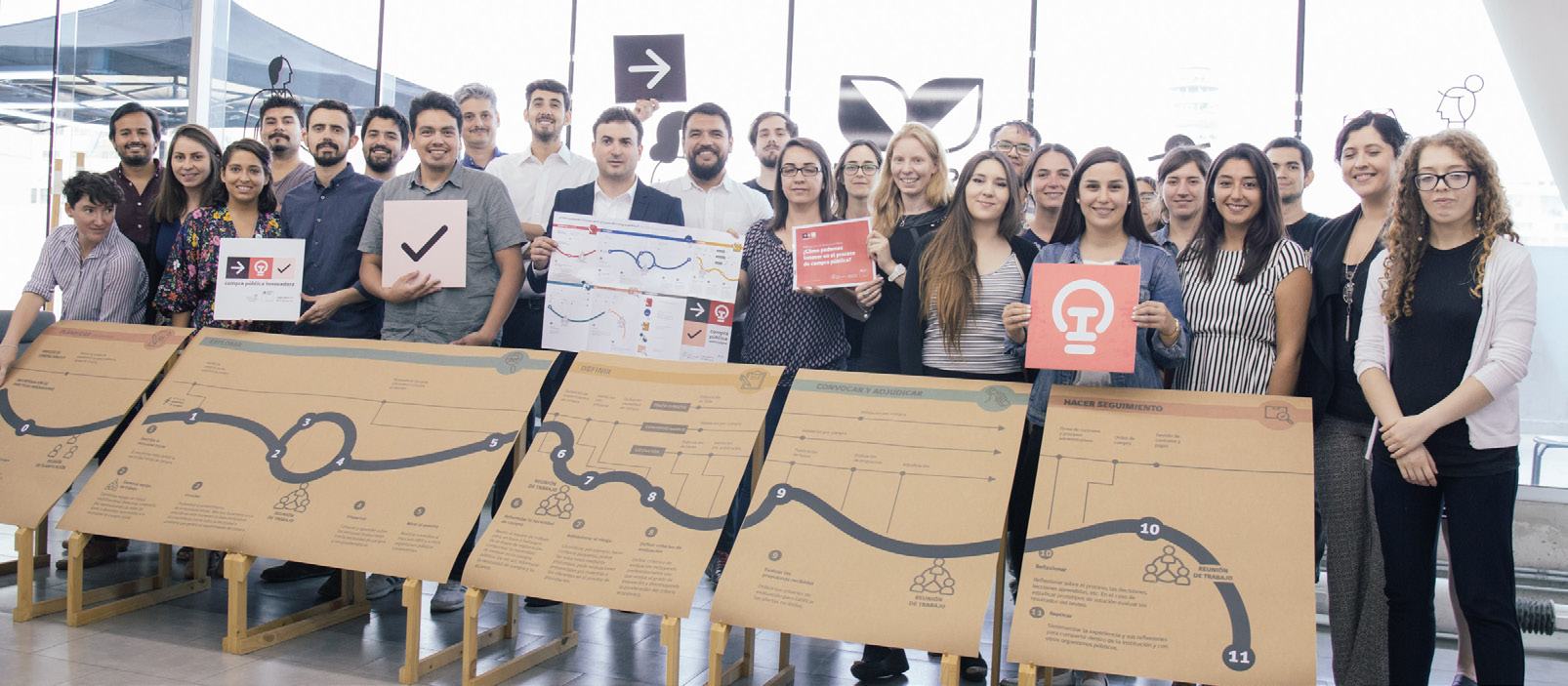
Bringing such principles to life requires a team that has broad as well as deep skills and knowledge. Broad skills allow people to work across domains and disciplines, whereas deep skills add specialist expertise and technical skills to the mix. The need for a hybrid set of skills is reflected in the lab's multidisciplinary design, with backgrounds in design, art, policymaking, communication, education, social sciences and more. The team consists of 20 people, about 30% of them are external consultants.
1.2.4 The lab as an ecosystem
Innovation labs have many forms and structures. To understand how Laboratorio de Gobierno works, and how Experimenta fits into its portfolio, it is important to look at the lab as not only a team. Instead, it can be best seen as an ecosystem that involves various stakeholders and is driven by a set of programmes and initiatives (see figure 1). These programmes and initiatives are structured around three streams of activity: exploring and problem solving, training, and connecting and mobilising. Before we explain Experimenta in more detail, we will first briefly explain each of its programme:
- Proyectos: involves projects that address public challenges and develop solutions that have an impact for the people of Chile. For example, Laboratorio de Gobierno worked with electricity suppliers and users to co-create an electricity bill that helps them to understand how much energy they actually use, and how to reduce it.
- Impacta: through an open innovation call, Impacta aims to mobilise people around public issues such as energy, tourism and perception of security, and to tap into their talent and expertise to tackle these complex and pressing issues.
- AULAB: this programme is an open innovation call, similar to Impacta, but specifically designed for higher education students.
- Funciona!: an award issued by Laboratorio de Gobierno and Servicio Civil (the human resources office of the civil service) for public sector institutions that have successfully implemented innovation.
- Innovadores Públicos: a network of public innovators that is run by and for civil servants. It is closely related to Experimenta and plays a crucial role in spreading and embedding innovation skills in public sector institutions. The network runs as both a face-to-face and digital space where all Chilean civil servants can come together, motivated by improving the public services that they deliver to people and thus re-engaging collectively with the public mission. All the network's activities are based on generating collective learning, connecting the motivations of members and raising the visibility of existing public innovations. Currently there are more than 3,200 members, and its first national summit attracted over 400 civil servants.
Figure 1: Laboratorio de Gobierno's ecosystem
A diagram titled "Laboratorio de Gobierno's ecosystem" illustrating three main streams of activity: "Exploring & Solving", "Training", and "Connecting & Mobilising".
Under "Exploring & Solving" are two programs:
- Proyectos
- Impacta (with "CONCURSO ABIERTO DE INNOVACIÓN PÚBLICA" below it)
Under "Training" are two programs:
- EXPERIMENTA
- Innovadores públicos
Under "Connecting & Mobilising" are two programs:
- AULAB
- Funciona! (with "programa apoyos institucionales" below it)
Arrows connect all these programs to a central "Laboratorio de Gobierno" block, and "EXPERIMENTA" is shown feeding into "Innovadores públicos", illustrating the interconnectedness of these initiatives.
1.3 About Experimenta
1.3.1 Building innovation capacity
Experimenta is Laboratorio de Gobierno's flagship capacity building programme. It is a practice-based programme that aims to build innovation capacity in Chile's public sector institutions². Building this innovation capacity involves three elements:
- Abilities: teams are equipped with the hard and soft skills to effectively use innovation methods and tools that help them carry out innovation processes.
- Motivations: teams are intrinsically and extrinsically motivated to adopt new ways of working and enhance their performance.
- Opportunity: teams have the opportunity, which involves structures and conditions, to effectively use and develop their skills.
1.3.2 Learning by doing
It is particularly the practice-based nature of Experimenta that is different from the normal repertoire of learning programmes for civil servants. Often these programmes focus primarily on conceptual learning. However, having only theoretical knowledge of innovation methods and processes doesn't mean that learners can then effectively manage and run innovation processes in practice. In reality, these processes are a lot more complex than textbooks can describe. The premise of Experimenta is therefore to challenge this dominant learning modality and demonstrate the value of experiential learning. This is key to Experimenta's learning philosophy. Experiential learning takes the actual experience of solving public problems as the source of learning. Participants "learn by doing" by actively using innovation methods and tools, collaborating across silos and with various stakeholders, while at the same time creating an enabling environment to make innovation happen.
1.3.3 Working on real life public challenges
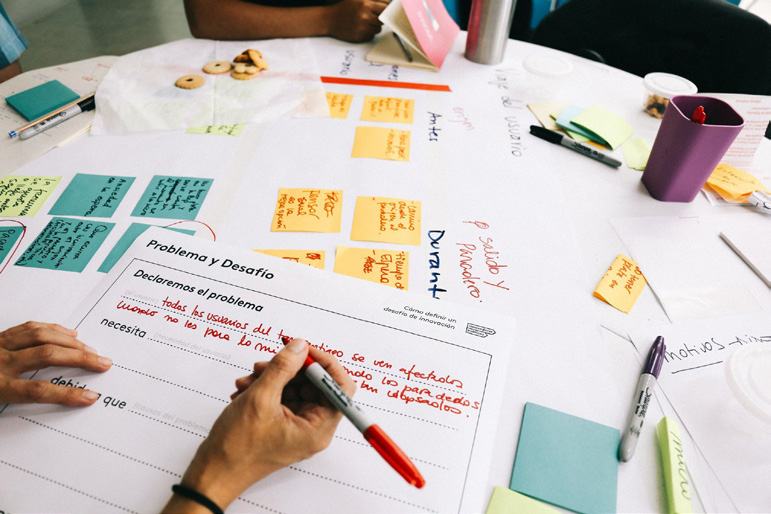
During the programme, teams of civil servants work on projects that address real life public issues. Working on real life issues makes learning relevant and enhances the participants' learning experience, while at the same time serving the strategic agenda of their institution. While working on these projects, teams are supported with training and mentoring sessions. In the training sessions, teams learn to develop their skills around how to use specific innovation methods and tools. In the mentoring sessions, teams discuss their challenges and reflect on their experiences. Both the training and mentoring sessions are facilitated by experienced innovation practitioners.
1.3.4 Co-designing with experts
These experienced practitioners are also actively involved in the design process of the programme, working closely together with Laboratorio de Gobierno's team. This approach adds credibility to the programme as it builds on the experience and expertise of practitioners, while also increasing ownership.
1.3.5 Two cohorts
So far, Laboratorio de Gobierno has run two editions of Experimenta. The first edition started in 2016 and included 11 teams (81 participants) from national and local government. This cohort consisted of two groups: one based in Santiago and the other in Concepción. The second edition started in 2017 and is an improved version of the 2016 edition. It included 19 teams (196 participants), also from both national and local levels. This cohort consisted of three groups: two groups based in Santiago and one group in Puerto Montt.
Institutions participating in the Experimenta Program - Cohorts 2016 & 2017
| 2016 |
2017 |
| Santiago chapter: |
Santiago chapter - Group 1: |
| 1. Dirección General del Crédito Prendario |
1. Subsecretaría de Vivienda y Urbanismo |
| 2. Servicio de Salud Metropolitano Oriente |
2. Instituto de Previsión Social |
| 3. Servicio de Registro Civil e Identificación |
3. Subsecretaría de Telecomunicaciones |
| 4. Ministerio del Deporte and Instituto Nacional de Deportes |
4. Fondo de Solidaridad e Inversión Social, O'Higgins |
| 5. Tesorería General de la República |
5. Superintendencia de Salud |
| 6. Municipalidad de Providencia |
6. Agencia de Calidad de la Educación. |
| 7. Municipalidad de Peñalolén |
7. Superintendencia de Electricidad y Combustibles |
| Concepción chapter: |
Santiago chapter - Group 2: |
| 1. Servicio Médico Legal, Biobío |
1. Municipalidad de Renca |
| 2. Seremi de Vivienda y Urbanismo, Biobío |
2. Municipalidad de La Pintana |
| 3. Hospital Regional de Talca |
3. Gobierno Regional de Valparaíso |
| 4. Municipalidad de Hualqui |
4. Gobierno Regional de Biobío |
|
5. Servicio de Salud Metropolitano Occidente together with Servicio Nacional de Menores |
|
Puerto Montt chapter: |
|
1. Servicio Nacional para la Prevención y Rehabilitación del Consumo de Drogas y Alcohol, Los Lagos |
|
2. Gobernación Provincial de Chiloé |
|
3. Instituto de Desarrollo Agropecuario, Los Lagos |
|
4. Dirección de Aeropuertos, Los Lagos |
|
5. Servicio de Salud Valdivia |
|
6. Servicio de Salud Osorno |
|
7. Servicio de Vivienda y Urbanización, Los Lagos |
CHAPTER 2 Unique value
In this chapter we discuss the main outcomes and unique value of the Experimenta programme. We first describe the key statistics, followed by an account of the unique value generated by Experimenta, and concluding with a reflection on the international position of the programme.
2.1 Key statistics
Throughout the design, development and implementation of the programme, Laboratorio de Gobierno's team has used various indicators to keep track of progress and achievements. Below we describe the key figures that illustrate the programme's outcomes (also see figure 2).
2.1.1 First edition (2016)
For the first edition of Experimenta that started in 2016, 51 teams from five regions of Chile applied for the programme, and 11 teams were selected. All teams completed the programme, involving a total of 81 civil servants. The programme included 58 training sessions and 209 mentoring sessions, run by a faculty of 17 experts.
While going through the programme, all teams managed to develop a solution that addressed their public challenge. So far - at the time of writing this report - five teams have successfully implemented their solution, and this number is likely to increase over time as effective implementation takes time. What's interesting is that seven teams so far - have managed to institutionalise innovation practice within their agencies. This means that they have created innovation roles, functions and support structures, and have actively improved conditions for innovation to happen. Three teams created a role for an innovation coordinator (Tesorería General de la República; Hospital Regional de Talca; Municipalidad de Peñalolén), five teams have been running learning programmes based on Experimenta (Municipalidad de Peñalolén; Tesorería General de la República; Servicio de Salud Metropolitano Oriente; Municipalidad de Providencia; Municipalidad de Hualqui; Hospital Regional de Talca), and four have set up innovation teams (Tesorería General de la República; Municipalidad de Peñalolén; Hospital Regional de Talca; Municipalidad de Hualqui).
2.1.2 Second edition (2017)
For the second edition that started in 2017, 30 teams applied for the programme. For this edition 19 teams were selected, involving 196 civil servants. All teams have completed the programme. The programme included 63 training sessions and 315 mentoring sessions, run by a faculty of 23 experts.
All teams have developed a potential solution addressing a public challenge. The number of successfully implemented solutions is not known yet because the programme was still running at the time of writing of this report. However, so far five teams have managed to embed innovation practices within their agencies: Subsecretaría de Vivienda y Urbanismo, for example, is developing a national online learning programme; Instituto de Previsión Social is creating an innovation unit; and Gobierno Regional de Biobío has created an innovation coordinator role for one of the team members.
Figure 2: 2016-2017 programme comparison
|
2016 |
2017 |
| Applications received |
51 |
30 |
| Teams selected |
11 |
19 |
| Civil servants involved |
81 |
196 |
| Solutions created |
11 |
19 |
| Solutions successfully implemented |
5 |
(Programme is still running) |
| Mentors / trainers (experts) involved |
17 |
23 |
| Training sessions delivered |
58 |
63 |
| Mentor sessions delivered |
209 |
315 |
| Institutions that have institutionalised public innovation |
6 |
5 |
2.2 Cost efficiency
Figure 3: Key statistics from Experimenta and its predecessor
A line chart showing "Key statistics from Experimenta and its predecessor".
The y-axis ranges from 1x to 14x.
The x-axis categories are GIP 2015, Experimenta 2016, Experimenta 2017, and Experimenta 2018.
Multiple lines represent different metrics (COST USD, BENEFICIARY INSTITUTIONS, INVESTMENT BY INSTITUTION USD, METHODOLOGICAL EXPERTS, DURATION IN MONTHS) and their evolution across the years.
COST USD
- GIP 2015: USD$1.152k
- Exp 2016: USD$446k
- Exp 2017: USD$569k
- Exp 2018: USD$423k
BENEFICIARY INSTITUTIONS
- GIP 2015: 10
- Exp 2016: 12
- Exp 2017: 19
- Exp 2018: 21
INVESTMENT BY INSTITUTION USD
- GIP 2015: USD$115k
- Exp 2016: USD$37k
- Exp 2017: USD$30k
- Exp 2018: USD$20k
METHODOLOGICAL EXPERTS
- GIP 2015: 7
- Exp 2016: 3
- Exp 2017: 4
- Exp 2018: 4
DURATION IN MONTHS
- GIP 2015: 14
- Exp 2016: 10
- Exp 2017: 8
- Exp 2018: 5
The GIP (Public Innovation Management Fund) which was led by Corfo from 2013-2015 and financed expert organisations outside of the public sector to manage innovation systems in a specific number of public institutions.
Looking at the costs of Experimenta (see figure 3), we can see that the these have reduced over the editions - enabling more teams to take part for less. The total cost for running the 2016 edition was USD$446k and USD$569k for the 2017 edition. The costs were higher in the second edition as it served almost twice the number of teams. When we look at the cost per institution, we see that it has become more cost efficient through scaling the number of teams more teams have been served without significantly increasing the number of facilitators. For the first edition the cost per institution was USD$37k, and for the second edition the cost involved was USD$30k. For the third edition in 2018 costs, the costs are estimated to reduce further (±USD$20k per institution) as costs for learning design have already been covered in the previous two editions.
2.3 Unique value of Experimenta
The graph in the section above shows that Experimenta is cost effective in terms of building skills and helping teams to generate and implement solutions for strategic public issues. Apart from these numbers, we see that Experimenta has generated outcomes that are not always easy to quantify. Results show, for example, that participants have adopted new ways of working that are more collaborative and people-centred, enabling them to solve public challenges more effectively. We also noticed that the programme has helped participants develop professional identities as a public innovator, connecting them with a thriving network of public innovators. Below we describe the outcomes that demonstrate the unique value of Experimenta in more detail.
2.3.1 Experimenta helps civil servants to develop a set of essential innovation skills and mindsets
When we look at the structure and content of Experimenta, it is fair to say that it is an archetype of an innovation learning programme. If there were to be a "standard" version of an innovation learning programme, then it would or actually should - look like Experimenta. From all the innovation learning programmes we in Nesta's Innovation Skills team have seen, Experimenta includes all the essentials that we find in almost every one of them. These essentials are:
- Building empathy
- Framing problems
- Generating ideas
- Testing ideas, iteration and prototyping solutions
- Co-creating solutions
The programme provides teams with a structure (i.e. process) and a set of essential tools and methods, which help them to explore the nature of a problem and learn about people's experiences and motivations in order to develop solutions that better fit people's needs and everyday routines.
But the value of the programme goes beyond just skills. Evaluations show that most teams have adopted mindsets that are more people centred (putting users and people at the heart of decision making) and experimental (adopting a process of continuously testing and improving ideas). They have also embraced the approach of co-creating (actively involve people and other actors to develop solutions together). The evaluations show, for example, how the problem definition of each team developed over time and became more user-centred. The teams also started using the tools and methods in their everyday practices, and several teams (Municipalidad de Peñalolén; Tesorería General de la República; Servicio de Salud Metropolitano Oriente; Municipalidad de Providencia; Municipalidad de Hualqui; Hospital Regional de Talca) have even developed learning programmes to spread these skills and tools across their departments.
2.3.2 Experimenta enables civil servants to become effective change agents for the public good
Interviews with participants along with the programme evaluations show that Experimenta is a transformative learning experience. There are three dimensions that drive this transformation: changes in skills and behaviours, changes in belief systems, and changes in identity³. We see that at a skills level Experimenta helped civil servants to build confidence in using innovation tools and methods in their everyday practice. For example, they started using innovation tools such as customer journeys, brainstorming, prototyping and testing in their everyday work (Ministerio del Deporte e Instituto Nacional de Deportes; Tesorería General de la República; Municipalidad de Peñalolén; Servicio de Salud Metropolitano Oriente; Hospital Regional de Talca; Seremi de Vivienda y Urbanismo Biobío; Servicio Médico Legal Biobío; Municipalidad de Hualqui). We also see that at a deeper level, participants have changed their beliefs as one participant explained, for example, from "Innovation is only for the select few" to "I can innovate, and actually everyone can!". This indicates a transformation of the self; participants have become aware that they can be active agents of change. This is part of developing an identity as a public innovator. Additionally, the lab has empowered some of the teams to set up their own innovation function within their department (e.g. Municipalidad de Peñalolén has set up Peñalab and TGR created an innovation unit), or to start training their direct colleagues (also stimulated by the train-the-trainer programme).
2.3.3 Experimenta provides a safe space for trying new ways of working and collaborating
Experimenta offered civil servants a space to collaborate across departments, as well as a "safe space to fail" and try out new ways of working. As with most governments, working across departments is often a struggle and Chile is no exception to this. Even if there is the opportunity to collaborate, then the dynamics of managing different interests, working styles and perspectives can be daunting. The participants found managing this diversity in their teams frustrating, but they also described learning this soft skill as one of their key learning outcomes. As well as offering a space for collaboration, Experimenta also offers the space - in terms of time, support and opportunity - to try out new ways of working (e.g. directly engaging with citizens and testing prototypes with them). This allowed the teams to build solutions that better fit the needs of citizens. The need for a safe space was mentioned by one of the participants from 2016 during the team interview: "We actually miss Experimenta, our weekly sessions. It was a place where we could do things we normally didn't do at our office, and also discuss our struggles, challenges and concerns with our mentor and peers".
2.3.4 Experimenta connects civil servants with a support network of peers and experts
Learning together ("we learn, they learn, everybody learns") runs through the wider portfolio of Laboratorio de Gobierno and is particularly important for the Experimenta programme. Learning, doing and solving problems together is interwoven into every activity, and adding this social dimension helps participants establish durable relations with colleagues, experts, the lab and its peer network Innovadores Públicos. We consider these relations as crucial for providing a safe learning and working environment: peers and mentors can give emotional and technical support when the innovation or learning process feels daunting or when a team gets stuck. We noticed that the mentors particularly played a central role in this process. Conversations with the faculty showed that many mentors have developed friendships and working relationships that go beyond the learning programme. Also, the train-the-trainer programme has helped participants to further develop their role as a public innovator, spreading skills across their colleagues and developing enabling environments for innovation to happen.
2.3.5 Experimenta generates value at different levels for various stakeholders
The outcomes described above suggest that Experimenta has for the most part generated value for its teams and participants (see figure 4). Yet, when we take a step back and look at the wider network of stakeholders (also see figure 11) we see that Experimenta has created value at multiple levels for various actors.
For example, the solutions that have been implemented so far have, as a result of a people centred focus and iterative approach, created public services that better fit the needs of citizens and users (for example, the Nexo Project designed by the Hospital Regional de Talca's team, or the new User Assistance Protocol designed by the Tesorería's team). Teams managed to align innovation approaches to the core business of government, making services more efficient and effective and helping institutions achieve their strategic objectives.
We believe that the combination of "learning by doing" and using public challenges situated in the real world as a vehicle for learning - rather than situated in a fictitious or simulated learning environment - produced ripple effects of substantial change that went beyond the ambition of the lab.
2.4 International position
Figure 4: Civil servants before, during and after Experimenta
A diagram illustrating the transformation of civil servants "before, during and after Experimenta".
BEFORE THE PROGRAMME
A team of civil servants that want to learn how innovation can help them address a strategic problem within their institution.
(Arrow pointing right)
DURING THE PROGRAMME
A stylized logo with a heart-like shape and "EXPERIMENTA" text, representing the program itself.
(Arrow pointing right)
AFTER THE PROGRAMME
* A new service that addresses the problem and is ready to be implemented
* A team trained with essential public innovation skills
* A public sector institution motivated to spread and sustain innovation practices
In our work with other labs and public innovation teams, we see that many of them offer learning or capacity building programmes of some sort. The purpose of these programmes is to increase the impact of their work. There are broadly two categories of learning or capacity building programmes: problem focused and learning focused. For the first category the learning programme is a means to an end, so they focus on building capabilities to address a specific public problem. For the second category, programmes serve a more generic objective by developing a comprehensive set of competencies that can be used for various public issues.
When looking at the international landscape of innovation learning programmes, we see that various programmes fall under the first category of focusing on problems. Experimenta falls under the second category; its primary focus is to develop innovation capacity. There are other international players that offer programmes with a similar purpose, but often these programmes are one-offs (e.g. Masterclasses, Executive Programmes) that offer a 'deep dive' on a specific method or set of principles. Experimenta is different to such programmes in two respects. Firstly, while Experimenta focuses on learning it also manages to effectively address public challenges and create enabling environments for innovation to happen. Secondly, Experimenta is a constituent part of a wider portfolio or ecosystem of programmes and initiatives (see figure 1). The relation between Experimenta and the Innovadores Públicos in particular offers a unique value, allowing Experimenta's participants to join a thriving and active network that helps them advance their career as a public innovator. We haven't seen examples of such networks in the international landscape that match the size, level of activity and member commitment as we see with Innovadores Públicos.
CHAPTER 3 Principles, elements and structures
In this chapter we discuss how Experimenta is designed and managed. We look at the explicit structures and elements (e.g. learning objectives, agenda, roles) and use an "Elements of Learning Experience Design" framework to break the programme down into its constituent parts. In addition to this, we describe key elements of the "hidden curriculum" that are often more tacit or implicit, but that largely shape the learning experience and indirect outcomes of the programme.
3.1 Programme design and management
Before we describe the constituent elements and structure of Experimenta, it is important to understand how the programme is designed and managed. We will therefore first describe the key actors, their roles and responsibilities.
3.1.1 Core team and support
Various teams from Laboratorio de Gobierno are involved in the design, management and delivery of Experimenta. The innovation capabilities team forms the core, and as the programme managers they work closely with the administrative & legal team and the communications & production team.
- The lab's innovation capabilities team are responsible for the design, implementation, review and quality control of the programme. They ensure that the learning experience is consistent and coherent, and that learning design and materials meet high quality standards. The team serves as the main point of contact for teams and their institutions, trainers and mentors. Team members are typically "T-shaped", meaning they hold both broad knowledge (the horizontal bar) and deep knowledge (the vertical bar). Key competency areas of the team are: domain knowledge about the Chilean public sector, user-centred mindset and skills, and learning design skills.
- The faculty of innovation experts are responsible for the delivery of the programme and also play a crucial role in its design. During delivery, the faculty play the role of trainer and mentor. The faculty consists of innovation practitioners, who are procured by the lab specifically for the design and delivery of the programme. They have backgrounds in design and innovation management, and have experience in facilitating and designing learning programmes.
- The lab's administrative & legal team provide administrative support and help with legal back-end of the programme, which involves the design of legal solutions and providing support for bidding and contracting. Team members have a background in law, public administration and accounting.
- The lab's communications & production team helps the innovation capabilities team produce communication and learning materials, and ensures that they are aligned with Experimenta's visual identity. They also oversee the logistics and promotion of the programme. Team members have backgrounds in design, art direction and journalism.
3.1.2 Design and review process
The programme is the result of a co-design process that involves both the faculty and the lab's innovation capabilities team. In this process, the innovation capabilities team provides the objectives and guidelines for the process, and the experts design the sessions. This approach adds credibility to the programme as it builds on the practical experience and expertise of practitioners, while also increasing ownership.
Part of this involves a continuous review process. For this, the Laboratorio's team has set up a review committee that convenes at least twice a month for a review session. During these sessions the learning objectives, content and materials for each module are revised and adapted to the progress of the teams, with input from the trainers and mentors. This continuous process of improvement helps the learning teams to reach the desired outcome for each module and the programme as a whole.
3.2 Key elements and structures
3.2.1 Analysis framework
Figure 5 presents the different elements needed to create a learning experience. However, for the purposes of this report, we have used it to analyse the programme's constituent elements and structures. It features eight elements that need to be considered - and most importantly, aligned - to make a learning experience effective. For each of these elements, the overall vision of learning (i.e. the pedagogy) will form the basis of the decision making, We start with a description of this vision, then we describe the elements structured around their overarching categories:
- Narratives: describes the learning journey, its modalities and content
- Enablers: describes the environments and resources that enable the learning process
- Actors: provides a profile of the learning audiences and faculty
- Impact: describes the intended outcomes and evaluation methods
Figure 5: Elements of Learning Experience Design by Nesta
A circular diagram titled "VISION ON LEARNING" in the center, illustrating "Elements of Learning Experience Design by Nesta".
The inner circle contains "LEARNING JOURNEYS & EXPERIENCES".
An outer ring is divided into eight segments, clockwise from top:
- OUTCOMES (under IMPACT)
- EVALUATION (under IMPACT)
- MODALITIES (under NARRATIVES)
- CONTENT (under NARRATIVES)
- ENVIRONMENTS (under ENABLERS)
- RESOURCES (under ENABLERS)
- AUDIENCE (under ACTORS)
- FACULTY (under ACTORS)
The segments are grouped under four overarching categories: IMPACT, NARRATIVES, ENABLERS, and ACTORS, which are themselves positioned along the outer edge of the inner circle.
3.3 Vision on learning
3.3.1 Purpose of the pedagogy
The vision on learning or the pedagogy - describes the lab's learning philosophy and provides principles and guidelines for the design and delivery of the programme. Experimenta's pedagogy aims to situate learning in practice and to champion learning by doing. It tries to avoid creating a one-size-fits-all programme that cannot be embedded into the contexts of different institutions. It is particularly the practice-based nature of Experimenta that is different from the normal repertoire of learning programmes for civil servants, which often focus primarily on conceptual learning. Through the learning-by-doing approach, the aim of the programme is to create agents of innovation in the public sector.
3.3.2 Kolb's experiential learning theory
The pedagogy of Experimenta largely builds on Kolb's theory of experiential learning⁵. Kolb's theory provides a foundation for practice-based learning in a professional context. It considers learning as a continuous process that is grounded in actual experience and strengthened by reflecting on this experience. Learning therefore happens best in a "real world" environment, according to Kolb.
3.3.3 What experiential learning means for Experimenta's participants
The principles of experiential learning create a process that strengthens for the learners the links between the work context, personal development and education. Throughout the process, participants 'learn by doing' by working together on public challenges and using innovation methods and tools, while at the same time developing the conditions and structures to make innovation happen.
This process is further enhanced by adding a social dimension. By bringing together teams from different institutions, the programme merges together the experience of various actors with different cultures, disciplines, domains and backgrounds. The aim is to create a learning experience that brings together the experience and knowledge from the participant institutions in order to build up a learning community of civil servants and enable social learning.
3.3.4 What experiential learning means for learning design
For learning designers, Kolb's experiential learning cycle (see figure 6) offers a practical framework to plan and structure a learning session or programme. Ideally, for a learning session to be effective, a learner should go through all four stages of the cycle. The cycle has four stages or learning activities:
- Experiencing a new situation or recreating a known situation.
- Reflecting on these experiences and identifying discrepancies between experience and initial (conceptual) understanding.
- Conceptualising by forming (new) ideas or modifying existing concepts, and by developing broad principles or general rules of thumb and 'success models' for what works and how.
- Experimenting in reality through applying new ideas or modifications, implementing tools, methods and key concepts, or testing hypotheses.
3.4 Narrative
Figure 6: Experiential Learning Cycle
A circular diagram illustrating the "Experiential Learning Cycle".
The cycle consists of four stages arranged in a circle, moving clockwise:
1. EXPERIENCING (followed by "DOING" arrow)
2. REFLECTING (followed by "THINKING" arrow)
3. CONCEPTUALISING (followed by "THINKING" arrow)
4. EXPERIMENTING (followed by "DOING" arrow)
Arrows indicate continuous movement through the cycle.
In this section, we describe what the Experimenta learning journey looks like and how the programme works. We start with a summary of the programme, followed by a more detailed description of each module.
Figure 7: Experimenta's programme journey
A timeline diagram illustrating "Experimenta's programme journey", with a central line representing the flow.
Key stages on the main timeline:
- APPLICATION PROCESS
- WELCOME CEREMONY
- TRAINING SESSIONS X 4
- MENTORING SESSIONS X 4
- SELF-GUIDED PROJECT WORK
- TRAIN-THE-TRAINER SESSIONS AND SKILLS TRANSFER
- VALIDATION SESSIONS
- CLOSING CEREMONY
- IMPLEMENTATION
A dashed box labelled "4 CORE MODULES" encompasses "TRAINING SESSIONS X 4", "SELF-GUIDED PROJECT WORK", "VALIDATION SESSIONS", and an 'X4' marker below the "TRAIN-THE-TRAINER SESSIONS AND SKILLS TRANSFER".
3.4.1 The learning journey in brief
The Experimenta learning journey involves a range of activities and learning sessions. It starts with an open call for civil servant teams to apply, and a committee then selects the teams that will be part of the programme. These selected teams are invited to a welcome ceremony for the official kick-off of the programme.
The core of the programme comprises a series of training and mentoring sessions that guide teams through the innovation process. This process is inspired by the "double diamond" process⁶.
Building on the logic of the double diamond, the learning activities are structured into four modules. In these modules teams build skills that help them discover and frame their challenge, generate ideas of possible solutions, prototype and test them. Teams also learn how to effectively implement these solutions by applying innovation management strategies and how to make innovation practices sustainable in their institutions.
At the end of each module, there is a train-the-trainer session that enables participants to share their innovation skills with other civil servants from their institution as part of a skills transfer. In addition, there is a validation session in which teams present their progress and achievements to chief executives and middles managers..
The programme concludes with a closing ceremony where participants receive a certificate for participating in the programme.
3.4.2 Application process
The programme starts with an open call for public sector institutions to apply. To promote the Experimenta programme and invite civil servants to participate, Laboratorio de Gobierno organises sessions to inform potential candidates about the programme and application process.
The institutions that decide to apply are given an on-line application kit, which includes a proposal form and templates for support and authorisation letters. To apply, institutions have to assemble a team and write a proposal that describes the problem they want to address, explaining who is most affected by it and how it fits into the institution's strategy. The proposal must be accompanied by support and authorisation letters from the team's managers and the institution's senior executives, granting their participation for the entire programme.

Once the call is closed, an evaluation committee from Laboratorio de Gobierno reviews the applications using the admissibility and technical aspects detailed in the open call rules. Each application is given a score using a set of guidelines. Based on this evaluation, the applications are ranked and the 10 institutions per region or chapter with the highest scores are invited to a face-to-face evaluation. This meeting involves a brief presentation and an interview to assess the motivation of the team and how they will involve more people from their institution in the process. During this meeting, the teams must be accompanied by their executive manager and head of department.
Each application is again evaluated by the evaluation committee and a maximum of seven teams (per region of chapter) are selected to enter the programme.
3.4.3 Welcome ceremony
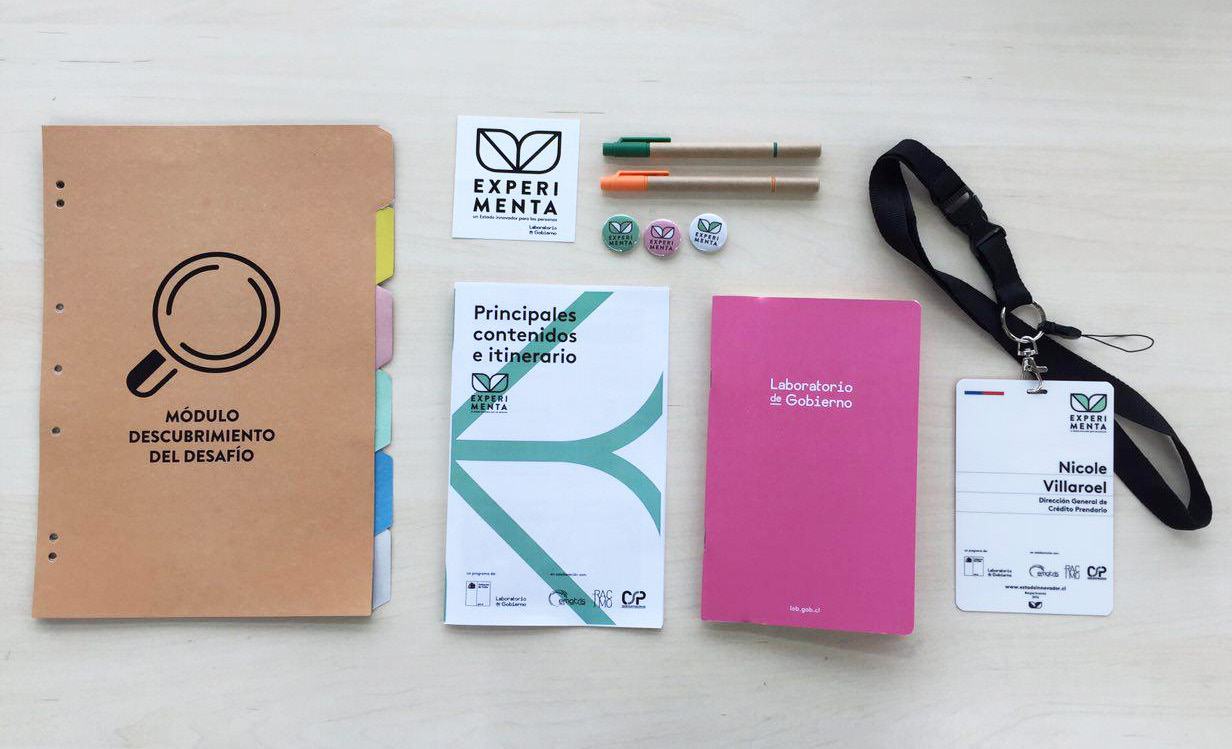
Once the teams have been selected, they are invited to a welcome ceremony. This ceremony marks the formal start of the programme where teams are recognised as participants and officially welcomed by the Laboratorio de Gobierno. The executive manager and head of department of each team is also invited. To mark the beginning of their journey, participants are given a welcome kit that includes publications about public innovation, a notebook and a pin with the logo of Experimenta. Each team receives a workshop kit that includes stationary such as post-its, markers, scissors, masking-tape, etc. to use in the training and mentoring sessions.
3.4.4 The modules: content
The core of the programme consists of four modules that builds on the structure of the "double diamond" process. This double diamond was originally developed by the Design Council (UK) around 2005 and has since then been widely adopted - and adapted - by numerous design and innovation agencies. Each module focuses on specific content areas that are described in more detail below. The format of the learning activities is described in the next section, and the learning objectives for each session are described in 3.8.1.
Module 1: Challenge discovery
This module focuses on exploring and understanding the proposed problem for the institution, and (re)defining the innovation challenge. The teams learn how to carry out social research to explore the experiences, needs and goals of various stakeholders and the wider context of the challenge. Teams map out key stakeholders, define and reframe their innovation challenge based on insights and evidence, and create a hypothesis and metrics that reflect the expected change. At the end of this module, the teams map out their learning journey to illustrate how their problem definition has developed.
Module 2: Idea generation
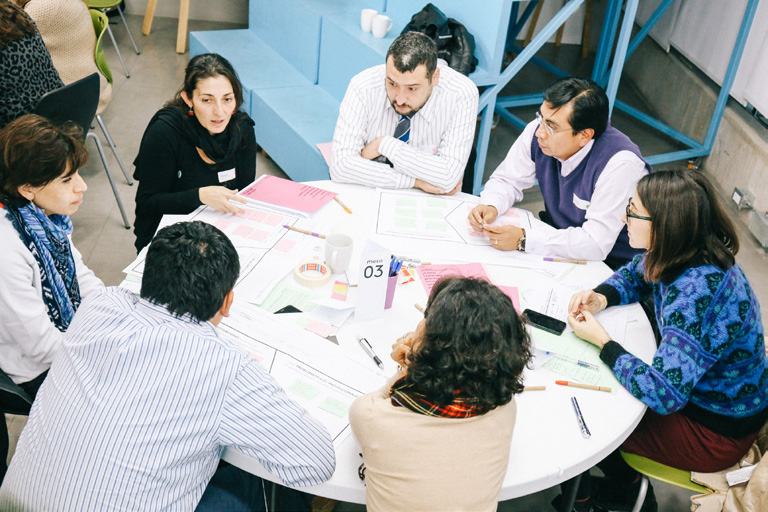
This module focuses on generating ideas for possible solutions that address the challenge. Teams identify what has been done in in the past within their own and other public sector institutions to tackle the challenge. They develop alternative ways to address the challenge, learn how to prioritise ideas and how to evaluate the public value of these ideas. At the end of this module, the teams map out their learning journey to illustrate their process and describe how they got to the idea they have selected.
Module 3: Prototyping and testing
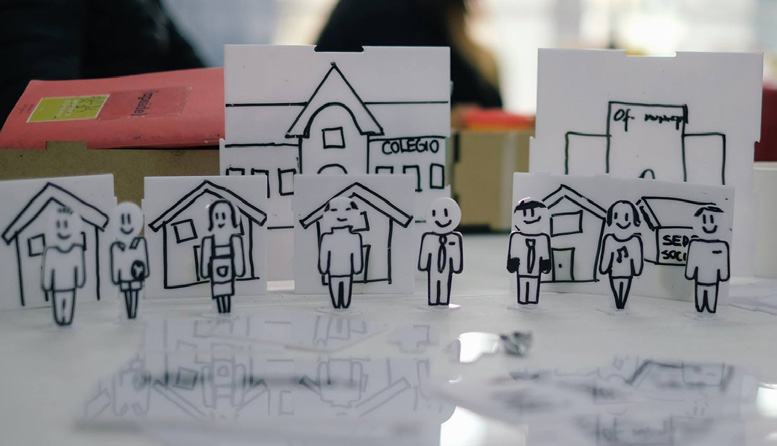
In this module teams develop prototypes of their idea and test their proposed solution. Iteration is crucial at this stage and helps the teams to refine their solution and ensure that it can be embedded in their institution. Teams develop a scenario, which considers all key stakeholders, and describes how the prototype and its main functionalities work. Teams then need to test their idea to validate it. At the end of this module, the teams map out their learning journey to illustrate what their iterative process has looked like.
Module 4: Public sector innovation management
The fourth and final module consists of two parts. In the first part, the teams must create an implementation plan for their solution that takes all necessary stakeholders into account. This should also include a scalability plan that describes how the team will implement the solution and what the milestones are, as well as mapping out what the main risks of implementing the solution would be and what strategies would have to be adopted to mitigate them. In the second part, the teams have to develop a strategy that describes how they will institutionalise public innovation within their institutions.
3.4.5 The modules: learning activities
Each module consists of a mix of learning modalities and activities (see figure 8), which are described in more detail below. Every week the teams attend a training or mentoring session (these sessions are alternated). In the training sessions, teams develop their innovation skills. The mentoring sessions provide support for the teams and help them reflect on their learning and innovation journey. The training and mentoring sessions are supplemented with self-guided activities, where teams work autonomously on their projects. 'Transfer' activities at the end of each module focus on skills and knowledge transfer. This includes a train-the-trainer component that enables participants to transfer their newly acquired skills to their colleagues and spread them across their institutions. Sharing skills and experiences is of great
Figure 8: Module's structure
This diagram illustrates the structure of the program's four modules and their associated learning activities.
- MODULE 1: CHALLENGE DISCOVERY includes Training Sessions, Mentoring Sessions, Train-the-Trainer Session, Skills Transfer, and Validation Session (indicated by 'X4' for four repetitions).
- MODULE 2: IDEA GENERATION includes Training Sessions, Mentoring Sessions, Train-the-Trainer Session, Skills Transfer, and Validation Session (indicated by 'X4').
- MODULE 3: PROTOTYPING AND TESTING includes Training Sessions, Mentoring Sessions, Train-the-Trainer Session, Skills Transfer, and Validation Session (indicated by 'X4').
- MODULE 4: PUBLIC SECTOR INNOVATION MANAGEMENT includes Training Sessions, Mentoring Sessions, Train-the-Trainer Session, Skills Transfer, and Validation Session (indicated by 'X3' for three repetitions).
importance for Experimenta, as it helps create a learning community and build innovation capacity across the Chilean public sector. Each module concludes with a validation session where teams have to present their progress and results to their managers.
Training sessions
All training sessions have a similar structure that includes the following four stages:
- Check-in: each session starts with a check-in round where participants share how they are feeling and what has their attention, and the trainer then introduces the purpose and aims of the session.
- Skills development: the trainer delivers the actual content of the session, introducing key concepts, tools and methods. Activities are structured around the four stages of Kolb's experiential learning cycle (experiment, experience, reflect, conceptualise) to make learning effective. Practical exercises let participants experience how specific innovation tools or methods work, and are supported by reflection and conceptualisation to reinforce learning.
- Setting objectives: facilitators define objectives, and the teams discuss them in preparation for their next mentoring session.
- Check-out: the session ends with a check-out to verify how the participants are doing emotionally. They may be asked to build something that represents their learning progress or journey. This helps the faculty to identify the highlights of the session and areas that need improvement.
Mentoring sessions
These sessions aim to provide teams with support that is tailored to their institutional context, challenge and learning journey. Mentors are responsible for guiding teams to achieve the requirements of the programme and to move forward with their projects. The mentoring sessions offer an opportunity for the teams to further develop their projects, as mentors support them to find new ways of exploring and framing their challenge and developing and testing potential solutions.
Each institution has a permanent mentor that works with the team throughout the programme. This is part of a wider objective to build a relationship of trust with the teams. Each mentoring session has a specific aim that is described in a 'mentor's guide', which is created by the team of experts leading the module in collaboration with the innovation capabilities team.
Self-guided project work
The training and mentoring sessions are supplemented with self-guided project work, or so called "autonomous work hours", where teams work on their projects without the direct supervision of a trainer or mentor. This was introduced in the second edition of Experimenta, with the aim of creating space and designated time for teams to work on their project with the authorisation of their superiors.
Skills transfer and train-the-trainer sessions
Within two weeks of the completion of each module, the teams have to organise a skills transfer workshop for their colleagues or institutions they partner with. The aim of these workshops is for the teams to disseminate the skills and knowledge they have acquired within their institution. The workshops are designed, developed and facilitated by the participant teams themselves. To help them achieve this, they take part in a train-the-trainer session beforehand in order to develop their learning design, facilitation and group management skills. The skills transfer workshops are delivered at the institutions or at Laboratorio de Gobierno. The reach of these workshops varies from 5 to 200 participants per institution.
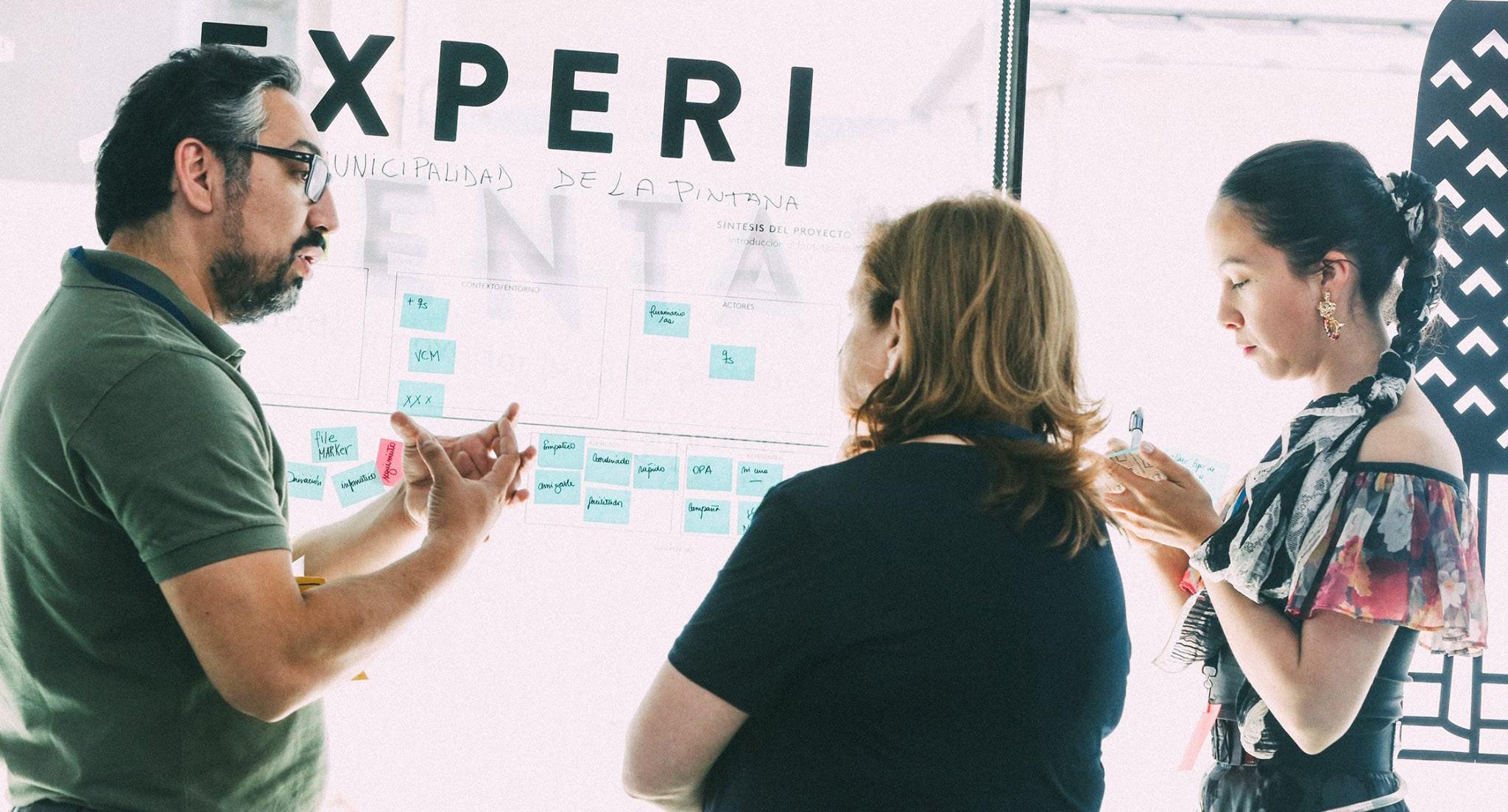
Validation sessions
Each module concludes with a validation session, which should be organised by the team and held within two weeks of the completion of the module. The teams have to present their progress and achievements to their executives and managers. This presentation also includes a reflection on team dynamics, their challenges and how they have resolved them. Once the work is validated by the executives and managers, the team can move forward to the next module.
3.4.6 Closing ceremony
Finally, when the teams have completed all the modules, they are invited - with their executives and managers - to a closing ceremony. During this session, the lab invites them to reflect on their journey and receive a certificate as recognition of their work and participation in the Experimenta programme.
3.5 Actors
In order to establish a learning community, Experimenta brings together various actors. In this section we describe these main actors and their different roles:
- The learners: the participants of the programme, who are civil servants from local and national public sector institutions.
- The faculty: experts who are responsible for the design, delivery and implementation of the programme, and also for documenting the experiences of the teams and their projects.
There are also two indirect stakeholders related to the learners: their managers and their colleagues - who are potentially the learners of the skills transfer workshops.
3.5.1 The learners
The key learning audience is the civil servants who participate in the Experimenta programme. Any institution in the Chilean public sector can participate in Experimenta regardless of innovation maturity level. Participant profiles show that each cohort has been quite diverse, with varied age groups and seniority levels. Also civil servants with either a permanent or temporary contract were welcome to participate. The only criteria that played a role in the application process was gender balance, with each team required to have a mix of male and female participants.
Within each institution, civil servants formed a team. These consisted of 5-7 members for the first edition in 2016 and 3-5 members for the second edition in 2017. Each team had a team coordinator who served as the point of contact between participating institutions and the Laboratorio's team, the team members and the mentor, and the team's executives. It is important to note that the team coordinator does not act as a leader of the team but primarily as a point of contact with different actors. Within the team there is no hierarchy between the participants, and seniority levels or institutional positions do not matter. In addition, from the 2017 edition, each participant nominated a substitute in case they could not attend a training or mentoring session. This substitute could be nominated to take the place of several people within the same team.
3.5.2 The faculty
The faculty consists of innovation practitioners, who are procured by the lab specifically for the design and delivery of the programme. This faculty is gender balanced, and its members mainly come from private consulting firms and have backgrounds in design, innovation management and academia. They also have experience with facilitating and designing learning programmes. For the delivery and implementation of Experimenta, the faculty takes on three main roles: trainer, mentor and documenter. We explain each role in more detail below:
Trainer
In their role as a trainer, the faculty is responsible for delivering the training sessions. For this, as well as having experience designing and/or managing innovation projects, it is essential that they have experience with designing and facilitating learning sessions. Domain knowledge about the chilean public sector is desirable. Each trainer may run one or more modules depending the results of the public procurement process in which they participate. The trainers are also part of the Experimenta review committee, and share their feedback with the innovation capabilities team and give recommendations for improving the programme.
Mentor
In their role as a mentor, the faculty supports the teams in their learning and innovation journeys. They support teams with:
- technical issues: instructing teams how to use a specific innovation tool or method.
- strategic and institutional challenges: helping teams with creating change and developing and embedding their solutions within their institution.
- team dynamics: helping teams resolve issues around managing diversity in their team.
And above all, they play a key role in providing emotional support, as the teams are often operating outside their comfort zone. It is therefore essential that the mentors have good soft skills. They should be able to quickly build trust with a variety of participants to establish a productive relationship.
Mentors need to know what the content of the training sessions is to ensure alignment between the training and mentoring. The mentors are also responsible for the design of the mentoring sessions.
The mentors play a fundamental role in the faculty, as they are the only consistent actor that links the programme and the participating team throughout its duration. They form the linking pin between the key actors involved in the programme. In that capacity, they report directly to the innovation capabilities team about the status and progress of the teams.
Documenter
The documenters help to systematise the outcomes and learnings of Experimenta. They are responsible for capturing and documenting the process, results and learnings of each team and present these insights as a case study that reflects the highlights of the team's innovation and learning journey. To apply for this role, candidates must demonstrate they have experience capturing and codifying processes, outcomes and experiences (e.g. through products such as case studies, reports, books).
3.5.3 Indirect stakeholders
Next to these key actors, there are two indirect stakeholders that can affect or are affected by the teams' performance. There are respectively the executive and middle managers within the institutions of the teams, and the colleagues who are trained by the teams as part of the skills transfer activities.
Management
From the beginning of the application process, teams of civil servants must involve both their direct managers and their institution's executive management, as these stakeholders approve their application and participation. During the application process, the managers participate in a face-to-face assessment with the teams in order to get involved in the process. They are also involved in the validation sessions, during which the teams present their progress and developments from the modules to get approval. The link between the team and their management is critical for the continuity of the project, as it guarantees their constant support and secures their resources. The teams' management also attend the closing ceremony to recognise the work of the team.
Colleagues
At the end of each module, the teams have to facilitate a training session for colleagues from their own and their partner institutions. The purpose of these transfer sessions is to disseminate the innovation tools, methods and skills they have learned during the module. In this way, colleagues and partners of the teams become indirect participants of Experimenta. This helps the lab to spread innovation skills and practices, increase organisational readiness and leverage the impact of Experimenta.
3.6 Enablers
In this section, we describe the resources, learning materials and environments that enable the learning journeys of the teams.
3.6.1 Learning environment
Here, we focus particularly on the physical environment as a touchpoint of the learning. There are also intangible "spaces" or environments (e.g. the social and emotional space) which are described in 3.9.1. The main purpose of the physical learning environment is to support the two learning activities: the training and mentoring sessions. The function of these spaces is to provide a safe, collaborative, productive learning environment.
The training and mentoring sessions take place in a mix of spaces, as the exact locations depend on the region where the modules are delivered. The sessions in Santiago are normally run in the events space at Laboratorio de Gobierno. For other chapters, the sessions happen in an open space, ideally within a public sector institution or hotel event space. The welcome and closing ceremonies take place in the auditorium of a public sector institution to add more legitimacy to the event, while the skills transfer and validation sessions happen in the institutions of the participating teams.
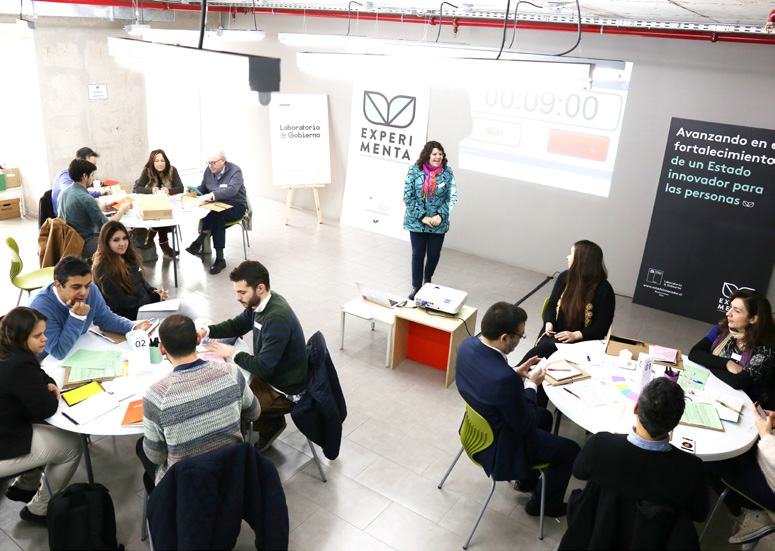
Visual materials such as standing banners and smaller signs with the Experimenta logo are used to transform the meeting and conference rooms into learning environments for the programme. This allows the different actors to "feel" like they are at Experimenta no matter where they are.
Set-up of the training sessions
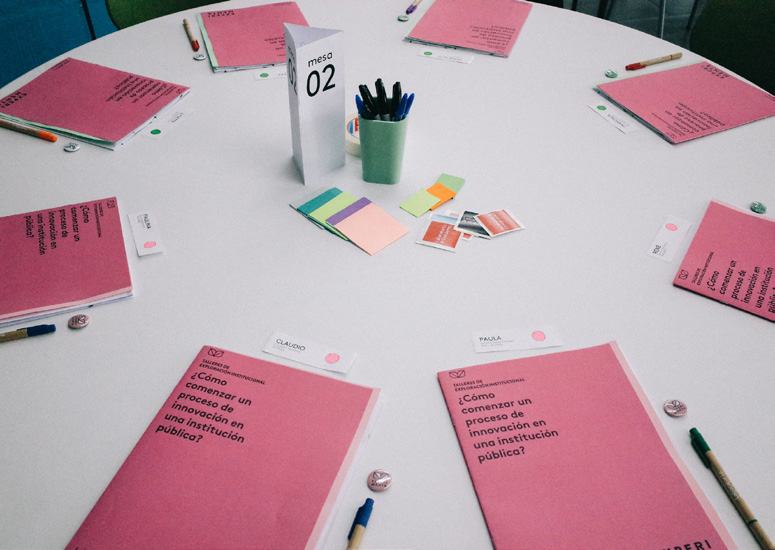
The training sessions are held in open spaces where the programme materials can be used to transform and visually appropriate the spaces. This helps teams to feel that they are arriving at the Experimenta programme. In general, the materials and spaces are configured as follows:
- The room is set up in cabaret style. Each team selects a table for the session, and creates a name tag of their institution so they can be easily identified by other people in the room.
- On each table, work materials are placed such as worksheets for the session, markers, sticky notes, etc.
- Each participant has a name tag with just their first name so that everybody knows who is in the room, and to promote closer relationships that don't focus on job titles and positions.
- Ideally, the walls or surfaces are used like a canvas to place training materials on for the teams to work on during the session.
Set-up of the mentoring sessions
For the mentoring session, the teams usually use a space within their own institutions or offices. These are environments where they feel comfortable and it gives them the freedom to perform the session in a less formal manner than their normal meetings. During the sessions, worksheets and materials are provided by the mentor to help recap the content from the previous training session and reinforce the key messages and concepts.
3.7 Resources
Throughout the programme the faculty and teams are supported with guides, learning materials, tools and documentation to make the learning experience effective, productive and meaningful.
3.7.1 Materials for faculty
The materials that the faculty use are created by and for the trainers and mentors in a co-design process with the lab's innovation capabilities team.
Trainer resources
The trainers are provided with a facilitation guide, a slide deck and tools for each session. This facilitation guide describes the overarching goals of the module, and the objectives, content areas and intended outcomes for the session. It also includes an agenda with activities, instructions and required materials and tools.
Mentor resources
The mentors are provided with a summary of what was covered during the previous training session, highlighting the teams' activities during the session to make sure that the mentoring session is aligned with the training activities. The mentors also receive a guide with instruction on what the mentor should cover during the sessions. All mentors have access to a shared digital repository with all the materials from the modules.
3.7.2 Materials for the teams and participants
The teams are supported with learning materials that help them navigate their learning journey and work on their projects. All these materials are consistently branded with the Experimenta identity. Below, we briefly explain the main resources for each stage (see 3.4 for a detailed description of the activities).
Application process
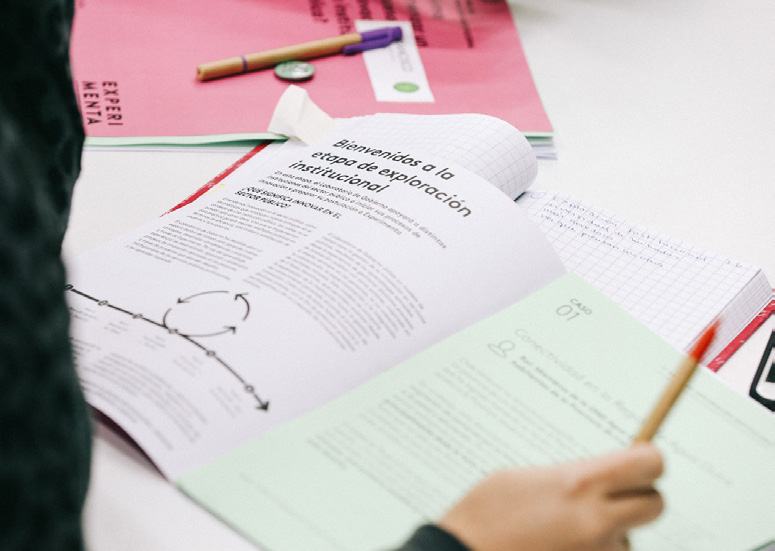
The teams receive a digital application kit that includes the Terms of Reference, a guide explaining the application process, the application forms, a team profile sheet and authorisation letters that need to be signed by their executives.
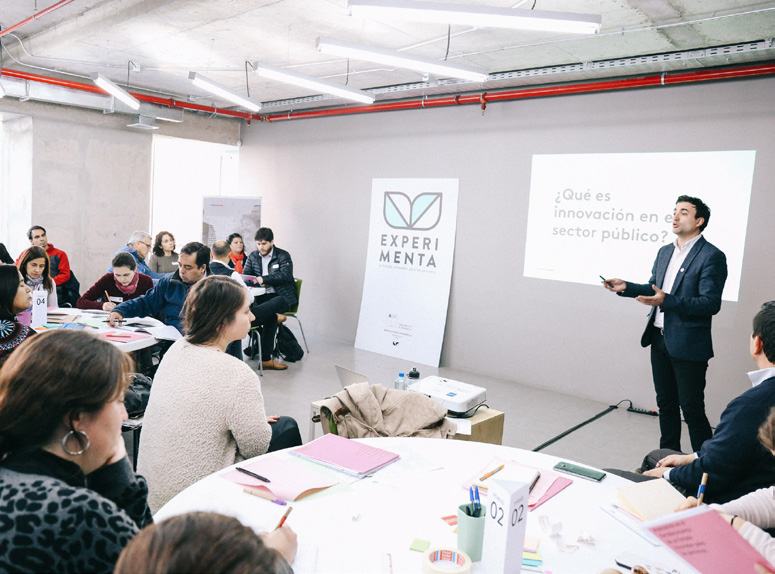
During the application process, an introductory workshop takes place to present key concepts of public sector innovation to the potential participating teams. A workbook is provided to everyone who attends with the purpose of motivating the participants around public sector innovation and explaining the key terms of the programme in a tangible way. In addition, the workbook provides application guidelines to help teams define the challenge they want to work on in the programme.
Welcome ceremony
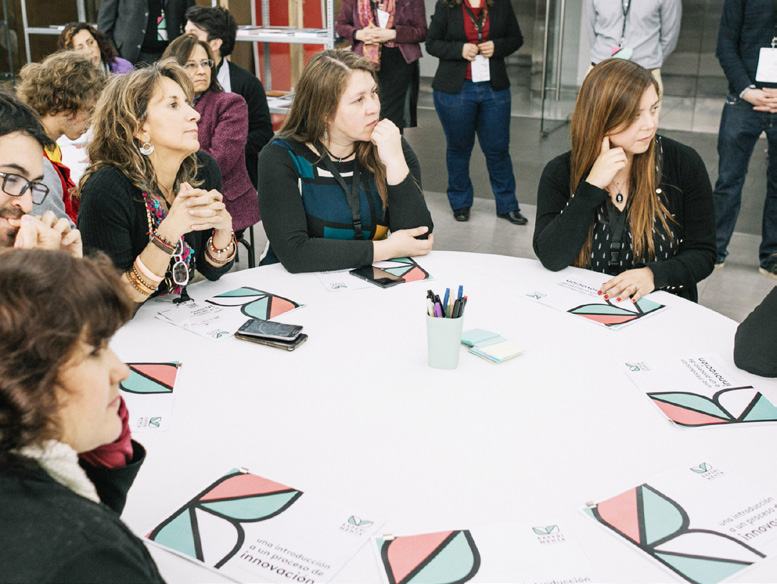
At the welcome ceremony, participants receive a welcome kit that marks the beginning of their innovation and learning journey. The includes a tote bag with books about innovation and a general kit from Laboratorio de Gobierno with marketing materials: e.g. stickers, notebook, pin badges.
Each team also receives a portfolio to hold the materials that they will receive during the training and mentoring sessions. This helps teams to keep all their project materials in one place, and it also serves as a resource for other projects outside Experimenta or for spreading them within their institutions. For the 2017 edition the format for this changed to become a digital journal. At the end of each module, the team had to complete their journals with all the information about their project and what they had worked on during the module. Based on this, the documenters (see 3.5.2) could then develop a case study for each of the teams.
Training sessions
For each session, the materials generally used include stationery (sticky notes, markers, masking tape, blank sheets of paper, etc.) worksheets, tools and slide decks. The tools and slide decks are shared with the teams at the end of each session by email. This also includes a session summary, which describes the objective of the session, the activities they worked on, tasks and reminders for deliverables and the date of the next session. For specific activities, for example prototyping, the teams are provided with special materials such as coloured paper, moulding clay, scissors and a prototyping kit designed by Laboratorio de Gobierno
Closing ceremony
At the end of the programme, each team is given a certificate. This document confirms their participation and provides the certification that they need to accomplish every year as civil servants.
3.8 Impact
In this section we describe the intended outcomes, and how the lab tracked progress and evaluated the outcomes of Experimenta.
3.8.1 Outcomes
For learning programmes to be effective, participants have to be able to demonstrate specific competencies or behaviours, either at the end of the programme or the end of a module. The learning outcomes and competencies per module are presented in the following table:
|
LEARNING OUTCOME |
COMPETENCY |
| Module 1 Challenge discovery |
Establish an innovation challenge by conducting field research empathising with users, civil servants and relevant actors of the institution, to begin an ideation process for a solution. |
Field research: Participants are able to conduct inquiries on the ground, collecting and analysing different types of data and feedback from the outside. This allows them to better visualise the context and the problem or opportunity for innovation with a focus on continuous and iterative learning. |
| Module 2 Idea generation |
Design a solution that responds to the innovation challenge, creating, categorising and prioritising ideas through an ideation process with various actors, with the aim of beginning the process of prototyping and testing. |
Visualisation: Participants are able to identify new perspectives, possibilities and opportunities through the development of information and concepts to challenge and change existing perceptions. |
| Module 3 Prototyping and testing |
Test the previously ideated solutions in a controlled environment, carrying out an iterative process of designing and testing the prototype(s) of a product/ service, projecting the implementation of the solution. |
Experimentation: Participants are able to validate assumptions through an iterative prototyping process using a trial and error approach, managing uncertainty and unpredictability, with the aim of mitigating the risks of the public innovation project. |
| Module 4 Public sector management |
Propose an implementation strategy for the product/ service designed, considering the learnings from the process in order to facilitate the development and scalability of the project. |
Innovation management: Participants are able to manage a public innovation project and its stakeholders in a comprehensive manner, exploring multiple ways to address possible difficulties, joining resources and people with the goal of moving from low-scale prototypes to systems-level solutions. |
3.8.2 Tracking progress
There are two ways Laboratorio de Gobierno tracked the progress of the teams. Firstly, at the end of each module, the review committee evaluated how the teams and their projects had progressed. Progress was tracked in a spreadsheet that clearly showed how the teams had developed over time. Secondly, at the end of each training session, the lab's innovation capabilities team and the facilitators got together to reflect on their experiences and provide suggestions for improvements.
3.8.3 Evaluation
To ensure Experimenta was delivering outcomes as intended, Laboratorio de Gobierno used a variety of data points, evaluation methods and instruments. It's important to bear in mind that evaluation methods for programmes like Experimenta are still being developed, given its complexity and that the outcomes the programme is trying to achieve are at multiple levels (skills development, public value, institutional strategic goals, culture change, etc.). This means that some evaluation instruments were developed during the process by the Laboratorio's team, by other labs or by third parties. The lab used the following five methods:
Self assessment
The Laboratorio's team asked participants to self assess their competencies. Although the reliability of such self-diagnosis is generally regarded as questionable, it helped the lab to get an impression of attainment levels, and it also helped participants to better understand the nature of innovation competencies. For this self assessment, the lab used the competency framework that was developed by Nesta and OECD (see figure 9). The lab used a selection of competencies that focused on the following skills and mindsets: motivation, a focus on results, human centered approach, systemic thinking, open to feedback, critical thinking, problem solving and decision making, visual thinking, experimentation, teamwork and team dynamics, communication skills.
Figure 9: Innovation Competencies for the Public Sector
| ACTIVATING |
POLITICAL SPHERE |
POLITICAL AWARENESS |
| PASSIONATE |
PRAGMATISM |
BRIDGING |
| ADVOCACY |
DEMONSTRATING VALUE |
CREATING OWNERSHIP |
| TRANSLATION |
ACCOUNTABILITY |
MANAGING POWER DYNAMICS |
| AWARENESS & UNDERSTANDING |
FRAMING & IDEATION |
DEVELOPING, IMPLEMENTING & SCALING |
| INQUISITIVE MIND |
CURIOSITY |
AGILITY AND RESILIENCE |
| IMPACT-ORIENTATION |
DESIGN |
EXPERIMENTATION |
| NUANCED DATA MANAGEMENT |
(RE)FRAMING |
ACTION-ORIENTATION |
| HOLISTIC APPROACH |
CREATIVE FACILITATION |
STEWARDSHIP |
| OPEN APPROACH |
COMMUNICATION |
PROCESS MANAGEMENT |
| SYSTEMS THINKING |
OPPORTUNISTIC |
CO-CREATION |
| DOMAIN KNOWLEDGE |
|
THINKING IN SCALES |
| EMPATHY |
PEOPLE, NETWORKS & TALENT |
ENTHUSIASM |
| REFLEXIVITY |
MULTI-DISCIPLINARY |
COMMITMENT |
| COACHING |
RELATIONAL |
HUMILITY |
| CODIFYING |
CONNECTING |
|
Impact synthesis framework
In order to determine the broader outcomes of the programme, and to also capture results in a way that would be useful for participating institutions to communicate their achievements, the lab used this impact synthesis framework (see figure 10). The framework was developed through the collaborative effort of leading public sector innovation labs from around the world. It tries to identify change and outcomes at four levels: the individual level, organisational or institutional level, community and citizen level, and wider results at an ecosystem level. The framework looks at the following seven dimensions as indicators of change: attitudes, behaviours, discourse, functions, relationships, outputs and ripple effects. This instrument helped the lab to map results and effects that were not expected from the programme, but that were nevertheless significant for its participants. The framework also helped the lab to translate the outcomes into a narrative and to present its main achievements in a short video.
Figure 10: Impact Assessment For Cultural Change In Government Organisations
|
ATTITUDES (MINDSET/APPROACH) |
ABILITIES (SKILLS/AGENCY) |
BEHAVIOR (ACTION) |
DISCOURSE (LANGUAGE) |
ROLES (FUNCTIONS) |
RELATIONSHIPS (INTERACTIONS) |
ENVIRONMENT (INCENTIVES) |
OUTPUTS (PRODUCTION) |
RIPPLE EFFECTS |
| INDIVIDUAL |
|
|
|
|
|
|
|
|
|
| TEAM |
|
|
|
|
|
|
|
|
|
| ORGANISATIONAL |
|
|
|
|
|
|
|
|
|
| ECOSYSTEM |
|
|
|
|
|
|
|
|
|
Surveys
At the end of each module, the lab asked participants to fill out an online survey to evaluate their satisfaction. Topics included: general satisfaction, usefulness of the content, performance of mentors and trainers, and opportunities and suggestions for improvement.
Assessment workshop
To assess attainment levels and verify whether civil servants were able to transfer the competencies they developed to other challenges and contexts, the innovation capabilities team designed an assessment session that included a hypothetical challenge - similar to the one they applied with - for participants to solve. This workshop was held after the end of the last module. Together with the trainers, the Laboratorio's team evaluated the participants using a set of guidelines that were based on the lab's innovation principles.
Feedback sessions
At the end of the fourth session (Innovation management), teams had to present their innovation project using the format of a pitch. The lab's staff, the trainers and other experts were invited to this session and gave feedback to the participants on the following aspects: communication skills, idea presentation and content. Although the focus of this session was on skills, the session served as a data point that helped the lab generate a comprehensive picture of the teams' progress and performance.
3.9 Hidden curriculum
The hidden curriculum involves the implicit transfer of knowledge, skills, attitudes and norms through the design, development and delivery of the programme. Every programme has some sort of hidden curriculum and it usually enhances the formal curriculum. This hidden curriculum is socially constructed and instilled in the innovation capabilities team, the trainers and the mentors. They make decisions or take actions that are driven by their shared or individual beliefs, values, tacit knowledge and expertise that shape the character or personality of the programme. An example of this is how one of the lab's staff members described the purpose of Experimenta, which is not described in the programme's documentation: "the focus of the programme is not on the innovation methods or tools, the programme is about learning a new way of doing things in the public sector".
In our research we have tried to identify the "secret ingredients" that constitute this hidden curriculum and have found three interconnected categories. The first category is about 'space', the second is about identity and branding, and the third is about 'the social'. We explain them in more detail below.
3.9.1 Space
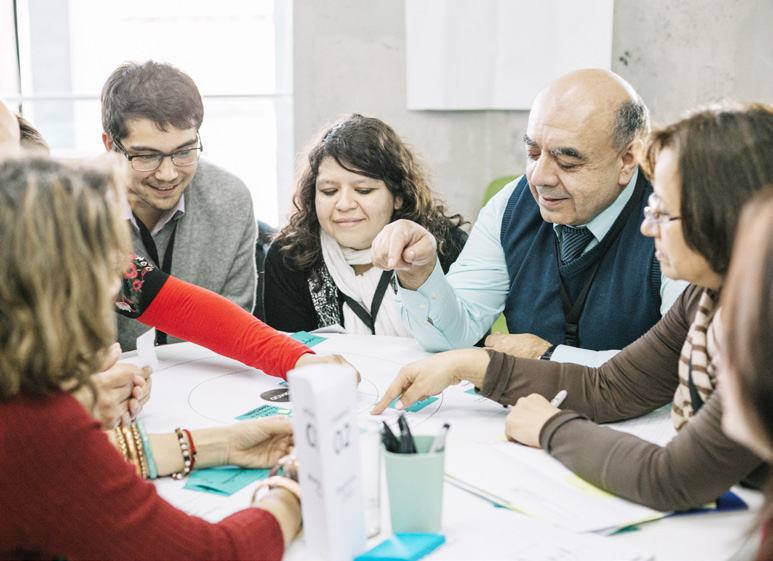
The notion of 'space' has various dimensions when we look at Experimenta, as it involves the physical as well as the social and emotional space. In chapter two we already mentioned the "safe space" as a unique value. This safe space allows participants to experiment with new ways of working: using new tools and methods to solve problems, learning by doing and collaborating with both the usual and also unusual suspects at a cross-institutional level. Participants are given the mandate to do things differently by the lab and the faculty, but also by their managers. There is also a safety net for when doing things differently becomes daunting or when teams get stuck, which is formed by the lab, the trainers, the mentors, the peers and also the wider Innovadores Públicos network. This is secured by a mutual trust, and the mentors particularly play a key role in creating this trust.
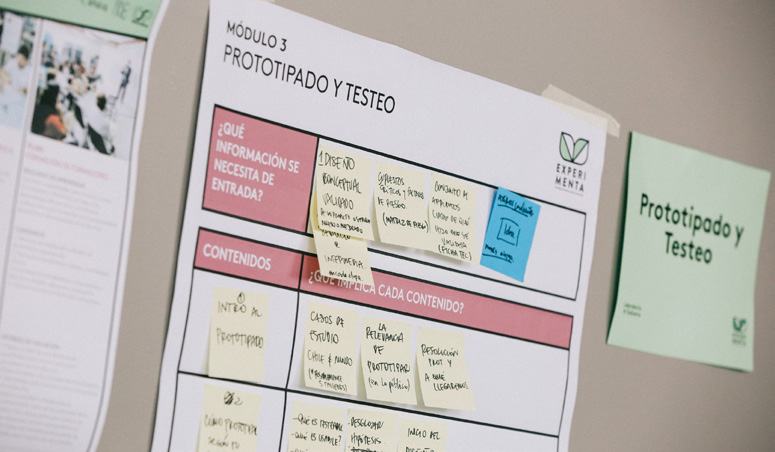
3.9.2 Identity and branding
There is also the physical space, for example the way the rooms are set up, and more prominently what the Laboratorio de Gobierno office looks like, as one of the participants mentioned: "The first time I walked into the office of the lab, it looked very different from any government office I'd ever seen". The lab's space sends out a clear message that "things are done differently here", and this gives participants permission to experiment and learn?.
The second category is about the brand, both the identity of Laboratorio de Gobierno as well as the Experimenta programme. By brand we don't just mean a logo or visual identity. A brand is the vision, purpose or image of a product, service or organisation that people connect with. It is about the connection that people feel to an organisation. This gut feeling is based on their experiences of interacting with an organisation. It involves every aspect: the staff's tone of voice, their behaviour, body-language, the look and feel of the website, office, furniture and of course the logo, marketing materials, and even the quality of the coffee Laboratorio de Gobierno and Experimenta have a certain "sexiness", as one of the facilitators put it. People want to be associated with the lab or the programme: "they want to be part of it" and become ambassadors. Take for example the photos participants have taken of their team holding the logo of Experimenta/the lab in a prominent position. Participants have also added the Experimenta logo to their email footer to show they are part of it. It seems to appear to give them them credibility and legitimacy as an innovator.
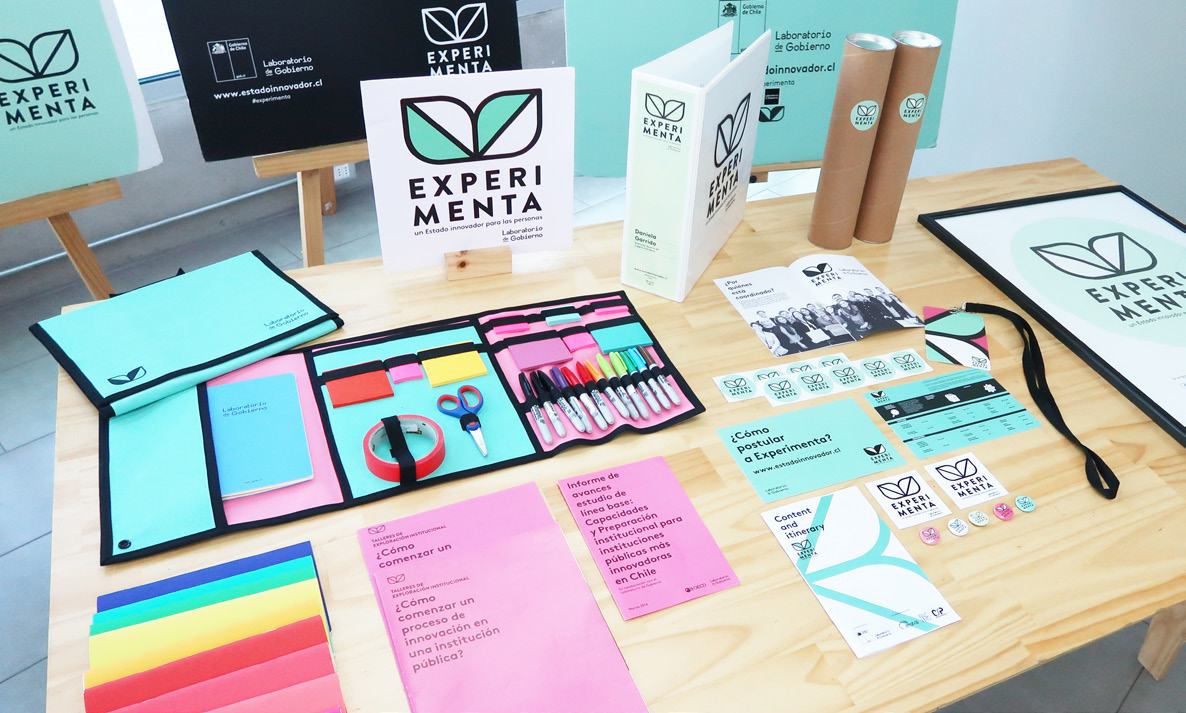
The lab's high quality design output certainly plays a big role. The clear and simple style adds clarity and accessibility to the concept of innovation, which is often perceived as vague, complex and risky. But we also sense that the lab's mission, enthusiasm, energy, openness and willingness to collaborate attracts many people. The lab resonates with the reason why many people join or once joined the civil service - which is often to improve society or help citizens - and manages to (re)activate that personal motive that sometimes gets lost between the grinding stones of a bureaucratic system. It was remarkable to read from a quick survey that participants describe the lab as a friend who want to make the best of you, or a leader that generates positive change - which signifies the strong and meaningful relationship that the lab has managed to build.
“I see Experimenta as a leader that generates positive change, enhances the qualities of its team, unites people, generates admiration and creates good work in collaboration with others."
EXPERIMENTA PARTICIPANT 2016 (CONCEPCIÓN)
"For me Experimenta is a guide, a partner and a friend. Someone who demands that you give the best of yourself. Who gives you the confidence and freedom to act, and provides guidance when you ask for it. It doesn't impose things on you, but shows you different alternatives."
EXPERIMENTA PARTICIPANT 2016 (CONCEPCIÓN)
3.9.3 'The social'
The social is the element that makes Experimenta tick, that gives it a heartbeat. When we take a step back and look at the lab as a living ecosystem, we see an intricate network (see figure 11) that is defined by its actors, relations and interactions. We also see how the word 'together' runs through virtually every activity of the lab and its Experimenta programme. How it is designed, developed, reviewed and delivered, but also the practices and new ways of working that are promoted and shared through the programme (e.g. train-the-trainer) are all based on the same principles of working, learning and solving problems together.
One of Laboratorio de Gobierno greatest strengths is probably its power to mobilise people around a shared ambition and purpose, and its ability to create value through a collaborative process that is based on reciprocity, diversity, inclusion, trust and shared ownership.
Figure 11: Network map of stakeholders
This diagram illustrates the network map of stakeholders, showing interconnected groups and their relationships within the Experimenta program.
The central circle represents LEARNERS.
Surrounding the Learners are:
* FACULTY, which includes:
* INNOVATION CAPABILITIES TEAM
* TRAINERS
* MENTORS
* DOCUMENTERS
* SUBSTITUTE
* Related to the Faculty are:
* REVIEW COMMITTEE (linked to INNOVATION CAPABILITIES TEAM)
* MENTORSHIP GUIDES (linked to MENTORS)
* TRAIN-THE-TRAINER SESSIONS (linked to TRAINERS)
* JOURNAL (linked to DOCUMENTERS and LEARNERS)
* VALIDATION SESSIONS (linked to LEARNERS)
Further out, INDIRECT STAKEHOLDERS include:
* MANAGEMENT
* COLLEAGUES
The outermost circle represents INNOVADORES PUBLICOS (Public Innovators) and NETWORK.
CHAPTER 4 Improvements and recommendations
In this chapter we describe a number of changes and improvements that have been made to the programme. We also describe several challenges and opportunities that we identified, each with recommendations and suggestions to increase the value and potential of Experimenta and Laboratorio de Gobierno.
4.1 Improvements (2016-2017)
Since the start of Experimenta, the Laboratorio's team has run two editions of the programme. In the table below we describe the main changes that were made to the programme based on evaluations and experiences.
| 2016 |
2017 |
MOTIVATION - RATIONALE |
| Duration |
The duration of the programme was 10 months and included 23 training sessions. |
The duration of the programme was 8 months and included 19 training sessions. |
| Strategic focus |
Teams needed to apply with a problem that was linked to strategic goal of the institution (e.g. inform the population about social benefits). |
Teams needed to apply with a pressing issue for their institution, and link it with a concrete product or service (e.g. the "User Assistance Protocol" project developed and implemented by the treasury TGR). |
| Team configuration |
Teams had to include civil servants from different units or departments. Teams consisted of between 5 and 7 participants per institution. |
It was no longer mandatory for a team to have civil servants from different departments. Instead the team had to be the problem owner and be in charge of solving it. Each team consisted of between 3 and 5 participants per institution, plus a substitute to cover for one or more participants per team. |
| Role of mentors |
Mentors were not necessarily involved in the training sessions. |
Every mentor had to be involved in the training sessions as well. |
| Application process |
Prior to the application process, the lab ran "exploration workshops" based on the application form to help teams with framing the problem and the application process. |
Teams didn't receive specific help on framing their challenge and submitting their application. Instead, the lab ran introduction to public sector innovation workshops. |
| Assessing commitment |
As a part of the application process, teams had to send in a video that demonstrated their commitment, which included a short speech from their chief executive and managers. |
Teams had to deliver a face-to-face presentation, and the presentation included the attendance of their chief executive and middle managers. |
| Implementation & institutionalisation |
The initial design of module 4 on innovation management only covered tools related to innovation management in terms of project implementation. As the programme was being implemented, the lab developed a train-the-trainer workshop for the end of the module. |
Module 4 was divided into two main objectives; teams were given tools and strategies for effectively implementing their projects, and they were given strategies to spread and embed innovation practices within their institutions. |
| Documentation |
The lab used the impact synthesis framework to capture outcomes based on evaluation sessions with the teams after completing the programme. The results led to a video of each teams' journey and results. |
Documentation happened throughout the programme, with teams capturing their process in a learning journal. The results will end up in as a printable case study for each team's journey. |
4.2 Challenges
As Laboratorio de Gobierno's team designed, developed and implemented Experimenta they experienced various challenges. We briefly describe the main challenges below, and have added suggestions and recommendations for future versions of the programme.
4.2.1 High complexity
During our conversations with the Laboratorio's team, it was frequently mentioned that designing and managing Experimenta is "complex" which makes it challenging and interesting at the same time. This complexity is caused by two factors. The first factor involves the multiple, interlinked purposes the programme serves: it aims to develop skills, create an enabling environment and solve public/complex problems at the same time. The second factor involves the variety of stakeholders involved in the design, development and delivery of the programme (also see figure 11 - Network map stakeholders). Each actor comes with different perspectives, experiences, ideas about learning and innovation, and interests, which may lead to friction and confusion. This complexity doesn't make it easy to communicate what Experimenta is about with a short and comprehensive message, without leaving one of the salient aspects.
We don't believe there is a solution to reduce this. Complexity is inherent in running programmes like Experimenta, and this often means that strategic decisions about purpose and approach have trade-offs. However, to make this complexity more manageable we would suggest creating more clarity - for the lab team as well as external stakeholders - on the strategic priority areas. What is the prime focus of Experimenta? Developing skills, solving problems or creating enabling environments (see figure 12)? Using even-over statements helps prioritise strategic focus areas (e.g. "developing skills even over solving problems", "solving problems even over creating enabling environments").
Figure 12: Strategic priority areas
A circular diagram illustrating three strategic focus areas of Experimenta, with "EXPERIMENTA" in the center.
- Top: STRATEGIC FOCUS SOLVING PROBLEMS. LAB ROLE: CO-CREATOR / ACCELERATOR
- Bottom-Left: STRATEGIC FOCUS DEVELOPING SKILLS. LAB ROLE: TRAINER / MENTOR
- Bottom-Right: STRATEGIC FOCUS ENABLING ENVIRONMENTS. LAB ROLE: CURATOR / CHANGE MANGER
4.2.2 Mobility of staff
During their learning journey, several teams struggled with members leaving because of staff moving within the public administration. These members often held valuable knowledge about the project, and were replaced with new members who didn't have all the skills because they had not been involved in the prior training sessions. The Laboratorio's team has already taken measures to tackle this issue for the 2017, by adding a reserve team member and by shortening the programme from 10 to 8 months to keep participants engaged and reduce the risk of dropouts. For the 2018 edition, the team is even considering making the programme more intensive.
On top of these measures, we suggest doing a risk assessment at the beginning of the learning journey. This could include a questionnaire or interview to understand the dynamics of the participants' work contexts, as well assessing the availability of resources. The lab could also be clearer on commitment, and ask participants to sign up to a pledge at the beginning of the journey.
4.2.3 Getting buy-in from middle management
Laboratorio de Gobierno and the participant teams often seemed to struggle to get buy-in from middle management, and in some cases from senior leaders. The Laboratorio's team have included information sessions exclusively for management in their programme to help them understand the value, content and structure of the programme. But middle managers still seem to prioritise developing solutions over developing innovation skills.
There may be many other reasons why middle management don't support projects, and the issue could be better understood through in-depth interview. Solutions to the issue could also be explored through testing and trialling ideas, for example experimenting with different learning modalities such as short taster sessions that help them learn about the value of innovation and hands-on exercises to help them understand the dynamics. They may also consider offering a safe space for managers to discuss concerns they have about innovation. Another tactic that seem to be effective is to increase the proximity between management and learning teams. Canadian social design organisation InWithForward, for example, has experimented with learning teams that include managers and this has shown to be effective for creating buy-in and an enabling environment. Reverse mentoring, where managers are mentored by a staff member, could also be considered as a less time consuming tactic for getting managers more involved in the innovation process.
4.2.4 Managing team dynamics
In our workshops and interviews with participants, they mentioned teamwork as their biggest pain. But they also described being better at working in an (innovation) team as a "gain" - one of their greatest learning outcomes. The teams consisted of civil servants with different backgrounds, coming from different departments, bringing diversity in skills, aspirations and interests, which they struggled to manage effectively. Team design and team performance were not an explicit part of the programme.
We recommend considering adding a basic course on team design, as well as reflection activities and tools for reflecting on teamwork and performance. The team is, after all, the unit of learning for the participants' learning journey as well as the unit of action for their innovation journey. We believe that providing them with team-focused tools and skills will greatly enhance their outcomes.
In our interviews with the mentors, they suggested that help with mentoring the teams on change management would be useful and they asked explicitly for change management tools. We are not sure, however, if a toolkit will help mentors in supporting the teams. Change management is a complex process that requires specific (soft) skills and not only tools. Also, managing such a process from a detached position as a mentor will most likely not generate the desired outcomes.
There might be an opportunity to involve Experimenta's alumni in this process in a supplementary role as a "change mentor". They have experience with such processes and are familiar with the context of the public administration.
4.2.6 Enhancing reflection
Involving experts in the co-design of the Experimenta programme has added credibility, quality content and ownership. Experts did seem to struggle however with applying the principles of experiential learning and including reflection in their learning activities. Although experts were recruited for their experience as innovation practitioners and experience with learning design, we believe that learning design is one of those skills that typically can take many years to master. To resolve this, the innovation capabilities team has supported the experts with their learning design expertise, yet some gaps still remain.
In addition to their support, the innovation capabilities team might provide the experts with a "fundamentals" course on learning design, in order to highlight key concepts and principles and to create a shared frame of reference. There are also additional resources worth using (e.g. Julie Dirksen's book "Design for how people learn" offers a good introduction). Providing teams and participants with a reflection toolkit to strengthen and support reflection activities could also be considered.
4.3 Opportunities
Apart from challenges, we also see opportunities to improve Experimenta and increase the impact of Laboratorio de Gobierno. As we carried out our research and analysed the data, there were a few questions that frequently re-emerged: what happens after Experimenta? How might Laboratorio de Gobierno support teams and participants to progress to the next level of innovation competencies? How might Laboratorio de Gobierno support teams and participants to integrate innovation learning into their life-long learning efforts?
There are several ways that Laboratorio de Gobierno could create opportunities for an extended version of the learning journey. They fall broadly into two categories: by expanding the content scope, or by expanding the learning journey or portfolio of learning activities.
4.3.1 Expanding the content scope
Experimenta has shown to help civil servants develop a comprehensive and essential set of innovation skills. The programme builds, on the whole, on the principles of human centred design and co-creation. Yet in our work we often see that innovation practitioners use a slightly broader palette of innovation methods and tools to 'get the job done' (see figure 13).
Figure 13: Landscape of innovation approaches by Nesta
A complex diagram titled "Landscape of innovation approaches by Nesta" with four main interconnected spaces: TALENT SPACE (Empowering people), INTELLIGENCE SPACE (Understanding reality), SOLUTION SPACE (Shaping reality), and TECHNOLOGY SPACE (Enabling action). Each space contains various innovation approaches and roles.
TALENT SPACE (Empowering people)
- Team/Organisational Culture Design
- Innovation Learning/Pedagogy
- Talent Management
- Experimental Leadership
- Ambidextrous Leadership
- Adaptive Leadership
- Open Innovation System Leadership
- Change Management Labs / Teams
INTELLIGENCE SPACE (Understanding reality)
- Sensemaking
- Collective Intelligence
- Lead User Innovation
- Positive Deviance
- Open Policy Making
- Democratic Design Research
- Evidence-based Policy
- Action Research
- Systems Thinking
- Randomised Control Trials
- Human Centered Design
- Speculative Design
- Living Labs
- Data Visualisation
- "Nowcasting"
- Reverse Data Ethnography
- Social Media Analysis
- Citizen Generated Data
- Agent Based Data Modelling
- Big Data
- Open Data
SOLUTION SPACE (Shaping reality)
- GovJams/Service Jams
- Co-creation
- Reality labs
- Citizen Engagement
- Challenges & Prizes
- (Community) Asset Mapping
- Regulatory Sandboxes
- Accelerators
- Social Innovation Camps
- Frugal Innovation
- Jugaad
- Minimal Viable Product (MVP)
- Transdisciplinary Design
- Systemic Design
- Transition Design
- Behavioural Insights
- Service Design Gamification
- Innovation/Creative Spaces
- FabLabs
- Hackathons
- Crypto Currencies
- Digital Social Innovation
- Smart Cities
- Risk Assessment Testing
- Design Sprint
- Prototyping
- Lean Startup
- Impact Investment
- Open Design
- Alternative Finance
- Crowdfunding
- Reverse Innovation
TECHNOLOGY SPACE (Enabling action)
- Augmented Reality
- Virtual Reality
- Artificial Intelligence / Machine Learning
- Sensors
- Open Source
- Blockchain
- Algorithmic Governance
- Internet of Things
Moreover, we see that effective innovation practitioners organise their activities around six areas: people and systems, facts and futures, and problems and solutions. Innovation practitioners commonly use methods from these six areas, but some of the methods are emerging and not widely used yet. In particular, methods around the following subjects could enhance the lab's learning portfolio:
- Using research evidence and data (e.g. randomised controlled trials)
- Exploring and (re)imagining futures (foresight, horizon scanning and speculative design), user or community driven innovation (e.g. need-solution pairing, positive deviance, asset mapping)
- Using emerging technologies (e.g. machine learning, collective intelligence)
- Communication for innovation and change (e.g. language of change, visual thinking, storytelling)
These content areas could be part of a larger comprehensive programme (e.g. "Experimenta Level 2") or offered as a series of electives - which may also be a way to test demand.
4.3.2 Expanding the learning journey
With initiatives like Experimenta and Innovadores Públicos, the lab has shown that there is demand for innovation learning within Chile's public service. Therefore, we see opportunities for enhancing the learning experience around Experimenta or aligning a learning offer with life-long learning or a career in the civil service.
Currently the learning offer of Experimenta consists primarily of guided learning activities by a trainer or mentor. Self-guided learning activities seem to be missing, such activities may include reading exercises, online learning that learners can do when it suits them best. A reason for this is the limited time that civil servants have. We believe that the lab should explore and consider self-guided learning modalities that help civil servants develop innovation skills and use innovation tools to tackle public issues. Take for example "micro-learning", which could offer civil servants self-paced, bite-size courses on a specific subject or tool (see e.g. DIY Learn), and get them quickly up to speed and help them to get a specific job done. A self-guided learning offer could also focus on conceptual learning to complement Experimenta's hands-on training sessions, creating a mixed learning experience.
When we look at the wider learning journey and professional career of civil servants, we suggest that the lab should explore what this life-long learning path might look like. What are natural entry points for building or enhancing innovation capabilities? What might a learning offer for the different stages of the civil servant's career look like? In the previous section we have already suggested a next-level Experimenta, and when looking at earlier stages of a career there are perhaps opportunities for integrating a learning offer into the civil service's induction programmes. We also see opportunities for leveraging the social capital of Innovadores Públicos to enhance the extended learning journey.
¿Qué haremos para construir juntos el Estado del futuro?
4.3.3 Opportunities for scaling
As discussed in chapter two, the outcomes generated by Experimenta can be attributed to the high quality of learning design, and the expertise and talent of Laboratorio de Gobierno's innovation capabilities team. Additionally, the programme and its underpinning evaluation and management processes are well documented, and show a rigour and clear rationale that enables scaling of the programme within Chile's government. We see potential for running and scaling this programme outside Chile; we see great value for other governments in Latin America and other regions as well. This would of course require localisation to make the programme fit to different cultural norms and organisational contexts. We believe it is worth exploring this model as part of the global learning collective States of Change in order to help build the next generation of public innovation.
ANNEX Case studies
CASO 01: Conectividad en la Región de Agua Dulce
1° TALLER DE EXPLORACIÓN INSTITUCIONAL
zen què innovar y por qué es importante hacerlo en nuestra institución?
Laboratorio de Gobierno
Rol: Funcionarios de la comisión local del Gobierno Regional de Agua Dulce
Chile por su estructura geográfica tiene diversos desafíos respecto a la conectividad. La provincia de Los Quillotos en la Región de Agua Dulce es uno de los territorios con difícil acceso, siendo incluso más fácil llegar vía terrestre atravesando Argentina que mediante vía marítima en transbordador por Chile.
El Gobierno Regional (GORE) de Agua Dulce ha decidido incluir este tema dentro de su agenda, ya que han levantado como una necesidad urgente el tener una conexión más expedita, que facilite conectarse con la capital regional donde encuentran la gran mayoría de empresas, universidades, hospitales y otros servicios públicos, ya que esta situación que también ha afectado el desarrollo productivo de la región.
Considerando estos antecedentes, el GORE ha designado funcionarios para conformar una comisión local que trabajará en este tema, de la cual ustedes son parte. Como primera tarea, se les ha solicitado proponer una primera propuesta de solución que ayude a abordar este desafío, la cual deberán presentar en no más de 3 minutes, en la siguiente reunión ampliada de la comisión.
Case Study 1 Hospital Regional de Talca: innovating to improve patient experience at the emergency unit
The Hospital Regional de Talca (HRT) was one of the 12 public institutions that joined the first version of Experimenta. The programme challenged the hospital workers to find a solution to a problem that aligned with its strategic plan over a 10-month period. The challenge they defined was "How can we develop an informative and educational programme for patients and their companions to improve their experience in emergency unit?"
For this, a multidisciplinary and interdepartmental HRT team worked hand in hand with experts from the Laboratorio de Gobierno and mentor Jorge Bustamante, a member of the private consultancy Ematris. The team was composed of Miriam Eliana Navarrete Novoa; José Luis Bravo Jara; José Francisco Weinnberger Illanes; Carola Loreto Inostroza Campos; Camila Elvira Puga Rillon; Camila Andrea Campos Urrutia and Wilson Alexis Espinoza Chamorro.
According to José Luis Bravo from the Communications and Public Relations Unit of the hospital, "the waiting room is a very conflictive place" for patients during their wait, particularly in the emergency unit, due to their discomfort as well as a lack of information and understanding about what's happening. This was reinforced by Miriam Navarrete, head of the Planning and Management Control Department, who expressed that "in the waiting room there are all those people with pain, discomfort and anger".
To tackle their challenge, the HRT team used social research and design tools, such as interviews, surveys and more, to approach patients in the emergency unit. As stated by Carolina Inostroza, the person in charge of civic engagement of the Center of Responsibility for Customer Care, "these techniques helped us greatly to collect ideas from the community."
Another valuable tool highlighted by Navarrete was the user journey tool, which had surprised the entire team. This was because it illustrated to them for the first that they had never really thought through or articulated how they delivered information to their users.
The results of Experimenta for HRT
From these insights, the "Nexo: information with you" solution was born, a new orientation service for the emergency unit. This service consists of personalised assistance delivered by a host, who informs the patient and his/her companion about the different steps to follow upon arrival, during their wait in the emergency unit and when they leave, regarding their healthcare. In addition, to further professionalise the service, the hospital staff in charge of this new role were given special uniforms, credentials and technological devices, which allow the "Nexo" to share information online, such as the priority order for patients to be seen.
In relation to this, the team's mentor Bustamante stated that both the participants of Experimenta and HRT's administration had "realised that they do not require very sophisticated technological tools to be able to make innovation happen within public institutions". This meant that they were able to justify the implementation of Nexo, as it considered aspects such as feasibility of implementation, costs, risk factors and impact among other indicators.
"When there is an opportunity to gather more information from a patient or a companion, one should do it from an active listening mode," said the head of the Information Analysis Unit, Wilson Espinoza. By doing so, he described that "we remove the fear of approaching the user, the patients, thanks to Nexo and the empathic approach the HRT staff use to deliver information". This was validated by user surveys, which showed they valued the presence of Nexo in the emergency unit, suggesting it could be used in other units of the facility. "We listen to their problems and ask them the reasons why they were in the emergency unit," added Bravo. "In this way, both the patient and their companions experience being listened to as something positive".
Innovation has since become a central part of the institution, and the HRT Experimenta team is in charge of coordinating and reformulating innovation models within the hospital. In addition, as a long-term goal, they want to create an innovation unit to continue to spread learning to other civil servants and departments in the organisation. Meanwhile, they have started an internal programme to train other public servants of the hospital in public innovation techniques, inspired by Experimenta.
Case Study 2 Tesorería General de la República: innovating with users
The General Treasury of the Republic (TGR), which sits in the Ministry of Finance, is an institution that stands out for its active participation in training programmes to improve service and productivity for its users and civil servants. Innovation has been fundamental to achieve this, and for this reason it was included in the 2021 Treasury Strategic Plan, approved by its highest authority, the General Treasurer of the Republic, Hernán Frigolett.
This meant that in 2016 the institution was already following an innovative path. In its annual report of that year, TGR declared that "we generate public value when we fulfill the obligations that the law entrusts us with, satisfying the needs of our citizens, public, private and government users, through a result-oriented management approach, excellence in services and innovation". They also reformulated the debt collection procedures between the treasury and the judicial system, which can now be done virtually.
The same year, TGR applied and was selected to participate in the first version of Experimenta, and formed a multidisciplinary and decentralised team. The team members were Armando Aravena, head of the Organisational Development Section of the Personnel Division; Nelly Carreño, Chief of the Management and Support Section of the Operations Division; Teresa Correa, executive of Management of the Rancagua Regional Treasury; Martín Ortega, Coordinator of Studies and Innovation of the Institutional Management Unit; Carlos Pinto and Claudia Ramírez, both analysts of Planning and Control of Institutional Management, and Luciana Serraino, manager of Human Resources in the Organisational Development Section.
TGR and its experience in Experimenta
The TGR team worked hand in hand with experts from the Laboratorio de Gobierno and mentor Inés Pascal, a member of the design studio Racimo.
The civil servants were able to "place themselves in the shoes of the taxpayer" thanks to tools such as the 'service safari', structured interviews, user journeys and collective brainstorming. Using this range of tools helped the TGR team since, according to Correa, TGR is an institution that provides services to all Chileans, regardless of their profile.
The diversity of methods used and the direct contact with users led the team to discover that the innovation challenge had to answer the following question: how do we redesign our contact points, using a language that is easy for users to understand across all channels? In other words, TGR needed a simple language to facilitate procedures for taxpayers. The solution that they came up with was the TGR Universal Language Innovation Project. Its purpose is to have a universal TGR language for both face-to-face and remote services,
designed based on the needs of users and the knowledge acquired about them.
To work on the solution, they focused on three keys areas of interaction with citizens: the offices where the public visit, the website, and notifications in writing and via email sent to people. They also evaluated the feasibility of their solution with other civil servants and users of different cities of Chile through focus groups and card sorting exercises, such as Antofagasta, Rancagua and Punta Arenas.
The learning of TGR and its public value
After Experimenta finished, the project was approved by the managers of the institution and transferred to the Office of Project Management (PMO). In this regard, Ramírez stressed the importance of "being able to share this duty with people who have the specific skills the project needs and, in addition, helping to turn them into mobilisers of innovation", referring to the transfer of skills and ideas.
Likewise, the programme contributed to the team members re-engaging with their daily tasks. Serraino commented that prior to the programme "it was a super office-based job and this helped me to realise that this – public innovation – is also public service". She also added that "Experimenta helped us to think differently, not to come up with solutions immediately, and not to get solutions straight from experts".
Instead, by implementing the project "the user will achieve clarity in the information received from the institution", generating an understanding that will allow the taxpayer "to feel confident about the information they are being given," the team said.
As innovation is a long-term process, TGR has created an innovation committee and the position of coordinator, which has been filled by Claudia Ramírez, a member of the Experimenta team. This was possible thanks to the support of the management, such as the General Treasurer of the Republic and the Ministry of Finance, who validated and recognised the progress made with the project.
Case Study 3
Municipalidad de Peñalolén: installing innovation as a strategic pillar
For the Municipality of Peñalolén, installing innovation across the institution in systematic way is an organisational objective. For this reason, the current mayor, Carolina Leitao, has continued to position innovation as a fundamental pillar of her administration, a legacy inherited from the former mayor Claudio Orrego.
As a result of this, the Municipality of Peñalolén has managed a series of innovation projects on different topics, including the Online Circulation Permit (2006); Permits from the Municipal Works Directorate in digital format (2010); Kintún, the first care centre for older adults with cognitive problems (2013); and Ecoparque, an environmental education centre (2016). This set of projects demonstrate the Municipality's interest in innovation, despite the fact that they happened in isolation and over time - something which the participation of a team in Experimenta has helped resolve.
The Municipality of Peñalolén and the Laboratorio de Gobierno
In 2014, the Municipality of Peñalolén was one of the institutions selected to be part of the Public Sector Innovation Management Fund (GIP). This fund was set by the Production Development Corporation (Corfo), and its main objective was to install a culture and permanent practice of innovation in public institutions.
The GIP was relevant for the Municipality because, as explained by Paulina Villalón, its innovation manager, it allowed them "to move their innovation muscle". This included holding an internal innovation contest amongst civil servants, and carrying out a co-creation process with residents to improve the relationship with the Municipality through the services it delivers. After the 12-month duration of the GIP, one of the most significant outcomes was the establishment of an innovation committee and an innovation coordinator.
After this, the institution applied to be part of the first version of Experimenta in 2016. The members of the Experimenta team were Marcia Jiménez, journalist; María Eugenia Lagos, Assistant City Manager; Hugo Montes, Support Professional in the Technical Unit; Mariely Oemick, a Supervisor in the field; Nicolás Pastén, an Architect in the Methodological Technical Unit and Paulina Villalón, innovation manager. To be selected, according to Pastén, the main characteristics required were that they had to belong to different municipal units and have underlying skills that could be used to innovate.
These underlying skills were very important for the team's progress, as recognised by the team's mentor in Experimenta and executive director of the design studio Racimo, Andrés Ortega. He stated that "we were not working from zero. The capabilities that the team started with were clearly something that we realised were an important factor when it comes to setting up an innovation team".
During Experimenta, the team learned to use tools such as the user journey, stakeholder mapping and brainstorming. These all helped the team to understand the needs and routines of the residents of Peñalolén. However, the most influential tool was the double diamond, which was used as the structural methodology of the programme and also the basis for solving the problem, which brought together the different departments. Pastén explained that was useful as often "they are very independent from each other, and that has led to little coordination between them when intervening and executing."
Consolidating innovation within the Municipality of Peñalolén
As an unexpected result of the team participating in Experimenta was the Municipality's creation of Peñalab, an innovation strategy for the period 2017-2020, whose objective is to generate a "cultural change with focus on collaboration", Villalón explained.
The launch of this initiative was in September 2017 and included a one-week 'design sprint' workshop - a problem-solving process that invited civil servants to work collaboratively for five days. During this time, civil servants proposed solutions to institutional challenges, but always focused on people, both civil servants and residents.
This workshop was one of the ways in which the Municipality of Peñalolén has disseminated innovative practices among its workers. However, "Peñalab is not just an occasion. We aim to have a physical space, with assigned civil servants; a new unit with a focused mission".
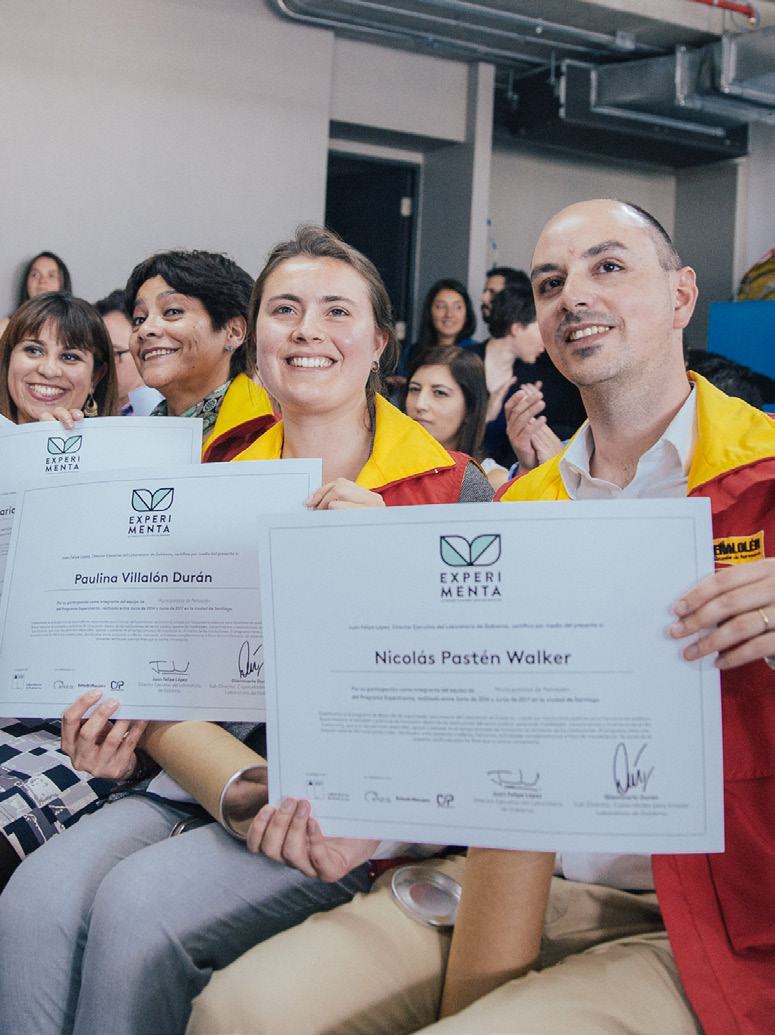
Endnotes
- This fifth principle was added recently in early 2018 as the team became aware they used it implicitly but never made it explicit.
- OECD (2017)
- Mezirow (1991)
- Leurs & Roberts (2018, p. 20)
- Kolb (1984)
- Design Council (2015)
- Also see the work of Kursty Groves and Oliver Marlow (2016) for an analysis of effective innovation space. In addition, see Scott Doorley and Scott Witthoft (2011) for guidelines on setting up and designing innovation spaces.
- Neumeier (2005)
- NOBL (2017)
- Mainly in 2016
- See the work of NOBL (2017)
- Leurs (2018)
- Leurs, Quaggiotto & Christiansen (2018)
- See modalites of learning in the Playbook for Innova-tion Learning (Leurs & Roberts, 2018, p. 54)
References
Design Council (2015) The design process: What is the double diamond? Retrieved July 17, 2017 from http://www.designcouncil.org.uk/news-opinion/design-process-what-double-diamond
Doorley, S., & Witthoft, S. (2011). Make space: How to set the stage for creative collaboration. John Wiley & Sons.
Groves, K., & Marlow, O. (2016) Spaces for Innovation: The Design and Science of Inspiring Environments. Frame Publishers.
Kolb, D. A. (1984) Experiential learning: Experience as the source of learning and development (Vol. 1). Englewood Cliffs, NJ: Prentice-Hall
Leurs, B. (2018, February 6) Landscape of innovation approaches. Retrieved February 14, 2018 from https://www.nesta.org.uk/blog/landscape-innovation-approaches
Leurs, B., & Roberts, I. (2018) Playbook for Innovation Learning: 35 diagrams to support talking and thinking about learning for innovation. Nesta, London.
Leurs, B., Quaggiotto, G. & Christiansen, J. (2018, 4 February) Exploring the unobvious: six principles to establish experimental practices. Retrieved February 14, 2018 from https://www.nesta.org.uk/blog/exploring-unobvious- six-principles-establish-experimental-practices
Mezirow, J. (1991). Transformative dimensions of adult learning. Jossey-Bass, San Francisco.
Neumeier, M. (2005). The Brand Gap: Revised Edition. Peachpit Press.
NOBL (2017) Team Design Bootcamp. NOBL.
OECD (2017), Innovation Skills in the Public Sector: Building Capabilities in Chile, OECD Publishing, Paris.
Team Experimenta Laboratorio de Gobierno
Valentina Arros, Paulina Buvinić (2016), Gianncarlo Durán, Editha Fuentes (2016), Beatríz Hasbún, Mariana Lavín, Katalina Papic (2016), Gabriela Valenzuela (2016), Francisco Vera (2016).
Expert organisations
Aukan Dictuc, CSP Universidad de Chile, Ematris, Estudio Racimo, Lead to Change, Pensum.
Experimenta participants 2016
Mariela Valenzuela Guajardo, Daniela Andrea Aguayo Ochoa, Carolina Alejandra Fuentealba Mella, Claudia Elena Gutiérrez Fernández, Rodrigo Sebastián Mora Gatica, Animaría Cecilia Muñoz Duran, Jaime Eduardo Téllez Igor, Miriam Eliana Navarrete Novoa, José Luis Bravo Jara, José Francisco Weinnberger Illanes, Carola Loreto Inostroza Campos, Camila Elvira Puga Rallón, Camila Andrea Campos Urrutia, Wilson Alexis Espinoza Chamorro, Miguel Ángel Hernández Aguayo, Pía Rodríguez Aravena, José Rodrigo Sanzana Vásquez, Álvaro Rojas, Cesar Jara González, Lorena Navarrete Gálvez, Carolina Santibáñez Sepúlveda, Rodrigo Alberto Cid Fuentes, Alejandro Andrés Alarcón Monsalves, Javier Benjamín Soto Pino, Camila Nicole Bugueño Pérez, Nicole Estefanía Ibáñez Arévalo, Pamela Andrea Rojas Aravena, Elizabeth María Vega Salazar. Macarena Araya Aliaga, Claudia Díaz Araneda, Rodrigo Díaz Cortez, Cristian Ortega Bravo, Paz Olmedo Campos, Álvaro Sverlij Zapata, Isabel Troncoso Marzan, Víctor Grijalba Vergara, Patricia Tobar Valenzuela, Maribel Duran Bravo, Cristian Sandoval, Dánnae Vega, Cristian Sandoval, Erik Viñals Bravo, Rubén Alexis Martínez Arce, Rosalba Soledad Ávila Soto, Marcia Jiménez Briones, Katalina Jofré Guzmán, María Eugenia Lagos Oyarce, Hugo Montes Soro, Mariely Oemick Ramírez, Nicolás Pastén Walker, Paulina Villalón Durán, Marcelo Bernal, Daniel Salas Blanco, Marco Colina Barahona, Alejandro Sepúlveda, Christian Silva Vásquez, Paola Madrid Lamatta, Estrella Ibarra Gutiérrez, Marcelo Palacios Piña, María Angelica Pizarro, María Soledad Orlandi, Solange Montaldo, Lorena Elgueta, Patricio Ovalle, Mauricio Brito, Leopoldo Vallejos, Felipe Schiaffino, Carlos Pinto, Nelly Carreño González, Carlos Pinto, Teresa Correa Valenzuela, Claudia Ramírez Carvajal, Luciana Serraino Guerra, Daniela Garrido, Sofia Landaeta, Jonnatan González, Cristian Salomo, Nicole Villarroel Pérez, Juan Pablo Vilches Ponce, Andrea Solis Aguirre, Jorge Álvarez, Carolina Leitao Álvarez, Nicole Sáez Pañero, Josefa Errázuriz, Evelyn Matthei, Hernán Frigolett Córdova, Mario Acuña Prambs, Jaime Eduardo Téllez, Dr. J. Alfredo Donoso Barros, Jaime Arévalo Núñez, Ricardo Fuentes Palma.
Experimenta participants 2017
Luis Aránguiz Cabrera, Francis Durán Mellado, Geraldine Letelier Muñoz, Millaray Martínez García, Constanza Bravo Franco, Ignacio Maldonado Blázquez, Khamila Caniupan Alcayaga, Macarena Carroza Athens, Carlos Zúñiga González, Julio Bravo, Carolina Vidal Leyton, Eduardo Enrique Abud Parra, Leandro Cristian Pozo Araya, Alejandra Marisela Guajardo Orellana, Ricardo Alfredo Canales Coronado, Valeria Pino Riveros, Eduardo Andrés González Pérez, Daniela Francisca Arriaza Rojas, Ariel Arnaldo Cornejo Arcila, Víctor Hugo Miranda Torres, Vany Francisca González Liberona, Carlos Fernández Rodríguez, Gaby Garay Silva, Lucy García Milla, Eduardo Bluhm Brandt, Waldo Salazar Dinator, Paulina Rodríguez Groppas, Claudia Moraga González, Gonzalo Mura, Gabriel Urrea, Carlos Gutiérrez Contreras, Carlos Hernández Barra, Ingeborg Fehrmann, Leonora Zuleta, Alejandro Lisoni, Marcia Sapiains, Danissa Solís, Javier Saravia, Rudy Videla, Alejandra Ramos, Viviana Andrea Sánchez Lichtemberg, Cristián Alejandro Loyola Carvallo, Yelka Ruiz Rocha, María Cristina González Irrazábal, Isidora Velasco Navarro, Alejandro Solís Vásquez, Carolina Graciela Ruz Ibáñez, Amelia Manzano Silva, Marcia Escobar Nieto, José Miguel Von Bischoffshausen Maluenda, Nélida Cousiño, Dajana Vergel, Ricardo Claudio González Rosales, Loreto Alejandra Guerra Toledo, Patricia Beatriz Echeverría Jara, Cecilia Hortensia Farías Olguín, Juan Pablo Sepúlveda Olmos, Alejandro Patricio Santander Cepeda, Ruth Marianne Rautenberg Talhouk, Rodrigo Alexis Rosas Cornejo, Francisco Esteban Segura Folchi, María Consuelo Gutiérrez Pérez, Pedro Alfaro, Carlos Sebastián Cerda Pinto, Francisco Javier Ortiz Espinosa, Nicolás Andrés Mena Reyes, María José Fuenzalida González, Leonardo Javier Mellado Barría, Verónica Mariana Torres Méndez, José Antonio Ruiz Fernández, Mauricio Alexis Cofré Rodríguez, Laura Ester Barriga Romero. Daniela Rivera Espinoza, María José Díaz Nova, Claudia Ceballos Uribe, Carolina Hernández Valdés, Vanessa Parra Merino, Juan Carlos Molina Retamal, Patricia Godoy Cartajena, Patricio Meza Abarca, Karina Urbina González, Tomás Vicuña Meneses, Héctor Santibáñez Frey, Carlos Vera Gallardo, Patricia Torrico Lazcano, Carlos Cubillos Aránguiz, Marcelo Escalona Hatte, Sandra Silva Leiva, Teresa Pastor Garrido, Paola Aliste Zambrano, Jazmín Arredondo Saavedra, Patricia Freire Sagasti, Sergio Olivares Pino, Javier Venegas Medina, Paula Azócar Saldaña, Ximena Figueroa Díaz, Silvia Díaz Canales, Javier Morales Norambuena, Luis Patricio Solís Guzmán, Natalia Gallardo Osses, Carmen Olivares Riveros, Jennifer Torres Catalán, Alicia Alarcón San Martín, Daniela Silva Rochat, Pamela Labrín Neira, Andrea Díaz Canales, Marcela Valenzuela, Jacqueline Sanhueza, Nicolás Azócar Rojel, Cristián Cancino Ríos, Javier Errázuriz Araneda, William Tobar Argueta, Felipe Macaya Araya, Carolina Leiva, Josefa Karmy, Yanela González, Alex Vargas, Miguel Quiñones, Francisca Díaz, Romina Bacigalupo, Álvaro Parra, José Herrera, Carlos Felipe Alfonso Barría, Nancy Gatica Fuentes, Ana María Barrientos, Margarita Soto Henríquez, Jorge Saavedra Estefo, Mercedes Rueda Sáez, Bernardita Javiera Sepúlveda, Rodolfo Adriazola Rivera, Claudia Antinao, Robert Aguayo Rivas, Marcos Sabag, Corina Riquelme, Pedro Alfaro, Carlos Sebastián Cerda Pinto, Francisco Javier Ortiz Espinosa, Nicolás Andrés Mena Reyes, María José Fuenzalida González, Leonardo Javier Mellado Barría, Verónica Mariana Torres Méndez, José Antonio Ruiz Fernández, Mauricio Alexis Cofré Rodríguez, Laura Ester Barriga Romero. Bernardino González, Carlos Covarrubias, Joao Romero Bravo, Sebastián Ruiz Miranda, Moisés Oñate Vallete, Gonzalo Norambuena, Constanza Nualart, Roxana Hernández, Hugo Araya, Mario Gómez, Priscila Vargas, Gabriela Muñoz, Pedro Legue, Renato Herrera, Joaquín Águila, Paulo Bello, Javier Cárdenas, Jorge Carrasco, Joshua Arismendi, Javier Martínez, María Carolina Ruiz Soto, Mónica Cecilia Bustamante Leimbach, Hans Peter Burrows Formantel, María Carolina Vidal, Willy González, Alex Torres, Cristian Trujillo, Leonor Herrera, Arlett Vargas, Marissa Evelyn Jaramillo Aravena, Jaime Nolasco Andrade Uribe, María Cecilia Daguer Biffi, Carolina Yanet Araya Muñoz, Luis Alfredo Paredes Ruiz, Paulina Alejandra Fuentes González, Rafael Olguín, Claudia Sherrington, Rodrigo Sepúlveda, Daniela Soto Almonacid, Consuelo Córdova López, Daniela Barría Angulo, Gabriela Paz Rodríguez Tobar, Angélica Levicán Cañulef, Sara Villalobos, Ariel Muñoz, Pamela Reyes, Maricel Sobarzo, Iris Gonzáles, Marly Cruzat Arriagada, María Ignacia Olivares, Daniel Tello, Graciela Gaete, Alejandra Lobos Castillo, Jenny Riffo Poblete, Diego León Mantero, Juan Pablo Hernández, René Franjola, Alejandra Millar, Macarena Monet, Carmen Gloria Valeyvela, María Soledad Cheng, Tatiana Zenteno, Marta Triviño, Vanessa Lisset Carrasco Carrasco, Luis Rodrigo Ríos Ríos, Rubén Villaroel, Rodrigo Herrena, María Flores Vera, Cindy Almonacid, María José Rivas, Marcelo Luengo Godoy, Carolina Cárcamo Cárdenas, Melissa Almonacid Serón, Juan Carlos Riquelme Venegas, Silvana Asencio Pérez, Andrea Castillo, Claudia Sherfen, Carolina Hernández, Paula Serón, Iván Paulo Leonhardt Cárdenas, Patricio Coronado, Luis Ávila Bravo, Rodrigo Ramírez Pino, Sebastián Pavlovic Jeldre, Iván Felipe Osorio, Carlos Henríquez Calderón, Claudio Castro Salas, Claudia Pizarro Peña, Gabriel Aldoney Vargas, Rodrigo Diaz WöRner, Omar Jara Aravena, Vladimir Pizarro, Solange Huerta, Andrea Castillo Rosas, Rene Alfonso Garces Alvares, Patricio Rosas Barrientos, Enrique Marcel Santis, Carlos Covarrubias Melero, Hardy Grandjean Rettig, Dr. Nelson Bello Oyarce.
EXPERIMENTA
un Estado innovador para las personas
Laboratorio
de Gobierno
nesta
58 Victoria Embankment
London EC4Y ODS
+44 (0)20 7438 2500
[email protected]
@nesta_uk
www.facebook.com/nesta.uk
www.nesta.org.uk
Nesta is a registered charity in England and Wales with company numer 7706036 and charity number 1144091.
Registered as a charity in Scotland number SCO42833. Registered office: 58 Victoria Embankment, London, EC4Y ODS.