Authors
This report has been written by Michelle Eaton and Camilla Bertoncin from Nesta's Government Innovation Team.
Acknowledgements
Nesta wish to thank Essex Police, Essex County Council, Essex County Fire and Rescue Services, and all those who have contributed both directly and indirectly to this project.
Special thanks also to Eddie Copeland, Nevena Dragicevic and Ed Parkes who have all worked on this project.
About the Essex Centre for Data Analytics
At the core of the 'Essex Innovates' programme, a data science and AI partnership between Essex County Council, Essex Police and Essex University, the ECDA is a programme designed to create a 'whole-system approach' for integrating data and predicting risk across the region. Its vision is to make Essex national leaders using the power of data science and AI to tackle public policy challenges.
www.essexfuture.org.uk/ecda/essex-centre-for-data-analytics
About Nesta
Nesta is an innovation foundation. For us, innovation means turning bold ideas into reality and changing lives for the better.
We use our expertise, skills and funding in areas where there are big challenges facing society.
Nesta is based in the UK and supported by a financial endowment. We work with partners around the globe to bring bold ideas to life to change the world for good.
www.nesta.org.uk
If you'd like this publication in an alternative format such as Braille, large print or audio, please contact us at: [email protected]
Design: Green Doe Graphic Design Ltd
Introduction
Nesta has been working with Essex Police, Essex County Council and partners on a pilot for the Essex Centre for Data Analytics (ECDA). The ECDA is a programme designed to create a 'whole-system approach' for integrating data from partners and predict risk, in order to reduce vulnerability.
This data sharing pilot sought to prove the value of this kind of approach, and make the case for continued support for ECDA's future.
The aim of this report is two-fold:
- To provide a detailed account of Phase 1 of the ECDA pilot: the methodology, the approach, the challenges to delivery and the potential solutions identified.
- To identify a series of key learnings which can be used to inform future data-driven projects of this kind.
We share these findings both to consolidate our learning about the future shape of ECDA, and to provide a useful inspiration and guidance to other ODAs in their attempts to make smarter use of data to deliver better, more responsive and effective public services.
Why Nesta?
Nesta has expertise and experience in working closely with partners to scope viable data-driven projects, develop information sharing agreements, collect data, perform analysis and measure results. To date, Nesta has completed three Office of Data Analytics (ODA) pilots in London and the North East, which focused on tackling rogue landlords and issues related to alcohol abuse respectively.
Section 1 The approach
The overall approach we took for the project follows Nesta's four-step Office of Data Analytics methodology, summarised in the graphic below:
Figure 1. Nesta's four step methodology for public sector data analytics
A diagram illustrating Nesta's four-step methodology for public sector data analytics, represented as a linear flow with branches for "Problem", "Discover", "Define", "Develop", "Deliver", and "Solution". The steps are: Specific problem -> Defined action -> Clear data product -> Accessible data.
Specific problem
A workshop with local experts, including the Anti-Slavery Partnership Coordinator at Essex Police, the Behavioural Insights Team, and other organisations involved in relevant fields was held in June 2017, and as a result the problem identified was:
"It is hard to identify the regulated businesses most likely to be engaged in exploitative labour practices."
Defined action
The intention of the pilot was to combine and analyse data from a variety of sources (workplace safety inspections, fire safety and rescue inspections, police intelligence, etc.) to identify local businesses most likely to be engaged in exploitative labour practices, and direct inspection teams towards them.
The objectives were designed in the early stages of the pilot:
- To test how data analytics can help reduce the risk, harm and vulnerability associated with modern slavery in Essex.
- To increase the impact of limited resources available for business premise inspections.
Clear data product
Although at the initial stage there was no clear idea of a data product, partners seemed to have a propensity towards building a predictive algorithm, focusing on the identification of businesses, rather than individuals, to support inspection activities.
Accessible data
Mainly public sector data (workplace safety inspections, fire safety and rescue inspections, police intelligence, etc.), but possibly adding private sector data (e.g. utility bills).
Once a problem and action had been defined, the team moved into designing and delivering the pilot.
In terms of delivery design, we opted for the Double Diamond created by the Design Council, which includes four phases:
Figure 2. Double Diamond – a simple visual map of the design process
A diagram illustrating the Double Diamond design process with four phases: Discover (insight into the problem), Define (the area to focus upon), Develop (potential solutions), and Deliver (solutions that work). It shows a path from Problem to Solution with "Problem definition" and "Design brief" as key points.
Flash thought
Although this diagram suggests that the design process is a linear sequence of steps, we found ourselves jumping back and forth, especially between the third and second stage.
Key elements of the discovery phase
By the end of this phase, we wanted to be able to answer the following questions:
- What are the stages a business work through to set-up and operate (e.g. finding a premises, recruiting workers, finding customers, connecting to utilities etc.)?
- What is the inspection regime across public sector organisations inspecting businesses?
- What is the data profile of a business?
- Who holds what data?
- What data predicts which businesses are likely to engage in modern slavery and which ones are not likely to/do not engage in modern slavery?
Desk research and literature reviews
In order to answer these questions, we undertook the following activities:
- Desk research and literature reviews
- Expert interviews and user research
- Business journey mapping workshop
- Ethical review
In an initial phase, a literature review on recent and current research about slavery and slavery-related practices in the UK was conducted. This included the relevant legislation, and national and international examples of data initiatives tackling modern slavery.
This body of research was crucial to inform not only our understanding of the problem, but also all activities that followed. It gave a clear steer to our ethical reviews, and helped us prioritise the list of experts we needed to talk to. A selection of the relevant documents on modern slavery can be found in Appendix 1.
Expert interviews
We conducted expert interviews and workshops with a number of organisations involved in this field. A detailed list of interviews can be found in Appendix 2. The two main findings from interviews are:
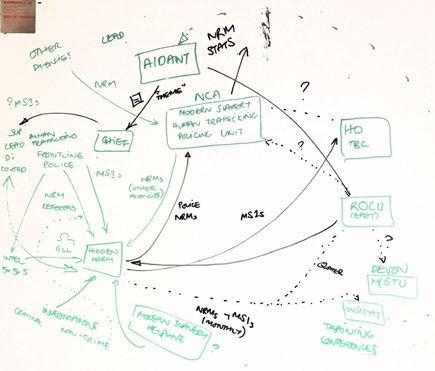
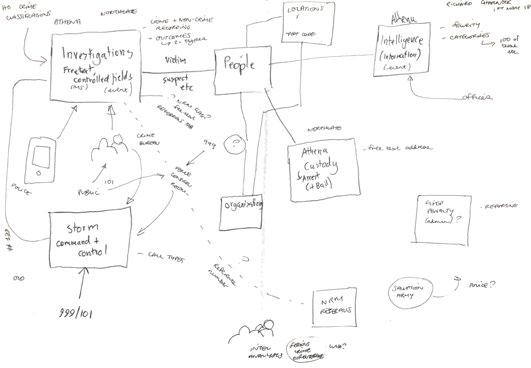
- The complexity of modern slavery processes. Expert interviews with Police analysts allowed us to create data flow diagrams to understand how data, such as incidents, investigations, intelligence, arrests and National Referral Mechanism referrals are captured and accessed by the Police. Data is scarce, and very difficult to link to businesses, no UPRN (Unique Property Reference Number) are used and it is therefore very difficult to have a complete overview of the region.
Figure 3. Data flow maps taken during expert interviews with police analysts
- Different agencies and organisations have different deliverables and priorities. Many do not have specific mechanisms to investigate instances of modern slavery, and/or this is not their priority. A recurrent theme of user research interviews was that agencies, although acutely aware of the issue, do not necessarily feel modern slavery is their area to own and target.
Business journey map
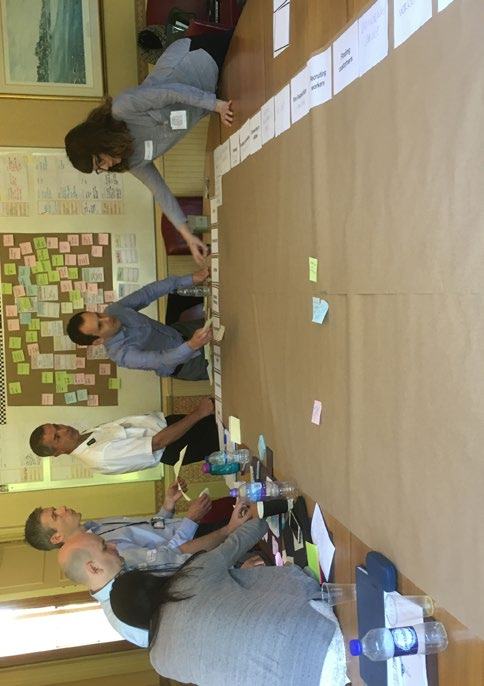
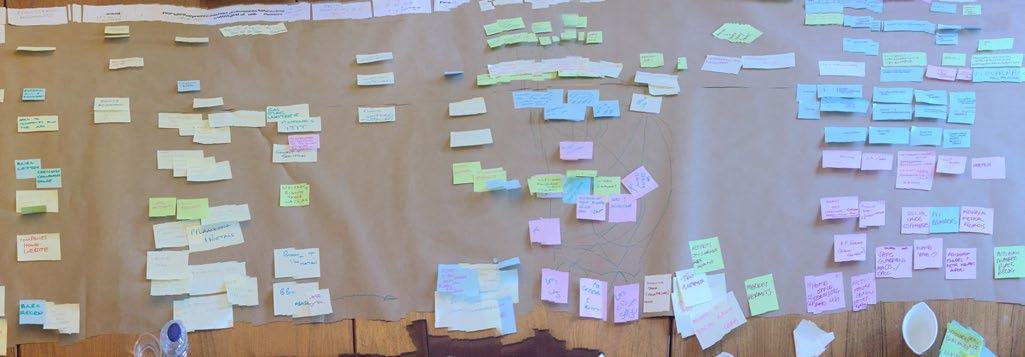
A workshop was organised with partners, aimed at co-creating a description of the journey businesses go through (from registration to closing up), highlighting where the local public sector and other local organisations have contact with them and where they collect data. This exercise shed light on the lack of current multi-agency arrangements around business inspection and the poor tracking of data.
Figure 4. Business journey mapping workshop
Ethical review
As part of the discovery phase, an initial ethical assessment was undertaken, for which a number of frameworks were considered. Partners at Essex County Council had previously used the Cabinet Office Data Science Ethical Framework, therefore we adopted the newly published DCMS Data Ethics Framework, to which we incorporated elements of the Open Data Institute Data Ethics Canvas.
Flash thought
Conducting an ethical review at the initial phase of the project was crucial to consider the risks of different approaches before they were put into action.
The result of the ethical review uncovered the following:
- Given that modern slavery has only been classified as an offence since 2015 there have been relatively few prosecutions in Essex to date. This makes historical data availability a challenge.
- The complexity of this crime and poor availability of data makes it problematic to extract factors that could help us draw strong correlations between inspection outcomes and predictions of businesses exploiting victims of modern slavery.
- A number of businesses (e.g. nail salons or car washes) are already on the police radar for exploitation practices. There is intelligence on these industries, hence it would be possible to identify a number of risk factors for these specific businesses. However, an algorithmic model built solely on those would end up reinforcing current targeting practices, rather than helping identify emerging ones elsewhere.
We therefore concluded that the data available for the project might not be of sufficient quality to be able to identify unambiguous risk factors of modern slavery exploitation. Focusing solely on modern slavery exploitation would therefore create a high risk of producing ineffective insights or causing adverse impacts on individuals and groups.
Section 2 Early insights
Over the months of discovery phase, we tested the initial hypothesis, researched data availability, best practice, regulations, and plumbed the depths of frontline professional experiences.
We realised that the problem and data product identified were not the best fit for this project and produced two recommendations based on a series of considerations and insights from the discovery phase.
First recommendation: To broaden the scope of the initial data product from Modern Slavery to capture a multi agency picture of business inspection.
In undertaking our discovery for a pilot on modern slavery, we uncovered a challenge that was even more fundamental - that data and information on businesses are not systematically shared across public sector organisations in Essex, but only on a case by case basis.
We suggested that this should become the focus of the first ECDA pilot, for the following reasons:
- Legislation around modern slavery recommends a multi-agency approach, suggesting that it is a precondition for any successful effort in tackling the complexity of this crime. Therefore we feel tackling the lack of systematic data sharing of businesses as a whole could enhance the existing multi agency working arrangements.
- The Police generally will not directly act upon a data insight unless it is reinforced by intelligence. Therefore it is likely that any tool that increases multi-organisation inspection insight could prove just as complementary as another, and in turn be relevant to a wider audience; for example, those tackling other forms of business crime.
- A focus solely on modern slavery might be irrelevant for organisations that are not actively inspecting businesses to find exploited labour. There might however be reciprocal value in sharing data and information on inspection patterns and outcomes, that could even result in more efficient and targeted planning across organisations.
- There are limitations to conducting an effective impact assessment and evaluation of a data tool solely dedicated to modern slavery. This is due to the diverse nature of modern slavery and labour exploitation offences, the difficulty and timeliness of obtaining an outcome at court, and differing measures of success for victims.
Second recommendation: To remove for the moment any algorithmic prediction of risk relating to solely modern slavery.
Considering the challenges raised through our ethical review, we believed that as a proof of concept it would be more sensible and ethically acceptable to initially focus on strengthening multi-organisational relations and building new ways of collaborating in business inspections rather than framing it as a 'modern slavery project.'
Flash thought
Reporting findings and suggesting a change of focus in a project can be daunting, however ensuring that recommendations are communicated alongside evidence makes this easier. Emphasising the benefits of changing the approach as well as the risks if things stay the same can go a long way in making a successful argument for change.
Discovery phase conclusion
At the conclusion of the discovery phase, as a result of what we had found, we proposed reframing the problem statement as follows:
"We do not have a consolidated view of business enforcement and inspection data across Essex services. This limits our understanding of business-related risk and harm from a multi-agency perspective.”
Section 3 Reframing the project
We began by redefining the project based on the discovery phase and key findings, again in line with our four-step methodology:
Specific problem
We do not have a consolidated view of business enforcement and inspection data across Essex services. This limits our understanding of business related risk and harm from a multi-agency perspective.
Defined action
Identify businesses, or business types, which cause demand and harm across multiple public sector service areas, this will:
- Create opportunities for multi agency working and approaches.
- Aid operational decision making.
- Create opportunities for intelligence led/proactive work.
Clear data product
A business lookup tool for all inspections, complaint and enforcement data, which will:
- Concisely display chronological history of interactions across services.
- Include additional scoring or weighting mechanisms to highlight businesses potentially requiring closer inspection.
Accessible data
A visual representation of data sources, categorized into Protected data, Open data, and Datasets to be incorporated in future versions.
Protected data includes logos for:
- Essex County Fire & Rescue Service
- Essex County Council
- Essex Police
Open data includes logos for:
- Environment Agency
- NFCC National Fire Chiefs Council
- Care Quality Commission
- Food Standards Agency
Datasets that will be incorporated in future versions includes a logo for Zoopla, with a description: "District councils and unitary authorities – building control, planning, licensing and health and safety".
Flash thought
When collecting data from a range of organisations, it is useful to record consistent information on each source from the outset to help inform product design and understand the viability of inclusion further down the line, e.g. key data variable, type of data owner, level of geography.
Section 4 Delivery phase
The information governance process was managed by Essex County Council, through existing arrangements set out in the Whole Essex Information Sharing Framework. The data was securely uploaded to a platform called PredictX, where it is pseudonymised and matched.
Data product design
Designs of the data product were created by Nesta using Adobe Illustrator and later on turned into interactive designs on PowerBI using 'dummy data'.
Early designs were tested with Essex Police, Essex County Council and Essex County Fire and Rescue Services, to test their usefulness and clarity. At this stage, it would have been beneficial to run a user design workshop in order to test the product and redesign it in line with user requirements. Due to circumstances beyond our control, however, it was not possible.
The data product
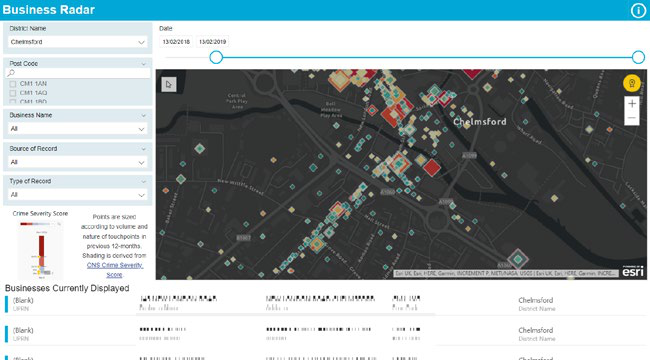
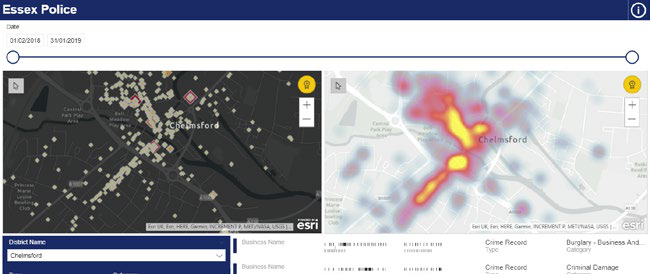
At the most basic level, the tool can be used as an overview to identify which businesses in Essex are known to any services, with size denoting volume of interactions with services and shading representing severity score (based on criminal activity).
Business radar
The business radar tool allows the search and navigation of all business records in the database. Navigation filters are present along the left hand side of the tool where searches can be filtered by district, postcode, business name, source and type of records. A date slider is also available.
Figure 5. Business radar tool
Business matrix
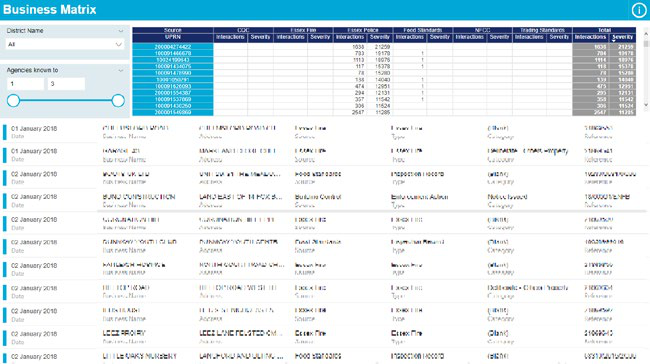
The business matrix tool works as a fast look up tool for proactively scanning businesses which may require additional attention. It is a tabular view of the business radar map, which allows all businesses to be filtered by district and the number of agencies holding information about them. Interaction and crime severity scores can also be displayed here.
Figure 6. Business matrix tool
Single agency data views
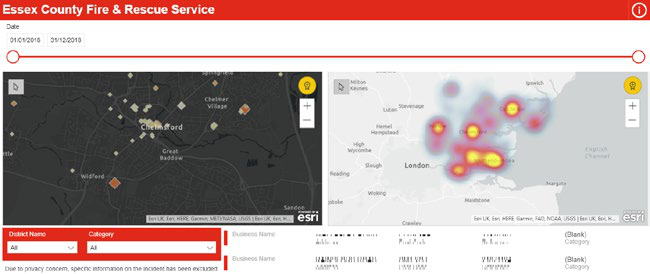
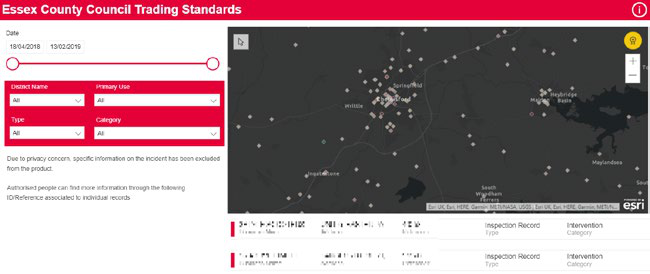
The single agency views are customised to navigate through single datasets. There are currently four available including Essex Police (crimes, incidents and intelligence reports), Essex County Fire and Rescue Service (accidental and deliberate fire data and other calls attended), Food Standards Agency (latest food hygiene inspection ratings) and Essex County Council Trading Standards (inspection and enforcement scores).
Figure 7: Single agency views within the data product
Section 5 Lessons learned
A discovery phase is essential, not just good practice.
There are a number of reasons why it can be tempting to overlook this stage at the beginning of a new project. Often pressure to deliver may make it feel that upfront research is a luxury that we cannot afford, perhaps we have convinced ourselves we already know enough to start. Yet, the discovery phase is a key opportunity to understand the task better, develop better solutions and provide a more thorough context to the problem.
In this project, through undertaking a discovery phase we were able to test a number of assumptions and ideas that could have dramatically impacted the legitimacy and effectiveness of any data product produced. It has increased the likelihood that the product will be accurate, useful and able to tangibly be introduced into working practices. Without this, the project would have overlooked the foundations needed to execute a multi agency approach to businesses for any issue, let alone modern slavery.
In addition to the problem statement itself, the discovery phase can provide a good opportunity to understand and test the relationships that already exist between partners, as well as establishing viability and appetite for forming new ones.
Fix the foundations to enable radical thinking
Aspirational projects like the ECDA pilot are exciting. However, they will not succeed if strong foundations are not in place. Thinking of big ideas and exploring the art of the possible is a key part of the process, but these aspirations should not be blindly strived for without thinking deeply about whether the foundations for success have been laid.
In the example of ECDA, it was clear that the foundations for multi agency business data sharing were not in place. It was therefore critical to lay solid foundation (an ability to share and display data on businesses, with relationships in place to allow this to happen and in turn be useful) before pursuing a data project on a high harm, complex area such as modern slavery. Strong foundations needed to be laid to allow ECDA to explore something predictive, and then modern slavery focused in the future.
People and communication are the key to action
For a whole system approach to be successful, having the right people in place and forming effective relationships is critical.
People, roles and responsibilities should be made clear from the outset to ensure the smooth running of a project and for good communication to be maintained, it is helpful if these roles remain consistent and have sufficient influence over the project. Where this falls short, significant delays in progress are seen.
Communication and relationships go hand in hand. We have found that communication has been more effective when limiting it to fewer channels and understanding which of these are easiests for the stakeholder to use, meaning bias or assumptions around the best way to communicate should be removed. Collaboration tools allowing instant messaging or virtual list and goal setting are only as effective as the user allows, and whilst these are adopted as business as usual in some organisations, there is a dramatic cultural difference in others meaning these are perhaps difficult to access and unattractive to use, and this should be recognised.
We have also found that communication is more effective and relationships are reinforced when co-location of project resource is possible. This will not usually be viable for an entire project, however utilising face to face stand-ups, team meetings or activity sprints can significantly speed up progress by removing time waiting for written responses, resolving misunderstandings and getting agreement on significant objectives or actions and it is what we have found most effective.
Marginal gains and non-cashable benefits should not be underestimated
Although a project may have one big output in mind, such as a data product, a new source of information, cashable savings or new process, there are often many incidental benefits that emerge, which should not be underestimated. Throughout this project we identified 'quick wins' that were useful for some of the organisations involved, for example:
- A general improvement and consistency in data quality, increasing the opportunities for joint working and improving the current business intelligence picture in Essex. This was achieved by suggesting standardisation in the way organisations capture business addresses, encouraging the inclusion of UPRN from the National Gazetteer.
- A more informed picture of business crime proves useful not only for the Police, but also for wider audiences; for example the Fire and Crime Commissioner for the purpose of performance measurement and service commissioning.
- Opportunities were created for the sharing of skills across Essex partners; the sharing of skills across the partnership was identified as a cost effective way of upskilling current staff and strengthening the ECDA partnership through good working relationships.
Designing and delivering should be done with users
The second diamond did not entail the same amount of detail or time as the first, for a number of reasons however the second diamond should receive as much prominence as the first, with emphasis on user design and generating a range of solutions.
Conclusions
The establishment of an Essex Centre for Data Analytics provides an opportunity to draw together projects, ideas, expertise and resources from across the public sector in Essex to address some of the most important areas of vulnerability and tackle some of the biggest challenges across the county. This pilot sought to prove the value of a multi-agency data sharing approach in order to help achieve this.
At Nesta, we believe the the most effective way of running a public sector data analytics project is to use a four-step methodology, and found this method particularly useful when first identifying, and then later reframing the project itself. The double diamond approach gave us a good framework for engaging in a rigorous discovery phase, which lead us to conclude that the problem we originally set out to prove was not the most suitable or perhaps be the most effective in 'proving the concept' of ECDA.
Delivering the project relied on building strong relationships with partners and having supportive leadership in place. This is vital for embedding the ECDA partnership approach in the long term but in this instance, made the necessity of redefining the project objectives viable. Suggesting a change of focus in a project can be daunting, but building trust with decision makers and ensuring that recommendations are communicated alongside evidence made this process significantly easier. Real credit should be given to the ECDA leadership for adopting the recommendations and supporting the change in direction of the project; we believe this style of leadership provides excellent foundations for the future success of ECDA.
We advocate that user design is extremely important to ensure that an end data product will sufficiently meet the users needs knowing it can play a big part in understanding the why, the what and the how of the products use. Following the detailed discovery phase, it was not possible to run another workshop when setting out to build the data product, however we were able to draw on the foundations built in the discovery phase, where workshops and interviews had identified detailed data profiles of a business, touch-points with different services and who holds what data.
Ultimately, this pilot has produced a number of valuable insights and has overcome a range of technical and cultural challenges in joining-up data across local authorities. This pilot has brought about a solid review of data availability and quality, as well as the working practises and relationship in place to allow this approach to happen.
Change does not happen overnight, it is the small incremental changes that can add up to provide the most value and the pilot has encouraged organisations, in particular those at the forefront of the centre to take stock of how they work with, record and share data; enabling the formulation of a formal Essex Centre for Data Analytics in the near future.
Appendices
Appendix 1
Relevant documents reviewed through desk research and literature review.
- Home Office Modern Slavery Strategy. London: Home Office (2014).
- Reducing modern slavery - National Audit Report (2017).
- Modern slavery in the UK: How many victims?: The Royal Statistical Society (2015).
- Report of the Inter Departmental Ministerial Group on Modern Slavery (2016).
- Relevant legislation:
- The Data Protection Act 2018. In particular the sections that relate to:
- Law enforcement provisions.
- Data Privacy Impact Assessment provisions.
- The Modern Slavery Act 2015.
- The Equality Act 2010.
- ICO Code of Practice for Data Sharing.
Appendix 2
Complete list of organisations and purpose of interviews conducted in the discovery phase:
- Essex Police (including Modern Slavery, Serious Crime Directorate and the Anti-Slavery Partnership) – to review the operational structure of Modern Slavery Task Force at a national and local level, performance and intelligence datasets held by the Police in relation to Modern Slavery and possible use for the project.
- Home Office – to review modern slavery challenges surfaced so far, and learn about relevant data projects.
- FLEX – to reach out to a charity working on research and advocacy on labour exploitation, exploring mechanisms to prevent it from happening.
- GDS - to explore available data in Public Registers that could be used for the project;
- TISCReport – to review dataset and possible use for the project.
- Health and Safety – to review the type of engagement of H&S with businesses, inspection prioritisation, data collected and possible involvement in the project.
- Fire and Rescue Service, Essex – review the type of engagement of Fire and Rescue teams with businesses, inspection prioritisation, data collected and possible involvement in the project.
58 Victoria Embankment
London EC4Y 0DS
+44 (0)20 7438 2500
[email protected]
@nesta_uk
www.facebook.com/nesta.uk
www.nesta.org.uk
Nesta is a registered charity in England and Wales with company number 7706036 and charity number 1144091. Registered as a charity in Scotland number SC042833. Registered office: 58 Victoria Embankment, London, EC4Y 0DS.
CC BY NC SA