Outcomes: intended and unexpected
An introduction to the pilot R&D case studies
At a networking meeting in London a speaker from the US pointed out something interesting. "Why", she asked, "do you in the UK always talk about digital?" Back in the US these same discussions were "about start-ups, or business change." Digital was hardly referred to because it pervaded everything; there was as little need to identify it as there was to point out the existence of oxygen.
She certainly had a point, although I suspect that her argument was partly driven by the financial differences in our two cultures - there, where cultural innovation is usually funded by private investment, and here, where there is more of a mix of public and private.
There is, in other words, a perceived risk that publicly-funded culture in the UK may be missing a trick when it comes to the application of digital technology. Funding organisations - in this case the Arts Council England and the Arts and Humanities Research Council - have a responsibility to work with research and innovation bodies like Nesta to stimulate, encourage and share the new digital applications to the business of creating excellence, for as wide an audience as possible. That's why they came together in 2011 to launch the £0.5 million pilot Fund.
This is the background that also brought together, or at least temporarily aligned, a widely disparate group of institutions. They included a clutch of museums based in one of London's main cultural quarters, a world class London-based orchestra, an immersive drama company that creates theatre in abandoned buildings, another theatre company based in an old town hall in South London, a contemporary art gallery rooted in a diverse community in Nottingham, a network of concert venues in the North East, another network of arts centres across England, and a large, venerable war museum.
The projects they explored were equally varied. Student Pulse focused on mobile ticketing for classical music concerts, where the smart phone provides advance information, easy booking and payment, and paperless tickets. Scratchr looked for an online space where new talent could develop their work with experienced producers, while in the public view. Culture Cloud tested nothing less than the use of social media to democratise the curation of art. Social Interpretation asked: could we have the same sharing relationship with museum objects that we have with music or photo images? DERO explored the market for live and 'near-live' streaming of classical music. Happenstance tested the embedding of technologists in arts centre teams. Punchdrunk experimented with a digital version of theatrical immersion. And CulturApp explored the curation of the geographical space between museums.
The case studies that follow are designed to provide a clear, straightforward introduction to each project; setting out what worked, what didn't, and the lessons we can all learn. While these explore the territorial space, it is important that there is also an opportunity to mine deeper. Each project has its own in-depth research report, which provides a wealth of detail, helping to illuminate why some things worked and others didn't. These will be essential reading for arts and cultural institutions thinking of innovating in these areas.
The projects were selected for the Digital R&D Fund against six 'hot topic' areas: user-generated content and social media; distribution and exhibition; mobile, location and games; data and archives; resources; and education and learning. These themes had, in turn, been identified through a combination of 60 semi-structured interviews with the sector and a crowdsourcing project with Google Moderator.
But in practice the themes were not equally represented - an inevitable consequence perhaps of almost 400 eligible applications competing for eight awards. Disappointingly, there was little practical work around data and archives (with the exception of assets from the Dickens House Museum for the CulturApp), and nothing that drew directly on the world of games. Social media, however, was a major interest. In fact, it could be suggested that the ambitions for social media outstretched its current ability to deliver. As a tool it was central to Social Interpretation, Culture Cloud and Scratchr. When it appeared not to deliver quantity or quality (Social Interpretation) it was a source of frustration. When it did (Culture Cloud) it was difficult to interpret. Notably, social media turned out to be a more marginal feature than anticipated of both the Student Pulse and CulturApp projects.
Distribution, in the sense of using digital technologies to deliver artistic and cultural experiences in new ways, was the purpose of classical concert network DERO. Despite the technical difficulties, the project was designed in a way that, had it worked as intended, it was scalable across the sector. The technical difficulties faced by Punchdrunk, however, in interfacing the online and the real audience, were in the event managed with a non-scalable solution - by interposing human managers. Culture Cloud demonstrated the enormous potential of arts exhibitions online.
Using digital technology to improve the management of resources was an important dimension of Happenstance. It was also central to the end-to-end ticketing concept in Student Pulse, and its influence on the Barbican Box Office arrangements demonstrates its effectiveness. In the long term, the digital impact on the efficient use of increasingly scarce resources may be one of the more lasting effects of the Digital R&D Fund.
Education and learning audiences featured in Student Pulse for students and Happenstance for professional development in the arts and culture sector, although neither project was designed to deliver learning resources. Social Interpretation, however, has the capacity to build learning packages with user-generated content.
Finally, out of the pilot themes, mobile technology and location-based services were the basis for Student Pulse and CulturApp. The key difference, however, was that Student Pulse was consolidating an existing relationship with a mobile-using audience effectively upgrading them from text to smart phone while CulturApp expected to reach a new audience through the commissioning of an app.
But if these were the expected themes, and their relation to the intended outcomes, what were the unexpected themes across the projects? And what were the unintended outcomes?
Clearly, a reluctantly shared theme was the tight timescales and budgets for these R&D projects. In many of them, the digital products were launched late in the schedule, and the research base suffered accordingly. There may be lessons here for the future of the Fund.
One interesting lesson was the need to trust the audience, even when they were participating as users of social media. Social Interpretation, Scratchr and Culture Cloud all set up situations where the exclusive professional role of museum curators, theatre producers and art gallery curators was challenged by the arrival online of the 'crowd'. The professionals expressed their anxieties around the moderation of the posted comments. But in practice there was little to be alarmed about. Potential confrontation was replaced by a constructive public/professional conversation.
'Marketing' was another critical factor. Both DERO and CulturApp felt that their outcomes were partly the result of a breakdown in marketing arrangements they had organised with partners. Social Interpretation and Student Pulse were built on existing audiences. Scratchr eschewed a formal campaign and relied on word-of-mouth through existing networks. Interestingly, Culture Cloud had one of the largest responses and does not appear to have relied on a specific marketing campaign at all.
One of my favourite incidents from the pilot is the one from Happenstance where the embedded digital technologists persuaded the arts administrators to stop emailing and to talk to each other instead. It's a reminder of the importance of process as well as product. Happenstance had already built in that concept by employing elements of the 'Agile' approach, used in product development by many successful digital start-ups. Happenstance also put high value on detailed preparation, openness in working methods, and sharing across arts organisations.
The projects threw up different answers to the question of how disruptive digital technology can (or should) be. In the case of Student Pulse, digital technology offered a means of being smarter and consolidating an existing student concert-going market. But with Culture Cloud we can see the glimmer of something more transformative; the public taking an equal role with curators in defining a market for art. And as we have already noticed, the potential public challenge to professional groups always has the potential to turn into a constructive conversation rather than a displacement of one group by another.
There is clearly a technology lesson from Punchdrunk and DERO about not trialling an innovation without doing a beta test first. It would be easy with hindsight to describe these projects as being overambitious, but that is because they are pioneers. Successful immersive online theatrical experiences, and network screening of live concerts, will surely happen in the next few years. The organisations that make it work will have learnt from the significant trialling of these two projects.
Scratchr and Culture Cloud both benefitted from unexpected outcomes. Scratchr found a new way of commissioning theatrical performance, and Culture Cloud found new artists to work with. It is a tribute to both organisations that they want to share those outcomes with everyone else.
We have also learnt something about risk taking, and how its value outweighs the negative feeling around 'failure'. All of these projects have generated substantial evidence and learning material for the arts and cultural sector, which will be returned to again and again. It is more than likely that some of the organisations that successfully apply the striking ideas developed through the Digital R&D Fund will be the ones who have piloted them through this experimental phase.
Overall, which of the projects created new value - for the public and potentially commercially? This is almost certainly the case with Student Pulse, Scratchr, Culture Cloud and Happenstance. A 50 per cent strike rate with a publicly-funded R&D exercise is no mean feat. A more demanding measure of success would push the strike rate down to more familiar levels for public R&D.
At least three projects clearly did not engage audiences as intended, but their great value lies in suggesting what mistakes other arts and cultural institutions can avoid in the future. It's right that we want to collectively share our passion and insights around museum objects, as in Social Interpretation, but to build this we need a better understanding of what motivates and stimulates us before we create the technology to enable us to do so. CulturApp had the opportunity to draw on a rich archive of Dickens material, but chose to limit itself to two or three dozen locations - much less than those available in any of the many books on Dickens and London. DERO attempted to build a pioneering network of streaming concert venues around an existing programme of fairly specialised music. Future attempts will surely be built around popular works with proven demand. Meanwhile DERO and Social Interpretation yielded valuable data and insights. And they have all paved the way for future projects.
It is probably still too early to agree the full legacy of the projects supported through the Digital R&D Fund for Arts and Culture. A lot will depend on the effective sharing of these lessons, and further interpretations of the research findings. The longitudinal evaluation strategy that the funders have put in place for the scaled-up Fund in England will be fascinating to follow in this regard.
Maybe we are at the beginning of the end of our apparent obsession with 'digital' as a separate way of doing things. As the speaker from the US suggested, it's really just one of the ways we can engage with culture today, and therefore an essential component of how we deliver it. Perhaps it's time to stop being anxious and to start being playful - as well as efficient - with the new tools in the toolbox. Which is why we need initiatives like the Digital R&D Fund.
Paul Gerhardt
Archives for Creativity
Punchdrunk
Extending the experience of immersive theatre through digital technology
The background
Punchdrunk is a successful UK-based theatre company, specialising in 'immersive' audience involvement which can literally leave participants 'reeling' www.punchdrunk.org.uk.
Because their shows are usually a sell-out, thereby creating a growing demand to experience their work, they are a natural candidate to explore the growing opportunities around live digital distribution.
However, Punchdrunk faced a complex task. They define their productions as 'unrecordable' because video would fail to show how the audience chooses its own path. More interesting - and much more challenging - would be to create links between members of the live audience and the online community in order to share the emotional and immersive experience.
In effect, Punchdrunk planned to create an entirely new theatrical experience based on 'mixed-reality' - the live performance linked with the online experience. Could they offer an interactive online user anything to match the quality of the interactive live experience that is at the heart of immersive work?
They had two important assets to use and to build on: a well-received production of Sleep No More in New York, and a working relationship with the MIT Media Lab (www.media.mit.edu).
Following the successful application to the Digital R&D Fund, Punchdrunk partnered with Dan Dixon, University of the West of England and Jon Rogers, University of Dundee to research and to evaluate the project. The results are summarised here, and you can read the full report at www.artsdigitalrnd.org.uk/content/case-studies
Punchdrunk's R&D conceptual design, showing a masked figure with labels pointing to "IR Emitters for Location Sensing", "Biometric Sensors", "Environment Sensors", "Transducers embedded in the strap", "Connector that connects the vest and mask", and "Computers and Batteries".
Innovative theatre company uses digital technology to connect 'real' and 'online' audiences.
What were the objectives?
- To create an online platform that gives access to a live production, Sleep No More.
- To allow online individuals to work with selected audience members to provide a unique and interactive experience for both.
- To allow other observers to interact with the process, via the website and social media.
- To identify the cultural conditions which support or inhibit digital innovation, and to draw out the differing attitudes towards processes and methods, risk and failure.
- To encourage arts bodies to develop different business models for managing digital initiatives.
The challenges
Because the project was built around an extension of the existing production of Sleep No More, care had to be taken to build in communication technology, both on set and with selected members of the audience, which would not disrupt the performance.
A new storyline needed to be developed within the production to provide a trail, clues and items for discovery, all of which formed the content of the mixed-reality experience. In many ways, this was comparable to a computer game.
Decisions had to be taken about how the physical and online worlds would interact, with each other and with the story. Would they be in sync? Would they communicate with pictures or text or sounds? In other words, how could the online world become a faithful re-imagining of the world of the production?
R&D Circuit Board Case prototype: A close-up image of an electronic circuit board encased in a small wooden or plastic box, showing wires and components.
Punchdrunk's R&D control room: A dimly lit image showing multiple computer screens displaying various data and interfaces, with people in the foreground appearing to monitor the systems.
How they were tackled
The decision was made to focus on paired online and real-world participants who, over three hours, would work together to discover a hidden narrative. They would connect through technology integrated into selected versions of the masks that all audience members wore, and at a series of discreetly installed portals embedded in the space. The online interface would offer a digital version of the world of Sleep No More for participants to explore, and a location-based system would allow them to track movement and progress.
The technical challenges of creating this network meant that the wider objective of sharing the online experience with an observing community had to be dropped. The team realised that they could not predict the quality of the mixed-reality experience in this, its first incarnation. It would therefore be impractical to open it up to a wider audience, although that remains an important long-term goal.
For the more limited project a smaller number of individuals were recruited, for both the real world and the online world. They included both Punchdrunk 'groupies', online enthusiasts familiar with gaming, and others who were completely new to both.
The role of partners
Punchdrunk's existing relationship with the MIT Media Lab has been strengthened through the development of the digital technology project. It could not have been realised without their expertise.
However, the experience raised issues about over reliance on a geographically separate technology team. Punchdrunk's enrichment team have come to recognise the importance of a senior technology lead based within the company itself.
The project in action
The project was tested over a week of performances of Sleep No More in New York. Managing this array of technological innovation proved very challenging, and sustaining the mixed-reality relationships became dependent on two important 'operators' from the MIT Media Lab. Even so, the first night attempt to pair five audience members with five online participants had to be scaled back to two the following night. In all, 28 participants experienced the project.
The 'mixed reality' approach leads to over reliance on untested technology.
Of these, 14 were audience participants in this special version of Sleep No More, with the equipment to communicate with their online partners. In this sense they had a quite different, more purposeful experience than the usual audience member. As a result, they were less likely to become immersed in the ritual quality of the production.
This 'distancing' applied even more so to the online participants, who were interacting with their partners through laptops from homes or from offices.
The project outcomes
How successful was the Punchdrunk experiment?
A key outcome was that many participants felt that they barely scratched the surface of the experience, or they felt lost and disconnected.
This was in part due to the difficulty of simulating the experience of the real-world audience, who are usually prepared before the performance of the ritual nature of the event, and are similarly 'disengaged' at the end. For the online participants the process felt much more remote and abrupt.
Their experience had to be mediated by ‘operators', real people who were standing in for the uncreated Interactive Fiction engine. In a fully-realised operation, the online participants would automatically trigger a host of rich media that simulated the world of Sleep No More.
The project researchers identified a tendency by the online participants to slip into a 'game playing' role rather than accepting what was more of an exploratory experience. It led to the question of whether the online experience should have been constructed as a 'goal driven' game from the outset. But this in turn would have been at odds with the actual experience of Sleep No More.
Clearly, this highly experimental and ambitious digital engagement with a live production did not work out as planned. But there is a huge amount to be learnt from the project and these lessons will need to be absorbed by the next organisation that attempts to reproduce the emotional engagement of live performance through digital media.
Considerable experience and lessons available for the next leap into extended, live immersive theatre.
The key practical lessons
- Ambition is to be welcomed, but it has to accommodate significant time to test equipment. The complexity of communication technology, and the absence of stress testing, can lead to a scaling down of what needs to be tried out.
- The researchers noted that "the relationship between the operator and the audience seems to have emerged as the most exciting and playful part of the experience." However, this complex intermediary role is a significant limitation to scaling-up to a wider mixed reality project.
- The ambitious objectives evolved into the complex creation of three projects: the online world, the physical world of the live space with portals through to the online audience, and the knitting of the two together. Unsurprisingly, this was beyond the available resources and timescale.
- The internal company developments for Punchdrunk have been considerable. They have identified the need for a digital specialist in the team, and are currently working out how this would work artistically. They have also grasped how to seamlessly integrate communications technology into their productions. As Pete Higgin of Punchdrunk says, "Bridging the void between the live show and your home computer or laptop and creating an experience that immerses your body and mind in the same way as a live production is still some time away. We feel the project was an important starting point...and are now beginning to develop ways in which we could create distinct and companion pieces of and for our work.”
Hotel lobby for online experience: A dark, atmospheric image of a virtual hotel lobby with text overlaid: "enter hotel", "The formality of the room lends it an elegance but also a menace. The reception desk is long and crafted of dark wood. Several small sitting areas haunt the lobby."
Culture Cloud
Pioneering new ways of curating exhibitions and engaging with artists and audiences online
The background
Skinder Hundal is the Chief Executive of the New Art Exchange (NAE), thenewartexchange.org.uk in the Hyson Green area of Nottingham. The challenge of engaging audiences in what they describe as the 'international square mile' around the gallery became the centrepiece of their pitch to the Digital R&D Fund. Initially, they saw the geographical shape of the community as 'cloud' shaped, but the concept also captures the 'shapeshifting' relationships between the art world, galleries, audiences and artists. Could digital technology connect with local talent and with local and online audiences, building a more diverse marketplace for art? And would this be applicable to other regional galleries?
ArtFinder, www.artfinder.com, was chosen as the technology partners. Since their launch in 2011, ArtFinder has demonstrated a commitment to finding new audiences for contemporary art, drawing on the effectiveness of tools like those developed by eBay, LastFM and other innovatory sites.
The research and evaluation was undertaken by a team led by Dr Paul Long, Professor Tim Wall and Dr Nick Webber at Birmingham City University, www.bcu.ac.uk, focusing on the key questions: how can galleries use online platforms to encourage new audiences to connect with new and established artists and their work? And what are the implications for how we judge 'value' in art?
This case study summarises the findings, and the report can be found at www.artsdigitalrnd.org.uk/content/case-studies
Ashok Mistry, New Art Exchange, Nottingham: An exterior shot of a modern building with large windows and a sign that reads "New Art Exchange" in front of a tree.
Artists respond to the opportunity of online exhibition curated by 'the crowd'.
What were the objectives?
- To create a partnership of nine gallery and visual arts organisations that would encourage local artists to upload their work to the Culture Cloud interactive online platform.
- To engage artists in a competition to have their work curated in virtual and physical gallery exhibitions.
- To enable audiences to go online and 'vote and virtually collect' their favourite art works on the Culture Cloud platform.
- To create a national panel of curators (drawn from the partners) to moderate the selection process.
- To organise a live exhibition of the 'Top 40' works and to identify up to ten for sale online.
- To identify the components of a new business model for a more diverse and digital art market.
Bartosz Kali, Culture Cloud launch, Top 40 Artists at NAE: A group photo of about twenty people, likely artists and organizers, posing in front of an art exhibition.
Bartosz Kali, main gallery space, Culture Cloud launch: An interior shot of a minimalist art gallery with various artworks displayed on the walls.
The challenges
Culture Cloud began as an ambitious concept, embracing everything from attracting new audiences to the gallery to the democratisation of the curation process, and including the creation of a new online marketplace. Given the time and resources available, the project would need to be carefully managed.
How could the process be made attractive to artists? Would they accept judgement by the public? And how could the terms and conditions, particularly around intellectual property, reassure them as their work was digitised, uploaded and shared?
At the same time, how would the process of professional curation work in parallel with the process of public selection? Would it deliver comparable outcomes?
The core of the project was to reach a new audience online. How could it be found? What kind of platform would encourage participation?
How they were tackled
As the plans developed, they were organised into a series of practical stages. But the risk remained that neither the artists nor the audiences would respond.
Submitting artists were reassured by a straightforward set of legal terms and conditions.
The platform consisted of two technologies. Artists uploaded their work to the main 'landing' site, www.theculturecloud.com, managed by NAE. Meanwhile ArtFinder organised the crowd curation side at www.artfinder.com and using Facebook.
Finally, the complexities of professional curating amongst nine gallery partners were resolved by a panel of three judges supported by two representatives of the other galleries.
The role of partners
The gallery partners around the country worked together to publicise the project and to attract artists and online participants to the voting stage. The original concept included an expectation that these galleries would use the project to energise their own specific communities. In practice, this was not a priority for them, but they did successfully stimulate many artists in their networks to submit their work to the Culture Cloud.
The relationship between ArtFinder and the NAE worked well. The research study from Birmingham City University suggested this was partly due to the fact that ArtFinder is a lot more than just a technology provider, just as NAE is not a traditional art gallery, and the responsible executives had diverse backgrounds but with a shared commitment to the arts. The result was that the partners successfully tackled issues such as the dual technology platform, and each organisation understood and appreciated the contributions and skills of the other.
Bartosz Kali, in-gallery interactive screen for voting, NAE: An interactive screen in a gallery setting displaying art, with an interface for voting.
Bartosz Kali, Top 100 Artworks slide show, NAE: A screen displaying "CULTURE CLOUD: YOUR ART, YOUR VOTES, YOUR EXHIBITION" with a visual of an artwork, likely from the 'Top 100 Artworks' slideshow.
A decorative visual featuring intricate, calligraphic artwork with warm golden and red tones on a dark background, contrasted by teal and green borders.
The project in action
The project was organised in four stages: a two-month period for artists to register and to upload to www.theculturecloud.com; a shortlisting stage where the panel of curators selected the top 101 works; an audience voting stage of four weeks; and finally a public exhibition of the 40 most popular art works at New Art Exchange in Nottingham.
Besides the artists' portal hosted by NAE (www.theculturecloud.com), and the main viewing and voting mechanism platform (www.artfinder.com), there was a social media presence. The public could also vote, indicating 'likes' via Facebook (www.facebook.com/CultureCloud), and share via Twitter @NaeCultureCoud, Google+ and Pinterest.
ArtFinder also created an iBook, which many in the project considered to be a considerable aesthetic improvement on the online gallery. It provided the best presentation of all the 101 artworks.
The project was hugely successful in terms of artist involvement. Over 900 artists registered and submitted a total of 907 works. It was from these that the panel of curators selected 101 for the public vote. And over 40,000 votes from approximately the same number of voters, were registered over the four-week period.
Furthermore, of the most popular forty works, as selected by the public, over a quarter were by artists from minority communities. This was an impressive showing, and may have reflected NAE's strong relationship with its constituency.
There were two final winners, one chosen by the public and the other by the panel of curators - and the general consensus was that they could not have been more different! This is, of course, only the first Culture Cloud project, but it may demonstrate that online curation by the public could offer a distinctly different cultural voice.
The Culture Cloud Exhibition at NAE launched on the first night to record numbers, making it the second most successful opening at the gallery. The final total for visitors was 4,296.
Digital formats still have the potential to transform the art market, as they are transforming music and book retailing.
The project outcomes
NAE knows that it has a model which can deliver. At the very least, the success is driving the gallery to consider making Culture Cloud an annual event.
Meanwhile, NAE has planned wider schemes to support both the winning artists beyond the cash prize. Individual iBooks have been designed for the artists, with the possibility of solo shows and of future projects with NAE.
The entire project has helped to boost digital thinking at the gallery. The team know that digital projects can contribute to their core purpose; they have the confidence to take on initiatives themselves; and they have a better understanding of the costs and resources required.
The network of galleries has been strengthened, with discussions about further collaboration and co-commissioning. This could lead to a renewed focus on the real, local audiences.
One of the biggest challenges remains the need to understand the online audience. What does 40,000 registered 'likes' actually mean? How can that level of participation be turned into an actual online marketplace?
Image: A headshot of a man with short dark hair and a beard, wearing a string vest, looking directly at the viewer.
Caption: Mahtab Hussain, String vest, two tears - Digbeth - Highgate, Photography (curator's choice winner)
Understanding the audience may help with the creation of a genuine online art market. As it currently stands there have been sales of one original and 19 digital art prints. The sale of the prints will continue until the end of December 2012. More focus on the business end may help Culture Cloud to become sustainable.
But if the project is repeated and developed it is likely to throw up some more answers. There is a great deal more to be explored about the impact of digital and online technologies on the role of the gallery and the arts organisation, on the power and expertise of the curator, and on the opportunity for wider public engagement.
The key practical lessons
1Be ambitious about the potential of digital and online engagement, but take care not to let it spiral into a complex technological process. Simplify the specific project as much as possible.
2What happens if it works? Plan to capitalise on success and scale, as well as to manage with disappointment. If you find that you attract a large audience, do you have the mechanism in place to find out more about them?
3Transferring intellectual property from the real arts world to the digital can become cumbersome and complex. Get advice on simplifying the terms and conditions and improving their readability.
4If retail is to be part of the plan, then be prepared for how long it may take to build a real customer base.
5Build complementary partnerships. As the research showed: “More is achieved more quickly when arts organisations have a greater awareness of technical constraints and real practicalities, and when technical providers have real insights into the aims, organisation and concerns of those who work in the arts."
Social Interpretation
Applying the principles of social media to relationships with cultural objects
The background
Museums and galleries have always been interested in technology which can enrich the visitor's experience. But contemporary digital media now opens up the possibility of the public directly engaging with an object and contributing to its understanding.
The idea of applying the technology model of social media to relationships with objects in museums, Social Interpretation was developed by Tom Grinsted at the Imperial War Museum (IWM) in London and Claire Ross of the Centre for Digital Humanities at University College London. Tom moved on from IWM early in the project, but Claire remained centrally involved in the project with the Museum.
The technology partner was Knowledge Integration, www.k-int.com/home, with web design company Gooii, www.gooii.com. Research and evaluation was carried out by teams led by Gabriella Giannachi at the University of Exeter, www.exeter.ac.uk and Gaynor Bagnell at the University of Salford, www.salford.ac.uk. The results are summarised in this case study, and you can read the full reports at www.artsdigitalrnd.org.uk/content/case-studies. The researchers focused on the key issue: does the application of social media models to cultural collections successfully increase engagement and reach?
Image: A person is shown looking at a smartphone, which is displaying content. The background suggests an exhibition or museum setting.
Caption: Interaction with Family in Wartime at IWM London
IWM develops the use of social media to make artefacts more relevant and interesting for audiences.
What were the objectives?
- To create a system using social media models which encourages visitors to respond to objects in IWM's themes and collections.
- To facilitate this through the application of digital tools in the gallery, via mobile and online.
- To employ user-centred design to ensure the project is informed on what users expect, require and want.
- To share learning across the IWM and with other museums and galleries.
Image: A close-up of a person, likely a child, smiling while interacting with an interactive screen in a museum setting.
Caption: Interaction with Family in Wartime at IWM London
The challenges
The IWM London, together with its sister IWM North, is a large and complex cultural institution. There were issues for this project around technical ambition, risk taking and stakeholder management. Museum exhibitions have their own lifecycles, and these may not always be consistent with a Digital R&D project. How could the project play to the strengths of the museum and reduce anxieties about the introduction of new technology?
Included in this was a potential 'problem of success'. Successfully applying social media relationships to museum objects could disrupt the traditional power of the curator and the institution's role in guiding the visitor experience. Would the project be fully understood by the departments responsible for its installation?
There were three major components to be developed simultaneously: kiosks in the galleries, together with a sprinkling of 'quick response' QR codes for use with smartphones; the mobile app in Android and iPhone versions; and finally, online object commenting, collecting and sharing.
Viewed as critical to this process was the deployment of user-centred development of the technology platforms, which requires sufficient time and resources to constantly test designs with user groups and to change the product appropriately.
Limited trials show some visitor interaction in gallery space but the quality of the interaction remains to be determined.
How they were tackled
The project team coped with short timescales and complex relationships by being as open, collaborative and transparent as they could. The departure of a key figure soon after the project was given the go-ahead was a challenge, but the IWM commitment remained firmly in place.
In practice, the components of the project were developed simultaneously but installed and launched in sequence, with the kiosks taking precedence and followed by the website and the mobile phone apps.
The user-centred approach to development was inevitably redefined and prioritised within the available time limits. This meant that only two iterations of the kiosk interface were tested with users, while minimal testing time was available for the mobile and web components.
The role of partners
The project involved complex partnership arrangements, with some work being commissioned and other work, including building the kiosks, contracted within the IWM. But the partnership management seems to have successfully held it together.
The research approach was distinctive. The academics from Exeter conducted two ethnographic studies, based on observations of the behaviour of visitors to the galleries; while Salford conducted interviews with project members, visitors and users. While these were all at some distance from the project, it was also evaluated directly by a participant - Claire Ross from University College London.
The project in action
Six Social Interpretation kiosks were installed with interactive touch screens against objects in the Family in Wartime exhibition at IWM in London. These were accompanied by eight QR codes offering a different route to information and comment.
An example of the kiosks was the one installed next to an infant's gas mask. Visitors were supplied with additional object information on one screen 'the museum voice' and then invited to comment on the question 'What is your immediate reaction to learning that babies were put into these objects?' by scrolling to another screen view 'the visitor's voice'.
Image: Top image shows a person holding a smartphone up to a display in a museum. The bottom image shows a person interacting with an electronic touch screen.
Caption (top): Interaction with Family in Wartime at IWM London
Caption (bottom): Interaction with Family in Wartime at IWM London
The project outcomes
From April to October there were a total of 16,128 visitor contributions, or social interactions, to the chosen objects. Of these 9,760 were in IWM London and 5,976 in IWM North, even though these kiosks had only been installed in July. A further 373 comments were made on the website, and 19 by mobile.
During the research observation a third of all visitors interacted with the kiosks - especially younger visitors. But overall there was a reluctance to enter comments, again except for younger visitors. The QR codes were generally ignored, with only a few generating double figures in usage.
Overall, it is clear that the engagement - at any level - with the kiosks was reasonably high. What is less clear is the degree to which this was seen as a continuation of 'text visiting', where viewers read everything offered to them, or seen as an opportunity to interact with the object. A great deal of work remains to be done on the quality of the interactions, and unpack what single word responses such as 'cool' mean in this context. This work forms part of Claire Ross's ongoing PhD research.
A substantial amount has been learnt, and much more remains to be done, on the positioning of Social Interpretation technology in and around the gallery. The research
Evidence suggests that the application of social media to museum collections is an enhancing rather than a disruptive innovation.
suggests that visitors may need some contextualisation when they visit the museum, and some sort of 'framing' device which explains the Social Interpretation opportunities. Future projects will have a great deal of experience to build on.
The project has now finished. The Museum is now planning to apply Social Interpretation, in some form, to ten more objects, this time in the First World War gallery and in time for the forthcoming centenary.
One issue that remains to be resolved is the degree to which Social Interpretation with museum objects is a qualitatively better experience via the Web than 'on the spot' in the gallery. There is some evidence to suggest that, online, people have the capacity and privacy to gather their thoughts more successfully. In the gallery it may be more difficult to respond quickly and constructively - especially if you can't log off and others can see what you have just written.
Clearly, this has not turned out to be a disruptive technology for the museum's curators. They had some anxieties about a 'post-moderated' system where unacceptable comments are removed after they have been posted, but in practice this has not proved to be a problem. In fact, most have welcomed Social Interpretation as a valuable enhancement to the visitor experience, not least because it opens up a conversation between the museum and the public. These may be the first steps towards a lasting legacy.
The key practical lessons
1It can be over ambitious to design, develop and implement three separate components at the same time on a new digital project. Simultaneous development on Social Interpretation did not, in practice, save any time.
2Work with the strengths and values of the institution. An open and collaborative approach will help to manage anxieties about the impact of new technology.
3Be realistic with stakeholder expectations. Nothing is likely to change overnight. But at the same time be clear about what success is, and its implications for future planning.
Happenstance
Transforming arts organisations by embedding technologists
The background
The idea of Happenstance came out of conversations between Laura Sillars at Site Gallery, www.sitegallery.org, Sheffield's centre for contemporary art, and Rachel Coldicutt at Caper, www.wearecaper.com, an agency that produces digital innovation initiatives across the creative, culture and technology sectors. They saw the chance to research and develop an experiment in placing digital innovators in arts bodies, giving them an opportunity to commission digital work internally, and confidence in using digital across the organisation.
The name 'Happenstance' came from Ruth Leary, one of the University of Warwick's researchers who followed the project. It happily reflects the serendipitous quality of the project, the starting point of which was: what would be the outcome of embedding two technologists - one designer and one developer - in each of three arts organisations?
Site Gallery in Sheffield and Lighthouse, www.lighthouse.org.uk, the digital culture agency in Brighton, were part of the original proposal. The third arts body chosen was Spike Island, www.spikeisland.org.uk, a centre for contemporary art and design in Bristol. Caper took on the key role of recruiting the six technologists, matching them up with each other and with the arts centres, and facilitating their 12 week residencies.
The research team from Warwick was led by Chris Bilton and Ruth Leary. Their findings are summarised below and the full report is available at www.artsdigitalrnd.org.uk/content/case-studies
Image: A black and white drawing of a stylized cat-like figure stretching upwards.
Caption: Heathcliff's rendition of Longcat
What were the objectives?
- To test the proposition: How do resident technologists transform arts organisations?
- To discover how technological innovation could become 'embedded' into the organisation at a deeper level.
- To identify the cultural conditions which support or inhibit digital innovation, and to draw out the differing attitudes towards processes and methods, risk and failure.
- To encourage arts bodies to develop different business models for managing digital initiatives.
A breakthrough strategy for tackling the culture gap between arts management and digital innovation.
The challenges
Each of the three arts organisations sat in different parts of the digital literacy spectrum, with Lighthouse the most experienced, regularly curating and commissioning digital work, while at the other end Spike Island were aware of their need to build digital capacity across the organisation. But in each case it was essential that the senior management were completely committed to the project, and open to the potential outcomes.
Image: A desk with electronics components, including a breadboard and wires, suggesting a setup for thermal printer experiments.
Caption: Natalia's thermal printer experiments
The project aimed to show the potential impact and relevance of digital technology across all areas of activity, influencing not only curatorial and artistic outputs but also day-to-day administrative and marketing tasks.
Part of the initial 'sell' of the project was that it would not just be measured by the number of digital applications developed or specific output achieved. Instead, the open-ended, open-method, risk-taking process of digital development would also be shared - even if this sometimes sat uneasily with the usual way the arts were administrated.
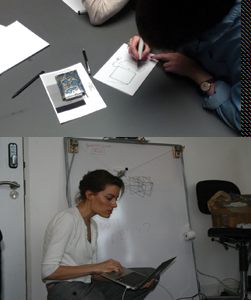
Drawing computers at the Happenstance workshop
The six residents were tasked with stimulating innovation and the introduction of new ways of solving problems in their host arts teams. But at the same time they would be immersed in a traditional arts administration culture - and quickly learn the 'organisational literacy' that would be new to many of them. To succeed, they would need a great deal of support and co-ordination, not just individually but as a network across the three sites.
Image: A woman with dark hair working intently on a laptop.
Caption: Leila calibrating the Polargraph
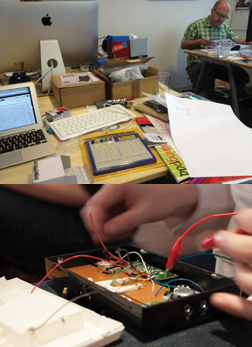
Arduino
Digital technology can introduce new ways of doing things as well as new products.
How they were tackled
In practice, all three senior management teams bought into the project and helped to mobilise the support and enthusiasm of their staff. This top-down support was further enhanced by the experience and communication skills brought by the residents. The time and care that had been taken in their recruitment paid off.
From the start of the project, Caper introduced the concept of Agile development. Drawing on a manifesto first published in 2001 (agilemanifesto.org/principles.html). Agile defines a software development process which emphasises flexibility in people, processes and technologies. The teams were offered this approach not as a rigid framework, but as a source of ideas to enable them to work rapidly across multiple tasks and projects. How they worked became as influential to their hosts as what they worked on. For instance, open working methods and quick communication became valuable skills - separate from their applicability to digital innovation.
Image: A person's legs and feet are visible on a wooden floor, next to various electronic components and wires.
Caption: Floor work
Each of the pairs of residents were provided with highly experienced, local mentors: Matt Locke (Storythings) in Brighton, Clare Reddington (Pervasive Media Studio) in Bristol, and James Boardwell (Folksy) in Sheffield, who could be called upon to provide advice and guidance. At the same time Caper, as the national technology partner, provided continuous support to both the residents and their hosts, and dissemination of results to the wider sector (www.happenstanceproject.com).
The role of partners
In practice the national co-ordinating and support role of Caper became much more significant than the local mentoring. The residents preferred to contact the organisation which had an overview of both sides of the relationship.
Furthermore, the six residents wanted to work together as a cohort across the geographically separated organisations, again increasing the co-ordination role for Caper.
The University of Warwick research of Happenstance was commissioned separately, in line with the other R&D Fund projects. However, for future applications there may be benefit in a research process which is more integrated into the process at each residency site. A more action-research methodology could provide more immediate feedback.
Image: A woman with dark hair working at a desk, looking intently at a screen.
Caption: Leila hard at work
The project in action
In practice the biggest challenge for Caper was the preparatory work they had to carry out with each of the arts organisations, all of whom needed development work to identify their needs before the residents could be placed.
James Bridle and Natalia Buckley were the residents in the Lighthouse, Brighton. Their activities included Offbot, a tool for collecting thoughts and insights from a team which usually get lost on a long-term project, and a Friday Coding Club.
Leila Johnston and James Jefferies were based at the Site Gallery. Their projects included 'Cathy and Heathcliff', Internet-enabled thermal printers, with personalities of their own, which offered a means of connecting Site's presence on Twitter to the everyday life of the building. They also introduced Trello, a simple project management software.
At Spike Island Kevin Walker and Linda Sandvik led a Design Jam which set the brief of making a visit to an art gallery more interesting, and set up workshops to develop their hosts' understanding of technology.
Happenstance also organised two Open House events at each organisation, plus a final event at Nesta, to take stock of the progress of the residencies and to demonstrate outcomes. The first Open House was held mid-way through the residencies and the second at the end. And parallel with all these activities each team of residents maintained project blogs, the Happenstance Twitter account @h8ppenstance, and addressed relevant conferences and seminars.
The project outcomes
The research, including testimonies, confirms the project's success in embedding digital thinking in each of the host organisations, and driving forward their digital transformation. These successes were measured in terms of digital capacity building, transferring skills and confidence, incorporating more efficient working methods, updating the organisation's core assets such as website or branding, and connecting with the local community beyond the centre. There is also evidence that the project has influenced the organisation's business development.
Image: A woman with a laptop at a table, focused on her work, with other materials scattered around.
Caption: Linda concentrating
Now taking shape: a new model, strategically, creatively and financially, for digital residences.
To take the example of Site Gallery, two creative media businesses have moved into the Site premises since Happenstance finished. They have also made changes to the make-up of their board, have initiated a collaborative programme with their local mentor, and are also developing new ideas around how they can offer professional development opportunities to local businesses.
Image: A small electronic circuit board with many wires connected.
Caption: Prototyping is messy
One of the key outcomes of the project has been the development of a model for a technologist-in-residence programme, initially for arts organisations but potentially with application to other sectors as well. The new model includes changes to the funding arrangements to ensure stronger central project direction and management.
The project continues to be newsworthy. Besides the project blog (www.happenstanceproject.com), outputs include a Happenstance newssheet and a video in preparation. Guardian Media Professionals published a well-received article about Happenstance in April 2012 (http://bit.ly/Yptxok).
Happenstance gave people confidence to take things apart and look inside
'Agile' thinking continues to be a significant outcome. As the Warwick research points out, "innovation is often seen as a linear process, from conception to prototyping to testing to shipping of the completed project. 'Agile' principles allow these steps to undertaken simultaneously, allowing greater flexibility, speed and efficiency.” If it can be disseminated separately from the residency programme it may prove to be one of the most significant legacies of Happenstance.
Image: A close-up of small electronic components, including a circuit board and wires.
Caption: Even the Polargraph's components are cute
Image: A close-up of wires connected to a circuit board.
Caption: Testing shift registers
The key practical lessons
1Embedding digital thinking into arts organisations can be transformative. But getting the preparation right is key. A period of development may be required before embedding a technology resident - although this has resource implications.
2This preparation includes ensuring the right level of buy in from the senior management of the arts body. They need to be convinced of the need for the project, and to be able to communicate through 'visible leadership'.
3Care needs to be taken in the recruitment of the technologists, and the recruitment itself may be best handled through a specialised agency.
4Don't underestimate the level of external leadership and management required to see the project through.
5Build openness into every aspect of the project. The learning outcomes could be unexpected, and would benefit from being shared immediately. There is everything to be gained by being as non-judgemental as possible in the work, the process, and its communication to a wider audience.
CulturApp
Piloting a location-aware mobile application for cultural institutions
The background
Paul Cutts heads the Exhibition Road Cultural Group (www.exhibitionroad.com/who), which includes 16 major arts, science and educational institutions in South Kensington. In discussion with the London Cultural Quarters (LCQ) network, Paul had noted the high proportion of visitors - especially the young - with smartphones who also engaged with the museum's digital offers including websites and social media. The idea was born to develop a phone app that could deliver trails across London based around broad, shared curatorial themes.
Paul and his partners agreed on the idea of Charles Dickens trails, which would tie in with the 200th anniversary of the writer's birth. The life and work of Charles Dickens ticked a lot of the boxes. He had addressed key social, political and economic themes in Victorian society, and they shaped the stories and famous characters in his novels.
The Dickens House Museum (www.dickensmuseum.com), a partner in the LCQ, was closing in 2012 for a major renovation but was keen to bring its archive to the project. The technology partner was the development agency Seren, www.seren.com. Research and evaluation was undertaken by teams led by Richard Ellis and Theo Peterson at
Image: A smartphone screen displaying the 'Dickens London Trails' app. The left side shows the app's title, a tagline "Experience London through the eyes of Dickensian characters," and a "Download for iPhone" button. The right side shows a map view with a pinned location and details about Covent Garden, including a quote about Dickens's observations and options to "Mark as visited." The phone screen also shows current time (4:20 PM) and navigation icons.
Caption: Dickens London Trails app interface, showing map and content
Exhibition Road
Exhibition Road explores a mobile app that connects locations and museums.
MTM London, where they focused on “the potential for reinterpreting and enhancing the traditional walking tour experience through the use of an interactive smartphone application". The findings are summarised here and the full report is available at www.artsdigitalrnd.org.uk/content/case-studies
What were the objectives?
- To test whether there was a latent demand for culturally-based apps, alongside the ever popular games and information offerings.
- To test the potential of mobile technology to extend a cultural organisation's reach beyond the institution.
- To test how such a project could encourage cultural organisations to collaborate and share assets and access to mobile audiences.
- To develop a reusable mobile app platform with the potential to support smaller organisations also seeking an affordable route to the app market.
The challenges
What do users expect from a cultural app? The project team needed to know the level of expectation around its text and its media functions. Some of this would be available through app market research, but with limited time and funding the project also needed detailed and specific information.
How could digital technology support cultural curiosity outside of the institution, and in the physical spaces between institutions? Would users want to follow a pre-arranged trail already curated for them, or would they want to plot their own routes and choose their own locations?
Would there be issues around the need to have the smartphone on display in the open street? And how long would users wait for video or audio content to be requested and downloaded?
Finally, how could this small-scale project maximise take-up? Would it be possible to piggyback on another brand or marketing campaign associated with Dickens?
How they were tackled
Concept development and concept testing became central to the project's understanding of users and their expectations. Consumer groups provided feedback on the app's development. They supported the original decision to develop a Dickens-based app, and their comments led to considerable modifications in the design and the content.
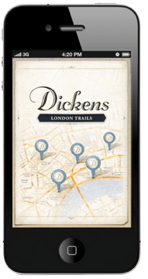
Dickens Trails map screen
These changes included extending the text introductions to the four Dickens characters that linked the trails. They also led to the scaling back of rich media plans which could have quickly drained the phone's battery life.
The final product retained some limited opportunities for user-generated content particularly photos and for links to social media. However, although audio description of buildings or locations was identified in concept testing as a key factor in enhancing a London trail, the decision was made to drop this element due to lack of time and resources.
A communications partnership with the CityRead campaign provided a good opportunity to launch the app; the project involved all 33 London borough library services developing a literacy campaign around the novel Oliver Twist. The app features the Artful Dodger as one of its characters so the synergies were obvious. However, the CityRead campaign was launching in April 2012, requiring a market-ready app by mid-March. This put the small project team under pressure.
The role of partners
The partnership arrangement with Dickens London House, and with the other members of the Exhibition Road Cultural Group, was important to the low-cost acquisition of illustrations and other archive assets. This arrangement is likely to be transferable - and scalable as long as all partners are able to realise the value for themselves in the development of a digital app.
The project in action
The Dickens Trails app was released in April 2012. Unfortunately, the CityRead PR campaign failed to generate any significant coverage, by which time it was too late to switch campaign partners or put in place alternative PR arrangements.
App development demonstrates value of institutions sharing content and expertise.
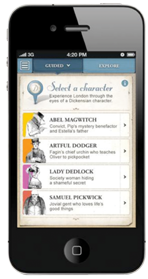
Dickens Trails character screen
The result was a low take-up of the app, around 250 in the first 12 weeks. This in turn has provided insufficient data to fully understand user behaviour and reactions to the app. Furthermore, the lack of GPS data - due to the limitations of the analytics platform - means it is not possible to analyse how the app was used at locations, as intended.
However, the data does reveal that most users opened the app for up to only three minutes, mainly through a Wi-Fi connection, in turn suggesting that most exploration of the app has been in a home or an office environment - for which the app was not intended.
The home page of the app encourages users to follow London trails linked to one of four Dickens characters. Most used this route, but a large number from the small sample also used the Explore mode, which allowed them to display all 45 locations and create their own paths.
Social media and sharing links were available on 'top menus' on each location page, and on a special drop-down menu from the home page. But very few users accessed these, or utilised the opportunity to create their own content - such as uploading photographs.
The project outcomes
The Dickens Trails app is available at www.dickenstrails.co.uk
The Exhibition Road Cultural Group has retained ownership of the platform and is in advanced negotiations with a heritage organisation in the north of England that is interested in licensing the platform to develop its own trail.
The project's research report offers considerable insight into the process of app development and the use of consumer testing.
The question about whether an app is the route to new audiences or to richer engagement with existing visitors is still an open one. This project did not yield sufficient data to provide answers.
Overall, the project provided few insights into a viable and sustainable business model for apps. Basically, the choice remains between free, freemium (where users pay for additional content), and paid models. However, focus group responses to the app did reveal potential opportunities to boost revenue through advertising and sponsorship, especially from services such as restaurants, adjacent to buildings and on the trail itself.
Low take-up means that evidence that smartphone app brings in new audiences remains inconclusive.
The key practical lessons
1. Think again about whether you need to develop a cultural app. The market is still quite specialised, and you will be competing with thousands of entertainment-based apps. Above all, you need to be sure that it helps you to reach new audiences and new ways to engage with them.
2. Invest time and resources in marketing your app. In such a crowded marketplace you may need to link to a major trusted brand, and you will need recommendations, online and by word of mouth, to encourage phone users to visit their App Store or Market.
3. Involve potential users in the design and development process. Research with customer groups can provide valuable insights and help you to modify your app right up to launch.
4. Find the right balance between ease of use and compelling and rich content. Remember that users need an incentive to return to the app, and rich content helps.
5. Ensure that the app performance and user behaviour is well monitored with effective and useful technical feedback. There are sites that provide this service for free.
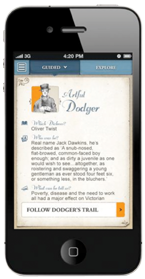
Dickens Trails Artful Dodger screen
Ensure that partners get value from collaboration. The leveraging of expertise and assets, such as archive material, can be encouraged in return for information and feedback about user behaviour, and use of the platform for other themes.
Scratchr
Artists and audiences create new work online in an innovative development process
The background
Through her agency Arts Collective, www.artscollective.org.uk, Katherine Jewkes explores the relationship between digital and the arts. When she met David Jubb, Director of the Battersea Arts Centre (BAC) www.bac.org.uk, they saw an opportunity to create an online version of the Centre's Scratch process - where artists work with producers and present work-in-progress to a live audience. Would building an online version of Scratch change the process itself? And would it bring new online audiences to the work, and to BAC?
They began the project with Videojuicer, www.videojuicer.com, the technology company specialising in streaming moving image, but as the project developed they switched to NativeHQ, www.nativehq.com, and a focus on social media.
This project has been researched and evaluated by teams led by Eric T. Meyer and Isis Hjorth at the Oxford Internet Institute www.oii.ox.ac.uk and Oxford University Consulting www.isis-innovation.com/consulting. They asked, ‘if suitable digital tools are provided...will new practices emerge and new audiences engage theatres and artists?'
The results are summarised in a report which can be found at www.artsdigitalrnd.org.uk/content/case-studies Some of their key findings are included below.
What were the objectives?
- To build digital tools for capturing the process of innovating new theatre.
- To engage audiences in the creative process.
- To explore the potential to evolve new practices and to reach new audiences.
The Forbidden Rhythm performance featuring young beatboxers and dancers was livestreamed
Open, creative, artistic development online can offer opportunities for new artists.
One of the ZooNation Young Company's dancers watches the recorded footage from the livestream
The challenges
The original and successful Scratch process of developing performance at BAC requires the involvement of a live audience and a professional producer, as well as a committed artist. Would it be possible for these features be transferred online, and to remain relevant to each of these participants?
Interaction with the live audience is central to Scratch. How would this work online? Anonymous comments could prove very unconstructive. But online audiences may be unwilling to register and create an identity.
How should the creative process be captured? Would it be a succession of videos, showing auditions, rehearsals and performances and leading up to a live event? Or could social media offer the tools for a more engaged interaction with the development process?
Was there a risk that the artists who want to work with BAC would feel there was a two-tier process, with a small number having real, direct access to its producers and the rest diverted to an online pitch?
How they were tackled
As the project evolved, it became clear to BAC and to partners that one particular unanticipated potential use of Scratchr was as a means of organising and encouraging the commissioning of new work. As such, it became well suited to the needs of artists who were already seeking the attention of BAC producers. And for the BAC itself, it offered the promise of revealing new talent that had not yet made it through their doors.
The original goal of the project to engage audiences in the creative process by exposing more of it online, remained central. But opening up this opportunity for new artists reassured them that they would not be excluded from a direct relationship with BAC.
From the start, the project team saw the potential for social media to engage new audiences, although the precise means for doing so was not always clear. While working with the first technology partner, options such as timelines of posts and livestreaming of events were considered. With the change to a second technology partner, there was a shift to a focus on envisioning the online space as a place to create what came to be called an Itch which is an idea that someone feels needs a good Scratch. Social media was seen to offer a more open relationship with an artist, and an opportunity to actively contribute to the ideas behind the building of a performance.
Concerns about how to curate online feedback led to the decision to require participants to register to join the online platform to create Itches. Non-members were still able to comment, via moderation.
The role of partners
There were considerable delays in this project relating both to platform development issues during the early stages and to the change in technology partners. The research team noted that the challenges of bridging the two cultures, technology and arts, often lead to friction, as the goals of the organisations may not always be clearly aligned.
In this case, the technologists' goal of delivering a clearly specified website clashed with the artists' goals of trying different ideas to see what might work. However, the second technology partner contributed an entirely new concept to BAC: the Itch as the precursor to a good Scratch.
A digital technology team which was fully integrated into the arts organisation may, of course, be more naturally responsive to the exploratory process; but its value would still need to be balanced against efficiency in the development process.
The project in action
The delay in the project meant that launch, in a BETA phase, took place at the end of August 2012. Since then marketing has been low key, mainly word-of-mouth and through BAC's network. This has generated good early results (see page 38) but it is too early to know if it can be sustained.
The decision was made to call the platform Scratchr, directly linking it to BAC's home grown Scratch process, but building in the feel of an end-to-end project. “Before every scratch is an itch. All artists have felt an itch; that uncontrollable urge to pursue an idea, explore its possibilities and limitations.” (www.scratchr.net)
To stimulate the project's development the Scratchr community has been connected with facilitators and communicators within the BAC, who can help artists by suggesting new ways to develop their ideas online, and to successfully manage the process of working offline and online simultaneously.
The initial emphasis has been on the organisation, and how Scratchr can contribute to the workflow, and to its relationship with artists. Through case work, several commissioned artists have also tested the ability of the platform to allow them to engage with audiences, and their initial attempts have suggested several strategies for the future. However, partly as a result of the late launch, the audience development has not yet been a top priority. Time will tell if this 'decision by default' will pay off, and how it will enable steps to be taken to develop the more audience-facing aspects of the website.
The project outcomes
With 200 active artists online - and nearly half developing a performance idea (the majority in response to a particular call from BAC related to a showcase event) - in the first three months, there is initial evidence that artists feel comfortable enough with Scratchr to post ideas. They appear to have overcome any perceived risk of putting their work and its development online.
There are about 2,500 unique visitors. Some of this engagement is extensive - 60 per cent of page views were in long 20+ page sessions, particularly by about 9 per cent of visitors. Sixty per cent of visits via mobile or tablet devices are new visits, with users then spending longer on their laptops. There is a lot that can be built on this promising user engagement.
The research team found that far from Scratchr creating a two-tier system, there has been an integration of the online experience back into the original BAC process. Producers have welcomed the fact that they are no longer the 'gatekeepers' to new talent, and that a new, open platform has become available. Scratchr has also become a new route for pitching ideas directly to BAC.
There is also considerable evidence that Scratchr has begun to shape organisational development at BAC. The latter has appointed two Scratchr Community Managers “to assist you in getting the most out of the site.” The roles will be crucial to the future evolution of the platform.
Forbidden Rhythm performers watching the recorded footage from the livestream of the event half an hour earlier, whilst sharing it on social media sites via their mobile phones
As an important by-product, Scratchr is also building an archive of creativity in development. By recording both successful and unsuccessful projects, the platform will be able to extract meaningful examples and demonstrations for future aspiring performers.
Although Scratchr is unique to BAC, the ambition of using digital to open up a company's creative processes is clearly transferrable. The question, however, is how it can add value to both artists and to audiences.
It is too early to determine if existing and new audiences will become equal participants in the process?
The key practical lessons
1. It may be too ambitious to build a new process for artists and to drive new audiences simultaneously. If you have to develop the audience at a later stage, then work out what you expect of them and research it rigorously.
2. Recognise the potential conflict between the two cultures of arts and technology. There is a balance to be struck between a creative process and efficiency in delivering outcomes. Ensure that your expectations in terms of process are explicitly shared by technology partners.
3. Not all artists are born digital, or have the time and ability to capture their work and share it online. Even experienced artists are likely to need resources to support them.
4. Seize the opportunity to build a valuable archive; get advice on how to capture it and store in order to release future value.
5. Be prepared for the resource costs of maintaining a new platform and integrating it back into the host organisation.
6. If you decide that your users need to register to interact with your platform then you may well pay a price in terms of access. Make sure that it is a price worth paying.
Note
1. The research report from Oxford University Consulting also identifies "nine transferable lessons". These Key Practical Lessons draw on that list.
Student Pulse
Facilitating student participation at classical music events with an easy to use app
The background
Jo Johnson, Digital Marketing Manager at the London Symphony Orchestra, www.lso.co.uk, had already been working with technology company Kodime, www.kodime.com, to run a text-based service allowing students to buy reduced price concert tickets. The 'Student Ambassadors' scheme offered a free ticket for each one bought through a text message system. But the high administration cost and the prevalence of 'one-off' sales, encouraged thinking about updating the scheme.
The Digital R&D Fund offered the opportunity to introduce and test a new mobile and Web-based ticketing system, combined with a range of possible enhancements.
The research and evaluation of this project was carried out by Garry Crawford, Victoria K. Gosling, Gaynor Bagnall and Ben Light at the University of Salford, www.salford.ac.uk. They worked with the partners in the development and testing of the new mobile- and Web-based ticketing and marketing tools, and evaluated their effectiveness with a student audience.
The results are summarised here, and you can read the full report at www.artsdigitalrnd.org.uk/content/case-studies
Digital ticketing influences partner organisations.
What were the objectives?
- Create and test and end-to-end mobile marketing and ticketing solution for classical music concerts for students in London.
- Build the student audience for classical concerts.
- Use location data, social media integration, audience participation and other enhancements to enrich the experience.
- Demonstrate that this technology is transferable and beneficial for other arts organisations.
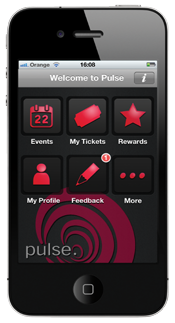
Student Pulse home page
The challenges
The classical music audience often reflects a narrow demographic: older, middle-class, white. One part of the effort to reverse this trend is to consolidate the relationship with students (18-25 age group) and ensure they develop the habit of concert going. But could a digital app also help to break out beyond those who are 'classical music aware'?
Many students were comfortable with the existing text-based service and needed to be convinced that the new app offered genuine advantages.
Given that the new service would be delivered as a smartphone app, was there also an appetite for marketing and contextual rich media and social media that could improve the concert going experience?
To achieve maximum efficiency the smartphone would also replace the paper ticket. But would this end-to-end process be compatible with all box offices? Would they be able to fulfil ticket orders through hand-held scanners?
How they were tackled
Focus groups were clear that while they welcomed a simple process to buy tickets for classical music events they were doubtful that it would reach beyond their specific group. They confirmed that becoming 'classical aware' usually happened at school or in early family life and they indicated that they would be reserved about discussing their involvement in classical music with those outside the set.
LSO consolidates its student audience with a smartphone technology update.
The research also clearly showed that student users wanted a simple technical service, with no 'bolt-ons'. There was little interest in enhancements both before and during the concert experience. The decision was taken, however, to offer social media links, sound clips of future concerts, and a location data tool that enabled you to find concerts nearby.
There was, however, support for the offering of incentives, including a loyalty points system which could pay for a monthly subscription to Spotify, the online music service.
The role of partners
The LSO already had strong partnerships with the Aurora (chamber) Orchestra and their technology partner, Kodime. These relationships served them well in the timely development and launch of the new app.
Discussions were held with a key concert venue partner - the Barbican - to adopt the 'paper-free' ticket system. At the inception of the service the Barbican box office remained wedded to the traditional paper ticket. But a demonstration of the new app by the LSO and Kodime convinced them to consider changes, and they have incorporated the smartphone alternative into the spec for the future management of their box office.
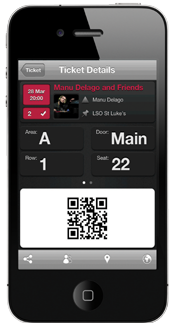
Student Pulse ticket page
The focus groups agreed it would be helpful for the app to be extended to classical events beyond the LSO and Aurora, enabling the LSO to enter into negotiations with other London orchestras and venues.
The project in action
The project confirmed that discounted tickets remained very popular with students. Despite some concern about replacing the old text-based system, and the apparent prioritisation being given to smart phones, the new app was welcomed.
By August 2012, 265 users had registered and 82 per cent of the tickets made available to students were sold.
Successful extension of the app to cover events for nine London orchestras and venues.
Usage of the app confirmed that there was little interest, at this early stage, in such enhancements as sound clips and social networking links. As long as it was functional in booking and securing reduced price tickets it was welcomed. The loyalty system, however, has been recognised as a genuine benefit.
The research uncovered a small proportion of users who were attending classical music concerts for the first time, but it is possible that this group overlaps with the high number of international students attending LSO concerts. They point out that classical music is a London attraction and likely to be more accessible and cheaper than in their home countries.
The project in action confirmed that a new app and a streamlined ticketing system is effective in consolidating an existing audience group, but that in itself it is not sufficient to attract new supporters to classical music events.
The project outcomes
With the success of the new app the name has been changed from Pulse, associated with the LSO, to Student Pulse (www.studentpulselondon.com).
The LSO has built on the interest in extending the app by welcoming into the scheme six more orchestras: London Philharmonic Orchestra, London Sinfonietta, Royal Philharmonic Orchestra, Philharmonia Orchestra, Orchestra of the Age of Enlightenment, BBC Symphony Orchestra and two major venues: Barbican Centre and Southbank Centre.
It would be possible to further extend the scope to cover other arts events, in London and elsewhere, who want to offer student discounts. But the feeling is that this would overload the app with information and choices, and inevitably lose the focus on classical music.
Nevertheless, the app is clearly applicable to other cultural and arts organisations and the technology partner, Kodime, is exploring this potential market.
Meanwhile, Student Pulse demonstrates that mobile ticketing is desirable, affordable and scalable.
The key practical lessons
1. The introduction of digital technology doesn't have to be disruptive. It can play a key role in strengthening and consolidating an existing relationship.
2. Focus on what your audience needs from an app. Wherever possible, simplify.
3. If it works, share it. Both the LSO and the target student audience benefit from extending the scheme to cover other classical music events.
4. Use digital to shape partnerships. The LSO has assisted the Barbican in updating its ticketing system.
DERO
Enhancing audiences for classical music
The background
Claire Harvey was based at video company Aframe when she proposed to The Sage Gateshead, www.thesagegateshead.org, a project to extend and enhance their live concerts. The outcome was Developing Enhanced audiences and Revenue streams for Orchestra and ensemble performances, DERO, a network that would bring together musicians, concert halls, mixed arts venues, audiences and digital distribution.
Mixed arts venues in semi-rural locations, such as the Alnwick Playhouse, www.alnwickplayhouse.co.uk and The Maltings, in Berwick, www.maltingsberwick.co.uk, were quick to sign up, and video platform developer VideoJuicer, www.videojuicer.com, agreed to capture the concerts. The online streaming partners included The Guardian Online, Medici and the BBC Music Magazine.
The research and evaluation was undertaken by teams led by Becky Schutt and Dr.Allègre Hadida for Cambridge Judge Business School, www.jbs.cam.ac.uk, in collaboration with Mathew Petrie and Adrian Brian Cruz at Fusion Analytics, www.fusion-analytics.com. They tested the proposition that new audiences and revenue can be generated by complementing live classical performances with digital experiences. Their findings are summarised below and the full report is available at www.artsdigitalrnd.org.uk/content/case-studies
Recording at the Roundhouse
Orchestra network attempts to build on successes of NT Live and the Metropolitan Opera: Live in HD.
What were the objectives?
- To test if it is possible to find new audiences, and therefore revenues, for classical music through simulcasts, nearcasts and paid downloads.
- To assess the quality of the remote experience, and the technical resources and support required.
- To test the scope for a network of orchestras who can stream their performances into a network of venues across Britain.
- To refine a viable business model.
The challenges
A co-ordinated programme of concerts and simulcast venues had to be identified and organised. The plan was to schedule three classical music concerts, each of which would generate a mix of live and on-demand performances in the concert hall, in remote venues and online.
A project management team and organising process was required – one which could bring together the orchestra players, the venues, the technology partners and the streaming platforms.
The technical readiness of all the venues had to be tested, especially those new to high-speed broadband, to ensure they could receive live and downloaded concerts.
Marketing and promotion had to be organised which would drive audiences to the new, simulcast or near cast venues, and which would maximise the potential online audience through the streaming partners.
How they were tackled
Three live concerts were identified, together with mixed art venues for the simulcast and nearcast relays.
The first was with London-based Aurora Orchestra from the Roundhouse. The live streaming venues were The Maltings and the Gala Theatre in Durham, www.galadurham.co.uk. The nearcast venue was the Alnwick Playhouse. Streamed versions were available on demand for one week from The Guardian Online, and also for all concerts from VideoJuicer and The Sage Gateshead.
Specialised programmes and technical breakdowns limit the impact of the project, but key issues are revealed for future planning.
The second was a concert by Manchester Camerata performed live from the Royal Northern College of Music. Live streaming was to the Gala, and nearcast to The Maltings and Alnwick Playhouse. Streaming on demand for one week was available from Medici and BBC Music Magazine.
The third concert was Northern Sinfonia from The Sage Gateshead. Live streaming was to Otley Courthouse, The Maltings and Alnwick Playhouse. The nearcast venue was the Gala Theatre in Durham. Again, streaming on demand for one week was available from Medici and BBC Music Magazine.
Introductions and presentations were organised at the streamed concerts to ensure that each audience shared a similar, basic experience.
The team behind DERO were geographically dispersed, but they established a structure and regular communications – initially through Skype but because of the patchy availability of broadband they relied on the telephone.
The venues were encouraged to be responsible for their own technical infrastructure, with The Sage providing critical back up technical liaison in all cases.
Promotion of the concerts was through an enhancement of the websites linked to the orchestras and the venues, use of social media, PR coverage in the music press, and a DERO website, www.dero.videojuicer.com.
The role of partners
DERO aspired to be a network of equal partners. However, the complexity of organising a realistic schedule around a programme of live concerts meant that the partners were a mixture of well-resourced entrepreneurial organisations and less equipped, underfunded, often rural venues.
Marketing was heavily dependent on the relationship with The Guardian Online, the partner for the first concert. When it did not materialise with the expected well-placed coverage DERO switched to alternative arrangements with Medici and the BBC Music Magazine.
The substantial technical weaknesses in the project required significant intervention by technicians from The Sage Gateshead but even this last resort was not always successful.
The need for a strong central team to manage the broadcast and distribution was an early lesson for the project, though not one that was fully heeded within the project's lifetime.
An orchestra performs on stage, with dramatic lighting.
Aurora Orchestra at the Roundhouse
The project in action
The live streaming of the first concert was experienced by small audiences in The Maltings and the Gala. Due to low ticket sales in advance of the event, the venues and the DERO team decided to offer complementary tickets to build up the research base for the project. The nearcast was streamed to the Alnwick Playhouse which was only 15 per cent full, with all tickets purchased. The free online stream was watched by nearly 3,000, decreasing to 24 by the end of the concert, although a server issue blocked the stream for an unknown number of users. The on-demand stream was watched by just over 3,000, decreasing to three audience members over the course of the concert.
The second concert was live-streamed to the Gala, with an 11 per cent capacity audience - half of which received free tickets. The nearcasts experienced severe technical difficulties with the concert at The Maltings not loading and the Alnwick Playhouse streams failing to show. This resulted in The Maltings cancelling the performance. The live online stream began with 191 views and decreased to one. The free on-demand stream began at 398 views and also decreased to one by the end.
The third concert was streamed live to 30 per cent capacity audiences at Otley Courthouse, all paid, 7 per cent at The Maltings and 25 per cent at Alnwick. Unfortunately significant technical difficulties at the last two forced the cancellations of both concerts. Nearcast streaming to the Gala, was successful, with a 48 per cent capacity, of which over half had received free tickets. The live online stream attracted 682 decreasing to 12 and the on demand stream from 973 to three.
Overall, DERO attracted only 2,650 audience members to venues which had a total capacity of 6,414 over the course of the three concerts. This is likely to have been partly due to quite specialised concert programmes, relatively little marketing and the impact of technical breakdowns. Online audiences were also significantly below expectations. Only 8,748 were recorded, against a total projection of 30,000, and next to none lasted out the performance. Again, marketing failures had a significant impact, but a challenge for the research design was to separate out these different factors.
Some evidence that streaming concerts can attract new audiences to mixed arts venues.
For the final concert audience, extra enhancement was provided by expert commentary, interviews during the interval, a timer to let audiences know when the second half would commence, and a video introduction to the venue.
The project outcomes
The research suggested that the streaming to mixed arts venues did attract new and different audiences. Although a high proportion of these were incentivised with free tickets, 84 per cent said they were unlikely to have attended the DERO live performance unless it was streamed in their local mixed arts venue, and many were likely to attend a live or streamed event in the future.
There are a number of ways in which a remote concert can be enhanced to provide a different but equally compelling experience. These include the provision of introductions, commentaries and interviews with performers. The DERO project improved this enhancement through the experience of each of the three performances and recognised that even more could be done to prepare and support the audience, and to manage their expectations.
Of the ten scheduled live and nearcast performances to mixed arts venues, three were cancelled outright and at least one experienced considerable technical difficulties. These setbacks – plus the technical issues that led to the cancellation of the three streamed performances – confirm that technical management will need to be a priority for future projects of this kind. Until then, it will be difficult to assess the quality of the audience experience. Even DERO's fall-back strategy, relying on support from The Sage did not overcome the unreliability of the broadband network in streaming to remote locations. Audiences will require guaranteed security of the sound and vision transmission quality. The drop off in the already low online viewing figures, which could have been related to the quality of the experience, will also need to be addressed.
Although DERO was subsidised, it explored two revenue streams: ticket sales and advertising revenue on the online service. From the evidence of this trial it will need to considerably enhance this income to cover the costs, which include the network management, the concert hall venue, orchestra, video production and streaming platform, marketing and the support at the mixed arts venues. Realistically, any future network which streams live classical music is likely to continue to need public subsidy or private investment, at least until new revenue streams, such as pay per view, become more attractive.
DERO was a research and development exercise, not a test of a 'near-to-market' service. Its value lies in the lessons to be learnt. DERO and its research team identified many issues to support the next - inevitable - effort to network live classical music.
Business model analysis suggests a continuing role for public subsidy in order to sustain the network.
The key practical lessons
- Be ambitious about the potential of digital and online engagement, but take care not to let it spiral into a complex technological process. Simplify the specific project as much as possible.
- What happens if it works? Plan to capitalise on success and scale, as well as to manage with disappointment. If you find that you attract a large audience, do you have the mechanism in place to find out more about them?
- Transferring intellectual property from the real arts world to the digital can become cumbersome and complex. Get advice on simplifying the terms and conditions and improving their readability.
- If retail is to be part of the plan, then be prepared for how long it may take to build a real customer base.
- Build complementary partnerships. As the research showed: “more is achieved more quickly when arts organisations have a greater awareness of technical constraints and real practicalities, and when technical providers have real insights into the aims, organisation and concerns of those who work in the arts."
Nesta
1 Plough Place
London EC4A 1DE
[email protected]
www.twitter.com/nesta_uk
www.facebook.com/nesta.uk
www.nesta.org.uk
Arts & Humanities Research Council
Polaris House
North Star Avenue
Swindon SN2 1FL
[email protected]
www.twitter.com/ahrcpress
www.ahrc.ac.uk
Arts Council England
14 Great Peter Street
London SW1P 3NQ
[email protected]
www.twitter.com/ace_national
www.facebook.com/artscouncilofengland
www.artscouncil.org.uk
Awarding funds from
The National Lottery®
February 2013
ISBN 978-1-84875-143-9
9781848 751439

