Our thanks to all the interviewees who gave their time to speak to us and to Glasgow Disability Alliance, Bridging The Gap, Youth Cymru, Catch-22, South Riverside Community Development Centre, and the 16+ Team at Torfaen County Borough Council for their help and assistance.
Key findings
1 in 7 adults in Scotland and Wales are experiencing data poverty.
24% of the unemployed people we spoke to were 'data poor'.
11% of those with monthly mobile contracts regularly run out of data before the end of the month.
One in seven adults in Scotland and Wales are experiencing data poverty:
Nearly a million adults in Scotland and Wales struggle to afford sufficient, private and secure access to the internet.
Data poverty widens inequalities:
Not going online impedes life chances, increases social isolation, impacts on wellbeing and limits economic opportunities.
Data poverty and income poverty intersect:
More than twice as many households with incomes below £20,000 were data poor compared to those with income above £40,000. While just 2 per cent of people in Scotland and 3 per cent in Wales said they couldn't afford enough data, this rose to 6 per cent of households with incomes less than £20,000 per year. 24 per cent of those who are unemployed were data poor.
Connected but compromised:
Individuals' and families' needs for data are often not adequately met. One in ten people with monthly mobile contracts regularly run out of data before the end of the month and larger households struggle to meet very high data needs.
Financial and data literacy compounds data poverty:
Only about half of the people we spoke to felt they were able to shop around for the best data deals. People with low digital and financial literacy and weak purchasing power may not realise that better deals are available to them. Our case studies highlight the high costs of exceeding contract allowances.
Different needs and circumstances of data poverty require different solutions:
Some people are restricted by income and unaffordability, others have high data or device requirements. Poor signal at home is a common problem, while others have financial and digital literacy needs.
It's more complex than connectivity:
Most people (92 per cent in Wales and 94 per cent in Scotland) said they had a broadband connection at home, and 80 per cent have both a broadband connection and a monthly mobile phone contract that includes data. But having sufficient data is now so essential that people were prioritising spending on connectivity even if this meant cutting back elsewhere. We spoke to a young person spending nearly a third of his £340 monthly income on his phone and Wi-Fi.
Disadvantaged groups experience more data poverty:
Adults living in more deprived neighbourhoods, those with disabilities, adults who feel less confident reading in English, adults who live with children and those in larger households are significantly more likely to experience data poverty.
We need evidence of what works:
There has been a lot of action and innovation to address urgent need caused by COVID-19, but the systemic social and economic issues driving data poverty are long term and complex. As we look to the future, we need to know which solutions work, particularly in the long term. As a priority, we need robust evidence of the impact and sustainability of solutions to data poverty.
Public Wi-Fi access is particularly important for those who are experiencing data poverty:
Before COVID-19, public Wi-Fi offered a safety net, with one in five people experiencing data poverty regularly using Wi-Fi in public libraries pre-pandemic. COVID-19 restrictions have resulted in the loss of public Wi-Fi accessed via shops, public transport, libraries and leisure facilities, reducing use of sources of public Wi-Fi by as much as a third of the pre-pandemic level.
Foreword
In our increasingly digitised and online world, ensuring that everyone has adequate, affordable and secure data to fulfill their essential needs is an increasingly urgent social, economic and moral priority.
In addition, at Nesta we believe that households and individuals being able to afford and access the data they need is both an enabler and driver of innovation for social good.
It is clear that we will struggle to meet the urgent challenges of our time - ensuring we all have a better and more equitable start in life, closing the gap in health inequalities and ensuring we deliver a sustainable and inclusive economic and environmental recovery from the pandemic - if we allow data poverty to further take hold as a form of pervasive social inequality in our society.
With this in mind, we are pleased to now publish for the first time a deep dive analysis into the scale and nature of data poverty in both Scotland and Wales. This work builds on our initial discovery report that sought to develop a shared and useful definition of what we mean by the term data poverty. It takes this definition and uses it alongside quantitative polling and case studies to try and understand how many people in Scotland and Wales are experiencing data poverty.
The findings raise important questions about how we must seek to respond to this issue in the months ahead: how do we help people find the best deals for their data needs? What role does access to public WiFi play in people's lives? And, importantly, how do we ensure that the interventions put in place in the short-term are both effectively evaluated and made more sustainable to ensure people don't hit a data cliff-edge when these interventions are removed?
At Nesta we are very grateful to Dr Patricia Lucas and the team at Frame CIC as well as to Survation for conducting this independent research, polling and analysis. We also wish to thank all those members of the public in Scotland and Wales that contributed to these findings or shared their stories to help inform this work.
This report sets out clearly that data poverty is a significant and complex issue that needs much greater engagement, focus and urgency to address. There isn't one single solution to this challenge - we need a range of interventions and measures that help tackle each cause and symptom of data poverty in a sustainable way, from government, regulators and businesses.
It is our hope that as we approach the national elections in Scotland and Wales in the coming weeks, that policy makers and those seeking elected office on all sides will engage with these findings and work to ensure that tackling the drivers and mitigating the consequences of data poverty is a central priority of any agenda for equality and inclusive social innovation in the months ahead.
Adam Lang,
Head of Nesta in Scotland
Rob Ashelford,
Co-Lead of Y Lab and
Head of Nesta Cymru
Introduction
During 2020, Nesta became aware that COVID-19 has exposed a new digital divide between those who have data to spare and those who struggle to afford the data they need for essential tasks. In our initial discovery research, we set out a working definition of data poverty:
By data poverty, we mean those individuals, households or communities who cannot afford sufficient, private and secure mobile or broadband data to meet their essential needs.
We heard of many people who were struggling to get online, but we found a lack of detailed information to quantify the scale and depth of data poverty. This report seeks to fill that gap. With the help of Survation, Nesta commissioned demographically representative polling of over 2,000 people in Scotland and Wales in late January 2021. Using telephone interviews, we asked a representative sample of adults in each nation about barriers to going online and whether they were experiencing data poverty. We then interviewed people in Wales and Scotland struggling to afford the data access they needed, adding the human story to the survey findings in a series of case studies. This is the first study that we know of to attempt to describe the depth and extent of data poverty.
A laptop and a smartphone displaying a "Budget" screen and "Waiting for current data," suggesting themes of digital finance and data usage.
What is the extent of data poverty in Scotland and Wales?
Using our definition, we found that across Scotland and Wales about 14 per cent (or one in seven) of adults said they experienced at least some degree of data poverty. Across the two nations, that's equivalent to nearly a million adults who feel they can't afford sufficient, private and secure data to meet their needs.
The total number of people experiencing data poverty will be higher than this estimate. Our data do not allow us to estimate the number of children who are experiencing data poverty, but we know that about 40 per cent of adults reporting data poverty live with children. We also think that those with low digital literacy will be at high risk for data poverty, but may be less likely to self-identify as data poor.
Our survey and interviews show that data poverty is not simply about a lack of connectivity. Most people (92 per cent of those in Wales and 94 per cent of those in Scotland) said they had a broadband connection at home, and 80 per cent of people have both a broadband connection and a monthly mobile phone contract that includes data. Very few people (only 59 people across both nations) had neither a mobile phone with data nor broadband at home, but only four in this group said that they were data poor.
Compared to previous surveys, fewer people in this survey in both nations were using pay-as-you-go (PAYG) phones: just 11 per cent of people in Scotland and 12 per cent in Wales told us they were using PAYG. Ofcom reports that in 2019 25 per cent in Scotland and 20 per cent in Wales were using PAYG. The number of people not using a mobile at all (7 per cent in Scotland and 5 per cent in Wales) has been stable over the same time period. This suggests that people have moved from PAYG to contracts in the last year, highlighting the importance of connectivity during the COVID-19 pandemic. As our case studies show, people may be prioritising broadband and mobile connectivity and cutting back elsewhere. Contracts may be data limited, people may be paying high rates or may not have enough data and devices for the size of their household or for data-heavy activities such as streaming school lessons or online classes.
A stacked bar chart comparing data poverty levels in Scotland and Wales.
Scotland:
* Total Data Poor: 620,000
* Experience some aspects of data poverty: 440,000
* Experience most aspects: 90,000
* Deep data poverty: 90,000
Wales:
* Total Data Poor: 350,000
* Experience some aspects of data poverty: 275,000
* Experience most aspects: 50,000
* Deep data poverty: 25,000
Who is experiencing data poverty?
Unsurprisingly, larger proportions of those experiencing a range of different forms of social and economic disadvantages say they experience data poverty (See Table 1).
24% of those who are unemployed.
18% of people who work less than 30 hours per week.
13% of other groups (employed, students, retired, or unable to work).
Those who experience data poverty are significantly more likely to have a household income below £20,000, to not currently be in work, to live with children or in a larger household, to report a disability, and to report difficulties reading English. In Scotland, rates of data poverty differed significantly between those living in more and less deprived neighbourhoods (this difference between the most and least deprived areas is apparent in Wales but did not reach statistical significance).
The sample included very few respondents from Black, Asian or minority ethnic participants, so we cannot comment with confidence on how these experiences might differ for minority ethnic groups.
Table 1 Proportion of households who report experiencing data poverty
|
Scotland |
Wales |
| Data poverty among all adults |
14% |
14% |
| Data poverty in the most deprived neighbourhoods Tlodi data yn y cymdogaethau mwyaf difreintiedig |
18% |
15% |
| Data poverty in the most affluent neighbourhoods |
7% |
12% |
| Data poverty among those whose household income is <20,000 |
26% |
21% |
| Data poverty among those whose household income is >40,000 |
10% |
9% |
| Data poverty in households with children |
17% |
15% |
| Data poverty in households with 3+ children |
21% |
34% |
| Data poverty among those living in social housing |
22% |
30% |
| Data poverty among those with a disability or long-term health condition |
18% |
23% |
| *First and fifth S/W IMD quintiles |
|
|
What are the drivers of data poverty?
From a list of options, we asked people which barriers to internet access applied to them. Figure 2 compares these as reported between Scotland, Wales, and in those self-reporting as experiencing data poverty.ymhlith
The most commonly reported difficulty was getting the best deal. Only about half of the people we interviewed said they knew how to shop around for the best data deals (55 per cent in Wales and 49 per cent in Scotland), and this figure was slightly lower among those who reported data poverty (46 per cent).
There is an interesting and potentially important interaction between data poverty, financial literacy and digital literacy that makes this finding challenging to interpret. Clearly, a large number of people feel they should be able to get a better deal, but there are multiple possible barriers to being able to do so. People may lack the time, knowledge, confidence or financial know-how to seek financially advantageous and appropriate deals. In addition, there may be barriers to getting better deals, such as contract restrictions or signal limitations in some locations. In addition to those who feel they should or could get a better deal, there may also be a group who may be unaware that they are missing out. People may be paying more than they need to, or have limited data in their contracts because they do not know about shopping around. In our case studies, Alaia is happy with her provider, despite incurring £200 in charges for exceeding her data allowance, because they helped her to move from PAYG to a contract.
Across the whole population and among those who self-report as experiencing data poverty, poor signal and shared devices were the next most commonly reported barriers. Very few people (just 34 people across both nations) said they couldn't get a monthly contract because of their personal circumstances.
A horizontal bar chart showing the proportion of people agreeing to each statement regarding barriers to online access, broken down by "Experiencing Data Poverty," "Wales," and "Scotland."
-
I don't know how to shop around for the best data deals (whether contract or pay-as-you-go)
- Experiencing Data Poverty: ~46%
- Wales: ~55%
- Scotland: ~49%
-
I share access to devices with others
- Experiencing Data Poverty: ~38%
- Wales: ~31%
- Scotland: ~28%
-
I can't get good internet signal in my home(broadband or mobile)
- Experiencing Data Poverty: ~27%
- Wales: ~15%
- Scotland: ~14%
-
I can't afford the devices I need to go online
- Experiencing Data Poverty: ~13%
- Wales: ~4%
- Scotland: ~3%
-
I would like to go online more than I do
- Experiencing Data Poverty: ~13%
- Wales: ~5%
- Scotland: ~4%
-
It is difficult for me to have private access to the internet
- Experiencing Data Poverty: ~10%
- Wales: ~4%
- Scotland: ~4%
-
I can't afford as much internet access/data as I need
- Experiencing Data Poverty: ~10%
- Wales: ~3%
- Scotland: ~2%
-
I can't get a monthly contract because of my personal circumstances (e.g. age, temporary housing or poor credit)
- Experiencing Data Poverty: ~5%
- Wales: ~1%
- Scotland: ~2%
-
None of the above
- Experiencing Data Poverty: ~13%
- Wales: ~29%
- Scotland: ~34%
While just 2 per cent of everyone in Scotland and 3 per cent of those in Wales said they couldn't afford enough data, this rose to 6 per cent of those in households with incomes less than £20,000 per year and 10 per cent of those who say they are experiencing data poverty.
Even though 14 per cent of people self-identified as experiencing at least some degree of data poverty, only 4 per cent of respondents in Scotland and 5 per cent in Wales said they would like to go online more than they do.
One impact of COVID-19 restrictions has been the loss of public Wi-Fi (see Appendix Table 2 for details). The people in this survey report a large reduction in the use of public Wi-Fi, with the proportion using Wi-Fi in shops, public transport, libraries and leisure facilities reducing to as much as a third of the pre-pandemic level. For example, use of Wi-Fi in public leisure facilities reduced from 34 per cent to 17 per cent in Scotland and from 35 per cent to 16 per cent in Wales and use in public transport fell from 31 per cent in both nations to 12 per cent in Scotland and 10 per cent in Wales. The numbers of people currently using all forms of public Wi-Fi in shops, cafes and restaurants are lower than both their own reports of use before March 2020 and the rates reported by Ofcom in January/February 2020. Public Wi-Fi access is particularly important for those who are experiencing data poverty, who reported higher use of all public Wi-Fi both before and since COVID-19 restrictions were brought in. Those experiencing data poverty used all types of public Wi-Fi more often than the general population with 22 per cent using Wi-Fi in public libraries pre-pandemic, but only 8 per cent doing so in early 2021.
Online activities
Our survey confirms that access to the internet has become an intrinsic part of most people's everyday life. About 85 per cent of people told us they went online to stay in touch with friends and family, 80 per cent go online for entertainment and shopping and about 75 per cent are now managing their money online.
These figures are broadly similar across nations and among those experiencing data poverty (See Figures 3-6). Essential services are also accessed online: 65 per cent of those who experience data poverty go online to access health information/services and Government or Council services and 34 per cent to look for work.
Our case studies provide examples of how important going online has been to reduce social isolation, access education and economic opportunities during the pandemic. As Rhys says, having data means being 'in contact with the world'.
A horizontal stacked bar chart showing the proportion of "A lot," "A little," "Not at all," and "Don't know" for various online activities in Scotland.
- Social:
- A lot: 61%
- A little: 26%
- Not at all: 13%
- Entertainment:
- A lot: 57%
- A little: 22%
- Not at all: 20%
- Shopping:
- A lot: 44%
- A little: 37%
- Not at all: 19%
- Managing money/banking:
- A lot: 42%
- A little: 35%
- Not at all: 23%
- Working:
- A lot: 41%
- A little: 17%
- Not at all: 42%
- Accessing lessons/education:
- A lot: 31%
- A little: 18%
- Not at all: 50%
- Health (accessing information or online services):
- A lot: 12%
- A little: 48%
- Not at all: 39%
- Access government or council services:
- A lot: 12%
- A little: 48%
- Not at all: 40%
- Looking for work:
- A lot: 10%
- A little: 19%
- Not at all: 71%
- Accessibility:
- A lot: 4%
- A little: 11%
- Not at all: 82%
A horizontal stacked bar chart showing the proportion of "A lot," "A little," "Not at all," and "Don't know" for various online activities in Wales.
- Staying in touch with family and friends:
- A lot: 61%
- Not at all: 24%
- A little: 14%
- Entertainment:
- A lot: 57%
- Not at all: 22%
- A little: 20%
- Shopping:
- A lot: 47%
- Not at all: 32%
- A little: 20%
- Managing money/banking:
- A lot: 42%
- Not at all: 31%
- A little: 25%
- Working:
- A lot: 38%
- Not at all: 16%
- A little: 45%
- Accessing lessons / education:
- A lot: 29%
- Not at all: 17%
- A little: 53%
- Health (accessing information or online services):
- A lot: 15%
- Not at all: 46%
- A little: 37%
- Access government or council services:
- A lot: 15%
- Not at all: 47%
- A little: 36%
- Looking for work:
- A lot: 9%
- Not at all: 15%
- A little: 75%
- Accessibility:
- A lot: 3%
- Not at all: 14%
- A little: 79%
A horizontal stacked bar chart showing the proportion of "A lot," "A little," and "Not at all" for various online activities among data poor individuals in Scotland.
- Social:
- A lot: 61%
- A little: 24%
- Not at all: 14%
- Entertainment:
- A lot: 58%
- A little: 23%
- Not at all: 18%
- Shopping:
- A lot: 61%
- A little: 24%
- Not at all: 14%
- Managing money/banking:
- A lot: 41%
- A little: 34%
- Not at all: 25%
- Working:
- A lot: 30%
- A little: 15%
- Not at all: 45%
- Accessing lessons / education:
- A lot: 30%
- A little: 26%
- Not at all: 44%
- Health (accessing information or online services):
- A lot: 12%
- A little: 50%
- Not at all: 38%
- Access government or council services:
- A lot: 12%
- A little: 48%
- Not at all: 39%
- Looking for work:
- A lot: 10%
- A little: 19%
- Not at all: 61%
- Accessibility:
- A lot: 4%
- A little: 18%
- Not at all: 77%
A horizontal stacked bar chart showing the proportion of "Scotland," "Wales," and "Experiencing Data Poverty" for various online activities among data poor individuals in Wales.
- Social:
- Scotland: 67%
- Wales: 21%
- Experiencing Data Poverty: 11%
- Entertainment:
- Scotland: 62%
- Wales: 21%
- Experiencing Data Poverty: 17%
- Shopping:
- Scotland: 50%
- Wales: 34%
- Experiencing Data Poverty: 15%
- Managing money/banking:
- Scotland: 49%
- Wales: 37%
- Experiencing Data Poverty: 15%
- Working:
- Scotland: 37%
- Wales: 15%
- Experiencing Data Poverty: 39%
- Accessing lessons/education:
- Scotland: 37%
- Wales: 20%
- Experiencing Data Poverty: 42%
- Health (accessing information or online services):
- Scotland: 27%
- Wales: 39%
- Experiencing Data Poverty: 33%
- Access government or council services:
- Scotland: 21%
- Wales: 51%
- Experiencing Data Poverty: 27%
- Looking for work:
- Scotland: 15%
- Wales: 23%
- Experiencing Data Poverty: 56%
- Accessibility:
- Scotland: 2%
- Wales: 18%
- Experiencing Data Poverty: 76%
What is being done to tackle data poverty?
The impact of COVID-19 on digital needs has been astonishing. For months at a time, all education has had to move online. Unprecedented numbers of people have been working from home and our social lives have turned digital. These changes have all driven huge increases in use of the internet and consumption of data.
At the same time, reliable access to free Wi-Fi in libraries, cafes and community centres has disappeared as venues have had to close or introduce COVID-19 safe practices and huge numbers of people have suffered significant income reduction through lost jobs or reduction in pay or hours. Governments of the UK nations, charities and businesses have all responded to this crisis with actions and initiatives to help mitigate the worst impacts of these changes on the most disadvantaged. Our case studies highlight examples of the schemes reaching people in need. Actions taken across the UK and in Scotland and Wales are detailed below. To our knowledge, none of the schemes described here include outcome evaluations so we cannot be sure of their impact.
UK Level Actions
Through partnerships between content providers and telecoms providers, zero-rating of content has been used to provide cost-free access to crucial information. Since March 2020, access to NHS websites across the UK nations was zero-rated 'for as long as coronavirus (COVID-19) remains widespread in the UK.' In June 2020, this offer was extended to include a number of organisations that support victims of crime. In January 2021 the BBC announced that their BITEsize education content would be zero-rated for customers of EE, BT Mobile, and Plusnet Mobile. Another education content provider, Oak National Academy, has also been zero-rated by some providers. In all cases this means that customers of participating mobile providers can access these web addresses without incurring data charges.
Individual telecoms providers have launched other initiatives to support their customers. For example, Vodafone launched a low cost unlimited tariff for unemployed job seekers and Virgin offered reduced price broadband for those receiving Universal Credit. Existing customers were offered support through lifting of caps on minutes or reducing the price of mobile data contracts for a fixed period of time.
Existing national device recycling and reuse schemes continued, offering low cost refurbished devices to those taking up a broadband contract, and smartphone gifting and reuse. These have been boosted by new platforms and campaigns to promote device donation by the public and businesses. The BBC estimates individuals donated more than 17,500 devices in response to their Give a Laptop campaign. Across the UK individual schools and charities have been asking for donations of laptops.
In all of the UK nations, the voluntary sector action has also supported vulnerable groups to get online during the pandemic. Activities have included distribution of pay-as-you-go SIM cards, dongles and devices and community-level engagement and action.
Action in Scotland
The Scottish Government has been working with a range of partners across the public, private and third sector to provide devices and data to vulnerable groups through their Connecting Scotland programme. The first phase (April-July 2020) focussed on supporting those who were shielding (the clinically vulnerable and those at high risk of developing severe illness). Phase 2 (Aug 2020 - Jan 2021) supported households with children (including pregnant women) and care leavers. Since November, projects for older and/or disabled people and care homes have been added to the population covered. To be eligible, people need to be digitally excluded (without a device or internet connection at home) and living on a low income. Organisations (not individuals) apply to be able to distribute devices, with an allocation for each local Council area. The total budget allocated to the scheme to date is £43 million. By November 2020, over 600 individual organisations had distributed devices (some in both phases of funding) and approximately 8,700 people had been supported by the scheme. Projects are provided with internet-enabled devices, MiFi dongles, and training for their staff to become digital champions. Recipients receive a device, a dongle and data package (for up to 2 years) and support from the digital champion.
In addition to Connecting Scotland, the laptops for schools scheme set out to provide 25,000 Chromebook laptops to disadvantaged pupils. By mid-August 2020 about 20,000 Chromebooks had been delivered to schools in 18 Scottish council areas, although 14 councils opted out preferring to run their own schemes instead.
Action in Wales
The Welsh Government has prioritised funding to ensure that children in full time education, job seekers and vulnerable groups can get online during the pandemic. Up to £3 million (repurposed from the £30 million Hwb EdTech capital funding) was allocated to the Stay Safe. Stay Learning programme, to support digitally excluded learners to access data and devices. By May 2020, 10,848 MiFi devices (wireless routers) and 9,717 software licenses funded by the Welsh Government (covering approximately 2.7 per cent of pupils) had been distributed. By January 2021, over 74,000 MiFi devices had been distributed to local authorities and Welsh Government made a further £8.1 million of capital funding available to enable further education learning providers to support post-16 learners in need of data and devices.
In addition to Stay Safe. Stay Learning, Digital Communities Wales (DCW), the Welsh Government's digital inclusion programme, has delivered devices and data to priority groups during the pandemic. DCW has provided digital training and over 200 tablets loaded with data to sheltered housing and hospices plus 1,050 devices to 584 public and private care homes across Wales. DCW also provided support for young carers (age 16-18), distributing 440 Chromebooks with a 12-month unlimited data package (20 devices per local authority) in collaboration with. the Carers' Trust Wales and local authorities. DCW also loaned Chromebooks and MiFi devices to job seekers via the Communities for Work and Communities for Work Plus employability programmes across Wales. Connectivity for refugees and asylum seekers was also prioritised, with British Telecom (BT), DCW and Welsh Government collaborating to provide 500 six-month unlimited data vouchers and access to BT Wi-Fi hotspots across Wales. Additionally, the Welsh Government changed guidance for the St David's Day Fund for looked after children and care leavers, encouraging local authorities to provide financial support for technology to maintain contact including devices, internet data and phone credit.
In October 2020, Digital Inclusion Alliance Wales (DIAW) was formed. It is a multi-sector group of organisations who are committed to taking joint action to significantly shift the digital inclusion agenda in Wales, including access to the internet. Alongside the Digital Communities Wales programme, the Welsh Government's Digital Inclusion Forward Look (December 2020) reflects issues highlighted by the pandemic and prioritises actions to be taken over the next twelve months. Welsh Government are also consulting publicly on their digital strategy, planning publication of a new digital inclusion strategic framework in late 2021.
Conclusions and how we can tackle data poverty
This study is the first to try to assess the scale and depth of data poverty. We estimate that at least a million adults in Scotland and Wales struggle to afford sufficient, private and secure access to the internet. People's lives are increasingly reliant on being able to go online to reduce social isolation, access education and be economically active. Not going online impedes life chances, impacts on wellbeing and limits economic opportunities.
People's habits are changing in response to their greater data use, moving from PAYG to contracts for their mobile phones. Despite the high take up of home broadband and mobile data contracts, sufficient and affordable access remains a problem. 11 per cent of those on mobile contracts regularly run out of data before the end of the month. Larger households seem to struggle with very high data needs. Our case studies highlight the high costs of exceeding contract allowances and the challenges of having enough data and devices for competing needs in larger households.
We have documented the loss of public Wi-Fi in the last year. This is particularly significant for those who are experiencing data poverty, who rely in larger numbers on accessing Wi-Fi for free outside of the home. COVID-19 restrictions have resulted in the loss of public Wi-Fi, accessed via shops, public transport, libraries and leisure facilities-reducing use of public Wi-Fi by as much as a third of pre-pandemic level.
Only around half of those we asked felt they were able to shop around for the best data deals, suggesting a very large proportion of people could benefit from help and support to find the best deal for them. This has not previously been reported and we think this is a significant finding. Our case studies also lead us to believe that those with low digital and financial literacy and weak purchasing power may not realise that better deals are available to them, producing a steep poverty premium. Helping people to get the best data deals should be a priority for action. This might need action from providers or regulators to ensure that comparisons between data deals are easy to find, regulation against high charges for exceeding data allowances, and the addition of financial literacy support in digital inclusion activities led by the voluntary sector, local or national governments.
It is clear that in both Scotland and Wales there has been rapid innovation and expansion of programmes addressing the problem of data poverty and digital exclusion. These have already reached people who need help urgently, including those we spoke to. At the moment, these solutions are one-size-fits-all, but this research highlights the range of difficulties that result in data poverty. We need different solutions for the different needs and circumstances of data poverty identified in this report - for example, low income and unaffordability, high data or device requirements, financial and digital literacy needs, or restricted choice of contract. As well as immediate responses to urgent need, we also want to see solutions address the systemic social and economic issues driving data poverty.
At the moment we also do not know the impact of the various schemes currently in place to address different aspects of data poverty. Our case studies provide a useful illustration of the importance of measuring outcomes as well as outputs; distributing a dongle does not guarantee that it is used and a single 4G MiFi device does not give sufficient access to education for five children in a household. Solutions also need to be affordable; unlimited data at an unaffordable price solves data poverty but exacerbates other forms of poverty. Many of the schemes are also short or fixed term, but we must support long term engagement with the digital world. As a priority, we need evidence of the impact and sustainability of solutions to data poverty through robust evaluation.
Case studies
Alaia
A visual collage representing digital life elements, including hands interacting with smartphones, a face mask, and shoes, framing the name "Alaia."
I have unlimited WiFi from them on broadband, and I have a mobile phone contract. I pay just under £50 a month £20 for broadband and £24 for my mobile. My daughter and husband have mobile contracts too. I only started to have a mobile data contract after the lockdown. Before then, I used free WiFi a lot...at the Hub [at Cardiff Central Library].
PROFILE:
Alaia lives in Cardiff with her husband and their five children, all under the age of twelve. Her husband works in catering (he's currently on furlough), and Alaia stays at home taking care of their children. Before the pandemic, Alaia had a pay-as-you-go (PAYG) mobile and often used public Wi-Fi. Lockdown has made internet access from home essential for Alaia's family, especially for homeschooling.
At the start of lockdown she received two separate charges of £100 on her PAYG mobile account. When she contacted her provider about these charges they arranged broadband and mobile contracts for the family, but these are a significant part of their monthly income. They offered At the start of the pandemic, Alaia incurred two separate charges of £100 on her mobile account. Vodafone told her that she went over her data allowance, but Alaia doesn't understand how it happened. School have helped by providing laptops so that children can access education, but Alaia doesn't know how to use the dongle they gave her so that isn't being used.
A laptop with hands typing, a stethoscope, pills, and a window with a city view, suggesting themes of telehealth or technology in healthcare.
It is important at this time for my family to have the internet. I need to prioritise the WiFi. We all need it; even the little ones. They're learning online, on the laptop, even when they are in the nursery.

We all use YouTube, Facebook, WhatsApp, and I use Facebook to find out what's going on in the world, in my country; I like to contact my family in Sudan. I do online banking and, during Covid, that's been a really important thing. Email is also a priority because we need to see messages from the school and my husband's employers.
I got charged £200 during the lockdown, but I don't know why; they said we used more data. I had stopped my broadband contract. I didn't want it anymore because our income goes up and down. It depends on my husband's situation--if he's working or not.
And my mobile contract ended in March. I didn't call them to upgrade, and I kept using my mobile data. I asked why it cost me [an extra] £200 in March and April. They said, 'You need to upgrade, you are on pay-as-you-go.' I don't know how they were working it out.
They checked my credit and were happy to do it. I've got a mobile, my daughter has a mobile, and my husband has a mobile, so it made the prices higher. We pay £100 a month for mobile and broadband.
We mostly use the Internet for learning, though. The kids use apps for education, and I use Teams and Zoom. My children all got computers from the school they gave them laptops and even a dongle, but I don't know how to use it, so I keep it safe in a drawer.
Gloria
A collage representing elements of Gloria's life, including a laptop, a router, receipts, hands typing, a "job centre plus" graphic, and a "THANK you NHS" note.
When my husband was working, we had a contract for broadband with Talk Talk - this was around £40 a month. I would prefer to stay with Talk Talk, we have been with them for a long time, but we had no choice; we cannot afford it. If we have broadband, there is no limit, we can do anything, we can connect with our phones too and use Whatsapp.
PROFILE:
Gloria lives in Glasgow, with her husband and five children. Her eldest daughter is 12, and her youngest child is 23 months and she looks after the children full time. Gloria's husband has lost his job as a kitchen porter due to lockdown, and this meant they had to end their broadband contract because their income dropped. The family has high data and devices needs because her husband is looking for a job and four of the children are homeschooling. School has given them a 4G MiFi and two ipads from school which have helped, but they are still struggling with accessing education and job searching.
An illustration depicting a Wi-Fi router and hands interacting, symbolizing shared internet access.
When we were cut off, our neighbour let us share their Wi-Fi and data for the children to be able to do their schooling. But our neighbour is a family of six and we are seven and it was too heavy for the internet - too many devices and people sharing; it was not a good connection.
My husband could not search for jobs on this connection. He had to wait till the children stopped using their devices, and then he could try and search for jobs using his phone.
The school gave us two iPads but that is not enough, but the school has run out of devices to give out. We have to give these back, and I had to sign that if anything happens and they are not in good condition or are broken, I will provide a new one this is very scary. It is scary to sign this, scary to use something that's not yours. It makes me stressed, I am scared the children will drop it, the iPad is too expensive. I have to be there all day (and when) they finish their work, I hide it.
My youngest child likes to watch TV, to watch Peppa Pig. I can't put it on in the mornings to as it uses too much connection and then it is not strong enough for the older children to study. The children have to study first and then tv later as the box cannot handle too much.
The most difficult part was when I could not go online when Talk Talk was cut off, now I feel a little more relaxed as the school has now given us a 4G mobile Wi-Fi box to use for a year. I worry about my two eldest girls; they stay up very late finishing their work and sending it to the school as they have to wait for the two younger children to finish their school work first as we only have two devices. The school does everything online, the expectation is that everything is done online.
Rhys
A visual collage for the "Rhys" case study, featuring hands interacting with smartphones, a face mask, and a stack of books, alongside a laptop with headphones.
I've lived on my own for almost two years now. Being nineteen, all my mates are like, 'It's sick that you can live on your own'. But they don't realise that you've got bills, you've got to go food shopping, and you've got to pay for your Wi-Fi because, as sad as it sounds, it is essential, especially if you live alone.
PROFILE:
Rhys is a 19-year old care leaver. He's in full-time education, studying for A-Levels, and lives alone in his flat in Torfaen, South East Wales. For Rhys, access to the internet is crucial to be able to stay in touch with friends. Since he lives along this is a priority for him. He has been able to get a good deal on data and broadband using his experience working for a phone company. However, the high cost of getting enough data means he has very little left for other bills.
A laptop with headphones and a clock face, representing time management and digital learning.
I get about £340 a month in Universal Credit. I spend almost £100 on my phone and Wi-Fi, £37 on my water bill and around £27 for my gas and electric. So I'm left with about £43 a week for food and everything else.
I pretty much rely on technology, not just for my social life but also for studying. I've got Wi-Fi coming next Wednesday but, at the moment, I'm hot-spotting my phone to my laptop so I can study and connect to Zoom and Microsoft calls.
I used to work for EE, so I'm fortunate to have a mobile data contract at a discounted price. It's rare to see an 18 or 19-year-old pass the credit check to get an unlimited plan for data; it's just that I was an employee. I had Wi-Fi before, but I had to sign a new contract when I moved house, so it's another 18-month contract with a £150 cancellation fee. It's their way of tying me in.
My phone bill comes to £65 a month, and my Wi-Fi with Talk Talk is £25. It's a substantial amount of money, but it's kept me sane, especially during the pandemic. It's simple things, like being able to eat with people, that you miss when you live alone. Obviously, I can't have face-to-face interaction right now, but I can video call people. If I didn't have Wi-Fi coming or couldn't afford it, I don't know what I'd do. I don't think I could maintain my studies. In the past three weeks, I've used 250 gigabytes of data just streaming my online classes.
This hotspot is temporary, so it's easier to manage, but I used to run out of data a lot. I moved out of my foster parents' house when I started sixth form, and because I was only seventeen, I couldn't take out a Wi-Fi contract or a phone contract. There was a pay-as-you-go phone, but it didn't have much data, so I'd hotspot it to my laptop as needed. I found myself going into libraries for hours so I could use the W-iFi. I was finding every opportunity to turn off my data. On pay-as-you-go, it cost about £20 a month. It was significantly cheaper, but it's a huge sacrifice to make. There was nothing I could do if I ran out of data; I just had to wait.
Arguably, electricity, water and food are more important than W-iFi, but it comes down to priorities. If I didn't have enough money one week, I would pick Wi-Fi over food. That's the sad reality of it. I definitely would choose Wi-Fi because it means I'm still in contact with the world and my mates.

Jenny
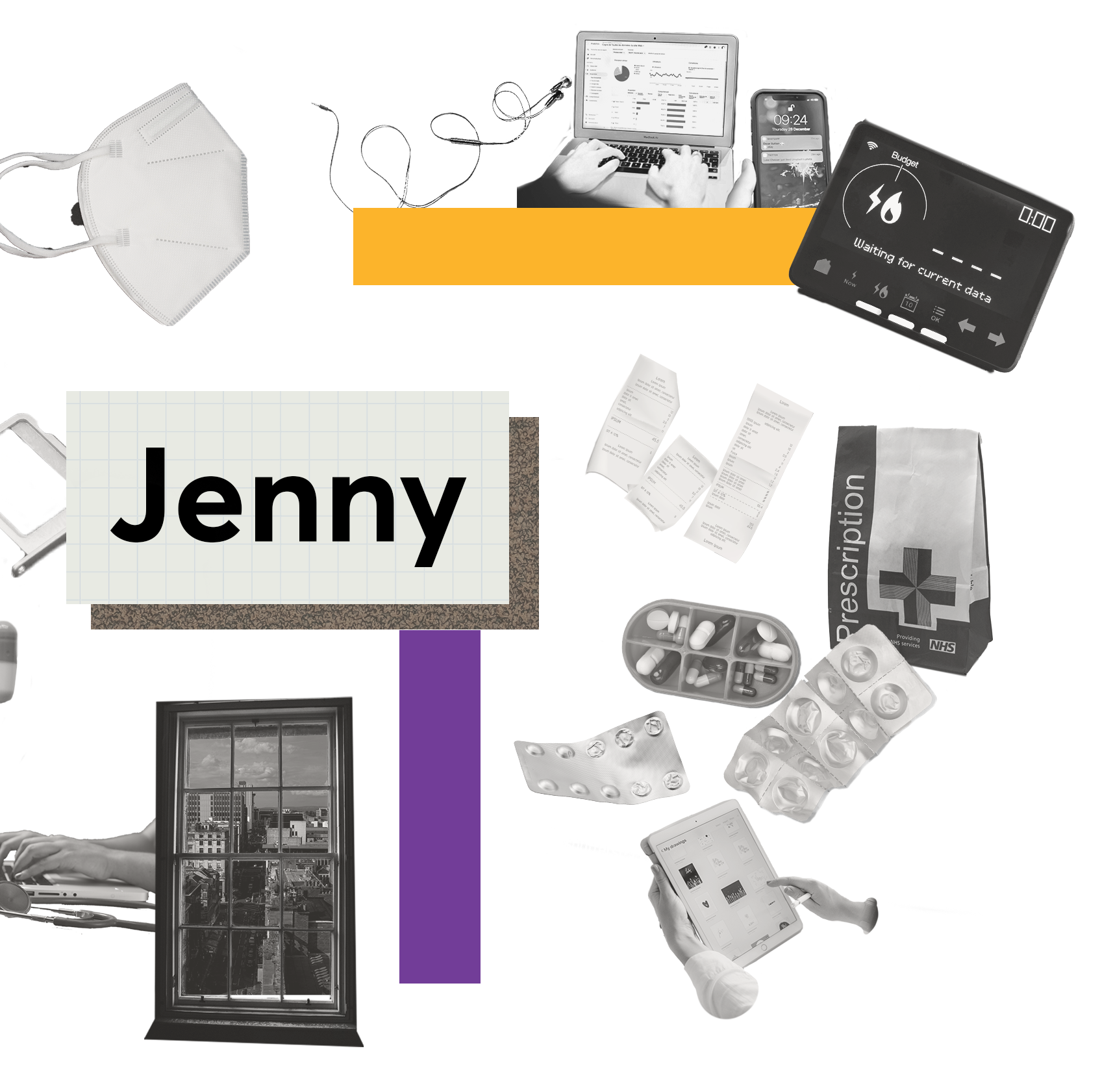
I had broadband - it stopped in summer 2019. It was a complete change in circumstances, a complete change in finances....broadband was something that could be eliminated.
PROFILE:
Jenny lives in Balornock, Glasgow. Following a diagnosis of a long-term debilitating health condition, Jenny had to give up full time work and is now on Universal Credit. Her relationship also broke down, so she now living alone and struggling to pay all her household bills. This dramatic change in her financial situation meant Jenny had to stop her broadband contract, but access to a phone is vital to stay in touch with her doctor. The coronavirus pandemic meant that Jenny faced an even more difficult time. Being alone during lockdown without access to the internet and a phone was a very lonely time for Jenny. She described to us vividly how not being able to get online was itself costly, both in lost access to the Universal Credit system, and the inflated costs of telephone services.
A laptop with hands typing, a stethoscope, pills, and a window with a city view, suggesting themes of telehealth or technology in healthcare.
I was paying around £29 a month for my contract. It also had a landline phone with landline calls allowed. Now I'm topping up a phone, a lot of my credit goes to calling doctors, ordering prescriptions, phoning to change or confirm appointments.
I learned very quickly that mobile data and PAYG is expensive, it just disappears; and then the packages that were affordable on the phone that I've got don't get you much data, and I had no real concept of how much 500 MBs of data was. It just seemed to go. So I cut down the social, what you could call unnecessary stuff. I kept data for going online for banking and paying bills - all that data was then gone. The online access was eradicated, which then puts up your expense for the mobile phone side of things, because all these people who you then have to contact on the phone, when you cannot go to them, it then thrusts the mobile phone side of it up through the roof.
You're on your tod, you cannae go and see anybody and there's no break from it. It seems a bit relentless because of covid - you could have popped in to somebody and said 'go and let me use your computer for ten minutes', but because of covid that's not allowed. It was just the combination of everything, it was this perfect storm of terrible.
It was just quite dark really to be honest with you. Long, lonely because if you think, everything really depends on it, folk watch their telly now on the internet; you know most folk are streaming things and I just wanted to pay my tesco bill. You know with the isolation side of it; your support network's completely gone and if you don't have access to them in a digital sense, then that's you you're stuck here all day, all night.
Universal credit is completely online so if I received a text telling me to check my journal as I had a message, I couldn't do this. This risks sanctions and causes unimaginable stress!
Most places have automated numbers for paying bills, but my smart meter had not been working, the bills were massively inflated and again you can put your meter readings in online. No you cannae, if you cannae get online. So again you need to call, that's the number which was three pounds something a minute. It's insanity; sometimes you're on hold for goodness knows how long, it's crippling, its soul destroying.
I got this wee tablet [through a Connecting Scotland project], it came with a sim card that gives it mobile data its unlimited. It's been amazing! I think, at first I was just doing the boring things, then you realise. I can go on youtube, I can look that up, I can connect with people again. You're not penny pinching and worrying about the data allowance running out. In the mental health sense it is so important. You can amputate your own social life in terms of the finances, to favour the stuff you need to do just to make life keep ticking
Appendix: additional tables
Table A1: Self-identified as experiencing data poverty population estimates for Scotland and Wales
|
Scotland |
Wales |
| Mid-2019 total population estimate* |
5,463,300 |
3,152,879 |
| Mid-2019 adult (>18 years) population estimate |
4,434,138 |
2,522,940 |
| Percentage of adult population reporting experiencing some aspects of data poverty |
10% |
11% |
| Estimated size of adult population reporting experiencing some aspects of data poverty |
443,414 |
277,523 |
| Percentage of adult population reporting experiencing many aspects of data poverty |
2% |
2% |
| Estimated size of adult population reporting experiencing many aspects of data poverty |
88,683 |
50,459 |
| Percentage of adult population reporting experiencing all aspects of data poverty |
2% |
1% |
| Estimated size of adult population reporting experiencing all aspects of data poverty |
88,683 |
25,229 |
| Total percentage of adult population reporting experiencing any level of data poverty |
14% |
14% |
| Total estimated size of adult population reporting experiencing any level of of data poverty |
620,779 |
353,212 |
*Using mid-2019 population estimates https://www.ons.gov.uk/peoplepopulationandcommunity/populationandmigration/populationestimates/bulletins/annualmidyearpopulationestimates/mid2019estimates
Table A2: Proportion of participants experiencing barriers to going online
|
Scotland |
Wales |
Experiencing Data Poverty |
| I can't get a monthly contract because of my personal circumstances (e.g. age, temporary housing or poor credit) |
2% |
1% |
5% |
| I can't afford as much internet access / data as I need |
2% |
3% |
10% |
| It is difficult for me to have private access to the internet |
4% |
4% |
10% |
| I would like to go online more than I do |
4% |
5% |
13% |
| None of the above |
34% |
29% |
13% |
| I can't afford the devices I need to go online |
3% |
4% |
13% |
| I can't get good internet signal in my home (broadband or mobile) |
14% |
15% |
27% |
| I share access to devices with others |
28% |
31% |
38% |
| I don't know how to shop around for the best data deals (whether contract or pay-as-you-go) Nid wyf yn gwybod sut i chwilio am y bargeinion data gorau (mewn contract neu ar sail talu wrth fynd) |
51% |
45% |
54% |
|
Technology tracker (2020) |
Our survey 'before March 2020' |
Our survey 'since March 2020' |
Technology tracker (2020) |
Our survey 'before March 2020' |
Our survey 'since March 2020' |
Our survey 'before March 2020' |
Our survey 'since March 2020' |
| Scotland |
|
|
|
|
|
|
|
|
| Public transport |
|
31% |
12% |
|
31% |
10% |
35% |
16% |
| Cafés, restaurants, pubs |
35% |
50% |
22% |
38% |
52% |
23% |
56% |
29% |
| Shopping |
25% |
49% |
34% |
35% |
51% |
38% |
52% |
41% |
| Private leisure facilities, including gyms and parks |
|
28% |
14% |
|
35% |
16% |
33% |
17% |
|
10% |
|
|
14% |
|
|
|
|
| Public leisure facilities, including gyms and parks |
|
34% |
17% |
|
35% |
16% |
39% |
23% |
| Public library |
7% |
14% |
6% |
7% |
10% |
3% |
22% |
8% |
| An educational institution |
|
27% |
14% |
|
25% |
14% |
57% |
22% |
| At workplace |
|
55% |
14% |
|
52% |
26% |
57% |
41% |
| At someone else's home |
|
52% |
28% |
|
40% |
28% |
53% |
36% |
| Wales |
|
|
|
|
|
|
|
|
| Data Poor |
|
|
|
|
|
|
|
|
Table A4: How often do those with a mobile contract run out of credit before the end of the month? (n=1645)
| Reported frequency |
Proportion |
| Never |
87% |
| Sometimes |
9% |
| Often/Always |
2% |
| Don't know |
2% |
Nesta data poverty survey questionnaire
Questions were designed by the research team in collaboration with Nesta. These drew on phase 1 research and our definition of data poverty, aiming to explore what we believed were the drivers of data poverty. Survation reviewed, advised on demographic items, and designed the survey structure. The survey was piloted with 10 individuals living in Scotland and 10 in Wales, after piloting the question order was changed in response to feedback but no questions were altered (all were understandable by participants and no questions were refused).
Demographic Questions
D1. Age (single year)
NUMERIC
D1b. Age (recoded)
|
|
| 18-24 |
1 |
| 25-34 |
2 |
| 35-44 |
3 |
| 45-54 |
4 |
| 55-64 |
5 |
| 65-74 |
6 |
| 75+ |
7 |
D6. Household composition
Multiple choice
|
|
| Alone [EXCLUSIVE] |
1 |
| Partner |
2 |
| Children |
3 |
| Parents |
4 |
| Other relatives (e.g. siblings, cousins, grand-parents, in-laws, etc.) |
5 |
| Other |
6 |
D8. Employment status
If you are currently a student and have a job, please select "student".
If you are currently employed and not working (furlough), please select your regular employment status.
|
|
| Employed full-time (More than 30 hours per week) |
1 |
| Employed part-time (Up to 30 hours per week) |
2 |
| Student |
3 |
| Unpaid volunteer |
4 |
| Self-employed |
5 |
| Family carer / homemaker |
6 |
| Unemployed |
7 |
| Unable to work due to long-term illness or disability |
8 |
| Retired |
9 |
D8b. Employment status
If D8 "Employment status" is "Student"
If you are currently employed and not working (furlough), please select your regular employment status.
|
|
| Employed full-time (More than 30 hours per week) |
1 |
| Employed part-time (Up to 30 hours per week) |
2 |
| Self-employed |
3 |
| Not employed |
4 |
Survey Questions
Don't know / Prefer not to say / None of the above options are unprompted.
Q1. Does your home have a current fixed broadband connection?
Do you have a monthly mobile phone contract that includes data?
|
|
| Yes |
1 |
| No, I have a pay-as-you-go mobile phone |
2 |
| No, I don't have a mobile phone |
3 |
Q3a. How often does your mobile data allowance run out before the end of the month?
If "Q2. Do you have a monthly mobile phone contract that includes data?" is "Yes"
|
|
| Never |
1 |
| Sometimes |
2 |
| Often |
3 |
| Always |
4 |
| Don't know |
9 |
Q3b. What do you do when you are close to running out of data credit?
If "Q3a. Do you have a monthly mobile phone contract that includes data?" is "No, I have a pay-as-you-go mobile phone"
|
|
| I buy more straight away |
1 |
| I wait until I can afford to buy more |
2 |
| I reduce or restrict my data usage |
3 |
| Don't know |
9 |
Q3c. How long do you typically wait until you can afford to buy more data credit?
If "Q3b. What do you do when you are close to running out of data credit?" is "I wait until I can afford to buy more"
|
|
| 1 day |
1 |
| 2-3 days |
2 |
| 4-6 days |
3 |
| 1 week |
4 |
| More than 1 week |
5 |
| Don't know |
9 |
Q4. Do any of the following statements apply to you?
RANDOMISE OPTIONS
|
Yes |
No |
| 1 I can't afford the devices I need to go online |
1 |
0 |
| 2 I can't afford as much internet access / data as I need |
1 |
0 |
| 3 I can't get good internet signal in my home (broadband or mobile) |
1 |
0 |
| 4 I know how to shop around for the best data deals (whether contract or pay-as-you-go) |
1 |
0 |
| 5 I can't get a monthly contract because of my personal circumstances (e.g. age, temporary housing or poor credit) |
1 |
0 |
| 6 I share access to devices with others |
1 |
0 |
| 7 It is difficult for me to have private access to the internet |
1 |
0 |
| 8 I would like to go online more than I do |
1 |
0 |
| 9 None of the above [Yes = EXCLUSIVE] |
1 |
0 |
Q5. How much do you as a household use the internet at home for the following?
This includes across all devices.
If "D7. Household composition" is not "Alone"
How much do you use the internet at home for the following? This includes across all devices.
If "D7. Household composition" is "Alone"
RANDOMISE OPTIONS
|
A lot |
A little |
Not at all I |
Don't know |
| 1 Access government or council services |
2 |
1 |
0 |
9 |
| 2 Health (accessing information or online services) |
2 |
1 |
0 |
9 |
| 3 Accessibility services, e.g. automated transcription or narration |
2 |
1 |
0 |
9 |
| 4 Accessing lessons / education |
2 |
1 |
0 |
9 |
| 5 Working |
2 |
1 |
0 |
9 |
| If "D7. Household composition" is not "Alone" OR if "D9. Employment status" is "Employed" |
|
|
|
|
| 6 Looking for work |
2 |
1 |
0 |
9 |
| If "D7. Household composition" is not "Alone" OR if "D9. Employment status" is not "Retired, Unable to work due to long-term illness or disability" |
|
|
|
|
| 7 Managing money / banking |
2 |
1 |
0 |
9 |
| 8 Staying in touch with friends and family |
2 |
1 |
0 |
9 |
| 9 Shopping |
2 |
1 |
0 |
9 |
| 10 Entertainment |
2 |
1 |
0 |
9 |
Q6. Before March 2020, how often did you typically use the internet in any of these locations?
This includes across all devices and networks.
RANDOMISE OPTIONS
|
Often |
Sometimes |
Never |
Don't know |
| 1 Public transport |
2 |
1 |
0 |
9 |
| 2 Cafés, restaurants, pubs |
2 |
1 |
0 |
9 |
| 3 Shopping |
2 |
1 |
0 |
9 |
| 4 Private leisure facilities, including gyms and parks |
2 |
1 |
0 |
9 |
| 5 Public leisure facilities, including gyms and parks |
2 |
1 |
0 |
9 |
| 6 Public library |
2 |
1 |
0 |
9 |
| 7 An educational institution |
2 |
1 |
0 |
9 |
| 8 At workplace |
2 |
1 |
0 |
9 |
| 9 At someone else's home |
2 |
1 |
0 |
9 |
Q7. How often have you used the internet in any of these locations since March 2020?
This includes across all devices and networks.
RANDOMISE OPTIONS
|
Often |
Sometimes |
Never |
Don't know |
| 1 Public transport |
2 |
1 |
0 |
9 |
| 2 Cafés, restaurants, pubs |
2 |
1 |
0 |
9 |
| 3 Shopping |
2 |
1 |
0 |
9 |
| 4 Private leisure facilities, including gyms and parks |
2 |
1 |
0 |
9 |
| 5 Public leisure facilities, including gyms and parks |
2 |
1 |
0 |
9 |
| 6 Public library |
2 |
1 |
0 |
9 |
| 7 An educational institution |
2 |
1 |
0 |
9 |
| 8 At workplace |
2 |
1 |
0 |
9 |
| 9 At someone else's home |
2 |
1 |
0 |
9 |
Q8. Do people experience "data poverty"?
Data poverty is where individuals or households cannot afford sufficient, private, and secure mobile or broadband data to meet their essential needs.
To what extent do you think this definition applies to your household?
|
|
| Completely |
3 |
| In many aspects |
2 |
| In a few aspects |
1 |
| Not at all |
0 |
| Don't know |
9 |
| Prefer not to say |
8 |
D3. Ethnicity
|
|
| White |
1 |
| Asian |
2 |
| Black |
3 |
| Mixed or multi-ethnic groups |
4 |
| Other |
5 |
| Prefer not to say |
6 |
D3b. Ethnicity (recoded)
|
|
| White |
1 |
| Black/minority ethnic |
2 |
D5.1 How many adults aged 18 or older live in your household?
|
|
| One |
1 |
| Two |
2 |
| Three |
3 |
| Four Pedwar |
4 |
| Five |
5 |
| Six or more |
6 |
| Prefer not to say |
9 |
D5.2 How many children aged 14 to 17 live in your household?
|
|
| None |
0 |
| One |
1 |
| Two |
2 |
| Three |
3 |
| Four |
4 |
| Five |
5 |
| Six or more |
6 |
| Prefer not to say |
9 |
D5.3 How many children aged 13 or younger live in your household?
|
|
| None |
0 |
| One |
1 |
| Two |
2 |
| Three |
3 |
| Four |
4 |
| Five |
5 |
| Six or more |
6 |
| Prefer not to say |
9 |
D5.4 How many children aged 17 or under regularly stay in your household?
For example in a shared parenting arrangement?
|
|
| None |
0 |
| One |
1 |
| Two |
2 |
| Three |
3 |
| Four |
4 |
| Five |
5 |
| Six or more |
6 |
| Prefer not to say |
9 |
D5.5 Household income before tax and benefits
Please note that if you live in shared accommodation with people but make all purchases separately, do not count them in your household.
|
|
| Less than £20,000 |
1 |
| £20,000 - £39,999 |
2 |
| £40,000 - £59,999 |
3 |
| £60,000 - £79,999 |
4 |
| £80,000 or more |
5 |
| Don't know |
9 |
| Prefer not to say |
8 |
D5. Annual equivalised household income
(calculated from D5.1, D5.2, D5.3, D5.5)
|
|
| £0 - £19,999 |
1 |
| £20,000 - £39,999 |
2 |
| £40,000 - £59,999 |
3 |
D5x. Index of Multiple Deprivation quintiles
(coded from postcode)
|
Scotland |
Wales |
| 1st (most deprived) |
1 |
1 |
| 2nd |
2 |
2 |
| 3rd |
3 |
3 |
| 4th |
4 |
4 |
| 5th (least deprived) |
5 |
5 |
D5z. Number of household children
(sum of D5.2, D5.3, D5.4)
|
|
| None |
0 |
| One |
1 |
| Two |
2 |
| Three or more |
3 |
D7. Housing tenure
Which of the following types of housing tenure best describes the accommodation you live in?
If you live with your parents / family, please select whichever best fits your housing tenure as a household.
If you live in shared accommodation with people but make all purchases separately, do not count them in your household.
|
|
| Owned outright |
1 |
| Owned with a mortgage or loan |
2 |
| Shared ownership (part owned, and part rented) |
3 |
| Rented from Council (Local Authority) |
4 |
| Rented from housing association, housing co-operative, charitable trust, or registered social landlord |
5 |
| Rented from private landlord or letting agency |
6 |
| Tied accommodation (accommodation provided by employer of a household member) |
7 |
| Rented from a relative or friend of household member |
8 |
| Other private rented |
9 |
| Living rent free |
10 |
D9. Disability or long-term health condition
|
|
| Yes |
1 |
| No |
2 |
| Prefer not to say |
3 |
D10. English reading proficiency
|
|
| Very Well |
3 |
| Well |
2 |
| Not Well |
1 |
| Not at all |
0 |