ACKNOWLEDGEMENTS
We would like to thank our colleagues at Nesta, Stian Westlake, Madeleine Gabriel, Louise Marston, Chris Haley and Lucile Stengel for providing valuable support and feedback on the research.
From the NCVO we would like to thank Veronique Jochum, Michael Birtwistle and David Kane, for their insights on the community and voluntary sector and their contributions to the research.
We are grateful for the support from the crowdfunding platforms that took part in this study and would like to thank the following people and platforms for taking the time to be interviewed by us: Bartolomeo Guarienti (Kriticalmass), Dave Boyle (The Community Shares Company), Harriet Gridley (Spacehive), Jamie Hartzell (Ethex), Jonathan May (Hubbub), Jonathan Waddingham (JustGiving Crowdfunding), Phil Geraghty (Crowdfunder) and Simon Borkin (The Community Shares Unit).
We would also like to thank all those charities, community groups and social enterprises who completed or shared our survey.
Much of the crowdfunding market size data used throughout the report is based on past studies of the UK alternative finance market, such as Understanding Alternative Finance (2014) and Pushing Boundaries (2016) that Nesta has published in partnership with the University of Cambridge.
As ever, all errors and omissions remain our own.
Nesta is an innovation charity with a mission to help people and organisations bring great ideas to life.
We are dedicated to supporting ideas that can help improve all our lives, with activities ranging from early-stage investment to in-depth research and practical programmes.
Nesta is a registered charity in England and Wales with company number 7706036 and charity number 1144091. Registered as a charity in Scotland number SC042833. Registered office: 1 Plough Place, London, EC4A 1DE.
www.nesta.org.uk
©Nesta 2016
FOREWORDS
Nesta has been researching and supporting the crowdfunding and alternative finance sector since 2010. As both a major innovation in finance, and a key route to funding for innovative ideas, Nesta has studied how it has taken off in a wide range of sectors.
Our alternative finance market studies (in partnership with the University of Cambridge) have helped shed a light on an industry that has grown from £267 million in 2012 to £3.2 billion in 2015, and our analysis of the market and the models has helped create typologies, guides and tools to support those using crowdfunding, as well as examining the potential and pitfalls of this new approach to investment, loans and donations.
However, while small businesses, startups and the creative industries have been some of those making the most of this new form of finance, charities, community groups and social entrepreneurs are yet to make the most of crowdfunding. This is surprising as many of the attributes of crowdfunding – the direct engagement with funders, ability to select projects and beneficiaries, and the importance of creating a community – play to the strengths of the sector, and could bring real benefits, financial as well as non-financial.
As we demonstrated when running the pioneering Innovation in Giving fund with the Cabinet Office, there is a significant opportunity for the charity and voluntary sector, when innovation in giving money, time and expertise is taken seriously, and given the opportunity to grow.
We are delighted to be working with NCVO on this report and hope its insights on opportunities and challenges in crowdfunding will be used as a guide to help more charities, voluntary organisations and social enterprises experiment with crowdfunding, and unlock its potential.
Louise Marston,
Director of Innovation Policy and Futures, Nesta
Amidst talk of falling trust in charities, public disquiet over some fundraising methods and a wider environment of continued austerity, there nevertheless remains evidence that the philanthropic impulse is alive and well in Britain. There is a proud tradition of giving and volunteering in this country and it would seem foolish to forecast any substantial decline.
This is, however, not to say that the giving of time or money is immune from broader social and economic trends. A millennial generation in particular that is sector agnostic, more impact-focused and investment-minded is arguably one of the factors driving the brave new world. Add a dash of digital, the rise of social networks and a frustration with models of marketing centred upon interruption, and we can begin to see that the future of doing good is starting to look a little different.
Crowdfunding is at the leading edge of this new world. What is clear from this report is that the term now encompasses a broad range of activities that are characteristic of a rapidly-maturing space, albeit one that is relatively small in comparison to more traditional approaches to raising funds for doing good. As such, the insights put forward in this report are important: the social sector is awash with its fair share of the 'next big thing' and it could reasonably be argued that crowdfunding is near the peak of the hype cycle. The trough of disillusionment may well follow; if so, it will be important for social organisations to reflect on the insights contained within this report once the irrational exuberance of some crowdfunding ideas has dissipated.
This is a real and important challenge: faced by the demographic impact of a declining but generous baby boomer generation and a visible end-point for currently successful 'industrial fundraising' methods, many charities in particular will be facing their own Kodak moment. I hope that this report will help them decide on where next.
Many of us believe that the future of social sector organisations will be as the hubs for social networks, empowering supporters to change the world around them. Crowdfunding absolutely fits this model. This report helps us understand that future better.
Karl Wilding,
Karl Wilding, Director of Public Policy and Volunteering, NCVO
EXECUTIVE SUMMARY
This report explores crowdfunding for charities, community groups and social entrepreneurs.
Chapter 2 describes what crowdfunding is and how it can be used to fund good causes. This includes descriptions of the crowdfunding models, the amounts they can help you raise and the type of projects they can help raise funds for.
Chapter 3 discusses the main opportunities and challenges in crowdfunding. In addition to helping raise funds for projects that would otherwise struggle to access finance, crowdfunding has many potential non-financial benefits. These include opportunities to boost volunteering, transparency, more experimentation and new ways of combining campaigning and fundraising to increase awareness of social issues and needs. The main challenges: are a potential negative impact on equality and participation in projects, too much focus on short-term initiatives rather than long-term projects, that crowdfunding is hard and that there are significant limits to what can be raised.
Chapter 4 discusses insights from a survey of more than 450 community and voluntary organisations' perception, usage and awareness of crowdfunding. The survey found that:
- A high proportion of organisations were aware of crowdfunding but relatively few had used it.
- A lack of crowdfunding skills and knowledge within organisations was the biggest barrier to using crowdfunding.
- Opportunities to fund core cost and access to crowdfunding training would influence organisations to try crowdfunding. A positive impact on volunteering, fundraising and campaigning were also seen as very influential factors.
- Donation-based crowdfunding was the most well-known model and was also seen as most suitable to organisations' needs. Community shares was the least well-known model, but was perceived to be the third most suitable model (after donations and rewards).
- Those that had used crowdfunding thought that it was better than other sources of funding for its possibility to fund innovative projects and that it provided more freedom to define projects.
- 43 per cent of organisations were likely to use crowdfunding in the next 12 months.
Chapter 5 presents a number of recommendations for what practitioners and funders can do to support more crowdfunding to happen.
Charities, community groups and social entrepreneurs should...
- Try and set up at least one crowdfunding campaign.
- Join up fundraising and campaign teams to run their crowdfunding campaigns.
- Curate a group of projects on a pre-existing platform or develop a customised crowdfunding platform. (Particularly relevant for larger organisations or networks.)
Grant funders, social investors and other supporters should...
- Invest in crowdfunding skills and capacity building.
- Integrate crowdfunding into existing funding schemes and programmes through match funding.
- Support transition from crowdfunding projects to developing sustainable organisations.
- Set up referral schemes from grant funders and social investors to crowdfunding platforms.
- Test and measure effect of crowdfunding.
1. INTRODUCTION
Crowdfunding is rapidly changing how everything from personal loans to startup investment is financed. It also presents a great opportunity to disrupt how we get involved in good causes, from increasing giving, to boosting volunteering and raising awareness. In spite of this, charities, community groups and social entrepreneurs are yet to make the most of this opportunity.
This new form of finance, where projects are funded through many small donations or investments from a large group of people ('the crowd') - rather than a few large donations or investments from one or a few traditional funders - is growing fast. In 2015 alone, more than one million people took part in crowdfunding, totalling £3.2 billion of loans, investments and donations in the UK.
However, while there has been a rapid growth in crowdfunding in the rest of the economy - for example, making up 12 per cent of new loans to small businesses and 15 per cent of the market for seed and venture-stage equity investment we estimate that crowdfunding for good causes makes up less than 0.5 per cent of giving in the UK.[^2]
This is in spite of the potential benefits of crowdfunding for the sector. Studies have shown how three in four of those who have used crowdfunding to support a social project said that the money they spent was in addition to what they what would normally give to charity, and one in four had offered to volunteer for the project they supported, indicating an opportunity to use crowdfunding to boost volunteering.[^3]
Alongside this, the community and voluntary sector faces significant challenges. Reductions in public spending have created a funding gap within smaller community and voluntary sector organisations. While larger charities' incomes have been continually increasing in recent years, smaller charities have seen reductions in government grants and contracts which increases in individual giving have been insufficient to offset.[^4] Decreases in income are particularly detrimental to smaller organisations for which single funding awards are the difference between survival and closure.[^5] In addition, parts of the sector have received increased criticism for their fundraising practices, adding further incentives to explore new ways of getting people involved in supporting good causes.
While crowdfunding is not a panacea for the challenges the sector is facing, it could play a much bigger role in how people and organisations with a social mission fundraise and campaign.
In this report we explore how to better exploit this potential. We have done this through a combination of methods. We reviewed existing literature on crowdfunding for these types of projects and interviewed eight of the leading UK crowdfunding platforms that work with charities, community groups and social entrepreneurs to understand the key characteristics as well as opportunities and challenges in crowdfunding for good causes. To further understand the barriers to the increased usage of crowdfunding, we surveyed more than 450 charities, community groups and social entrepreneurs on their perceptions, awareness and usage of crowdfunding.
The report is split into two parts:
Part one explores what crowdfunding is, the different crowdfunding models and how they can be used to fundraise for good causes. It also explores the opportunities and challenges in using crowdfunding that those thinking about crowdfunding should be aware of.
Read if you want to understand what crowdfunding is and/or if you are interested in setting up your own campaign.
Part two discusses insights from the survey, highlighting what charities, social enterprises and community organisations see as the main barriers to using crowdfunding and what would make them consider this form of fundraising. It also presents recommendations of how practitioners, policymakers and funders can support the growth of crowdfunding for good causes.
Read if you want to understand what the main barriers to the increased usage of crowdfunding are and what can be done to support more organisations and people to use crowdfunding.
2. WHAT IS CROWDFUNDING AND HOW CAN IT HELP FUND GOOD CAUSES?
Crowdfunding is in some respects a very old form of finance, used to fund numerous public works, monuments, statues, churches and mosques in the past. It's a simple idea: if many people contribute small amounts, even costly projects can happen. One of the most cited historical examples of this is how the plinth for the Statue of Liberty was crowdfunded through public subscription in 1885.[^8]
What's new is the role played by the internet in mobilising people quickly and easily around common causes, often across large geographical distances and in numbers that were not previously possible.[^9] This has enabled people, projects and organisations not only to find new sources of much needed finance, but also to build online communities of supporters who can help them design and promote their crowdfunding projects.
The creative sector is often hailed as the pioneer of modern crowdfunding. British rock group Marillion is recognised by many as the first to prove how a loyal and engaged crowd can be used as a powerful source of online finance. In 1997, the band tapped fans through their website to fund a £39,000 US tour and subsequent albums. In a similar vein, the world's first dedicated reward-based crowdfunding website, ArtistShare, focused on 'fan funding' for musicians. Fast forward to today, and crowdfunding is a £3.2 billion market which has spread to covering most parts of the economy and society, funding more than £1 billion worth of SME loans through P2P lending and £245 million of investments in startups.
Although it is still a relatively small market,[^10] crowdfunding for good causes, which we characterise as campaigns by charities, community groups, social enterprises and individuals crowdfunding for projects with a social aim, is also growing fast. An estimated £81 million[^11] was raised for good causes through crowdfunding in 2015, with £61 million alone coming from community shares.
This has provided much needed finance for a range of projects with a social purpose, from very small donation-based campaigns, such as the £362 raised by the Riding for the Disabled Association to fund transport costs for student volunteers from the University of Nottingham,[^12] to larger campaigns like the £103,395 worth of community shares sold by Portpatrick Harbour Community Benefit Society[^13] to save and secure the community ownership of the harbour.
In the following section, we explore some of the key characteristics of crowdfunding and the models used to fund good causes.

The Pup-Mobile Appeal campaign by the Hearing Dogs for Deaf People charity is an example of a rewards-based crowdfunding campaign. By offering a variety of rewards, from a bespoke pub quiz to an away day at the charity's HQ in Buckinghamshire, the charity managed to raise £16,155 to buy a new van for transporting dogs, trainers and deaf people.[^14]
Crowdfunding is in most cases enabled by crowdfunding platforms. At its simplest, a crowdfunding platform is a website which works as an online marketplace where those interested in crowdfunding can pitch their project to a crowd of potential funders. Fundraisers use the platform to outline what their project is about, the timescales involved, how much money is needed and what funders get in return. The platforms themselves are operated by third-parties who manage transactions and vet projects before presenting them to the public. The platform provides a single place that isn't limited by geography or its capacity to engage a limited amount of people at a time, where fundraisers can send people interested in funding their project.
While the platform provides the marketplace where fundraisers can list and pitch their project, it is the fundraiser's responsibility to drive potential funders to their campaign. Fundraisers typically promote their campaign by asking friends, family and colleagues, reaching out to interested communities and community groups, sending out direct mail, marketing on social media and (for larger campaigns) media mentions. Social media in particular plays a strong role in this as it provides efficient and low-cost methods for reaching large, often very niche and geographically distributed communities and connecting them through crowdfunding campaigns.[^15]
Most platforms offer free guides and support on how to set up and run a crowdfunding campaign on their website. Nesta has also developed free guides and toolkits such as 10½ Crowdfunding Tips[^16] and Working the Crowd[^17] for anyone considering setting up a crowdfunding campaign.
THE DIFFERENT CROWDFUNDING MODELS AND WHAT THEY CAN HELP YOU FUND
Crowdfunding is used as the catchall term to describe the process of mobilising large crowds to finance projects through small donations and investments. However, it covers a range of different models which target different markets and offer different financial products. This means the different models help projects raise very different amounts of money, depending on what they can offer their supporters in return for finance.
The first challenge most organisations encounter is selecting a platform and crowdfunding model that suits their project. The main crowdfunding models and their key features are listed in the table on the following page. Community shares, donation and rewards-based crowdfunding are best suited to funding projects by charities, community groups and social entrepreneurs, and these will be the main focus of this paper. However, lending-based and equity-based crowdfunding are also included in the table to illustrate the differences between the models.[^18]
While lending-based models make up the majority of the UK crowdfunding market, it is important to note that there currently aren't any lending models aimed specifically at facilitating social loans for UK-based charities and voluntary sector organisations.
The nature of the project and type of rewards that fundraisers are willing to give the crowd in return for their investment will dictate which crowdfunding options will be available. Nesta has setup crowdingin.com, a free directory of platforms operating in the UK, where those considering crowdfunding can filter platforms by the model and type of projects they support.
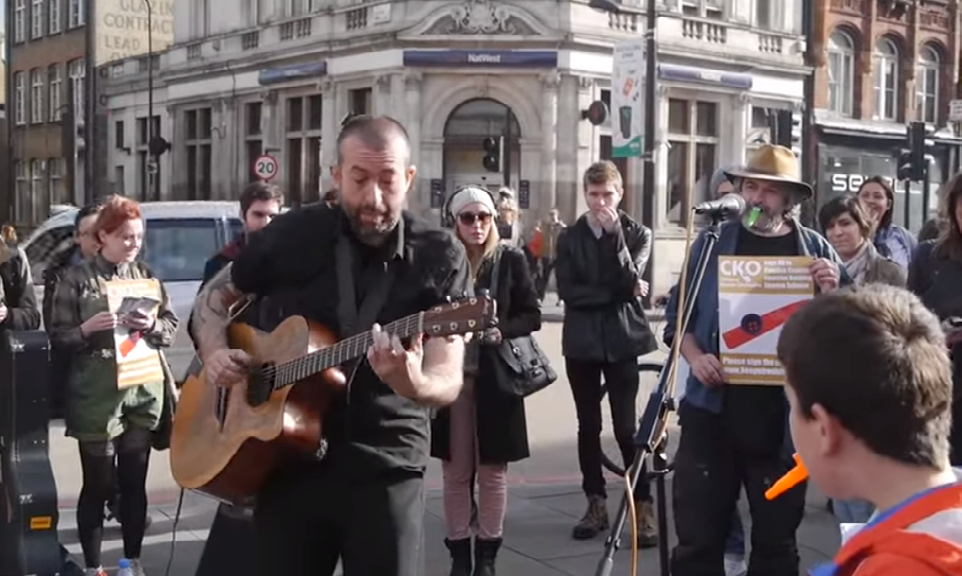
Keep Streets Live UK - a grassroots campaign to keep the streets and shared public spaces of the UK open to informal art and music performances, used reward-based crowdfunding to raise £3,285 from 133 backers to go towards paying legal and campaigning costs when they challenged anti-busking laws in the Court of Appeal. Rewards included badges, T shirts and private music performances.[^19]
Table: Crowdfunding Models Overview