About Nesta and Rocket Science
We are Nesta, the UK's innovation agency for social good. We design, test and scale solutions to society's biggest problems. Our three missions are to give every child a fair start, help people live healthy lives, and create a sustainable future where the economy works for both people and the planet.
For over 20 years, we have worked to support, encourage and inspire innovation. We work in three roles: as an innovation partner working with frontline organisations to design and test new solutions, as a venture builder supporting new and early stage businesses, and as a system shaper creating the conditions for innovation.
Harnessing the rigour of science and the creativity of design, we work relentlessly to change millions of lives for the better.
Find out more at nesta.org.uk
Rocket Science is an independent policy consultancy with a team of experts focusing on poverty and welfare, health and social care, and employability and skills. Most of this work involves evaluation, strategic review and project and programme design and review.
We work across the UK from our three offices in Edinburgh, Newcastle and London. We work closely with our clients including central and local government, charities, and community organisations to review and evaluate services, conduct social research including understanding needs, exploring lived experience, setting strategies and governance structures and conducting quantitative impact analysis.
Find out more at rocketsciencelab.co.uk
Foreword
Looking back over the last 15 years, productivity in Scotland, and the rest of the UK, has stalled. One of the issues, as identified through OECD modelling, is 'skills mismatches' within the workforce. Addressing these, the OECD has estimated, could account for an increase of 5% in national productivity.
More recently, we have seen what short term but severe shocks can do to our economy, as well as specific industries and jobs as Covid-19 affected some sectors more than others and some geographies more than others. This should be a wake up call for us to develop a smarter, more intelligent and more agile labour market.
A labour market that can be informed by real-time, or near-time data and even make predictive assessments for areas of growth, contraction and risk. That information could be passed to skills providers, local authorities and employers so that they can support trainees, job seekers and current employees to secure future work and remain employed through shifts and shocks to the labour market.
The Covid-19 crisis gives us an idea of what will happen and we know there are shocks to come. We are heading into a necessary and urgent period of industrial transformation in response to the climate crisis. Some industries will be contracted with certain jobs being particularly squeezed and the people who have worked their whole professional life in one sector will be jettisoned into retraining and job seeking.
We know this will happen so we should prepare for it. We can prepare by building the tools and systems now to not only support people who find themselves out of work, but support people in areas at risk to retrain, upskill and transition into areas of growth and professional sustainability.
To understand the specific and local challenges that Covid-19 has created, Nesta worked with Rocket Science to develop a place-based approach to understanding the impact in local areas and the different skill development transitions it may be possible to support, encourage and promote.
Dumfries and Galloway, Dundee, and Edinburgh were selected to provide a range of distinct local circumstances to examine and use as case studies against which to design potential reskilling pathways.
In thinking about how to support people who have been affected by disruption - whether due to Covid or the disruption to come as we look to transition away from high-carbon producing industries – we have developed a model to support positive transitions through intelligence as well as local knowledge and positive relationships.
This work builds on our Rapid Recovery Challenge Prize, Open Jobs programme and Skills Taxonomy as we look to support an intelligent labour market through a time of drastic change and solve Scotland's and the UK's productivity puzzle.
Kyle Usher
Mission Manager – A Sustainable Future
1. Introduction
1.1 Background
Following the submission of our Second Interim Report, “Mapping COVID disruption into sustainable growth industries", our discussions with Nesta have identified the need to focus on transitions to low carbon occupations and sectors. For that report we carried our research into wider transitions and where local interest was focused in three areas: Dumfries and Galloway, Dundee and Edinburgh.
In this follow up report we have drawn on these discussions to develop a set of related proposals. These provide the basis of detailed follow up discussions with stakeholder in the three areas and the development of a programme which can provide new and valuable insights into how to contribute to a just transition to a low carbon future.
The context for this work in Scotland is provided by the Just Transition Commission and by the imminent report from Skills Development Scotland (due in September 2021) which will present current estimates of low carbon job opportunities across Scotland.
The Just Transition Commission was established by the Scottish Government and held its first meeting on 31st January 2019. The Commission's role to advise Scottish Ministers on how to apply the Just Transition principles which guide the transition to environmentally sustainable economies and societies[^1], in light of the Climate Change Bill. These principles are summarised as follows:
- Plan, invest and implement a transition to environmentally and socially sustainable jobs, sectors and economies, building on Scotland's economic and workforce strengths and potential
- Create opportunities to develop resource efficient and sustainable economic approaches, which help address inequality and poverty
- Design and deliver low carbon investment and infrastructure, and make all possible efforts to create decent, fair and high value work, in a way which does not negatively affect the current workforce and overall economy
The Just Transition Commission has published their advice to Scottish Ministers - 'A National Mission for a fairer, greener Scotland'. The key points from this advice are:
Energy sector
- There are real growth and export opportunities associated with renewable energy and low-carbon technologies.
- Oil and gas still support a significant number of jobs - but the recent economic climate (ie Brexit and COVID-19) has meant that the sector was hard hit, across Scotland but mainly in the NE. Recent data has shown the decline in payroll (PAYE) employment in the North East has been at nearly twice the rate of that seen across Scotland as a whole.
- There is a need to create the conditions for renewables to thrive – but many policy levers are determined by the UK Government
- Based on previous low carbon transitions, it is clear that there needs to be a strong, local supply chain in order to maximise the opportunities within low carbon sectors. When considering the transitions to new sector, the supply chain needs to be mapped, and given time to adjust, to be able to support the new sector and, ultimately, to help it thrive. There are funds and initiatives that can help with these transitions in Scotland such as the Energy Transition Fund which is a 5 year £62 million fund for the energy sector launched in June 2020 to support the oil, gas and energy sectors grow and diversify, whilst helping attract further private investment.
- It is important to consider how to help people currently working in the sector. Skills traditionally in demand in the oil and gas sector will need to be drawn on to help people transition to the wider energy sector and other areas of the economy.
- There has been growth in the low carbon sector which includes the provision of high quality jobs - but Scotland has not been able to create a thriving, competitive manufacturing base for renewables.
"The significance of our lack of a strong local manufacturing supply chain is reinforced when we consider that the operation of offshore wind will support far less labour than oil and gas production."
- Scotland's failure to create and sustain alternative high skill, high wage, mass employment threatens to undermine trust in efforts to pursue a just transition amongst Scottish workers and their communities. There are significant concerns amongst some workers, communities and their representatives that, based on experiences to date, the transition will not lead to substantive new opportunities, and will be anything but 'just' in the way it impacts them.
Transition plans
- The Commission suggests having a roadmap of actions by the Scottish Government and industry through investments in infrastructure and skills development and tailoring it to different sectors
- This should be jointly developed and owned by Government, industry, trade unions, consumer groups and other relevant stakeholders to make them more effective. They should build on of existing groups / platforms that are already in existence such as:
- NECCUS - North East Carbon Capture Usage and Storage Alliance
- Or a commitment from the Scottish Government to develop a Green New Deal for Scotland could be a potential route for transition planning.
The evidence for the Just Commission has been drawn from lessons learned from previously badly managed transitions (such as the closure of coal mines) to try and ensure that Scotland can achieve just transitions for the energy sector.
- Capitalise on manufacturing opportunities - it is important to plan ahead to ensure there is investment and supporting policy framework to encourage the replacement technology / sector.
- Scottish firms operate on an unfair playing field to foreign competitors (often subsidised) and lose out on opportunities to them.
- The UK Government, through the Department for Business, Energy and Industrial Strategy, has developed the Contracts for Difference (CfD) scheme which is the main mechanism for supporting low-carbon energy generation. This incentivises renewable energy investments in a number of ways[^2], but the evidence suggests that this scheme is not effective at driving local supply chain development which needs to transition along with the sectors to capitalise on the market opportunities that exist.
-
Need to make sure that workers as well as management and industry leaders are aware of the efforts being made - empower them to take part in decision, making sure that the voices of workers and communities are properly accounted for and weighted in decision making.
-
They recommend that the Government starts ground work for developing transition plans over the next year
- "As a starting point, a programme of engagement should be undertaken with businesses, workers, consumer groups and communities to clarify the role that different sectors will play in the transition to net-zero. This could build on engagement already taking place, but should also link to development of Scotland's economic strategy. It may also be beneficial to begin to map the support provided to businesses, by Government, enterprise agencies, and local authorities to begin to consider whether these could be better coordinated as part of transition plans and a Green New Deal."
- "Our work plan for 2020 is currently structured around a range of cross-cutting themes such as finance, skills and technology innovation which will help inform our considerations.”
The recommendations from the Just Transition Commission have been summarised into 4 key messages. We have set out those which are relevant to the commissioned research and developing low carbon transition proposals. For more details on the key messages, see the Just Transition Commission's report[^3].
Key message 1: Pursue an orderly, managed transition to net-zero that creates benefits and opportunities for people across Scotland:
- Ensure roadmaps exist for the net-zero transition in Scotland
- The public sector must focus on building strong and resilient local supply chains through the use of funding streams
- Local content and more competitive Scottish offshore wind projects should be encouraged.
Key message 2: Equip people with the skills and education they need to benefit from our transition to net-zero
-
Lay groundwork for a flexible, accessible skills and education system that can meet the needs of net-zero while addressing existing inequalities in the labour market
- Review how climate change is embedded in learning across all school ages and that teachers are equipped with the necessary training
- Leverage the transition as an opportunity to help address existing labour market inequalities
- Address the gender imbalance in STEM subjects and careers in digital skills jobs
- Explore changes to funding so that Universities and Colleges are supported to introduce new courses related to climate change, even where applicant numbers may initially be low
- Undertake research to better understand the impact of under-utilisation of skills.
-
Create a skills guarantee for workers in carbon-intensive sectors
- Long-term commitment to support retraining for workers in carbon-intensive sectors, beyond the horizon of the pandemic
- Ensure a high degree of visibility, and promote it through social partnership with trade unions and industry
- Increase the portability of skills, across the energy sector in particular
- Work is underway through the Energy Skills Alliance to address some of these issues.
-
Support small and medium sized enterprises to invest in their workforces
- Examine the effectiveness of existing sectoral and regional outreach mechanisms in informing business owners, managers and workers of the training opportunities available to them
- Boost funding opportunities to help smaller companies release their business owners, managers and workers for training
- Identify opportunities to support accreditation regimes that create incentives for small companies to invest in training themselves.
Key message 3: Empower and invigorate our communities and strengthen local economies
Key message 4: Share the benefits of climate action widely; ensure costs are distributed on the basis of ability to pay.
It is Key message 2 that forms the focus for the proposals that we are recommending should be taken back for discussion with each of the selected areas, and we suggest that these discussions are framed in this way.
Similarly, these approaches should recognise the impending publication of the SDS report on the low carbon sector, but we do not feel that the engagement with local stakeholders needs to wait on this report being published. However, when it is published it will be important to review it in detail to see if it provides any helpful new insights into demand that could help with the design and delivery of appropriate transition routes.
2. Potential areas for partnership action
In this Chapter we have focused on developing a coherent programme of action and research around transitions from Covid-19 affected areas, and sectors where employment is declining, to low carbon activities. The intention is to map out forecasts and potential transition activities over a medium term horizon - that is, 3 year, 5 years and 10 year propositions.
As with our previous work the focus is on identifying a distinctive place-based approach, as it is clear from our research and stakeholder discussions that the issues and opportunities around these transitions vary significantly from area to area. However, there are also some common themes across the areas, and it is important that in this programme of work the transferability of research and insights is maximised.
These common themes are:
-
The significance of information and insight around low carbon opportunities and areas of decline - in terms of both 'snap shots' and trends - and presenting these in a way that is accessible, easy to understand, persuasive and appealing. Within this there are three particular strands of research:
- In Dumfries and Galloway there is a specific link to be made here to the traditional perceptions of some parents and teachers which may lead to young people being encouraged to look for work in areas with declining career opportunities.
- Young people as recipients of information - there appears to be scope to test out different ways of presenting and conveying information about labour market trends and exploring the impact of these.
- How Colleges and training providers use information and insights about the labour market and exploring the kind of information that they find helpful and useable. Within this, how these providers can help to lead and not follow transitions and what can be done to mitigate the risks involved in the development and promotion of new programmes of low carbon based training.
-
Identifying high carbon activities in each of the three areas and specifically target these for transition work
- Complementing this information with the development of forecasts of future demand in terms of employment opportunities around low carbon activities.
Dumfries and Galloway
Areas for potential partnership action
Working with Dumfries and Galloway College and Developing the Young Workforce to explore the role of labour market perceptions in helping to support transitions:
- What are the perceptions that parents and teachers have of the labour market and to what extent do these perceptions match the reality of the current and emerging labour market?
- What could influence this, and how can labour market insights and intelligence be presented in ways that will influence their perceptions and change the way they engage with and influence young people? What is the best way of reaching them with this information?
- What are the perceptions of young people of trends in the labour market and how do they relate to these? How do they respond to different ways of presenting and conveying these insights? What is likely to change their appreciation about the opportunities that may be open to them - how do they need to be described in order to make them sound appealing and relevant to their aspirations and aptitudes?
Working with the Green Skills Academy at Dumfries and Galloway College to explore and refine current forecasts about the scale of low carbon job families over the next 5-10 years, what skills will be needed, and the extent to which current pathways match this likely demand, and where there is need for further pathway development. This will involve:
- Mapping out the trends in local carbon activities that may be expected over the next 5 – 10 years
- Considering the skills related to the job families involved in these activities
- Matching this will current and planned provision of skills training and identified main areas of mismatch in terms of both provision and the scale of provision.
Dundee
Areas for potential partnership action
The key area of need identified in our discussion was for more detailed 'live' information and insight from vacancy adverts. While the specific need was identified in the digital sector - specifically in the digital sector – but it would be important to complement this with a wider understanding of vacancy trends across the economy - not least because many digital roles are embedded in sectors outside the digital sector (technically, the information and communications sector). There is scope to ensure that there is a particular emphasis on identifying and specifying trends in both digital and low carbon opportunities - and the links between these.
There may be scope for a joint project with Adzuna in this area – they are already the market leaders in ad scraping and they may welcome the opportunity to develop a product/service which explores how to scrape with more precision around a particular topic in a locality.
This partnership (potentially with Dundee City Council and Dundee and Angus College) would focus on:
- Specifying the areas of interest in terms of the information required from vacancy adverts
- Developing a way of presenting this information – and the trends that it is displaying - in ways that provide a basis for decisions by training partners, together with an assessment of the risk involved in taking forward new course development
-
Working with local employers to verify findings (specifically in terms of the reliability of what appear to be emerging trends) and identifying areas for more detailed exploration
-
Trialling the development and delivery of courses that build on the information to ensure that they meet employers needs and deliver recruits who are able to perform in their new roles. As part of this, it would be important to ensure the creation of longer pathways that provide pre-course development to ensure that the training is available to school leavers and those with the aptitude and aspiration to transition but who may be further from work.
- There is scope to explore the similarities and differences between pathways into digital and pathways into low carbon – and to identify the extent to which digitally focused jobs are displayed in low carbon activities.
Edinburgh
Areas for potential partnership action
-
Working with Capital City Partnership (CCP) to explore ways of accelerating the translation of new insights and intelligence about skill requirements into appropriate training, targeting particularly those further from work and those made redundant as a consequence of the impact of COVID-19. This is essentially a systems analysis, exploring:
- How labour market intelligence is currently collected and analysed, and what intelligence training providers currently use and how they use it - with a focus on low carbon opportunities
- The extent to which this collected labour market intelligence is translated into useable insights by training providers, and how this translation can be made more effectively and in real time
- The issues around rapid short course development and how this process can be accelerated
-
Building on the SDS work on cross-cutting skills to work with CCP to implement Recommendation 8 of the Ekosgen report (NB a further recommendation was added to the original 7). There is the opportunity as part of a three locality programme of work to work across all three locality partnerships in taking this particular recommendation forward to ensure the creation of a generic tool that could be trialled and tested in three different economies, with a specific focus on transitions into low carbon activities.
The extent to which cross-cutting skills are part of teaching and learning varies and if providers and stakeholders involved in the skills system are to plan and implement, they must first have an up to date and accurate picture of the current position. Establishing this baseline will allow them to understand and capture what they are already doing; identify gaps and limitations, plan how these can be addressed; and measure progress.
The region is ideally positioned to develop and pilot a toolkit that will allow providers to audit current provision and develop an action plan for addressing gaps that are identified.
- The rapid expansion in the number of training providers that CCP is working with is creating a network of c50 training providers for short course 'spot training' and 1000-2000 front line employability staff. CCP have recognised the need for providers to have a way of understanding the existence and value of cross-cutting skills and how staff can draw on this to help their clients think about appropriate transitions, with a particular focus on transitions into low carbon opportunities.
- Our discussions with CCP suggest that these opportunities would be likely to bring a bigger impact if they were carried out at a city region scale - this would enable CCP to relate this to Edinburgh and South East Scotland City Region Deal priorities and focus.
3. Modelling transition
In this Chapter we draw on the work done so far and our engagements with stakeholders to model the main features of a transition model.
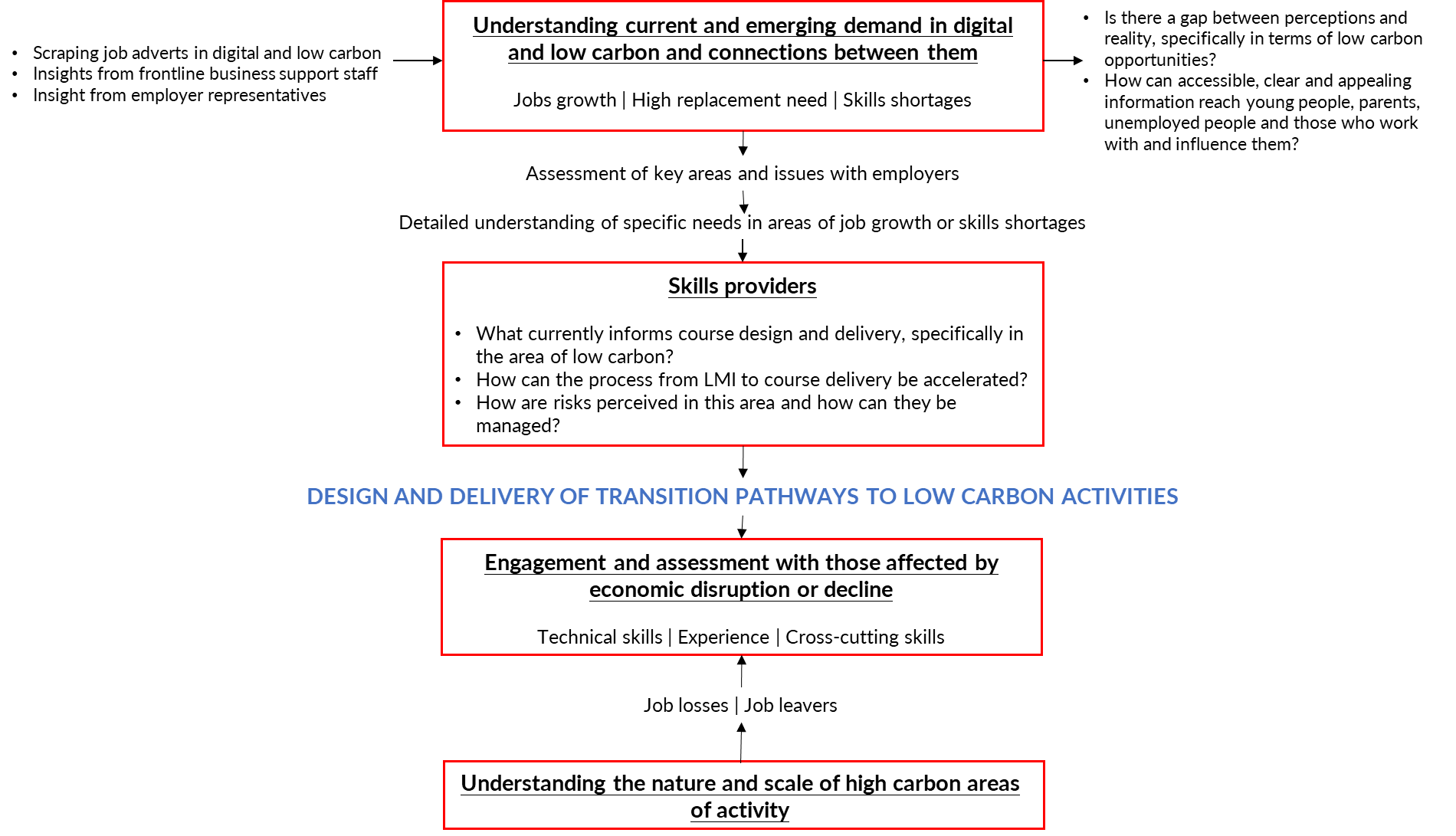
We should stress that, while we have identified specific areas for intervention in each locality, a potential programme across the three localities presents a coherent whole, exploring a number of key areas of the transition model - these are identified in red in the diagram on page 17.
We have identified 6 components for a transition model:
1. Information, intelligence and insight about both the areas affected by Covid or wider decline (ie how many jobs have been/are being lost and what kind of skills and experience do they have) and about areas of job growth/job turnover.
This area of work clearly relates to Nesta's Careers Causeway project which mapped the jobs at risk of being lost through automation and possible transition routes to areas of job growth.
- How to use **vacancy advert information** to gain much more sophisticated insights into both labour market snapshots and trends. Recent work for the West London Alliance by Rocket Science, Adzuna and the Institute for Employment Studies has explored how to scrape vacancy data and match this with current skills provision to identify areas where there are gaps.
- In particular, this could create the basis for **in-depth exploration** of areas of significant growth and/or skills shortages with employers in the low carbon sector
- As part of this work we are suggesting the need to understand **both the reality of these shifts, but also understand local perceptions** and the gaps that may exist between these, with a specific focus on the growing opportunities in the area of low carbon activities. Where these gaps exist (eg with parents or teachers) it will be important to find effective ways of providing persuasive and appealing information about current and emerging opportunities.
- More generally, there is a need to ensure that there is **obvious, accessible and appealing information** which highlights the opportunities in the low carbon sector, and how these may relate to the skills and experience of those who are losing their jobs.
2. Understanding how the local skills system works in terms of the flow of intelligence into transition pathways in terms of skills programme design and delivery in the area of low carbon skills.
We have identified two components of this:
- Exploring **how skills providers make decisions about the development and delivery of courses**, for low carbon opportunities, and their perception of the risks involved (ie content plus scale of demand): what information do they currently use, and how quickly they are able to translate this into new course delivery at times of transition.
- What is the process for connecting live information on transitions into the skills system and what can be done to **accelerate the connection between insight and skills response**.
3. Understanding the role and value of cross-cutting or meta skills in the transition pathways to low carbon activities.
How can staff and organisations develop their ability to identify and use the existence of cross-cutting skills in helping individuals follow appropriate transition pathways?
- The need for tools to help organisations and individual staff become aware of the significance and presence of cross-cutting skills, and how to use these to help clients identify appropriate transition pathways and destinations.
4. Pinpointing areas of high carbon activity and highlighting these as areas requiring specific action in terms of transitions to low carbon activities for those employed:
- How can job loss patterns be identified and acted upon?
- What tools are needed to identify key skills and experience and the match with areas of growth?
The way that these areas for exploration are mapped onto the geographies that we have been focusing on is set out below:
| Programme component |
Area focus |
Commentary |
| 1. Labour market information, intelligence and insight |
|
|
| - How to use vacancy advert information to gain much more sophisticated insights into both labour market snapshots and trends. |
Dundee |
Working with an organisation like Adzuna to explore the scope for more in-depth scraping and analysis |
| - In particular, this could create the basis for in-depth exploration of areas of significant growth and/or skills shortages with employers |
Dundee |
Drawing on scraped data to identify areas for more in-depth discussion with employers |
| - As part of this work we are suggesting the need to understand both the reality of these shifts, but also understand local perceptions and the gaps that may exist between these, and how to bridge this gap. |
Dumfries and Galloway |
Gap between perception and reality reported to be particularly significant in this area of traditional employment and provision |
| - More generally, there is a need to ensure that there is obvious, accessible and appealing information which highlights opportunities and how these may relate to the skills and experience of those who are losing their jobs. |
Dundee, Dumfries and Galloway and Edinburgh |
This is a cross area requirement. SDS information is very high quality but there is a need to translate it into more appealing and accessible information for use by those who need t follow transition pathways. |
| 2. Understanding how the local skills system works in terms of the flow of intelligence into transition pathways in terms of skills programme design and delivery. |
|
|
| - Exploring how skills providers make decisions about the development and delivery of courses |
Edinburgh |
Working closely with CCP, some of their training provider network, and in particular with Edinburgh College |
| - What is the process for connecting live information on transitions into the skills system and what can be done to accelerate the connection between insight and skills response. |
Edinburgh |
Working closely with CCP and Edinburgh College |
| 3. Understanding the role and value of cross-cutting or meta skills in the transition pathways to low carbon opportunities |
|
|
| - Explore with relevant employers the cross-cutting skills that are particularly pertinent for low carbon opportunities – is this different from other sectors? |
Edinburgh |
Working with CCP but developing this as part of the City Region Deal |
| - Develop tools to help organisations and individual staff become aware of the significance and presence of cross-cutting skills, and how to use these to help clients identify appropriate transition pathways and destinations in the low carbon sector. |
|
|
| 4. Pinpointing areas of high carbon activity and understanding the nature of the transition pathways to low carbon activities |
Dundee |
Strong connections to the Aberdeen economy |
Below we have created a model of transition that incorporates these features and highlights in red the potential areas for intervention.
Appendix 1: Pathway tables with supporting evidence
Edinburgh
| Areas of Disruption |
Growth Areas |
| Occupational group (difference from predicted) |
Specific occupations (% difference from predicted) |
| Sales occupations (-5872) |
Sales supervisors (-52%) |
|
|
|
|
|
|
| Elementary administration + service occupations (-5143) |
Cleaners and domestics (-35%) |
|
|
Dumfries and Galloway
| Areas of Disruption |
Growth Areas |
| Occupational group (difference from predicted) |
Specific occupations (% difference from predicted) |
| Nesta: Mapping Covid-19 disruption into sustainable growth industries in Scotland |
|
| ==End of OCR for page 26== |
|