Sam Freedman is a political journalist, author and former policy adviser at the Department of Education. He has conducted an analysis of the UK 2040 Options reports on economic growth, health, education, tax and public finances, wealth and income inequality, and power and place. In this report, he draws out the cross-cutting themes that span the UK government's most pressing challenges.
This report was funded by Nesta, as part of UK 2040 Options.
About UK 2040 Options
UK 2040 Options is a policy project led by Nesta that seeks to address the defining issues facing the country, from tax and economic growth to health and education. It draws on a range of experts to assess the policy landscape, explore some of the most fertile areas in more depth, test and interrogate ideas and bring fresh angles and insights to the choices that policymakers will need to confront, make and implement.
About Nesta
We are Nesta. The UK's innovation agency for social good. We design, test and scale new solutions to society's biggest problems, changing millions of lives for the better.
Executive summary
The UK is in a bad place – stuck in a loop of low growth and productivity, with underfunded and inefficient public services, record low levels of trust in politics and a general sense of frustration from across the political spectrum, regardless of ideology.
But there is nothing stopping us from turning it around by 2040. That's the timeframe that the UK 2040 Options project is looking to: it has commissioned analysis in topic areas that will be critical to deciding what our future will look like.
There's a long list of things we could do, it's just that the nature of our political system makes it so hard to do them. Only by tackling head on these broader cross-cutting political challenges can politicians steer us through our current problems to a more optimistic future. And they need to get on with it, because the list of demands on the state is only going to grow.
- By 2040, there will be much higher healthcare, social care and pensions costs due to an ageing population. Chronic health conditions are projected to affect a substantially greater number of people.
- Decades of underinvestment in capital and infrastructure risk driving future costs in acute crisis management even higher. We can already see this playing out in the NHS and the criminal justice system, among other examples.
-
There is a growing number of external risks, including worsening global security following the Russian invasion of Ukraine, growing tensions in the Middle East, and concerns about China. The effects of climate change will increase and we have learned the hard way the need to be prepared for pandemics.
-
The rise of the 'regulatory state' has meant a big, and largely undiscussed and unplanned, increase in regulatory costs for public and private institutions. There is ongoing pressure for further regulation across multiple sectors – often with good cause.
The UK isn't unique in this regard. Countries across the world are facing similar challenges, but there are elements of the UK's political set-up that make them particularly difficult for us to deal with.
- The UK is uniquely centralised. This puts huge operational pressure on the centre, while leaving local government weak and unable to raise its own funds. There are major regional disparities in wealth and productivity that are, in part, driven by this lack of power at regional or local level.
- The UK has a constitutionally extremely powerful executive combined with weak central institutions that struggle to use this power effectively.
- Government ministers rarely last more than a year or two. Attempts to reform the civil service have been half-hearted at best and it has been left largely as originally designed.
- The Treasury is unusually powerful for a finance ministry and essentially holds veto power over everything that happens in government, meaning it sets the de facto strategy.
- The UK has a highly centralised political culture that is caught up in a super-fast media cycle. This leads to a focus on communications at the expense of policy, which paradoxically creates a loss of trust with the public.
Managing demand for services will require the state to spend more upfront. Some of this can be achieved through better taxation but mostly it requires growth through improved productivity. It will also need more efficient public services through greater investment in infrastructure, technology, and prevention. This is well known and has been for a long time. There isn't a shortage of ideas about how to do these things, but our structural constraints keep getting in the way. To tackle them effectively, politicians need to confront the ‘meta' cross-cutting challenges of the way our state works.
The UK needs:
- more effective central institutions that are able to support ministers in decision-making, rather than the haphazard collection of structures that have evolved over centuries
- more capacity at regional and local level, with more operational functions devolved to them and more ability to decide strategy for regional economies and services
- more effective engagement around democratic trade-offs, through greater transparency and accountability, as well as exploring new ways to assess the public-preferred routes through difficult trade-offs
- a clearer framework for regulation, risk and prevention, rather than the entirely arbitrary and poorly evaluated and costed approach we take at the moment.
There are many different approaches politicians could take to create a new political settlement. But we will only get to 2040 in good shape if we have one. What we have now isn't up to meeting the challenges we face.
Introduction
There is a stench of pessimism hanging around British politics: a concern, increasingly hard to quell, that there are so many difficult problems that have been ignored for so long, that any government, however talented and well-intentioned, will struggle to manage the deluge.
But we've been here before, indeed we've been in worse places before, and turned things around. The aftermath of World War Two, with bombed-out cities and what seemed like a crippling debt load, turned into a sustained period of economic growth and improving living standards. The apparently intractable industrial and economic problems of the mid-70s – which led to rumblings of military coups – were replaced with the fast-growing, if increasingly unequal, economy of the 1980s and a surging sense of optimism in the late 1990s.
It would be hard to see the next few years as anything but difficult. With a 2040 horizon, though, we can be more positive. There are solutions to our problems, but solving them will require honesty about the challenges we face and some clear-eyed choices from government.
Over the past six months, Nesta has commissioned analysis in eight topic areas that will be critical to deciding our future (economic growth, health, technology, education, net zero, wealth and income inequality, tax and public finances, power and place). In this paper we have drawn together key findings from these analyses, along with conversations with hundreds more people, into a high-level assessment of these challenges and opportunities, and the options available to the next government. The aim is not to be prescriptive, but to identify the trade-offs ministers will have to grapple with.
The challenge: finding ways to manage higher demands on the state
At the heart of all of our biggest problems is capacity, both state and private. That's whether we're improving public services, increasing productivity, or building the infrastructure that is necessary for both. This capacity crunch – which leads to a sense that everything from A&E departments to railways are failing – is getting worse. This is both because of rising demands on the state and trends that have reduced its ability to meet them. It is not a challenge unique to the UK – other European countries in particular are struggling with similar problems – but there are aspects of the UK's institutional set-up that make it even harder to manage these higher demands.
There are four factors driving higher demand on the state: demographics; historic underinvestment; growing threat from external risks; and greater expectations of the state. We explore each below.
Demographics
The most obvious demographic trend is people getting older. Almost a fifth of the population (18.6%) is now over-65, up from 15.8% in 1991. It is projected to be 24% by 2043. At the same time the fertility rate has fallen to 1.61 births per woman, down from 1.94 in 2012 (and 2.93 in 1964). This is well below replacement rate, which means the population under 20 is dropping. There are projected to be 800,000 fewer children in school in 2032 than there were in 2023 – a 10% decrease.
An ageing population will require more spending on pensions, and associated benefits, which the Institute for Fiscal Studies (IFS) projects will rise to 6.3% of national income by 2050 (from 5.1% now and 4.2% in 2003/04). It will also require significant additional social care and healthcare capacity – these costs are projected to increase by 4.1% of national income by 2050 (or around £105 billion a year in today's money). The Health Foundation estimates we will see social care spending rise by £18 billion a year by 2032, and that we will need around 30,000 additional hospital beds by 2030/31 – which we are nowhere near on track to deliver. The Health Foundation has set out projections for big increases in the most common chronic conditions.
Health conditions are projected to rise dramatically
Projected total number of diagnosed cases for the 10 conditions with the highest impact on healthcare use and mortality among those aged 30 years and older, England, 2019 and projected for 2040
Label 2019 2040
Source: Health Foundation https://www.health.org.uk/publications/health-in-2040 + denotes uncertainty intervals. COPD is chronic obstructive pulmonary disease.
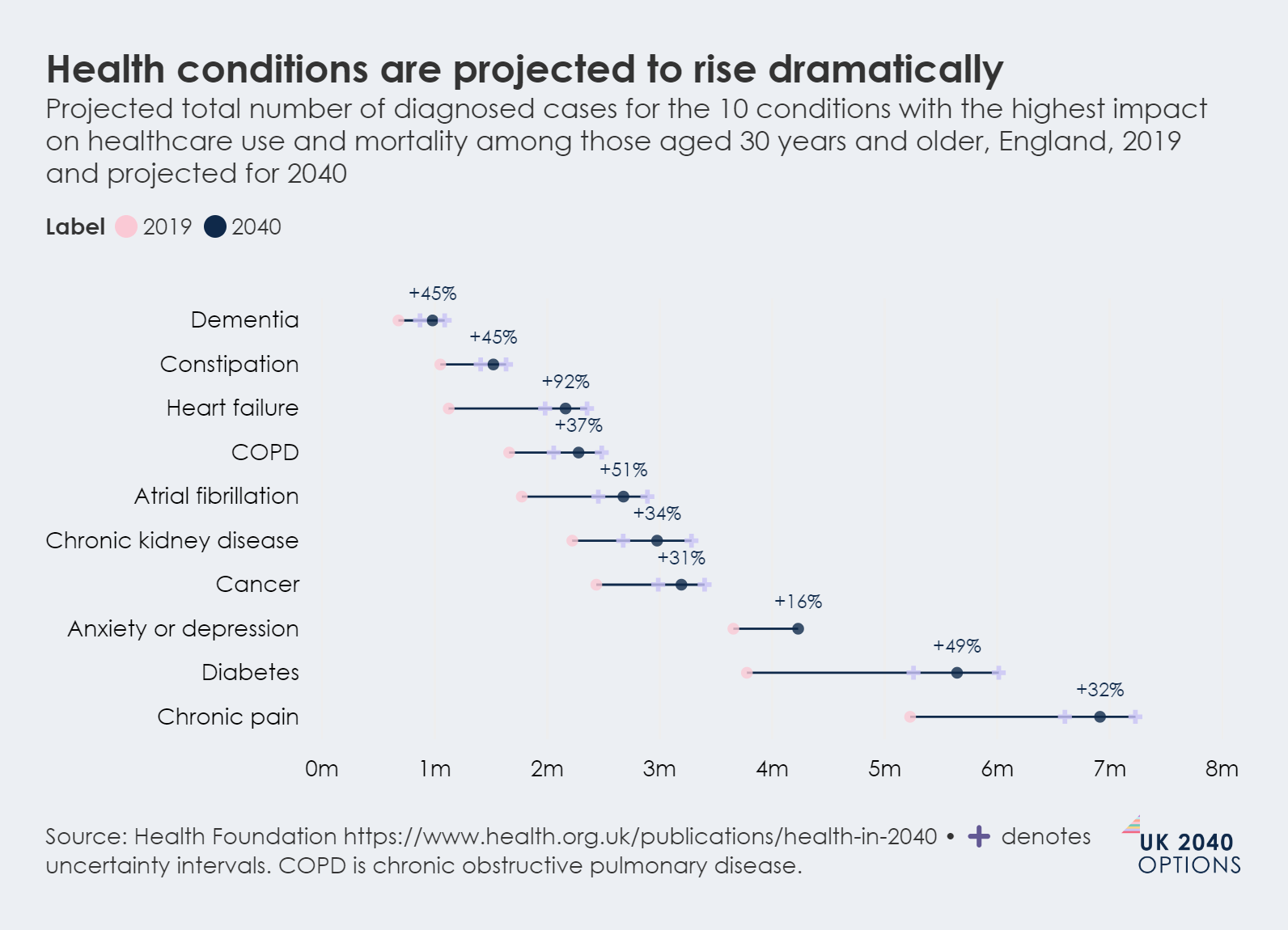
The overall rise in healthcare costs is driven by ageing, but also by improvements in medical treatments which enable more conditions to be treated for longer. Non-demographic pressures have historically been a bigger driver of rising healthcare costs than ageing.
Rising incidence of chronic conditions among the working age population is also driving higher labour market inactivity, and higher disability benefits costs, which the Office for Budget Responsibility (OBR) projects will rise from 1.4% to 1.8% of GDP by 2028/29.
Underinvestment
Since the 2008 crash, low economic growth has made it hard to manage demands on public spending. This is due to an initial reluctance to increase the tax burden and substantial increases in public borrowing to manage the fallout of that crash as well as, more recently, the pandemic. Leaving the EU has also meant a further economic hit as barriers to trade have increased.
Post-2010, the decision by the coalition government to prioritise spending cuts in reducing the deficit was not accompanied by any meaningful reduction in the state's role. This led to more needing to be done with less money. Politically high-profile areas of spending – pensions, health and schools – were relatively protected, meaning most of the cuts fell on those parts of the state that are responsible for the most vulnerable or neglected citizens: non-pensioner welfare; local government; and criminal justice. This has created a feedback loop of negative outcomes that then cost more to fix.
In addition, the UK has historically underinvested in public sector infrastructure, which has made it harder to manage constrained spending. Apart from two years between 2007 and 2009, the UK has always spent significantly less on healthcare capital than the OECD average, leaving a large accumulated underspend on hospital capacity and diagnostic equipment.
This is, in part, due to the highly centralised nature of the political system in England, which means spending decisions are often taken in a short-term way. Scotland, Wales and Northern Ireland have devolved governments so are not centralised in the same way. Institutions have little sight of future budgets, which makes effective planning harder, and longer-term projects are deprioritised in favour of managing acute crises. Equally, the fragmented nature of local government funding, with literally hundreds of disconnected pots allocated to councils, makes it hard for them to plan or make long-term investments. The underlying causes of this are discussed in the next section.
Added together, all of these challenges have left us with serious service crunches across the public sector. There can, of course, be an element of special pleading from sectors keen to secure additional money without considering the wider picture. But it is impossible to argue that we don't have serious funding challenges. Almost seven million patients waited longer than four hours to be seen in A&E in 2023, ten times more than in 2011. Waiting lists for non-emergency patients hit a record 7.8 million in October 2023. And since 2020, eight local authorities have declared effective bankruptcy – only two had ever done so before.
There are very few parts of the public sector that don't have a strong case for additional resources. Look at criminal justice and there are serious court backlogs, families struggling without legal aid, and full prisons. Day-to-day school funding has been relatively well protected but there are still major teacher shortages and a severe maintenance backlog for the school estate. And so on.
As with capital investment, the UK has been particularly poor at ‘invest to save'-type spending that would bring down future costs. For instance, there are still NHS trusts using paper records, and most appointments are still communicated via post – causing numerous missed appointments and increasing administrative costs for GPs and hospitals. Spending on public health interventions that could prevent expensive chronic illness has been cut, even as overall NHS spending has risen. Cuts to council spending have disproportionately hit early interventions to support at-risk families and young people.
These public sector service 'crunches' will, one way or another, create additional demand for the state. Government will either have to fix them directly or manage the downstream consequences of not fixing them.
Growing risk of external shocks
At any point in history, one could have pointed to potentially serious global risk factors. But from the end of the Second World War until fairly recently, spending on defence has been falling – despite the Cold War, 9/11 and our involvement in the Afghanistan and Iraq wars.
The big reduction in costs came in two blocks. First from the end of the Second World War to 1970, largely due to decolonisation and reducing global reach, and then in the late 1980s and 1990s when defence spending fell from 4.5% to just over 2% of GDP as the Cold War ended. But it then fell again from 2.5% to under 2% between 2010 and 2019. This created space for higher spending elsewhere. As late as the 1970s we spent more on defence than healthcare. Now we spend almost five times as much on healthcare.
But that trend is now reversing and the both main parties are, in theory, committed to increasing spending on defence to 2.5% of GDP by the end of the decade. Many argue it will need to rise to 3%.
The Russian invasion of Ukraine does not just represent a long-term commitment in itself (the UK has so far committed £14.5 billion to the war) It also presents the likelihood of a long-term hostile and militarised state on Europe's border. There is widespread concern that UK forces are now inadequate to deal with the risk (the army has shrunk from 100,000 to 73,000 since 2010) .
Russia isn't the only threat. The UK is part of an alliance trying to hold China in check in the Pacific, with ongoing concern about an invasion or blockade of Taiwan. And in the Middle East, Iran is exploiting multiple proxy insurgent organisations across the region, like Hamas and the Houthis, increasing instability yet further.
Of the non-military risks, the best understood are pandemics, given our recent experience, and climate change. Extreme weather events are already more common and driving higher levels of migration and military conflict over scarce natural resources. These will get worse, even if countries now move more rapidly towards reducing emissions. The UK has committed to achieving net zero by 2050 but the real costs of this have not been fully factored into spending plans.
In 2021, the OBR estimated that the UK would need to spend £1.3 trillion by 2050 to meet net zero and that there would be almost £1 trillion of resulting benefits over that period. But the costs are frontloaded and the benefits come later on in the period, putting pressure on investment now.
At the moment we are not making these investments and our success in reducing emissions is not on track to continue.
Shocks, such as the invasion of Ukraine and the effects of climate change, increase demands on the state, and the growing range of potential threats is increasing pressure for spending on ensuring greater resilience – whether that is NHS capacity, army size or future climate change mitigation.
Greater expectations of state intervention
There is a growing expectation from citizens that government will protect them from external shocks. We saw this during the pandemic when the government spent almost £400 billion including substantial amounts of support for individuals and businesses affected.
Subsequently, rising energy prices following the invasion of Ukraine led to the government offering support that has cost around £60 billion between 2022-2024, an amount that was anticipated to be much higher before energy prices dropped back.
The ability for governments to step in like this, while managing market concern about debt levels, again requires an additional level of resilience in public finances.
This change in attitude towards macro risks follows a decades-long shift in the state's broader approach to risk that has fundamentally changed the scope of its role – all with little public debate or recognition. The so-called ‘rise of the regulatory state' has five dimensions:
1The establishment of regulators and offices to oversee previously nationalised monopoly industries like water, gas and rail. Here we have seen a change to the state's role from direct provision to oversight – with, in many cases, little of the risk actually transferred. But the other four dimensions, which follow, have all added to the state's responsibilities.
2Many large professions such as financial services, medicine and higher education have shifted from mostly self-regulation to greater state regulation. This has led to the creation of organisations like the Financial Conduct Authority, Professional Standards Authority for Health and Social Care, and the Office for Students.
3As central government has become more directly involved in trying to ensure public sector accountability, it has created organisations such as Ofsted and the Care Quality Commission to provide information and oversight.
4Growing concern about the risk from private companies' failures has led to growing regulation of industries. For instance, the creation of the Food Standards Agency following the 'mad cow disease' scare. Other examples of this trend include the Security Industry Authority and the Information Commissioner's Office.
5Most recently we have seen an increase in 'social regulation' designed to support the equality of marginalised groups. Most notably this includes the creation of the Equality and Human Rights Commission. The Human Rights Act (1998) and Equality Act (2010) have also led other public bodies and regulators to implement social regulation as part of their wider duties.
There are good arguments for all these things, but collectively they have led to a substantial and uncoordinated increase in the role of the state. The direct cost of all these bodies runs to many billions but there are also significant costs imposed on other public bodies and the private economy.
Moreover, the increase in regulation creates further demand, both from existing bodies that are looking to take on more responsibility, and around sectors that are seen as under regulated – for instance the private rental market, social media, or even football. This is reinforced by rapid technological change, such as the rise of artificial intelligence, that also creates additional demand for regulation.
Making our lives harder: structural constraints to building capacity
All of these demand factors would be present regardless of how the British state was set up or operated. Our historic underinvestment problem would not be so bad if governments had behaved differently in the past, but every European country is seeing pressure on public services given the difficult financial environment of the last 15 years. Shifting demographics; growing risk of external shocks; and a changing appetite for risk and regulation are universal demand factors, affecting nations all over the world.
But there are also additional constraints on the ability of the UK state to meet this demand. None of these factors are confined to the UK but for historic or political reasons are particularly significant here. Other countries would have a different mix of supply constraints.
Important factors in the UK include the below.
Centralisation
The UK has a uniquely high degree of centralisation amongst large, wealthy, democratic states. Considerable power is devolved to Scotland, Wales and Northern Ireland, but within England, where 84% of the population live, central government is far more powerful than in most countries, with no constitutional protections for regions or local government. Even France, which was traditionally as centralised as England, has devolved somewhat in recent decades.
State revenue is almost entirely raised and controlled by central, rather than local, government. The small amount that is raised locally is subject to strict central rules. Councils are not allowed to increase council tax beyond a nationally set limit without permission or a referendum (only one of which has been held, and was lost).
Grant income from central government is tightly fragmented into hundreds of small pots that direct activity down to an extremely micro level. Many of these pots require bids even for tiny amounts of money (£2,500 for chess tables in parks is a recent notorious example). All of this makes it hard for local authorities to plan or direct budgets to local priorities.
Not only does this make local government less attractive to work in and harder to run, but it also means central government is becoming increasingly overwhelmed as Whitehall departments end up having to deal with micro operational challenges, which can often end up requiring ministerial-level decisions. The number of levers available to central government also leads to greater instability as structures and operational frameworks are endlessly tweaked by a succession of ministers who rarely last longer than a year or two in post.
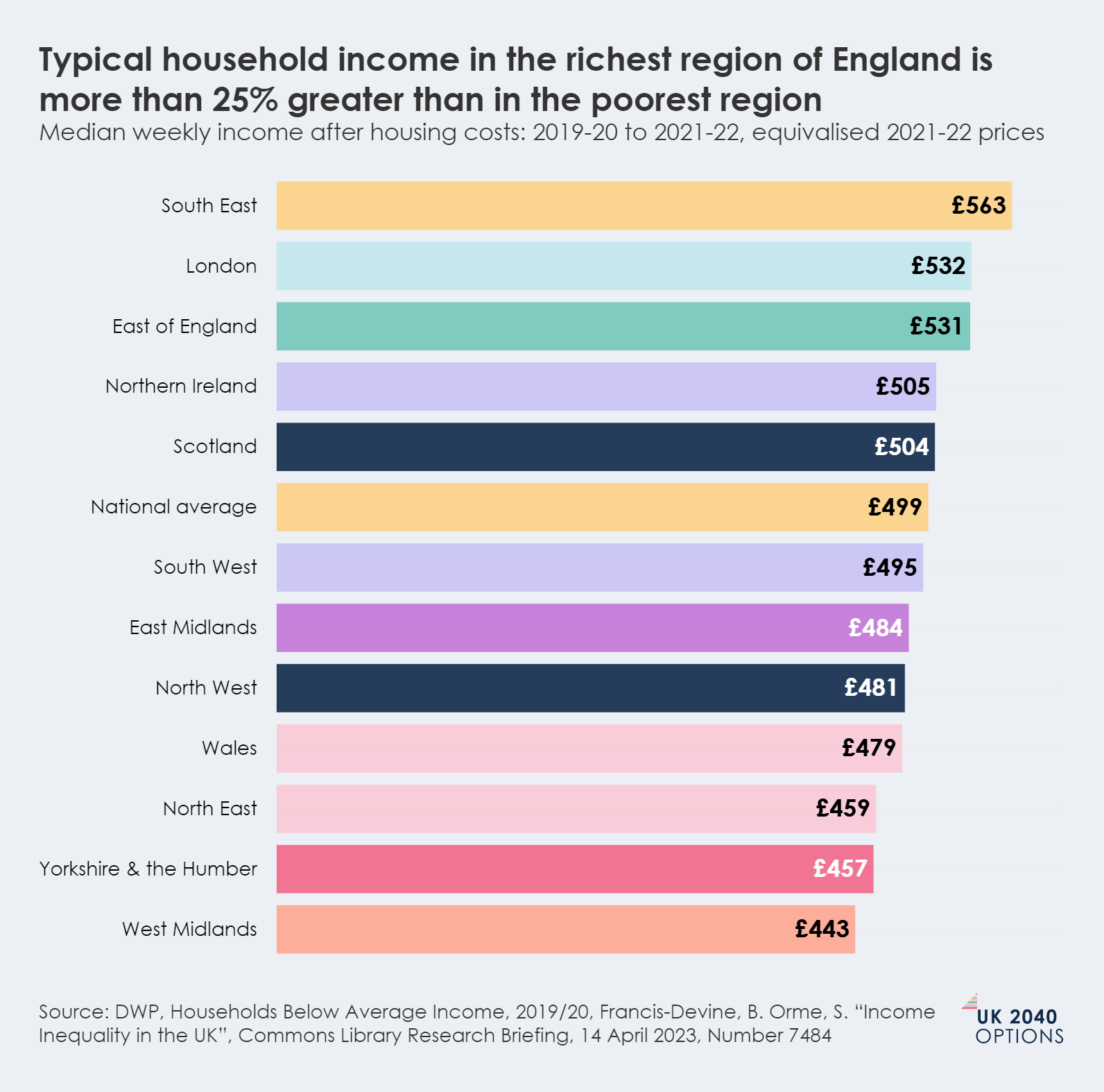
Economically, having such centralised governments is bad for areas outside of London and the South East, and is one cause of lower regional productivity. Despite talk of 'levelling up', the UK has higher levels of regional inequality than comparable countries, and our 'second cities' such as Manchester and Birmingham are significantly less productive than their counterparts elsewhere in Europe, such as Munich or Marseille. This lower productivity also leads to ongoing differences in household income between parts of the country. These are substantial – even after controlling for much higher housing costs in London and the South East.
London has higher per capita spending on transport, especially in terms of capital spending, compared to other regions
Capital and current expenditure on transport per capita (3-year moving average) in British regions, 2001-2019 [other English regions shown in grey on chart]
Source: ONS Data
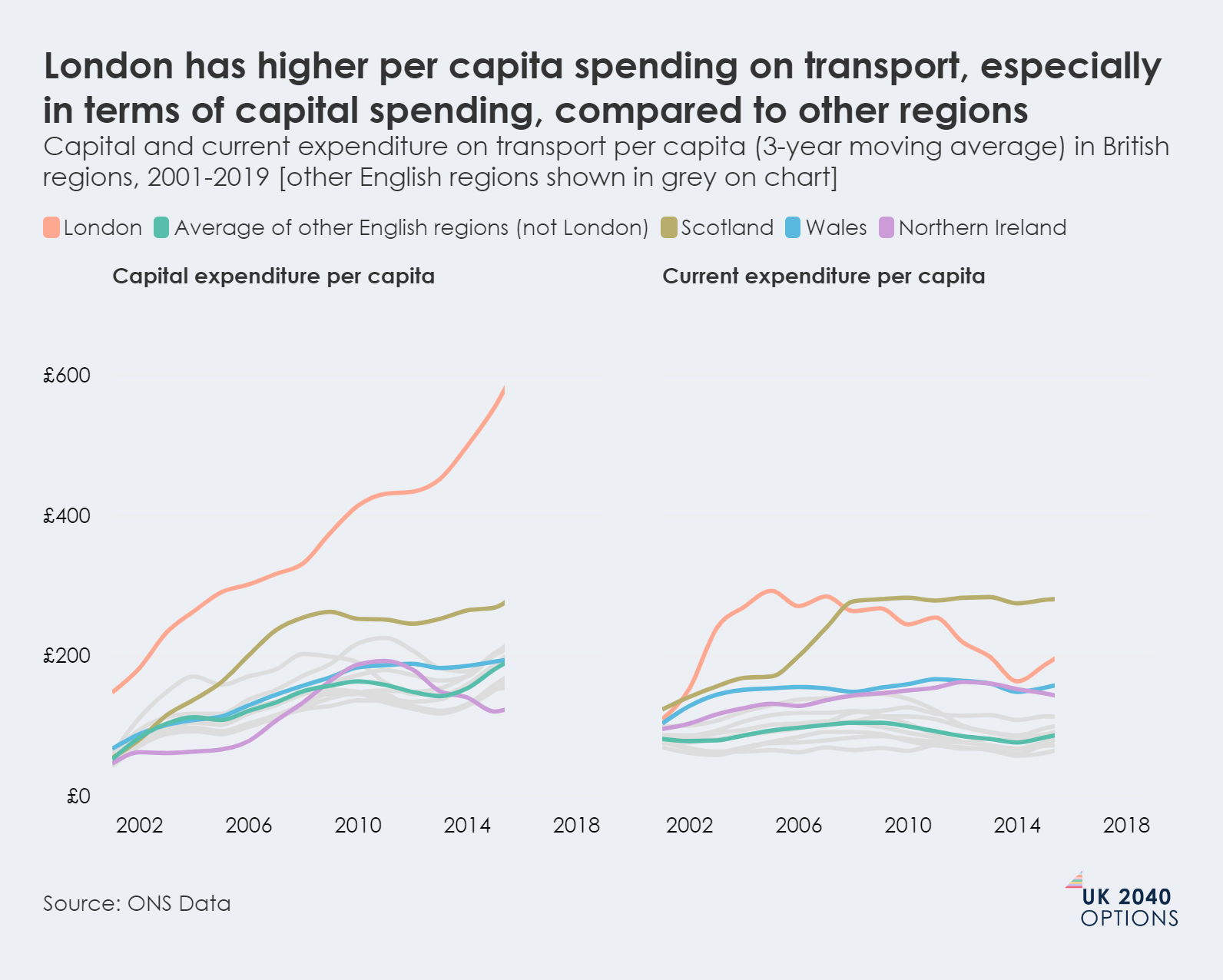
It is hard to see how we can improve the UK's productivity while this is the case, and while levels of investment in areas like transport and skills are controlled by a London-based government.
Typical household income in the richest region of England is more than 25% greater than in the poorest region
Median weekly income after housing costs: 2019-20 to 2021-22, equivalised 2021-22 prices
Source: DWP, Households Below Average Income, 2019/20, Francis-Devine, B. Orme, S. "Income Inequality in the UK", Commons Library Research Briefing, 14 April 2023, Number 7484
Governance and institutions
For historic reasons the UK has an unusually strong executive, and a relatively weak legislature and judiciary. There is also not a codified constitution and thus not a formal separation of powers, which is true of only a handful of democracies. There are advantages to this: it offers a greater level of flexibility and speed of decision making. But there are also serious disadvantages, especially during periods of government instability.
The centre of government is constitutionally extremely powerful. A UK prime minister with a majority in Parliament and the support of their MPs can, in theory, do almost anything. But as a recent Institute for Government report sets out, Number 10 and the Cabinet Office are institutionally weak, with few staff working directly to the prime minister, little sight of much of what is going on in other departments, and little capacity to engage in thinking on complex issues. This is an unhelpful combination.
The UK's political institutions, such as the role of the prime minister, evolved during the 18th to early 20th century. The state was far smaller during this period, accounting for 10%-15% of a much lower GDP, rather than the 40%-45% seen today. We see this not just at the centre of government but across Whitehall. The civil service, for instance, despite occasional attempts at reform, still has many of the flaws built into its Victorian design as a vehicle for young academically bright Oxford students with little practical experience.
These weaknesses, combined with high levels of centralisation, lead to unusual levels of policy instability and short-termism: an issue raised in nearly all of the 2040 Options roundtables. This issue is further exacerbated by the difficulties Parliament has in scrutinising executive action, given MPs' lack of control over their timetable, and the ever growing amount of legislation that is never even debated at all (so-called statutory instruments).
The Treasury
In contrast to a weak centre of government we have an unusually powerful Treasury. In most countries economics and finance are split into two different departments, but in the UK they are combined. The finance element has tended to dominate the economic, one reason for relatively low infrastructure investment and weak industrial policy. As Giles Wilkes wrote in a review of the UK 2040 Options economic growth roundtable: “What passes for industrial strategy in the UK has been started, stopped and started again too many times to count. Once-a-generation strategies appear every year or two.”
The rationale for having no, or a light-touch, industrial strategy, is that government shouldn't 'pick winners'. Yet in practice it does end up bailing out politically important companies and industries – Tata Steel and Bulb Energy being recent examples. The absence of a strategy just ensures this is ad hoc.
All finance ministries need to focus on spending control. Governments have to have some mechanism to keep spending on policy within reasonable limits. But when that mechanism is unchallengeable, it creates an imbalance of power that means sensible suggestions for spending can be rejected out of hand.
As the authors of an Institute for Government report on the Treasury put it: "Its veto power is pervasive, and its ability to initiate and force through policies unique. Of course, it would be dangerous to want a weak finance ministry easily cowed either by the prime minister or big spending departments. But the absence of firepower elsewhere to match the Treasury's sway distorts how policy is made. Insofar as the government operates a strategy worthy of the name, it is often determined too much by the outcomes of Treasury-led spending processes, rather than a comprehensive strategy determining those outcomes."
Political culture and risk aversion
Ultimately, responsibility for this rests with politicians not officials. But institutions with strong institutional beliefs and outsized power will influence decision making, especially when there is high turnover of inexperienced ministers.
Since the rise of 24-hour news and the internet, the political cycle has sped up to the point where it is now a permanent stream of information and noise. Social media has intensified this trend further. As a result, communications has become a greater focus for government. Initially developed as a way to explain government policy, instead it has too often become the basis for policy.
Within Whitehall this is exemplified by the 'Grid'. This was introduced as a way to coordinate announcements across government but, over time, filling the Grid has become an aim in itself. This has led to announcements being created for the sake of having something to say – creating further instability and cost-implementing needless programmes.
Equally, government set pieces such as fiscal events, of which there are now usually two a year, have become ever more focused on ensuring there are a string of announcements to keep the news stream full. The increasing incoherence of the tax system is at least partly down to the need to have something to brief journalists on in advance of each budget and autumn statement. This has contributed to a personal tax system, which the IFS calls “unnecessarily complex and opaque" – with a growing array of irrational “humps” that could disincentivise work.
It also makes UK business less attractive to investors due to frequent changes to the main rate for corporation tax, as well as near annual changes to investment allowances and tax breaks.
A communications-driven political culture creates instability due to the need for content. But it also, somewhat paradoxically, has widened the gap between politicians and the public. Just 10% of the public say they trust government ministers – the lowest ever recorded. This is partly due to more intensive media coverage and social media, which has led to greater scrutiny of politicians, with the expenses scandal being a particularly high-profile example.
But the lower trust is also due to politicians being overly responsive to superficial indicators of public opinion, such as issue polls, which are inevitably incoherent when pieced together. Topline results from these types of polls can mask the true picture and give the impression voters are unable to understand trade-offs or complexity. It can also lead to government communications becoming divorced from policy reality. This is most obviously true on the issue of immigration, where decades of 'tough-talking' has been accompanied by an almost linear increase in net migration figures.
A toxic mix
Short-termism, instability, and a refusal to consider trade-offs are problems for all democratic governments. They have been exacerbated everywhere by the double global crisis of the pandemic and Russia-Ukraine war. But these peculiar aspects of the British state – centralisation, outdated institutions, weak scrutiny of the executive, and a very powerful finance ministry – make these tendencies even more acute. Combined with the increasing dominance of communications over policy, it's a toxic mix. These constraints limit state capacity and make it harder to deal with the growing demands on it.
Options for 2040: building capacity and managing demand
There are two broad approaches that could be taken to managing rising demand so that the UK in 2040 is healthier, happier, and richer: increasing the amount spent by the state and reducing demand.
Increasing the amount spent by the state
This could happen via higher productivity or higher taxes, or a combination of both. We have had 15 years of historically very low productivity growth which has led to overall per capita GDP being largely stuck. Nesta analysis shows that by 2040, the average person will be £8,000 poorer if we stay on the current growth trend versus the trend before the financial crisis.
By 2040, the UK could be £8,000 poorer on average per person each year than if it had stayed on the pre-global financial crisis trend
GDP per capita, chained volume measure, 1955-2022 with linear trends 1990-2007 and 2010-2019 projected to 2040
Source: ONS Data Trends projected are linear
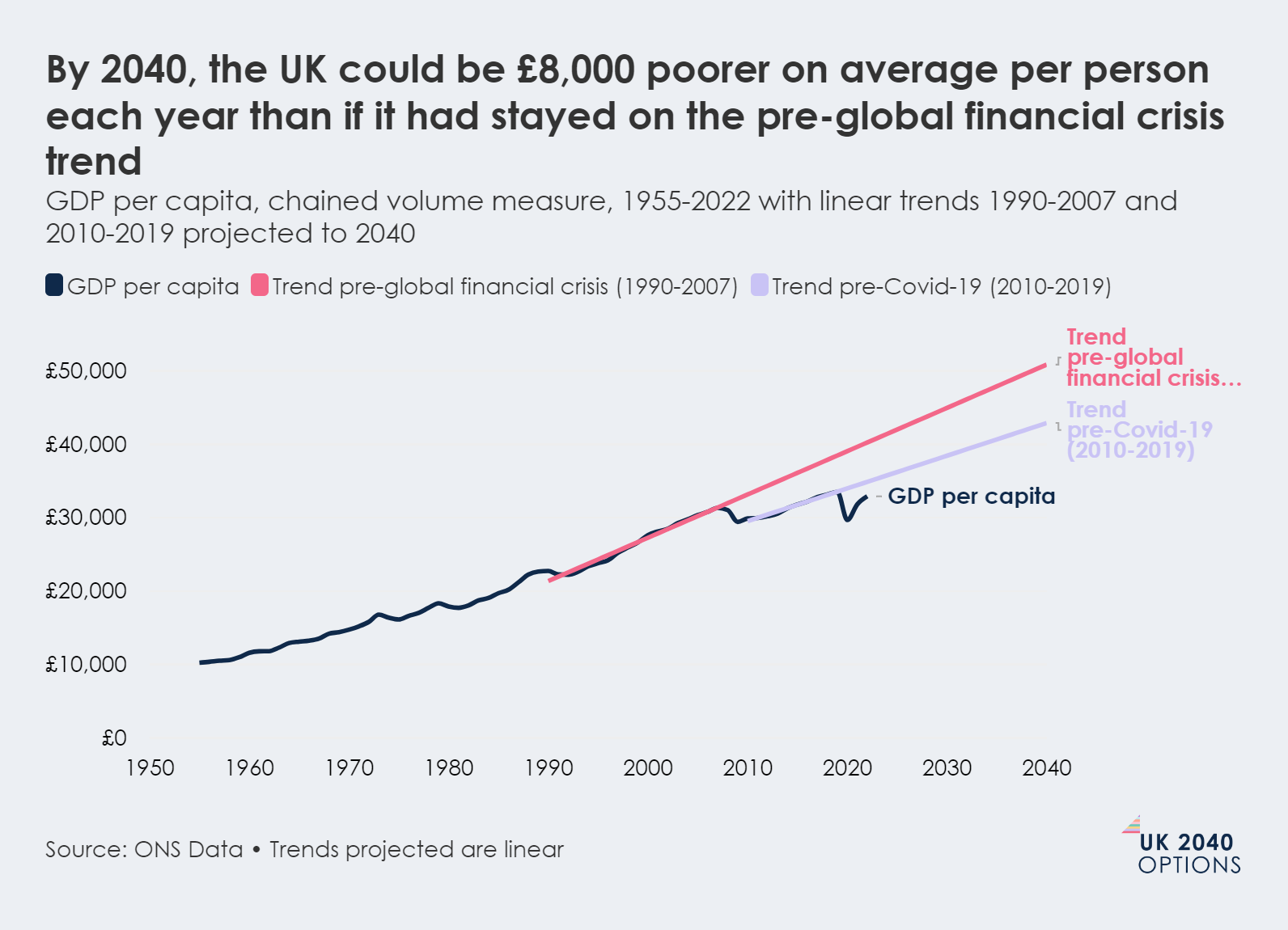
If we had stayed on track, or could get back on it, then the same rates of tax would produce much more income and allow for higher levels of public and private investment, which in turn would help future growth.
As Giles Wilkes says: "Britain's productivity problem is a crime mystery with multiple culprits. The worst trap to fall into is impatience, which can lead to an urge to use 'one simple trick' to solve something as longstanding, multifaceted and intractable as the UK's productivity problem, like it is some clickbait article about losing weight."
Low private investment in skills is an issue. So are, in recent years, additional trade barriers due to leaving the European Union. The UK's governance challenges set out earlier also play a role – particularly overcentralisation and historic underinvestment.
Infrastructure projects
Part of the reason for underinvestment is that the UK struggles with infrastructure projects. We are not unique here. A recent comparative study found our costs are higher than European counterparts but lower than the US or Australia.
Unfortunately our projects take a comparable amount of time to European counterparts and a lot longer than the US or Australia. We are not outliers in either category but we are the only country to have high costs and long project durations.
These challenges are particularly acute for transport projects which are of significant importance to productivity, and where UK ‘second cities' that have much lower productivity than European counterparts have a distinct disadvantage.
There are, again, multiple reasons for this. But planning processes are particularly slow in the UK, and supply chains unusually fragmented and complex. An overcentralised state, driven by short-termism, is a big problem too, as can be seen from the multiple politically-driven delays and changes to the HS2 project, which is currently on track to achieve none of its goals at a cost of £67 billion.
Increased tax burden
In the absence of productivity growth over the past 15 years, the tax burden has had to increase to manage higher demands on the state, even as public services have been cut. In the last few years it has risen from around 33% of GDP to 35%. This does, though, remain considerably lower than either the EU14 (pre-2004 EU members) or the G7.
If we taxed at EU14 levels we would have around £125 billion extra a year for services, welfare and investment. Moreover, our tax system is distorting. As the IFS note in their analysis of tax for UK 2040 Options:
"Tax rates are much lower on capital incomes than on labour incomes, which distorts the labour market away from employment and towards self-employment."
The amount of tax paid on income varies hugely depending on employment status
Tax due on a job generating £40,000 in 2023-24 (excluding Scotland)
Source: IFS Calculations NICs stands for National Insurance Contributions. Calculations exclude trading allowance and employment allowance where applicable. We assume no pension contributions are made.
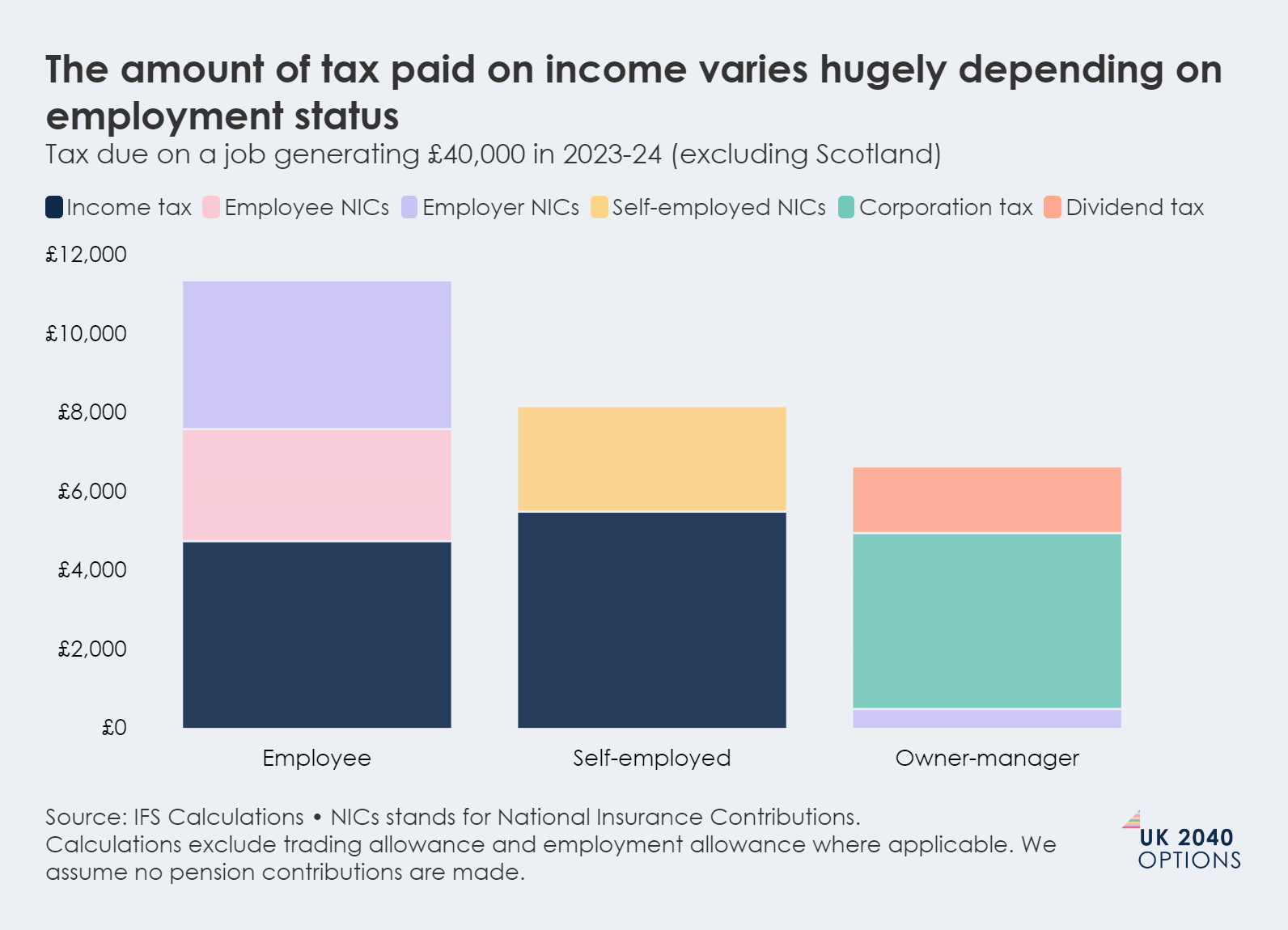
In addition, wealth is generally undertaxed relative to income (one driver of growing intergenerational inequality) and council tax is hopelessly regressive and outdated. Properties have not been revalued since 1992 and half the homes in the country pay more council tax than Buckingham Palace. VAT rules are complex and costly and zero-rating means a lot of potential tax on consumption is left on the table.
It would be possible to make the system fairer and better aligned to productivity growth without increasing the tax burden. But if we do need to increase taxes, it is possible to do so without in areas other than income or work.
Reducing demand
If we do not achieve enough growth to pay for all the pressing demands on the state, and don't want to put up taxes (or, as per the current government, are looking to reduce them), then the only other choice is to reduce the additional demands being made on the state.
The simplest way would be to have the state stop doing things. The difficulty for politicians is that the most expensive things the state does (welfare, healthcare, education, and defence) are all seen as essential and important to voters. It would be politically easier (if not necessarily advisable) to stop, for example, funding foreign aid or cultural subsidies. However, this wouldn't make much of a dent against the rising demand.
The current government, despite rhetorically talking about a smaller state throughout the last 14 years, has in practice barely cut any state activities – it has just funded many of them at a lower rate. Indeed, it has increased the state's role in multiple areas including expanding childcare, increasing university participation, putting a triple lock on pensions that ensure they will increase above inflation over time, and creating many new regulatory requirements.
Increasing efficiency and funding preventative interventions
If it is politically hard to stop the state doing things, then it should at least be possible to make existing services more efficient. The NHS is a good example. Spending has increased significantly since the start of the pandemic, with a 15% increase in doctors and more than 10% increase in nurses. Despite this, the number of patients being seen has barely risen and waiting lists are higher than ever. The problem here is misaligned spending. Adding more staff without more beds or equipment has led to full hospitals with inefficient throughflow. Investing in capital would unlock higher productivity, but this means an initial increase in spending. Much technology investment would fall into this category of investing to save.
Likewise funding preventative interventions could, in theory, help reduce the number of people with expensive long-term conditions like diabetes and heart disease. But public health spending has been cut, as it is easier to do this than to cut acute care.
Some think tanks have proposed creating a new category of preventative spending so that it can be more easily protected. This would be hard to do as there is no clear way to classify spending as preventative. (For example, all school funding might be considered 'preventative', given that education should lead to long-term positive outcomes for students.)
But introducing this classification would certainly help to increase transparency about projects specifically designed to reduce future costs and to evaluate them properly. The Treasury is typically sceptical, often justly so, of claims made about future cost savings. Building up a stronger evidence base is key, but without taking some risks it will never be possible to do so. It also requires long-term commitment. Recent IFS studies identifying preventative benefits of SureStart appeared 14 years after the policy ended.
The need for a more effective state
Given the scale of the demand challenges the UK faces, and the difficulties associated with each of the options described above, it is likely future governments will need to do some mix of all of them. We will need to boost productivity; raise taxes in a way that makes the system fairer and better aligned to growth; stop doing some things; and find ways to invest to make services more efficient – while stopping so many people needing them in the first place. The decisions will be about which of these things to give greater priority to given limited capacity.
The ability, though, of governments to do all of those things requires not just policy decisions on individual issues, but a focus on building underlying state capacity. Underinvestment and short-term political instability are built deep into the foundations of the British state. None of the challenges or problems raised in this paper are new: people have been calling for simplified planning rules or more investment on prevention for decades. Very few politicians from any party would claim to oppose these things in principle. And yet they do not happen. Without an emphasis on state capacity, they never will.
So all roads lead back to the need to create a more effective state. (That's not to say that nothing can be done until this is achieved: government can attempt to make better policy within the current system at the same time – it will just be harder.)
What might some of the options be for achieving this?
1. More effective central institutions
As discussed earlier, we have an unusually weak centre of government that is also unusually powerful; a bad combination. Power can be dispersed to some degree through devolution (see below) but we still need better-functioning institutions at the centre. Too many governments deprioritise this issue, when it is key to their ability to effectively deliver their objectives.
There have been a number of different proposals for reforming Downing Street and the Cabinet Office to provide better support to prime ministers. All agree that there needs to be more policy-making capacity, especially with regards to longer-term thinking. Small policy units tend to be overwhelmed with firefighting and man-marking departments. They also tend to agree on the value of having a smaller group of cabinet ministers providing close support to the prime minister. This would be outside of full cabinet, which is simply too large to be an effective decision-making body, and whose meetings have become largely symbolic.
There is less agreement on the role of the Treasury. Some argue that it is too powerful and that via its control of spending, and fixation on short-term targets, it will always override the ability of Downing Street to set a proper strategy. Others believe that the fixation on short-term targets is ultimately a political choice, and the problem wouldn't be solved by breaking up the Treasury. Either way there is general agreement that spending decisions need to be properly tied into an overall strategy process, which doesn't exist at the moment.
The civil service also remains a challenge. It has many talented people within it but has sometimes lacked leadership, has too few specialists, and officials move between roles too rapidly, causing instability and loss of expertise. These themes are reflected over and over in decades' worth of official reports.
Again, restructuring the civil service is something that governments tend to deprioritise in the face of more apparently urgent challenges, leaving senior civil servants little space, or incentive, to drive improvements. There are well-known solutions that never seem to happen such as: creating more opportunities to be promoted within specialist roles; making it easier to recruit from outside; creating clearer lines of accountability for senior officials in return for greater autonomy; and significantly improving training.
Rather than reform, governments have a tendency to announce arbitrary cuts in numbers of civil servants or put forward new rules reducing officials' autonomy, both of which tend to make things less efficient.
2. Sharing the load better: building institutional capacity outside of central government
Our central institutions can be improved but fundamentally we are asking them to do far too much. Local government has been hollowed out leaving operational decisions about public services and regional economies to be made from Whitehall. Even if we had more stable government, this would be too much of a burden.
In theory, this is something all our parties agree with. The creation of regional 'combined mayoral authorities' is seen as a success on all sides. Both the government and Labour propose to strengthen them further over the coming years. Yet only half the population (in England) are covered by them and the ones that do exist have very different set-ups and responsibilities. Further devolution needs to be accompanied by a clear set of criteria for: what should remain with national government; what should sit regionally with mayors; and what should be done at local authority level – with funding and powers aligned accordingly.
There are also important questions around fiscal devolution and whether regional mayors should have more powers to raise money, as they would do in almost any other developed country. If they cannot, their power is seriously limited. However, it would be a big step for a national government that has spent decades restricting fiscal manoeuvrability for any institution outside Whitehall.
3. More effective democratic engagement around trade-offs
The core of politics is choosing between difficult trade-offs. That is never something that has been easy, in any democracy. But the more data politicians have on public opinion and the more communications driven politics has become, the less willing politicians have been to make these choices. In a highly centralised system, this leads to an instability of policy approaches, which then, somewhat paradoxically, leads to paralysis.
But politicians are heavily reliant on polling and focus groups to understand public opinion. These are useful but extremely limited. If you ask people if they want more spending they'll say yes. If you ask them if they want lower taxes they'll say yes. That doesn't mean they don't think there's a trade-off between the two.
One approach to this problem is to try and limit the room for politicians to avoid acknowledging trade-offs. The creation of the OBR was designed for this purpose. But in practice politicians have found loopholes – in this case setting impossibly tight spending plans for future years that never materialise. Ultimately, in a democracy, you can provide greater transparency and information but you cannot technocratically constrain the behaviour of an elected government in a sovereign parliament, nor would that be acceptable. There may be ways to further increase transparency, for example through independent costing of policy proposals and evaluation. But there are limits to the value of this approach.
An alternative, or rather complement, to this would be to lean into representative public opinion more but in a structured and thoughtful way. Other countries such as Ireland now make regular use of citizens' assemblies or juries to support decision-making on complex and often emotive policies like assisted dying or the distribution of environmental costs. These involve inviting a representative group of citizens to join an assembly or jury and then running sessions led by independently chosen experts representing a range of viewpoints. Meetings are live-streamed and all the information given to the group is made public.
It's an intensive process which, if done well, can lead to deep engagement with trade-offs. Critically these are not decision-making bodies. Ministers and Parliament can choose to ignore their recommendations, but observing the process gives them a much better insight into how the public work through trade-offs, rather than using standard means of opinion research. Informal trials of similar processes by UK organisations and think-tanks have produced similarly thoughtful exercises. Similarly, if mayoral authorities are to avoid the trap of becoming 'mini-Whitehalls', they will need to change the way they engage with citizens.
4. Clarity around the state's role in risk management
The rise of the regulatory state has happened in an organic and largely unplanned way. It has left us with a confused and often contradictory set of approaches to thinking about risk. This is true both when it comes to the costs we're willing to place on industry but also trade-offs between personal liberty and risk.
A standardised way to assess the costs and benefits of regulation for industry, across a range of economic, social and environmental measures, would help improve the nature of the debate, enabling governments to make better, more consistent and more stable choices.
Likewise, a framework for public health interventions – such as the NICE framework for deciding on which drugs the NHS will pay for – would support a more useful discussion about the role of 'sin' taxes in reducing poor health, or in tighter regulation of vapes and cigarettes.
A new political settlement for 2040
The challenges the country faces are serious but not insurmountable. Rising demand for the state and increasingly constrained capacity means the status quo is not an option. But there are plenty of things we could do that would help us do much better. There are lots of ideas that would reduce barriers to productivity, create a fairer tax system, boost sustained investment in infrastructure and long-term prevention of chronic illness, and so on.
Our problem is not a lack of ideas; it's how to make them happen within a poorly functioning and over-centralised state in which politicians are increasingly unwilling to make choices about complex and painful trade-offs.
Governments have a tendency to focus on individual policy problems in a scattergun way, often due to a crisis situation that pushes them up the news agenda. But really we need politicians to focus on the ‘meta' challenge of building up state institutions and processes to allow for more coherent, stable, long-term policymaking.
Given many of the things that need to change have been known about for a very long time and are, in principle, agreed on between the main parties, the problems must be about structures and the way politics is working. There is no one right answer for these 'meta' questions – but we do need politicians who will at least start engaging with them.
About this Report
UK Options 2040 supports policymakers as they make choices about what to prioritise and how to deliver: setting out alternative policy options and pathways for the future, creating space for honest debate about the trade offs and testing and interrogating ideas that take us beyond immediate crises.
58 Victoria Embankment
London EC4Y ODS
+44 (0)20 7438 2500
[email protected]
@nesta_uk
www.nesta.org.uk
Creative Commons
BY NC SA
Nesta is a registered charity in England and Wales with company number 7706036 and charity number 1144091.
Registered as a charity in Scotland number SC042833.
Registered office: 58 Victoria Embankment, London EC4Y ODS.



