Authors: Izzy Brennan, Edwin Chan, Madeleine Gabriel, Toby Park, Andrew Schein, Andrew Sissons, Kevin Wiley
Summary
The UK has decarbonised more than any other high-income country over the past 30 years, but mostly through decarbonising electricity generation. Decarbonising heat is more challenging, and heat pumps are a core part of the solution to this thorny problem. The UK government's goal is to reach 600,000 heat pump installations per year by 2028. This is a large increase on current figures of approximately 30,000 heat pump installations per year.
One flagship policy under consideration is to mandate that boiler manufacturers match gas, oil and other fossil fuel boiler production with a certain amount of heat pump installations.
We support the mandate as described by the UK government, as part of broader support for low-carbon heating, based on research conducted before and during our response to the government's consultation about this proposal.
We expect the mandate to reduce heat pump costs. It will do this by creating new incentives to reduce upfront costs of the heat pump equipment, reduce non-equipment costs of installation and reduce running costs – which, together, may increase installations a lot. In addition, we expect the mandate to improve customer adoption for reasons other than financial savings, such as by reducing the time required for installation, increasing coordination between tradespeople and incentivising new business models that reduce the complexity of customers' choices.
In the second section of this report, we discuss ideas to safeguard and improve the mandate's performance:
- Ensure high-quality installations by creating rating systems and mechanisms to withhold credit for subpar installations, thereby incentivising manufacturers and other stakeholders to prioritise quality and high customer satisfaction.
- We argue that the UK government should take an 'inclusive' approach to heating solutions eligible to receive credit under the mandate – to ensure that households obtain the right heating system for their particular circumstances.
- We support key 'safety valves' for industry, including a simple monetary penalty for non-compliance and allowing robust ‘credit trading' between manufacturers.
- We urge the UK government to test the policy in the real world before or during full implementation.
To reach the UK government's goal of 600,000 heat pump installations per year, we'll need the proposed mandate on manufacturers, along with the following complementary policies:
- Massive increases in heat pump installer training.
- Stimulating consumer demand for heat pumps.
- A complementary mandate on energy suppliers to support heat pump adoption among their customers.
Finally, we show in three summary tables that the mandate on manufacturers is useful and important to scale heat pump adoption but is not itself sufficient to overcome:
- Cost and finance barriers to heat pump adoption.
- Non-financial barriers to heat pump adoption.
- Barriers to high quality heat pump installations.
Note: The mandate is a UK government policy proposal that would apply across all parts of the UK. However, many policy levers related to heating buildings - particularly provision of skills and some financial subsidies - are devolved to the Welsh, Scottish and Northern Irish governments, and so will vary in different parts of the UK.
Introduction
Context for the policy the government is proposing
In the past 30 years, the UK has delivered a greater per-capita CO2 emissions reduction than any other major high-income economy. Most of that reduction has come from decarbonising electricity.
The country has decarbonised heat more slowly, though. Most heat still comes from boilers that use gas, oil or other fossil fuels. Heating homes accounts for 17% of all UK emissions.
The UK government wants many homes as many as 600,000 per year by 2028, and rising through the 2030s – to switch to heat pumps. Heat pumps use electricity, which by 2035 should be 100% zero-carbon, to provide heat. They do so highly efficiently, taking a unit of electricity and turning it into between two and four units of heat an engineering feat made possible by drawing latent heat outside the home, even on a cold day, into the home.
But, right now, gas boilers are cheaper and easier to install. Heat pumps are expensive upfront, often have higher running costs for consumers (despite typically being two to four times more efficient, the very high cost of electricity dominates), and can take about a week to install. The installation often involves plumbing, electrical wiring and installation of outside and inside units. Some homes need to install bigger radiators or get home insulation because heat pumps don't heat the water to such high temperatures. Replacing a like-for-like gas boiler feels simpler, less risky, more affordable in the short and long-term, and more familiar.
However, by 2035, new fossil fuel boilers will likely be completely phased out, meaning the vast majority of the 29 million existing homes in the UK will end up with a low-carbon heating system by 2050 (given boilers last approximately 12-15 years). But we cannot wait until 2035 to make progress. Production and installation capacity must be ramped up before then, and costs reduced significantly, meaning there are a range of policies needed now to maximise early adoption. We also have medium-term carbon budgets to hit, not just a Net Zero target in 2050. The UK government has therefore targeted 600,000 annual installations by 2028 a significant jump from the 30,000 per year currently installed.
To achieve this goal, the UK government has planned a suite of policies, including:
- £60m towards a 'Heat Pump Ready' programme to spur innovation in heat pump design and installation.
- £3.9bn to 2025 to be shared by the Social Housing Decarbonisation Fund, the Home Upgrade Grant scheme, the Boiler Upgrade Scheme, the Heat Networks Transformation Programme, and the Public Sector Decarbonisation Scheme.
- A Future Homes Standard under which new homes must come with low-carbon alternatives to fossil fuel boilers (from 2025).
The Scottish Government has also set out its own Heat in Buildings Strategy - which includes a slightly higher subsidy than the UK Government's Boiler Upgrade Scheme - while strategies from the Welsh and Northern Irish governments are expected to follow soon.
Recently, the UK government consulted on a proposal to complement these policies by mandating that boiler manufacturers support heat pump installations, too. Under the mandate, manufacturers would be allowed to sell boilers only where the manufacturer has sold sufficient heat pumps (or bought credits from others who have). We think this is a bold idea. It has risks, but we think it is the right approach to help the UK deliver on its ambitious net zero commitments.
What the UK government has proposed: how the 'market-based mechanism to support low carbon heat' will work
The UK government plans to mandate that manufacturers of fossil fuel heating appliances achieve the sale and installation of heat pumps equal to a proportion of their fossil fuel boiler sales in a given period. The government has not specified what the proportion would be. They note that it could be ‘stepped up' over time.
The government may allow manufacturers to trade credits with each other, where manufacturers sell excess heat pump credits to manufacturers responsible for otherwise insufficient heat pump installations. Manufacturers who do not produce sufficient credits to match their fossil fuel boiler sales (or procure them through trading) would face penalties – e.g. through a fine proportionate to the amount of fossil fuel boilers sold beyond the allowance implied by their heat pump 'credits'.
Our interpretation and perspective on this package of policies:
- We assume that, to meet the mandate, manufacturers will reduce the cost of heat pumps faced by installers, merchants and, ultimately, customers, likely financing this reduction in cost by increasing the cost of gas (and other fossil fuel) boilers. Of course, this is an oversimplification: manufacturers might invest in better marketing for heat pumps, or in research and development to make them more desirable (e.g. through even higher energy efficiency, quieter components, smaller equipment size, elements that aid faster installation) without changing heat pumps' upfront cost.
- However, at a high level, we think the mandate creates an implicit subsidy for heat pumps, financed by an implicit tax on fossil fuel boilers.
- We believe this rebalancing of prices is justified by the costs to society associated with greenhouse gas emissions from fossil fuel boilers, emissions that are largely avoided by heat pumps as renewable sources generate increasing proportions of the UK's electricity supply.
Who we are
Nesta and the Behavioural Insights Team (BIT) are sister organisations co-writing this response. Nesta is an innovation agency for social good, designing, testing and scaling new solutions to society's biggest problems and changing millions of lives for the better. BIT has evolved from the heart of the UK government to become a world-leading social purpose company with the largest pool of behavioural scientists in the country; our mission is to apply behavioural science, rigorous research methods and service design to the betterment of individual lives and society.
Research supporting our thinking
Our perspective on the UK government's proposal to impose a mandate on manufacturers has been informed by:
- Qualitative research into the customer journey for heat pump adoption.
- An online hypothetical choice experiment investigating British householders' willingness to pay for heat pumps.
- Analysis of heat pump installations data from Microgeneration Certification Scheme (MCS), to analyse how the cost of heat pumps varies for householders.
- A workshop with experts from the heating industry – stakeholders from boiler and heat pump manufacturers, energy suppliers, trade associations, installers and third sector groups. We worked with these experts to conduct a pre-mortem – we asked participants to imagine that the policy had failed to deliver on its goals of greater heat pump adoption and innovation in the heat pump market, ‘work backwards' to determine what caused the failure and develop mitigation strategies and solutions to these causes.
We support the UK government's manufacturer mandate, as part of broader support for low-carbon heating
We support the UK government's proposed mandate on manufacturers of gas boilers – the ‘market-based mechanism to support low carbon heat', in the language of its consultation as part of a suite of policies to support low-carbon heating.
We engaged with stakeholders from the heating industry on the UK government's plans and discussed whether incentivising manufacturers would lead to solutions for all bottlenecks and barriers to adoption throughout the value chain. The response from industry to this question was instinctively 'no' – and this was true across stakeholders with both positive and negative views of heat pumps.
Many (though certainly not all) participants in our workshop argued that incentivising greater supply of heat pumps is not the right lever to pull to achieve higher heat pump adoption. They noted that demand for heat pumps is still low, due to high upfront costs, high running costs, hassles involved in customer adoption journey, unsuitability of some housing and lack of awareness. They also noted scarcity of installers, due to lack of specialist training, and a tendency of installers to promote boilers over heat pumps. In summary, their concern was that the issues are primary ones of demand and installation, so mandating increased manufacturing supply is misguided.
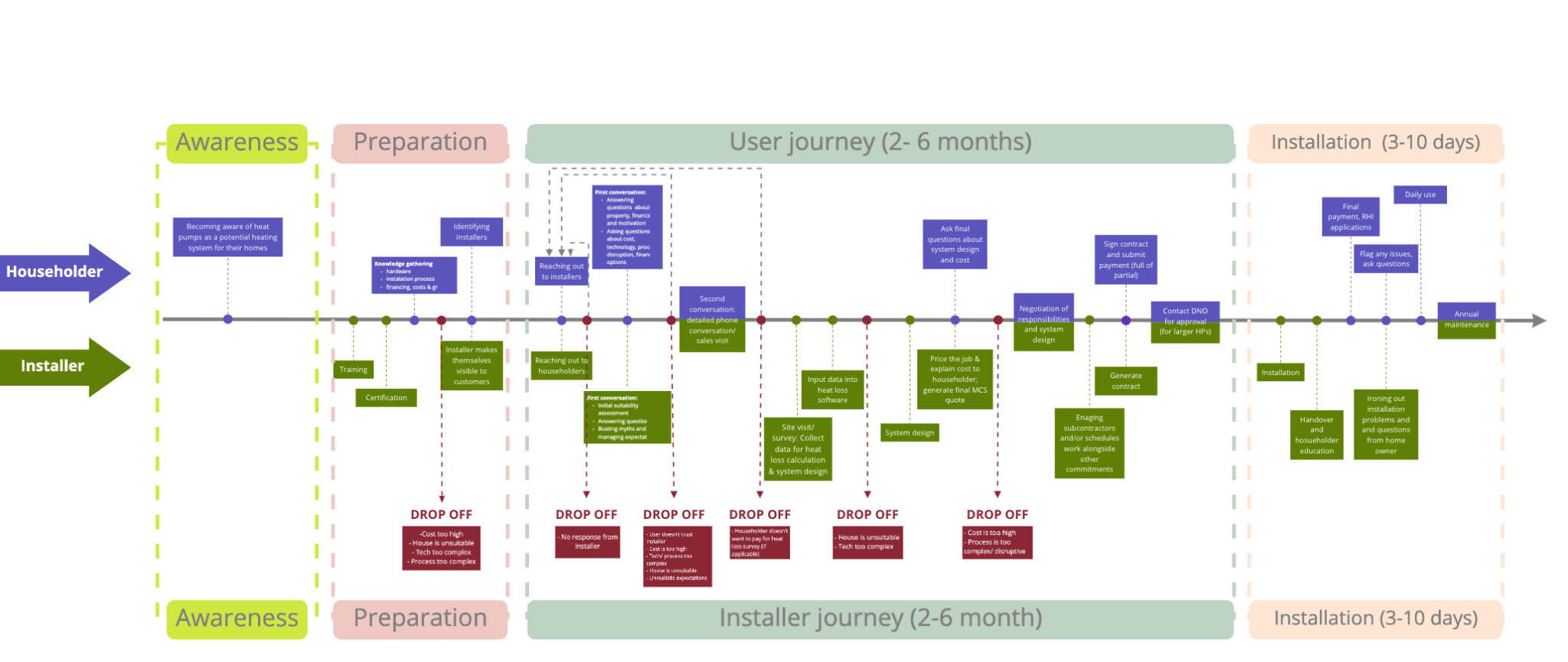
Our own behavioural research has amply highlighted the adoption barriers faced by consumers.
Diagram 1. A stylised heat pump installation journey showing friction points for consumers and installers
We expect the mandate to reduce heat pump costs – which may increase installations a lot
However, a plausible counter-argument also exists: though increased supply of heat pumps is not the direct solution to these problems, this policy proposal is more than an incentive to manufacture heat pumps. It is an incentive to install heat pumps. The incentive should therefore motivate manufacturers to find varied and creative solutions to the above problems. This is possible to a greater extent than may at first be believed by manufacturers and other industry stakeholders once the incentive is real, and assuming it is strong enough to 'bite', many will form innovative partnerships and business models that help them achieve more heat pump installations.
We believe the truth lies somewhere between these two positions. Yes, a strong incentive placed on manufacturers will lead them to find solutions to bottlenecks and barriers at various points in the value chain. These solutions might address barriers within their own operations, with installers and with respect to consumer demand. However, manufacturers are not always best placed to solve all these problems, and in some cases expecting them to do so may be unrealistic. Other actors (including government) will be better placed to solve some issues relating to low consumer demand and installer shortages and skills gaps, for example. As such, we believe this policy will significantly help, but supplementary policies to 'grease the wheels' of adoption and installation are critical to ensure success.
So, while we support the UK government's plans to mandate manufacturers to match gas boiler installations with a certain level of heat pump installations, we believe it is a useful and important – but not sufficient – measure.
Our perspective is informed by the Fogg model of behaviour change, which emphasises the complementary roles of motivation and ability (or ease). An implication of the model is that incentives work best when paired with removal of key frictions, and disincentives on undesirable behaviours work best when the desirable behaviour is viable (or even better, easy). As the UK incentivises manufacturers away from the installation of fossil fuel boilers and towards heat pumps, it must simultaneously make it easier for manufacturers to do this – by increasing the capacity of trained installers and consumer demand.
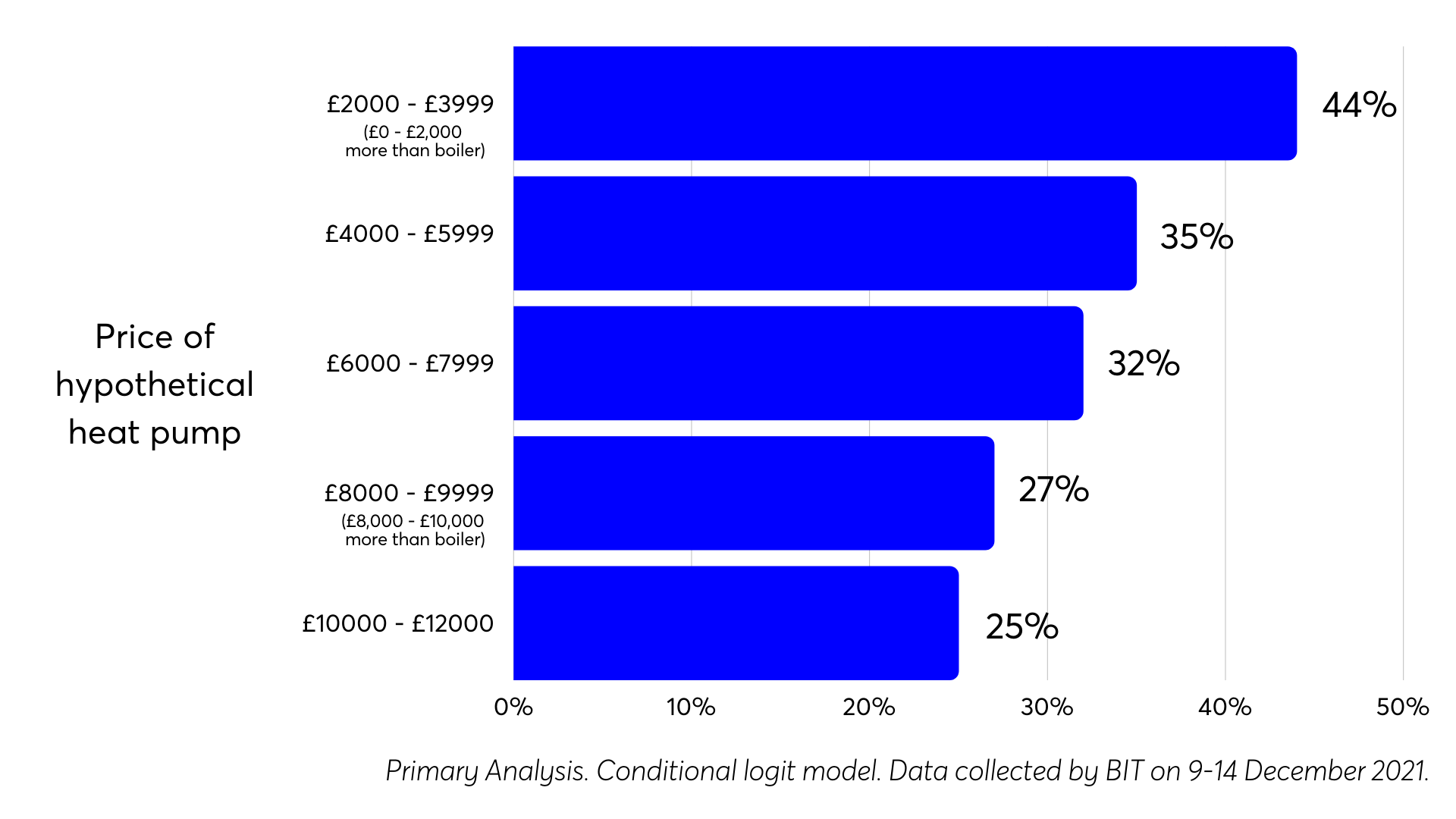
In a hypothetical choice experiment we ran online 9-14 December 2021, we found that people were responsive to differences in heat pump costs though, at least in our experiment, perhaps not as responsive as one might assume. In our experiment, participants saw a hypothetical scenario where they needed to replace their current gas boiler with either a new gas boiler or a heat pump. Participants saw a randomly selected heat pump price (ranging from £2,000 to £12,000) to account for a wide range of hypothetical subsidies and/or future cost reductions.
By construction, this experiment isolated consumer choice conditional on quite a few other parts of the heat pump adoption journey being approximately perfect: participants knew about heat pumps, had been told their home was ready and suitable, and had received the 'ok' on a heat pump from a hypothetical installer. On top of this, hypothetical choices are likely upper bound estimates of true adoption – stated intentions in an online experiment do not fully reflect the actual hassles and gravity of real-world consumer choices.
With that said, we found that a majority would refuse a heat pump even at cost parity with gas boilers – but that a sizable minority said they would adopt a heat pump at current prices. Between these two camps, some customers were price sensitive.
Diagram 2. Percent of people who would choose a heat pump, at varying prices, over a £2,000 gas boiler (n=1,801)
Later in the experiment, we asked participants who chose gas boilers what (if anything) would motivate them to choose a heat pump instead. Seven in ten said they would change their mind and buy a heat pump if they were cheaper to install. Other drivers were cheaper running costs and ease of installation.
Diagram 3. Percent of people who chose gas boilers willing to adopt a heat pump, under certain conditions (n = 1,215)
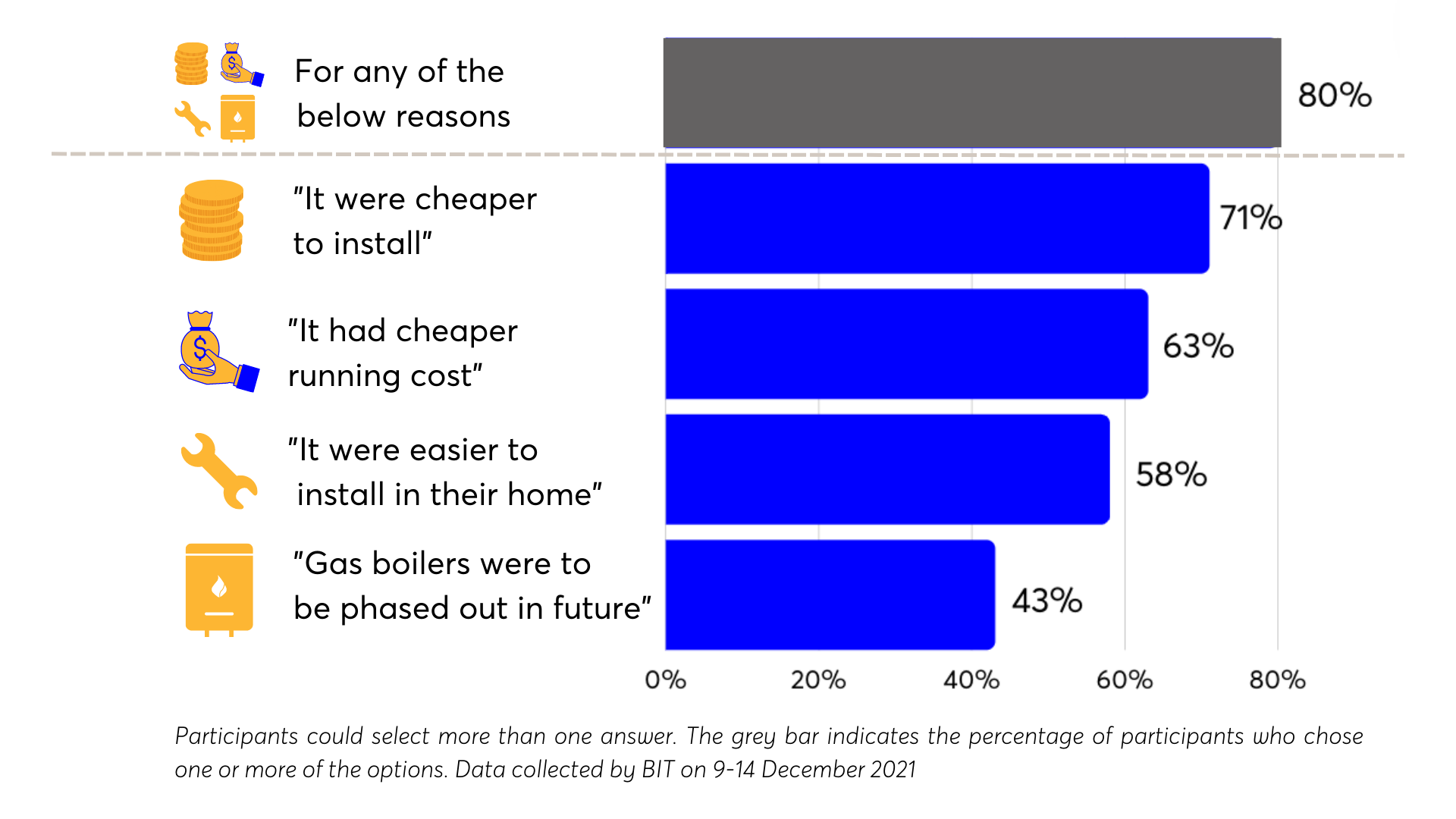
Note that beyond the financial motivators, making heat pumps easier to install was persuasive to a majority of participants who chose gas boilers. As we note in the next section, we are optimistic that the mandate could drive improvements in ease of installation, too.
We expect the heat pump mandate on boiler manufacturers will reduce the cost of heat pump installations, contingent on sufficient complementary policies to support manufacturers, installers and other stakeholders to achieve these reductions. It is useful to analyse cost reductions in terms of:
- Manufacturing / equipment costs
- Installation costs
- Ongoing running costs
Manufacturing / equipment costs
The manufacturer mandate will provide a signal of sustained and increasing demand in a significant and growing market, potentially leading to new incentives for investment in heat pump innovation by manufacturers themselves. This is especially true for UK manufacturers, who currently produce a majority of British-bought heat pumps, but also may change incentives for international manufacturers selling in the UK.
Installation costs
The increase in volume of heat pump installations may decrease the non-equipment costs of heat pumps through two channels:
- Increased learning by doing may drive productivity increases among heat pump installers and other key actors in heat pump adoption, ultimately lowering costs for consumers.
- Consumers may see lower prices from new entrants to the market.
The best-case scenario would be that the UK heat pump market experiences similar labour productivity improvements in installation as experienced in photovoltaic (PV) installations among countries that subsidised that sector. A 2013 comparison of German PV installation prices compared to prices in the US found that residential German solar systems cost customers $3.00/watt, whereas residential US solar systems cost $6.19/watt. The analysis found that, in Germany, customer acquisition costs were lower, total labour (in hours) was lower, overheads were lower and project development times were shorter – and these non-hardware costs were responsible for the large price difference between countries.
These are the sort of savings potentially unlocked by the manufacturer mandate the UK government has proposed – productivity improvements from 'learning by doing'. In this scenario, installers' productivity increases, while productivity improvements accrue to other actors key to consumer adoption, too, such as surveyors, businesses offering support for planning applications and noise assessments (if necessary), and retrofit specialists.
New entrants are the other important mechanism to reduce the non-equipment costs of heat pumps. We expect this policy – by increasing the size of the 'prize' associated with a company increasing its sales and installations of heat pumps – will incentivise startups and disruptors to find better, cheaper, and/or quicker ways of designing and installing heat pump systems.
While we are optimistic about the mandate on manufacturers contributing to productivity improvements through learning by doing and new competitive pressures, its success in doing so rests on complementary policies. One negative outcome for the planned policy would be for it to create new demand for heat pumps in the face of supply chain constraints – such that these constraints are not overcome, but instead become sources of further cost increases for manufacturers, installers, or other key actors in the supply chain.
One key policy to avoid this outcome is the massive increase in quality training we urge governments across the UK to support. In addition, the UK government (as well as the governments of Wales, Scotland and Northern Ireland) should consider:
- Expanding research grants – to drive efficiencies not only in heat pump equipment and components, but also in non-equipment installation costs. New technology, such as automated diagnostic tools to measure homes' thermal properties remotely, may be critical to streamline initial surveys and help installers and homeowners more quickly understand their home's heating needs.
- Offering scale-up grants and/or low-interest loans for manufacturers or installers who want to shift their focus from manufacturing or installing boilers to heat pumps.
- Investing in reducing consumer frictions. For example, creating independent advice services for consumers to navigate heating solutions without relying solely on installers' recommendations; bolstering trusted parties who deliver advice, in particular community energy groups and local authorities; and supporting Building Renovation Passports to provide a bespoke pathway for the home and reduce frictions in linking householders to lenders and contractors.
The manufacturer mandate potentially unlocks a new source of revenue for the UK government in the form of the penalties for non-compliance. The government should use some of this revenue to support the supply chain in overcoming the very constraints that contribute to non-compliance.
Ongoing running costs
The annual running costs of a typical heat pump in the UK are currently higher than for a gas boiler, despite heat pumps being around three to four times more efficient in turning electricity into heat. This is primarily a function of the UK's high retail price of electricity relative to gas. Poorly optimised system design, such as insufficient heat emitters or fabric efficiency to allow low flow temperatures (35-40°C), also contributes to the problem by limiting heat pumps' efficiencies to two to three times efficiency in turning electricity into heat.
Reducing running costs is an important consideration in incentivising heat pump takeup, for at least three reasons:
- Many consumers are willing to pay a (modest) upfront premium for a product which saves them money in the long-term, but if it is both more expensive to buy and to run, this significantly reduces demand for the product. This may change if heat pumps were (even slightly) cheaper to run than boilers.
- Lower running costs could make financing offers much more attractive. It is difficult for banks and financial institutions to offer green loans for heat pumps if they do not make a cost saving on running costs, and without finance most households will not be able to afford the upfront cost of a heat pump.
- Replacing a gas boiler with a heat pump does not necessarily lead to a better 'headline' cost efficiency score as calculated by the Standard Assessment Procedure (SAP – the basis of a house's energy performance certificate), given the heat pump currently tends to have higher running costs. Ever-more efficient heat pumps and low-temperature installations would mitigate this issue, helping align heat pumps with wider cost-saving based energy policies as well as carbon-reducing initiatives.
We suggest two ideas to address the issue of running costs:
- The UK government should consider a differential incentive for higher-efficiency heat pumps, e.g. slightly higher credits for the installation of a heat pump with a higher Seasonal Coefficient of Performance (SCOP) value. The standard to achieve these extra credits could escalate over time, to drive continuous improvement.
- The UK government should also consider other ways to close the gap between gas and electricity prices. Heat pump adoption has been much faster in countries where electricity is less expensive compared to gas than the UK. In particular, the UK government should continue to focus on increasing renewable electricity generation and seek ways to weaken the link between gas and electricity prices. In our modelling, the single biggest saving to be made on the running costs of heat pumps is to shift environmental levies from electricity to gas. This switch, which the UK government is already considering, would reduce annual running costs of heat pumps by £211 – £488 relative to gas boilers (equivalent to around 30% of current heat pump running costs). Finally, adopting a higher carbon price would also make heat pumps significantly more attractive (by raising the price of gas).
We expect the mandate to improve customer journeys beyond purely financial costs and savings
Finally, the mandate on boiler manufacturers may contribute to non-cost improvements to the heat pump adoption journey.
Nesta and BIT's previous research finds even among interested consumers, it is difficult to find credible, trustworthy information. This leads to a dynamic that favours the status quo: when consumers need a boiler replacement, they are likely to replace it with a gas boiler with which they are familiar.
Only some manufacturers sell direct-to-consumer, but we share the UK government's expectation for new marketing strategies to emerge in response to this mandate. We foresee manufacturers – and other stakeholders – working hard to make heat pump information more accessible for consumers, and make heat pumps more attractive, in order to facilitate meeting the mandate. Effective marketing will enable consumers to consider heat pumps when they evaluate heating options – a crucial first step in the adoption journey.
We also know from our research that heat pump adoption is complex and cumbersome. We expect the planned mandate to go some way towards driving innovation to reduce this burden. We have previously recommended that the UK government incentivise and enable ‘one-stop-shops' and other innovations to help consumers project-manage the various components of heat pump adoption, especially where some energy efficiency improvements or other retrofitting is also required. The planned mandate provides an incentive for just this sort of useful intermediary. However, these barriers are not easy for manufacturers to solve on their own. The market as currently constituted means manufacturers have little power to reduce installation hassles, nor to provide solutions for homes where heat pumps are not suitable. This further highlights the need for complementary policies to address these barriers, discussed next.
The mandate must ensure high-quality installations
Our biggest concern about the manufacturer mandate is that it may incentivise quantity of installations over quality.
Quality is hard to define. For the purpose of this note, we consider a high-quality installation to be one that leaves customers satisfied and comfortable, and does so at operating costs that are affordable.
Low-quality heat pump installations may result in severe negative social impacts: adverse health outcomes and unaffordable energy bills. Poor-quality heat pumps could amplify these problems if they cannot adequately heat homes at reasonable prices. Even where outcomes are not so extreme, dissatisfied early adopters could significantly dampen demand among later adopters, and it is therefore important that this and other policies over the coming 5 to 10 years deliver positive outcomes to avoid jeopardising the long-term rollout.
There are many reasons for optimism – this policy will normalise heat pumps and create economies of scale that allow better heat pump installations at lower cost. But there are possible scenarios where manufacturers, potentially struggling to fulfil their mandate obligation, find ways to partner with sales channels (such as installers, energy suppliers and boiler engineers) who 'push' heat pumps on customers that do not provide an excellent customer experience, or who under-spec the heat pump or ancillary works to the home, to achieve a target cost and installation volumes rather than a high-performance standard.
Sub-optimal outcomes are common in markets which consumers only enter once or very infrequently, since there is no opportunity to learn. This is exacerbated where quality appraisal is hard because information is complex or hard for consumers to access. Heat pump choices and installation requires extensive technical understanding, and ordinary consumers do not know which heat pump is most suitable without installers' recommendations.
The UK government must prioritise:
- Transparency and visibility of product and installation quality.
- Post-installation accountability to align installers' and manufacturers' incentives with good installations, rather than simply rewarding quantity of installations.
A centralised review platform helps the market meet both of these goals. It acts as a 'double nudge': 1) helping consumers identify high-quality heat pumps and installers, and 2) encouraging manufacturers and installers to compete on quality. It could be explicitly managed by the UK and/or devolved governments, or it could be enabled by government data shared in a safe, consent-based way with various review platforms. In either setup, this de-shrouding of installer and equipment quality and service will enable consumers to find better, more suitable products, helps good firms and products grow and take market share, and drives poor-quality products and firms to exit the market or improve. A rating system for installers may be particularly important, given that installers will be most consumers' point of access to the market, and the source of heat pump recommendations.
A potential additional feature would be to award manufacturers additional credit for 'well-reviewed' installations (and/or reduce credits for installations associated with poor customer satisfaction ratings), somewhat similar to the way in which Ofwat rewards (fines) water companies that obtain high (low) customer satisfaction ratings from their customers.
We also recommend the UK government:
- Set up an official installation audit system to ensure post-installation accountability, or expand and strengthen existing ones (such as MCS audits, competent persons scheme, and so on) to align installers' and manufacturers' incentives with good installations.
- Include checks of heat pumps where the customer has reported no issues – to ensure quality even among disengaged customers.
- Impose penalties for low-quality installations. This trend is as simple as not awarding the installation credit where a customer is dissatisfied and an audit has concluded substandard practice from the supplier.
- Centralise complaints and provide ombudsman services, with high potential financial protection commensurate with the high consumer expenditure involved in heat pump adoption.
The UK government should take an ‘inclusive' approach to what kind of heat pumps receive credit
The UK government is considering only awarding credit to specific types of heat pumps in the mandate on manufacturers to install heat pumps, excluding some potentially promising low-carbon heating solutions.
We understand the reasoning: the UK government wants to keep the manufacturer mandate simple, and it only wants to include solutions that decarbonise 100% of households' heat.
But we are nervous about this strict approach. The best heating system for a property ultimately depends on idiosyncratic characteristics of the property – and the preferences of the people living in it.
Air-to-air heat pumps
So, we recommend the UK government include 'air-to-air' heat pumps as a low-carbon heating system capable of receiving credit. The problem with 'air-to-air' heat pumps is that they don't usually provide hot water, so many homes need a separate solution to heat their water – such as small gas boilers, or electric immersion heaters (which are much less efficient than heat pumps at turning electricity into heat).
That said, for certain homes, air-to-air heat pumps may be optimal.
- They may be best for space-constrained flats and very small homes. The Cost Optimal Domestic Electrification research commissioned by the UK government suggested that air-to-air heat pumps could be the most cost-effective option in many smaller homes (and also possibly very large homes), with lower installation costs outweighing lower efficiencies. Even with separate direct electric immersion heating for hot water, air-to-air heat pumps may often be a cost-effective choice and are generally absent from the UK market.
- They are particularly useful for homes that would like to use their heating system as a cooling system in the summer, which is becoming especially important in cities as the climate warms. Our understanding is that air-to-water heat pumps need special configuration, and ideally underfloor radiation, to cool homes in warm weather. Insofar as air-to-air heat pumps are best at providing cooling services, we worry about completely excluding them from the mandate.
There are some important behavioural implications to this second point. Heat pumps that can provide cooling may cause excitement and help manufacturers and installers frame the heat pump as a luxurious appliance worth paying for. In contrast, heat pumps that only provide heat may be considered as a more direct substitute for (currently cheaper) gas boilers.
We reject one potential argument against including air-to-air heat pumps as sources of credit in the manufacturer mandate to install heat pumps: that they are already somewhat price-competitive (e.g. compared to the costs of extending a home's heating circuit to a new room, adding a radiator and buying a dedicated non-heat-pump air cooler). The mandate on manufacturers to install low-carbon heat is primarily a decarbonisation policy; if it supports low-cost decarbonisation pathways, that is a positive feature of the policy, not an outcome to be avoided.
As long as an air-to-air heat pump can adequately heat a home, it should be considered as part of this policy. The mandate must ensure good quality and efficiency of heat pumps, and this applies to air-to-air as much as other types of heat pump.
High-temperature heat pumps
Similar to our view on air-to-air heat pumps, we recommend that the UK government include high-temperature heat pumps as a low-carbon heating system capable of earning manufacturers credit against the mandate.
We understand the UK government's concerns about excessive electricity demand from high-temperature heat pumps. However, we believe that the UK government should rely on people's self-interest in avoiding high electricity bills to ensure high-temperature heat pumps are installed only where they are necessary.
And sometimes they are necessary. High-temperature heat pumps more seamlessly integrate with properties' existing piping and radiators, and may thus be ideal or even critical for installations in certain types of older properties where changing piping, radiators and/or the fabric would be prohibitively expensive or clash with conservation or listed property requirements.
We note also that high-temperature heat pumps usually only run at high temperature for the coldest few weeks of the year, so their disadvantage compared to low-temperature units may be smaller than the UK government may fear (unless over-sized in general).
Hybrid heat pumps
Hybrid heat pumps use gas and electricity to make heat so they're not a total decarbonisation solution. Moreover, the level of emissions savings for each system depends on the level of heat demand met by the low-carbon heating component, which can vary across installations.
Nevertheless, we are broadly supportive of allowing credits for hybrid heat pumps – in line with our emphasis on allowing flexibility for the market to deliver the best solution for each household.
We do support incentivising the installation of standalone heat pump systems more significantly than hybrid heat pump systems. This may be through 'deemed' credits for ‘typical' installations, but would ideally be performance based, e.g. comparing gas consumption after installation to gas consumption before installation – either across a large sample of installations, or (better still) individually for each customer. Whatever system is chosen, we note that it could then be applied to other important partial-decarbonisation heating solutions, too.
Other low-carbon heating systems
Heat pumps are not the only system that delivers low-carbon heating, and – in the spirit of our recommendation that the UK government be ‘inclusive' – we worry the UK government is making a mistake by excluding these other systems from its mandate on manufacturers to provide low-carbon heating. The UK government should give credit for electric-powered heat batteries, solar thermal and other non-heat-pump systems that provide low-carbon heat. As noted above, every home is different, and there are some homes where these are the ideal solution. Some of these solutions offer only partial decarbonisation, e.g. not heating water or only heating water – in this case, the system of calculating 'partial' credit used for hybrid heat pumps would make sense.
We support building this policy with key ‘safety valves' for industry
We support a simple monetary penalty for non-compliance
It is prudent for the UK government to include an option for manufacturers to pay a monetary penalty rather than procuring the necessary credits to match their boiler sales. This penalty will act as a ceiling on the price of credits, providing stability to the credit market. In cap and trade systems without price ceilings, bad outcomes can occur when allowance supply is unexpectedly ‘tight' relative to demand. Price ceilings provide a ‘safety valve' in such situations.
The UK government should not see the overall policy as a failure if the price of non-compliance is cheaper than compliance. Penalties for non-compliance are a new source of revenue for the UK government that can be used to support the supply chain to overcome the very constraints that make compliance expensive. They can also cover some or all of the following:
- Further subsidies for heat pumps.
- Expansion of the boiler upgrade service.
- Offering, or support for, interest-free loans to consumers.
- Offering new research grants.
- Ombudsman, consumer protection and/or personalised advice services to help consumers choose the right heating solution for their home.
- Extra support to assist vulnerable customers.
Simple monetary penalties for non-compliance seem sufficient to us – we do not see the need for non-monetary penalties. The amount that a manufacturer pays in monetary penalties would depend linearly on the extent to which a manufacturer meets its target. This, in turn, would depend linearly on the number of gas boilers it manufactures. This creates a simple, direct incentive for manufacturers to encourage heat pumps where possible; and the incentive is consistent – binding no matter how far away from meeting the total target the manufacturer finds itself.
The UK government should not set the target and penalty at such high levels that they endanger manufacturers' profitability. However, having a simple monetary penalty for non-compliance does allow the government to be ambitious with its target ratio of heat pumps per fossil fuel boiler because the penalty functions as a safety valve for manufacturers and the wider market in the event that the target ends up being excessively 'stretching'.
We support allowing credit trading
The case for allowing credit trading is strong.
We are influenced by our pre-mortem workshop, where participants raised the concern that some boiler manufacturers are not well-suited to producing heat pumps. Allowing trading enables manufacturers who specialise in fossil fuel boilers to continue specialising in these appliances if they wish to do so, but at a cost driven by the price of purchasing credits (or paying the monetary penalty associated with non-compliance, if cheaper).
Meanwhile, manufacturers who specialise in heat pumps can continue to do so, but will now earn revenue from the sale of 'boiler credits'. This revenue is effectively a subsidy allowing them to increase margins on heat pumps; or reduce the price of heat pumps and increase demand – either directly because of the extra revenue or by investing the revenue in cost-saving product development and innovation.
This cash injection to manufacturers who already specialise in heat pumps – who would not benefit in the absence of a system of credit trading – may be the most important part of the mandate.
These firms may be able to scale up much faster than specialist boiler manufacturers entering the heat pump market from a lower baseline of product expertise and production capability.
At the same time, higher margins on heat pumps should induce new entrants into the heat pump market (assuming a competitive market), further increasing consumer choice, decreasing price and/or increasing quality.
Allowing firms to 'bank' heat pump credits for a few years seems prudent
We recommend allowing manufacturers to ‘bank' allowances from one year for use in a subsequent year, within reasonable limits. In credit trading systems, allowing ‘banking' of credits for future use generally leads to overall lower costs associated with credit-trading schemes and less volatility of credit prices. This is because 'fat' years for heat pump installations can help installers cope with subsequent ‘lean' years.
The downside to allowing banking is that a regulator that sets insufficiently ambitious targets in one year may see firms bank credits from that year to use in subsequent years, which introduces complexity in how best to ‘ratchet up' the target in these subsequent years.
With these benefits and risks to allowing banking in mind, we suggest the UK government take a balanced approach, allowing banking but limiting the 'lifetime' of credits to not more than a few years, or using a system where credits deteriorate over time according to a pre-specified function (e.g. a compounding 10% reduction in value each year).
This said, the existence of a monetary penalty for non-compliance (see above), acting as a ‘safety valve' against excessively high credit prices, does perform a similar function as allowing banking, thereby reducing the benefits from banking somewhat.
One final recommendation: test the policy in the real world before or during full implementation
Finally, we urged the UK government to explore ways to test this policy programme on a small scale, such as in a specific set of communities with a specific set of gas boiler and heat pump manufacturers, ahead of full implementation of the policy.
Our engagement with industry stakeholders highlighted how sensitive the policy's success may be to implementation details – such as how heat pump and gas boiler registration will work, how credit trading will work, and the ways in which manufacturers deepen their involvement in the installation market (directly or via formal partnerships with installers).
The UK government can optimise these policy details by iteratively testing aspects of the mandate at local scales. More broadly, we expect that the government is building plans for a formal evaluation of the market-based policy's impact on the market at key points in the roll-out; we support such plans.
Key complementary policies
Heat pump installer training is a crucial complementary policy
Manufacturers already face an incentive to work with and train installers in the installation and maintenance of their products. However, training, and the importance of installer advice to consumers on whether to get a heat pump over a boiler, are such bottlenecks to wider-scale heat pump adoption that we welcome the additional incentive created by the proposed mandate on manufacturers. The policy should encourage manufacturers to find their own solutions to this issue, whether closer relationships with installers, incentives to receive training on heat pumps, or other solutions.
However, the UK government and governments in Wales, Scotland and Northern Ireland must pull their weight too.
- Training schemes for existing installers must be attractive and backed by meaningful incentives, both to qualify as an installer and to build competence and skill on an ongoing basis – ideally through collaborations between government, unions, certification schemes, major installation companies and manufacturers. The four UK governments should consider supporting training schemes to enable them to compensate installers for attending time-consuming and demanding training, thereby allowing trainers to go in depth.
- Recruiting new installers also requires attractive apprenticeships – perhaps pitched as a programme to become an engineer building smart 'homes of the future', with a focus on not just heat pumps but also renewable generation installation, smart appliance set-up, etc. Financial support for installers and other companies to take on apprentices is an important complementary tool here. Courses can give the necessary theoretical grounding, but installers and engineers need high-quality experience too – and this is especially difficult to gain in an industry dominated by sole traders and micro-businesses.
- The UK government should also collaborate with industry to ensure that the process to become accredited through MCS is as un-burdensome as possible, in terms of both administrative and financial burdens, as part of a general effort to lower barriers to entry for tradespeople considering laddering into heat pump installation.
With this all said, we reiterate the importance of this boiler manufacturer mandate to the ‘installer training' puzzle. Installers who are trained in installing heat pumps are scarce in part because the market for heat pump installations is small. Potential installers fear that learning how to install heat pumps will be a poor use of their time, as there may be insufficient future demand. The mandate (along with other policy commitments, such as a future ban on boilers) directly encourages training by signalling high demand for future heat pump installations – providing more certainty in the value of training now. But the behavioural principle still applies: Don't just rely on this presumed market incentive – also make the desired behaviour easy.
Stimulating demand for heat pumps is the other crucial complementary policy
The boiler manufacturer mandate pushes ‘out' the supply curve for heat pumps, and we agree with the UK government that manufacturers will pursue innovative new sales models and partnerships to reach new customers. However, faced with low, inelastic demand, increasing installations solely through a manufacturer incentive may be costly (for manufacturers, and thus ultimately the market as a whole). Installer training is part of the solution (many consumers follow installers' recommendations), but we urge the UK government to stimulate demand for heat pumps through other means, too, such as:
- Large-scale information and education campaigns. Our research shows that many have now heard of heat pumps, but only around half have an accurate sense of what they do.
- Greater subsidies for consumers purchasing heat pumps, insulation and other ancillary home improvements that enable low-carbon heating.
- Support for neighbourhood groups enabling heat pumps (such as local buying clubs to reduce costs).
- Leading by example – installing heat pumps in government buildings, government-owned housing, etc.
- Visible and credible consumer advice services, ombudsman services and protection.
- Enabling a more streamlined adoption process – improving information services, empowering or directly offering trustworthy and independent sources of advice, supporting platforms to help customers find reputable installers.
- Supporting innovation to streamline installation, e.g. supporting diagnostics to more efficiently calculate thermal properties of homes.
- Streamlining planning application processes where frictions still exist.
The UK government needs energy suppliers to 'pull their weight', too
In their consultation, the UK government suggested that an alternative to the mandate on boiler manufacturers would be a mandate on energy suppliers to support their customers to obtain heat pumps. We don't see this as a substitute for the main proposal – we think the UK government should implement both ideas.
Implementing both the lead and alternative proposals would look something like the following:
- The main mandate applies to all manufacturers.
- A separate mandate on energy suppliers means that they are obligated to support customers to obtain heat pumps, too.
- Heat pump manufacturers could sell heat pumps through energy suppliers, who may be better placed to market them to their customers and manage the sales and installation journey.
- Bulk orders from energy suppliers might drive economies of scale in manufacturers' production, customer acquisition and administrative processes. Bulk orders might also free up manufacturers' capital for additional research and development.
- But manufacturers would continue to sell through other channels, too.
Under the supplier mandate, the UK government expects to see 'pass-through of costs' to consumer energy tariffs. We agree that this is likely. However, we expect a similar dynamic under the manufacturer mandate, with pass-through of costs to consumers effectively financing the provision of additional heat pumps. Our view is that combining the lead and alternative proposals will stretch this consumer burden across more types of consumers, causing fewer consumers to face sharp increases in costs.
On top of this, energy suppliers have some distinct advantages in supporting their customers to decarbonise their home heating:
- They have customers' energy consumption data, as well as customer location, sometimes property type and number of occupants. With proper customer consent, they could use this data to provide customers with personalised recommendations on the best heat pump, including recommending the best heating system controls, tariff and other components of the 'whole' / heating system.
- They have experience managing the Energy Company Obligation (ECO) – an obligation on them to help low income, fuel poor and vulnerable households install measures to heat their homes more efficiently. Many already have relationships with installers and third-party agencies who would be important partners in delivering heat pump installations. They may be well placed to offer ancillary efficiency works alongside the heat pump, perhaps as part of a single ECO programme.
Manufacturers or energy suppliers might struggle to meet the mandate if the lead or alternative proposals were implemented alone; by incentivising both sets of actors to increase heat pump adoption, the UK government will increase the odds of overall success.
We acknowledge that the administrative costs of implementing both the lead and alternative proposal together would be larger than implementing only one proposal. The ‘combination' we envision would need two separate systems of credits. However, we think the advantages of combining the proposals outweigh the disadvantages posed by the higher administrative costs.
An even better 'supplier mandate'
Note: we think there's an improvement to be made to the UK government's 'alternative proposal' mandating that suppliers support customers to buy heat pumps. The mandate should be for suppliers to reduce their customers' greenhouse gas emissions from energy consumption, much as Ofwat incentivises water suppliers to reduce households' per capita consumption of water. This would align supplier incentives with the country's net zero commitments, while giving them flexibility to enable customers' decarbonisation in whichever way is lowest cost and most amenable to customer preferences. This may be by replacing gas boilers with heat pumps, but it may be through other strategies (e.g. provision of heat batteries, solar thermal). We believe this would also be complementary with the lead proposal.
Protecting vulnerable consumers – three solutions we suggest
Pair a supplier mandate with subsidies for fuel-poor households
A critical disadvantage of the supplier mandate (discussed immediately above) is that the pass-through of costs to energy tariffs creates a potentially regressive policy. The UK government would need to couple the alternative proposal with subsidies to lower-income consumers. These should be able to avoid regressive outcomes at low cost – in a similar way that only a small portion of a carbon tax's revenue needs to be ‘recycled' to poorer households to make the overall policy progressive.
Pair the manufacturer mandate with support for vulnerable customers
Similarly, the potential for gas boiler prices to increase as costs to meet the mandate are ‘passed through' to boiler consumers – justifies a limited but generous subsidy scheme for low-income households who must replace their heating system.
Finally, consider a ‘heat pump special forces' to guarantee high-quality heat for particularly vulnerable customers
People with other vulnerabilities, particularly people with health problems who rely on a warm and/or damp-free home for their wellbeing, are also a key group in need of special protections in a policy regime focused on expanding heat pumps. For them, the need for affordable, high-quality heat is acute. At a minimum, this highlights the need for strong consumer protection and accountability on installation quality. It also raises the possibility that a collaboration between government, energy suppliers and other industry stakeholders could create a specialised team of advisors and auditors to ensure high-quality installations for this customer group.
Three tables that summarise our view on the mandate: useful and important but not sufficient
Cost and finance barriers to heat pump adoption
| Barrier |
Addressed by market-based mechanism? |
Key complementary policies required |
| High upfront cost |
Partially addressed: the lead proposal acts as an implicit upstream tax on gas boilers and subsidy of heat pumps – but some heat pump installation costs are not in manufacturers' control. Moreover, even where manufacturers lower upfront costs, the cost reduction may be lower than is necessary for widespread adoption. |
Expansion of boiler upgrade scheme; enabling innovations to reduce non-equipment costs of heat pump installations (such as diagnostic tools to improve surveys and heat loss calculations). |
| High ongoing cost as gas is cheaper than electricity |
Partially addressed: manufacturers do not set electricity prices. However, they can make more efficient heat pumps. |
Change environmental levies to reduce the relative costs of electric versus gas heating. |
| Lack of finance option |
Partially addressed: the proposal does not provide additional financing options, though we agree with the UK government that it does incentivise manufacturers to innovate new financing options and offers. |
Pilot, test, support and/or directly provide low-interest or interest-free loans that can fund heat pump installations, alongside appropriate retrofit measures. |
| Unsuitable homes (homes where heat pump installations are cost-prohibitive) |
Not directly addressed: the mechanism theoretically incentivises manufacturers to innovate solutions for homes that are unsuitable for heat pumps, e.g. because of excessive heat loss, but this issue is out of most manufacturers' main area of expertise. |
Expanded home upgrade grant; personalised advice service for consumers seeking to understand their options to decarbonise heating while maintaining (or improving) comfort; expanded training for boiler engineers and installers to recommend key improvements to enable heat pump adoption when doing regular maintenance; support for Building Renovation Passports. |
Other barriers to heat pump adoption
| Barrier |
Addressed by market-based mechanism? |
Key complementary policies required |
| Consumers receiving mixed signals from the government / industry on future heating technology |
Well addressed: the majority of consumers may still be hesitant to commit to electrifying heating because of expectations by them (and/or key influencers such as installers) that boilers will use clean hydrogen in the future. However, the market-based mechanism is a clear signal from the UK government – and will change industry participants' communications and marketing incentives – in favour of electrifying heating. |
Large information campaign, in collaboration with industry participants, community groups, consumer groups and other stakeholders, explaining that (for majority of houses) heat pumps or other heat-electrification solutions are the future. Rapid acceleration of local plans, so that households know whether they might ultimately need to electrify, might find themselves in a hydrogen zone, or be connected to a district heat network. |
| Default bias and unfamiliarity with heat pumps lead consumers to favour gas boilers |
Partially addressed: manufacturers may introduce new marketing strategies to help them meet the mechanism's mandate, collectively changing consumers' – and installers' - view of the 'default' and 'familiar' choice. |
Large information campaign (see directly above). |
| Installation hassles |
Not directly addressed: the proposal does not directly target installers – though we agree with the UK government that it does incentivise new partnerships between manufacturers and installers and new business models that could reduce installation hassles. |
Expanded installer training programmes; enabling innovations to improve and/or make more efficient the installation experience for installers and consumers. |
| Installers do not trust/recommend heat pumps |
Partially addressed: many installers resist recommending heat pumps to consumers, dampening consumer demand. This is not in manufacturers' direct control, but we do believe that the market-based mechanism is complementary to expanded training in heat pump installations by signalling increased future demand for heat pumps. |
Concerted effort to train existing and new installers – with government and industry working together to avoid scarcity/bottleneck of heat-pump-receptive and trained installers. |
Barriers to high quality heat pump installations
| Barrier |
Addressed by market-based mechanism? |
Key complementary policies required |
| Poor installation quality or customer experience may be rewarded by market-based mechanism |
Partially addressed: the market-based mechanism currently awards credits for quantity of installations, without differentiating by quality. Engaged consumers may seek out higher-quality manufacturers and installers but less engaged or informed customers may have poor experiences. |
Increase transparency and visibility of product and installation quality by using accreditation and rating systems to 'de-shroud' the markets for heat pumps and installers. Ensure post-installation accountability to align installers and manufacturers' incentives with good installations, rather than simply rewarding quantity of installations, potentially through differential incentives based on quality ratings from customers or auditors. |
| Installers may provide sub-optimal recommendations on type of heat pump, ancillary improvements to home, and other heating system changes |
Not directly addressed: the proposal does not directly change installers' behaviour. Manufacturers may work with installers to meet the mandate, and in so doing may help them to deliver high-quality installations. However, installers are a key intermediary between manufacturers and consumers, and uncertainty around how they make decisions and behave is a key risk for the policy. |
Expanded installer training emphasising quality installations, advice for customers on optimal use of heat pumps. Centralised review platform for installers and manufacturers – to help consumers identify high-quality heat pumps and installers, and encourage manufacturers and installers to compete on quality. |
| Consumers are not sufficiently protected from poor installations (perhaps stemming from above two barriers) |
Consumers who face poor outcomes – despite industry and government's best efforts - may be insufficiently protected from both a financial and comfort-maintenance perspective. Low-quality heat pump installations may result in severe negative social impacts; even where outcomes are not extreme, dissatisfied early adopters could significantly dampen demand among later adopters, and it is therefore important that this and other policies over the coming 5-10 years deliver positive outcomes to avoid jeopardising the long-term rollout. |
Set up an official installation audit system to ensure post-installation accountability, or expand and strengthen existing ones (such as MCS audits, competent persons scheme, etc.) to align installers' and manufacturers' incentives with good installations. Include checks of heat pumps where the customer has reported no issues to ensure quality even among disengaged customers. Impose penalties for low-quality installations. Centralise complaints and provide ombudsman services, with high potential financial protection commensurate with the high consumer expenditure involved in heat pump adoption. |
Themes - in detail
Theme 1: lack of consumer demand
Stakeholders worried that the consumer demand would be insufficient, at least without complementary policies more comprehensive than those currently proposed by the Department for Business Energy and Industrial Strategy (BEIS), for manufacturers to meet the market-based mechanism's mandate.
| Specific causes |
Potential solutions |
| Persistent high cost of heat pumps: heat pump running costs may remain higher than gas boilers, dampening consumer interest in heat pumps. Upfront cost advantage of gas boilers may also persist because (as identified in the consultation) full societal costs of transition are not reflected in current market prices. |
Expansion of boiler upgrade scheme and similar; reduce levies on electricity (possibly paid for by increased levies on gas, or shifting onto general taxation). Enable new energy tariff models, including expanded dynamic time-of-use tariffs, Heat as a Service, etc. Labour costs are 40-50% of installation; consider policies to subsidise development and scale-up of tools and techniques to reduce these labour costs. Create incentives for formation of localised heat pump 'buying clubs' – to exploit local economies of scale and capture 'learning by doing' productivity improvements. |
| Suitability for homes, high retrofit costs: fabric improvement requirements make heat pumps cost-prohibitive for many households. |
Consider allowing hybrid heat pumps, and possibly high-temperature heat pumps, as part of the market-based mechanism – to reduce necessary fabric improvements among older properties installing heat pumps. Note that high-temperature heat pumps usually only run at high temperature for the coldest few weeks of the year, so may be less inferior to low-temperature units than BEIS's consultation may imply (unless over-sized in general). Consider complementary policies to future-proof houses e.g. 'heat pump readiness' checks, along with EPC, as part of house sales or at other timely moments. Consider changes to the way EPCs are used; under current energy prices within SAP, an EPC with an ASHP will be worse than a condensing gas boiler counterfactual. Examples of changes may include making the 'headline' score combine the efficiency and CO2 ratings. |
| Uncertainty about associated retrofit costs: consumers and installers may be uncertain or confused about which retrofit measures to install – and which are 'critical' versus 'advisable'. This uncertainty may decrease installer willingness to recommend heat pumps and dampen consumer demand. |
Invest in an independent personalised advice service for householders, and/or bolster trusted parties who deliver advice, in particular community energy groups and local authorities. Use / roll out Building Renovation Passports to provide a bespoke pathway for the home and link householders in with lenders, the supply chain and sources of further advice/information. |
| Lack of financing options: manufacturers do not have the knowledge/capacity to link with finance providers to offer appealing consumer finance offers. |
Pilot, test support, and/or directly provide interest-free loans to fund heat pump installations, alongside appropriate retrofit measures. |
| Consumer confusion may lead them to put off purchasing a heat pump. - Consumers receiving mixed signals from government, industry, and commentators on which technologies are optimal (e.g. hydrogen-ready boilers, heat pumps, other low-carbon heating solutions) may decide to wait as long as possible before choosing a new heating system. - Consumers uncertain about future increased subsidies or reduced prices for heat pumps may wait to avoid first-mover disadvantage. |
Align mechanism proposals with policy framework e.g. demand off-gas grid to ramp up from 2026. Provide clarity to specific regions and subregions on whether householders should adopt heat pumps versus, e.g., hydrogen-ready boilers. Liaise with local organisations, community groups, and even estate agents to ensure this communication reaches homeowners and other key stakeholders. Provide support and special grants for customers who have installed heat pumps and find they need further fabric improvements – to avoid both consumer harms and 'horror stories' that scare some potential heat pump adopters. |
| Lack of consumer awareness or desire: insufficient consumer understanding and awareness of heat pumps may be a barrier to wide-scale adoption. Consumer aversion to low-temperature heating systems due to perceived discomfort and inconvenience may also be a barrier. |
'Open houses' – homes with heat pumps (where householders are satisfied) paid to show heat pumps in operation once every few months to neighbours. Hopefully improves education and combats the idea that heat pumps are abnormal. |
Theme 2: mechanism incentivises heat pump quantity but not quality
Stakeholders worried that manufacturers might meet the mandate through means which sacrifice quality of installations or overall system efficiency. Low-quality heat pumps and/or installations might earn 'credit' but create poor consumer outcomes and backlash, thereby dampening interest from other consumers. Poor quality installations would also have problematic interactions with fuel poverty and thermal comfort (including health and safety) issues for vulnerable consumers.
| Specific causes |
Potential solutions |
| Lack of consumer protection and incentives for quality installations: Installations may be 'under-specced' (heating output too low for home's heating needs), involve too little fabric improvements to ensure comfort and energy efficiency, involve low efficiencies from excessive ‘over-sizing' or low-quality heat pumps, involve components with short lifespans, and/or involve limited controls and integration with home's wider heating system. Similarly: a scheme that is 'too' stretching may cause the supply chain to focus on quantity of installations – to avoid the cost of paying for credits or non-compliance penalties – over quality installations. The need to source new installers to meet the mandate may cause installation companies to employ lower quality / less experienced installers. |
Random audits of installations, with penalties for low-quality installations. Centralised review website – as a 'double nudge' – 1) helping consumers identify high-quality heat pumps and installers, and 2) encouraging manufacturers and installers to compete on quality. - Optional additional feature: manufacturers earn additional credit for 'well-reviewed' installations (or lose credits for poor customer satisfaction ratings). Government/industry collaboration to develop extended-guarantee contracts – somewhat similar to 'soft landings' in operational performance of works in commercial buildings. Expand and strengthen MCS audits (or similar, e.g. 'competent persons scheme') to include random spot checks of heat pumps where the customer has reported no issues – to ensure quality even among disengaged customers. Enhanced consumer protection – centralised disputes system with ombudsman facility as a final step. Improved financial protection commensurate with consumer spend. Bolster trusted parties who deliver advice, in particular people who are well connected with the community – community energy groups, local authorities. |
| Consumers may lack awareness or engagement with measures to protect installation quality. |
BEIS can provide ombudsman services in the early stage of deployment. |
| Consumers may operate heat pumps sub-optimally – for example, not keeping heating on enough hours per day, setting unrealistic expectations of heat pump's ability to heat home quickly, etc., ultimately causing poor consumer outcomes. |
Run awareness campaigns on optimal operation of heat pumps. Emphasise customer advice and engagement in installer training. |
Theme 3: manufacturers not well-placed to lead the expansion of heat pump adoption
Some stakeholders made the point that manufacturers already have an incentive to sell heat pumps, where appropriate, given their high retail price. Some stakeholders argued that a key barrier – both currently and under a market-based mechanism – is that few consumers proactively seek out heat pumps, and few installers are willing to recommend them. Some of the following specific causes are related to this point.
| Specific causes |
Potential solutions |
| Manufacturers may not be able to change installers' or consumers' behaviour. Many manufacturers do not have direct sales channels to reach consumers, and even many installers procure heat pumps and boilers through other stakeholders, such as merchants. Manufacturers may not have the tools or 'touch-points' to change the recommendations installers make or consumers' preferences about their heating. |
Bolster trusted parties who deliver advice, in particular people who are well connected with the community, such as community energy groups, local authorities. Build new partnerships and sales channels. Create 'one-stop-shops' that manage heat pump purchase, installation and even associated retrofit requirements. |
| Slow development of partnerships: - Boiler manufacturers (stated as) having zero direct consumer relationships (unlike segments of the heat pump supply chain) and not able to influence consumers effectively. |
Pursue other complementary policies that bolster different segments of the heat pump value chain. |
| Installers as a bottleneck: - Shortage of trained installers may impede scaling up heat pump installations. - Installers may be resistant to recommending heat pumps to consumers, dampening consumer demand, particularly if installers lack training in heat pump installation and maintenance. |
Attractive training schemes with good incentives for existing installers. These must be backed/pushed by unions, certification schemes, major installation companies (as well as government). Attractive apprenticeship schemes to recruit new installers - including apprenticeship schemes that focus on renewables and building smart 'homes of the future', rather than focusing only on heat pumps. Work with manufacturers to pay installers to retrain. Tap not just boiler engineers and plumbers but also electricians and tradespeople with expertise in refrigeration. |
Theme 4: poor scheme design
Stakeholders raised concerns about the reporting, monitoring and compliance burdens on manufacturers, installers, third party organisations and the government itself as well as scheme complexity and prescriptiveness.
| Specific causes |
Potential solutions |
| Reporting, monitoring and enforcement: - Extra bureaucracy and paperwork burdens associated with certifying a heat pump installation (for credit to the manufacturer) could reduce engagement with the heat pump market from installers (and other supply chain stakeholders), cause delays, reduce installer capacity to meet consumer demand, and/or raise installation costs. - Further registration costs associated with ensuring manufacturers know whether a given heat pump went into a new-build versus retrofit home. - Registration complexity could also lead to lack of clarity on the part of manufacturers about the number of heat pumps actually installed, especially if there are delays in registration or meaningfully high numbers of installations with no registration 'paper trail'. Where only some heat pump installations receive ‘credit' due to issues with registration, manufacturers face higher uncertainty in supply planning and scheme compliance and a weaker overall incentive to install heat pumps. |
Ensure a consistent, standardised certification process, ideally co-designed with installers and manufacturers. Link certification scheme to existing processes, such as (simplified?) MCS certification, Benchmark Checklist and registration with Gas Safe, Trustmark, etc. Rely on sales from manufacturers instead of installations for application of credits. However, the UK government must weigh up the pros and cons of various approaches. - Allowing sales plus random audits may be simpler for manufacturers but creates its own complexity in determining and auditing whether and where the heat pump was installed. - Some attendees noted that there is a place for a central register of sales (and it makes sense for this central register to be MCS) – but this role can become burdensome, especially if it also involves audits of boiler manufacturers, tracking credit trading, etc. - Under any scheme design, there will need to be rigorous counting and auditing of installations to avoid 'gaming' of the system. |
| Complexity of scheme: - Complexity – from issues with registration by third-party installers, to trading of credits and other compliance paperwork costs – may deter new entrants to the market. - Smaller companies may struggle to meet the paperwork costs created by the scheme, especially relative to large companies with teams dedicated to compliance and to vertically integrated companies with their own sales channels and/or installers. This may create an incentive for vertical or horizontal integration among manufacturers. |
Ensure a simple process, and possibly provide special assistance to new and/or smaller manufacturers or other key stakeholders. |
| Exclusion of useful low-carbon heating solutions: - As noted in the section on lack of consumer demand, some stakeholders noted problems associated with exclusion of useful low-carbon heating solutions such as high-temperature heat pumps, heat batteries, etc. Essentially, for some homes, low-temperature heat pumps are not optimal (or require costly retrofit to become heat-pump ready), and a market-based mechanism focused solely on low-temperature heat pumps effectively reduces potential customers and raises total costs. |
Consider including high-temperature heat pumps, air-to-air heat pumps and other low-carbon heating solutions in the market-based mechanism. |
Other potential causes of policy failure
Other potential causes of policy failure that did not fit neatly into the four themes listed here include:
- Heat pump installation scale-up may not be aligned with electricity transmission and distribution infrastructure improvements, and so consumers and installers struggle to support connections of heat pumps, or heat pumps overwhelm the electricity system.
- The mandated proportion (gas boilers to heat pumps) and financial penalty for non-compliance are both unspecified in the current consultation, but the ultimate effects of the market-based mechanism depend on these details. Some stakeholders noted that if the proportion or financial penalty for non-compliance are set at levels that are not achievable, this will encourage mergers/acquisitions, and/or cause manufacturers to shut down UK operations.