Choosing a childcare provider
 www.nesta.org.uk/project-updates/choosing-a-childcare-provider/
www.nesta.org.uk/project-updates/choosing-a-childcare-provider/
www.nesta.org.uk/project-updates/choosing-a-childcare-provider/

We started with a brief: can a decision-support tool for choosing childcare - going beyond Ofsted grades - help parents with low prior knowledge meaningfully assess and compare local settings?
A few weeks before the sprint, we aligned as a team on how we understood this brief and where we didn’t agree. Most of us aren’t working in this context day-to-day, so this gave us time and space to get up to speed on the evidence base before the sprint began. We used this time to map key assumptions that we’d want to test during the sprint, and developed a plan for how we’d test them. These were:
To test them, we built profiles for three fictional nurseries, with varying quality signals, cost and features, and asked two parents to talk us through how they’d choose between them.
We asked them to narrate their views of each nursery and ultimately which they would select and why.
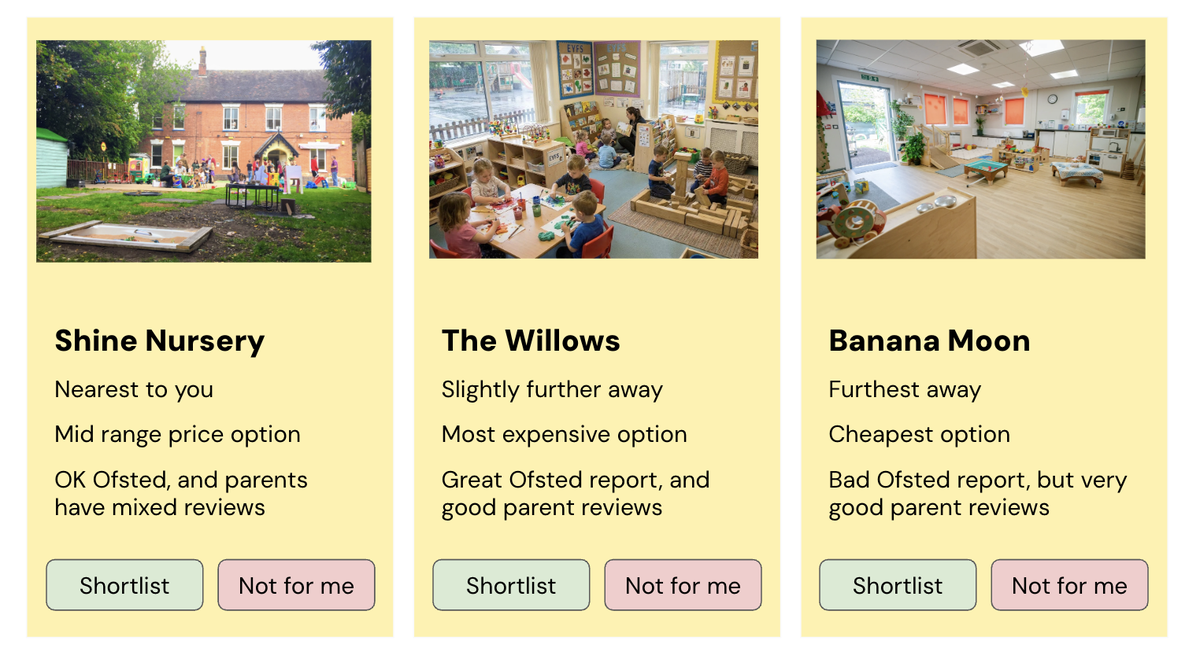
Comparison of three nearby nursery choices detailing location distance, pricing tiers, and mixed user ratings. Nurseries (including names and features) are fictional.
What we learned table
Taking these insights together suggested that parents may be missing guidance on what good childcare actually looks like - not because they don’t care but because they’re not sure what to weigh it against. Cost and peer trust, as suspected, are doing most of the work. This led us to think about a potential solution that didn’t overwhelm parents with lots of information and detail about Ofsted but rather stripped it back and presented the bare minimum to allow them to explore further.
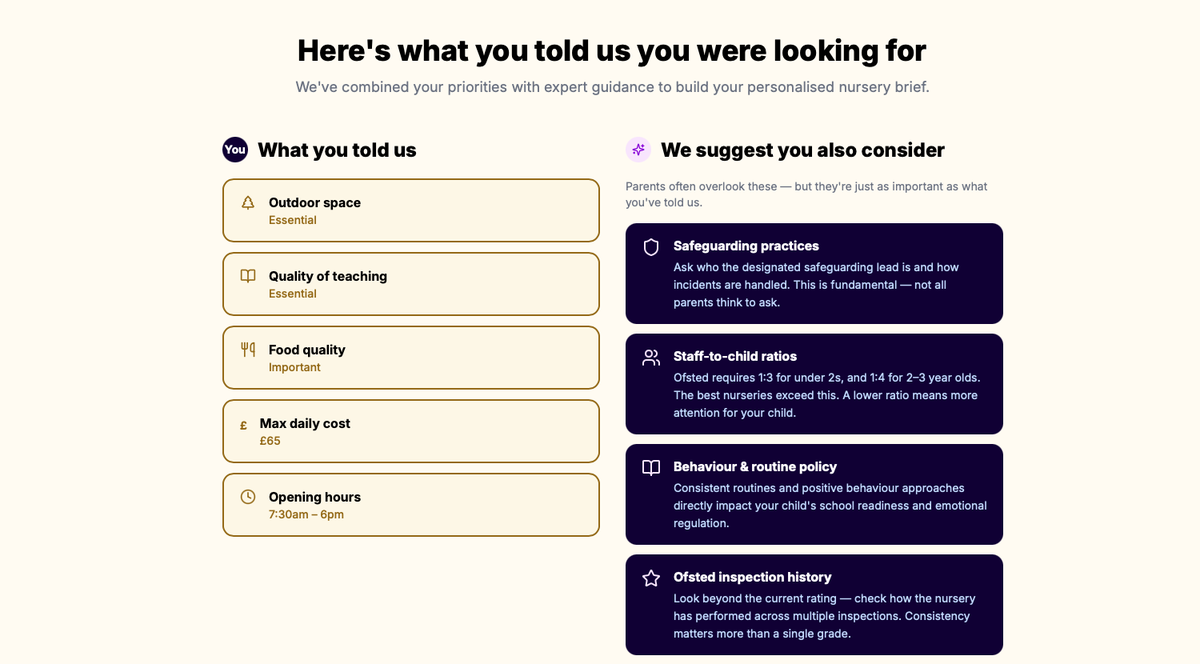
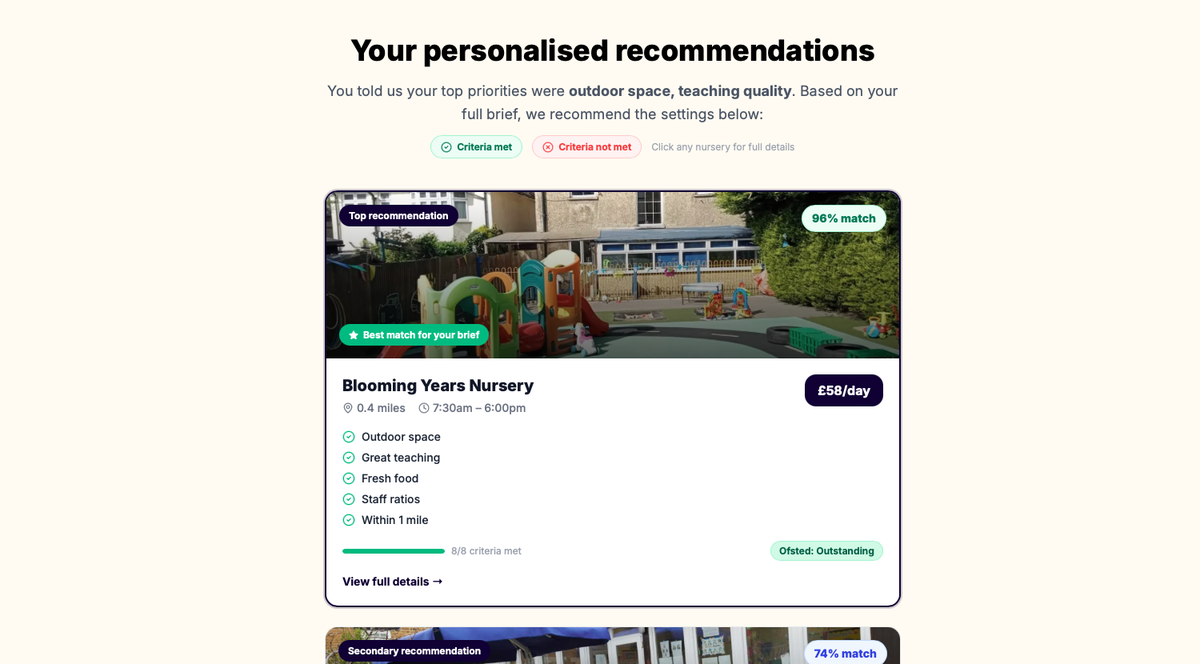
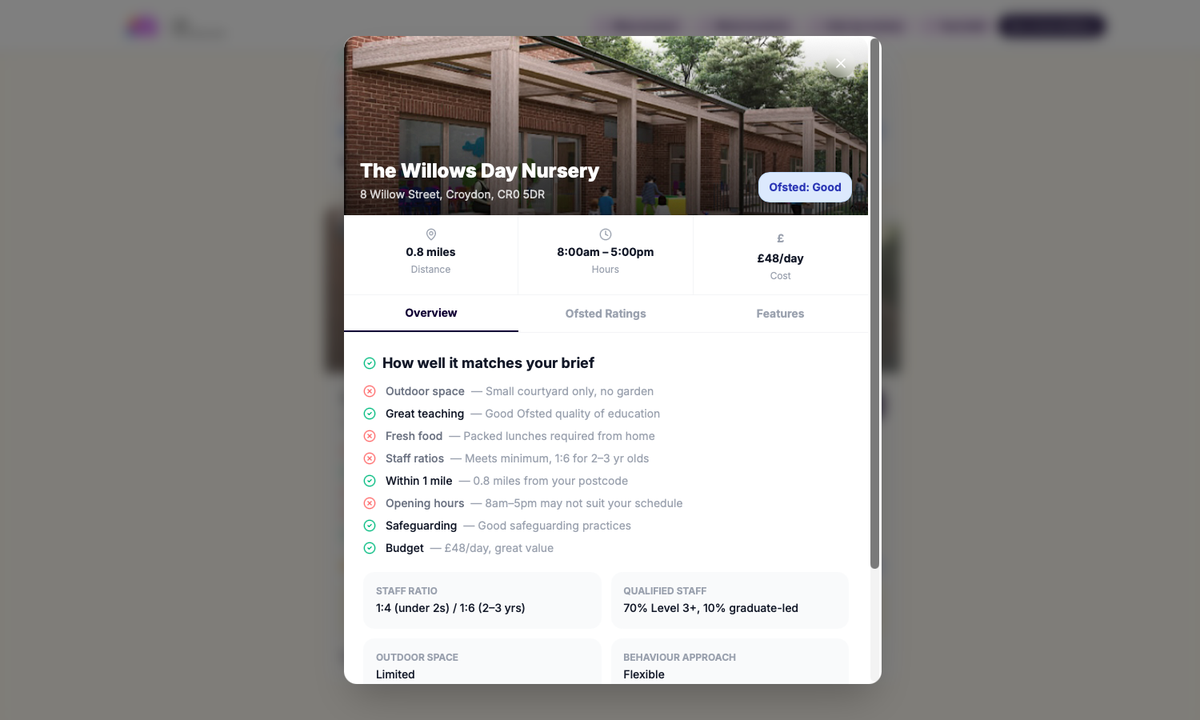
We used Figma and Figma Make to develop a prototype, designed to sit on the Best Start in Life website that gives parents information about what to look for in good quality early childhood education and care. Based on parental preferences and choices, the prototype then recommends the best-fit nursery for their requirements.
We’ve got an early stage prototype and a shortlist of open questions.