What is the healthy food standard, and why does Scotland need it?
 www.nesta.org.uk/blog/what-is-healthy-food-standard-and-why-scotland/
www.nesta.org.uk/blog/what-is-healthy-food-standard-and-why-scotland/
www.nesta.org.uk/blog/what-is-healthy-food-standard-and-why-scotland/
Almost a third of adults in Scotland are living with obesity, the highest rate in the UK according to official estimates. The health costs are staggering - equivalent to 3% of Scotland’s GDP - and behind that figure lies a growing burden of preventable illness affecting families across the country.
Six months ago, the UK government announced the healthy food standard as part of its 10 Year Health Plan. Based in part on a policy proposal by Nesta, this represents one of the most ambitious and potentially impactful obesity policies announced anywhere in the world. If also adopted and implemented effectively in Scotland, it could reduce obesity by around a fifth.
But while the UK government intends to implement the policy in England, it will be for the Scottish Government to decide if and how to proceed with it in Scotland. With Holyrood elections in May this year, and the new national Diet and Healthy Weight Implementation Plan currently in development, there is both opportunity and urgency. If we don’t act now, levels of excess weight in Scotland are projected to rise even higher in coming decades.
Here we explain what the healthy food standard is and why it matters for Scotland.
For years, we've relied on a range of policies to help people achieve a healthier weight. Yet rates of obesity in adults have risen from 24% to 31% over the last twenty years - with 33% of children now at risk of becoming overweight or obese. Our willpower hasn't changed, but our food environment has. The food that's available, affordable, promoted and marketed to us has become less healthy over time.
The healthy food standard takes a different approach. Rather than placing the burden on people to resist an environment that encourages unhealthy choices, the policy will require food businesses to improve the healthiness of what they sell, promote and develop. As we get around 80% of our calories from food bought in supermarkets, implementing the policy in the retail sector meets shoppers where they are - making the healthier choice easier for everyone.
The healthy food standard would require large food businesses to meet a target for healthy food sales. This is an outcome-based form of regulation - rather than telling businesses what to do, it sets where they need to get to. Shoppers won’t have to do anything differently, and businesses can use whatever means at their disposal to hit the target.
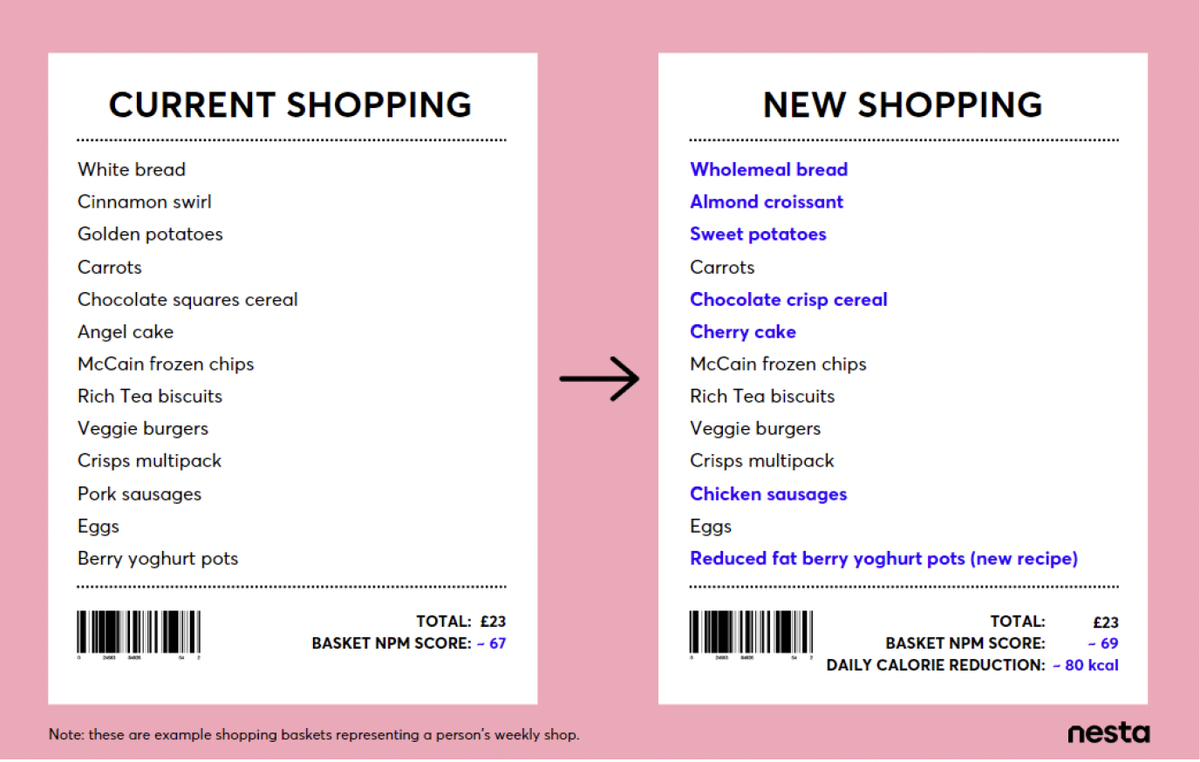
In supermarkets, this might look like putting healthier products on promotion, reformulating own-brand items to reduce fat content, or giving more shelf space to low-sugar options. The resulting changes on a shopping basket would be small, as illustrated below:
Given communities experiencing the highest levels of poverty in Scotland bear almost half the cost of obesity, it’s important that the healthy food standard does not increase food costs for consumers. An independent economic assessment conducted by a former Competition and Markets Authority director suggests this is unlikely.
The assessment found that the cost of implementing the policy is low relative to the scale of large food retail businesses. This, combined with the highly competitive nature of the food retail industry, means there’s a very low likelihood that the small cost of any changes will be reflected in consumers’ shopping baskets.
We have also found that there isn't a strong link between a retailer's health score and the average cost of its basket. Since budget supermarkets aren't at an unhealthier starting point compared to high-end retailers, the policy should lift health standards equally across the board - and lower-income shoppers shouldn't be left behind. That’s important given persistent health inequalities in Scotland.
At Nesta, we recommend implementing a targets-based system around the Nutrient Profile Model (NPM) because businesses are already familiar with it - it underpins existing regulations that define food as High in Fat, Salt or Sugar (HFSS). It can be applied to calculate the health score of a supermarket's average sales. For ease of interpretation, NPM scores can be converted to a 1-100 scale (1 = least healthy, 100 = most healthy).
Using this converted score, we calculated the healthiness of the largest supermarket retailers and modelled what an effective target would be. Our analysis found that setting a target close to the level of the healthiest-performing retailer (an NPM score of 69) would reduce obesity by around a fifth, making this a pragmatic and feasible route for driving down obesity rates in Scotland.
Mandatory data reporting on the healthiness of food sales will be a fundamental part of the healthy food standard and should be fast-tracked across the food sector. While evidence shows that reporting alone has minimal effect, it’s a necessary foundation to the setting of mandatory targets. That’s what will drive real impact on obesity levels.
In Scotland, like the rest of the UK, the evidence points to implementing targets for retailers first. While food purchased from restaurants, coffee shops and takeaways is often unhealthy and exceeds daily dietary recommendations, food sales from major supermarkets account for a much higher proportion of our diets (over 80%). For these reasons the impact of health targets for supermarkets is likely to be significantly higher than for out-of-home businesses (~20% reduction in prevalence of obesity over three years compared to ~2.5%).
Above all, creating health targets for out-of-home businesses requires the right data. That’s why mandatory data reporting for all food businesses should be expedited now, so that a clear metric and target for the out-of-home sector can be agreed without delay.
The Scottish Government's recently published 10 Year Population Health Framework identified 'Improving Healthy Weight' as an initial priority for action. The current development of the new national Diet and Healthy Weight Implementation Plan provides a timely opportunity to commit to this policy.
Most large food businesses trade across the UK, so adopting the healthy food standard in Scotland would be a natural next step - though the specific context of Scotland's food system and legislative requirements would need to be considered.
Setting ambitious health targets for supermarkets could help around 280,000-350,000 adults achieve a healthy weight in Scotland.* In Scotland specifically, it could make meaningful progress toward the Population Health Framework's ambitions around healthy weight and help reduce the gap in healthy life expectancy between Scotland’s least and most deprived areas.
Whoever forms the next Scottish Government after the May 2026 elections will have an opportunity to adopt this policy and implement it at pace. If Scotland drags its heels with the healthy food standard, it will face intensified levels of excess weight and obesity - and health system pressures - while England moves ahead to action.
Conversely, if implemented well, the healthy food standard would be one of the most ambitious and impactful public health policies ever introduced in Scotland.
* We apply 2024 obesity prevalence rates (31%) to Scotland’s ~4.5 million adults (18+) to estimate that ~1.4 million people currently live with obesity in Scotland. A 20%–25% impact of the policy would therefore mean there would be ~280,000 to ~350,000 fewer people living with obesity.