Three ways communities of practice have helped our technical teams
 www.nesta.org.uk/blog/three-ways-communities-of-practice-have-helped-our-technical-teams/
www.nesta.org.uk/blog/three-ways-communities-of-practice-have-helped-our-technical-teams/
www.nesta.org.uk/blog/three-ways-communities-of-practice-have-helped-our-technical-teams/
In an era where AI and automation promise unprecedented speed and scale, it's more important than ever to ensure technical expertise is nurtured, not just accelerated.
For an innovation foundation like Nesta, where over a third of our staff are methods experts, it is important there are ongoing opportunities for learning, challenge and coaching with other experts across the organisation.
Nesta is harnessing the power of communities of practice (CoPs) to foster a world-class talent-driven organisation where technical talents are supported with peer coaching and on-the-job learning.
CoPs are internal groups of colleagues with a common skillset or interest. A successful CoP does not simply appear because someone creates a Slack channel or monthly calendar invite. In busy, high-impact organisations, successful CoPs require intention, though these vary in format. Here are examples of how others have set up CoPs, that we are looking to with interest as we keep developing our own model.
To back our commitment to fostering learning, Nesta dedicates a robust scaffold to its CoPs. It includes providing the financial engine required to support 10 active formal Methods focused CoPs, backing the initiative with a senior sponsor and a member of the community (or two) providing leadership and engagement.
At Nesta, CoPs are seen as central to our ways of working and we view our technical specialists as a critical capability that must be actively nurtured and developed. We believe in a bottom-up approach similar to JPMorganChase’s where CoPs are self-organised.
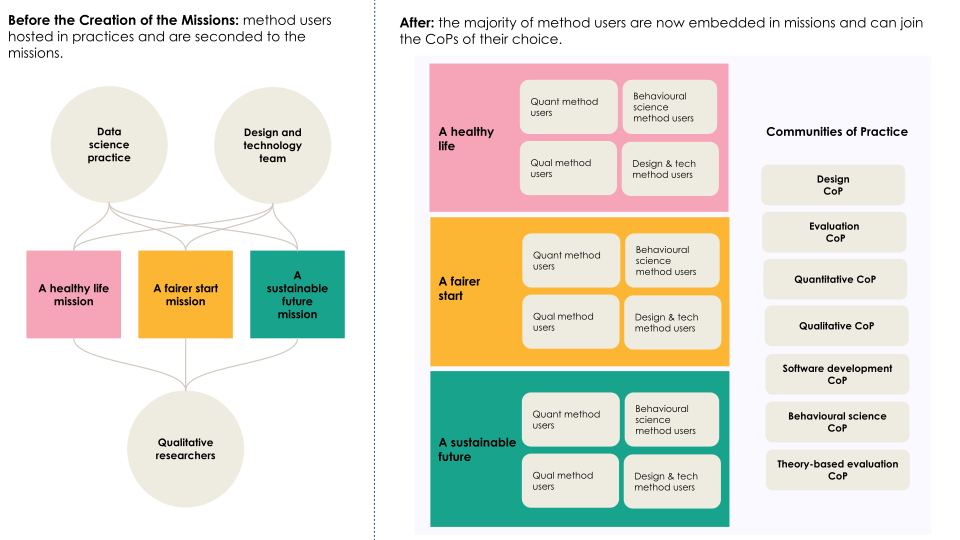
In recent years, Nesta transitioned away from a traditional hub-and-spoke model - where method experts worked within isolated, dedicated teams, called practices - to a mission-driven model. This means that method experts are now directly embedded within our three core missions. This allows us to assemble diverse, multidisciplinary mission squads - combining data scientists, qualitative researchers, policy experts and design specialists - to target our three explicit, long-term societal goals of: reducing household carbon emissions by 30% by 2030, narrowing the early-years attainment gap and halving obesity by 2030.
While this shift keeps our teams tightly aligned with the daily, frontline impact of our projects, it introduces a natural organisational risk: the isolation of specialists distributed across different missions.
To prevent a mission silo effect, Nesta has intentionally invested in CoPs to serve as the connective tissue across the organisation. CoPs break down structural boundaries, unite curious minds and lay a foundation for sharing learnings across missions.
We have benchmarked ourselves against Emily Webber’s Organisation Maturity Model and see many similarities between the environment at Nesta and level 4 in her maturity matrix. As with the model, Nesta houses networked communities and they operate at multiple scales. We provide them with dedicated support and enablement. However, instead of focusing on levels of maturity for our CoPs, we anchor them around specific purposes as laid out in the complex system framework collection. This ensures staff are engaged flexibly and avoids a one-size-fits-all format. At Nesta, CoPs sit across two crucial purposes:
Our CoPs are open to three distinctive audiences:
In addition to the regular CoP meet-ups, Nesta organises events twice a year to bring together methods experts and share learnings and the latest developments in research practices.
CoP audiences and purpose framework
Visualisation showing how Nesta segments its CoPs into difference categories, including core practitioners, practitioners and the broader community.
By prioritising personal relationships, coaching and mentoring over rigid knowledge management tools, CoPs keep skills sharp. Insights gathered this year show that Nesta staff highly value checking their ideas directly with human experts rather than relying on static documentation. This particularly applies in quality assurance (QA) support, where technical experts lend their expertise in other missions and projects. A principal data scientist in our sustainable future mission may, for example, conduct QA in statistical analysis in the fairer start mission. Likewise, a data scientist from the healthy life mission might share knowledge on core data pipelines and models with a sustainable future mission team.
CoPs are judgement-free environments centred around peer-to-peer troubleshooting and the sharing of tacit knowledge. It creates psychological safety, a space where technologists can openly share project failures and experiment with cutting-edge tools. If a team wants to explore using AI orchestration to analyse policy documents, they don't have to navigate that risky frontier alone. They can leverage our shared AI sandboxes, pulling down tested code patterns and relying on the collective intelligence of the entire data science community.
Dr Camille Stengel, head of qualitative methods at Nesta, co-manages the qualitative research methods CoP across Nesta and the Behavioural Insights Team (BIT). Camille highlights activities and ways of collaborating of the Qual CoP:
“The community meet-ups have included method-showcasing sessions and practical workshops that cover a variety of topics, like deliberative methods and analysing AI-powered interviews. Members of the community actively support one another with real-world methodological troubleshooting, such as offering peer feedback on things like participant recruitment challenges, or allowing cross-pollination learning across teams through opportunities like shadowing each other’s project-related fieldwork. The community has hosted external speakers from the charity and academic space to share their qual-related experiences, and we often collaborate with other Nesta-based communities of practice to share knowledge and insights.”
This collaboration and self-directed learning space is also found in the other CoPs. The Behavioural Science CoP, for example, has recently identified a group interest in advanced training.
The CoP structure flattens the traditional hierarchy that so often stifles learning. In our CoPs, a junior methods user or a degree apprentice isn't tucked away at the bottom of a siloed team, they are structurally connected to senior colleagues across the organisation. Senior experts act as technical coaches from the very earliest stages of project design, co-sponsoring excellence and ensuring that junior talent is continuously pulled upward rather than left to find their own way.
Beyond top-down coaching, this flat dynamic creates a reciprocal exchange of ideas where early-career colleagues actively share fresh perspectives, emerging toolkits, and novel methodologies with seasoned practitioners. By serving as session facilitators or leading working groups, junior team members build crucial leadership capabilities early in their careers without needing formal managerial titles.
In practice, this has meant junior staff members getting direct input from more senior colleagues months before they would otherwise have had the level of access. Likewise, senior colleagues get a regular, structured route into mentoring that their day-to-day work doesn’t always leave room for.
As AI continues to rewrite the rules of social innovation and automate routine research tasks, Nesta’s CoPs are a deliberate tool that we use in the construction of our organisation. While transitioning to a mission-driven model keeps our teams tightly focused on real-world outcomes, our CoPs provide the vital horizontal scaffolding that prevents specialist isolation.
Going forward, we will continue to refine our community formats by prioritising human connection to support our technical experts in not only doing their best work today, but also continually evolving to tackle the complex societal challenges of tomorrow.