The healthy food standard is our best bet for tackling obesity, but time is running out
 www.nesta.org.uk/blog/the-healthy-food-standard-is-our-best-bet-for-tackling-obesity-but-time-is-running-out/
www.nesta.org.uk/blog/the-healthy-food-standard-is-our-best-bet-for-tackling-obesity-but-time-is-running-out/
www.nesta.org.uk/blog/the-healthy-food-standard-is-our-best-bet-for-tackling-obesity-but-time-is-running-out/
It has been nearly a year since the healthy food standard (HFS) was announced in the 10 Year Health Plan, yet we are still waiting for a formal consultation. We are now reaching a critical point. To ensure the policy delivers impact within this Parliament, the government must publish a consultation before the upcoming summer recess.
The HFS represents a step change in how we tackle obesity by targeting the food that’s promoted, advertised and available to us. It will require large food businesses to report on the healthiness of their sales and meet mandatory targets for improvement. If implemented effectively, it could reduce obesity prevalence by around a fifth. It is a landmark opportunity to improve our food system, but we must learn from the past; too many previous obesity-reduction policies were delayed or diluted until they were ineffective to deal with the scale of the challenge.
To ensure the HFS delivers impact, the government must do the following.
Mandatory reporting is the first step to enable the government to understand the healthiness of food sales. But evidence shows reporting alone will have minimal effect on obesity prevalence - it is mandatory targets to improve the health of sales that will drive impact.
The wheels need to be in motion for mandatory reporting as soon as possible: that means the government must publish a formal consultation on this element of the policy before summer recess, with an intent to introduce mandatory reporting next year for all sectors.
This is crucial to ensure that the data is being collected to allow the government to enforce health targets by the end of this Parliament. This will provide the long-term policy certainty businesses need, and prevent the policy from being delayed by future government priorities.
To drive meaningful change, targets should focus on the sectors where they will have the greatest impact on what the nation eats. While reported data will inform pragmatic and ambitious targets across the food system, the rollout of targets should not be delayed in order to design the perfect set of targets that apply to all.
The government should consider starting with large supermarket chains, who account for over 80% of the calories purchased in the UK, and most major supermarkets already have the data infrastructure needed to move quickly. Because of this, Nesta estimates the implementation cost for large retailers would be less than 0.1% of their ~£210 billion annual turnover. For a policy that could generate societal value of around £17 billion, this is extremely good value.
To maintain a level playing field, the government should also look to introduce targets for the out-of-home (OOH) sector, while noting that the OOH sector has further to go to improve their data. By ensuring all applicable large food businesses are captured by this regulation, the government can ensure every major player in the food system is contributing to a healthier nation.
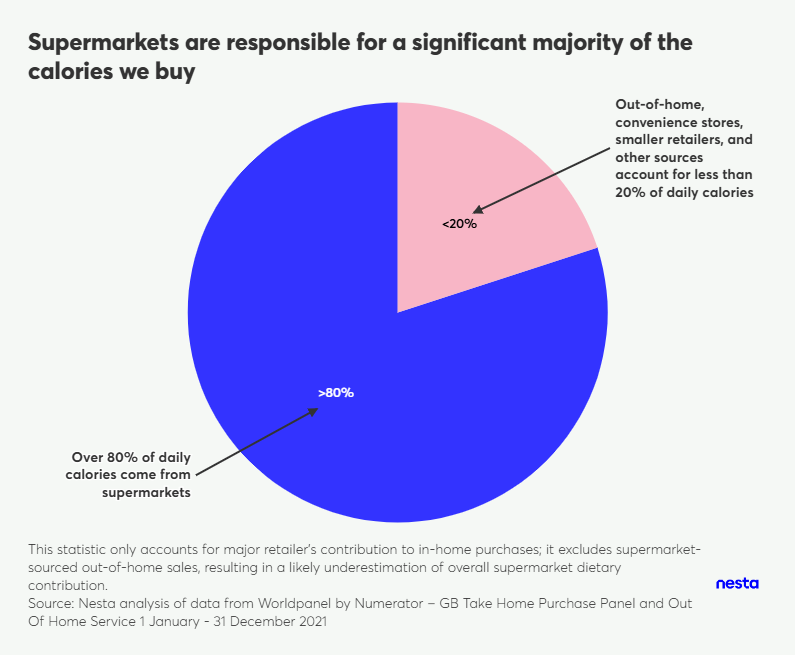
Large supermarket chains account for over 80% of calories purchased
A successful reporting framework will track progress against health targets, while balancing the need for robust data with business practicalities.
We recommend that the headline metric for all large retailers should be a sales-weighted average nutrient profile (SWA NPM) score. The NPM is a holistic measure that accounts for both positive and negative nutrients, and is already well-known across the food sector as the basis for existing advertising and promotion legislation. By using the NPM as a continuous measure rather than binary ‘pass/fail’ thresholds in current regulation, it means every nutritional improvement is recognised and incentivised across a company’s entire range.
But a single headline score doesn’t tell the whole story. The regulator should also collect, on a confidential basis, product-level nutrition data. This is crucial for regulators to assess the accuracy of reported NPM scores, understand the drivers of a business’s score, and assess the impact of the policy over time.
The government should work to identify a middle ground that provides regulators with enough detail to monitor compliance, while keeping the administrative burden on businesses low.
A policy is only as effective as its enforcement. To turn the dial on obesity, the policy must set targets at a level that is sufficient to drive meaningful change and be enforced in a way that makes businesses sit up, take notice and change their behaviour.
Enforcement is required both to guarantee that data reporting is complete and accurate, and to ensure businesses meet the targets for improvement. We welcome the commitment of the Food Standards Agency, a potential regulator, to provide policy advice that “promotes transparency… and enforceability."
For these principles to translate into public health impact, the government must equip the regulator with the power to issue robust penalties for businesses that fail to comply. While it is ultimately for the government to determine the exact level of the fine, effective precedents exist in the Groceries Code Adjudicator (GCA), which has the power to fine retailers up to 1% of UK turnover, and the Extended Producers Responsibility (EPR) scheme, where penalties can reach 5%. This would ensure the policy is supported by a credible deterrent capable of driving change.
The HFS is our best bet for tackling obesity, but time is running out to deliver it within this Parliament. If this window is missed, the policy risks slipping down the agenda and not being implemented at all. The principles set out here can deliver a well-designed and effective policy, but most importantly, the government needs to act now to ensure that by the end of this Parliament, our high streets and supermarkets are playing their part to improve the nation’s health and turn the tide on obesity.