Acknowledgements
Authors
Toby Park, Ed Whincup, Tu Vy Do, Ambika Bhura, Abigail Mottershaw and Elena Meyer zu Brickwedde (BIT); Marine Furet, Adrian Stymne, Andrew Sissons, Andy Marsden (Nesta).
We would also like to thank the organisations and individuals who contributed to a survey shared in the early stages of this project to feed into its design, including Gwyrfai Gwyrdd, Scottish Enterprise, Vattenfall, EdinBRIC, Under One Roof, Bath and West Community Energy, Somerset Council, Unmapped, SAV Systems, Kensa, Regen and Thermal Storage UK.
About Nesta
We are Nesta. We design, test and scale solutions to society's biggest problems. Our three missions are to give every child a fair start, help people live healthy lives and create a sustainable future where the economy works for both people and the planet. For over 20 years, we have worked to support, encourage and inspire innovation.
We work in three roles: as an innovation partner working with frontline organisations to design and test new solutions, as a venture builder supporting new and early stage businesses and as a system shaper creating the conditions for innovation. Harnessing the rigour of science and the creativity of design, we work relentlessly to change millions of lives for the better.
Find out more at nesta.org.uk
About BIT
BIT is a global research and innovation consultancy which combines a deep understanding of human behaviour with evidence-led problem solving to improve people's lives. We work with all levels of government, nonprofits and the private sector, applying behavioural science expertise with robust evaluation and data to help clients achieve their goals.
Find out more at bi.team
If you'd like this publication in an alternative format such as Braille or large print please contact us at: [email protected]
Executive summary
Background
Heating decarbonisation is crucial to the UK's net zero strategy, with residential heating contributing 18% of the UK's greenhouse gas emissions. Current efforts to promote low-carbon heating, including financial incentives and regulatory measures, have led to slow uptake due to financial, logistical and behavioural barriers.
Coordinated switching, also called clean heat neighbourhoods (where multiple households transition to low-carbon heating collectively), has been suggested as a potential model to lower costs, make the process easier and encourage more people to adopt low-carbon heating technologies.
Methodology
Nesta and BIT conducted an online randomised controlled trial (RCT) with 5,525 UK homeowners. Participants were presented with a hypothetical scenario in which they needed to replace their boiler and were randomly assigned to see either an individual switching option (control) or different variations of coordinated switching offers. The study examined their likelihood of choosing low-carbon heating over a boiler under two cost scenarios: cost parity (similar cost) and cost discrepancy (higher cost for low-carbon heating). This allowed us to assess whether coordinated switching, alongside varying types of financial incentives, influenced adoption decisions.
Key findings
- Simplifying the switching process alone does not meaningfully increase adoption. When compared to a standard, individually sourced low-carbon heating offer, a coordinated switching approach did not statistically significantly increase uptake whether costs were presented as similar to a boiler replacement or as more expensive. This suggests that reducing perceived hassle alone is not a strong enough driver.
- Reducing upfront costs through financing can help increase adoption. When coordinated switching was paired with a 'spread costs' option (0% interest financing), adoption of low-carbon heating statistically significantly increased compared to the base offer in both cost scenarios. When the upfront cost was higher than a boiler replacement, we also observed a statistically significant increase in adoption, compared to the control (individually sourced heat pump) condition.
- People underestimate neighbour participation, which may impact uptake. Based on our observations, participants consistently predicted lower adoption of low-carbon heating among their neighbours than their own likelihood to switch. When costs were similar to a boiler replacement, those in the control group estimated statistically significantly lower neighbour adoption compared to coordinated switching conditions. When low-carbon heating was more expensive, only the 15% discount and spread costs conditions led to a statistically significantly higher perceived uptake compared to the control.
- Trust, familiarity and reliable information sources matter. Consumer websites and heating engineers were the most frequently trusted sources for information on low-carbon heating, while local authorities and government sources were selected less frequently. Among those who opted for a traditional boiler in the cost parity scenario, practical considerations - such as familiarity with boilers and the perceived ease of installation - were cited as key barriers to low-carbon heating adoption.
- Income-based differences shape responses to financial incentives. Households with below-median income households were statistically significantly more likely to respond to coordinated offers that included direct cost reductions, such as discounts (cost parity) and cashback on energy efficiency upgrades (both cost scenarios), compared to those in the control group. On the other hand, households with above-median incomes only showed a preference for financing options such as 0% interest plans.
Recommendations for the roll-out of coordinated switching schemes
- Introduce flexible financing options. Offering 0% interest or government-backed financing schemes can help improve uptake by making low-carbon heating more affordable, particularly for households deterred by high upfront costs. Providing structured payment options can help ensure financial accessibility across a wider range of households.
- Include financial support to support equitable uptake. While financing options can help reduce upfront costs, additional support - such as targeted grants or discounts - can improve accessibility for lower-income households who may still find the costs prohibitive. Designing schemes that address different financial circumstances can improve equity in the transition to low-carbon heating.
- Enhance communication and transparency. Providing clear, accessible and detailed information on costs, benefits and performance comparisons with traditional systems can help counteract scepticism and uncertainty. Policymakers should ensure that communication is transparent and that trusted sources are promoted.
- Leverage social norms to encourage uptake. Social proofs, such as showcasing successful community-level adoption, can help correct misperceptions and increase participation in coordinated switching schemes.
- Address performance concerns directly. Coordinated switching schemes should include information that builds trust and confidence among potential adopters. These could demonstrate the reliability, efficiency and long-term savings of low-carbon heating systems, helping to challenge the status quo.
- Use clear messaging to amplify perceived neighbour interest. People tend to underestimate their neighbours' willingness to switch, which may discourage participation. Policymakers should highlight both the financial and collective benefits of coordinated switching while also clearly signalling widespread local interest to strengthen social influence and encourage adoption.
Research recommendations
- Explore the value of hassle reduction in coordinated switching. Use deliberative methods, such as walkthroughs or guided simulations, to assess how reducing hassle influences decision-making in practice as participants may not fully appreciate the complexity and effort involved in switching, potentially leading them to undervalue the benefits of coordination.
- Test coordinated switching in real-world settings. Field studies - where coordinated switching is implemented - could track adoption rates, installation logistics and customer satisfaction to identify practical barriers that self-reported intent may not capture.
- Investigate the role of autonomy in decision-making. Future research could also investigate how different levels of consumer control within coordinated switching schemes affect uptake, which could provide useful insights (for example, fully coordinated vs guided options).
- Examine the impact of trust and social influence. Explore how trust in the scheme's reliability, transparency and impartiality, as well as social norms messaging, shape willingness to switch.
- Understand differences between early and late adopters. Future studies should explore how motivations and barriers differ between those who adopt low-carbon heating early versus late adopters. Late adopters may require additional support, such as financial incentives, hassle reduction or clearer communication, to encourage participation.
- Explore income-based differences in financial incentives. Further segmentation by income levels can help refine financial support mechanisms to ensure accessibility for lower-income households.
1. Introduction
Heating decarbonisation is a pivotal aspect of the UK's commitment to achieving net zero carbon emissions by 2050 – according to the latest data, household heating accounts for 18% of the UK's greenhouse gas emissions. In its seventh Carbon Budget report, the Climate Change Committee states that, in order to meet the net zero requirements by 2040, the largest reduction in residential building emissions will come from switching to low-carbon heating, which is expected to reduce emissions by 66%. The report also attributes a key role to heat pumps in this, both as standalone installations as well as within communal heating systems. The UK currently uses an individual-led approach to low-carbon heating in the residential sector, where households independently decide whether to adopt technologies such as heat pumps, while the government provides incentives and regulations to encourage uptake. However, despite these efforts, adoption remains slow, hindered by financial, logistical and behavioural barriers.
Given these challenges, alternative models are being explored to accelerate adoption. One such approach is coordinated switching, which enables multiple households - across a street, neighbourhood, or city - to switch to low-carbon heating at a similar time. Also called clean heat neighbourhoods, this model could take various forms, such as local authority-led collective purchasing schemes for air-source heat pumps, shared ground loop systems across multiple homes, or heat networks in urban areas. By grouping installations and investments, coordinated switching could drive down costs, streamline supply chains and reduce hassle for households, making the transition to clean heating more attractive and feasible for households.
Despite the potential appeal of coordinated switching schemes to both consumers and policymakers, there is little evidence of household appetite to opt for such a scheme. Homeowners may be hesitant due to concerns over costs, disruption and trust in unfamiliar technologies and installers. Collective schemes - which describes group-based schemes more broadly, such as energy supplier switching or the collective purchasing of solar panels - also depend on strong social buy-in, as success relies on multiple households agreeing to switch together.
To develop effective coordinated switching schemes, it is essential to first understand public willingness to participate. By gauging consumer attitudes, preferences and concerns, policymakers and industry stakeholders can design schemes that are both attractive and practical. Nesta worked with BIT to explore whether clean heat neighbourhoods might appeal to consumers, and build an evidence base to support the development of these schemes in practice.
1.1 Key research questions
Our work was guided by the following research questions:
- Could a coordinated switching approach to low-carbon heating increase potential adoption and accelerate decarbonisation?
- What factors influence the appeal of a coordinated switching approach to households?
- How does the cost of low-carbon heating, relative to boilers, affect potential adoption decisions?
1.2 Glossary of key terms
| Term |
Definition |
| Coordinated switching |
Coordinated switching is a practical approach to adopting low-carbon heating systems such as heat pumps and heat networks. Switching to these systems individually can be costly and complex, but coordinating the switch with others - such as neighbours in the same building, street or area - can help overcome these challenges. |
| Low-carbon heating systems |
Low-carbon heating systems use renewable or low-carbon energy to provide heat with minimal or no greenhouse gas emissions. Unlike traditional boilers that burn fossil fuels such as gas or oil, low-carbon systems such as heat pumps and heat networks - use cleaner energy sources, meaning they can have a significantly lower environmental impact. |
| Boiler |
Throughout the report, the term “boiler" is used inclusively to refer to gas, oil or LPG boilers for clarity and consistency. |
| Heat networks |
Heat networks distribute heat from a central system to multiple buildings through pipes, which works well in urban areas, especially for flats and homes with limited outdoor space. |
2. Methodology
To assess the effectiveness of coordinated switching in encouraging low-carbon heating adoption, we conducted an online randomised controlled trial (RCT) with a five-arm experimental design. The study recruited 5,525 UK homeowners, who were randomly assigned to see either an individual offer to transition to low-carbon heating (control group) or one of four variants of a coordinated switching offer, compared to a simple fossil fuel boiler replacement. The experiment aimed to measure likelihood and intent to adopt low-carbon heating under different conditions and incentive structures.
2.1 Sampling
Our sample consisted of 5,525 UK home owner-occupiers, with a nationally representative split between house and flat owners (78% and 22% respectively). Participants were excluded from the sample if they did not have a gas, oil or LPG boiler as their current main heating system. Participants were also excluded if they were not responsible (or jointly responsible) for the decision to replace their current heating system. For detailed information on sample characteristics see Appendix A.
2.2 Experimental design
Participants first received general information about low-carbon heating options, with some randomly assigned to see a control version (no mention of coordinated switching) and others randomly assigned to see a treatment version, which included an explicit mention of coordinated switching. All participants were first asked to imagine having to replace their boiler (Appendix B.3) and to make a choice between a traditional boiler and a low-carbon heating system. The cost of both the boiler and the low-carbon heating system were presented as similar ('cost parity' scenario). Participants were randomly assigned to see one of five presentations of the low-carbon heating system, where the benefits of low-carbon heating and promotional offers varied.
- In the control group, participants chose between a boiler and a low-carbon heating system with no mention of coordinated switching.
- In treatment 1, participants chose between a boiler and low-carbon heating offered through coordinated switching.
- Treatments 2, 3, and 4 highlighted financial benefits, such as group discounts or payment flexibility, as part of the scheme's benefits.
- Treatment 2 included a 15% discount, making the low-carbon heating system cheaper than the boiler option, to ensure that similar costs did not dilute the effect of this treatment.
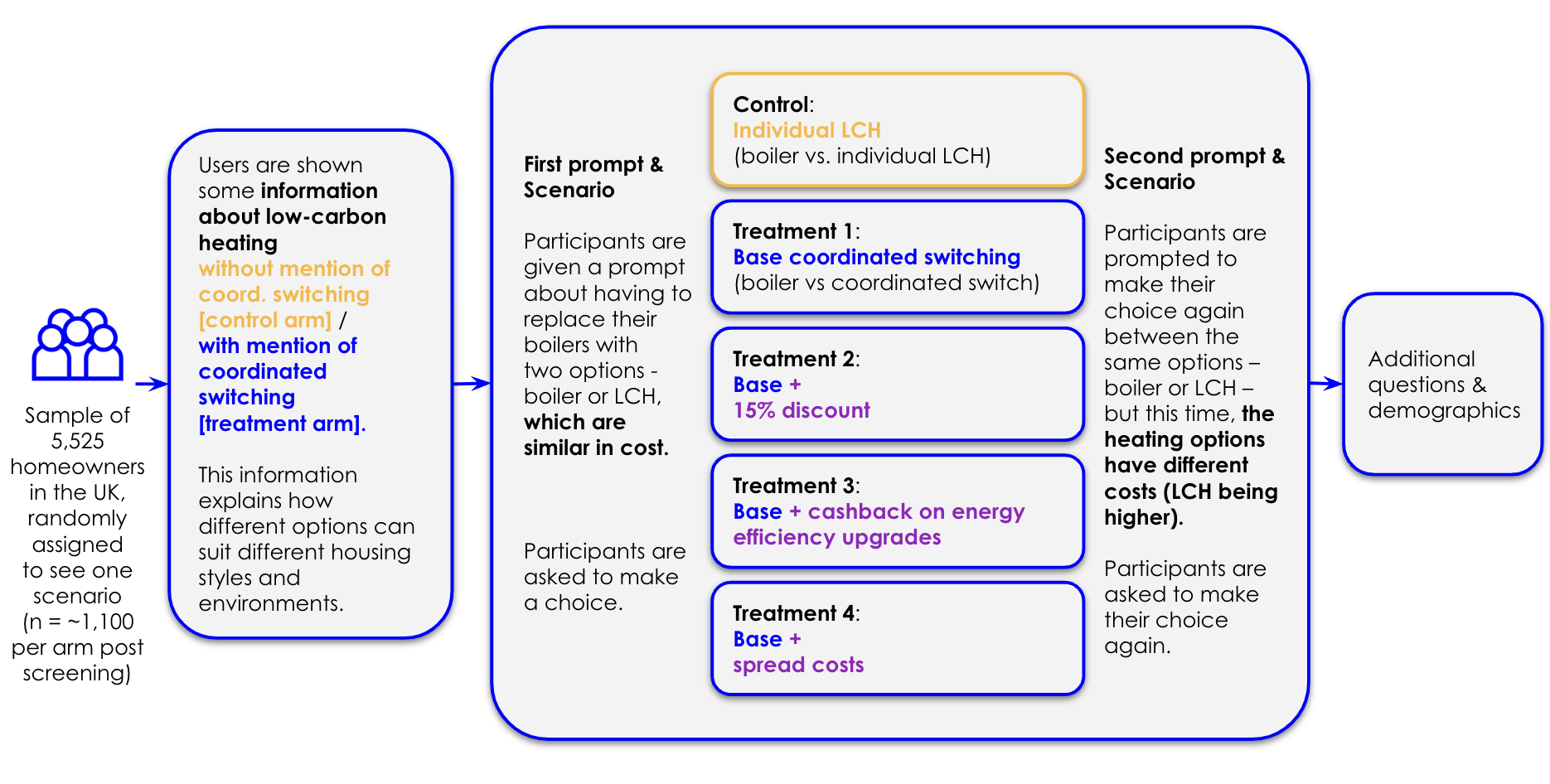
Figure 1. Experimental flow
After participants made their initial decision, they were presented with a new 'cost discrepancy' scenario (Appendix B.4) and asked to decide again. In this second scenario, the low-carbon heating system was more expensive (£5,000), while a traditional boiler cost £3,000, introducing a cost discrepancy to assess how cost differences impact choices. Participants saw the same offers as in the first (cost parity) scenario. In treatment 2, where the 15% discount was previously described with the added phrase: “making this cheaper than the boiler”, this wording was removed from the offer in the second (cost discrepancy) scenario.
2.3 Variations of coordinated switching schemes we tested
sourced and purchased individually. To test the impact of coordinated switching on low-carbon heating adoption, we designed a set of treatment conditions that built on a base coordinated switching offer. The base coordinated switching condition (T1) (Figure 2) streamlined adoption through a structured local scheme, allowing us to isolate the effect of reduced effort on uptake.
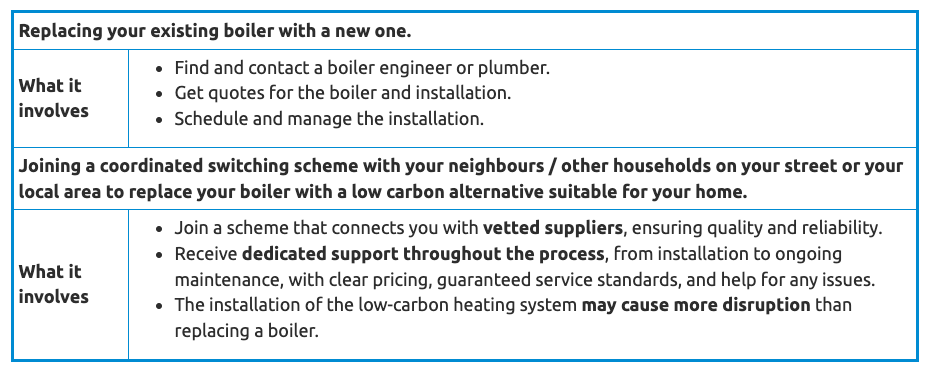
Figure 2. Offer presented to participants in T1 (boiler vs base coordinated switching)
Building on the base coordinated switching offer, we included variations of the scheme with additional financial incentives to assess whether specific cost-related benefits could enhance the appeal of coordinated switching.
- Treatment 2 (T2) included the features of the base offer, plus a 15% discount on low-carbon heating installation to test the role of direct cost reductions.
- Treatment 3 (T3) added cashback on other home energy efficiency upgrades (such as solar panels, insulation, or windows) to examine the appeal of broader household benefits.
- Treatment 4 (T4) incorporated a 0% interest financing option to spread costs over monthly payments, allowing us to evaluate the impact of reducing upfront financial barriers.
These variations in treatments enabled us to understand not only whether coordinated switching itself could drive adoption, but also which financial levers might be most effective in making low-carbon heating a more attractive option to households. A detailed breakdown of how these variations were worded and displayed to participants can be found in Appendix C.2.
| Non coordinated |
Coordinated switching scheme |
| Control |
Treatment 1 |
| Individually sourced low-carbon heating |
Base coordinated switching |
| n = 1,095 |
n = 1,083 |
Table 1. Experimental conditions and sample sizes
2.4 Key considerations for the experimental design
A. Technology-agnostic approach
To keep the study simple and avoid confounding factors, we did not specify a particular low-carbon heating technology (for example, air-source heat pumps (ASHP), ground source heat pumps (GSHP), or communal heat networks). Matching specific technologies to participants' housing situations would have added complexity due to variations in outdoor space availability and infrastructure compatibility. Instead, we used a generic framing to ensure broad applicability of findings. Similarly, in the cost parity scenario, costs were described qualitatively (for example, “similar in cost”) rather than with specific price ranges, maintaining relevance across different low-carbon heating options.
However, this approach means our findings are less applicable to specific heating solutions. For instance, many air source heat pumps are less feasible for flats, but this was not explicitly accounted for in the study design. Additionally, while we ensured a nationally representative sample of 22% flat owners, this does not fully reflect the fact that a significant proportion of flat dwellers already use electric heating rather than gas, oil or LPG boilers. As a
result, our sample of flat owners primarily represents those still using fossil fuel heating, which may not align with the broader reality of heating in flats.
Flat owners with fossil fuel heating may face different technical challenges compared to those in houses, such as space constraints, building regulations and limitations on external modifications. These factors could influence both feasibility and likelihood to adopt low-carbon heating.
B. Separating cost parity vs cost discrepancy
Since coordinated switching is an emerging concept, the study first assessed participants' likelihood to adopt low-carbon heating when costs were similar to those of a traditional boiler (cost parity). Only afterwards were participants presented with a scenario where the low-carbon heating option was more expensive (cost discrepancy). This sequencing allowed us to distinguish between interest driven by the perceived benefits of low-carbon heating (for example, hassle reduction, convenience, discounts) and sensitivity to cost differences.
However, the cost discrepancy scenario relied on a highly generalised cost estimate for low-carbon heating (including assumed / hypothetical grant deductions within a coordinated switching scheme), which does not account for significant variations between different systems (such as ASHP vs GSHP). While this approach allows us to infer likelihood to adopt low-carbon heating without exact pricing, it does not reflect the full range of real-world costs.
C. Fixed (non-randomised) cost sequencing
The sequence of cost scenarios was not randomised, as cost strongly influences decision-making. We therefore had the 'cost discrepancy' scenario after the 'cost parity' scenario for all participants. Our prior research involving online experiments shows that cost is a primary determinant of consumer choice, meaning it would likely dominate decisions regardless of when it was introduced. To measure explicit likelihood to adopt when the price of the low-carbon heating was more realistic, we made the cost discrepancy highly salient in the second scenario. This fixed sequence allowed for clearer interpretation of price sensitivity while minimising noise from order effects.
D. Cost presentation and grant considerations
We considered incorporating grants into the cost presentation, as financial support is a key factor in real-world decisions. However, grant availability varies across the UK (for example, Scotland has a different grant scheme, while Northern Ireland only offers a discount for certain types of heat pumps) and can depend on the kind of low-carbon technology being installed. To keep the scenario clear and avoid unnecessary complexity, costs were displayed as “the cost you would pay,” without explicit mention of grants. This approach ensured that participants were not required to make additional calculations or interpret varying eligibility criteria, maintaining focus on the decision-making process itself (Figure 3, see Appendix B for more prompts).
Now imagine that in the previous scenario, the cost you would pay for replacing your boiler with a low-carbon heating system is £5000, while the cost of a new boiler is £3000.
The monthly energy bills for the low-carbon heating system and boiler are roughly the same.
The information you just read is available here, if you would like to refer back to it (opens in a pop up on this page).
Figure 3. Prompt presented to participants in the cost discrepancy scenario
E. Equal running costs assumption
The study presented the running costs as "roughly the same" for both heating options, despite potential long-term savings with low-carbon heating. The decision was made to isolate the impact of upfront cost differences without introducing uncertainty related to fluctuating energy prices. While lower running costs can be a benefit of low-carbon heating, they are highly contingent on market conditions and policy incentives, making them less reliable as decision drivers in this context.
F. Intent as a behavioural outcome
This online study measured behavioural intent rather than actual purchasing behaviour. While this allows for controlled comparisons across conditions, it does not account for real-world complexities such as installation logistics, social influences or changing financial circumstances. Future research could explore how coordinated switching schemes perform in real-world settings to validate these findings, as actual adoption rates are likely lower than stated intent due to real-world barriers.
2.5 Outcomes
The study measured three key outcomes:
- Whether coordinated switching messaging increased likelihood to adopt low-carbon heating.
- Which features (such as cost reductions, financial incentives) were most effective in boosting likelihood to adopt.
- How price sensitivity influenced likelihood to adopt low-carbon heating.
Additionally, several exploratory questions were incorporated into the study to gain deeper insights into participants' attitudes and decision-making processes.
- Social influence perceptions: participants predicted what they thought their neighbours would choose if given the same options.
- Decision rationale: participants explained why they selected either a boiler or low-carbon heating.
- Payment preferences: participants indicated their preferred payment methods for a new heating system.
- Incentive sensitivity: participants identified which types of benefits would make them more likely to opt into a coordinated switching scheme.
- Trusted information sources: participants specified who they would trust most for information on coordinated switching schemes.
- Prior experience: participants reported any previous encounters with low-carbon heating technologies.
3. Key findings
3.1 Hassle reduction alone may not be enough to encourage people to switch to low-carbon heating at this time
To test whether coordinated switching increases adoption of low-carbon heating, we primarily compared participant choices in the control group (individually sourced low-carbon heating) with those in the base coordinated switching condition in the cost parity scenario. We then explored whether the findings held in the cost discrepancy scenario. This approach allowed us to assess the isolated impact of a coordinated switching scheme on low-carbon heating uptake.
The base coordinated switching offer did not statistically significantly increase adoption compared to the control group in the cost parity scenario (Figure 4). This pattern held in the cost discrepancy scenario, with no statistically significant difference between the two conditions. This suggests that reducing hassle alone may not be appealing enough to drive low-carbon heating adoption, reinforcing previous research showing that reducing installation time - a proxy for hassle - had no statistically significant effect on people's choices.
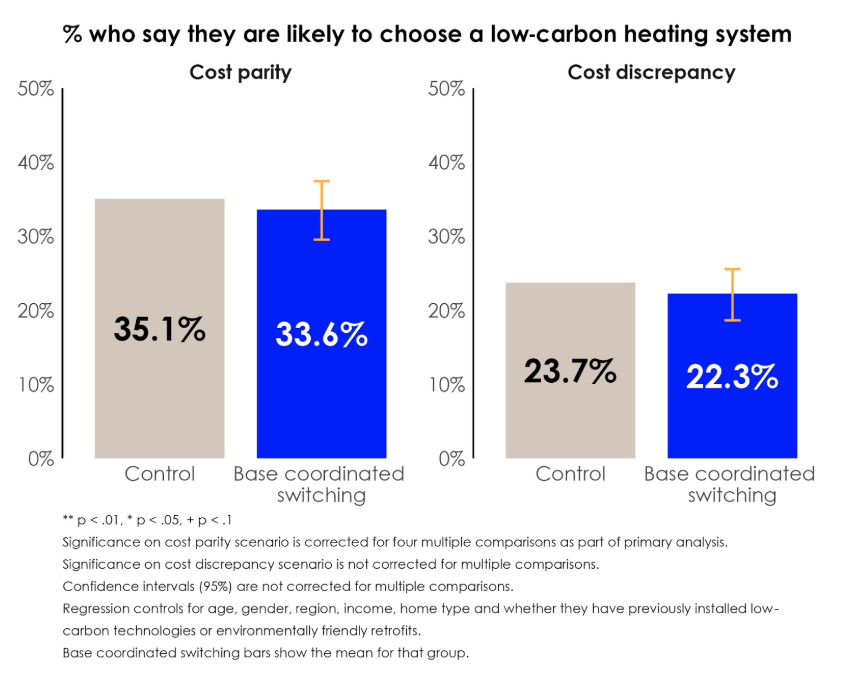
Figure 4. Likelihood of choosing low-carbon heating in both cost parity and discrepancy scenarios
In the cost parity scenario, adoption rates were similar between the control group (35.1%) and the coordinated switching group (33.6%). This suggests that even when cost was not a barrier, the added convenience of a coordinated scheme did not meaningfully increase uptake. However, overall low-carbon heating adoption remained high, with around a third of participants likely to switch.
In the cost discrepancy scenario, where low-carbon heating was more expensive (£5,000) than a boiler (£3,000), uptake was predictably lower. Adoption rates dropped to 23.7% in the control group and 22.3% in the coordinated switching group indicating that coordinated switching did not offset the impact of higher costs.
The drop in uptake between the cost parity and cost discrepancy conditions highlights the important role that price plays in adoption (Figure 5). When the cost difference between low-carbon heating and boilers increased, we found a statistically significant drop in adoption (by 11.4 percentage points in the control condition and 11.3 percentage points in the base coordinated switching condition). This suggests that cost is a primary factor in the decision-making process for many participants, even for those who might otherwise consider low-carbon heating. This finding supports the idea that reducing the price gap between low-carbon heating and conventional systems could increase adoption, particularly for those deterred by cost.
Figure 5. Likelihood of choosing low-carbon heating in control and base coordinated switching conditions across both cost scenarios
The lack of difference between the control and coordinated switching groups may suggest that early adopters of low-carbon heating - those choosing it at this relatively early stage of rollout - are already confident in their decision, meaning the effort required to source and install systems does not deter them. Their motivations for adopting low-carbon heating may be driven by factors beyond convenience. However, as low-carbon heating adoption becomes more widespread, a coordinated switching scheme may hold greater appeal, particularly for late adopters, who are typically less confident and knowledgeable about new technologies and may value additional support in the decision-making and installation process.
It is also possible that participants struggled to fully appreciate the hassle reduction benefits within our online experiment scenario, as they may not have been familiar with the process or the administrative burden the scheme would alleviate in reality. In this case, some aspects of the intervention, such as social norms and hassle reduction, may actually have been underestimated in an online experiment, as they are harder to think about in the abstract but play a significant role in real-world decision-making. In contrast, factors such as cost savings and risk reduction are more tangible and likely to be assessed more accurately. This mixed pattern of over- and under-estimation may explain why the coordinated switching scheme showed no clear advantage in this setting.
3.2 Softening upfront costs may be key to making coordinated switching more appealing
To understand what makes a coordinated switching approach more attractive to households, we tested three variations of the base offer, each adding a different financial incentive: a 15% discount, cashback on energy efficiency upgrades, and spread costs. We primarily examined whether these features increased low-carbon heating adoption compared to the base coordinated switching offer in the cost parity scenario. We then explored whether their effectiveness depended on the relative cost of low-carbon heating versus boilers by comparing the conditions within the cost discrepancy scenario.
When comparing different versions of the coordinated switching offer under cost parity, the only statistically significant increase in uptake occurred in the spread costs condition (39.3%) compared to the base coordinated switching (33.6%) (Figure 6.1).
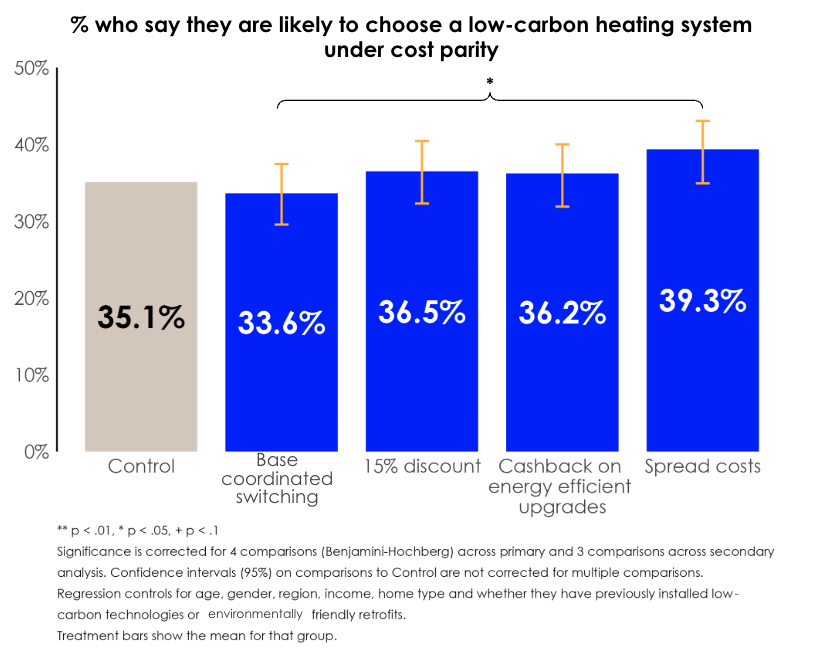
Figure 6.1. Likelihood of choosing low-carbon heating for different conditions under cost parity
In the cost discrepancy scenario, we saw a similar pattern of results as the cost parity scenario. However the differences were descriptively larger between the control and the spread costs, the base coordinated switching and the 15% discount, and the base coordinated switching and the spread costs. The spread costs led to a statistically significant increase in uptake compared to the base coordinated switching in the cost discrepancy scenario (Figure 6.2). Further, we also found that the coordinated switching scheme with spread costs led to a statistically significant increase in uptake of low-carbon heating compared to the control.
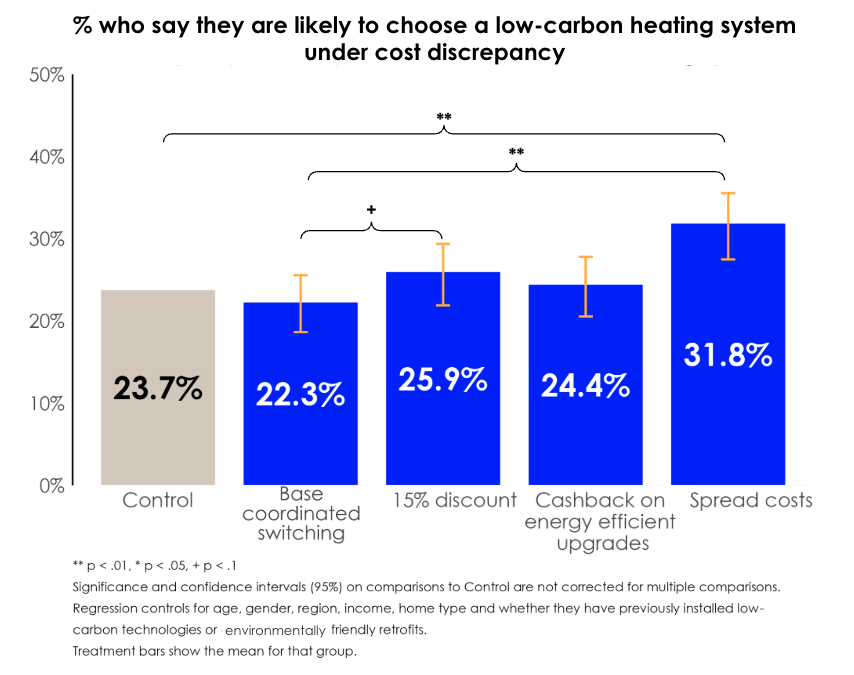
Figure 6.2. Likelihood of choosing low-carbon heating for different conditions under cost discrepancy
The findings suggest that when the cost of low-carbon heating is comparable to a boiler, structured financing that reduces upfront costs - such as the spread costs option - makes coordinated switching more attractive. This aligns with expectations, given the substantial financial commitment involved in adopting low-carbon heating. Interestingly, the 15% discount did not significantly increase uptake in the cost parity scenario. One possible explanation is that early adopters of low-carbon heating may be less price-sensitive and motivated by other factors beyond financial incentives. Additionally, the discount may not have been salient enough in this context or clearly perceived as a meaningful reduction in cost relative to a boiler.
Under the cost discrepancy scenario, the spread costs option remained effective, which is unsurprising given that the additional £2,000 cost of low-carbon heating compared to a boiler makes affordability a more pressing concern. Our finding suggests that as upfront costs rise, financial support mechanisms become even more necessary in driving adoption. If policy cannot bring low-carbon heating costs down directly, it is essential that financing options are made available to ensure uptake. However, the cashback for energy efficiency upgrades and the 15% discount did not statistically significantly boost adoption. It is possible that participants already felt that their home was sufficiently energy efficient, making the upgrades a less compelling reason to switch.
Notably, the only statistically significant difference between the control and the treatment conditions was found in the exploratory analysis for the cost discrepancy scenario, where the spread costs statistically significantly increased low-carbon heating uptake compared to the control. This may suggest that structured financing is a key factor in making coordinated switching schemes more appealing and effective in driving low-carbon heating adoption. Providing options that ease the immediate financial burden may be critical in scaling up participation in coordinated switching initiatives.
3.3 Key factors influencing households' decisions on low-carbon heating and coordinated switching
Participants were asked why they made their choice after the cost parity scenario, revealing the barriers and drivers to selecting low-carbon heating.
Key drivers for choosing low-carbon heating
Among those who opted for low-carbon heating in the cost parity scenario, environmental impact and the UK's plans to transition away from fossil fuels were the most common reasons for choosing the low-carbon heating option (see Table 2), reinforcing that those choosing the low-carbon heating option are likely early adopters. This also illustrates the importance of aligning communications with broader policy signals to increase adoption in the near future. Financial incentives also seemed influential, with direct cost reductions and flexible payment options cited as reasons for choosing low-carbon heating more often than bundled incentives such as cashback on other home upgrades. Other commonly chosen factors included perceived property value gains and trust in the coordinated switching scheme, including access to vetted suppliers and installation support.
However, relatively few participants cited having positive experiences with similar technologies in the past or knowing others who use low-carbon heating, indicating a potential need for greater consumer education and personal connections to enhance trust in low-carbon heating's suitability and effectiveness. For a detailed breakdown of each condition, see Appendix E.1.
| Reasons for choosing low carbon heating |
Overall (n 2,000) |
| It's better for the environment |
76% |
| I believe the country is heading towards low-carbon and boilers will be phased out in the future |
66% |
| The 15% discount makes it affordable (15% discount condition only, n = 395) |
58% |
| The opportunity to spread the costs over monthly payments at 0% interest makes it affordable (spread costs condition only, n = 467) |
53% |
| I find the cashback on other energy efficiency upgrades appealing (cashback on energy efficiency upgrades only, n = 390) |
48% |
| I think it will add value to my property |
45% |
| I trust the coordinated switching scheme as it offers access to vetted suppliers (treatment conditions only, n = 1616) |
41% |
| I would benefit from the dedicated guidance on installation and ongoing maintenance (treatment conditions only, n = 1616) |
41% |
| People I know use low-carbon heating |
11% |
| I've had positive experience with similar technologies in the past |
6% |
Key barriers to low-carbon heating adoption
Among those who opted for a traditional boiler in the cost parity scenario, practical considerations appeared to be key barriers to low-carbon heating adoption, with familiarity and perceived ease of boiler installation often chosen as reasons for choosing a boiler (see Table 3). Concerns about performance, reliability and environmental benefit were also common, potentially reinforced by a lack of direct experience with low-carbon heating technologies. Distrust in the coordinated switching scheme appeared to be further influencing choices, with one in two participants expressing scepticism about neighbour participation and one in four being hesitant to engage in a coordinated switch and/or did not want to engage with neighbours. These findings suggest that beyond financial incentives, addressing perceptions of convenience, reliability and social dynamics may be important for encouraging wider adoption. For a detailed breakdown of each condition, see Appendix E.2.
| Reasons for choosing a boiler |
Overall (n 3,525) |
| I'm more familiar with boilers |
58% |
| I don't think my neighbours / other households in my street or my local area would join the coordinated switching scheme (treatment conditions only, n = 2814) |
50% |
| It's less disruptive to install |
48% |
| I'm not sure about the performance or reliability of low-carbon heating |
43% |
| I'd need more information on low-carbon heating |
35% |
| I'm not convinced about the environmental benefit of low-carbon heating |
26% |
| I don't want to engage with my neighbours / other households in my street or my local area (treatment conditions only, n = 2814) |
26% |
| I don't trust the coordinated switching scheme (treatment |
25% |
conditions only, n = 2814)
| The environment impact of my heating system is not as important as other factors |
17% |
|
|
A lack of information was chosen as a reason for selecting a boiler by around one in three participants. When asked what additional information would be needed, many participants selected that they would need greater clarity on costs, system performance and benefits. These findings align with broader concerns about familiarity and trust, suggesting that uncertainty - rather than outright opposition - may be driving reluctance. Given the study's limitations in providing detailed information, these responses were expected and reinforce the importance of accessible, trusted resources to demystify low-carbon heating installation and running costs, technology and its benefits.
Table 4. Additional information needed among those who selected a boiler and cited needing more information as a reason for their choice.
| Additional information needed |
Overall (n 1,239) |
| Detailed breakdown of costs |
74% |
| More reassurance that low-carbon heating works as well as a boiler |
68% |
| More information on the benefits of each heating system |
59% |
| More information on how low-carbon heating works |
57% |
| Opportunity to look at other homes nearby who have already benefited from the scheme (treatment conditions only, n = 973) |
56% |
| Financing options |
46% |
| Terms of eligibility to join the scheme (treatment conditions only, n = 973) |
45% |
3.4 People may underestimate neighbourhood low-carbon heating adoption, potentially hindering uptake
Since coordinated switching relies on multiple households adopting low-carbon heating, we explored whether people believed their neighbours would switch. While social norms may influence adoption, our findings suggest that people may underestimate how many of their neighbours would choose low-carbon heating.
Across all conditions, participants tended to report being more likely to switch than to believe their neighbours would (36.2% vs 26.9% in the cost parity scenario). This perception gap - where people assume lower adoption among others - could contribute to hesitancy, though this was only explored descriptively. If people expect low uptake in their area, they may be less inclined to switch themselves. In the cost parity scenario, 35.1% of participants in the control condition said they would choose low-carbon heating, but only 20.6% of them believed their neighbours would. This pattern appeared across all treatment groups, with neighbour adoption generally perceived as lower than self-reported adoption. This pattern of findings appeared consistent across the cost discrepancy scenario, where 23.7% said they would switch in the control condition, but only 16.6% thought their neighbours would.
We also explored whether the treatment conditions influenced participants' beliefs about what their neighbours would choose in terms of low-carbon heating adoption. We found that the differences between the low-carbon heating offers are greater when people were reporting on what they think their neighbours would do (see Figure 7 and 8), compared to when they reported their own likelihood of adopting (see Section 3.1).
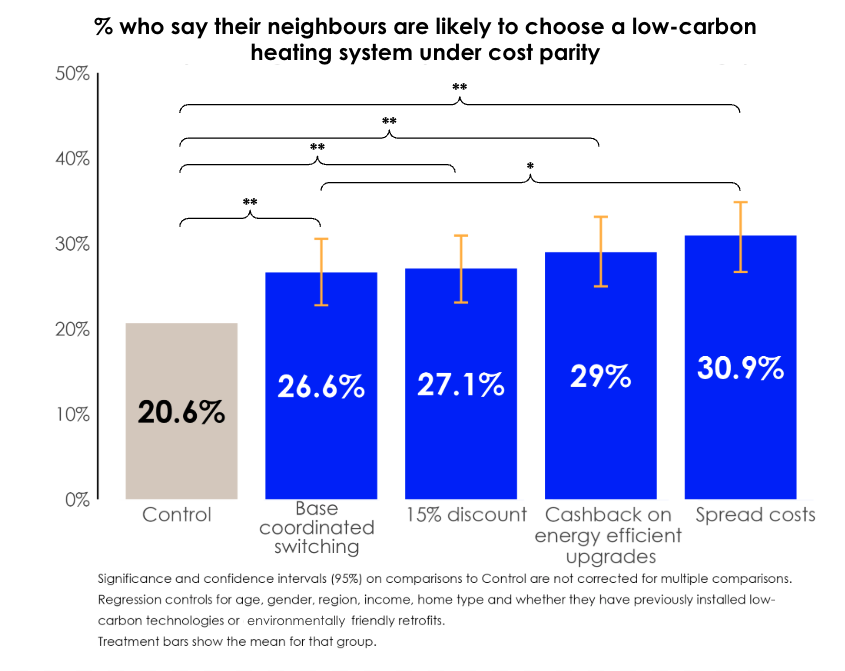
Figure 7. Perceived likelihood of neighbours choosing low-carbon heating under cost parity
How should we interpret these findings?
Overall, people tended to perceive their neighbours as less likely to choose low-carbon heating than themselves. This could reflect a 'false social reality', commonly observed in other climate policies. In other words, many people support climate action but do not believe this to be the common view (a form of pluralistic ignorance). This might highlight the importance of promoting a positive norm to correct this perception - particularly given this policy explicitly relies on collective action. If people do not believe others will participate, there is little incentive for them to take action.
Additionally, despite this lower baseline, people perceived their neighbours as more likely to be influenced by coordinated switching offers than they themselves would be. This might be explained by an observation we have also seen in past data: many people support climate policies in theory, believing they are beneficial (in this case, thinking the offers would encourage people, generally), but they themselves have particular reasons for not following through with the action. They also tend to underestimate the extent to which other people may also have particular concerns or barriers.
3.5 Insights into making coordinated switching work: payment, perks and trusted advice
How people would pay for low-carbon heating
When asked about how participants would fund the costs of a new low-carbon heating system, the most common method was personal savings, while a substantial proportion would need the cost spread over time without interest (see Table 5). Formal financing options, such as consumer finance plans and credit cards, were less popular, with only a small minority considering loans or borrowing from family and friends, potentially highlighting the importance of accessible payment structures to support adoption.
Table 5. How participants would pay for low-carbon heating
| Preferred funding methods for low carbon heating |
Overall |
| Using my personal savings |
49% |
| I would not be able to pay for it upfront unless the cost was spread over time, without using formal financing options |
28% |
| Using consumer finance options (for example, financing plans, buy now pay later schemes, or point-of-sale credit) |
18% |
| Using a credit card |
17% |
| I would use a portion of my salary or income over time |
15% |
| I would apply for a personal loan |
10% |
| I would borrow the money from family or friends |
4% |
Additional local benefits
Participants in the treatment groups (n = 4,430) were asked which of the seven potential benefits would make them more likely to opt into a coordinated switching scheme. Among those in the treatment groups, collective energy discounts were the benefit most frequently selected as making them more likely to opt into coordinated switching schemes, followed by infrastructure upgrades such as road resurfacing and improved drainage. Green initiatives, such as tree planting, communal spaces, and EV charging points also held some appeal, while cycle hangers were less influential.
Table 6. Community benefits that enhance the appeal of coordinated switching
| Local improvements that increase interest in coordinated switching |
Overall |
| Collective energy discounts for the area |
51% |
| Resurfacing of roads |
44% |
| Improved drainage |
42% |
| Planting of new trees in the area |
39% |
| More communal spaces (for example, playgrounds, benches) |
34% |
| On-street charging points for electric vehicles |
30% |
| Cycle hangers for you and your neighbours to use |
19% |
Percentages represent those who answered 'moderately' or 'very much' to the question “Coordinated switching may come with improvements to your local area. Would the following additional benefits make you more likely to opt into coordinated switching?”.
When we asked participants who they would trust most for information about low-carbon heating options and - for those in the treatment groups - coordinated switching schemes, we found that consumer websites were selected most frequently, followed by plumbers or heating engineers. Other sources, such as independent organisations, energy suppliers and local authorities or councils, were selected less frequently, though they were still chosen up to one-third of the time. Devolved governments and property management of buildings were the least frequently selected, likely due to their limited relevance to the full sample.
Table 7. Trusted sources of information for low-carbon heating and coordinated switching
| Trusted sources for information on coordinated switching and low carbon heating |
Overall |
| Consumer websites (for example, Money Saving Expert, Which?) |
51% |
| Plumbers or heating engineers |
37% |
| Independent, accredited third-party organisations |
33% |
| Energy suppliers |
32% |
| Your local authority or council |
30% |
| The national government (UK government) |
29% |
| Environmental or consumer advocacy groups |
26% |
| Property management of my building, if applicable |
19% |
| Devolved governments (Scottish / Welsh Parliament) |
10% |
3.6 Adoption patterns across income, urbanity, region and property types
Income
In the cost parity scenario, 42% of individuals with above-median household incomes selected the low-carbon heating option in the control condition. This rate was statistically significantly lower in the baseline coordinated switching condition (36%). In contrast, the spread costs condition saw a statistically significant increase in adoption compared to the baseline coordinated switching condition. No other comparisons reached statistical significance. A similar pattern emerged in the cost discrepancy scenario, though the only statistically significant difference was the increase in adoption for the spread costs condition compared to the baseline coordinated switching condition. See Table 9 for a detailed breakdown of results.
For lower-income households, no significant differences were found between the control and baseline coordinated switching conditions in either cost scenario. However, certain coordinated switching incentives significantly increased low-carbon heating adoption rates. In the cost parity scenario, the 15% discount (34%), cashback on energy efficiency upgrades (36%), and spread costs (33%) conditions all showed significantly higher adoption rates compared to the control condition (27%). In the cost discrepancy scenario, the cashback (23%) and spread costs (28%) conditions significantly outperformed both the control (17%) and baseline coordinated switching conditions (18%).
These findings suggest that financial incentives, particularly those reducing upfront costs or offering direct financial returns, are key in encouraging low-carbon heating adoption among lower-income participants, especially when low-carbon heating costs more than a boiler. When costs are similar, coordinated switching schemes with financial incentives significantly increase adoption over individual switching.
Table 8. Likelihood of choosing low-carbon heating across the different conditions, cost scenarios by income level
The following table presents the likelihood of choosing low-carbon heating for people with above median incomes:
| Scenario |
Control (n 588) |
Base coordinated switching (n 593) |
15% discount (n 612) |
Cashback on energy efficient upgrades (n 610) |
Spread costs (n 687) |
| Cost parity |
42% |
36% (*) |
38% (-/-) |
37% (+/-) |
44% (- / **) |
| Cost discrepancy |
30% |
26% (-) |
30% (-/-) |
26% (+/-) |
34% (- / **) |
The following table presents the likelihood of choosing low-carbon heating for people with under median incomes:
| Scenario |
Control (n 507) |
Base coordinated switching (n 490) |
15% discount (n 471) |
Cashback on energy efficient upgrades (n 467) |
Spread costs (n 500) |
| Cost parity |
27% |
31% (-) |
34% (* / -) |
36% (** / -) |
33% (* / -) |
| Cost discrepancy |
17% |
18% (-) |
21% (-/-) |
23% (* / *) |
28% (** / **) |
**p<.01, *p < .05, + p < .1, - p <= .1
Base coordinated switching is tested against the control condition.
(-/-) left hand side was tested against the control condition, right hand side was tested against the base coordinated switching.
Urbanicity
We found no statistically significant differences in the proportion who would be likely to choose the low-carbon heating option when comparing responses from participants living across urban, suburban vs rural areas in the cost parity scenario. However, in the cost discrepancy scenario, we found that individuals living in urban areas were statistically more likely to choose a coordinated switch to low-carbon heating (32%) compared to those in suburban (24%, p < .01) or rural areas (22%, p < .01). These findings could suggest that urbanicity plays a more influential role when upfront cost discrepancies exist, though these findings are exploratory and we have not controlled for multiple comparisons. See Appendix F.1 for descriptive trends across urbanicity, conditions and cost scenarios.
Property types
While we had sufficient sample sizes to conduct significance testing on overall intent to choose low-carbon heating between home owners and flat owners, at the treatment level, subgroup sizes were too small to test for significant differences in responses to treatment. When comparing the likelihood of uptake between flat owners and house owners, we found no statistically significant differences in their likelihood to choose a coordinated switch to low-carbon heating in either cost parity or cost discrepancy scenarios. Details can be found in Appendix F.2.
Region
We found some regional variations in the reported likelihood of choosing a coordinated switch to low-carbon heating. These differences are based on descriptive data only due to small sample sizes in certain areas and should be interpreted with caution (see Appendix F.3).
In the cost parity scenario, those from Northern Ireland (n = 119, 41%) more frequently chose the low-carbon heating option, followed by London (n = 816, 38%), the Midlands (n= 906, 37%), and the South and East (n = 1,622, 37%). Wales less frequently chose the low-carbon heating option (n = 223, 30%). This pattern was similar in the cost discrepancy scenario, where London, Northern Ireland, the Midlands and the South and East more frequently selected the low-carbon heating option (ranging 27% - 30%), and Wales least frequently selected the low-carbon heating option (19%).
4. Recommendations
The findings from this research provide key insights and implications for the development of coordinated switching schemes to accelerate the adoption of low-carbon heating moving forward. These are summarised as recommendations for policymakers and researchers.
4.1 Recommendations for the roll-out of coordinated switching schemes
These recommendations align with the broader challenges that all low-carbon heating technologies need to address in order to increase adoption. By focusing on key barriers such as affordability, perceived complexity and trust, these insights aim to support the successful uptake of low-carbon heating solutions.
- Coordinated switching schemes should incorporate flexible financing to address upfront costs and accelerate low-carbon heating adoption. To increase uptake, policymakers should prioritise introducing financing options that allow households to pay for low-carbon heating installations over time (for example, zero interest payment plans or government-backed loans). This will make low-carbon heating more accessible to households who are deterred by high initial costs, especially when low-carbon heating is more expensive than conventional boilers.
- Coordinated switching schemes should include financial support to support equitable uptake. While neither cashback nor upfront discounts consistently increased low-carbon heating uptake, they were more appealing to lower-income households - cashback in both cost scenarios and 15% discount when costs were similar to a boiler replacement. Notably, the spread costs option was the most effective financial incentive, significantly increasing adoption compared to the base coordinated switching in both cost scenarios. This highlights the importance of offering structured financing options alongside other financial support mechanisms to maximise uptake, particularly for cost-sensitive households.
- Be clear and transparent in the communication of costs and benefits of coordinated switching schemes and low-carbon heating. Coordinated switching schemes should provide clear, easily accessible information on the total cost, financing options and expected performance of low-carbon heating systems to counteract barriers such as lack of awareness, trust and scepticism towards new low-carbon heating technology. This could include detailed cost breakdowns, performance comparisons with traditional systems, and testimonials from households who have already adopted low-carbon heating. Policymakers should ensure that the communication is transparent and that trusted sources, such as vetted suppliers, are promoted.
- Use social proof to change perceptions of neighbourhood adoption. Given that coordinated switching may require a certain number of households within a given area to be rolled out, policymakers should actively promote the social proof of low-carbon heating adoption within neighbourhoods. This can be done by showcasing successful community-level adoption, organising local campaigns, or even creating a "neighbourhood challenge" to encourage adoption. Social norm messaging should be used to reassure households that they are not alone in their decision to switch, and that low-carbon heating adoption is part of a larger movement.
- Provide reassurances on low-carbon heating performance and reliability. Coordinated switching schemes should include educational components that specifically address the concerns around the specific low-carbon heating technology involved. This can involve providing performance data, guarantees on system reliability and the option for participants to visit homes that have already adopted low-carbon heating. Policymakers should work with trusted partners to develop materials that reassure households about the reliability of low-carbon heating options.
- Leverage perceived neighbour influence for collective action. Recognising that individuals tend to underestimate their neighbours' inclination to switch, yet acknowledging the greater influence of well-supported coordinated schemes, policymakers should clearly and consistently communicate the comprehensive benefits of these schemes, prioritising financial incentives and community perks. Given the inherent need for substantial community engagement and sign-ups in successful coordinated switching initiatives, fostering a strong perception of widespread participation is crucial. Clearly articulating the scheme's attractiveness could increase individual likelihood to join by reinforcing the understanding that their neighbours are also likely to participate.
4.2 Research recommendations
- Carry out deliberative research to better understand the value-add of hassle reduction provided by coordinated switching schemes. Future research could use deliberative methods, such as walkthroughs or guided simulations, to help participants better envision the coordinated switching process. This approach could provide more grounded insights into how hassle reduction influences decision-making in practice. This may provide added value given that our online experiment methodology may not have fully conveyed the real-world hassle of switching, potentially leading participants to undervalue the benefits of coordination.
- Conduct real-world trials to test implementation challenges. Future research could involve field studies where coordinated switching is implemented in a real community, tracking adoption rates, installation logistics and customer satisfaction. This would help identify practical barriers that self-reported intent may not capture and assess whether uptake differs when participants experience the switching process firsthand.
- Investigate the role of autonomy in decision-making for coordinated switching schemes. Future research could explore how different levels of decision-making control within coordinated switching schemes affect uptake. Experimental variations could include allowing participants to choose from a set of vetted suppliers, offering different levels of involvement (fully coordinated vs. guided options), or testing a default opt-in model with an easy opt-out. This would provide insights into whether perceived loss of autonomy is a key barrier to low-carbon heating adoption within coordinated switching schemes.
- Examine the impact of trust and social influence. Future research could investigate how trust in the scheme's reliability, transparency and impartiality affects likelihood to switch. Studies could also test messaging that highlights social norms (for example, “X% of people in your area have switched") and assess the role of peer influence, including friends, neighbours and online reviews, in shaping decisions.
- Examine the role of early vs. late adopters in coordinated switching schemes. Future research could explore the different needs and motivations of early versus late adopters of low-carbon heating technologies. Late adopters, in particular, may face additional barriers to adoption, including higher levels of uncertainty and a greater need for support. Understanding how coordinated switching schemes could be tailored to meet these needs - especially as the gas grid becomes increasingly uneconomical - could help target interventions more effectively. Research could investigate whether late adopters are more likely to respond positively to increased support in the form of financial incentives, hassle reduction, or enhanced communication.
- Explore income-based differences in coordinated switching adoption. Our findings suggest that financial incentives could play a particularly important role in increasing low-carbon heating uptake for below-median income households. This could have important policy implications, especially when understanding which areas may be most suited to coordinated schemes or designing targeted financial support mechanisms. Future research could examine these differences in greater granularity, potentially by segmenting participants by income bands to assess varying responses to financial incentives, hassle reduction and financing options. Understanding these dynamics could help refine coordinated switching schemes to ensure they ensure a fair and just transition to low-carbon heating.
5. Conclusion
In conclusion, our research suggests that coordinated switching schemes can only be successful if they address key barriers to clean heating. The ability to spread costs over time appears to be the most important contribution coordinated switching schemes could make. Additionally, providing more information, increasing familiarity and reducing total costs are ways in which coordinated switching schemes could help increase uptake. The overall impact on low-carbon heating adoption across other conditions was more limited, suggesting that coordinated switching schemes alone may not be enough to drive widespread adoption. Additionally, while hassle is a known barrier to low-carbon heating adoption, further research is needed to understand whether and how coordinated switching schemes effectively reduce this burden. Given the limitations of our online experiment, future studies using more immersive methods may provide deeper insights into the impact of these schemes on perceived and actual hassle reduction.
Key considerations for the future of coordinated switching schemes include the following.
- Financial support: prioritising policies and incentives that offer flexible payment options is more effective than relying solely on the convenience of coordinated switching.
- Clear communication: transparent and accessible information regarding costs, benefits and the reliability of low-carbon heating systems is crucial to address consumer scepticism and encourage adoption.
- Social influence: highlighting community-level adoption and addressing the underestimation of neighbour participation can foster a sense of social buy-in and increase individual likelihood to switch.
Ultimately, coordinated switching schemes must address both financial and behavioural barriers to low-carbon heating adoption to realise their potential in decarbonising home heating. Future research using deliberative methods could provide more grounded insights into how hassle reduction influences decision-making in practice. Our findings also highlight the need to explore income-based differences in response to financial incentives within coordinated switching schemes. By integrating flexible financing, clear communication and social proof, while also considering the role of hassle reduction, these schemes can become a more attractive and feasible option for households, driving a more rapid transition to low-carbon heating.
6. Appendix
Appendix A - Sample characteristics
The following tables present sample characteristics by Age, Gender, Ethnicity, Education, Employment, Income, Urbanicity, Home type, and Location.
| Age Group |
Percentage |
| 35 to 54 |
44% |
| 55 and over |
47% |
| Under 35 |
9% |
| Gender |
Percentage |
| Female |
48% |
| Male |
52% |
| Other |
<1% |
| Ethnicity |
Percentage |
| Asian |
6% |
| Black |
3% |
| Other |
2% |
| White |
89% |
| Education |
Percentage |
| Degree |
40% |
| No degree |
58% |
| None of the above |
2% |
| Employment |
Percentage |
| Employed |
72% |
| Inactive |
27% |
| Unemployed |
1% |
| Income |
Percentage |
| £40,000 and over |
56% |
| Less than £40,000 |
44% |
| Urbanicity |
Percentage |
| Rural |
19% |
| Suburban |
49% |
| Urban |
32% |
| Home type |
Percentage |
| Flat, maisonette or apartment |
22% |
| Whole house or bungalow: detached |
28% |
| Whole house or bungalow: semi-detached |
32% |
| Whole house or bungalow: terraced |
17% |
| Location |
Percentage |
| London |
15% |
| Midlands |
16% |
| North |
24% |
| Northern Ireland |
2% |
| Scotland |
9% |
| South and East |
29% |
| Wales |
4% |
B.1 - Description of low-carbon heating systems presented to all participants
Low-carbon heating systems use renewable or low-carbon energy to provide heat with minimal or no greenhouse gas emissions. Unlike traditional boilers that burn fossil fuels like gas or oil, low-carbon systems - such as heat pumps and heat networks - use cleaner energy sources meaning they can have a significantly lower environmental impact.
* Heat pumps extract heat from the air, ground, or water and use electricity to transfer it into buildings, making them suitable for detached, semi-detached, or terraced houses.
* Heat networks, on the other hand, distribute heat from a central system to multiple buildings through pipes, which works well in urban areas, especially for flats and homes with limited outdoor space.
B.2 - Description of coordinated switching presented to participants in treatment conditions
Coordinated switching is a practical approach to adopting low-carbon heating systems like heat pumps and heat networks. Switching to these systems individually can be costly and complex, but coordinating the switch with others - such as neighbours in the same building, street or area - can help overcome these challenges.
With support and coordination from an overseeing body such a local authority, coordinated switching streamlines the process by simplifying logistics, reducing hassle, and offering benefits like bulk purchasing, vetted suppliers and potential costs savings.
The success of the scheme depends on a minimum number of households participating - the more people who join, the greater the benefits. Fewer households joining the scheme could reduce the overall benefits for everyone.
B.3 - Prompt shown to participants in the cost parity scenario
Imagine your boiler is nearing the end of its lifespan and needs to be replaced. You are given the following options to choose from to replace your heating system.
Please think about this choice as if it were a real decision affecting your home and respond as you would in real life. The cost for both options are similar.
The monthly energy bills for the low-carbon heating system and boiler are also roughly the same.
The information you just read is available here, if you would like to refer back to it (opens in a pop up on this page).
The definition of low-carbon heating, and for the treatment conditions, coordinated switching, was accessible via a pop-up, by clicking on the link under “here”.
B.4 - Prompt shown to participants in the cost discrepancy scenario
Now imagine that in the previous scenario, the cost you would pay for replacing your boiler with a low-carbon heating system is £5000, while the cost of a new boiler is £3000.
The monthly energy bills for the low-carbon heating system and boiler are roughly the same.
The information you just read is available here, if you would like to refer back to it (opens in a pop up on this page).
Participants in the 15% discount and the spread cost conditions saw slightly tweaked prompts:
- Added to the 15% discount (T2) condition: “low-carbon heating system is £4250 after a 15% discount” (first paragraph).
- Added to the spread costs (T4) condition: “The £5000 cost for the equipment and installation of the low-carbon heating system is paid through a separate monthly plan, for example £83/month for 5 years, or £42/month for 10 years." (second paragraph).
Appendix C - Offers shown to different conditions
Offers were the same across both cost parity and cost discrepancy scenarios.
C.1 - Control offer (boiler vs individually sourced low-carbon heating)
Replacing your existing boiler with a new one.
| What it involves |
|
|
• Find and contact a boiler engineer or plumber.
• Get quotes for the boiler and installation.
• Schedule and manage the installation. |
Replacing your existing boiler with a low-carbon alternative suitable for your home.
| What it involves |
|
|
• Find and contact a qualified supplier for the low carbon system.
• Get quotes for the heating system and installation.
• Schedule and manage the installation, ensuring that your new heating system is tailored to your home's needs.
• This may involve more time and disruption compared to replacing a boiler. |
C.2 - Treatment offers (boiler vs T1, T2, T3, T4)
Replacing your existing boiler with a new one.
| What it involves |
|
|
• Find and contact a boiler engineer or plumber.
• Get quotes for the boiler and installation.
• Schedule and manage the installation. |
Joining a coordinated switching scheme with your neighbours / other households on your street or your local area to replace your boiler with a low carbon alternative suitable for your home.
| What it involves |
|
|
• Join a scheme that connects you with vetted suppliers, ensuring quality and reliability.
• Receive dedicated support throughout the process, from installation to ongoing maintenance, with clear pricing, guaranteed service standards, and help for any issues.
• The installation of the low-carbon heating system may cause more disruption than replacing a boiler. |
All participants in treatment conditions saw all elements of the base offer (Treatment 1). Participants in the other treatment groups saw an additional bullet-point listed in their offer under the first one:
- T2 (15% discount): “Receive a 15% bulk purchase discount on the low-carbon heating system” (+ “making this cheaper than the boiler" in the cost parity scenario).
- T3 (cashback on energy efficiency upgrades): “Get cashback on home energy efficiency upgrades (up to £1,000 for solar panels or batteries, or £500 for doors, windows, or insulation). These upgrades can further lower your energy costs and improve comfort."
- T4 (spread costs): "There are no upfront charges, the cost for the equipment and installation is spread over monthly payments with 0% interest, making payments more manageable."
Appendix D - Price estimates
After making their choice in the cost parity scenario, participants were asked to estimate how much they think it would cost to replace their current heating system with a boiler or low-carbon heating. Despite the prompt suggesting parity in costs between the two options, our results indicate that participants who selected low-carbon heating consistently estimated higher average costs for low-carbon heating compared to those who selected boilers and estimated the price for boilers.
| Experimental conditions |
Cost for boiler |
Cost for low carbon heating |
| Control |
£3,173.77 |
£4,254.97 |
| Base coordinated switching |
£3,074.84 |
£3,432.91 |
| 15% discount |
£2,906.95 |
£3,342.43 |
| Cashback on energy efficiency upgrades |
£2,932.38 |
£3,724.21 |
| Spread costs |
£3,091.24 |
£3,547.50 |
Appendix E - Reasons for choosing low-carbon heating vs boiler
E.1 - Reasons for choosing low-carbon heating per condition
| Why would you choose low carbon heating? Please select all that apply. |
Overall (n 2000) |
Control (n 384) |
Base coordinated switching (n 364) |
15% discount (n 395) |
Cashback on energy efficiency upgrades (n 390) |
Spread costs (n 467) |
| It's better for the environment |
76% |
80% |
77% |
73% |
77% |
72% |
| I believe the country is heading towards low-carbon and boilers will be phased out in the future |
66% |
73% |
69% |
63% |
66% |
60% |
| The 15% discount makes it affordable (15% discount condition only, n = 395) |
58% |
- |
- |
58% |
- |
- |
| The opportunity to spread the costs over monthly payments at 0% interest makes it affordable (spread costs condition only, n = 467) |
53% |
- |
- |
- |
- |
53% |
| I find the cashback on other energy efficiency upgrades appealing (cashback on energy efficiency upgrades only, n = 390) |
48% |
- |
- |
- |
48% |
- |
| I think it will add value to my property |
45% |
46% |
44% |
40% |
46% |
47% |
| I trust the coordinated switching scheme as it offers access to vetted suppliers (treatment conditions only, n = 1616) |
41% |
- |
45% |
39% |
41% |
38% |
| I would benefit from the dedicated guidance on installation and ongoing maintenance (treatment conditions only, n = 1616) |
41% |
- |
42% |
42% |
42% |
40% |
| People I know use low-carbon heating |
11% |
11% |
10% |
13% |
11% |
10% |
| I've had positive experience with similar technologies in the past |
6% |
8% |
5% |
7% |
5% |
5% |
E.2 - Reasons for choosing boiler per condition
| Why would you choose the boiler? Please select all that apply. |
Overall (n 3525) |
Control (n 711) |
Base coordinated switching (n 719) |
15% discount (n 688) |
Cashback on energy efficiency upgrades (n 687) |
Spread costs (n 720) |
| I'm more familiar with boilers |
58% |
58% |
59% |
57% |
61% |
56% |
| I don't think my neighbours / other households in my street or my local area would join the coordinated switching scheme (treatment conditions only n = 2814) |
50% |
- |
52% |
50% |
51% |
50% |
| It's less disruptive to install |
48% |
53% |
50% |
45% |
49% |
43% |
| I'm not sure about the performance or reliability of low-carbon heating |
43% |
47% |
44% |
42% |
45% |
39% |
| I'd need more information on low-carbon heating |
35% |
37% |
34% |
35% |
35% |
34% |
| I'm not convinced about the environmental benefit of low-carbon heating |
26% |
27% |
26% |
27% |
25% |
23% |
| I don't want to engage with my neighbours / other households in my street or my local area (treatment conditions only, n = 2814) |
26% |
- |
28% |
27% |
25% |
26% |
| I don't trust the coordinated switching scheme (treatment conditions only, n = 2814) |
25% |
- |
27% |
27% |
24% |
23% |
| The environment impact of my heating system is not as important as other factors |
17% |
19% |
16% |
19% |
16% |
17% |
Appendix F - Main subgroup analyses
F.1 - Likelihood of low-carbon heating uptake by urbanity
| Urbanity |
Condition |
Control (n 344) |
Base coordinated switching (n 333) |
15% discount (n 352) |
Cashback on energy efficiency upgrades (n 336) |
Spread costs (n 381) |
| Urban |
Cost parity |
35% |
38% |
37% |
40% |
42% |
| Urban |
Cost discrepancy |
27% |
29% |
31% |
31% |
36% |
| Suburban |
Condition |
Control (n 537) |
Base coordinated switching (n 536) |
15% discount (n 538) |
Cashback on energy efficiency upgrades (n 535) |
Spread costs (n 562) |
| Suburban |
Cost parity |
34% |
32% |
35% |
34% |
38% |
| Suburban |
Cost discrepancy |
22% |
21% |
23% |
22% |
30% |
| Rural |
Condition |
Control (n 214) |
Base coordinated switching (n 214) |
15% discount (n 193) |
Cashback on energy efficiency upgrades (n 206) |
Spread costs (n 244) |
| Rural |
Cost parity |
37% |
31% |
40% |
36% |
38% |
| Rural |
Cost discrepancy |
23% |
15% |
24% |
20% |
29% |
F.2 - Likelihood of low-carbon heating uptake by property type
| Property Type |
Condition |
Control (n 247) |
Base coordinated switching (n 246) |
15% discount (n 241) |
Cashback on energy efficiency upgrades (n 215) |
Spread costs (n 286) |
| Of flat owners, % likely to choose low carbon heating |
Cost parity |
33% |
35% |
39% |
40% |
38% |
| Of flat owners, % likely to choose low carbon heating |
Cost discrepancy |
21% |
26% |
31% |
30% |
31% |
| Of houseowners, % likely to choose low carbon heating |
Condition |
Control (n 848) |
Base coordinated switching (n 837) |
15% discount (n 842) |
Cashback on energy efficiency upgrades (n 862) |
Spread costs (n 901) |
| Of houseowners, % likely to choose low carbon heating |
Cost parity |
36% |
33% |
36% |
35% |
40% |
| Of houseowners, % likely to choose low carbon heating |
Cost discrepancy |
24% |
21% |
25% |
23% |
32% |
F.3 - Likelihood of low-carbon heating uptake by regions
| Region |
Condition |
All conditions (%) |
Coordinated switching conditions only (%) |
| London (n = 816) |
Cost parity |
38 |
39 |
| Midlands (n = 906) |
Cost parity |
37 |
38 |
| North (n = 1,336) |
Cost parity |
35 |
35 |
| Northern Ireland (n = 119) |
Cost parity |
41 |
43 |
| Scotland (n = 419) |
Cost parity |
33 |
32 |
| South and East (n = 1,622) |
Cost parity |
37 |
38 |
| Wales (n = 233) |
Cost parity |
30 |
29 |
| London (n = 816) |
Cost discrepancy |
30 |
31 |
| Midlands (n = 906) |
Cost discrepancy |
27 |
27 |
| North (n = 1,336) |
Cost discrepancy |
23 |
23 |
| Northern Ireland (n = 119) |
Cost discrepancy |
28 |
27 |
| Scotland (n = 419) |
Cost discrepancy |
25 |
26 |
| South and East (n = 1,622) |
Cost discrepancy |
27 |
27 |
| Wales (n = 233) |
Cost discrepancy |
19 |
19 |
58 Victoria Embankment
London EC4Y ODS
+44 (0)20 7438 2500
[email protected]
X @nesta_uk
f nesta.uk
www.nesta.org.uk
ISBN: 978-1-916699-36-6
Nesta is a registered charity in England and Wales with company number 7706036 and charity number 1144091. Registered as a charity in Scotland number SCO42833. Registered office: 58 Victoria Embankment, London EC4Y ODS.
CC BY NC SA