You've built a great program or service. So why aren't more people using it? At BIT, we've worked with dozens of organizations in the public, private, and nonprofit sectors to design, implement, and test successful uptake strategies rooted in what really influences behavior. This playbook outlines our five-step approach to understanding and addressing barriers to program and service uptake.
Whether you're launching something new or looking to scale engagement with an existing program or service, we'd love to help!
1 Set uptake goals
What does uptake mean for you? You might be trying to increase:
- Program registration rates
- App downloads
- Event attendance
- Responses to information requests, like surveys
- Use of digital service channels
Make sure you have a clear, specific goal in mind. Your goal should include who you want to reach and what exactly you want them to do. We recommend setting a numerical target for uptake increase - what would success look like?
2 List the actions needed for uptake
Sometimes uptake is simple for users – for example, signing up on a website. But it's often more complicated and there are multiple steps that a user may need to take to onboard onto a service or program. Taking the time to list all the steps people or organizations need to complete can help to expose the frictions that may be affecting your uptake rates.
BIT worked with the City of Chicago to encourage residents to take advantage of a water lead testing program. There is no safe level of lead exposure, so the City invested millions in free test kits for people to complete at home. Before BIT stepped in, only 30% of kits were returned.
While the goal was simple - increase the return rate – it required 14 distinct behaviors! These included:
- Learning about the program
- Ordering a kit online or by calling 311
- Planning a time to stagnate water for 6 hours
- Properly filling out paper and digital forms
- Scheduling pickup on a City website
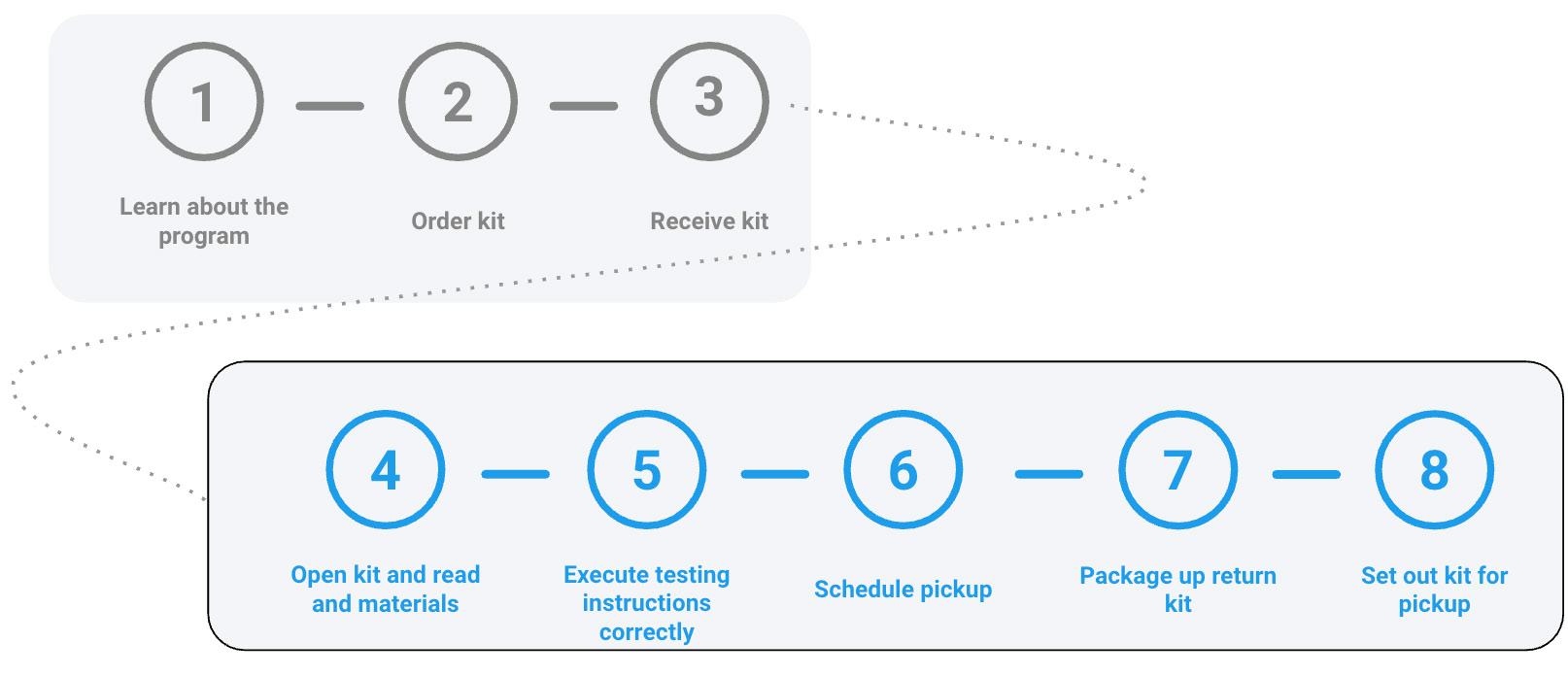
By breaking "uptake" down into these behaviors and many more, we were able to design more effective solutions. The City achieved over a 50% return rate – possibly the highest in the nation at the time.
Mapping these behaviors helps spot dropout points and tailor solutions. At BIT, we conduct behavioral mapping sessions with program staff or service users to help outline all of the actions needed to reach your uptake goals. These sessions offer a wealth of insight, exposing key barriers to users or opportunities to improve their experience.
3 Uncover the barriers
Even desperately needed and valuable programs can see low engagement. It's not just because of a lack of awareness or financial incentives. Common barriers we've found across dozens of uptake projects include:
- Sludge: The smallest frictions, like an extra click or a confusing instruction, can have an outsized effect.
- Personal relevance: People think the program is valuable, but is not "for them" (even though it is!).
- Status quo bias: People tend to avoid doing new things, like engaging with a new program, even when the status quo isn't working.
- Visibility and social influence: People don't see their friends or family doing it, even if they are.
At BIT, we help our partners discover the barriers standing in the way of uptake goals using tools like:
- Administrative data analysis: Your existing data can reveal who isn't taking up the service and at what step in the process they're dropping out.
- Sludge audits: Our behavioral experts user-test your customer experience and find hidden barriers embedded in it.
- Qualitative research: Observations and interviews are particularly valuable tools to understand the "why" behind uptake challenges.
- Journey mapping: We bring your insights together in a map of the barriers at each step in the process. This map informs solutions by pinpointing where, and how, things need to change.
We make sense of this data to identify the most important barriers through a variety of qualitative analysis techniques, like thematic analysis, and rigorous frameworks, like the COM-B model of behavior change. We developed a barrier identification tool using COM-B that you can use to help us begin to improve program uptake.
BIT worked with the Future Skills Centre and the provinces of Alberta and Saskatchewan to increase uptake of free career and employment services among people who had recently lost their jobs.
Through an innovative data program called Targeting, Referral, and Feedback (TRF), the federal government sends the contact information for people who had lost their job and applied for benefits to the provinces, which fund career and employment services, in near real time. TRF enables the provinces to reach out very quickly to get people into services and - hopefully - re-attached to the labour market.
We interviewed a wide range of people that had lost their jobs and been contacted through this program, and learned a lot about the barriers to participation. There were concerns around the legitimacy of the outreach, and some friction in signing up, but something surprising kept coming up - the early outreach was too early! A lot of folks just weren't ready - practically or psychologically - to take this next step. We added a follow-up outreach 10 weeks later and saw a 27% increase in people attending an appointment!
We developed and tested a wide range of practices for engaging jobseekers, so check out the full report.
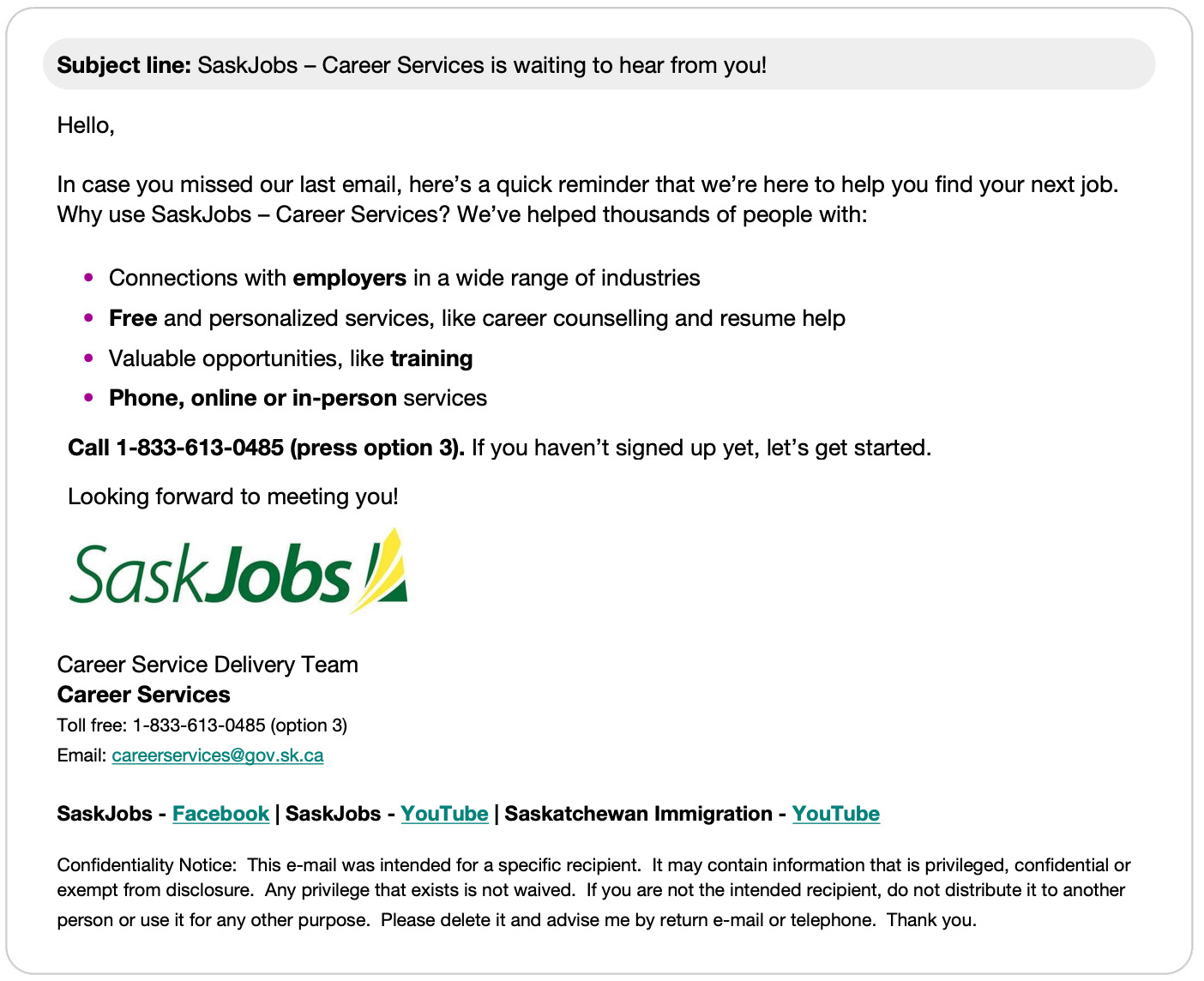
Subject line: SaskJobs - Career Services is waiting to hear from you!
Hello,
In case you missed our last email, here's a quick reminder that we're here to help you find your next job. Why use SaskJobs - Career Services? We've helped thousands of people with:
- Connections with employers in a wide range of industries
- Free and personalized services, like career counselling and resume help
- Valuable opportunities, like training
- Phone, online or in-person services
Call 1-833-613-0485 (press option 3). If you haven't signed up yet, let's get started.
Looking forward to meeting you!
SaskJobs
Career Service Delivery Team
Career Services
Toll free: 1-833-613-0485 (option 3)
Email: [email protected]
SaskJobs - Facebook | SaskJobs - YouTube | Saskatchewan Immigration - YouTube
Confidentiality Notice: This e-mail was intended for a specific recipient. It may contain information that is privileged, confidential or exempt from disclosure. Any privilege that exists is not waived. If you are not the intended recipient, do not distribute it to another person or use it for any other purpose. Please delete it and advise me by return e-mail or telephone. Thank you.
4 Design solutions
Solutions should address the behavioral barriers you've uncovered, with the aim of making it easier and more attractive for users to take up your program or service offer.
At BIT, we design innovative, yet practical, interventions grounded in insights from service users, proven frameworks like EAST, and evidence of what has worked well in similar contexts. Much of that evidence has come from BIT's own work over the past 15+ years.
We often build prototypes of promising interventions and test them with their target audiences. As we learn more, we refine, reducing risks of failure later on. Here are a few types of uptake solutions our clients have found successful.
Communications
Using behavioral science principles to design and evaluate communications campaigns can be a low-cost, scalable solution. Here are a few examples of approaches we've tested:
- Active choice: Encourage people to make an active decision about what they want to do, while drawing out the implications of saying "no." Nearly 4x as many people responded to our active choice email promoting a free tax-filing service for low-income Canadians.
- Appeal to "ego": People can be motivated by the desire to feel unique. A "You have been selected" message we tested led to a 40% higher rate of scheduling a doctor appointment, helping more low-income individuals access primary care. This work with the New Orleans Health Department was part of a broader program of research with US cities that focused significantly on uptake; more details can be found here (see page 11-12 for this example).
- Social norms: Show that others are taking part and seeing benefits. When we told residents that many of their neighbors participate in a composting program, it convinced 60% more people to sign up to start composting themselves.
- Personalization: People are more likely to act on information that is tailored to them. We worked with the Singapore Police Force to encourage people to complete a safe driving course. When we informed people with demerit points that signing up for a safe driving course would wipe 4 demerit points wiped off their record, they were 20% more likely to register. While this had always been part of the policy, the invitation now felt customized for their driving records.
Process
Make it easier for people to sign up and participate by removing unnecessary sludge or frictions in the process.
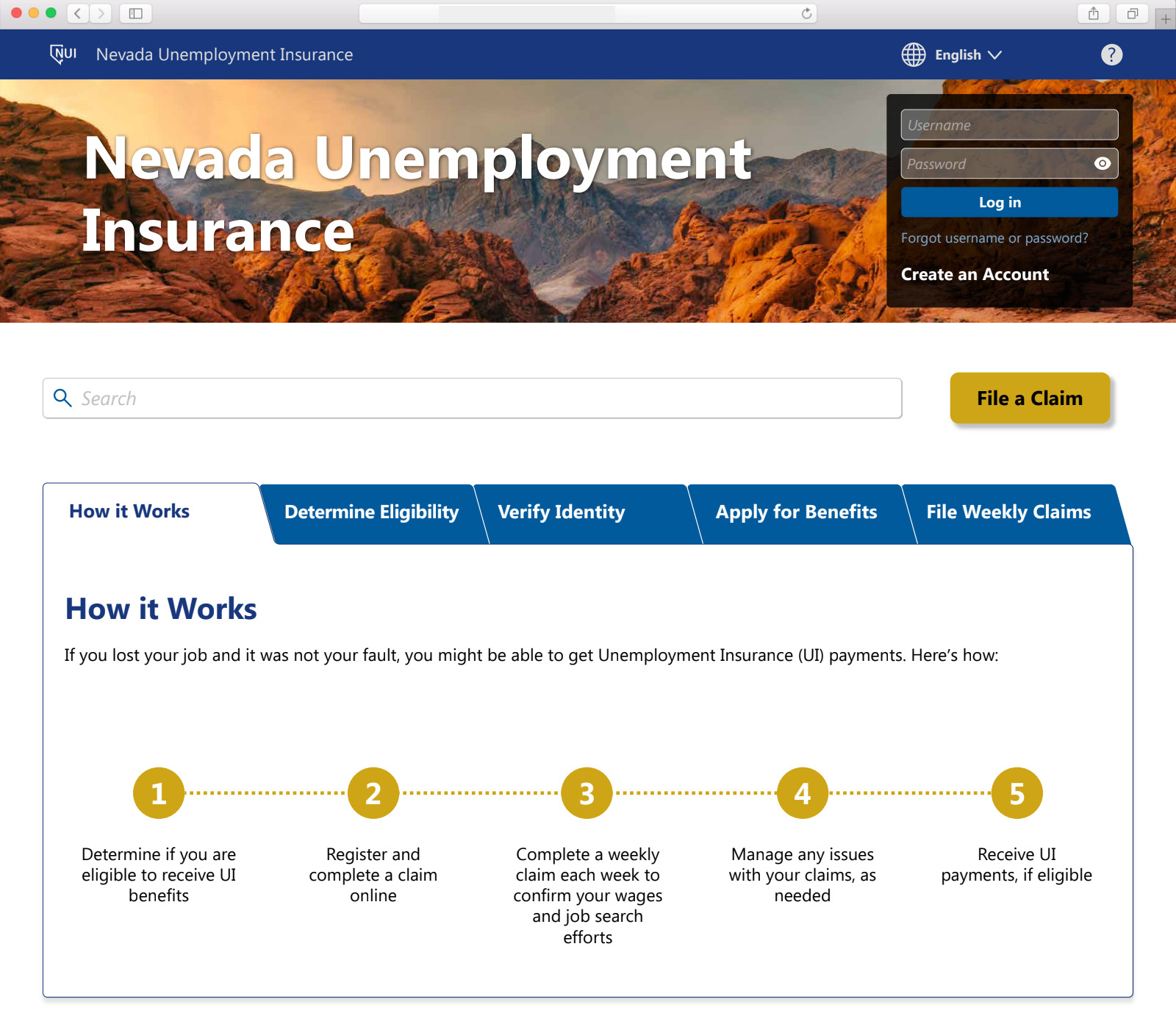
- In-person: We simplified the enrolment process for a teen internship program (see page 5) by replacing multiple paperwork requirements with a single form that public schools could easily provide, increasing applications.
Incentives
Incentives are a great way to motivate engagement, but it's not only the value of the incentive that matters. How you design and frame the benefits can make a huge difference. For example:
- Regret lottery: We helped the City of Gresham in Oregon increase participation in AutoPay for utilities through an innovative form of incentive. We let residents know that they had been entered into a lottery, but could only claim their prize if they signed up. This is fundamentally the same as a lottery where you need to sign up to enter, but taps into "regret aversion." It more than doubled sign-ups compared to no incentive, and was 24% more effective than the traditional lottery framing! You can read more about it on page 46 of this report.
- Matching incentives: To support emergency savings among low-income residents in Rochester, NY, we tested different forms of incentives. We found that a 50% savings match was the most effective incentive, leading to higher program retention and increasing savings 40% more than those who received no match. You can read more about it and other municipal uptake strategies here (see page 7 for this example).
Policy
When feasible, developing organizational or public policy using evidence from behavioral science can dramatically boost uptake.
- Defaults: People usually stick with the default option they're given. To increase uptake of workplace pension programs in the UK, BIT helped design a national policy that auto-enrols employees (with the option to opt out). Millions of UK workers are now taking part.
5 Measure how it's working
While there is no single right way to evaluate, randomized controlled trials (RCTs) are often a highly rigorous and feasible option for understanding the impact of uptake campaigns. We should know, as BIT has run more than 800 RCTs all over the world!
BIT partnered with Singapore's Public Utilities Board to increase uptake of a smart water meter app. We evaluated the solution through a practical but innovative RCT. First, households were randomly assigned to receive either the status quo invitation to participate (our "control") or a new invitation inspired by behavioral science (our "treatment").
We then took the households that still hadn't registered two months later and randomized them again and sent them two different reminders, this time in the form of a highly visual pamphlet. The new "treatment" version was again inspired by behavioral insights. Registration rates were significantly higher for the treatment groups in both rounds. Because it was an RCT, the client could be confident that these sign-ups were due to our solutions.
"When I got the letter, I was shocked that I was using so much water! I thought I better download [the app] and see where I can reduce my water."
RCTs offer a great combination of rigor and simplicity, but they are just one of the many rigorous evaluation methods that could help you to understand the effectiveness of your intervention. At BIT, we regularly conduct evaluations using Predictiv – our online experimentation lab – where we design and conduct sophisticated trials simulating real-world settings. This gives you quick, low-cost data to refine and further evaluate your solution with confidence, which is especially useful for pre-testing communications or digital journeys.
Let's talk uptake
Do you have a program or service that isn't maximising its reach and impact?
Get in touch to discuss how our expertise in evidence-led problem solving can help you boost engagement and uptake.
Get in touch