About the Challenge Prize Centre
The Challenge Prize Centre was launched in April 2012 and brings together the growing expertise and interest in challenge prizes.
This will help build an understanding of how challenge prizes can play an effective and strategic role in the stimulation and support of innovation.
Visit: www.challengeprizecentre.org to find out more.
Nesta
About Nesta
Nesta is an innovation charity with a mission to help people and organisations bring great ideas to life.
We are dedicated to supporting ideas that can help improve all our lives, with activities ranging from early-stage investment to in-depth research and practical programmes.
Nesta is a registered charity in England and Wales with company number 7706036 and charity number 1144091. Registered as a charity in Scotland number SCO42833. Registered office: 1 Plough Place, London, EC4A 1DE.
www.nesta.org.uk
©Nesta 2016
PARTNERS
We worked with a number of partners to maximise the potential of the challenge and its outcomes. We would like to take this opportunity to thank them for their contributions in making the challenge such a success. Special thanks go to Jo Tasker for her hard work and dedication to supporting the programme.
FUNDING
Winton Charitable Foundation donated £25,000 for the winning entry and seeks to support science, technology, engineering and maths education, the development of science and the study of risk and statistics for the public benefit.
WINTON icon
UK Space Agency
A government agency responsible for government policy and key budgets for space exploration. It represents the United Kingdom in all negotiations on space matters and related benefits.
UK SPACE AGENCY icon
Raspberry Pi
The Raspberry Pi is a low cost, credit-card sized computer that plugs into a computer monitor or TV. As well as funding, Raspberry Pi provided kits for each participating team.
Raspberry Pi icon
DELIVERY
Satellite Applications Catapult/National Space Academy
Expert in satellite applications, Space and STEM education, providing a range of GNSS/GPS data, support and expertise in the field.
CATAPULT Satellite Applications icon
StemNet
StemNet run the UK's only network of STEM Ambassadors: inspiring volunteers giving their time and support to promote STEM subjects to young learners.
STEMNET icon
Ignite Futures
Ignite! works with young people to reveal and develop their capacity for creativity and creative thinking. Ignite deliver the Art Science Prize in the UK.
Ignite! icon
Technopop
Technopop is a social enterprise driven by the ever-growing skills gap in industry. The Technopop Team is dedicated to driving the uptake of STEAM subjects and careers through the engagement and enlightenment of school children and their teachers.

The Big Bang UK Young Scientists & Engineers Fair is the largest celebration of science, technology, engineering and maths (STEM) for young people in the UK.

COMMUNICATIONS
National Schools Partnership
NSP used their extensive network of contacts at schools all over the UK to raise awareness of the challenge and stimulate registrations.
national schools partnership icon
FOREWORD
Longitude Explorer is the first challenge prize that Nesta's Challenge Prize Centre has developed specifically to engage young people, aged 11-16. Our aim was to encourage young people to shift from solely being consumers of satellite applications, which have a significant impact on almost every aspect of their lives, to become the creators, designers and developers of a whole new generation of satellite applications for social good.
2014 marked the 300th anniversary of the original Longitude Prize, the first incentive prize of its kind set up by the British government to solve the problem of extensive losses at sea. It demonstrated that solutions could come from unexpected places, as clockmaker John Harrison developed the chronometer that went on to save thousands of lives, by enabling sailors to know their exact coordinates to navigate accurately. This heralded a new era of innovation.
In celebration of this achievement, Nesta extended its drive for innovation to young people all over the UK by engaging them with satellite navigation in a completely new way.
Longitude Explorer provided the opportunity to promote better use of technology for learning, rooted in evidence of impact, informed practice and a tailored approach. We challenged secondary school pupils to come up with innovative products and technologies using satellite data (GPS, communications, navigational) for social good. The young people that took part never failed to impress.
The commitment and support of the teachers and the hard work of the participating students made the pilot year of Longitude Explorer a real success, which we hope to continue with new challenges for this age group in the future.
We worked with a great range of partners and supporters, who played a variety of roles throughout the challenge and added value to the experience.
Special thanks go to Winton Charitable Foundation for their donation of £25,000 to the prize fund, which went to an all-girl team from Rendcombe College.
It was a great experience that we hope to continue to develop and deliver to schools across the UK well into the future.
1. THE CHALLENGE
This report aims to guide you through the Longitude Explorer experience, providing an overview of the challenge itself, a summary of the participants' ideas that were submitted, and an overview of the results from the evaluation process.
The Longitude Explorer Prize was designed and delivered by Nesta's Challenge Prize Centre to stimulate social innovation among young people and promote STEM education.
UK Map Diagram:
An illustration of the UK map with a point highlighting its location.
We challenged young people to come up with ideas that use navigational and observational data from satellites, for social good.
Summary of Participants and Prizes:
A visual summary indicating:
- 67 TEAMS took part from all over the UK including Northern Ireland
- £25,000 Winner
- £5,000 x 2 Runner-Up Prizes
Challenge prizes (also called 'inducement prizes') offer a reward to whoever can first or most effectively meet a defined challenge. Prizes act as a powerful incentive for meeting specific challenges, and we believe they can help stimulate new ideas for some of the most difficult challenges we face.
WHY LONGITUDE EXPLORER?
STEM education is vital to future economic growth.
Science, technology, engineering and mathematics (STEM) subjects are identified as being critical to the future industrial competitiveness of the UK and are of strategic importance to the nation due to increased competition from rapidly advancing economies around the world. In the 2011 report The Plan for Growth, the Government pronounced STEM education as the foundation of future economic success.
Infographic showing impact of the prize:
OVER 90%
of the young people involved in the prize expressed that they have developed additional STEM skills through participation in the challenge
A recent study found that the majority of 10-14 year olds in England enjoyed and were interested in science; however, only 17 per cent of these young people aspired to a STEM career. Over the last decade, the UK has experienced a marked decrease in the number of A-Level students taking mathematics, chemistry and physics. There is also a pronounced gender gap in the number of females taking science subjects, and some ethnic minority groups attain significantly below the national average in science and mathematics subjects.
Aim of the prize
Longitude Explorer Prize was a youth-focused challenge for secondary school students aged 11 to 16, which aimed to provide a practical education opportunity linking young people to the history of the Longitude Prize, while supporting them to develop STEM (science, technology, engineering and maths) skills for the 21st century.
OBJECTIVES
Our overarching objective was to inspire the next generation of inventors, designers, engineers and explorers to develop the skills required for the 21st century and to imagine a world beyond our current comprehension, which is imperative to the success of UK industry.
Graphic: 250 YOUNG PEOPLE
An illustration depicting two figures representing young people, alongside the text "250 YOUNG PEOPLE".
- Provide a practical education opportunity linking young people to the history of the Longitude Prize.
- Inform young people of the type of applications that satellite data is currently used for and how it affects their lives.
- Engage young people and support them to develop practical STEM skills linked to satellite technology, to enhance their learning and practical understanding of how they can utilise the technology to develop new products, technologies and systems for social good.
- Develop young peoples' understanding of the relevance of satellite technologies to entrepreneurship and UK industry.
- Inspire young people to consider continuing to develop their skills in space technologies.
The Challenge encouraged young people to explore ideas relating to the following areas:
Diagram: Areas of Exploration
A diagram showing six interlinked areas:
- PERSONAL SAFETY
- ENVIRONMENT
- FRIENDS & FAMILY
- EDUCATION
- ACTIVE & HEALTHY
- TRANSPORT
ENTRY CRITERIA
The Longitude Explorer Prize was open to any constituted organisation based in the UK, that works with young people aged 11-16. This included secondary schools, youth groups, museums or discovery centres. Entries were supported by teachers or youth leaders.
Entrants had to explain how they met the following Judging Criteria:
- Innovation
- Theme
- Use of satellite data
- Turning the idea into reality
- Application in the real world
- Teamwork
- Communication
THE LONGITUDE EXPLORER JOURNEY
Longitude Explorer was a staged challenge with a number of different activities that took place over the course of a year, from November 2014 - December 2015.
This provided participants with an opportunity to really develop their ideas and build their product identity.
Flowchart: Longitude Explorer Prize Journey
- Stage 1: Open Call (Entry period: November 2014 - January 2015)
- Stage 2: Semi-finalists (Semi-finalists invited to the Big Bang Fair in March 2015 and pitched their prototypes at Technopop in July 2015)
- Stage 3: Finalists (12 finalists shortlisted to showcase their ideas at TeenTech in December 2015)
- WINNERS! (Selection of 1 Winner and 2 Runners-up)
2. PARTICIPANTS, ACTIVITIES AND IDEAS
PARTICIPANTS
The entry period was open for eight weeks from November 2014 - January 2015, and a total of 67 entries were received from across the UK. Most entries came from schools located in the East of England, South West and the London area. There was also representation from Wales and Northern Ireland.
Bar Chart: Entries by Region
A bar chart showing the number of entries from different UK regions:
- London: 12
- East Midlands: 3
- West Midlands: 1
- South East: 6
- Yorkshire and Humberside: 3
- South West: 13
- North West: 10
- East of England: 16
- Wales: 1
- Northern Ireland: 1
- North East: 1
Entries were received from the following schools:
- Cardinal Pole Roman Catholic School
- Churston Ferrers Grammar School
- Coopers School
- Dalriada School
- Eskdale School
- Falinge Park High School
- Harris Academy Greenwich
- Heathrow Aviation Engineering UTC
- Katharine Lady Berkeley's School
- Nonsuch High School for Girls
- Okehampton College
- The Ockendon Academy
- Ormiston Bolingbroke Academy
- Pakefield High School
- Rendcomb College
- Richmond Park Academy
- Spalding High School
- St Ambrose Barlow RC High School
- Stokesley School
- Sutton Grammar School
- The Freeston Academy
- The Warwick School
- Thomas Deacon Academy
- The Hollins Technology College
- The Marches School
A number of the schools submitted multiple group entries and some teams submitted more than one idea. Teams comprised up to five young people, aged 11-16, and submitted entries by the deadline of 31 January 2015. Personal Safety was the most popular theme, but other themes were equally spread among the submitted ideas, as shown in the pie chart below.
Bar Chart: Teams of...
A bar chart showing the distribution of team sizes:
- One: 6 teams
- Two: 6 teams
- Three: 9 teams
- Four: 20 teams
- Five: 27 teams
Pie Chart: Distribution of Submitted Ideas by Theme
A pie chart showing the percentage breakdown of ideas by theme:
- Personal safety: 34%
- Active and healthy lifestyles: 21%
- Family and friends: 18%
- Transport: 18%
- Education: 13%
- Environment: 6% (estimate based on chart)
ACTIVITIES
Big Bang - Induction
Sixty ideas were selected and the teams were invited to an induction event held in Birmingham at the national Big Bang Fair on Friday, 13 March 2015, which is a celebration of science, technology, engineering and maths for young people in the UK. This was the first convening of over 200 participants of Longitude Explorer.
The objective of the day was to provide inspiration, information and tools to create a workbook to bring their concept to life and market.
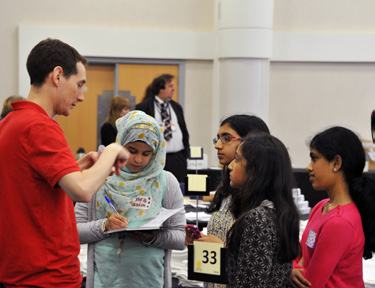
Being a part of the Big Bang Fair gave the young entrants the opportunity to meet their peers, visit the fair and also network with the Longitude Explorer partners and other relevant exhibitors on their stands.

The day began with an introduction from Nesta offering an overview of the Prize journey, and comedian Chella Quint delivered a bespoke comedic set inspired by the shortlisted entries. Engagement continued with interactive workshops where entrants were tasked with visualising their ideas and prompted to think how they may be sold and marketed. Practical tasks included creating advertising for their products. STEM ambassadors were on hand to assist the teams and provide additional information, coaching and expertise, including advice on 3D printing from Itis3d.
Inspirational talks by the Explorer partners, Raspberry Pi, UK Space Agency and Satellite Applications Catapult, also provided a broader perspective on the importance of satellite data in relation to future career opportunities.
The students were also given an opportunity to visit the Big Bang show floor to source information from exhibitors that would help them develop their products.
The day culminated in the presentation of CREST Award certificates – the first stage of the entry was equivalent to a Bronze Stage certificate in the British Science Association's Award scheme.
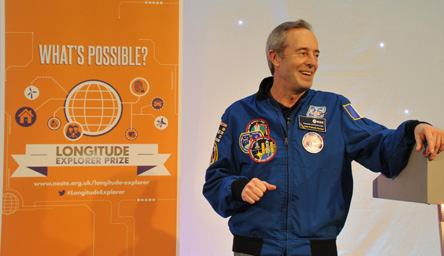
Everyone present - both young and old 'Longitude Explorers' - had the pleasure of meeting and listening to Jean-Francois Clervoy, who regaled the audience with tales from his experience on the International Space Station and gave out the CREST Award certificates to the excited recipients.
"When I challenged our STEM students with the Longitude task they jumped at the opportunity and put time and effort into their work. Their excitement when they got to the regionals in Birmingham, and the brilliant idea of using the Big Bang as a venue, was really motivating. When they progressed further to Technopop in Brixton, London, the excitement and motivation was intense. A brilliant and challenging event."
Bob, Thomas Deacon
"I remember going to Birmingham with my team, somewhere I had never been before. I was so intrigued by the Astronaut that had visited and was amazed by the fact that he had actually gone to space. We had learnt so much from the other group that we were paired with and from their idea. It helped so much to see what they came up with and how they planned to do it."
Shakira, Cardinal Pole
PROTOTYPING
Each team was provided with a workbook to outline their action plans. This contributed to the final submission describing their journey from concept to reality through R&D, design and prototyping, marketing and commercialisation. In addition to the workbook, each team was also asked to provide a prototype of their idea.
Tools, resources and further information were included within the workbooks to assist with the prototyping process. STEM ambassadors with technical expertise were allocated to support teams in the areas of satellite data application, marketing strategy, design and/or prototype development.
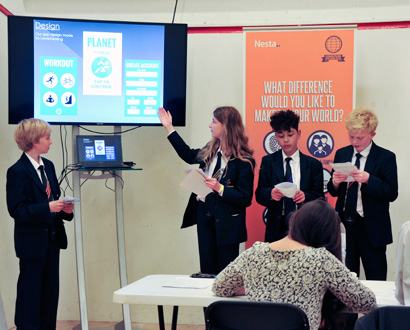
July 2015 saw the semi-final teams attending Technopop to present their final prototypes to the judges. Technopop is a festival of science, technology, design and innovation for young people, held in the Brixton Recreation Centre, South London.
Over two days, the Longitude Explorers had the opportunity to engage with an exciting mix of activities and workshops provided by Technopop and partners which included:
- Physical and competitive challenges with Classroom Medics and local sports clubs such as tennis2bee, Fit4Sport and Cage cricket.
- Tech and programming workshops with VEX Robotics, It is 3D and RAF SKYTECH.
- Science activities run by King's College London, Sphere Science, John Wood Science.
- Life-skills and career talks from Founders4Schools, Augmented Vacancies, Lambeth College and South Bank UTC.
The event certainly inspired students and provided them with an exciting picture of what STEM can involve. However, the main purpose of this event was to give our semi-finalists a chance to present their prototypes.
Each team had 20 minutes to pitch their product in front of the judging panel. Among great ideas and working prototypes, judges saw apps analysing soil moisture, wristbands tracking elderly people with dementia, an online platform connecting new university students, or fitness apps planning and analysing your workout.
There was some drop-out at this stage and 44 teams presented their prototypes. The judges were very impressed by the creativity, passion and huge amount of thought that all of the students had put into their work for the Prize and the presentations.
In August 2015, Nesta's team finished assessing the workbooks against the criteria and compared the scores with the judges' recommendations to select 12 finalists. The assessors and judging panels agreed that selecting the finalists was a very difficult decision.
At the event we received over 100 survey responses from students. Key findings are included in the Evaluation section.
"During the process of this competition, we have spent hours trying to improve our product, our ideas and our teamwork skills. This is what I loved so much about this competition; the aspect of learning a variety of skills."
Onder, Cardinal Pole
Final Award Event - TeenTech
The selected finalists were given a couple of months to further develop their prototypes, polish their presentation skills and finalise marketing resources to showcase their technologies at the TeenTech event that was held at the Copperbox Stadium, Queen Elizabeth Olympic Park in London.
Each team was able to exhibit their product and produced a range of marketing materials to showcase. The judges and TeenTech visitors were hugely impressed by the amount of work all young people put into preparing their stands. Among the promotional materials and business products we saw were wristbands, posters, flyers, t-shirts, key rings - all customised to reflect the teams' ideas. The visitors were able to play around with the prototypes to see how each idea worked.
The final round of judging focused on product development and team interactions with the public. At the Award Ceremony the winning school was awarded £25,000, each runner up received £5,000 and all students received individual prizes, including iPads, Raspberry Pi kits, SamLabs kits and trophies.
TeenTech visitors were also asked to vote for their favourite stand. The student choice winners were announced at the TeenTech closing ceremony on the day.
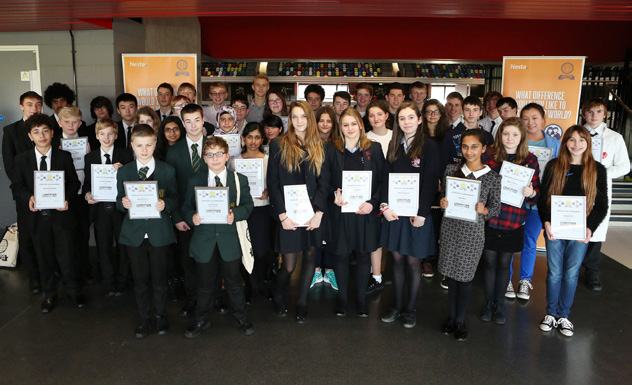
WINNERS
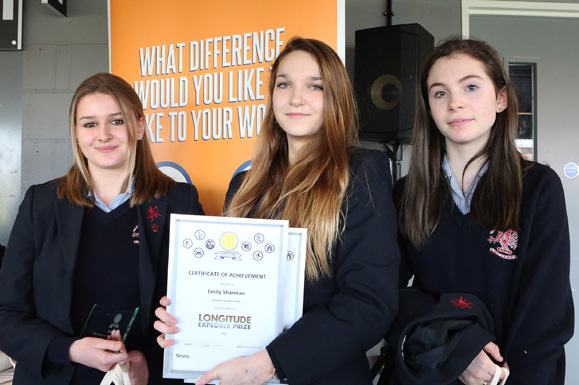
Displaced - Tromless Hackers (Rendcomb College)
'Displaced' is a cloud-hosted mobile web app that uses live GPS data collected from mobile devices to allow local charities to better coordinate the logistics of supporting homeless and vulnerable people.
With location data and notes provided by users, the app will allow charities to better coordinate the logistics of supporting vulnerable people around the world.
The all-girl team from Rendcomb College won £25,000 for the school, as well as individual prizes including iPads or SamLab kits.
"It was a really interesting experience. We'd definitely recommend that other young people try it - particularly girls. There's a gender imbalance in tech and it really needs to end. We like the idea that more girls get into tech because of the competition.”
“The only person who can bring your idea to life is you – so if you have an idea that nobody else has tried then you need to work on making it happen!”
1ST RUNNER-UP
Safety.net - Keep Me Safe (Sutton Grammar School)
Keep-Me-Safe team from Sutton Grammar School was announced as the first runner-up and won £5,000 for their school, and individual prizes such as Raspberry Pi kits and Fit-Bits.
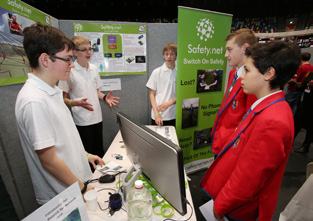
Based on their own experiences, the team came up with the idea Safety.net that enables teachers to see where their students are at all times thanks to wristbands and a simple app. That gives students on field trips and expeditions the freedom to explore and adult guardians the ability to monitor their safety.
Run using a Raspberry Pi, the absence of a screen means the battery lasts for several days without charging - ideal in a wilderness environment.
2ND RUNNER-UP AND STUDENT CHOICE AWARD:
Fast Aid - Jeremy Team (Churston Ferrers School)
The Jeremy Team from Churston Ferrers Grammar School were named second-place runner up winning £5,000 for the school and individual prizes.
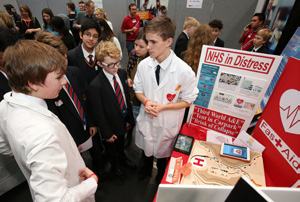
Fast Aid is a data collection and navigation tool to be located in ambulances which will help crews to check live data about nearby hospitals including details of available beds and facilities. The team was also named people's choice winners by TeenTech attendees.
OTHER FINALISTS
MapShot - Dalriada Robotics (Dalriada School)
Enables users to take scientific readings from satellites and upload them to a global online forum where they can be converted into infographics. The visualisations can promote discussion and collaboration between researchers in different fields.
Proximity Safety Unit - Salutem Aviation (Okehampton College)
An aviation system that relays live-stream data via satellite systems directly from a plane to ground control and data collection posts, enabling investigators to immediately discover key flaws in a plane's flight or instruments.
Land Identifier - Team Just (Spalding High School)
To help farmers and agronomists in the developing world to measure and map soil moisture in real time, to maximise the potential crop yield.
Riversearch for Schools - The Warwick Wizards (The Warwick School)
To enable groups to monitor sections of watercourse or pond, and to measure biological and chemical indicators to determine the ecological status.
Planet Fitness - GALL (Thomas Deacon Academy)
An app which uses GPS satellite information to track users during open-air exercise, customising outdoor workout programmes to location and person.
Sun Watch - The Inventors (Spalding High School)
A piece of wearable tech which uses satellite and UV index information to warn users if they are in danger of skin damage due to exposure to the sun.
SafeHaven - The White Van Man (Thomas Deacon Academy)
A tool which uses GPS information to map safe places for young people when they are feeling vulnerable or threatened. Once activated, the nearest safe haven will be alerted.
Bee there - Bee there (Churston Ferrers Grammar School)
A tracking system which uses satellite information and crowdsourced reporting to locate local bee groupings, allowing scientists to study how the environment and location might affect population numbers.
ZAPP - QWERTY (Churston Ferrers Grammar School)
An alarm clock app which employs live open data on traffic, public transport disruption and weather to work out the best time to wake users in order to meet the demands of their schedule.
3. EVALUATION
"The Project has been very mind opening, in a world perspective. Working in teams can be challenging at times, but when things pull through you get a great feeling of achievement. The challenge has been very good for team-building and learning how to cooperate with people, presenting and working. If given the opportunity, I would definitely take the challenge again!”
Jack, Churston Ferrers School
Evaluation is a core aspect of every challenge prize. In running the evaluation we aim to share results in a transparent way, learning from the evidence and engaging stakeholders by allowing them to contribute in the observation and assessment of the change generated.
The evaluation is comprised of an impact assessment and a process evaluation. The impact assessment is aimed at identifying whether the challenge achieved significant impact against the objectives. The process evaluation focused on the prizes' activities to understand whether they were suitable for the intended purpose.
The prize was designed to reach five main objectives:
1 Provide a practical education opportunity linking young people to the history of the Longitude Prize.
2 Inform young people of the type of applications that satellite data is currently used for and how it affects their lives.
3 Engage young people in and support them to develop practical STEM skills linked to satellite technology, to enhance their learning and practical understanding of how they can utilise the technology to develop new products, technologies and systems for social good.
4 Develop young peoples' understanding of the relevance of satellite technologies to entrepreneurship and UK industry.
5 Inspire young people to consider continuing to develop their skills in space technologies.
METHODS
The overall evaluation shows a positive achievement of all objectives and an overall satisfaction with the Challenge Prize experience. Seventy-two per cent of the teachers considered the Challenge a suitable learning tool for young students, 100 per cent of the teachers from the finalist teams would participate again, and would recommend the Challenge to a colleague. As for the students, for 90 per cent of them this was the first challenge they were involved in, 83 per cent of them judged it a very good or excellent experience, and 15 per cent a good experience.
"I enjoyed getting to create a new idea that will aid communities locally and hopefully globally too."
Student
We conducted three different surveys, as listed in the table below. All surveys were run in parallel with the main events, in order to be able to engage with the highest number of stakeholders.
| ACTIVITY FOR IMPACT EVALUATION |
METHOD USED |
WHEN |
WHO WE ENGAGE |
RESPONDENTS |
| 1.Process monitoring |
Semi-structured survey |
At the Big Bang event in March 2015 |
Teachers from all the schools |
14 respondents out of 28 teachers |
| 2.Process evaluation and impact assessment |
Semi-structured survey |
At the Technopop event in July 2015 |
Students reaching semi-finalist status |
108 respondents out of an estimated 150 students belonging to 40 teams |
| 3.Process evaluation and impact assessment |
Semi-structured survey |
At the Teen Tech event in December 2015 |
Teachers of the students who reached finalist status |
Six respondents out of eight |
1. Process monitoring
At the Big Bang event in March 2015, we ran the first survey designed to collect feedback on the ongoing prize activities, as well as asking preferences for next stages and events. The principle aim of the survey was to monitor the relevance of the activities and address any particular needs. We engaged teachers of the semi-finalist groups.
2. Process evaluation and impact assessment
At the Technopop event in July 2015, we ran the evaluation survey with students. The survey included questions about the process and questions about the results of the prize. At this stage we were able to survey all the semi-finalists.
At the TeenTech event in December 2015, we ran a final evaluation survey with the teachers from the finalist groups. This survey aimed to evaluate process improvement from the previous survey, and to assess teacher satisfaction with the prize programme.
RESULTS
The evaluation proved that the Challenge was a useful tool to introduce innovation as a topic and entrepreneurial skills within schools. Both teachers and students reported very positively on the topic choices, activities and learning outcomes of the Longitude Explorer Prize journey.
Impact Assessment – objectives results
The evaluation reported an overall positive achievement against the five objectives of the Challenge Prize (see Annex 2). Teacher responses were really positive, in that they confirmed the strengths of using a prize as a learning tool. The students' survey provided a deeper assessment of the learning outcomes generated by the challenge.
"Technology and innovation competitions are great opportunities to meet new friends, hone presentational skills and learn more about the vast field that encompasses technology – other entries to the Longitude Explorer Prize include a redesigned black box for aircraft and GPS tracking devices for pupils on field trips. I have to say, that if you are enthusiastic about technology in any sense, please do enter competitions – you will be surprised at how far they take you.”
Teacher
"It has been a memorable experience. I have enjoyed the time I have spent with my friends on this venture. I have enjoyed seeing how well we work together as a team to complete tasks. I have also enjoyed expanding my skills as a person and the opportunities this will give me later on in life. I think this will look amazing on my CV and will reflect well on me when applying for university or jobs. It has given me leadership skills, it's given me team building skills and understanding of how the world works. It has also meant I have become better at having entrepreneurial skills."
Student, 14 years old
Teachers
According to teachers, the challenge proved to be a practical education opportunity which informed young people of the type of applications that satellite data is currently used for and how it affects their lives.
Though some teachers highlighted the difficulty in introducing a challenge prize during the academic year, all of them agreed that the challenge is a great learning experience for students and they would encourage other colleagues to participate in a challenge with their class.
"This was a great opportunity to work on a project with real life application. The students learnt a lot through being involved in the challenge prize, about the science behind our app idea, also team working and communication and presentation skills."
Teacher
In one teacher's personal opinion, the best aspects of the Challenge were:
"Being able to take part in the whole journey from concept to presentation, a good introduction to real world problem-solving and the need to engage with experts along the way and focus for a long period."
Teacher
"Watching the students taking part to learn and develop their skills."
Teacher
As further confirmed by the students' evaluation, the challenge succeeded in inspiring young people to consider continuing to develop their skills in satellite technologies.
Students
Students' overall learning outcomes from the challenge were very positive and the challenge gave the students the opportunity to participate in a different learning experience.
"I have loved working with people whom I would not normally have a chance to work with."
Student, 14 years old
The Challenge engaged students in developing practical STEM skills linked to satellite technology to enhance their learning and practical understanding of how they can utilise the technology to develop new products, technologies and systems for social good. It also developed their understanding of the relevance of satellite technologies to entrepreneurship and UK industry.
In particular, students confirmed a great interest in STEM education, technologies and innovations. Also, the Prize demonstrated that it was a useful tool to aid the development of social innovation skills amongst young people. The participants confirmed they had gained entrepreneurial, business and marketing skills from this experience.
More specifically, for 90 per cent of the students this was the first challenge they had been involved in, and 98 per cent of them valued the overall challenge experience as positive. Also, 87 per cent of the students found the topic interesting, fascinating or exciting, and 93 per cent of the students stated that they gained a better understanding of how to bring an idea into market.
Pie Chart: Student challenge prize experience
- Excellent: 55%
- Very Good: 29%
- OK: 15%
- Poor: 2%
Pie Chart: Students who learnt how to bring an idea into market
- Yes: 93%
- No: 6%
- N/A: 1%
Seventy-three per cent of the students developed good additional STEM skills thanks to the Challenge, and 96 per cent of them would be willing to develop further STEM skills in the future. Additionally, 12 per cent of the students reported improvement in tech knowledge, 14 per cent in tech practical skills, 34 per cent in entrepreneurial skills, and 11 per cent of the students reported having a better understanding of the UK tech job industry.
I have learnt...
"That there is a wider range and more jobs in what I find interesting."
Student, 12 years old
"Keep working hard when times get tough. There are so many jobs out there in STEM."
Student, 13 years old
In addition to STEM skills and practical technologies, the challenge has taught students a whole range of entrepreneurial and business skills, as referenced in the following quotes:
I have learnt...
"How to make a good presentation and to work as a team."
Student, 11 years old
"How to work under pressure, how apps and prototypes are created, team work, presentation skills, etc."
Student, 12 years old
"I have learnt that having entrepreneurial skills is near essential in being successful in this day and age."
Student, 15 years old
"The challenge was an opportunity to inspire innovation and ideas in students."
Teacher
I have learnt...
"How hard it is to develop your idea and changing that idea into reality. I learnt how hard it is and how rewarding it is as well."
Student, 12 years old
"Trying something new can be a door to opportunities."
Student, 12 years old
Area Chart: Particular area of student improvement
An area chart showing the percentage of students reporting improvement across different areas:
- Tech knowledge: 12%
- Tech practical skills: 14%
- Entrepreneurial skills: 34% (peak)
- UK job industry: 11%
- Others: 18%
- No answers: 20%
- None: 0%
Pie Chart: Students' favourite aspect of the challenge
A pie chart showing the distribution of students' favourite aspects:
- The whole prize experience: 26%
- Learning at Big Bang and workshop: 19%
- Creating ideas and prototyping: 11%
- Learning STEM, tech, data: 9%
- Team work: 9%
- Testing and making ideas real: 8%
- Looking to other ideas and competing: 8%
- Others: 4%
- No answers: 6%
Evaluation of the process
Both teachers and students gave overall positive feedback on the Prize activities. Even though some students (13 per cent) would have preferred to have more time to develop their idea, the majority of them expressed positive comments on the main Challenge activities, as shown in the following diagram. In particular, 75 per cent of the students state that the Challenge was very useful in learning how to turn ideas into reality, 70 per cent of them said the teamwork-building skills were very useful, and 55 per cent valued highly the workbook and the workshop at the Big Bang event.
Bar Chart: Students' judgement: Extent to which each activity was useful to learn
A bar chart comparing responses for usefulness across different activities:
- Workshops at the Big Bang:
- Negative: 15%
- Positive: 60%
- Slightly positive: 25%
- Teamwork:
- Negative: 10%
- Positive: 65%
- Slightly positive: 25%
- Completing workbook:
- Negative: 20%
- Positive: 55%
- Slightly positive: 25%
- Turning idea into reality (prototyping):
- Negative: 10%
- Positive: 75%
- Slightly positive: 15%
Teachers and students made some suggestions on the logistical aspects of the Prize. In particular, a minority of them found the journey to the events quite long. However, considering the fact that all schools were from different regions in the UK and had to be gathered in one location, it was to be expected that some would have a longer travel time than others.
Teachers also suggested receiving more support from experts during the various Challenge stages. In particular for this Challenge, they felt additional support from STEM Ambassadors would have been useful.
4. ANNEXES
Objectives evaluation summary
This is a status summary of the evaluation results in relation to the objectives of the challenge.
Key
- 100% positive results
- From 80% to 99% positive results
- From 60% to 79% positive results
- From 40% to 59% positive results
- Less than 39% positive results
| Objective |
Key performance indicators |
Stakeholder interviewed |
Result |
Key |
| 1. Provide a practical education opportunity linking young people to the history of the Longitude Prize |
Prize as a learning tool |
Teachers |
72% of the teachers considered it a suitable learning tool for students. 28% said it is not. |
(From 60% to 79% positive results) |
|
Attracting new talents |
Students |
For 90% of the students this was the first challenge they were involved in, and 83% of them judged it a very good or excellent experience. |
(From 80% to 99% positive results) |
|
Willingness to participate in Prize |
Teachers |
100% of the teachers would participate again and would recommend the Challenge to a colleague. |
(100% positive results) |
| 2. Inform young people of the type of applications that satellite data is used for and how it affects their lives |
Increase in learnings in satellite data |
Teacher |
100% of teachers said the Challenge encouraged young people in learning more on use of satellite data. None expressed negative comments. |
(100% positive results) |
|
Level of interest in the topic |
Students |
87% of the students find the topic interesting, fascinating or exciting. |
(From 80% to 99% positive results) |
| 3. Engage young people in and support them to develop practical STEM skills linked to satellite technology... for social good. |
Use of satellite data topic to support STEM education |
Teachers |
73% of the students developed good additional STEM skills thanks to the Challenge and 23% of them developed some additional STEM skills. |
(From 60% to 79% positive results) |
|
Improvement in young people STEM skills |
Teachers |
100% of teachers said that satellite data is a very useful topic to support STEM education. None expressed negative comments. |
(100% positive results) |
|
Encourage young people in developing STEM skills for social good |
Students |
100% of teachers said the Challenge encouraged the development of ideas to tackle social problems. None expressed negative comments. |
(100% positive results) |
| 4. Develop young peoples' understanding of the relevance of satellite technologies to entrepreneurship and UK industry |
Improvement in students' entrepreneurial, tech and UK industry knowledge |
Students |
12% of the students reported improvement in tech knowledge, 14% in tech practical skills, 34% in entrepreneurial skills, and 11% of the students reported better understanding of the UK tech job industry. |
(From 40% to 59% positive results) |
| 5. Inspire young people to consider continuing to develop their skills in space technologies |
Understanding practicalities of becoming an entrepreneur |
Teachers |
100% said the Challenge developed their understanding of practicalities to become entrepreneurs. None expressed negative comments. |
(100% positive results) |
|
Improvement of business skills |
Teachers |
100% said the Challenge provided an opportunity for students to improve communication skills, team work, and prototyping skills. |
(100% positive results) |
|
Teacher judgement on Prize as a tool to inspire students |
Teachers |
100% said the Challenge spurred innovative ideas in schools and students. None expressed negative comments. |
(100% positive results) |
|
Students' commitments to developing STEM in the future |
Students |
68% of the students want to develop STEM skills in the future, 28% are quite committed and 4% of the students don't think they will commit any further. |
(From 60% to 79% positive results) |
Process evaluation summary
This is a status summary of the challenge process.
| Prize Process Activities |
Stakeholders |
Result |
Key |
| Information received by LEP team |
Teachers |
57% said it was very good or excellent. 43% said it was fair. None expressed negative comments. |
(From 40% to 59% positive results) |
| Time required to participate |
Teachers |
72% said it was good or excellent. 28% said it was ok. None expressed negative comments. |
(From 60% to 79% positive results) |
|
Students |
13% of the students would have wanted more time to develop and test their ideas. |
(Less than 39% positive results) |
| The materials available to support completion of the Challenge (training pack and online materials) |
Teachers |
72% said it was good or excellent. 28% said it was fair. None expressed negative comments. |
(From 60% to 79% positive results) |
|
Students |
55% find it useful. 23% find it slightly useful. 22% said it was not useful. |
(From 40% to 59% positive results) |
| Team work |
Teachers |
86% said the Challenge enhanced team work a lot. 14% said it helped a bit. None expressed negative comments. |
(From 80% to 99% positive results) |
|
Students |
70% find it useful. 23% find it slightly useful. 7% find it not useful. 9% of the students said it was the best part of the Challenge experience. |
(From 60% to 79% positive results) |
| Prototyping – turning ideas into reality |
Teachers |
100% judged the prototyping of ideas useful |
(100% positive results) |
|
Students |
75% of students said prototyping was useful. 20% said it was slightly useful and 5% expressed a negative judgement. 34% of the students considered the prototyping the best part of the Challenge. |
(From 60% to 79% positive results) |
| Final events (Technopop/ TeenTech) |
Teachers |
72% rated the event very good or excellent. 28% rated it fairly good. None expressed negative comments. |
(From 60% to 79% positive results) |
| Middle term Big Bang Fair and workshop |
Teachers |
72% rated the event very good or excellent. 28% rated it fairly good. None expressed negative comments. |
(From 60% to 79% positive results) |
|
Students |
55% of the students said the workshop was very useful. 30% said it was slightly useful. 15% expressed a negative comment. 19% of the students considered the Big Bang Fair the best part of the prize. |
(From 40% to 59% positive results) |
Nesta
1 Plough Place, London, EC4A 1DE
[email protected]
@nesta_uk facebook.com/nesta.uk
www.nesta.org.uk
Nesta is a registered charity in England and Wales with company number 7706036 and charity number 1144091. Registered as a charity in Scotland number SCO42833. Registered office: 1 Plough Place, London, EC4A 1DE.
Creative Commons License
CC BY NC SA