
The family navigator journey
Engagement pipeline
As part of the Family Hubs Pregnancy Grant pilot, half of the grant recipients are randomly assigned to the ‘Navigator’ condition. These parents should receive a phone call from a Family Navigator soon after they are offered the grant. During this phone call, the Family Navigator tells the recipient about Family Hubs, describes the support available at Family Hubs that is relevant to them, and offers to schedule a time to meet the parent at their closest Hub for a tour (see Navigator Conversation Guide in our Toolkit for more details).
Overall, out of the grant recipients who are in the ‘Navigator’ condition, just over half (54.6%) have spoken with their Family Navigator on the phone and 15.8% had completed a Family Hubs tour.
Figure 6 shows the engagement pipeline for parents in the Navigator condition.
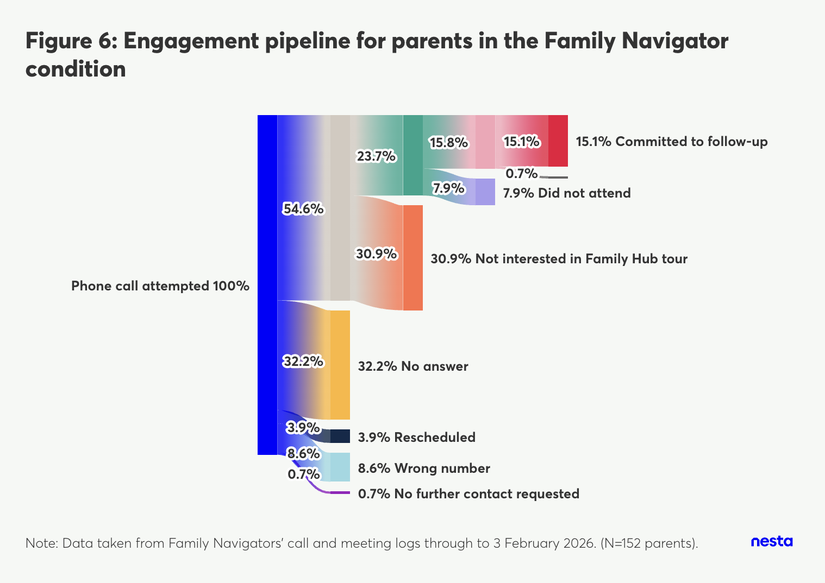
Figure 6
Image Description
A Sankey diagram titled 'Figure 6: Engagement pipeline for parents in the Family Navigator condition'. It illustrates the flow of engagement starting from a single vertical blue bar on the left labeled 'Phone call attempted 100%'. This 100% splits into five paths: 54.6% continue down the pipeline, 32.2% result in 'No answer', 8.6% result in 'Wrong number', 3.9% are 'Rescheduled', and 0.7% request 'No further contact requested'. The 54.6% group then splits, with 23.7% continuing on and 30.9% being 'Not interested in Family Hub tour'. The 23.7% group splits again, with 15.8% continuing and 7.9% marked as 'Did not attend'. Finally, the remaining 15.8% splits into 15.1% who 'Committed to follow-up' and an unlabeled 0.7% drop-off. A footnote at the bottom reads 'Note: Data taken from Family Navigators' call and meeting logs through to 3 February 2026. (N=152 parents)'.
Engagement with the Family Navigator
Early data suggests that the Family Navigator outreach is well-received, though there are emerging challenges around how parents recognise and prioritise these contacts.
Overall, parents we surveyed and interviewed were positive about receiving a phone call from a Family Navigator. Of the survey respondents who had spoken with their Family Navigator, 85% reported that the conversation was either ‘helpful’ or ‘very helpful’ (Figure 7).
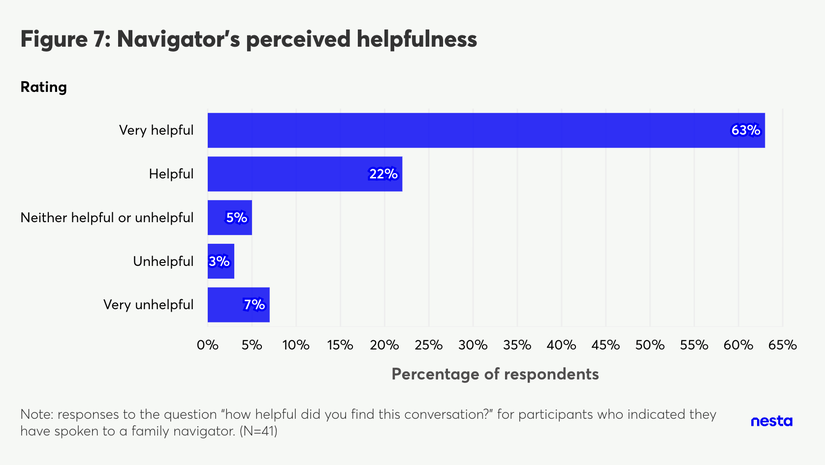
Figure 7
Image Description
A horizontal bar chart titled 'Figure 7: Navigator's perceived helpfulness'. The vertical axis lists 'Rating' categories, and the horizontal axis measures the 'Percentage of respondents' from 0% to 65%. The blue bars show the following distribution from top to bottom: Very helpful at 63%; Helpful at 22%; Neither helpful or unhelpful at 5%; Unhelpful at 3%; and Very unhelpful at 7%. A footnote at the bottom reads 'Note: responses to the question "how helpful did you find this conversation?" for participants who indicated they have spoken to a family navigator. (N=41)'.
In interviews, parents frequently described the initial call positively:
“really nice and helpful.”
Interviewee 13, pregnant with first child, navigator condition
“[I appreciated] speaking to someone from the team who told me about the services and if I’m interested in looking around Family Hubs - I think this is good as I have my first child in lockdown”
Survey respondent 4, pregnant with second child, navigator condition.
However, the perceived value of the call depends on parents’ experiences and preferences. Parents who already had children were less likely to find the call personally helpful, but these parents say they still feel it is a valuable offer for others.
Among those who did not find the call useful, some interviewees talked about preferences for how they receive information, saying they would prefer to do their own research online. Parents’ varying preferences for how they receive information speak to the importance of multi-modal communications, combining phone calls with optional meetings, written communication, and accessible, easy-to-find information on the council’s website.
Barriers to engagement: timing and ‘mental load’
We heard from some parents who wanted to engage with the Family Navigator but felt they were not ready or did not have the time. Some parents reported missing calls or intentionally delaying the conversation until they felt better equipped to process the information. One interviewee noted:
“She has texted me to give her a call back, which I need to do, but, haven't, because I need to go see her, and I feel like I need to find the right time, and… it's just been a stressful few weeks.”
Interviewee 11, pregnant with second child, navigator condition
Others noted that the call came at an inopportune time - for instance, during school holidays when parents were busy with older children at home.
Similarly, as shown in the engagement pipeline diagram above, some parents spoke with the Family Navigator over the phone and were interested in meeting, but were unable to attend due to illness and other life events:
“I was meant to meet them in person. Um, but I've been really busy because I've been attending viewings - I'm trying to move. Um, so I've been attending viewings. I've had work, and my children have been sick. So yeah, we had to reschedule a couple of times.”
Interviewee 19, pregnant with third child, cash-only condition
For others, non-attendance was due to their pregnancy. This is to be expected, given that some grant recipients were quite far along in their pregnancy and either found it difficult to meet in person or had short-notice medical appointments to attend. Attendance rates may be higher if the tour were offered earlier in pregnancy, but this was not possible given the timing of data flows – see our Toolkit for more detail on this.
Together, these insights suggest that some parents may benefit from alternative options to engage - for example, having a Navigator recontact them a few weeks later, or after their baby is born.
Potential barriers to impact: information overload and recognition
In our survey, most parents who had not spoken to their Family Navigator said this was because the Navigator did not contact them. However, through our interviews, we spoke with some parents who selected this option in the survey, but they had in fact received the call - they said they did not understand who had called and why. Furthermore, 17% of survey respondents in the Navigator condition said they were unsure if they had spoken to their Family Navigator or not. As one parent explained:
“I get so many calls from hospitals constantly, midwives and stuff, and other places, so… I'm not sure. But I did get one call from someone.”
Interviewee 10, pregnant with second child, navigator condition
For parents who have spoken to a Family Navigator but do not remember doing so, we may expect little impact from the Family Navigator offer. This is something we will explore further in our final evaluation report to better understand which groups are most likely to benefit from the outreach.
Family navigators’ perspectives
In our interviews with the family navigators, we heard that they overwhelmingly feel that parents appreciate and welcome the call:
“Overall, it seems like women are reassured and feel cared about by us taking this extra step of calling them.”
Navigator interview 1
“You're introducing people to support services that some of them might really need and wouldn't otherwise know how to access.”
Navigator interview 2
Family navigators also reported that their work is facilitated by resources published in our Toolkit.
“We can just focus on building that relation with the women and we don't have to really overthink everything else 'cause the step-by-step process has already been there.”
Navigator interview 1
“That whole navigator toolkit is just my Bible. It's fantastic. I refer back to it all the time.”
Navigator interview 2
Together, the family navigators report that offering a service that they feel provides real value to parents and having the tools to do so makes the role feel rewarding.
“To be honest, I really enjoy the work.”
Navigator 1
The meeting and follow-up actions
Of the parents who did the Family Hub tour with a Family Navigator, they were generally very positive about the experience. One parent (Interviewee 2, pregnant with first child, navigator condition) described the Family Navigator as “very knowledgeable and very informative”, and the experience of attending the Family Hub tour as “relevant”.
Of the parents who attended a tour, meeting logs show that almost all committed to some follow-up action during the meeting. Most agreed to being recontacted by a Family Hub staff member postnatally. Around half scheduled an appointment with a benefits advisor. A smaller number signed up for antenatal classes. Some others also received practical help, such as support filling in benefits application forms or referrals to a baby bank.
More broadly, when we asked survey respondents if they intend to visit Family Hubs once their baby/babies were born, those in the Navigator condition were more likely to say ‘yes’ instead of ‘unsure’ compared with those who only received the grant.
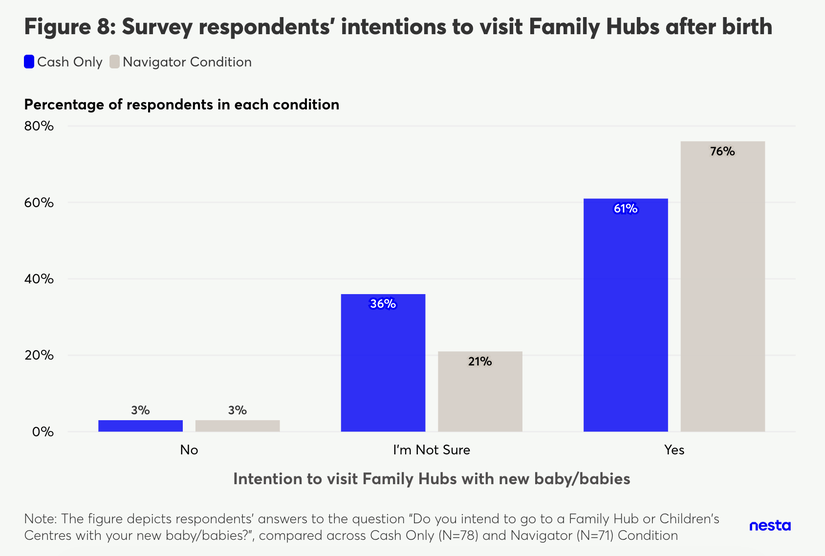
Figure 8
Image Description
A grouped bar chart titled 'Figure 8: Survey respondents' intentions to visit Family Hubs after birth'. The vertical axis measures 'Percentage of respondents in each condition' from 0% to 80%. The horizontal axis categorises 'Intention to visit Family Hubs with new baby/babies' into 'No', 'I'm Not Sure', and 'Yes'. For each category, two bars compare the 'Cash Only' group in blue and the 'Navigator Condition' group in grey. For 'No', both groups are at 3%. For 'I'm Not Sure', Cash Only is 36% and Navigator Condition is 21%. For 'Yes', Cash Only is 61% and Navigator Condition is 76%. A footnote reads 'Note: The figure depicts respondents' answers to the question "Do you intend to go to a Family Hub or Children's Centres with your new baby/babies?", compared across Cash Only (N=78) and Navigator (N=71) Condition'.
Impact of navigator outreach on grant associations
The grant was intentionally labelled as a ‘Family Hubs Pregnancy Grant’, and sent from Camden Family Hubs, with the aim of creating a ‘halo effect’ for Family Hubs.
This association was more salient for survey respondents in the Navigator group. 70% of respondents in the Navigator condition correctly remembered that the grant came from Camden Family Hubs compared with 50% those who only received the grant but with no outreach from a Family Navigator.
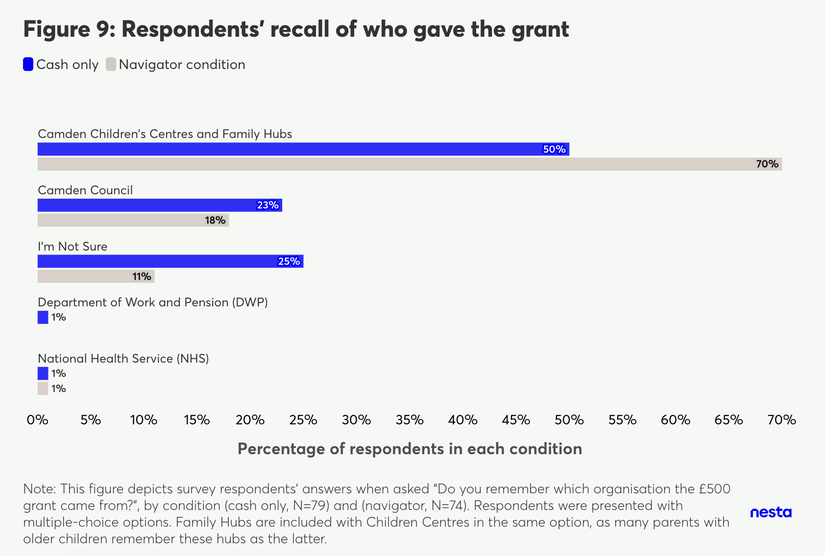
Figure 9
Image Description
A grouped horizontal bar chart titled 'Figure 9: Respondents' recall of who gave the grant'. A legend indicates blue bars represent the 'Cash only' condition and grey bars represent the 'Navigator condition'. The vertical axis lists five options, and the horizontal axis measures the 'Percentage of respondents in each condition' from 0% to 70%. For 'Camden Children's Centres and Family Hubs', the Cash only group is 50% and the Navigator condition is 70%. For 'Camden Council', Cash only is 23% and Navigator condition is 18%. For 'I'm Not Sure', Cash only is 25% and Navigator condition is 11%. For 'Department of Work and Pension (DWP)', Cash only is 1% with no bar shown for Navigator. For 'National Health Service (NHS)', both groups are 1%. A footnote details the survey question, notes that Family Hubs and Children Centres were grouped together, and provides sample sizes (Cash only N=79, Navigator N=74).
Meeting the demand for more information about Family Hubs
In order to understand different avenues to access services, we asked survey respondents what they think the council should do to support families with young children. The most common theme that emerged was a request for more proactive information and reminders about what support is available to families, “as it can be overwhelming and information is never readily accessible” (survey respondent 5).
Survey respondents suggested a number of different formats, including emails and letters, advertising, phone calls to new mothers, and “simple, quick, clear” messaging. Others expressed confusion that they thought they had to “become a member” or pay to access Family Hub services.
From what parents have told us so far, this suggests that family navigators may play an important role in spreading information about what is on offer and addressing misconceptions.