
The cash grant experience
Cash delivery
Of the 311 people offered the grant as of mid-January 2026, 82% have received it.
The main administrative challenge in delivering the grant has been dealing with gaps in the data linkage, leading to missing or incorrect contact details. The grant cannot be paid without some means of contacting the recipient, and therefore, these data gaps mean that staff must spend time chasing down parents’ correct phone numbers.
Most parents were automated into the programme through the administrative data linkage. So far, 11% of parents have self-referred to the programme. Self-referrals have increased over the course of the pilot, as knowledge of the grant has spread through word of mouth.
Parents have generally found the process smooth - with many expressing surprise about how quick and easy it was to receive the grant, and about being offered the grant without needing to apply. In our survey, 4 in 5 respondents said that the process of receiving the grant was smooth or very smooth.
As parents described:
“It was just literally that easy. It wasn't difficult at all, the process.”
Interviewee 2, pregnant with first child, navigator condition.
“I didn't even know about the grant, I've received an email and a week later the money was in my account.”
Survey respondent 1, pregnant with second child, navigator condition
To receive the grant, parents can either collect the money from an ATM using a code that is texted to them (this is the default option) or fill in a short online form to request a bank transfer. Among our survey respondents, most (59%) had chosen to receive a bank transfer instead of collecting the cash from an ATM.
Implementation challenges
Given that cash withdrawal from an ATM was the default option and the bank transfer required additional steps, it is interesting that most survey respondents had opted for a bank transfer.
One interviewee explained their reasons for choosing the bank transfer option:
"I was a bit worried about [withdrawing the grant] just because I find it a bit odd to carry that much cash with me in the street. So I've seen there's an option to just get it directly sent to your bank account, which felt safer to me."
Interviewee 15, pregnant with second child, navigator condition.
While most survey respondents said the process for receiving the grant was smooth, some found it challenging. Around 6% of respondents had not yet collected the grant at the time of the survey (5 weeks after the initial offer); they reported that this was mainly due to a lack of time or instructions, or issues with withdrawing money from ATMs. Finding an ATM that had enough cash available to complete their grant withdrawal was a recurring challenge among parents we surveyed and interviewed. One survey respondent explained that: “I did spend 1 hour 50 minutes travelling to different cash points.”
Impact of the grant
How parents spent the money
In order to understand the impact of the grant, we asked survey respondents how they spent the money. Most respondents reported that they used the grant to buy baby items, as well as to pay bills and cover their daily essential spending.
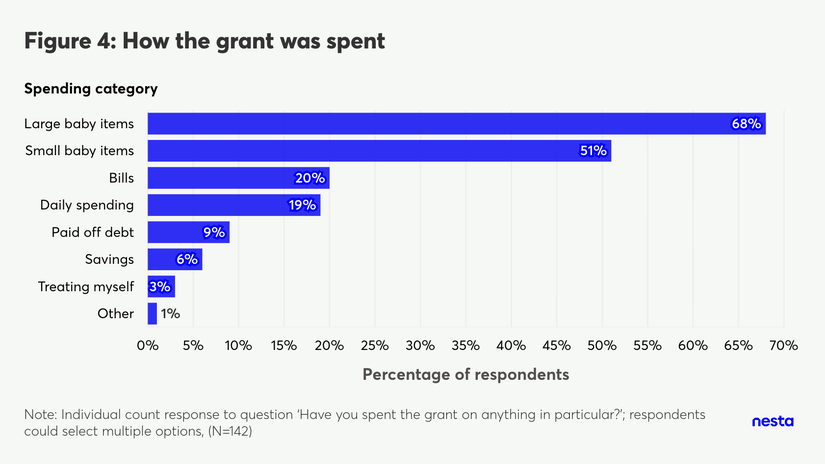
Figure 4
Image Description
A horizontal bar chart titled 'Figure 4: How the grant was spent'. The vertical axis lists 'Spending category' options, and the horizontal axis measures the 'Percentage of respondents' from 0% to 70%. The blue bars show the following distribution from top to bottom: Large baby items at 68%; Small baby items at 51%; Bills at 20%; Daily spending at 19%; Paid off debt at 9%; Savings at 6%; Treating myself at 3%; and Other at 1%. A footnote at the bottom reads 'Note: Individual count response to question "Have you spent the grant on anything in particular?"; respondents could select multiple options, (N=142)'.
Spending fell into three main categories, which interviewees described in more detail:
Large baby equipment: spending in this category looked like using the lump sum to purchase or contribute towards "big ticket" items, such as buggies and change tables.
Daily baby essentials: spending in this category looked like stocking up on consumables and smaller necessities, such as nappies and wipes, formula, clothing, and feeding equipment like bottles and sterilisers.
Bills, debts, and general cost of living: for those who used the cash this way, the grant provided a “huge sense of relief” (Interviewee 4; pregnant with fourth child, Navigator Condition) from financial pressure. Parents we spoke to mentioned using the money to pay off energy bills, council tax, and credit card debts or arrears.
Across spending categories, parents described the grant not just as financial aid, but as a significant mental relief that reduced anxiety and pressure.
"For us to receive it will be a huge burden lifted.”
Interviewee 7, pregnant with fourth child, cash - only condition.
While receiving the grant did not eliminate financial stress, parents appreciated the temporary relief:
"The grant was incredibly helpful and has lifted a bit of weight off of my shoulders. I know it's only temporary, but it was much needed. As silly as it sounds, I can put the heating on now!"
Survey respondent 2, pregnant with third child, cash-only condition.
The unconditional nature of the grant allowed parents to choose items that met their needs and preferences without feeling ‘under pressure’, contributing to a sense of dignity and independence:
"It lessened that pressure for me [and allowed me to] feel quite independent in that sense."
Interviewee 20, pregnant with first child, navigator condition
What parents would have done without the money
Money is fungible. Especially for recipients who spent the grant on baby essentials, it is likely they would have acquired those items even without the grant. To understand the impact of the grant, we asked survey respondents how they would have paid for or acquired the items they spent the grant on had they not received the grant. Respondents gave a wide range of answers, from purchasing cheaper options to borrowing money (formally or informally), borrowing the items, or receiving the items from charity or as a gift.
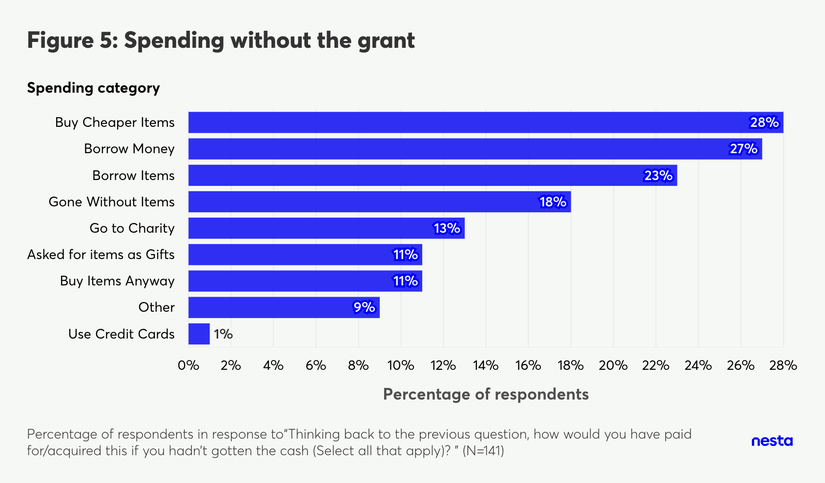
Figure 5
Image Description
A horizontal bar chart titled 'Figure 5: Spending without the grant'. The vertical axis lists 'Spending category' options, and the horizontal axis measures the 'Percentage of respondents' from 0% to 28%. The blue bars show the following distribution from top to bottom: Buy Cheaper Items at 28%; Borrow Money at 27%; Borrow Items at 23%; Gone Without Items at 18%; Go to Charity at 13%; Asked for items as Gifts at 11%; Buy Items Anyway at 11%; Other at 9%; and Use Credit Cards at 1%. A footnote at the bottom reads 'Percentage of respondents in response to "Thinking back to the previous question, how would you have paid for/acquired this if you hadn't gotten the cash (Select all that apply)?" (N=141)'.
Impact on attitudes towards the council
We had anticipated that receiving the grant might make recipients feel more positively towards the council and about Family Hubs, which are run by the council.
For some, the grant changed their perception of the council, making them feel "considered" or "looked out for."
“It makes me feel like they are looking out for new parents."
Interviewee 17, pregnant with first child, cash-only condition
However, our interviewees had varying levels of awareness that the money had come from Family Hubs and that Family Hubs are run by the council. Even among those who were aware of the link, they often viewed Family Hubs as distinct from the council:
“I always see it as two different things – what's the word? – two different entities. I know it comes from Camden, but the way the Family Hub is so different to the way Camden runs, so we see it as two different things.”
Interviewee 11, pregnant with second child, navigator condition
This meant that for interviewees who had unfavourable views of other parts of the council (these were primarily related to housing), this grant did not change their overall impressions of Camden Council. But these overall impressions did not affect their view of, or willingness to use, Camden Family Hubs.