
Family Hubs Pregnancy Grant pilot
Camden Council is currently piloting the Family Hubs Pregnancy Grant, a programme designed to provide timely financial and practical support to low-income families during pregnancy.
About the pilot
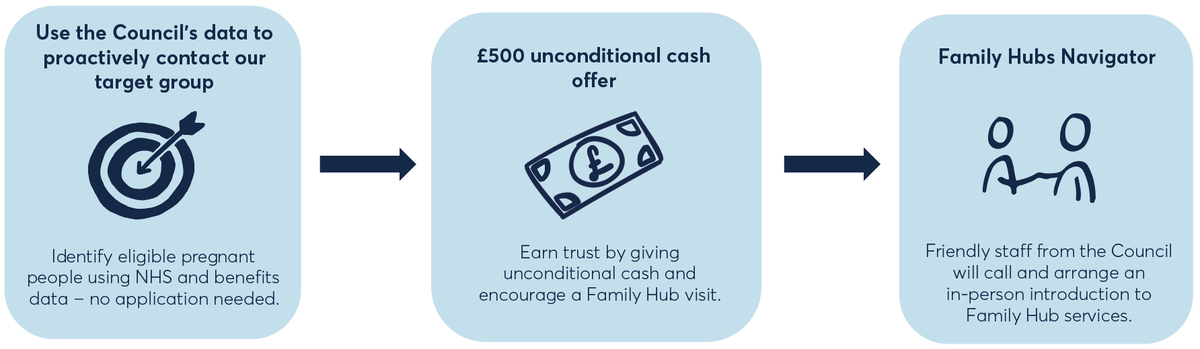
In April 2025, Camden Council began piloting the Family Hubs Pregnancy Grant. This is an offer of £500 to low-income pregnant people. Parents are notified of the grant and given simple instructions to collect it – they do not need to apply.
As part of the pilot, we are trialling pairing the cash offer with proactive outreach to tell recipients about broader support available to them through Family Hubs. This involves a phone call from a family navigator, who explains what Family Hubs are and offers to meet recipients in person to show them around their local hub.
The pilot is made possible through the use of administrative data. Working with Policy in Practice, we have linked together information from the council and the NHS on who receives benefits and who is pregnant. Camden Council is then able to proactively offer this support, without parents needing to know about it and apply.
Why was this programme needed?
Camden, like much of the UK, has experienced increasing rates of child poverty over the past decade. In 2024, two in five children in Camden were living in relative poverty after housing costs. Babies and young children growing up in poverty are less likely to live healthy, fulfilling and happy lives than their peers. Prior research tells us that a grant in pregnancy can improve babies’ health, with potential long-term benefits. We also know that the types of broader, integrated support services that Family Hubs offer can improve children’s longer-term health and education outcomes. But lower-income families across England are systematically less likely to access such services.
Intended outcomes
By providing parents with financial as well as practical support, we aim to reduce stress in pregnancy, which will make the baby healthier. In the long-term, we aim to build the foundations of trust for parents with young children to continue engaging with Family Hubs.
We are evaluating this pilot to learn about…
- Implementation and acceptability: Is it possible to implement this programme, and do parents and practitioners like it?
- The grant: In what ways does the £500 grant affect parents?
- The family navigator: Does proactive outreach help families access available services?
- ‘Stacked’ support: What is the value of providing the grant and family navigator support together?
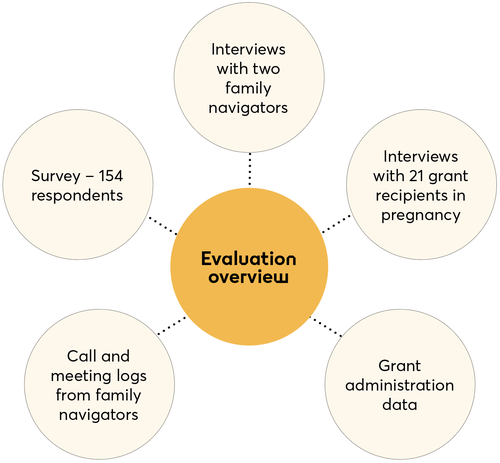
This report draws on our evaluation data from our surveys and interviews with programme participants (both grant recipients and family navigators), as well as administrative records. More details about these data sources are provided in the Appendix.
Where this report fits in the overall evaluation
This interim report sets out what we have learned so far, roughly halfway through the pilot. It largely covers implementation, acceptability, and immediate user experience.
We cannot yet draw any firm conclusions around the impact and effectiveness of the programme, though in this report, we share some early insights.
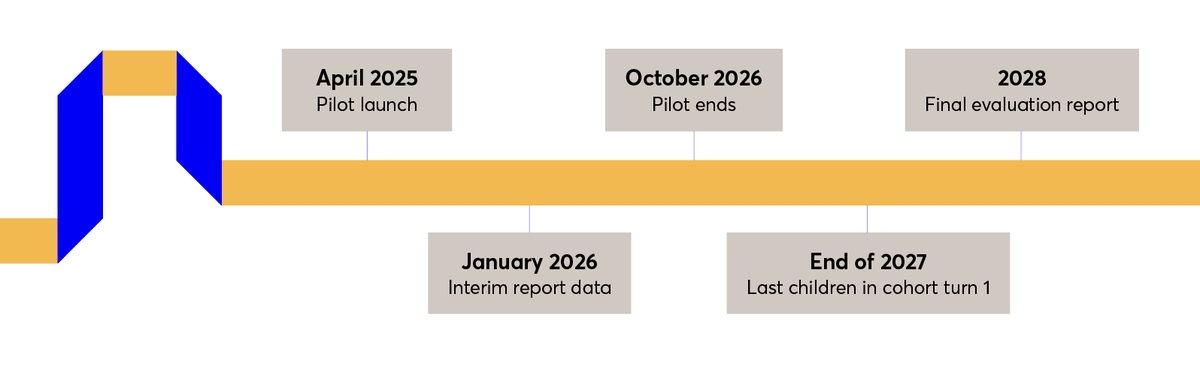
This report does not provide any outcomes from the randomised trial of the family navigator intervention, which is embedded into this pilot - we expect to publish results from this trial in mid-2028, when all babies in the cohort will have turned one.
The final report will also present additional data we have not yet collected, including more interviews with parents, interviews with staff, and data on Family Hub engagement.
Acknowledgements
We would like to thank the following individuals for their assistance in creating this report: Denise Amankwah, Jess Gillam, Amy Kimbangi, Abigail Knight, Jun Nakagawa, Carla Sanke, Benny Souto, Zoe Tyndall, Sophie Jobbings, Alex Baiden, Hudda Abukar, Lorraine Richardson, Julie Peel, Anna Lesnykh and Mara Bruno.

Context: who are the families?
Context: who are the families?
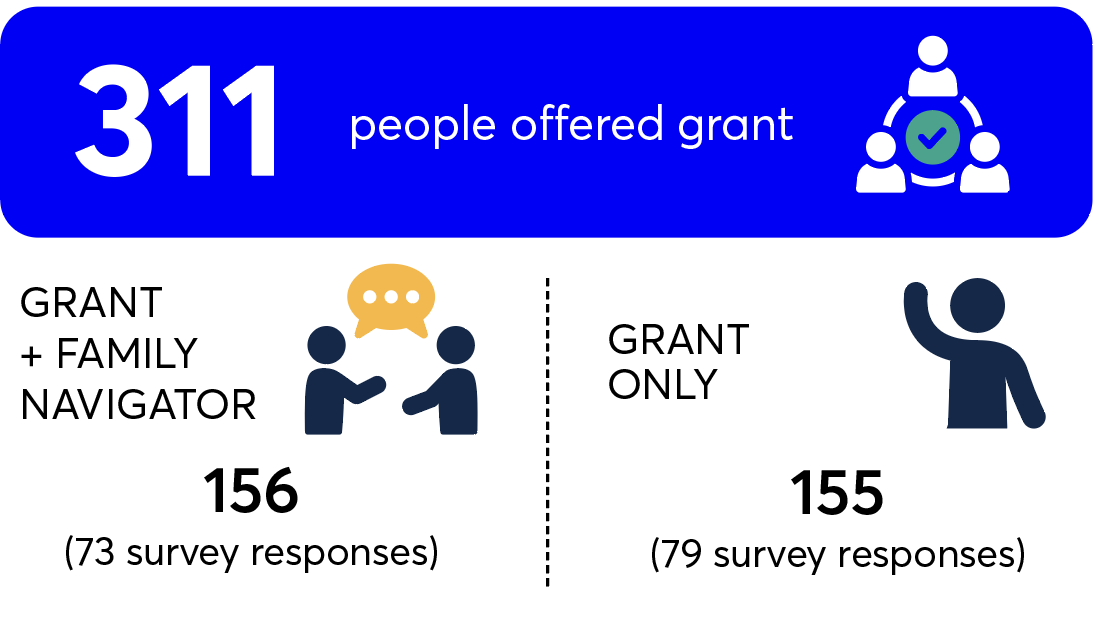
From the beginning of the pilot through to mid-January 2026 (9 months), 311 parents were offered the grant. As part of the pilot, parents are randomly assigned to receive either the grant only or the grant as well as proactive outreach from a Family Navigator. Both groups receive information in writing about Family Hubs.
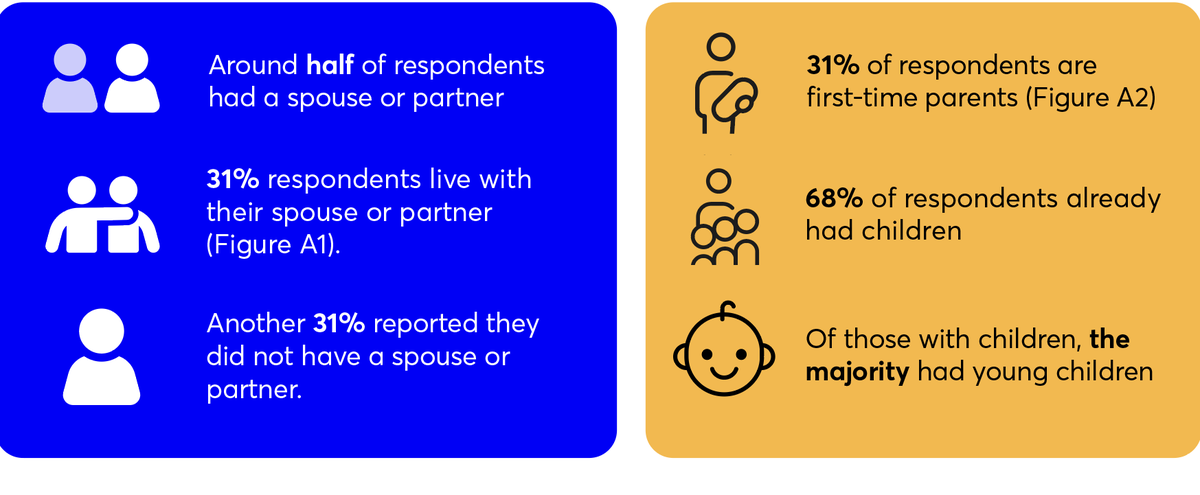
Note: Much of the data in this report comes from our survey, which has been completed by around half of the grant recipients. The appendix provides graphs with more detail than is shown in the main report.
Household composition
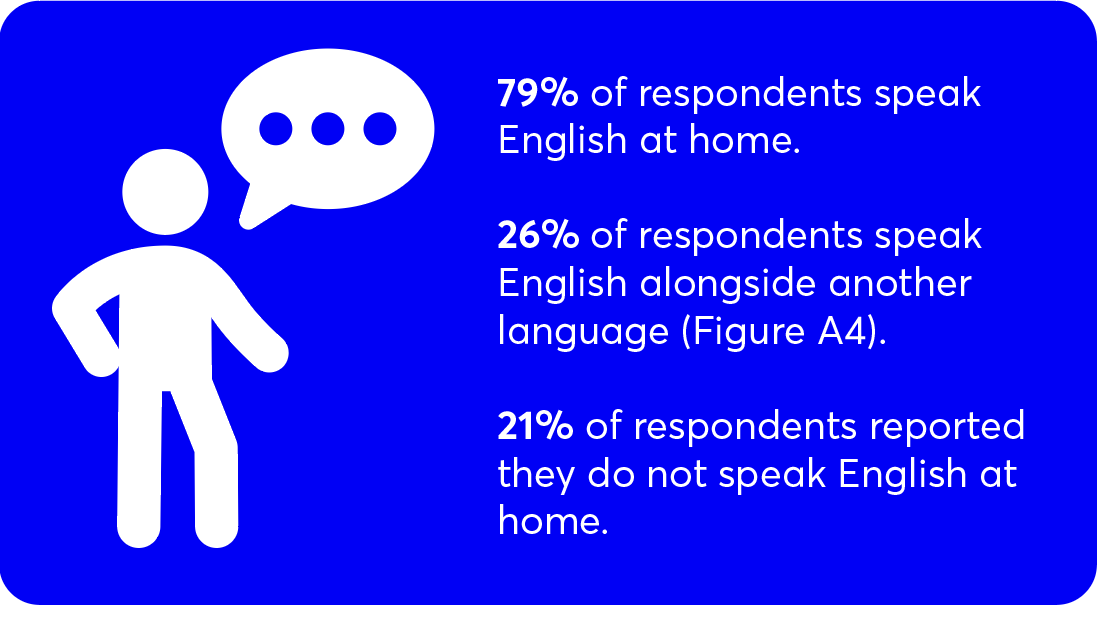
Ethnic and linguistic diversity
Survey respondents reported diverse ethnic backgrounds, with the single most common ethnicity being White, followed by Asian or Asian British.
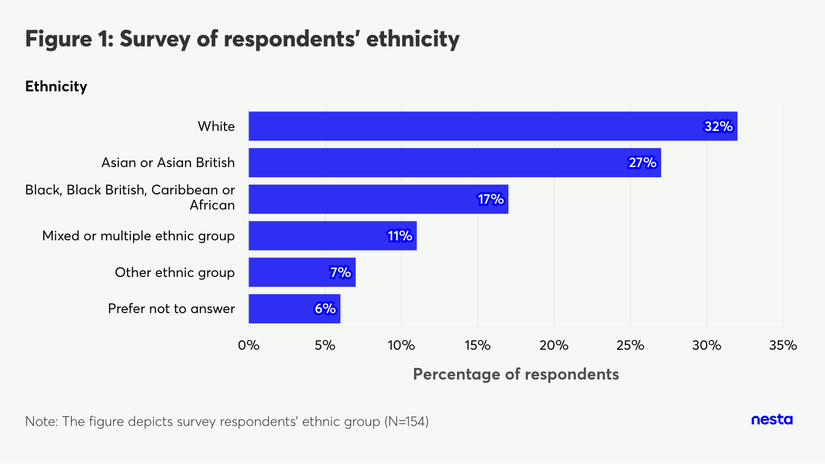
Figure 1
Image Description
A horizontal bar chart titled 'Figure 1: Survey of respondents' ethnicity'. The vertical axis lists different ethnic categories, and the horizontal axis measures the 'Percentage of respondents' from 0% to 35%. The blue bars show the following distribution from top to bottom: White at 32%; Asian or Asian British at 27%; Black, Black British, Caribbean or African at 17%; Mixed or multiple ethnic group at 11%; Other ethnic group at 7%; and Prefer not to answer at 6%. A footnote at the bottom reads 'Note: The figure depicts survey respondents' ethnic group (N=154)'.
Financial situation
Around one-third of survey respondents were employed full-time or part-time (Figure 2). Just over half reported that they are not currently employed.
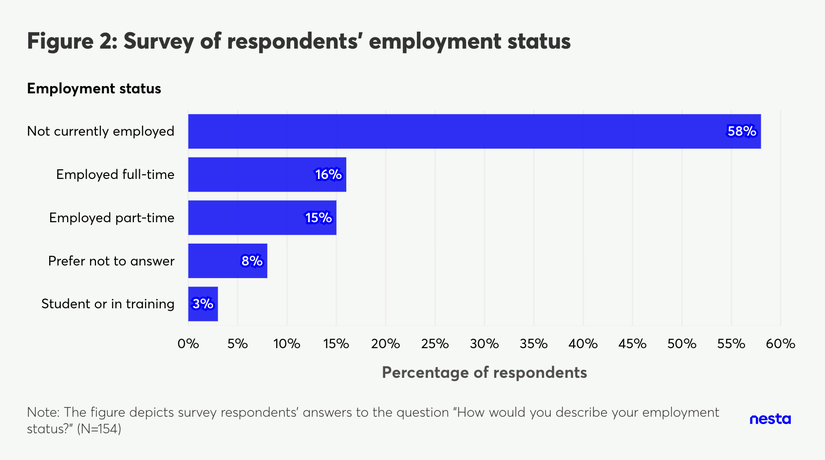
Figure 2
Image Description
A horizontal bar chart titled 'Figure 2: Survey of respondents' employment status'. The vertical axis lists different employment categories, and the horizontal axis measures the 'Percentage of respondents' from 0% to 60%. The blue bars show the following distribution from top to bottom: Not currently employed at 58%; Employed full-time at 16%; Employed part-time at 15%; Prefer not to answer at 8%; and Student or in training at 3%. A footnote at the bottom reads 'Note: The figure depicts survey respondents' answers to the question "How would you describe your employment status?" (N=154)'.
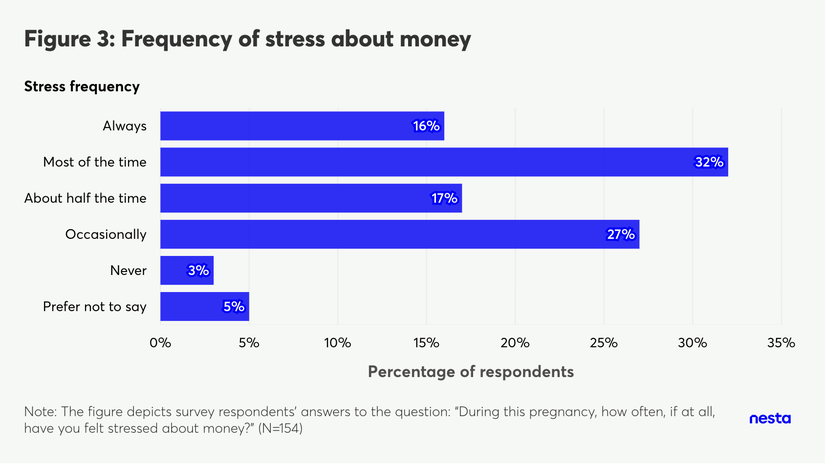
Figure 3
Image Description
A horizontal bar chart titled 'Figure 3: Frequency of stress about money'. The vertical axis lists 'Stress frequency' categories, and the horizontal axis measures the 'Percentage of respondents' from 0% to 35%. The blue bars show the following distribution from top to bottom: Always at 16%; Most of the time at 32%; About half the time at 17%; Occasionally at 27%; Never at 3%; and Prefer not to say at 5%. A footnote at the bottom reads 'Note: The figure depicts survey respondents' answers to the question: "During this pregnancy, how often, if at all, have you felt stressed about money?" (N=154)'.
Previous experience with Family Hubs

Note: This question regarding visiting Famuiy Hubs was asked in the survey, which takes place approximately five weeks after the intervention – some respondents had already been to a Family Hub as part of the Family Navigator intervention at this point.
Have visited a Family Hub
1 in 5 respondents reported that they attend a Family Hub regularly. But of those who had been to a Family Hub before, most currently go rarely.
Of those who have been to a Family Hub, two-thirds said that they were either satisfied or very satisfied with the Family Hub services. Most others were neutral.
Haven't visited a Family Hub
For survey respondents who had not been to a Family Hub before, or said they do not intend to go, we asked them why.
The most common responses related to information: many respondents said they don’t know about Family Hubs or were unsure what they offer (Figure A6).
This lack of understanding of what Family Hubs offer was also clear when we asked interviewees where they would go for support with their pregnancy or baby - Family Hubs are not (yet) established as a primary point of reference. Instead, interviewees cited personal networks (nuclear and extended family, friends, especially those who have had children), medical professionals (GP, midwife, doula, health visitor) and online sources (Google, Networks, ChatGPT, Camden website).
For survey respondents who were aware of what Family Hubs offer but had not been or did not intend to go, the most common reason for not visiting a Family Hub was a lack of time.
The cash grant experience
The cash grant experience
Cash delivery
Of the 311 people offered the grant as of mid-January 2026, 82% have received it.
The main administrative challenge in delivering the grant has been dealing with gaps in the data linkage, leading to missing or incorrect contact details. The grant cannot be paid without some means of contacting the recipient, and therefore, these data gaps mean that staff must spend time chasing down parents’ correct phone numbers.
Most parents were automated into the programme through the administrative data linkage. So far, 11% of parents have self-referred to the programme. Self-referrals have increased over the course of the pilot, as knowledge of the grant has spread through word of mouth.
Parents have generally found the process smooth - with many expressing surprise about how quick and easy it was to receive the grant, and about being offered the grant without needing to apply. In our survey, 4 in 5 respondents said that the process of receiving the grant was smooth or very smooth.
As parents described:
“It was just literally that easy. It wasn't difficult at all, the process.”
Interviewee 2, pregnant with first child, navigator condition.
“I didn't even know about the grant, I've received an email and a week later the money was in my account.”
Survey respondent 1, pregnant with second child, navigator condition
To receive the grant, parents can either collect the money from an ATM using a code that is texted to them (this is the default option) or fill in a short online form to request a bank transfer. Among our survey respondents, most (59%) had chosen to receive a bank transfer instead of collecting the cash from an ATM.
Implementation challenges
Given that cash withdrawal from an ATM was the default option and the bank transfer required additional steps, it is interesting that most survey respondents had opted for a bank transfer.
One interviewee explained their reasons for choosing the bank transfer option:
"I was a bit worried about [withdrawing the grant] just because I find it a bit odd to carry that much cash with me in the street. So I've seen there's an option to just get it directly sent to your bank account, which felt safer to me."
Interviewee 15, pregnant with second child, navigator condition.
While most survey respondents said the process for receiving the grant was smooth, some found it challenging. Around 6% of respondents had not yet collected the grant at the time of the survey (5 weeks after the initial offer); they reported that this was mainly due to a lack of time or instructions, or issues with withdrawing money from ATMs. Finding an ATM that had enough cash available to complete their grant withdrawal was a recurring challenge among parents we surveyed and interviewed. One survey respondent explained that: “I did spend 1 hour 50 minutes travelling to different cash points.”
Impact of the grant
How parents spent the money
In order to understand the impact of the grant, we asked survey respondents how they spent the money. Most respondents reported that they used the grant to buy baby items, as well as to pay bills and cover their daily essential spending.
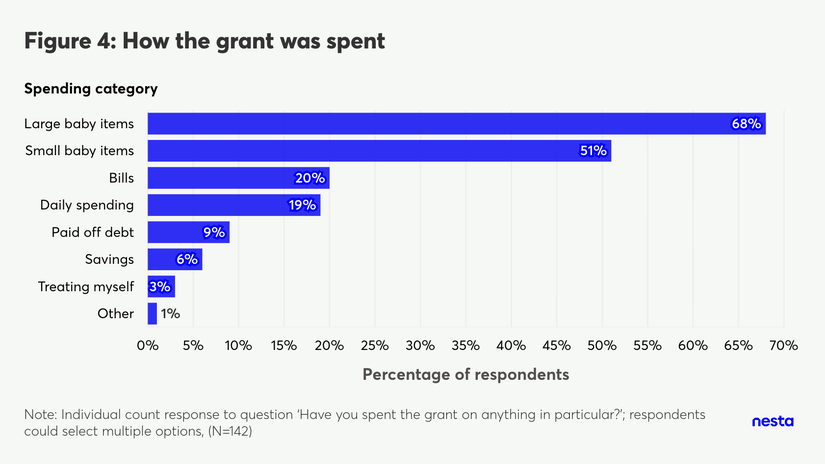
Figure 4
Image Description
A horizontal bar chart titled 'Figure 4: How the grant was spent'. The vertical axis lists 'Spending category' options, and the horizontal axis measures the 'Percentage of respondents' from 0% to 70%. The blue bars show the following distribution from top to bottom: Large baby items at 68%; Small baby items at 51%; Bills at 20%; Daily spending at 19%; Paid off debt at 9%; Savings at 6%; Treating myself at 3%; and Other at 1%. A footnote at the bottom reads 'Note: Individual count response to question "Have you spent the grant on anything in particular?"; respondents could select multiple options, (N=142)'.
Spending fell into three main categories, which interviewees described in more detail:
Large baby equipment: spending in this category looked like using the lump sum to purchase or contribute towards "big ticket" items, such as buggies and change tables.
Daily baby essentials: spending in this category looked like stocking up on consumables and smaller necessities, such as nappies and wipes, formula, clothing, and feeding equipment like bottles and sterilisers.
Bills, debts, and general cost of living: for those who used the cash this way, the grant provided a “huge sense of relief” (Interviewee 4; pregnant with fourth child, Navigator Condition) from financial pressure. Parents we spoke to mentioned using the money to pay off energy bills, council tax, and credit card debts or arrears.
Across spending categories, parents described the grant not just as financial aid, but as a significant mental relief that reduced anxiety and pressure.
"For us to receive it will be a huge burden lifted.”
Interviewee 7, pregnant with fourth child, cash - only condition.
While receiving the grant did not eliminate financial stress, parents appreciated the temporary relief:
"The grant was incredibly helpful and has lifted a bit of weight off of my shoulders. I know it's only temporary, but it was much needed. As silly as it sounds, I can put the heating on now!"
Survey respondent 2, pregnant with third child, cash-only condition.
The unconditional nature of the grant allowed parents to choose items that met their needs and preferences without feeling ‘under pressure’, contributing to a sense of dignity and independence:
"It lessened that pressure for me [and allowed me to] feel quite independent in that sense."
Interviewee 20, pregnant with first child, navigator condition
What parents would have done without the money
Money is fungible. Especially for recipients who spent the grant on baby essentials, it is likely they would have acquired those items even without the grant. To understand the impact of the grant, we asked survey respondents how they would have paid for or acquired the items they spent the grant on had they not received the grant. Respondents gave a wide range of answers, from purchasing cheaper options to borrowing money (formally or informally), borrowing the items, or receiving the items from charity or as a gift.
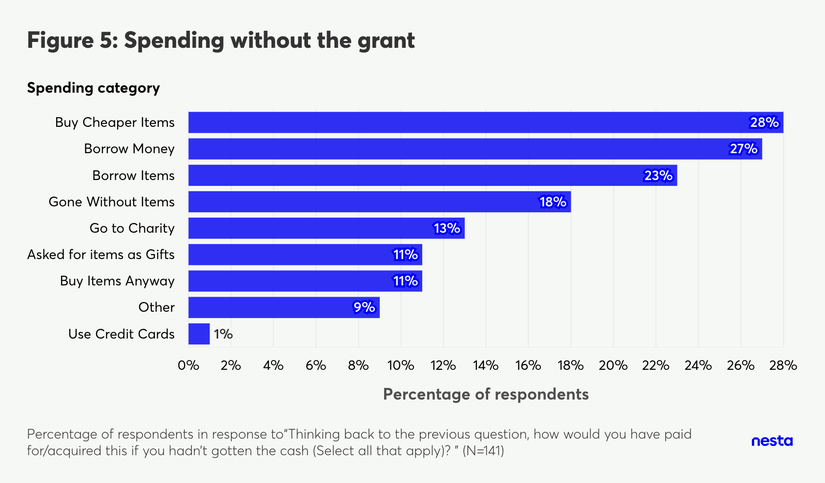
Figure 5
Image Description
A horizontal bar chart titled 'Figure 5: Spending without the grant'. The vertical axis lists 'Spending category' options, and the horizontal axis measures the 'Percentage of respondents' from 0% to 28%. The blue bars show the following distribution from top to bottom: Buy Cheaper Items at 28%; Borrow Money at 27%; Borrow Items at 23%; Gone Without Items at 18%; Go to Charity at 13%; Asked for items as Gifts at 11%; Buy Items Anyway at 11%; Other at 9%; and Use Credit Cards at 1%. A footnote at the bottom reads 'Percentage of respondents in response to "Thinking back to the previous question, how would you have paid for/acquired this if you hadn't gotten the cash (Select all that apply)?" (N=141)'.
Impact on attitudes towards the council
We had anticipated that receiving the grant might make recipients feel more positively towards the council and about Family Hubs, which are run by the council.
For some, the grant changed their perception of the council, making them feel "considered" or "looked out for."
“It makes me feel like they are looking out for new parents."
Interviewee 17, pregnant with first child, cash-only condition
However, our interviewees had varying levels of awareness that the money had come from Family Hubs and that Family Hubs are run by the council. Even among those who were aware of the link, they often viewed Family Hubs as distinct from the council:
“I always see it as two different things – what's the word? – two different entities. I know it comes from Camden, but the way the Family Hub is so different to the way Camden runs, so we see it as two different things.”
Interviewee 11, pregnant with second child, navigator condition
This meant that for interviewees who had unfavourable views of other parts of the council (these were primarily related to housing), this grant did not change their overall impressions of Camden Council. But these overall impressions did not affect their view of, or willingness to use, Camden Family Hubs.
The family navigator journey
The family navigator journey
Engagement pipeline
As part of the Family Hubs Pregnancy Grant pilot, half of the grant recipients are randomly assigned to the ‘Navigator’ condition. These parents should receive a phone call from a Family Navigator soon after they are offered the grant. During this phone call, the Family Navigator tells the recipient about Family Hubs, describes the support available at Family Hubs that is relevant to them, and offers to schedule a time to meet the parent at their closest Hub for a tour (see Navigator Conversation Guide in our Toolkit for more details).
Overall, out of the grant recipients who are in the ‘Navigator’ condition, just over half (54.6%) have spoken with their Family Navigator on the phone and 15.8% had completed a Family Hubs tour.
Figure 6 shows the engagement pipeline for parents in the Navigator condition.
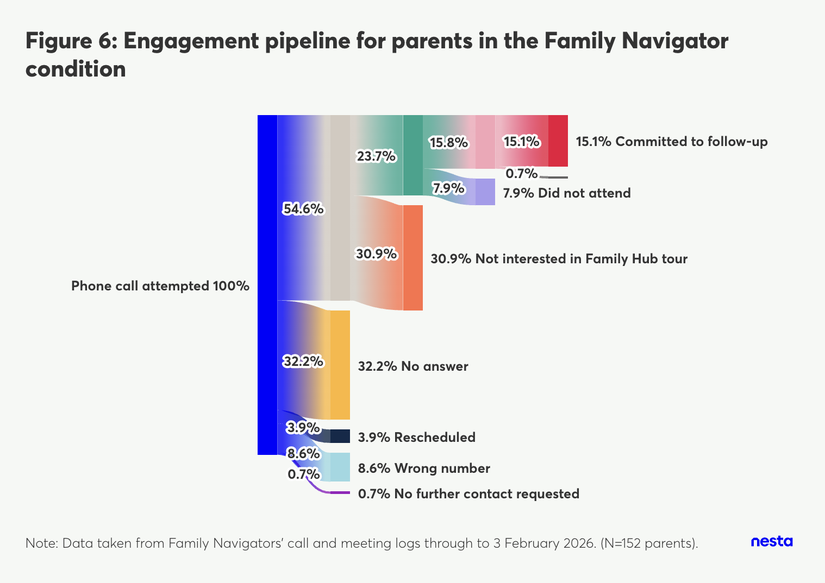
Figure 6
Image Description
A Sankey diagram titled 'Figure 6: Engagement pipeline for parents in the Family Navigator condition'. It illustrates the flow of engagement starting from a single vertical blue bar on the left labeled 'Phone call attempted 100%'. This 100% splits into five paths: 54.6% continue down the pipeline, 32.2% result in 'No answer', 8.6% result in 'Wrong number', 3.9% are 'Rescheduled', and 0.7% request 'No further contact requested'. The 54.6% group then splits, with 23.7% continuing on and 30.9% being 'Not interested in Family Hub tour'. The 23.7% group splits again, with 15.8% continuing and 7.9% marked as 'Did not attend'. Finally, the remaining 15.8% splits into 15.1% who 'Committed to follow-up' and an unlabeled 0.7% drop-off. A footnote at the bottom reads 'Note: Data taken from Family Navigators' call and meeting logs through to 3 February 2026. (N=152 parents)'.
Engagement with the Family Navigator
Early data suggests that the Family Navigator outreach is well-received, though there are emerging challenges around how parents recognise and prioritise these contacts.
Overall, parents we surveyed and interviewed were positive about receiving a phone call from a Family Navigator. Of the survey respondents who had spoken with their Family Navigator, 85% reported that the conversation was either ‘helpful’ or ‘very helpful’ (Figure 7).
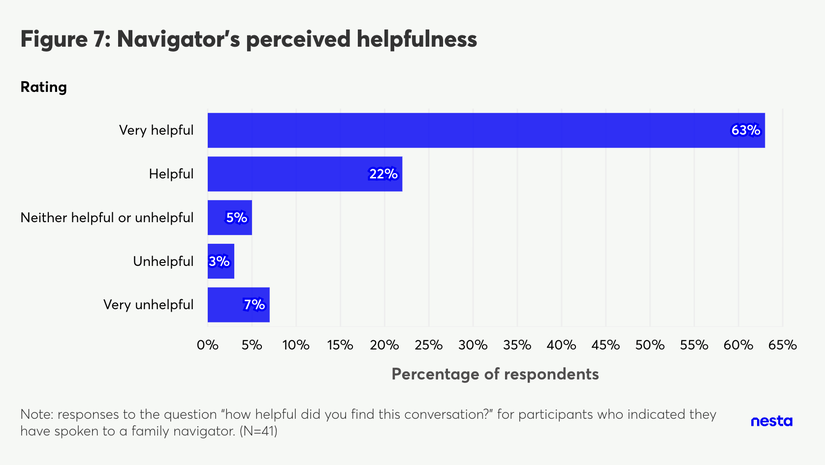
Figure 7
Image Description
A horizontal bar chart titled 'Figure 7: Navigator's perceived helpfulness'. The vertical axis lists 'Rating' categories, and the horizontal axis measures the 'Percentage of respondents' from 0% to 65%. The blue bars show the following distribution from top to bottom: Very helpful at 63%; Helpful at 22%; Neither helpful or unhelpful at 5%; Unhelpful at 3%; and Very unhelpful at 7%. A footnote at the bottom reads 'Note: responses to the question "how helpful did you find this conversation?" for participants who indicated they have spoken to a family navigator. (N=41)'.
In interviews, parents frequently described the initial call positively:
“really nice and helpful.”
Interviewee 13, pregnant with first child, navigator condition
“[I appreciated] speaking to someone from the team who told me about the services and if I’m interested in looking around Family Hubs - I think this is good as I have my first child in lockdown”
Survey respondent 4, pregnant with second child, navigator condition.
However, the perceived value of the call depends on parents’ experiences and preferences. Parents who already had children were less likely to find the call personally helpful, but these parents say they still feel it is a valuable offer for others.
Among those who did not find the call useful, some interviewees talked about preferences for how they receive information, saying they would prefer to do their own research online. Parents’ varying preferences for how they receive information speak to the importance of multi-modal communications, combining phone calls with optional meetings, written communication, and accessible, easy-to-find information on the council’s website.
Barriers to engagement: timing and ‘mental load’
We heard from some parents who wanted to engage with the Family Navigator but felt they were not ready or did not have the time. Some parents reported missing calls or intentionally delaying the conversation until they felt better equipped to process the information. One interviewee noted:
“She has texted me to give her a call back, which I need to do, but, haven't, because I need to go see her, and I feel like I need to find the right time, and… it's just been a stressful few weeks.”
Interviewee 11, pregnant with second child, navigator condition
Others noted that the call came at an inopportune time - for instance, during school holidays when parents were busy with older children at home.
Similarly, as shown in the engagement pipeline diagram above, some parents spoke with the Family Navigator over the phone and were interested in meeting, but were unable to attend due to illness and other life events:
“I was meant to meet them in person. Um, but I've been really busy because I've been attending viewings - I'm trying to move. Um, so I've been attending viewings. I've had work, and my children have been sick. So yeah, we had to reschedule a couple of times.”
Interviewee 19, pregnant with third child, cash-only condition
For others, non-attendance was due to their pregnancy. This is to be expected, given that some grant recipients were quite far along in their pregnancy and either found it difficult to meet in person or had short-notice medical appointments to attend. Attendance rates may be higher if the tour were offered earlier in pregnancy, but this was not possible given the timing of data flows – see our Toolkit for more detail on this.
Together, these insights suggest that some parents may benefit from alternative options to engage - for example, having a Navigator recontact them a few weeks later, or after their baby is born.
Potential barriers to impact: information overload and recognition
In our survey, most parents who had not spoken to their Family Navigator said this was because the Navigator did not contact them. However, through our interviews, we spoke with some parents who selected this option in the survey, but they had in fact received the call - they said they did not understand who had called and why. Furthermore, 17% of survey respondents in the Navigator condition said they were unsure if they had spoken to their Family Navigator or not. As one parent explained:
“I get so many calls from hospitals constantly, midwives and stuff, and other places, so… I'm not sure. But I did get one call from someone.”
Interviewee 10, pregnant with second child, navigator condition
For parents who have spoken to a Family Navigator but do not remember doing so, we may expect little impact from the Family Navigator offer. This is something we will explore further in our final evaluation report to better understand which groups are most likely to benefit from the outreach.
Family navigators’ perspectives
In our interviews with the family navigators, we heard that they overwhelmingly feel that parents appreciate and welcome the call:
“Overall, it seems like women are reassured and feel cared about by us taking this extra step of calling them.”
Navigator interview 1
“You're introducing people to support services that some of them might really need and wouldn't otherwise know how to access.”
Navigator interview 2
Family navigators also reported that their work is facilitated by resources published in our Toolkit.
“We can just focus on building that relation with the women and we don't have to really overthink everything else 'cause the step-by-step process has already been there.”
Navigator interview 1
“That whole navigator toolkit is just my Bible. It's fantastic. I refer back to it all the time.”
Navigator interview 2
Together, the family navigators report that offering a service that they feel provides real value to parents and having the tools to do so makes the role feel rewarding.
“To be honest, I really enjoy the work.”
Navigator 1
The meeting and follow-up actions
Of the parents who did the Family Hub tour with a Family Navigator, they were generally very positive about the experience. One parent (Interviewee 2, pregnant with first child, navigator condition) described the Family Navigator as “very knowledgeable and very informative”, and the experience of attending the Family Hub tour as “relevant”.
Of the parents who attended a tour, meeting logs show that almost all committed to some follow-up action during the meeting. Most agreed to being recontacted by a Family Hub staff member postnatally. Around half scheduled an appointment with a benefits advisor. A smaller number signed up for antenatal classes. Some others also received practical help, such as support filling in benefits application forms or referrals to a baby bank.
More broadly, when we asked survey respondents if they intend to visit Family Hubs once their baby/babies were born, those in the Navigator condition were more likely to say ‘yes’ instead of ‘unsure’ compared with those who only received the grant.
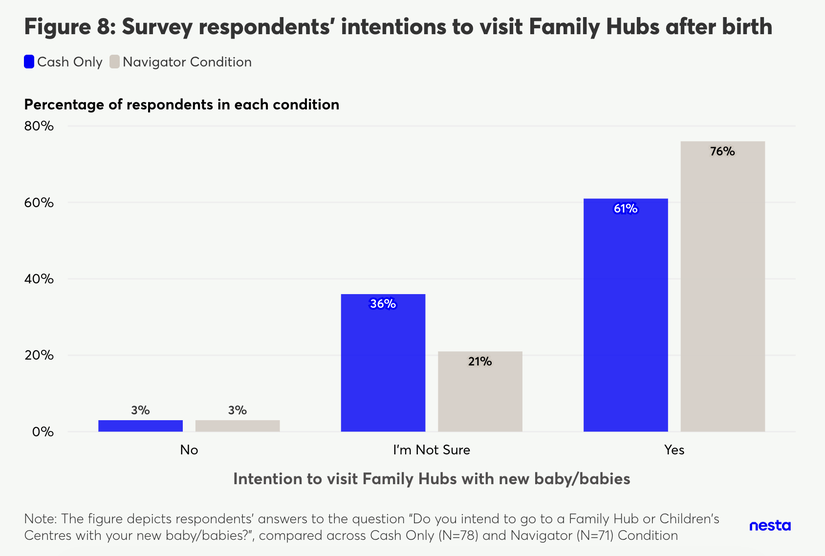
Figure 8
Image Description
A grouped bar chart titled 'Figure 8: Survey respondents' intentions to visit Family Hubs after birth'. The vertical axis measures 'Percentage of respondents in each condition' from 0% to 80%. The horizontal axis categorises 'Intention to visit Family Hubs with new baby/babies' into 'No', 'I'm Not Sure', and 'Yes'. For each category, two bars compare the 'Cash Only' group in blue and the 'Navigator Condition' group in grey. For 'No', both groups are at 3%. For 'I'm Not Sure', Cash Only is 36% and Navigator Condition is 21%. For 'Yes', Cash Only is 61% and Navigator Condition is 76%. A footnote reads 'Note: The figure depicts respondents' answers to the question "Do you intend to go to a Family Hub or Children's Centres with your new baby/babies?", compared across Cash Only (N=78) and Navigator (N=71) Condition'.
Impact of navigator outreach on grant associations
The grant was intentionally labelled as a ‘Family Hubs Pregnancy Grant’, and sent from Camden Family Hubs, with the aim of creating a ‘halo effect’ for Family Hubs.
This association was more salient for survey respondents in the Navigator group. 70% of respondents in the Navigator condition correctly remembered that the grant came from Camden Family Hubs compared with 50% those who only received the grant but with no outreach from a Family Navigator.
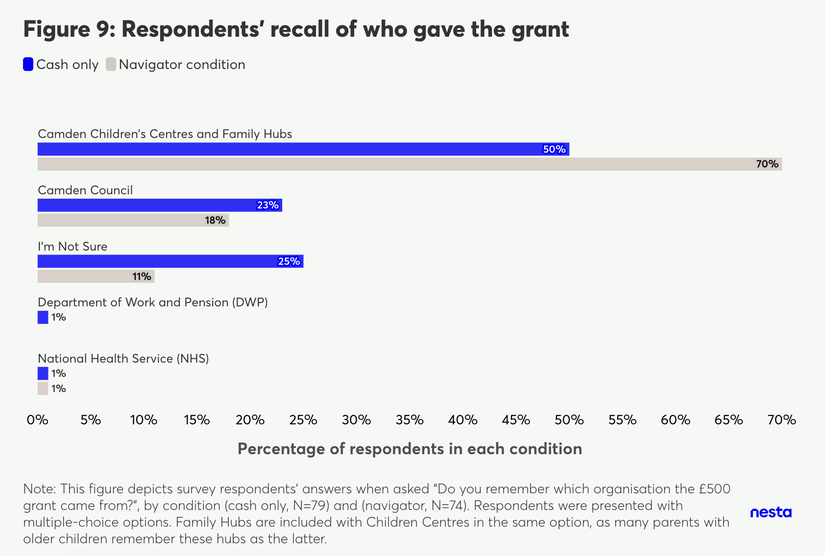
Figure 9
Image Description
A grouped horizontal bar chart titled 'Figure 9: Respondents' recall of who gave the grant'. A legend indicates blue bars represent the 'Cash only' condition and grey bars represent the 'Navigator condition'. The vertical axis lists five options, and the horizontal axis measures the 'Percentage of respondents in each condition' from 0% to 70%. For 'Camden Children's Centres and Family Hubs', the Cash only group is 50% and the Navigator condition is 70%. For 'Camden Council', Cash only is 23% and Navigator condition is 18%. For 'I'm Not Sure', Cash only is 25% and Navigator condition is 11%. For 'Department of Work and Pension (DWP)', Cash only is 1% with no bar shown for Navigator. For 'National Health Service (NHS)', both groups are 1%. A footnote details the survey question, notes that Family Hubs and Children Centres were grouped together, and provides sample sizes (Cash only N=79, Navigator N=74).
Meeting the demand for more information about Family Hubs
In order to understand different avenues to access services, we asked survey respondents what they think the council should do to support families with young children. The most common theme that emerged was a request for more proactive information and reminders about what support is available to families, “as it can be overwhelming and information is never readily accessible” (survey respondent 5).
Survey respondents suggested a number of different formats, including emails and letters, advertising, phone calls to new mothers, and “simple, quick, clear” messaging. Others expressed confusion that they thought they had to “become a member” or pay to access Family Hub services.
From what parents have told us so far, this suggests that family navigators may play an important role in spreading information about what is on offer and addressing misconceptions.
Emerging personas: what it’s like for parents (to-be) receiving the Family Hubs Pregnancy Grant
Emerging personas: what it’s like for parents (to-be) receiving the Family Hubs Pregnancy Grant
So far, we have interviewed 21 parents who have received the grant. Below, we set out four personas, representing different backgrounds and ways that parents have experienced the intervention. Our intention in presenting these personas is to convey parents’ experiences in a more holistic way. These personas do not relate to any single individual. Rather, they are composites representing common themes that we have seen during our interviews. We expect to see the shape of these personas change as the evaluation continues.
All names have been changed to protect the privacy of interviewees.
Serena - offered £500 grant
Born and raised in Camden, Serena is a first-time parent. Her pregnancy hasn’t been straightforward; she has gestational diabetes, and her tiny 5th-floor flat doesn’t have an elevator. Her family are close and always checking in to offer support. She knows she received an email from someone from the council, and she engaged with the £500 grant offer, but she doesn’t remember any other information in that email.
Serena was really happy to receive the grant; it helped her to afford high-cost essentials that she otherwise would have paid for using her overdraft. She opted for the ‘bank transfer’ option and found the whole process really straightforward.
Initially, Serena assumed this grant was the Sure Start Maternity Grant that she had heard about - it was only through talking to a friend that she realised that the process for applying for the Sure Start grant is different. She then went back to the initial email and saw that the grant she received was from Camden Family Hubs.
Serena is naturally curious (she’ll Google anything she’s unsure about), and she likes to feel informed. Serena didn’t realise she had already been inside her local Family Hub building; it’s where her midwife appointments are. She’s never consciously engaged with the service before, but now that she’s received the Family Hubs Pregnancy Grant, she might take a look around the Family Hub at her next midwife's appointment.
Alicia – offered £500 grant
Alicia is mum to two boys with a third on the way. She lives with her partner and their boys, but their home barely fits the family as it is. Her entire day is spent managing her family's lives: getting the boys up, dressed, fed and out the door. Thinking about how these needs will grow makes her feel quite anxious.
Alicia reads every letter, every email, every text that comes her way. She found out about the grant online and applied using her MAT B1 form. The whole process was pretty easy. She remembers receiving an email which notified her that her grant eligibility application was accepted and that she’d receive the money in her bank within a week. She definitely clicked on one or two links in the email about other Family Hub services, to check them out, but she doesn’t really feel confident that she knows everything she should. Alicia’s eldest son was born before Covid, and she attended a few different antenatal and stay and play sessions, but at that time, the centres weren’t called ‘Family Hubs’. Her second was born during Covid, and she really struggled with the lack of support available in comparison to her firstborn. This time, she’s determined to re-engage; she liked the stay and play sessions before, so wants to go again, but also wants to find out what else is on offer. Once the baby is born and she’s established a good routine, she plans on going to her local Family Hub. Because Alicia still has the big baby essentials from when her boys were newborns, she used the grant to stock up on bottles, nappies, wipes and formula.
Diya – offered £500 grant and outreach from Family Navigator
Diya is a first-time parent. Her pregnancy was unexpected. She’s still living at home with her parents. She wants to move out, but it doesn’t seem feasible. Her family have been a consistent source of support for Diya throughout. As a first-time parent, she’s not too sure exactly what help she may need, let alone support that’s available. She’s getting a lot of advice from a lot of sources (online and in person), but it's all quite overwhelming and hard to navigate. Language isn’t a barrier for her, but every now and then, Diya feels like everyone knows about something she doesn’t know. She’s heard of Family Hubs (her cousin goes with her kids) and knows there’s one nearby, but she’s never actually been. Diya would like to feel more confident in her knowledge of what is out there, so the phone call from a Family Navigator was really welcome. It was a friendly chat, and there was a lot of information, but from what she can remember, Family Hubs might be able to help her learn some new things and figure out what benefits she’s eligible for. Diya thinks others like her would benefit from the call, too. She’s been invited for a tour, and she’s open to visiting to see what’s on offer. As for the grant, Diya was really pleased and genuinely surprised to receive it. She wasn’t expecting it at all, and it came at just the right time when her housing situation and cost of living were weighing on her heavily; it gave her a little bit of breathing space. The bank transfer process was a breeze. She used the grant to upgrade to a nicer buggy than she originally budgeted for, something that made her feel more prepared and positive about her baby's arrival.
Pri – offered £500 grant and outreach from Family Navigator
Pri is a mum of three, and she lives with her husband in a two-bed flat. They don’t have any wider family nearby, but Pri keeps in touch with relatives and friends digitally. English isn’t her first language; she knows bits, but wouldn’t call herself ‘fluent’.
Pri finds all of the letters, newsletters, emails, and other communications the family receives overwhelming and tricky to keep on top of. She remembers having a phone call, but didn’t really understand what the call was about. Pri has been to Family Hubs before for a ‘stay and play’ session, so she feels like she knows what Family Hubs offer. She doesn’t plan to visit again, though, as she doesn’t think there is anyone there who can support her with the pressing housing and financial challenges her family are facing. She feels the services at Family Hubs (that she’s aware of) don’t fit her needs.
Pri was really sceptical when she first found out about the grant. She tried asking around to check if it was legitimate before taking the chance to accept it. She was worried it was a scam, but felt it was a risk worth taking. She was genuinely pleased and relieved to receive the money. That said, the SMS instructions to receive the money were in English; she struggled to make sense of them, and even once she did, locating the right ATM proved quite hard.
Pri still isn’t sure where the money came from, but nevertheless, she’s thankful for it. She used part of it to clear some outstanding bills, and spent the remainder on some baby essentials.
Interim lessons for implementation and scale
Interim lessons for implementation and scale
The Family Hubs Pregnancy Grant pilot programme is ongoing, with planned completion in late 2026. It is too early to draw firm conclusions about whether and to what extent the programme is leading to the intended increase in engagement with Family Hubs. However, the evaluation data we have analysed to-date suggest three emerging takeaways regarding the programme’s design and its immediate effects on parents.
1. Operational feasibility: administrative data is a viable route for targeted support
The use of linked administrative data to identify and automate the grant offer appears to be effective. Despite some gaps in the data linkage, the grant has been successfully delivered to hundreds of expectant parents. Uptake of the grant is high, and parents are pleasantly surprised by, and appreciative of the low administrative burden.
Delivering the grant via bank transfer seems to be the preferred, lower-friction route for the majority of parents. However, parents must provide their bank account details to the council in order to receive a transfer, and we have heard from some parents that they were hesitant to do so because of worries that the grant was a scam. We also expect that some families - perhaps those who are less likely to take part in our survey and interviews - may be wary of council contact, and may miss out on the grant if they were required to fill in a form in order to receive the grant. Therefore, the ATM withdrawal option remains worthwhile for inclusivity.
Family navigators find the role enjoyable and meaningful, and they feel that their job is made easier by the Toolkit. They have been able to speak on the phone with over half of the parents they have reached out to, and have met with around 15% of them. While there is room to increase these rates of contact success, a 50% call completion rate is in line with other telephone outreach initiatives.
2. Impact on families: the grant supports material needs and reduces stress
So far, the £500 grant is being used as expected: on items for the baby, or to cover costs that would otherwise represent a source of stress for parents (day-to-day spending, bills, debt). Our survey suggests that parents in the target group had faced high baseline levels of financial stress throughout their pregnancy. While the grant is not enough to remove financial stress, it provides a temporary buffer. Parents we interviewed shared the relief they felt from having received the grant, and how the money contributed to a sense of dignity and independence.
3. Service integration: early signals suggest proactive outreach can bridge the awareness gap
The Family Navigator role is intended to serve as a bridge between the grant and the ongoing support that is available through Family Hubs. With the data we have to date, we are not able to assess the impact of the Navigator programme on the use of Family Hubs. Early results from the 154 parents we have surveyed so far indicate that those offered support from a Family Navigator are more likely to intend to visit a Family Hub with their baby. Parents we interviewed who attended a Family Hub tour with their Family Navigator found the experience very helpful. Overall, parents seem to value the Family Navigator’s proactive outreach and are requesting more frequent, targeted updates about available services.
Next steps
As the pilot continues through 2026, our evaluation will move from assessing implementation to tracking longer-term engagement of families who have received the grant. We will focus on whether the connections made during pregnancy translate into changes in service take-up after the baby is born.
A key hypothesis of this pilot is that providing a grant and a Family Navigator together (known as a ‘stacked’ intervention) is more effective than providing either in isolation. Our theory is that by addressing immediate material needs, the grant creates both the trust and mental headspace necessary for parents to engage with family navigators. We do not yet have sufficient longitudinal data to test this hypothesis, but it will remain a focus in the full evaluation report.
We expect to complete the full evaluation in 2028.
Appendix
Appendix
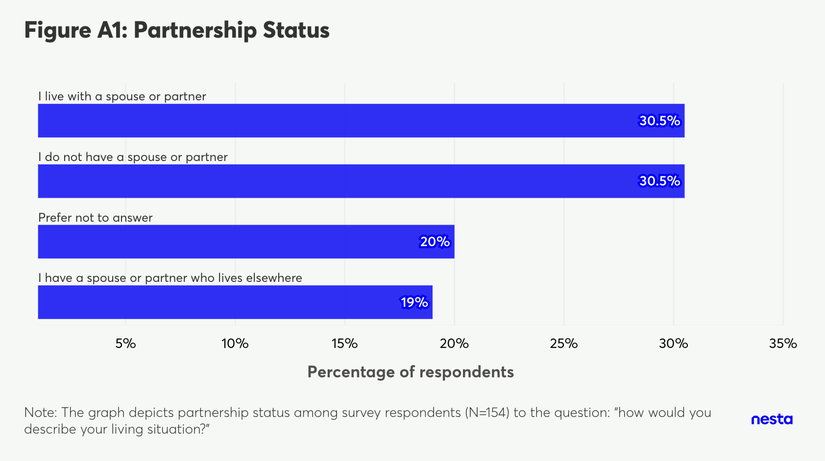
Figure A1
Image Description
A horizontal bar chart titled 'Figure A1: Partnership Status'. The vertical axis lists four partnership status categories, and the horizontal axis measures the 'Percentage of respondents' up to 35%. The blue bars show the following distribution from top to bottom: 'I live with a spouse or partner' at 30.5%; 'I do not have a spouse or partner' at 30.5%; 'Prefer not to answer' at 20%; and 'I have a spouse or partner who lives elsewhere' at 19%. A footnote at the bottom reads 'Note: The graph depicts partnership status among survey respondents (N=154) to the question: "how would you describe your living situation?"'.
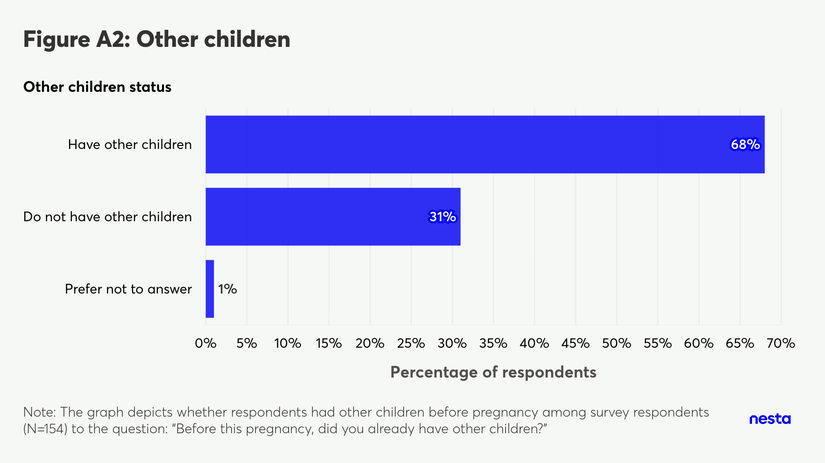
Figure A2
Image Description
A horizontal bar chart titled 'Figure A2: Other children'. The vertical axis lists 'Other children status' categories, and the horizontal axis measures the 'Percentage of respondents' from 0% to 70%. The blue bars show the following distribution from top to bottom: 'Have other children' at 68%; 'Do not have other children' at 31%; and 'Prefer not to answer' at 1%. A footnote at the bottom reads 'Note: The graph depicts whether respondents had other children before pregnancy among survey respondents (N=154) to the question: "Before this pregnancy, did you already have other children?"'.
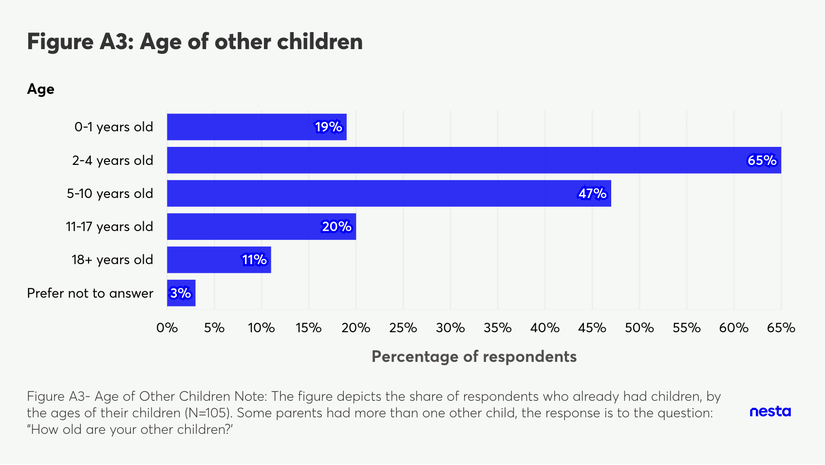
Figure A3
Image Description
A horizontal bar chart titled 'Figure A3: Age of other children'. The vertical axis lists 'Age' categories, and the horizontal axis measures the 'Percentage of respondents' from 0% to 65%. The blue bars show the following distribution from top to bottom: 0-1 years old at 19%; 2-4 years old at 65%; 5-10 years old at 47%; 11-17 years old at 20%; 18+ years old at 11%; and Prefer not to answer at 3%. A footnote at the bottom reads 'Figure A3- Age of Other Children Note: The figure depicts the share of respondents who already had children, by the ages of their children (N=105). Some parents had more than one other child, the response is to the question: "How old are your other children?"'.
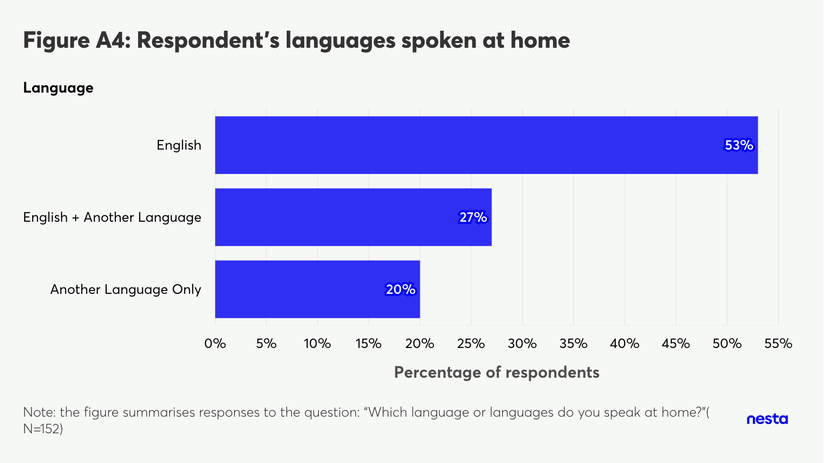
Figure A4
Image Description
A horizontal bar chart titled 'Figure A4: Respondents' languages spoken at home'. The vertical axis lists 'Language' categories, and the horizontal axis measures the 'Percentage of respondents' from 0% to 55%. The blue bars show the following distribution from top to bottom: English at 53%; English + Another Language at 27%; and Another Language Only at 20%. A footnote at the bottom reads 'Note: the figure summarises responses to the question: "Which language or languages do you speak at home?"( N=152)'.
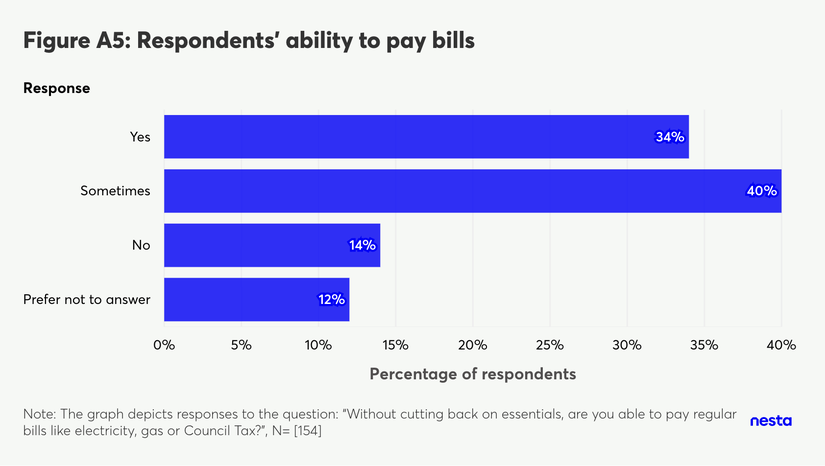
Figure A5
Image Description
A horizontal bar chart titled 'Figure A5: Respondents' ability to pay bills'. The vertical axis lists 'Response' categories, and the horizontal axis measures the 'Percentage of respondents' from 0% to 40%. The blue bars show the following distribution from top to bottom: Yes at 34%; Sometimes at 40%; No at 14%; and Prefer not to answer at 12%. A footnote at the bottom reads 'Note: The graph depicts responses to the question: "Without cutting back on essentials, are you able to pay regular bills like electricity, gas or Council Tax?", N= [154]'.
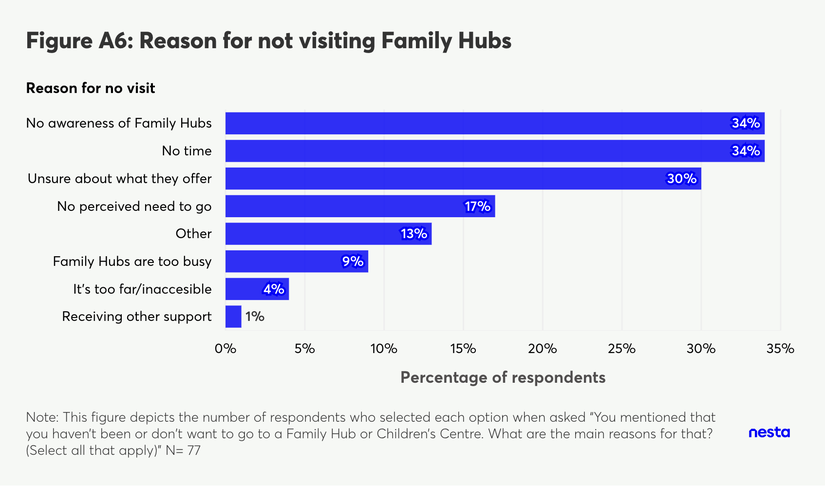
Figure A6
Image Description
A horizontal bar chart titled 'Figure A6: Reason for not visiting Family Hubs'. The vertical axis lists 'Reason for no visit' categories, and the horizontal axis measures the 'Percentage of respondents' from 0% to 35%. The blue bars show the following distribution from top to bottom: No awareness of Family Hubs at 34%; No time at 34%; Unsure about what they offer at 30%; No perceived need to go at 17%; Other at 13%; Family Hubs are too busy at 9%; It's too far/inaccesible at 4%; and Receiving other support at 1%. A footnote at the bottom reads 'Note: This figure depicts the number of respondents who selected each option when asked "You mentioned that you haven't been or don't want to go to a Family Hub or Children's Centre. What are the main reasons for that? (Select all that apply)" N= 77'.
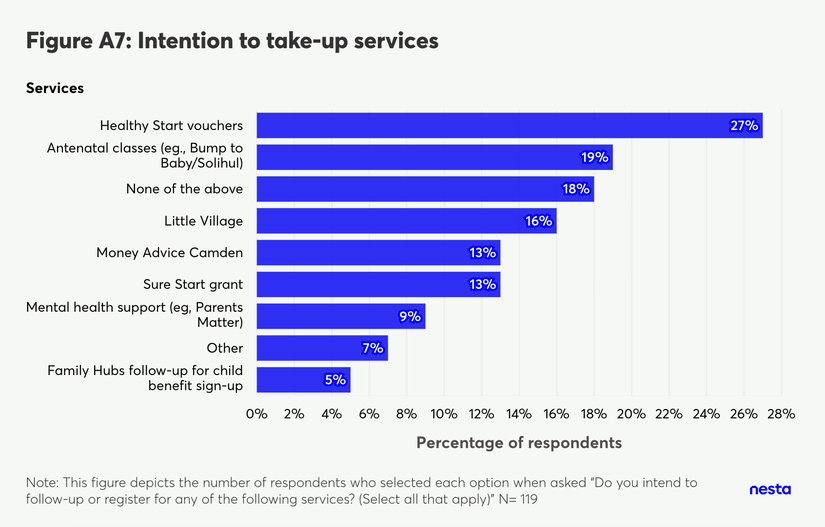
Figure A7
Image Description
A horizontal bar chart titled 'Figure A7: Intention to take-up services'. The vertical axis lists 'Services' options, and the horizontal axis measures the 'Percentage of respondents' from 0% to 28%. The blue bars show the following distribution from top to bottom: Healthy Start vouchers at 27%; Antenatal classes (eg, Bump to Baby/Solihul) at 19%; None of the above at 18%; Little Village at 16%; Money Advice Camden at 13%; Sure Start grant at 13%; Mental health support (eg, Parents Matter) at 9%; Other at 7%; and Family Hubs follow-up for child benefit sign-up at 5%. A footnote at the bottom reads 'Note: This figure depicts the number of respondents who selected each option when asked "Do you intend to follow-up or register for any of the following services? (Select all that apply)" N= 119'.
Data in this report
Data used in the pilot comes from NHS records of 20-week pregnancy scan appointments, and the council’s own benefit records. The pilot uses the LIFT platform, which helps the council to process its administrative data and target support to low-income households. See our Toolkit for more details.
Data used in the evaluation is a combination of administrative records and our own data collection. Ethical approval for the evaluation data collection activities was obtained from the UCL Institute of Education ethical review board (REC2164). Participants were informed that their decision to take part in the survey and interview would not affect their access to the Family Hubs or any other Council services.
Survey
We invited all parents who were offered the grant to complete our online survey. We invite parents by email and SMS in fortnightly batches, approximately 5 weeks after the initial grant offer, and parents are given two weeks to respond, with two reminders sent during this period. Respondents provided informed consent before beginning the interview. Respondents who complete the survey are sent a £25 gift voucher as a ‘thank you’ for their time.
The data in this report includes responses received through to 19 February 2026, for respondents who were offered the grant between April 2025 and January 2026. During this period we received 154 responses that completed all questions used in this report: 79 in the cash only condition and 75 in the Navigator condition.
Respondents had the option to select ‘prefer not to say’ for most questions. Throughout this report, percentages are calculated including all respondents who answered the question, including those who preferred not to provide an answer to a specific question, in the denominator.
Figures show percentages rounded to the nearest whole number, and therefore some figures may not sum to 100%.
Family Navigators’ call and meeting logs
Family Navigators keep records of phone calls and meetings with parents in a pre-defined format. The Data Capture Table for Navigators is available in our Toolkit. Put together, these logs allow us to view engagement pipelines for all parents who were randomised into the Family Navigator condition. In this report, we include records for any calls or meetings that occurred through to 3 February 2026, with 152 parents. Outreach was not possible to some parents in the Navigator condition because of missing or invalid contact details. Because the pilot is ongoing, the pipeline shown likely includes some ‘open’ cases - i.e. meetings and calls that are scheduled for a date after 3 February 2026.
Interviews with Family Navigators
We interviewed two Family Navigators, in December 2025 and January 2026.
Interviews with parents in pregnancy
We have interviewed 21 pregnant grant recipients to date. Interviewees were recruited through our survey, in which we asked respondents if they would be interested in an interview. Interviews were conducted over phone or video call. We obtained informed consent to record the interviews, and transcribed the interviews verbatim. Anonymised transcripts were then coded by three team members and analysed using thematic analysis.