ACKNOWLEDGEMENTS
This report was produced for the British Council by Nesta as part of an evaluation of the Playable City Lagos workshop. It was written by Jessica Bland, Head of Futures Research, Nesta. Tom Saunders, Senior Researcher and Benjamin Reid, Head of International Innovation supported this research in Lagos and London.
Lynsey Smith, Programme Manager, Creative Economy, British Council provided much valuable insight and time to make sure this evaluation saw as much of the Playable City Lagos project as possible. Caroline Meaby, Senior Programme Manager, Creative Economy, British Council guided the work, helping make connections to the wider aims of the British Council.
Playable City is produced by Watershed, in partnership with British Council. The programme spans an international award, touring programmes, a network and a programme of workshops. The Watershed team, particularly Clare Reddington and Hilary O’Shaughnessy, shaped the thinking and delivery of the workshop in Lagos. Their generosity in sharing the ideas behind this was vital to the commentary in this report.
About the British Council
The British Council is the UK's international organisation for cultural relations and educational opportunities. We create international opportunities for the people of the UK and other countries and build trust between them worldwide.
Arts has been a cornerstone of this mission for more than 80 years, finding innovative new ways of connecting with and understanding each other through the arts, to develop stronger creative sectors around the world that are better connected with the UK.
For more information, please visit: www.britishcouncil.org
About Nesta
Nesta is an innovation charity with a mission to help people and organisations bring great ideas to life.
We are dedicated to supporting ideas that can help improve all our lives, with activities ranging from early-stage investment to in-depth research and practical programmes.
Nesta is a registered charity in England and Wales with company number 7706036 and charity number 1144091.
Registered as a charity in Scotland number SCO42833. Registered office: 1 Plough Place, London, EC4A 1DE.
FOREWORD FROM THE BRITISH COUNCIL CREATIVE ECONOMY TEAM
“Cities have the capability of providing something for everybody only because, and only when, they are created by everybody”
Jane Jacobs, The Death and Life of Great American Cities
By 2050, almost 70 per cent of people in the world will live in urban areas. How will we thrive in these communities? Around the world, urbanists, planners, activists and artists have been experimenting with new ways of using city spaces to promote social cohesion and increase well-being for the people who live in them.
We've been really inspired by the work Watershed, a cultural and digital creativity centre in Bristol in south west England, are doing to encourage creative, collaborative approaches to make their city more playful. We wondered how their Playable City approach would work in other places and what ideas and connections would come out of mixing expertise and ideas from different countries and cultures. We've been working with Watershed since 2013 and so far we've helped take the Playable City methodology to Recife in Brazil, Tokyo in Japan and Lagos in Nigeria. This report is an independent evaluation of the latter. Playable City Lagos was a ten-day residency that brought together artists and creative professionals from Nigeria and the UK to devise and develop playful interventions for Africa's biggest metropolis.
Playable City Lagos was part of British Council's season UK/Nigeria 2015-16. This was a major Arts festival in Nigeria aimed at building new audiences, creating new collaborations and strengthening relationships. As the report shows, Playable City Lagos was an effective catalyst in achieving these aims.
The people who responded to the invitation to take part in Playable City Lagos have already made their mark as creative professionals in their respective fields. Between them, they represent a diverse range of skill sets, experience and practice. We trust that this talented group will continue to challenge, provoke and inspire themselves and others to engage with their environment in different ways and hope that city planners and policymakers will pick up on the energy behind these ideas and continue to work with more voices from the creative community as they shape the future of Lagos.
ABOUT THE CREATIVE ECONOMY TEAM
The Creative Economy team supports new collaborations, learning and policy development within the rapidly-changing creative and digital industries worldwide. We provide the space, tools and connections for people from different backgrounds to test imaginative ideas, learn new skills and tackle social and civic challenges together. We aim to build long-term systemic change for a more prosperous, equitable and sustainable creative future.
ABOUT WATERSHED AND PLAYABLE CITY
Watershed is a cultural venue and producer developing cultural engagement, imagination and talent in Bristol, UK. Watershed launched Playable City® in 2012, and runs an annual international Award for Playable City projects, as well as delivering consultancy, producing workshops and installing projects from Recife, Brazil to Tokyo in Japan.
INTRODUCTION
This is an evaluation of the form and impact of Playable City Lagos, as advice to those taking the Playable City programme to other locations around the world.
A team from Nesta was commissioned by the British Council to evaluate the attitudes, activities and immediate impacts of Watershed's Playable City Lagos workshop in March 2016. That programme helped creatives and technology talent from the UK and Nigeria to design experiences that would prompt Lagosians to engage directly with their city, to feel like the city is open for play.
TIMELINE
The timeline for the Playable City Lagos project is described in a flow chart, indicating two main phases: PREPARATION and WORKSHOP, followed by longer-term project development, skills, and network sharing.
PREPARATION Phase (July 2015 - February 2016):
* 6-10 JULY 2015: Scoping in Lagos - Recce of the city; run-through of Playable City exercise with creatives; roundtable with government and private sector stakeholders.
* OCTOBER-DECEMBER 2015: Local research - Vox pops, street surveys and workshops.
* JANUARY 2016: Applications - Forms submitted from Nigeria and the UK.
* FEBRUARY 2016: Briefing - Participants chosen and background material sent out.
* 22-26 FEBRUARY 2016: Final preparation - Final recce; Attending Picnickers Anonymous pop-up event to promote Playable City Lagos.
WORKSHOP Phase (March 2016):
* 9-11 MARCH: Sharing expertise - Sharing professional experience and information about Lagos; site visits; presentations of previous Playable City outputs and local research.
* 12-16 MARCH: Building prototypes - Tech briefing; brainstorming; playing out ideas; user testing.
* 17 MARCH: Showcase - Presenting prototype ideas with local audience.
Post-Workshop:
* Longer-term project development; skills and network sharing continues indefinitely after the workshop.
This report puts to paper what we observed, with some advice and suggestions for future Playable City hosts and producers. Given the skills, experience and preparation time put into this project by Watershed and British Council staff in the UK and Nigeria, much of what is described here happened by design. So this report concentrates on evidence of how this affected the specific experiences of individuals - what mattered to them, what did it change afterwards.
It begins by describing the motivations for Playable City in relation to global discussions about how to support urban citizens: why the report is titled Creative Construction.
Then it runs through the lessons from observing that workshop. This follows the logic model developed to describe the processes at play (below).
THE LOGIC MODEL FOR PLAYABLE CITY LAGOS
This diagram illustrates "THE LOGIC MODEL FOR PLAYABLE CITY LAGOS", outlining a theory of change through "LEARNING ACTION" and "IMPACT OF LEARNING" phases.
LEARNING ACTION:
This phase begins with three parallel inputs:
* Reach of application process (Steps taken by decision and policymakers)
* Preparation - active in design (Steps taken by partner organisations)
* Preparation - engaged during design (Steps taken by participants)
These lead to:
* Engagement - in the content - in the making
* Engagement - functional role in workshop
* Engagement - attending final sharing
All these contribute to Satisfaction at the end of the workshop.
IMPACT OF LEARNING:
This phase branches from "Satisfaction at the end of the workshop" and "Engagement - attending final sharing" into several outcomes:
* New skills, networks and knowledge (Internal impact)
* New creative and tech networks (Internal impact)
* Ideas for creative and tech sector collaborations (Internal impact)
* External impact - inspire others
* External impact - New creative tech projects in urban environments, preferably Lagos
Legend for Stakeholders:
* Red block: Steps taken by decision and policymakers
* Dark red block: Steps taken by partner organisations
* Orange block: Steps taken by participants
Taking an action-learning approach - more in an appendix - led to this model for the theory of change for Playable City Lagos.
Along the way, light bulbs highlight ideas that played an important function in the project and are worth bearing in mind for future workshops.
The conclusion distils these lessons into two guiding principles for future workshops. It then asks two questions about how Playable City positions itself relative to global debates about the future of cities.
A RECENT HISTORY OF GLOBAL CITY POLICY
Cities, with their dense populations and overlapping infrastructure, provide rich landscapes and ample motivation for the building and rebuilding of products and services. But cities also offer some of the most stark examples of what happens when citizens do not have a role in the development of new initiatives.
In Lagos, Eko Atlantic City is a new area of the city being built from reclaimed land on Victoria Island. There are ambitious plans for large residential complexes that will house a quarter of a million people, as well as new jobs for 150,000 Lagosians. However, it has come under criticism for being part of what Vanessa Watson sees as a new ensemble of African city masterplans directed by international property developers. These plans "stand in dramatic contrast to the lived reality of most urbanites, and while their impacts are likely to be complex and contradictory, what seems most likely is that the majority of urban populations will find themselves further disadvantaged and marginalized" . It's not clear that Eko Island is the best way to help the swelling population of Lagos arriving from elsewhere in Nigeria. Nor is it clear that this kind of investment should be prioritised over projects that address the city's precarious energy, water and transport infrastructure.
Keller Easterling studies the new economic zones in cities around the world. She describes these as a new dynamic of power - where global architecture practices and multinational firms have more say over design than residents of the city. Easterling emphasises how infrastructure is not just a physical constraint, it is also the hidden rules that structure urban life. As power over this infrastructure moves beyond even the city or national government, little opportunity remains for citizens to play a role in developing the rules that govern their own lives.
This dynamic is replicated in so-called smart city technologies. This family of technology uses data, to co-ordinate, analyse and target services: reducing traffic jams; less energy waste; and public services targeted where they are most needed. Too often these technologies are quickly standardised across a city or cities, missing the opportunity to respond to citizens' differing needs.
The proliferation of plans for sleek and simple new economic zones or smart infrastructure ideas can distract urban planners. But they also constrain the opportunities for others to play a role in that planning - for innovation to come from entrepreneurial ideas found outside town halls or large contractors.
New products and services come about, according to the Austrian economist Joseph Schumpeter, through periods of repeated destruction and improvement that changed whole industries. The now well-known idea of 'creative destruction' is a process led by entrepreneurs that challenge incumbent businesses or destroy existing markets with a new way of doing things.
Supporting entrepreneurship usually involves: access to knowledge, finance, market environment, labour, entrepreneurial culture and a supportive regulatory regime. Small business support, accelerator programmes and leadership courses are often used as ways to do this. But much like the challenges of imposed economic zones or smart city programmes respond to, they can often suffer from a one-size-fits-all approach.
A candid street photograph taken from waist-level shows a man in a plaid shirt with a backpack walking past a storefront that reads "PAUL & MIKE". The street is busy, with other people in the background, suggesting a lively urban environment.
Lagos morning. Photographer: Jessica Bland
They can end up as a mismatch with the needs of people living in a city, failing to work with the grain of their lives. Part of the attraction of these kinds of programmes is their novelty - the new solution to long-term intractable problems. This is sometimes useful, but it can also ignore the silent 'collective unglamorous', as Ash Amin from Cambridge University calls it: "The unglamorous consists of all those things in the city that we take very little note of, but which are absolutely essential for our lives and our identities." These are issues that can get lost because they don't have the attractive simplicity of a new economic zone, smart city system or accelerator programme for startups.
The Social and Economic Action Center (SERAC) in Lagos provides legal representation for residents of informal communities including Makoko and Badia. They help them fight for the right to stay or compensation for resettlement. However, the Lagos initiative that caught global media attention in 2012 was the design of a floating school in Makoko. Architects and engineers in Lagos and Amsterdam designed the prototype floating structure. The local government threatened to shut down the first version. But the attention led to a change of heart by Lagos State Government, including an ambitious plan for floating homes to take the place of the current slum houses. This could seem like a great plan, but Makoko residents may not be able to afford floating houses, possibly leading to new evictions. There are further threats to the 30,000 people in the slum after the Makoko floating school collapsed in June 2016 inadvertently becoming a symbol of the fragility of the community rather than reimagining their existence.
A photograph captured from a low vantage point shows a sunset over a body of water with numerous small boats and wooden structures, indicating a waterside slum area. The sun casts a golden glow, silhouetting the distant city skyline.
Wood floats downstream past the Makoko slum from inland. Photographer: David Haylock
The challenge is set then: there need to be new initiatives that support a more inclusive, or at least more accessible, mode of innovation in the city responding to the challenges a city faces. There needs to be a refocusing on the creative construction of new ways of doing things as much as the destruction of old ones: making the most of the attraction of visions of the future of a city. They should match that creativity with the technical knowhow to make ideas real.
Playable City is one of the new ways to take on this challenge. Produced by Watershed, in partnership with the British Council, the programme spans an international award, touring programmes, a network and a programme of workshops. The workshops aim to flex to the local context: in who produces them, attends them and in the open format of the workshops themselves. As the Playable City programme looks to roll out globally, run and managed by an increasing number of local hosts, its success will be based on maintaining this local specificity.
This way of locating Playable City Lagos in a recent history of city planning and policy was front-of-mind during the evaluation. The concluding section of this report returns to the topic, articulating questions that Playable City could help answer in order to challenge popular notions of urban innovation.
1. PREPARATION
Playable City Lagos benefited from a strong core team that worked together for almost a year before the workshop to cover local logistics, research, recruitment and workshop design and engaging local stakeholder networks.
Eight months prior to the workshop, there was a scoping meeting with local experts in Lagos organised by Watershed and the British Council Creative Economy team, which was followed on the same trip by a meeting with potential partners including Government stakeholders. This led to a significant research commission from independent local researchers Future Lagos. That included vox pop research with Lagosians about attitudes to their city. It also included a workshop that re-engaged some of the stakeholders in future scenarios for the city, producing ideas for the kind of interactions that could come out of Playable City Lagos. This research was used in the design of the workshop, particularly in coming up for sites for the Playable City Lagos interventions and the theme 'mobility'.
During this process, Lynsey Smith from the British Council Creative Economy team spent approximately a day a week on the project. Local British Council staff also spent significant time coordinating local activities and preparing for the workshop. Hilary O'Shaughnessy from Watershed spent a similar amount of time to Lynsey albeit over more intense periods. Other partners, CCHUB and the Goethe-Institut, supported with their networks and contacts and advice during the process for selecting participants.
USING NETWORKS
The scoping meetings and Future Lagos's research workshop provided a structured way to engage local decision-makers and experts including architects and government officials. Individuals from partner organisations: Marc-André Schmachtel from the Goethe-Institut, Femi Longe from CcHUB and Olamide Udoma from Future Lagos - helped publicise the project and shortlist applicants.
A photograph shows Clare from Watershed and Marc-André Schmachtel from the Goethe-Institut speaking at a Pecha Kucha event. They are seated, engaged in conversation, with other attendees in the background, suggesting a collaborative workshop environment.
Clare from Watershed and Marc-André Schmachtel from the Goethe-Institut speaking at a Pecha Kucha event hosted by the British Council during the Playable City workshop. Photographer: Tosin Oshinowo
Mature relationships between the British Council Creative Economy team and local partners also influenced the depth of issues that were covered. For instance, Ore Disu, Founder of the Nsibidi Institute - who delivered some of Future Lagos's local research - had previously travelled to London with the British Council, had already started to articulate the value of an emerging creative technology scene in Lagos a year before the workshop:
"Even though a lot of these cities (across Africa) haven't really had what you would call an industrial revolution, there is something happening in the tech sphere... it is democratising so many things that otherwise wouldn't have been reachable or accessible for the average person in Nigeria. And this is happening in terms of how people communicate with each other, in terms of how they run their businesses and creating not just design solutions but also, for example, the boost in the creative economy is creating new jobs for people and increasing participation in all kinds of activities.”
Ore Disu in London (March 2015)
By the time of the workshop she had edited a published collection of essays on Open City Lagos in collaboration with the German Green Political Foundation, Heinrich Böll Stiftung. The workshop also came at a time that Future Lagos was becoming a formal group of urban activists. Some of this could be characterised as serendipity, which the team then used to help improve the workshop itself.
A lightbulb icon is accompanied by text describing a key insight: Experience from other workshops and the strength of the local network led Watershed to invite participants to provide the background to the city through 'My Lagos' talks rather than bringing in external experts.
COMMISSIONED RESEARCH
The sites of intervention suggested by the previous research included, for instance, the Danfo buses controlled by local Yoruba leaders. This specificity noticeably increased the local sensitivity of products developed during Playable City Lagos. The Danfo bus was the location used for one of these projects.
A lightbulb icon is accompanied by text describing a key insight: At least one of the ideas from the research workshop was referenced frequently early on in the workshop: phone credit for school children as they cross the pedestrian bridge rather than the road. It worked as a straw man idea, providing a focus for participants' debates over what it means to produce a playable city intervention in Lagos.
2. REACH
To recruit seven participants from Lagos and four from the UK, candidates submitted applications three months before the workshop. Partners were involved in recruitment and selection.
NOT JUST THE USUAL SUSPECTS
The partners worked hard to ensure participants came from diverse backgrounds, including gender, a range of sectors. They have expertise in media, business development for entrepreneurs, technology photography, architecture, performance, games and sound. Some came from commercial backgrounds, producing profit-making media or designing buildings. Others from NGOs or more traditional arts backgrounds. By design, applicants were picked to cover some standard diversity measures: four female and eight male.
Word of mouth recommendation featured highly in how people came across the project, often down to the strong networks locally. Sometimes this brought in unusual suspects: Gbadebo Rhodes-Vivour heard of it through an ex-colleague who knew Watershed's work on Playable City Tokyo. She said: "look out for Playable City in Lagos, it's just your kind of thing." Tosin Oshinowo met Olamide Udoma (from Future Lagos) when Olamide came along to a talk she organised at an architecture school in Lagos.
A lightbulb icon is accompanied by text describing a key insight: Other participants were sought out by actively recruiting from the networks of, for example, tech centres like Cchub. The founder of the successful tech news blog TechCabal was among those participants. He did not have the overseas education or family support in Lagos of many of the others.
"In 2011 when I was done with my law school [in my local state], I told my parents I wanted to come and live in Lagos. And I knew no one. It was just because of this guy who I had seen speak at an event, and the others that had started to talk and write about tech... I was borrowing money off my friend then - I closed down - to the point where I was living in an apartment with ten other guys and just sat at my laptop all day every day. This was my life until the point where the blog became a successful business.”
Bankole Oluwafemi
EXCITED ABOUT AN OPEN PROCESS
In Lagos, Clare Reddington from Watershed described the factors that went into this curation and what they expected the impacts to be:
"Lots of this is about open innovation and finding ways to collaborate across disciplines... This is why we curate people and discipline, to have a mix of backgrounds, art forms and experiences in the room. We seek out new talent and design in wisdom; having mature practitioners who have done this kind of thing before and who understand the dynamics of it is crucial.”
Clare Reddington
Despite this diversity, there was also a shared set of characteristics amongst the successful applicants.
In any group project, there are those that respond best to an open, evolving process and those that like clear tasks and objectives. Playable City balanced a toolkit of exercises and prompts with a self-directed process for idea generation. It is likely to suit better those that prefer open processes. Bankole summed up the kind of attitude that worked well for the participants of the approach of the Playable City workshop in an email sent before the project:
"Will we break into teams? Or the whole workshop cohort is the team? Or we'll work solo? Or a mix of all these? A strictly regimented programme in which we are herded by our handlers, or a blank slate configurable by the members of the workshop via a quasi-democratic process? I don't know, and I'm curious to find out myself. The truth? I'm keeping an open mind, even though I will admit to have been led to expect a very creative and collaborative experience with very smart and out-of-the-box types.”
Bankole Oluwafemi
CLEAR INDIVIDUAL GOALS
A photo shows two women, Bankole and Shaina, working on a prototype. One woman is looking intently at the other, who is demonstrating something on a small, box-like device. The setting appears to be a workshop or creative space.
Bankole and Shaina working on their Fibre prototype. Photographer: Simon Johnson
This attitude is not to be confused with participants that don't have clear goals for what they want to get out of a process. Even those not from traditional creative economy or technology backgrounds have a good sense of what they were looking for in their application form:
"Playable City interests me because the project combines the things that I love the most: art, technology, culture, and gamified experiences. My experience in Lagos since I moved there in April 2015 has been around solving social problems through business/ entrepreneurship. This project will allow me to use my creativity as well as my perspective as a Haitian/American expat living in Nigeria, to create 'playful interventions' that tie together the best of all three worlds."
Shaina Silva
Similarly those participants near the beginning of their career were still clear about what they would achieve during the workshop. Desiree is an engineer, who has recently started working at CcHUB as technical lead for their youth engagement programmes. Via email she said ahead of the workshop that:
"I'm quite keen about the power of IoT and technology to improve the quality of life; however, this will require proper application and an understanding of local context. Playable City will help kickstart that process of identifying ways technology can be applied in a practical manner to make Lagos more interactive as a city.”
Desiree Craig
A lightbulb icon is accompanied by text describing a key insight: Prompts during the application process helped skew towards people that prefer to work in this way - with their own goals in mind and those who want to engage with an abstract idea like Playable City. The application form focus on the participants' own goals for the programme, rather than how they fit a pre-existing set of goals was helpful. Similarly it asked for their understanding of the concept of a playable city.
THE WORKSHOP AS TIME OUT
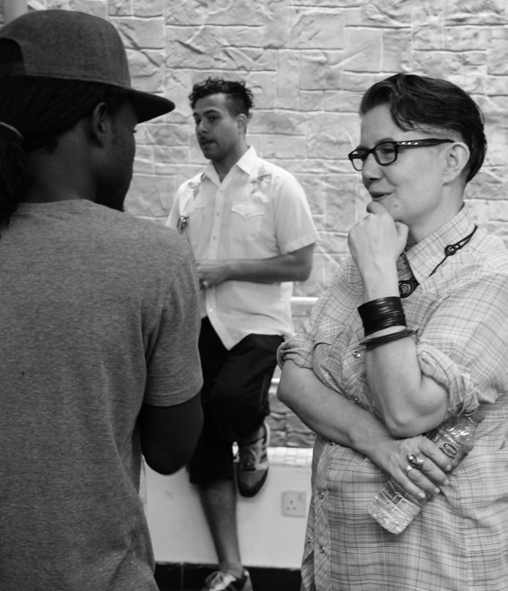 Ju, Simon and Jere Ikongio during the workshop. Photographer: Logo Oluwamuyiwa
Clare Reddington reflected afterwards: "Maybe someone is attracted to these kinds of things because they are at a crossroads."
This was true for UK and Nigerian participants. Ju Row Farr from the UK brought some of the wisdom Clare mentioned above, but she was also looking for new connections in a region and culture that Blast Theory hadn't worked in before.
Simon Johnson saw this as some time out from the day-to-day of his work producing games:
"I am not trying to get something out of this for my practice [ie a game for my portfolio], but I want to work in a different way, with people with different backgrounds and skills.”
Simon Johnson
Tosin Oshinowo, who returned to Nigeria after training and working in Europe, was similar:
"[This workshop] is not my norm, but I am very conscious that... when I came back to Nigeria I was doing the standard. So by buying some time, I wanted to get back to thinking creatively.“
Tosin Oshinowo
Gbadebo Rhodes-Vivour, who trained as an architect in the US before returning to Lagos, has ambitions to eventually move into a government urban planning role and the workshop was part of a process of moving his career in that direction:
"This year I went back to school to do a Masters in public policy at UniLagos, to do this thing, to get into government... I am learning how to understand the numbers and statistics and the evidence behind policy decisions. But for me it always starts with the user, what the person on the street needs. And then on top of that you build lovely experiences.“
Gbadebo Rhodes-Vivour
3. ENGAGEMENT AND SATISFACTION
This section covers how participants and partners engaged with the Playable City Lagos programme and what they reported their experiences to be, during and after the workshops.
During Playable City Lagos the participants went through a structured programme, starting with three days of sharing expertise: UK participants talking about their practice and Nigerians about 'My Lagos' which for some included examples of their practice too. There were site visits during this time too. Clare Reddington presented previous Playable City outputs and Olamide briefly on Future Lagos and the previous research. Examples of possible tech were then introduced, Watershed organised participants into three groups, which produced ideas for playable city interventions in Lagos. The ideas were then tested on Lagosians: to understand how they would interpret them and how interesting they found them. At the end there was a showcase of the three ideas interventions and celebration of the work, mainly with previously engaged stakeholders and partners.
MANY FACES OF THE CITY
The sessions where the Lagosians described 'My Lagos' provided a starting point for some of the richest cultural discussions during the workshop. Gbadebo focused on the structural and economic difficulties that the country faces, moving between historical facts and insights about his views on differences between those with Igbo, Yoruba and Hausa ancestry in Lagos.
Others told more personal stories about their own experiences in Lagos and the city's culture. Desiree talked about the general notion of people from all over the country coming to Lagos to 'hammer' which means to work hard to become successful.
She also pointed out the 'bubble' Lagos seemed to be in when compared to other parts of the country.
"So say you want to dominate the technology industry, you have to decide if you are building for the 1 per cent, or the whole of Nigeria. Because Lagos appears to be the hub with regards to technology it's easy to judge the rest of the country by the progress made in Lagos. Lagos is chaotic but also has this big buzz about it.”
Desiree Craig
A lightbulb icon is accompanied by text describing a key insight: Prompts during the application process helped skew towards people that prefer to work in this way - with their own goals in mind and those who want to engage with an abstract idea like Playable City. The application form focus on the participants' own goals for the programme, rather than how they fit a pre-existing set of goals was helpful. Similarly it asked for their understanding of the concept of a playable city.
Characterisation of Lagosians were debated among the group. For example, one participant talked about road rage incidents as a daily release after work while others talked about them as symptomatic of an attitude that needs to be changed. This openness made conversation with UK participants easy. 'My Lagos' sessions were crucial in developing a trusting and animated group of participants, making the most of a shared first language.
PLAYING WITH THE IDEA OF PLAY
Clare explained that this was different from other workshops Watershed had participated in, where external experts had been brought in to describe the city and its structures. Ju Row Farr, one of the UK participants, echoed Clare's sense that 'My Lagos' worked much better because it used the expertise in the room:
"That part of the process afforded that kind of layer of understanding where you really know what matters to them in their lives and their worlds.”
Ju Row Farr
This was aided by the fact that all participants were able to articulate their ideas in English. There was a mutual comfort in conversation that was questioning and challenging.
A photograph shows a group of diverse individuals gathered in a brightly lit room, engaged in discussion. Some are seated, intently listening or looking at a laptop, while others stand, contributing to the conversation. This captures a collaborative atmosphere during the early sessions of the workshop.
Sharing ideas in the early sessions of the workshop. Photographer: Shaina Silva
As well as discussions about what makes Lagos the city it is, participants also debated the concept of a Playable City.
The workshop format allowed for these open debates. But there were moments where they were brought back in, or boundaries were placed around them in order to avoid being sidetracked by conceptual discussions. The steer around what makes a Playable City project is a good example of this. Watershed colleagues steered open discussion and prototype development towards an idea that was bounded by at least five properties that were also picked up on by participants and debated for much of the first few days and in their free time.
BOX 1 THE CONCEPT OF A PLAYABLE CITY
The concept of a playable city was not explicitly defined during the workshop. Afterwards Clare emphasised the need for 'a galvanising theme without it necessarily having to dictate the terms of all those interactions'.
- #### Playful {: #section-playable-city-playful }
Playable City projects can end up being and doing many other things, but first they have to embody the value of play that Yann Seznec summarised in his blog after returning to Edinburgh from Playable City Lagos: “It does not get in the way or require extra time and energy, and it does not pretend to be creating extrinsic value. It is open and free and potentially magical (or funny or sad).”
- #### Accessible by most citizens {: #section-playable-city-accessible }
Clare Reddington defined the rules of Playable City when talking about the first Playable City award winner, Hello Lamp Post [^7]: "Don't make stuff for hipsters that live in the centre of the city. Make stuff where you can reach out to wider parts of the community. And make the barrier to participation really low - which is why they chose SMS."
The idea of widening access to digital interventions in the city is related to the motivation to move against the idea of an exclusive smart city cited in the introduction.
- #### Momentary interaction {: #section-playable-city-momentary }
Without prompting, several of the participants described playable projects as producing fleeting moments that remain with the audience but don't overshadow the rest of their day. Tosin said: "There was this guy on the bus and we asked him about his experience. And he said he will tell his family he spoke to a mirror. And maybe that sounds a bit silly. But it's the fact that he will take a memory away from it, which he will carry and tell people about. That adds to the experience.”
- #### Responding to local debates {: #section-playable-city-local-debates }
Playable City interventions had to respond to the specific problems of that city. They had to be a serious kind of play: one that aimed at highlighting a serious issue and going some way to solving it. Tosin connected this directly to the idea of play: 'The whole purpose of play is about making people aware of their environment.'
- #### Commenting on global city governance issues {: #section-playable-city-global-governance }
During the workshop Clare then described the previous Playable City Shadowing project as a commentary on surveillance in the city. Urbanimals [^8] projected animated characters that people interacted with in parts of the city that were often seen as frightening or unattractive. The projects cover ideas about the future of the city that are hidden both physically and politically: aiming directly at some of the points of view missed by new economic zones, smart city or startup accelerators mentioned in the introduction to smart city policy.
PROPER PRODUCTION
A photograph shows Yann Seznec, a man with short hair and a plaid shirt, leaning over a table and intently focused on a device with a laptop open next to it. He appears to be working on a prototype with various electronic components.
Yann Seznec working on the Danfone prototype. Photographer: Clare Reddington
Although the opportunities for networking and for new knowledge were important, the participants interviewed afterwards emphasised the value of producing a prototype. They described how having a real project to work on was crucial to their satisfaction. Bankole said that 'actually making something' was his main memory. Tosin said it helped her as the process of producing a physical product is her normal way of operating.
Yann Seznec has attended many different kinds of workshop that go beyond idea sharing into trying to build new products: "I really like unpolished broken things that test out how you work." He positioned Watershed's approach to a Playable City workshop in a history of hack days:
"This is part of the third wave of hacks... It starts from the game jam thing. And then it circulates into the tech incubator thing. I got so annoyed with them. It encouraged chasing a silly carrot on the end of a stick. Building things or coming up with ideas to win a prize, which was often just access to potential investors, when you'd just come up with the thing in two days. They were outsourcing their ideation. There is value in sitting and working and thinking of things and testing them. And not worrying about the end project is key. That's the third wave.”
Yann Seznec
Ju Row Farr was careful to distinguish the objective value of this kind of process from the value of producing the very best product you can in the time:
"I think that thing when you work with other people and when you produce anything, it's a good thing. But up to a point. For me, the work and the nature of the thing should be slightly more highlighted or foregrounded in the discussion."
Ju Row Farr
Even if the products in the workshop are not expected to be finished, polished. Ju pointed out that they still needed artistic integrity.
"It's not about the materials or the access to tech, it's about why the hell are you using that mirror. What do you mean by that?”
Ju Row Farr
BOX 2 DANFONE
A photograph shows three individuals, Ju, Logo, and Tosin, seated at a table, intensely focused on writing and discussing early responses to site visits. Various papers and a drink are on the table.
Ju, Logo and Tosin writing down their early responses to site visits. Photographer: David Haylock
All three projects caught the attention of audience members at the final showing, particularly those from Lagos's young creative sector. But the Danfone project was picked out by the other two groups of participants as the project that worked best. They emphasised its technical plausibility:
"In terms of comic relief we definitely got the best response... But I think in terms of long-term sustainability, probably not. I think that Danfone is actually one that could be pushed. It could be reappropriated in many different circumstances in Lagos, outside Lagos in Nigeria in general - anywhere in the world really because as an idea it was so technically clean."
Tosin Oshinowo
This is an abridged version of Yann Seznec's blog about producing Danfone, one of the three prototypes that were developed during Playable City Lagos:
Eventually, however, we decided to try and make something that focused on Danfos. These are the yellow minibuses that operate as one part of a multi-layered public transport system within Lagos. They are publicly regulated but privately run - putting them somewhere in between the informal motorbikes and the big fancy BRT buses which wouldn't look out of place in any European city... They are cheap, easy to use, and very democratic - several locals told me that in any danfo you'll get a nearly perfect cross section of Lagosian society...
A photograph captures an early evening queue for a danfo bus. People are standing in line next to a bright yellow minibus. The scene conveys a sense of everyday urban transport.
An early evening queue for the danfo. Photographer: Yann Seznec
As a group we started thinking about how we could play with this idea, and we came up with the idea of connecting random people in random danfos. What would happen if you could start up a conversation with someone you had never met who is in the same situation as you, but in a different place? What would you talk about? What kind of serendipitous interactions could be created?
We didn't have enough time to build a fully functional version of this, so we made a sort of proof-of-concept. We focused a lot on the design, making it fun and engaging (with some flashing LEDs of course), and making sure the interaction made sense. To that end we hacked an old fashioned telephone handset into a mobile phone, since we liked the idea of a really tangible interface with very little control.
A close-up photograph of a prototype labeled "DANFONE SAY HELLO MAKE WE TALK ? PICK ME". The device features a telephone handset and simple text, designed to be interactive.
Final prototype. Photographer: Yann Seznec.
A photograph shows the "DANFONE HELLO TALK" prototype installed on a danfo bus. The phone handset is visible, ready for interaction.
Danfone on the danfo. Photographer: Yann Seznec.
In practice the way we used our prototype was hilariously low-tech: we dialled the number of a mobile phone hidden in the Danfone, answered that phone and then put it all back together so you could only speak through the handset. Then we put the whole thing in a danfo and waited for people to interact. The incredibly patient Desiree waited for anyone to pick up the phone and have a discussion. We did this twice, once with Inua and Jere in the bus engaging with people who were interested, and once with Jere hiding in the back to see if anyone would pick it up.
It was only really half of a test, but I would say that it was very successful. A few people spoke to Inua and Jere and tried it out, and on the second test a very curious person built up the courage to pick up the phone - only for the mobile to drop the signal! That was a bit frustrating, but by showing the limit of our prototype we also saw the potential for what it could be.
As a part of our work we also thought about what future possibilities could be explored. For example, we considered a future radio show, Danfo Diaries, which could be built out of conversations between strangers on danfo buses. This could make for some pretty compelling listening, and encourage future conversations.
SEEING THE STREET AGAIN
Some of the Lagosian participants mentioned how the workshop took them back onto the street, where they might just pass by in a car most of the time:
"You tend to find that you filter things out, so you don't want to deal with... I have driven by there so many times, but I have never walked on that bridge... Going there made me think like the people who cross there every day. It helped me think creatively about the possibilities of what we could create.”
Gbadebo Rhodes-Vivour
HELPING BUILD PROFESSIONAL IDENTITY
Outside the formal workshop activities, participants shared advice about how to act and succeed in their profession. Early on in the workshop, from discussion with UK participants, Desiree discovered a name (and a new community of practice) for her interests and skills; she is a creative technologist.
They also spent time sharing skills. For example, one Nigerian participant taught another about their photographic practice: about how to see the 'the texture of Lagos' through a photography lesson on the bus and during a visit to a local market.
In the evenings, there was a lot of discussion about how to get a creative project off the ground. Collaboration at this point was about sharing different experiences. Many of the group remarked that they had shared and met Bankole's desire to find: a very creative and collaborative experience with very smart and out-of-the-box types.
A photograph shows a man (Logo) standing on a blue plastic chair, holding a camera, and looking upwards, seemingly trying to get a unique angle for a shot. The scene suggests a creative and resourceful approach to photography.
Logo finding the best angle. Photographer: Shaina Silva
Near the end of the workshop, Logo Oluwamuyiwa commented on his public Facebook page that:
"Had the most amazing opportunity over the last week co-creating with some of the most amazing minds as part of the 'Playable City' Lagos project... Sometimes we feel like a Hippie convention from MIT. Everyone is themselves. Diverse creative processes coming together to make one harmony... Most of all the immense possibilities in collaboration.”
Logo Oluwamuyiwa
Clare observed that some of the most valuable insights swapped at this point were 'tools for a conceptual emergency'. These are the kind of insights that help someone get through a crisis of confidence or help them to take a step forward in their career. They are a valuable part of building up a resilient professional identity in the creative economy. These discussions are easier and more natural in the free time around a workshop, whether that is over dinner or walking around a market.
A lightbulb icon is accompanied by text describing a key insight: Making space and time around formal activities supports some of the most valuable interactions, particularly sharing career advice, helping shape each other's approach to work and ideas for new ventures.
4. IMPACT
The key impact measures after the workshop were that participants from both countries have new networks and skills that they can point to and that there are signals that they are likely to use these to work in new ways.
Details of instances of and attitudes towards these developments are given below. The advantage of an open workshop format was that participants with different goals could mould the experience to meet them. Similarly, impacts have been about participants following their different interests. This section also includes analysis of how the workshop content could continue to have a life locally.
The image displays a presentation slide titled "THE FUTURE OF FIBRE" with a speaker (Bankole) in front of it. The slide lists five points:
- Context aware monologue and commentary based on surrounding input and stimuli
- Data visualisation/tactile feedback that informs users of ongoing developments in the tree's spatial universe
- Hyperlocal news, advertising, deals and easter eggs
- Fortune telling, tales by moonlight
- Tree Radio - a stream of voices from all other connected trees that exist!
Bankole presenting his team's prototype at the final showcase. Photographer: Simon Johnson
REINVIGORATING SKILLS
There was evidence that participants who wanted to return to skills they had lost or develop in new directions were able to do so:
"Ju is very, very, very, thorough. And I remember very early on in my career being that thorough. But when you work in the world of business you don't always have the chance to go over things a million times. I know that the best ideas come from recycling, rejigging, turning it round and checking it's watertight, which I had kind of forgotten. So it was really refreshing to work with someone who was still really strict in that approach. And I have taken that back into my own work."
Tosin Oshinowo
During the project, there was a lot of shared activity on Twitter and Instagram, which not only brought the participants' connections to each other, but made their work visible to each other's networks and stakeholders in the project.
Between 7 March 2016 and lunchtime on 15 March 2016, 389 tweets were recorded as using #playablecitylagos. This was after cleaning the tweets to remove those using the hashtag to advertise online games. Two hundred and fifty-three of these tweets were unique. The rest were retweets. This visualisation shows how often accounts (nodes) tweeted each other. Those that have shorter lines between each other have tweeted at each other more often than those that have longer lines. (The horizontal or vertical position of the tweets is defined only by the easiest way to display the lengths of ties between the network. There are more edges than tweets because some mention two other accounts.)
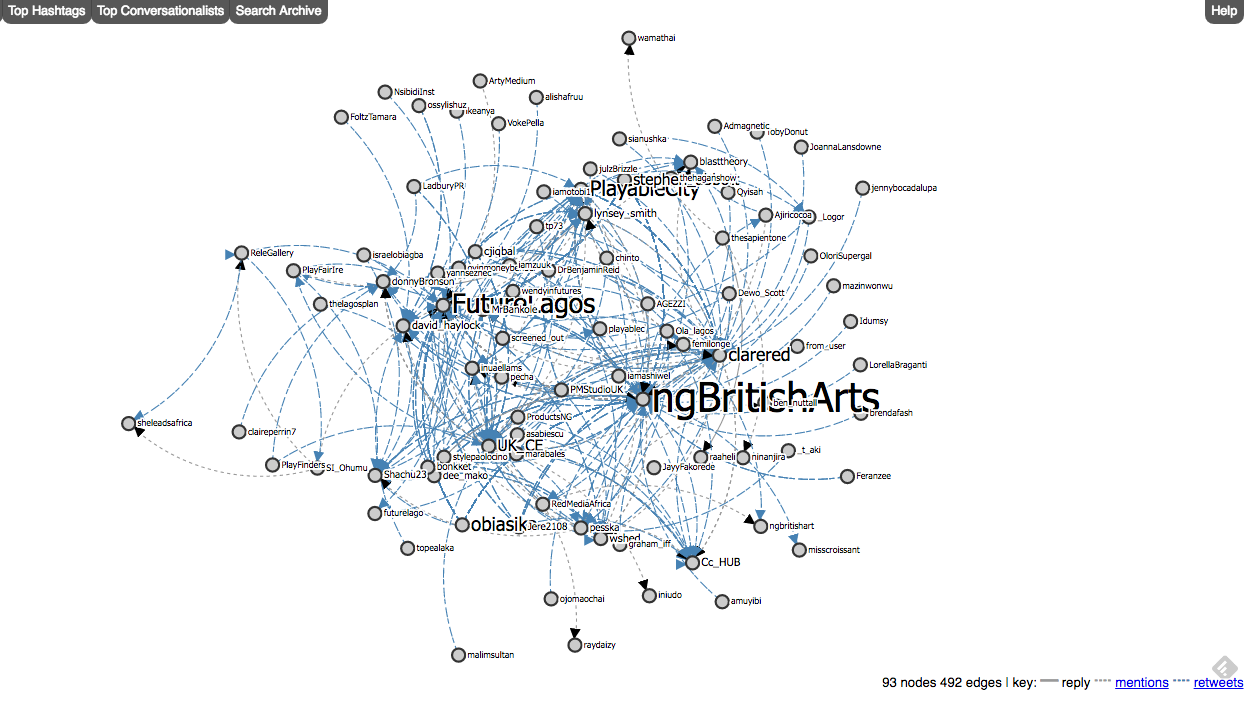
The diagram shows: Reply | Mention | Retweet | 93 nodes | 492 edges
You can see close relationships between some of the participants Twitter accounts - MrBankole, yannesznec, _Logor, BlastTheory - and key stakeholders with large audiences - PlayableCity, FutureLagos, ngBritishArts and UK_CE.
TIME FOR THINGS TO PERCOLATE
There were a few new project ideas already discussed during the workshop. For example, participants from Lagos helped Inua from the UK work through how a Midnight Run would work in the city, explaining how current programmes with some similarities could help get it off the ground and how best to work with local authorities.
Two months on from the workshop, there are ongoing conversations between participants.
Most are about trying out working together rather than formal creative collaborations. Tosin and Logo have a project trying to print photographs onto furniture fabric. Bankole has become a coach for young entrepreneurs in Lagos, as part of one of the courses that Shaina runs.
Yann pre-empted this, saying from experience: "I go back to my own place and then I reach out when I have an idea." Tosin also expected this to be the case:
"The reality of creating a network with these kinds of interventions is that when an idea pops in your head, you kind of know who to go to because you know that person is good at that thing and you can approach them.”
Tosin Oshinowo
Ju echoed that, that 'things take a while to percolate' after intense periods of interaction. She also described how working as part of Blast Theory means she has to convince the rest of the group that they might want to work with someone new. She has started some serious conversations with some of the participants, but it will really be about 'what sticks' with the rest of her team. And that takes time.
A lightbulb icon is accompanied by text describing a key insight: Don't expect to see signals of participants building networks and relationships in open forums afterwards. However, those forums can be a useful form of continuity for the group, which they can use when opportunities arise later on.
The conversations that happened in the margins of the workshops looked like they might lead to future relationships that were more about mentoring than professional collaboration. Ju mentioned wanting to make this transition at some point, but wasn't yet sure what that kind of relationship would look like. She is talking to Yann, and Logo did a residency at Blast Theory when in the UK in May 2016.
A LEGACY IN LAGOS
The workshop has a legacy in Lagos through the participants. Bankole mentioned that he has been talking to Gbadebo recently, and he has been paying much more attention to his urban environment and how it affects his life.
BOX 4 NOTICING YABA'S GENTRIFICATION
Bankole wrote a piece on the gentrification of the Yaba area because of Lagos's tech scene, on his popular snapchat account. Here's him retelling why:
A photograph shows a brightly lit Domino's Pizza storefront, with "NOW OPEN" signs and a crowded entrance area, indicating its popularity. A Coldstone Ice Cream sign is also visible nearby.
Pictured to the right is a typical Dominos Pizza and Coldstone Ice Cream combo at the intersection where Harvey road bisects Herbert Macaulay Way. It opened last week, I heard. When we walked in, the place was teeming. It was so full that we couldn't find a place to sit and eat our frozen confections. A classic if you build it they will come scenario. Photographer: Bankole Oluwafemi
Yaba is slowly but surely gentrifying... because of the convergence of strategic geography, educational institutions, infrastructural improvements, a private-public led broadband rollout pilot on the Herbert Macaulay strip, all of which are beginning to have the magnetic effect of pulling tech startups into its orbit... It's pretty, but ugly to watch as well. The people of lesser economic means who used to occupy these spaces are slowly but surely getting pushed out.
At least that is what it looks like to a 20-something who moved to Yaba/Surulere in 2012 while these things were only just beginning to happen. I actually wrote about my optimism for Yaba becoming Nigeria's Silicon Valley way back then, but with no historical context to help shape my opinion. One of my elders on Twitter saw my tweet via Instagram about the subject and pointed out that to those standing on his side of history, what is happening in Yaba is actually better described as a renaissance. A reclaiming of its lost glory. Unfortunately, history isn't taught in Nigerian schools, so most people my age and younger wouldn't know this.
It also has provided partners with new ideas and experience to draw on. For instance, Future Lagos recently tweeted about Logo's exhibition in the UK, with a link to an analysis of what this says about Lagos's future. Working so closely together has left a legacy in terms of future opportunities for these partners built on this experience.
A more formal legacy - a playable city programme or similar in Lagos - will have to negotiate a series of issues first.
"After the presentations, people were like: ‘This is cool. I am so jealous you guys got to do this, but what next?' And I don't think anyone could answer that question... It needs someone to be constantly pushing it. Otherwise, it is the great idea that came in and went. And that would be really sad.”
Tosin Oshinowo
BOX 5 LAGOS ALREADY PLAYS / LAGOS CAN'T PLAY
A photograph shows Bankole, Lynsey Smith from the British Council, and Olamide Udoma from Future Lagos working collaboratively outdoors. They are gathered around a tree, focused on manipulating various wires and components, suggesting they are putting final touches on the Fibre prototype.
Bankole, Lynsey Smith for the British Council and Olamide Udoma from Future Lagos working together on the final touches to the Fibre prototype. Photographer: British Council
Handing over ownership might be something that happens by itself over time, as partners like Future Lagos or the Goethe-Institut start to work up ideas for future programmes. Clare from Watershed said: “I feel a great deal of responsibility for those in Lagos". But she emphasised that there is a natural moment of pause after something this intensive, not just for participants but for the organisers and partners thinking about what they have learnt.
During the workshop and afterwards, there were pointed questions asked about how the concept of play should be approached in Lagos, particularly whether Lagos can play or whether it already does in its own way.
One government stakeholder argued during the preparation meetings that Lagos is already taking steps that meet the aims of a Playable City programme. The local official said that a radio announcement and advertising campaign were already encouraging more people to use the pedestrian bridge. They weren't convinced that the playable city intervention added anything to this.
During the workshop, there was debate over two kinds of meaning of play in Lagos.
One is already there; it is obvious from the street. Lagos has always had an entrepreneurial culture. Roughly 80 per cent are employed in the informal economy, which often means working for themselves. Making your own way in the city, playing it in this sense, is part of how it operates. Many of the participants have a second business, from selling furniture to exporting cashews. This is more normal than working in a large corporation. This attitude existed even when architect Rem Koolhaas went to Lagos under military rule in 1997, when he first started to think about infrastructure projects with local architects:
"At that point, the state had really withdrawn from Lagos; the city was left to its own devices, both in terms of money and services. That, by definition, created an unbelievable proliferation of independent agency: each citizen needed to take, in any day, maybe 400 or 500 independent decisions on how to survive that extremely complex system... it mobilised an incredibly beautiful, almost utopian landscape of independence and agency.”
Rem Koolhaas
The second idea of play was the one that framed the workshop and is described in Box 1. This is a playable city that works with creative industries to support urban innovation that is inclusive and enjoyable for its own sake.
Some attendees of the final showcase remained sceptical about this idea, reverting to comments about how Lagos isn't ready for this kind of project or that the city has more important urban challenges to respond to. There was resistance to playing with how people engage with their city without a tangible business or policy outcome.
During the workshop, participants argued that play in the first sense is the reason why play in second is not plausible for Lagos in general. There were statements about how people were too busy for this kind of engagement. The precariousness of the city doesn't lend itself to time and space for reflection. Tosin also emphasised this in her interview afterwards:
"Just that idea of play, play in an urban fabric. We don't have that here... Anything to do with the arts is always on the backburner. The reality is people have to be able to make ends meet every day. So we get into a sequence of just work work work.”
Tosin Oshinowo
The future of playful technology in Lagos will likely find it helpful to take on this second concept of a playable city. But they will also need a better response to the first: cynicism about whether this possible in Lagos and to the idea that in another sense Lagos already plays.
Without this it's not clear how this work can be owned locally. The partners brought in at the start are in a good place, however, to do this. They still sit outside the arena of local decision-makers. But they bring a youthful, smart thought leadership that it will be harder and harder for those decision-makers to ignore.
CONCLUSIONS
TWO LESSONS AND TWO QUESTIONS
The ideas in this report can be summarised as two guiding principles - two things that observations in Lagos showed are crucial to running a Playable City workshop (1 and 2 below). These are accompanied by two questions that this research prompted about the future positioning and function of a growing Playable City programme (3 and 4).
1. The quality of what you produce matters
Playable City may be aimed at developing new skills, networks and ways of working. But the way it does this best is through producing good products - products that in Lagos were particularly successful at thinking through the experience of the user. They need to have artistic integrity and work in the setting. Participants interviewed after the workshop talked about how this integrity - and pride in what they produced - was important to the quality of their experience. Too much emphasis on the experience as a learning programme rather than as prototyping products that work risks negating this important factor.
The extent to which the drive to create a working product shapes the activities in the workshop has to respond to what is plausible and desirable in a specific city context. With a ten-day exercise, there is a play-off between concentrating on developing systems that work technically and thinking through the best way to respond to the challenges of a city. In Lagos, it made more sense to focus on the latter because imagining new kinds of interventions was more valuable to stakeholders and participants, as well as making better use of the mix of skills in the room.
But no matter where future Playable City exercises land in that pay-off, the artistic integrity - the quality of the ideas - was key to the satisfaction of participants. Maintaining critical debate about the ideas as they progressed and taking seriously how prototypes might be used if they were to be turned into products, is what lifted this experience above other international conferences or workshops.
2. Go with the grain of the experts and attitudes in the room
An open format, which was highly curated in response to each day's output, allowed individuals to get out of the workshop what they wanted. And with a group with different background and levels of experience, that differs hugely from one person to the next.
Experienced and well-prepared workshop production was vital to the success of the Lagos project. From working out how to manage security concerns to knowing when to encourage or challenge the teams, this role was vital to the satisfaction and impact of Playable City Lagos.
3. How can ten days challenge urban planning or start a new industry?
"Creating specific goals around change would be a terrible goal, especially with the tiny budget we have for this. For us it's about starting a conversation with purpose and getting people to think differently about the city changes they can make.”
Clare Reddington
Playable City encourages creative practices and interdisciplinary working in a more forthright way than entrepreneurship programmes and tech hubs. But the nature of a workshop is that it is short-lived and intense. It produces networks and ideas that might play a part in a longer process of public and private sector innovation. This seeded the idea of alternatives to existing technology projects and urban planning practices.
In this way, Playable City is an attempt to support new kinds of entrepreneurs who meet Schumpeter's definition, while creating - or at least prototyping - ways for citizens to take a bigger part in their city.
It's easy to argue that Lagos's precariousness makes it an unlikely candidate for this effort to make a difference. But in a city where entrepreneurship comes as standard, there is a gap for schemes that focus on access to knowledge and labour (including specific skills).
However, the long hard slog of unpicking and upturning incumbent power is beyond the scope of this kind of intervention; the destruction in Schumpeter's definition needs to come from a different kind of programme.
Playable City Lagos was a protected space and time, designed for creative construction of new products and services in the midst of a fast-moving city. It is one of the early responses to the global standardisation of urban development and innovation.
The answer to this question about the role of Playable City might change over time. As the programme expands, it might be able to put more sustained pressure on local governments through global campaigns. The answer for Lagos might even change as the city itself matures. This is a question worth revisiting regularly as part of the Playable City's development.
4. Is it possible to generalise a response to the contemporary city's issues?
Smart cities programmes and some entrepreneurship programmes over-generalise the issues of a contemporary urban environment. To avoid replicating the faults of the programmes it works against, Playable City will need to work out (or keep updating) its view on how to balance the local context with general principles.
For instance, some argue that Lagos already plays or that Lagos can't play in the way that Playable City defines it (Box 5). The extent to which a Playable City workshop allows local leaders to reinterpret the concept will need to be reconsidered during the programme's evolution.
Another live debate is about whether prototypes developed to respond to one city's challenges can be reused in another. At the moment, this is tested through experimentation, taking Playable City 2014 award winner Shadowing from Bristol to Tokyo.
Insight into where and how local context is relevant to the success of a Playable City prototype or workshop would be a valuable addition to discussions on how technology is best used in different urban settings. It would enrich the UK's already world-leading discussions about the future of urban innovation and the role of the creative economy - how to have smart city policy without recourse to a very narrow idea of a smart city.
DEVELOPMENTS SINCE LAGOS
The immediate impacts of the workshop in terms of new connections, opportunities for mentoring and project development were discussed in the 'Time to Percolate' section. There are, for sure, many other conversations and nascent ideas that weren't recorded in the interviews and public discussions. Looking back on the exercise Watershed highlighted the breadth of impacts starting to appear:
"The value of any collaborative process takes time to develop - conversations need time to mature, opportunities to arise and ideas to grow. As this report highlights, in producing projects like Playable City Lagos, an emergent approach to understanding value is vital. However, barely four months have gone by since we returned from Nigeria and many seeds are already beginning to germinate, both with the participants and in the learning we at Watershed gained. In Playable City terms, the success of the urban journeying theme led us to make this the focus of our annual international Award, and learning from the lab is helping us shape an International Creative Producers programme to further support people who want to make change in their city. For us, Lagos will remain a focus for international Playable City projects for some time to come and we look forward to working with the wonderful group that gathered in May 2016, in Nigeria and hopefully across the world.”
The International Creative Producers programme responds to the second lesson (2 above). It looks to train a cohort of local producers who will have some of the craft imported for the Lagos exercise. This programme will help answer the question (3) about legacy. Locally-owned production will more easily translate into locally-owned legacy.
APPENDIX: THE RESEARCH FRAMEWORK AS AN ACTION LEARNING LOGIC MODEL
Nesta's approach was to view Playable City Lagos as a learning and development programme, assessing it using an action learning framework. Action learning is a powerful development tool, where small groups of people are brought together to solve problems, much as they were in their group projects in Playable City Lagos. It defines learning as a process coming from a combination of programmed or existing knowledge and questioning or action: L = P + Q where L is learning, P is programming and Q is questioning.
Pawson and Tilley suggest that such an approach is best designed in a way that is sensitive to the social context within which interventions are made - factors that affects whether a similar programme fails or succeeds in another context. Therefore, one of the tasks of evaluation is to learn more about: what works for whom; in which contexts particular programmes do and don't work; and what mechanisms are triggered by what programmes in what contexts. In this case that means reporting understanding the specific logic of the change that participants, partners and stakeholders are expected to go through during this action learning process.
Below is a logic model developed for evaluating leadership programmes in this way. It includes six stages, tracking those who might engage with the programme towards a potential positive impact through a causal chain. For instance, the individual participant's engagement and satisfaction with the programme influences whether they then apply what they have learned, which in turn determines whether they intend to create new initiatives or ventures. The evaluation assesses impact by looking for evidence of successful progress along the chain, therefore examining what contextual elements are affecting the impact it achieves.
Augmented to fit the structure of Playable City Lagos, impact is more short term than for large programmatic evaluations. Internal impact is understood to mean the immediate internal changes to partners and participants. External impacts could only be assessed through the intention to deliver new projects.
The evaluators took on the role of active observers during the Playable City Lagos workshop. They attended information sharing sessions, sat in on team discussions, joined site visits and went to the final showcase.
Preparation by partners ahead of this workshop was a significant factor in workshop design. It has been added as a first step in this model of the causal chain of factors that lead to impact.
The likely evidence for each of these stages is given below. The internal impacts are a version of the assessment criteria given by the British Council in the brief for this evaluation.
| Evaluating success at each step |
Likely evidence |
| Preparation |
• Stakeholders and decision-makers are consulted in design.
• Design of PCL responding to local conditions and networks. |
| Reach |
• Participants from diverse backgrounds, including gender, a range of sectors and go beyond close networks of the partners. |
| Engagement |
• Participants that engage generously with the content of the workshop and to delivering the final prototype for their group.
• Partners that are responsive during the workshop, troubleshooting any unexpected issues.
• Stakeholders attend final showcase and engage with the prototypes and presentations. |
| Satisfaction |
• Prototypes that reflect the idea of a playable city developed during the workshop.
• Increased coalition amongst partners and participants, including across national boundaries.
• Stakeholders come away with at least one idea of what a playable city project in Lagos could look like. |
| Internal impact |
• Participants from both countries have new networks and skills that they can point to.
• Partners update and clarify their understanding the idea of a playable city created through creative use of technology, as well as networks through which to achieve this.
• Stakeholders recognise value of creative and technology collaborations as a way to approach urban challenges in Lagos. |
| External impact |
• The intention amongst partners or participants to create new creative tech projects in urban environments, preferably Lagos. |
The logic model for this evaluation is illustrated at the start of the main report.
ENDNOTES
British Council
10 Spring Gardens
London
SW1A 2BN
www.britishcouncil.org
Nesta
1 Plough Place
London EC4A 1DE
[email protected]
@nesta_uk
www.facebook.com/nesta.uk
www.nesta.org.uk
Nesta is a registered charity in England and Wales with company number 7706036 and charity number 1144091. Registered as a charity in Scotland number SCO42833. Registered office: 1 Plough Place, London, EC4A 1DE.