How to develop a clean heat plan: learnings from our work with Plymouth Council
 www.nesta.org.uk/project-updates/how-to-develop-a-clean-heat-plan-learnings-from-our-work-with-plymouth-council/
www.nesta.org.uk/project-updates/how-to-develop-a-clean-heat-plan-learnings-from-our-work-with-plymouth-council/
www.nesta.org.uk/project-updates/how-to-develop-a-clean-heat-plan-learnings-from-our-work-with-plymouth-council/
Through our work on clean heat neighbourhoods, we identified a critical delivery gap between high-level and strategic energy planning and the actual installation of low-carbon heating. Local authorities across the UK confirmed that while broad targets exist, there is a lack of granular, delivery-oriented roadmaps and pipelines of projects to bridge this gap.
The aim of this project was to develop and test a localised heat planning approach that acts as the missing link for area-based decarbonisation. Working with Plymouth City Council, with our research set in a mid-density, complex-to-decarbonise ward on the edge of Plymouth city centre, we aimed to:
Over the past nine months, we have iterated draft plans with professional stakeholders and residents alike. This work has culminated in the clean heat neighbourhood playbook, which provides templates for local heat plans, communication guidance for households and a prototype digital tool designed to automate the planning process for other regions.
This project offers insights to local authority staff seeking actionable frameworks, policymakers looking for scalable models and households requiring clarity on their low-carbon options.
Intentionally situating the work within a ward of Plymouth ensured that our work could be framed around reality, and gave us a theoretical test bed to root theory into context. As a joint Plymouth and Nesta team, we chose a ward on the edge of the city centre made up of a complex mix of property types, tenures and densities. Although a small geographic area, the variance in the housing stock was chosen to offer a test bed for replicable approaches across a broader context.
Through rooting our work in a particular place we could tailor our outreach to stakeholders, ensuring that both the local and national contexts were covered. We invited insight from social housing providers, the heating and retrofit supply chain, the skills sector and local third sector organisations.
We convened groups of stakeholders to understand what they may need to see in a clean heat plan to drive delivery and build confidence in the skills sector. Running workshops to co-develop certain elements of a plan, building insight into the required data points, granularity and potential actions.
Households within the ward were invited to participate in workshops to hear more about the project aims, and interrogate what a clean heat plan should include, how they would expect to interact with the process and their preferred messenger for a plan.
There were some limitations in our ability to engage certain stakeholders and groups of households. In future phases, we will look to engage certain groups such as private landlords and tenants, to build confidence in how this work would relate to their situations.
The result of the engagement gave us a specification for a local heat plan. We quickly realised that there would need to be two different ways of communicating this work, one for households and a separate version for professional stakeholders, both underpinned by a data source. This data source is a grouping of properties by similar characteristics and assigning each cluster of properties a technology group deemed most suitable. The supply chain stated that a plan should surface opportunities and give certainty on the technical direction, whilst not duplicating work they may undertake themselves, such as feasibility studies. The four technology categories were designed with this in mind, offering certainty whilst also giving installers the space to design solutions for individual properties.
The four categories are shown below.
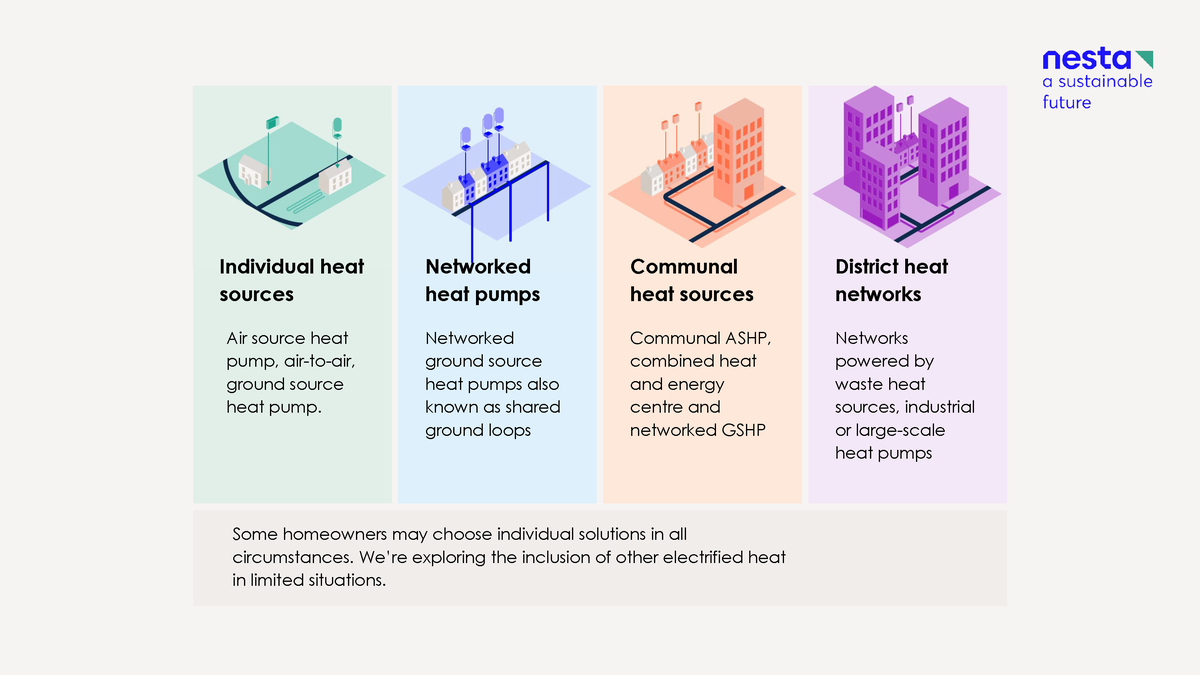
Four categories of electrified heat sources: individual, networked, communal, and district
Below is an example of our clustering for the area within Plymouth on which we based this research.
Note: the selected area for this project was adjacent to the district heat network zoning opportunity identified in Plymouth and therefore does not feature in the clusters.
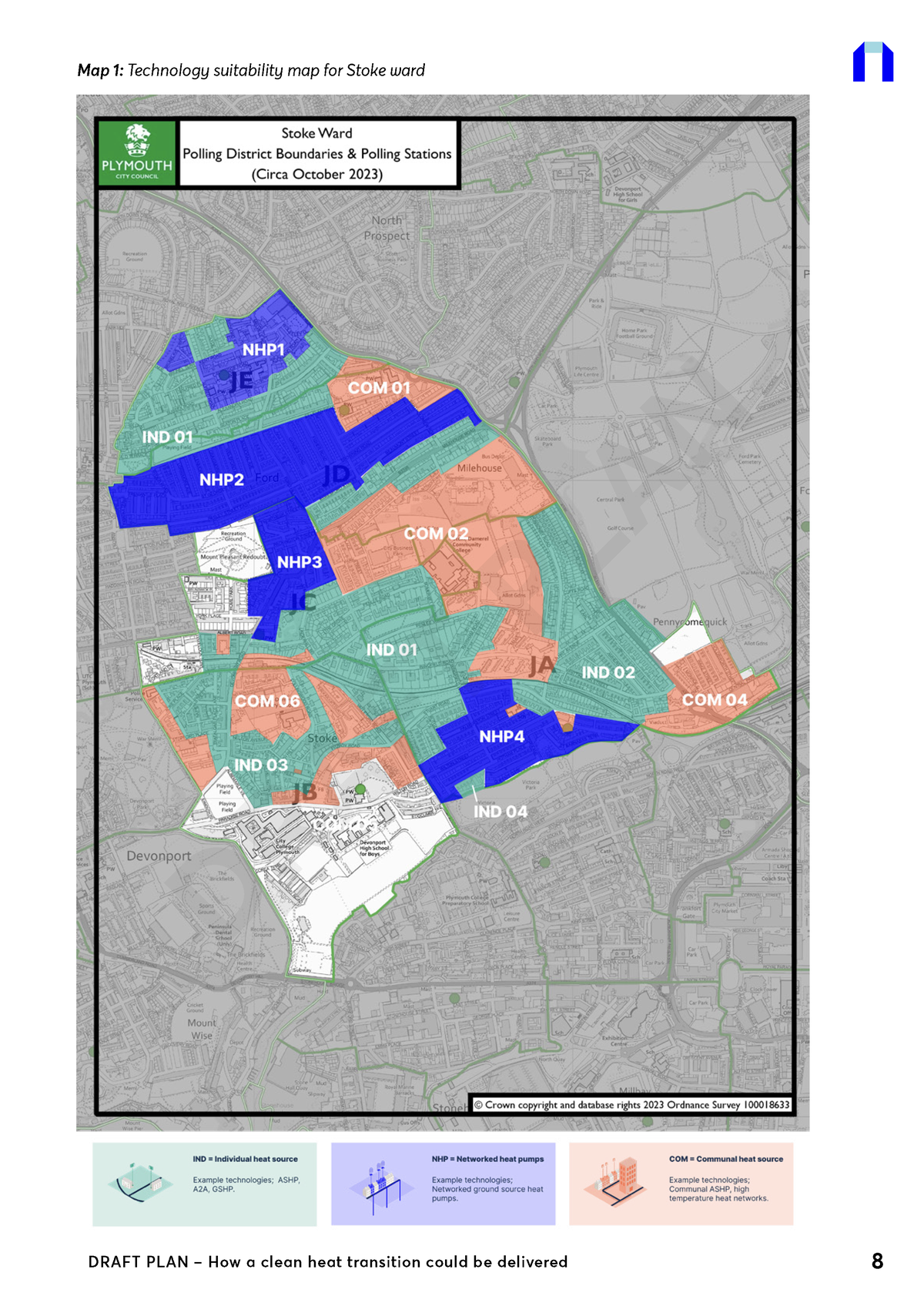
A colour-coded map of the Stoke Ward in Plymouth showing recommended heat technologies for different groups of homes, distinguishing between individual, communal, and shared ground source heat pump solutions
For households, we saw the value of planning was in direction-setting and giving confidence in the future changes to their home, their street and their neighbours’ properties. The wider plan for the ward wasn’t interrogated broadly. There was a general acceptance of the technology groupings presented and an intrigue at the different options. Households generally expected, and would appreciate, early messaging from the local authority, although they were willing to be signposted to suggested suppliers for more technical questions and more detailed information about the changes to their home.
There are three key steps to our guidance.
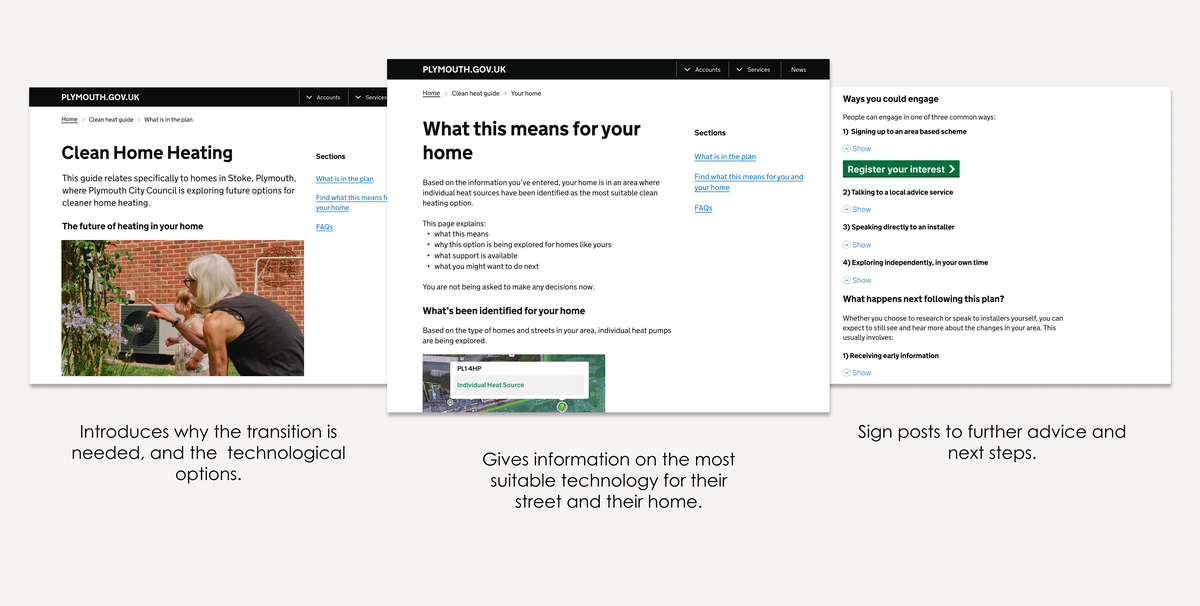
Three screenshots from an online guide prototype showing the key steps for communicating with households on clean home heating: introducing the transition, providing personalised technology information, and signposting further advice and next steps
We found that a local heat plan can create forward momentum and signals that it can lead to delivery. In Plymouth, the outputs from a clean heat plan have led to discussions with stakeholders exploring multi-tenure, area-based delivery. Without a clean heat plan, these conversations would not have happened.
We also see an emergent role of local authorities as a market facilitator - ensuring that parties are convened to consider an area as a whole, not just the immediate opportunity.
For households, a plan can offer certainty, reducing the friction of making the transition to clean heat and building confidence in technologies.
You can read the draft clean heat plan to learn more. While this plan identifies potential pathways and opportunities, it remains a research document and does not constitute a formal commitment or delivery plan by Plymouth City Council.
Our next steps are to explore opportunities with Plymouth to deliver on potential area-based clean heat schemes and to scale this work. Testing with several areas around Great Britain, building confidence in the data tool, the planning process and the ways to communicate with households. All learnings will feed into our clean heat neighbourhoods playbook and our ambition of areas around Great Britain delivering area-based clean heat.
The plan, its contents and the approach were shaped with input from local and national stakeholders. Nesta and Plymouth City Council would like to thank all those who contributed their time, including City College Plymouth, Dartmoor Energy, Kensa, Mitsubishi Electric, Peter Warm Associates, Plymouth City College, Plymouth Community Homes, Thermly, The Village Hub (Plymouth), and the residents of Stoke ward who engaged with this work