Data unions: people-powered data control
 www.nesta.org.uk/feature/future-signals-2026/data-unions/
www.nesta.org.uk/feature/future-signals-2026/data-unions/
www.nesta.org.uk/feature/future-signals-2026/data-unions/
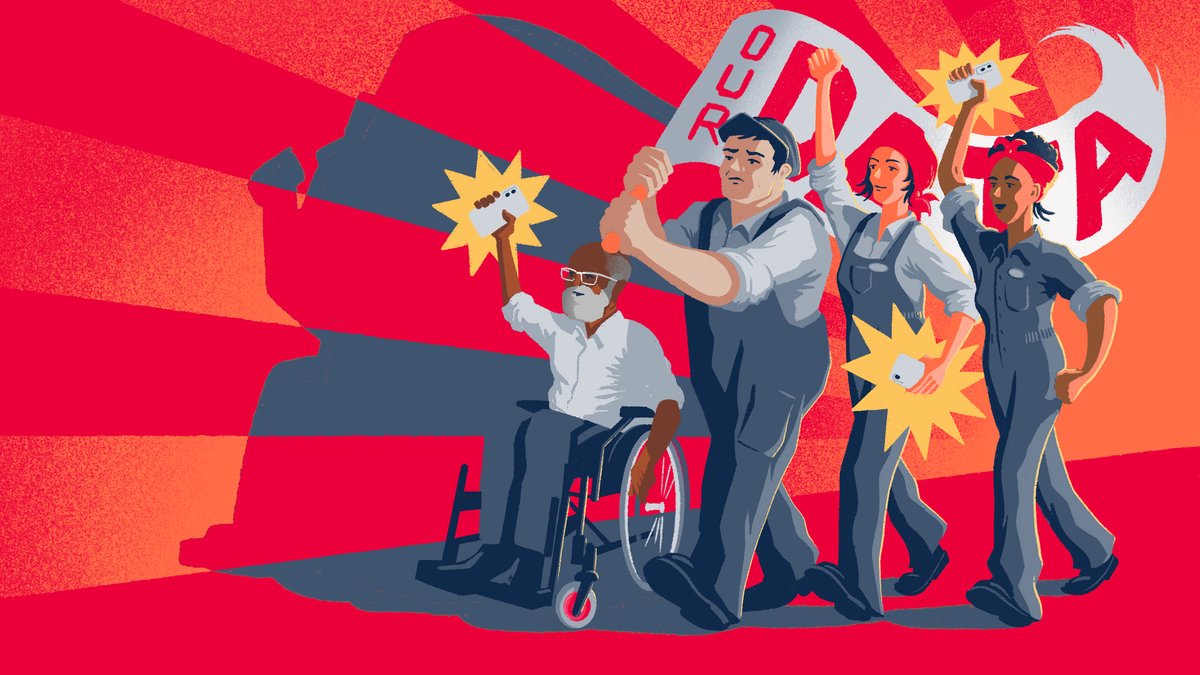
Illustration by Mark Frudd
Is 2026 the year that data collectives - unions, trusts, mutuals and clubs - tilt the balance of power in cyberspace away from mega-platforms and towards the citizen?
Last year, tech boss Sam Altman enabled ChatGPT to better remember past conversations in some jurisdictions, meaning that the AI might soon know us better than anyone else. In response to this sort of shift in power, we saw the creation of the First International Data Union (FIDU) to ensure that the data, knowledge and intimacy that Altman wants for ChatGPT would remain under members’ control and be managed according to their values.
Generative AI is causing a major overhaul of humanity’s life in cyberspace. There aren’t many examples of this sort of change - the web itself, Web 2.0 platforms, social media and mobile. The arrival of generative AI is upturning a decades-old equilibrium. ChatGPT has been the fastest-growing consumer application in history. It is displacing Google search in many lives. Open source models, especially from China, suggest that there are no natural moats in the technology, which means businesses can easily be overtaken by competitors with similar ideas.
Since the 2010s, many citizens and countries have become uncomfortable with how mega platforms have shaped the web. Scholars have pointed to these changes as important contributors to the deterioration of the mental health of children, the economic growth crisis and even falling global average IQs.
With the pieces of the cyberspace puzzle thrown into the air, citizens and governments do not want what happens next to be a repeat of what came before. Yet governments have discovered that their traditional policy tools against market power, like antitrust, are largely ineffective. Moreover, with the United States pushing back against tighter regulation abroad, even direct regulation by non-US states is proving difficult.
With other avenues of control largely defanged, this might be the moment for data unions. Data mutualisation promises to harness the collective power of citizens, providing a direct challenge to platforms.
Data collectives have a long history of being tomorrow’s next big thing in cyberspace. In his 2025 memoir, Tim Berners-Lee - the creator of the World Wide Web - describes how he first envisioned the web as empowering individuals through control of their own data and digital tools. When the mega-platforms first emerged in the early 2000s, thinkers like Doc Searls soon proposed the alternative of the ‘intention-helping’ web, as opposed to the ‘attention-harvesting’ web.
Although theoretically attractive, these tools have suffered from the ‘cold start’ problem. While they might make theoretical sense, there is no obvious way of moving to them from what we have today in small steps. It's as if we were asking the UK to switch to driving on the right-hand side of the road by asking each of us to make the change independently.
Generative AI now offers a window of opportunity to bake data unions into the new system. When many of us are data-unionised, our data will work for us much more than for the Silicon Valley platforms. For example, every UK household is paying a ‘subscription’ of approximately £1,000 per year for the content on the open, free-at-the-point-of-use, web. This is what advertisers spend online and need to recover from us in prices, but most of that goes to the platforms, not the content producers. If we were all in data unions, companies would buy the data and attention needed for advertising from them, allowing attention rents to be distributed to members. Data working for members will mean cash directly in their pockets.
The current platform model also means data is underused for social good. If platforms didn't hold data back for advertising, there could be more research like the collaboration between Imperial College and Cancer UK and Ovarian Cancer Action, which found that pain and indigestion medication purchases were higher in women who went on to be diagnosed with ovarian cancer. If many of us were data-unionised, these sorts of studies would be routine.
Of course, data unions have downsides that will need to be tackled if their use is to spread. Negotiating transactions for millions of people could impose a high administrative cost. It might be difficult to fully engage enough members, which might challenge the legitimacy of this model and mean the goals of unions become misaligned with their members. There is no guarantee that if the power of data is placed in data unions that they will avoid being corrupted by that power. After all, Google started with the best intentions (perhaps best summed up by their former motto, “Don’t be evil”), and DeepMind and OpenAI have both tried to extract themselves from the logic of data and attention exploitation. DeepMind tried to become an arms-length non-profit in Google; OpenAI tried to resist its for-profit arm dominating its not-for-profit foundation.
The generative AI revolution has kicked off a new mighty battle for control over users’ data and attention. This competition might exhibit winner-take-all tendencies, with the most popular chatbots able to collect conversational data that improves the next generation of AI. If the big AI labs are able to keep the chat data proprietary, one of them could become dominant. But if the data unions and collectives we have seen springing up recently can take root early and organise themselves properly, then they might help stop the privatisation of humanity’s thought-flow. With the rise of generative AI in 2026, we have a rare opportunity to change the way our data is used.