New life on Mars: babies in space
 www.nesta.org.uk/feature/future-signals-2026/babies-in-space/
www.nesta.org.uk/feature/future-signals-2026/babies-in-space/
www.nesta.org.uk/feature/future-signals-2026/babies-in-space/
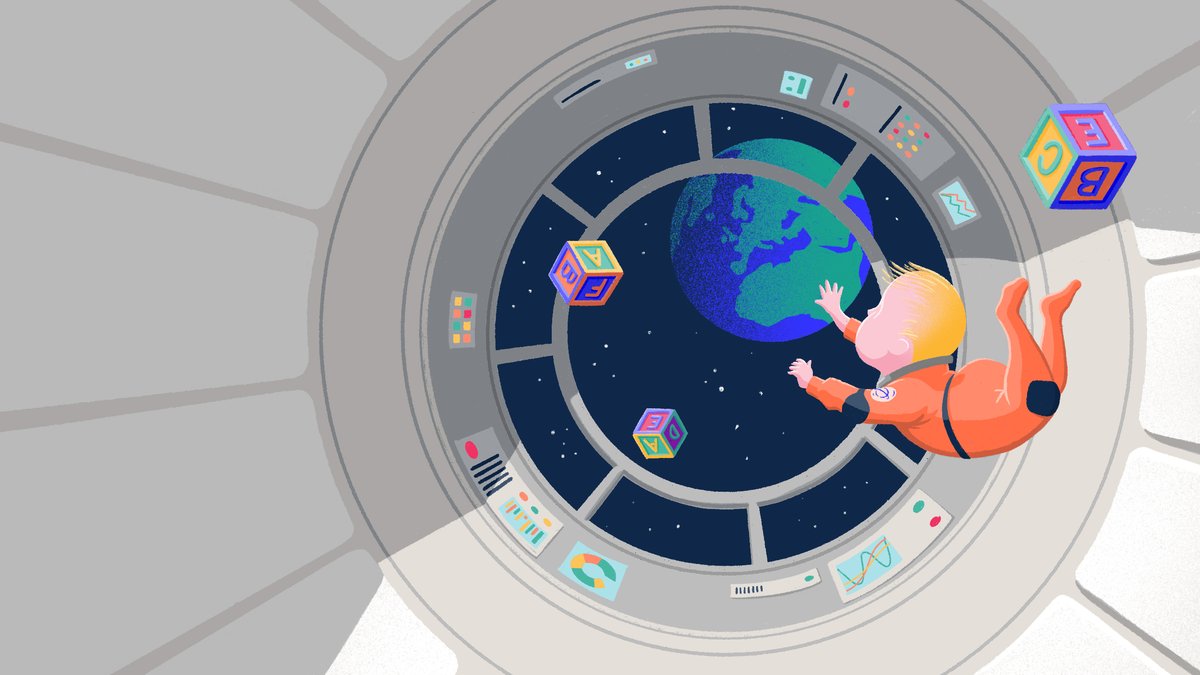
Illustration by Mark Frudd
Is 2026 the year we start to think seriously about having babies away from earth?
In 2025, space travel made headlines when Blue Origin flew an all-female crew into sub-orbital space, sparking debate on the rise in space tourism. Meanwhile, billionaires and space agencies continue to talk about the potential human settlement of Mars. But colonisation of space is tricky. Even if we could overcome challenges like long-term oxygen and water supply, the question would remain - can humans have babies in space? The answer will determine whether space becomes a place we visit or somewhere future generations actually call home.
It might seem like a simple biological process, but having babies in space isn’t as straightforward as having babies on Earth. First, there’s the problem of radiation. Outside of the Earth’s magnetic field, humans are exposed to highly charged and fast-moving particles that can damage our DNA and cells. Sperm and egg cells are particularly vulnerable.
Researchers at Kyoto University took a small but significant step towards understanding this risk in 2025. They froze precursors to mouse egg and sperm cells (germ cells) and sent them to the International Space Station, where they were stored for six months. When the cells returned to Earth, they showed no obvious damage. Later tests confirmed they could still produce healthy offspring in mice, suggesting that frozen germ cells can survive at least short-term space travel.
For pregnancies in space, fertilisation is only the first step in a long and risky journey. Space is full of hazards for a growing embryo. In the first weeks, fetal cells divide quickly to form early tissues. At this stage, a direct hit from a high-energy particle from space called a cosmic ray, though rare, could be dangerous for a pregnancy. As organs begin to form, radiation continues to be a risk. It can slow growth and damage the developing brain and nervous system. Protecting embryos from this radiation would be a challenge for space pregnancies.
Gravity, or the lack of it, creates another problem. On Mars, gravity is just 38% of Earth’s. Studies have suggested that microgravity could impair processes like implantation and the function of the placenta. If a mother were able to carry a baby to term in space, labour and delivery would present further hurdles. In microgravity, controlling fluids and positioning the mother’s body for vaginal birth or a C-section might be particularly difficult.
Beyond birth, an infant born in microgravity might develop differently from one born on Earth. Their muscles and bones would develop for a weaker gravity environment. Without Earth’s pull, they might struggle to lift their head, sit, stand or walk. It’s also hard to imagine what a childhood in space might look like. What might happen to a child’s mental health, learning or social development when raised in an isolated, confined environment, away from the communities and facilities that many parents rely on?
Despite the risks, reproducing in space will be vital if humans are to settle other planets. The company SpaceBorn United is researching ways to support conception, pregnancy and embryo growth in space, with an aim of enabling future human settlements away from Earth. They are also exploring the medical equipment that will make it possible.
Experimenting with reproduction in space is controversial because it raises serious ethical questions. Embryos cannot consent, and the risks to both mother and child are largely unknown. Yet such research could have benefits on Earth, too. Space research has already led to medical advances, from laser eye surgery to better DNA monitoring. SpaceBorn United suggest their work could one day improve fertility treatments like IVF, and they have expressed an interest in future technologies like artificial wombs.
As space tourism grows, the question of having children in orbit is becoming increasingly urgent. Conception in space, whether accidental or planned, could happen much sooner than we are ready for. This raises medical, ethical, and even legal questions we have never faced before. For example, space law does not clearly define citizenship for babies born beyond Earth.
If humans truly want to settle other planets, we will need new science to support safe conception and pregnancy, new medical technologies to protect developing babies, and perhaps even new legal frameworks to define rights and citizenship. It could lead to a rethink of childhood itself, considering how babies grow and learn, and how societies support them away from Earth. And even if we don’t end up with an interstellar nursery, history tells us that space research can offer benefits down on earth, from devices to improve heart health to durable new materials to help high-speed air travel. At some point, we may even have to ask - what would a passport look like for someone born in space?