Data in the early years: learnings from Somerset’s Transform Family View
 www.nesta.org.uk/feature/data-in-the-early-years-learnings-from-somersets-transform-family-view/
www.nesta.org.uk/feature/data-in-the-early-years-learnings-from-somersets-transform-family-view/
www.nesta.org.uk/feature/data-in-the-early-years-learnings-from-somersets-transform-family-view/

In our new series, Nesta is talking to local authorities who have found innovative solutions to common challenges, and who are using data to better support young children and their families. We will be drawing out key learnings and insights to help other local authorities consider how similar solutions could work in their local context.
The first years of a child’s life are some of the most important for their lifelong development. But the systems supporting these formative years - such as the ways assessments are run, or how practitioners access information about the children and families they are working with - are not always as effective as they could be. We have been talking to teams who have found ways of improving these services.
We spoke to Joanne Harris, senior commissioner – children’s services in Somerset, about their Transform Family View platform: a single digital view of a child which gives practitioners a fuller picture about the children and families they are supporting.
Various teams within and beyond local authorities are involved in supporting children’s earliest development. Providing children with the right help at the right time often requires sharing children’s and families’ personal information across these teams. But a lack of information sharing, and various case management systems being in use across teams, meant information was not joined up. Gaps in data sharing meant potential gaps in what teams knew about the children they were supporting.
To improve communication between professionals and share a common understanding of children and families who may require support, Somerset Council launched Transform Family View: a single digital view of a child and family. Alongside this, they created a toolkit to help professionals improve information sharing across safeguarding partnerships.
Transform Family View integrates data from over 32 data sources, including education, family intervention services, children’s social care, youth justice, the Department of Work and Pensions (re Universal Credit and two-year-old funding), and police and voluntary community support services to create a single, digital view. It supports identification, prevention and early intervention by enabling better information sharing across services, helping professionals coordinate support and respond effectively.
Transform Family View creates a joined-up picture - or a single golden record - of a child and family. Through this record, practitioners can gain a better understanding of education, people who live at the child’s address and others who have influence over them, health, benefits, vulnerabilities and past moves to name a few.
Joanne explains: “The system matches data across many sources - including police, health, schools, voluntary sector - with automated feeds. There are robust information governance agreements in place (DPIA, data sharing agreements, privacy notices/consultation), so that information can be shared safely with trusted partners. We use a data visualisation tool, Power BI, to make the information from these data sources available to authorised professionals, so they have a better understanding of what the need is and can provide tailored support.
“With all this information in one place, it’s easier for teams to detect where a child might need more support: there’s more potential to spot risks and provide timely interventions before issues such as developmental concerns escalate. Multi-agency collaboration is easier: before, effort was often duplicated and there could even be conflicting interventions provided by different teams. Now, continuity of care and support is much better.
“For families, the single view means they don’t need to repeat their story to lots of different people - instead, practitioners can use the data to tailor services to the specific needs of children and their families using the data available. At a broader level, practitioners are empowered with accurate, up-to-date information about population needs that helps them make informed strategic decisions about how resource is allocated.
“As we gather data, we can track how programmes are working and what impact they are having for children and families. Not only does this provide reassurance that vulnerable populations are being supported, it helps us in data-driven policymaking.
We can identify trends, gaps, areas for improvement and target investment and innovation where the need is greatest.”
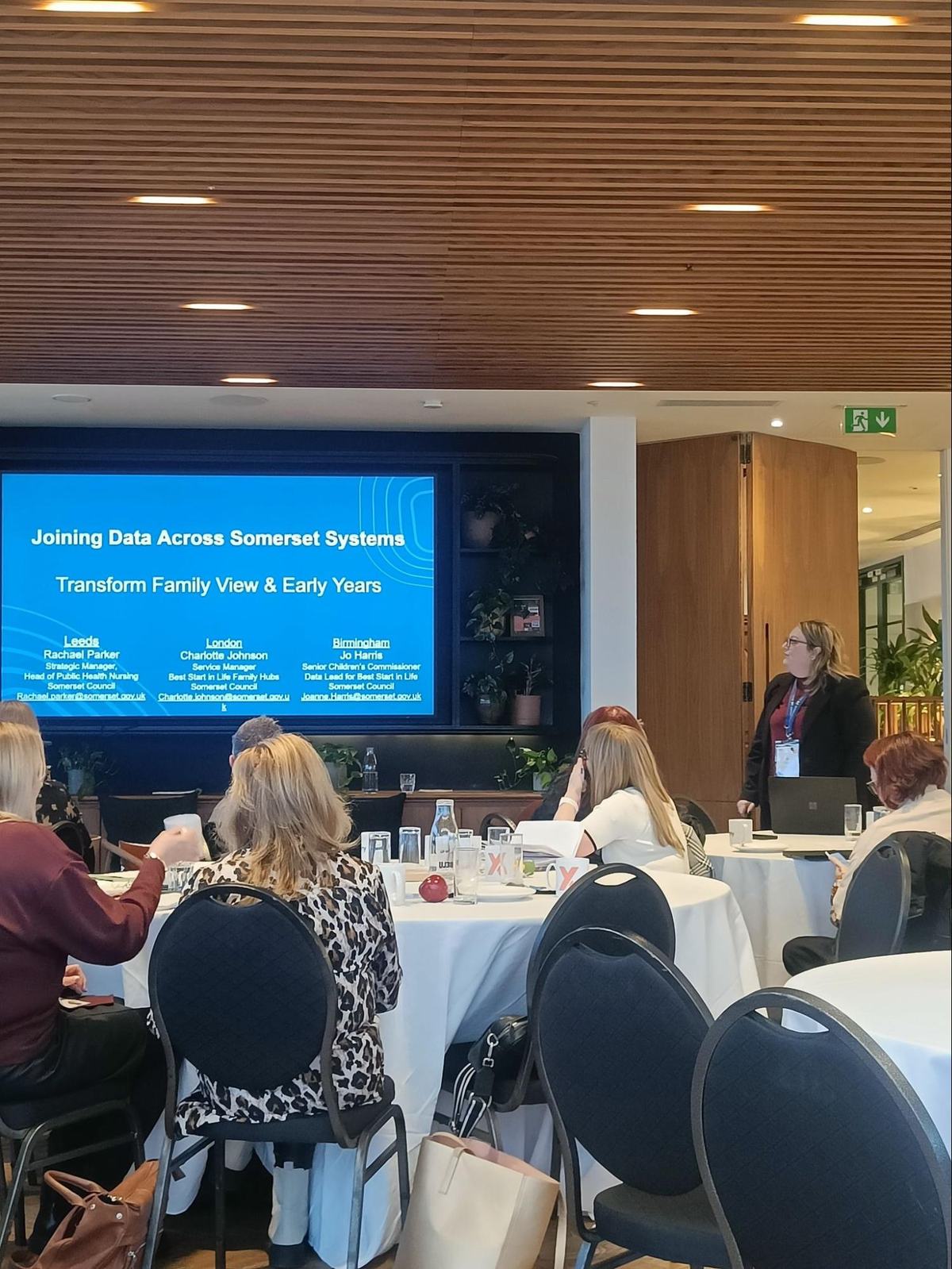
Joanne presenting Transform Family View at Nesta’s Best Start in Life event in Birmingham
Joanne talked about how Somerset gathered insights from the various teams that would use the platform from the early stages of development to ensure it could respond to the needs of those on the ground:
“Transform Family View was developed as a Department for Education-funded rebuild and expansion of our earlier Transform Data View. We co-designed it with practitioners: first consulting over 50 colleagues, including social care/front-door teams, from which we gathered over 100 requirements. Once we had built wireframes responding to those requirements, we went back to users to iterate - taking a ‘you said, we did’ approach - then tested and quality assured with a small group before rolling out more widely.”
“We took an iterative approach to rollout: early versions were released to internal teams first, then extended to schools and external partners. We kept making additions such as education pages, improved match/merge, new flags, NEET risk modelling work overseen with academic input.”
“One of the key things that helped us make this a success was developing the solution in-house, where it was within our fit to make changes. Our analytical team was well-resourced for this sort of project, and we were able to take an adaptable, forward-thinking and can-do approach.”
Transform Family View is now in widespread use across Somerset, and 105 training sessions for the platform have been delivered to over 1,700 professionals. Immediate efficiencies are easy to see: over 3,500 hours of retrieval time has been saved and data is being used in a more intentional way, to provide tailored support to families when they need it, intervene early and avoid escalation.
You can find out more about Transform Family View by listening to The P Pod and Research in Practice podcasts. You can watch Somerset’s video on information sharing, read Somerset Safeguarding Children Partnership’s online guidance and Somerset’s data sharing information for professionals, which includes a technical and project manager guide, with an estimated cost analysis.