Three things we learnt about childcare and early education at Plaid Cymru’s Spring Party Conference
 www.nesta.org.uk/blog/three-things-we-learnt-about-childcare-and-early-education-at-plaid-cymrus-spring-party-conference/
www.nesta.org.uk/blog/three-things-we-learnt-about-childcare-and-early-education-at-plaid-cymrus-spring-party-conference/
www.nesta.org.uk/blog/three-things-we-learnt-about-childcare-and-early-education-at-plaid-cymrus-spring-party-conference/
The Nesta Cymru team attended Plaid Cymru’s Spring Party Conference to dive deeper into their policy proposals - specifically, their ambitious "childcare promise”.
In Wales, 40% of children under five live in poverty. This is the highest percentage of any age group in Wales.
Plaid Cymru’s proposal is for a funded and expanded childcare offer for every family in Wales and aims to directly improve household finances. This is a bold attempt to lower costs for parents and ensure every child in Wales gets the best possible start in life.
Here are three takeaways from Nesta’s panel event on how that proposal can be achieved. Alongside me on the panel were Nesta’s head of Wales, Andy Regan, Dr Catrin Edwards, CEO of Mudiad Meithrin, and Sioned Williams MS, Plaid Cymru’s social justice and early years Spokesperson. The purpose of the event was to move beyond the headline figures and look at "how" the proposal can be achieved.
Ahead of the conference, I mapped the current journey parents and caregivers face when navigating the childcare system in Wales. Mapping this journey was no small feat. It took me hours - and several frustrated, crumpled-up drafts - to visualise the current system.
The final map revealed a chaotic, tangled web of competing programmes and shifting eligibility rules. When we shared the map, the reaction in the room was one of immediate, shared recognition: the audience was struck by the complexity, yet they recognised it instantly as their own daily reality.
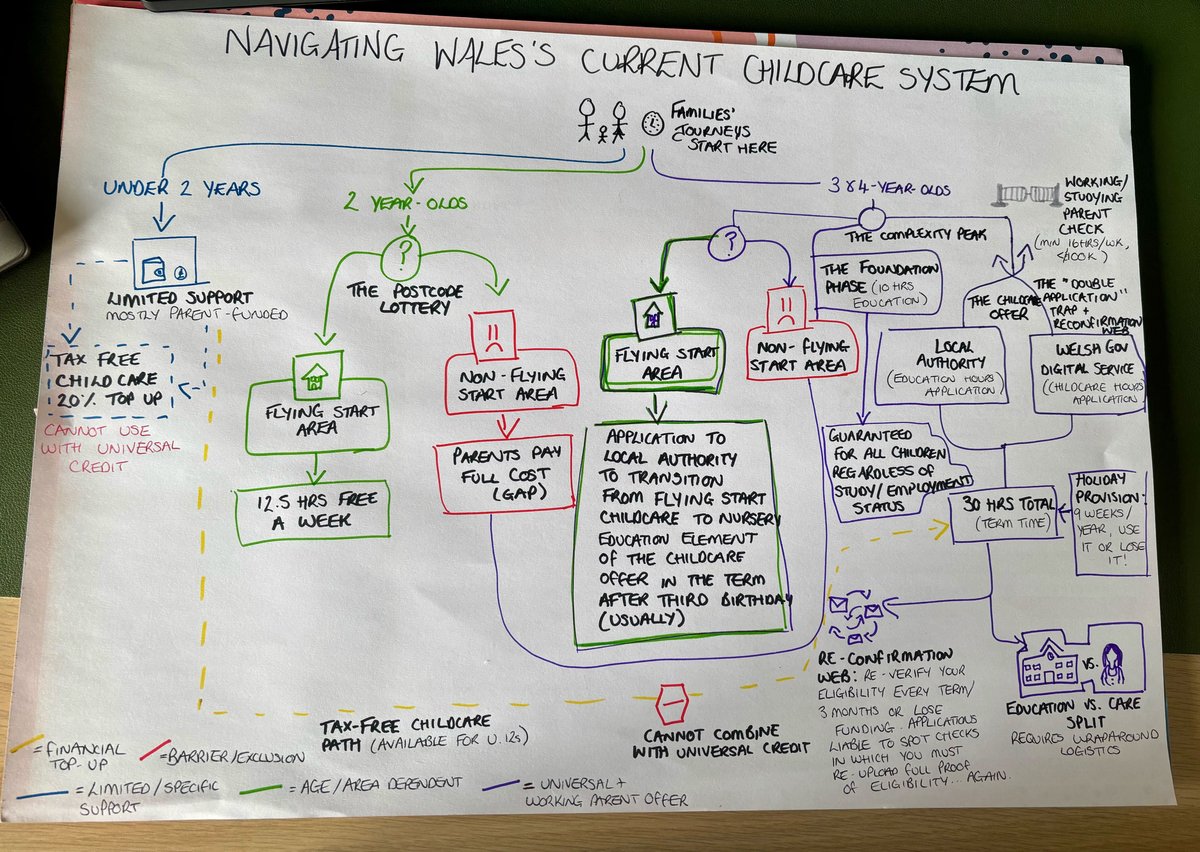
A chaotic, tangled map visualising the complex journey of parents and caregivers navigating the current childcare system and shifting eligibility rules in Wales
Sioned Williams MS was candid about the state of the current system: she likened the existing infrastructure to a "lumpy football that has had more and more bits added to it until it no longer rolls on the pitch." She emphasised the importance of taking a phased approach to ensure they don’t simply "add more lumps" to the ball.
The voices of children and families must sit at the heart of resolving some of this complexity. Currently, just under two-thirds of families in Wales access formal childcare and there is no clear understanding of why some eligible parents don’t access the current offer. Ensuring that the new offer can be accessed by every child, regardless of their background, will first require an exploration of the current barriers.
In Wales, there is currently no universal child development milestone measure. This means that there is no clear, national picture of how children are developing and what support they need to thrive on their first day of school and beyond. Additionally, there isn’t data on whether national policies aimed at improving early years outcomes are delivering the intended results.
The panel explored how a new child outcomes framework could be developed, which would help articulate what success looks like, and clarify the data that needs to be collected to monitor progress. Andy Regan probed the panel on what we would like to see measured and Sioned Williams MS noted the importance of examining international evidence to help inform what could be appropriate in the Welsh context. I put forward ideas about the importance of parental and caregiver voice, as well as sector collaboration, to ensure that any measures are inclusive for all children.
In their Better Government plan, Plaid Cymru committed to "adopting a test and learn approach to delivering on [their] key priorities." Our panel discussion highlighted that this shift in governance is essential. A policy of this magnitude is not a single, monolithic change; rather, it is a complex series of numerous small adjustments and underlying assumptions that need to be tested and refined repeatedly. Test and learn requires decision makers to assume we have got at least some things wrong, and commit to finding out what they are at the earliest possible stage.
This approach allows policymakers to "debug" the system in real-time. For example, Andy put to the panel the assumption that providing funded childcare spaces would automatically increase take-up among low-income families. But we know it won’t be quite that simple. The panel acknowledged that there are barriers, such as transport links or a lack of trust, that would need to be overcome. We concluded that, by running small-scale experiments, the policy could be refined using real-world evidence and there can be learning about which solutions are most likely to be successful for different groups of parents. From these findings, best practice could be scaled up across Wales.
Instead of a "big bang" launch that risks repeating the mistakes of the past, this iterative process could help build confidence in the best way forward. It can help ensure that when the full rollout reaches every corner of Wales by 2030, the "football" is finally rolling smoothly for everyone - and more children can be supported in reaching their full potential in the early years.