What might a tax on unhealthy food look like? 4 things we learned from our modelling
 www.nesta.org.uk/blog/four-things-we-learned-from-modelling-an-npm-tax/
www.nesta.org.uk/blog/four-things-we-learned-from-modelling-an-npm-tax/
www.nesta.org.uk/blog/four-things-we-learned-from-modelling-an-npm-tax/
Around two-thirds of adults in the UK are living with obesity and excess weight, with costs for individuals, the NHS and our wider economy. Our work at Nesta shows that only a small number of policies have the potential to deliver the large-scale reductions needed to halve obesity by 2030. These include health targets for food businesses, a significantly scaled rollout of weight-loss drugs, and a food tax to improve diets. Despite these high impacts, each option has a very different cost to government.
The UK’s Soft Drinks Industry Levy (SDIL), often called the ‘sugar tax’, has successfully driven reformulation in drinks. However there is currently no equivalent tax on unhealthy food. To fill this evidence gap, we designed a novel tax based on the nutrient profiling model (NPM) and commissioned Oxford Economics to model its impact. The World Health Organization (WHO) identifies the NPM as a strong foundation for effective food taxes, yet this specific approach remains largely under-explored. We are the first to publish research evaluating its potential in a UK context.
Here are the four key learnings from our report.
The NPM evaluates food and drink products based on their overall nutritional composition, scoring them from -15 (most healthy) to +40 (least healthy). Under current regulations, a score of 4 or higher classifies food products as ‘less healthy’ or HFSS (high in fat, sugar and salt).
Because these scores take into account multiple nutrients, an NPM-based tax would offer food producers greater flexibility than a tax that targets a single nutrient like sugar. An NPM-based tax would incentivise producers to reduce their tax burden through small changes across a wide range of nutrients - for example, by reducing saturated fat, sugar, salt or increasing fibre.
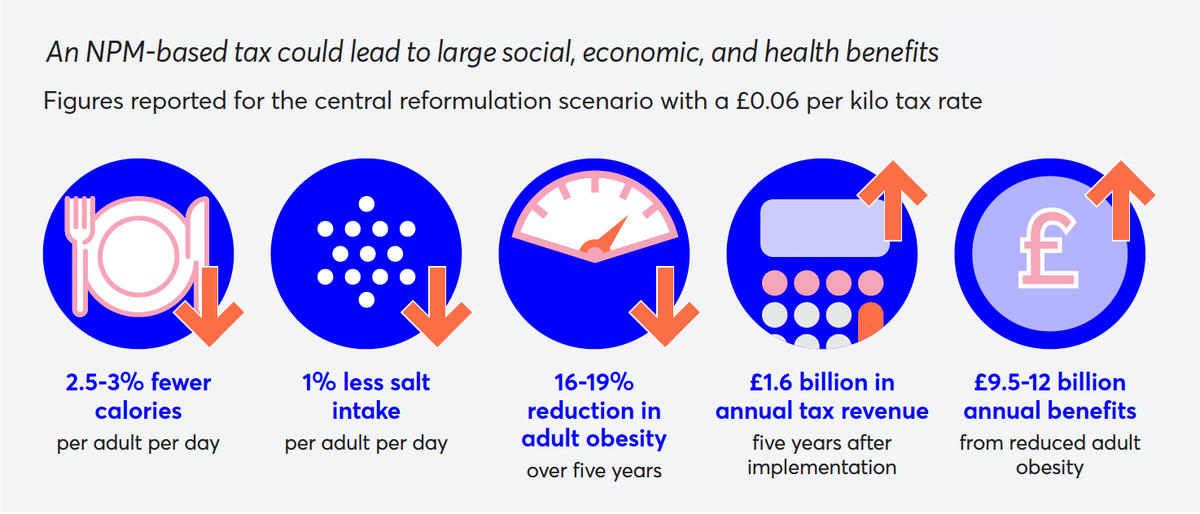
Our modelling suggests that an NPM tax could deliver health benefits comparable to the most ambitious obesity reduction policies. In our central scenario, adult obesity prevalence in the UK could fall by 16–19% over five years. The policy could also generate up to £1.6 billion in annual tax revenue, which could be reinvested into public health programmes.
The two main routes to health impact for a food tax are product reformulation (producers changing their recipes) and consumers changing what they buy (in response to unhealthier foods becoming more expensive). We applied the tax only to 12 specific categories of less healthy ‘discretionary’ foods - such as confectionery, sugary cereals and pastries. These categories align with existing HFSS regulation on advertising, placement and promotion, excluding the 13th category of soft drinks, which is covered by the SDIL. By focusing on these less healthy categories, the tax should protect staple foods - like fresh fruit, milk or pulses/grains - and healthier options from price increases.
Our model assumes that reformulation will be a key driver of change, as was the case with the SDIL. However, food is often more complex to reformulate than drinks due to recipe, taste and texture constraints. Because of this, price changes may play a more significant role in a food tax than they did for sugary drinks.
As a result, our findings suggest a targeted price impact: while the unhealthiest products (like certain chocolates) could see price increases of up to 30%, we estimate that the price of the average grocery basket could rise by around 1%. This shows how the tax captures foods that contribute most to excess calories, while affecting only a small share of total spend on food. However, we recognise that in a difficult economic climate, even a 1% rise in grocery costs represents a significant trade-off, requiring policymakers to carefully balance these health gains against ongoing cost-of-living pressures.
Tiered taxes, where tax rates are set for specific product characteristics or categories like in the SDIL, can encourage businesses to reformulate their products just enough to reach a specific cut-off point. That means there isn’t a strong incentive to reformulate the most unhealthy products - like some chocolates - which might sit too far away from a tier cut-off to change the tax rate they face.
Instead, the tax we modelled uses a continuous NPM scale. It applies a rate of £0.06 per kilo for products scoring NPM 4 or higher (less healthy foods), with the rate rising consistently for every NPM point. This design could motivate companies to reduce their tax burden by making improvements to lots of unhealthy products, including the least healthy ones, because every point of improvement reduces the tax rate they pay.
While an NPM tax could be impactful, we believe the best option for the government to pursue remains the healthy food standard. Already announced as part of the 10 Year Health Plan, this policy would introduce mandatory data reporting and health targets for large food businesses. By setting targets based on the average NPM score of a business' total sales, it would encourage companies to make improvements to their entire product range, helping the average shopping basket to become healthier by default.
Our analysis shows that the healthy food standard has the potential for an even greater impact on obesity rates than a tax (roughly 20% compared to 16-19%), while remaining low-cost to the government, businesses and consumers. In part because it gives companies the flexibility over which tactics they can use to meet targets, costs are minimised and are far less likely to be passed on to the public. We think the healthy food standard achieves the same goal of getting healthier food onto our shelves and into our diets, but more equitably.
There is no silver bullet for tackling obesity. While food taxes represent a powerful potential route to reducing obesity levels, they come with significant trade-offs. At Nesta, our focus remains the timely and effective implementation of the healthy food standard - a high-impact, cost-effective policy already on the table that can help ensure everyone in the UK has access to healthier options.