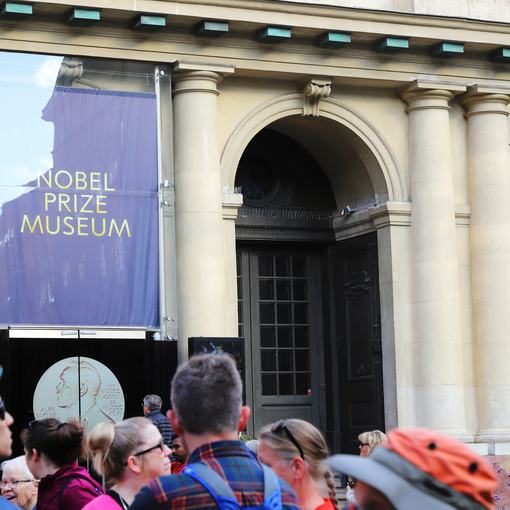
A ‘British Nobel Prize’
 www.nesta.org.uk/blog/a-british-nobel-prize/
www.nesta.org.uk/blog/a-british-nobel-prize/
www.nesta.org.uk/blog/a-british-nobel-prize/
Britain was the home of the Industrial Revolution. As a result of that contribution to humanity, billions of people have lived longer, healthier and happier lives. Joel Mokyr won the Nobel Prize in Economics for demonstrating Britain’s ‘industrial enlightenment’ was the recipe for modern progress: not just discovery, but dense networks of skilled engineers, artisans and tinkerers who thrived in a political culture that tolerated dissent and celebrated commerce.
This story can be dismissed as old-fashioned; as a symptom of British exceptionalism. But it is true. And we should draw inspiration from it. The UK’s past is littered with innovations and inventions that changed the world, from the steam engine to the computer, from penicillin to IVF. This government has said it wants to deliver patriotic renewal - to do that, it should make invention and innovation a core part of its vision.
This blog proposes an idea for how: a new awards system equivalent to Sweden’s Nobel Prize. The prizes should look to the future, unlike the Nobel. They should set big, ambitious societal challenges and then reward those who break new ground in pursuit of them, using applied science, technology and engineering, in the same spirit of our industrial enlightenment past. A technological revolution is happening, and governments are at risk of looking like nothing more than a passive bystander. A set of prizes like this would at least start to actively harness that technology for public good. We’ll begin with a description of the idea, before why and how it could work, and why now is the time.
This new prize should be modelled off the approach taken by the UK’s Longitude Prize of 1714, the world’s first challenge prize. Parliament set engineers and innovators a problem to solve, with cash and prestige on offer. And the result was the invention of the marine chronometer, which enabled navigation and long distance sea travel - and with that changing the world.
Just like with the first Longitude Prize, this new award system would set innovators and entrepreneurs fundamental societally important challenges and reward them for solving them. It would be open to teams from across the world, but developing and testing their technology in the UK for the UK’s benefit.
It would be a new, annual event, hosted by the BBC and bringing some of the best from around the world to the UK. Every year, a new prize would be set by an expert panel - following consultation with the public. And every year, the winners of past prizes would be announced, showcasing the new ground being broken on the biggest issues of our time.
Three prizes, along the lines of the approach suggested in this piece, have been launched in the past decade - funded by both government and philanthropic donations. But the difference we are proposing here is one of scale, prestige and regularity - moving it from one off stimuli on a given issue to an annual event much more akin to the Nobels.
We stopped children sweeping chimneys thanks to the invention of extendable brushes - the winner of an 1802 challenge prize from the Royal Society of Arts. We fly the Atlantic thanks to the winners of the 1919 Daily Mail Aviation Prize. And driverless cars were developed by innovators in DARPA’s 2003-2007 Autonomous Vehicle Grand Challenges.
Challenge prizes suit problems that are complex and require more than one approach to solve them. They allow different and often complementary approaches to the problem to be developed. With rewards focusing on outcomes rather than a fixed discipline, innovators aren’t restricted. And prizes can capture the public imagination.
The government, like many of us, is looking on at the technological breakthroughs happening and wondering what it might mean for everyday life. For every story of promise, there is one risk - it’s hard to know if, how or when things might get better or worse. A prize system is an opportunity for the government to show it has at least some means of shaping outcomes, of directing activity towards things that will make life better.
Just like with Nobel, the government should establish an independent body to administer the award system. It would have a panel of the great and the good from British innovation and invention, who would decide on the prizes and the winners.
For every prize, there would be a specific challenge and an agreed prize fund. The independent body would also set a series of milestone stages, with innovators racing to achieve them and qualify for the next stage - before the final award is announced. So, for example, the prize might be for the development of the most reliable and effective purpose-built mobility device that translates neural signals to navigate complex, real-life environments, with a total prize fund of £10 million. Applications are opened to teams from institutions around the world, with the 10 most promising teams being selected and given £300,000 each. A year later, the 10 teams must submit prototypes - with the best five qualifying for the final round and winning a further £800,000. Those five teams are then supported to trial and test the prototypes before a final winner is selected, taking home £3 million.
At each stage, as well as money as an incentive, the competitors would be given access to data sandboxes or given regulatory permissions to help them develop their ideas.
The annual awards ceremony would set a new prize, show the progress made by the teams working on existing prizes, announcing who has qualified for each of the milestone stages, as well as announcing the winner of prizes.
Its total budget would depend on how many challenges/prizes run concurrently, but should be no more than £20 million per year.
A foundation would be required to select prizes that are big, ambitious, and have a direct read across to the lives of people in the UK. But it should go further, working with the BBC to build awareness and support.
It could even require a vote from the public to select the new prize each year, choosing from the shortlist set by the foundation. For example, the foundation could appoint a public ambassador for each of the challenges, a celebrity or well-known expert in a field. The public ambassador could work with the BBC to make a short documentary. The public would then vote and decide which of the shortlist becomes the new prize, which would be announced as part of a big prize-giving ceremony at the Science Musuem.
The prime minister’s vision of patriotic renewal is about pride in the past, combined with confidence and optimism about the future. The government can make invention and innovation a distinctive part of this agenda: a ‘British Nobel Prize’ is one practical idea that would allow us to do so.
UK science, technology and engineering are increasingly important to our national economy. They are a rich part of the story we tell of our past, and they should be a part of the vision we set for the future. We should celebrate our history at the frontier by clearly demonstrating our commitment to staying there: supporting growth and defining what this government’s brand of patriotism means in practice.