We're a champion of good ideas.
We research and test the best ones from people and organisations all over the world to bring about a new way of doing things that will help shape a happier, fairer and more prosperous future.
1. Introduction
Innovation is the way we talk about having new ideas and making them happen. It's widely recognised by governments across the world as crucial not just to economic growth but also to greater human happiness and social justice.
But many of the systems that support innovation aren't working well. Our research shows that innovation investment is stagnating in business; that some fields are generating fewer good ideas than in the past; and that important sectors lack capacities for innovation.
People with potentially world-changing ideas still face innumerable barriers.
We exist to tackle these challenges and to help you bring your great idea to life.
Over the next few pages you can read about some of the work we're doing to help make this happen. If you're interested in finding out more about us and how to get involved, we'd love to hear from you. You can visit our website www.nesta.org.uk to find out more.
Illustration depicting a stylized figure with a glowing orb above its head, representing new ideas or innovation.
Illustration showing several stylized figures around a table, engaging in discussion with diagrams and charts on a board behind them, symbolizing collaboration and problem-solving.
We see how we... shape
2. Innovation policy
Our innovation policy work looks at how to make the UK a better place for innovators, and to make sure innovation is at the heart of the political and economic debate in Britain and beyond.
Decades of research have shown that innovation is the most important driver of long-term prosperity, and that innovative businesses create more jobs and grow faster. Our Plan I campaign argues for an innovation-led change towards more sustainable growth. Following on from our Plan I for the UK, we launched Plan I: an innovation plan for Europe, with European Council President Herman Van Rompuy in Brussels. It has already begun to shape the European Commission's policy on digital startups.
Our creative industries account for one-tenth of the UK economy and provide jobs for 2.5 million people, more than financial services or construction. We are world-leaders in this space, but history shows us that we cannot take our leadership for granted. A Manifesto for the Creative Economy presents ten big ideas to bolster our creative industries. Since it launched, the manifesto has encouraged the UK government to improve its policy towards the creative industries and has led to a redefinition of the way that the UK government measures the creative industries.
We are also looking at how UK businesses can master the greatest challenge of the big data era: how to turn data into value. Our two reports: The Rise of the Datavores and Inside the Datavores, highlight the importance of a growing cohort of companies that put analytics and information at the heart of their business, and demonstrates how others can follow their example.
Innovation methods are constantly being reinvented, and we know that policymakers and innovators need to look beyond Silicon Valley for inspiration. That's why we're committed to mapping new approaches to innovation around the world. As part of this work we have published a major report into China's innovation system, China's Absorptive State and Our Frugal Future: Lessons from India's Innovation System.
Callout Box:
2.5m
Our creative industries account for one-tenth of the UK economy and provide jobs for 2.5 million people.
Callout Box:
8%
Businesses that use their data more intensively are 8 per cent more productive.
Images of report covers:
- Nesta... INSIDE THE DATAVORES: ESTIMATING THE EFFECT OF DATA AND ONLINE ANALYTICS ON FIRM PERFORMANCE, with binary code visuals.
- Nesta... A MANIFESTO FOR THE CREATIVE ECONOMY.
- Nesta... CHINA'S ABSORPTIVE STATE: innovation and the prospects for China-UK collaboration.
- PLAN: INNOVATION FOR EUROPE, DELIVERING INNOVATION-LED GROWTH, Nesta and the Lisbon Council logos.
We see how we... champion
3. Inclusive models for economic growth
The developed world faces a dual economic challenge. Rates of economic growth have been slow and at the same time inequality has been rising rapidly. New means of fostering economic growth are called for and in particular, ones that can also promote fairer distribution of wealth.
Our work on collaborative consumption and the sharing economy focuses on how the internet is helping to bring people together to make better use of assets, from cars to DIY tools.
We are researching ways to apply the principles of the sharing economy to the world of finance. We've published a series of successful reports and blog posts on crowdfunding, including detailed research on how much money crowdfunding has raised in the UK, and reports on equity crowdfunding and peer-to-peer lending. Our directory of UK crowdfunding platforms, Crowdingin.org, has become a widely used resource for entrepreneurs looking to kickstart their ideas.
We also look at new ways to help turn great ideas into successful businesses, taking an active role so that our research is informed by data and practical experience. We have been working with several accelerators around Europe to build a network of accelerator programmes, called the Accelerator Assembly. We now also host the UK's leading social accelerator programme, run by Bethnal Green Ventures in partnership with the Cabinet Office's Social Incubator Fund, Nominet Trust and Google. This programme will accelerate over 80 social impact ventures over the next four years.
Images of report covers:
- Nesta... CROWDING IN: HOW THE UK'S BUSINESSES, CHARITIES, GOVERNMENT, AND FINANCIAL SYSTEM CAN MAKE THE MOST OF CROWDFUNDING.
- Nesta... BANKING ON EACH OTHER: PEER-TO-PEER LENDING TO BUSINESS: EVIDENCE FROM FUNDING CIRCLE.
- Nesta... THE RISE OF FUTURE FINANCE: The UK Alternative Finance Benchmarking Report.
Callout Box:
Within five years, crowdfunding could provide around £15 billion of finance per year in the UK.
We see how we... help
4. Public sector innovation
Local and national governments have pioneered some of the great public and social innovations of modern history. But in a time of rapid change they need new capabilities and new ideas to solve complex problems.
Rethinking Parks
Public parks are an enduring and defining feature of towns and cities across the UK. At their best, public parks don't just provide space for leisure and relaxation, they are also a hub of the local community and a ‘green lung' in the urban environment.
Yet our public parks are at risk. With funding cuts of 60 per cent and more projected over the next decade for non-statutory services provided by local authorities, parks are at risk of becoming no-go zones or being sold off.
Through our Rethinking Parks programme we want people to develop new ways to operate, fund and use public parks so that they continue to thrive, despite traditional sources of revenue and support being eroded.
Our strategic partners, the Big Lottery Fund and the Heritage Lottery Fund, have strong track records of supporting parks, having invested upwards of £700 million in them over the last two decades.
i-teams
We are working with Bloomberg Philanthropies to explore the teams, units and funds that make government innovation happen. Our aim is to understand the kind of structures needed and share these key lessons for other leaders looking to do the same.
Images of report covers:
- Nesta... RETHINKING PARKS: EXPLORING NEW BUSINESS MODELS FOR PARKS IN THE 21ST CENTURY.
- i-teams: The teams and funds making innovation happen in governments around the world, Nesta and Bloomberg Philanthropies logos.

We see how we... promote
5. Citizen engagement
From school governors to special constables there are lots of great examples of people helping people. But we think there could be more.
People Helping People
The Centre for Social Action Innovation Fund, run in partnership with the Cabinet Office, is finding new ways for people to help others.
The fund increases the impact and reach of innovations that use local people's energy and talents to help each other. All the initiatives in the fund work alongside public services and include examples such as supporting people with long-term health conditions, and helping unemployed people improve their skills and get back to work.
Challenge Prizes
We know that challenge prizes are a great way to stimulate new ideas from a broad range of people and our Centre for Challenge Prizes is running its most ambitious challenge prize yet - Longitude Prize 2014.
Launched on the BBC and with the Technology Strategy Board as launch funding partner, Longitude Prize 2014 asked the British public to decide which of six major challenges they wanted to be the focus of a £10 million prize fund. The challenges were Antibiotics, Paralysis, Food, Water, Flight and Dementia.
The six scientific challenges were put to a vote on the BBC's programmes Horizon and The One Show, and the public chose the issue of Antibiotics. Now the race is on to find a way to keep Antibiotics effective for future generations. The prize will be open for the next five years, and we invite anyone with a good idea to participate.
Innovation Skills
The Development Impact and You toolkit, developed in partnership with and funded by the Rockefeller Foundation, is a collection of 30 tried-and-tested tools to give practical support to busy people around the world, in helping them to develop, test and adapt their ideas. We have a growing network of supporters who have adopted the toolkit in their innovation practice, including the UNDP, Oxfam and Ushahidi.
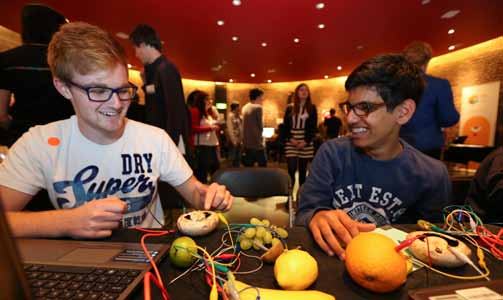
Image of a group of people smiling and interacting at a table.
Image with "DIY Development Impact & You" logo.
Image of the "LONGITUDE PRIZE 2014" banner, stating "The public voted for ANTIBIOTICS" and "The race is on to find the solution." Also contains text: "Nesta is a registered charity in England and Wales 1144091 and Scotland SC042833. 'Longitude Prize' is a registered trademark of Nesta." with URL: #longitudeprize www.longitudeprize.org.
We see how we... create
The UK is a world leader in this space, but we need to act now to find new ways of supporting our creative industries so they remain competitive in the future.
Above and top left images courtesy of the Royal Opera


Digital R&D Fund for the Arts
Three funds, across England, Wales and Scotland, have encouraged more than 600 collaborations on R&D proposals between arts, cultural, technology and research teams – we want to sustain this level of activity and support further fantastic cross-sector experimentation.
By teaming up with the Arts and Humanities Research council (AHRC) and the respective Arts funding organisations of each nation, we hope to encourage public funders of the arts to adopt and embrace the collaborative approach to R&D as a way of encouraging digital innovation in the arts.
Destination Local
Our research into hyperlocal media showed that despite rising demand, advertising alone is not going to sustain these services. This fact presents a serious challenge to emerging, but already important, public service media – namely, how to make it pay.
Some of the services we have supported through our Destination Local work have flourished despite this challenge and are running as sustainable businesses, with high levels of community engagement. One in particular is Kentishtowner. A daily publication serving London's Kentish Town community, it started as a blog and is now a multi-platform, award-winning publication.
The challenge now is to attract much-needed public investment into hyperlocal media as an emerging technology field.
Image of a person reading a newspaper outside.
We see how we... support
7. Health and ageing
There has never been a greater need for new ideas to solve the problem of an ageing population.
People Powered Health
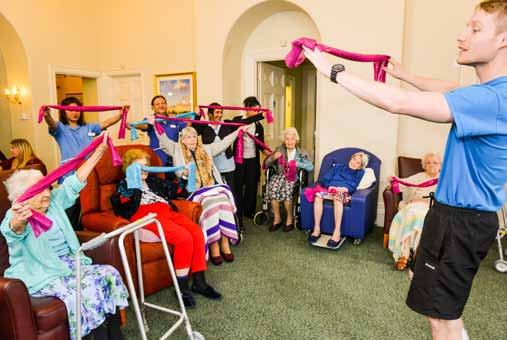
We've been working to influence the health system, to make it better-adapted to people with long-term conditions. Our People Powered Health work has looked at ways to re-balance our health and care system so that it is run for people, by people and with people. That means a system that cares for people when they need it, enables self-management by people, and connects people with other people with similar experiences so that they can support one another.
The programme supported six health teams across England by embedding and scaling-up collaborative approaches to long-term conditions. These ranged from community-based peer support groups to group ‘prescriptions' that help people to do more exercise or connect with others.
Ageing Innovation
We all know that our population is ageing, but many of our systems have not yet fully adapted. Our working patterns, social care system and housing stock, for example, are creaking at the seams, and not fit to help an increasingly older population to age well.
We published a report, Five Hours a Day: Systemic Innovation for an Ageing Population which argues that ageing is a systemic challenge requiring innovation not only in products and services, but also in the political and cultural domains. We're continuing to support a number of innovative organisations in this field, including Shared Lives Plus, GoodGym and Social Finance.
Image of a report cover: Nesta 5 FIVE HOURS A DAY SYSTEMIC INNOVATION FOR AN AGEING POPULATION by Halima Khan, February 2013.
Callout Box:
We've been working to influence the health system, to make it better-adapted to people with long-term conditions.
We see how we... develop
8. Opportunities for young people
Our aim is to help as many young people as possible learn about digital technologies through making their own digital products.
Digital Makers
The digital environment is ubiquitous. Understanding the way that digital technologies are made and controlled is important to understanding the world in which we live. Increasingly, the ability to make and adapt digital technologies is key to creative expression, social inclusion and business creation, and it is a skill that is increasingly in demand in the job market.
Make Things Do Stuff is a campaign run with our partners Nominet Trust and Mozilla, to create a platform for young people to test out and upload their own digital products. Since it launched thousands of young people from all over the UK have taken part and experimented, demonstrating the creative potential that technology can unlock for their generation.
Digital Makers Fund
We are backing organisations with bright ideas for significantly increasing the number of young people who participate in digital making. Notable successes include Code Club and Technology Will Save Us. Code Club has increased the number of schools it works with from 470 to 1,971 in the last year, and it has leveraged significant additional funding. Technology Will Save Us has developed its most successful maker kit (the DIY Gamer Console) and forged partnerships with Code Club and the Prince's Trust.
Image of "MAKE THINGS DO STUFF" logo.
Image of "[code club]" logo.
We see how we... invest
9. Impact investment
We are a catalyst in the field of social impact investment, investing primarily for a positive social impact, but also for a financial return.
Through our research work, direct interventions and support, we have helped to create a vibrant impact investment sector in the UK.
Bethnal Green Ventures runs accelerator programmes for early-stage social entrepreneurs and their organisations. We have provided funding, alongside the Cabinet Office and Nominet Trust, to help create 80 new ventures over four years. We believe that creating this early support for ventures is vital if we want to help build a vibrant, innovative and impact-focused entrepreneurial community.
We have established our first direct social impact investment fund. Nesta Impact Investments provides risk capital to early-stage ventures that have an impact for older people, younger people and community sustainability. In its first 12 months of investing, the fund has made five new investments, totalling £2.5 million. We aim to back organisations that can make a major impact and prove the effectiveness of their intervention. Notable investments to date include Oomph! and FutureGov.
Image of "Nesta Investment Management" logo.
Image of "FUTUREGOV" logo.
We see how we... connect
10. Future thinking
New ideas born today can change the world we will live in decades from now. We want to explore what these possible worlds could look like, and how we can help shape them for the better.
FutureFest
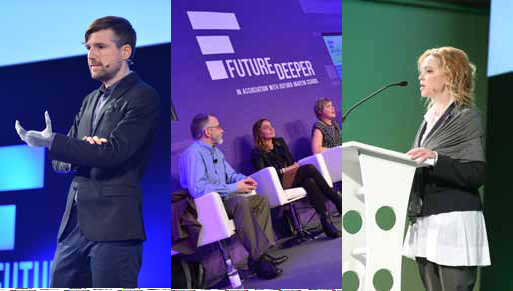
Our FutureFest events gather some of the planet's most radical thinkers, makers and performers to create an immersive experience of what our future might feel like a few decades from now. FutureFest is an answer to the fatalism that often stifles talk about the future, and encourages people to look at the future as something that can be shaped for the better – and shaped by them.
Hot Topics
Our thought-provoking event series looks at how cutting edge tech will affect our lives in the near future. We cover ideas as wide-ranging as the potential of drones to the future of prosthetics, and each event showcases the latest technology in action.
Predictions
Every December we bring together our in-house experts to make predictions about what the year ahead holds. The predictions range from the rise of robot overlords, to new science parks dedicated to social innovation. Our predictions series is a popular destination for people looking to us to get a sense of what the big trends for the year ahead might be.
Image of "FUTUREFEST SHAPING THINGS TO COME" logo.
Image of a person presenting at an event, with "FUTURE DEEPER" branding on a screen.

nesta.org.uk
Nesta
1 Plough Place, London EC4A 1DE
[email protected]
@nesta_uk
www.facebook.com/nesta.uk
August 2014
CC BY NC SA
Nesta is a registered charity in England and Wales with company number 7706036 and charity number 1144091. Registered as a charity in Scotland number SCO42833. Registered office: 1 Plough Place, London, EC4A 1DE.