About Public Digital
Public Digital is a consultancy that works with international organisations, governments, and large companies to deliver strategic change at scale. It was founded by the team that created the UK's Government Digital Service (GDS) which led the pioneering digital transformation of the state and public services in the 2010s.
We advise governments globally on strategy, scaling teams, designing and delivering better services, and aligning senior stakeholders around the potential of better government.
About Nesta
We are Nesta. The UK's innovation agency for social good. We design, test and scale new solutions to society's biggest problems, changing millions of lives for the better. nesta.org.uk
More responsive government
We think the constraints facing the next government provide an unmissable opportunity to change how government works.
Whichever political party wins the next election, the next administration to take charge in the UK will have to operate in a highly constrained environment. There will be little spare money to spend, a long list of problems to fix, and many threats on the horizon. Political space will be at a premium.
We believe in the old adage about making the most of a crisis. We think taking a new approach makes it possible to shift government from an organisation of programmes, projects and paperwork, to one of missions, services and people.
Any mission-focused government should be well equipped to define, from day one, what outcomes it wants to bring about.
But radically changing what the government does is only part of the challenge. We also need to change how government does things. The usual methods, we argue in this paper, are too prone to failure and delay.
There's a different approach to public service organisation, one based on multidisciplinary teams, starting with citizen needs, and scaling iteratively by testing assumptions. We've been arguing in favour of it for years now, and the more it gets used, the more we see success and timely delivery.
We think taking a new approach makes it possible to shift government from an organisation of programmes and projects, to one of missions and services. It gives the next administration an opportunity to deliver better outcomes, reduce risk, save money, and rebuild public trust.
Multiple attempts to reform how the machinery of government works over recent decades have failed to deliver radically improved outcomes at scale. Tweaks to departmental structures, new processes, or the creation of central units, have yielded some advances. But their effect on the overall character and direction of the public service has been fleeting.
The rare exceptions to this - and they exist in central government, local government and the NHS - prove the point. Thanks to unusual circumstances that created political cover, they were able to practise the methods we describe in this report - and they delivered. And yet these exceptions have remained just that. When leaders move on or the circumstances change, ways of working revert to the norm.
In this paper, we will draw on lessons learned from the experiences we and others have had as public servants, illustrate what these new ways of working look and feel like, and set out some of the deeper reforms needed to make them a new normal.
We call these changes the Radical How.
The Radical How in a nutshell
The struggles and shortcomings of delivering in government are well rehearsed. Many of the root causes that make it tough have been restated several times over several decades.
The Radical How is about changing how the public service delivers change. When government tries to predict the future and figures out all the answers upfront, it fails. Responding to reality requires agility.
We believe the government can and should change how it delivers, by:
- embracing test-and learn approaches at scale
- organising around multidisciplinary teams
- focusing on outcomes
The Radical How is a change of mindset as much as a change in organisation. It promotes methods and processes that have been shown to work, multiple times, at scale. They are the default ways of working for many of the world's most successful companies: Amazon has had scores of 'failures', yet it has become the world's largest online retailer. It has deliberately made many bets, several of which have come off. When it comes to change, the government tends to make one big bet - and it doesn't always win.
The occasions where a test and learn approach has been deployed are rare in government. There are examples scattered throughout recent civil service history, from the Emergency Planning College through to several teams doing exceptional work during the Covid-19 pandemic. But generally, they have happened only when there are exceptional leaders, exceptional circumstances, or both.
We think these ways of working would make a big difference if they became the norm, rather than the exception. We also think that without them, mission-oriented government will not become a reality. New policy ideas will remain just that, rather than translating into profound improvements to society.
Many of these ways of working can be described as being of the internet era. The internet may be decades old, but most government organisations have not yet caught up to the organisational implications it brings. If they can do so, the civil service will have a much better chance of successfully adapting to emerging technology developments like AI than it does now.
Making the Radical How a reality.
- Make outcomes matter most
Ministers should see delivering outcomes as a path to accelerating their own ambitions
- Let outcomes define accountability
Hold senior officials accountable for delivering promises, not paperwork
- Demand politicians set direction through missions
Empower civil servants to determine how to make them happen
- Add more teams to get more done
Because multidisciplinary teams are the best unit of delivery, not individual generalists
- Open up
Mandate that teams work in the open, sharing their successes, failures and knowledge in public
- Fund teams, not programmes
Invest public money incrementally, with oversight proportionate to financial risk
- Reinvent procurement
Buy or rent services that support teams, not simply to whom outcomes are outsourced
- Train civil servants for the internet era
Find, develop and keep the best, most skilled people; reward and incentivise them competitively
- Invest in digital infrastructure
Open data, common platforms, clear design; the basic foundations for everything
- Lead with courage
Accepting and committing to reform is the hardest, but essential first step
Very few of these 10 changes are untested. They do not mean throwing everything away and starting again. But they do represent a direct challenge to entrenched structures, behaviours and beliefs in Whitehall and Westminster.
This is radical in the sense that it asks powerful people to acknowledge that the status quo needs reform, and to take responsibility for that. It's radical in the sense of getting into the root of what government is for - delivering for the public - and thinking in terms of both the big picture and the practical basics. And it's necessary: we need a Radical How to underpin any mission-focused government of the near future.
The problem with programmes
Today, when the UK government wants to make a transformative difference to society, it sets up a programme.
For the last 30 years, the major programme approach has been the orthodoxy for delivering change at scale, whether that's infrastructure, military hardware, public service reform or technology. Almost anything with a large price tag and a significant 'implementation' component will be set up as a programme: These, in effect, are the government's big bets.
Programmes have become the default mental model for the vast majority of publicly funded activity. Whitehall's record with major programmes is a chequered one. At the time of writing, the Infrastructure and Projects Authority (IPA) counted 244 programmes within the government's portfolio, with an estimated whole life cost of £805 billion, double the figure of ten years ago. The level of transparency that exists for this portfolio is not perfect, but an example of working in the open that is much to the IPA's credit.
Of those 244 programmes:
- 26 (11%) are rated 'green', meaning that the IPA is confident of successful delivery.
- 23 (9%) are rated 'red', meaning successful delivery appears to be unachievable. These have a combined cost of nearly £100 billion.
Before the Covid-19 pandemic, the IPA and its predecessor agency had never rated more than 10 programmes as 'red'.
That leaves 195 programmes rated 'amber'. That means 80% of the government's biggest tasks are in a position where nobody knows for sure whether the programme will be a success or not - not the programme team, not the independent assessors, and certainly not ministers.
On one level this is understandable. By their nature, major programmes are extremely complicated and difficult. The government might be trying to do something no other organisation has tried before. Some level of failure is inevitable. But on another level: what we see is a profound level of uncertainty that exists for many years, backed by budgets in the hundreds of millions of pounds, with very little in the way of 'good practice' to draw upon. 'Sunk cost' fallacy also pervades; spend enough money on a programme and it can take on a life of its own, regardless of whether it is now the right thing to do.
What happens when a typical 'programme' goes wrong?
The Green Deal was the flagship energy efficiency policy of the Coalition administration (2010-2015). In 2016, a National Audit Office report concluded that:
The design not only failed to deliver any meaningful benefit, it increased suppliers' costs – and therefore energy bills...design and implementation did not persuade householders that energy efficiency measures are worth paying for.
The NAO's analysis was clear that one of the fundamental missteps made by DECC, the department responsible, was its inability to be "more realistic about consumers' and suppliers' motivations when designing schemes." The NAO noted that the Green Deal "looked good on paper," but fell short in reality.
DECC's approach made a series of major assumptions at the beginning of the policy development process. These were not tested in reality until much later, when implementation of the scheme was launched in 2013 - three years after policy work began. The policy assumptions included a focus on 'hard-to-treat' homes, a factor the NAO pointed to as the main reason why the Green Deal ultimately saved substantially less CO2 than previous comparable schemes.
The Green Deal was also weakened by focusing on measurable but relatively general outputs ("providing energy saving measures in millions of homes," which the scheme achieved) versus outcomes ("substantial reductions in CO2 emissions," which it didn't).
The department also omitted to test the Green Deal finance design directly with consumers, relying instead on a survey - which even in itself "did not provide a strong case". This lack of testing policy and economic assumptions against reality was in spite of "many stakeholders warning the Department it would be difficult to persuade people to pay for the measures themselves."
The error made by the Green Deal programme was not being wrong, but in leaving few chances to fix their mistakes quickly and cheaply.
The failure of the Green Deal, which took five years and cost taxpayers £240 million, was a textbook example of linear programme management processes leading to an increase in the risk of failure.
Its biggest mistake was predicating success in a complex, uncertain environment on a large number of untested assumptions about human behaviour.
The error made by the Green Deal programme was not being wrong, but in leaving few chances to fix their mistakes quickly and cheaply.
Common themes run through the recent history of major programme failures. Many of them relate to the separation of policy and delivery.
Borrowing the civil service's own definition, policymaking is "the act of designing, developing and proposing appropriate courses of action to help meet key government priorities and ministerial objectives". So: the art of translating political intent into reality. Too often, though, it becomes the art of translating political intent into something that works on paper.
Translating those paper plans into reality comes later, sometimes years later. Historically and culturally, "delivery" or "operational" work is seen as secondary in importance and status in Whitehall. Policy enjoys literal and psychological proximity to ministerial power. Delivery does not.
Another problem is the linear nature of the endeavour: politics first, policy second, delivery last. Often technology - in the form of defined requirements for an external supplier to build - will appear as another distinct stage of this linear process, inserted between policy and delivery, and rarely considered any earlier than that.
This step by step process, sometimes described as 'waterfall' in homage to the Gantt charts that govern it, is still typical of major government programmes. In practice, it means placing huge bets on the assumptions made at the policy stage. Yet this is almost always the moment where the least is known. The small policy or analytical error can snowball into a catastrophic mistake as implementation ramps up. And when faced with a hostile opposition and media environment, the cultural temptation to bury heads in the sand rather than face up to mistakes often serves to compound the damage further.
Where it's possible to predict all the variables and gather all the necessary information up front, waterfall methodology can work well. Building a motorway, or a submarine, for example. Waterfall-governed programmes tend to start with many assumptions that don't get tested until much later, or until the very end.
Diagram: Waterfall-style programmes start with many risky assumptions
This diagram illustrates a linear, sequential process typically found in waterfall project management. It includes the following stages:
- Predict everything
- Plan everything
- Implement everything
- In a series
- Of linear
- Stages of work
- Test everything
- Inflict on public
The number of programmes that actually meet the 'controlled environment' criteria of waterfall project management are in fact few and far between. Complexity and unpredictability are far more typical. The truth is that in most cases, even in ideal conditions, predictions can only be so good. People don't always behave like they do in economic models, sometimes not even close. Politics shift. Unexpected events happen.
Public servants and politicians can choose to put their heads in the sand and pretend that none of this is true.
Or, they could choose to adopt an approach that deliberately and specifically acknowledges complexity and uncertainty, and mitigates for both.
This is possible where teams work iteratively, with tight feedback loops to test what works potentially, and get buy-in and agreement from the most senior source possible. (As we'll see later in this paper, that can also include ministers.) The Radical How approach starts with hypotheses - just as waterfall does - but sets out to test them immediately - starting with the riskiest.
Diagram: The Radical How: test, learn, repeat
This diagram illustrates an iterative cycle with three main phases:
- Test the thing that matters the most
- Learn from the results
- This cycle is guided by the principle: "Do whatever it takes"
- And aims "to speed up this loop"
More responsive government
The goal is to create feedback loops that enable rapid iteration and improvement. That's made possible by building a permanent and multidisciplinary team that constantly improves its service in small increments, and constantly increases the scale of the service, as confidence in the approach evolves and grows.
The team is equipped to learn. The Radical How provides a built-in "Undo" button to correct errors - and of course, errors happen. But with this approach those errors are tiny, and cost very little to fix relative to the alternative. That's a consequence of the rapid feedback loop.
Teams like this have to be truly multidisciplinary, with policy and operations experts working alongside a range of other skills and experiences: service designers, technologists, analysts, product managers, delivery managers, user researchers, content designers, and others, all working together.
It is important to clarify that this approach is not a case of simply running lots of pilots. A pilot implies starting with a phase for learning, which then ends as you move into 'roll out'. Pilots also tend to imply testing a whole solution to see if it works, rather than specific hypotheses.
Applying the Radical How means conducting multiple small-scale experiments at the boundaries of policy and delivery - and doing this permanently, in pursuit of a policy intent or outcome. Incremental changes are scaled up, once there is good evidence they work in reality.
Responsiveness is an embedded attribute, not a phase on a timeline.
Working this way in government is not easy. Several structural and cultural challenges make it difficult.
Since the 1980s, the New Public Management approach (NPM) orthodoxy of making government more 'business-like' has profoundly shaped Whitehall culture and process. This way of thinking has had some positive impacts, but also served to embed certain preferences: such as outsourcing or rigid cost-benefit analysis.
One effect of NPM on central government is a tendency to focus accountability on measurable medium-term outputs over long-term outcomes. That can lead to excessive box-ticking of deliverables rather than delivery; symptoms rather than cause. The vertical lines of departmental accountability also make it hard for teams to work across organisational boundaries in the interest of the outcome they are seeking to achieve.
Programme funding rules, as set out in HM Treasury's [Green Book], encourage front-loaded cost-benefit analysis and discourage incremental funding proportionate to risk.
Whitehall operates in this way for reasons that make sense within the context of its history and power structure. Public service leaders are not wilfully incompetent. Focusing on outputs over outcomes is extremely tempting because of the long lead-in times to achieving and being able to measure outcomes, especially for long-term, national-level ambitions. Vertical lines of accountability have the virtue of simplicity, and fit with a centuries-old prevailing culture of bureaucracy. The alternative isn't easy to organise in terms of line management, and changing it would doubtless create some painful disruption. Hypothesis-driven cost-benefit analysis as demanded by HMT in business cases is a good thing, provided these hypotheses are tested against realities, and the analysis is iterated over time. But: all too often, the hypotheses are not tested until it's much too late to iterate anything.
In the past 30 years, this model has been buttressed by a dysfunctional relationship between public sector organisations and outsourced, enterprise technology and consultancy contractors. There are too many examples where these relationships have failed to deliver value for money or accountability for either senior officials or their suppliers.
Public service management practice and organisation is a domain few ministers have chosen to enter. The current orthodoxy is entrenched, and very hard to change. Even political leaders who want to change it rarely have enough time in office to even start thinking about how.
To use a common phrase in Westminster, it is what it is.
It doesn't have to be.
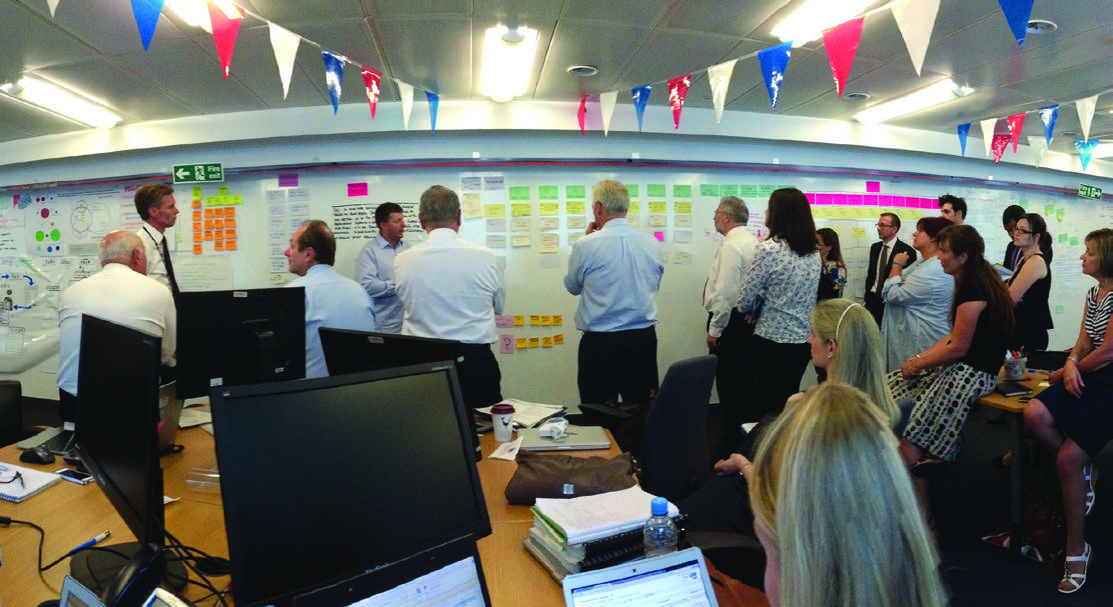
A 'show and tell' governance meeting held during the reset of Universal Credit, 2013. DWP's Secretary of State, Permanent Secretary, the Cabinet Secretary, and the team are all present
What is the Radical How?
A new mission-oriented government would not be starting from scratch.
Several major initiatives in government have adopted radically new ways of working in the last decade, and delivered substantially improved outcomes as a result.
Some of these were “programmes" in the typical sense, but programmes that made bold changes: to leadership, to governance, to communication, and by applying a test and learn approach as best as they could.
They all adopted a Radical How. They're quite unlike most programmes that came before.
Universal Credit (2013 - 2016)
The public conversation around Universal Credit (UC) has understandably focused on the political and human impact of cuts to benefit levels. But behind this, there's a largely untold success story about iterative user-centred ways of working. UC is a rare example of turning around a huge programme that was "heading for nowhere the rocks." A reset of the service design and delivery approach moved away from a typically linear, waterfall major programme to a much more Radical How. The results were striking.
UC was the biggest reform of the UK benefits system since 1948, combining six working age benefits into one and comprehensively overhauling the technological, operational and policy underpinnings of welfare provision. It was the Coalition Administration's flagship domestic policy. Yet after three years, the programme had spent £425 million, gone through five Senior Responsible Owners, and had not delivered a working service to a single claimant.
The fundamental shift the Universal Credit team made was to use a "test and learn" approach.
To begin the turnaround, a brand new team was set up, independent from the existing programme and incumbent suppliers. This team was initially very small – no more than 15 people – and located in a different building to the rest of the 1,500 strong programme team. There was no attempt to reset within the existing programme structure; doing so would not have been possible.
A crucial moment for the new team was the Secretary of State saying to them: "I want you to deliver an intervention that means we support more people to find more work, more of the time, while protecting those who can't work." Note the difference between this and: “I want you to deliver Universal Credit." The Minister set a clear outcome for the team to achieve, not a named policy for them to deliver.
The clarity of intent, and focus on outcome over output, set a marker for what the team would be held accountable for. It equally made clear that the ministerial role was not to opine on the details of implementation based on assumptions and hunches. This new approach combined accountability for outcomes with autonomy for the team in determining how to deliver them.
The team set itself up differently. Rather than separating the policy, technology and operational delivery functions (which were even based in different parts of the country), the new team brought those disciplines together in one, co-located team. Physical co-location was thought to be essential in pre-pandemic days. Since then, the experience of similarly successful and geographically spread teams like the Vaccines Taskforce has shown that while some physical co-location is hugely valuable, new tools and ways of working make highly effective dispersed teams a practical possibility.
The team included people with digital and technology skills, including service design, user research, content design, product management and internet-era technology. Day-to-day, it was led by a triumvirate of policy, product and operational experience. Most of the early team were full-time public servants, but some were from suppliers. External staff were fully integrated into the team, so that you couldn't see the joins.
The test and learn approach was designed to maximise the amount of learning about what would and wouldn't work in reality, at pace.
Universal Credit was initially tested as a complete end-to-end service with a pilot group of just 100 claimants in a single postcode area in Sutton, south London. This area was carefully selected to test whether the assumptions the team has made about the core proposition were correct. Doing so revealed unanticipated challenges within weeks, such as how payments information was displayed to claimants, or what the definition of a 'couple' was (a semantic point that had meaningful policy consequences). Over time, the team tested the core proposition with larger groups. Next, the team started to test assumptions about how that proposition could be scaled nationally.
Rather than a linear process of writing policy at the start and living with the consequences, the team started with outcomes and adjusted the policy, design and operational choices for the service iteratively, as they learned more.
That small team eventually replaced the first unsuccessful version of the programme. It then scaled up by adding more teams, each focused on specific tasks or problems.
Today, Universal Credit serves over five million households across the UK. It has become a world-leading example of how to build successful user-centric public services at scale. It was a dog that didn't bark during the Covid-19 pandemic; despite a sudden ten-fold increase in demand, the service stayed standing when it was needed most. That would not have happened without that fundamental reset in 2013, and the application of a Radical How thereafter .
Future Farming (2020 - present)
The Future Farming and Countryside programme was set up to replace the EU-funded Basic Payments Scheme to farmers, due to close for good in 2024. The programme is responsible for delivering the most significant changes in agriculture since the 1940s, designing and implementing a new set of domestic arrangements for land use across the country.
Like UC, a lot of the public debate around the Future Farming programme is likely to focus on the political decisions, such as the amounts of money awarded to farmers who deliver certain outcomes. And like UC, the level of success in achieving those outcomes depends significantly on economics. Good communications and service design cannot substitute for adequate investment. But these things done poorly can create insurmountable barriers to the effective use of public funds, regardless of how much is spent.
The programme communication doesn't focus on "handling and spinning", but on "listening."
Like UC post-reset, the Future Farming programme used ways of working designed to effectively direct public money towards delivering outcomes, and make it apparent more quickly if that wasn't happening. The team used the same "test and learn" approach, iterating both the delivery mechanisms and the policy simultaneously, as they steadily expanded the rollout to ever-larger groups of eligible farmers, landowners and land managers. That's the main difference between this and most other government programmes: usually, policy is written early and locked down before implementation and delivery even begins. In Future Farming, the policy responds as the team learns.
The farming industry has noticed the difference. Seeing the positive headline "Defra responds to farmers' feedback" on the front page of an industry newspaper not only reveals how important this iterative approach is to stakeholders, but also how unexpected. That a government programme should be seen to listen and consequently make changes - in response to informed feedback - to one of the most important interventions in land use policy for several decades should not be news. Yet it is.
The Future Farming programme has deliberately taken a very different approach to communicating, placing more emphasis on working in the open and actively canvassing for feedback and criticism, rather than adopting a reactive, defensive posture. The senior official responsible for the programme has used social media from the outset to communicate directly with farmers and others affected, as well as spending a substantial amount of her time meeting farmers and other potential service users in person. Giving the programme a human face - and showing that feedback has been translated into changes - has generally led to more constructive engagement, and a better designed service. That doesn't mean the team has to agree with or adopt all the feedback it receives, but it is at least given a genuine hearing and response.
Using social media well, seeking candid feedback and approaching engagement with authenticity and candour may sound like elementary communications, but it represents a radical cultural shift from what is typical today in both central and local government, and the NHS. For many parts of the public sector, effective citizen engagement is a new professional skill that will require investment and development. For those used to traditional policy consultations, it is an uncomfortable and unfamiliar concept.
Test and Trace (2020 - 2022)
The government's response to the Covid-19 pandemic offered the full sweep of civil service performance; the good, the bad and the ugly.
The pandemic temporarily suspended the 'normal rules of play' in government. Suddenly, there was a clear, shared, cross-government outcome to aim for, and the imperative to act quickly. Out of necessity, Whitehall was forced to abandon many of its standard ways of working, as these simply could not deliver the pace of decision making demanded by a crisis.
In some instances, such as the procurement of personal protective equipment (PPE), abandoning normal governance led to egregious failures and wasted public money. But there were several other cases where the opportunity to innovate led to positive outcomes that would have been virtually unimaginable for those organisations using their pre-pandemic working practices.
NHS Test and Trace is one example. While Test and Trace was clearly not perfect, it nonetheless demonstrated impressive agility in innovating and scaling despite a constantly evolving set of policy requirements in a highly complex and uncertain context.
Test and Trace benefitted from having a clear high-level mission and dedicated multidisciplinary teams designing and running experiments that could be scaled, once they'd learned "what works" to drive up COVID testing amongst specific groups of people. These included offering anonymous testing for marginalised groups; and community-led testing in areas of enduring transmission. Rapid experiments were set up in days, sometimes in just 24 hours. Then they were adjusted, abandoned, or scaled up over a bigger area. Each experiment team included its own "silo-busters", people from operations, clinicians, policy, legal and so on. Ministerial approval was same-day. These were “experiments” rather than “pilots”; they tested a specific hypothesis, such as "If we set up a walk-in clinic, will we reach people who haven't used our online service?" Scientific method, but for service design. Test and Trace was the Radical How, in action, at pace.
This approach allowed for rapid experimentation to coexist alongside high levels of pressure and scrutiny. Combining a clear focus on outcomes from the top with empowering teams on the ground to figure out how to achieve them, is what created conditions for rapid delivery impossible using more typical Whitehall processes.
Test and Trace also countered the enduring government premise that you need a single, monolithic service offering in order to deliver equality of experience across the country. Test and Trace proved that different experiments worked better to deliver the same outcome for different use cases. For example: the team needed to find out what worked for speakers of different languages, people with low literacy or people with disabilities. The team noticed that COVID was rife among food factory workers - and that they weren't getting tested that much - so proactively worked with employers to establish on-site workplace testing.
Scaling meant driving greater adoption of a service geared towards a single outcome; to do that, Test and Trace needed to create additional channels to reach all the target groups. As a programme, Test and Trace exemplified how taking an experimental approach can also help drive accessibility and inclusivity - when being inclusive around service quality wasn't optional.
All this was possible because working during a pandemic placed a premium on factors not always typical of national-scale government programmes. Test and Trace had very high observability - short, data-led feedback loops on the metrics that mattered (e.g. testing rates, COVID infection rates). Rapid experimentation was made possible because the technical infrastructure to deliver this data, and a culture that put it at the heart of rapid decision making, were in place. Testing rates and openly published COVID incidence data (e.g. via the Covid-19 dashboard) also enabled innovation and iteration by others working outside Whitehall; leaders in local health ecosystems had access to the same data and used it to target their own efforts.
This was far from perfect. There was significant local government frustration that central government decided not to make use of local capabilities and deliberately went outside existing structures. Careful thought is needed into how "test and learn" approaches can be reconciled with devolution. In theory, the principle of incrementally scaling experiments should align with engaging local, regional and national levels of government more effectively than 'big bang' launches, but politics and practice may make this harder than it looks.
Making missions real
Making mission-oriented government an enduring reality requires fundamental changes to the organisational architecture of Whitehall.
To illustrate what making those shifts might look like in practice, we have sketched out what it would look like to apply the Radical How to one important mission likely to be high on the next administration's agenda: decarbonising the nation's housing.
Decarbonising Britain's housing stock
Radically changing how we heat the nation's homes is a crucial contributor to achieving net zero and reducing our dependence on volatile energy supplies. Home heating accounts for about 14 percent of the UK's emissions, and gas or oil boilers are among the single most polluting items most households own .
Making missions real
The question for government is how to substantially increase the level of uptake in zero carbon heating.
That will require some of the tools typically used by Whitehall, including legislation to incentivise consumers and the market to shift away from gas boilers towards alternatives like ground and air source heat pumps.
Legislative levers will need to be applied thoughtfully by any government seeking to drive change; if the drafted legislation is highly prescriptive and not outcomes based, it can lock in all sorts of risky hypotheses that prove incorrect as time passes. However, well-drafted enabling legislation can provide the flexibility needed to accommodate the results of early experimentation, as it did for Universal Credit.
It is also clear that just focusing on legislation won't be enough. Previous attempts have not brought about their intended outcomes. There's enormous friction in changing the heating habits of millions of people - what else can government do to reduce, or eliminate, that friction?
The Radical How approach might look something like this:
After 100 days
In the first 100 days, the team should focus on testing assumptions that help answer the question “Can this work at all?" During this period, a government with this mission should:
1. Publish a clear statement of political intent, and a clear set of outcomes that the government will be held accountable for
To empower a team to start testing and learning at pace, it's essential to have a unifying 'north star' statement from the responsible Secretary of State. Political leaders need to make those statements, then stand aside and let the team work. Getting this right sets the cultural tone for a shift to thinking in terms of outcomes that contribute to the overall mission, not outputs.
For decarbonising domestic buildings, that outcome might be:
We will help households replace X million domestic boilers with zero carbon alternatives by 2030.
2. Establish a multidisciplinary team, including experts in policy, service design, user research, economics and technology, led by a Senior Service Owner.
Crucially, this team should include people with a deep understanding of the frontline. In this case, people with extensive direct experience of installing heat pumps, who should be there to provide an insight into practical realities that would otherwise be easily missed. Team members may be drawn from several departments; they are there to represent their expertise, not departmental allegiance. This first team - of no more than 12-15 people - should also have excellent and regular access to ministers, potentially through a paired special adviser. Daily access would be ideal. Weekly would probably be sufficient. Something in between the two would work well.
This team must have a mandate to reshape relevant policies. In this case, planning regulations will be especially important. In order to formalise this mandate, the team might be led by a small group of senior officials who collectively cover aspects of policy, operations, service development and delivery, working together to achieve the shared outcome. Alternatively, the team could be led by a single service owner who is explicitly accountable for decisions related to both policies and delivery mechanisms; they will likely be supported by a senior official who supports them by unlocking the policy changes needed to establish an enabling legislative environment; one that allows for flexibility and change in the face of new information.
What matters most is the genuine integration and alignment between policy and delivery at the heart of the team. Tensions and disagreements are reconciled within the team, not through the mechanism of programme boards and Whitehall write-rounds.
3. Define a clear set of hypotheses to test the core proposition - that it is possible to persuade people to give up boilers and install alternatives.
There's already plenty of evidence available about the likely points of friction in installing zero-carbon heat sources. The Electrification of Heat Demonstration Project will have uncovered several pain points; we are aware of ongoing work into assessing the barriers presented by existing planning permission rules.
The newly formed multidisciplinary team can draw on this evidence to pinpoint the gaps in frontline-tested knowledge - such as around subsidy levels, or scalable simple home surveying - and select a series of hypotheses that would need to be true in order for the core idea to work.
4. To Test these hypotheses for real through a series of small, bounded experiments in the marketplace.
These experiments will test installations in a small number of domestic buildings, exploring the effects of different choices on subsidy, policy, service design, and supply chain issues. The goal is to uncover unanticipated pain points in the end-to-end process. The only way to find these pain points is to try making the process work, and see what breaks.
The team will also start using live data to see how outcomes change depending on policy. Creating dashboards gathers people around the data to make decisions; automation has the advantage of avoiding burdensome manual data collection, and reduces the risk of gaming. Dashboards can be useful tools, but are no panacea - the team will look as closely at qualitative feedback as it does the quantitative data.
After 100 days, the team should have:
- disproved some of its riskiest assumptions
- uncovered what genuine legal or regulatory blockers exist
- a better understanding of the levels of subsidy that influence consumer behaviour
- exposed several unseen points of pratical friction
- installed (or at least begun the process of installing) zero carbon heat technologies in a very small number of homes
After 2 years
Even after just 100 days, a very short time in government, progress will be tangible and measurable in terms of learning and delivery - albeit a tiny amount of the latter to begin with.
That progress will be accompanied with a new approach to communications. The team will have established a monthly rhythm of pandemic-style briefings, open to the press and public, to share learning and progress. Ministers will be accompanied by experts to answer questions, and be collectively candid about gaps in knowledge that the team is working to address. These sessions will be augmented by the team working in the open, engaging on social media and regularly publishing progress on the web.
Within the first 2 years, the team will have shifted its focus on to how to scale up and complete a substantial national change within the lifetime of a Parliament, answering the question "Can this be done at a scale large enough to deliver the political intent?"
(Of course, sometimes, the answer will be "No". In which case, you get a chance to stop the work early, and at a point where the cost of stopping is still low.)
After 2 years, a government with this mission should:
1. Have a "team of teams" in place
By this point, the team working on the mission will have expanded beyond the initial 12-15 people into a structure formed of many multidisciplinary teams, each working on a discrete problem. Crucially, the mission will have scaled up by adding empowered, multidisciplinary teams, not by adding individual generalist people.
A core service team will continue to iterate and optimise the core proposition as it scales across the country. Additional teams will focus on distinct parts that require extra attention, such as looking at the supply chain to ensure sufficient installers are trained, and that enough heat pumps are manufactured or procured.
By this point, there will probably be a 'dependencies' team, making sure the work is connected to other relevant missions elsewhere in government. For example, government might also start on a mission to build a next-generation electricity grid, which heat pumps in millions of homes would rely on.
2. Publish real-time data on performance and progress towards delivering the political intent.
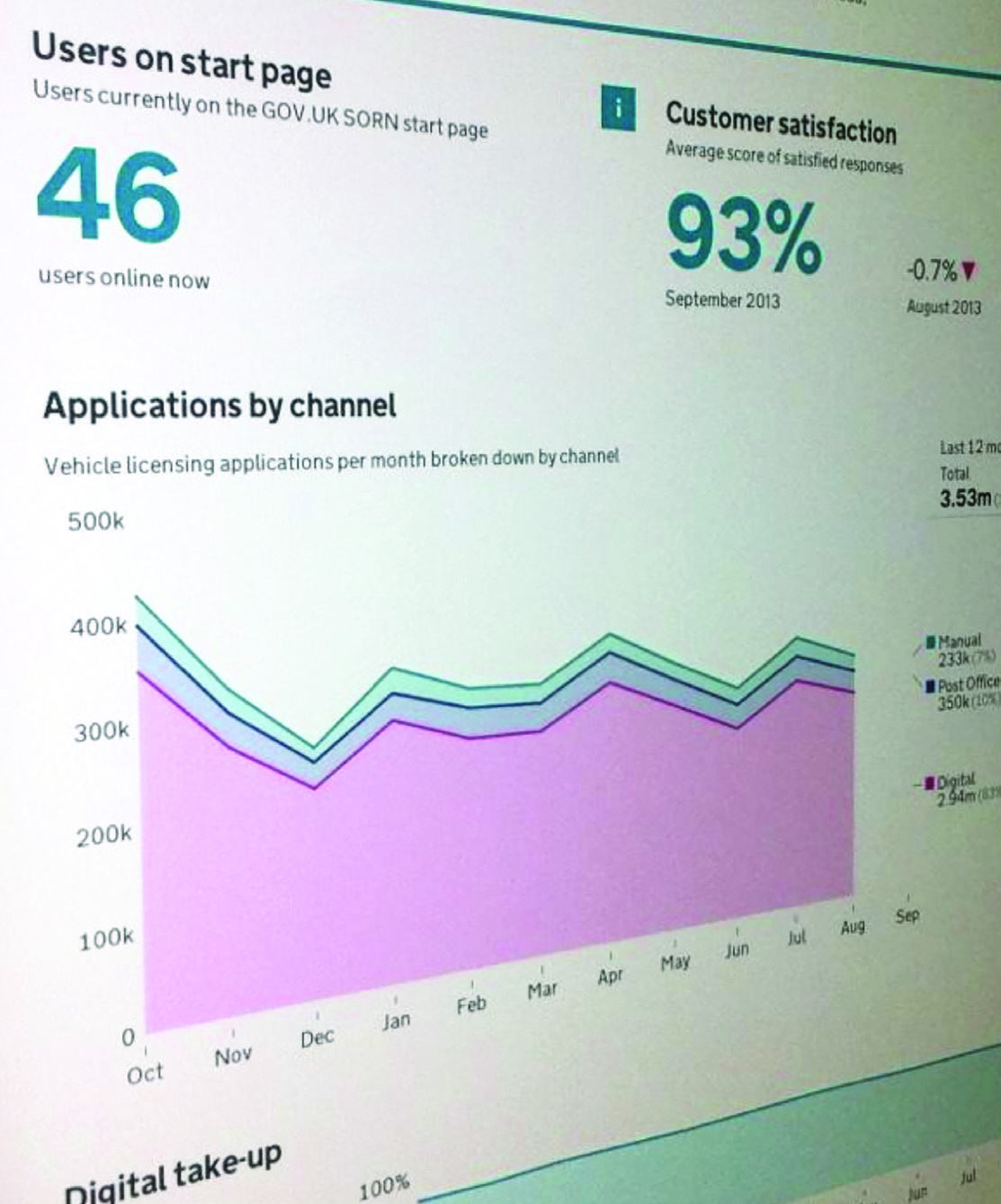
By this stage, it should be easy for the mission to communicate its own progress by using automated, even real-time, data flows. In the centre of the mission team's office space, you should expect to see screens showing the number of heat pump installations last week, last month and last year, updated daily. People would celebrate the numbers ticking past a particular milestone, rather than blandishments in a newspaper editorial.
Making this data transparent improves accountability. Not just internally, but publicly as well. The point is not so much to hit targets, but to show momentum. Being more open with the data helps outsiders get answers to questions like: "Are our decisions helping us make progress towards our outcome?" Or: "Are we moving fast enough?"
(Again: sometimes, the answer might be “No”, in which case data provides a valuable feedback loop, provoking hard conversations early. The absence of real-time feedback in most current government programmes usually means that these questions are asked too late, if at all, and the hard conversations end up being much, much harder.)
This real-time performance data forms an important part of the team's internal governance and external communications. They run monthly 'show and tell' meetings with the responsible minister and other senior stakeholders to talk through the data, show what the service currently looks like for actual users, and raise any issues. The dashboard is also published openly, on the web, so that peers across government, journalists, the public and other stakeholders can see quite clearly what progress has been made, and what level of momentum is building behind delivering the mission.
3. Test hypotheses that relate to the successful scaling of the intervention, rather than just the core proposition itself.
Even after two years, the team won't have fully answered all of its questions. It will know a lot about its core proposition, and about installing heat pumps in 'typical' homes. But it will still be testing multiple hypotheses, particularly those related to scaling nationally, and handling edge cases in far less 'typical' circumstances.
They will be looking for answers to questions like:
- How might we incentivise new building developments to adopt community heating?
- How might we ensure the training of sufficient numbers of installers per month? How many is sufficient?
- Do we need a national public organisation for installing solid wall insulation at the pace needed?
- How do you effectively incentivise 'hold-outs' - the final fraction of homes in an area who have held onto gas heating - so that you can turn off or repurpose the gas network in whole areas?
In the more typical policy making process, there would still be attempts to answer all these and other questions - but upfront, long before the core proposition was tested in reality with anyone. A mission team applying a Radical How approach will be asking the same questions at a more appropriate time, and addressing new, unanticipated questions as they arise. The team may also be actively looking for lessons learned from similar national rollouts that dealt with hard-to-reach properties, such as the rollout of broadband services.
After two years, the team will also have tried some experiments that failed. A special advisor may have proposed a boiler scrappage scheme that didn't really work. The team may have found the training of heat pump installers couldn't actually be addressed quickly enough by the market, confounding an assumption they started with.
A Radical How doesn't mean missteps won't happen. It may even mean that more mistakes occur. But they will be far smaller, less costly and less politically consequential than the major programme failures set in train by a waterfall style approach.
4. Automate the right things, for the right reasons, in the right order
All governments find the idea of efficiency and value for money appealing. In recent years there's been a strong push towards using online channels for service delivery, and more recently still towards automation-at-all-costs (with hype about robotic process automation, for example). It's entirely reasonable to expect that several parts of the heat pump installation journey will involve online services and automated information provision.
But years of experience in government technology and automation have taught us two important things. Firstly: applying a purely technology lens to mission-level problems without considering the process, cultural and organisational changes that accompany it is a recipe for disaster. And secondly: focusing on efficiency and cost saving as an outcome in itself has a strong tendency to lead programmes to deliver the wrong service in the wrong way. Focus solely on the pennies and you lose sight of the pounds - plus the other substantial benefits that could be realised.
The excitement (and hype) that currently exists around artificial intelligence is justifiable, but several governments have already counted the costs of placing too much trust in technology without getting to grips with human reality first. Australia's 'Robodebt' scheme, described as a "massive failure of public administration," by a federal court judge, led to a AUS$1.9bn settlement. Canada's Phoenix pay system has caused CAD$2.2bn in unexpected costs and is still paying some public servants incorrectly, 15 years after it was introduced.
After two years, our imaginary heat decarbonisation mission team will be able to identify parts of the process that are reliably repeating patterns. These might be needs that crop up in 80% of cases, things that are relatively predictable. These will be ideal candidates for automation - particularly as the heat pump roll-out moves out on a national level, and economies of scale are available.
At the same time, the team will be trying to avoid automating parts of the service that still require a level of bespoke support and/or human contact in order to meet needs. There probably won't be very many of these, but pretending they don't exist is a false economy. If the team tries to automate something in such a way that doesn't adequately address the user need, it will create additional friction in the service, slowing down progress towards delivering the ultimate outcome. What's more, mistaken automation will probably degrade the service experience to the point where it creates failure demand: people ringing up to get answers to questions a website chatbot can't give them, for example.
How radical becomes normal
Based on past experience, we are confident that applying a Radical How approach can deliver real public impact. But equally, we recognise that some of these ideas have been well used in government for a decade, and the default culture and behaviour of the civil service hasn't changed much. There are clearly more shifts to make, to truly change how all of government works, for good.
Make it easier for radically new ways of working to become default behaviours.
In order for radically new ways of working to become default behaviours, organisational cultures and incentives must be altered, so that these working methods are allowed in the first instance, and encouraged in the second.
This is a radical step for any bureaucracy. They tend to retain the Victorian imprints of machines designed for consistent, repeatable tasks carried out by humans who are broadly interchangeable. Creating multiple modes of working, and emphasising the need for specialist skills alongside deep operational knowledge, is contrary to that. This does not mean wholly replacing one orthodoxy for another by the way. We will still need generalists, too.
There is an urgent need for a wider conversation about the state of the civil service. Whitehall is depleted, emotionally and financially. It has experienced a significant talent flight over the last 10 years. Staff turnover reached 14% in 2023, the highest in a decade. A recent analysis of interviews with current and former civil servants reported that 39% referred to the civil service becoming a less attractive employer. Despite a great deal of noisy debate around civil service reform in the aftermath of Brexit, few changes have been made.
These are the big shifts needed to support a Radical How:
1. Making situational awareness easy, widespread and uncontested
It is striking how little ministers or senior officials know about how well a department's services are performing. The Public Accounts Committee (PAC) reported in September 2023 that public services "often lack... timely metrics on costs and performance which are essential foundations for identifying existing costs and tracking efficiency improvements."
This lack of situational awareness is not for want of governance meetings, risk registers and other project management documentation. There's plenty of that. These processes and artefacts are failing to provide leaders with a level of data and candour that leads to action.
No large failing government programme has hit the rocks because it didn't have enough meetings. At their worst, the documents and discussions become rituals divorced from the reality of what is actually going on.
This is a cultural issue as much as a process one. The PAC report referenced above also says that "programme resets are typically viewed negatively, government bodies continue to try to resolve unresolvable issues, leading to wasted effort and costs, rather than admitting the need for a reset." In other words, even when the management information is available, decisive corrective action tends not to happen.
Capability Reviews (2003-2012) were instituted as a way of holding departmental leaders to account for improving their department's competence to deliver. The then Cabinet Secretary, Sir Gus O'Donnell, said these reviews were intended as tools for "exposing the improvements needed, getting the right people into the right senior posts to deliver the improvements, ensuring they get the support they need, rewarding success, and taking tough action in response to failure." Used alongside Public Service Agreements (PSAs) that tracked the government's public service priorities, these frameworks provided hard levers for applying focus and accountability to performance across Whitehall.
The Coalition administration dismantled this system, before the idea was revived in the form of Outcome Delivery Plans (ODPs, in 2020). These were supposed to capture long-term objectives framed in terms of real-world outcomes. Conceptually ODPs were a good idea, but lacked teeth. Departments had little incentive to break down their outcomes into measurable progress, and ministers paid no attention to them.
Given sufficient political impetus and focus, we think a mission-centric version of Capability Reviews could be a powerful driver for filling the enduring leadership, strategy and delivery capability gaps across government. There are other simple behavioural steps ministers can take to enhance governance around service delivery. For example, the 2012 Budget announced that new online services could only go live if the responsible minister was able to demonstrate they themselves could use the service successfully. Reducing the distance between political power and the realities of frontline public service delivery does not have to be complicated - though it may sometimes be uncomfortable.
2. Changing the governance of funding
Changing how government works also means changing how government funds its work. All too often, funding processes are cumbersome and performative, increasing friction without actually reducing the risk of obtaining poor value for money.
Part of the Treasury's role will inevitably be to say no on occasion, and apply control. And business cases are not inherently a bad thing. It's a good idea to consider trade-offs and opportunity costs across government. But the way these tools are typically used and interpreted will make delivering through a test and learn approach almost impossible.
Business cases are weak because they only offer 'point in time' assessments when deciding where to make investments. They take months to write, and rarely get revisited once they're "done". The current Green Book process for appraising investment options doesn't include a way of asking whether risky assumptions have been tested, or whether a programme is on the right track early in its life. But the fault is less with the Green Book itself, and more how the process it codifies is interpreted and applied across Whitehall.
The very fact business cases take so much time and effort to construct disincentivises teams from starting small, testing assumptions, and asking for small amounts of money to do so. Why ask for £1 million over a few months, when asking for £100 million over a few years would take little additional effort, and get just as much scrutiny?
There's an urgent need to create room in investment governance that allows teams to pivot if the needle isn't moving.
At the other end of the business case timeline is the "benefits realisation". At the moment, anticipated benefits are outlined in business cases for programmes, but most of the “benefits realisation” activity is assumed to happen after an intervention has been "delivered". In reality, conversations about benefits realisation are pushed into the long grass and rarely happen - and even if they do, the team has usually been disbanded by then anyway.
3. Simplifying and modernising procurement to enable public interest technology
This approach to measuring benefits is largely pointless. Far better to understand value, and design the realisation of value as early in the process and as incrementally as possible - early enough to make design changes if the expected benefits aren't materialising. And early enough to make the senior officials responsible for the programme unavoidably accountable for delivering outcomes, rather than a list of deliverables.
The government spends around £300 billion a year – a third of all public expenditure – on buying goods and services from external suppliers. The relationship between government and suppliers to the public sector has evolved since the outsourcing boom of the 1990s and early 2000s, but the nature of contracting continues to fundamentally shape the state's ability to effectively deliver outcomes.
Procurement processes tend to follow the same patterns of waterfall programme management we discussed above. A set of policy rules are defined, then translated into a list of technical requirements or service-level agreements. Suppliers then bid for the right to deliver what's on the list.
For large-scale implementation of technology or service operations, these contracts can run to nine or ten figures, and last many years. Like the traditional policy making process, they effectively assume it is possible to predict the future, and use contractual mechanisms to protect the government and generate value for public money. The examples of where this has failed to work are many and well documented - perhaps the most catastrophic example being the £10 billion failure of the NHS National Programme for IT.
Some critics of the current orthodoxy point to a built-in asymmetry of information, because vendors cannot know the full scenario they are walking into when they take on a public sector contract. But in practice, it's not so much information asymmetry as information deficit - most of the time, neither buyer nor supplier has a clear understanding of precisely what to contract for. Nor can they if the contract is being let over several years, to deal with a complex social challenge.
As a recent Public Accounts Committee report has explained, it doesn't help that central functions like procurement still treat digital transformation programmes as if they were akin to 'controlled environment' infrastructure programmes:" departments can't precisely define and scope (digital) requirements, and yet procurement processes expect suppliers to price proposals as if that uncertainty were not a problem". This is not a problem specific to digital, it is an issue for any complex programme. Most government business is inherently complex.
Where uncertainty and complexity are high (as they would be for any mission-based approach), awarding a contract based on the most economically advantageous bid for a predefined solution drives up the average cost of change, making experimentation, iterative development and delivery much harder.
Public procurement suffers from a tendency to value the illusion of control. The comfort that comes from fixing a plan upfront, also applies to running an incredibly detailed multi-million or billion pound procurement. The civil service's enduring tendency to prize precision and control - even where none exists because of a scenario's inherent uncertainty and complexity - is a dangerous and expensive illusion. The Civil Service is often accused of risk aversion. This is only partly true. What these processes illustrate is a strong aversion to uncertainty.
We need procurement systems that support nimbler, more open marketplaces.
To unblock this, the government needs procurement systems that offer reduced barriers to entry for SMEs and more incremental contracting mechanisms. The Digital Marketplace established in 2012 made some headway in doing this for contracting digital and technology services, though its effectiveness has been steadily eroded over time.
We're not advocating for a blanket relaxing of rules. Suspending normal governance over the Covid-19 pandemic period was a decision taken in part because the current processes were entirely unfit for the pace of decision-making required. Few alternative checks and balances were put in place, leading to poor value outcomes in several instances. We think that if the typical procurement processes had allowed for more pace and flexibility, there would have been less need for the government carrying the risks of an 'all or nothing' approach.
Procurement in government is frequently cumbersome because of a cautious interpretation of rules, designed to minimise the risk of getting in trouble rather than maximise the chances of supporting the delivery of an outcome. A certain view of Covid-era procurement, and the 'Wild West' that was consequently created, implied a trade-off between pace and probity. We do not believe this is the case. Instead we see a huge opportunity for procurement reform, not least to underpin the development of public interest technology for the benefit of all.
4. Using transparency to radically improve public and parliamentary accountability
The rituals of parliamentary accountability play a quiet but profound role in shaping the default behaviours of ministers and senior public servants.
Select Committee or Public Accounts Committee hearings are almost always a 'red pen' exercise - they happen after things go wrong, or when they are very obviously about to. This turns them into performative occasions, in which committee members attempt to tease out admissions of failure while witnesses go on the defensive. Candour is rare. And in any case, by the time a hearing takes place, the issues in delivering the programme are usually far too advanced for a committee's recommendations to make much difference.
Hearings like these don't do much to improve outcomes. But they do encourage a certain set of skills to prosper in the senior ranks of the civil service. Being able to turn in a credible and compelling committee performance fronting up a programme that is falling apart is a valuable skill. Select Committees can only call civil servants above a certain grade of seniority as witnesses. These people tend to be generalists; genuinely deep experts in science, technology, data, design, even economics, rarely get a look in. And lower grade civil servants, who have the knowledge of the daily realities of public service delivery their senior management lack, never get invited at all. The fact that very few of the civil servants who've deployed the kind of approaches described in this report (or come from civil service professions that think in these ways) have risen to the point of taking part in these committees is a real problem.
Select Committees have very limited resources that they can bring to bear in investigations. Even the Public Accounts Committee, supported by the National Audit Office, is constrained in how far and in what directions it can dig. The language is also telling - 'audit' is an activity intentionally looking for malfeasance, or picking through the bones of failure. It is bound to look for flaws to address, rather than flagging opportunities to improve.
We need mechanisms for public scrutiny of progress towards delivering missions that are real-time rather than post-hoc, bring expertise from multiple fields to bear, and subject the government's highest priorities to robust, informed and constructive feedback. We also need them to recognise and celebrate success, as well as traducing failure.
Applying greater transparency is one approach to improve this. Openly publishing real-time data on progress towards achieving outcomes in order to inspire genuinely data-driven decision-making would be a good first step. Encouraging departmental boards to care deeply about service performance data the way private sector boards care about quarterly profits does not sound like an ambitious aim, but it would represent a radical shift in thinking. Creating regular public ceremonies built around live outcomes data would also help turn more senior attention towards taking those numbers seriously.
More radically, we could reframe the roles of ministers, Senior Responsible Owners (SROs - the senior official ultimately accountable for a programme), and Parliamentary committees themselves. Make them more oriented around missions or outcomes, rather than departmental lines of accountability. Create the constitutional space for select committees to confer honours for exceptional public service, to position them as advocates of great work as much as those holding poor performance to account.
What a Radical How means for ministers
As other commentaries on civil service reform have referenced, lasting institutional change will require ministers to adapt their roles and norms too.
The prescription often points towards better training - vocational education on how to be more effective in a job many new ministers have no professional parallel for. This is important, but not enough.
A central idea in the Radical How is reducing two forms of distance; between bureaucratic tribes, by bringing them together in multidisciplinary teams; and between Westminster and the frontline, by creating rapid feedback loops driven by testing assumptions against reality.
The same logic applies to ministers leading missions for a couple of days per week - the closer they are to the team and to the realities of how ideas play out in practice, the more effective they are likely to be at delivering the political aims they seek.
There are some intensely practical ways to help create that closeness. Ministers usually spend most of their time ensconced in their own Whitehall department buildings. The physical geography of power is important. Co-locating ministers responsible for delivering missions for a couple of days per week - possibly alongside decanting Number 10 for a long-overdue refurbishment - would cost nothing and help literally bring down the walls between departmental silos.
5. Investing in civil service capability
Like all organisations, the civil service is in a battle for talent. It is losing that battle.
Government often attracts brilliant people who want to work on important and impactful problems. Becoming mission oriented should further enhance that appeal. But, government struggles to convince those people that they will find a working environment in which they can bring their talents fully to bear, that they will continue to develop those professional skills, and that they shouldn't switch to a private sector job with double the salary.
For example, the government estimates it has less than half the number of digital, data and technology specialists and leaders it needs when benchmarked against comparable organisations. The civil service will also need to upskill the next generation of generalist leaders and recruit specialists, if there is to be any hope of addressing the shortfall. At the same time, it's important to develop the skills and knowledge of other professions across government - finance, procurement, policy, and so on so that they have the understanding and capability to be just as focused on missions as the mission teams themselves.
There's another whole other report to write about HR, recruitment and retention in Whitehall. Many specialists find they hit a professional ceiling where they can rise no further - the upper pay bands of the civil service being largely reserved for generalists, with generalists' strengths.
The pros and cons of a civil service career (pro: better holidays, a better pension, a better work-life balance, more job security; con: worse pay) contribute to a monoculture. This is compounded by the lack of porosity in the civil service - it remains relatively rare for officials to leave and rejoin Whitehall, or for mid- or senior-level hires to come in from outside government.
A National College for Government that invests in developing skills should be a no-brainer.
Addressing the current and growing capability gap will demand substantial interventions. Civil service training is a pale shadow of what it was 50 years ago. A National College for Government would pay for itself in saved management consultancy fees. Investing in that - and making it open to participants from outside the civil service - would start to answer the need for a talent pipeline in expensive, scarce skills like cyber security or data science. Retraining existing officials in such skills - those who may be more tempted to stay given their pension investments - offers a better chance of retention than focusing solely on graduates.
We must also rethink how civil servants are rewarded. Again, that does not mean throwing out the existing package. But it must involve a full discussion of how sufficient flexibility is introduced to induce and retain a far more diverse pool of talent, recognising both the fact that people's needs change over time, and that the labour market itself is changing fast.
6. Building the digital and data infrastructure that underpins everything else
The government has made some significant progress in digitally transforming some large-scale public services. Applying for a passport, or paying car tax - these are simpler, cheaper and clearer processes than they were 10 years ago. But there's still much more to do, and plenty of other services that fall short.
In the last decade, led by the Government Digital Service (GDS), the UK government developed a series of platforms. These are the common components of public services, the building blocks that many services need: taking payments, sending notifications, verifying someone's identity, having a public facing website. Departmental lines of accountability mean that different parts of the public sector have a tendency to build or buy these components again and again, rather than build a central common platform and reuse it multiple times. By creating shared technology platforms like Pay and Notify, and making them available to the whole of government, GDS attempted to provide a common infrastructure for public services, saving money and improving the quality and consistency of the citizen experience of online government. That didn't always work, as the experience of GOV.UK Verify exemplified. But the UK is now a recognised global leader in digital government based on the progress made to date.
Platforms like this are essential public infrastructure, and investing in them supports mission-oriented government. The good progress made so far with Pay and Notify is undermined by the continued lack of similar investment in shared data infrastructure. Canonical sources of data that can be used across government remain rare, but play an equally vital role. There is, for example, no single list of recognised countries used consistently across central government. (There was such a list - a Countries Register - for a short while, but disappointingly, it was defunded and disappeared.)
Teams no longer have to build everything from scratch.
Establishing fundamental data infrastructure like this is not a simple task, but getting it right would be a huge enabler for supporting mission-driven government. Platforms and data infrastructure provide a set of building blocks that service teams can use with very little additional effort. The more infrastructure that exists, the quicker and cheaper it becomes for teams to run more experiments with different policy choices, at scale. Teams no longer have to build everything from scratch.
Beyond data, there's also the technology - still all too often farmed out to "Big IT" suppliers of proprietary systems, at enormous cost and the loss of strategic flexibility and responsiveness. Government should not be beholden to suppliers, no matter how well-known their brand or how global their reach, if it means they lose the ability to configure and adapt systems for constantly changing circumstances. If a government is locked into a multi-year contract with a technology system it doesn't control, there is no Radical How. Test and learn approaches can't work if you can only make technology system changes once a month - still a common state in government.
Our experience at GDS showed that taking a "small pieces, loosely joined" approach was more effective. The technology infrastructure of government should be comprised of reusable, adaptable component parts, managed and maintained by in-house experts with the necessary deep knowledge. Some will be bought or rented from the market, some will be more appropriately built in-house. Which brings us back to civil service capability again: it's important to make working in government feel like a job that those technological experts actually want to do.
Enabling the Radical How will need a renewed commitment to common platforms, investment in data infrastructure, and re-energised innovation in procurement frameworks - something that successfully reshaped the vendor market in the early to mid 2010s, but has since drifted.
All this sounds far-reaching and radical compared with how the government works today. But it's important to stress: this is not that radical, nor that new. The world's biggest and most successful companies already work this way, and have done for many years. They are big and successful because they work this way. Because they are able to respond to changing circumstances rapidly, using experimentation and iteration as their primary tools. Government can do the same. Other governments, in Estonia and Taiwan, for example, have done so. In the UK we made a start, with good results, but more recently saw a loss of political and public service leadership ambition to keep up the momentum. We'd like to see that ambition return.
The Radical How is a different approach to running government and public services, but not so radical that no-one has tried any of it before. As we have shown, some services have been successfully re-shaped and delivered using many of these ideas.
Rolling out the Radical How across government will require 10 fundamental changes, described in detail above and summarised in this list:
Making the Radical How a reality.
01. Make outcomes matter most
Ministers should see delivering outcomes as a path to accelerating their own ambitions
02. Let outcomes define accountability
Hold senior officials accountable for delivering promises, not paperwork
03. Demand politicians set direction through missions
Empower civil servants to determine how to make them happen
04. Add more teams to get more done
Because multidisciplinary teams are the best unit of delivery, not individual generalists
05. Open up
Mandate that teams work in the open, sharing their successes, failures and knowledge in public
06. Fund teams, not programmes
Invest public money incrementally, with oversight proportionate to financial risk
07. Reinvent procurement
Buy or rent services that support teams, avoid outsourcing control over outcomes and implementation
08. Train civil servants for the internet era
Find, develop and keep the best, most skilled people; reward and incentivise them competitively
09. Invest in digital infrastructure
Open data, common platforms, clear design; the basic foundations for everything
10. Lead with courage
Accepting and committing to reform is the hardest, but essential first step
We think mission-oriented government risks being window dressing without a Radical How to accompany it.
But with that 'how', we are optimistic about the future. We believe it is possible to shift government from an organisation of programmes and projects to one of missions and services. By doing so, a government will reduce risk and improve the chances of delivering the outcomes it wants for society.
This paper is extracts and codifies lessons learned from lived experience taken from the last 10 years of trying to do this - despite political conditions and public service orthodoxy. It can be done. And we know what's needed to do a lot more of it.
There is a far broader coalition in favour of reform within and without Whitehall than is often perceived.
Those acting rationally in the present system have too few reasons to put personal and professional capital towards making long-lasting and sustained change. There are also people who will lose out from the kind of cultural and organisational shifts this paper is proposing, particularly those with the skills and experiences in which the civil service has an over-preponderance. Implementing the Radical How will mean having some difficult conversations.
But without addressing the incentives and levers acting on civil servants and suppliers who work with government and currently play a central role in implementation, there is little point trying to address gaps in the will or skill of the bureaucracy to deliver on missions. Get them right, and it becomes much easier to build the capabilities you need.
If a government applies new ways of working, while reforming the conditions in order to make those behaviours the default, citizens, ministers and public servants will see the difference. And we hope that in time, this Radical How approach to government will simply become the 'how'.
About the authors
This report was written by Andrew Greenway and Tom Loosemore, founders at Public Digital. The authors would like to acknowledge and thank the several current and former civil servants, former ministers, academics and Whitehall watchers who provided invaluable comments on this report.
Public Digital is a transformation consultancy, headquartered in London, that radically changes how organisations work so that they deliver excellent services and greater impact, even when the future is uncertain. It has advised more than 40 governments around the world, and worked with international funders and multinational businesses, including the World Bank, UN Development Programme, Bill and Melinda Gates Foundation and Bloomberg Philanthropies.
Public Digital was set up by the founders of the Government Digital Service (GDS). GDS was established under the Coalition government as part of the Cabinet Office. It had a mandate to make public services simpler, cheaper and faster. It won awards and saved billions of pounds. Improving the user experience and underpinning technology behind how services were delivered online was a large part of that team's mission. But GDS also imported new skills and ways of working into government. It then attempted to build levers that spread them at scale across central government departments. This made GDS internally disruptive, and not always popular.
GDS has gone on to influence the world. It inspired the creation of similar digital government units (DGUs) around the world, including the US, Canada, Australia, Argentina and Singapore. DGUs, like Delivery Units and behavioural insight teams, have become a global archetype and field of academic analysis.
I have analyzed the provided OCR for pages 1-4.
Pages 1, 2, and 3 are empty or contain no discernible text, indicating they are likely blank pages, purely graphical pages, or decorative elements.
Page 4 contains only the text "public.digital".
According to the requirements:
1. "Begin with first substantive content, omitting cover pages, title pages, and decorative elements."
2. "When PDF has no Table of Contents: Begin directly with the first content section - do not insert [TOC]."
3. "Use proper markdown heading levels (# ## ###) to preserve document hierarchy... H2 (##): ONLY for major top-level sections..."
4. Examples consistently start with [TOC] or an H2 heading.
The text "public.digital" does not constitute a "real content section" (which would typically have a heading and body text), nor does it appear to be a major top-level heading. It is most likely a branding element, part of a title page, or a footer, which should be omitted as per the instructions regarding decorative elements and front matter.
Since no actual content section or table of contents placeholder can be identified from the provided OCR that meets the criteria for starting the markdown output, the output is empty.