What we learned from households
To understand what ‘heat pump readiness’ means in practice, we spoke with 14 homeowners across the UK, from those living in rural detached homes to city terraces. We explored how they think, plan, and act around their homes, and what might make them consider a heat pump.
Across conversations, the message was consistent: people don’t think about heating until something goes wrong. Heating systems sit quietly in the background, noticed only when they fail or cause discomfort. When that happens, decisions are fast, emotional, and nearly always end with another gas boiler. It makes sense for households; it is quick, familiar, and restores warmth.
If most people only act at the point of crisis, then readiness must happen earlier. This means small, timely steps that make future changes smoother and cheaper.
How households think about heating and change
Who should readiness be aimed at
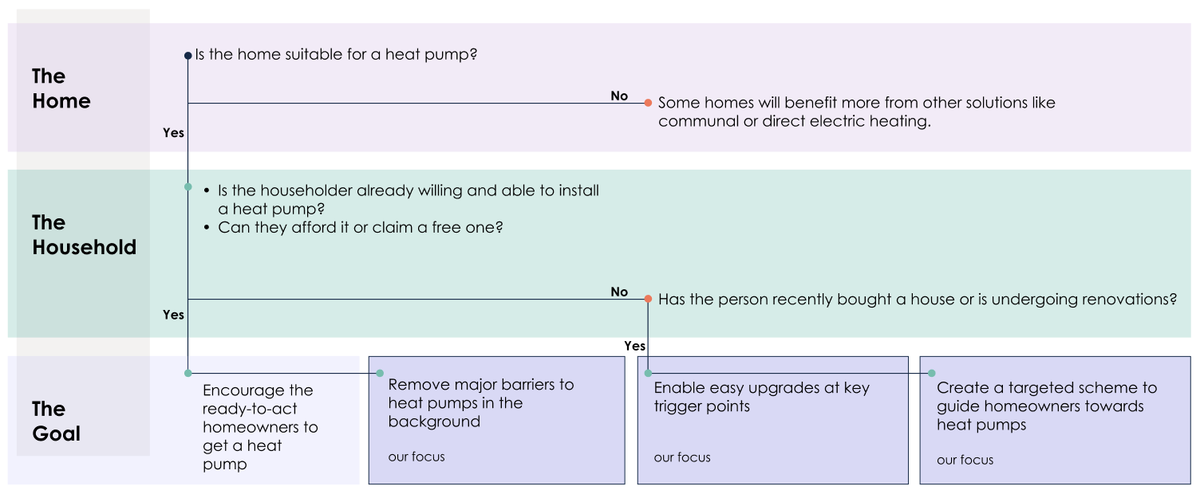
Many households have a pressing need for clear advice about switching to a heat pump. People tend to be more open to heating advice when they are buying a home, or planning renovations, or when their boiler is still working but showing its age. These are natural moments when households are already thinking about their property, likely more willing to spend money, and open to some disruption. Taking steps to make their home more ready for a heat pump can feel like good timing, rather than extra work. Three key groups are in a good position to make their homes “heat pump ready”.
Homebuyers are often already reviewing surveys and EPCs, with many planning renovations soon after purchase. Providing more information about heat pump readiness at this stage could help them spot opportunities or avoid undoing progress, such as removing a hot water cylinder or choosing undersized radiators. First-time buyers tend to be focused on affordability, whereas second-time buyers are often more established and stay in their homes for longer, which might make them more receptive to readiness advice.
Motivated by comfort, layout, or design, renovators are already spending time and money on disruptive upgrades. Heat pump readiness advice can provide “do-it-while-you’re-there” actions and prevent future rework, for example, upgrading wiring or keeping cylinder space. With all the changes listed above, we would anticipate households would only implement these measures if they are already undertaking major works. Otherwise, the additional disruption and cost associated with builders coming into the home would most likely not be worth the benefits.
When a boiler is old but not yet broken, people start noticing small issues and can become more receptive to future-focused advice, such as simple checks or guidance on what to do next. Light-touch readiness prompts during maintenance, such as checking radiator size or electrical capacity, could plant seeds for future decisions.
Testing ‘readiness as a service’
To explore how readiness might work in practice, we prototyped a heat pump readiness report – a tool that gives homeowners a personalised view of how prepared their home is and what steps they could take next. We conducted user testing of the initial prototype with five people.
Heat pump readiness prototype
The goal was to use the tool as a prompt to understand how households interpret heat pump readiness: what actions it implies, what they might do next, and how they perceive the effort and cost involved. We also explored whether it changed how feasible a heat pump felt, what further information or reassurance they might need, and when such guidance would be useful.
- People reported that the report helped them to see heat pumps as a more tangible and relevant option for their homes. They tended to regard it as a practical planning tool, something to keep and refer to when doing other work. Our testing suggested the report supported their understanding of potential upgrades and what might make sense to do ‘while you’re there’.
- New radiators stood out as a particularly relatable starting point for many people. This is because it is a step they can take that can directly improve their comfort. However, multiple people we spoke to wanted a clear explanation of the cost of installing new radiators and the disruption it might cause.
- Many people wanted reassurance that tradespeople and other professionals would recognise and trust the advice in the report in the future.
This exercise also revealed a deeper challenge: coordination fatigue. Even with clear steps, homeowners often felt overwhelmed by the number of actors involved. “Does one person help with all of these?” was a common question.
- People reported they were most confident tackling steps they had done before, such as insulation and radiators.
- More technical steps, like checking their electricity supply, felt daunting for some. For many, the combined effort seemed too much: “I have two young kids, work full-time… when do I do that?” “I’m super busy, have two little kids, I have so little time to arrange or look into things.”
- This speaks to a core question about how readiness could work in practice: to what extent does staggering the work reduce the perceived effort for households? When these works are done alongside a heat pump installation, the works are often all organised by the heat pump installation company. Staggering works over time may impose a greater burden on householders compared to doing them all together at the point of installing a heat pump.
Across our interviews, three broad mindsets shaped how households approached heat pump readiness:
Segmenting households by mindset
What readiness could unlock for households and what this means
Across all three of our mindsets, there were four potential benefits which stood out. These benefits show how readiness can meet households where they are: building awareness among the unconvinced, supporting the planner to act gradually while work is already underway in their homes, and enabling the ready-to-act to move more confidently through fewer steps. When we had these conversations, we did not have a single policy or product that defined ‘readiness’. Our discussions revealed three challenges for any future policies or services:
Benefits vs challenges