About Nesta
Nesta is an innovation foundation.
For us, innovation means turning bold ideas into reality and changing lives for the better. We use our expertise, skills and funding in areas where there are big challenges facing society.
Nesta is based in the UK and supported by a financial endowment. We work with partners around the globe to bring bold ideas to life to change the world for good.
www.nesta.org.uk
If you'd like this publication in an alternative format such as Braille, large print or audio, please contact us at: [email protected]
Design: Whatever Design
Radical Visions Acknowledgements
Making this book has been a true team effort and there are a lot of people whose hard work has made this possible.
A first set of thanks goes to each of the contributors, many of whom have worked on this in their spare time on weekends and evenings. They have all brought a passion and commitment to their work which was beyond what I could have expected when we started this project.
At Nesta, Thea Snow, Eddie Copeland and Sinead MacManus played an invaluable role as the reviewing panel for the submissions to the open call. Thea has also been a great source of wisdom throughout the process of curating this book. Caroline Back and Ellie Cusack provided much needed help and advice on production and communications.
Thanks are also due to Geraldine Bastide and Steve Lake at Whatever Design who have worked tirelessly, with great enthusiasm and imagination throughout.
Emily Reynolds has played a huge role through her editorial advice and support.
Finally, a thank you goes to everyone who participated in the open call. Endeavours such as this can only happen through the participation and work of large number of people and we are extremely grateful to everyone who submitted a pitch to us (see page 169 for details).
There are a number of fictional pieces in this collection. Any resemblance to real people is entirely unintentional. Each contribution is intended to inspire thought and discussion and none represent the views of Nesta.
Tom Symons
Radical Visions – Introduction
By Tom Symons, Head of Government Innovation Research, Nesta
Is government fit for purpose? Evaporating public trust in democracy and political institutions, a broken social contract, lack of money and stale ideas mean it feels increasingly difficult to answer that question in the affirmative. It is this fear – that government and our public services are no longer up to the job - that inspired us to launch an open call, seeking Radical Visions of Future Government.
This is written from a British context, but combinations of these issues have a resonance in governments around the world. We wanted a serious rethink about what government is, what it should do, and how it should work. This book is the culmination of that work, presenting 17 visions of the future of government.
We chose the year 2030: near enough to be imaginable, far enough away for radical change to actually be contemplated. This collection builds on a number of previous Nesta projects using futures methods (in health , education , local government , the internet , among others ).
Futures work can help stretch our imagination by considering what is desirable, what is plausible, and what should be avoided. This collection is not intended to set out exclusively desirable or optimistic futures, but instead to stimulate thinking about a spectrum of possibilities. As one essay in the collection argues, it is better to think about the future than not; that in itself is democratising.
Some of the visions are aspirational, but not all of them are desirable. It would be very surprising if a reader agreed with all of them. Nor are any of them a reflection of a Nesta view. But we think they are useful energisers, and we hope that any reader will come away with a sharpened sense of what might be possible and where we should set our sights for 2030.
The collection is grouped across three themes: future trust, future roles and future mindsets. It features essays, provocations, thought experiments, fiction, speculative design and original art.
Future Roles
This theme questions how the roles and skills of public sector staff, politicians and citizens will need to change to meet the challenges of the future. It deals with this at a micro level, discussing new types of government job or public servant, but also at a more macro level. Considering the changing role of government itself opens questions about both the need to revisit the social contract between citizen and about what this would mean in practice.
Advances in technology, structural economic change, social ruptures, and a deeper understanding of human behaviour are the inspiration for a number of contributions in this theme. Stephen Muers argues that governments could improve policy implementation by switching to more emotive and symbolic communication, and by embracing techniques of storytelling, anthropology and ethnography. In an age of concern about the impact of technology, Muers' essay suggests that new government roles must become more human.
Focusing on a different aspect of government, Andrew Greenway makes the case for updating the founding document of the British civil service: the Northcote-Trevelyan Review of 1854. A version for 2030 should focus on shifting the unit of delivery on the team rather than department, adapting working methods to embrace agile principles, and creating more scope for technical specialists. It would leave the civil service with a better equipped to adjust to further technological and social change.
This collection also features the voices of public servants themselves. OneTeamGov (OTG) a global community of digital and public policy professionals – crowdsourced ideas about the future of government from their network. These voices speak about the momentum building behind new technology as a force for change in public services, about the mainstreaming of OTG's collaboration principles, the continued importance of co-creation, and what it means to be positively disruptive in government.
Focused at local government level, Earth 2030: Governance for Life on an Evolving Planet uses the aftermath of climate catastrophe to tell a more positive story about the need for a new type of public servant. This speculative design project by Ann Light and Deborah Mason is a scrapbook of documents from 2030, describing the role of 'Creative Facilitators', who work with small communities – "districts” – to problem-solve and achieve local self-sustainability.
More fundamental questions about the role and purpose of government are addressed in Sacrosanctuary by Vik Sasi. Taking the form of a feasibility study into the potential of a new country specifically for refugees, it is a chance to simultaneously improve the lot of some of the world's most neglected and vulnerable communities while discussing the founding principles for a new state.
Future Mindsets
The theme tackles questions about the approaches and philosophies which underpin our government and public services, exploring a range of ideas about how we can deliver better social outcomes. The contributions cover the role of emerging technologies, new conceptions of power, the redistribution of non-monetary resources such as time, experimentalist approaches, and types of social movement which could bypass traditional government altogether.
Four works in the collection deal with questions of power and resources in government. Beneath the Stones by Simon Parker is a piece of speculative fiction which transports its protagonist from 2019 into 2030 and uses their encounter with a new world to tell a story about a different type of government and society. In this future, time is a resource which can be redistributed in the same way a government might with money. The story invites us to imagine our lives beyond the constrictions of full-time work, and explores the resulting impact that has on government.
Also following in the footsteps of William Morris' seminal utopian science fiction novel News From Nowhere (1890), Liv Bargman, SRG Bennett, Cat Drew and Phoebe Ridgway (Forest for the Future?) created speculations and writings about the future of Waltham Forest. The works are fantastical imaginations of what Waltham Forest could look like: sometimes utopian, sometimes dystopian, often oscillating between the two. This work is both a set of provocations about the future of a specific place, and an an argument for more inclusive and participatory futures work, believing it can be a democratising way to bridge our hopes and fears about the future with action in the here and now.
The question of how we use government funding in more innovative ways is tackled by Adam Fletcher. His essay takes the form of an annual report for the Health Investment Team. This new, imagined unit uses sophisticated modelling to take an investment approach to health spending, targeting money upstream to prevent poor health. This creates a mechanism for a more lateral approach to all government funding, leading to better collaboration between departments.
Featuring as a double page advert in the middle of the publication, the Centre for Public Impact use the mechanic of a board game to explore how the rules of power within government should change. It contrasts the rules of 'old' power – hierarchy, control and targets - with those of 'new' power – subsidiarity, relationships and learning. It draws on a wider body of work from the CPI arguing that spreading and sharing power as far as is practicable is an essential precondition for the longer-term viability of government.
The new abilities offered by emerging technologies are addressed by two contributions. The Government Which Couldn't Forget by Greg Falconer imagines a piece of future technology, referred to simply as 'Elephant', which would make 'forgetting' impossible for government. Inviting the reader to form their own view about the desirability of this, it raises questions about the relationship between politics and policy, and how far we should let technology control our futures.
Automated Externality Accounting by Nell Watson asks what it would mean to accurately quantify the environmental costs of all actions in real time. Offering more opportunities to intervene to reduce the threat of the climate emergency is appealing premise, and would force us to revisit assumptions about taxation, geopolitics and foreign aid.
Also tackling the issue of climate change, Studio Tangle (creative duo Anna Schlimm and Jacob Chabeaux), argue in The Others that a radical vision for future government is futile without also considering fundamental changes to the underlying economic system it exists alongside. Citing failure to deal with factors such as climate change and widening inequality, it is an active consideration of whether such fundamental change could be achieved through collective action. It asks the reader to consider something ostensibly outlandish but of increasing significance – could we really govern ourselves in a very different way? And what would it take to get there?
How should governments approach the introduction of change and innovation? The Experimental Polity by Professors Kevin Morgan and Charles Sabel argues that the answer is a set of design principles for governments. Drawing on lessons from devolution in Wales to create a broader set of principles, the essay argues for a form of co-governance in which local areas or services are able to design, test and iterate their own policies and services. These should be experimental, user-centric, subject to constant testing. It is a vision for a system of government better able to meet citizen needs and more resilient to future threats and changes.
Future Trust
This theme deals with questions about what would it take to reinvigorate democracy, trust, and citizens' relationship with their governments. Influenced by rapidly declining faith, primarily in politicians but increasingly in public and civic institutions too, it explores how we can rethink how governments and citizens interact.
First, Phil Booth explores the threats to trust which come with government's increased gathering and use of personal data. The essay focuses on the civil service's response to an imagined-yet-plausible critical data failure at the DWP, detailing the response would be needed to restore public faith in the ability of government to handle our personal data. Acting as a warning from the future, it creates an impetus to act on data privacy and security now, so that such a response will never be required.
In Overturning Parliament, Rachel Burgon addresses the erosion of public trust in Britain's democratic institutions. The essay argues our febrile times demand a simple yet dramatic change: Parliament must be turned on its head. The result would be a lower house of non-elected experts and citizens who, through detailed analysis and public engagement, identify where policy and legislation is needed to tackle the short and long term problems of the nation. These are then ratified by an elected upper chamber. It is ultimately an argument for more and better democracy, with the incentives for negative behaviour – dishonesty, short-termism, tribality – minimised.
A Day In the Life of the Department for Democratic Artificial Intelligence by Harry Farmer focuses on steps by the government to regulate and influence the use of Al. It forewarns us of the difficulty in creating a code of Al ethics which quickly breaks down as it is applied to specific situations, and casts similar uncertainty over the imminent collision of human-designed moral Al and our everyday reality. In so doing, it offers the government of today the chance to anticipate where nuance and care must be taken.
Life After The State is a piece of speculative scenario building by Charles Ikem. It imagines a future in which government is a digital ideology. Technology's primary purpose is to enable citizens and communities the ability to run their own democracy and government systems in their local areas, and is seen as the main means of overcoming barriers such as geography, finance, complexity and timing. As a result, citizens are the heart of government and decision-making.
Conclusion
We hope this exercise helps people consider the parameters of a future state, expanding existing ideas and innovations to breaking point or introducing entirely new ones. Our 17 contributions relate to three broad themes, but all have one thing in common: each is asking the reader to consider the implications of an idea about something fundamentally different in the future.
Some contributions are optimistic or inspiring, some are mechanisms for exploring a possibility for government, and others are thought experiments which invite the reader to form their own view about the desirability of a scenario. We hope readers will agree with some contributions and disagree with others, but that fundamentally are left with a set of questions of genuine importance as we embark upon a new decade of government and public services. At Nesta, our intention is that this collection also helps to provoke a debate about how we start to answer them.
Earth 2030: Governance for life on an evolving planet
by Ann Light & Deborah Mason
This governance strategy takes as its starting point that global uncertainties require flexible, quickly-implemented and localized decision-making. Building on discernible planetary trends, including political fragmentation, extreme weather and seasonal flooding, it demonstrates 2030s England & Wales making the best of greater demands on emergency budgets and less revenue by implementing a more collaborative and imaginative culture.
This entails social organization optimized for creativity, with a move from imposing bureaucracy and market economics to playful and profound local facilitation, where:
- self-determination, collective experimentation and can-do attitudes fuel a sense of purpose and a flow of creative energy;
- progressing through the profession of socially-engaged creative leads to running a Department that spreads innovation.
This is illustrated through documents belonging to a 'creative facilitator'.
CREATIVE FACILITATOR
UNITED KINGDOM OF ENGLAND AND WALES LEGISLATION
Climate Change Emergency Act 2022 as amended 2025
- Wildlife & Biodiversity Regulations 2022
- Air Pollution Regulations 2022
- Water Regulations 2025
- Innovation Regulations 2025
- Hardship Regulations 2025
Local Government Act 2025
- Budgeting Regulations 2025
- Creative Facilitation Regulations 2026
- Resource Allocation Regulations 2026
Housing Act 2023
- Abandoned Building Regulations 2023 (amended 2027)
- Passivhaus Regulations 2023
- Billeting Regulations 2027
Internally Displaced Person Act 2026
- River Traveller regulations 2027
- Transit accommodation regulations 2026
- IDP Resource allocation regulations 2027
Scotland Devolution Act 2021
Northern Ireland Devolution Act 2022
Gibraltar Act 2028
Job Description
Creative Facilitator
- **Reports to:**
- Regional Creative Facilitator Coordinator, South Central Region
- **Direct reports:**
- Facilitation Assistant (joint)
- **Grade:**
- 3XF
- **Financial authority:**
- Up to £1000 as joint community signatory
Purpose of role
The Creative Facilitator works with people of the district (approx. 2500) to imagine, initiate, develop and maintain local systems. Using imaginative and creative facilitation techniques, the CF encourages open-minded thinking within the district population to find the best solutions to local issues.
The range of issues that a CF will address varies from district to district, but is likely to include:
- Transport
- Local hygiene services (rubbish, decontamination, drains and sewers)
- Wildlife and biodiversity initiatives
- Food resources (including home-growing, food exchange/marketing, management of foraging, fishing, trapping)
- Accommodation resource and maintenance
- Innovation (at district level, or to be shared through the DfC innovation network if transferable across the region or country)
- Management of resource and requests for additional resource via the Treasury management system, based on local needs and outcomes.
Once embedded in a community, the CF often takes on the role of ‘trusted person’ and may find themselves acting as mentor, play-fellow, sounding board, celebrant, or mediator. These are important additional aspects of the role and we encourage all CFs to embrace them. Further training is available if required.
As well as helping the district manage the standard package of money, equipment and data, Creative Facilitators may also be involved in crowdfunding for additional resources and may, on occasion, request central support via the Treasury (see below).
Context of the role
This diagram shows the structure of the role and reporting lines:
This diagram illustrates the structure of the Creative Facilitator role and its reporting lines.
The diagram shows:
- Department for Creative Engagement (DfCE), Department for Connection (DfC), Department for Overseas Cooperation (DfOC), and Treasury as top-level entities.
- Super Facilitator reports to DfCE, DfC, and DfOC (implied by lines extending upwards to their boxes).
- CF Regional Coordinator reports to Super Facilitator.
- District Creative Facilitators report to CF Regional Coordinator.
- All entities appear interconnected, particularly to the Treasury.
CFs are appointed by and report to the Department for Creative Engagement (DfCE). Each district belongs to a region: a regional CF coordinator provides support and coordination at district level, and a link to other government departments and information on new policies, initiatives and directives.
CFs work closely with their neighbouring district equivalents through day-to-day conversation and regular scheduled meet-ups.
CFs are likely to work in their districts for 10+ years with opportunities to be seconded as super-facilitators working at a national and international level or civil servants at the DfCE or DfC.
Role description
- To facilitate community sessions and expedite the resolution of issues between different groups and/or individuals in the district using a variety of creative facilitation techniques
- To liaise with the local hub to obtain necessary materials, space and resources for formal and informal facilitation sessions. Where resources are not already available, to work with the regional CF coordinator to determine the best approach to resourcing, which may include crowdfunding or an application to the Treasury Fund for Creative Enablement (TfCE)
- To determine the appropriate mix of regular, issue-based and small-group sessions and to set up and run these sessions as outlined below:
Regular Sessions
To organize and run a number of ongoing group sessions with the district population to create positive relationships and for ongoing management issues (e.g. food resource) where appropriate.
Issue-based sessions
To attend to issues that do not fall into a regular session topic but may need one or more facilitations to reach closure or a good solution. These should be scheduled to allow the largest number of people to attend (e.g. evenings, weekends and daytimes).
One-to-one, family and small-group work
To diagnose where individual and small-group work is called for and to run as determined. People in some districts are resistant to facilitation and subject to change-grief that prevents them from making a positive contribution. Experience suggests these people held local power and exerted influence in the past and benefit from smaller facilitations.
Innovation
To encourage innovation, requesting additional Treasury resource to facilitate testing or deployment of innovative solutions as appropriate.
Hardship
To agree with the district when to request additional resource to deal with existing hardship or make a case for new or developing hardship as defined in the Climate Change Emergency Act 2025.
Essential Qualifications and Training:
- Creative Facilitator Training: Level 1
- Vulnerable Persons Protection Certificate
Desirable Qualifications and Training:
- Creative Facilitator Training: Level 2
- Celebrant Certificate
- Mediator Training: Level 1
Employment contract
Kiko Goddisdottir
Room 12
Audre Lorde House
London SE11
England & Wales
28 February 2030
Dear Kiko,
I am pleased to confirm your appointment as Creative Facilitator for Ray Park District; Ray Park District looks forward to welcoming you on 4th March 2030.
We believe you are the right person to facilitate this district. Your prize-winning training placement addressing 'Facilitation for a mixed-use site for wild flowers and wild foraging on a WAAT basis' gives us confidence you will do excellent work here.
The District is not without challenges, and attached is a short briefing note to prepare you for your role. I also attach your contract with details of accommodation and personal resource allowance.
I look forward to meeting you in person at the South Eastern Region May Day Meet-up on Wednesday 1st May.
With best wishes for a successful start to your creative facilitation career,
Anjum Klein
SE Region CF Coordinator
DfCE
Ray Park District Brief
Ray Park District is a resource rich district in the south of England & Wales. Many residents were activated during CE Phase 1 and much of the garden land is already being managed well for biodiversity. Participation in imaginative processes is high, and the creative facilitator enjoys considerable support.
Flooding initially caused some issues with contamination, but the first CF for the District brought the community together on this issue; water contamination is now within safe levels and wildlife targets are being met. Facilitation around water resources and fishing will be an important part of your role and there are good co-operations ongoing with neighbouring farming and market districts.
Nonetheless, the district recently lost a number of residences to flooding along the line of the flood ditch known as York Stream. Most of these homes were categorized as 'luxury'. Some of the residents have chosen to remain in their homes, living in the upper floors and accessing by boat. Other buildings have been abandoned.
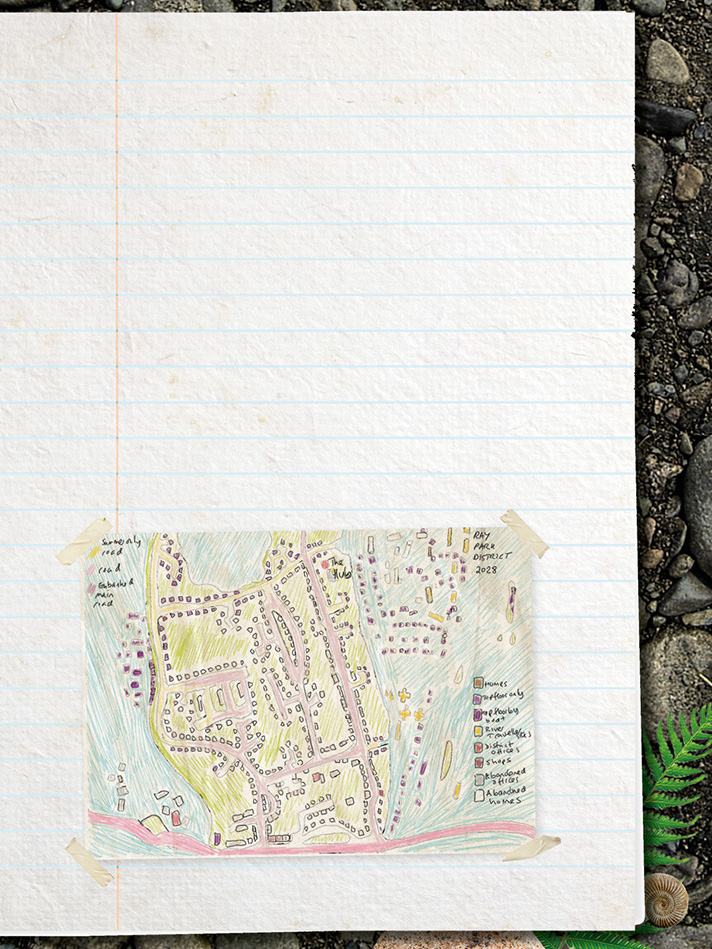
Caption: A hand-drawn map of Ray Park District, 2028, with labels like "Surmerly 1000 coad", "Gubathe d Main nad", and "The Hub". The legend includes: Homes, Upfloor only, Upfloor by boat, River valleys, Offices, Shops, Abandoned, Abandoned homes.
Challenges for facilitation are presented by ongoing change-grief amongst residents who have lost their homes or have had to change their lifestyles due to flooding. The original demographic of the area means that many of those worst affected also have a sense of privilege and can be antagonistic to creative facilitation. Your predecessor in the role made progress, reporting that one-to-one, family group and small-group intergenerational work was often the best route with these residents. Particularly effective was mobilizing grandparent-grandchild dyads in play. Whilst time-consuming, the results can be long lasting and transformational.
Also to note: habitable abandoned properties along the river line are being used by the River Traveller population as winter quarters, usually from mid-October to mid-February, dependent on weather. Thanks to effective facilitation by your predecessor, the River Travellers are aware that you, as creative facilitator for the district, are there for them as much as the permanent residents. Tensions remain between these two populations. Additional resources are available on a per capita basis from the first day of arrival to the spring move-on. River Traveller leaders will contact you on arrival and give you numbers for resource allocation purposes. Resources are held by Treasury in readiness for this event and are available within 24 hours of draw-down using the River Traveller Resource process, which you will find in Appendix 10 of the Creative Facilitator Manual.
Detailed files and notes can be found at the hub, while neighbouring district CFs will be on hand to help should you need it.
Training Manual excerpt 1
You may complete these exercises at your own speed, using as much ingenuity as possible.
Exercise 1: what might you do?
Scenario 1
Although the district doesn't have many seasonal roads, one of them is a main connecting road between villages, and people feel that last year's solution (boats) wasn't suitable for everyone. How would you work with the residents of the two villages to come to a more welcoming and inclusive solution?
I'd start the session with a 'more in common' exercise, which I find useful to get people in the mood to work together. There is still a lot of 'othering' and this helps leapfrog over that before we get to the reason for the meeting.
I'd also bring out a floor map so that people can be specific about where/what they were talking about and pin down discussion about types of vehicle, public transport services and how often people need to use this thoroughfare.
It will be important for people in both villages to express their opinions, separately and together. But I note there is a chance that if I consult each separately during the meeting, differences might set in. I hope the first exercise will reduce this likelihood.
Training Manual excerpt 2
You may complete these questions at your own speed; brevity and wit are appreciated. Please use diagrams as you see fit.
Question 1: Regarding the Department for Connection (DfC)
Question 1a: What is the function of the DfC?
a) The DfC ensures that innovations and other initiatives are shared across districts, promotes learning, and takes a global view of resourcing (both human and material) to work with the Treasury for equal access, support as needed and maximum change-readiness.
Question 1b: How is the DfC staffed?
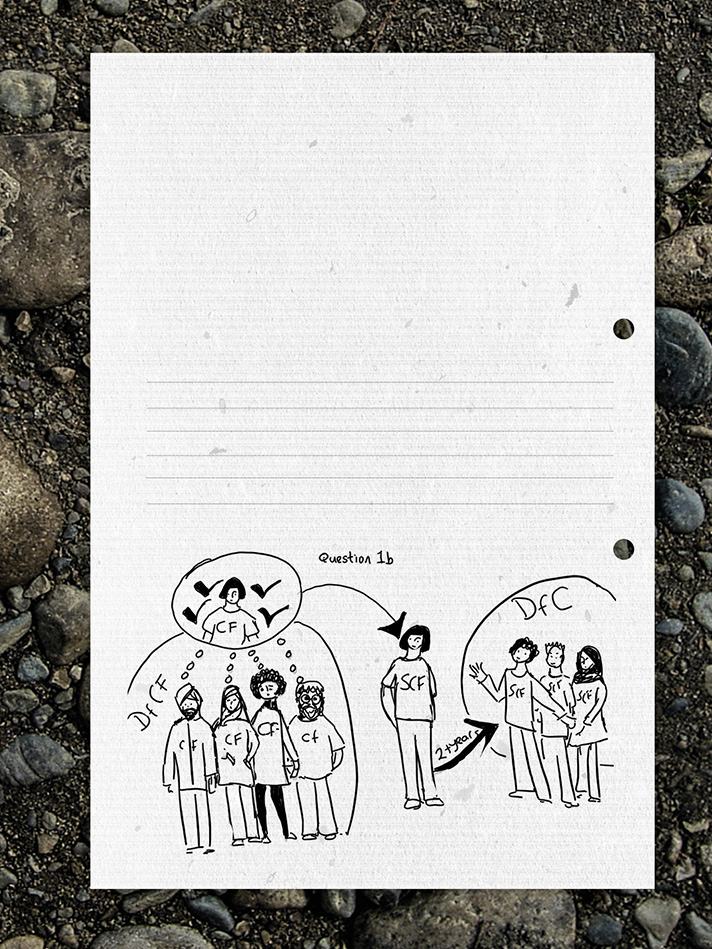
b) Staff at the DfC must have had experience as a creative facilitator and at the DfCF. In practice, this means that you have to be an experienced creative facilitator with competences recognized by your peers (to secure an initial secondment at the DfCF), before you can aspire to serving a term at the DfC.
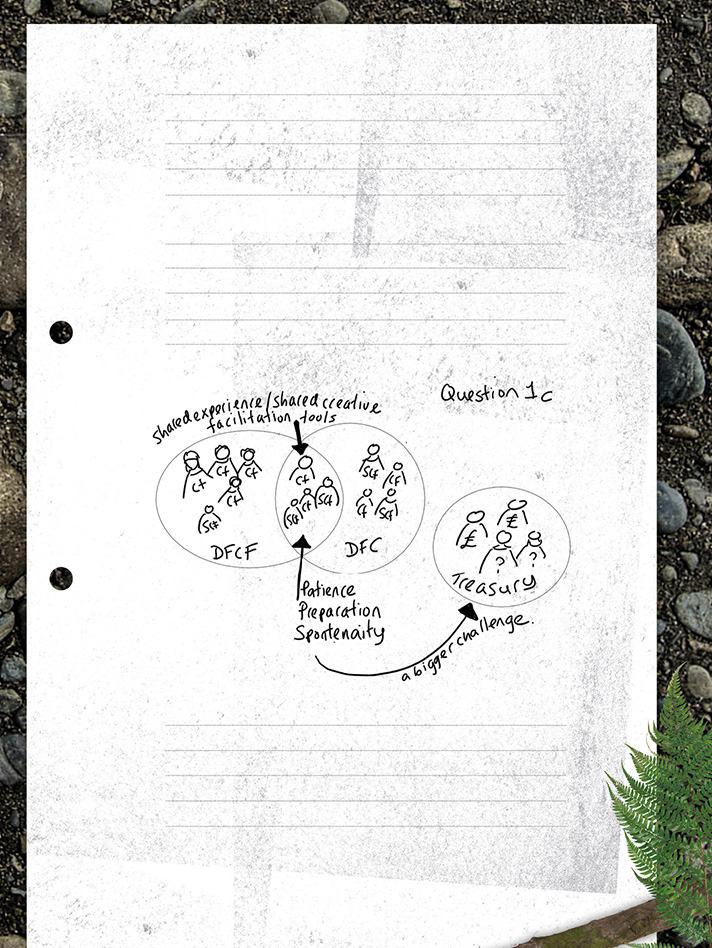
Question 1c: How are negotiations between the DfCF and the DfC handled?
c) The fact that everyone at both depts has worked as a creative facilitator makes resolving cross-departmental issues less daunting. As ever, patience, preparation, spontaneity and CF tools work best and here should be no exception. Bigger challenges come from liaising with the Treasury.
Question 1d: What are the major tensions affecting decisions from the DfC?
d) Tensions mostly stem from competition for resourcing between existing residents of a district and newcomers. One role of the DfC is to balance the requirements of the Department for Overseas Cooperation, ensuring that incoming and outgoing migrants can be well-prepared without compromising existing levels of provision.
The Northcote-Trevelyan Report
This section presents the cover of the embedded document, "Report of the Organisation of the Permanent Civil Service".
REPORT
OF THE
ORGANISATION
OF THE
PERMANENT CIVIL SERVICE
PRESENTED TO BOTH HOUSES OF PARLIAMENT
Printed by The National Endowment for Science, Technology & the Arts
London – 2030
by Andrew Greenway
Context:
Any radical future version of government will go unfulfilled without a radical working of the bureaucratic machine that supports it. Charged with implementing the policies of the government of the day, the Civil Service is often an under-exposed influence on how governments behave.
Attempts at wholescale reform of Britain's bureaucracy have been infrequent. The most famous was the Northcote-Trevelyan report of 1854. This report follows in its footsteps, written as Northcote-Trevelyan was - by the Chancellor and most senior Treasury official of 2030.
ON THE ORGANISATION OF THE PERMANENT CIVIL SERVICE
On behalf of the Prime Minister and Minister for the Civil Service, we have been asked to report on what changes are needed to alter the organisation and character of the permanent Civil Service to make it qualified to address our nation's needs.
This report is one in a line of several attempts at Civil Service reform. The most influential of these - the Northcote-Trevelyan report of 1854 - provided us with a template that still fits our times.
Hailed as progressive and modernising, Northcote-Trevelyan should also be read as a response to pressure. The 1840s were a time of popular discontent and continental revolutions. During a period of rapid technological change and the rise of private monopolies unaccountable to anyone but their owners, the Civil Service was perceived as ill-equipped. Respected as one of the world's strongest organisations, it was still disordered and lacking. The view was that it would change, or be changed. The same view prevails today.
The Civil Service encountered existential threats during the 1840s - echoed in Chartist protests and questions asked in Parliament - because of a poor response to fast-changing times. In our view, 2030 brings similar pressures. Whitehall has been consumed by Brexit and by the stark realities of a digital economy. Populism remains popular. Public concern about the Civil Service's inability to protect the public from behemothic technology firms is raising similar concerns.
The Victorian monopolists dealt largely in oil; the current generation deals in data. Both are global. Both leak with consequences.
Like Northcote-Trevelyan, we do not believe now is the moment to reach either for old tools or the unproven glitter of emerging technologies to counter these threats. Rather, this report seeks to outline the steps needed to reset Whitehall for a future where public service is expected to be seamless, responsive and authentic, and its public servants capable of harnessing the resources of the age in the public interest.
Reform is a response to pressure.
Original recommendations
Northcote-Trevelyan made 3 recommendations:
- to impose exams that provide for a 'thoroughly efficient class of men' to join the Civil Service
- for promotion to be awarded on merit, not seniority
- to make it simpler for civil servants to move between departments.
The same themes - selection, progression, organisation and regulation - are also the basis of this report.
The Civil Service's virtues
We see no need to make the argument for the ongoing importance of a competent, politically neutral Civil Service. It is enough for us to say that the Civil Service remains an organisation with exemplary people working in it, yet still rooted in Victorian practices.
Rooted in individualism
Significantly, Northcote-Trevelyan made recommendations to improve the quality of individual civil servants, and sustained focus on the individual has paid dividends; the quality of people working for the government remains high. Where the Civil Service consistently fails is in its inability to embody more than the sum of its parts.
During 'business as usual', the Civil Service has a poor record of working in harmony across organisational boundaries; this is not an accident of personalities. Individual merit is prized in selection, performance appraisal, reward and promotion. Team endeavour rarely is. Yet delivery of anything at scale is inevitably a collective effort.
Generalism and classicism
One effect of this is the Civil Service's preference for blending skills and experience within individuals, rather than teams, leading to the enduring dominance of generalism in the upper reaches of government. Trevelyan admitted he intended the exam system to tilt towards classically-educated Oxbridge entrants, and though most of the Civil Service no longer requires a grounding in the works of Plato and Aristotle, it is striking that it has kept in step with the prevailing 'social generalist degree'. Britain's bureaucracy continues to reflect the relative power of Oxford University's faculties - especially the shift from philosophy to economics. More than 80% of Cabinet Secretaries, past and present, studied Classics or Economics at university. Such homogeneity exists in few other nations.
Departmentalism
Other than the individual, the Civil Service's significant ‘unit of delivery' is the department, often leading to delay, duplication and duplicity. Senior civil servants are shaped by ministerial demands and parliamentary accountability mechanisms that map onto departmental structures. Collaboration across departmental boundaries is seen as a necessary evil to ward off potential embarrassment or conflict, not a meeting of minds.
The long-standing nature of these failings is partly a consequence of how Whitehall trains its leaders. Northcote-Trevelyan emphasised a preference for inexperienced entrants to the Civil Service, considering their ‘superior docility' an advantage. The scheme for graduate entrants is the modern echo of this; exceptional young people carefully moulded to absorb the norms of the Civil Service. We can be proud of making progress on the visible diversity of the Civil Service's graduate intake (in terms of gender, race, sexuality and so on). But there has been limited progress in expanding the diversity of life experience and perspective the Civil Service allows to prosper.
The departmental structure of government is no longer fit for purpose. It is time to shift the organising principle of the Civil Service from departments to teams.
A new organising principle based on teams
These teams should be representative: made up of multiple disciplines, perspectives, experiences and employers, efficiently delivering a clear intent.
The nature of government implies there will be three common types of teams: those who create and curate common components that their colleagues across government can adapt and reuse, those who use those components to address ministerial priorities, and those who act as Cabinet-style extended private offices, helping ministers decide what to do and connecting them to the businesses, civil society, academics and others from whom they would draw evidence and opinion.
What all of these teams should share is an internet-era way of working. It means working in the interest of user needs, rather than organisational convenience. It means testing risky assumptions with users and data. It means valuing simplicity, learning and agility. It is not working ‘like startups', but operating as the best of government already does.
In order for team-based organisation to work, several structural changes will be needed. None of these are unproven; all have been used in some form as hacks.
On selection, the first point is that there should be no team in the Civil Service entirely dependent on contractor or consultant labour. Private sector expertise is a welcome and valuable part of many teams - but it must not become a source of dependency. The country cannot afford to keep paying contractors double a government salary for the same job as a public employee simply because it draws from a different column in the accounts. The Civil Service's co-dependency on consultancy firms in the lead-up to and aftermath of Brexit amounted to a national embarrassment, belying a deep dearth of bureaucratic self-confidence and ability.
Avoid co-dependency on consultancy
New lines of accountability
On organisation, the unit of accountability in the Civil Service will shift from department to programme team. This will lead to a significant increase in the number of Accounting Officers (AOs). For now, we see no reason why ministers cannot continue to oversee and have political accountability for several AOs - they already deal with several senior civil servants at once. This would require some practical changes; central estates function that are able to find and manage space for new teams to be created, operate and disband at pace, for example. We would also advocate scrapping individual performance reviews for civil servants, with any bonuses awarded according to team performance.
The formal distinction between the Senior Civil Service (SCS) and other administrative grades should also be scrapped. A form of consistent grade structure will still remain across government to signify progression and authority, but there is no benefit to retaining a symbolically distinct executive class that ultimately encourages the rise of generalists.
Reconstituting civil service benefits
The Civil Service should also reset the way staff receive benefits. Their fixed nature – pay, holidays, pensions, leave, etc – inevitably holds more appeal for people with certain perspectives, characteristics and specialisms, making multidisciplinary teams practically impossible. All contracts should allow for the full range of benefits to be taken as cash, and all civil servants should be given the option to select the elements of their liquidated benefits package: to exchange holiday for more pay, or pension benefits for extra leave. Employees can adjust their mix on an annual basis according to their individual needs. This could have profound consequences on work-life balance and mental health; to mitigate such consequences, we suggest incremental roll-out, reviewing the impact on civil servants' health, wellbeing and motivation.
On the need for an Act and legal provisions
On regulation, like Northcote-Trevelyan, we believe that in order for these recommendations to have a chance of overcoming powerful interests and long-held positions, they must be established in an Act of Parliament.
Augmenting the power of Select Committees
We would also advocate for two additional provisions to enhance accountability. The first is to recast the enquiry powers of Select Committees. Rather than relying on set-piece evidence sessions and written evidence, Committees must be given Ofsted or Care Quality Commission-style powers to conduct on-site programme reviews of government teams with minimal notice. With the scrapping of the Senior Civil Service as a formal grouping, Parliament will be entitled to seek evidence from civil servants at any grade. Parliament should consider assigning significant additional resources as a high priority to the National Audit Office (NAO) and Select Committee secretariats in order to support this work, particularly experts with experience in programme delivery in similar contexts (in government, business or internationally) to conduct reviews. To ensure Select Committees do not become solely critical bodies, they should also be given the power to award honours to public servants in recognition of exceptional service.
The second is to impose a sunset clause of 12 years on the provisions of any Act of Parliament that includes these recommendations. We are fully aware that the changes we recommend could significantly change the character of the Civil Service. Inevitably, this will have unintended effects we cannot predict, some of which will be negative. The sunset clause should deliberately encourage formal renewal of the terms of Civil Service reform in good time; not least by giving the NAO power to conduct a full enquiry into all administration spending across central government bodies should the Act lapse without replacement.
In summary, our recommendations are:
- To have the team as the primary unit of delivery for government, and to adjust accountability and incentive structures with a view to retiring departmental structures
- To dispose of a formal grade boundary and performance appraisals for individuals
- To fully liquidate Civil Service benefits to maximise flexibility and personal choice according to need
- To give Select Committees resources and mandate to conduct expert, real-time programme inspections and award public honours.
As was the case with Northcote-Trevelyan, a few legal clauses are enough to accomplish all that is in this report. We believe they are a significant step to removing some of the misconceptions that are prejudicial to public service in a digital era.
September 19, 2030.
Rt Hon E. S. RANDALL, Chancellor the Exchequer
Dame D. A. HAVELOCK KCMG, Second Permanent Secretary, HM Treasury
RADICAL VISIONS UP TO THE YEAR 2030
ONE TEAM GOV PRESENTS
IN 2017, TWO CIVIL SERVANTS CREATED ONE TEAM GOV. WHAT BEGAN AS A HYPER-LOCAL COLLABORATION HAS TURNED INTO A GLOBAL COMMUNITY OF DIGITAL AND PUBLIC POLICY PROFESSIONALS PASSIONATE ABOUT COLLECTIVE COLLABORATION AND PRACTICAL ACTION.
They developed a set of principles, held regular meetups and organised an 'unconference', an event which subverts hierarchy through being participant led, all with the aim of bringing that community together.
Attendees at meetups and events were encouraged to start thinking of change through the lens of a 'micro-action' – doing the smallest thing you possibly can. This low bar to entry caused a ripple effect, with attendees sharing stickers, wearing lanyards, and telling colleagues about the principles. The community grew quickly, attracting a diverse group of people driven by an interest in reform, collaboration and change.
By design, One Team Gov has no central point or management. It is a collective, providing individuals with the reputation and permission they need to investigate what they believe is important – which is often outside their everyday work.
The community is also creating a framework for inclusive events we want to bring people together to solve problems, sharing knowledge beyond traditional organisational boundaries. In 2019, the community held events to "hack" bureaucratic processes, took look at wellbeing and inclusion, and held a global unconference of public servants in Canada. The movement continues to attract changemakers in the UK and further afield, and we are proud to be a small part of this group of engaged, motivated and proactive public servants.
To build our Radical Vision, we called upon this network, receiving 45 submissions from eight countries in audio, video and written form. It is those contributions we report below.
MOMENTUM
Our journey to 2030 will bring unprecedented change. While change is nothing new, it is something that public servants are uniquely suited to deal with, with most referencing the pace of change as a key consideration. The changes our contributors described also tended to be rooted in the anxieties and uncertainties of now: climate, technological, and intergenerational change.
Some spoke about emerging tech such as AI and predictive analytics, imagining that by 2030 they will have both become normalised and the skills required to use them ingrained within the public sector.
Our respondents also considered the impact of this technology on the efficiency of service delivery for the public, giving them immediate access to a range of information across organisational boundaries, in real time, while driving cost savings for the taxpayer. One contributor even declared “I want all information to be available to me!".
Another considered how by 2030 we may need to fix some of the decisions we are making now: "...in 2030 we might be dealing with the problems that we caused by offloading formerly human-managed processes," they said. A number of contributors felt it would be necessary to slow down this pace, even suggesting "two speeds of government": delivering services for both citizens and for the environment.
Others considered how generational differences will change our workplaces as people live and stay in their jobs for longer, and what effect this mix of older and younger people will have. “Our institutions will need to work out how to mediate between generations who will have different expectations of their workplace and environment," one wrote.
COLLABORATION
Perhaps expectedly, many of our contributors felt that by 2030 the principles of One Team Gov will have become commonplace. They described how public servants will be 'compassionate by default', incentivised to empower others, and will continue to work hard to improve outcomes for the public. Achieving this, they said, will require hope and enormous strength of will.
Communication will be key – creating this vision will mean continually adapting, configuring and reconfiguring. Transparency, our contributors say, will be vital to the success of public services we need to become increasingly confident in saying "I don't know”. Our world is too complex for there to be a single right answer.
Many believed we will need to build entirely new expertise in collaboration and working across boundaries. By 2030, entire careers will be focused on being 'connectors' or 'ecosystem orchestrators', as we increasingly prioritise taking time to get to know one another. We will value being open minded, questioning assumptions, and creating the space necessary for new perspectives. We will be increasingly connected to wider communities and networks outside of government as we prioritise co-creation and co-production.
Contributors spoke of how our work will be more flexible and mobile; this will be an expectation, rather than the norm. Work lives and home lives will become more equal, as portfolio careers increasingly encourage more part-time working and shared care obligations.
Our teams will be multidisciplinary by default, focused on bringing key skills together to solve the most complex problems. We will not be restricted to a physical office or city; our future is decentralised and dispersed as more of our time is spent working through networks and virtual platforms.
Many of those who contributed reflected on the fact that 2030 is actually not very far away. If we want our future to be truly different, we will have to be radical, and will have to start now. 2030 is to 2019 as 2019 is to 2008: it will not feel like an alien world.
CO-CREATION
Our contributors also considered the role of government in political and service delivery terms, as well as their roles as public servants or in related fields.
Responses focused on the need for trust, considering what structures or processes would move the country away from the polarisation of politics currently dominant in public consciousness. Some discussed citizen assemblies and other processes of citizen-focused democracy, while others considered how one might represent a population who did not all vote for the same outcome; a clear reflection of current politics.
Perhaps relatedly, a small number of respondents voiced a desire for the delivery of public services to be less closely connected to the politics of the day, or to be charged with greater citizen focus.
Consistently and firmly, contributors discussed their universal desire to be better connected with the public, to work with them more closely, and indeed, to ask whether their engagement should be beyond the usual formal remit of citizens. By 2030, they said, increased participation in service delivery, feedback loops and citizen focused use of data will be the norm.
In close conjunction, contributors felt that by 2030 they and their colleagues would be more reflective of the whole population. They considered the importance of a breadth of diversity – of cultural background or education, for example – and how this would bring different experiences and perspectives to the table. Contributors wanted to see their leaders reflect this breadth of experience.
Others talked about the organisation of government services around life events over and above thematic departments or delivery organisations, with the intention of enabling citizens to remove barriers to achieving their needs.
With a focus on environmental issues, contributors also reminded us that we need to learn from what's gone before, doing a better job of using the institutional memory of government. Practically, by 2030, we should have cracked digital working and findability of information.
The nature of these responses was reflective of the kind of people who self-identify as radicals. Many focused on independence and agency, enabling public servants to both act and be more closely connected to citizens. In collating these responses, we are conscious that a more autonomous society is not necessarily beneficial for everyone.
DISRUPTION
Our contributors called for, and were focused on, driving change. Many would self-identify as radicals; One Team Gov has become a badge of honour for those who see themselves as early adopters or disruptors. Meetups and events satisfy their need for belonging, especially in an ever-changing world where being a disruptor can be especially lonely.
Being radical is dependent on context. And while continual change is a natural part of our world, contributors have shown they are truly radical in identifying, highlighting and being comfortable with it, harnessing it to the advantage of all citizens. Transformation is also key as we continually evolve to meet ever-changing user needs and respond to new priorities. Change is not a programme that concludes - it is a constant operation of evolution.
As authors of this Radical Vision, as we look ahead to 2030, we need to take a moment of introspection and humility. With any movement, there has to be a moment where someone leads the charge, drives things forward. One Team Gov's original goal was to bring digital and policy closer together, to break down the professional silos that exist across government, and to foster a greater emphasis on users.
Our contributor responses show us this is already happening, and that the principles we strive for are increasingly accepted by people who may not ever see themselves radicals. Even the late Head of the Civil Service Sir Jeremy Heywood actively endorsed One Team Gov as an asset to Government.
So while we call ourselves disruptors, we are becoming less disruptive; our principles are becoming more normalised. And ultimately, we work to make ourselves obsolete. If we cease to be, it will be because we have been successful in our aims.
IT IS 2030, AND ONE TEAM GOV NO LONGER EXISTS. WE WELCOME THE NEXT REBELS!
I. Executive Summary
"Give me your tired, your poor,
Your huddled masses yearning
to breathe free”
Emma Lazarus, New Colossus
These words adorn the Statue of Liberty, but today they ring hollow across the world. Stratifying poverty is not a particularly satisfying task, but facilitating interventions on a macro scale requires serious study in an effort to distribute finite resources. Today, there can be little doubt that refugees are at the bottom rung of this ladder.
The United Nations, NGOs and governments alike unite in talk and action, yet despite their best efforts always seem to find themselves back at square one, at the onset of the next crisis. To truly solve this problem requires a radically different solution, one that will redefine the UN's place in the world, along with how society values sovereignty today.
To dumb it down, imagine a Sidewalk Labs for refugees. To smart it up, imagine UNHCR as an independent federated nation... a start-up country that accepts any human as a citizen and provides them with shelter, sustenance and dignity. Why do we not have ready-built and reusable infrastructure for those in need? It doesn't make economic or moral sense to constantly and consistently fashion solutions for them after the proximate cause of their misfortune.
Naysayers will term this idea fanciful, and in a sense they are right. How can anyone build and operate a mini-economy, much less govern a sovereign nation, when its populace is essentially donated and free to repatriate when ready? For one, refugees spend an inordinate time away from their home country, averaging out to roughly a decade and a half - not exactly transient. But the beauty of this solution is that it isn't solely for displaced persons, but a second-order effect of solving the "stateless" problem. This initiative represents the transformation of a refugees' last resort into their first line of defense.
Finally, lest there be any confusion, the idea of what we are naming “Sacrosanctuary" is not and will never be a for-profit initiative nor an attempt to arbitrage refugees' human capital. The zero-fail mission is to create a safe, dignified and voluntary path to citizenship.
II. Introduction
a. Context and background of the study
We live in a world at an inflection point of technology radically changing our evolution as a species. Geopolitical fissures erupt at the release of a tweet, and it often seems that society prefers to focus on finding solutions to “elegant problems", - those which garner the most public attention, yet prove to be of little consequence in the here and now. That is not to dismiss the dedicated social entrepreneurs and activists who endeavor to marry technology with new solutions, but food, water and shelter will likely forever outweigh AI, blockchain and CRISPR as these technological advancements yield diminishing, if any, returns for the stateless.
While we don't believe the nationalist – or nativist – political philosophies that have experienced a recent global renaissance are sustainable, I posit that it is equally irresponsible to think we may ever find ourselves in a peacetime period of equal opportunity and general prosperity.
We face one current calamity in climate change that could rapidly deteriorate in ways the IGPCC never modeled, but another in the future demographic imbalance of aging, developed societies vs. youthful, developing nations. “Countries with rapidly growing and very youthful populations, other things equal, tend to have a higher incidence of civil wars and other forms of civil violence. They also struggle to increase their education, infrastructure, and health services fast enough to keep up with populations at more than 2% per year."
This idea succeeds when closed-border countries fail us. This idea is unnecessary if we choose to enter a new phase of cultural evolution.
b. Rationale
The rationale for such an initiative is built upon a moral, legal and technological argument. The moral case is straightforward. The legal argument is founded upon the ideals of the UN Charter, UDHR, ICCPR and ICESCR that all signatories are bound by:
- Chapter 1, Article 1, part 2, which states that the purpose of the UN Charter is: "To develop friendly relations among nations based on respect for the principle of equal rights and self-determination of peoples, and to take other appropriate measures to strengthen universal peace."
- Article 1 in both the International Covenant on Civil and Political Rights (ICCPR) and the International Covenant on Economic, Social and Cultural Rights (ICESCR), which reads: "All peoples have the right of self-determination. By virtue of that right they freely determine their political status and freely pursue their economic, social and cultural development.”
- The United Nations Universal Declaration of Human Rights article 15, which states that everyone has the right to a nationality and that no one should be arbitrarily deprived of a nationality or denied the right to change nationality.
Moreover, in the same vein that the U.S. and other countries are trying to reckon with their past and talk about reparations, is it not inconceivable to think that former refugees in the future can lay claim given their mistreatment after applying for asylum? As Wes Boyd, a psychiatrist and bioethicist at Harvard Medical School who has evaluated more than 100 asylum seekers in the past decade, wrote, describing the migrant camps, “most kids will have lasting scars from what they have seen or are enduring right now... they're going to need as much medical help as they do legal help."
The technological argument is that we have reached a point where we can produce low-cost, high-quality shelter through novel methods (existing containers or modular structures), a much higher output of food (GMO, AgTech and IoT pursuing high-yield crops) and the educational and communication resources to teach kids, retrain adults and communicate across several languages through AI-enabled devices.
c. Objectives and Scope of Review
The objectives of this study are to identify the key components to an initial pilot of such a state for both parties: the World Refugee Agency and the beneficiaries (citizens). The most prominent precedent of conferral of statehood is exhibited by the UN's own 1947 Partition Plan for Palestine - though it was never implemented - and the subsequent birth of the nation of Israel.
N.B: The below obstacles represent the major issues we anticipate given our collective knowledge dealing in forced displacement and resettlement; we fully acknowledge that several other unforeseen challenges will arise, as we will detail and deal with in Section III's Approach and Findings.
Rescue
Key Short-Term Obstacles: WRA
Financing: While short-term financing can be provided through the WRA's Global Programmes unit or through a pro rata re-allocation from the Regional budgets and Pillars, it is envisioned that long-term financing will be accomplished principally through the same mechanism that funds the WRA currently: public (government) and private donations. It may very well make sense to use existing infrastructure financing structures currently used by the World Bank, IMF and IFC such as a public-private partnership to leverage all parties globally.
Land acquisition: This is likely the second greatest challenge that will be overcome with intense diplomatic and political efforts. The easiest option would be to lease large private tracts of land with a negotiated agreement on entry to refugees (Western Australia, Northern Canada, Central Asia). Another option would be uninhabited areas (islands or desolate areas) which will have to compete with environmental issues and finally, desolate areas of expanse which will likely pose a comfort issue re: climate. A long-term vision would have a few different settings.
Transportation: Moving tens of thousands of human beings and their things will come at great cost, though the UN has a sizable fleet, and with a joint military effort using modified C-5 and C-17s, it's doable. Prior precedent exists in Operation Exodus, which once evacuated 1,000 Ethiopians of Jewish descent in an El Al 747.
Infrastructure: The initial thesis behind Sacrosanctuary was to create a “Sidewalk Labs for refugees" – that we should create reusable infrastructure and reimagine IDP tents and refugee camps. Undoubtedly, this will come at a massive upfront cost: farms scaled to a projected inhabiting population, digging of wells and/or desalination depending on location, and building modular housing without upsetting the natural order (human, animal and environment). The highest consideration will go towards the downstream consequences of natural resource consumption and depletion.
Governance: The organizing principle behind Sacrosanctuary's governance is to eventually become a participatory democracy, with potential future effort to marry the concept of futarchy without jeopardizing anyone's franchise. However, we believe a socialist philosophy with equitable resource distribution at the outset with a sun-setting transition is the best way forward. Fairness is subjective in this context, and there will be a commission composed of representatives from each of the UN member states (with a potential proportional weight for each vote based on contribution amount per capita) along with NGOs providing the most amount of aid of to be a good start. Ultimately, Sacrosanctuary's raison d'être is best summed up by U.S. Congresswoman Ayanna Pressley: "The people closest to the pain should be closest to the power.”
Recovery
Key Long-Term Obstacles: Empowering citizens and building an economy
Employment: While governments traditionally view full-time employment as necessary for self-sufficiency, a traditional pitfall of resettlement is finding a job commensurate with their education and skills. Thus, the initial info intake and citizen profile will necessitate a mapping of aggregate labor supply and demand, the latter to be worked through with the commitment of the private sector. An especially important component of stable employment will involve job development/re-training/up-skilling and subsequent placement with a shared-profit (hybrid of for- and non-profit) incentive to multinational conglomerates. A key point to avoid is the compulsion of undesirable employment à la penal colonies and value the quality of employment vs. speed of placement.
Government Services: The simple way to explain the economy is a welfare state, though we are creating an analogous concept of Universal Basic Citizenship (UBC), which accords every citizen an essential package of services, most notably: food, shelter, healthcare and education. The key distinction between this approach and socialism is that citizens can garner further wages from employment which will then be taxed. Rome wasn't built overnight, and neither will a thriving, self-sustaining economy.
Healthcare: Transitioning from a rescue situation with mass vaccination campaigns and a triage mindset to building a scalable health system will require serious study given the complexity and path dependence of such a gargantuan task. Frankly, that can largely only be commenced once the state is up and running, and the real question is whether Sacrosanctuary's primary use is as a place of short-term refuge and medium-term resilience or long-term resettling. Front and center will be the immense mental health resources needed to combat the distress and trauma some may have suffered, along with any residual stressors or triggers.
Language Competency: Initially, resettlers will be segmented by language, mostly to decrease the lingual requirements for service providers (aid workers). However, we do think a foreign language should be an option at a certain point in schooling so that students can gain proficiency in a target language/desired country eventually. At no point does this initiative ever want to resemble anything remotely neo-colonial, and thus, a mandatory early education in a certain language (English, Mandarin, etc.) will not be considered, at least initially.
Community & Culture: The greatest hope for success of Sacrosanctuary lies in the ability to create and maintain a sense of culture, community and belonging. In a seminal work on integration outcomes, social bonds that reflect a sense of acceptance and lack of conflict, with its "linkage to a sense of safety and security, were most closely associated with positive judgements of 'quality of life' by refugees."
Unfulfilled Expectations and Hopes: The fact of the matter is that this new nation will almost assuredly never come close to the normalcy of citizens' previous lives in peacetime. New approaches to resettlement and integration will be needed, such as dedicated volunteer service programs for adjustment support, as well as mentorship from families that have undergone acculturation. Direct cash and investment capital to spearhead innovation must also be allocated. To the extent one believes it is possible to build a more perfect society, then that must be the overarching goal of Sacrosanctuary; and who better to live in and benefit from such an ideal place than those who have the least.
Image from Page 47
d. Project Schedule
Cross-functional diagram showing various analysis steps and location options leading to final location selection.
The diagram illustrates a process flow starting with "As-is Analysis" and "Location Analysis". These feed into "Risk Analysis", "Cost-Benefit Analysis", "Readiness Assessment", and "Transition Analysis". All these analyses contribute to identifying "5 Viable Location Options".
From "5 Viable Location Options", the process branches:
- Options flow into "Location 1", "Location 2", "Location 3", "Location 4", and "Location 5".
- From the viable options, there's also a path to "Government Negotiations".
- "Government Negotiations" leads to "Go/No-Go".
- "Go/No-Go" further leads to "Final Location Selection".
- Parallel to the main flow, there's a "Status Quo" option.
- "Transition Analysis" and "Organisational Analysis" are shown as feeding into the "5 Viable Location Options" node.
III. Approach and Findings
To be completed upon receipt of funding.
HOW DONALD TRUMP SHOWS US THE FUTURE
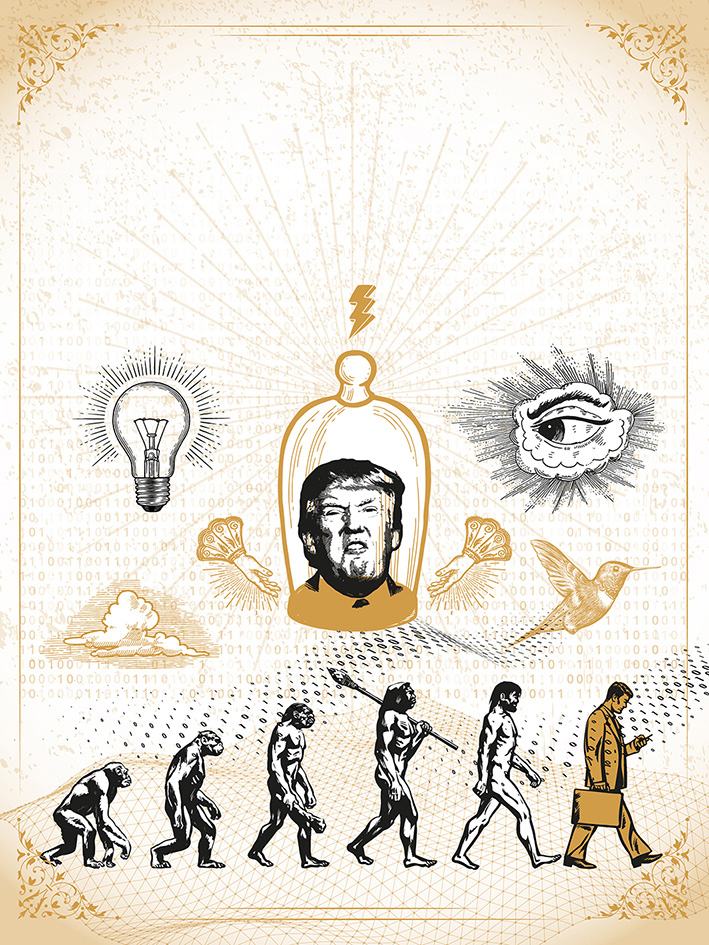
Love him or loathe him, it’s hard to argue that Donald Trump doesn’t have a distinctive style of political leadership. Compared to other Presidents, Prime Ministers or Chancellors, he seems remarkably uninterested in policy detail – or, indeed, policy at all. He is in constant, direct dialogue with the public and the media, mainly through Twitter, and provides a stream of comment on issues that would normally have been seen as well outside the realm of politics. He has shifted the tone of public debate and changed the boundaries of what politicians can say; many would argue he has done profound political damage as a result. This essay doesn’t argue the rights or wrongs of President Trump’s views or the tone he adopts. But there is a strong case that his approach points the way to a different type of leadership, well attuned to the challenges of governing in the twenty-first century.
There is a long tradition of scepticism about whether policy makers at the centre of government can expect their decisions to ever be delivered. Back in the 1980s, Michael Lipsky coined the concept of “street-level bureaucrats”¹: the front-line workers in any public service system who determine what actually happens day to day. A new criminal offence only has an impact if police officers on the beat decide to arrest people for it. A new curriculum will only change what pupils learn if teachers respect it sufficiently to teach it effectively. Driving through any policy change against the cultural grain and motivation of those expected to deliver it is extremely difficult.
There is also good reason to believe this challenge is getting harder. If front-line workers and the citizens with whom they interact have rapid real-time data on what is going on, they will respond to it. Those responses will decide what happens in public service delivery long before anyone in Whitehall or Washington knows what is happening.
Such use of data is already underway. Most schools now track pupil progress and adapt teaching priorities accordingly. The NHS ‘Friends and Family Test’ provides simple, immediate public feedback on the quality of a service. Via an app, charities and local housing departments receive alerts from the public on rough sleepers who may need assistance. As data processing and analysis becomes more sophisticated, we should expect more of the service quality and outcomes that citizens care about to be driven from the front line.
There is strong evidence that the public already recognises their leaders have little to do with the services they experience. This evidence comes from the way they research shows voters neither reward past good performance in delivering outcomes nor the promise of future policies they like. On past performance, Aachen and Bartels’ recent work has shown that random natural events – for example shark attacks in coastal towns – are at least as important to voter choice as any action the politicians take.² Another classic example comes from the 1983 General Election in the UK: based on the issues voters said were most important and the party they said had the best policies on them, you would have expected a landslide victory for the Labour Party. Instead, Thatcher’s Conservative government achieved the most decisive election victory in nearly forty years.
It is therefore futile for national political leaders to promise, or attempt to deliver, detailed policy propositions. Front-line responses to data will simply move too fast and overwhelm instructions from the centre, and they won’t be rewarded by voters for either trying or succeeding. So if this is the future, what role should those leaders play?
All these front-line interactions, and the choices voters make, take place in a social context: new technology doesn’t mean people are acting in isolation from what is around them. How we respond to data and analysis is shaped by our worldview and the narratives we use to make sense of a confusing and fast-paced environment. We also all carry a set of moral norms about what is acceptable and unacceptable, what is fair and what is just. These too shape how we respond and make choices.
Governments, too, can affect norms and narratives, and in fact do so whether they like it or not, while their ability to deliver services and outcomes is much weaker than has often been assumed. In this analysis, policy statements are not descriptions of what a government will do – they are tools for sending symbolic messages about what matters and what a society should value.
And so we return to Donald Trump. He clearly uses policy statements in this way, and voters understand that he does so. His best known electoral promise was his commitment to build a wall on the Mexican border and have the Mexican government pay for it – yet on the day of his inauguration, an opinion poll showed only 14% of the population believed he would actually do it. The wall was a symbol of his approach to immigration and to other countries, not a deliverable promise. And on Twitter, Trump is sending a stream of signals from the most powerful position in the land about which worldviews are true, what language and behaviours are acceptable, and what is fair and reasonable.
What is not clear is whether Trump has a firm intention to operate with a different model of leadership, or whether it has simply emerged as an expression of his personality. But the approach has some traction and could be used, intentionally, by different leaders in different government systems, and with completely different goals and values. What are the capabilities a government of the future needs if it is to enable this shift towards context-shaping and away from policy design and control?
Such a shift also calls into question the value of the tools and skill-sets designed to help make detailed policy choices and see them through to delivery; cost-benefit analysis is irrelevant for a wall that is intended to stand as a symbol rather than as real steel and concrete. That symbolic wall also won’t need a programme management methodology or a risk register. But leaders who want to take their responsibility for context-shaping seriously will still need serious professional tools – even more so if they are attempting to play this role in a more nuanced and positive way than Donald Trump. Government needs to invest in an understanding of how narratives are built, which types of symbols resonate and why, and how people use values and assumptions to simplify complex decisions. We need therefore to create a Government Anthropology Service, give departments Chief Psychologists and incorporate the skills of story-telling into the core curriculums of public policy courses alongside law and economics.
What might government and feel like if it built these new capabilities? Take as an example my old role in charge of criminal justice policy in the Ministry of Justice. Discussions with ministers on sentencing policy often involved a political desire to “send a message” on some type of crime by toughening sentencing. But in the civil service, we had little understanding of how such a message would land with potential criminals, or what other ways there might be to achieve the same political messaging at perhaps a lower cost. My hypothetical Anthropology Service would have immersed itself in the sub-cultures of the intended audience for this message, understanding what framing and symbols would work. Discussing messaging strategies would be second nature to senior policy officials like me.
Taking this approach might also open the way to a more decentralised model of government. One of the main arguments used against local control is the fear of the “postcode lottery”: that outcomes are different in different places. Of course, in reality, outcomes diverge anyway: the NHS may be a “national” service with plenty of centrally-imposed targets, but local quality still varies. Focusing on context-shaping could liberate central government from worrying about this (inevitable) divergence: we could dismantle some of the top-down control regimes and devote those resources either to building the new capabilities outlined above or transferring them to local level.
The famous concept of “evidence-based policy” would also change: policy-makers would need different types of evidence. A policy-maker interested in symbols and narratives wants to understand the process by which a policy is understood, interpreted and discussed, rather than whether or not people have followed the right procedures. Evidence around subjective outcomes, including the impact on values, becomes much more interesting.
Taking a historical example, the Thatcher government’s privatisation programme was, in part, explicitly aimed at changing norms in society towards greater commitment to the capitalist system. There are many studies that look at the economic impact of the privatisation programme. But I have been unable to find any systematic attempt to look at whether the intended impact on shaping culture and values actually took place. In the future this kind of assessment would be prioritised as a matter of routine.
To the person on the street, things might not feel so different: their experience and understanding of government is already one of symbolic promises and a gap to delivery. There is perhaps the potential for a more honest relationship between government and the governed. If politicians stop claiming they are going to deliver precise reform plans, instead talking openly about values and symbols, it opens up a different set of debates. Do we agree or disagree with the values that someone espouses? Are they the national symbols we want, and what do they say about our society? Debating these issues in their own terms, rather than by proxy through policies that everyone knows will never be implemented, feels a step forward.
The point about honesty is crucial. There could be a danger that Chief Psychologists become Chief Manipulators, and skilled story-tellers just skilled liars. Professional ethics and independence are as important, if not more so, in these new professional disciplines. Just as we have a strong set of standards around how governments use and publish statistics, we will need to develop similar safeguards for new ways of working.
Of course, many traditional policy functions and skills also remain essential. Central governments still need to set overall taxation and expenditure levels. They need to create the criminal and civil law and the institutions of government themselves. These building blocks will not emerge easily from data-driven responses at the front-line (although there may be interesting ways to draw out that data to inform relevant decision-making).
But the realities of how government functions will be delivered in a world of proliferating data, and how voters already behave, mean that a model of political leadership promising big reform programmes should be a thing of the past. Whether by accident or design, Donald Trump is showing us a new approach. Hopefully others will find ways to use and adapt it for positive social change.
Future Mindsets
Beneath the Stones
A rough awakening
The creak into consciousness, the weak February light infiltrating the room through a gap in the curtain. I’d worked late yesterday and felt like I could have slept for a decade, and a night of tossing and turning hadn’t done much to improve matters. My next thought is to roll over and go back to sleep, but a lie in isn’t going to pay the bills. And then it hits me: if it’s light, I’m already late for work. I tumble out of bed, cursing. After a hasty cup of coffee and a shower, I’m out of the front door and running for the bus stop. But instead of the usual hastening crowds, the pedestrians are meandering at a pace I start to find infuriating, and I mutter and swear as I push through a gaggle of dads pushing buggies at a crawl. There’s usually a queue of thirty waiting for the bus, but today there are just five sad commuters in expensive looking suits. I step onto the bus and look around uselessly for a sensor to wave my debit card at, though none appears. I’m reaching the point where my obvious confusion is about to turn into anger when I feel a light touch on my elbow and turn to see a lady in her mid-50s, her hair a mass of greying curls and her body wrapped up tightly against the cold. “Young man,” she says firmly.
“Beneath the paving stones, the beach!”
“I really think you should come with me.” The grip on my elbow becomes a little firmer as she steers me away from the bus stop. Before I know what I’m doing, I find myself walking away from the sad linesup and towards a nearby park. I start making furious protests. “What right do you have to drag me away from my bus stop? What’s my boss going to say?”. “I’m Ava, and you’re talking like one of those suits,” replies my acquaintance. “Listen, this isn’t the 2010s. No one in their right mind goes to work on a Wednesday.” Now, I can be a little absent-minded, but I wasn’t the sort to mislay an entire decade: when I fell asleep last night, it was very definitely still the 2010s. “You really are like those commuters,” she replied, smiling. “Always worried about the time. It’s the 14th of February 2031 and, more importantly, it’s a Wednesday, and no one works for pay today. Now, you haven’t told me your name.” I introduced myself as Joe Guest. “Well, Guest,” replied Ava, “I can see you’re confused and feel like you’re in a strange land, but I’m sure you’ll find your way home. And there’s a glorious winter day ahead of us which I mean to seize.” I found her words oddly reassuring. Perhaps I was dreaming? Or maybe I’d wandered onto the set of an immersive theatre experience? Whatever this was, I decided to try and quiet the anxious voices in my mind, full of targets and timetables, in order to explore this new country.
In the rose garden
My first question was simple: if no one worked today, what were those commuters doing at my bus stop? “Some people have never been able to accept the fact we don’t work like we used to,” Ava said. “Those men are what we used to call ‘city traders’ – and they refused to accept the four day week. Instead of fighting them, we took pity on them. A local charity took over a few office blocks in Canary Wharf and created fake trading floors. The brokers feel like they’re working in the old way, but their computers don’t connect to anything, so they can’t do any harm.” We had made our way into the heart of the park, where we were confronted with a huge clump of bright pink and pastel flowers. A large group had congregated there, and I immediately remembered it was Valentine’s Day. People took turns to walk up to the bushes with a pair of secateurs, snipping off a bloom and offering it to their loved one. Ava walked up to a man dressed as a gardener and took her go, offering me a bright pink flower. “Perhaps where you’re from, they still keep to the old tradition of flying dead flowers halfway round the world as a token of love. Now that we have more time on our hands, the tradition in London is for people to grow Lenten roses, and declare their love in public.
The missing pieces are found
But don’t worry. I’m not declaring anything to you beyond a welcome gesture for a stranger. Now if you’d like to learn more about our customs, let’s walk on.” We followed a steeply sloping path down through the park, heading towards the river, the city before us clad in late winter finery. Ava began to explain how my world had become hers. The early 2020s had seen an experiment in free market deregulation that held down wages and forced more and more people into insecure work via online platforms like Uber. An inevitable backlash kicked in, with workers organising cooperative alternatives to set their own terms and conditions. In 2026, a general cyber-strike was called, with people across the country boycotting Uber, Google and Amazon for months on end.
Peak oil passed early in the decade, and by 2027 the world was in the throes of an energy crisis: people were forced to work less as Britain struggled to secure enough power for its economy. What surprised everyone was that working less didn’t always mean earning less: productivity rose and sickness levels plummeted, while public services reaped the benefits of a less depressed and anxious population.
“If technology is felt to be becoming more and more inhuman, we might do well to consider whether it is possible to have something better”
As the economy recovered, it turned out that the people of Britain quite liked the four day week, and as so many now chose when and how they worked for the platform cooperatives, the government struggled to enforce standardised working hours. Millions simply refused to go back to the old way. Incomes fell, but not by as much as anyone had expected, and of course prices were falling too as the economy became more automated. A compromise was reached. Wednesday became a new day off, with the government asking citizens to donate at least one day a month of their time to socially useful activities to help offset the reduction in tax revenue. The young were expected to perform two years of service in local social enterprises, while people of Ava’s age were asked to spend at least a year sharing their life experience with the next generation before they could access their pensions. The result was that the financial surpluses of the past had been replaced by an immense social surplus of people donating their time to one another. I wondered what Ava had done for work. At that moment, a slim band on her wrist started glowing red. “What a coincidence,” she said, smiling. “If you want to know what I do for a living, you can come with me to the doctor for my appointment.” We walked through the great iron
The Visiting the doctor
gates of the park into the town and came to a café. The sign above the door read Illich Healthcare Centre.
E took a table. There were coffee machines, waiters and waitresses; all the accoutrements of a café from my own time. For a moment, I forgot this was 2031, but then a waiter walked up to us and asked Ava for permission to access her medical data. A swift wave of the near invisible wristband, and the data was seamlessly transferred to a tablet. "Just give me a second and let me check in with the doctor," the waiter said as he watched feedback scroll down his screen. "Ava, Doc AI is showing that your blood pressure is a little high again, and that you haven't been eating enough greens. It's asking if you've been attending the running club regularly?". Ava looked slightly guilty. "You of all people should know that we give you a personalised diet plan for a reason. I'll ask the guys in the community kitchen to whip you up a prescription soup, and I'll pop your medication in the coffee. Latte ok?". What kind of doctor offered you a free coffee? Ava explained: the rising cost of treatment had pushed the National Health Service of my day close to bankruptcy. "We look after our own health now, rather than just relying on doctors,"
Effective healthcare is self care; this fact is currently heralded as if it were a discovery
she explained. The waiter's tablet was connected to Doc AI, an artificially intelligent medic that tracked people's healthcare data and helped them adjust their diet and exercise regimes to prevent illness. "You asked me what I did for a living," Ava said, looking at me seriously. And for the first time, I saw a flicker of sadness across her face. "I used to be a nurse, but as you can see, health these days is about medicated coffee and cabbage. Some of us still work in nursing cooperatives, but a lot of people with my sort of qualifications are being replaced by waiters," she chuckled. "It's better now. We don't wait until people get sick. Healthcare is just part of everyday life. We still have hospitals, but these days we celebrate when we're able to close them down." "Now, Guest," she said, "If it's not too much to ask, perhaps you might help me pick up my vacuum cleaner?". I smiled at this strange request, and asked where Ava might be buying her new vacuum from. She laughed. "I keep forgetting that people used to buy vacuum cleaners. I gave mine to the frea Market years ago, but today my house is dusty and I'll need to borrow it back". We left Illich's and crossed the road into a covered market. The air was full of enthusiastic music, which I traced to a miniature marching band of children enthusiastically blowing into trumpets
A trip to the market
and flutes. Ava explained that schoolchildren spent their Wednesdays learning about the arts and culture that was so neglected on their four days of formal education. The market stalls looked much as markets had in my day, except that behind them were workbenches and tools, where stallholders laboured away on electrical gadgets. Many were operated by an odd collaborative – older men or women surrounded by a group of younger people.
VA explained that laws passed during the energy crisis required all new appliances to be easily serviceable, so that kettle elements and phone batteries could be replaced with only a little training. Some of the kit was improved and upgraded, offered for sale. But in the centre of the market was a large, wellslit space laid out like an old electrical showroom. A sign hanging from the centre of the roof read William Morris Library. Ava made for a desk staffed by a middle-aged woman in a leather apron. Greeting the chief librarian, Ava asked to check out a vacuum cleaner, offered up her wristband, and was shortly given a battered but powerful looking contraption. It had once been a standard household appliance, but years of upcycling in the frea market had given it
Nothing is yours. It is to use. It is to share. If you will not share it, you cannot use it
a silver aluminium shell with fins like a spaceship from a 1950s comic book and, I gathered, a series of comedic sound effects that could make it sound like a dog or a motorbike as it vacuumed. If the market had a downside, it was the sense of humour of the tinkerers in the stalls around me.
F felt a guilty twinge as I remembered my own world of work, the sales targets I should be hitting this precise moment. I couldn't afford to miss a day in the office, but I supposed I had no choice. Whatever was happening to me, there was no obvious way to wake up. Instead, I asked Ava how the frea Market was paid for. "Most of the people you see around you are offering part of their social surplus for the common good, but everything costs at least some money, and that's what we have the council for," she explained. "They spend a lot of their money on supporting places like the frea Market. It's a partnership with the community." I asked Ava how she knew so much about the way the council worked, and she immediately took my hand and said she would show me. I followed along behind, feeling flatfooted and outsofstime, clutching the ridiculous vacuum cleaner and wondering quite how far she
In tandem past the river barrier
expected me to carry it. We approached a row of electric bikes and Ava gestured to me to drop the vacuum into a trailer and jump on a tandem, swiping the same wristband she had used at Illich's. We pulled out into the street and cycled east along the length of the river. I was comforted to see the familiar sights of the suburbs passing by until we reached the river barrier, which appeared to be nearly twice as high as I remembered, the still unfinished upper heights swarming with what I assumed were some sort of construction robots. Eventually, we reached a grand Victorian building, its wedding cake façade topped by a solar panelsclad tower reaching up into the now leaden afternoon sky. My heart sank as I contemplated spending the rest of my afternoon in a dreary meeting. But, not knowing what else to do, I followed Ava into the grand debating chamber. What I saw took me by surprise. Roughly one third of the chamber was taken up by teenagers and young people, another by people I took to be retired, and a few who seemed very old. In the middle were adults of around my age. Who had elected this extraordinary collection of councillors? "Elections? We stopped those years ago. Our councillors are selected by lot. Some join to make particular decisions, others serve for a year on the assembly, and a few of the most
The council meeting
experienced serve slightly longer as facilitators. The lottery's designed to make sure we properly represent the community: women and people of colour aren't in the minority any more." "The young people represent the future. They make sure the assembly thinks about the long term. The older people over there represent our collective wisdom. They often break ties in debate. In the middle are working people, who represent today's concerns. We're here because I was called up in the lottery last May, and I've been sitting in the council since then. I only have a few months left, and I'm keen to make them count. There's a big debate today."
T THE council broke into small groups, each with an experienced facilitator whose role was to try and find consensus before a final debate and vote. Much of the time was taken up by a heated discussion about immigration: climate change was forcing millions of people across the planet from their homes, and the country was divided over how to respond. The cities had demanded the right to provide a sanctuary for climate refugees, so the decision was devolved. The council decided to affiliate directly to the UN's global resettlement programme, eventually voting
What does democracy mean to you?
through a threefold increase in its local quota of displaced people. The next vote was on whether to introduce a universal basic income. I gathered that the parliament of my day had been replaced by a House of Commoners made up of delegates from the councils: one of the people in the room that afternoon would be selected to represent the collective view on the national stage. Ava spoke passionately in favour, but the vote was carried by the working people and elders, who worried about whether the economy could bear the cost. I suspected that Ava bad badly wanted her moment in Westminster.
FTER several hours, the council meeting ended, and Ava and I headed out of the building into the stirrings of a chilly, dark february evening. We climbed back onto the electric tandem and started cycling back towards my home. It had been a long day, and even with the motor whirring we struggled to climb the bill back up from the river into the village. Docking the bike, I offered to help Ava take her absurd vacuum cleaner home, but she declined. "Goodbye, Guest," she said. "I hope you enjoy what's left of your stay here". I watched sadly as she turned the corner of the road, the fins of the vacuum glinting
There is yet a time of rest in store for the world, when mastery has turned into fellowship
in the street lamps. As I entered the hall of my building, I was overcome with a strange tiredness. I staggered through my door and collapsed on the bed. If this really was time travel, its effects were exhausting. Ava would probably say that it was a lifetime of working too hard catching up with me. I closed my eyes and the next thing I knew was blackness. Morning again. I rise gently into consciousness, the weak february light infiltrating the room through the very same infuriating gap in the curtain. The first thought on my mind is to roll over and dream just a little longer. So that's what I do.
A short story written by Simon Parker
& illustrated by Guillermo Ortego
With thanks to C
The Health Investment Team Annual Report 2030

Improving people's health is a positive-sum game for government. Children who eat well are healthier and do better educationally. Countries with better mental health are more productive economically. Making communities smoke-free saves lives and lifts people out of poverty. And ending pollution is good for both people's health and the environment.
The Health Investment Team (HIT) works to maximise investment in these win-win policies to improve people's health and end inequalities. By applying commercial investment principles to state spending, the team works in partnership with governments to identify what works for improving population health, and invests directly in these services to grow and sustain them.
Our journey
The HIT was established by the first Welsh Government Minister for Health Improvement, appointed in 2021. Based in Cardiff Bay, the HIT represented a radical innovation in health spending when it was created – the first time a multi-million pound health budget and executive decision-making process had been set up independently of the NHS and with a remit to invest across all departments and public services.
As with all radical government innovations, the impact of this new model was uncertain, representing a political risk. But the ability of the HIT to quickly invest in the most efficient services has transformed public health in Wales and elsewhere. Government departments have been incentivised to constantly evaluate the wider benefits of their services on people's health because of the direct financial support offered to them.
What's changed?
Ten years ago, different departments competed with the NHS for resources: there were few, if any, opportunities for public health executives to invest in services that improved people's health, despite the reciprocal benefits for them and other government departments. That is what made operationalising the concept of 'health in all policies' such a tough nut to crack. In short, ten years ago we knew what improved people's health but didn't follow through with sufficient investment.
By 2024, all UK Governments had both appointed a Health Improvement Minister and bought into the HIT model. The original Cardiff Bay team has expanded significantly, with offices across the UK. The model has been replicated in other countries – as well as by international NGOs – who want to incentivise radical, cross-government action to improve people's health via public policy. Today, governments from North America to sub-Saharan Africa know they have to invest in win-win public services to improve population health.
Our impact
The impact of the HIT model has been transformational. One unexpected benefit has been on the UK's public and political mindset: it is now widely accepted that having a healthy population is a country's biggest asset, and that health improving public services must be invested in and delivered universally. No longer will people tolerate underinvestment in youth mental health services.
The HIT has also catalysed public services to improve their data analytics capabilities as they seek to evidence their health impacts. With this has come new knowledge and a better understanding about what works and what is most cost-effective for improving population health, including more real time data. In turn, this has allowed HIT to rapidly invest - and disinvest when necessary - like commercial investors. Community services that detect high blood pressure, for example, have gained further investment because of the evidence fed back each week on numbers reached and their prevention value.
Most importantly, as the HIT budget has grown, so has the impact on population health in the UK. From childhood obesity and mental health to stroke prevention and cardiac arrest survival, the last decade has seen the UK reverse previous poor outcomes for the first time in decades.
How has the HIT improved people's health?
Population health impacts have been driven in two main ways. First, the creation of a new investment budget has provided additional resources for non-health departments that can deliver policies at scale – from healthy schools to active travel schemes, the money is now available to deliver these services universally and reap the rewards of the game. This also incentivises cash-strapped public services to deliver reciprocal benefits, as well as stimulating innovation – the model of allocating more money per student to healthy colleges and universities via the HIT, for one.
Second, many preventative health services with wider societal benefits, for which funding was often previously squeezed by more acute NHS and social care services, have been able to grow and become sustainable. The best examples of this are mental health services, smoking cessation services and health checks: by creating a health improvement fund and decision making process separate from the NHS, services with the greatest preventative and social value have been transformed.
Investing wisely
For this year's annual report, we reviewed the last decade's achievements and highlighted five of our best investment decisions – including an example of a health investment that didn't work out and what we learned from that.
- Universal free school meals and sports all year round. Childhood obesity has halved in Wales in the last decade. The universal availability of free healthy breakfasts and lunches for all children, and opportunity for everyone to be active during the school day, after school and during the holidays, has been a key driver of this change. Similar services have now been funded universally by HITs in England, Scotland and Northern Ireland, as well as internationally, with increasing evidence of the benefits on both health and education when every child has the chance to eat well and exercise every day.
- Wales becoming a world leader in CPR. With fewer than 1 in 10 people surviving an out-of-hospital cardiac arrest in Wales in 2021, the HIT invested in the Welsh Ambulance Service community team to support more people learning life saving CPR skills, extend its network of GoodSAM responders, and provide resources for the DVLA to introduce mandatory CPR training and defibrillator awareness for all new drivers in Wales. Between 2022 and 2029, out-of-hospital survival rates tripled in Wales because of increases in bystander CPR. Now 1 in 4 people survive, which puts Wales among the top countries in the world for its survival rates today.
- Ending the squeeze on mental health services. Before the HIT model was established, mental health problems and costs were increasing; but paradoxically, services were being cut because of other NHS priorities and acute needs. Though it impacted on future NHS costs, crime and criminal justice spending, and many other public services, the availability and waiting times for services was not addressed. The HIT has ensured there is now sufficient funding for universal youth mental health services - a great example of how we help more resources flow to win-win public policy investments.
- Changing how further and higher education funding is allocated. New life-course analysis by the HIT identified a mismatch between how many people's health deteriorated aged 16-21 and how variable the responses to this were among public services for their age group. The new policy of using HIT resources to increase the money allocated per student place for FE and HE institutions that work according to the highest standards of health improvement has changed practices. This year, better physical activity and mental health outcomes were reported for university students.
- Smoking cessation services that failed fast. The establishment of a new Health Improvement Minister and HIT in Scotland coincided with ambitious new Scottish Government targets to reduce smoking to fewer than 5% of the population by 2030. Smoking was identified as both a cause and consequence of living in poverty, and the HIT funding initially targeted smoking cessation services in the very poorest communities. However, real-time data on these services quickly showed a lack of uptake and impact in these communities, informing the decision to disinvest in highly targeted approaches that could both be stigmatising and weren't improving the population's health. This has been a game-changer for quit rates in Scotland, with new investments in universal campaigns now having an impact.
These are just some of our highlights, showing why we've had an impact globally as well in the UK. The HIT has now analysed all aspects of population health to allocate new funding to more than 50 different public services over the last decade. Our staff have come from – and gone into a wide range of commercial, public service and charitable organisations.
This year, the HIT also launched its new executive education programme with the London School of Economics on investment in population health improvement. We look forward to the next ten years, and to developing more partnerships to improve people's health.
The experimentalist polity
Kevin Morgan and Charles Sabel
Experimental governance – the principles
With both the legitimacy and efficacy of democratic governments currently in question, the only enduring response is to re-imagine new, more effective and accountable forms of democracy and democratic governance: to “make hope practical”, as Raymond Williams said of such projects. We propose that Experimental Governance (EG) – a form of multi-level organization in which goals are routinely corrected in light of ground-level experience of implementing them – is already re-imagining delivery of public services and regulation in ways that take up this challenge.
Our engagement with sectors central to social and economic wellbeing – including affordable housing, dignified eldercare and sustainable food provisioning – suggests the most successful national and sub-national governments are those in which the jurisdictional authority abandons the pretence of command and control. Instead, rules are subject to revision, to be corrected when challenged by compelling argument and evidence. This new understanding goes hand-in-hand with the advent of porous organisational structures that are more transparent and more open to participation by outsiders than traditional hierarchies.
These new forms of government are, in fact, forms of co-governance, in which officers of state and members of civil society work together to overcome the traditional and self-limiting division of labour between experts and government officials. Citizens and stakeholders in EG governance help redesign policy, recreate trust in the public realm, and re-imagine their own identities as subjects rather than objects of the state, making hope practical in ways that contributes to more sustainable forms of development and deeper forms of everyday democracy.
The devolved polity
Decentralisation to local governments has been one of the major governmental trends of the past 50 years, signalling a 'silent revolution' in the governance systems of both developed and developing countries – the most tangible result of which has been the proliferation of the devolved polity and its growing significance in economic and social development. In OECD countries, local governments now represent a significant share of public spending, accounting in 2016 for 16% of GDP, 40% of public spending and 57% of public investment. At the sub national level, education represents the largest share of public spending (25%), followed by health (18%), general public services (administration), social protection and economic affairs/ transport (OECD, 2019).
The role of devolution is misconceived in two contradictory ways, both of which distort the relation between levels of government as seen by EG. In the conventional misconception, the lower levels are the worker-bee agents charged with passively implementing the policy designs of higher level principals. But this view supposes, incorrectly, that the principals have precise and reliable ideas of what to do and how to do it. This kind of unerring foresight is simply impossible in an age of uncertainty. For this reason, the process of local policy implementation must be a creative, problem-solving activity, not a passive execution of higher policy designs.
The top-down view acknowledges this obliquely, conceding that although sub-national governments have inferior political status, they are closest to the citizen and by far the most knowledgeable about local problems. This recognition, together with the continuing failures of top-down government, explain why devolution has gone so far, but also why we need more of it: why those who feel the immediate pinch of their problems should be empowered and encouraged to better utilise their unique knowledge and experience in solving them.
But the second, bottom-up misconception is to think such empowerment is sufficient for successful devolution. It isn't. The ground-level actors know best what their problems are; indeed, it's hard to imagine effective solutions at all without their participation. But that doesn't mean local experience and initiative is all that's needed. Local actors have to learn from what's worked and hasn't elsewhere, and from pertinent experience in other domains: in short, they have to learn from the pooled experience of actors beyond their immediate ken. EG is designed to do that: it is a form of democracy in which the experience of the “higher” levels is corrected by the “lower” ones, and vice versa, in a continuing cycle that allows the initial and necessarily provisional goals to be adjusted in the light of experience.
EG, then, is neither top-down nor bottom-up. It does not aim to replace a failing form of government with an alternative, however appealing, that suffers mirror-image defects. At its most ambitious, EG is democracy in which legislation is in continuing and close touch with lived experience and the popular sovereign – commonly depicted as asleep except for periodic elections – is finally awake.
An experimentalist polity in the making?
After 20 years of devolution in the UK, the Welsh Government might legitimately claim to be an experimentalist polity in the making, being the first European government to adopt sustainable development as a statutory duty, the first to embrace the Foundational Economy as part of a political repertoire for social and economic wellbeing, and the first in the UK to launch a programme of local experimentation designed to incubate and scale public sector innovations – all of which involves a more iterative and equitable relationship between the Welsh Government and its interlocutors in local government and civil society, a relationship hitherto based on a command and control style of governance.
The widely acclaimed Wellbeing of Future Generations Act introduces 7 wellbeing goals (illustrated in Exhibit 1) that provide a more capacious conception of development than the conventional goal of GDP per capita growth that dominates the developmental agenda in most countries today. The legislation places a statutory obligation on all public bodies in Wales, including the Welsh Government itself, to demonstrate how they are taking action to meet the national wellbeing goals, all of which are aligned with the UN's Sustainable Development Goals.
At the national or all-Wales level, the Act establishes a statutory Future Generations Commissioner for Wales, whose role is to act as a guardian for the interests of future generations and to support public bodies to work towards achieving the wellbeing goals. At the local level the Act establishes Public Services Boards (PSBs) for each local authority area, each of which has a duty to engage local citizens to co-design and co-produce a local wellbeing plan to improve the economic, social, environmental and cultural wellbeing of its area (Welsh Government, 2016).
In EG terms, the Act establishes a radically new framework for place-based development and mandates a new process of co-production that challenges the hierarchical division of labour between the state and the citizen. The potential scope for such a new framework was increased when the Welsh Government officially embraced the Foundational Economy: the essential social goods and services that form the basis of civilized everyday life. These include material services through pipes and cables, networks and branches distributing water, electricity, gas, telecoms, banking services and food; and the providential services of primary and secondary education, health and care for children and adults as well as income maintenance (FEC, 2018).
To nurture local experimentation, the Welsh Government launched a new Foundational Economy Challenge Fund, inviting co-production partnerships between municipalities and their civil society partners and dissolving the traditional barriers between policy makers and policy takers. The Fund supports “experiments and innovation which adopt a collaborative approach to help inform ways Wales can realise the potential of the foundational economy”, and acknowledges local policy will have to be made locally. "There is no exact template we can lift and shift to Welsh communities, though undoubtedly there are lessons to be learned from others" (Welsh Government, 2019).
In 20 years of devolution, this is the first time the Welsh Government has ever conceded there is “no exact template” for public service reform or local development.
But the weakest part of the WFG legislation is the provision for monitoring and delivering the wellbeing goals. One of the key challenges of the next 20 years will be to transform the good intentions of the Act into good practice. To do this, the Welsh Government will have to break with the habit (hardly unique to Wales) of treating leading and lagging performers the same, as if noticing the difference was a form of discrimination, rather than the first step towards improvement for all.
Once that habit is broken, a modest reform of monitoring the PSBs could be of further help. Since the local PSB wellbeing plans are by law required to have regard for certain key sectors such as health and policing, it makes sense to institutionalize annual or more frequent peer review by a federated body including local and national actors. Similar functions in different local authorities could be compared horizontally and the assessments linked vertically to the Future Generations Commissioner and the Welsh Government. This would help generalize local successes quickly and detect local problems early, underscoring that participation is as important in implementation as it is in design. A demonstration that locales can learn from each other – and that government can help them learn, while also learning from them – might itself contribute to the restoration of trust in the public realm.
References
Foundational Economy Collective (2018) Foundational Economy: the infrastructure of everyday life, Manchester University Press, Manchester
OECD (2019) Making Decentralisation Work: A Handbook for Policy-Makers, OECD, Paris
Welsh Government (2016) Well-being of Future Generations (Wales) Act, Welsh Government, Cardiff
Welsh Government (2019) The Foundational Economy Challenge Fund: making the foundational visible, debatable and actionable, Welsh Government, Cardiff
Exhibit 1
Well-being Goals
Diagram showing a circular representation of "Well-being Goals" for Wales.
The segments include:
- A globally responsible Wales
- A prosperous Wales
- A resilient Wales
- A healthier Wales
- A more equal Wales
- A Wales of cohesive communities
- A Wales of vibrant culture and thriving Welsh Language
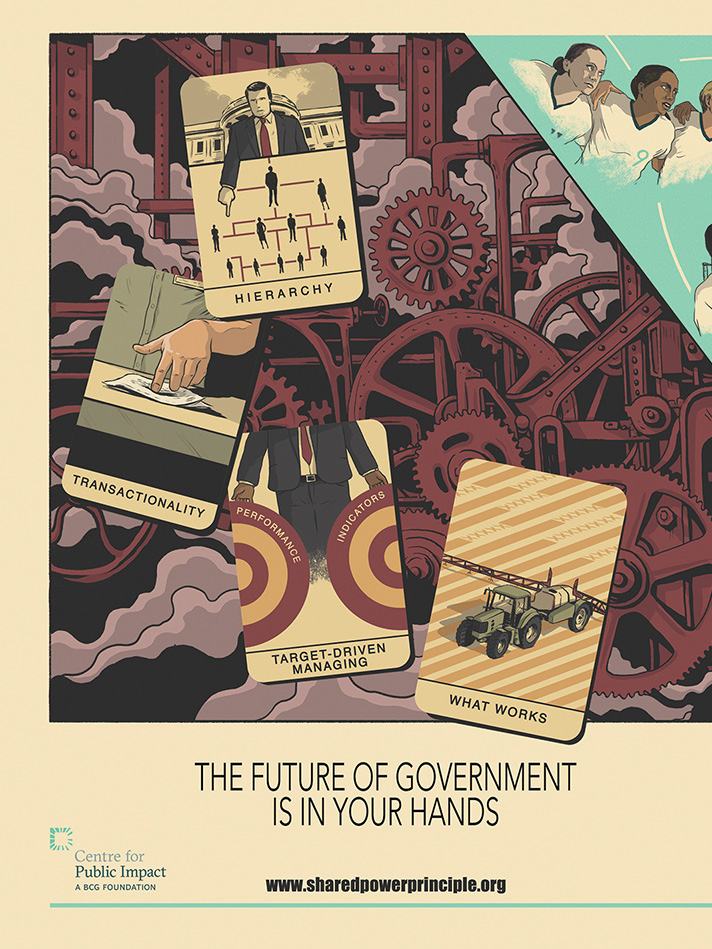
THE FUTURE OF GOVERNMENT IS IN YOUR HANDS
www.sharedpowerprinciple.org
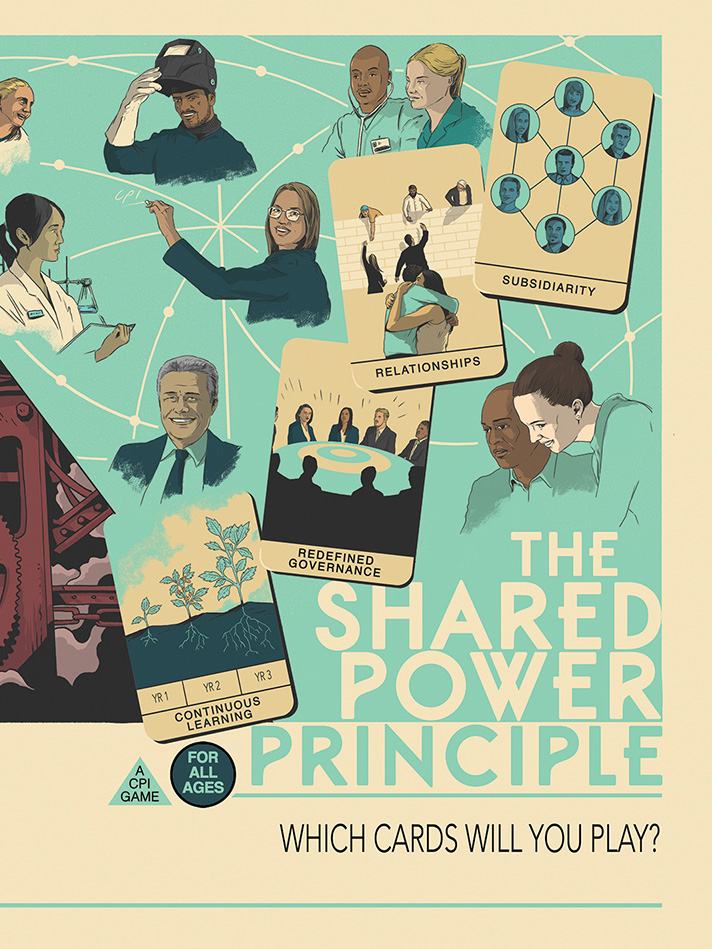
WHICH CARDS WILL YOU PLAY?
The Others
Introduction
We believe that imagining a radical and positive future for government is futile without reconsidering the economic system that underpins and shapes its priorities.
We need an alternative to the existing economic ideology that no longer produces overall positive outcomes for most of us, rather than simply suggesting fixes to government as is.
As evidenced by social and environmental issues like climate breakdown, global inequality, the sixth mass extinction, surveillance capitalism, migration and war, governments bound by this system are unable to care for us now, or in the long-term.
Pursuit of financial growth requires exploitation and commodification of both people and planet. It makes us pollute our air, erode our soil, poison our water and unravel our social fabric.
These outcomes affect all of us in one way or another, regardless of our personal ideologies or worldviews. But we are largely left to grapple with the consequences, as well as our own complicity, as individuals or nuclear units.
What could happen if a large enough number of us began to question the agreed upon fiction we inhabit? What if we could find each other and imagine a new way to organise life?
This contribution imagines The Others, a movement that could emerge to do this. The Others is made up of people seeking change, who are tired of waiting for it. They construct a society within society and an economy within the economy, which both place care for and maintenance of life at their core.
The Others creates a 'third space' within society. It is a place for anyone disenfranchised, seeking change or simply looking for connection.
Joining together enables a new, shared reality to emerge; one that carves previously unimaginable avenues of possibility into capitalist reality.
Inside the word 'emergency' is 'emerge'; from an emergency new things come forth.
– Rebecca Solnit
2020
Manifesto
We are...
- Hidden in plain sight; the strangers you don't yet speak to.
- The majority; the flowers in the dustbins of the few.
- Ready to unite; the voices assembling to break the silence.
- Your kin; the social fabric you need to thrive.
We are The Others.
We seek to...
- Pause to think, feel and wonder.
- Dissent in solidarity with each other.
- Subvert the system that divides.
- Organise around a logic that gives life.
- Reveal the world that we know can be real.
Find The Others
The Others find each other by spreading their message through a rhizome of channels (fig. 1); passed on by an Other, or dispersed, to be found by anyone paying close enough attention.
Diagram showing a network of interconnected nodes (circles and squares) with arrows indicating spreading channels, illustrating a rhizome structure (fig. 1).
As the message travels, the web grows, transgressing boundaries that commonly divide.
Seek and learn to recognize who and what, in the midst of the inferno, are not inferno, then make them endure, give them space.
– Italo Calvino
2022
An Other Economy
The Other Economy is not centered on the growth of financial capital. It runs on a new type of currency and generates value by maintaining and sustaining life.
It is made up of non-extractive entities and activities that share a common purpose and values, such as maintenance, care and other social reproduction work, different types of co-operatives, and grassroots and community initiatives. It networks and amplifies existing pockets of resistance and activism (fig. 2).
Conceptual diagram labeled "fig. 2" illustrating entities in "The Other Economy". It shows a central cluster of entities radiating out to specific categories:
- Cooperatives
- Household Labour
- Social Reproduction
- Unpaid Labour
All production, exchange and consumption of goods and services in The Other Economy inherently contributes to generative or regenerative outcomes for natural and/or social systems.
A New Currency
The Other Economy is federated by a new currency: Moments (fig. 3). It uses time as the basic unit of exchange and account because it is equitable – the one asset we all hold in equal amounts, the one investment everyone has to make and the one resource impossible to reproduce.
Time lived functions as a form of natural capital, a basic income. It is available to anyone alive. Every second, minute, hour, day, week, month, year, [...] lived adds credit in Moments to your account (fig. 4). They can be spent or saved, but expire when the life they are coupled to does.
Conceptual diagrams labeled "fig. 3" and "fig. 4". Figure 3 shows a vertical bar within an oval, while Figure 4 shows two interconnected, more complex loop shapes, indicating an accumulation or flow of "Moments" currency.
The master's tools will never dismantle the master's house.
– Audre Lorde
A Basis for Everyone
Moments can be used by account holders to purchase goods or services produced in The Other Economy. In this way anyone who wants to make use of their basic income will help it grow, regardless of their personal values.
Anyone wanting to earn Moments can lend time to activities in The Other Economy. Beneficiaries transfer the according amount to reflect time spent and value created (fig. 5).
Conceptual diagram labeled "fig. 5" depicting two large, interconnected loop shapes, one with a minus sign and the other with a plus sign, representing the flow or transfer of "Moments."
Free your mind of the idea of earning, and you will begin to be able to think.
– Ursula K. Le Guin
Shifting Power
The Other Economy is symbiotic within itself, whilst parasitic to the capitalist market economy (fig. 6). As The Other Economy grows, it saps capital's power, slowly liberating itself, the state and the public imagination.
Conceptual diagram labeled "fig. 6" illustrating the relationship between "Capitalist Market Economy," "The Other Economy," and "The State." It shows three interconnected circular entities with varying internal patterns, suggesting a dynamic interplay.
Governance
The Other Economy provides opportunities for the state, no longer instrumentalised by an extractive economic model, to make choices that truly serve its citizens.
The Others do not seek to exist outside of society or democratic governance; they believe in a democracy that empowers the majority.
They support political equality by expanding democracy to the economic realm. Providing basic economic egalitarianism frees up time and space for everyone to participate in political processes.
Charting Progress
To chart progress, The Others measure the quality and quantity of time spent on maintenance, care and other types of work that make us thrive.
They foreground and value the often invisible work that that upholds natural and social systems. Vitality, not growth is the core metric.
We ought to imagine the wildest possibilities and then wonder why they don't happen.
– Howard Becker
THE GOVERNMENT THAT COULDN'T FORGET
By Greg Falconer
Illustration of an elephant wearing a bowler hat, standing in front of a grand building shrouded in mist, representing a conceptual cover for the story.
By 2029 standards, the Cabinet Secretary's office was sparse. No interactive video screens, no automatic flip-charts. Just an oak desk, some antique bookshelves and a massive conference table. It was around this table that the third most powerful person in the country (behind the Prime Minister and the Chancellor) made most of her decisions. Today, that decision would be whether to ask the Home Secretary to resign.
There were five people in the room. Cabinet Secretary Helen Moore was joined by Mark Atwood, the Director General for Propriety and Ethics, on one side of the table. Home Secretary Simon Miller sat opposite, flanked by his Special Advisor Freya Wigmore and me. I was one of the Private Secretaries in Helen's office, there to take the note and nothing more. I knew nothing about the meeting other than that I had to take the minutes in a peculiarly old-school way, with a pen and paper. No laptop or tablet. There was a problem with the IT system, apparently: government computers had been temporarily rendered insecure. The tech folk hoped to fix the issue by early afternoon; the Daily Mail was having a field day.
What I did know was that Miller had a reputation for intimidating Civil Servants with his powerful glare. So I sat alongside him, out of his line of sight.
The meeting started with the usual cordial introductions. Moore asked Miller about his children, and Freya asked me how my holiday was. All very superficially chummy. Things went downhill as soon as Atwood started talking.
"Home Secretary," he began, eyes down on his ring-bound briefing. "We're here this morning to talk about a very serious matter. We fear your office has been responsible for some truly reprehensible behaviour that has brought Her Majesty's Government into serious disrepute."
Miller shifted in his seat, but let Atwood continue.
"I'll cut straight to the chase. Who was it that disabled Elephant?”
I looked up at caught Moore's eye. She nodded. So that was what this was about. It was far more serious than I'd thought.
"Look, Mark," Miller began, with a dismissive wave of a hand, “I don't know what you've been told or what you think you've seen, but I have no idea what you're talking about. I don't even know how Elephant works.”
I smiled, but kept my eyes fixed on my notepad. The Home Secretary was clearly lying. Pleading ignorance was not something he did often. The Cabinet Secretary saw straight through the tactic.
"Simon," she said. “You and I know full well that you are aware how Elephant works. You called for its introduction from the back benches before you came into government. But let's suppose you're having a lapse of memory.” She turned to Mark. “Mark, for the minutes, please read the description of the system in today's briefing.”
Atwood nodded, turned to the first page of his ring-binder and began to read. “In 2027, the Government Digital Service, in collaboration with The National Archives, rolled out a new IT system known as the Consolidated Historical Policy Resource (CHPR). The system, introduced under the 2026 Public Information Act, is a fully-searchable knowledge repository that contains detailed information about every policy the UK Government has ever introduced, or considered introducing, over the past thirty years. A definitive and publicly-accessible record including all emails, documents and data related to government policy, the CHPR provides a quick and easy way for policymakers, journalists and parliamentarians to learn lessons from past initiatives. In effect, it means that government is no longer able to forget its mistakes.”
Atwood paused, grinned and looked up from his brief. “Hence the nickname, Secretary of State."
"By using big data and analytics," he continued, "the CHPR has heralded a new era of smart policymaking and de-politicised the policy process, making it far more difficult for Ministers to enact foolhardy initiatives for ideological reasons. In the short period since the Act became law, the CHPR has started to make politics redundant."
"You see, Simon," Moore interrupted, "You can't introduce something if Elephant says it won't work. The public won't have it any more. No more pet projects or back-of-an-envelope crap. And no more of those stupid slogans on the side of a bus."
Freya cut in. “I don't like your insinuation, Cabinet Secretary. The Home Secretary and I feel strongly that we're here to deliver policies that keep citizens across our country safe and secure."
"Like biometric identifiers?" Moore shot back. Biometric identifiers. Two words to strike fear into the average Home Office policy official. Simon Miller had made biometric identifiers his flagship policy on becoming Home Secretary a year ago: his pride and joy. He had pledged to create a nationwide database of the entire country's vital statistics – eye colour, height, weight, blood type, DNA profile, fingerprint and others – and use this in efforts to fight crime and illegal immigration. Thousands of hours of civil servant time had been spent trying to turn his plan into a reality, but Elephant made sure nobody could forget one important fact – biometric identifiers are a lot like identity cards, which many governments, most recently Blair's in 2006, had tried and failed to introduce.
Elephant set out why each attempt failed, publicly and in minute detail. There was no disputing the cold hard fact that creating a national system of biometric identifiers would cost billions, need extremely complex technology and be time consuming and challenging to deliver. Not only that, but civil liberties groups challenged the very idea every step of the way. Elephant gave them their ammunition. And it was all very embarrassing for Simon Miller and his team.
"Okay, okay," Miller gestured for Wigmore to stand down, trying a more conciliatory approach. “Look, we all know Elephant has made doing anything on biometric identifiers difficult. It has stopped us driving forward with a policy we truly believe in. We know we can make it work, but that bloody database has made things impossible. Every time we try to look at a way forward, our opponents are able to use Elephant against us. They look back over ancient emails, send them to the press and stop ideas in their tracks before we develop them properly. The system was designed to help us learn from mistakes, not prevent innovation. What are we here for, if not to have ideas?”.
"So you shut it down?” Atwood spotted his chance to attack.
"I'm not saying that,” said Miller. “All I'm saying is we all know the system has gone awry."
"That's your view, but the CHPR is enshrined in law. Ministers cannot simply choose whether to turn it on or off.” Atwood turned back to his ringbinder and produced a document from the back.
"Ms Wigmore,” he said, addressing Freya formally. “Do you recognise these messages?". He passed the document across the table.
Wigmore studied the paper. When her eyes got half way down, she visibly winced.
"Yes," she sighed, “I do."
Wigmore had pressured one of the Cabinet Office Digital team to shut down Elephant. The communicator messages, intercepted by the Security Service, made that clear. Just temporarily, of course. Long enough to give Wigmore's team time to come up with enough ideas to save the biometric identifiers policy. To stop the noise for a second and let them have a quiet space to work up solutions instead of fighting off opponents. Wignore thought no one would notice the system would be down for maintenance for three weeks. After that, it would go back online. The storm would have passed by then.
But the digital staffer made an unfortunate mistake, shutting down the entire government IT platform instead of just the CHPR. And people did notice; MI5 thought it was a cyber attack.
The game was up. In the end, Miller did the honourable thing and resigned. Family reasons, they said. Wigmore left government too, never to return. She broke the law, but charges were never brought; the Cabinet Secretary thought it better that way. Miller and Wigmore leave with honour, but keep their reservations about Elephant to themselves. A solid quid pro quo. No need to rock the boat.
The technology problem was fixed quickly: Elephant was back up and running that day, along with the rest of the government's computers. The entire episode was put down to a power surge, just one of those things. I wrote up the minutes of the meeting and gave them, hard copy, to the Cabinet Secretary; she never asked me to write them up digitally or upload them to Elephant. The lie was allowed to stand, but the people in the room that day know the truth.
Biometric identifiers were forgotten as quickly as Simon Miller. His successor ditched the idea, just as the Coalition government had done with identity cards. Nobody spoke of them again. For once, we were all allowed to forget.
Automated Externality Accounting
By Eleanor 'Nell' Watson
Conceptual illustration showing measurement of externalities. A globe sits on a weighing scale, with a large ruler extending diagonally across the image, overlaid with numbers and geometric shapes. This diagram represents the complex process of accounting for external factors.
ABSTRACT
The following report discusses the prospect of applying emerging technologies to enable a more sustainable society. Economic transactions often involve the passing of costs such as pollution clean-up and abatement onto unrelated third parties or to the commons; these negative externalities are generally undocumented and unaccounted for.
By the year 2030, we will have an opportunity to leverage machine intelligence to create Automated Externality Accounting networks comprised of automated and networked mechanisms for detection, accountability generation, pricing, and redress of externalities.
These elements will enable us to enjoy the fruits of advanced civilisation in a sustainable manner.
NATURAL CAPITAL
Diagram: Interconnected Spheres of Economy, Society, and Environment
A diagram illustrating three concentric circles. The innermost circle is labeled "Economy", the middle circle is "Society", and the outermost circle is "Environment", visually representing their nested relationship.
Traditionally, economists have focused on human elements of the economy, not the nature or ecosystems that underpin them. The costs upon nature caused by pollution or resource extraction are not typically accounted for.
In fact, modern industrial society has grown uncontrollably at the expense of the planet's ecosystems, passing along negative costs to nature while masking the true costs of profit. The effects upon the commons are generally ignored, and the actual costs on natural and social resources have been significantly underestimated. Profits are privatized, and costs are socialised in a hidden subsidy.
"We use nature because it is valuable - but we lose it because it is free." - Pavan Sukhdev
EXTERNALITIES
Externality, an economics term, occurs when an exchange between a buyer and a seller has an impact on an uninvolved third party. Sometimes the third party who bears the costs is not an individual, but a group, society at large, or the broader ecosystem – the global commons. These negative effects add up to real costs that someone ends up having to pay for: estimates of global externality costs are greater than $2 trillion.
Identifying which externalities exist is also a significant challenge. Mobile distributed sensors have discovered that industrial methane emissions from Ammonium Nitrate fertilizer plants are 100 times higher than previously reported, for example, illustrating that we have a poor understanding of what externalities are actually occurring, and of who is doing the polluting, with what, and to what degree.
AUTOMATED EXTERNALITY ACCOUNTING
Good governance is concerned with the management and accounting of externalities, but it's generally done after the fact. We lack the capability to manage externalities in a manner that is fast, cheap, incorruptible, transparent, decentralised, and equitable, making products appear less expensive than they actually are.
We will, in the 2020s and 2030s, be able instead to include externalities within pricing mechanisms – to make people pay for them at the point of purchase. Products or services that result in fewer externalities will therefore tend to be cheaper.
This opportunity has arisen due to rapid advancements in a cluster of automation technologies:
- Machine Intelligence. Helps us make sense of situations that appear to be too chaotic to control, and enables us to automate the ineffable – that which cannot be adequately expressed in words or mathematics, but which we know when we experience. This is a fantastic resource for making predictions, generating improved solutions to difficult problems, and optimising very complex variables. Recent research developments also hint at new formulae that could be applied to assist externality tracking systems.
- Machine Economics. Blockchain, distributed hash tables, and associated cryptographic technologies enable decentralized mechanisms to align incentives, create a permanent public record, and guarantee escrow in an affordable, trustworthy, and (mostly) scalable manner.
- Machine Ethics. We can instil prosocial behaviours and values into machine intelligence by collecting examples from multiple cultures, demographics, and geographies, informing the artificial intelligence of our general preferences on an individual and societal level.
- Internet of Things (IOT). Sensors are becoming more affordable and powerful all the time. Soon, they may even be commonly embedded within consumer electronics.
These technologies are rapidly maturing at a time when the United Nations' Sustainable Development Goals call for change. Through Automated Externality Accounting, we can preserve the commons, grow new market opportunities in private industry, and develop new sources of funding to invest in a sustainable future.
DETECTION OF EXTERNALITIES
In order to account for externalities, one must know they exist, along with their location and extent. Initiatives such as Open Air Quality, enable ‘citizen scientists' with air pollution monitors to aggregate their own data and help triangulate the sources of pollution: consumer sensors can be bought for as little as £30, with prices dropping all the time. Pollution control and compliance may be verified through techniques such as satellite monitoring.
EXTERNALITY PRICING
Pricing externalities is a technically and politically sophisticated challenge.
There is a question of whether externality costs should be accounted for in full immediately, or through some graduated means. There is also a question of whether past externalities should be accounted for, and if so, then how far back should this accountability go.
Generally, a statute of limitations will apply with regards to civil tort liabilities. One could simply write off all prior externality effects altogether and start from a blank slate. This may be the most politically palatable.
Externality accounting mechanisms may allow the trading of pollution permits: a sustainable number of (infinitely divisible) permits could be produced and allocated to every individual and company. Those who are less flexible in their pollution activities could buy extra pollution permits from those who have more flexibility and are willing to trade them. Those who reduce their externalities cheaply could make a profit by auctioning off their permits to others. Externalities in specific locations may result in an extra cost due to their amplified effects there and should be priced appropriately.
Regulators may also imprint a warning on a product label to warn that it produces a large number of (explicitly quantified) externalities to help consumers make more informed purchasing decisions.
EXTERNALITY FUTURES & DERIVATIVES
Futures markets may have an important role to play in pricing the costs of externalities. Derivatives are a massive component of the modern economy, and those based on externalities may lead to substantial new markets. Such derivatives could be based on the future costs of externalities or long bets on the eventual remediation of their negative effects upon the commons.
Predictive processes could be used as part of a pricing mechanism, by asking people to make a prediction on the price at a specific date in the future based on the status quo or a given policy. Banked allowances have enabled speculators to buy permits now under the belief that they will be more expensive/scarce in the future; if expanded to other forms of externalities, these could become a substantial secondary market.
AUTOMATED REDRESS, AUTOMATED CLASS ACTIONS
Identity requires a permanent and discrete separation from peers. The commons possess no identity, and therefore it has no rights and no legal standing. What if we could change that en masse?
Organisations such as What3Words.com enable one to express a 3m² geolocation using just three words, a convention which is now used by the Mongolian postal service. Imagine if we used similar techniques to generate 'parcel codes' that delineate individual gullies, tributaries, ponds, oceans, glades, and woods. We could then give each patch of Earth its own unique identity.
Attempts have been made to give some legal status to certain rivers, generally by indigenous groups. So far, such initiatives have not been given much legal credence. By connecting these identity-deriving mechanisms to AEA, one could automatically register ‘environmental persons' en masse – formalised legal personalities that help illustrate legal standing for natural capital. An associated trust could represent the wellbeing of that legal entity, receiving its funds as redress for being polluted or unsustainably depleted of its natural resources.
This concept could also be suitable for patches of Earth outside of national sovereignty – oceans and seabeds, the upper atmosphere and outer space, the polar regions. A stateless legal person can still seek redress in court. Land in foreign jurisdictions might still be addressable using such a mechanism, just like a natural person may be granted citizenship of a country other than the one in which they reside. There is already an established legal principle whereby a third party may volunteer to step in as a legal guardian for a child who has none, such as a foster child.
Such principles may enable third parties to act as the guardian of a parcel of nature that has had its interest infringed upon. The detection and collection of necessary evidence could be automated, as could the accounting and submission of the proper legal forms for a class-action lawsuit. Successful automated legal processes have been used to great effect already. DoNotPay, for example, has overturned thousands of motor vehicle tickets and citations.
Part of the income derived from levied fines should subsidise the identification of new externalities; payment from externality costs should be reinvested to help to correct violations. Part of the redress cost from externality violations may also be held as a bounty for their remediation.
Positive externalities from genetic or cultural resources, for example, could also be rerouted into the communities and zones from which they came. A monkey selfie type of situation, whereby intellectual property is created or discovered within part of the natural ecosystem, could be held in trust to help protect the habitat it came from.
DRIVING ADOPTION
Certain blockchain-based initiatives (e.g. SolarCoin) have a model whereby they give away tokens in exchange for a demonstrable positive externality, such as generating electricity. Whilst the initial value of the tokens may be very low, as the value rises people may become more motivated.
People have invested vast sums of money in computer graphics cards and energy usage simply to redeem a single bitcoin – if one gave away tokens for planting trees or cleaning up litter, one could incentivize productive behaviour. Verification may be challenging, though AI and cryptographic techniques linked to real-world matter may assist.
POLITICAL PRACTICALITIES
Carbon Credits/Cap & Trade initiatives have experienced many challenges, sometimes met with scorn from those who view them as a ‘stealth tax and a bureaucratic nuisance', or for being 'morally bankrupt and a license to kill'.
Implementers of AEA must learn from the various successes and failures of prior initiatives, not thinking of it as merely a more sophisticated Pigouvian tax or opportunity for rent-seeking by authorities. On the contrary, it must be seen as proper, scrupulously honest accounting and the reason why some externalities are costed.
The focus should not be on carbon, which is politically contentious and open to questions on its importance, its impact, and the cost of containing its effects. Instead, the focus should be on other pollutants that are detrimental to the health of people and the Earth – particulates, microplastic, and endocrine disruptors.
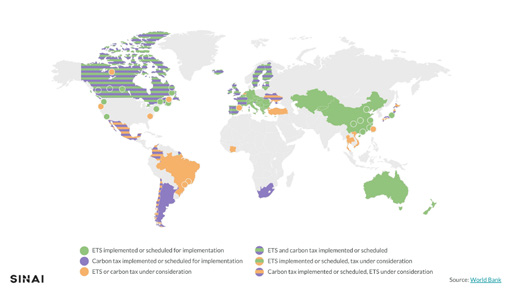
SINAI
Legend for the ETS and Carbon Tax World Map:
- ETS implemented or scheduled for implementation
- Carbon tax implemented or scheduled for implementation
- ETS or carbon tax under consideration
- ETS and carbon tax implemented or scheduled
- ETS implemented or scheduled, tax under consideration
- Carbon tax implemented or scheduled, ETS under consideration
Source: World Bank
GEOPOLITICS & ECOLOGICAL DEBT
AEA may have major geopolitical ramifications as regards to international sanctions or foreign aid, whereby payments and tariffs may be linked to steps taken to reduce externalities.
Geopolitical trade in externality costs or permits may also lead to a trade deficit in that some nations may find themselves trading externalities at a net loss. Operating in this fashion may alter the balance of economic power between nations, and in particular, change the status quo between the global north and the global south.
SOCIAL EXTERNALITIES
Externalities are not only environmental; they're social, too. One could create a lottery that randomly rewarded people with a modest bonus for prosocial action by earning free tickets towards a potential reward.
Social externality tracking could also be used to negotiate a higher place in a particular queue if one happened to be in a hurry, exchanging a credit for someone else's voluntary sacrifice.
CONCLUSION
It is necessary to bring forth an Industrial Reformation that can successfully manage the worst excesses and social costs that previous phase shifts have brought forth. This process must be gentle and non-coercive, but at the same time unyielding. Automated Externality Accounting offers radically improved forms of governance within the next five to 10 years and beyond.
The financial reforms of the 1980s positioned London as a prime securities trading centre. Today, the UK has a similar golden opportunity to drive global leadership in AEA and externality trading markets. Such endeavours will be built through an alliance of interoperable solutions for externality detection, accounting, trade, and arbitration.
Let's restore hope in the future by illuminating a path to a more sustainable, cleaner, and equitably prosperous world. Information and links that relate to this report will be posted at www.pacha.org.
Diagram: Automated Externality Accounting Can Enable Sustainable Development Goals
This infographic illustrates how Automated Externality Accounting can contribute to achieving the United Nations Sustainable Development Goals across three pillars: Economic, Environmental, and Social.
ECONOMIC PILLAR
* 1 No Poverty: Icon showing people.
* 2 Zero Hunger: Icon showing a bowl.
* 3 Good Health and Well-Being: Icon showing a heartbeat line.
* 8 Decent Work and Economic Growth: Icon showing a graph and gear.
* 9 Industry, Innovation and Infrastructure: Icon showing factories and a gear.
ENVIRONMENTAL PILLAR
* 6 Clean Water and Sanitation: Icon showing a water tap.
* 7 Affordable and Clean Energy: Icon showing a sun and a lightning bolt.
* 12 Responsible Consumption and Production: Icon showing a recycle symbol.
* 13 Climate Action: Icon showing the globe.
* 14 Life Below Water: Icon showing a fish.
* 15 Life On Land: Icon showing a plant.
SOCIAL PILLAR
* 4 Quality Education: Icon showing an open book.
* 5 Gender Equality: Icon showing gender symbols.
* 10 Reduced Inequalities: Icon showing people of different heights.
* 11 Sustainable Cities and Communities: Icon showing a city skyline.
* 16 Peace, Justice and Strong Institutions: Icon showing a balance scale and a dove.
* 17 Partnerships for the Goals: Icon showing interconnected arrows.
Below the pillars, the text "SUSTAINABLE DEVELOPMENT GOALS" is displayed.
ACKNOWLEDGEMENTS AND THANKS
Special thanks to Michael Michalchik, Robin Hanson, Tom Symons, Vector Newman, Nicholas Gogerty, Alfie Rustom, William Cooke, Anand Murthy, Kunal Sood, Steven Stutts, and Skinner Layne for sharing various insights, influences, and opportunities which have shaped this report.
FOREST OF THE FUTURE?
by SRG Bennett, Cat Drew, Liv Bargman and Phoebe Ridgway
Four Images Illustrating the "Forest of the Future" Concept
- Top-Left: Abstract mixed media artwork with blue and brown tones.
- Top-Right: An illustration depicting a stylized forest scene with a prominent deer-like creature and a "FIELD VOLE CROSSING" sign. (This relates to "A Green Corridor (2019)" on PDF page 10).
- Bottom-Left: A black and white hand-drawn illustration showing a person standing in front of a house, possibly engaging in an activity or delivering something.
- Bottom-Right: An abstract organic image with green and dark tones, resembling a cave opening or natural formation.
FOREST OF THE FUTURE?
Speculative futures for Waltham Forest
Following in the footsteps of William Morris' seminal utopian science fiction novel 'News From Nowhere' (1890), Liv Bargman, SRG Bennett, Cat Drew and Phoebe Ridgway created speculations and writings about the future of Waltham Forest. The artworks were exhibited in 'Forest of the Future?' at the Pictorem Gallery in Walthamstow in May to coincide with Waltham Forest's reign as London Borough of Culture 2019.
As a cross-disciplinary collective, we applied the emerging discipline of speculative design to the local context of Waltham Forest. Speculative design is the practice of creating visions of a future world: some positive, some less so. The aim is to use these speculations to help decision-makers – politicians, citizens, consumers, voters, businesses - think about what a better future can look like, and how to achieve it.
The resulting works, four of which are described in this essay, are based on local history, trend analysis and technology forecasts. They are fantastical imaginations of what the streets of Waltham Forest could look like. They are sometimes utopian, sometimes dystopian - often oscillating between the two – and always provocative, reflecting this amazing but fraught time for many communities. Growth, regeneration, opportunity, knife crime, gentrification, technology, immigration, populism, stress, dreams and hope - there is so much change, so much up for grabs. Yet the chance of being isolated and disempowered remains stark.
One of the motivations behind speculative design is that it is better to talk about the future than not: by speculating more and exploring alternative scenarios, reality becomes something we are more empowered to change. We can't predict the future, but we can think about what we do and don't want; that is democratising in itself. This has additional worth when big data, global finance and geopolitics appear to diminish choice. When you engage with these works, ask yourself the question: what do we want our Waltham Forest to be in the future?
Growth, regeneration, opportunity, knife crime, gentrification, technology, immigration, populism, stress, dreams and hope...
Images accompanying the text "Growth, regeneration..."
- Left: "Trace (2019) SRG Bennett, Mixed media on board, 40 x 56.5cm" - An abstract mixed media artwork with earthy tones.
- Right: "A Green Corridor (2019) Liv Bargman, Giclée Print edition of 10, 40 x 26cm" - An illustration depicting a stylized forest scene with a prominent deer-like creature and a "FIELD VOLE CROSSING" sign.
MAPS OF THE FUTURE • SRG BENNETT
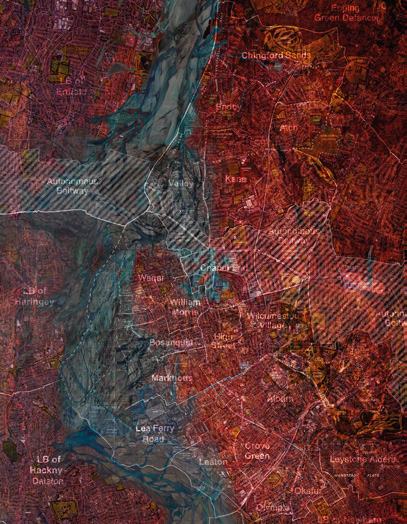
Image Caption: Kane (2019), SRG Bennett, Giclée Print edition of 15, 16 x 20in
Piotr looks at the map. It tells him many things about the change he has seen in the 30 years he lived in what was Waltham Forest. Even then, there are things which don't make sense, and must have predated his arrival in 2019. He definitely remembers when residents of Chingford renamed their ward after local hero Harry Kane helped England win the World Cup. Residents in Leytonstone had named their area 'Albarn', but he didn't quite understand that.
Images on Page 12 (PDF Page 117):
- Top Left: "New Lammas Land (2019) SRG Bennett, Mixed media on board, 30x30cm" - An abstract mixed media artwork.
- Middle Right: "Alluvion (2019), SRG Bennett, Mixed media on board, 30x30cm" - An abstract map-like image with blue and brown tones, featuring faint place names such as Hoe Street and Markhouse.

This seemed silly at the time, but now he realises they reflected a growing sense of local identity, spurred on by government reforms and incentives for Micro Governance. It was nice that people took more pride in their local area, but he thought it went too far in some places. The Epping Green Defence was, they say, created to protect Epping Forest from the desertification afflicting North Chingford. Having met some of the organisers, and experienced how difficult it is to cross the border, he felt there were other motives at play.
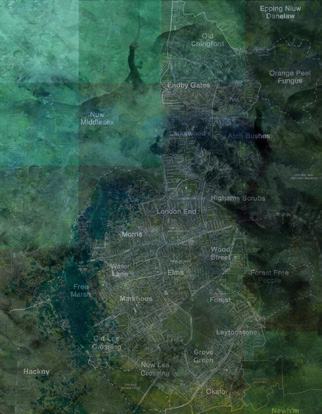
Image Caption: Forest of the Future? (2019), SRG Bennett, Giclée Print edition of 15, 16 x 20in
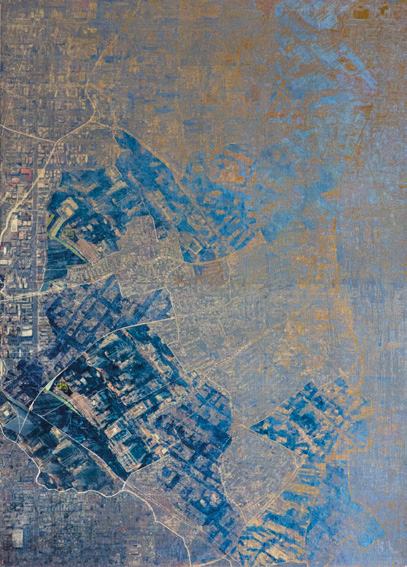
Image Caption: New Waltham Kong (2019), SRG Bennett, Mixed media on board, 40 x 56.5cm
The Autonomous Beltway was another case in point. He totally understood the adverts: the Beltway was the price to pay for 60 minute deliveries; it was necessary to secure the Xia Alliance and Prime Distribution centres; and the Autonomous Vehicle Night Zone took cars off the street at night, which made his neighbourhood more pleasant. It was just a shame that it cut the borough in two, making it so much more difficult to visit friends in Wilcumestou Village. And in the back of his mind, he has a nagging sense that all of this – the Beltway, the vehicles, the drones, the deliveries – somehow relates to the breaching of the Lea a few years back. Whilst the Lea's new estuaries and muddy banks unexpectedly provide a haven for wildlife, it has also cut people off from Enfield, Haringey and Hackney-Dalston. And the flooding of the newly created Lea Valley University of Culture really caused heartbreak for many good people...
FOREST DAYS • CAT DREW
“All residents work four days a week, with the 5th day as a Forest fellowship day. All residents contribute to the forest in a way that represents their strengths and interests."
Waltham Forest By-Law, 2032.
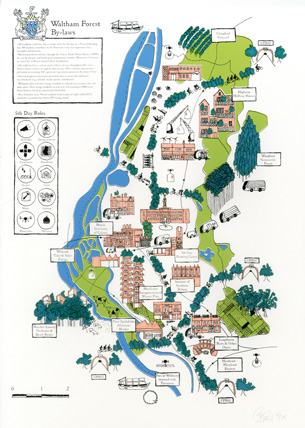
Image Caption: Waltham Forest By-Laws (2019), Cat Drew, Mixed media hand coloured screen print edition of 15, 35 x 50cm
The 2019 Borough of Culture project brought residents of Waltham Forest together, rekindling the collective feeling of fellowship first advocated by William Morris around 130 years ago. As automation made headway into both manual and non-manual jobs, and as other parts of the country started trials of Universal Basic Income, Waltham Forest Council gave its HR department a broader remit to consider how they would put the skills and energy of the borough's residents to common good.
Maia works as a street apprentice at Bakers Arms, working micro-roles at the Echo Antichamber cafe and the Drone Distribution pod. On her Forest Day, she is out the back in her garden, making cabinets for the new luxury treehouse resort on Hackney marshes, using sustainable bamboo from the Woodford plantation up the road.
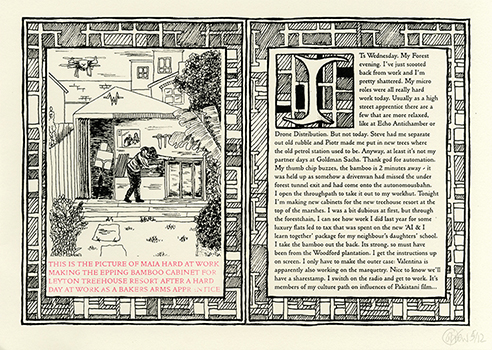
THIS IS THE PICTURE OF MAIA HARD AT WORK MAKING THE EPPING BAMBOO CABINET FOR LEYTON TREEHOUSE RESORT AFTER A HARD DAY AT WORK AS A BAKERS ARMS APPRENTICE
To Wednesday. My Forest evening. I've just soooted back from work and I'm poetry shamered. My micro roles were all really hard work today. Usually as a high street apprentice there are a few that are more relaxed, like at Echo Antichamber or Drone Distribution. But not today. Steve had me separate out old rubble and Piotr made me put in new trees where the old petrol station used to be. Anyway, at least it's not my partner days at Goldman Sachs. Thank god for automation. My thumb chip buzzes, the bamboo is 2 minutes away – it was held up as somehow a drivenvan had missed the under forest tunnel exit and had come onto the autonomousbahn. I open the throughpath to take it out to my workhut. Tonight I'm making new cabinets for the new treehouse resort at the top of the marshes. I was a bit dubious at first, but through the forestchain, I can see how work I did last year for some luxury flats led to tax that was spent on the new 'Al & I learn together' package for my neighbour's daughters' school. I take the bamboo out the back. Its strong, so must have been from the Woodford plantation. I get the instructions up on screen. I only have to make the outer case: Valentina is apparently also working on the marquetry. Nice to know we'll have a sharestamp. I switch on the radio and get to work. It's members of my culture path on influences of Pakistani film
Image Caption: Borough Manufacturer (2019), Cat Drew, screenprint edition of 12, 29 x 21 cm
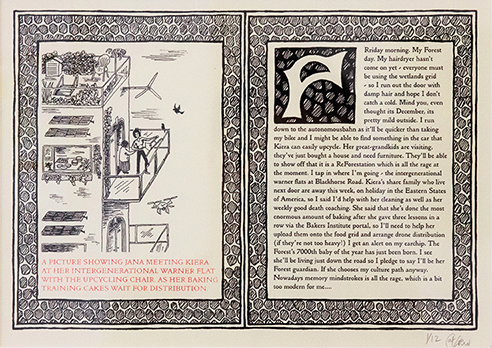
A PICTURE SHOWING JANA MEETING KIERA AT HER INTERGENERATIONAL WARNER FLAT WITH THE UPCYCLING CHAIR AS HER BAKING TRAINING CAKES WAIT FOR DISTRIBUTION
Rriday morning. My Forest day. My hairdryer hasn't come on yet everyone must be using the wetlands grid so I run out the door with damp hair and hope I don't catch a cold. Mind you, even thought its December, its pretty mild outside. I run down to the autonomousbahn as it'll be quicker than taking my bike and I might be able to find something in the car that Kitra can easily upcycle. Her great-grandkids are visiting, they've just bought a house and need furniture. They'll be able to show off that it is a ReForestation which is all the rage at the moment. I tap in where I'm going the intergenerationall warner flats at Blackhorse Road. Kiera's share family who live next door are away this week, on holiday in the Eastern States of America, so I said I'd help with her cleaning as well as her weekly good death coaching. She said that she's done the most enormous amount of baking after she gave three lessons in a row via the Bakers Institute portal, so I'll need to help her upload them onto the food grid and arrange drone distribution (if they're not too heavy!) I get an alert on my carchip. The Forest's 7000th baby of the year has just been born. I see she'll be living just down the road so I pledge to say I'll be her Forest guardian. If she chooses my culture path anyway. Nowadays memory mindstrokes is all the rage, which is a bit soo modern for me....
Image Caption: Reforestation (2019), Cat Drew, screenprint edition of 12, 21 x 30 cm
Amrit's Forest role is to attract inward investment to the borough. He managed to secure a borough-wide 'Al and I learn together' schools programme in return for the treehouses, but he also has to make sure investors go beyond financial contributions, making personal health, happiness and cultural investments too. Now that individual EU33 membership has been introduced (conditional on a pro-EU voting record), Amrit is reviving connections with European counterparts in Timisoara and Odessa.
Jana spends her Forest Day caring for Kiera, who lives at the intergenerational warner flats around Blackhorse Road. Kiera's share family (who pay cheaper rent in return for looking after her) are on holiday in the Eastern United States, so Jana is helping her clean, as well as providing her normal weekly 'good death' coaching session.
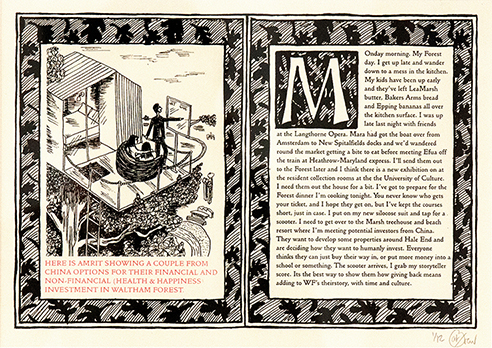
M Onday morning. My Forest day. I get up late and wander down to a mess in the kitchen. My kids have been up early and they've left LeaManh butter. Bakers Arms bread and Epping bananas all over the kitchen surface. I was up late last night with friends at the Langthorne Opera. Mara had got the boat over from Amsterdam to New Spitalfields docks and we'd wandered round the market getting a bite to eat before mecting Efus off the train at Heathrow-Maryland express. I'll send them out to the Forest later and I think there is a new exhibition on at the resident collection rooms at the the University of Culture. I need them out the house for a bit. I've got to prepare for the Forest dinner I'm cooking tonight. You never know who gets your ticket, and I hope they get on, but I've kept the courses short, just in case. I put on my new silocose suit and tap for a soooter. I need to get over to the Marsh trechouse and beach resort where I'm meeting potential investors from China. They want to develop some properties around Hale End and are deciding how they want to humanly invest. Everyone thinks they can just buy their way in, or put more money into a school or something. The scooter arrives, I grab my storyteller score. Its the best way to show them how giving back means adding to WF's theirstory, with time and culture.
Give & Invest (2019), Cat Drew, screenprint edition of 12, 21 x 30 cm
A BIODIVERSE FOREST • LIV BARGMAN
Rewilding Welcome Here (2019), Liv Bargman, Giclée Print edition of 10, 40 x 26cm
In a corner of the borough, down the back of those garages on Albert Road, is a warren of concrete and wood fences. These impenetrable walls, once used to cordon off astro turf from Number 31's garden, has opened up, and barriers have come down. The Bukhari family have rewilded their small space, creating tunnels and spaces for mammals, pollinators and insects to roam and inhabit. Each home has a responsibility to keep these green highways open, to join up. Red squirrels and pine martens are nesting, ospreys are flying above, and the stag beetle is scurrying from one patch of rotten bark to the next leafy pile.
The Lea Valley University of Sustainability
Liv Bargman, Giclée Print
edition of 10, 40 x 26cm
Each member of the family has a Citizen Science and Community Biolab membership card from The London Biodiversity Partnership's integration with the university, which shook up the 2020 vision of the Biodiversity Action Plan. The 2020 environmental campaigns woke people up to the pressing need for change and immediate large scale citizen action.
Andreea uses the Forest Biotechnology Makerspace Lab at the edge of the marshes. In her home is a mini lab where she tests and observes activity, gathering data for the Forest University of Sustainability's Big Nature Data portal, which builds a bigger picture of the status of the insect populations. She did a short course at the University called Mycelium Makers; everything that was once plastic in her home is now made from lab grown mycelium.
Open Access Garden (2019), Liv Bargman, Giclée Print edition of 10, 40 x 26cm
Since Matilde let her small patio garden become an open access green space, it has grown to be the micro-habitat of a churchyard. The Orange Peel Fungus grows freely, with hawk moths and other native forest species now common. The Meadow Pipit, Creeping Willow, Common Lizard, Small Heath butterfly, Slow-worm, Holly Blue butterfly, Common Spotted Orchid, Common Blue Butterfly and the Garden Tiger Moth are also regularly seen.
I'm in the Biolab
Community Fanclub (2019),
Liv Bargman, Giclée print
edition of 10, 40 x 26cm
WALTHAMWATERS • PHOEBE RIDGWAY
The Walthamstow Wetlands: infamous for hydrating London's ever-increasing thirst. The wetlands, once confined to Walthamstow, have sprawled over to Snaresbrook and up to Chingford, buoyant and full of lapping water.
Pools (2019), Phoebe Ridgway, Oil on Board, 45 x 47cm
Conveyor Belt (2019),
Phoebe Ridgway,
Oil on Board, 20 x 15cm
The expanding ecosystem has helped the wildlife in Waltham Forest thrive; flora and fauna have colonized the area, and it has become a biodiversity hotspot – the first of such within an urban environment. Birds flock to the reservoir banks and flora has blossomed in the Loamy soil. The reservoir is constantly in motion, fed by springs and pumped out by pipes; it must be hard for the water to feel any kind of consistency. It feels like a conveyor belt, taking a product from one place to another, stopping intermittently. The area is now defined by this relationship; visitors come to engage with the wildlife and the water. This is now Waltham Waters.
The Basin (2019),
Phoebe Ridgway,
Oil on Board, 20 x 15 cm
Liv Bargman: http://www.livbargman.co.uk/ | @LivBargman SRG Bennett: https://www.srgbennett.com/ | @SRGBennett Cat Drew: https://cargocollective.com/catdrew | @catdrew_ Phoebe Ridgway: https://www.phoeberidgway.co.uk/
Future Trust
GOVERNMENT OF THE UNITED KINGDOM
3rd May 2029
Government Response to the ad hoc Select Committee of the House of Lords on the 29th February Data Losses
By Phil Booth
Introduction
The Government is grateful for the Committee's comprehensive inquiry dating back to the mass breach of UK citizens' data on 29th February and subsequent events. The new Government believes that everyone living in the UK must know how data about them is accessed and used. Such information is indeed necessary for people to be able to make the informed choices to which everyone has a right.
Respecting choice has long been essential for public confidence in services, no more so than now, as we collectively seek to rebuild the trust that was shattered when bulk personal datasets – vast quantities of citizens' data were left unprotected on the internet on February 29th.
The confusion and uncertainty of previous Governments on data is self-evident in many of the quotations cited by the Committee, including:
"...the term 'data' is intended to be understood broadly and refers to all kinds of data unless otherwise specified – for example, covering both personal and non-personal data, information that is stored both digitally and non-digitally, and data used for various purposes, e.g. data about people, data about performance, government data, content data and so on"
Previous Governments' attitudes towards, and treatment of, citizens' data cannot be summarised any more clearly than by Baroness Gracey's frustration in oral evidence:
"Did you believe the law and your public task allowed you to do anything you wanted with data covering the entire population?”
While this Government cannot assist the Committee on that specific unanswered question, it typifies the situation we inherited. This statement from a previous administration remains timeless:
"We have ... security systems, we are updating those security systems, but we will look in detail at how they are functioning in the wake of what has happened this week. But I will stress that while the systems are one thing, the people who operate them are key ... The human factor is the decisive one."
This Government recognises the fundamental truth that personal data is data about people who can come to real harm – especially when a contractor at the end of an outsourcing supply chain, constrained by austerity and working to tight deadlines within unprecedented administrative complexity, inadvertently creates a single point of insecurity, having forgotten leap years exist.
Fairness and Justice
Following the previous administration's multiple losses at Judicial Review, we accept and actively agree with the Committee that the principle of fairness and justice must apply to all users of digital services, and to all digital decision-making.
The Government will enshrine into law the requirement for all public bodies to comply with new statutory definitions of “vulnerability” and “fairness” – definitions capable of being operationalised empirically, as recommended by the Committee – and, effective immediately, will require all public services to provide evidence demonstrating the compliance of the data architecture of every programme they deliver in a published Data Protection Impact Assessment.
While previous Governments may have believed harms could not be demonstrated if they refused to collect evidence, it is now beyond question that such evidence will be collected anyway. Evidence collected demonstrates harm. We recognise the Committee's suggestion that evidence must be collected, and this administration will do so – but only Parliament can write the laws binding future Governments.
The flow of claims for technology ethics and innovations' by 'centres' and 'new institutions' that were anything but privacy-enhancing have been shown to be little more than hype for headlines at the expense of the citizen, and 'governance' by those whose goals are not in the public interest.
History repeats itself
Distractions around the ‘ownership' of personal data only exacerbated the damage to our citizens and our country. This Government therefore mandates a 'verified attributes-first' approach to identity assurance throughout the public sector. Data minimisation is no longer a compliance goal, but a necessity. The requirement of previous administrations that all analytics must have a profit-driven "industrial component” under the euphemism of “deliverability and scalability” will no longer be hidden from the public.
All services predicated upon such approaches will be fully audited and re-engineered according to independently overseen Privacy-by Design principles. Linked individual-level data, rich in detail, is highly identifiable; while using such data securely is entirely necessary, proper handling does not render anything anonymous.
Purpose limitation and lawfulness are critical components of each one of the UK's Data Protection Acts, from 1984 to 1998 to 2018 to 2024. They have been ignored at the peril of our citizens.
The Government welcomes the National Audit Office's recent report, 'Ten Years of Challenges in Using Data Across Government', which updates the 2019 report of a similar name. As the NAO makes clear in its report, had steps already known to be necessary been taken in 2019 – or indeed in 1999 – this foreseen sequence of failure upon failure, response compounding error, would not have been so catastrophic to public confidence and public trust.
When service owners do not listen
When selections from the official archive of phone call recordings were published by the media following the February 29th breach, the “brutal inhumanity" of the previous Government's policy was made plain. The journalism placing audio from DWP helplines next to photographs of the victims and details of how they died was described as “haunting". We agree with the Committee that the episode was an "indelible stain on Her Majesty's Government".
It is impossible to deny that the harms of digital services are real when one hears those calls; past Ministers and senior officials simply did not listen.
The Government has already begun implementing the Committee's recommendation that Permanent Secretaries, Senior Responsible Owners, and Secretaries of State should sit in on at least one hour per year each of user research and helpline calls, though it was unable to ensure these calls were randomly selected and not carefully screened. We invite and encourage future work by subsequent Committees to consider how institutional denial insulates decision makers from the actual and harmful effects of their choices.
Parliament itself should scrutinise practice, given the very different approaches of different Governments over the last decade or more.
The interim publication of ‘(Nearly) Ten Years Touring The Monster Factory', a report by medConfidential, documents and details failures throughout the past decade – failures which led to the choices the Committee describes as “catastrophic” for both the country and citizens alike. This Government is cooperating in advance of the final report.
The Government recognises members of the public care deeply about the quality of their public services; that they are funded appropriately, that they are run competently, and that they are available to all as needed. It has been many years since the public made any real distinction between 'digital' and 'non-digital' services – they rightly expect things to just work safely.
Harms
The harms of data use, abuse and misuse are not equally distributed – those reading this document are amongst the least likely to be affected. Those who are affected will likely be amongst the most vulnerable – whether through possessing characteristics protected by the Equality Act, through fear or distress, or through circumstance or misfortune.
The Committee argued, with hindsight, that the primary folly of the 2010-2015 era of Digital Government turned out to be its presumed benevolence – that ‘digital' was, and would only ever be, a force for good.
The years 2016 and beyond revealed the flaws in that approach – ‘thoughts and prayers' were insufficient. While lists of principles and frameworks were popular, these were only meaningful when transparently operationalised with independently-designed metrics to evidence compliance. 'Digital' is more effective at manifesting misery than it ever was for increasing engagement – much as was proved to be the case during that period, for both empowerment and democracy.
The Government recognises it is by and large the Courts and the Justice system, led by those with an innate sense of justice, which ensures the equality of all under the law is maintained. Until every public body has understood and fully respects that principle in every aspect of its digital policy and practice, they will continue to lose Judicial Reviews in front of judges who do.
Choices
It is the policy of this Government that all uses of data by public bodies can be seen by the citizens represented within that data – on NHS.UK for their NHS data, and GOV.UK for everything else. Where choices exist about how data is used, the effects of those choices can be clear – and it is equally clear when (and why) those choices do not apply.
The Government notes the Committee's conclusion that expansive reliance on limited exceptions is entirely inappropriate, and accepts its recommendation that the use of such exceptions be discontinued, recognising this is a legacy approach from four decades ago, in a world that has changed immeasurably during that period. We will shortly consult on the closure of remaining loopholes.
That previous administrations sold the personal data of patients who had opted out of the use of their data for purposes other than their individual care was prima facie wrong, and the harms to those people are not the hypothesised risks decried by commercial advocates at the time.
The harms cited by the Committee, and the harms cited by other Committee reports and official inquiries are real, they are evidenced, and were entirely predictable. They were also predicted. Predictions and possibilities only matter when Government chooses to listen – the previous administration did not, and to quote the Committee, “the most vulnerable of innocent citizens paid the price”.
We agree with the Committee that the consequences of the February 29th breach and some of the responses to it have threatened the intrinsic values and principles of the UK, and that it is right that Government addresses these issues as a matter of priority. This detailed and considered inquiry has made a valuable contribution to the public debate, and the evidence, conclusions and recommendations of many Inquiries in Parliament have enabled this Government to draw on a wide stakeholder and evidence base in considering how best to tackle these issues.
The Government will bring forward legislation to ensure that loopholes in the Data Protection Act are closed. ‘Public task' must mean demonstrating compliance with the rule of law, and citizens must be able to know how data about them is used, absent an unambiguous statutory requirement otherwise, e.g. for National Security, Public Health, or Official Statistical purposes. The convenience of user access to comprehensive administrative data was placed above real harms to families who believed they had protected themselves from official data mistakes and misuse – only to find that Government had ignored the choices they had made, and that they had become victims anyway.
Sir Bonar Neville-Kingdom III GCB
His Majesty's Government
LIFE AFTER THE STATE
by Charles Ikem
Government as a digital ideology
Imagine a prosperous digital future without the government as we know it
There was a feeling, as we approached the 2020s, that government, politics, and politicians had lost their way. There was widespread distrust in political and public institutions, populism was on the rise, and many countries were divided socially, culturally and economically. How could we rebuild trust in government and make it work better for ordinary people?
Since then, contemporary society has changed rapidly, with social and technological trends giving more people a louder voice to call for change, and a sense that radically alternative forms of government are possible.
It is 2030, and new digital developments have created a very different set of power relations in government, society and the wider economy, leading to new forms of participation and interaction between government and citizens. Citizen participation has been reinvigorated, typical red tape and bureaucracy removed, and government imagined as a digital ideology.
Welcome to the new world of DIYs. DIY democracy, DIY services, DIY government. Technologies such as artificial intelligence (AI), distributed ledgers and advanced cryptography have allowed people to put themselves at the heart of government. And a new form of government, much smaller and less visible than before, is based on three key principles.
- Technology is the preferred method for any service or interaction requiring a trusted intermediary, removing the need for government from a range of areas and activities
- The role of digital technology in a government context is to facilitate civic participation and put people at the heart of governance
- Technology is the primary route to overcoming barriers facing public services related to complexity, finance, geography and timing.
A life beyond the state
Redditch, UK
Jason is born in
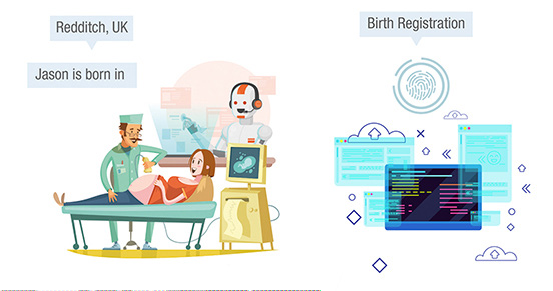
Name: Jason
Born: Redditch, UK
Date: 20/03/2030
On a normal day, in a normal town, a child with a normal name is born. But Jason's life will look anything but normal compared even with those born a decade earlier.
Jason's birth is an uncomplicated process, overseen by a local doctor and midwife and supported by an AI assistant selected by Jason's parents from a range of commercial, public and not-for-profit options. Within minutes of his birth, Jason's life is registered, via a personal e-ID, onto a decentralised data infrastructure designed to facilitate ownership, security and privacy. Wherever Jason goes in life, he will be accompanied by this randomly generated 10-digit number. This unique identifier links to all of his core personal and biometric data, enabling him simple and secure access to key public services and civic duties.
Birth Registration
Conceptual diagram of a digital birth registration system, featuring a fingerprint scanner and user interface elements, as described in the accompanying text.
University of Helsinki, Finland
As Jason approaches school age, his parents begin the search for the education best tailored to his preferences, abilities and ways of learning. But Jason's parents are not restricted to the four or five schools closest to where they live: e-residency initiatives and improved technology have allowed virtual enrolment and learning across borders. His parents compare schools in cities as disperse as Lima, Tallinn, Nairobi and Seoul, each rated by how well they meet Jason's needs. They eventually select a school in Helsinki, where Jason also completes his university education - all without needing to physically leave Redditch.
Graduation

As an adult, Jason lives in an urban community which over time has been able to greater gain control over local decisions. These decisions can be debated and decided upon locally using participation technology, before being formalised by smart contracts.
When Jason parks his car in a restricted area without the correct permit – as decided locally by Jason's community – a sensor detects the infringement. This violates one of the conditions of a social smart contract Jason signed with his community when they collectively agreed local parking restrictions. In the past, a fine would have been issued by the local authority, but these days the process is automated.
As the smart contract is triggered, Jason automatically makes a payment directly to others in his community – the ones personally inconvenienced by Jason's actions and with whom he broke a form of social contract.
The local community also has a shared agreement about what should happen to proceeds from parking fines. In Jason's case, the money is directed towards a project which provides non-car based modes of transport, an initiative the community felt was important to support ongoing obligations to reduce carbon emissions.
Smart Contract

Illegal parking
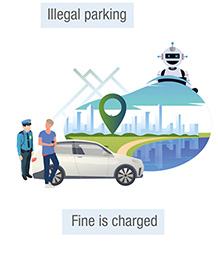
Fine is charged
Fine payment

Fine is paid to citizens
Payment Successful

Jason Votes on a participatory community project
Authentication

Jason's life involves a lot of voting, but on a far wider range of purposes than just electing representatives, with communities now making many more decisions collectively: setting local rules, deciding how local budgets will be spent, and other key decisions affecting the area. Occasionally, local referendums are held, though communities have a strong preference for deliberative processes, and there are strict criteria on which issues can be put to referendums.
To vote, Jason verifies his identify through a decentralised system built to require the minimum amount of data needed to prove he is who he says he is. This can either be done through the use of digital attributes, or through a secure biometric scan: so simple and fitting so seamlessly into Jason's online civic participation that he barely notices he's doing it.
Voting occurs

Much of Jason's civic participation happens at a local level, but some issues sit at a level beyond geographic states. One such issue is tax evasion, which citizens agree must be tackled internationally.
All tax records, filing and payments are done online, with automated calculations for bills and rebates: the same process for companies and individuals. An AI tool is used to detect where tax evasion may be happening, and where the tool's various checks and criteria are satisfied, charges are brought. A jury of citizens is selected to preside over the trial remotely, while information and footage can be viewed by other citizens online in real time. The jury's role hasn't changed much, except they all participate remotely now.
Jury selection
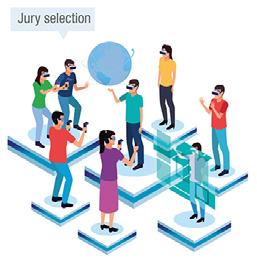
Online Tax Payment

Citizens also informed the tax evasion laws and how they should be interpreted, collectively deciding that not only would companies need to comply with the letter of the law, but would also be judged by jurors on whether they had complied with the spirit of the law, too. When a verdict is passed, any fines are paid automatically, and are distributed according to where and who suffered the most as a result of the evasion.
Corporate tax defaulters
Online verdict
A DAY IN THE LIFE of the DEPARTMENT for DEMOCRATIC AI
by Harry Farmer
9am – Bernard Williams room
So Jimmy, one final question.” The young man opposite Julia shifted in his seat, preparing to pounce on this query as eagerly as the others she'd thrown at him that morning.
“What would you identify as the main challenges facing the Department?".
This one was always the clincher, Julia thought. As interview questions went, it was practically impossible to answer well: on the one hand, the Department didn't want to recruit anyone who saw its role as fundamentally flawed. But on the other, if you didn't have the wherewithal to see the difficulties – absurdities, even – of regulating the morals of AI systems, you really had no business as an adviser in one of the most scrutinised and challenging government departments.
"Well..." Jimmy began. "There are a few, actually. There are the problems faced by any body that exists to take morally charged questions out of the hands of politicians still in the firing line for them. Then there's enforcement. Because you can't realistically scrutinise every programme developed, you have to make the fines for non-compliance huge. It's impossible to make this sort of regulation light-touch."
"But most fundamentally, people's moral judgements aren't consistent. I don't mean they can't agree on answers to moral questions – though that also seems to be a bit of an open question." This aside drew a thin smile from Julia.
"I mean that it's seemingly impossible to come up with a set of general moral principles that, when applied to specific cases, consistently suggest courses of action we feel to be right."
For the first time in what had seemed like an eternity to Jimmy, Julia spoke.
"Some might suggest you've got the moral psychology backwards,” she said. "They'd say that when people's moral intuitions clash with what follows from a moral principle they agree with, they're just as likely to dismiss their intuition as they are to abandon the principle."
Now it was Jimmy who smiled. He'd hoped this would come up today.
"So there's evidence this happens sometimes,” he said. "But if you look at what happened a couple of years ago in the States – when people were asked to choose the moral principles of their cars – it's clear it doesn't always work that way.”
Julia was all too familiar with what had happened when US regulators had decided it should be users of autonomous vehicles, not their manufacturers, who should decide how they should react to high stakes moral trade-offs. Every time you got in your car, it would ask you to reconfirm how you wanted it to behave: “before we set off, Mr Smith, I'll need you to confirm: would you like me to protect the car's occupants at all costs, or to minimise overall casualties and loss of life?". It hadn't gone well.
"Most people couldn't stand the idea of telling their car to respond to life or death situations in a particular way - not once they realised it made them responsible for decisions they could neither predict nor stomach. Those who got into crashes seemed pretty bad at rationalising their disgust with how the car had behaved – how they'd told it to behave. It didn't matter that the behaviour followed from principles they'd thought sounded about right."
"And why is this problem unique to the Department for Democratic AI?” Julia asked. “Why don't other institutions that regulate behaviour struggle with this? The legal system seems to more or less function, even though it also exists to codify and police norms."
Jimmy took longer before answering this one. He knew the answer – or thought he did – but he always struggled to express it clearly.
“Well, the difference is that the law only applies retrospectively. Of course there are legal principles that look forward – that allow people to understand what they are and aren't allowed to do – but sometimes we choose not to apply the law, to let people off the hook.” Jimmy used a lengthy sip of water to gather his thoughts.
"It's different when the principles you decide upon are guaranteed to be followed to the letter, when there's no human to sense check or override them."
"The way we think about morals – I'd suggest – is based on specifics. But AI forces us to develop general principles, towards an uncomfortable level of absolution. That's a heavy burden for the Department to bear."
Julia smiled more fully this time. “Given these difficulties, do you think the department can do any good? And are there things we could be doing differently?".
The interview was more than twenty minutes over time by this point. Julia didn't really need to hear any more – she'd made up her mind to offer Jimmy the job a while ago. To her vague embarrassment, she was actually asking the question because she didn't know the answer herself. It wouldn't do for the Head of Policy to ask such a desperate sounding question of a recent graduate, but an interview provided the perfect cover for her to clutch at straws.
"I should say right away that I think what we have now is infinitely preferable to a world in which AI isn't regulated at all – or where regulators just look at outcomes rather than processes," Jimmy answered.
"If there's nobody keeping an eye on the decisions made by AI, then we're delegating, what? Eighty per cent of the choices made about us to something we can neither understand nor control. That's clearly not acceptable.”
"For all the challenges, the Department at least provides a degree of certainty for those developing and subject to AI decisions. Even if the specific regulatory choices aren't always right, it's better to have imperfect ones than none at all.”
Julia, who had been making notes on a tablet, looked up. “Thanks, Jimmy. We've overrun by quite a bit – but I think it was worth it.”
2pm – Alan Turing suite
"Okay, let's try something different.” Freya ran these workshops at least twice a week, but this one was proving tricky.
The thirty or so coders gathered around her were a rowdier group than usual. Most of those who attended her sessions were keen to get their machine ethics certification as quickly – and with as little effort – as possible, but this group had been disconcertingly engaged.
“I want you to break into groups again. I'm going to give you three different kinds of AI systems, and I want you to explore what moral issues you might encounter in developing them."
Slowly, the group shuffled itself into clusters.
"The first one should be nice and easy,” she said. “A driverless car.” A sigh rippled audibly across the room. “Yes, yes,” Julia retorted, “but it's a cliché for a reason. We wouldn't be here if people had taken it seriously sooner”.
"First, a driverless car system for use on mixed roads. Second, a system to optimise and monitor power usage in public buildings. Third, an assistive robot used by older people living alone."
"Before you start, I don't want you to try to solve any of the problems you identify. I just want you to come up with as many as you can, and tell me which you think are the most pressing. Any questions?".
Mercifully, and for the first time today, all Freya got was sullen stares. “Alright, I'm gonna give you half an hour. Then we'll go through them together."
With the task assigned, Freya grabbed her laptop and retreated to the corner of the room. While she enjoyed the subject matter – the idea that she could use her philosophy PhD outside of the academy still seemed too good to be true – she had recently been struggling to see the point in forcing coders to think about these things.
It wasn't as if she couldn't see the value of this part of her job. The government's requirement that anyone writing code in a professional capacity undergo ethics training was certainly an improvement on the past, when people would routinely develop software that turned out to have profoundly amoral dispositions – and then wring their hands when people noticed.
Nor was it fair to say that coders didn't care about the ethical implications of what they did. Ever since a landmark series of high court rulings established that it was developers of AI systems, not their users, who bore ultimate responsibility for their actions, most (though not all) programmers had been keen to cover their arses – though a lot had just found other, less fraught, careers.
The no-win no-fee AI compensation bonanza of the mid-twenties had taught everyone this the hard way. The party had been subdued when the company providing the algorithm used to identify potential claimants was itself sued into administration, and lawyers were forced to go back to drumming up business the old-fashioned way – with incredibly annoying adverts. It only truly ended when the Department had been formed and taken these cases out of the lawyers' hands for good.
The problem, Freya thought to herself, was that being aware of a problem wasn't the same as being able to fix it. As more than one of today's cohort had pointed out, it's all very well being aware of the moral dilemmas machines are likely to run into, and all very well – in principle at least – for a regulator to decide how they should respond.
The real problem was a technical one, bound up with the specific way most AI systems worked. As one particularly irritated coder had put it earlier this morning, “you're telling us to develop systems that follow particular moral principles. But you know that's not how AI works. Real AI is engaged with at the level of goals, not principles.” Freya hadn't really had an answer to this, and struggled to get the group to see the point of their being there for the rest of the day.
Philosophers and cognitive scientists were working on solutions to this problem, the most promising of which was a project to develop 'explanatory systems' to run in parallel with existing AI – effectively allowing an AI to produce a rationalisation of its behaviour that coders could engage with in moral terms. But this was still a long way off. The difficulty was, more often than not, that the rationalisations produced by the AI were obviously obscuring the real reasons behind its behaviour. Freya, who had worked on this problem as a postdoc, suspected this was exactly the way the human brain worked, but until the machines got at least as good as people at pretending to think morally, it would be an issue.
Wary of the time, Freya forced herself from her reverie back to the task in hand. Glancing up periodically to make sure the coders hadn't mutinied in her absence, she began typing.
"Outcomes of notable recent decisions from DDAI's Citizen Councils – notes for Ministerial briefing..."
2:30 pm – Offices of the Secretary of State for Democratic Artificial Intelligence and Automated Systems
"Tariq, get in here now!"
"Yes, Minister?"
Tom had been Secretary of State for Democratic AI for almost six months, but still hadn't quite grown used to its permanent secretary's ability to appear silently within seconds of being called. Sometimes Tom entertained the suspicion (more seriously than was healthy) that Tariq was never really gone, just hiding somewhere, dormant, until needed.
“Have you seen the memo Freya just sent over – the one going over key changes to our regulatory principles since last year?".
"Of course, Minister."
"Well, how the hell am I supposed to justify some of these to the PM? I've got an interview with Theo Ashby from Youtube in four hours, what am I meant to say to him?".
"What specifically was bothering you, Minister?" Tariq asked. It was Tariq's job to understand the Minister's brief so he didn't have to, but half a year in, Tom's seemingly wanton ignorance of the nuances and paradoxes of the Department was becoming wearing.
The department was in an odd place. When it was founded, it was seen as somewhere a bright young politician could distinguish himself from his older peers, dealing with issues that were both unequivocally important and, so ran the prejudice, totally beyond the comprehension of anyone born before the nineties. The past two years had served as ample counterexample, but the Department was still new and shiny enough that a minister could pretend without too much determination that being sent there was an honour, not a punishment.
Tom was sharp enough to see the Department for what it was, but didn't quite have the self-awareness to accept he was unlikely to be leaving anytime soon – at least not for something better. The result was that he regarded learning the ins and outs of the place and its work as somewhat of a waste of time, knowledge he'd only have to discard once he'd been shuffled up to the Foreign Office or the Ministry of Resource Security.
"What's bothering me is that almost half of our new policies are totally inconsistent with our existing ones. One of the promises we made to industry when we set this place up – the main promise – was that even though the regulation we imposed would be onerous, we'd provide certainty. We said AI business would know where they stood.”
"Until this morning, our position on AI paternalism – so carebots, personal avatar assistants, semi-autonomous exoskeletons, God knows how much else – was that a system can go against the stated wishes of its user if it's necessary to prevent clear and immediate physical harm to that person, or harm to others that would follow as a result of the AI's action – but not its inaction... I'm paraphrasing, obviously."
"Yes, Minister.”
"So look at what she's just sent me.” Tom gestured the text on his tablet up onto the wall and circled a paragraph. "She says this year's citizen councils have almost completely reversed this position. Assistive AIs basically can't intervene now – practically the only exception is that they can't help you to commit suicide.”
“If I were the CEO of one of these companies, I wouldn't know where I stood. Hell, I'm the Minister of the department that makes the rules and I couldn't tell ‘em where they stand. How do I justify this? We can't have our regulatory position change every bloody year."
“Well, Minister,” Tariq began, carefully. “It's a different set of citizen councils to last year. They can't be expected to come to the same conclusions.”
"I still don't get why the can't use the same bunch of people every year, or at least give them longer terms," Tom replied.
"The problem with that is that the councils are meant to be representative of the population as a whole. The mere act of serving on a council like this for any period of time is not a normal thing to do – it makes you less representative.”
"But why is there such variation year on year? A bit of change I understand, but a one eighty pivot on such an important principle? The groups are meant to be pretty much the same, aren't they? If we choose them so carefully, how come there's this much variation?”.
"We can't control for everything.” Tariq said. “People's moral dispositions seem to vary in unpredictable ways.”
"But surely we can. There must be correlations between the other data we collect and answers to the trolley problem? Why can't we recruit the councils like that?”.
“Well technically, Minister we could –".
"- So?".
“But it would violate our own regulatory principles on data mining. And supposing we could understand people's fundamental moral dispositions in advance, then what? Would we pick council members on that basis? It would feel rather like loading the dice, don't you think?".
"Then there's the question of how you load the dice. Do you want equal representation between people with different moral psychologies, or do you want the fundamental moral psychology of the councils to reflect that of the country? And how do we even know what the country thinks?".
"This is all fascinating, Tariq, but how does this help me? We're still in a position where the rules are changing almost every year. It's just not acceptable."
"There's every chance things will settle down. If we know anything, it's that people aren't sure how they want AI to behave; these questions really are difficult. Right now, members have got very little to go on – AI morals have barely been regulated for four years now, and for the first two, nobody really knew about it.”
"Future members will go in knowing full well what previous councils have decided. Given the huge levels of responsibility placed on them, by far the easiest thing for them to do will be to agree with what's come before. That way, if they get it wrong, they won't be the only ones. And the more this happens, the more likely it will be to happen. If five previous councils have decided on a set of principles, you've got to be damn sure of yourself to suggest something different. Give it a couple of years and you'll get your stable regulatory environment.”
Tom pondered this for a moment. It would have been more comforting if he'd had any intention of being at DDAI for anything close to two years.
“That's all very well, but how is that meant to help me now? I can't say that tonight."
"I've prepared you some talking points that should buy you some time before this kicks in. They should be in your Red Box."
Tom glanced down at his tablet, opening up the Red Box folder. “Okay, I'll read this now. Thank you, Tariq."
"Of course, Minister."
Tom looked up to smile at his Permanent Secretary, but he was already gone, the door closed silently behind him.
Overturning Parliament
It's summer 2030, and extremists have been relegated to the margins of UK politics. Britain is now considered the world's truest democracy, and pragmatic, forward-thinking government looks set to stay.
Yet only a decade ago the country was teetering on the brink of civil war. Our parliamentary system, which had appeared to serve us well for centuries, was broken beyond repair. Having been gridlocked for close to two years, Parliament was battling attempts to bring it down. Public faith in democracy was dead, and violent anger had begun to spill out onto the streets.
Upside-down Parliament
It may have been Brexit that had brought the crisis to a head. But it had been brewing for many years. It's now widely accepted that traditional parliamentary democracy in the UK was doomed to fail since its inception – because the entire structure upon which it was built was upside down!
On the face of it, the two parliamentary chambers had appeared to balance democratic accountability (via the Commons or Lower House) with expert scrutiny and long-term interest (via the Lords – the Upper House). There were merits to both houses, but each also exhibited fundamental flaws – flaws compounded by the 'upside-down' nature of the parliament.
The population had its say through general elections, determining the political hue of the Lower House. But democracy became increasingly diluted as policies and legislation moved up the parliamentary ladder, through the unelected Upper House, before ultimately being signed off by the Monarch.
The Problem with the House of Commons
Elections to the Lower House were democratic, with party-political considerations playing a key role. But party politics, combined with general elections at least twice every decade, meant that policies were driven by ideology, political ambition and the need to ensure re-election.
Elected governments regularly used previous incumbents as scapegoats when things went wrong, and sometimes when they didn't. Ministers relished every opportunity to reverse perfectly adequate policies introduced by previous governments simply to make their political mark. And, when it came to the opposition's scrutiny of government policy, it was less a case of dispassionate analysis and more blame-mongering with a view to snatching power at the next election.
All in all, parliamentary democracy was a costly, ineffective and antagonistic model of governance, slowly fanning the flames of animosity for several decades before Brexit poured on the oil and exposed its failings for all to see.
The Problem with the House of Lords
Hereditary Peers: Attended School
* State School: 2%
* Private School: 98%
Age of Members of House of Lords
* Less than 39: 0.2%
* 40-59: 17%
* 60-79: 66.8%
* Over 80: 16%
The Upper House was by no means devoid of political rivalries and inflated egos. But, freed from electoral imperatives, it represented stability – enabling it to take a much more considered approach. Members of the Upper House spent much of their time considering draft laws emanating from the Lower House, scrutinising each draft law line by line. And, although the House had lost its judicial role back in 2009, its voting membership included many individuals with top legal or judicial backgrounds. This meant the House was well placed to understand the implications of new legislation, and was often able to persuade the government to make policy changes on a wide range of issues, such as a delay on cuts to tax credits until protections for low paid workers were put in place.
One of the problems with the Lords, however, was that because it generally considered draft laws that had already passed through the democratically elected Lower House, any legislative delays, amendments or rejections could be construed as anti-democratic. This, coupled with the highly visible fact that the Upper House did not reflect the demographic makeup of the UK, meant it seemed aloof and out-of-touch with everyday people. It lacked diversity in terms of ethnicity, age, gender and religion, appearing to be a relic of a bygone era. Its members were regularly portrayed in the press as "sleeping on the job", "squandering tax-payers' money” and “deliberately frustrating the will of the people to serve their own self-interest".
Hidden Cracks in the System Start to Show
Despite the flaws in both parliamentary houses, the system had been relatively stable and appeared largely democratic since the end of the First World War. Elections had been dominated by two main parties, Labour and the Conservatives, each benefiting from a defined voter base to which it was able clearly to articulate its values. Highly-unionised blue collar workers and academics tended to vote Labour, whilst wealthy land-owners, entrepreneurs and industrialists generally voted Conservative.
The result was a century of functioning representative democracy within the Lower House; within this stable two-party system, the fact that an unrepresentative group of septuagenarians held the power to curb the electoral will of the Lower House appeared purely academic. In effect, the two-party system served to paper over the cracks of the fundamentally flawed system.
But societal shifts in post-industrial Britain meant the voter base became fragmented. People no longer cast their votes along clearly defined party lines and, as a result, the Labour Party and the Conservatives became pressured to adopt increasingly incoherent and populist policies in a desperate attempt to gain votes.
As politics became more polarised and extreme, the majority of the electorate felt there was no party that spoke directly to them: voters, more often than not, resorted to placing their cross in the box for the party they felt represented the 'lesser of two evils'. So whilst some people got what they voted for, almost nobody got what they actually wanted. Parliamentary democracy had failed.
New Democracy
By 2020, with the Brexit Bill failing to pass successfully through both houses of parliament, attitudes to the Establishment had turned from disillusionment to downright hostility. Whilst anger had spilled onto the streets, in many cases setting neighbour against neighbour, the brunt of it, from all shades of the political spectrum, was directed at the established political system, which lay impotent in the face of a national uprising.
The spring 'Million Man March on Parliament' had ended with the occupation of parliament buildings by the people, and in the absence of any credible political authority, the monarchy took charge. The Army was commanded to ensure peace on the streets whilst the Queen established a temporary government of national unity, and a Royal Commission was rapidly established to devise a new model of parliamentary democracy to truly act in the interests of the country and be enshrined in law under a new national constitution.
The resulting parliamentary model sees democracy become strengthened, not diluted, as it passes through the Parliamentary process. The Lower House is now made up of expert 'peers' who propose sensible, well considered policies and legislation and we, the public, have the final say on these proposals through the Upper House.
Members of the Lower House are selected on merit to represent key sectors or interest groups: scientists, engineers, farmers, doctors, head teachers, senior police officers, youth workers, small business representatives, economists and heads of industry. Social, cultural and religious groups are also represented in this Lower House. Membership is supplemented by representatives from the general public, randomly selected from a group who have opted in to contribute significant amounts of their time. While Members serve for a period of 3-5 years, the focus is on maintaining sustainable health, wealth and happiness for the nation and all its people.
Membership of the Lower House is supplemented by seasoned legal experts, such as judges and QCs, many drawn from the disbanded Upper House. These legal experts provide guidance on the implications of new legislation, and undertake other necessary due diligence before draft laws are passed to the people to take the ultimate decision.
The Upper House is now where we, the people, get our democratic voice. In many instances this still takes the form of representative democracy, whereby people elect a local representative to approve policies and legislation on their behalf. The Upper House performs a role similar to that of a company board, responsible for approving the final composition of the Lower House.
The development of new policies and legislation is generally initiated when members of the Lower House identify a particular need or potential benefit – drawing widely on input from civil society and the various sectors they represent. But technology is increasingly being harnessed to allow the population as a whole to suggest, discuss and ultimately determine which draft policies and laws should be approved.
Ordinary members of the public can also petition for new policy and legislation to be considered. Members of the Lower House then work together to shape proposals and identify any unintended consequences or indirect implications on other interest groups. Proposals are either agreed by consensus in the Lower House and put to the Upper House for approval by the people or, if there is more than one option, put to the Upper House for final decision. Each decision is supplemented by online and offline engagement with the public, producing considered reflections of public opinion to factor into the legislative process.
This has lead to a truly representative and efficient democracy. Advancements in cyber security and biometric technology mean secure input can be gathered from individuals on a mass scale, and time sensitive laws and legislation can be approved or pushed back to the Lower House in a time efficient manner. As technology advances, the need for members of the public to be represented in the Lower House is expected to diminish.
Under our new system, draft policies and legislation are driven by long-term, strategic vision rather than short-term populism. But where proposals are widely unpopular with the voting public, they can be voted down in the Upper House.
The system is vastly more cost-effective, policy direction remains steady, and investment in public services is planned and committed over decades rather than years. To an extent, fiscal responsibility is shared by both houses – core budget priorities are proposed by the Lower House and approved by the Upper House. But in the same way the Bank of England took charge of setting interest rates in the 1990s to de-politicise monetary policy, an independent body has been established to oversee fiscal accountability and determine whether there is a need to increase taxation or borrowing to meet additional spending pressures.
The Lower House enforces a code of conduct for its members; the increased engagement of individuals in policy development through technology creates an additional element of accountability. And an Independent Scrutiny Committee and transparent process for any complaints or investigations helps to safeguard against corruption and bad government.
It is often said no system is perfect, and it remains to be seen how our new democratic system will be viewed through the lens of history. However, under the new system, the Brexit stalemate was brought to a a satisfactory and democratic end in little over six months. Where the previous system had failed so spectacularly, our newly born democracy has proven itself capable of delivering sensible, workable solutions, and re-united our polarised nation.
Perhaps ironically, the monarchy played the pivotal role in averting civil unrest and in the development of the new constitution. At the opening of the new parliament, King Charles III declared the successful establishment of new and true democracy in the United Kingdom to be Queen Elizabeth II's legacy after seventy years on the throne.
The Old Parliamentary System
4. Monarch
3. Upper Chamber
Role
Considers and amends draft legislation. Scrutinises the work of the government.
Problem
* Not representative of the demographic make up of the UK
* Has the power to delay, amend and at times reject legislation introduced by the democratically-voted Commons. As this upper chamber is unelected, it can be seen as an anti-democratic institution with the power to frustrate democracy
* A number of Members are hereditary peers rather than appointed on merit
* Appointments are often party political and therefore partisan
* Members are generally appointed at the end of their careers and are perceived as out of touch.
2. Lower Chamber
Role
Government (made up of MPs from the party with most votes) sets priorities, decides how to spend public money and deliver public services, develops draft legislation. MPs from other parties hold the government to account by 'challenging it'.
Problem
* The need to get re-elected promotes vote-winning initiatives over long-term strategic vision
* Party politics leads to a culture of blame, with MPs refusing to work together cross-party
* Short-term nature of government means investments and delivery models are overturned by future governments and are therefore costly to the public purse.
1. Universal suffrage
Free vote for all adult citizens, regardless of wealth, race or ethnicity*. People vote for MP to be their local representative. Most MPs are part of a political party.
*Very minor exceptions apply e. g. the Queen, Members of the Lords, and long-term ex-pats.
The New Parliamentary System
2. Upper Chamber
Make-up
* Representatives elected by the voting public or direct democracy. Representatives are elected on a geographic but not party-political basis.
Role
To have the final say, deciding on and approving or rejecting draft policy and legislation proposed by the lower chamber.
1. Lower Chamber
Make-up
* Made up of experts representing sectors and interest groups - selected on merit/proposed by sector bodies.
Role
Engage with stakeholders to identify areas which need, or would benefit from, new or reformed policy or legislation. Work together to develop and draft policy and legislation. Work together to develop and draft policy and legislation and assess the potential implications across all sectors.
Contributors
Ann Light
Ann Light is Professor of Design and Creative Technology at the University of Sussex, UK, and Professor of Interaction Design, Social Change and Sustainability at Malmö University, Sweden. Her work addresses the co-making of futures, the social impact of technology and the politics of design. She is currently investigating how creative practices can promote transformations to sustainability and working on social justice in the digital economy.

Deborah Mason
Deborah Mason is an artist and cultural & environmental activist (she also runs a micro-gardening business in Maidenhead where she lives). She has recently completed commissions for the University of Sussex, Wild Maidenhead and the Gulbenkian Foundation. Her work engages with feminism and the environment. Her recent Artist In Residence 'In My Own Street' explored the dual themes of community as a vehicle of environmental protection and the idea of 'close attention' as a means to empathy and care. The project ran Jan 2016 to June 2018 in Kennington.

Andrew Greenway
Andrew Greenway is a writer, former senior civil servant and partner in Public Digital. He was a product manager in the Government Digital Service, and worked in five UK government departments, covering energy, climate change, business, health and science. He has published two books, Bluffocracy and Digital Transformation at Scale, and has written about institutional reform for the Guardian, New Statesman and The Spectator, among others. He is a member of Council for the University of Exeter.

One Team Gov
Logo for One Team Gov, showing text "ONE TEAM GOV" inside a stylized orange square outline.
One Team Gov is a global community, working together to radically reform the public sector through practical action. We're driven by optimism and the desire to make things better, and united by a set of core principles.
Acknowledgements
With thanks to our global community for taking the time to record, write and coordinate the submissions that this Radical Vision is based on, including One Team Gov Australia, One Team Gov New Zealand, One Team Gov Finland, One Team Gov Canada, One Team Gov Wales, One Team Gov Scotland and One Team Gov Midlands, and to attendees at One Team Gov Bureaucracy Hack in London in July for their contributions. Thanks also to Graham Higgins for video editing.
This Radical Vision was coordinated, written, and filmed by a small group of central volunteers: Sam Villis, James Cattell, Jenny Vass, Morgan Frodsham, David Durant, Nour Sidawi, Prateek Buch, and David Buck.
Vik Sasi
Vik Sasi is a Partner at Dreamers, a $100m early-stage venture fund co-founded by Will Smith and Keisuke Honda, having previously been on the investment team at AmFam Ventures. He began his career as an Analyst for the Clinton Foundation's Health Access Initiative and as a Strategic Advisor to the Haitian Ministry of Health, with additional stints in investment banking at Morgan Stanley and venture capital at Healthbox. Vik is a former state chess champion, FAA Private Pilot and speaks Spanish, French and Haitian Creole. He holds a BA in Biology from Washington University in St. Louis and an MBA from the University of Chicago Booth School of Business.

Stephen Muers
Stephen Muers wrote this piece in his capacity as a Policy Fellow at the Institute for Policy Research, University of Bath. He has extensive experience in senior policy and strategy roles in government and the third sector. He is currently writing a book on the role of culture and values in policy-making.

Simon Parker
Simon Parker is a senior local government officer. He previously led the think tank NLGN and held senior positions at the Institute for Government and Demos. He is the author of Taking Power Back, published by Policy Press.

Guillermo Ortego
Born in Madrid and currently living in London, Guillermo has been inking comic books and illustrating books and magazines ever since he completed a degree in History in 2009.
On inking duties, he has worked for American publishers like Marvel, DC Comics and Valiant, where he's been lucky to work on titles such as Astonishing X-Men, Batman Eternal and Punisher.
On the illustration front, Guillermo provides covers, portraits and interior pieces for newspapers like Politico or El Mundo and for magazines like Panenka, Firewords Magazine and Stir to Action. He has also illustrated books for the Spanish publishers Espasa, Everest and Graphiclassics.

Adam Fletcher
Adam Fletcher is the Head of British Heart Foundation Cymru. Adam previously worked as a health and social science researcher and lecturer at Cardiff University and the London School of Hygiene & Tropical Medicine. At Cardiff University, he helped to establish a new public services innovation lab in partnership with Nesta. He has published over 100 peer-reviewed journal articles, research reports and book chapters about public health and how to improve it.

Kevin Morgan
Kevin Morgan is Professor of Governance and Development in the School of Geography and Planning at Cardiff University, where he is also Dean of Engagement. His research revolves around the inter-related themes of governance, innovation and the development of cities, regions and localities. He explored the interplay of these three themes in a recent report for the OECD called Experimental Governance and Territorial Development: https://www.oecd.org/cfe/regional-policy/broadening-innovation-policy.htm

Charles Sabel
Charles Sabel is a professor of Law and Social Science at Columbia Law School. Previously he was Ford International Professor of Social Science at MIT. His undergraduate degree is in social studies and his graduate degree is in government, both from Harvard University. Earlier work focused on the crisis of mass production and its implications for the regulation of markets and the macro economy. More recent work develops pragmatist ideas into a general conception of democratic experimentalism, with particular attention to regulation, the provision of complex social services and contracting under uncertainty. Current projects include the elaboration of experimentalist or incremental solutions to apparently global problems such as trade and climate change; an investigation of the current transformation of US administrative law in the face of uncertainty, and new models of economic development emerging with the spread of advanced techniques of “industrial” production to all sectors of the economy in the context of globalization.

Centre for Public Impact
Logo for Centre for Public Impact, a BCG Foundation. It shows a circle with three dots and text "Centre for Public Impact A BCG FOUNDATION".
The Centre for Public Impact (CPI) is a not-for-profit founded by the Boston Consulting Group. Believing that governments can and want to do better for people, we work side-by-side with governments – and all those who help them - to reimagine government, and turn ideas into action, to bring about better outcomes for everyone. We champion public servants and other changemakers who are leading this charge and develop the tools and resources they need, like our Public Impact Fundamentals, so we can build the future of government together.
Our contribution to the radical visions collection was informed by our recent discussion paper on the Shared Power Principle. (https://www.centreforpublicimpact.org/future-of-government/). The core idea of the principle is that for government to work better for everyone, we need a radical redistribution of power from the centre and the top to the lowest levels. The CPI contributing team included Elena Bagnera, Danny Buerkli, Margot Gagliani, Magdalena Kuenkel, Adrian Brown and John Burgoyne. We would also like to thank Joe Wilson, the talented illustrator who helped us bring this radical vision to life.
Anna Schlimm
Jacob Chabeaux
Anna Schlimm and Jacob Chabeaux are London-based designers with a creative practice that spans graphic, motion, service and speculative design.
They believe that design can and must contribute to social and environmental good, by imagining and revealing possible worlds that are hiding within and beyond our own.


Greg Falconer
Greg is the Director of Innovation Policy at Nesta. He drives delivery of our current strategy to make innovation policy smarter, more inclusive and fit for the future while raising the profile of our work and thinking about what comes next. Greg joined Nesta from BEIS, where he was Deputy Director for Innovation Policy, responsible for increasing the R&D intensity of the UK. He is most interested in increasing the impact of innovation policy and making sure it supports the priorities and values of citizens. Before BEIS, Greg was a Deputy Director in the Cabinet Office working to make government more efficient and effective. During that time he wrote the report, Better Innovation for Better Government, which inspired his short story. He has also spent time at Eurasia Group, KPMG, the Foreign & Commonwealth Office and RAND Europe.

Nell Watson
Eleanor 'Nell' Watson CITP FBCS FIAP FIKE FRSA FRSS FLS is a Machine Intelligence engineer who grow up in Northern Ireland.
She helped to pioneer Deep Machine Vision at her company QuantaCorp, which enables fast and accurate body measurement from two photos. Later she decided to teach these techniques to others, as author of Machine Intelligence coursebooks for O'Reilly Media.
Nell serves as Vice-Chairman of the IEEE P7001 Committee creating new safety standards for autonomous systems, and is also the Co-Founder and Chairman of EthicsNet.org, a community teaching pro-social behaviors to machines.
She serves as a Senior Scientific Advisor to The Future Society at Harvard, and holds Fellowships with the British Computing Society, and Royal Statistical Society.

Cat Drew
Cat Drew is the Chief Design Officer at the Design Council, has held leadership positions at FutureGov and Uscreates, was a co-founder of the UK Government's Policy Lab where she combined 10 years of experience in Government with an MA in Graphic Design to pioneer new approaches to policymaking, including speculative design. She speaks widely about the value of design and co-presents BBC Radio 4 The Fix. She is a member of The Point People.
https://cargocollective.com/catdrew | @catdrew_
Stephen Bennett
Stephen Bennett is a multimedia artist and policy-maker working at the intersection of art, science and policy. Stephen's practice incorporates data and evidence in unexpected and interactive ways, including a collaboration with Nesta to create a hanging installation showing health inequality across the UK, and a residency at CERN to communicate particle physics through microscopic images of the surfaces of the particle collider. Stephen has exhibited at the Tate Exchange, Imperial College and the Royal Society. Stephen further explores these themes as part of Policy Lab in the Cabinet Office, deploying artistic and creative techniques in projects with policy-makers.
https://www.srgbennett.com/ | @SRGBennett
Liv Bargman
Liv Bargman is an award-winning illustrator and artist. Liv has worked on a variety of projects with clients including We The Curious, Barclays, House Of Illustration, Radio Netherlands, Leo Burnett, Marie Curie, Tommy's Baby Charity, Parkinson's UK and Nuffield Primary Care Health Sciences. She also works as a graphic facilitator at Capgemini, EY and PwC in accelerated solutions workshops to enable radical change for public and private sectors. Liv has exhibited internationally and won the 2017 Biodesign Challenge at MoMA, New York.
http://www.livbargman.co.uk/ | @LivBargman
Phoebe Ridgway
Phoebe Ridgway graduated from Leeds Arts University in 2018 where she studied Fine Art. Since graduating Phoebe has been involved in many collective and individual shows across the UK. She is currently living and working in London where she works as an artist in residence at an East London primary school and is maintaining her practice in a shared studio in Peckham. In September she will start at 2 year MFA at The Slade School of Art, London. https://www.phoeberidgway.co.uk/
Phil Booth
Phil Booth is the founder and coordinator of medConfidential, and was previously national coordinator of NO2ID. medConfidential is an independent non-partisan organisation campaigning for confidentiality and consent in health and social care, which seeks to ensure that every flow and use of data within and around the NHS and wider care system is consensual, safe and transparent. medConfidential also engages with data use all across Government, as to a first approximation – the data that institutions of state most want to copy is your medical record.
(photo credit: Mike Goldwater)
Charles Ikem

Charles was born in Eastern Nigeria and lives in Italy. Charles is a service designer and has worked for Amazon UK, CELT UK, and CTE, Italy and consulted for ITU (Geneva), Hilti (Liechtenstein) and Safi analytics (Kenya/USA). Charles holds an MA in Design Management from Birmingham City University, UK and a PhD from the University of Padova, Italy. Charles's work is at the intersection of design and technology and ever curious on how design can foster new behavior for emerging technologies and more specifically the future with autonomous technologies, digital identities and distributed technologies. Charles is a member of the Expert group for EU NGI Explorers and LEDGER Projects.
Harry Farmer

Harry Farmer is a policy professional fascinated by the ethical, societal and economic ramifications of emerging technologies. Since September 2019 he has been a senior policy adviser at Nesta working on inclusive innovation, having previously worked for regulators, think tanks and in policy consultancy.
Rachel Burgon
Rachel Burgon is an international higher education specialist and entrepreneur. She is co-founder of UK University Services (uk-universities.co.uk), which supports international students applying to UK universities, and provides consultancy to higher education institutions.
She has two decades of experience in higher education and international relations and she is a non-executive director for gap-year charity Lattitude Global Volunteering. lattitude.org.uk
Rachel lives near Milton Keynes with her husband, Ross, and two children.
A thank you to everyone who participated in the open call
- Gustavo Luis Gava
- Jonathan Whethan
- Randall Hayes
- Arnaldo Pellini
- James Sancto
- Joan Roses
- Colin Pattinson
- Benjamin Buch-Andersen, Isabella Brandalise and Joao Sigora
- Neill Kramer
- Miquel Estape
- Melanie Nock
- Riley McCullough
- Himanshu Rohilla
- Andrey Uriel Vergara Sanchez
- Mark Ridgewell
- Dan Bowyer
- Holly Brenan
- Helen Pallett
- David Wood
- Philip Oldenshaw
- Areeq Chowdhury
- Gary Stevens
- Miguel Wood
- Alberto Partida
- Amr Samir
- Cristian Gil
- Emmet Regan
- Derk van der Hast
- Richard Evans-Lacey
- Flavia Mancini
- Laura Silva
- Joe Hall
- Andrew Bennett
- Sanjiva Weerwarana
- Dr Timothy Baker
- Rich Wilson
- Fabrizio Matillana
- Pablo Acuna
- Tom Brady
- Chris Yiu
- Lorenzo Velotti
- Vanesa Weyrauch
- Michael Szego
- Nailya Shamgunova
- Shane Middlemiss
- Dr Helen Cook
- Will Derks
- James Baye
- Ian Shaw
- Paula Martin-Gonzale
Text and Artwork licenses
All text in this publication is licenced under AttributionNonCommercial-ShareAlike 4.0 International License (CC BY-NC-ND 4.0)
| Contribution |
Artwork License |
| A Day in the Life of the Department for Democratic AI |
AttributionNonCommercial-ShareAlike 4.0 International License (CC BY-NC-ND 4.0) |
| Automated Externality Accounting |
AttributionNonCommercial-ShareAlike 4.0 International License (CC BY-NC-ND 4.0) |
| Beneath the Stones |
Attribution-NonCommercial-NoDerivs 3.0 Unported (CC BY-NC-ND 3.0) |
| Earth 2030: Governance for Life on an Evolving Planet |
AttributionNonCommercial-ShareAlike 4.0 International License (CC BY-NC-ND 4.0) |
| Feasibility Study: Sacrosanctuary, a State for the Stateless |
AttributionNonCommercial-ShareAlike 4.0 International License (CC BY-NC-ND 4.0) |
| Forest for the Future? |
Artwork is copyright of the artists |
| Government Response to the ad hoc Select Committee on the 29th February Data Losses |
AttributionNonCommercial-ShareAlike 4.0 International License (CC BY-NC-ND 4.0) |
| How Donald Trump Shows us the Future |
AttributionNonCommercial-ShareAlike 4.0 International License (CC BY-NC-ND 4.0) |
| Life After The State |
AttributionNonCommercial-ShareAlike 4.0 International License (CC BY-NC-ND 4.0) |
| Overturning Parliament |
AttributionNonCommercial-ShareAlike 4.0 International License (CC BY-NC-ND 4.0) |
| Radical Visions up to the year 2030: "imaginative, challenging, optimistic and radical" |
AttributionNonCommercial-ShareAlike 4.0 International License (CC BY-NC-ND 4.0) |
| Report on the Organisation of the Permanent Civil Service |
AttributionNonCommercial-ShareAlike 4.0 International License (CC BY-NC-ND 4.0) |
| The Experimentalist Polity |
AttributionNonCommercial-ShareAlike 4.0 International License (CC BY-NC-ND 4.0) |
| The Government that Couldn't Forget |
AttributionNonCommercial-ShareAlike 4.0 International License (CC BY-NC-ND 4.0) |
| The Health Investment Team | Annual Report 2030 |
AttributionNonCommercial-ShareAlike 4.0 International License (CC BY-NC-ND 4.0) |
| The Others |
AttributionNonCommercial-ShareAlike 4.0 International License (CC BY-NC-ND 4.0) |
| The Shared Power Principle |
AttributionNonCommercial-ShareAlike 4.0 International License (CC BY-NC-ND 4.0) |
58 Victoria Embankment
London EC4Y
+44 (0)20 7438 2500
[email protected]
www.facebook.com/nesta.uk
www.nesta.org.uk
@nesta_uk