Summary - key messages from our research
i) Volunteers have a positive impact on patients' experience
Quantitative data supplied by King's shows a positive association between exposure to the volunteer service and various dimensions of patients' experience. Our qualitative evidence makes it clear that volunteers have a positive impact on patients' experience - both patients and staff expressed this in a number of ways. It also appeared that in areas where patients stay in hospital for a long time, the role of volunteers is particularly clearly understood by patients, appreciated, and carefully managed. In some cases staff said they would find it difficult to run their service without volunteers.
ii) Volunteers contribute to a culture of compassion in the hospital
Volunteers contributed to patients experiencing smoother care processes, as well as offering them emotional and practical support, acting as an intermediary with staff.
iii) Challenges and opportunities in expanding should be carefully considered
King's College Hospital (King's) is planning to extend the volunteering service into the community with a 'hospital to home' scheme. Nearly 40 of the most experienced volunteers have been trained so far- they will develop a relationship with patients while they are in hospital and then help them to go home, and visit them up to six times post discharge.
When asked staff and volunteers thought this was a good idea:
“I think anybody that's been in hospital for an extended period of time, that might not have connections in the community or anybody that doesn't have any family to do the basic things, you know.....go with the patient home and just help them to sort of settle back in. You know, a lot of patients, adult patients, will have anxieties about returning home, not sure what to expect, might feel overwhelmed by going back into an
environment where they're going to be totally on their own, even though they're adult and they've been living an adequate life, something might have happened to them from a health perspective that has suddenly changed some of that or their perception about how they feel they're going to cope again in the future.” (Staff)
The clearest concern about expanding the service in terms of increasing the number of volunteers, was that unless the resource is increased to manage the volunteers, the quality of the service from the point of view of staff, patients and volunteers might suffer.
iv) The key characteristics of a successful volunteering service
It is possible to draw upon our findings to identify the key characteristics of a successful volunteering service, findings that will be applicable to the development of volunteering services nationally. These findings are also included as recommendations at Appendix 5.
A successful volunteering service should be based on a clear volunteering strategy which fits with organisational priorities. The successful enactment of such a strategy requires the following to be present:
- Active senior commitment to the development of volunteering.
- Increasingly sophisticated analysis of where volunteering roles can be developed to best effect, with the potential for greatest positive impact on patients' experiences.
- Appropriate resources to recruit train, manage and develop volunteers, in line with organisations' volunteer strategies. A result of this will be that volunteers' skills and expertise are carefully and creatively matched to service areas; and that volunteers are well managed and feel part of the team.
- On-going oversight of the workload associated with the expanded volunteering service, recognising the significant contribution of front-line
- staff's time in supporting, training and inducting volunteers, and day to day management.
- Recognition of staff contribution to the management of volunteers as part of their job descriptions.
- Close attention to good practice in the development of the volunteering service within organisations, with a view to promoting better sharing of learning.
- On-going robust monitoring of the service to understand its impact on patients, staff and volunteers, and including why volunteers are joining and leaving.
- A robust economic evaluation to be conducted when volunteering services are expanded, including bespoke data designed for this purpose, and which includes the impact on patients' experience.
- Clear role boundaries between paid staff and volunteers, well communicated, recognising that sometimes blurred boundaries may be perceived rather than real.
- A clear communications strategy so that patients, staff, volunteers and the local community are clear about what the volunteering service can and cannot offer.
- Close links with the local community.
- Opportunities available for volunteers to come together for peer support and learning.
1. Introduction
In July 2013, King's College Hospital, in association with NESTA (National Endowment for Science, Technology and the Arts), with funds from the Cabinet Office's Innovation in Giving Fund, commissioned The King's Fund to conduct an evaluation of the volunteering service. The volunteering service has expanded and developed since 2011, supported by funds from NESTA, the hospital trust, and King's Charity.
The volunteering service has expanded and developed since 2011, supported by funds from NESTA, the hospital trust, and King's Charity.
The purpose of the evaluation is to draw out the learning from the development and expansion of the volunteering service:
- to provide assurance for King's, the King's College Hospital Charity and NESTA, on the impact of the volunteering service
- to inform decisions on the spread and application of volunteering
- to highlight areas of success and areas for learning and improvement
- to share learning with the health and social care system nationally
- to identify the extent and ways in which the volunteering initiative builds community assets with the local population.
This evaluation is located in the context of the national picture of volunteering in the NHS which is the subject of separate research conducted by The King's Fund and recent King's Fund publications on the subject, as described in the box below (Galea et al 2013; Naylor et al 2013).
The King's Volunteering Project aims to utilise volunteers to help ensure the highest quality and experience of patient care throughout the hospital at all times. Specific objectives for the volunteering project are:
- To make a significant improvement in the experience of care for patients and added support to professional clinical staff
-
To reach out into their community and build a large cohort of active and highly skilled volunteers
-
To invite that community into the hospital to expand their coverage of volunteers to all wards, outpatient areas and reception areas
- Increase the number of hours that volunteers are present in these areas
- To create exciting and enjoyable volunteer roles and support them with appropriate training and induction
- To improve management to ensure recruitment, training and maintenance of the volunteer group is efficient and delivers value to patients, staff and the volunteers
- To ensure that King's places high value on the unique contribution of volunteering and identifies, recognises and rewards it.
The volunteering service is currently developing in three ways:
- It is continuing to expand in scale, to meet its original objectives
- It is seeking to become an exemplar for other health and public sector organisations to use as a basis on which to consider similar schemes
- It is also seeking to expand in scope to include supported discharge by using volunteers a bridging support to patients as they leave hospital and
The national context
The recent King's Fund survey of acute trusts (Galea et al 2013) found that
- On average, acute trusts had 471 volunteers, with a range from 35 to 1,300. This variation is only weakly related to size of trust.
- On average, volunteers give approximately 14 hours per month.
- The volunteering profile has changed nationally over the last 5 years, with 66% of respondents reporting that new volunteers tend to be younger, and just over half reporting greater diversity of ethnicity.
- Respondents felt that volunteers were playing an important role in improving patients' experience. However, most trusts were unable to measure this impact formally.
- Around half of trusts have a formal strategy for the future of volunteering in their organisation.
- Nationally we have estimated that on average the return on investment is around 11 times the actual cost of supporting volunteering (so every £1 invested yields a £11 return).
- 64% of trusts reported that Boards receive information on the volunteering service, although it is less clear how this feeds into the decision making processes, or how it relates to other sources of intelligence.
- Volunteering is expected to grow significantly in the next three years (reported by 87% of trusts), with around half expecting this growth to be by more than 25%.
- A wide variety of roles are being undertaken by volunteers: befriending, peer support, hospitality, entertainment, collecting survey data. They are working in a wide variety of areas including theatres, accident and emergency departments, and maternity units.
return home.
2. Scope of The King's Fund evaluation
The core questions that this evaluation seeks to answer are:
- Did the volunteering project succeed in improving the experience and wellbeing of patients during their visit to or stay in hospital by additional volunteer presence and / or input?
- Did the volunteering project succeed in meeting the needs and expectations of those who volunteer at King's?
- Did the project succeed in improving staff perceptions of the volunteering contribution to care and the overall work of the clinical team?
- Did the project succeed in building links to and assets in the local community?
- Did the expansion of volunteering contribute to a culture of compassion in the areas in which volunteers worked?
- How did the observed organisational changes occur?
- What is the cost / benefit of the investment made in volunteering by King's?
- What are the key characteristics that are likely enable successful application of a similar scheme elsewhere?
In addressing these questions, the evaluation also makes recommendations that are applicable nationally, as well as for specific improvements to the King's volunteering service.
As set out in the original proposal, there are some limits to the scope of the evaluation in terms of whether the volunteering project succeeds in building
links to and assets in the local community. This question would require a full separate exploration and resources are not available as part of this research. We do include questions on building community links and assets in our focus groups / interviews but as previously agreed, are not be able to complete any separate work to answer this specific point.
As set out in the original proposal, a full economic evaluation is not feasible given the resources available. However, we include an exploration of costs and potential benefits and return on investment, given the resources expended in managing and supporting volunteers. However, this is not a rigorous economic evaluation and should not be over-interpreted.
3. Evaluation methods
The evaluation method consists of a triangulated approach using desk research, focus groups, 1:1 interviews, observational work and an exploratory value for money analysis. As set out in the original proposal, the following key activities were undertaken:
- Design of the evaluation including an analysis framework
- Review of the work via an internal King's Fund evaluation steering group
- One to one interviews with 10 senior staff at King's. These individuals include those responsible for the strategic and operational development of the volunteer service and for patients' experience within the trust as well as senior clinical staff working in areas where volunteers are well established
- Two focus groups of staff, plus a discussion at a Ward Managers' forum, and a Matrons' forum
-
Informal conversations with 24 patients and carers at various settings (outpatients, inpatients, adults, parents of children who are patients) about their experiences of the volunteering service and volunteers
-
Attendance and discussion at a forum for Trust patient governors
- Two focus groups of volunteers
- Desk research which included analysis of key documents including nine King's board papers (March 2013 – January 2014), six volunteer role descriptions, Hands Up! Volunteers' newsletters from April 2013 – September 2013 and entries in the stroke unit volunteers handover book from October 2013 – January 2014. The documents were analysed using the same analysis framework used in focus groups and observations.
The scope of each of the evaluation tools used in this phase of the fieldwork is shown in the appendix 1. The data have been analysed using the framework in appendix 2. An evaluation such as this is limited in the scope of the data captured. Therefore we can only give examples of staff, volunteer and patient views, and the small number of periods of observation in clinical areas. We cannot judge whether these observations are representative of the Trust as a whole. Our conclusions in the rest of this report point to areas of good practice that could usefully be spread further across the trust as well as recommendations that will be relevant more widely.
4. Findings
4.1 The role of volunteers
“The volunteers are excellent, they are an integrated part of the team. They go to the shops, help with surveys, top up water tidy up the environment, help with food." (staff member)
King's uses volunteers in a wide variety of roles and settings, and has plans to increase this further into community settings. At a corporate level, there was strong commitment to ensuring that volunteer roles were clear and distinct from those of paid staff. However, some staff described examples of volunteers carrying out “essential” roles, saying that services could not continue without the
contribution of volunteers. Volunteers also described examples of being asked to do work which was the role of paid staff. Both staff and volunteers felt that this was in part due to some staff not fully understanding the role of volunteers. Addressing this will be an important role for the volunteering service as it expands.
The role of volunteers at King's is closely associated with its work on patients' experience: it sits in the same part of the organisation corporately; and the Board receives updates on volunteering as part of the Quarterly Patient Experience Report. Often these updates focus on volunteers' role in supporting patient experience surveys but the volunteer role descriptions and accounts from volunteers reveal the wide variety of roles undertaken by volunteers in different parts of the hospital. The volunteer newsletters and entries in the stroke unit handover book describe volunteers helping with meal times, providing support and encouragement, and reading to patients. The role descriptions (for example see appendix 3) illustrate the variability between departments with some providing a loose and non-specific description and others providing detailed description of the sorts of tasks that volunteers would be expected to undertake. Roles varied from cuddling and playing with babies on the newborn intensive care unit (NICU), to welcoming patients and helping to prepare rooms for clinic in the surgical department.
Volunteers appear to occupy a number of roles which fall into four distinct broad categories: guiding, patient experience data collection and administration, trust events, and providing comfort, support and reassurance. Almost 61% of volunteers at King's volunteer on wards compared to 24% in outpatients (Quarterly Patient Experience Report, December 2013).
Guiding
One volunteer described how he knows the hospital better than most paid members of staff:
"If somebody asks me where something is I should know it – if I don't know it either it doesn't exist or they have got the name wrong! I help
staff as well, the students at the moment who are all over the place and patients as well."
During a big construction phase after outsourcing their outpatients' pharmacy department, the pharmacy service used volunteers to help guide patients to their appointments and provide a friendly face during the disruption. They helped the service to run smoothly. It brought unexpected benefits too - for example a volunteer stayed with a patient who was left by a porter in the corridor, and they later found out the patient was very scared of loud noises and busy places. Volunteers provide help in outpatient clinics. One volunteer in outpatients was observed undertaking the following tasks: offering and helping book patients in using the automated booths, escorting patients to a second waiting room, smiling and saying hello to patients, directing them to take a seat, walking with them to the treatment room if needed, helping deal with an angry patient, helping a patient with a question about her appointment and finding a member of clinical staff to help. (researcher observation)
Volunteers helping patients check in using the electronic system (“automated booths") clearly made a huge difference to the efficient running of clinics. Volunteers continue to help after the appointment is over by escorting patients from their appointments when they're finished towards the main entrance to go back home.
Volunteers played an important part in welcoming members at King's Open Day
“They did a fantastic job on the open day last year, we had an open day where we had like 2000 or 3000 people turn up at the hospital and obviously we haven't got full staff to do it, so we rely on the volunteers to support us and they were absolutely fantastic last year, things like being on the main gates, talking to people and explaining what was on site and how to get to places, and they were also involved in the stalls, so they were very much an integral part of the open day and they enjoyed it too, a lot of them came back and said how much they enjoyed it, so it was nice, a social occasion rather than just the work side of things, it was good fun." (staff member)
There was a feeling from patients and some staff that volunteers could be more visible in this way around the hospital on a daily basis. One suggestion was that more could be more done to meet and greet patients and visitors, create the right first impressions and help people, escort people, and for example, direct people toward the passenger lifts rather than the theatre lifts.
One example of good practice was described by a volunteer:
“After I'd learned my way around I made a couple of maps, listing all the wards because the board diagrams with colours for each wing don't actually show the wards or clinics so I put them on all my maps. When I show a new guide around, that's one of the things that I do. It's a kind of mini induction, just a guided tour explaining the way the place is laid out and I do recommend they walk around a lot because it's the only way you'll get to know your way around it. And I give them a copy of the map".
Collecting patient experience data and administration
“They do surveys in the outpatients, looking at the waiting time, speaking to patients and helping them, they help us to collect notes from the health records office, they support us on the ward as well in terms of doing the surveys, like the one you do, like giving them some surveys on paper to complete and then they'll hand it over. On the ward they work closely with the nurses in charge who tells them what to do and at what particular time, and in the out-patients area sometimes they help us when we have a good number of letters to go out, so they help us to send [them], they know where the post office is so they go around and they are very important to us." (staff member)
Staff find this role helpful one described how she decided she wanted to evaluate her particular clinical area and approached the volunteering service for help - which was forthcoming immediately.
Providing comfort, support and reassurance.
Many volunteers are involved in surveying patients for the “how are we doing?” and other surveys. Some volunteers voiced their frustration with the task, finding that it did not satisfy what they wanted to achieve by volunteering, namely directly helping patients. Others, however, found it a helpful way of breaking the ice when approaching patients as a way in to striking up a conversation which would then continue and develop the relationship.
Volunteers were often mentioned as having a 'befriending' role but the way this was described by staff, volunteers and patients, shows that it goes beyond befriending, and can best be described as providing comfort, support and reassurance. This role was often seen as the most important way in which volunteers made a difference to patients.
"It is a very busy environment and sometimes everyone is busy. Volunteers fill that gap. We know patients don't always feel there is someone to talk to, so the volunteers help with that aspect – chat, companionship and company.” (staff member)
On the older people's assessment unit for example, volunteers spend time with patients, taking them cups of tea and cake, and talking to them:
"volunteers have time to talk, volunteers are adding a lot of value in terms of patient comforting." (staff member)
A volunteer on the stroke ward explained how she interacts with patients and families (such as those that are going to lose someone), helps at meal times, sits and talks to people, plays cards – there are two patients that have been there since she started. Volunteers also accompany patients when they go for scans.
"Every day is kind of different but the basics are you do the vouchers, you help feed the patients, I take some of the patients downstairs to get some fresh air, I run errands for patients as well as being a companion. You
can be there for the patient's family as well. You often find you are a bit of a go between because you are a neutral person, not family and not medical staff and patients tend to open up to you a lot more.” (volunteer)
One ward manager concurred with this description of `go between' role when she explained how she saw volunteers as not just an extra pair of hands, but more an extra pair of eyes and ears.
"If a volunteer knows, then I should know. Getting indirect feedback that things are OK.”
A volunteer said: “you are often collecting complaints - people want to voice their frustrations or they haven't had a brilliant night and you pass that information on to the nurses and offer help in that way”.
More than this: “We're not empowered but if the staff know there is an issue on their ward they may wish to tackle it there and then without it escalating to PALS." (volunteer)
A member of staff said: “Volunteers are an extra pair of eyes – call for help when they see it's needed – they are very sensible. They pick up patients' worries and have a good rapport with the ward manager so can tell her”.
Volunteers often do things for patients that a family visitor might do – but not all patients have visitors, for example doing someone's hair or nails:
“...it's nice to maintain your personal appearance and that doesn't need to diminish when you're here in hospital, you know? So it's those extra little touches that volunteers definitely have input.”(volunteer)
One of the ward managers recognised that the role of befriending includes comforting and reassuring:
"It was like when I first started working on a ward, you know, the first time a crash call goes off it's quite all-hands-on-deck and everyone's
focused on that, and the only helpful thing that you can really do is prop doors open or be there, so people can help. So I just make sure that they feel that they still can feel useful if something like that were to happen, or just reassure them actually that everything's in hand, 'This is what the staff are trained for, you don't need to worry about it', and obviously try and just carry on and if any of the other patients are looking upset or alarmed that you can offer reassurance to them, everything's under control, it's absolutely fine.”
Another example was given:
“They can't help with clinical work, but can answer some of the bells, and come and get us and tell them someone is coming. The patients will feel someone has heard. Or something simple like water, they can help with that." (ward manager)
There are volunteers in day surgery, for example for cataract operations, where volunteers wait with patients and reassure them, put scrubs on and go in with them and hold their hand throughout the operation. Volunteers in the chaplaincy team have extra training in the chaplaincy and spend a lot of time sitting with and listening to patients, keeping them company (as well as helping in the chaplaincy office and the chapel).
Volunteers working with children spend much of the time entertaining and playing with the children. The volunteering service did some engagement work with staff on the wards to help think about what a volunteer could bring (play, giving parents a break, someone to talk to and listen, play music). Then volunteers were asked what skills they have and want to bring, and made particular requests for things such as face painting, music, reading stories. A volunteer who worked on the children's ward described what she did:
"......lots of arts and crafts with the children to help distract them, especially as their parents are not always there. Children will get to know me and I'll be there week after week so I'm a friendly face for them. The children interact with me quite a lot.”
On the NICU volunteers are there to interact with parents and babies. The role description provided to volunteers (appendix 3) says they are there to cuddle and play with the babies, which is important for the babies' development. A volunteer described how she plays with the babies “especially the more mature babies who need interaction when parents aren't there, play games and sing to them". This volunteer felt that her role included modelling how this should be done because some parents were self-conscious in such a quiet environment about singing and playing.
A volunteer who also works for Bliss [charity for premature babies] described how she speaks to patients, sees how they are feeling, gives them advice and provides signposting, putting parents in touch with other parents.
Volunteers appreciate the variety of experiences they can gain:
"Acute medicine and A&E are very different from say the maternity ward, it is completely different worlds. I call it time travelling because you can go from somebody on the edge of life to somebody at the beginning of life." (volunteer)
Volunteers and staff found it interesting and helpful to hear from others (in our focus groups and interviews) about the different roles volunteers played in different areas they were working.
Recommendation
- Do more to share good practice and learning about volunteering across the hospital
Boundaries between professional and volunteer roles
When the volunteering strategy, including an expansion in the number of volunteers, was put to staff, a senior manager reported that at first they were a bit worried about job substitution, and wondered if it was a way of plugging the gap when they were carrying vacancies. The volunteering service worked hard to ensure that unions and staff were involved in conversations about defining the role descriptions of volunteers and the recruitment and training package devised with staff. They also emphasised the importance of good communication about the volunteering service to staff: for example to make clear that there would be no nursing duties done by volunteers. However, there was still some confusion at the beginning:
"[staff] weren't sure what the role of the volunteer was about, even though there were posters etc about. Not sure about delegating. At the beginning delegating things that were semi clinical, and the volunteers raised their concerns. It took some time for staff to be clear. Quite clear now." (staff member)
In general most managers seemed clear about what volunteers could and couldn't do:
“But in some areas it's difficult. In ICU they just answer the phones. It's hard to find them things to do. It's similar in critical care. They can sit with parents. They can play with the kids (those that are well enough). In the NICU they can sit and cuddle and play, and sit with parents. But you have to be clear with nurses and volunteers, they can't change nappies and feed babies. You have to work hard to communicate the role." (staff member)
Most controversial appeared to be helping patients go to the bathroom - volunteers can escort people to the bathroom, but not inside the bathroom. One member of staff explained how they are not allowed to do anything that would be considered to be someone's paid job - eg clearing the plates after meals service. Another member of staff said she was clear from the start:
“No concern that volunteers could replace paid staff .....They have embraced them and made them part of their team, have seen the difference it can make. It gives nurses the opportunity to do other things”.
Where ward managers were clear about roles it seemed that volunteers were most appreciated:
“They do admin (putting admission packs together), show people around the ward, accompany children to the school room. Very clear not to replace a member of staff – but nurses don't have time to sit and chat – it is really important for parents to know there is someone sitting with their child if they are going off for a cup of tea." (staff member)
On the stroke unit volunteers are told not to do manual handling or personal care. A lot of time is spent helping patients to eat, but they are told specifically which patients it is all right to help - for example, they would not be allowed to help someone who had swallowing problems.
“The volunteers on the stroke unit are valued and seen as part of the team but they have a clear role – staff and volunteers understand." (staff member)
However there were examples of where boundaries between professional and volunteer roles were blurred. For example the role of 'go between' (mentioned earlier) could be tricky: one member of staff talked about how a volunteer gave 'feedback' about patient care:
"...but it wasn't factual feedback, it was a bit of judgement, and it wasn't received very well, and there was a tension.” (staff member)
"We had to have a discussion about her boundaries. Everyone can see and feel and judge but the volunteers don't necessarily have the whole picture." (staff member)
We were told that sometimes staff “... forget what volunteers can engage with. Essentially they know that volunteers are here to befriend and engage with patients, accompanying them off the unit if they need to, but obviously things like manual handling and preparing bed areas, those would be things that are nursing staff only, but some of our volunteers are really hands-on and quite enjoy doing things like that. So I suppose..." (staff member)
Another member of staff was not sure:
"I mean, I have seen volunteers with nursing staff preparing bed areas, but it's something they just want to do, you know, and they add a little touch and sort of just make it extra presentable for when the patient arrives, you know, just go that extra mile. I don't see any harm in that, I really don't. I mean, obviously the nursing staff will obviously take the lead in doing all of those things that have to be done in a particular way, but if a volunteer wants to help I don't see any reason why not, from my perspective anyway."
When asked about the possibility of blurred boundaries a senior manager said it was more likely to be the other way round and often the volunteers have to tell staff "we can't do that!"
Volunteers did express some anxiety about either being asked to do things that were not appropriate or being given too much responsibility:
“...So I think there is a very fine line where volunteers could be abused for their position. I don't feel that personally is the case for me but I have seen job descriptions for other posts for volunteers and I've thought, wow, that's bordering on a paid position there.” (volunteer)
“I think it is quite defined that what I do as a volunteer is a volunteer's job. However in saying that, I've seen some job descriptions going through for other positions and I've sat there and thought that it seems that you've taken someone's job and given it to a volunteer and that I think is wrong.” (volunteer)
".........When I looked at my job description I thought how will I manage, how will I cope?” (volunteer)
One example we came across illustrated how there might sometimes be a risk of 'boundary drift' or role substitution:
“The reason a volunteer is here is a specific one, we are not here to take a paid position. First and foremost our primary concern is the patient and the patient's wellbeing and comfort and satisfaction. I don't think it's right that you get a job description that says you will be answering phones and doing filing, you know, that's not right. Don't get me wrong, I do cover the receptionist on []ward for lunch because otherwise she wouldn't get a lunch break and I'm happy to do that." (volunteer)
Where boundaries were blurred, the notion of risk arose:
“I think that's one of the major risks that people are seeing in this, it's the volunteers' goodwill essentially leading to do things that they shouldn't be doing." (staff member)
Recommendations
- In general, role boundaries were clear between paid staff and volunteers, but King's should continue to place high priority on maintaining this clarity in practice.
- It is important to explain the purpose of their role description to volunteers and to make clear that it is not the same as a job description.
Examples of appropriate and inappropriate roles
The issue of risk arose again where there might be inappropriate reliance on some volunteers:
“In [outpatient clinic] they're actually a necessity at the moment because sometimes the section is asking 'oh do we have the volunteer this afternoon because it's going to be a heavy clinic', so we're really quite dependent on them and some of them are so nice that the staff actually enjoy working alongside them, and we even had one lady, well she's stopped coming now but she was coming for eight or nine years, but she was doing such a wonderful job and she is really missed now".(staff member)
There was a discussion of the demographics, and the challenges it poses to have too many young and inexperienced volunteers. One member of staff said, "they are meant to be helping us, not taking up our time". Some settings are really challenging for some young people - "they are really young" - and there were some concerns about the levels of confidence of the volunteers one member of staff described how unconfident and nervous some volunteers could be. In some cases members of staff said they have had to do some additional work on communications skills and on safeguarding.
The volunteer service works hard to get the right people into the right place "its all about how we triage them as volunteers”. Where areas are particularly challenging (for example A&E or intensive care, the neonatal unit, some children's wards) the volunteers come through the standard recruitment process and are then re-interviewed by the relevant placement manager.
One member of staff was adamant that those volunteers who are only after something for the CV shouldn't even be hitting the clinical areas.
"Young people who have never been in hospital... An hour, hour and a half out of the ward sister's time then three weeks later you get a request for a reference through your inbox. There is such pressure for people (wanting to go into medicine or nursing) to get hands on experience.” (staff member)
Recommendations
- Continue to review placements that may be particularly challenging for volunteers, and assess the levels of skills and confidence of volunteers to deal with these prior to making a placement.
- Review how soon it is appropriate for volunteers to request a reference, and communicate this to them when recruiting.
New ways of involving volunteers in the service
The Hospital to Home project is being developed; one member of staff explained how volunteers come onto the ward before a patient goes home and gets to know them a bit, and will help them home, and maybe give them a ring, and let ward staff know if some bit of the care package is a bit late, so they know to chase it up.
The NICU have developed the idea of a 'senior' volunteer who has widely been helping with parent advice, re-designed the parent survey and helped with the parent booklet. Some areas were suggested where staff would like to use volunteers but they don't at the moment – palliative care for example, although staff said that managers would want to feel confident that volunteers were well enough trained when they came. Some staff thought that there are currently no roles which are about accompanying patients going from one department to another around the hospital. It was thought there are no volunteer drivers.
Recommendations
- Explore the idea of having `senior' volunteers to help the newer volunteers.
- Explore whether volunteers could be more visible at the entrance and around the hospital on a daily basis.
4.2 Experience of the volunteer service - staff
Many of the staff present in focus groups and interviewed were employed in senior roles in King's. The most senior staff expressed a high degree of support for the volunteer service and a high level of appreciation for volunteers.
Staff were generally positive about the contribution of volunteers, describing how “it enables the staff to keep the process moving” (member of staff in outpatients) and how “it takes the pressure off”. Staff described “depending on" volunteers, and looking forward to having them in wards and clinics. They sometimes expressed concern about coming to depend on volunteers too much.
Staff described how the volunteering service had developed and expanded in recent years. As it had grown it had become more apparent the range of roles that volunteers could take on, and this had encouraged staff to ask for volunteers in greater numbers. As the service has become more formalised, there was greater clarity about what a legitimate volunteering role is. “In the early times, some parts of the organisation abused it - photocopying, scanning notes - one volunteer being a ward clerk” (staff member).
Staff mentioned the need to continue to re-assert the boundaries of volunteers' roles, both because of the risk of them being seen by staff as an extra pair of hands, and sometimes compounded by over-enthusiastic volunteers themselves.
Staff were mindful of the scope of volunteers' skills, and were described as cautious and protective of their patients until they felt the volunteers had been tested. They worried about volunteers over-stepping boundaries. However, staff also described their gratitude to volunteers, for example, sitting with an anxious patient when another pressing clinical concern took them away.
Although volunteers' contributions were appreciated, we heard that staff did not know the volunteers well as individuals, and that this can sometimes make volunteers feel superfluous. The movement between roles within the staff group (as well as turnover among volunteers) also inhibited the building of relationships between volunteers and staff.
In terms of staff perception of the role of volunteers, it was clear that this had developed in recent years. One member of staff described how initially:
"staff weren't sure what the role of the volunteer was about" and were “not sure about delegating”.
"At the beginning ... delegating things that were semi clinical, and the volunteers raised their concerns. It took some time for staff to be clear" (staff member).
Efforts made by senior staff to engage with staff to think about what a volunteer might bring appeared to have paid dividends in tackling any concerns. There were also some concerns expressed that the expanded volunteering service would create more work for staff in managing volunteers.
A high turnover of volunteers can be disruptive for staff and one unit was running a pilot to try to get people to stay for over a year. One clinical manager said she thought it was very important to get the right people into the right place.
In the stroke ward, the volunteers are actively managed by a member of staff who, with the support of her manager (although it is not part of her job description), devotes a good proportion of her time to the volunteers:
“I need to make sure that they [the volunteers] feel happy and comfortable and safe and secure while they're on the unit, they've got someone to touch base with, they've got someone at the end of an email or at the end of the telephone that they can contact anytime, and somebody they can feed back to, because it's because of the volunteers' feedback that we've developed the things that we've developed, and I changed the induction programme, you know, to include other things.”
Having the resources and time to manage volunteers is a key challenge, particularly as it is not part of staff members' job descriptions.
Some of the staff that we spoke to mentioned that they don't get formal feedback from volunteers. They were aware that the volunteer team follow up when people have left, but often reported not receiving this feedback at departmental level, “It would be good to know so we can improve the volunteers' experience.” Staff expressed the desire to conduct secondary analysis to help understand which placements have the most positive impact for patients. This is outside the scope of this evaluation.
From the volunteers' perspective, mostly they felt that they were welcomed by staff as part of the team. But this sense was more marked in clinical areas where senior staff had embraced volunteers' contribution, and put efforts into induction and orientation.
“I'd say overall my experience from the staff is a positive one and they take me as part of the team. The ... ones who maybe do feel that their position is threatened... the cleaners and that sort of staff who perhaps feel their position is in jeopardy because of a volunteer. But in the grand scheme of things I'd say overall you are welcomed with open arms and made to feel part of the team.” (Volunteer)
Patients too, recognised the importance of a good relationship between staff and volunteers. One wondered “if staff worry about their jobs” (patient in outpatients clinic). Another couldn't think of any downsides to the volunteering service “provided there is no bad relationship with staff" (patient in outpatients clinic).
Recommendations
- Ensure that volunteers are known by name - clearly communicate that volunteers should be included as team members in team activities
- Recognise staff contribution to the management of volunteers at departmental level as part of their job description
- Do more to measure the impact of volunteering and share results
- Continue to develop specific role descriptions for volunteers in particular clinical settings
- Support more junior staff in directing the activities of volunteers
- Continue to assert role boundaries of volunteers
- Share accounts of the successful integration of volunteers with clinical areas to utilise volunteers better.
4.3 Experience of the volunteer service - volunteers
Volunteers frequently described their motivation for volunteering as wanting to 'give something back'. This could be either to give something back to a particular department after a personal experience as a patient or as a relative of a patient, or to give something back to the community in general. The hospital's identity as a part of the community came through strongly for many of the volunteers, who described it as "my hospital”. Other reasons included wanting to gain experience for career progression, self-development or to meet new people.
The great majority of volunteers described their experience positively, and had a high degree of satisfaction with their volunteering role. A positive experience was often associated with 'making a difference', a sense of achievement, enjoying being busy and feeling useful, building relationships with patients and seeing their progress, feeling a part of a team or that they were contributing to the community.
In the stroke unit volunteer handover book, volunteers described the sense of achievement they get from making a difference to patients:
"I really look forward to meeting my patients on Saturdays. This is an achievement for me in that I am able to make someone smile knowing that some patients do not have relatives or friends to visit them so they welcome me." (Volunteer)
Volunteers also described enjoying building relationships and seeing the progress patients make:
“It's wonderful to see the progress that some [patients] have made from the week before. Very enjoyable day.” (Volunteer)
"Slightly better than last week as I begin to make links with patients and staff. Overall, it's great and lovely to put a smile on the face of a patient.” (Volunteer)
Volunteers often described enjoying being busy and feeling useful and appreciating recognition for what they were doing:
"Much better when some patients say to me that I'm very helpful when indeed I didn't expect to get a compliment.” (Volunteer)
“Enjoyed my morning very much, I look forward to coming each week. Today was busy but I enjoy being busy." (Volunteer)
“Busy afternoon, I love it." (Volunteer)
“Feeling useful to others makes me feel good. Listening to a thank you from a patient doesn't have a price." (Volunteer)
Experience varied according to setting and some roles for volunteers were described more favourably than others, with volunteers often wanting direct experience of helping patients on the ward. Helping with surveys or volunteer roles in outpatients for example, were sometimes seen as less appealing as they lack this direct experience of helping patients and enabling them to feel they were 'making a difference'. Volunteers in our focus group asked to what extent it was possible to design volunteer roles to “mix and match" their more and less fulfilling aspects. This was particularly evident for those who were the only volunteer in a particular setting. Some volunteers also expressed a desire to develop or 'branch out' once they were settled in their initial volunteering role.
"I enjoy doing this job and I hope to continue in a more advanced role.” (volunteer)
Volunteers in the focus groups described being quite isolated from one another. Volunteers are often on shift in a ward or department on their own, with little or no cross over or contact with other volunteers. The volunteers would welcome the opportunity to engage more with other volunteers to enable them to feel part of a team and to get support from each other. Suggestions included:
- buddying with an experienced volunteer when you first start
- overlap of shifts to allow a volunteer handover
- publicise more the opportunities to socialise with each other for example volunteer forums in the evenings or weekends
- online forums where volunteers could communicate and build relationships or networks with each other
- the stroke unit has a volunteer handover book which was considered a helpful way for volunteers to communicate with each other.
Several volunteers mentioned their experience as Olympic games volunteers and liked the idea of a visible uniform and they also liked the way the volunteers kept in touch through a Facebook group, `formed a community' socialised together and still meet up, and pass on other volunteering opportunities to each other.
"It's good to meet the other people who do the same thing as you on different days. It takes someone to have the initiative to do it but I think it helps everyone”. (volunteer)
Again a volunteer described the Volunteer Handover Folder that is kept on the stroke ward, where volunteers write what they have been doing during the shift, including who they have been talking to and who might need attention for example if a patient is feeling lonely, and helps the volunteer know who to go to and what to do. There was a lot of agreement in the group that this was a good idea.
Some volunteers described a need for more support.
“I don't think there is enough support actually for the volunteers. There's not enough feedback and there are volunteers thinking that they haven't got a voice.” (volunteer)
The King's Volunteers Survey (2013) showed that 34.6% of volunteers found staff were not aware of their start date. The volunteers we spoke to during our focus group echoed this and mentioned that staff were sometimes not aware of they were there or what they should be doing. Volunteers described variable induction support from managers and others and some described having to take time off work for induction training.
Some volunteers described frustration with the processes and checks necessary before start date, such as having to get CRB [now DBS] checks and vaccinations. One volunteer who was volunteering in other hospitals mentioned having to have a new CRB check and new immunisations for each hospital. He thought this was long-winded and a waste of money for the NHS, and that there should be one CRB check for the whole NHS. Proof of immunisation should also be portable. He described having to have “an immunisation they know doesn't work and has bad side effects".
On the NICU an experienced volunteer has developed materials and an orientation session for new volunteers. One volunteer described her experience of volunteering at another hospital where she had a mentor that she shadowed on her first day, and described how it was good to have someone to ask all the questions. This also provides the opportunity for volunteers to get to know each other and give and receive support. Other members of the focus group agreed that this would be a really useful thing to do at King's.
Some staff observed that the motivation of volunteers appeared to be changing (for example, more people seeing volunteering as a route back into employment) and wondered what the implications of this were for the volunteering service (for example, higher turnover). Turnover of volunteers leaving placements was perceived (in interview) to be around 50 per cent. Volunteers are able to move placement every three months to gain more experience. However, turnover data for the volunteering service as a whole for the period of this evaluation show turnover to range from 23.8% (November 2013) to 32.2% (March 2014), with the figure rising month on month over the period of evaluation.
Data on the reasons volunteers leave are not yet available either to the volunteering service or to the clinical areas where volunteers work (although we are aware the volunteering service has plans to collect this information). This information will be helpful in monitoring the workload associated with increasing the number of volunteers, and the success in designing volunteer roles and placing volunteers. Staff attending our focus group felt that the signed volunteer agreement between volunteers and King's, which sets out a guaranteed length of the volunteering commitment, had a beneficial impact on volunteer turnover.
Recommendations
- Consult volunteers about their suggestions for peer support and reducing isolation
- Explore how to provide volunteers with more systematic feedback
- Undertake further exploration of why volunteers leave (a simple survey using survey monkey, or exit interviews) and use findings to reduce turnover
- Offer induction training in the evening and ensure volunteers are aware of when training is available
- Make clear to volunteers who are surveying patients why it is important, and what is done with the data they collect
- National recommendation: make volunteers' record of DBS checks and immunisations ‘portable’.
Volunteers can be seen as building a community asset – the research literature, and a recent national survey of volunteering shows that there are personal benefits gained through volunteering, in terms of confidence and skills, which in turn benefits the wider community. Recent research suggests that volunteering can encourage people to get involved in other activities in their communities, as well as providing experience which can lead to paid employment (Naylor et al 2013). This was borne out by the experiences of volunteers at King's, which we heard in the volunteers' focus groups.
It was said in the staff focus group:
“What makes King's unique is that they are operating as a district general hospital and maybe that makes it easier......Would Guys get the same response because of where they are?” (staff member)
King's is in the middle of a residential area, and it was felt that some of what the volunteer service achieves might not be transferable because not everywhere has 'that community feel'.
4.5 Experience of the volunteer service - patients
This theme of King's commanding a huge amount of community loyalty also came through strongly with volunteers who talked in terms of giving back to 'our hospital'.
The Trust wide How Are We Doing? Survey for inpatients enables a comparison to be made between survey results for those patients who did or did not meet a volunteer during their hospital stay or visit. The scores indicate that there is a positive association between patients' experience scores and access to a volunteer. This association is substantial for the environment and care perceptions scores: particularly worries and fears, involvement in care, and hospital food. There was also a positive association between access to a volunteer and patients' perceptions of cleanliness, and a slightly negative association with patients' perceptions of privacy and dignity.
Identifying specific causation is problematic and there are some limitations to the data (this is picked up more fully in section 4.9 – Maximising value and appendix 4).
For example, many questions specifically ask about the input of staff, and it is not always clear that patients will include the contribution of volunteers in their responses. In addition, some questions do not relate to the role of volunteers (for example cleanliness or pain control), and these are included in the survey's analysis of patient engagement and care perceptions.
In addition to this quantitative information, this evaluation collected qualitative information about patients' perceptions of volunteers at King's.
Inpatients were generally very warmly pre-disposed to the volunteers
“A volunteer came in regularly to feed a lady who was in the next bed. They contributed hugely to a positive sense of atmosphere for the whole bay, not just the lady.” (patient)
When patients were aware of volunteers, they gave positive feedback:
"It's a good idea, especially to help older people”, “She's a sweet lady, with a calm attitude.” “They are a gentle presence." (patient)
In outpatients most of the patients weren't aware of who was a volunteer and who was staff but often felt it didn't make a difference:
"It doesn't matter whether they are staff or volunteers as long as they do what they are supposed to do." (patient)
Some felt they should make it clearer who is and isn't a volunteer.
Patients reflected on their experiences of volunteers beyond the outpatients clinic and whether an experience was good or bad often depended on the attitude of the volunteer – rude volunteers creating a bad experience and polite volunteers a good one.
A sense of authenticity and genuine interest was mentioned by patients as especially important:
"You can tell when someone means it and isn't just going through the motions." (patient)
One stroke patient told us that she appreciates people who ask 'May I talk to you?' – they “ask properly."
Generally patients seemed to be more positive about experiences of volunteers as inpatients compared to outpatients.
It seems that volunteers are particularly appreciated in areas where patients stay in hospital for a long time. For example, in the NICU one mother said of volunteers:
“They bring lightness to a place that can be full of darkness.”
The same patient said that she was a Muslim and “in Islam we believe a smile is a blessing - that's what the volunteers do”.
Parents on the neonatal unit described being able to go for a meal:
“This is the first time in ages we have been able to have something to eat together, just in the parents' room, and I completely knew she[her baby] was ok" [because the volunteer was there].
Volunteers were seen by staff and some carers as important intermediaries in feeding back the quality of care. But it is vital that volunteers are clear what to do with such information. For example, one mother described feeling vulnerable and that it was upsetting to see her baby being ventilated:
"....the nursing staff are medical so want to reassure but the volunteers can just support you. Also you wouldn't want to compromise the care of your child by talking to a staff about concerns, you can unload on volunteers." (Parent)
A member of staff described how effective this intermediary role can be when it is handled well.
“I've had volunteers feed back to me things the patients have said to them that they were never going to say to a member of staff, and we took that on board very confidentially without that person ever knowing. So we were able to positively change the environment for a patient based on a volunteer feeding back to me something that a patient had raised with them. You know, we had a fantastic letter last year from the Chief Executive, who passed a letter to us that was written from a patient that was here specifically highlighting the impact of volunteers”. (Staff member)
Parents appreciated someone with the time to talk to them:
"you need that adult interaction.”
One mother described her first experience of volunteers as walking in and seeing a volunteer cuddling her baby. Volunteers give her baby attention when she's not there, entertaining them or their brothers and sisters. She felt it was very positive that they were there and was aware of the training/recruitment volunteers receive.
Another parent was very positive about volunteers – “sometimes you just need to talk to someone outside, who isn't in here all the time”. She felt reassured that her baby was being picked up when she wasn't there. Parents described volunteers providing information and support. In particular it was mentioned that it is nice to have volunteers who know what it's like because they have been through the same experience:
"if you haven't been a parent on the ward you don't know what it's like.” (mother)
On the children's ward a mother said:
"......I can't praise them highly enough....we are terribly isolated here, away from home ... I said to my husband, to hear them laughing is just marvellous.” (mother)
On the stroke unit there seems to be a particular need for volunteers providing reassurance and encouragement, some patients are attached to machines for hours and the ward manager knows it's good to have someone to talk to – volunteers can support them when they feel they need emotional support.
Volunteers felt that patients enjoy quality time with someone to talk to. They are more likely to engage with a volunteer than a member of staff – they see how busy staff are, and won't ask for something unless it's really necessary.
One patient told how he goes to the day room and eats with other patients there and a volunteer helps him. With her encouragement he is now managing more on his own. The volunteers cut the food up if needed and push wheelchairs. This same patient said he thought it did young volunteers good to see life in hospital. He appreciated the amount of time they gave:
"They put their hands on and help".
A volunteer told us about a very ill patient who was depressed when a volunteer first met her and now, after weeks of her sitting with her and stroking her hand, she smiles.
Volunteers on the stroke unit are trained to help patients to eat and drink. They also talk to patients, give advice, get newspapers, read to them, put cream on, hold their hands, plump pillows; as one patient put it "they are keeping you happy" (patient). Overall, patients on the stroke unit were clear about who the volunteers are and what they are there for: there was no blurring of boundaries between volunteers and staff “they don't disturb each other” (patient).
When asked whether they had any concerns related to the presence of volunteers very few could think of any downsides to volunteering. The only concerns expressed by patients were related to the perceived risk of coming to depend too much on volunteers:
"It's worrying that essential services are filled on a voluntary basis"
and
“It's really worrying, they don't have to turn up if they're volunteers"...."if you depend on them, and then they don't turn up." (patient)
Patients who had been in hospital a long time and had more contact with volunteers, mentioned that sometimes the volunteers appeared to be hanging around not really knowing what to do, but overall patients were positive about them.
Although one or two patients mentioned that they weren't sure what they could ask volunteers to do to help them, where patients were in hospital for longer and saw more volunteers, they found it very useful to be able to ask them to do things for them if they didn't have any visitors – such as going to the shop, getting drinks topped up, reading to them, or wheeling them outside for some fresh air.
Recommendations
- To communicate better with patients about what the volunteering service can offer, and reassure patients that volunteers are, trained and not substituting staff roles.
- To include in volunteer training how patients value the volunteers' good manners and behaviour
- To include training volunteers in how to feedback information they may have gleaned to staff in a skilful way.
4.6 Development of the volunteering service
King's recognises the importance of volunteers and the positive impact they can have on patients' experience and considers this an organisational priority. The organisation's commitment to developing its volunteering service is illustrated by the work it does with organisations including NESTA, the King's College Hospital Charity and in this King's Fund evaluation. The volunteering service is led by the Head of Volunteering and sits under the same umbrella in the organisation as the patient experience service. The Board receives updates on the volunteering service as part of the Quarterly Patient Experience Report and volunteering forms part of the Engagement and Experience Strategy.
King's has over 1500 volunteers (King's website). The service continues to expand rapidly and demand for volunteers as well as for placements remains high. The volunteer strategy at King's sets itself an ambitious goal of significantly increasing volunteer numbers in the future, including expanding its services beyond the hospital with 'Hospital to Home', where volunteers support patients during the transition from hospital back to their own homes by providing befriending and practical support. Expansion of the service raises opportunities for increased impact of volunteers on the experience of patients and the staff interviewed for this evaluation broadly welcomed the plans for greater input from volunteers. However, they were keen to ensure that provision of volunteers should be matched to the needs of the service, for example by placing volunteers in wards or departments where patient experience could be most improved or having volunteers on shift at times when the need is greatest.
“This clinic, it's quiet today. But you should see it on a Monday, it's packed out all day. And we don't have anyone come on a Monday.” (Staff member)
This will require more sophisticated analysis to identify those volunteering roles which have the greatest positive impact on patients' experiences. It may also require changes to the recruitment strategy to target volunteers who will be able to match to the needs of the service.
The need for a volunteer can be identified by a department who may request volunteer support or in response to a patient complaint, for example in the case of the transport lounge where a patient complaint was received and as a result volunteers recruited “to help support transport staff to give more attention to the patients waiting” (Patient Complaints Annual Report 2012/13). Generally, volunteers were identified as a way to improve patient experience.
As the volunteering service expands and the number of volunteers increases it is important to ensure that the service is able to meet the demands of managing a rapidly increasing number of volunteers. The expansion of the volunteering service will also have an impact on the staff that provide local supervision, support, training and induction for volunteers within their departments. The volunteering service will have an important role to play in reassuring staff that the workload will not become unmanageable as volunteer numbers grow. This is particularly important given that our research suggests providing support and structure for volunteers at departmental level is appreciated by volunteers and ensures that they are used effectively. It was also felt that the expansion of volunteers beyond the hospital, as part of 'Hospital to Home' volunteering requires particularly careful recruitment, training and management (see section 4.7 below).
Recommendations
- As the volunteering service expands, more sophisticated analysis will be needed to identify volunteering roles where need is greatest and where volunteers can be well matched to have the greatest impact on patients' experiences.
- Ensure that the workload associated with managing an increasing number of volunteers does not become unmanageable. Recognise the role of departmental staff in supporting, training and inducting volunteers into their department, as well as the benefits this brings for volunteers, and consider the impact expansion of the service will have on them.
4.7 Recruitment, training and management
King's has been very successful at recruiting large numbers of new volunteers, through attendance at freshers' fairs at King's College London and Lambeth College; through its newsletters, and events such as “Volunteers' Week” with stands around the hospital. The approaches have led to a shift in the demographic make-up of the volunteer-force which has shifted toward greater numbers of younger people. Nearly 70% of volunteers at King's are under the age of 30 (Quarterly Patient Experience Report, December 2013). While this is a positive development, it may also have implications in terms of turnover, as younger people are likely to move on in employment or education. Linked to this is the comment from staff that there are variable levels of interpersonal skills among volunteers (for example, extreme shyness in speaking to patients). Staff suggested that sometimes more mature volunteers or gender matched volunteers are the most appropriate match for a particular circumstance (King's volunteers are currently 79% female – broadly in line with NHS workforce). We were told of examples in the Accident and Emergency department and in the Neonatal Unit, where young volunteers had found the clinical setting upsetting. This wasn't universally the view however, with one patient on the stroke unit remarking [about the young volunteers] that “it does them good to see a bit of life in here".
We learned about the comprehensive and systematic approach to the recruitment of volunteers at King's, which is largely reliant on group interviews. However some staff mentioned concerns that the recruitment process may not always be sufficiently individualised to identify people who might not be a suitable candidate to volunteer in a particular setting, for example if there had been a previous traumatic personal experience in that setting [though in these cases the placement manager would interview them personally]. From volunteers' perspective, we heard some concerns about the length of time taken by the recruitment process, and the complexity of the online recruitment system. This is an issue nationally as identified in the recent King's Fund survey of volunteering in NHS acute trusts.
King's has a comprehensive approach to vetting, with applicants supplying references, and completing Disclosure and Barring Service paperwork and occupational health clearance as part of the recruitment process. At this stage they also sign a confidentiality agreement. There is a list of set modules of training to complete within 3 months of recruitment - corporate induction; fire safety; care environment training; hand-washing; feeding; safeguarding and communication skills. Some higher risk placements (eg ICU) require volunteers to have done all of this training before their first placement. Some training modules are “e-training” and some volunteers found these difficult to complete.
“The compulsory online training, especially the part about vulnerable children, I find it is very detailed, very difficult. The questions are very difficult to understand and it is compulsory and it is expensive and if you don't do it within three months you will be struck off." (volunteer)
It was some of the older volunteers who found the online training too complex; it didn't appear to be an issue for the younger ones.
Some staff and volunteers said that they would like allocation of volunteers to be speedier, and there to be a better match between staff needs, volunteer roles, and skills and requirements of the volunteer allocated. Staff remarked on areas where there were opportunities to increase the utilisation of volunteers, but where the service wasn't yet well established: these included a general sense of “where patients' experience was less good”, or some clinical areas such as palliative care, where volunteers were not yet established.
There was an appetite among some staff for there to be a "trial shift" in the intended volunteer's setting, so that both staff and volunteer could get a sense of whether it was what they expected, and whether the volunteer would be comfortable fulfilling the required role. Specialist clinical areas tended to have been more proactive in describing very specifically the role for volunteers, and this also helped in establishing clearly the expectation on the volunteer.
Staff felt that a clear role description, meeting with the senior member of staff in advance of the volunteer placement, and orientation to the setting before the placement was made, would maximise the chance of a successful placement. It was suggested that volunteers should come and see the area before they commit:
“They should meet the matron and be absolutely clear what they are going to be doing.” (staff member)
Good practice case study – The Friends Stroke Unit
The stroke ward, where they have 33 volunteers, provides a case study of good practice. Volunteers are actively managed by staff and the stroke unit volunteer manager meets everybody who volunteers at the weekend by having them come in during the week, often in the evening, for their induction to the stroke ward:
"...and now we make it gold standard that they wouldn't start on the unit until they've actually had an induction”
The stroke unit provides direction and guidance for the volunteers, as well as ways to ensure volunteers can communicate and staff are aware of the volunteers needs. One example of this was the volunteers' handover folder which allows volunteers to record what they have been doing:
"We have a volunteering folder on the unit and this is work in progress to identify patients who would benefit from a volunteer, specifically, and that's done by the nursing staff and volunteers themselves, and there's some lovely feedback that I've read recently and, you know, it's quite wonderful to see the interactions the volunteers have had during the week and during the weekends with the patients. Other volunteers can go and read that, and if the same patient's still on the unit then they know, it kind of helps them to direct their time whilst they're here, to make it as productive for them as possible, because obviously we want them to get as much out of the volunteering as we benefit from their presence on the ward.”
The volunteer manager is also developing a 'volunteer activity template" ward diary:
"I've started a template which is something that I would hope that the nursing staff will be able to fill out, it's a very, very quick tick-box type of thing, so that they can take a blank 'volunteer activity template' I think we're going to call it and put the patient's name on that with a few ticks against what the patient enjoys, what they would like to be able to do, what they have difficulty with; it could be using their mobile phone, opening wrappers, you know, just really simple stuff, but it actually helps part of the rehabilitation process.”
There is a 'How are we doing' noticeboard on the ward with the monthly results from the patient survey on show. The ward manager and volunteer manager go through it each month and look at where areas need improving and how volunteers can do more to achieve better results - for example in helping patients to eat and talking to patients ('did you find someone to talk to about your worries and fears?'). Volunteers are then allocated to focus on these areas.
There is a dedicated volunteers' notice board on the ward as well as a 'patient feedback' noticeboard with letters and cards from patients and families, thanking staff for the care they have received and volunteers are often mentioned specifically.
Staff and volunteers described a widely differing approaches to orientation for volunteers in different clinical settings, with volunteers in some clinical areas describing a much more thorough, detailed process than in others: some settings were felt to need a more thorough orientation due to the risk and complexity of the clinical area - for example A&E and children's services. We heard of some very successful approaches to orientation which “paired" new volunteers with long established and experienced volunteers. Highly experienced, long standing volunteers seemed to be an under-utilised resource in improving the contribution of volunteers: some clinical areas, such as the newborn intensive care unit, seemed to be very successful in this regard.
Where volunteering appeared to work particularly well was where senior staff were involved in designing roles and shaping the service to match the needs. In such cases, there was specific local induction, and locally developed processes and systems. Local induction wasn't just good for the staff: it helped volunteers feel more connected to the service, feel more part of “the team” and helped them to navigate so they knew who to contact if they needed to.
“The first day I joined the head nurse who was going to be my actual manager was on annual leave and the nurse who took her place was not prepared, not keen, I don't know what the word is but she just said hello, and that was it. When the head nurse came back from annual leave it was a completely different experience, she was amazing. She was very welcoming, incredibly thorough.” (Volunteer)
On other occasions, where the orientation was felt to be less good, this was said to be in part due to a mismatch in timing between when the senior nurse managing the volunteer was present and the timing of the volunteer's "shift" on the ward, which meant that it was difficult for them to spend time together and feel part of the team. Senior staff described “not really knowing” the volunteers because of the timings of their shifts, and wondered whether the staff on duty when volunteers were present necessarily had the skills to manage and direct the volunteers. There was an appetite among staff to have more volunteers around during the day when more of the senior staff are on duty.
Where the allocation of volunteers worked well, staff described being fully informed about which volunteers were attending, and good communication between volunteers and clinical areas, for example, if a volunteer needed to change their shift.
Volunteers appreciate the structure that is in place in King's generally for volunteering. Some had experience of volunteering at other places with no structure where they would turn up when they want to and do what they want to. Conversely, others had volunteered at hospitals with too much structure! They described how they were told exactly what they had to do and by when and would be told off for being late, which felt more like it was for paid work and “didn't feel good as you were giving up your time”.
The difficulty in ensuring management oversight of volunteers was the biggest concern that we heard from staff. The question of “who is responsible for managing them" came up repeatedly, although it was clear that the first port of call was the ward manager. We heard about high levels of demand on clinical staff in terms of induction, management, direction and oversight.
The concern about management oversight coincided with the expansion of the service, with staff perceiving a changed motivation among some of the newer volunteers. We heard numerous mentions of the requirement on young people to have volunteering experience in order to progress their careers, and "people doing it to get it on their CV”. Staff balked at being asked to provide references to volunteers when they had only been volunteering a short time, or when they were not well known to them. Staff mentioned their disappointment when volunteers did not attend, or turnover was rapid when they had invested significant time in inducting them. Turnover may also be seen as an issue from the managers' point of view because volunteers are able to move on after three months to a new placement, to gain more experience in other parts of the hospital. It may be appropriate in some areas for the three month period to be lengthened.
The flip side of the issue of the difficulty of management oversight of volunteers, is the issue that volunteers themselves sometimes feel isolated in their roles and from one another. King's has attempted, via the monthly Volunteers' Forum, to tackle this. King's also recognises and celebrates the contribution of volunteers, via "Volunteer of the month” and the “King's Volunteers' Annual party".
Both staff and volunteers wondered whether it was possible to clarify the responsibilities of the volunteering service and the ward staff with whom they are in contact day to day. The issues mentioned included volunteers' duties and role descriptions, day to day management, where to go, for example, if there was a problem with a placement, or if a reference was required. It was also suggested that it would be possible to improve the consistency of communication between clinical areas, the volunteer service and volunteers to support the improved management of volunteers.
Recommendations
- Explore the option of adding a question about personal experience of being a patient (or family member being a patient) in King's to the recruitment process, to identify individuals for whom an individual interview may be appropriate to explore motivation for volunteering further.
- Continue to identify higher-risk settings where individual rather than group interviews may be more appropriate.
- Review the data on time taken in the recruitment process to explore further whether staff and volunteer concerns are warranted.
- Collect data on to explore further why volunteers leave.
- Consider including a supervised trial shift before the placement allocation is made, as part of the recruitment and matching process.
- Clarify the relative role of the volunteering service and the ward managers in the management of volunteers.
- Promote better sharing of learning between clinical areas, about volunteer roles, induction and good ideas for reducing workload for managers in the long term.
- Explore the option of skilled, long established volunteers to take on some of the management/liaison role.
-
Set parameters for the requirements on volunteers before they can expect references. Clarify the nature of the references that can be expected and
-
from whom. For example, a simple account of role, attendance, duration
should be provided by the volunteer service. Minimise the requirements
on clinical staff for provision of references
- Clarify reasonable expectations (for both staff and volunteers) in terms of
reference writing, and whose responsibility it is
- Explore, in consultation with managers, where it would be appropriate for
placements to be longer than the minimum three months.
- Share more role descriptions from different parts of the organisation, to
stimulate ideas for volunteering. Ensure volunteers carry out at least one
shift when the ward manager is on duty and they meet other key staff in
the setting.
- Support more junior staff who may be responsible for directing volunteers
out of hours or at weekends. Initiatives such as the stroke "volunteers
book" can help junior staff in directing the activities of volunteers.
- Ensure that staff know the names of the volunteers.
4.8 Are volunteers supporting the development of a “culture of compassion”?
One aspect of the evaluation is to answer the question whether “volunteers are
supporting the development of a culture of compassion at King's?"
We define compassion as a feeling of empathy and a desire to alleviate suffering
in others. This evaluation therefore seeks to establish what aspects of
compassionate care we would expect volunteering to support. We have observed
that that volunteering aims to improve the following aspects of care, which could
all be identified as enhancing the compassion of care:
- Care processes - smoothing the flow, reducing waits (for example, helping
with electronic booking in). This has a dual effect of alleviating pressure
on staff, and theoretically giving them more "time to care"
- Interacting with patients (for example, making sure staff are aware of
patients' needs so are more responsive)
- Comfort and befriending
- Taking time to listen
- Encouraging patients to communicate and ask questions if they need to
- Volunteers acting as someone to talk to if patients are worried
- Being "cared about" not just cared for – volunteering as a cultural
intervention, with volunteers interacting with patients in a way that shows
the organisation cares.
- Equipped to deal with the emotional impact of the care they provide, to
enable them to remain resilient themselves, to enable them to deliver
compassionate care.
We describe where we have seen evidence of the volunteering service
contributing to a culture of compassion (as we have defined it), it is also
important to recognise that numerous other factors within the operation of the
hospital will also impact on this culture. Many systems within the almost
industrial scale and speed of operation of modern hospitals may mitigate against
compassion for patients, and for staff and volunteers.
The examples that we observed where volunteers were contributing to a culture
of compassion, tended to be in the clinical areas where volunteering was well
developed, with skilled volunteers and well developed roles.
One volunteer told us that patients say nurses and everyone on that ward
[where she was] are very kind and considerate. She felt that volunteers being
there is all part of creating that atmosphere or culture on the ward.
It is possible that volunteers work best where there is already a positive culture,
because where staff are managed well it is likely that volunteers will be also
managed well.
We observed volunteers contributing to smoother care processes, for example,
electronic booking in in suite 7 outpatients, or guiding people to the waiting
area. Patients appreciated this.
Feedback was markedly more positive and appreciative when relating to people's
current or previous inpatient experience. There was less clarity about the role
(and indeed who was or wasn't a volunteer) in outpatients.
We saw volunteers interacting with patients on the stroke unit, with kind
communication, alerting staff to patients' needs and anxieties (observation –
outpatients' clinic).
We saw evidence of volunteers comforting and befriending patients and taking
time to listen to them on the stroke unit. We saw volunteers reassuring patients,
sitting with them, giving them time, listening and picking up worries and
anxieties. We saw volunteers take particular trouble to communicate on the side
where the patient's hearing was best (observation – stroke unit). One matron
and a patient both described how reluctant patients can be to engage with a
member of staff who is perceived to be busy, and that it eases patients' anxiety
about asking for support from a volunteer.
“There is more choice about what you would ask them to do for you. I'm
very sensitive to how busy the nurses are. To even ask a nurse for
something outside their job description is unthinkable to me”. (Patient in
outpatients – referring to an earlier inpatient stay)
Volunteers were described as relieving stress and anxiety on the ward
“This is the first time in ages we have been able to have something to eat
together, just in the parents' room, and I completely knew she was ok. I
can't praise them highly enough.” (Parent)
Volunteers understand, they "talk to me about how I'm feeling.”
(Patient)
We saw examples where patients were being “cared about” by volunteers.
Examples included volunteers getting to know the personal preferences of
patients with very limited capacity to communicate, and understanding the
patient's interest in religion and spirituality, and talking to her about that. One
patient particularly remarked on the value of authenticity among volunteers “you
can tell whether people are genuine.” (patient)
The value to patients of the volunteer contribution might be enhanced further if
it was clearer to patients the sort of support they could ask for from volunteers.
"You don't want to ask for something crazy. Some prompts about the
range of possibilities would be helpful as a guide”.
"Well I was almost embarrassed to ask, could you just go downstairs and
get me a coke and a twix". (Patient in outpatients - referring to an earlier
inpatient stay)
We did not observe examples of volunteers encouraging patients to
communicate and ask questions, and so we are not able to comment on this
aspect of compassion in this evaluation.
It was suggested to us that in engaging volunteers to collect patient feedback
and stories, these were more likely to be more honest and open, and this in
itself would help King's to reflect on the quality and compassion of care more
effectively.
A culture of compassion will equally as much to staff and volunteers, as it does
to patients. Staff in some areas described volunteers having been upset by what
they saw on certain wards. When asked, most volunteers said they didn't know
who they would speak to for support should such a situation occur. During one
of the focus groups with staff, concern was expressed that volunteers may come
across situations which are difficult to deal with emotionally, and that they
should be able to access support.
Recommendations
In terms of the contribution volunteering can make to the culture of compassion:
- Recognise that the contribution may differ in different clinical settings.
(This contribution was particularly marked in wards where patients tended
to have long stays. For parents of children who were inpatients, the
support from volunteers seemed invaluable.)
- Ensure that carefully developed volunteer roles are matched with
volunteer skills.
- Provide high quality management and support for volunteers.
- Provide appropriate support for volunteers who may be emotionally
affected by the work.
- Recognise that volunteers are not a panacea, and their input is not for
everyone. (One patient was reluctant to engage with volunteers, saying
“there's not much they can do for me” (patient). Another patient preferred
to engage with a particular volunteer who shared an interest in football. A
third (young boy) preferred to play on his X-box.
4.9 Maximising value
How do we know if volunteers are value for money? An exploration of costs and
benefits
We explored the costs and benefits of King's volunteering service based on
information from Kings' response to our survey of English acute trusts,
information on patient experience and other sources.
Our analysis is an exploration, and is not an economic evaluation – that would
require a properly resourced study. Our exploration relies on data not collected
for the purposes of evaluation, and should not be taken as a definitive statement
on the value for money of the service. In particular, the rest of our evaluation
shows how important volunteers are in a wide variety of ways that cannot be
captured adequately in our analysis below.
Given this, we explored five measures that give an indication of the value for
money for volunteering in King's: cost per volunteer; return on investment; cost
per Friend and Family Test increment; cost per QALY and cost-benefit ratio.
The cost (based on the training and management costs of the volunteer service)
per volunteer ranged from £82 to £249 (depending on the specific cost estimate
of supporting the volunteering service taken) compared to £123 for the average
response of trusts to our acute trust survey (Galea et al 2013).
This range reflects King's substantial investment in volunteering, and the fact
that King's offered subsequent information on the numbers of volunteers
recruited (see appendix 4 for more details).
The return on investment (ROI) estimate lies between £5.40 for every £1 spent
and £16.40 for every £1 spent, again depending on the range of values King's
supplied in terms of volunteer hours. ROIs are based on assessing the
breakeven point – in terms of the value King's receives per volunteer hour –
against the overall costs of managing and recruiting volunteers. More details are
in appendix 4, and in our survey report (Galea et al 2013). These ROIs are all
significantly greater than one, implying that King's investment is worthwhile.
More speculatively, we used King's data on differences in the percentage of
patients on wards with and without volunteers who recommended care at King's
on the Friends and Family Test (FFT) to construct a measure of cost per
percentage improvement in FFT recommendations. This relies on the
assumption that the difference in scores is due to volunteer presence. If this is
true, then the cost per percentage increment in Friends and Family test
recommendation between those wards with volunteers, and those without,
ranges from £61,429 to £154,286 per percentage point increase in
“recommending” King's (depending on which estimate of the cost of supporting
volunteering is taken).
More speculatively still, we looked at the possible cost per quality-adjusted life-
year (QALY) gained of volunteers, using data from the Department of Health's
impact assessment of introducing the Friends and Family Test. We find a range
of £7,543 to £18,947 per QALY. These figures are below NICE's benchmark
threshold of what it considers to be value for money in the NHS of £20,000 –
£30,000 per QALY. Translating these numbers into cost-benefit threshold gives
a range of 3.3:1 to 1.3:1. More details of how these estimates are derived are
given in the appendix 4.
In summary, our analysis has set out a tentative exploration of the potential
economic evaluation of King's volunteering services. However, clearly this
analysis has been driven by assumptions, all of which are questionable.
As we said in November last year, “...there is clearly a need to develop a more
sophisticated approach for measuring the value of volunteering to include impact
on patient experience and quality of care”, as part of that robust economic
evaluations need to be built in from the start.
Recommendations
- To be clearer about the economic case for the volunteering service we
recommend a full economic evaluation that is designed from the outset,
and is not reliant on data which was not designed.
- This should be one part of a more systematic approach to measuring the
impact on patient experience and outcomes of volunteering.
- Continue to invest in the volunteering service. The ROI estimate lies
between £5.40 and £16.40 for every £1 spent.
5. Overall recommendations
These key recommendations are taken from recommendations made throughout
the report. They have been selected because they are supported by a consensus
view in our focus groups, or were repeated by several interviewees. In addition,
we have drawn out in Appendix 5, the recommendations that we believe will
broadly applicable to volunteering services nationally.
- Ensure that the workload associated with supporting an increasing number
of volunteers does not become unmanageable.
- Clarify the relative role of the volunteering service and the ward managers
in the management of volunteers.
- Review the data on time taken in the recruitment process to explore
further whether staff and volunteer concerns are warranted.
- Promote better sharing of learning between clinical areas, about volunteer
roles, induction and good ideas.
- Explore options for developing roles for volunteers in outpatients.
- Support junior staff who may be responsible for directing volunteers out of
hours or at weekends.
- Explore the option of skilled, long established volunteers to take on some
of the management / liaison role.
- In general, role boundaries were clear between paid staff and volunteers,
but continue to place high priority on maintaining this clarity.
- Explore whether volunteers could be more visible at the entrance and
around the hospital on a daily basis.
- Continue to ensure volunteers feel included as team members where they
work
- Consult volunteers about the volunteers' suggestions for reducing the
isolation some of them feel.
- Consider ways of finding out why volunteers leave and use findings to
reduce turnover.
- Measure impact of volunteering and share the results, including secondary
analysis of available data collected for the Friends and Family test and the
'How are we doing?' survey.
- Develop and build in a robust economic evaluation as part of overall
evaluation.
- Make sure there is a clear route for support for volunteers who may be
emotionally affected by their work.
- Celebrate the value of volunteers consistently.
- Share learning from good practice within King's and elsewhere, especially
as the volunteer service expands in numbers and locations.
- National recommendation: make volunteers' record of DBS (previously
CRB) checks and immunisations `portable'.
- Continue to invest in the volunteering service. The ROI estimate lies
between £5.40 and £16.40 for every £1 spent.
6. Conclusion
This section offers a short commentary on each of the aspects of the original
brief for this evaluation.
This evaluation shows that the volunteering project is highly successful in
improving the experience well-being of patients and carers, with this impact
being greatest for inpatients who have lengthy stays, and for parents with
children who are inpatients. There is variability around the hospital, and good
practice which can be used to support the further development of the volunteer
service.
Volunteers who are in direct contact with patients who are inpatients, appear to
gain the most from their experience, especially when there is management
commitment at departmental or ward level to designing and supporting
volunteer roles. Volunteers' needs and expectations are less likely to be met
when their activities are not directly associated with helping patients, or where
they feel their roles are less well designed or supported.
Senior staff, in particular, were enthusiastic about the contributions volunteers
made to the work of the clinical team, although they had concerns about the
management workload associated with a greatly expanded volunteer service.
The views of more junior staff and medical staff were less apparent in this
evaluation. Junior staff who are responsible for directing the activities of
volunteers out of hours may need extra support to get the most out of volunteer
placements, and manage volunteers well.
King's was strongly recognised by staff, patients and volunteers as being part of
the local community. Volunteering was seen by volunteers as beneficial to their
personal development, confidence and employability.
Volunteers made an active contribution to a culture of compassion. There is
more work to do to explore this further. In particular, a culture of compassion
will apply to everyone within the organisation, including volunteers, and requires
support for volunteers who may encounter emotional challenges in their roles.
King's successes with its volunteering project have been achieved as a result of a
specific corporate commitment and priority, and focused investment in the
service. Expansion is not without consequences for management and oversight
of the services, and these should kept under review as the service develops.
A simple ROI calculation suggests that investment in volunteering in King's is
worthwhile. However, we are not able to provide a robust cost-benefit analysis
of the volunteering service, given the limitations of the data. We have provided
some exploratory analysis, and recommend a full cost benefit analysis be
undertaken.
King's exhibits many of the essential key characteristics of a high performing
volunteering service. Even more can be achieved if King's transfers its own good
practice across the trust.
References
Department of Health (2011)
https://www.gov.uk/government/uploads/system/uploads/attachment_data/file/
213536/DH-5169-Friends-and-Family-Test.pdf
Donaldson C et al (2011) http://www.biomedcentral.com/1472-6963/11/8
Galea et al (2013) Volunteering in acute trusts in England. Understanding the
scale and impact. http://www.kingsfund.org.uk/publications/volunteering-acute-
trusts-england
Illman J (2012) http://www.hsj.co.uk/Journals/2012/11/13/h/j/h/Briefing-
friends-and-family.pdf
King's College Hospital (2013) http://www.kch.nhs.uk/Doc/corp%20-
%20298.1%20-
%20bod%20agenda%20and%20papers%20dec%2017%202013.pdf
Naylor C et al (2013) Volunteering in health and social care: securing a
sustainable future. London: The King's Fund
Appendices
Senior staff interview guide
- Objectives of volunteering service, and how they know whether they are
meeting them (especially in terms of contribution to local community;
contribution to prevention / upstream) - future plans / strategies (including
demographics)
- How was it established that there was a need for volunteers in your area -
what was that need?
- How does the King's volunteering service dovetail with other voluntary sector
activity in your area?
- Any staff concerns emerged as the volunteering service was formalised? How
addressed?
- Biggest risk in expanded formalised volunteering service
- Commissioner attitude toward volunteering service
- What is the process for selection, recruitment, training and induction,
management and quality assurance for volunteers?
- To what extent are applicants declined by the selection process for volunteers,
or who are felt not to be appropriate to continue after the probationary period.
- How is the volunteering service resourced?
- What are the main areas of work for volunteers (probe supporting nurses
with manual handling, food, personal hygiene vs social support for patients, way
finding etc.)
- Main areas of the organisation where volunteers are located - if not, why not?
- To what extent are volunteers / staff / patients clear about what volunteers
are there for? Give examples.
- Describe how you learn about the impact of volunteers from the perspective
of patients, families and carers, and staff. How do you judge the contribution of
volunteers to your organisation?
- Does your organisation have any innovative practice in its volunteering
service it would like to share?
- To what extent do volunteers exhibit King's values (eg equality,
confidentiality, escalating concerns)
- To what extent do volunteers represent the diversity of the local community?
Focus group guide – volunteers
- Can we begin by just quickly going round the table, just saying first names,
where you volunteer at King's and how long you've been involved?
- What is your primary motivation for volunteering? To what extent has your
volunteering experience met your needs?
- What sort of work do you do as a volunteer? Give examples.
- What do you think is the purpose of the volunteering service?
- Do you think it is successful in achieving its aims?
- What do patients get out of having volunteers there?
- And what do the paid staff get out of having volunteers there?
- How could volunteering at King's be better? (Probe - for patients ? For
volunteers? For the staff?)
- To what extent are volunteers / staff / patients clear about what volunteers
are there for? Can you give some examples of what is appropriate or not
appropriate for volunteers to do?
- Are there any occasions when you think you are asked to do things that the
paid staff should really be doing?
- What are relationships like, between the paid staff and volunteers?
- How did you come to be recruited as a volunteer? What was your experience
of the selection, training and induction process?
- Are you part of a "team” when you are volunteering? Who would you say is
your manager, and how does this relationship work?
- Do you think the volunteers here are "the right people" with the right skills
and values to do this sort of work?
- King's has really clear values as an organisation. Are you aware of those as a
volunteer - and how do you think it affects the way you carry out your
volunteering role?
- To what extent do volunteers feel their training prepares them for their role?
- Is there anything else you think that the managers here at King's ought to
know about the volunteering service?
Focus group guide – staff
- Can we begin by just quickly going round the table, just saying first names,
where you work at King's and how long you've been aware of working alongside
volunteers?
- Objectives of the volunteering service and whether you think they are being
met?
- How was it established that there was a need for volunteers in your area.
What was the need?
- What do you think are the benefits of having volunteers in the service?
- Did the staff have any concerns about the volunteering service as it was
formalised. How were these addressed?
- What are the main areas of work for volunteers. (Probe: essential and non-
essential services, perceptions of different groups. Any other areas where
volunteers could help?)
- To what extent are staff / patients / volunteers clear about what volunteers
are there for. Are there any examples of volunteers doing things that paid staff
should be doing?
- How could the volunteering service be better (for staff, for patients, for
volunteers).
- To what extent are volunteers part of your team when they work alongside
you? Who is their manager and how does this relationship work?
- What is the relationship like between paid staff and volunteers?
- What is your view of the process of recruitment, selection, training, induction,
management and quality assurance of volunteers?
- To what extent do staff feel that volunteers are the "right people" with the
right skills and values?
- Is there anything else that you feel the managers here at King's ought to
know about the volunteering service?
Patients and carers discussion guide
- When you were in King's, did you notice the volunteers in the hospital? (Probe
for where / when)
- What did you make of their presence?
- Can you tell us a little about your experience of the volunteers at King's?
(Probe both positive and negative)
- What sort of help did they offer you?
- What else were the volunteers doing?
- Did you always know “who was who" - who was a volunteer and who wasn't?
- What can volunteers give you that a member of staff can't?
- Did it make a difference to you, that a person was a volunteer and not a
member of staff? Where there any aspects of this that worried you (eg probe,
confidentiality)
- Do you know why volunteers are there - the sort of help they can, and cannot
offer?
- What do you think the staff made of the volunteers where you were?
- Were there any down sides to having the volunteers where you were?
Appendix 2. Analysis framework
The documentation were reviewed, and interviews conducted using the following framework for analysis, to allow for comparison and consistency across data sources, and triangulation of data.
i) An exploration of the development of the volunteer service at King's
- Organisational structure: where does the service sit
- The volunteering service (size, roles, activity)
- Objectives of the service
- Identifying need for volunteers
- Size of volunteer base
ii) What are the arrangements for the recruitment, training and management of volunteers?
- Development of job role?
- Process for recruiting volunteers
- Checks and clearances required
- Training
- Management of volunteers
iii) An exploration of the roles of volunteers, how these have developed and how they vary across the organisation
- Types of activity being done by volunteers [over time]
- Boundaries between professional and volunteer roles [over time]
- Examples of appropriate and inappropriate roles
- New ways of involving volunteers into the service
iv) What is the staff's experience of the volunteer service?
Do volunteers become a part of the clinical team?
- Have staff perceptions of volunteers changed over time?
- Do you have any concerns about the service?
v) What are volunteers experience of becoming and being a volunteer at King's?
- Reason for volunteering
- Satisfaction with volunteering role
- Dissatisfaction with volunteering role
- Role changed over time?
- Do volunteers feel supported by the organisation?
- Has volunteering experience met expectations
vi) What are patients' and carers' experience of the contribution made by volunteers?
- Awareness of volunteers in hospital?
- What did you make of their presence?
- Positive / negative experiences of volunteers?
- Would you have liked to see more or fewer volunteers present?
- What activities were volunteers performing?
- Did you have any concerns related with the presence of volunteers?
vii) What can we learn about the impact of the volunteering service?
- Is impact measured?
- How is it measured?
- Does this get reported and if yes, where?
viii) An exploration of the value of volunteering
- Benefits to patients (including contribution to a culture of compassion)
- Benefits to family and friends
- Benefits to volunteers
- Benefits to staff
- Value for money
- Examples of good practice
- How will, or should the role of volunteers change in future?
- Risks of an expanded service?
Appendix 3. Volunteer role descriptions
King's Volunteers
King's College Hospital NHS
NHS Foundation Trust
VOLUNTEER ROLE DESCRIPTION
POST TITLE: Newborn Intensive Care Volunteer
DEPARTMENT: NICU
ACCOUNTABLE TO: Geraldine Cochrane
RESPONSIBLE TO: Senior Sisters (contact Kim Adler)
MAIN DUTIES AND RESPONSIBILITIES
GENERAL
The post holder has a general duty of care for their own health, safety and well being and that of work colleagues, visitors and patients within the hospital, in addition to any specific risk management or clinical governance accountabilities associated with this post.
To observe the rules, policies, procedures and standards of King's College Hospital NHS Foundation Trust together with all relevant statutory and professional obligations.
To observe and maintain strict confidentiality of personal information relating to patients and staff.
To be responsible, with management support, for their own personal development and to actively contribute to the development of colleagues.
This job description is intended as a guide to the general scope of duties and is not intended to be definitive or restrictive. It is expected that some of the duties will change over time and this description will be subject to review in consultation with the post holder.
Infection Control Statement
The post holder has an important responsibility for and contribution to make to infection control and must be familiar with the infection control and hygiene requirements of this role.
These requirements are set out in the National Code of Practice on Infection Control and in local policies and procedures which will be made clear during your induction and subsequent refresher training. These standards must be strictly complied with at all times.
SPECIFIC
The post holder might be expected to:
- Cuddle/play with patients when parents are unavailable (particularly older, long-term patients)
- Hold infants for tube feedings
- Provide ward tours to families new to the unit
- Entertain siblings while parents visit patients
- Organise baby supplies (clothes and toys) and ensure that they are cleaned regularly
REQUIREMENTS
- A volunteer accepted onto the King's Volunteers programme, willing to comply with all King's Volunteers policies.
- Completed CRB check
- Completed Module 2a – Overview of the Care Environment
- Completed Module 3b – Safeguarding Children
- Completed Module 4 – Communication
Appendix 4. Volunteering at King's – an exploration of value for money
Introduction
This appendix sets out an analysis of the costs and benefits of King's volunteering services. It relies on variable data, not collected for that purpose. It should therefore be interpreted as an exploration, not a definitive statement of the cost-effectiveness of the service.
The costs and benefits of volunteering
An economic analysis of volunteering requires information on the costs and benefits of volunteering. Whilst there is much literature on the benefits of volunteering in general, and in healthcare, most of this refers to a large array of benefits to the volunteer. Whilst much is qualitative and anecdotal, there are also larger studies on the impact on mortality. As a body of evidence, whilst it is convincing, it is hard to summarise, or to express in standardisable terms.
There is much less research on the benefits of volunteering to the receptor of that volunteering, in healthcare or in general.
Similarly, there is some information on the costs of volunteering, at least in terms of the resources used to coordinate and manage volunteering services. Volunteering of course also has costs to volunteers (in terms of their time, travel and other costs) but since their services are given freely, by definition, it is assumed that the personal benefits they receive from their actions outweigh theses costs.
Figure 1 from Naylor et al (2013) sets out some of the existing evidence on the economic assessment of volunteering in healthcare.
Figure 1: Quantifying the value of volunteering
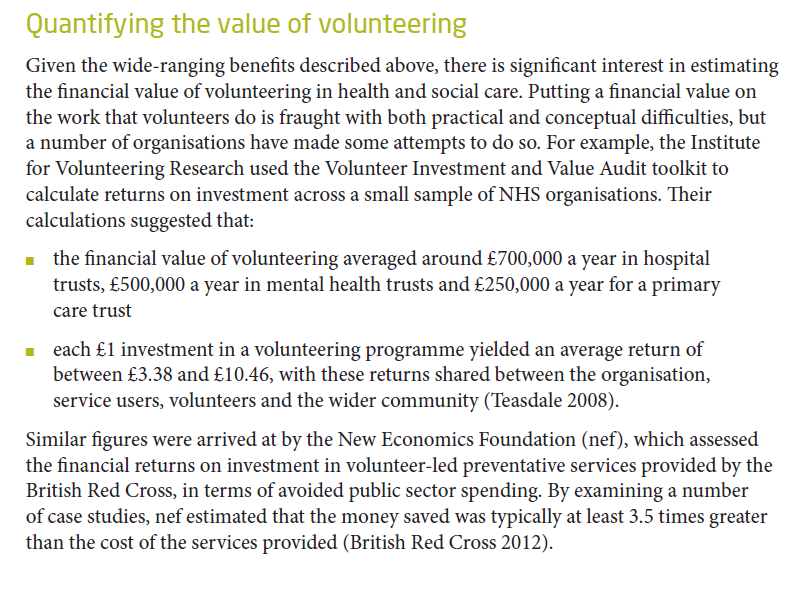
Towards an economic evaluation of King's volunteering services
In this appendix we set out a tentative range of economic analyses of King's volunteering services. These rely on many assumptions and should not be viewed, or used as, a reliable estimate of the cost-benefit of the service. This would require a dedicated study, with new data collection and analysis.
Galea et al (2013) asked voluntary service managers whether volunteers added “value” in various ways including improving the experience of patients and carers, additional services, and community involvement. The vast majority agreed or strongly agreed (Figure 2)
Figure 2: The value of volunteering in acute hospitals
|
Strongly agree (%) |
Agree (%) |
Neither agree nor disagree (%) |
Disagree (%) |
Strongly disagree (%) |
| Volunteers enhance the experience of patients and carers |
93 |
2 |
0 |
0 |
5 |
| Volunteers provide services that the trust would not otherwise be able to provide |
59 |
23 |
10 |
3 |
5 |
| Involving volunteers helps the trust to show it cares as an organisation |
59 |
31 |
6 |
0 |
4 |
| Volunteers provide a good way of involving the local community in the hospital |
74 |
21 |
0 |
0 |
5 |
| Volunteers provide a good way for the trust to listen to patients and the public |
58 |
29 |
9 |
1 |
3 |
Sample size: 92 responses
Whilst this does express value to patients and the wider community it is not possible to translate this into information helpful for economic analysis. What's more it is for England as a whole, not for King's services. It would be possible to assess where King's comes in rankings on these scores, to give a sense of relative performance versus other trusts – though this is of course, reports from voluntary service managers not patients directly. Further, it gives no assessment of whether this benefit is in some way worth the effort in generating it. Economic evaluation attempts to do so, and we set out four measures below that give a tentative indication of the economic case for volunteering in King's: cost per volunteer; return on investment; cost per FFT increment; cost per QALY and cost-benefit ratio.
Cost per volunteer
In our interim report we benchmarked King's against other providers. In Table 1, we develop that analysis. We received further information from King's both on volunteer numbers and on the breakdown of the budget for the volunteering service between recurrent and one-off funding. This leads to four possible cost per volunteer ratios for King's (Table 1). At the time of the survey the most appropriate figure to take for the number of volunteers to benchmark against others is 869 but there is a judgment to be made about whether the appropriate budget is £86,000 (what King's can offer recurrently) or £216,000 (including non-recurrent funding, which would put at risk the number of volunteers that King's could support to the level they do). So, the likely cost per volunteer lay somewhere between the estimates at d) and b) in the table, £99-£249 against £123 on average across our sample. If we were to take King's situation during the evaluation this would now lie between a) and c), £82 and £207 on the same basis.
|
Volunteer to staff ratio (at time to survey) |
Overall number of staff |
Number of volunteers |
Budget for volunteering service |
Budget per volunteer |
| Mean |
0.876 |
4,330 |
471 |
£58,000 |
£123 |
| King's |
0.116 |
7,494 |
i) 869^
ii)1,046* |
iii) £86,000+
iv) £216,000~ |
a) £82 (iii/ii)
b) £99 (iii/i)
c) £207 (iv/ii)
d) £249 (iv/i) |
^ King's volunteer total at the time of our national survey
* King's volunteer total at the time of our evaluation
+ King's recurrent volunteer budget
~ King's total volunteer budget (including non-recurrent spending)
Of course whilst it is useful to benchmark cost per volunteer of managing and supporting volunteers for King's versus other services, it tells us nothing about the relative impact, or return for that investment.
One simple way to arrive at an assessment of return on investment, is to estimate whether the staff time involved in training and supporting volunteers is likely to be paid back by the contribution volunteers make. Our national survey allowed us to develop a crude ROI for England as a whole through assessing the overall costs of supporting and managing volunteers against value of their labour they would have to provide, in order to make that investment breakeven for the average trust.
So, the average trust spends about £58,000 per year on the management and training of volunteers, and that over a year the average contribution of volunteers is 79,128 hours. In order to make that expenditure worthwhile – to 'break even' – each volunteer needs to contribute activities and outcomes worth 73p per hour or more (£58,000/79,128 hours). Going a step further, and using a method based on how some of our survey respondents calculate the return on investment in volunteering, we suggested that volunteers contribute value at least to the equivalent of a salary band 21 on 'Agenda for Change'. At the mid-point for our average trust, this is equivalent to an hourly rate of a little more than £8. Therefore, for every £1 that is invested in the training and management of a volunteer, the trust receives value of at least £11 in return (see ROI calculation at the end of this section).
We can do the same calculation based on King's own numbers. Again, due to the range of numbers on volunteers and the breakdown of funding this results in four different estimates. King's survey results suggest that (at the time of the survey) volunteers were each contributing on average 4 hrs per month.
However, in subsequent conversation they said that there may have been an error in their response to the survey, and that the actual time given is closer to the average amongst other survey respondents of 3.5 hours per week. We have therefore used 3.5 hours per week in subsequent analysis, if the original response was used ROI figures would be commensurately lower.
Table 2 shows how this translates into ROIs in the last column. First we calculate how many hours King's volunteers donate – there are two figures, given the two different figures we have for the number of volunteers (column 1), we then divide the two different budget figures (column 2) by the number of volunteer hours, to give the “breakeven” value of volunteering per hour for volunteering to at least pay for itself in terms of the volunteer budget (column 3). There are four figures here since we have two estimates of hours, and two estimates of budget. The final column shows the ROI, assuming that the true value of volunteering is equivalent to the services of Agenda for Change, at the midpoint of band 2 – this is the value that several of our trusts suggested in the survey.
| Volunteer hours p.a. |
Budget for volunteering service |
"Breakeven value" |
ROI at AFC band 2 midpoint (hourly wage of £8.04) |
| i) 145,992 |
iii) £86,000 |
a) £0.49 (iii/ii) |
a) 16.4:1 |
| ii) 175,728 |
iv) £216,000 |
b) £0.59 (iii/i) |
b) 13.6:1 |
|
|
c) £1.23 (iv/ii) |
c) 6.5:1 |
|
|
d) £1.48 (iv/i) |
d) 5.4:1 |
These ROIs are all greater than one, implying that King's investment is worthwhile. This approach to economic assessment, like all others, has strengths and weaknesses. A major one is that it relies on assumptions about the level of benefit required in order to break-even from a cost-benefit perspective, rather than any measurement – or even estimates - of the size of the benefit to patient experience itself. The two methods set out below are an attempt to remedy this.
Cost per unit change in Friends and Family Test results
Section 4.5 of this report has described the largely positive association between patients' survey results and access to a volunteer, alongside some limitations of the data (see Figure 3 for an illustration of this in relation to the Friends and Family Test).
Figure 3: Percentage of patients who are “extremely likely” to recommend King's to friends and family for those who had access to a volunteer during their stay and those that did not
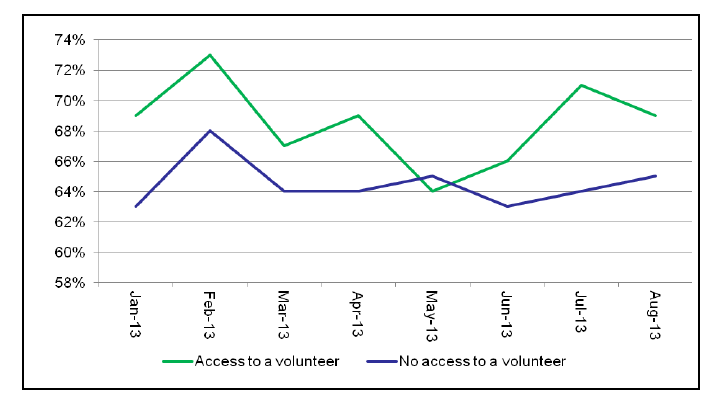
This data can be translated into percentage score differences, and on average over the period is equivalent to a 4% point increase per month over the period. The Board papers also reveal that 35% of patients benefitted from volunteer presence. Assuming that these differences are due to volunteers, we can therefore calculate scores for “cost per percentage increase in extremely likely to recommend King's to friends and family" as a result of investment in volunteering. These are either “£61,429 per percentage increase" (taking the budget cost of supporting volunteers to be £86,000) or “£154,286 per percentage increase” (taking a cost of £216,000). These numbers include a deflation factor, based on the fact that only 35% of patients benefit from the uplift.
Cost per quality-adjusted life year and the cost-benefit ratio
However, the assumption that this is due to volunteering is questionable and in a fuller analysis would need to be tested. For example, we do not know whether the FFT scores for the wards before the introduction of volunteers were already high (i.e. volunteers went into high performing wards), or the breakdown of types of patients between wards, or how scores are collected which could also affect scores (Illman 2012).
We can also go a step further, into looking at cost per quality adjusted life year (QALY) gained based on estimates and assumptions made by the Department of Health in its impact assessment of the introduction of the Friends and Family Test (Department of Health 2011). Clearly these could rightfully be argued to be stretching the analysis to breaking point and beyond, but it is useful to demonstrate the technique, at least.
In their impact assessment the Department assume that “4% of patients see an improvement from poor service to good, each gaining 2% on a quality of life measure for a number of days after the episode of care". The Department derives this estimate from work by the Centre for Health Economics who suggest that by delivering better quality services and by being more content a patient's quality of life can be improved by 5% by alleviating anxiety or depression, whilst in hospital. The Department assumes that the introduction of the FFT – by focusing hospital's efforts in response could deliver around 40% of this, or a 2% increase per QALY per patient for a number of days, perhaps around five. If we assume that King's decision to increase volunteer involvement has created a similar effect we can derive a total QALYs gained score. In 2012-13, Kings' College Hospital Trust admitted 118,621 patients, if 35% of these benefitted from volunteers leading to a 0.02 increase in QALYs for five days, then volunteers “created” 11.4 QALYs in year. Based on the cost estimates above this therefore costs between £7,543 per QALY to £18,947 per QALY.
Taking these cost per QALY numbers we can then convert these to cost-benefit ratios, since we have a lot of evidence on the value of a QALY, from NICE's decision-making and from other sources. NICE suggests that a QALY is worth between £20,000 and £30,000 per QALY (Donaldson et al 20112) and this is the benchmark for them recommending treatments on the NHS. Although some evidence suggests values could be higher, there is currently no compelling evidence to settle at a given higher value. We have therefore taken the mid-point of £25,000 per QALY as our value in our cost-benefit ratios below. Given this value, the cost-benefit ratio (based on our assumptions about the value and duration of patient experience improvement) lies between 3.3:1 and 1.3:1.
Conclusion
This analysis has set out a tentative exploration of the potential economic evaluation of King's volunteering services. However, clearly this analysis has been driven by assumptions, and all are questionable.
To be clearer about the economic case for the volunteering service would require a full economic evaluation designed from the outset. As we said in November last year,
"...there is clearly a need to develop a more sophisticated approach for measuring the value of volunteering to include impact on patient experience and quality of care".
As part of that robust economic evaluations need to be built in from the start.
Return on investment calculation
This calculation is based on our survey respondents and is set out in Galea et al (2013).
- Average budget for volunteering services: £58,000
- Contribution of volunteers in hours based on average:
- Per volunteer: 3.5 hours x 4 times a month = 14 hours
- Average contribution of volunteers per trust: 14 x 471 = 6,594
- Average contribution of volunteers per trust over a year: 6,594 x 12 = 79,128
- Return on investment calculation:
- Break even = input/output
- Where:
- input = budget for the volunteering service
- output = total number of hours contributed by volunteers (based on the average)
- Therefore, break even = £58,000/79,128 = 0.73
- Some trusts use Agenda for Change pay band 2 to calculate value of volunteers:
- Using information on Agenda for Change from NHS Careers 2013:
- Annual salary range for AFC pay band 2 (2013/14): From £14,294 to £17,425
- The midpoint of this is: £15,718.75
- The hourly rate would be £15,718.75/52.14 = £301.471/37.5 = £8.04
- The cost benefit calculation:
- Cost: Benefit
- £0.73: £8.04
- ((£8.04 x £1.00)/£0.73) = £11.01
Appendix 5. List of all recommendations
Recommendations for all volunteering services
The following recommendations are relevant for developing volunteering services nationally.
- There should be a clear volunteering strategy which fits with organisational priorities.
- Enactment of the volunteer strategy requires active senior commitment to the development of volunteering.
- There is a need for increasingly sophisticated analysis of where volunteering roles can be developed to best effect, with the potential for greatest positive impact on patients' experiences.
- Senior leaders should ensure that there are appropriate resources to recruit train, manage and develop volunteers, in line with organisations' volunteer strategies. A result of this will be that volunteers' skills and expertise are carefully and creatively matched to service areas; and that volunteers are well managed and feel part of the team.
- Senior leaders should maintain on-going oversight of the workload associated with the volunteering service, recognising the significant contribution of front-line staff's time in supporting, training and inducting volunteers, and day to day management.
- The contribution of staff to the management of volunteers should be recognised as part of their job descriptions.
- Organisations should recognise good practice in the development of volunteering and ensure that this is promoted and shared across the organisation.
- There needs to be on-going robust monitoring of the service to understand its impact on patients, staff and volunteers, and including why volunteers are joining and leaving.
- A robust economic evaluation should be conducted when volunteering services are expanded, including bespoke data designed for this purpose, and which includes the impact on patients' experience.
The volunteering service at King's
Recruitment, training and management
- There need to be clear role boundaries between paid staff and volunteers, well communicated, recognising that sometimes blurred boundaries may be perceived rather than real.
- There should be a clear communications strategy so that patients, staff, volunteers and the local community are clear about what the volunteering service can and cannot offer.
- The volunteering service should be developed with close links with the local community.
- The service should include opportunities for volunteers to come together for peer support and learning.
- It should seek ways to minimise bureaucracy for those who volunteer in more than one setting, for example by making volunteers' record of DBS checks and immunisations 'portable'.
-
Seeks ways of minimising bureaucracy for those who volunteer in more than one setting, for example by making volunteers' record of DBS checks and immunisations 'portable'.
-
Explore the option of adding a question about personal experience of being a patient (or family member being a patient) in King's to the recruitment process, to identify individuals for whom an individual interview may be appropriate to explore motivation for volunteering further.
- Identify higher-risk settings where individual rather than group interviews may be more appropriate.
- Review the data on time taken in the recruitment process to explore further whether staff and volunteer concerns are warranted.
- Consider including a supervised trial shift before the placement allocation is made, as part of the recruitment and matching process.
- Clarify the relative role of the volunteering service and the ward managers in the management of volunteers.
The role of volunteers
- Ensure volunteers carry out at least one shift when the ward manager is on duty and they meet other key staff in the setting.
- Support more junior staff who may be responsible for directing volunteers out of hours or at weekends. Initiatives such as the stroke "volunteers book" can help junior staff in directing the activities of volunteers.
- Ensure that staff know the names of the volunteers.
- Explore the option of skilled, long established volunteers to take on some of the management/liaison role.
- Set parameters for the requirements on volunteers before they can expect references. Clarify the nature of the references that can be expected and from whom. For example, a simple account of role, attendance, duration should be provided by the volunteer service. Minimise the requirements on clinical staff for provision of references etc.
-
Clarify reasonable expectations in terms of reference writing, and whose responsibility it is (volunteer service or other?)
-
Identify placements that may be particularly challenging for volunteers, and assess the levels of skills and confidence of volunteers to deal with these prior to making a placement.
- In general, role boundaries were clear between paid staff and volunteers, but King's should continue to place high priority on maintaining this clarity in practice.
- It is good to have a written role description for volunteers but it is important to distinguish between this and a 'job' description.
- Explore the idea of having 'senior' volunteers to help the newer volunteers.
- Explore whether volunteers could be more visible at the entrance and around the hospital on a daily basis.
Experience of the volunteering service
Staff
- Ensure that volunteers are known by name – clearly communicate that volunteers should be included as team members in team activities
- Continue to develop specific role descriptions for volunteers in particular clinical settings
- Support more junior staff in directing the activities of volunteers
- Continue to assert role boundaries of volunteers
- Share accounts of the successful integration of volunteers with clinical areas to utilise volunteers better.
Volunteers
- Consult volunteers about their suggestions for peer support and reducing isolation
- Explore how to provide volunteers with more systematic feedback
- Undertake further exploration of why volunteers leave (a simple survey using survey monkey, or exit interviews) and use findings to reduce turnover
- Make clear to volunteers who are surveying patients why it is important, and what is done with the data they collect
Patients
- To communicate better with patients about what the volunteering service can offer, and reassure patients that volunteers are, trained and not substituting staff roles.
- To include in volunteer training how patients value the volunteers' good manners and behaviour
- To include training volunteers in how to feedback information they may have gleaned to staff in a skilful way.
Maximising value
- To be clearer about the economic case for the volunteering service we recommend a full economic evaluation that is designed from the outset, and is not reliant on data which was not designed.
- This should be one part of a more systematic approach to measuring the impact on patient experience and outcomes of volunteering.
- Continue to invest in the volunteering service. The ROI estimate lies between £5.40 and £16.40 for every £1 spent.
Contributing to a compassionate culture
- Recognise that the contribution may differ in different clinical settings. (This contribution was particularly marked in wards where patients tended to have long stays. For parents of children who were inpatients, the support from volunteers seemed invaluable.)
- Ensure that carefully developed volunteer roles are matched with volunteer skills.
- Provide high quality management and support for volunteers.
- Provide appropriate support for volunteers who may be emotionally affected by the work.
- Recognise that volunteers are not a panacea, and their input is not for everyone.