Contributors
Jed Cinnamon, Nesta.
Michaela Latham, Nesta.
Toby Baker, Nesta.
Fionnuala O'Reilly, Behavioural Insights Team.
Dr Marcus Witt, University of the West of England.
Olly Offord, Franklin Scholars.
Acknowledgments
With thanks to all the teachers, students, parents and delivery partners involved in the Maths Mission pilots.
Also thanks to Jo Tasker, volunteers from Tata Consultancy Services, Bruno Reddy, Rob Eastaway, Zoe Cunningham, Maggie Steel, Will Woods and Olly Offord.
About Maths Mission
How can we support more young people to see maths as an engaging, problem-solving tool? How can we encourage students to be positive about maths, improve their key skills and develop their mathematical problem-solving capacity?
Through the Maths Mission partnership, Tata and Nesta are working together to identify and support high-potential solutions. We are providing support to pilot and test interventions that can then be helped to scale their reach and develop their impact.
Nesta is a global innovation foundation. We back new ideas to tackle the big challenges of our time. We use our knowledge, networks, funding and skills - working in partnership with others, including governments, businesses and charities. We are a UK charity but work all over the world, supported by a financial endowment.
Tata Group is one of the world's oldest and largest business organisations. The Tata group's presence in Europe traces its beginnings back to 1907 with the establishment of Tata Limited in London. Since that time, Tata's presence has grown into a diverse portfolio of 19 companies with over 60,000 employees and a presence in almost every European country.
These companies include iconic brands such as Jaguar Land Rover and Tetley Tea as well as leading Tata businesses such as Tata Steel, Tata Consultancy Services, Tata Communications and Indian Hotels Company. Other Tata companies with a strong European presence include Tata Elxsi, Tata AutoComp Systems and Tata Interactive Systems.
Consistent with Tata group's global philosophy, Tata's businesses in Europe are committed to our shared mission of improving the quality of life of the communities we serve. We do this through long-term stakeholder value creation built on leadership with trust and our common values of integrity, understanding, excellence, unity, and responsibility.
Tata Consultancy Services is an IT services, consulting and business solutions organization that has been partnering with many of the world's largest businesses in their transformation journeys for the last fifty years. TCS offers a consulting-led, Cognitive powered, integrated portfolio of IT, Business & Technology Services, and engineering. This is delivered through its unique Location Independent Agile delivery model, recognized as a benchmark of excellence in software development.
To find out more visit www.nesta.org.uk, www.europe.tata.com and www.tcs.com
If you'd like this publication in an alternative format such as Braille, large print or audio, please contact us at: [email protected]
Introduction
It is crucial that young people gain strong mathematics and numeracy skills as early as possible and keep building on them throughout their education. Without maths, their chances of succeeding in today's digital world will be severely restricted.
We've all experienced occasions when colleagues, friends or family have cheerily claimed they 'can't do maths', or that they 'just aren't numbers people'. At Nesta and the Tata Group, we believe we must challenge negative attitudes to mathematics, and make the case that everyone can 'do numbers'. We must find the most effective ways of supporting attitudes and attainment in the subject to help young people start out, and move through, their education with a positive approach to maths.
But it's not just about succeeding in the classroom. Today's generation needs to be able to use maths skills in many different contexts, applying them to solve problems, employing subject knowledge alongside teamwork and creative skills. Extensive research by Nesta has shown that it is this combination is essential to prepare tomorrow's generation for the demands of the future economy.
Tata companies in the UK range across almost all parts of the modern economy: from salt to steel, from tea to IT, automotive, engineering, hospitality and services. In every single business, maths plays a critical role. Tata companies are amongst the most prolific investors in UK research and development, and employ tens of thousands of engineers, IT specialists, scientists, technicians and researchers. These roles all depend on a strong foundation in STEM - which itself is rooted in an appreciation of and strength in maths. But it's not just the 'scientific' and 'technical' jobs that need maths: every single Tata colleague will be actively using maths skills at some point of every working day.
So Tata understands the importance of maths at work. But, throughout our 150 year history, we have also sought to respond to our responsibility to the communities in which we operate, with practical programmes to address vital needs. Tata Sons, the Group's holding company, is two-thirds owned by the charitable Trusts set up to support India's development. In the UK, one of our key priorities is to contribute to developing the skills people need for today – and tomorrow.
At Nesta, the UK's innovation foundation, we back new ideas to tackle the big challenges of our time, from the pressures of an ageing population to stretched public services and a fast-changing jobs market. We have brought our innovation focus to this partnership, and the challenges around maths skills in the UK.
We will continue to evolve our approach, learning from the pilot projects so that we can widen the impact of Maths Mission. We will be working with more partners in the corporate sector and in maths education, reaching more young people and deepening our impact on their maths attitudes and skills in 2018/19 and beyond.
If your organisation is keen to address these issues – please do reach out. Entrenched issues such as these can only be tackled when we work together to understand the problem and support great solutions to test and grow.
 David Landsman,
Executive Director,
Tata Limited
David Landsman,
Executive Director,
Tata Limited
 Joysy John,
Director of Education,
Nesta
Joysy John,
Director of Education,
Nesta
Summary
There is broad agreement amongst businesses, schools and government that proficiency in mathematics is important for everyone - including for young people. This means having a positive attitude to the subject and being motivated to improve.
Recent research has also shown how important it will be that young people are able to apply their knowledge to solve complex problems, in order for them to succeed in a rapidly changing world.
At Nesta and Tata, we want to support high-potential interventions and solutions that can help young people improve in maths, enjoy the subject and apply it to solve problems. In 2017 we launched Maths Mission and our first three pilot projects that ran through the 2017-2018 academic year:
- Cracking the Code: an open youth challenge centred around 'escape-rooms' aimed at changing student's perception of maths, through classroom experiences, live events and collaborative group-work.
- Solving together: using parental SMS messaging to improve maths problem-solving, working with the Behavioural Insights Team.
- Young maths mentors: developing pupil maths and peer mentoring skills in schools, working with both Funkey Maths and Franklin Scholars.
Our approach was to identify innovative solutions that worked with parents, teachers or students directly, and that provided enriching opportunities outside and alongside the classroom rather than adding additional content to an already packed curriculum. The pilots were also selected on the basis of the potential for impact and long-term, sustainable growth and scaling.
Key findings from the pilot year projects
- Competitions that provide opportunities to apply maths in interesting contexts, and combine with other important skills like collaboration and creativity, can support improved attitudes to maths. More exploration of how such programmes can be designed to maximise long-term impact is needed.
- Text messages can improve parental engagement in their child's maths education but the content used must be carefully tested to ensure it encourages helpful engagement.
- Well-structured peer mentoring programmes can make a real difference to pupil outcomes. More evidence is needed on the longevity and transferability of improvements in maths attainment, and the impact on wider skills and capabilities.
The problem
It is well-known that the skills needed for the future world of work will be different from today, as Nesta's 2017 report The Future of Skills: Employment in 2030 explored.
Although there is a level of uncertainty around these future needs, there is strong evidence that maths skills and collaborative problem-solving will be particularly important.
The World Economic Forum has made the case for a range of skills that will be increasingly important in the future job market, that include collaboration and problem-solving. Nesta's report Solved! Making the case for collaborative problem-solving, published in 2017, explored how the UK can better equip young people with this skill set.
It is also widely agreed that maths skills are, and will continue to be, crucial for individuals to be successful in the world of work. Andreas Schleicher of the Organisation for Economic Co-operation and Development (OECD) has made the powerful case that 'good numeracy is the best protection against unemployment, low wages and poor health.'
One of the major obstacles to maths and problem-solving attainment is attitude - the belief that 'some people just can't do maths'. This limiting belief, which is prevalent in the UK, can encourage young people to disengage from an early age. There is an increasingly solid evidence base for how best to improve attitudes and motivation in maths, gathered by organisations such as the Education Endowment Foundation looking at how attitudes and motivation can be improved in maths.
As a nation, the UK is not as good at maths as it should be. Maths is the foundation of learning and achievement in science, technology and engineering, yet UK teenagers are ranked just 27th in the OECD's global tests when it comes to their maths skills, a fall from 26th in 2012. We also know that more than one million new engineers are needed by 2020 simply to meet current industry demand, and 50 per cent more STEM graduates will be needed just to maintain the status quo.
Key statistics on maths skills in the UK:
- 27th UK rank in PISA maths rankings
- 22% Of UK 15 year olds 'don't have even basic maths skills'
- OECD UK teenagers worst out of 23 developed countries for numeracy skills
- £90bn What the STEM skills gap could cost the UK per year by 2024 (LGA)
"It's important that we instil in our young people a strong interest in maths and ensure that they have the confidence to explore all the exciting things it can be used for."
David Landsman,
Executive Director, Tata
"Good numeracy is the best protection against unemployment, low wages and poor health."
Andreas Schleicher,
Organisation for Economic Co-operation and Development
The programme and pilot year projects
Overview
Tata and Nesta came together in Spring 2017 with the purpose of identifying the best way to support efforts to tackle this set of problems, in particular to change attitudes and increase attainment in maths, promoting the subject as a practical, engaging and problem-solving tool.
The Maths Mission approach brings together Nesta's expertise in supporting innovation and evidence-based interventions, and Tata's commitment to investing in high-impact programmes. The two organisations understood that there was great potential in many early-stage innovations, run by experts who needed support to pilot and test their solutions. An opportunity was also identified to run a challenge prize-style programme to promote not only maths skills but collaboration, problem-solving and communication skills.
The partnership therefore decided to implement the Maths Mission pilots:
| Pilot |
Type of programme |
Age group worked with participating |
Number of students |
Delivery partners |
Location of pilot |
| PILOT 1 Cracking the Code |
Competition |
11-14 |
405 |
Nesta, Tata Consultancy Services |
Open to all UK schools |
| PILOT 2 Solving Together |
Parental engagement tool |
11-18 |
2,157 |
Behavioural Insights Team |
Three London schools |
| PILOT 3 Young Maths Mentors |
Peer mentoring programmes |
7-11 |
210 |
Funkey Maths, Franklin Scholars |
Hereford, Bristol, Cornwall, Hertfordshire |
The Maths Mission pilots are focused on nurturing an interest in - and love of - maths and problem-solving outside the formal educational curriculum. Each looks to tackle the issue working with a key group - whether it be parents, students or teachers, and has a strong focus on developing collaborative skills through peer-to-peer activities.
PILOT 1 Cracking the Code
Overview
Cracking the Code is a national maths competition that challenges 11-14 year olds to design their own 'escape room' by applying their creativity, use of maths and collaborative problem-solving skills.
Through this pilot competition, we were seeking to find a way to help young people see maths as a fun, engaging and problem-solving tool, providing a new perspective on how the subject can be applied in exciting contexts.
The idea for the competition was inspired by The Crystal Maze and the growth in popularity of 'escape rooms', with teams of students creating escape rooms containing puzzle questions to reach a code to unlock a padlock. Students needed to utilise creativity to create an engaging narrative that integrates mathematical puzzles; communication skills to develop a compelling entry and to work collaboratively; and a range of maths skills to develop the puzzles and tasks.
Competition journey
| Event |
Date |
Location/Notes |
| Launch event and prize opens |
1 February 2018 |
Science Museum |
| Entry deadline |
22 March 2018 |
|
| Finals and Award event |
22 June 2018 |
The Crystal, London, Docklands |
| Winning escape room created and delivered to winning school |
October 2018 |
|
Programme delivery
The competition launched with an event at the Science Museum in February 2018 - with 250 students from 12 schools completing maths challenges set by escape room experts from The Problem Solving Company, and explored the museum's maths exhibition, guided by TCS volunteers.
Entries then opened to schools, with 114 schools registering for the competition and to use classroom resources. We received 90 applications from across the UK, from Cornwall to Inverness. Schools used classroom maths resources made available through the Cracking the Code website to promote the competition, and we engaged young people through news articles in The Week Junior.
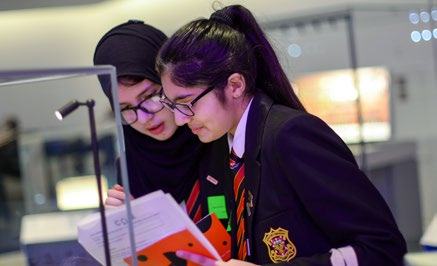
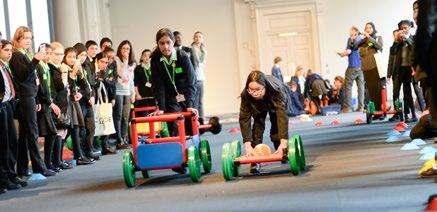 Launch event at the Science Museum, February 2018
Map showing participating schools, 2017-2018:
A map of the UK with numerous blue dots indicating participating schools spread across England, Scotland, and Wales, with concentrations in urban areas and the south-east.
"Cracking the Code exposed students to a side of maths they don't often get a chance to experience - when maths is engaging, creative and collaborative. I witnessed some great presentations by students from a wide variety of schools and backgrounds. Their excellent work makes me optimistic about the next generation of mathematicians in the UK."
Rob Eastaway,
Maths expert, author and broadcaster
Success Criteria
| Criterion |
Description |
| Creativity |
How unique and exciting is the escape room concept? How innovative is the idea? How well do the puzzles fit with the theme? |
| Use of Maths |
How well do the puzzles use mathematical concepts and problem-solving? How well are different mathematical concepts used? |
| Communication |
How well does the team communicate their escape room idea? How strong is their written communication at application stage, and their verbal communication at the finalist stage? |
Of the applications:
- Fifty-nine per cent of the 400 student applicants were girls, raising the possibility that different approaches to engaging in maths may attract different groups of young people.
- Ninety per cent of schools that entered were state-funded.
Industry experts, from escape room designers to professionals from Tata, judged all our entrants before deciding on the ten finalists from across the UK. These finalists were paired with a volunteer mentor from TCS who coached them on their ideas, use of maths and presentation skills.
This culminated in the final event at sustainable events and exhibition venue The Crystal, in London on 22 June for our finalists - 60 students from nine schools attended. The students were welcomed with dynamic maths puzzles by maths educator Rob Eastaway, explored the fascinating sustainability exhibition and presented their ideas to a panel of judges.
The winning team was Elgin Academy from Moray, Scotland, with the runners up from Al-Ashraf Secondary School for Girls in Gloucestershire. Elgin Academy will see their escape room brought to life and have won £2,000 for their school, which they intend to use to promote effective numeracy approaches in local schools.
"It was great to see students, particularly girls, engaging so positively with the challenge. To hear first hand the impact that the competition had on them really showed me the power of providing new perspectives and approaches to the subject.. It was wonderful to be part of a bigger mission to change attitudes to maths."
Maggie Steel,
Cracking the Code judge and founder, Funkey Maths
Outcomes
The competition's pilot year involved a series of evaluation surveys in order to understand its impact on young people - to understand if and how it can change perspectives on maths and problem-solving, and support collaborative and creative skills. The early signs are that Cracking the Code can have a positive impact on attitudes to maths and support the development of wider skills.
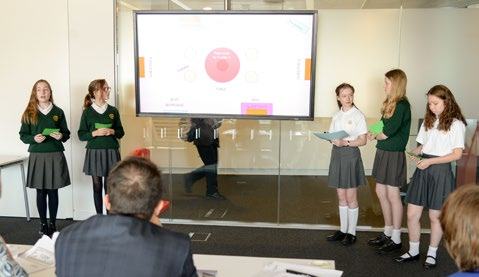
 Final event at the Crystal, June 2018
| Group |
Statement 1 |
Statement 2 |
Statement 3 |
| The teachers of the finalists |
100% Said that Cracking the Code has had a positive impact on students |
100% Said that since Cracking the Code, their students seem more interested in maths |
78% Said the competition had an effect on the whole year group, not just the finalists |
| The student finalists |
100% Reported the competition helped them see how maths can be applied usefully in a new context |
78% Said the competition helped develop their teamwork skills |
85% Said it helped develop their presentation skills |
| The teachers of teams that entered |
100% Said the competition help their students presentations skills through applying for the competition |
78% Of teachers intend to apply for the competition next year |
85% Said that their students seem more interested in maths since the final |
Recommendations
The Maths Mission partnership is now exploring how to increase the reach and impact of the competition. This may include:
- Spreading the geographical reach of the programme beyond the concentration in the South-East and major urban areas.
- Ensuring students across the ability range can be engaged in the competition, including by clarifying the competition success criteria and providing a range of supporting resources.
- Promoting whole year group entries from schools, supporting increased numbers of entries and promoting entries from across the ability range.
- Developing the approach to evaluation to better understand the impact of participating in different elements of the competition on attitudes to maths, as well as problem-solving, creativity and collaboration skills.
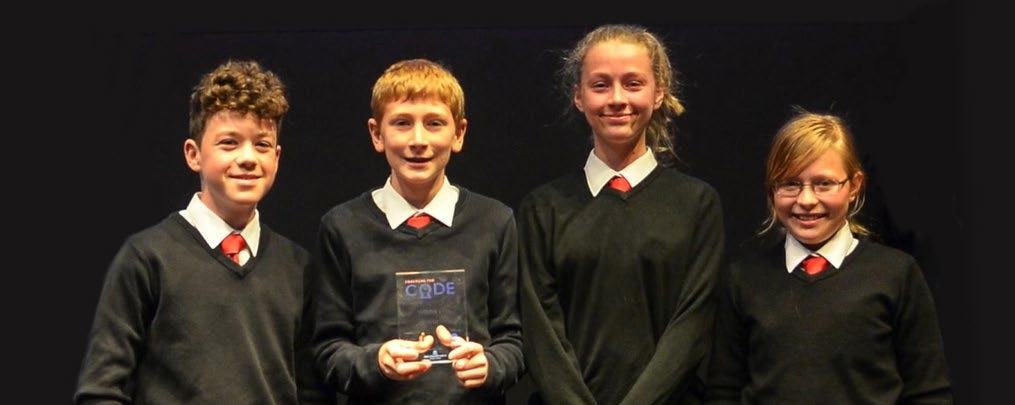 Winning team from Elgin Academy, Moray
"Cracking the Code presents maths in a way young people often don't get to see - as practical, useful and fostering teamwork. Not only did it improve their maths skills, but their attitudes towards it. The entries were outstanding, showing us that young people are full of innovative ideas and able to practically apply maths, and Cracking the Code provides a great way to do that. I can't wait to see next year's entries!"
Bruno Reddy,
Maths teaching expert and founder, Timestables Rockstars
"Cracking the Code was an amazing experience for the students. As the students were across different year groups it really fostered their teamwork and communication skills. It supported them to be creative, innovative and really see a different side to mathematics. The prize money from Cracking the Code will be used to set up maths masterclasses at our school, reaching out to other schools in the region, to enable more students to experience maths as a practical, useful and engaging skill.”
Lynne Weir,
Elgin Academy
PILOT 2 Solving together
Overview
Research has shown how influential parental engagement can be in contributing to a child's success in school and later life. When parents invest time and effort in their children, the payoffs, although sometimes far into the future, can be significant. Research in the UK and US suggests that texting parents easy-to-understand and actionable information about their children's education could help to promote parental involvement, especially with clear suggestions on how parents can support their child's learning.
Through the 'Solving Together' project, a collaboration with the Behavioural Insights Team, we sought to test the impact of a parental engagement approach - weekly text messaging - on student maths performance at secondary school. Below is a summary of the project and its findings. You can find a full impact report on our website.
Programme delivery
The project tested the impact of sending weekly text messages to parents of students in Years 7 to 11. The primary outcome measure was students' performance in the end-of-term maths exam, with secondary measures being parental engagement and other attitudinal indicators (such as attitudes to maths).
The intervention was evaluated using a randomised controlled trial (RCT) at three non-selective state schools in London: Bridge Academy, London Academy and Kingsbury High School. The RCT involved 2,157 students in total.
Using insights from qualitative work with teachers and students, and an evidence review, a set of text messages was devised which followed four general themes:
- Homework reminders and upcoming tests.
- Conversation prompts based on topics covered in class.
- Revision tips and helpful resources.
- Motivation messages.
Example message and design rationale
Personalisation: Helping parents to know what to do: making conversation fun.
Hi Denise, Marc is learning about probability in maths this week. Here's a fun quiz for you to do together. If you throw a dice one time only, what is the probability of rolling a five? Thanks for supporting Marc's maths learning! Mr Smith.
Rationale:
* Helping parents to know that the school wants them to be involved
* Signing off the messages from teachers could foster reciprocity - the teacher has done something for the parent so the parent feels they should give something back.
The maths department at each school provided a scheme of work which detailed the topics being covered during each week of term. Messages were created one to two weeks before they were due to be sent out. Once the messages were created, they were sent to teachers to sense-check before being uploaded to each school's texting platform, and sent across five to eight weeks for two of the schools, and across two and a half weeks for one school due to changes to assessment timings.
Flowchart: Trial model of the Solving Together project
This flowchart illustrates the stages of the trial model:
- Schools provide baseline data
- Randomisation at the parent level
- Control group (do not receive messages)
- Control group (do not receive messages)
- Outcome measures
- Students complete self-report questionnaire
- Students sit the end-of-term maths exam
- BIT analyses the impact of the messages on
- Student-reported engagement with parents
- Performance in the end-of-term maths exam
Outcomes
The RCT followed a simple two-arm structure where parents were either randomly assigned to the treatment group (who received text messages) or the control group (who did not receive text messages). Assignment to the treatment group or the control group was stratified by class, so that there was an even distribution between treatment and control students within classrooms.
The main research question was whether the intervention would improve students' performance in the end-of-term maths exam. Overall, we did not find any effect on standardised attainment scores (i.e. the end-of-term maths exam); the intervention had no impact on the performance of medium- and high-ability students, and a small negative impact on low-ability students. This is in contrast to previous research testing similar interventions, raising interesting questions for future research and practice.
There could be several reasons to explain these results. Perhaps the conversation prompts and motivational messages used in this study confused parents or spurred conversations that were not helpful, particularly to lower ability students. This is an important finding for the evidence base and demonstrates the need to consider tailoring messages for different groups.
Language barriers may have also played a role in the overall results. During qualitative interviews with teachers, many teachers mentioned that a large proportion of students came from households where English is not the first spoken language.
The project did, however, have a statistically significant and positive effect on parental engagement. This indicates that students noticed the effect of the intervention through the conversations they had with their parents around maths. It also suggests that text messages could be a good way to communicate with parents. The key question now is how to ensure the content of the messages generates a supportive, high-impact conversation for students (particularly low-ability students).
Recommendations
Although the intervention did not improve maths attainment, there are several interesting findings which will inform future iterations of this intervention in different contexts, including:
- Sense-checking the message content with parents to ensure they are useful and relevant. This is particularly important for parents of low-ability students.
- Exploring whether sending messages in different languages is effective in improving conversation quality between parent and child and in turn, student attainment in maths.
- Working closely with schools to ensure messages are timed carefully in line with key assessments.
PILOT 3 Young maths mentors
a. Funkey Maths
Overview
Funkey Maths Peer Mentoring is an innovative, cross-age peer learning project which aims to develop number sense in young children and a range of hugely important soft skills in older student mentors. Funkey Maths harnesses the energy of Year 5 and 6 students to help Year 1 and 2 students, who have been identified as falling behind in their maths work.
The project also brings huge benefits to the student mentors. Being a Funkey Maths mentor helps students develop a range of soft skills including organisational, communication and leadership skills and also brings metacognitive gains.
The programme was supported by the Maths Mission partnership to pilot its peer learning programme in ten schools in Hereford and Bristol for the duration of a school year.
Programme delivery
The Year 5 and 6 students are trained to work with Year 1 and 2 students on a set of specific games and activities which help embed key aspects of early number work, such as counting, ordering, and place value. The pairings meet for three sessions a week for 15 minutes for the course of the programme with highly-targeted learning outcomes and goals.
Once the mentor students are selected, they are trained in both how to work with children struggling with mathematics, and more specific training on the activities they will be covering with their mentees. This covers both social and emotional aspects of learning, such as communication and leadership, and how to administer the activities within the intervention. The mentors are provided with carefully designed resources, based around a small booklet called a 'licence'.
 Illustration of Funkey Maths playing cards.
Outcomes
The evaluation of Funkey Maths was undertaken by Dr Marcus Witt, Senior Lecturer Primary Mathematics Education at the University of the West of England. He found the intervention to be highly successful, with the gains made in maths ability “considerable and highly statistically significant."
Dr Witt reported that the impact made from Funkey Maths is highly cumulative: "The short, but frequent nature of the intervention coupled with the fact that, within each session, there are a number of games, each reinforcing a particular concept, or piece of understanding, suggests that the intervention has been designed to maximise retention and understanding."
The intervention also improved attitudes towards maths as well as attainment in maths. It was noted that the young children looked up to the older mentors, and through their interactions, this subtly shifted their perceptions of maths. Through these interactions the mentees' confidence in maths improved, resulting in more participation in class and clearer explanations of their reasoning within maths.
The intervention also had a positive impact on the mentors. Mentors developed their organisational skills and own mathematical understanding. Through engagement in the project the mentors felt valued in the school hierarchy.
"The mentors are really keen and invest personally in 'their' mentee. They really want them to make progress."
Gemma Fricker,
Ashley Down Primary, Bristol
"Funkey Maths has helped children find their voice. It really was their 'thing'. They are more confident to put their hand up in class."
Sara Phillips,
Teaching Assistant in Ledbury Primary in Year 2 class
"We do want to continue with the scheme. It had positive gains for all Year 2 children in terms of their maths outcomes, but also in their confidence levels. The Year 5 mentors also benefited from being part of the program at a PSHE level.”
Lauri Houchin,
Maths Co-ordinator, Trinity Primary, Hereford
"The children love it. The Year 5s loved the training. It was fantastically clear, concise and well timed."
Rob Cox,
Maths Co-ordinator, Ashfield Park Primary, Ross-on-Wye
Recommendations
"Funkey is a hugely beneficial programme, which has an immediate and low-cost impact on the children involved. It has undoubtedly not yet reached its full potential, and as more information comes to light about how and why it works so successfully, I think that it will only become stronger and more effective."
Dr Marcus Witt,
Senior Lecturer Primary Mathematics Education at University of the West of England
Whilst the report found that the intervention had a positive impact on the children involved, it made a series of recommendations for future development. In particular, further evaluation was recommended in order to learn more about the impact the programme can make:
- Reassess students twice after the completion of the intervention, once immediately after and again several weeks after to establish the level of information and skill retained.
- Include questions in the evaluation that test how transferable the maths skills learned are to different problems within maths.
- A deeper study should explore the impact of the intervention on pupils of different abilities and characteristics: e.g. students for whom English is an additional language, or 'quieter' students.
Following the pilot, Funkey Maths will be developing the programme structure, range of content and evaluation model to deepen its impact. The programme will also be to new areas. In September 2018 another 25 new schools will be joining the existing programme (15 in the Port Talbot region and ten in Kent).
The programme leaders will be focusing further evaluation on how participation improves motivation in maths, and how it promotes a growth mindset.
b. Franklin Scholars
Overview
Franklin Scholars is a social enterprise, set up in 2013, that exists to help every pupil make a strong start in secondary school. To do this, they recruit and train cohorts of older students to provide a year-round programme of support to boost, strengthen and stretch younger pupils vulnerable to dips in progress. These coaches are Franklin Scholars.
Their programme challenges and equips the Scholars to lead weekly workshops combining group activities, one-to-one academic tuition and one-to-one coaching for younger pupils. While the Franklin Scholars help their mentees boost academic skills and develop the resilience to tackle the challenges that lie ahead, they themselves develop a sense of purpose, self-worth and responsibility.
Until 2017-2018, academic support has focused on literacy. The pilot programme supported through Maths Mission was to trial a focus on numeracy - the other fundamental proficiency alongside literacy - within the existing model.
Programme delivery
The numeracy programme was piloted across three schools - Holte School in Birmingham, Reach Free School, in Hertfordshire, and Mounts Bay Academy, Penzance. In each school, 15 Year 10 students were trained to help support 15 Year 7s.
Map showing Participating schools, 2017-2018:
A map of the UK showing the locations of the three pilot schools for Franklin Scholars:
* Holte School, Birmingham
* Reach Free School, Hertfordshire
* Mounts Bay Academy, Penzance
Flowchart: Numeracy pilot programme model
This diagram illustrates the stages and timeline of the Franklin Scholars Numeracy Pilot 2018 program, showing activities across Term One and Term Two.
Recruitment
Selection of the Franklin Scholar mentors
Initial Training Day
Y10 Franklin Scholars
1 full day
Induction Session
Y10 and Y7
2 hours
Booster Training
Y10 Franklin Scholars
1.5 hours
Final Session and Evaluation
Term One
Weekly 30min sessions run by Y10 Franklin Scholars
On-going support for Franklin Scholars & school staff
Term Two
Each cohort of mentors was given a day's training to help them to develop the skills and abilities they need to be great mentors. Following that, they then worked with their Year 7s for at least 30 minutes every week, over either two terms or the whole academic year. The resources and sessions were designed to support the Year 7s with the core number skills they'd need to succeed in their maths lessons, and to make sure they had the proper baseline for the start of their secondary school careers.
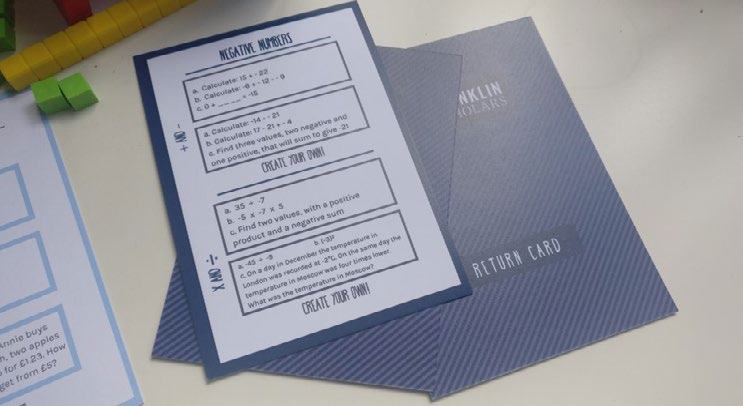 Numeracy pilot resources used by mentors and mentees
Outcomes
The programme seeks to understand the impact of the initiative on academic outcomes for the Year 7 students, as well as the impact on wider characteristics for the Franklin Scholars. The final evaluation results will be available later in the Autumn term 2018, and will be published on the Nesta website.
Initial feedback from schools has been very positive. Initial survey data taken at the end of the pilot year shows that all schools agreed strongly that:
- The Year 7 students have been engaging well with the numeracy elements of the programme.
- The Year 10 students are well equipped to coach with numeracy.
- Year 7s are likely to get better at numeracy as a result of Franklin Scholars.
Later in the Autumn term the programme will complete a full evaluation, utilising data on:
- Competence with numbers (baseline and end of programme): Students have taken a baseline quiz assessing their ability to answer questions on the numeracy topics covered by this pilot. A re-test at the end of the pilot will determine the change in students' abilities.
- Academic progress at school: Academic progress scores from school assessments will be compared to the wider year group.
- Social and emotional development: End of year survey with students, and some of their teachers, will seek to discover if there have been any marked improvements in students' social and emotional skills, including resilience, leadership and courage.
Following this numeracy pilot, the charity will be offering numeracy as the academic element of their peer-tutoring programme. This will mean that partner schools will now have a choice of academic focus to better suit the needs of their students. Two schools in Cornwall have already confirmed numeracy programmes will run in 2018-2019.
Image: Franklin Scholar working with her mentee
A young woman (Franklin Scholar) and a male student (mentee) in school uniforms sit on a sofa, looking at a document or book together in a classroom or library setting.
"Since our inception, we've known that just as many young people don't make enough progress in numeracy as in literacy. Building a numeracy programme that aims to mirror the academic impact we've seen so far in our literacy programme has given us the opportunity to support even more young people across the country.
We're really proud of what has been created with the help of our numeracy specialists and design experts. The students have really responded to the resources, and are enjoying tracking their progress in with their 'Mastery licence'. We're looking forward to evaluating the academic impact to see if it matches the change in attitudes that our teachers have been observing.
In two of our pilot schools, our existing literacy programme has been running alongside. What's been great to see is how well it's fitted alongside, and how pleased our school partners have been with both elements."
Olly Offord,
Programme Director, Franklin Scholars
Next steps
Key findings from the pilot year projects
- Competitions that provide opportunities to apply maths in interesting contexts, and combine with other important skills like collaboration and creativity, can support improved attitudes to maths. More exploration of how such programmes can be designed to maximise long-term impact is needed.
- Text messages can improve parental engagement in their child's maths education but the content used must be carefully tested to ensure it encourages helpful engagement.
- Well-structured peer mentoring programmes can make a real difference to pupil outcomes. More evidence is needed on the longevity and transferability of improvements in maths attainment, and the impact on wider skills and capabilities.
Through the delivery of these three pilot programmes, the partnership has generated learning and insights that will be helpful for the wider sector, as well as informing our future work.
Tata and Nesta are committed to continuing to identify and support effective approaches to improving attitudes in maths, maths attainment and problem-solving.
The Maths Mission partnership is now planning to grow its reach and impact in its next phase of development over the next academic year and beyond, including through the use of digital platforms. We will also be actively engaging with key stakeholders in maths education and working with additional corporate partners.
Our priorities include
- Utilising the learning from the pilot year to support existing projects to sustainably scale their work, increasing their reach and improving their impact.
- Identifying new, high-potential ideas that meet the aims of the programme and supporting these ideas to pilot, test and learn. This will include supporting digital approaches that can improve outcomes at scale.
- Convening and working with aligned organisations to raise the profile of the issues in maths education.
- Partnering with additional corporate partners with a shared purpose, to increase the scale and impact of the work.
Future Maths Mission project evaluations will be published through the Nesta website, where you will also find updates and news from the partnership.
If you would like to discuss the project further and opportunities for collaboration, please contact [email protected]
58 Victoria Embankment
London EC4Y ODS
+44 (0)20 7438 2500
[email protected]
@nesta_uk
www.facebook.com/nesta.uk
www.nesta.org.uk
Nesta is a registered charity in England and Wales with company number 7706036 and charity number 1144091.
Registered as a charity in Scotland number SC042833. Registered office: 58 Victoria Embankment, London, EC4Y ODS.
CC BY NC SA