We are Nesta.
The UK's innovation agency for social good.
We design, test and scale solutions to society's biggest problems. Our three missions are to give every child a fair start, help people live healthy lives and create a sustainable future where the economy works for both people and the planet.
For over 20 years, we have worked to support, encourage and inspire innovation.
We work in three roles: as an innovation partner working with frontline organisations to design and test new solutions, as a venture builder supporting new and early stage businesses and as a system shaper creating the conditions for innovation. Harnessing the rigour of science and the creativity of design, we work relentlessly to change millions of lives for the better.
Find out more at nesta.org.uk
If you'd like this publication in an alternative format such as Braille or large print please contact us at: [email protected]
Authors
Marcus Shepheard, Martina Kavan, Elysia Lucas and Daniel Lewis
Click the Nesta logo on any page to return to the contents
Acknowledgements
The authors would like to thank Madeleine Gabriel, Andrew Sissons, Ravi Gurumurthy and Tim Leunig for their thoughts and comments on this work at various stages of its development. We would also like to thank Elin Price, Rob Harris, Georgina Roberts, and Michelle Pauli for their help in producing this report. We are also grateful to Elliot Price at the Centre for Sustainable Energy for helping us with the Ofgem archetypes.
Summary
Electricity in Britain is too expensive. This burdens households with high energy bills and slows the transition to efficient heating technologies such as heat pumps. This leaves Britain overly reliant on gas – risking a repeat of the 2022 energy crisis – and causes hundreds of thousands of people with direct electric heating to suffer acute fuel poverty.
The high cost of electricity is partly driven by the various levies which fund environmental and social schemes. These currently add £141 to a typical annual electricity bill, compared to £46 to a typical gas bill. This disparity exacerbates other costs, which makes electricity almost four times as expensive as gas.
The case for reforming levies is overwhelming. The current levies are regressive, with lower-income households spending a higher share of their income on them. They act as the opposite of a carbon tax by penalising increasingly clean electricity at the expense of polluting gas. They block one of the main routes to lowering energy bills, switching household heating away from gas towards efficient electric heating. And they slow the UK's journey to net zero by disincentivising the adoption of clean heating. Reforming levies could make UK energy bills fairer while offering a clear route to cheaper energy bills and lower carbon emissions.
The UK Government has several options for reforming levies. One is to remove some or all the levies from energy bills to general taxation. This would reduce energy bills for all homes and would be a fairer, more progressive way to distribute the costs of the levy-funded schemes. But removing the levies would require up to £5.9 billion in extra government spending; with the expectation that this cost would only increase over time. We do not anticipate that this level of public spending will be forthcoming in the current fiscal climate. Further, removing levies only has a modest effect on the ratio of electricity to gas prices. As such, while removal is nominally an option, in our assessment it is not a viable route to reform levies.
A second option is to rebalance levies between electricity and gas. Collecting more revenue from gas would mean lower electricity bills for all households (because everyone uses electricity) and higher gas spending for households with gas heating. Off-gas properties – including those using direct electric heating – would see benefits in hundreds of pounds a year. This would also substantially reduce the electricity-to-gas price ratio – potentially as low as 2.4 – creating a strong incentive for households to switch away from gas. However, without mitigation, gas-using households would see an increase in energy bills overall, including some already facing significant fuel poverty.
The third option, which we suggest is more attractive, is to rebalance levies from electricity to gas while providing targeted support to lower-income households to offset any rising bills. This targeted support would require far less funding than a general removal of levies, with a more progressive benefit. It could be funded either via general taxation or via levies on other energy bills. The latter is already used for the Warm Home Discount. There are challenges involved in such an approach particularly in ensuring households that need support actually receive it – but it is a more promising route than other options, and is far better than the status quo.
Any approach which removes or rebalances all the levies from electricity would provide immediate benefit to households with direct electric heating – who suffer the most acute fuel poverty. Further, it would mean that a typical household could reduce its heating bill by £420 a year by switching from a gas boiler to a heat pump or a similarly efficient form of low-carbon heating.
We conclude that the UK Government should adopt a rebalance-with-support approach to reforming levies, and should seek the most practical and fair way to achieve this. There are many ways to fine-tune this type of approach to accommodate specific equities and account for the practicalities of making these kinds of changes to energy bills. While there are trade-offs with any option, this approach would provide a clear route to lowering energy bills and reducing carbon emissions, while making bills fairer and limiting the impact on the most vulnerable households.
Notes on our methodology
- Numerical results presented here are correct for the price cap period covering 1 October to 31 December 2024. Any costs described as "typical" or relating to a “typical household” are based on Ofgem's Typical Daily Consumption Values for a dual-fuel household using a single-rate electricity meter and paying by standard credit. These are 2,700 kWh for electricity and 11,500 kWh for gas.
- Our modelling in this paper only concerns the portion of levies currently collected from domestic customers. This assumes it is possible to ringfence the levies paid by domestic customers from non-domestic customers, for which separate reforms would be needed.
- We only consider levies considered as "policy costs" by Ofgem in our analysis and advice: the Renewables Obligation, Feed-in Tariffs, the Energy Company Obligation, Assistance for Areas with High Distribution Costs, the Warm Home Discount, and the Green Gas Levy. This means that we exclude the costs associated with Contracts for Difference and Capacity Markets, where there is a clearer argument that these should be treated (as Ofgem does) as part of the wholesale cost of electricity. We also have not considered the Smart Metering Net Cost Charge.
- We use Ofgem's consumer archetypes (2024) for our distributional analysis. These 24 profiles are based on fuel consumption, property type, income and household needs; they allow us to compare how choices around levies will affect different types of households.
Energy costs more in Britain than in other similar countries; and costs have risen dramatically over the last four years. Electricity is particularly expensive, both in absolute terms and relative to gas. The root cause of this problem is Britain's dependence on gas. Gas plays two dominant roles in our energy system. It supplies 79% of all the heat in British homes, and sets the electricity price 97% of the time, despite accounting for less than a third of total electricity generation. This is a quirk of how the UK's wholesale electricity market sets prices.
The typical household energy bill is £700 more now than in early 2021, with gas bills up £375 on average. Expensive energy has knock-on effects; it has been the major driver of inflation in the past couple of years. The Energy Crisis Commission concluded that “The UK is dangerously underprepared for, and at risk of, another energy crisis because it remains heavily reliant on gas”. The best way to mitigate this risk is to replace oil and gas boilers with efficient electrical heating, while making electricity much cheaper.
The UK Government has made cheaper electricity a priority, both for the purposes of delivering progress on climate policies and making energy costs fairer. The Clean Power 2030 mission is its main initiative to get this done. The mission aims to decarbonise Britain's power supply by replacing gas generation with renewables, breaking the link between gas and electricity prices. But this will take time, and it does nothing to reduce gas bills for home heating. We need other types of intervention to deliver cheaper electricity and fairer bills in the near term.
Levies on energy bills added £5.9 billion to domestic energy bills in 2024 to fund environmental and social schemes. They raise the cost of electricity more than gas, accounting for 16% of a typical electricity bill and 5.5% of a typical gas bill. This means that 82% of the revenue is raised from electricity bills despite households consuming around three times as much gas each year.
Electricity is not only expensive in absolute terms, it also costs 3.9 times more than gas, the worst price ratio in Europe. This makes efficient electric heating more expensive and diminishes incentives for households to switch away from their boiler. The energy bill of the future is an electricity bill, and it should be cheaper.
The levies on energy bills need reform. They are unfair, they lock in higher energy bills, they reduce Britain's energy security and they block progress towards net zero. Electrification is the best way to reduce energy bills, make the energy system fairer, and accelerate the UK's progress to net zero. Fixing the levies would support the Government's wider efforts to electrify heating and transport.
What are the current levies on energy bills?
Policy costs are the element of energy bills which fund various environmental and social schemes. These costs translate into a range of benefits for consumers. The Warm Home Discount and the Energy Company Obligation help to reduce bills for poor and vulnerable households. Others, such as the Renewables Obligation, were designed to help fund the UK's transition to a lower-cost energy system based on low-carbon electricity generation. But this scheme has been closed to new projects since 2017 and has been replaced by Contracts for Difference.
Abolishing the levies by ending the schemes they support is not a viable option. Instead, the Government should focus on reforms which improve distribution of costs across households, and between gas and electricity bills. Our analysis focuses on the six levies Ofgem classifies as 'policy costs'.
- Renewables Obligation adds 3.18p/kWh to domestic electricity bills. It raised £3,000 million in 2024 to provide revenue support for legacy renewable generation projects.
- Feed-in Tariffs adds 0.73p/kWh to domestic electricity bills. It raised £690 million in 2024 to cover the cost of electricity from renewable generation installed in homes through Government schemes between 2010-2019.
- Energy Company Obligation adds 0.87p/kWh to electricity bills and 0.30p/kWh to gas bills. In 2024 it raised £1,150 million for the Energy Company Obligation scheme, which funds heat and energy efficiency measures for fuel-poor households, and a further £475 million for the Great British Insulation Scheme, which funds similar measures for households that are not fuel-poor.
- Assistance for Areas with High Electricity Distribution Costs adds 0.04p/kWh to electricity bills, raising £40 million in 2024. This money funds investment in electricity distribution infrastructure in Northern Scotland.
- Warm Home Discount adds £10.91 to the annual standing charge for both electricity and gas, raising £553 million in 2024. This scheme provides a £150 energy bill rebate for millions of poor or vulnerable households every winter.
- Green Gas Levy adds £0.38 to the annual standing charge for gas bills, raising £9.4m in 2024. It funds the production of biomethane, which is then injected into the gas grid.
There are other components of gas and electricity bills that are often considered to be policy costs. These include Contracts for Difference, the Capacity Market and the Smart Metering Net Cost Charge.
- Contracts for Difference replaced the Renewables Obligation as the main means of supporting capital investment in new renewable generation in 2017. Ofgem includes Contracts for Difference in its calculation of the direct fuel cost component of the electricity bills, rather than treating it as a policy cost like the Renewables Obligation.
- Similarly, the Capacity Market is treated as part of the fuel cost for electricity. The way the market operates creates a price signal that is part of moderating hourly demand for electricity. Moving these costs away from electricity (either onto general taxation or gas bills) would mean that price signal is lost.
- The Smart Metering Net Cost Charge is applied to both gas and electricity bills.
We do not consider Contracts for Difference, the Capacity Market or the Smart Metering Net Cost Charge within this analysis. We do not recommend reforming Contracts for Difference or Capacity Markets at this time, because they are integral to ongoing efforts to reduce electricity wholesale costs.
The current levies are regressive and unfair
The levies are regressive with respect to household income. Lower-income households pay more than their fair share towards the costs of the levies. Energy bills generally take up a larger share of income for poorer households, and levies follow the same pattern (Figure 1). In our analysis, we have used Ofgem's 24 energy consumer archetypes to assess the distributional impacts of current policies and any policy changes. These represent 27 million British households grouped by income decile, from the poorest (A) to the wealthiest (J) (See Annex 2 for more).
Figure 1. Annual cost of energy levies as a share of net income
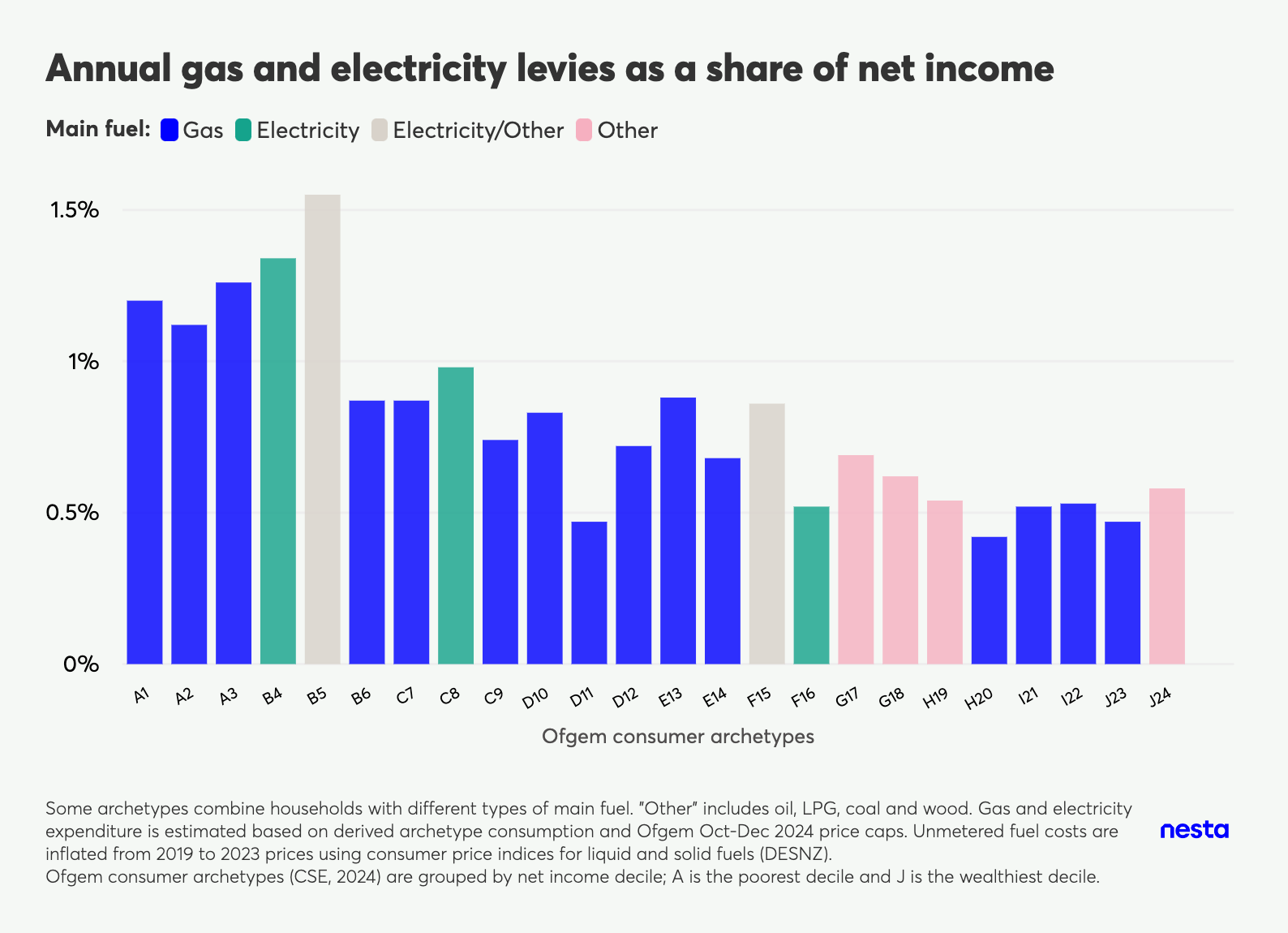
Some archetypes combine households with different types of main fuel. "Other" includes oil, LPG, coal and wood. Gas and electricity expenditure is estimated based on derived archetype consumption and Ofgem Oct-Dec 2024 price caps. Unmetered fuel costs are inflated from 2019 to 2023 prices using consumer price indices for liquid and solid fuels (DESNZ).
Ofgem consumer archetypes (CSE, 2024) are grouped by net income decile; A is the poorest decile and J is the wealthiest decile.
The levies also currently act as the opposite of a carbon tax, penalising the cleaner fuel (electricity) more heavily than the more polluting fuel (gas). This is in contrast to the polluter pays principle, widely used to inform government policy, and is another way the levies are unfair. This particularly affects those using direct electric heating, who are far more likely to suffer acute fuel poverty than households using gas.
Levies keep electricity expensive relative to gas, blocking the main route to reduce bills
Heating accounts for the majority of every household's energy bill. Switching homes from gas to efficient electric heat sources is one of the best ways to reduce energy bills in the medium term.
1Electrical heating systems use less energy. They are much more efficient than boilers, with heat pumps typically using three to four times less energy to produce the same amount of heat. Using less energy should lower energy bills in the longer term. The only reason that heat pumps might not reduce a household's energy bills right now is the high cost of electricity. But the number of households where this is true will decrease to zero as electricity gets cheaper (including via levy reform).
2Electricity prices should fall over time. The Government expects the wholesale price of electricity to get cheaper – and decouple from gas prices – over the next decade (Figure 2). This is driven by the transition to an energy system based on zero marginal cost renewable generation, and the gradual erosion of the link between gas and electricity prices.
3Electricity prices should be more stable than gas. The Government expects that electricity prices will be more certain and predictable in future, as low-carbon energy increasingly becomes linked to Contracts for Difference or other price support mechanisms. Gas wholesale prices, by contrast, are expected to remain much more uncertain (Figure 2).
Figure 2. Wholesale price projections for electricity and gas
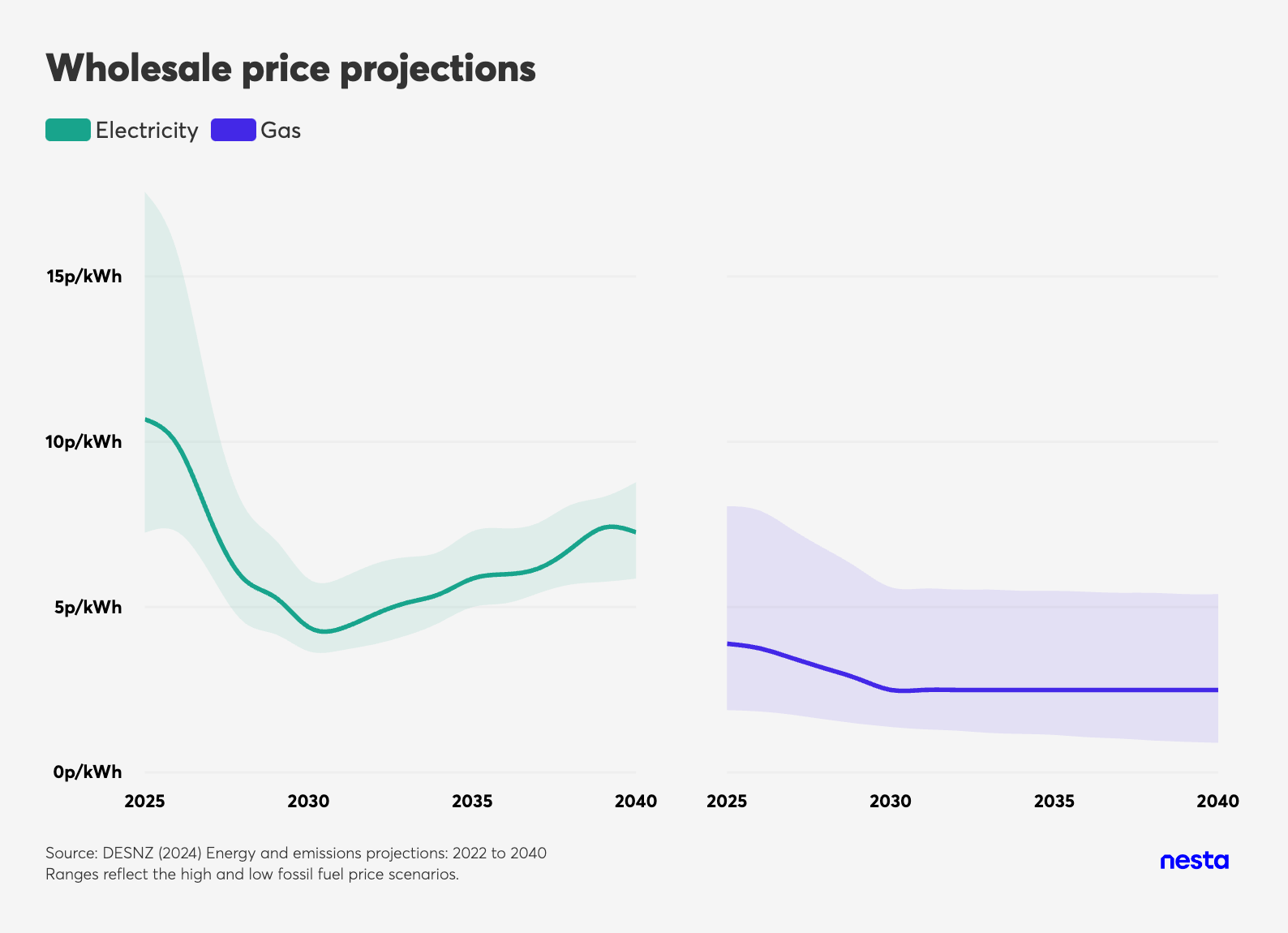
Source: DESNZ (2024) Energy and emissions projections: 2022 to 2040
Ranges reflect the high and low fossil fuel price scenarios.
If levies are reformed, households in Britain would be able to significantly reduce their energy bills by switching to a heat pump or other efficient electric heating. Nesta's previous analysis suggested that if levies were set at the same rate per kWh across electricity and gas, a typical household would save £420 on their energy bill by switching from a gas boiler to a heat pump.
Levies slow the UK's path to net zero
The UK needs to switch one in ten homes away from gas and oil heating to a low-carbon alternative over the course of this Parliament to meet future carbon budgets, the UK's 2030 NDC and to stay on track for net zero in 2050. However, levies on electricity and gas bills are a significant barrier to achieving this.
The current price ratio of 3.9 means that, even if a heat pump uses four times less energy than a gas boiler, it will cost almost the same to run. Heat pumps currently have greater upfront costs than a boiler because most homes are installing a heat pump for the first time, rather than doing a like-for-like replacement. This means the lifetime cost of heat pump ownership is typically higher, even with a government subsidy. Reforming levies would make most heat pumps cheaper to run than gas boilers, and help to make them a more attractive option for households.
"Make electricity cheaper” is the Climate Change Committee's top recommendation to accelerate the UK's progress towards net zero. Removing the "range of policy costs on electricity bills” is their proposed solution. This is a view of levies shared by a wide range of independent organisations, charities, trade groups, advisory bodies and the Government itself (Annex 1).
We propose a set of principles to guide the UK Government's approach to levy reform, and energy bills more widely.
The final distribution of bill costs should be fairer
- Poorer households should not pay a disproportionate share of the costs to support these environmental and social schemes. The overall impact of levies on bills should be as progressive as possible.
- Low-income and vulnerable households should not lose out because of levy reform.
- Levy reform should reduce bills for those experiencing the most acute fuel poverty, such as those using direct electric heating.
- Levy reform should ensure that low-income and vulnerable households are no worse off as a result of any changes.
The levies should be compatible with net zero
- Reforms should reduce the ratio of gas to electricity prices as much as possible, to support the adoption of efficient low-carbon heating.
The UK Government has two broad options for levy reform. It can move levies from one bill to another (rebalancing). Or it can take levies off energy bills and find an alternative way to fund their associated policy costs (removal). Both approaches change the price ratio, energy costs and overarching fairness of bills. The Government can also use targeted support for energy bills to complement levy reform and help to achieve a fairer overall distribution of bills. This section analyses the benefits and downsides of different ways to reform the levies, including combinations of rebalancing, removal and targeted support. In summary:
- Moving levies from electricity to gas improves the price ratio much more than removing them. Moving levies is the option most compatible with net zero, by creating a route to reduce energy bills and support the transition to low-carbon heating.
- Moving levies from electricity to gas does not require any new public spending. Removing them would create a new cost for the Government, which would likely be returned to households via higher taxes.
- Every approach to reform will reduce some household energy bills. Removing levies would make every household's energy bill cheaper, although this would likely be offset by tax increases. Moving the levies will reduce some households' total energy bills, and increase them for others.
- Support can mitigate the effect of any rebalancing for some households; or it can provide benefits that go beyond rebalancing to deliver further energy bill savings. Support schemes could be funded using public spending or other bill-payer subsidies, as is currently the case with the Warm Home Discount.
The ideal outcome is one that makes electricity cheaper, both in absolute terms and relative to gas, and which distributes the policy costs in a more progressive way. It would also involve little or no new public spending, and minimise increases in bills for any households. The tension between these preferences makes it difficult to find a 'best' outcome. However, our analysis suggests that an approach that combines moving levies from electricity to gas bills with targeted support could let the Government maximise the upsides of levy reform while minimising the downsides.
Moving levies from electricity to gas has the biggest positive effect on the price ratio
Shifting all the levies from electricity to gas would make electricity much cheaper. It would reduce unit costs from 23.3p/kWh to 18.5p/kWh under the current price cap, and cut £10.32 from the standing charge. The gas standing charge would grow by the same amount, and the unit cost of gas would increase from 5.9p/kWh to 7.7p/kWh. The price ratio would drop to 2.4, from 3.9 today (Figure 3).
4.1 is the threshold price ratio where a typical air-source heat pump has cheaper fuel costs than a gas boiler for the average household. The threshold where heat pumps and boilers reach parity on whole-life costs is lower. Moving some (but not all) of the levies will have less of an effect, but can make heat pumps much cheaper to run than a boiler. For example, moving just the Renewables Obligation and Feed-in Tariffs onto gas bills and leaving all other levies in their status quo would reduce the price ratio to 2.6. Any improvement in the price ratio would have significant benefits for households currently using direct electric heating.
Figure 3. Effect of rebalancing on the price ratio

Note: this analysis is based on current energy prices (apart from levies). The electricity to gas price ratio may fall further over time if wholesale electricity prices decline relative to gas.
In contrast, removing all the levies from electricity bills without putting any onto gas bills would only reduce the price ratio to 3.1. Removing the Energy Company Obligation from both bills would actually increase the price ratio because it makes up a larger share of the unit price of gas than of electricity (5.1% compared to 3.7%).
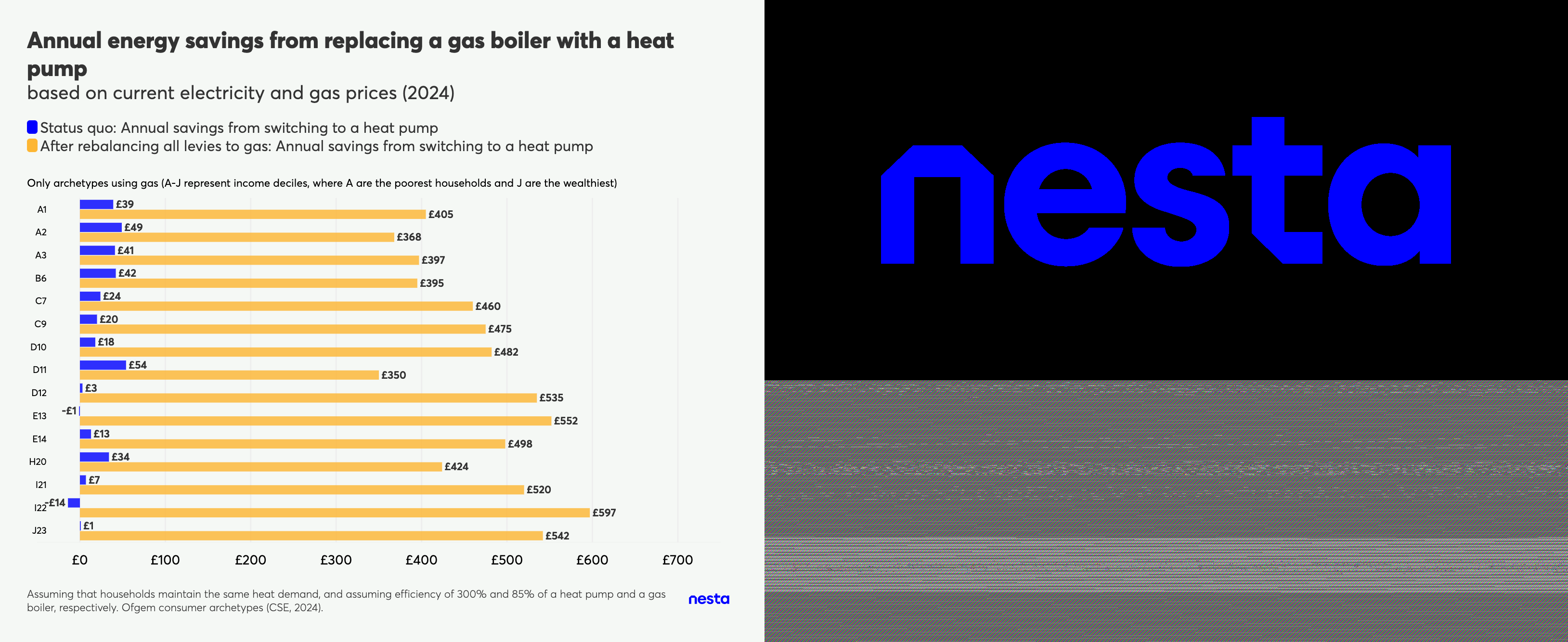
The running costs for a heat pump at a price ratio of 2.4 – with all the levies moved on to gas – would be more than £350 cheaper than a boiler for every type of household currently using gas (Figure 4). For a typical home, switching to a heat pump would reduce energy bills by around £420 a year in this scenario.
Figure 4. Running costs for a heat pump relative to a gas boiler after rebalancing for gas-using household archetypes
Moving levies onto gas would make electricity significantly cheaper for all households
The effect of moving levies between bills is asymmetric. Every household benefits from cheaper electricity, although the amount varies. The costs of moving the levies between bills are spread across 22.5 million gas-using households. Households that do not use gas (which includes those using oil, LPG, biomass and solid fuel, as well as electrical heat) would save up to £400 per year on their energy bill on average (Figure 5). Gas-using households would see their total energy bill rise by £15-100 on average. The increase is smaller than the saving because the gas-using households also benefit from cheaper electricity.
Figure 5. Move all levies from electricity to gas
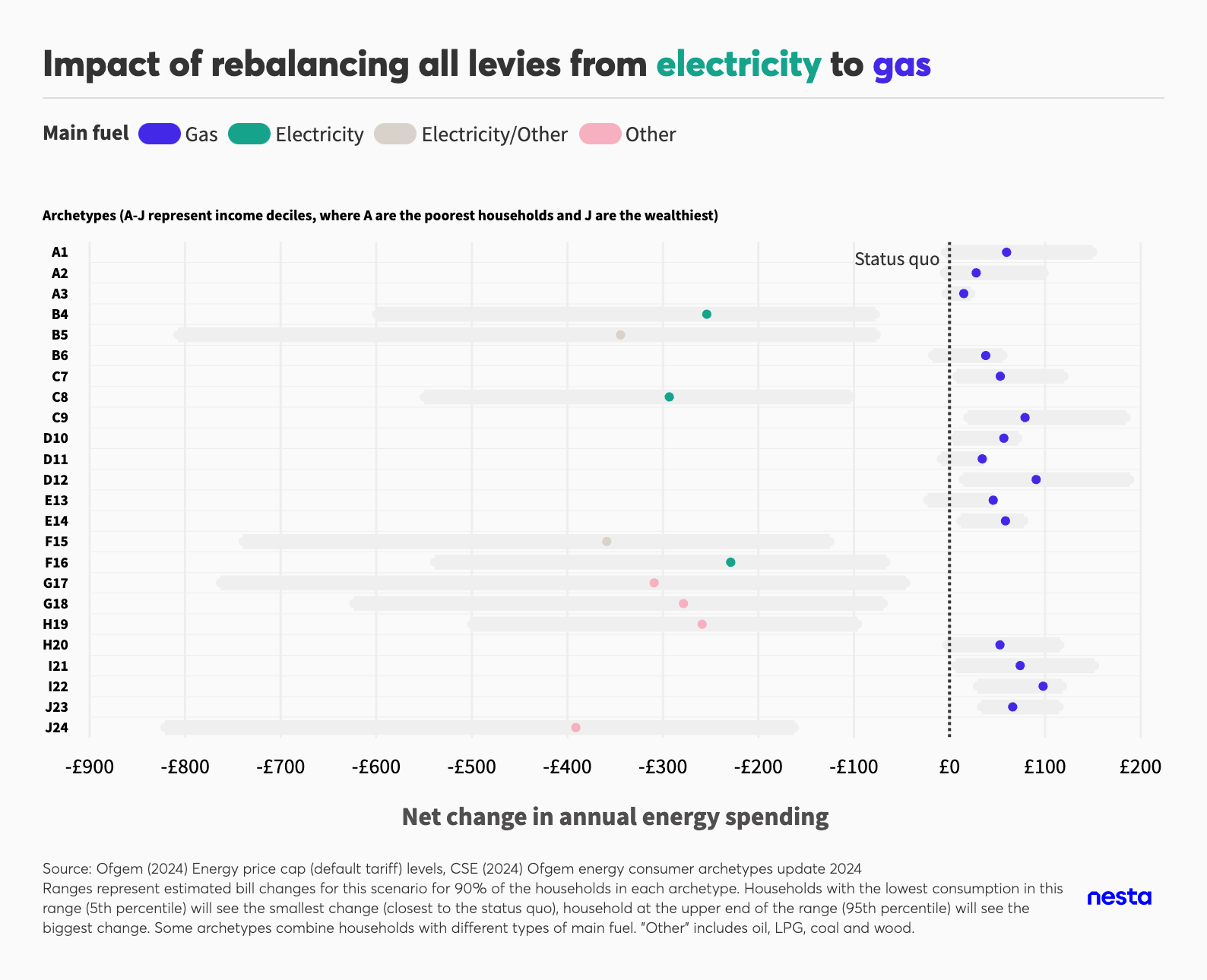
Removing levies from electricity reduces energy bills for all households but passes the costs to Government
Removing levies from electricity would reduce the total energy bill for all households (Figure 6). Households that do not use gas get the same bill savings if levies are removed as if they were moved from electricity to gas. Households that use gas typically use less electricity overall than similar households that do not use gas; their energy bills would fall by £140-270.
However, removing all levies on households (from both electricity and gas) would cost the UK Government around £5.9 billion per year. These savings would likely be returned to households via taxation. Income taxation is a more progressive way to distribute costs than levies on bills, but the UK Government has signalled that public spending will be constrained in the future.
Figure 6. Remove all levies from electricity
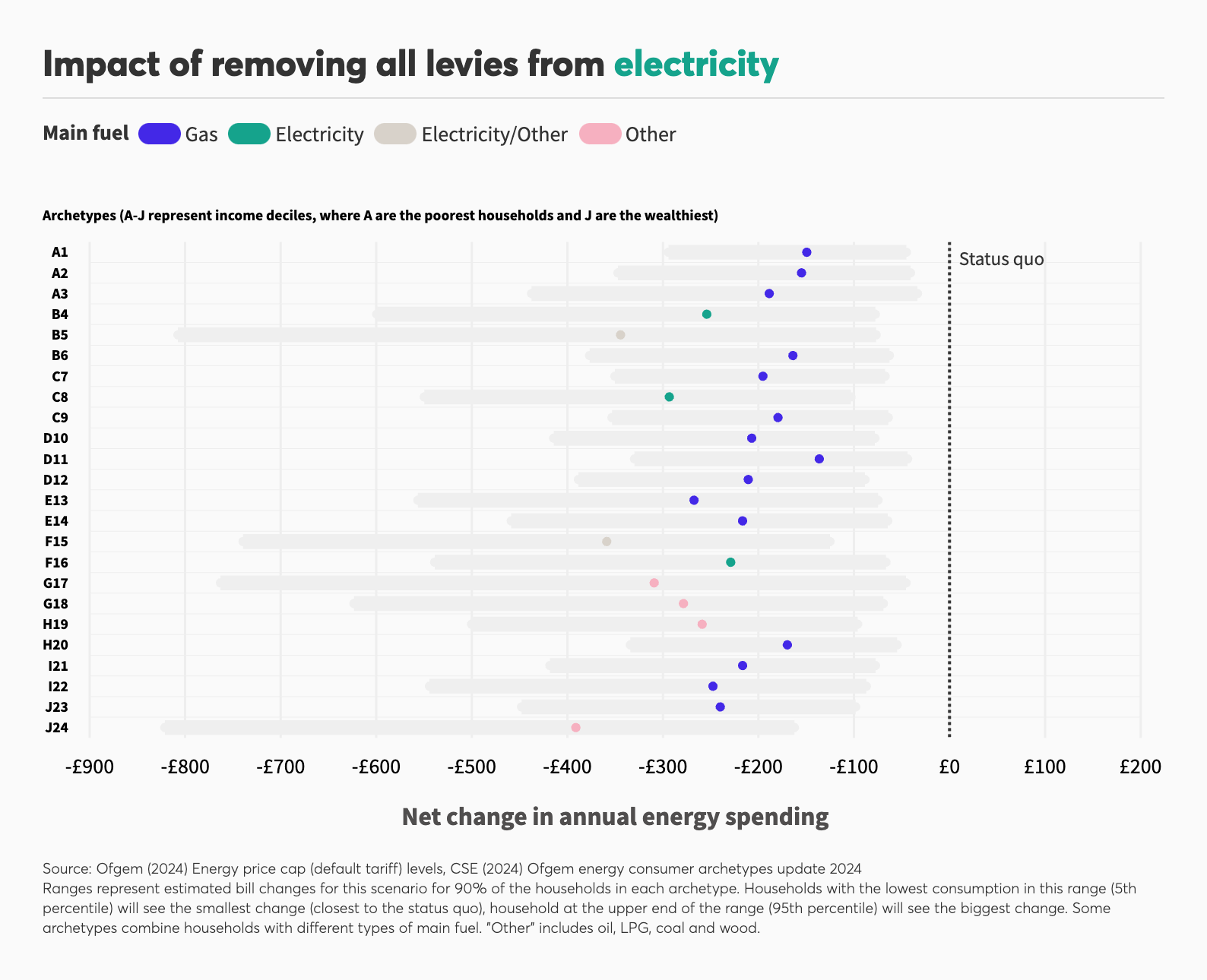
Mitigating the impacts of moving levies for a similar cost as removing them
A targeted benefit supporting households whose bills rise when levies are moved from electricity to gas is more progressive than removing levies outright. Consider a scenario where we move all the levies from electricity to gas. This change would add £1.4 billion to the energy bills of 22.5 million gas-using households, while reducing the bills for the 4.5 million households that do not use gas by an equivalent amount. £655 million of those bill rises accrue to 9.5 million households in the four wealthiest gas-using archetypes. The remaining costs accrue to the 13 million households in the eleven poorest gas-using archetypes. The Government could (in theory) target support to offset these bill rises just for poorer or vulnerable households (Figure 7). This hypothetical mitigation, targeted at the poorest gas-using households, would cost £751m per year and would ensure that 13 million households avoid any bill rises. Their net bill change after rebalancing and the targeted support would be £0 (Figure 8).
Figure 7. The cumulative number of households and the cumulative cost to offset bill rises when rebalancing, for all archetypes, from poorest to wealthiest
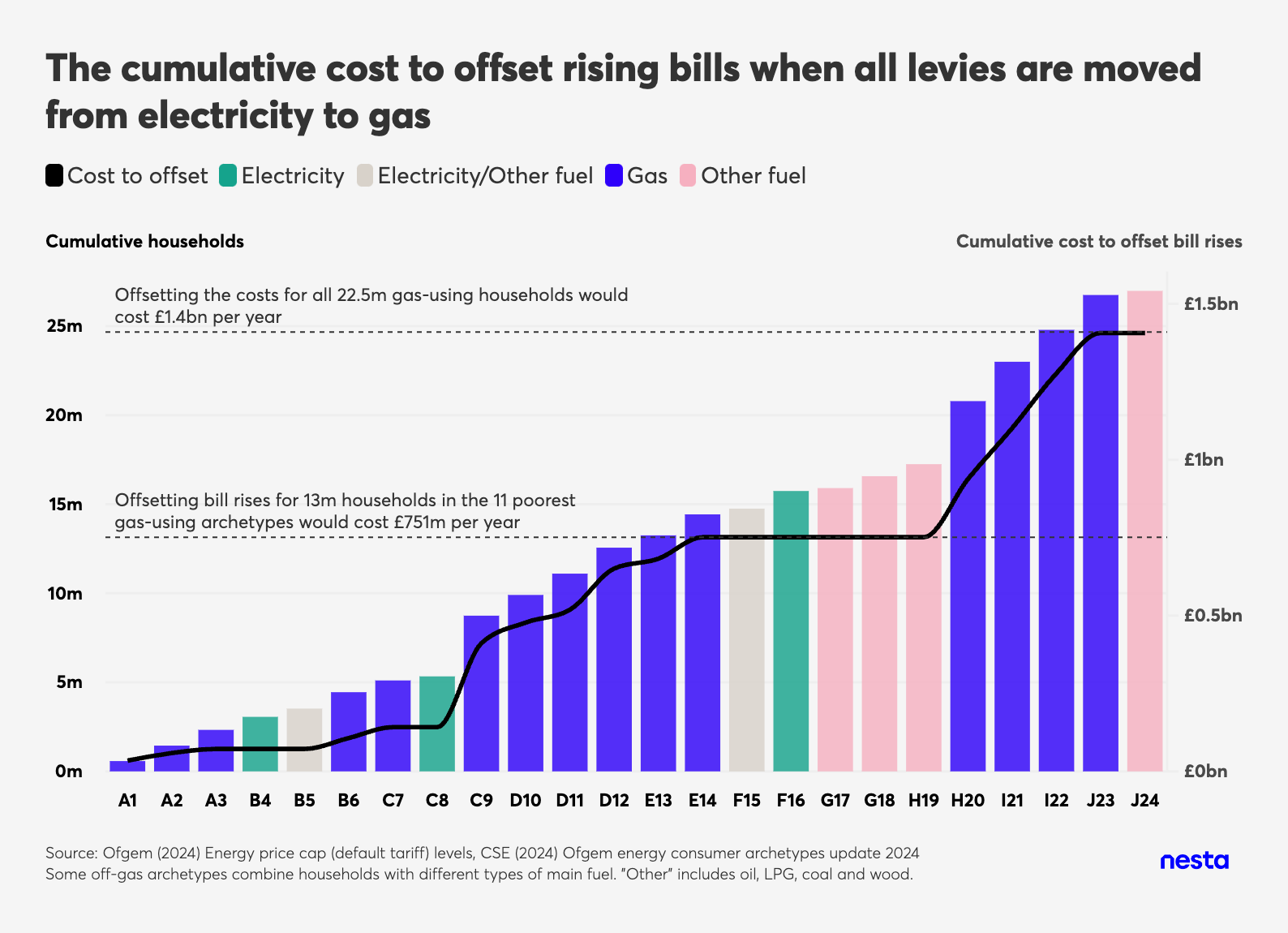
For a similar cost, the Government could remove a component of levies from electricity bills, such as the Feed-in Tariff (£690 million per year), but this gives different outcomes. In this example, the distribution of bill changes with respect to income is broadly the same in both scenarios, but the mitigated rebalancing scenario would reduce the price ratio from 3.9 to 2.4, compared to 3.8 when just removing the Feed-in Tariff levy from electricity bills.
Removing the Feed-in Tariff levy would reduce the energy bill for every household, although wealthier households that tend to use more electricity see bigger savings on their annual energy bill (Figure 8). This would be offset by any costs that are passed back to households via taxation – with wealthier households presumably paying a greater share of that cost. The 4.5 million households that do not use gas get a much smaller bill saving from removing FiT.
Figure 8. Bill changes after mitigating the effects of moving levies compared to removing the Feed-in Tariff levy
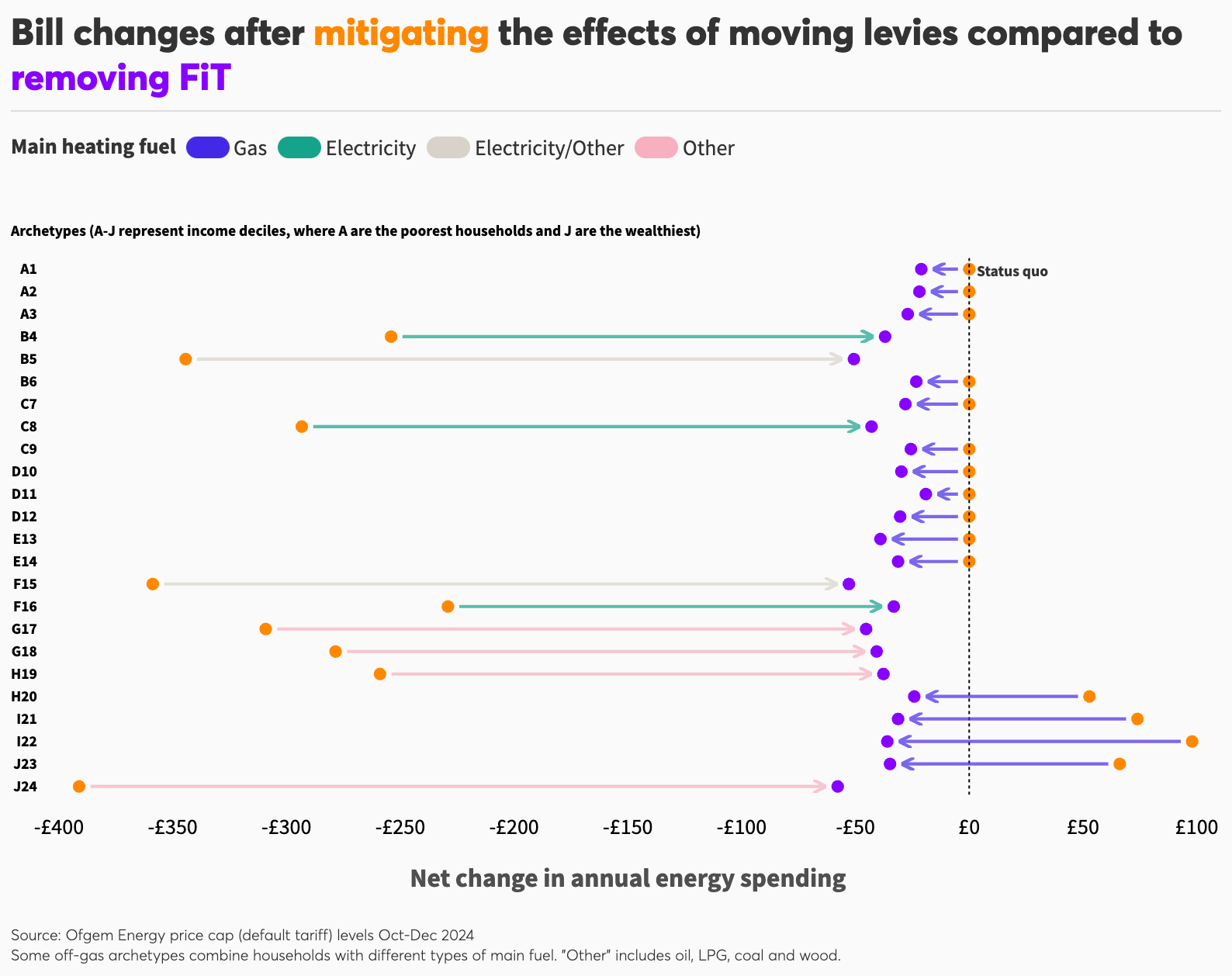
This hypothetical mitigation would create a net benefit for the 13 million poorer gas-using households relative to a scenario where the levies are all moved to gas, but they do not see any bill savings relative to the status quo. Wealthier gas-using households would still see their bills go up. The 4.5 million households that do not use gas would all get a larger bill saving relative to a scenario where the Feed-in Tariff levy is removed from bills; but no change relative to the scenario where the levies are moved to gas.
However, this option is hypothetical because the Government does not have the means to target this type of benefit with this degree of precision. The £751 million cost of this mitigation may also be too steep for the current public finances, despite the benefits it offers. But there are ways the Government can mitigate the effects of moving levies without public spending, such as expanding the Warm Home Discount.
Expanding the Warm Home Discount to provide enhanced bill support
The Warm Home Discount is a form of levy-funded support which provides a £150 rebate, credited directly onto the energy bills of some vulnerable customers. The Government could increase the Warm Home Discount to offset bill impacts from rebalancing levies, and reduce energy bills for low-income households.
- The scheme supported 3.14 million poor and vulnerable households in 2023-24. Eligibility includes those receiving the guarantee credit element of pension credit and low-income households with high energy costs.
- The Warm Home Discount adds £10.91 to both the gas and electricity standing charges. Eligible households still pay the levy, so those using both fuels get a net benefit of £128 from the rebate, or £139 for those just using electricity.
Increasing the Warm Home Discount levy and then moving it to gas (along with the other levies on electricity) would increase the difference in bills (relative to the status quo) for all gas-using households. However, the change for each archetype is typically less than the size of the Warm Home Discount rebate. This means that eligible households in every archetype would see a net reduction in their overall energy bill (Figure 9). This chart shows the difference in bill changes for households who are eligible for the Warm Home Discount compared to those who are not.
Figure 9. Rebalance all levies from electricity to gas and double the rebate to Warm Homes Discount recipients
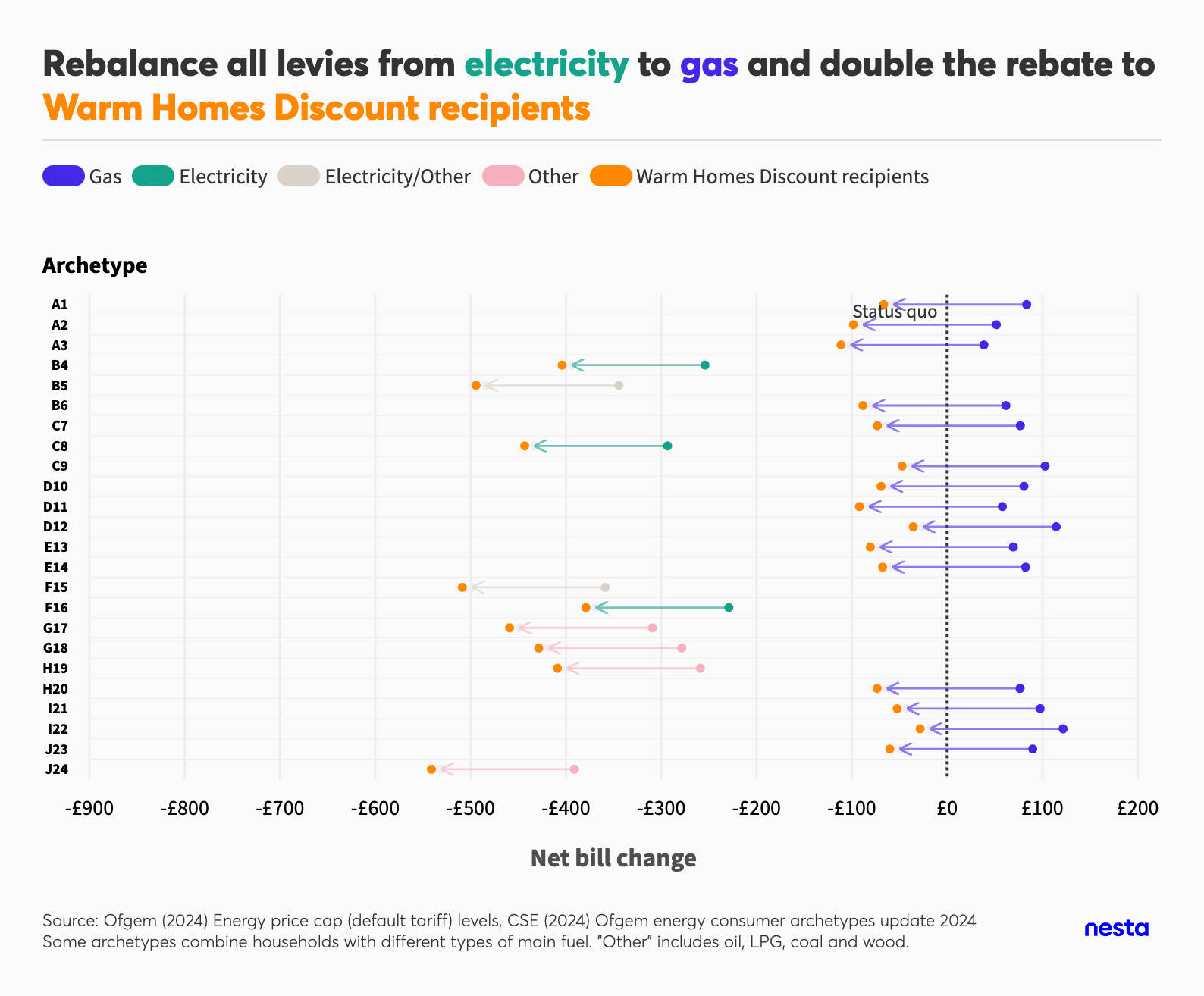
Using an enhanced Warm Home Discount to support levy reform has some upsides. It would amplify the bill reductions for 790,000 households that do not use gas. It also uses an existing policy mechanism – the Government can easily adjust the size of the Warm Home Discount rebate without needing to create a new type of benefit. This should be relatively easy to implement, compared to other forms of targeted support as mitigation.
However, as with other types of reform, this approach has its limitations. The most critical is that many poor households would not benefit. Warm Home Discount is aimed more towards poorer pensioners than working-age households. Only 22% of households in the 11 poorest gas-using archetypes are eligible (Table A1). So any mitigation using the Warm Home Discount would miss 9.5 million of those households. This assumes that all eligible households actually take up the benefit, in 2023-2024.
The relative value of a flat rebate varies between households depending on the amount of energy they use. This does not necessarily reflect relative differences in the underlying need for support. There is a lot of variability in energy consumption within the archetypes, which are nominally similar households. Households with the lowest consumption in the A1 archetype have energy bills of around £600 per year, while those with the highest consumption are spending more than £3,200 per year. This variation is a major reason why many proposals for new types of bill support focus on social tariffs that provide a benefit proportional to energy use.
Doubling the Warm Home Discount is sufficient to mitigate the effects of full rebalancing for at least 95% of eligible gas-using households. A few eligible households with the highest energy use (95th percentile or higher for their archetype) could still see bill increases of £20 to £90 even with the extra £150 rebate (Figure 10). In practice, we expect that eligible households are more likely than not to have below-average consumption relative to their archetype. So the actual number of Warm Home Discount-eligible households that lose out in this scenario is likely to be negligible.
Figure 10. Bill changes change for Warm Home Discount-eligible households by energy consumption
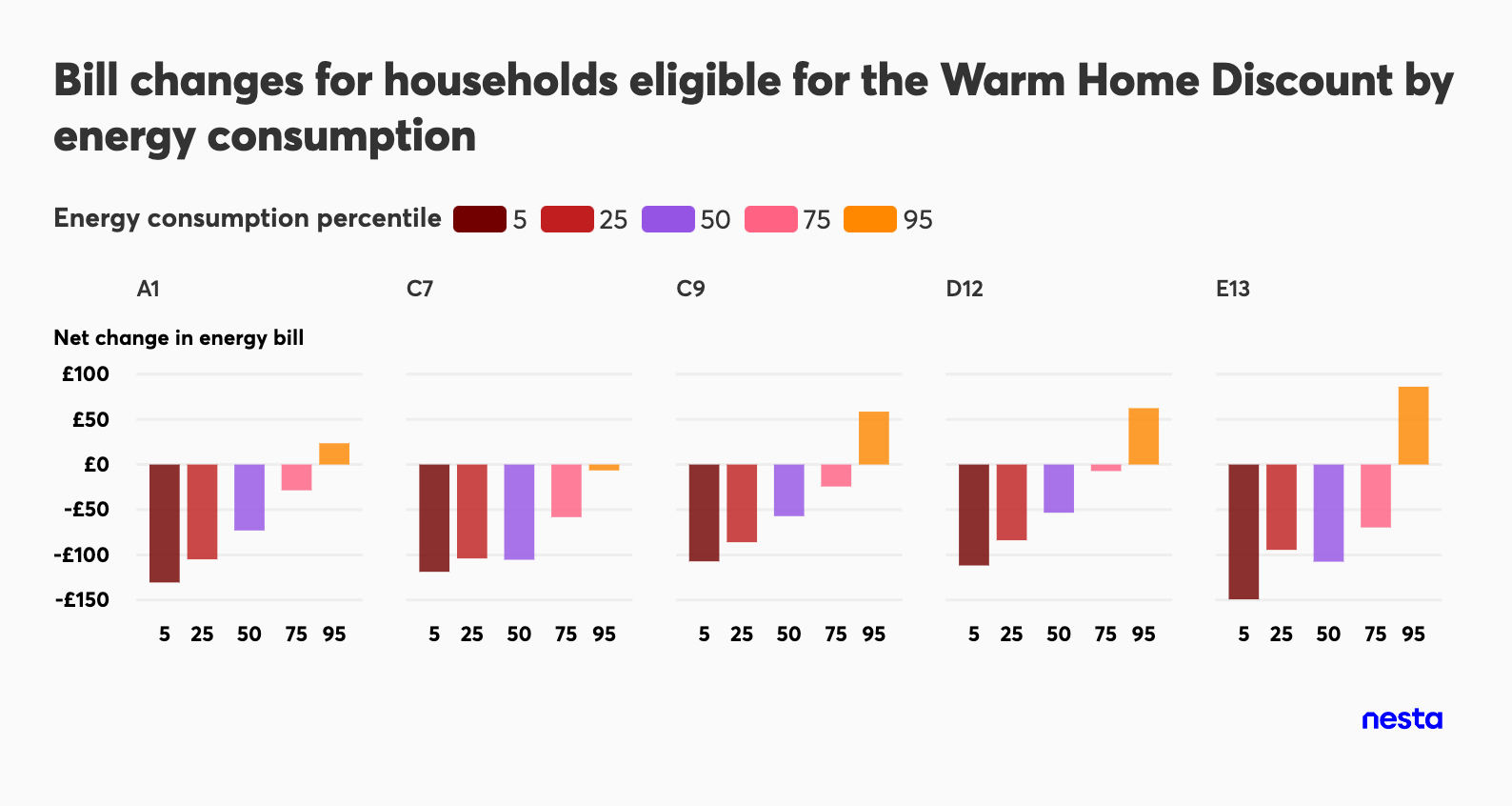
Increasing the additional rebate to £252 would ensure even the households with the highest consumption get a net benefit after rebalancing. This is one way of fine-tuning an approach to levy reform, which we will now discuss in more detail.
In our view, the best type of levy reform would be to combine rebalancing with targeted support. However, targeting support at the most in-need households is difficult, and the best outcome will ultimately be subject to some political considerations. In this section we look at some of the specific considerations for this type of reform, which helps us to fine-tune our approach.
One advantage of using the Warm Home Discount to deliver support is that it already exists. Creating a new type of support system is implicitly more difficult and time-consuming. Using the Warm Home Discount avoids the need to increase public spending as the costs are socialised through bills. While this is more regressive than income taxation, the effect is offset by the benefit, to the extent that it reaches the households most in need.
However, last year only 11.5% of households in England and Wales actually received a rebate. This amounts to 3.05 million households (with another 90,600 in Scotland), which is less than the Government's estimate for the number of fuel-poor households in England alone (3.17 million). Ensuring that poor and vulnerable households do not lose out as a result of levy reform is one of our key principles. The current means of targeting the Warm Home Discount is not adequate on this basis, and while it offers a route to mitigate bill rises due to rebalancing, it may not be sufficient.
As part of fine-tuning levy reform, the Government should consider whether changing the Warm Home Discount will produce better outcomes than creating a new alternative. This includes weighing whether to provide a flat or variable benefit, and how best to target any support. It also needs to consider how levy reforms will play out in the future, as gas demand falls and electricity consumption rises.
Mitigating bill rises using rebates or discounted tariffs
As discussed, flat rebates have some limitations as a benefit because the degree of need varies between households. A social tariff is an alternative where the level of support scales with energy consumption. The specific implementation could take the form of a fixed unit-rate discount, or a percentage reduction for the final energy bill. This is better than a rebate because it distributes the benefits in a more efficient way.
If the Government did opt for a consumption-based benefit, it could still use the Warm Home Discount levy as a vehicle to raise the necessary revenue. To an extent, the Warm Home Discount already provides a set of wider benefits beyond the rebate – the 'industry initiatives'.
- These are a range of sanctioned activities which qualify towards each supplier's obligation, typically ~10% of the annual budget for the scheme.
- Last year the three biggest expenditures in this part of the scheme were: energy efficiency measures (£7.23 million supporting [22,000] households) and financial assistance (£6.60 million supporting 59,000 households), and debt assistance (£4.62 million supporting 27,000 households).
- Suppliers can provide up to £150 as additional financial assistance (on top of the rebate) to the households at most risk of fuel poverty. They can write off up to £2,000 of energy debt per household using these funds; although the total amount of debt relief is capped at £6 million per year, of which half is reserved for customers on prepayment meters.
The purpose of the industry initiatives is to allow suppliers to tailor their support to the particular needs of their customers. We do not think there is any need to change how they work, but they illustrate how the Warm Home Discount (as a scheme) can provide a portfolio of benefits beyond the rebate. The Government could expand the Warm Home Discount, and allocate the additional revenue to a social tariff, further debt relief, or other forms of support. We do not think there is a good case to significantly expand the provision of energy efficiency measures through the Warm Home Discount, as this duplicates the role of the Energy Company Obligation.
Targeting support to create fairer outcomes
As noted, the Warm Home Discount does not even cover all the fuel-poor households in England, let alone Britain as a whole. Ideally, any targeting would be directed towards gas-using households with low incomes and high energy needs who lose out as a result of rebalancing. However, specifically targeting these households can be difficult.
- While some low-income households can be targeted through the benefits system, many poorer households may not be eligible for means-tested or disability benefits, or may not claim the ones they are entitled to (Figure 11). For example, many pensioners do not currently claim Pension Credit even if they are eligible.
- Other forms of targeting can be too broad. For example, expanding support to include all pensioners would extend benefits to many well-off households.
Figure 11. Households eligible for support on the basis of receiving means-tested benefits by consumer archetype
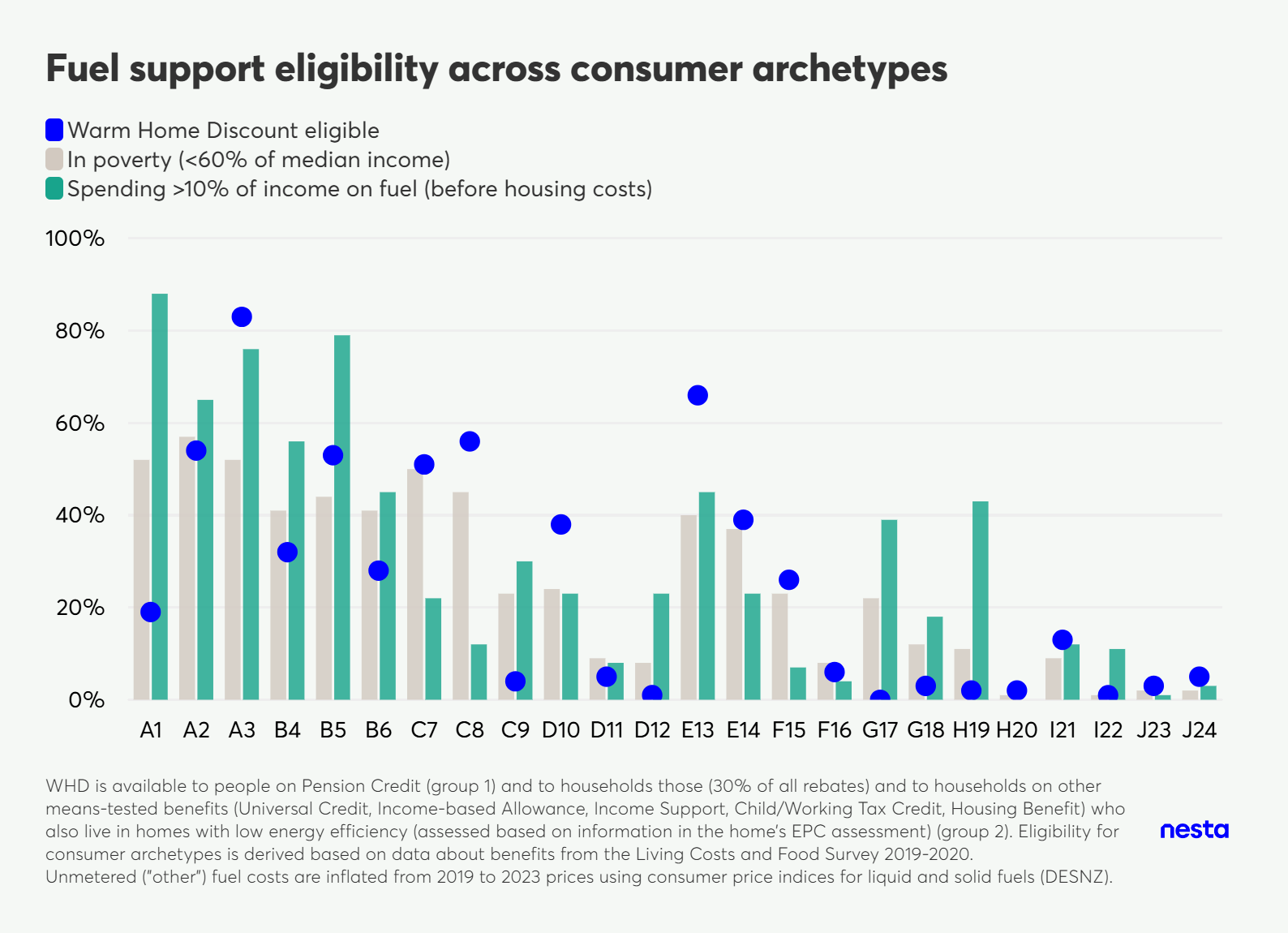
One way to specifically target gas-using households would be to apply any financial assistance only to customer accounts with a gas meter. This would help manage the costs of any support scheme. Using the example of expanded Warm Home Discount, it would mean 790,000 fewer households eligible for the additional benefits. This would increase the amount of funding per eligible household by 20.4%. Alternatively, the Government might not want to change the way the Warm Home Discount targets its existing core groups. Instead, it could create a new group within the scheme or create an entirely new and separate form of bill support. Households with low incomes and high energy needs could be targeted either through data about their homes' energy efficiency and size of the home or through actual energy expenditure (which energy companies already know).
However, any support scheme needs to avoid indiscriminately funding fuel expenditure of big gas consumers regardless of their income. This would be in direct contradiction to one of the main goals of rebalancing, which is to incentivise households to switch to low-carbon heating. Other characteristics that could be used to target support have pros, cons and barriers which limit their use.
- Target households using HMRC data. Ideally, the Government would target support on the basis of household income. HMRC data could be used to determine eligibility, but this would need to be shared with energy providers. To date, HMRC has resisted this. Discounts based on income might not account for differences in energy needs of different homes.
- Target households in lower council tax bands. While poorer and more vulnerable households tend to live in homes with lower council tax bands, the relationship is not particularly strong. In 2022 the Government provided a £150 rebate to homes in bands A-D in England to help with energy costs. Yet the share of this support which went to poorer homes was only roughly equal to the share of poor homes. Targeting on the basis of council tax will not produce the type of progressive impact that would make levy reform fairer than the status quo.
- Target vulnerable households using NHS data. NHS trusts hold information on patients who are vulnerable to cold; but this data is not joined up with other systems and could be hard to share. The priority services register is a similar dataset, but it is too broad, and insufficiently focused on the types of need we want to address here.
The outcomes of levy reform will change over time as the UK's energy system shifts away from fossil fuels. The best option for the here and now may not be the best option in 2035. These outcomes will be affected by the relative amount of gas, electricity and other fuels used by households, and any changes in the cost of levy-funded schemes.
Falling gas consumption will reduce the revenue base for gas levies
NESO projects that residential gas consumption will fall by 92.5TWh between 2023 and 2035, with 5.3 million fewer households using gas. Electricity consumption falls between 2023 and 2030 as homes become more energy efficient, before rising steadily after that with the growing adoption of EVs and electrical heat. These changes will have a profound effect on the distribution of levy costs, even without any reform. To give a sense of scale, if we apply NESO's 2035 projections for gas consumption and consumers to the current levies (holding everything else equal) we estimate that the gas standing charge would increase from £11.29 per year to £14.44 and the variable levy costs would increase from £34.38 to £50.29 for a typical dual-fuel household.
The cost of some levies will fall as their associated schemes wind down and close
- The legacy schemes funded by the Renewables Obligation and Feed-in Tariffs are not taking on new projects. Existing contracts will gradually expire, and their associated costs will taper down over time between now and the late 2030s.
- The Green Gas Support Scheme, supported by the Green Gas Levy, was due to close to new entrants in 2025, but this has been extended to 2028. Tariff payments are guaranteed for 15 years, which implies that the levy would run until 2043 at least. The Government expects the cost of the scheme to grow over time. To date, the Green Gas Support Scheme has underspent its budget, and the Green Gas Levy rate was reduced in February 2023.
The cost of other levies will likely rise, and new policy costs could be added
- The current round of the Energy Company Obligation runs until 2026. The Government has not yet confirmed their successors, but further rounds seem likely. Nominal spending on this levy has increased over time and we expect it will have to keep growing to support the progress needed to reach the UK's 2030 NDC and national fuel poverty targets.
- The cost of the Warm Home Discount will probably continue to rise, at least in the near term. The size of the scheme is influenced by the value of the support provided and the number of eligible households. The rebate started at £120 and rose to £140 between 2011 and 2014, but was only increased to £150 in 2022. Further increases would increase the levy rate. The number of rebates may increase due to an ageing population but could fall if economic conditions improve.
- The Energy Intensive Industries Support Levy is expected to apply to bills from April 2025. This levy will subsidise 60% of the electricity network costs for energy-intensive industries via the Network Charging Costs scheme. While this levy will apply to energy suppliers, “the presumption is that this cost will be passed on to their customers.” The Government projected it would cost £320-£410 million in the first year. The levy would apply to the unit costs of electricity bills, split across domestic and non-domestic consumers in a similar fashion to the Renewables Obligation and Feed-in Tariffs. At the projected cost this would increase household electricity bills by £3.54 to £4.35 per year for a typical dual-fuel household.
- The Government had planned a hydrogen levy on gas bills to fund the development of hydrogen production, transport and storage infrastructure. This would have added an estimated £118 to domestic gas bills by 2030. The proposal was changed following a backlash and the levy will now apply to gas shippers rather than energy suppliers.
Specific considerations for individual levies
We have considered scenarios that entail removing or rebalancing all the levies on electricity. But alternative, partial forms of removal and rebalancing may produce better results. There are good reasons why the Government may not want to change some of the levies, or why reforming some may be harder than others.
Renewables Obligation and Feed-in Tariffs
Both the Renewables Obligation and Feed-in Tariffs apply to both domestic and non-domestic electricity bills. Their levy rates are calculated using the total metered electricity consumption, excluding energy-intensive industries, which are largely exempt from current policy costs. This means that 39% of the total revenue for each scheme is raised from households, despite only accounting for 38% of total electricity demand. In contrast, households account for 61% of all gas consumption; so rebalancing the levy directly would increase the share of revenue raised from households. The move would also increase bills for non-domestic gas users; an outcome the Government may want to avoid. This suggests that any approach to rebalancing these levies, or the Energy Intensive Industries Support Levy coming in 2025, would involve setting a fixed share of the revenue to come from domestic and non-domestic bills, and then setting each independently.
Assistance for Areas with High Electricity Distribution Costs
Households in the north of Scotland face much higher electricity network costs in their energy bill than those in any other part of Britain. This reflects the greater cost of building and operating the electricity distribution network in remote areas. Assistance for Areas with High Electricity Distribution Costs reduces the distribution costs for these customers, bringing them in line with the rest of Britain. Citizens Advice has argued that Assistance for Areas with High Electricity Distribution Costs using gas bills to socialise the cost of electricity networks between regions is illogical. We agree, and would also suggest that Assistance for Areas with High Electricity Distribution Costs is left on electricity bills. Given how small it is compared to other levies, this should not have any major impact on the outcome of levy reform.
Contracts for Difference and the Capacity Market
Contracts for Difference and the Capacity Market are often included in proposals for levy reform (Annex 1). The Office for Budgetary Responsibility (OBR) treats them as environmental levies, raising £1.8 billion and £1 billion respectively in 2023–2024. Moving them off electricity bills would have a material effect on costs and the price ratio, especially given that their costs are expected to rise to £3.1 billion and £4.1 billion in 2029–2030. However, they play an integral role in setting the short-term price of electricity. This price signal is an important tool to help direct some consumer behaviours, such as flexible energy use. We also expect these costs to increase as the British energy system grows and shifts to renewables. This investment will continue to be repaid long after households stop using gas. As such, moving the costs of Contracts for Difference and the Capacity Market onto gas would create unnecessary risks.
Considering the seasonality of levies
One other approach the Government could consider is varying levies by season. Most energy consumption for heating, whether gas or electricity, happens in the winter months, roughly from October to March. This means people pay far higher energy bills in winter, which especially affects customers on pre-payment meters or who do not pay for energy via direct debit.
Shifting levies so they are higher in the summer months – April to September – would smooth out energy bills across the year. It would mean households paying more in the summer than they do now, but less in winter. This would lower the cost of heating, which should ease fuel poverty in winter and may also make switching to low-carbon heating more attractive.
There are possible risks and downsides to making levies seasonal – for example, it would disproportionately favour homes with solar panels – but it is an option the Government could consider as part of an effort to make bills lower and fairer.
Conclusions and next steps
Adjusting levies on household electricity and gas bills is not an easy policy change, but it is a very important one. The status quo which is regressive, provides high energy bills, locks in reliance on gas and holds back the switch to low-carbon heating - is a very poor one. There is no perfect, painless policy solution, but there are options that are much better than the status quo.
Based on the analysis in this paper, the best approach is to rebalance levies from electricity to gas while providing targeted support to those households most in need. This would provide a clear route to lower household energy bills over time, by switching to efficient electric heating. It would save some of the most acutely fuel-poor households – those who currently use direct electric heating – immediately. It would also, by targeting support at those most in need, offset bill increases for the most in-need households.
The key challenge with this approach is around targeting support at those households who need it most. The UK currently has limited frameworks for targeting households effectively, although these could be improved. The next phase of Nesta's work on this topic will consider targeting options in more detail, alongside more detailed proposals on how best to rebalance levies in a fair, affordable and socially beneficial way.
Annex 2. Ofgem's household archetypes
Table A1. Eligibility for major bill support or energy efficiency schemes
| Archetype |
Households |
Cold Weather Payments |
Energy Company Obligation |
Warm Home Discount |
Winter Fuel Payments |
| A1 |
578,335 |
11.1% |
2.9% |
19.3% |
99.1% |
| A2 |
868,191 |
24.4% |
0.0% |
54.2% |
48.8% |
| A3 |
883,411 |
100.0% |
2.4% |
82.6% |
23.7% |
| B4 |
731,319 |
17.4% |
5.6% |
32.2% |
83.2% |
| B5 |
465,289 |
99.1% |
20.2% |
52.7% |
46.6% |
| B6 |
920,170 |
12.2% |
0.7% |
27.8% |
37.1% |
| C7 |
659,595 |
14.2% |
0.0% |
51.1% |
1.7% |
| C8 |
228,477 |
18.0% |
2.0% |
55.5% |
3.0% |
| C9 |
3,408,515 |
2.6% |
4.2% |
4.4% |
70.4% |
| D10 |
1,163,944 |
100.0% |
28.2% |
37.8% |
61.5% |
| D11 |
1,197,075 |
1.8% |
0.5% |
4.9% |
22.9% |
| D12 |
1,457,830 |
0.6% |
0.6% |
0.6% |
100.0% |
| E13 |
690,892 |
99.5% |
22.6% |
65.7% |
3.1% |
| E14 |
1,178,682 |
12.6% |
22.5% |
39.3% |
1.9% |
| F15 |
323,434 |
5.9% |
37.0% |
25.6% |
0.0% |
| F16 |
989,639 |
0.9% |
1.7% |
6.2% |
7.0% |
| G17 |
163,168 |
3.8% |
0.0% |
0.0% |
37.2% |
| G18 |
667,836 |
2.2% |
2.8% |
3.2% |
45.4% |
| H19 |
675,712 |
0.0% |
3.5% |
2.0% |
56.5% |
| H20 |
3,540,271 |
1.1% |
1.8% |
2.1% |
7.4% |
| I21 |
2,210,493 |
1.7% |
55.0% |
13.0% |
1.2% |
| I22 |
1,792,593 |
0.0% |
1.9% |
0.8% |
21.3% |
| J23 |
1,956,103 |
0.3% |
67.4% |
2.9% |
1.0% |
| J24 |
231,657 |
8.3% |
73.0% |
5.0% |
3.5% |
Endnotes
58 Victoria Embankment
London EC4Y 0DS
+44 (0)20 7438 2500
[email protected]
X @nesta_uk
f nesta.uk
www.nesta.org.uk
ISBN: 978-1-916699-32-8
Nesta is a registered charity in England and Wales with company number 7706036 and charity number 1144091. Registered as a charity in Scotland number SC042833.
Registered office: 58 Victoria Embankment, London EC4Y 0DS.
CC BY NC SA