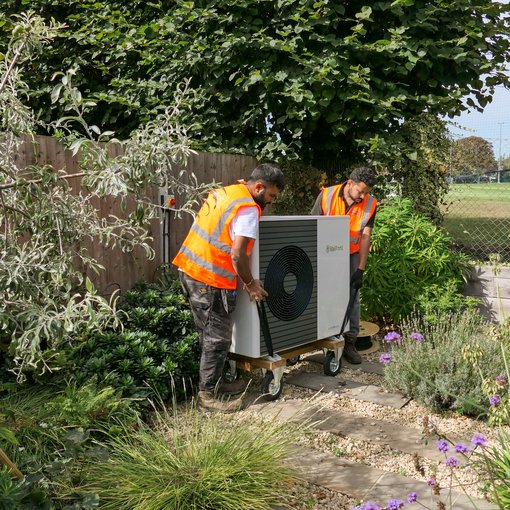
Four learnings from scoping finance options for heat pumps
 www.nesta.org.uk/project-updates/four-learnings-from-scoping-finance-options-for-heat-pumps/
www.nesta.org.uk/project-updates/four-learnings-from-scoping-finance-options-for-heat-pumps/
www.nesta.org.uk/project-updates/four-learnings-from-scoping-finance-options-for-heat-pumps/
Upfront costs are commonly referred to as the biggest barrier to heat pump adoption in the UK, with a YouGov poll commissioned by Nesta finding that 72% would find installing a heat pump unaffordable without additional borrowing. Subsidies such as the Boiler Upgrade Scheme (BUS) have helped to reduce this barrier, but for many, the remaining cost is still higher than that of a boiler. For a lot of people, funding the difference in cost after the £7,500 BUS grant with personal savings is not an option. If we are going to have any chance at reaching our ambitious heat pump adoption targets we need to start thinking about how households can install one at zero upfront cost.
At Nesta, we have done a fair bit of research into making heat pumps affordable, but this has primarily been focused on reducing the cost of installation and running costs. Paying for heat pumps is our first project focusing on how finance could be used to tackle the upfront cost barrier. We want to understand whether there are barriers to existing private finance, and whether new models might be more appealing to consumer segments that find traditional forms of finance less accessible. From our initial scoping we heard a few recurring themes from the retail banks, tech aggregators, trade associations, and financial institutes that seemed promising for further exploration.
Paying for heat pumps: the key points
Everyone we spoke to raised sections 56 and 75 of the UK’s Consumer Credit Act 1974 (CCA). Section 75 ensures lenders share joint liability with the supplier of goods or services for any misrepresentation or breach of contract, whilst section 56 establishes an agency relationship between the dealer and financier. While the CCA provides vital protection to consumers, it has potential negative consequences for lenders, evident during the solar mis-selling scandal. Sales companies sold faulty solar panels to customers with promises of large savings and quick returns on investment. In response, consumers took out loans to fund the solar panel installations, which frequently failed and left many in debt. Lenders were then held responsible for claims, as the original sales companies went into liquidation.
The prevalence of this concern amongst lenders has encouraged us to explore the role an insurance- or assurance-type body might have in reducing lenders’ perceived risk. Could an assurance body help validate the quality of heat pump installations to ensure specific in situ performance or running costs, shifting some of the liability away from lenders for promises made by installers? And similarly, could a government-backed financial protection scheme, like ATOL, protect both consumers and lenders in the case of a supplier ceasing to trade after a faulty installation?
In a nutshell, property linked finance (PLF) is when a loan is taken out to fund work on a property, but the loan is linked to the property itself, rather than the owner. PLF was raised a number of times by stakeholders we spoke to as a novel model that could unlock large amounts of finance and potentially appeal to consumer segments that don’t typically engage with existing forms of finance. PLF is currently not possible in the UK, but there are examples of it being used in the US and Australia. A common concern is whether property prices and resale value would be impacted and who would be trusted to administer the loan. We think that PLF could be a novel solution to the high costs of retrofits in the UK and want to further test its appeal with consumers.
A key theme that arose from our stakeholder interviews was the importance of lowering running costs, primarily via lowering electricity prices and rebalancing levies. Low running costs benefit everyone. A heat pump lowering consumers' energy bills results in more disposable income, which in turn improves the affordability of green loans. From a lender’s perspective this means consumers are less likely to default on repayments, reducing the risk associated with product-specific lending and potentially enabling them to reduce the interest rates they can offer. Guaranteed larger savings on energy bills could also unlock new business or finance models that are not currently viable. An example is pay-as-you-save, where a third party, such as a utility company or local authority, could cover the upfront cost and recoup their investment from the consumer’s monthly savings.
In European countries with the highest uptake of heat pumps, the upfront cost is tackled by a combination of grants and government-backed loans. In France and Germany, the tiered grants can be integrated with private loans, where the interest on the loan is paid by the government. This raises the question of whether public-private partnership in the UK could see similar success. If the size of grants needs to taper down, could a lower-cost option be government-backed loans?
We are keen to continue speaking to people about these topics so that we can further prototype and propose solutions. To ensure we capture a wide breadth of opinions we will be sharing some of our key questions, while also welcoming suggestions for any other methods to scale heat pump financing that we might have missed. We will also be conducting some consumer testing to investigate whether new financial models are more appealing to specific consumer groups and why existing forms of finance might be acceptable for an asset such as a car, but not a heat pump.
If you would like to get in touch, please email [email protected]