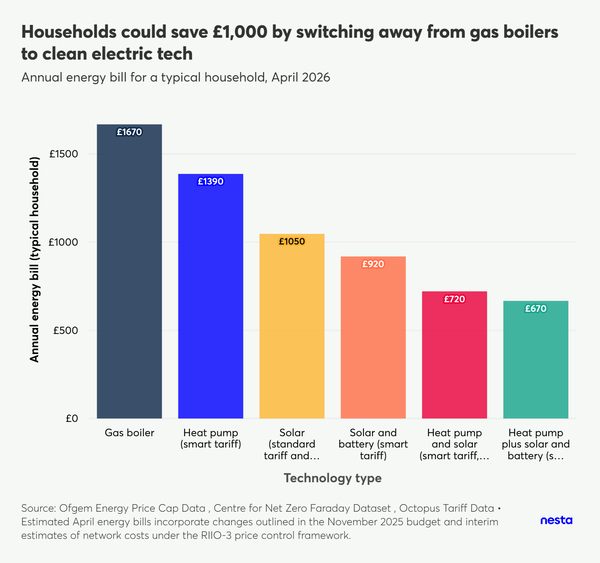
London, UK - The UK Government’s Warm Homes Plan could save a typical household that invests in home upgrades £1,000 on its energy bill, new analysis from the research and innovation charity Nesta finds. Households that get a heat pump, solar panels and a battery could see their yearly bill from April fall from around £1,670 to around £670 under changes announced by the government.
The UK government is launching its Warm Homes Plan, focusing on boosting the electrification of UK homes, by supporting the uptake of solar, battery and heat pump technologies. Under the plan, the government will offer fully funded solar panels and batteries to low income households. Other households will be able to access a new Warm Homes Loan, as well as a subsidy from the Boiler Upgrade Scheme, to help with the cost of investing in clean energy technology.
To understand the potential impact of this policy in practice - and provide clarity for consumers and policymakers - Nesta has conducted an independent quantitative analysis of the projected energy costs associated with different low-carbon technologies and energy bill tariffs.
Nesta’s analysis models the expected annual energy bill for a combination of solar PV, battery storage and electric heat pumps. By analysing these technologies against a range of current and emerging energy tariffs, the analysis projects the real-world energy bill impact of these changes for households moving away from fossil fuels.
Nesta’s analysis finds that across every low carbon technology combination modeled, households can expect to see a reduction in their annual energy bills compared to a typical dual-fuel home that is on a standard tariff with a gas boiler.
The changes to energy bills announced in the Budget in November last year also help increase these savings, due to removing some levies from electricity bills, making clean electric technologies cheaper to run.
Commenting on the Warm Homes Plan, Madeleine Gabriel, director of sustainable future at Nesta, said:
“Increasing access to technologies that can help people live more sustainably comes with significant additional benefits. Solar panels and batteries are smart choices for people looking to cut their bills, and heat pumps also ensure people can enjoy a more comfortable, consistently warm home.
“Today’s announcements provide a clear path to helping millions more families reap the rewards of low-carbon home upgrades, whatever their financial situation and whether they own or rent their home.
“We now look forward to seeing the UK government, local authorities and industry work collaboratively to deliver the Warm Homes Plan in practice, ensuring households across the country benefit from warm homes and lower bills.”
Notes to editors
- For these calculations Nesta assumes a ‘medium’ 2-3 person, 2-3 bedroom home. Ofgem statistics show that a medium home consumes 2,700kWh of electricity and 11,500kWh of gas annually. Nesta assumes an equivalent home with a heat pump consumes 5,877kWh of electricity annually and does not have a gas connection. Nesta used synthetic data generated by the Centre for Net Zero (CNZ) from 1m Octopus customers to estimate demand profiles for households with different low carbon technologies. Nesta assumes 8-10 solar panels generating 3,740kWh annually and a 5kWh home battery.
- Nesta forecast what the energy price cap might look like in April by applying the changes to bills made in the Autumn Budget - removing the Energy Company Obligation (ECO) levy and moving 75% of the Renewables Obligation (RO) levy off of energy bills, using interim determinations to apply the effect of changes to network costs brought about by the RIIO-3 regulatory framework, which starts in April and then adjusting the time of use tariffs by the difference in the unit rates and standing charges observed for the price cap. Nesta derives time of use tariffs by averaging current Octopus tariffs for Great Britain.
- Nesta’s estimates reflect typical energy usage behaviours. However, advanced users with a higher appetite for risk could make even larger savings by engaging in home battery ‘arbitrage’ (charging the battery from the grid when electricity prices are low and selling back the energy during higher peak-time prices) or using a pass-through tariff (e.g. Octopus Agile, EDF FreePhase) which track the real-time cost of generating electricity.
- For more information on the analysis or to speak to one of the experts involved, please contact Kieran Lowe, Media Manager, on 020 7438 2576 or [email protected]. Spokespeople are available for broadcast interviews.
About Nesta
Nesta is a research and innovation foundation that designs, tests and scales solutions for the biggest challenges of our time.
Driven by a vision to improve the lives of millions of people, our focus up to 2030 is on three missions: breaking the link between family background and life chances, halving obesity and cutting household carbon emissions.
We work with partners to develop high-potential solutions and test them as they evolve, drawing on expertise in qualitative and quantitative research, data science, behavioural science and design.
Once confident in the effectiveness of a solution, we take it to scale. We create national policy proposals, develop consumer-facing products and services, build and spin out commercial ventures and harness the power of the arts.
We work with two specialised units: BIT applies a deep understanding of human behaviour to help clients achieve their goals. Challenge Works designs and runs challenge prizes to spark innovation in science, technology and society. Find out more at nesta.org.uk
 www.nesta.org.uk/press-release/warm-homes-plan-set-to-help-people-with-solar-panels-batteries-and-heat-pumps-save-on-bills-nesta-analysis-finds/