The machinery of government: AI’s promotion to the executive level
 www.nesta.org.uk/feature/future-signals-2026/machinery-of-government-ai/
www.nesta.org.uk/feature/future-signals-2026/machinery-of-government-ai/
www.nesta.org.uk/feature/future-signals-2026/machinery-of-government-ai/
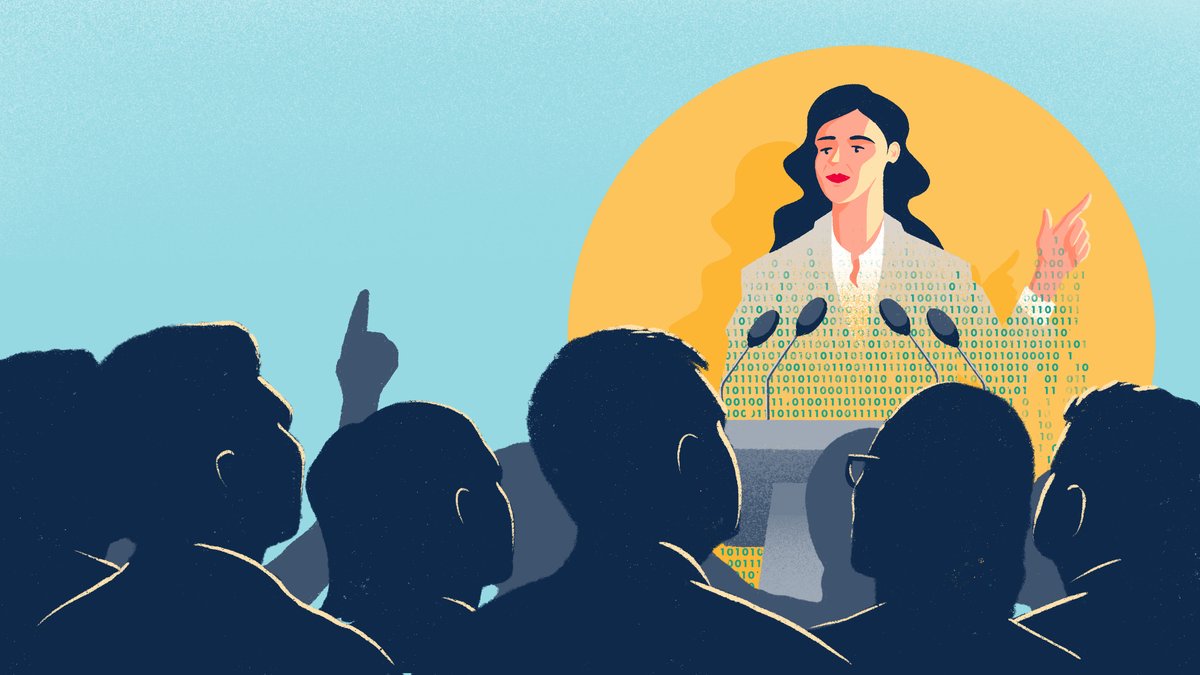
Illustration by Mark Frudd
Is 2026 the year machines start to take the top roles in government?
In September 2025, the Albanian government appointed the world’s first AI minister, Diella, to its cabinet. Described by the Prime Minister Edi Rama as a not physically present but virtual entity, Diella’s portfolio is to manage public procurement and tackle graft. Is Diella an isolated case, or part of a wider trend of AI moving into executive positions?
Diella is more than just a chatbot on a help desk. ‘She’ holds a dual role as both a virtual assistant on the e-Albania platform and a cabinet member with symbolic executive power. The aim is for Diella to help Albania tackle corruption related to public tenders.
This expansion in AI authority is appearing in other experiments. In the Philippines, an AI company has purchased Sensay Island with the intention of establishing the world's first AI-governed nation.
Unlike a sovereign state, this is a private experiment in government. The island is intended to be run by a council of 17 AI agents modelled on the personalities and decision-making patterns of historical figures. For example, the digital cabinet includes Nelson Mandela as the justice minister and Florence Nightingale as the health minister. The agents are trained on the specific literature, speeches, and philosophies of their real counterparts and designed to emulate their values when voting on island policy.
While these projects may seem fantastical, they can be seen as a radical response to a very real human problem - the global decline in public trust in political institutions. The goal of the Sensay experiment is to determine if AI, trained on philosophy and strategy, can make decisions free from political partisanship. The project implies, though does not explicitly state, that if human leaders are fallible and biased, a machine trained on the 'best' of human leadership could offer a ‘neutral’ alternative.
Replacing human judgment with code introduces complex challenges that could fundamentally alter the relationship between citizen and state. Foremost is the question of accountability. If an AI minister were to disqualify a local business from a public tender based on an automated risk assessment, who bears the ultimate responsibility - the programmer, the operator, or the government? This ambiguity creates a layer of opacity, making it significantly harder for citizens to challenge the decisions that shape their daily lives.
We often imagine algorithms as neutral arbiters, yet this relies on a myth of impartiality. These systems are trained on human-generated data. If that data carries historical biases, the AI will not eliminate inequality but simply automate it, replicating systemic flaws at a speed no human bureaucrat could match. In the Netherlands, for instance, an AI system designed to flag potential welfare fraud was shut down in 2023 when it showed persistent biases even though it had been built using recognised responsible-AI methods.
An AI minister also represents a high-value target for sophisticated cyberattacks. These could range from prompt injection (manipulating the AI's input to override its safety rules) to social engineering, where attackers bypass digital security entirely by manipulating the human operators who hold the keys to the system.
These vulnerabilities feed broader problems of legitimacy. Critics have labelled the Albanian government’s project a "...virtual facade to hide this government’s gigantic daily thefts". The danger is that a minister without a human face will further erode the trust it was designed to rebuild.
What is fueling this move to put AI in charge? For Albania, one reason could be EU accession. With Brussels encouraging the completion of accession negotiations by 2027, the Albanian government may view the AI minister as a way to demonstrate the rapid modernisation demanded by international observers. This urgency frames Prime Minister Rama's ambition to leapfrog advanced countries still locked into traditional bureaucracy.
The project intends to expand rapidly, though with dubious framing - Rama has announced that Diella will "give birth" to 83 digital aides. Despite the unusual biological metaphor, the function of these “children” differs significantly from the minister. While Diella targets high-level procurement, these aides are administrative tools, assigned to human lawmakers to monitor attendance and track commitments.
Leadership by AI is not limited to the government. The business and education sectors are experimenting too. In 2023, a China-based gaming company, NetDragon Websoft, appointed an AI program named Tang Yu as what has been claimed to be the world’s first AI CEO, in a bid to transform business operations and drive strategic growth. Similarly, a UK boarding school appointed an AI principal headteacher, Abigail, to advise its headmaster on issues ranging from staff support to writing school policies. These moves may reflect a growing belief among some leaders that AI could eventually represent the future of corporate management.
For the UK, where AI is already streamlining administration, these innovations suggest the gap between assistant and executive is closing. The rise of virtual leadership offers the potential for faster decision-making and a more efficient, less partisan bureaucracy. However, this push for efficiency carries the risk of sacrificing accountability and embedding systemic biases into the machinery of government.
As this first generation of virtual leaders takes office, governments must prioritise establishing clear, auditable lines of human responsibility and developing ethical oversight frameworks to ensure that AI serves the citizen, not just the state.