How we could build millions of houses in the UK
 www.nesta.org.uk/blog/how-we-could-build-millions-of-houses-in-the-uk/
www.nesta.org.uk/blog/how-we-could-build-millions-of-houses-in-the-uk/
www.nesta.org.uk/blog/how-we-could-build-millions-of-houses-in-the-uk/
The UK Labour government came into office committed to increasing the rate of housebuilding in England to 300,000 a year, and 1.5 million over the course of the parliament.
Although things have improved recently, the government is not on course to hit this target. Here we set out ideas on how the secretary of state could get more houses built.
Make no mistake, the levers are in the government’s hands. Where there is economic demand, and a willing local authority, homes get built. Last year, for example, 2,200 homes were completed in Milton Keynes, increasing the number of homes by 1.8%. If the rest of the country built at the same rate we would have 460,000 homes built each year. Talk of skills shortages and the like are just excuses, and indeed we would expect to see an increase in people enrolling on building trades courses if we built this number of homes across the country, and for a sustained period. Demand for skills creates its own supply.
The government is not on track to meet its housebuilding targets
This visualisation compares annual housing completions against the UK government's target of 300,000 homes. The data tracks a decline from 208,600 completions in 2024 down to 201,200 by late 2025. A static target line highlights a widening delivery gap of approximately 33%. This trend illustrates the significant challenge in meeting national housing requirements, primarily driven by planning delays and viability constraints in a volatile economic environment.
At present councils derive next to no benefit from development. The surplus goes to the landowner or the developer. It is therefore rarely in a council’s interest to be radically pro-development - especially if there are vocal ‘NIMBY’ (not in my backyard) local residents who like the area exactly as it is.
Under the current system, the UK government informs councils in England of the number of houses they are supposed to accommodate. The council then identifies the best sites for those houses, setting them out in the local plan. Councils identify the right number of sites. This effectively gives each site market power - there is definitely demand for the houses that can be built there, however quickly or slowly the houses are built. In contrast Volkswagen knows that if they do not build cars fast enough, people wanting to buy a car can and will buy a Toyota. As a result, VW has an incentive to build cars as quickly as they can sell them. So does Toyota, and every other car firm. The result is high levels of competition, on price, quality and innovation.
We could run our planning system like this. Councils could be required to identify land for the next 10 or 20 years' supply, rather than five, so that each site knows that there are rival landowners who might win over would-be homeowners from them, just as happens in the car industry.
Alternatively, councils could auction planning permission to the highest bidder. This would mean that the value created by the planning system would accrue to the council, rather than to landowners or land speculators. This approach would also give the council an incentive to support denser development - allowing terraced houses rather than semis, or allowing six storeys rather than four, to increase the revenue that the council would receive. That money could then be used to raise the quality of local services, or cut council tax - both good strategies to persuade local people that development is in their interests.
Rather than simply auctioning planning permissions - which could lead to some really weird developments - councils could ask all landowners in their area the price at which they would sell land to the council for development. The council would then pick land using both price and suitability as criteria. This is, in essence, how we tender for everything. When the council wants to buy chairs for local primary schools, or lorries to pick up the bins, they ask suppliers to name a price and describe the product, before picking the best price-suitability combination.
The council would then grant itself planning permission and auction the sites onto builders to build out. The council would expect to make a profit - it is buying land in a competitive market, and by adding planning permission it raises the value of the land, particularly in the South East.
Although this approach has never been tried, it is now legal: Michael Gove’s planning bill included an explicit provision stating that a local authority could undertake what is formally termed a ‘community land auction’. In the right area, it has the potential to create a lot of value for the local community. The government could and should find a local authority willing and able to pilot this approach, and then refine it as necessary, and roll it out more generally.
Housing applications by ITL1 region
This chart visualises housing application volumes across UK ITL1 regions for 2025–2026. The South East and London dominate with the highest total applications, reflecting concentrated demand. However, the North East shows the strongest growth trend at 6.8%. The data indicates a regional imbalance: while southern regions lead in sheer volume, northern markets are seeing increased activity due to improved affordability and shifting investment patterns.
The secretary of state has almost complete powers to call in almost any planning application. They can, in other words, take all decisions away from local councils if they are acting in a NIMBY way. Having called in a decision, the procedure should be handled efficiently.
An example of how not to do it is the government’s recent approach to Highsted Park, a proposal to build around 8000 homes near Sittingbourne in Kent. The government did call this decision in - but only at the last moment, literally a few hours before the council was due to make a decision. It could and should have been called in earlier.
All sides knew their positions and had already submitted the evidence to the council. Despite that, the planning enquiry did not begin for four months. It is unclear what caused that delay. The enquiry heard evidence at a desultory pace. The 53 days of oral hearings were spread over almost eight months, thus taking 50 weeks from the date on which the decision was called in. As the local parish council noted, the process finished “months later than originally scheduled”.
Even since the hearings finished last October, the planning inspector has not finished her report, and so the secretary of state cannot make a decision. The parish council has reported that the decision “is unlikely to be before Easter 2026”.
This whole process could be streamlined dramatically.
At the moment planning appeals consist of both sides submitting evidence, and then either side can call the authors of reports to be cross examined. This should be changed so that only the planning inspector can call witnesses, and that this should be done only in exceptional circumstances. Otherwise the written evidence should be read and considered. This creates good incentives - those who submit confusing evidence are less likely to be taken seriously.
Second, the Planning Act states that when a local authority is not granting enough planning permissions to reach their government imposed planning target, the ‘presumption in favour of sustainable development’ should apply. When that is the case, the planning appeal should start from the assumption that the development should be approved, with rejection possible only if the proposal can be shown to be unsustainable. This negates the need for the enquiry to read anything by the developer - rather they should read objections solely through the lens of “Can these people convince me that the proposal is unsustainable?” The definition of sustainability should be in line with the recent Fingleton review - that is, is there environmental damage that cannot be reasonably compensated for in the local area. This will also speed things up.
The enquiry should not accept submissions from rival developers or landowners, whose objections largely seek to restrict competition. Nor should it concern itself with viability: if the scheme is not viable, it will not get built.
It is hard to imagine that a major scheme such as Highsted Park will generate sufficient high quality paperwork in opposition to the scheme that it should take a team from the planning inspectorate more than four weeks to come to a decision. If they approve the plans, the decision would go to the secretary of state for a final decision, although we would expect that to be granted in minutes.
If they decide it is not sustainable, they would have to tell the developer why, and the developer would have the right to try to change their mind - for example, by submitting alternative ecological assessments.
If these principles were applied to the Highsted Park case, the planning inspectorate would have made an initial decision in late 2024. If that was in favour of the developer the final decision would arrive before Christmas. If it was against the developer, they would be given a few weeks to prepare their case, and the decision would have been made by early 2025.
When an approval is granted, the local authority, the planning inspector and the secretary of state should also be encouraged to state whether it is likely that permission would have been granted for a higher number of houses on the site. At present, some developers propose relatively few houses on many sites, in order to reduce opposition. But this has the effect that we as a nation need to use far more land in total to meet our housing needs. Lower densities also lead to more car-based developments, as the newly developed area may have insufficient houses to make shops, schools and so on viable.
Take this example of a current application by Taylor Wimpey, for example. The site is in Long Ditton, between Surbiton and Esher and near where I live.
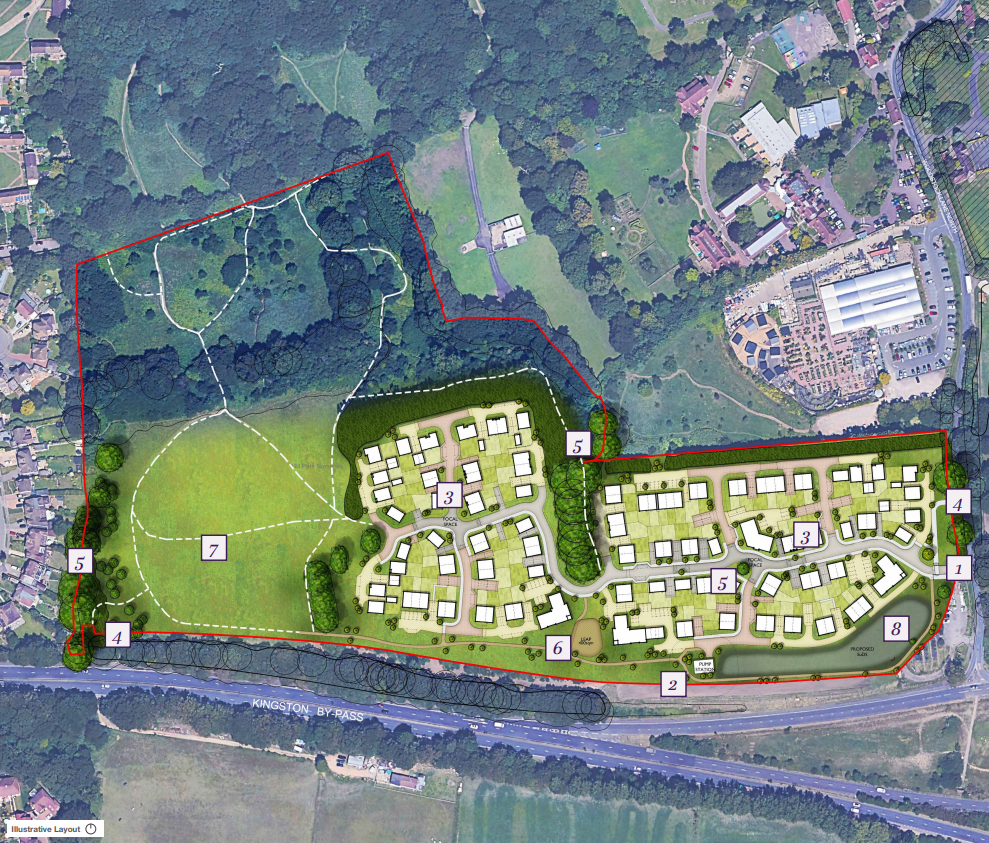
Development proposal for land at Woodstock Lane North, Long Ditton. © Taylor Wimpey
Of the 27 acres, nine acres will be used for housing, five for a formal village green, and 13 acres will be informal green space. As a result, there will only be 150 houses, or about six per acre.
It is plausible that a positive decision should be issued, but with a note saying that the developed area could be built to a greater density, with, for example, more three-storey terraced houses included. Taylor Wimpey and other builders would know that more ambitious schemes would be likely to be approved.
The fastest way to get the UK building is to allow building, rather than requiring planning permission. The 2010-15 government’s permitted development rights allowed office buildings to be converted into residential housing irrespective of the views of the council. This led to more homes being created.
There are three plausible permitted developments, all of which the government should allow. The first is for ‘additional dwelling units’, aka small houses in back gardens. Examples exist in Bristol, built by the We Can Make organisation, as well as in many parts of the US. Broadly speaking permission is granted for a ‘subsidiary house’ in the back garden. Access is usually via a passage to the side of the existing house and the existing rear garden is divided between the existing house and the new one. Many people have a large garden, and being able to have a smaller property in the back garden, either to rent out for an additional income, or for grandparents, or to be grandparents in, will be desirable to many.
To further incentivise such developments, we could say that so long as the additional unit is no greater than 40 square metres, it will not count as a separate property for council tax, but instead raise the council tax banding of the main house by one band. This means that the council would receive about £500 extra, which is likely to be sufficient to cover their costs, but which would be a much cheaper option for the resident.
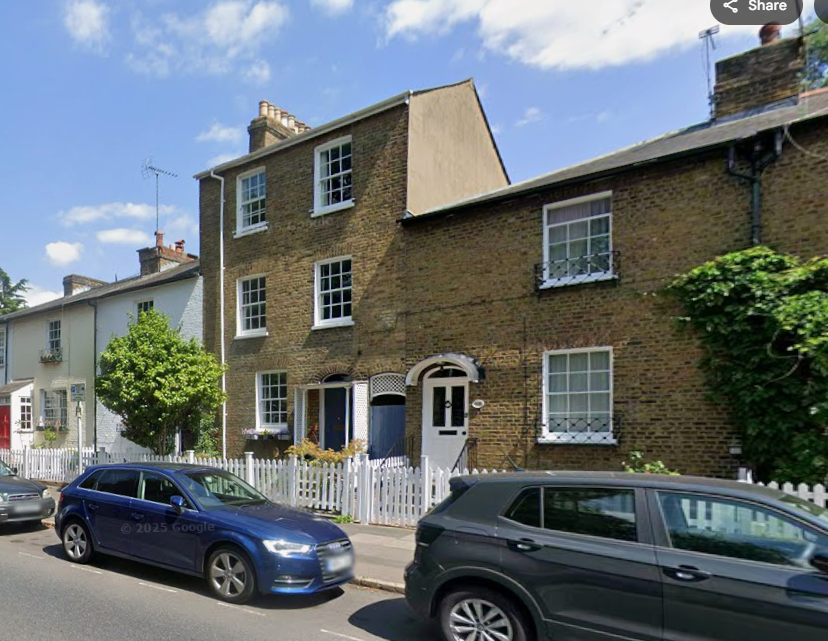
The second permitted development right would be to allow everyone owning a house that is currently up to three storeys tall to add a storey, so long as it is in keeping with the existing house. In the short run this will lead to some houses looking a bit odd, but what is initially odd soon becomes cute and human. An example of a row of two-storey terrace houses with an upward extension can be found opposite Kew Gardens.
This house is clearly out of keeping with the others, and it is also clearly acceptable. It does not ruin the area. Although this does not create an additional house, it does create more living space. That, rather than the number of houses, is the ultimate aim.
Finally, we should have permitted demolition and rebuild right in the areas of greatest shortage, as judged by prices per square metre. Outside of conservation areas, and excluding listed buildings, we should permit the demolition of existing buildings and their replacement by taller and higher-density options. The standard in central London, for example, could be eight stories, in line with the well-loved mansion blocks that characterise the area between Victoria station and Westminster. Further out, the maximum allowed might be six or four stories. In all cases, there would be controls over the aesthetics - ‘pattern books’ of well-designed popular frontages would be available for developers to select from.
England is falling far behind where it needs to be on housing. But places like Milton Keynes show that Britain can be a place where building happens, where communities grow and prosper, and where opportunities are greater as a result.
This report sets out a number of ways in which the government could make it more likely that Britain gets the homes it promised in its manifesto, and - more importantly - the homes the people of Britain need.