Nesta Working Paper No. 14/08
September 2014
www.nesta.org.uk/wp14-08
Abstract
The business of managing personal information is changing fast, enabling new value opportunities to emerge, including a new type of consumer service: Personal Information Management Services (PIMS). PIMS are services that help individuals gather, manage and use information, including personal information, to help them manage their lives better and achieve their own goals. This paper sets out the methodology, approach and assumptions behind Ctrl-Shift's June 2014 paper entitled "Personal Information Management Services: An analysis of an emerging market". Only by standing on the side of the individual can we fully understand the range of impacts from PIMS, by recognising the number of relationships people have with organisations and the value of those relationships. The paper also details challenges in the research process, including availability of organisation data, its quality and wider challenges in measuring the impacts of innovations that – by definition – have not yet happened.
Keywords: Personal data, privacy, big data,
Presented by Ctrl Shift. Corresponding Author: Jamie Smith; T6 3rd Floor West Wing, Somerset House, Strand, London, WC2R 1LA; [email protected]
The Nesta Working Paper Series is intended to make available early results of research undertaken or supported by Nesta and its partners in order to elicit comments and suggestions for revisions and to encourage discussion and further debate prior to publication (ISSN 2050-9820). © Year 2014 by the author(s). Short sections of text, tables and figures may be reproduced without explicit permission provided that full credit is given to the source. The views expressed in this working paper are those of the author(s) and do not necessarily represent those of Nesta.
1. Background to the research paper
This paper sets out the methodology, approach and assumptions behind Ctrl-Shift's June 2014 paper entitled “Personal Information Management Services: An analysis of an emerging market”. The research was co-sponsored by Nesta, who has an ongoing interest in the economic and social impacts of personal data innovation, especially in relation to wider studies of open and big data innovation.
Ctrl-Shift proposed to undertake this research for two reasons. The business of managing personal information is changing fast; new technologies, regulation and consumer behaviours are impacting every organisation's relationships with their customers. These impacts vary widely, but in one key area - of PIMS - they are crystallising into new types of consumer services whose core business is to change the relationship between individuals and the organisations they currently deal with. First, the research set out to understand how these innovations - both technical and commercial - would impact individuals, businesses and the wider economy. Second, businesses from a range of sectors were starting to ask for advice on what changes in personal information management meant for them. They were looking for qualitative and quantitative information on which to base their response: to know if and how much to invest in this new market.
The Open Identity Exchange and Nesta were the two non-commercial sponsors of the Ctrl-Shift report, seeking to understand the broader innovation and economic impacts of PIMS. The three private commercial sponsors (from the telecoms, loyalty and wealth management sectors) looked to understand the impacts on their business.
2. Context of Personal Information Management Services
For the last 50 years, technology has enabled organisations to gather, store, analyse and use information about their customers and their target markets. In recent years technological change, including the falling costs of gathering and using information and the internet, has made it possible for individuals to take on more control and management of that data for themselves, including managing their identity.
This control shift from 'organisation-centric' to 'person-centric' data management is being driven by a powerful combination of changing consumer expectations, business opportunities and regulatory responses as well as technology. This has enabled a new type of consumer service to come to market: Personal Information Management Services (PIMS). Ctrl-Shift has identified three core PIMS offerings:
- Personal Data Management Services, which help individuals gather, store, use and share their own data under their own control.
- Decision Support Services, which help individuals gather and use information about markets and themselves to make better decisions.
- Life Management Services, which coordinate and integrate information to help individuals manage life tasks, events and processes better.
3. Overview of the research
The research had four key objectives:
- Provide 'ball-park' figures for the economic impact of this emerging industry
- Create insight into the impacts on different sectors, highlighting issues of interest
- Identify key drivers affecting the evolving market (pain points and opportunities for key organisations)
- Build a solid foundation for further, more detailed research.
Ctrl-Shift set out to test three hypotheses:
- PIMS will create a new competitive environment for gaining consumer trust that affects customer service, products and services and marketing.
- Some sectors will have more to gain than others from PIMS.
- For organisations
- PIMS will create new forms of revenue
- PIMS will create new efficiencies in supply chain and customer service
- Increasing use of personal information will generate new complexities and costs. There will need to be new policies, processes, common standards and possibly legislative and regulatory intervention.
Ctrl-Shift recognised the significant challenge in finding suitable research data in this emerging market. In this context, the research team set out to build a detailed picture of the market structures, patterns and impacts through a mix of interviews, surveys and desk research, and by making assumptions where required.
4. Research methodology
To manage the research scope and project timescales, the researchers based their modelling on one key assumption – to imagine an alternative 2014. This allowed us to do the following:
- Only consider a ‘mature' (full) UK market – all UK adults use PIMS as needed.
- Looking at the services PIMS are currently offering and those that are planned, the research asked ‘what would their impacts be if they were already a mature industry?'.
- Use real data - only modelling using data from real companies: what today's PIMS are currently doing; how they are currently earning their money, what they are currently charging. Likewise, discussions covered companies' current cost structures, pain points and opportunities in relation to services offered by PIMS. Thus, the study avoided 'futurology', grounding itself in credible evidence.
- Avoid detailed analysis of certain areas barriers and enablers (changing technologies, standards, regulation, consumer adoption, business adoption), timelines (is market maturity five or fifteen years away and what are the factors influencing the pace of change?), and demographic, price and other changes that may take place in the intervening period were not considered. These are critical issues for understanding the PIMS market but they were out of scope for this research.
The research approach had three key overlapping phases:
- Modelling the PIMS market
- Defining impact types
- Quantifying the impacts.
A. Modelling the PIMS market
The research team started examining the new innovative services by 'standing on the side of the individual’. By taking the consumer's perspective, the full marketplace could be analysed, rather than confined to current industry silos and sectors such as 'insurance' or 'grocery retailing'. They decided to map PIMS not to industry structures but to how people live in 2014. Specifically, they mapped onto the seven key 'life departments':
- manage my home
- manage my money
- manage my health and wellbeing
- manage my travel
- manage my lifestyle and shopping
- manage my citizenship
- manage my learning and work.
This perspective captures all the main industry sectors that individuals deal with in their lives (e.g. insurance or grocery retailing), but it also recognises the costs and issues that individuals face in dealing with these industry sectors - costs and issues that typical analyses based on organisational boundaries routinely miss. For example, for the individual, the cost of the weekly grocery shop is not confined to the money paid in the store. It also includes the time, money and energy invested in planning meals, making shopping lists, travelling to the store, shopping in the store, queuing at the checkout, travelling back home, loading and unloading etc.
Part of understanding the PIMS market is understanding the consumer's costs and 'jobs' not currently addressed by existing service providers. To sense-check the choice of life departments, the researchers analysed and grouped the most popular apps in Apple and Google mobile app stores. Most of the apps mapped to the initial shortlist of life departments, but a few exceptions are worth discussion. General information services (such as news and weather) and gaming or entertainment apps didn't fit. They were aligned to lifestyle and shopping departments. There were few 'home' apps, which were usually organised by their context (help with home-related purchases; help with customer services; help with DIY or local trades). The 'home' life department accommodates the wider context for individuals organising their personal lives. This exercise helped ground the analysis in today's realities.
Additionally, the research drew inspiration from previous Ctrl-Shift market insight, including splitting the PIMS market into three types of service Personal Data Management, Decision Support and Life Management. Further, the team discussed this approach with those close to Royal Mail's own research in 1998, which found that individuals have over 200 relationships with organisations by the end of their lives.
B. Defining impact types
The team then set out to map a long-list of identified PIMS against ‘life departments' and service types (Personal Data Management, Decision Support and Life Management Services) to ensure all data was gathered across a representative range.
First, the team approached over 60 PIMS to gather data about the innovations using surveys, structured interviews and desk research. Data included:
- Business model, revenue streams and partnerships
- Charging and cost structures
- Expected/proven costs/benefits for individuals
- Expected/proven costs/benefits for organisations
- Expected/proven costs/benefits for other business
- Barriers and enablers to the PIMS market.
Second, the team approached over 60 organisations to gather data about the potential impacts PIMS might have on them using structured interviews and desk research. Data included:
- Key areas of the business impacted by personal data innovation - by business activity (e.g. customer acquisition) or function (e.g. sales)
- Impacts on business suppliers and partners
- Barriers and enablers to connecting with the PIMS market
- Key performance measures across these business activities, related to personal information (e.g. Average Revenue Per User, Cost of Sale, Marketing Channel Effectiveness).
By the end of the research project the team had spoken with, or gathered data from, over 30 PIMS and 20 organisations.
Third, the team analysed the wider impacts for individuals, examining the full range and number of relationships an individual has with organisations. This was based on the data gathered and mapped to the PIMS market structure defined in section A. This approach measured the number of relationships, and their value to individuals and organisations.
It became clear during analysis that PIMS can directly impact organisations, but they also have indirect effects inside the business as well as on the external market environment. The research team addressed this fact by categorising the business impacts in the following way:
- First order impacts - direct exchanges of value with the PIMS
- Second order impacts - knock-on internal impacts due to PIMS
- Third order impacts - further external impacts due to PIMS.
This approach is similar to other Economic Impact Analysis research projects. The effects observed could also be labelled Direct (the result of money initially spent); Indirect (the results of other transactions indirectly caused by the direct effects); and Induced (the results of changes caused by the other direct and indirect effects).
Building on other Ctrl-Shift PIMS research and through a range of brainstorms, the team mapped the full range of PIMS impacts across four areas:
- Organisation function - Customer Acquisition and Retention; Customer Services and Operations; Value Proposition, Brand and Strategy; Risk Management.
- PIMS type - Personal Data Management; Decision Support; Life Management
- The 'order' of impact - First order, Second order, Third order
- Opportunity vs. threat
This mapping resulted in a series of ‘wave' diagrams, showing how different PIMS types impact a specific organisation function. Below is an example from Customer Acquisition and Retention. Together the wave diagrams form a roadmap for organisations concerned about how PIMS will affect their business.
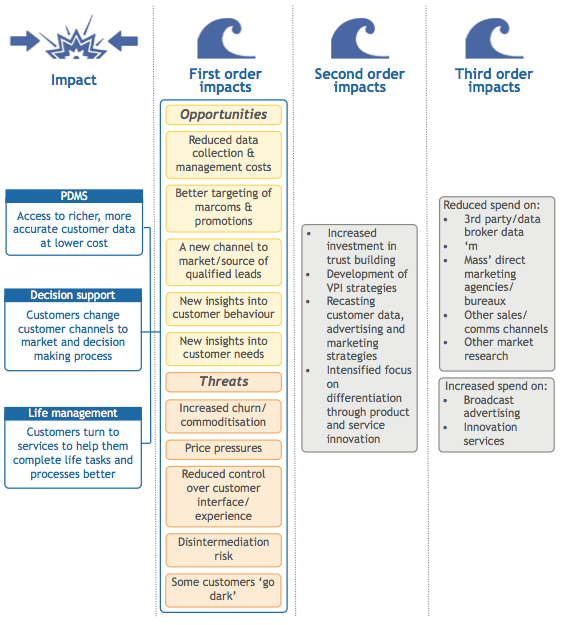
Wave diagram showing potential impacts on Customer Acquisition and Retention
C. Quantifying the impacts
Because of the complexity of these PIMS impacts, Ctrl-Shift decided to only quantify and model the first-order impacts, providing narrative and qualitative references for the second and third order impacts.
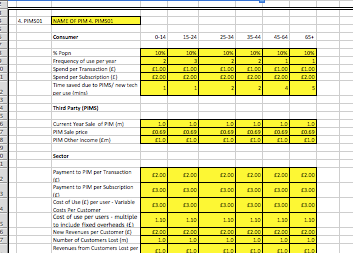
Screenshot of the PIMS Value Model
The team created a ‘PIMS Value Model', representing the first-order financial flow between PIMS, organisations, individuals and other 3rd parties. They used the value model to test thinking about costs and revenue streams, impacts on different sectors, the individuals costs and benefits and how this rolls out at a whole economy level. It was in building the value model that the team learned most about what data was really required, and at what level of detail they could model PIMS quantitatively.
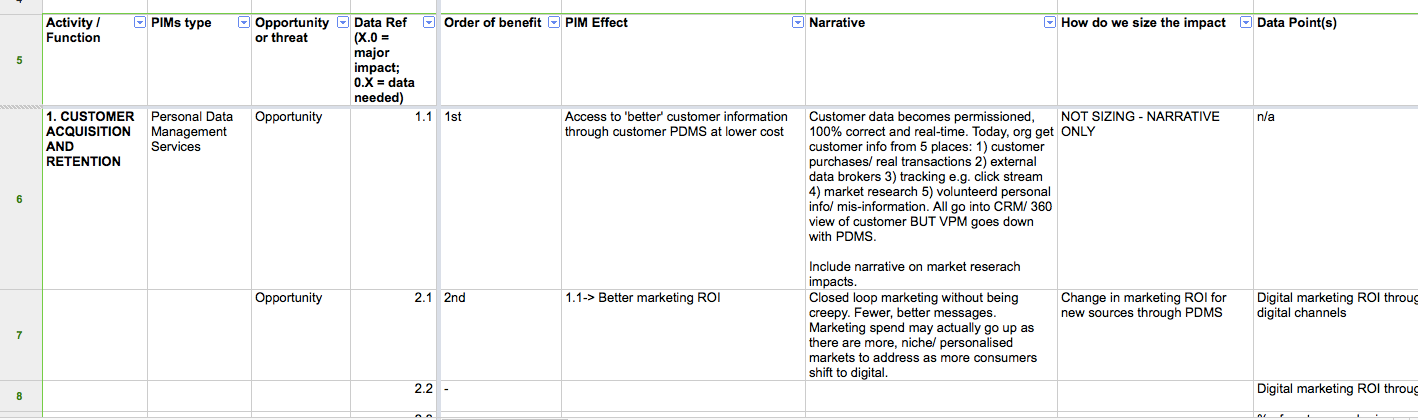
Screenshot of the Organisation Impact Model
Further, the team wanted a deeper understanding of the organisation impacts, so they created an 'Organisation Impact Model' to map the impacts by business activity and examine the first, second and third order benefits/costs. This model was created by transposing the 'wave' diagram into a spreadsheet, and mapping data points to each impact. Against each data point the team was able to track sources, calculations and assumptions.
This analysis led them to use two principles:
- Because PIMS consumer adoption data isn't available (as it's an emerging market) the research used ONS population/household data as a proxy to model a full, mature PIMS market.
- Because different PIMS types have different business models, the research used different market size calculations:
- For Personal Data Management Services (PDMS) and Life Management Services (LMS): A range of business models were noted, including annual 'relationship' fees, transaction fees, commission fees, advertising revenues, white label platform charges and freemium charges. Costs varied from a few pence to £120 per transaction and from £3 to £5 per relationship, per year. The research assumed a single, representative business model to account for these variances and to simplify the modelling. The researchers assumed the PIMS was a free consumer application, subsidised by the organisation as a yearly relationship fee of £4 per year. This figure was referenced by a number of PIMS independently, and was validated by a range of organisations. £4 was observed to be a fraction of today's total cost to acquire and retain customers, manage their data and run customer services.
- For Decision Support Services: a range of PIMS transaction commission fees were noted, from 1% to 20% per purchase transaction, depending on business sector. The research assumed a representative commission fee of 5% of Average Revenue Per User.
5. Whole market modelling calculations
Using the valuations in section 4C, the researchers estimated the size of a mature PIMS market. Below is a key table from the report showing how the number of relationships per individual was calculated.
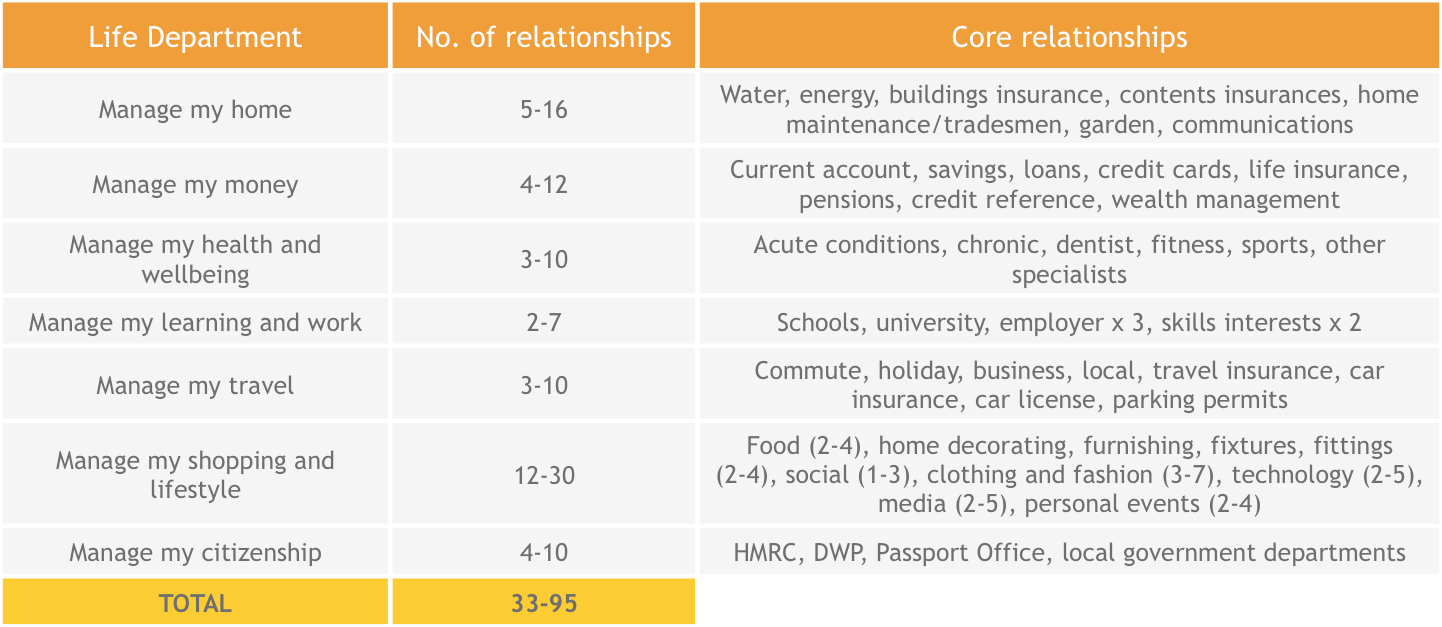
Analysis of relationships by life department
The research team assumed an average of 65 relationships per person for the calculations. This was made up of 45 relationships for the individual and 20 for the household. Using ONS population and household data, the team created the table below, showing the total number of specific relationships in the UK. With an assumed cost per relationship of £4, this gave a full potential market size of £11.5bn.
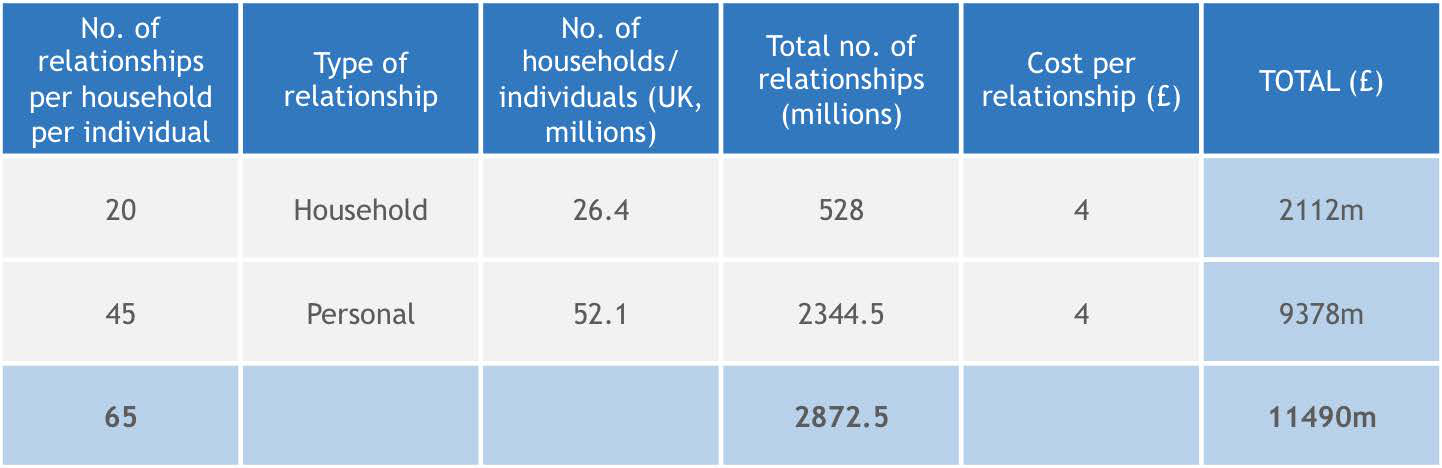
Market size calculations based on relationship volumes
Separately, the research team used ONS data to review UK household spend by category to understand proportion of consumer spending, which would be relevant for Decision Support Service (DSS) PIMS. By applying a DSS weighting to 18 consumer spend categories, the research team analysed how much of UK spend would be enabled by Decision Support PIMS, who would charge organisations a 5% commission fee for a 'qualified lead'.
The result found a mature Decision Support PIMS market to be worth £5bn (or around 2% of total consumer spend). The table below shows only four of the 18 household spend categories, along with the DSS weighting, resulting UK annual spend relevant to DSS PIMS, and the assumed 5% commission fee for that spend across all UK households (£bn).
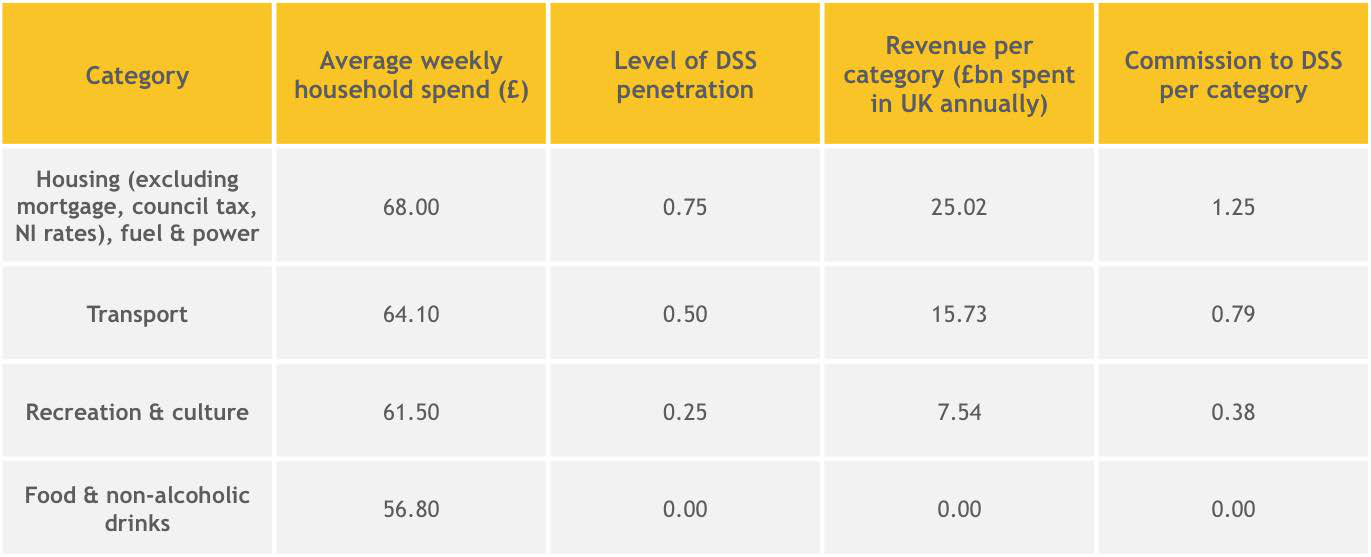
Market size calculations based on household spend categories
6. Limitations of method
During the research, the project team faced a number of data gathering and measurement challenges. Below is a summary of the issues and key impacts on the project.
i) Organisations believe they make decisions with evidence, but don't
It became clear that companies often don't have the data needed for the business case for their response to PIMS, especially in innovative areas. They are working on hunches, beliefs, or partial data. This is true of both PIMS and big corporates. Lack of data meant that the PIMS narrative was as important as the PIMS number.
ii) Organisations don't have much data to hand, and what they do have, they won't share
It was difficult to retrieve the data needed for analysis. Sometimes it was difficult or not cost effective to retrieve; and sometimes datasets were guarded for commercial or confidentiality reasons. This hampered the research data gathering, extended the project timelines and created extra work for the interviewees. It was also an additional barrier to engaging interviewees.
iii) Organisations don't have data on everything
The team found that organisations collect data about established priorities. This means they have less of a grasp of emerging issues because this requires collecting, storing and analysing new and different sets of data. The researchers had to rethink which data to base their calculations on, and which data gathering tool was most appropriate.
iv) Measuring the ‘dogs that are not barking’
The greatest issue for this project was finding market evidence for the knock-on (indirect) impacts of innovation, many of which haven't happened yet. The project used proxies for volume and population, and made generalisations about costs across a range of PIMS and sectors.
v) Sizing the value of relationships hasn't been done before
Very little research completed to date has looked at the number and value of an individual's relationships with organisations, and none had done so recently, recognising today's mobile, social and cloud enabled economy. The research team asserted that consumer costs are the ‘dark matter' of economics, largely unmeasured. Again, the team used assumptions about PIMS types and value to simplify the modelling and market sizing.
vi) Ensuring the measurement is meaningful
The value of personal data is immeasurably tangled up in multiple, separate processes and transactions for both individuals and organisations. The research team chose to measure the costs rather than the specific value to individuals and organisations, to ground the research as much as possible.
7. Conclusions
This research was only an initial assessment of the emerging PIMS market in the UK. There is significant opportunity for further research, especially in the following areas.
i) Enablers and barriers to the PIMS market
The research did not provide detailed analysis of the factors that may accelerate or slow down the PIMS market. Themes which emerged from the PIMS and organisation interviews included the adoption of technology open standards; new supporting (or challenging) regulation; changing consumer behaviours and expectations; emergence of ‘trust frameworks' (legal, technical and business agreements for data sharing). Further research is needed to help organisations and PIMS identify and address these enablers and barriers.
ii) How the market will unfold – evolution vs. revolution
A key question that emerged was whether PIMS will be an evolution of today's brands and services, or if they will be new, disruptive organisations outside today's recognised business sectors. Further research needs to be done to understand the merits of each, and the impacts on consumer adoption.
iii) PIMS routes to market – ‘outside-in’ vs. ‘inside-out’
Many PIMS are innovating at the edge, choosing to be deliberately disruptive from the outside of today's businesses - building new frameworks, policies and pursuing organic consumer growth. Others are attempting to partner with today's brands, clearly articulating the case for change in business terms and measures. Further research could review the impacts of each approach on organisations, notably in terms of disruptive innovation and scaling strategies.
iv) Validating data sources and evidence
Much of this research is about today's organisations' competitive positions, their customer relationships and data management strategies - highly protected information, often the 'secret sauce' of the business. Further research is needed to dig into the detail of the specific impacts on organisations across sectors, and understand how the case for change will be made to today's organisations.
References