A series of essays outlining innovation opportunities to shape the future of parks and greenspaces in the UK.
Foreword: Being bolder and even more creative at rethinking parks
Drew Bennellick, Head of Land and Nature Policy UK, The National Lottery Heritage Fund
For over 25 years The National Lottery Heritage Fund has been the UK's leading investor in public parks and urban greenspace, from our very first grant to restore Lister Park in Bradford in 1996 to our latest park regeneration project to open, the fabulous Pearson Park in Hull, jointly supported with The National Lottery Community Fund. Public parks are in the DNA of The National Lottery Heritage Fund and to date over £1 billion raised for Good Causes through The National Lottery has been awarded to help support over 900 public parks right across the UK, as well as urban wetlands, commons, woods, nature reserves, historic cemeteries and urban farms. Our focus has not just been the built heritage of these places, but also their social and natural heritage, both of which are critical ingredients to healthy urban life as recent events have proved.
Our own research in 2016, the State of UK Public Parks, demonstrated not only the worrying plight of these important green lungs, but also the vital role that local authorities and the public play in their upkeep and survival. Whilst the debate over whether parks should be a statutory provision carries on, it is our firm view that it is the breadth of benefits and values delivered every day by urban greenspaces that needs to be more widely understood and shared.
Our most recent research Space to Thrive clearly demonstrated that high quality parks are absolutely vital for urban dwellers and that we must find better ways to reap their values, protect their future and improve access for all. Whilst we will continue in future to support projects that regenerate local urban greenspaces, the scale of the problem requires more dramatic solutions. Yes, local authority management and funding remains absolutely critical, but we have a role in using our funding to bring new players to the table to explore and test new approaches, to develop ways to attract new funding and to investigate how urban green and blue space can better serve our evolving towns and cities in the twenty first century.
Our historic parks are key parts of urban infrastructure but all green and blue spaces matter and especially those in the most deprived and underserved communities.
Rethinking Parks has helped to explore and grow new ideas, and our Future Parks Accelerator in partnership with the National Trust is supporting a cohort of nine places to reimagine the role urban greenspaces should play in the future.
But we need to be ever bolder and more creative in our future investments to maximise the role greenspaces should play in helping our changing cities to remain liveable, equitable and vibrant in spite of the challenges being laid down by the current health, climate and ecological crises.
Foreword: Putting communities at the heart of parks
Tony Thapar, Capital Projects Team, The National Lottery Community Fund
The National Lottery Community Fund believes in supporting communities to shape and sustain the places that matter to them. The value placed on parks and open spaces will not be a surprise to many, given the role they play in improving cultural life, local economies, wellbeing and biodiversity. The challenge remains of how to sustain them now and for future generations.
Over recent months, the pandemic has challenged us all, as individuals, as a sector and as decision-makers. We are unclear what the 'new normal' will be. COVID-19 cannot distract us from other big challenges looming large too – climate crisis remains key - the scale of which requires the whole of society to participate. There is an imperative to build on the vibrant community response to COVID-19, generating new solutions and partnerships to retain and expand the places and spaces that communities have relied on to cope with the pressures created by the pandemic. We believe communities understand what is best for them and what will help them to thrive. As we look to respond, recover and renew, we need to embrace new ways of working and to trust one another more. Let us take up the opportunity and let change be driven by listening to communities, in particular those voices who are often lost or marginalised. Let's be inclusive as we move forward and ensure our neighbourhoods, parks and open spaces welcome all.
As a number of the essays in this series suggest, parks provide an interesting ground for experimentation for communities to test a broad range of new ideas to shape and sustain the places that matter to them.
Parks are often thought of as islands in our towns and cities for recreation and escape; a legacy from the Victorians who understood the need to experience the picturesque. The next challenge is probably to consider how we can better connect our islands, for our communities, wildlife and climate. How can we use tactical urbanism to test new ideas about changes to our parks and neighbourhoods and innovate how and where we deliver these services?
Neighbourhoods, local government, health providers and new stakeholders are all required in the creation and management of our greenspaces. Forging new partnerships around culture, ecology, economy and health, as well as bringing together the public, private and third sector, is undoubtedly the next challenge for the future of parks.
To succeed we all need to get better at letting go of our certainties and be prepared to fully embrace a more inclusive and collaborative approach to service delivery – whatever happens next, let communities be in the lead.
About this collection: What next for Rethinking Parks?
By Carrie Deacon and Camilla Bertoncin, Nesta
One of the more surprising aspects of the COVID-19 pandemic has been the increased attention that has been given to the role of parks and greenspaces. Whilst our love of parks and outdoors spaces shouldn't come as a shock to anyone working in the field, typically parks do not make the front page of newspapers and their value is rarely at the forefront of people's minds. Too often their value be that for our health and wellbeing, for the environment, or for our community and social connections – remains invisible.
Yet the surge in attention that parks and greenspaces have received is much welcomed and could prove significant for their future sustainability and success.
In recent years our parks and greenspaces have been under huge threat. As a result of austerity and the demand placed on local authorities' budgets to support statutory services such as social care, non-statutory services like parks have been facing budget pressures. Some local authorities were reported to have reduced parks budgets as much as 87 per cent, and their ability to maintain these spaces, and ensure their sustainability has been greatly challenged. As a result, in recent years public parks managers have been in search of new solutions and new business models to keep them free, open and valued community assets.
Rethinking Parks
Over the last seven years, Nesta, in partnership with The National Lottery Heritage Fund and The National Lottery Community Fund, has provided two rounds of funding and support for organisations and partnerships to develop innovative ways of managing and financing the UK's public parks. Rethinking Parks has backed 24 innovations, with £3 million in funding and support, to test and replicate ideas. Innovations experimented with a broad range of ideas – tapping into the public willingness to give in new ways; mobilising the skills and energy of communities; developing ways to generate and use data to create smarter parks; designing approaches to use spaces in more environmentally friendly and financially astute ways; using parks assets to generate renewable energy and income, as well as developing new ways to engage with local businesses.
All of the innovations tested provide lots of insights and useful lessons for other park innovators, which have been documented and shared for inspiration. We hope many of these ideas will be picked up, and built upon, especially in light of the significant work the Future Parks Accelerator is leading too. Although, no one single idea tested through Rethinking Parks will be sufficient, they offer some very fertile ground for innovators in different areas of the country to further test and develop approaches that suit their context.
We hope that the increased attention in our parks and greenspaces will also help us make an even more persuasive case about their value. We must invest in our parks and greenspaces as essential social infrastructure. Yet, even where there is an increased investment in parks and greenspaces, there is still a need to innovate to enable them to evolve to meet the needs of our communities in the years to come.
How innovation can help the future of parks
As we bring the Rethinking Parks programme to a close, now is not the time to stop innovating, and of course the parks innovators have no plans to. Our experience of working with parks innovators up and down the country, both inside of local authorities parks teams, and outside in universities, community organisations, social enterprises and charities, shows there is a real community of experimenters, activists and entrepreneurs working to enable our parks and greenspaces to evolve, adapt and continue to be at the heart of our communities. But to face the challenges and opportunities ahead, we must continue to adopt and spread the mindset, habits and tools that can support this innovation.
The challenges and opportunities ahead create a loud and clear call for us to keep innovating for the future of our parks and greenspaces. We have brought together a collection of perspectives to share some of the innovation opportunities and challenges that lay ahead. This paper presents seven visions of the future of parks and greenspaces, featuring essays, provocations, and fiction. Whilst not exhaustive in their possibilities, these contributions seek to encourage us all to be bold in our imagination about the role of parks and greenspaces in our communities in the coming years.
The future purpose and value of parks and greenspaces
As many begin to contemplate how our cities, towns and places will need to adapt, both in the face of the COVID-19 pandemic, and as we face other challenges such as the climate crisis, there is a clear role that our parks and greenspaces can play to help us to be more resilient, happier and healthier. From the collection, a number of key themes emerge:
All contributions remind us of the critical role of parks and greenspaces as key social infrastructure in preventative healthcare, supporting climate adaptation and mitigating climate crisis, and in what some are calling the 'green recovery'. The collection features an interesting range of ideas of how to start recognising such value, from 'Valuing the invaluable: A Parks for All Fund' proposing a fund that invests public money into parks with confidence that the health benefits and future health savings more than justify the expense, to 'The park is dead. Long live the park', championing the idea of a one-minute city where parks are immersed in the streets, flipping the logic of the park as a separate entity altogether. 'De-traumatising the city' challenges us to explore and mitigate the physiological impact of cityscapes and highlights how stressors, in the absence of nature, create a habitat which can trigger chronic stress and traumatise.
How might the purpose and value of parks and greenspaces need to evolve and develop in the coming years?
The future roles for public services, civil society, communities
The essay 'What if we thought about localities the way we think about gardens' outlines how adopting a 'garden mind' could better equip local authorities and government with the mindset and capabilities to support innovation and reshape the way we all think about where we live. 'News from Nowhere Garden' emphasises what communities could achieve if our full civic muscle is unleashed, from setting the agenda for parks and green space, structures for decision-making, or implementing projects that communities themselves design and lead.
'Fresh ideas in green places' reflects in young people's views directly, exploring the value of parks and greenspaces for young people, alongside ideas for shaping the future involvement and use of parks by young people. From these voices new ideas spring directly, but also remind us to keep innovating to enable all communities to have a say over our parks and greenspaces, beyond consultation to enable greater civic imagination and engagement in our places more broadly.
How might our roles need to adapt? How can we enable more people to participate in shaping and setting the agenda for our parks? How might we engage more people in all our areas to reimagine the future of our parks and greenspaces?
Change must be underpinned by addressing inequalities
All contributions touch upon issues of access, inclusion and inequality, reflecting a fundamental challenge we face. 'Will COVID-19 make parks even less accessible' explores some of the dynamics at play, and how we might work to address systemic inequalities in access to parks and greenspaces. This essay sets out possible trajectories and asks the reader to choose what is the role we have in shaping the transformation we want to see when it comes to our parks.
The seven visions all outline ways in which the survival of parks cannot only be secured, but also built on so that they have a more significant role in the lives of our communities in the next 5-10 years. Looking to the future can help stretch our imagination by considering what is desirable, what is plausible, and what should be avoided. This collection aims not to tell us what should be done, but instead to stimulate thinking about some of the key challenges and opportunities that the parks and greenspaces community must respond to in the coming years. We hope this will open up the debate further at a critical time.
What's next for the future of parks?
We don't expect readers to agree with all of the visions but we hope they are useful energisers that will give you a sharpened sense of what might be possible and where we should set our sights for the future. There are lots more opportunities and challenges awaiting too. We'd love you to join in the conversation on what you think the future of our parks and greenspaces is and how we might get there. Share your view on Twitter using #RethinkingParks.
The only evidence we have of the future is our commitment to it in the present.
Bill Sharpe, Futurist
Will COVID-19 make parks even less accessible?
Joy Green and Daniel Ford
Parks in the wake of COVID-19
COVID-19 has woken us up to the value of our greenspaces and the role of nature in our recovery from this crisis. 76 per cent of people agreed that nature has been a source of comfort for them during the crisis, signalling the health benefits of access to greenspace, for which the evidence is now substantial.
Research released by Honest highlighted that:
- 49 per cent of Brits said that daily life would be improved if they had access to greenspace.
- 65 per cent said that being outdoors makes them happier.
RSPB found that in England, since COVID-19:
- 4 out of 5 people (84 per cent) support the suggestion that the Government should increase the number of accessible nature-rich areas in the UK.
- 4 out of 5 people (80 per cent) oppose the idea of Government reducing spending on nature.
- 3 out of 4 people (76 per cent) support the suggestion that nature could contribute to economic recovery in the UK.
Will COVID-19 make parks even less accessible?
The bottom line here is that we value our greenspaces, they make us happier and healthier, mentally, physically and ecologically. They play a critical role in preventative healthcare, mitigating climate change and in what some are calling the 'green recovery'.
The C40 Mayors, a network of world's megacities committed to addressing climate change, have pledged not to return to business as usual in their COVID-19 recovery plans, insisting on a green recovery. Their recently published Agenda for a Green and Just Recovery outlines the importance of giving public spaces back to people and nature.
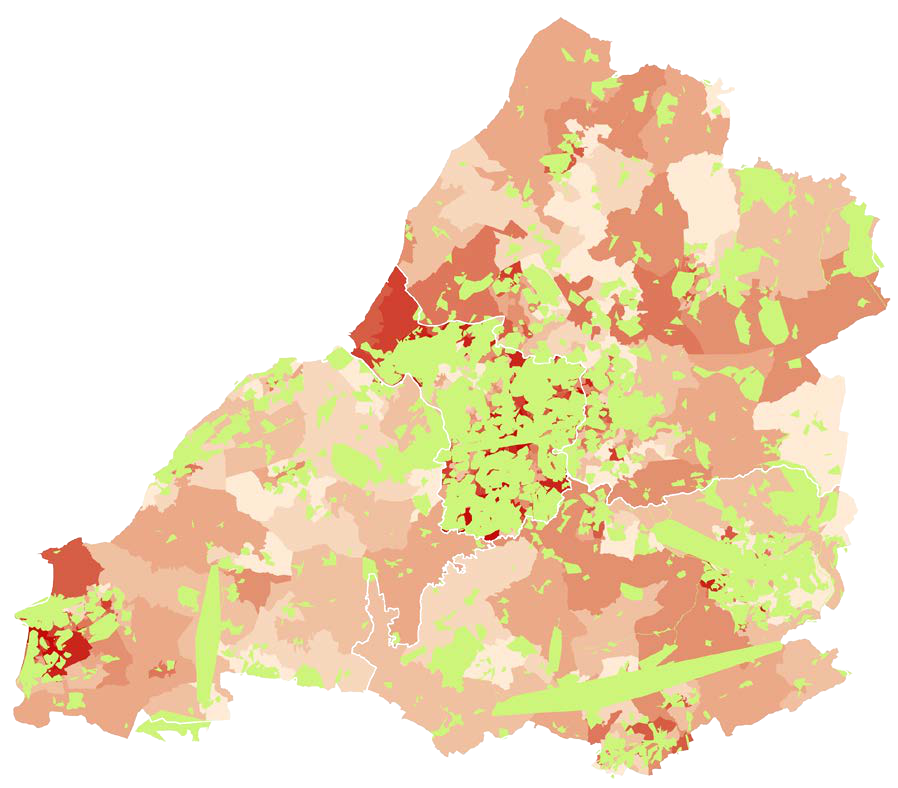
Image by West of England Nature Partnership. The dark red areas show areas in West of England where there's the highest incidence of multiple deprivation.
Legend:
* Accessible to open green space
* Highest incidence of multiple deprivation
* Lowest incidence of multiple deprivation
However, access to greenspace is not shared equally in our society. Disadvantaged groups appear to gain a larger health benefit and have reduced socioeconomic-related inequalities in health when living in greener communities. Greenspace is therefore central to building a fairer society. Yet, in keeping with many of our systems, the people who need it the most have the least access to it. Why is that?
Systemic inequality and greenspace
Of the multiple drivers of systemic inequality in our society, let's consider two dynamics that relate particularly to parks and greenspace:
Dynamic one: Physical alienation
The first dynamic driving inequality of access to greenspaces is that the system we have created is incrementally pushing poorer communities away from them. When it comes to greenspaces, living close matters. People who live within a five-minute walk of their local greenspace are significantly more likely (61 per cent) to visit once a week or more often, compared to those living further away (40 per cent for those who live 5 to 10 minutes walk away and 18 per cent for people living 11 to 20 minutes away). People want to live closer to parks, which raises the value of property near parks and pushes people who can't afford it further away.
The addition to property values associated with living near a greenspace is estimated to be just over £130 billion in the UK. This is seen as a positive thing from the perspective of our economic indicators, but disadvantaged people are being further disadvantaged through diminishing access to greenspace.
Compounding this, the places that get investment in their parks and greenspaces are then more likely to get more investment.
The net effect of this is the phenomenon of 'forgotten places', where the places that are already ahead get further ahead through getting more attention and funding, and the places behind get left further behind.
Dynamic two: Psychological alienation
More subtle than this, and perhaps more discomforting, is the psychological alienation that accompanies this physical alienation. This reinforcing feedback loop means the more you get told that this space is not for you, the more you start to believe it. This is the degradation of trust in the system as people experience the impacts of this systemic inequality. Poor communities have their needs weaponised against them – 'you can't stop this, it's for your housing development' or underused spaces are taken away from them just as they start to stake a claim of ownership and participation. Local councils are not to blame for this dynamic, far from it; local councils themselves are victims of the perverse incentives embedded in the system: the pressure to generate capital sales receipts often outweighs the long-term social value created by parks. The march of privatisation of greenspaces therefore continues, and with it the sense that these spaces are shared in common, for us all to participate in and care for. The implicit message of the market mechanism – 'you get what you pay for' – alienates people from caring for their local greenspaces, and deteriorates what's left of the public commons – those spaces held for the common good.
Civil society is asking for change. The Independent Inquiry into Civil Society Futures that heard from over 3,000 people across English civil society (from Penzance to Sunderland) put forward a PACT for civil society: a great power shift; an accountability revolution; building deeper, closer connections and investing in trust. Some councils are leading this shift in power towards civil society, for example by developing policies for community asset transfer and partnering with communities to reimagine local spaces, with glowing examples like Organic Lea and Tomorrow Today Streets.
Trajectories shaping the future
What's in store for us following COVID-19? The simple answer is we just don't know. We're in a time of unprecedented anxiety and uncertainty and rapidly shifting assumptions. Change is happening at so many different systemic levels that normal scenario building is hard and risks being overtaken by events. This is why we're currently finding it more useful to talk about possible trajectories playing out given the plethora of signals we're seeing in response to the crisis.
Diagram illustrating Systemic inequalities and Possible futures
The diagram shows:
* On the left, labeled "Today", two dynamics lead into "Systemic inequalities":
* "Dynamic 1: Physical alienation"
* "Dynamic 2: Psychological alienation"
* From "Systemic inequalities" (center), two main trajectories lead to the right, labeled "Possible futures":
* "Disciplined trajectory"
* "Transform trajectory"
Option one: A disciplined trajectory
One of the trajectories we're tracking is what we're calling the disciplined trajectory, in which greater control and surveillance is considered justified to maintain public health and security. If this ethos of control and market-based access prevails, we risk sleepwalking into the erosion of truly public spaces, and more and more barriers to inclusive access. Already it is becoming common to see park benches designed so that homeless people can't sleep on them. In London, many seemingly public spaces around corporate premises have been privatised, and behaviour in them is monitored by private security. Even community gardens can have bureaucratic complexities in their access policies that exclude many of the people from the community they are supposed to serve. While the pandemic has really exposed the need for easy access to greenspaces for all, it has not curbed the underlying barriers to access.
Here is a possible, provocative glimpse from the 'transform' trajectory, where rebuilding and reform are centred around regenerative principles and the recognition that planetary health is human health.
It's 2030 and Nadia is walking through the estate where she lives, reflecting on how much it has changed in the past ten years. The old car park by her block is an orchard now, and the trees have grown tall enough to provide welcome shade in the summer and enough mulberries to turn all the kids' hands and faces red in August.
She remembers the shock and delight when the vote went through, the unaccustomed feeling that they could actually shape the place they lived in. The car park one block down became a football pitch, and just one remains for the few residents who still own cars. Even that one has shrunk – half of it has been taken over by a five-year old Miyawaki pocket forest with an unbelievable number of trees in it – which is earning them all community carbon credits that top up the community fund.
Green kids corridors link the estate to the local park. Well, they call them kids' corridors, and children use them no question, but actually those paths are also heaving with young mums and OAPs. They've been great for everyone. When they were first introduced people held their breath, fearing a repeat of the 'cycle-lane wars' but the participatory voting system was a revelation in determining where to place the green kids corridors. Apparently it's based on the system they use in Taiwan and is configured to help people to find points of agreement rather than discord and get real transparency and power around decisions, even down to where the money goes.
Some extraordinary experiments started happening once people understood the potential participatory voting systems had. There was the Breakers Yard run by some local artists where anyone could go to smash things and let off steam – that was surprisingly popular! The Healing Flowerbeds, the Rewilded Lorry, Bat Towers and Parakeet Perch became so popular on the roof of the empty commercial block across the road that they had to rethink the demolition plan. People still come from all over the city to hand feed the parakeets and hang out in the cafe. Of course not all of the ideas lasted, and things have settled down, but the ethos of communal creativity and wellbeing has bedded in. Planting day in Diaspora Gardens in the local park quickly became a neighbourhood festival. As Ruby next door says, 'that was the day it became my park!'
The future we choose
Futurist Bill Sharpe of the International Futures Forum says that the only evidence we have of the future is our commitment to it in the present. In times of discontinuity like this, it feels like there are too many levels of possibility to even start to accommodate what the future might be like. But the choices we make in the next 6–18 months are critical for our societies and will have ripple effects that will shape the next decade and century.
In all likelihood, multiple trajectories will play out in many different ways for different contexts and cultures. But what role do we have in shaping the transformation we want to see when it comes to our parks? Are we going to adopt a mindset of control when it comes to our public spaces, and risk reinforcing existing feedback loops of inequality of access? Or might we adopt a regenerative and participatory ethos, in which we invite Nadia's world into being with every passing day? What role will you play in forging this future?
Urban settings can evoke the same feelings as being in the psychological state of survival, whereas being in natural settings can evoke the same feelings as being in the psychological state where we are 'living'.
De-traumatising the city
Beth Collier
During the COVID-19 outbreak, our need for nature to support resilience has demonstrated that wildlife habitats, parks, green and blue spaces, are essential assets and not luxuries. It has also revealed that millions of us don't have easy access to greenspaces within walking distance and that there are socio-economic and racial disparities in accessing nature's health benefits in cities.
Ethnic minorities died of COVID-19 at a greater rate. Evidence suggests that part of this is because the COVID-19 mortality rate was made worse by air pollution and ethnic minorities and people on lower incomes tend to live in areas with greater air pollution. Greenspace and trees counter air pollution, however, ethnic minorities and people on lower incomes tend to live in areas with fewer trees and less access to green space. In addition, it was harder for lower paid essential workers to avoid social contact than higher earning employees who could shelter at home. The pandemic also revealed that those with money and means could relocate to greener areas, whilst those without were trapped within the city's stressors. Making cities and towns greener is a crucial public health response to an environment that doesn't currently meet our needs.
Urban areas are home to over 83 per cent of the UK population. It's where we live, work and play, yet seemingly cities have been designed with an acceptance of environmental stressors which harm health – rather than designed to nurture and support health, qualities associated with nature and our natural habitat.
The city environment and its stressors (air pollution, noise, cityscape) have a detrimental effect on our cardiovascular system, neuropsychiatry, and gastrointestinal, reproductive, respiratory and immune systems. This leads to an increase in disorders such as male and female infertility, miscarriage, fetal development issues, low birth weight, Alzhemers, Parkinsons, high cholesterol and early death from asthma, lung disease, obesity, diabetes, stroke, cardiovascular disease and cancer.
Loud noise, hectic movement of people, traffic and other competing visual stimuli of signs and lights take a toll on us and can be experienced as overload which our bodies perceive as a threat. This, in turn, triggers our fight, flight, freeze response, designed to protect us from danger. It is a survival instinct. When exposed to ongoing stressors that put us on alert for an extended period of time, we are likely to become irritable, angry, anxious or depressed and experience fatigue or burn out. Ongoing relentless stress from situations that leave us feeling overwhelmed and isolated can lead to emotional trauma.
Non-polluted natural environments, in contrast, can lower stress and heart rate, calm our nervous systems and support optimum health. Contact with nature can support us through hard times and help us to recover and repair from the inflammation of stress by inducing feelings of relaxation and connection.
Contrasts between living and survival
The impact of being in an urban environment mirrors a state of 'survival' with high levels of the stress hormone cortisol and a high heart rate, operating more in adrenaline with a lower quality of rest and sleeping problems. It can also lead to emotional detachment, withdrawal, feelings of being overwhelmed, anxious and isolated, or becoming more aggressive and combative.
Being in a natural environment correlates with a state of 'living' – having a lower heart rate, lower cortisol levels, feeling rested, relaxed and having a sense of belonging. In nature it is much easier to be in the moment with our feelings and have a general sense of wellbeing. While we are more adrenalised in the city than in nature, we are not meant to live on constant alert. Survival mode is meant to help us cope with occasional encounters and not to be our default.
Optimum habitat
Humans are not outside nature but part of nature. As such, we are as vulnerable to habitat change as the hedgehog and the stickleback. We have needs and requirements from nature in order to live in health and we suffer poor health when our environment does not provide optimum conditions. Wildlife and humans feel stressed when our natural habitats are tampered with, urban residents with a deficiency of access to nature are impacted most.
Our evolutionary biology hasn't quite caught up with the environments that we've created for ourselves.
Our physiological systems are designed for regulation by circadian rhythms which in turn are imprinted into the phenological rhythms of nature, and the effects of nature performing natural cycles and interactions.
We have lost touch with the baseline for what's normal in terms of biodiverse habitat health. We tend to base our view of normality on what the norm was during our formative years. We do the same for our baseline of city stressors. If we grew up with pollution, sensory overload and deprivations, we tend to see that as normal and it becomes our baseline for accepting stress and the associated traumatic response.
There's a danger that our baseline for natural habitats and our baseline for city stressors have become normalised at an unhealthy level. 'It's normal to have few birds, it's normal to have loud noise'. We seem unaware of what we've lost, with each unhealthy city element we pile up layers of disconnect and trauma; removing nature, introducing air pollution, noise and fast traffic.
Dysfunctional relationship
There is a strange denial that we're not directly affected by habitat loss, rather we externalise it as a matter of stress and loss to 'other' species, and not to ourselves. We have a delusion that as humans we are above needing nature for our own sakes. Our quality of life would be higher with more nature. Why don't we bring more in?
We have a dysfunctional relationship with the city; it harms us but we still tolerate it, as if there was no choice to change this relationship. We need to break the trauma bond of our dysfunctional relationship with an abusive environment and let go of systems and norms which bring the comfort of familiarity but which are causing us harm.
De-traumatising the city
We've been here before, toxifying our cities in the name of progress. The mid 1800s saw a number of outbreaks of disease related to larger numbers of people living in industrialised cities and environmental stressors which harmed the public's health, triggering change. The cholera outbreak of 1832 and the Great Stink of 1858 showed a lack of sanitation was harming human health; infrastructure did not meet the needs of the populace.
Motivated by an outbreak of typhoid in 1838, social reformer Edwin Chadwick's investigation into urban sanitation explored how the city's design led to negative health outcomes and the spread of disease. His response was to effect social justice for the 'labouring population of Great Britain', recommending improved drainage, clean water and removal of waste in addition to government pensions, a shorter work day and a transfer of funds from prisons to preventative policing – not so dissimilar to calls for social and environmental justice today.
We are also at a time of reckoning, in a year we couldn't breathe. Sanitation and disease in our era is not just viral and bacterial outbreaks but pollutants and stress.
De-traumatising the city means implementing environmental justice and allowing more space for nature as a health necessity for all, not just the moneyed and privileged. We know that people who live closer to greenspaces live longer and are less stressed. We know that deficient access to greenspace leads to higher levels of air pollution, and areas with fewer trees experience more crime and hotter summers. So why are we not addressing these disparities as a public health issue?
In the same way the State (at least in some countries) provides everyone with sanitation as a basic health right, everyone should be provided with nature sufficient to mitigate city stressors. Nature contact is a life lengthening, health supporting essential, not a luxury. We need to do more than make streets look pretty with flower boxes. We need to be brave and create enough nature sites in neighbourhoods lacking them to recover our health. Nature's recovery and our own are intertwined.
Air pollution is no more a necessary evil that open sewers were in the 1800s - there may be a period of change or temporary inconvenience to achieve a better life for us and future generations. We should be glad that Victorian Londoners accepted this inconvenience so that we are no longer troubled by stink and cholera.
Increasing wildlife sites will offer some respite; soft ground, tree leaves and bark absorb sound waves, dulling the abrasive impact of loud noise, lessening the impact of sound on our nervous system. They will also cool our cities and absorb pollutants.
Rather than conceiving parks as boundaried spaces within a city, we need to think of the city as a habitat and consider whether it is fit for a human. We need to be concerned with the quality of the air we breathe, the noises we hear and the state of 'living' we are able to achieve within it. Think of the city as our zoo. If we must be removed entirely from a fully natural habitat, as much as possible needs to be brought in to make it habitable without us becoming depressed or enraged.
Valuing the invaluable: A Parks for All Fund
Holly Lewis
Everyone likes a park. But, I'm not sure how many of us truly appreciated how important they are to our way of lives and sense of well-being until recently. The value of our parks has become acutely felt during the COVID-19 pandemic and associated lockdown. When being outside was restricted to just one hour a day, town and city parks became the go-to place for many. Even after the strictest lockdown measures were lifted, parks became a vital resource for both physical and mental health for those with limited access to private outdoor space, small gardens or any semblance of a social life.
Contrast this with recent years, where so often the conversation around the future of parks frames them in terms of cost as liabilities that must be covered. We need to change the basic premise of this conversation – to understand parks as multipliers of investments that are made into them. This will require us to question established models of value.
From the work my practice We Made That did on the High Streets for All study for the Mayor of London, which considered the social value of London's high streets, I know the challenges that this poses - we're not very good at placing value on so many of the things that matter. For this study, high streets were defined as 'any stretch of adjacent retail unit of 250m or more in length, though we know from multiple studies that they can include a much wider range of uses than merely shops.
Our research found that 51 per cent of people surveyed on London's high streets during the day were not employed, compared with 27 per cent across the entire city. This highlights our high streets as important places for groups at risk of marginalisation and under-representation – the unemployed, young people, those with young families and the elderly. Much the same can be expected of our parks. Whilst examples of value such as this can be difficult to quantify - consider the value of a shopkeeper knowing a lonely older person's name or the value of a child having space to run around - they are nonetheless essential to be recognised as funding decisions are made. Whilst high streets are certainly facing current challenges, I am encouraged that their value has been recognised sufficiently to attract the £1bn Future High Streets Fund from the UK government.
Take just one example of a park delivering for its local community; Myatts Field a 14-acre Victorian Park in Camberwell, South London. Surrounded by diverse communities and a range of socio-economic groups, it has the obligatory open lawns, mature trees and rose beds of a common-or-garden local park. Alongside these sit tennis courts, a playground, a community café, food growing space and a greenhouse, a five-a-side football pitch, a basketball hoop, an outdoor pre-school, a nature area, public toilets, secluded 'no dog' areas, a band stand, a weekly market, a tucked away stone mason's yard, bee hives and wedding venues. It's a tardis of a park that crams value into its modest scale. Throughout the day and across the week, the park is a hive of activity, bustling with people of all ages and ethnicities, from babes-in-arms to centenarians. Currently run on a shoestring by a small charity, the value that its local communities receive from its presence outweigh the funding it attracts many times over. Collectively, we need to be better at evidencing and promoting the value of this public good, and better at maximising it to address the substantial public health challenges faced by our towns and cities, and the global challenge of the climate crisis.
Research has clearly shown the positive health outcomes associated with outdoor activity. If you have access to a good park, your chances of achieving the 20 minutes of exercise that can reduce your risk of heart attack or stroke by 50 per cent are increased. While the link between investment in public spaces and improved health outcomes has been established, more research in this area would help us to articulate the local public health benefits of high-quality parks. In Waltham Forest, improvements to streets to prioritise walking and cycling over vehicular transport through the Mini-Holland schemes has caused an evidenced uplift in physical activity with anticipated life expectancy gains of seven months for residents across the borough.
Now, of all times, we should recognise that investment in our parks is a public health issue of relevance to everyone in our towns and cities. This understanding should lead to greater cross-departmental collaboration within local authorities to target place-based improvements in and around parks – in public health, regeneration, education and economic development. At We Made That, we see some pioneering examples of this – improvements to the greenspaces on the Chicksand Estate in Whitechapel are funded through the public health team. Recently, the London Boroughs of Camden and Islington have launched a joint Parks for Health programme, part of the Future Parks Accelerator. Still, these examples seem to be outliers rather than the norm and the funding they attract is in the hundreds of thousands of pounds, not the hundreds of millions that it needs to make a meaningful difference at a national level.
I dream of a Parks for All Fund that is even
more generous than the Future High Streets
equivalent – a fund that invests public money
into parks with confidence that the health
benefits and future National Health savings
more than justify the expense.
This fund will need to cover capital costs for investment in park infrastructure, but crucially must also offer long-term committed revenue funding for maintenance and management. By focusing on impactful projects that address the grand challenges of our time - public health, the climate crisis, inequality – the fund could bring multiple local authority departments and wider parks stakeholders together, with a focus on delivering genuine and measured change.
Delivered in the spirit of adaptation and innovation, its projects could be used to pioneer our understanding of how to increase engagement with and use of parks, or how to maximise health benefits. By setting clear, locally-specific missions and establishing the full range of stakeholders needed to deliver on those missions, these projects would help us squeeze the maximum possible value from each and every park. This could include delivering new parks in areas of greenspace deficit, or addressing imbalance in the use of parks across different ethnicities through socially-engaged and bias-aware design processes.
Recent action to respond to the COVID-19 crisis shows that funding can be available if the challenge it is tackling is sufficiently pressing - with parks, I believe it is.
Parks are a fundamental 'public good', when our parks thrive, people thrive. Of course, all of this says nothing of the environmental benefits of greenspace in terms of biodiversity, flood management and contribution to tackling the climate crisis. With research, leadership and co-ordinated action, we can reframe the conversation around the future of parks. Rather than 'nice-to-haves' whose funding is pressured, discretionary or de-prioritised, a rounded and balanced understanding of the incredible and multi-faceted value that parks offer will see them recognised as net contributors to healthy, productive urban living, which are more than worthy of taxpayer funding.
What if we thought about localities the way we think about gardens?
Dr Sue Goss
'Out of a history so much ruled by the motto Think Big,
we have come to a place and a need that require us
to think little. Instead of ostentation, we have undertaken
modesty, instead of haste, patience; for the discipline
of generalisations we have begun to substitute
the discipline of details.'
Wendell Berry
Nature is a great teacher
Brockwell Park in the London Borough of Lambeth is the home to a community greenhouse experiment. A haven for wildlife, it makes space for local adults and children to get involved in gardening – growing fruit and vegetables – alongside music, yoga and cooking classes. In my village of Hawkhurst, Kent, a charity, Hands of Hope, has taken ownership of an old walled garden. As it works out how best to use this space, it is bringing together volunteers to create growing kits for local families and harvest vegetables for local food banks. In the Lake District National Park, the National Trust is restoring a sheep farm in Borrowdale to its natural habitat to explore whether tree planning can prevent flooding downstream in Keswick and Cockermouth. These are just three of thousands of experimental projects across the country where parks managers, ecologists, volunteers, gardeners and farmers are finding new ways to use open spaces and natural land.
Life shows us a different way to understand how change happens. Working with nature, we are not controlling, we are 'caretakers, guardians and facilitators.' We cannot force wild creatures and plants to do what we want, but we can find the conditions that enable them to flourish. Gardens, parks, waterway plantings, woodlands and farms all emerge through an ever-changing dance between the needs of the humans shaping them and the climate, soil, seeds and pollinators.
Gardeners seldom start with a business plan. We spend our time observing the seasons and the cycles that life moves in. We attract wildlife to do the work of maintaining equilibrium. We encourage diversity. We begin by creating a rich soil. Life wants to grow, and, through trial and error, it finds many different, quirky ways to do so. We learn to work with this, not to override it.
The possibilities are endless. Solutions are not found in isolation; everything participates in the evolution of its neighbours. The rules for life are simple, a move through experiment and mess towards order.
Life self-organises. Networks, patterns and structures emerge without external imposition or direction.
From machine mind to garden mind
For a century we have thought about progress in terms of machines. We have treated organisations as machines to work in. We explain them using engineering diagrams. We write business plans like car manuals. We plan change using metaphors like 'construct', 'wiring', 'channels'. We have copied from machinery a view of efficiency that streamlines processes, separates tasks, removes variation, eliminates redundancy and centralises decisions. In farming and land management we have worked at an industrial scale, treating the land as a receptacle to hold fertilisers and pesticides. But the ecological problems we now face, and the impacts of the COVID-19 pandemic, show us that this approach is brittle, fragile and dangerous.
Over-specialisation creates complex supply chains which chop up processes and isolate decision-making so that the slightest shift in circumstances lurches the whole over-engineered delivery into problems that no-one knows how to fix. On the contrary, a more localised system offers resilience through diversity and distributed decision-making. This type of system sees the inter-dependencies and the dynamics in motion, drawing on the intelligence of the people close enough to the problem to understand what needs to be done.
Nature is resilient because it accepts redundancy; it finds
multiple ways to solve a problem, not simply one way.
A machine mind engineers a solution and expects it to work every time. A garden mind knows that every solution is a compromise, with potential difficulties, and is alert to the need to constantly recreate balance. Gardening is a process of constant adjustment and maintenance. Gardeners don't make a perfect garden and leave it alone. We try things, we fail, we move things around. With garden mind thinking we don't expect things to work comfortably, we understand the compromises and are vigilant and attentive to the things that can go wrong.
Reshaping how we think about where we live
According to one UN definition, London could be classified as a forest. It has over eight million trees. If we thought of London as a forest - what opportunities would that create? Despite our recognition of the UK's unique countryside, we tend to see our towns and cities as if they were just people and buildings. But a third of urban areas are covered with natural land – scrub, woodland, waterways, parks, playing fields and greenspaces. A further third is made up of private gardens.
We know greenspaces reduce flooding, mitigate pollution, reduce heat, contribute to well-being, improve mental health. We know that climate change is the most important threat to our planet. And yet, a glance at the average council agenda or Westminster order paper would give no hint of this. This is not just about the good work going on in parks and open spaces, but about reshaping the way we all think about where we live.
- If councils and government applied 'garden mind' to the work of a town or a city, what would change?
- We would connect things together. We would no longer think about food, leisure, shelter, travel or pollution in separate boxes, we would trace the connections and encourage our experts to talk together to find ways to amplify each other's solutions rather than cutting across each other.
- We would acknowledge the many experiments that are underway and make more. We would create space for self-organising to flourish. We would work through trial and error, not abandoning experiments when they fail, but learning thoroughly and curiously about our mistakes, encouraging others to improve upon our attempts.
- We would 'think little'. Instead of abstract strategy documents, we would start with practical work in a specific place. Local teams would work with the energy and experience of the people they encounter, co-creating solutions that work in that place. These initiatives would be led by the people who made them and be flexible to adjustments, changes and constant improvements.
- We would build relationships. We would spend time together, sharing knowledge, building a shared endeavour, linking our networks, so that we connect more and more people to these ideas.
- We would change the relationship between councils and communities. Communities brim with ideas but often need practical help and funding from local authorities. But councils can too easily take over and treat community organisations as 'contractors' rather than partners. By making the relationship reciprocal, by responding with kindness and flexibility to match the excitement and energy of community groups on the move, councils can forge a new powerful dynamic that draws on the strength of both.
- We would start to change the education not just of children, but of civil servants, council officers, managers, doctors, social workers - sharing the skills to collaborate effectively and think about and work in systems. Perhaps every council and health service employee could be allowed to volunteer for a local project for a few days a year. Perhaps every senior manager should be reverse coached by a young environmental volunteer.
Gardeners, horticulturalists, ecologists, parks managers, enthusiasts and volunteers know how to do these things. How do we share this with others?
Since none of this can be accomplished through committee reports, we will have to experiment. Let's go outside. Ask decision makers to spend less time in meeting rooms and more time out and about.
Post COVID-19, should we create meeting spaces in parks? Perhaps we can make meetings more useful – by litter picking or weeding or making up foodbank parcels as we talk. In a neighbourhood project I was involved in in Islington, we began to hold 'walkabout meetings' where for two hours or so we walked the patch. In doing so, everything changed. We would notice things around us and stop and chat to residents. We spotted railings fencing off a garden space so it couldn't be used. The housing director made a note. The chief executive came alongside a community worker and discussed the adventure playground. We popped into the health centre. Understanding grew.
Show, don't just talk or write papers. Invite MPs and councillors down to the woodlands and parks, to the community greenhouses and the rewilded waterways. Offer the top management team their own allotment. Give the MP a flower garden to design with residents. Ask schoolchildren to help you plan the next project. Put your garden mind to work.
News from Nowhere Gardens
Kate Swade
"It's bittersweet, really." says Jan, leaning back on the new, spacious bench near the gate of her local park, Nowhere Gardens. "I was definitely one of those saying that this would never work. And, well. I was wrong. I guess I don't mind admitting that, now. Things have just changed so quickly".
Jan's local park was at the forefront of a revolution in local governance and democracy in 2025. Five years later, we sat down with her to think about what had been gained, and lost, since the introduction of neighbourhood citizens' panels.
"When I was chair of the Friends Group for this park, we worked so hard", says Jan. "Everything felt like a battle, from encouraging people out on a Saturday morning to pick litter, knowing there'd be more by Sunday, to lobbying the council to get play equipment replaced, or even properly looked after. We were on the front line, both of day to day parks maintenance, but also of the holes left in social care – bumping into people rough sleeping in the park, dealing with the fallout from people joining our group because they needed something, much more than we could provide. The National Federation of Parks and Greenspaces did an amazing job, but we always felt like we were battling over the scraps – like each park was in competition with each other for funding. Parks in general were in competition against all the other calls on the council.
"Sometimes we'd get 20 people out for a litter pick or a party, but we never got more than five or so actually coming to meetings and helping with admin or fundraising. We did it because we loved this park. Most of us live around the edges of it, and it's like an extension of our back gardens". She pauses, looking over at a family picnicking next to the play area. "Maybe it was partly the sense that it was ours which meant no one else wanted to join".
The 2020 pandemic had kicked off a national conversation about the importance of green and public spaces to public health, and the inequalities of access, provision and quality across the country. This was particularly acute in Jan's area, where the relatively affluent neighbourhood immediately surrounding the park sat in between two dense estates with little greenspace of their own.
The 'double' devolution of power from local authorities to new neighbourhood citizens' panels was first proposed in the 2023 planning system reforms. Many were cynical at the time, seeing the move as a way of further stripping local authorities of power and funding, but community and neighbourhood organisations saw opportunities. The other change, that to some seemed like a nuance, was the change in emphasis of the planning system as a whole – from focussing on buildings and the built environment, to focussing on land and the wider landscape.
It was the Nowhere Trust, a local community enterprise, that persuaded the local authority to invest in a single neighbourhood experiment. The Trust had already set up a neighbourhood forum and created a neighbourhood plan for the area which had been approved in a local referendum. Jan had been on the Nowhere Trust committee.
The Trust saw the opportunity to create deeper democracy, a whole new set of civic relationships, and an environment that worked for both the people surrounding the park and those in the estates just beyond. The Trust's team of community organisers knocked on every door locally, and spoke face-to-face with over half of the local residents. They also organised a number of meetings and parties, many in the park.
The heart of the proposal was to take advantage of the double devolution to create a neighbourhood citizens' panel to make decisions on where to spend money on local 'green infrastructure' (plants, trees, street furniture, park lawns) as well as maintaining a budget to support community-led projects. The really radical thing the Trust proposed, though, was appointing the members of this panel by lottery. A key job of the community organisers and those initial parties and meetings was to introduce people to this new civic role and to see if they were willing for their names to be 'in the hat' to potentially become new panel members.
At the time, Jan grumbled, "well, I was a bit offended. Me and the rest of the Friends, and other local groups, had put so much time in and now here's an opportunity to make real change. And they're just pulling names out of a hat? It seemed absurd”.
Maybe it was the absurdity of it that got people's attention. In the end around 500 people said they'd be willing to be in the pool of potential panel members, and the local park party where they announced the results of the lottery was the best attended party yet. Twelve new local representatives were chosen that afternoon, random numbers picked by local kids and cross-referenced against the database of potential panel members. Two-thirds were residents from the estates, and a third were from the houses nearest the park. The majority hadn't been involved in any civic roles before.
"Honestly, I thought they'd never stick at it" says Jan, with a wry smile. "And maybe I was a bit resentful that they got paid, not much mind, but after we'd put all that work in for free, it was a bit galling. But they did mostly stick it out, apart from that one gentleman who had family issues, and to be fair, they managed to get more done than we ever did".
The Nowhere Trust's community organisers worked with them over the course of their two year term, helping them work well together, manage conflict and make decisions. One of the organisers, Safiyya, explained the tricky balance involved in the role. "We are working to help them build their power as a group. We are very much there to facilitate – and that's where being able to pay them is so important. We're all equals with different roles – theirs to decide, ours to hold the process and the space. It's challenging, but when it works, it's brilliantly exciting".
The Panel took a little time to acclimatise, but quickly Jan noticed some changes. "They supported a local teacher to run regular forest school sessions for the little kids but advertised them on the estates first. I think that meant that all those kids and their parents got more comfy coming to the park. The swings were suddenly much busier!". There was a series of small but very practical changes – creating some designated barbeque areas with big fox-proof bins and an online booking system so people could see whether others were already planning to use the space.
They hosted a series of community circles in the park about expectations, behaviours and desires. Jan attended some of them and noted "to be honest, the thing that blew me away was how off-putting some people find dogs. I mean lots of us are dog walkers but I had no idea how scared some people were of them. Now we have some agreed dog-free times. Because so many people were involved in the process, people is more comfortable asking others to move on if they are there with a dog in the dog-free time".
Now on their fifth cohort, the members of the Panel are getting more ambitious. While 2023 was all about the park, in later years they extended planting and other schemes along the neighbourhood's streets and through the estates. "It's like the whole place is a park now", says Jan. "I see more birds and butterflies around and so much of the new planting is edible. It's really nice walking down the street. I feel like it's more looked after somehow and I think that is what began to change my mind about the whole thing".
"One big thing was when the Travellers came", she says. "Every couple of years they would turn up, and we would kind of brace ourselves – people didn't like them being there. There would be more mess, and it always felt like locals were looking to the Friends to sort things out. This year someone got in touch with them and found out when they were coming; they organised a welcome party and a skill share and mapped out a bit of the park for them to stay on. I actually went to the welcome party and chatted to some of them. I can't believe we'd been in this antagonistic relationship with them for years and never even had a conversation".
The local authority judged the pilot year a success and has seen both the general health of people in the neighbourhood improve as well as fewer instances of anti-social behaviour. There is also a growing cohort of ex-panel members who are now more deeply involved in civic life. The rest of the borough now has similar citizens' panels and other areas around the country are taking note.
"We genuinely never wanted to exclude anyone", says Jan, "but it was obvious even then that we were, somehow, excluding people – or more accurately, we were gathering people around us who looked like us and thought like us". She pauses again, looking over at the family playing on the swings and sighs pensively.
With thanks to Catherine Max for some of the ideas in this piece.
The physical and mental health benefits parks and local greenspaces bring will support young people in these strange and uncertain times.
Illustration of a stylized person wearing sunglasses, sitting and holding a cup, with a musical note floating above.
Fresh ideas in green places
Green. Walk. Enjoy. Nature. Surround. These are a few words the young people of the Future Proof Parks programme used to describe the value of local parks and greenspaces. The programme is a partnership initiative between Groundwork, the National Youth Agency and Fields in Trust, funded by the Heritage Lottery Fund. Through this and similar initiatives, young people are engaging in their local parks and greenspaces whilst building on skills and experiences that help their social, emotional and educational development and integration into their local community.
We asked young people who are part of the project three questions, to explore the value, ideas and future involvement of young people in parks and local greenspaces.
By young people involved in National Youth Agency's Future Proof Parks programme, curated by Lydia Allen
Greenspaces are incredibly important to me. Not only do they provide a home to an array of organisms, but they provide a serene place where I can simply go to relax ... Greenspaces make me feel calm and help me to escape from the struggles of the world for a while. I feel like I can breathe when I'm in places surrounded by nature. It makes life simpler. It's nice to be able to just sit and listen to nature sometimes. I don't know what I would do if I didn't have these spaces ... They are vital for a community to thrive.
Ellen, 19
What do parks mean to you, how they make you feel and how important are they to you and others?
Personally, I find parks very relaxing as they provide the wildlife, nature and fresh air that is difficult to get in my city (Bristol). I love plants and greenery so being able to take a walk to the park with my family is very important to me for my physical and mental wellbeing.
Aurora, 17
When asked how they perceive the value of parks and greenspaces, young people's responses analysed what local parks and greenspaces meant to them, what they did in these spaces, how they made them feel and how important they were to them and others in their community.
Within their answers, the majority focused on the physical and mental health benefits these green, nature spaces brought to them and their communities. They also appreciated how welcoming and optimal these spaces were to them and their friends for meeting up and socialising. In addition, young people valued the outlet greenspaces provided during the COVID-19 restrictions.
To me they make places look a lot nicer than they would without the greenspaces whilst helping wildlife at the same time. I use the spaces to meet up with friends and walk my dog. They make me feel happy that there's places with grass and flowers and trees ... They're important to me because without them birds and other insects and animals wouldn't be able to live in cities and could die.
Mason, 14
... a place to relax, a place to enjoy solitude and a place to enjoy the company of others. It would be hard to imagine not having access to these spaces. I feel like these are places which everyone benefits from ...
Max, 17
Benefits to health and wellbeing – if I am experiencing stress or anxiety, I take a walk outside and feel calmer and more grounded. I also find experiences in parks and greenspaces refreshing and they give me energy and motivation to carry on with tasks. They are also good for physical exercise and act as social spaces for friends especially with the current restrictions regarding COVID-19 guidelines.
Beatrice, 21
What would you like to see happen in parks and greenspaces and what would you like to be able to do in these spaces?
Community-led (so the local people decide what the space is used for and their opinion is asked regarding any new facilities or changes to the space). Community can raise funds but there should be a local council budget to maintain so that the space is used to its full potential.
Amelia, 19
The young people of today are the future. Their ideas matter. More specifically, how they want to use greenspaces will shape the future management of parks. In answer to our request for ideas for parks and greenspaces in the future, many young people emphasised the importance of community and local people being involved in the management of parks and engaging more people to use these spaces. A lot of answers included suggestions for accessibility for all of those in the surrounding community, including young people who are sometimes discouraged by others to use the park or local greenspace.
I think they should be maintained and looked after well ... I would like to see and do more activities in these spaces to make people aware of their surroundings and the atmosphere that they can create.
Anonymous, 18
Young people were ambitious about the future role of parks and greenspaces at the heart of the community. They saw that parks are and could play an even greater role as a hub for the community – a common space to enable the entertainment, creativity and mixing of people across differences.
I would like to see more workshop type experiences to involve many different types of people in learning more about different cultures, music, exercises, etc. Also, different performances at parks such as dance performances or drama performances ...
Aurora, 17
Undercover seating areas so the parks can be used when the weather is bad, and it gives older teens and young adults a place to go, as we aren't as accepted in playground areas. Playground equipment for older kids more adventurous things I'm almost 18 now, but me and my friends still love going on the swings, but if we do, we have to deal with mean looks or abuse from parents with their younger kids for using the playgrounds.
Freya, 17
Some also saw parks as having a role in shaping social justice in our communities.
In light of recent BLM protests, the opportunity for education about environmental justice especially in urban contexts really involves greenspaces. Opening greenspaces in areas with the highest air pollution or most deprived communities in London could also attract young people interested in social issues.
Beatrice, 21
How could young people get involved and what activities could they get involved in? What leadership opportunities could they take on and how would this support young people?
Young people could participate in and host events held in greenspaces. This also provides them with leadership opportunities which can increase experience and confidence which could aid in future employment in green industries.
Ellen, 19
Young people are influential in the future use and management of parks and local greenspaces and their involvement is pivotal. This last question explored how young people could get involved, the leadership opportunities they could take on and how their involvement would support their wellbeing.
From leading activities and events, to taking part in litter collection and managing vegetation, to creating social media pages to publicise park activities and increase engagement, young people said they want to increase youth leadership activities. They show a willingness to be involved and to have their voices and opinions heard, but local parks need to reach out and engage young people in these opportunities and make it easy and accessible for young people to participate.
Young people could get involved by creating their own activities for people to take part in, whether it be a scavenger hunt, painting competition or designated walk explaining aspects of the park. They could also explain to people what they have to do or lead the designated walk, this allows them to gain more confidence in themselves and realise their passion.
Anonymous, 18
Young people also want a legitimate role in decision-making. The future of parks and greenspaces should be shaped with and by young people as equal citizens.
Have a voice at meetings where decisions are made in order to represent the younger population who are most likely to use the space. This would give them experience in a working environment and skills on how to project their opinions. They can push forward their own ideas and feel empowered that they are making a difference. It could be a great activity to engage in for those who don't get out of the house as much. They can meet like-minded individuals.
Amelia, 19
This could change the relationship positively between young people and assets such as parks and greenspaces in their communities. But to unlock the benefits for young people, the community and park management, parks need to be more accessible and inclusive for young people.
Not only would this provide work experience but it could also provide participants with a deep sense of satisfaction along with a greater appreciation for the outdoors ... it could encourage better health and lifestyle choices.
Max, 17
... when I've talked about it with my peers, it's more that they just don't know of events or things going on in their local parks and so they miss them, which is the biggest issue. Young people could easily and happily get involved in the same events that have gone on before.
Francesca, 19
... promoting more educational opportunities, including outdoor lectures/ talks/ workshops that are youth-focused and led by young people. Finding ways of making them safer spaces especially for people who are alone – greater presence of park rangers/ patrol, better lighting, etc.
Beatrice, 21
Where do we go from here?
Local parks and greenspaces are important to young people, their families and their local communities. Young people have a willingness to be involved in their local parks, bringing new creative ideas with them and the interest in taking on leadership roles. Local parks and greenspaces are one of the places in society where they feel that they can go, as meeting places to socialise with friends, but they do not always feel like they're accepted there.
Especially at these difficult times with COVID-19 restrictions, parks have been closed in some areas for safety reasons, but to also avoid young people meeting in the evening to socialise in parks. There is a lot of stigma about young people meeting in groups. The negative stereotypes attached to young people around anti-social behaviour and gangs can mean that they are moved out of parks or these spaces are closed at particular times to prevent them from using these important community spaces.
In the future, parks will need to be flexible in their approach to engaging young people. Connecting with those who already work with young people, such as local schools, colleges, youth groups
Fresh ideas in green places
and public services, could form a supportive network for park management groups and young people.
With the oncoming recession and increase in youth unemployment, these types of opportunities could help a young person gain skills and experience that they can use in their personal and career development. The physical and mental health benefits parks and local greenspaces bring will support young people in these strange and uncertain times whilst thinking about the current and future climate and nature crisis that their generation will have to face and live through.
Creating gardens and meadows that are curated, cared for and owned by residents is a powerful act ...
The park is dead. Long live the park
Dan Hill
Fumifugium
One of the first recorded complaints about air quality in a major city is around 400 years old, by the writer and gardener John Evelyn. It takes the form of a pamphlet sent to King Charles II in 1661, which Evelyn titled:
'Fumifugium, or, The inconveniencie of the aer and smoak of London dissipated together with some remedies humbly proposed by J.E. esq. to His Sacred Majestie, and to the Parliament now assembled'.
'Fumifugium' is a typically English whinge to the authorities, albeit with good reason given the filthy London air, followed by what could be called a suite of creative policy proposals.
In Fumifugium, Evelyn complains bitterly of the city's "impure and thick Mist", primarily caused by the burning of “Hellish and dismall Cloud of SEA-COAL" and exacerbated by wood burning, and other agricultural and industrial processes inside the city.
Evelyn's solution? Shunt these smelly trades outside of the city wherever possible and surround London with great 'plantations' of sweet-smelling flowers and vegetation placed near the city.
Evelyn carefully lists dozens of flowers, from woodbinds and pipe trees to musk roses and sweet-brier, that he envisaged would be planted in this vast array of gardens. He describes how the impact of the "poisonous and filthy smoake remov'd", in that "the City and environs about it, might be rendred one of the most pleasant and agreeable places in the world."
The park as shadow
For all of its mega structural boldness, Evelyn's idea of obscuring pollution with fragrance does not move the science forward much beyond the Venetian plague doctor's mask with its elongated nose, or proboscis, stuffed with flowers to fend off 'the miasma'. This practice of shuffling much of the problem elsewhere, recalls the feminist geographer Val Plumwood's notion of 'shadow places'. While hiding the residual impact with a large greenspace segregated from industry and housing, Fumifugium contains the seeds of a more recent urban vision.
The idea of grand municipal parks as the 'lungs of the city' emerged in the 19th century bureaucratisation of spatial formation and function; it also presupposes large greenspaces working as clear zones to counterpoint the maladies of industry, housing, and commerce. John Evelyn was a botanist rather than a biologist and did not reach for the metaphor of lungs, but after three centuries, his ameliorating greenspaces were eventually transplanted into the city.
So in this sense, the idea of the park is an old model. For all that it can be considered the green 'shadow' of other apparently more important urban functions, for most of the following two centuries it was a powerfully beneficial element of cities. Yet just as the late Ken Robinson described how Industrial Revolution-era societal patterns still damagingly pervade our education systems, long after mass factory work has disappeared, the idea of 'square plots of fragrant shrubs' as a green sticking plaster onto the wounds carved into a largely grey-brown hardscape city no longer makes much sense. The broader issue is that, with its segregated ameliorating function, this model of park does not change systems – it works more as counterpoint than point.
Richard Sennett has noted how urbanists and planners have traditionally found it easier to efficiently segregate rather than devise open, fluid, porous urban spaces required for sociability of human or nonhuman life:
This is true not only of gated residential communities, but of places to work or consume – the office campus, the shopping mall – which are mono-functional in character. Segregation of function has become the planner's yardstick of efficiency.
Richard Sennett
While it may have been efficient to segregate function at one point, cities are not about efficiency. Yet the idea of the park as segregated space still pervades. The integration of biodiversity into living spaces is still not tight enough given the order of challenge we face. This 'othering' of non-human biodiversity foregrounds the fact that parks were not simply about greenery, either. In the UK, the creation of parks was also about regulating forms of behaviour as massive infrastructures amongst the masses.
(With parks) there was a hope that the working classes would be encouraged into places where they could be seen and weren't doing things that were disapproved of, such as gambling or drinking.
Abigail Gilmore, Manchester University
Conversely, in Sweden parks emerged at the same time from the bottom-up often as a challenge to established hierarchy. Alongside the introduction of the People's House model all over Sweden, as a place for progressive newspapers, cooperative associations and unions to organise, the People's Parks were places to hold associated rallies, events, dances.
Over time, both the regulating and organising became absorbed into the city's everyday life. Its political roots remain in the soil yet the park became something to be managed, following the bureaucratic logic of the last half-century.
Yet that physical separation of parks from other spaces, and a bureaucratic shuffle to its own column in the municipal spreadsheet, means that they can often be picked off if the political weather changes. The Heritage Lottery Fund report 'State of UK Public Parks 2016' concluded that "It is clear that there is a growing deficit between the rising use of parks and the declining resources that are available to manage them".
Small pieces of park, loosely joined
It is easy to padlock a single gate and close a park. Yet it is far harder to padlock a street that has been turned into a park. For there are numerous alternative design patterns to the separated, managed 'central park' model. Given the need to refocus much of what we do around biodiversity restoration, alongside public health and social justice, are those models that look to pervade the condition of the park through the city itself, completely reversing the idea of the separate park? Here, the park becomes the idea of flipping space inside-out such that the street itself becomes the park. This super-distributed model can be thought of as a 'small pieces, loosely joined' design pattern.
There are precedents for this. For example, Ron Finley planted and cultivated gardens across vacant lots in South Central Los Angeles. Finley has calculated there are 26 square miles of such lots, which adds up to around 20 Central Parks. Those lots have "enough space for 724,838,400 tomato plants." But gardening in South Central LA is about more than the production of tomatoes. As Finley says "gardening is the most therapeutic and defiant act you can do, especially in the inner city." (Though he does add, "Plus, you get strawberries.")
Leonora Ditzler and team at University of Wageningen researched 'pixel farming', which also exemplifies this 'small pieces, loosely joined' pattern. Her work is a form of intensified, highly-distributed and diversified companion planting in 10cm by 10cm plots, only possible through alternate technology models, different notions of environmental care and fundamentally reversed paradigms.
These distributed gardens and farms and the spaces they retrofit are about politics, race and culture, as well as the environment.
These landscapes cannot be captured simply by their pattern of spatial distribution, as if on a typical map spread out in an urban planning office, but also by the actual condition of their lived experience in a place; what these spaces do; how they act; and how you are involved and embedded within them.
Parks, as currently understood, cannot produce this complex lived experience. There is a vast difference between 20 Central Parks and 26 square miles of vacant lot. The ability to locate the latter outside your front door, in what we might call the 'one-minute city' of your immediate environment, enables the more complex interactions between a more diverse set of conditions, uses, activities, vegetation and people.
There is much academic research into numerous forms of psychological, physical and social wellbeing that would be generated or promoted by transforming our living environments with 'salutogenetic' approaches to health. In other words, producing environments that make us healthier rather than unhealthier. Yet, despite the original idea of the park as a set of life-saving lungs, at this point, we cannot unlock these salutogenetic benefits by making separated parks. Bram Büscher and Robert Fletcher write of the need to "do away with conservation's long-standing infatuation with wilderness and associated ideas of 'pristine' nature ... the spectacle of nature and instead focus on 'everyday nature' in all its splendour and mundane. Indeed, we argue that it is in the mundaneness rather than the spectacle that we can find the most meaningful engagement with nature.”
This mundaneness describes, to some extent, the humble municipal park - rather than the showpiece Central Park model as well as the everyday act of gardening or of simply being with the natural environment in more un-programmed ways, truly opening up the sense of possibility in the idea of the park which is often lost when it is governed by someone else.
During 2020, the Australian artist Linda Tegg's installation 'Infield' created a meadow outside the Swedish centre for architecture and design, ArkDes, in its concrete car park outside the museum's front doors. Kieran Long, ArkDes director, described how the installation asked questions of public spaces that could “work with nature instead of against it, making space for non-human species and sharing the city with them." Indeed, Tegg notes that due to these intensive human-plant interactions, “Sweden's remnant infields are among the most species rich plant communities on Earth." There's a looseness to Infield, with its overtones of re-wilding cities, yet it works precisely at this scale of pixel-farming and is based on hundreds of highly modular small elements. It's not hard to imagine these meadows emerging in streets, growing out of parking spaces as they become available, as part of a transformation from street to park and garden. Our challenge is to live amongst such species-rich biodiversity, as one of these active species; not by placing nature 'over there', cultivated across agricultural infields or lying fallow in outfields but in public space, in urban space.
Creating gardens and meadows that are curated, cared for and owned by residents is a powerful act given the context of streets and spaces currently regulated and maintained by abstract others. In fact, such shared gardens and meadows necessitate engagement. They require care.
This creates a pull on people, which can only be fulfilled by reorganising the way we live, by flattening time and power relations, by slowing down.
In that 'flattening', we learn not only to live with non-humans but as humans too. Paraphrasing Sennett again, the point of cities is to learn to live well with people who are not like us. Now we know we must learn to live well with non-human life too.
The most complex part of that mission involves the governance and how the street itself can decide, care for and cultivate these newly participative forms of park. Currently, streets are largely optimised for traffic due to how the governance is arranged. In other words, if we give the street to traffic planners, we get traffic. The clue is in the name. If we give the street to gardeners we'd get gardens. What would we get if we gave the street to the street itself and suggested that the answer might be a new form of park but on their terms?
The park of the one-minute city
Many world cities are now re-weaving their built fabric with intense greenery as part of wider urban agendas alongside transformations in our mobility technologies. Perhaps most prominent in the city strategies of Barcelona's 'Superblocks' and Paris's '15-minute City', removing cars and other motor vehicles from streets wherever possible provides space not just for conviviality, commerce, culture and community but also for the reintroduction of a baseload of biodiversity. The courtyard blocks of cities like these or the narrower alleys and side-streets of Amsterdam and Tokyo lend themselves to this form of retrofit. Yet these moves are replicable, indicating how excising the problem also creates the opportunity to begin to actively repair the environment.
British cities tend to have rows of streets rather than grids of courtyard blocks, so the emphasis here must be on the street itself, and in transforming that into gardens or parks.
Learning from Paris's '15-minute city' strategy, we might shift emphasis to the 'one-minute city', the city immediately outside the front door. This is also a space for 'park' to occur, threading the condition of biodiversity and healthy social environments more thoroughly through our urban spaces. Michael Sorkin wonders, in his written meanderings across Manhattan rooftops, whether we can "imagine that the city enacted legislation requiring that the equivalent of 100 per cent of the surface area of New York were to be green ... If such aerial parkland were linked by bridges or by more continuous building form, an entirely new kind of public space would be created."
The mass littering in Britain's parks, albeit overplayed by the media no doubt, indicates the issue with making the care of parks 'somebody else's problem'. Parks have often had this sensibility; the comics of my childhood often featured the angry 'Parkie' character, a form of municipal stormtrooper figure with a sharpened stick for snaring litter – or children. That kind of park had a sister in 'The Rec' in 1970s/80s Britain, short for 'recreational grounds'. These were often liminal spaces in the city, where edgy, often dangerous things happened. Such spaces are actually crucial in a culturally-healthy city, yet due to the separated park-like condition ('over there') they were spaces to awkwardly control and contest, rather than embody any more complex model of shared ownership.
This 'us versus them' model, in which the gated park is looked after by someone else, has run its course, in some senses betraying our greater problem with understanding the environment as something separate, another kind of 'over there'.
Carefully avoiding an outcome of extending unpaid labour even further, the true value of encountering and nurturing biodiversity could be best achieved, and broadly shared, by ensuring that the street itself - its residents and primary users is maintaining much of its green and blue spaces. This means not only seeing the city and the park differently - understanding that vacant lots, parking spaces, back-alleys and wastelands can effectively be park – but also shifting models of ownership and governance. Often, the insertion of greenery into the street, by people directly, is seen as illegal or contested. It's a good contest to watch and learn from. The Dutch 'de stoep' model concerning the first few seconds of this one-minute city, in the form of the stoop directly outside the front door – tends to afford a rich plantation in only a few square centimetres.
In Japanese cities the tiny pockets of space in-between front door and street witness hugely inventive 'parks' at the scale of 50 centimetres. (As there is no on-street parking in Japan, this buffer is delightfully human, or green, despite its size.) Those small trees and plants feel like simple offerings to the street itself, and the community it implies, rather than private possessions and spaces trapped behind hedges or white picket fences or behind municipal gates. How might we encourage this further, enabling greater invention and care, and in places with patchier social fabric to that of Japan?
Nolli-ing the park and the city
The famous map of Rome by Giamnbattista Nolli, ‘Pianta Grande di Roma’ (1748) used a figure-ground representation to demarcate private buildings (in black) from open civic spaces (in white). This indicates that the city is not simply one giant open piazza in the centre as if Central Park – but hundreds of small public spaces distributed throughout – what I would call a 'small pieces, loosely joined' design pattern. We may need to think of the park in a similar way; not as green lungs of Central Park or Hyde Park or Whitworth Park sitting in a body of concrete, brick, steel and glass, but as a distributed condition, distributed throughout the city.
This not only produces more park but offers more diversity. By taking the single large park, with its few edges, and shattering it into thousands of smaller pieces, at the scale of streets, it creates far more surface area, making the form far edgier, as it were.
This pattern still affords the possibility of concentrations of park at certain points, just as streets converge on squares. In streets, communities themselves can largely manage and part-maintain their own parks, or parklets (micro-parks that eat parking spaces.)
'This isn't about scenery'
The idea of seeing core elements of cities as parks, with everyday spaces such as streets transformed into our parks and gardens, aligns with movements like 'London National Park City', as well as the numerous urban forest programmes around the world.
Street trees and forests can be brought together so that we see a continuum, rather than segregation, of vegetation. This implies a reforesting of cities, effectively, using the streets as its root systems.
Street trees and trees in forests have different advantages. Street trees provide cooling and carbon capture, and are especially positioned to capture particulate matter. For a real urban drawdown in emissions, preserving existing urban forests and expanding them can get more bang for the buck.
Adrian Benepe
As Benepe says, "this isn't about scenery. This is about life-saving infrastructure for cities." In the 19th century, when that idea first emerged most clearly, the municipal park saved lives through separated spaces. In the 21st century, amidst mass diversity loss and crises of climate resilience, public health and social justice, we understand that model is no longer enough. That life-saving dynamic has to extend beyond segregated set-pieces and flood through our streets, the street being the basic unit of the city.
We have a chance to reinvent the idea of the park by opening it up to a more radically diverse set of ideas, enabling it to rebalance our towns and cities by locating it everywhere rather than somewhere, ensuring it has the truly participative maintenance and care regimes of a garden, that it speaks to the needs and desires of diverse groups of people by placing it literally in their hands.
2020's major events, from COVID-19 clearing the street to Black Lives Matter filling it, indicates that it is clearer than ever that the street is where the city's politics plays out. It always has. Parks have always been a space of 'ritualised routine' now we might connect these ideas, representing the need for integrated approaches to the more complex challenges of the 21st century, rather than the merely complicated ones of the 19th and 20th, which allowed that all-too-easy separation of infrastructure, space, culture and politics.
By immersing the park in the street, we can flip the logic of the park inside-out, moving it well beyond its roots in Evelyn's Fumifugium and the municipal activists of the 19th century.
One could argue that by putting 'park' everywhere, it is nowhere. But if that nowhere is a richly restorative biodiversity, a generative tangle of human and non-human social life, addressing climate resilience, public health and social justice it may be worth exploring.
This could be a possible scenario for not only the future of parks, but of the infrastructure of everyday life and the way that we live.
A garden locates you in eternity ... It also connects you to the future. When you don't know how much time you have left, that sense of planting something that will flower next summer is immensely sustaining.
Derek Jarman
Contributors

Joy Green
Joy Green has over ten years of specialist experience practicing futures at Forum for the Future with a sustainability and systems lens, contributing to flagship projects by providing expertise in horizon scanning, scenario building and futures techniques. She is also involved in running the Futures Centre, Forum's unique participatory scanning and sensemaking platform.

Daniel Ford
Daniel Ford is a Senior Strategist at Forum for the Future. He's worked in the world of futures and sustainability for five years, on a mixture of collaborative system change projects and strategy work. He is also a Lewis Deep Democracy practitioner, looking at how to use difference and conflict to grow stronger group relationships, make wiser decisions and build more effective collective action.

Beth Collier
Beth Collier is a Nature Allied Psychotherapist and ethnographer, teaching woodland living skills and natural history. She is Director of Wild in the City and hosts the Black Nature Narratives podcast. Her work explores interpersonal relationships between people and nature. As a naturalist her work aims to reignite the oral tradition for learning about nature within families and challenges racism within the environmental sector.

Holly Lewis
Holly Lewis is an architect and co-founded architecture and urbanism practice, We Made That, in 2006. She has led a unique range of urban and research projects for the practice, from pioneering industrial intensification work through to comprehensive high street regeneration projects and fine-grain social research.

Dr Sue Goss
Sue Goss is a writer, consultant and a gardener, living in rural Kent. In her working life, she has nearly thirty years' experience of working with central and local government, health and social care, neighbourhoods and community organisations to make services more creative and responsive.
Kate Swade
Kate Swade is Shared Assets' co-executive director. She has over 15 years' experience helping local authorities and communities collaborate in stewardship of their environments and neighbourhoods.

Lydia Allen
Lydia Allen is a Youth Work Specialist on the Youth Work Directorate Team at the National Youth Agency (NYA). Having worked at NYA for over 4 years, Lydia has a passion for youth environmental programmes and has built up experience across a number of different projects working directly with young people. Lydia holds a strong belief that the current and next generation are fundamental in solving current pressing issues to both people and planet.

Dan Hill
Dan Hill is Director of Strategic Design at Vinnova, the Swedish government's innovation agency. A designer and urbanist, Dan's previous leadership positions have included Arup, Future Cities Catapult, Fabrica, SITRA and the BBC. He is a visiting professor at UCL Institute for Innovation and Public Purpose in London and at Design Academy Eindhoven, an adjunct professor at RMIT University in Melbourne, and one of the Mayor of London's Design Advocates.
Acknowledgments
This essay series has been a real team effort and there are lots of people who have dedicated their time and energy to make it possible.
A first set of thanks goes to each of the authors for sharing their passion, enthusiasm and creative ideas, working with such commitment in spite of the extraordinary and difficult circumstances of the past few months.
A second set of thanks goes to our partners at The National Lottery Heritage Fund and The National Lottery Community Fund, Drew Bennellick and Tony Thapar respectively, for their support and ideas.
At Nesta, the Rethinking Parks team has worked tirelessly to bring this project to life. Thank you to Nesta colleagues Caroline Back, Kathy Peach, Laurie Smith and Sally Zlotowitz, who offered their precious advice along the way.
A huge thank you also goes to Amanda Forsey for her excellent editorial advice, and to Žiga Kropivšek for his imaginative work on the collection's design.
About Nesta
Nesta is an innovation foundation. For us, innovation means turning bold ideas into reality and changing lives for the better. We use our expertise, skills and funding in areas where there are big challenges facing society.
Nesta is based in the UK and supported by a financial endowment. We work with partners around the globe to bring bold ideas to life to change the world for good.
www.nesta.org.uk
If you'd like this publication in an alternative format such as Braille, large print or audio, please contact us at:
[email protected]
There are a number of fictional pieces in this collection. Any resemblance to real people is entirely unintentional. Each contribution is intended to inspire thought and discussion and do not necessarily represent the views of Nesta.
Nesta is a registered charity in England and Wales with company number 7706036 and charity number 1144091. Registered as a charity in Scotland number SCO42833. Registered office: 58 Victoria Embankment, London, EC4Y ODS.
designbysoapbox.com
CC BY NC SA