Foreword
Innovation in public services is going to prove crucial to the UK's ability to meet the social challenges of the 21st century. However, at the moment, the UK does a poor job of developing innovations in the public sector. We are particularly weak in using innovations in one service to improve public services in others in the same locality or nearby.
Historically, nearly all innovation policy has been tailored to the needs of for-profit manufacturing sectors. However, there is an increasing thirst for understanding how finance, policy and institutions can support social innovation. Over the past year, NESTA and the Young Foundation have collaborated on two research projects that try to advance understanding of the UK's 'social innovation system'.
In this second project, we have conducted four in-depth case studies of UK local social innovations as well as five smaller case studies of innovative localities internationally. The findings challenge many widely-held assumptions about the most favourable conditions for social innovation and lay out an easy-to-use model and toolkit to help local authorities understand how to make more of the innovation that currently goes on and how to stimulate more.
NESTA does not like to do research in a vacuum. As such, we intend to take what we have learned here and put it to work in our practical programmes. Taken together and over time, we hope that we will develop a compelling vision of how to make the UK more socially innovative – to improve our economic competitiveness and social wellbeing.
As always, we welcome your input and your comments.
Jonathan Kestenbaum
CEO, NESTA
January, 2008
NESTA is the National Endowment for Science, Technology and the Arts. Our aim is to transform the UK's capacity for innovation. We invest in early stage companies, inform innovation policy and encourage a culture that helps innovation to flourish.
Executive summary
The ability of local areas to innovate is unevenly spread
This report investigates why some places innovate more effectively to meet social needs than others. It is based on a series of case studies - in the UK and internationally – which explore how cities and localities have thrived, or reversed their decline, by finding new ways of tackling problems.
For our case studies, we looked in detail at very diverse places. We found conclusive evidence that innovative capacity can be nurtured, even in unpromising circumstances. And we drew from them some common lessons about the importance of facing up to problems and underperformance; the role of leadership and organisational cultures; and, crucially, the structure of networks within the public sector and across organisational boundaries.
Innovation is sometimes treated as a desirable luxury: in fact it's essential
Many towns and cities in the industrialised world have experienced severe downturns over the last 30 or 40 years. These arose partly because of external forces. But they also reflected a failure to respond to these shocks, and to innovate quickly enough to anticipate or mitigate them.
Innovation is also essential for local government as a whole. One explanation for the decline of local government's powers in the UK over the last 30 years is its failure to innovate sufficiently, or in the right ways, and its consequent inability to resist incursions from national government and quangos.
Some common assumptions about local innovation are flawed
Our research challenges many previously widely-held assumptions about social innovation.
It shows that money matters – but in quite complex ways (and too much money can sometimes inhibit innovation). In none of our case studies are deep cultures of social innovation or the impact of particular institutions identified as critical drivers for innovation. Previous innovation studies emphasised the importance of local institutions having freedom to experiment. This freedom is undoubtedly vital, but our research also shows that constraints and restrictions can be important triggers and drivers for innovation. We found little evidence that citizens and public service users influenced innovation – a symptom of their relatively weak voice and choice in the UK. And we found little evidence that the management of innovation consciously drew on proven methods – a symptom of the relative underdevelopment of this field.
The critical factors: the will to change, strong internal capacity, external resources and feedback
In the case studies, three groups of critical factors explained much of the dynamic of innovation:
- The will to change that comes from awareness of threat or failure (and, occasionally, from a sense of a new opportunity).
- The presence of internal capacities to change, including leadership and culture.
- Access to the external resources that help change happen, including people, money, skills and networks, as well as the positive feedback that comes from providing the public with better services.
From this analysis, we developed a model to describe different aspects of the local social innovation process and to explore how local social innovation can spread and grow (and we showed how this model can apply to community organisations, frontline services and entire services).
Local government has paid relatively little attention to innovation in recent decades. Far more effort has gone on performance management and compliance with targets. As a result, although there are many highly innovative local services and agencies, the system of innovation is deficient. Innovators and managers have had little help in navigating the several dozen contending methods which they could use. There are few mature systems for spreading successful local models. And the intermediary or broker roles which are so essential in other innovation systems are largely absent. Too little attention has also been paid to the bigger role that could be played by other local institutions, such as universities.
A model of local social innovation
Our model demonstrates the phases through which innovations evolve, from a latent phase, through development and mainstreaming to embedding. The model shows the changing relationship between authority, organisational capacities and demonstrable value for the public. It also sets out the priorities for leaders at each stage - and why innovations can fail at any point.
A main finding from the case studies is that local areas can improve their innovative capacity by building up their networks for collaboration, linking people across organisational boundaries to share information and ideas. As we show, the emerging methods of social network analysis (SNA) provide powerful tools for diagnosing innovative capacity and enhancing it.
The right amount of innovation at the right time
In most services, at most times, the primary focus must be on effective implementation and incremental improvement. However, an organisation should always have some people focused on future possibilities – including what can be learned from elsewhere and from new ideas emerging locally. In times of rapid change or underperformance – innovation often needs to move centre stage. The ideal stance for a locality is a subtle combination of creative energy, the willingness to try out new ideas, an eagerness to learn from others, and pride in presenting whatever results as utterly rooted in the area's own history and culture.
How to improve innovative capacity
We make a series of recommendations for supporting local innovation. The new National Improvement and Efficiency Strategy for local government could provide new ways to support local innovation, particularly if the emerging framework for Local Area Agreements (LAAs) allows localities greater freedom to experiment, and if central government commits to sharing the costs, and risks, of innovative new approaches in priority fields such as youth offending, carbon reduction or eldercare.
Although external pressures (including inspections) are likely to continue playing an important role in triggering change, performance frameworks need to evolve to assess and reward innovation - and the demand for innovation from elsewhere - rather than focusing exclusively on current performance.
Organisational capacity needs to be strengthened by nurturing leadership and internal cultures that support innovation. Those should include more deliberate cultivation of local networks, helped by methods such as SNA. Local government, public agencies and voluntary organisations need better access to the necessary skills for successful innovation – current support is patchy (ranging from courses on creativity and seminars on improvement to peer learning networks) and only weakly grounded in evidence about what works.
Access to external networks of money, people and skills must be improved. The UK needs a richer set of funding sources, to cover the diversity of types of need and risk involved in innovation (including grants, loans, equity and guarantees). We also need a stronger range of intermediaries to broker links between different agencies and to connect creative ideas to practitioners on the ground. We found no localities which systematically nurture their own social, civic and public entrepreneurs (and many that see them as threats). Yet they are a vital force for renewal and are as important to the long-term vitality of localities as many more familiar assets.
All of the current methods in use - such as formal pilots, pathfinders and collaboratives, as well as the many methods drawn from design, technology, communities of practice, social entrepreneurship and venturing – need to be developed further and fitted better to the needs of local authorities and other organisations. In short, a field which remains ad hoc and short on evidence needs to mature quickly to help localities innovate effectively in response to challenges such as ageing, climate change, poverty and competitiveness.
Acknowledgements
This report was written by Nicola Bacon (Local Projects Director, Young Foundation), Nusrat Faizullah (Associate, Young Foundation), Geoff Mulgan (Director, Young Foundation) and Saffron Woodcraft (Programme Leader, Young Foundation).
Additional substantive contributions were made by Richard Halkett (Executive Director of Policy and Research, NESTA), Neal Harrison (Researcher, Young Foundation) and Liz Bartlett (Researcher, Young Foundation).
We would like to thank all those who contributed to this project.
Contents
- Foreword
- Executive summary
- Acknowledgements
- 1. Introduction
- 2. Background: why innovation matters
- Footnotes
- 3. Case study summaries
- 4. Findings
- 5. Modelling social innovation
- 6. Recommendations
- 7. Conclusions
- Sources and References
- Appendix A: Putting the lessons of the research into practice: a toolkit to support local social innovation
- Appendix B: The strategic triangle through the local social innovation lifecycle
- Appendix C: Case studies
- 6. Summary and conclusions
- Timeline 2: Innovation in Secondary Education in Knowsley
- Case study 3: Innovation to address social exclusion in South Tyneside, England
- 5. Analysis: Drivers and Enablers of Innovation in South Tyneside
- 6. Summary and conclusions
- Timeline 3: Innovation in South Tyneside to address social exclusion
- Case study 4: Innovation in Youth Services in the London Borough of Tower Hamlets, England
- Footnotes
- 3. Innovation process
- 4. Outcomes
- 5. Analysis: drivers and enablers of innovation in Tower Hamlets
- 6. Summary and conclusions
- Timeline 4: Innovation in Tower Hamlets to address Youth Services
- Case study 5: Gouda, Netherlands: Innovating to tackle community cohesion issues
- Timeline 5: Innovation in Gouda
- Case study 6: Cultural regeneration of Lille, France
- Footnotes
- 3. Innovation process
- 4. Outcomes
- 5. Analysis: drivers and enablers of innovation in Lille
- 6. Summary and conclusions
- Timeline 6: Innovation in Lille
- Case study 7: Work force development and unemployment, Pittsburgh, US
- Timeline 7: Innovation in Pittsburgh
- Case study 8: Social innovation, Portland, US (mini case study)
- Footnotes
- 3.2 Enabler: A culture that embraces social innovation
- 3.3 Enabler: Collaboration between the private and public sector
- 4. Summary and conclusions
- Case study 9: Technological innovation, Cambridge, England (mini case study)
- 1. Summary: context and need
- 2. Innovation strategy
- 3. Innovation process – Technological innovation
- 4. Outcomes
- 5. Analysis: drivers and enablers of technological innovation in Cambridge
- 6. Summary and conclusions
- Case study 10: An experiment in using Social Network Analysis as a tool for understanding social innovation
- 1. Background
- 2. What is SNA?
- 3. SNA and local social innovation
- 4. SNA of one UK socially innovative locality
- Sources and References
- Appendix D: In-depth literature review
- 1. What is social innovation?
- 2. Why do some places innovate?
- 3. Public sector innovation: drivers and enablers
- 4. Leadership
- 5. Organisational culture
- 6. Learning and best practice
- 7. Networks and people
- 8. Resources
1. Introduction
This report investigates why some places innovate more effectively to meet social needs than others. We know that most social innovations start off local – in the creativity and enterprise of people trying to solve everyday problems. But many areas fail to make the most either of their own ideas or of innovations that come from elsewhere, and many fail to adapt quickly enough to change.
This report draws on extensive research, including literature reviews and case studies from around the world, and from interviews. It looks at successes as well as failures. It aims to clarify which conditions best support and sustain local social innovation. And it provides guidance to future practitioners and policymakers.
Over the last two decades in the UK, there has been a strong drive to tighten the performance management of local government. This has meant greater measurement and inspection of service delivery, as well as additional support to achieve improved outcomes. But performance management is concerned with the present. And all competent organisations must also address the future if they are to ensure a flow of new methods which can improve long-term outcomes.
Despite its ubiquity, local innovation has been neglected - it has not been managed, measured, audited, taught or financed. And the few initiatives which have ostensibly been established to support local innovation have often been based on flawed assumptions. A good sign of the field's neglect is that many widely-held beliefs turn out to be at odds with the evidence.
It is widely believed, for example, that local innovation depends on:
- significant amounts of free money;
- the absence of external inspection or performance management;
- deep cultures and histories of innovation;
- the presence of a single entrepreneurial individual;
- demand from service users; and
- key institutions, like universities.
Yet, as we shall show, these assumptions are at best unproven, at worst wrong. Moreover, although there are many different methods available for strengthening innovation and innovative capacity (with their origins in fields as diverse as design and technology, professional development, venture capital and social movements), remarkably little attention has been paid to evidence about what works, or to the most appropriate tools for particular tasks.
This report aims to provide a more coherent framework for thinking about innovation. It describes some of the key stages of innovation and how they can be managed well. Our model explains the links between the authority to act (which often comes from politics), the capacity to act, and the value that is created for the public at each stage of the process as innovations prove their worth. There is no universal formula for becoming more innovative – but there are strong messages about how localities can radically change their prospects.
2. Background: why innovation matters
The research
This report is based on four detailed UK case studies, three international case studies and several other mini case studies, as well as accumulated experience and learning within the Young Foundation and its partners.
The UK case studies were chosen to focus on four contrasting areas at different stages of the innovation cycle. The lack of comprehensive data about the effectiveness of innovation meant that the perceptions of key stakeholders became a key criterion for choosing each case study. Each case study focused on a particular field of activity, recognising that no locality would be innovative in every field at any one time. The case studies chosen were:
- children's services in the Highlands;
- Knowsley's secondary education;
- social exclusion in South Tyneside; and
- youth services in Tower Hamlets.
The UK examples are primarily focused on the public sector - partly a reflection of the importance of the public sector in the UK context, and partly to complement parallel work we have undertaken recently on innovations that grew more through the third sector.
The international case studies looked more broadly at the roles of different sectors. The international case studies covered:
- Gouda in the Netherlands, exploring efforts to deal with the marginalised Moroccan community;
- Lille in France, with a focus on cultural regeneration; and
- Pittsburgh in the United States (US), looking particularly at workforce development.
Smaller case studies of Cambridge, England and Portland in the US also fed into our findings and analysis. The research also draws on a very wide range of other examples of successful and less successful innovation around the world.
Innovation is sometimes presented as a desirable extra, something that local government or voluntary organisations might do when they have some spare cash. This study starts from the premise that innovation is much more basic than this: it is the condition for survival in a changing environment. This is true in many fields, from biology to business. But, it is also very clearly the case for localities. Many towns and cities in industrialised countries have experienced severe decline over the last 30 or 40 years, with higher unemployment, dereliction and weakened institutions. This decline has often been the result of changing patterns of industry, technology and demand; the places most affected are those dependent on shipbuilding, steel or domestic tourism.
Decline partly reflects the impact of external forces. But it also reflects a relative failure to respond to these shocks, and a failure to innovate quickly enough to anticipate or mitigate them. Some places have managed to turn themselves around, and to adapt against the odds. Others have not, and have paid a high price in declining prosperity, population and confidence. However, unlike other fields, decline in localities is not necessarily terminal. Businesses that fail to anticipate market shifts go under. In the past, declining nations were conquered by rising ones. But, in today's environment, localities can drift downwards and adapt to a lower level of achievement.
Innovation also matters for local government as a whole. There are many explanations for the decline of local government's powers in the UK over the last 30 years. But one reason is its failure to innovate sufficiently – or in the right ways - to resist incursions from national government and quangos. There have, it is true, been innovative councils and places, but there have not been enough. And British local government as a whole has not innovated sufficiently visibly on the most compelling issues by comparison with some international counterparts. This is another reason why local government should take innovation much more seriously than it has in the past. In a world of intense competition between places and between different tiers of governance, its future depends on a sharper ability to adapt and learn new tricks.
The recent National Improvement and Efficiency Strategy signalled that the world of local government now recognises innovation as essential to long-term improvement. There are now several organisations dedicated to improving local capacity. Some are focused on local government (like the IDeA, the Local Government Alliance and Local Government Leadership Centre); some on other parts of the public sector (like the NHS Innovation Centres); and others are focused on the third sector (like Changeup). Whether these initiatives are adequate to the scale of change that local areas may face in the next two decades is unclear given the enormity of the challenges faced: these include adapting to a low carbon economy, to the new care needs of an ageing population and the integration issues presented by growing migration.
Elsewhere in the world, the public sector and local government are taking innovation much more seriously. We have previously documented some of the new methods developing in countries as diverse as Denmark and Finland, Singapore and Taiwan, New Zealand and Spain. In most of these cases innovative localities are finding a new relationship with central agencies and departments – recognising that all benefit from better and faster innovation, and from some sharing of risk. Their experiences will provide a useful source of inspiration and challenge for the UK, hopefully raising the bar against which good examples will be judged.
2.1 What is social innovation
We use the term 'social innovation' to refer to new ideas (products, services and models) developed to fulfil unmet social needs. Many are supported by the public sector, others by community groups and voluntary organisations. Social innovation is not restricted to any one sector or field. It can take the form of a new service, initiative or organisation, or a new approach to the organisation and delivery of services. Social innovation can either spread throughout a profession or sector - like education or healthcare - or geographically from one place to another. An extensive literature review of social innovation can be found in Appendix D.
Local innovations and creative places
Most social innovations start locally. In this respect, they differ from technological innovations which often emanate from multinational companies or research collaborations far away from the site of their eventual application. There are striking international examples of how a local innovation has led to systemic change. For example, the integrated transport system in Curitiba, Brazil has become a role model for fast growing cities around the world. This integrated system demonstrates how efficient public transport can provide a socially and environmentally superior alternative to the car, and has been influential in new Chinese eco-cities such as Dongtan.
The US city of Portland, Oregon has long pioneered new ways of involving the public in decisions. Other places have also experimented with citizens' juries and participatory budgeting, Planning for Real and large scale consultations. Singapore pioneered new methods of road charging, to be followed more recently by London. Paris has become a role model for extensive bicycle hiring. Freiburg showed in the eighties and nineties how to cut car traffic during a period of rising prosperity. And Barcelona demonstrated how a city's public spaces could be transformed.
Sometimes innovation has been very visible. Tirana's Mayor Edi Rama ordered that several hundred old buildings should be painted in vivid colours to help kick-start a process of renewal. Gateshead's Angel of the North was another powerful symbol of renewal and openness to creativity. The Waterfire display in Providence, Rhode Island, a display of one hundred sparkling bonfires beside three rivers, is intended to symbolise the city's rebirth. Lee Myung Bak's Cheonggyecheon development in Seoul, South Korea is an even more striking example of a physical redevelopment (a 6km reclaimed river through the middle of the city that went from design to delivery in little more than two years) that symbolised an ability to innovate and change rapidly.
Some of the most striking recent examples of local innovation are technological: the spread of single non-emergency phone numbers for example, or virtual cities like Amsterdam's De Waag or the Fixmystreet website (developed by MySociety and the Young Foundation). There are also innovations in citizen feedback like Patient Opinion, Schoolsnet and Belgium's kafka.be, which encourage citizens to comment on areas where public services could be improved.
There are also many examples of more formal testing and evaluation of innovations in local areas, such as the 'Five Cities' project conducted at Stanford in the early nineties, and the World Health Organisation's Healthy Cities' programmes, which showed how to improve health outcomes by intervening in a whole community rather than responding to individuals' disease status.
The UK as a nation of local innovation
The UK has a long history of local social innovation. Some point to a golden era in the second half of the 19th century when local government developed new approaches to public health, utilities and welfare, whilst sustaining a vibrant civil society. But, in recent years, local government has often led central government on innovation, despite its constrained powers and budgets.
Woking Borough Council, in Surrey, pioneered radical action around climate change, with its approach to energy in public buildings. Its Climate Development Good Practice is thought to be the first of its kind, promoting voluntary cooperation between parties involved in the local development process with a view to achieve an 80 per cent reduction in carbon dioxide and equivalent emissions, whilst also mitigating against climate change. Other recent examples of local social innovation in the UK include choice-based lettings in Market Harborough, Leicestershire; integrated children's services in Hertfordshire; joined-up bereavement services in Wolverhampton; the development of clusters of social enterprises to provide cleaning, shopping, gardening and care for the elderly in Leeds; 'village agents' in Gloucestershire to provide advice and guidance; and new models of affordable housing in Basingstoke and Deane, Hampshire.
What counts as innovation?
The word 'innovation' means bringing in something new. As such, it is not inherently virtuous. Innovations can fail, and they can damage services. But innovation also enables many fields of human activity to advance through the systematic experiment and testing that demonstrates what does and doesn't work. Markets advance through multiple failures, as do science and product design. In the public sector, this sort of experimentation is inherently more difficult because failures are harder to explain and manage in the glare of public accountability. As we will show, this is one reason why innovation tends to happen only when other approaches have visibly failed.
However, our focus on innovation is not just about novelty. What is innovative in one area may have been tried elsewhere before. Innovations can also arise simultaneously in different places in response to similar needs and pressures. Indeed, it is often difficult to trace the origin of a successful idea, particularly when it is going with the grain of national policy. In any case, the public cares less about an idea's origins or novelty than its effectiveness.
2.2 What stands in the way?
It has often been assumed that local government cannot innovate because it is too bureaucratic and risk-averse. Town Halls are frequently seen as inherently conservative more at ease with rules and regulations than creativity. National policies can further inhibit innovation. Specific targets can squeeze out the room for creativity; and risk may be discouraged in a culture where few are promoted for successful risk taking, but failures are quickly punished. For elected members, the imperatives of the electoral cycle can undermine attempts to push forward more long term plans for innovation.
The voluntary and community sectors have often been thought of as the source of much local social innovation in the UK, especially in the delivery of specialist services for marginalised or vulnerable groups, while business has been seen as the source of innovations in service design and technology.
This perception has been reinforced in recent years as central controls have made it harder for local government to innovate. Tighter prescription of how services should be run and what they should seek to achieve have tended to reduce the scope for local enterprise. Similarly, complaints about 'postcode lotteries' have led central government to bear down on local pluralism.
There are certainly many barriers in the way of local innovation – and few councils manage innovation systematically. But the conventional accounts are misleading. They underestimate just how much local innovation takes place in every sector – even if it is inadequately recognised or supported. And they exaggerate the importance of factors such as the availability of free money.
It is true that some cities (like Pittsburgh) have benefited from the presence of foundations reflecting historic wealth, and some flexible funding often provides the space for experiment. But our research shows that much innovation happens without large-scale additional resources. Indeed, pressure on resources often acts as more of a spur to innovation than plenty. The critical issue is to have the right kind of money that can fund ideas, and force their practical development, rather than propping up old and unsuccessful models. Similarly, central government regulation and intervention is often blamed for hampering innovation. But, as we will show, although targets can be constraining, the right kind of external pressure has aided innovation more than it has hindered it.
Local government at its best has shown that it can lead imaginatively, and to an extent that is hard in national government. Research published by the Audit Commission in 2007 indicates that 95 per cent of English local authorities reportedly engaged in some degree of innovation in some or all areas of activity. Quite what they mean by this is unclear, since many in the public sector confuse improvement and innovation, a confusion exemplified in industry by the difference between the type of continuous improvement of Japanese corporate culture, like Toyota's production philosophy of kaizen, and the flexible ways of working that generated a company like Google or products like the Apple iPod.
But, in some ways, the remarkably high figure cited by the Audit Commission is plausible. Look in detail in any locality and it is not hard to find innovation. Much takes place organically at the frontline of service delivery in health centres, classrooms, youth clubs or community centres, and sometimes (although evidence suggests not frequently) as a direct response to demands from individual residents. It is rarely formally evaluated or analysed. Because no institutions are charged with mapping, interpreting and spreading these innovations, they generally remain local. So the key problem may not be a lack of innovation but a lack of the means of making the most of it.
This matters because localness is not always a virtue. Wheels can be reinvented; 'not invented here' attitudes can inhibit change; and neighbouring areas are often unaware of each other's innovations. Some impressive innovations from local areas in the UK (in fields as varied as arts policy, crime reduction and healthcare) only received national attention when they were taken up in the USA and marketed back to Britain. In short, we lack a mature system of innovation that is good at developing new ideas, appraising them and then spreading them.
2.3 Existing thinking on local innovation
An extensive literature exists on why some areas are creative and innovative (some of which is discussed in the literature review in Appendix D). In economics, this work dates back to Alfred Marshall's 19th century study of industrial districts, through the work of Michael Piore and Charles Sabel in the eighties, to Michael Porter in the nineties. On a broader canvas, Peter Hall's work on creative cities and milieux has shown how particular cities have provided the ideas, images and arguments that shaped the world at different periods, and the importance of such factors as migration, bridging institutions and the 'ethos' of a place. Hall's work emphasised how the greatest creativity has often come at one remove from the centres of power, in smaller cities, or in marginal parts of bigger cities. Charles Landry's work over many years has also examined what makes cities creative, and in this decade Richard Florida has helped to spread these and other ideas to a wider public.
All this work has identified a host of interesting features of dynamic and creative societies and economies - including the roles of intermediary bodies, incubators, universities, finance, creative industries and migrant workers, in encouraging and supporting the emergence of geographical innovation.
The largest literature has been in the field of regional and territorial innovation theory. This has tried to explain the success of places such as Silicon Valley in California, or Bangalore in India, both acknowledged worldwide for their success in innovation within specific economic sectors. This literature has also tried to explain why so many emulators have failed - and why it is so hard to engineer a new cluster. The experience of Cambridge in the UK shows how clusters can sometimes stagnate.
A parallel literature has looked at why some places are culturally dynamic – from Memphis and Hollywood to Mumbai and contemporary London. Some places with illustrious pasts have reinvented themselves: Antwerp, once a great trading city, went into serious decline in the seventies and eighties and then reinvented itself with a very large multicultural population, with Moroccan, Turkish and Jewish-orthodox communities, and the work of organisations like Antwerpen Open (which was set up to organise big international events). Antwerp's creativity has been widely recognised, from being the 1993 European Capital of Culture to Newsweek Magazine naming Antwerp as one of the world's top eight creative cities in 2002.
In the US, New Orleans, the birthplace of jazz and once the cultural capital of the South, is currently undergoing its own creative renaissance. After Hurricane Katrina in 2005, sustaining the arts has been at the forefront
In the UK, Bristol has also been acknowledged for the strength of its music scene and its talented young artists. From the late eighties to the mid-nineties Bristol was at the fore of new musical genres and talent as bands such as Portishead and Massive Attack achieved international recognition.
These examples are all suggestive for the social and public field. They confirm the importance of energy and commitment, the sometimes critical role played by institutions and the underlying role of culture. They also show that, in some circumstances, places can radically change their reputation and performance.
2.4 Social innovation clusters
Comparable clusters of social innovation exist in the social and public fields. Over the last decade, for example, Manchester has adopted many new approaches, from changing behaviour on its most deprived estates to reducing car use. Tower Hamlets, in East London, has a long history of innovation. It was the scene of radical welfare initiatives in the twenties, neighbourhood devolution in the eighties and a new approach to youth services in the early 21st century. In the last few years, South Tyneside has energetically innovated to transform service delivery for residents and its external reputation. Liverpool innovated in new ways of delivering services through call centres and the web. And, Knowsley is innovating in secondary education, replacing all its secondary schools with new learning centres by 2010.
Internationally, Pittsburgh has one of the highest numbers of social enterprises and charities in the US. During the last 20 years, Lille in France has adopted a number of innovative approaches to regenerate the city, tackling deprivation and other social issues. Portland in Oregon has been described as the 'poster child for regional planning, growth management and a number of innovative urban planning policies', through sustained innovation over several decades.
2.5 Why are some areas more socially innovative than others?
So why can some places innovate socially while others can not? There is a modest literature on social innovation in cities and regions. Works like Walker and Gray's studies of diffusion of innovations in US states in the sixties and seventies focus on a few key characteristics of innovating places. One is the presence of strong leaders, and the effect of leadership on social innovation. These may be Mayors – like London's Ken Livingstone, Jaime Lerner in Curitiba or Pierre Mauroy in Lille. Or, they may be social entrepreneurs, like Fazle Abed the founder of BRAC, a Bangladeshi organisation which works with people whose lives are dominated by extreme poverty, illiteracy, disease and other handicaps. In many of our case studies, the passion and commitment of particular individuals was critical to getting innovations started.
Another body of work has focused on organisational cultures. These suggest that local innovation is greater where there are large numbers of organisations which avoid excessively bureaucratic, hierarchical methods that hinder innovation. They adopt more decentralised, organic, and horizontal models and 'open' working cultures where staff are supported and allowed to experiment. In principle, places where the main public agencies have an open organisational culture are more likely to innovate than ones that don't.
Our previous work on social innovation suggested some attributes that may be important in developing a socially innovative cluster. Innovation often depends on the right kinds of difference (what we called the 'connected difference' theory of innovation). Clusters need to link people and institutions with sufficiently divergent cognitive frames and cultures to spark off new ideas and insights, while also providing sufficient common and mutual understanding, and the right brokering and intermediary bodies. This combination is particularly visible in some of the most dynamic industrial clusters; it is also seen in some places generating more dynamic social ideas, which constantly bring together unusual partners, often using the skills and experience of people new to an area. For the public sector, such hybrid working is harder – and public sectors have tendencies towards homogeneity that can crush innovation. These theories are borne out in most of our case studies, where a degree of 'connected difference' has been either deliberately or fortuitously created, with wide-ranging, dense networks linking diverse organisations and individuals in common projects.
What methods are currently used to support local innovation?
Many methods have been used by local areas around the UK to support innovation. National government has used a variety of tools to support and reward innovators with various degrees of success. In the late nineties, the Beacon Councils approach provided additional support for strongly performing organisations (based on the assumption that these would be the most innovative or best able to implement innovations). More recently, the Innovation Forum was established by government as part of the Comprehensive Performance Assessment, again to bring together a group of high performing councils in a loose network.
Since the eighties, national Governments have also encouraged local 'zones' in enterprise, employment, education and health, which assumed a latent capacity for innovation, either within the public sector or more often outside, that can be untapped with freedoms. There have also been special budgets with competitive bidding for innovative projects (like the Treasury's Invest to Save Budget or the much smaller budgets used in individual public services to reward ideas coming from the front line).
Local government itself has favoured mutual support for its own officials (like IDeA's communities of practice), while the NHS has favoured collaboratives (like the Primary Care Collaborative), and the education system has used the Innovation Unit's Next Practice approach for teachers and education managers.
Elsewhere in the public sector, different models have been used to generate and implement new ideas: 'skunk works', setting up small units within or at arm's length from bigger agencies to develop innovative ideas; in-house innovation teams such as Denmark's MindLab or Kent's community of practice. In this decade, there has been growing interest both in design-led methods – used by firms like Livework, often in collaboration with local councils - and open source methods which enable commentary on ideas, such as New Zealand's recent use of a wiki for rewriting Police legislation.
The Young Foundation, and its predecessor the Institute of Community Studies, has used a range of methods to support local innovations. One is a social entrepreneurship model in which new approaches are designed based on user experiences and research, and then demonstrated on a small scale in particular localities. This approach has been used with extended schools, patient-led healthcare, Healthline - the precursor to NHS Direct – and language translation services. Another model has involved bringing together groups of local authorities, national government departments, academics and other innovators to design, implement and evaluate new models. Examples include the Local Wellbeing Project, and Neighbourhood Action Network, which have involved over 20 local authorities. In addition, many other methods have arisen out of the arts, and from efforts to spur creativity such as open space meetings.
All these methods have advocates. But, although each is promising, and some have achieved impressive results, there remains surprisingly little hard evidence on which methods work best – and where. In principle, given what is generally assumed about innovation theory, their effectiveness should depend on four factors: the urgency of change; the capital intensity of the service in question; the power of the professions; and the level of knowledge and evidence about specific interventions. But, as we shall see in the next section, one of the findings of our case studies was how little common understanding there is of which methods are available and which are most useful in different circumstances. This remains a rather less mature field than spatial planning or performance management.
3. Case study summaries
We drew on some of the ideas and research described in Section 2 to study a variety of case studies about places and agency initiatives in the UK, Europe and the US. We also tested the factors identified as encouraging and driving local social innovation. The case studies were chosen to reflect different types of social innovation (for example, process or service innovation) in different fields and at different stages. These are briefly summarised below. For a detailed analysis see Appendix C.
The Highlands (UK): Children's Services
The Highlands covers a third of mainland Scotland. It is the largest local authority in the UK. Since 1999, the Highland Council in Scotland has radically reorganised the delivery of children's services, creating effective joint working between key agencies. This approach was both ahead of mainstream national practice and in tune with the overall direction of national policy priorities. The integrated service has been praised by Audit Scotland and has enabled the Council to make significant service improvements in a short period of time. In 2006, its success was recognised by the Scottish Executive, which selected the Highlands as a pathfinder for the rest of the country. The case study shows innovation coming out of a need to improve outcomes and arrest population decline, piloted by a small group of outsiders coming into the authority, but mainstreamed through new working practices that fundamentally changed frontline services
South Tyneside (UK): Social exclusion
South Tyneside Metropolitan Borough Council is the only unitary council ever to move directly from 'fair' to 'excellent' in the Comprehensive Performance Assessment (CPA). Since 2001, the local authority has developed a number of innovative projects to address social exclusion, including their Neighbourhood Appraisal and Action Planning project, and the Beacon-awarded financial inclusion scheme pioneered by leaders in the local voluntary sector. South Tyneside has both pioneered new approaches and replicated and adapted innovations from elsewhere. There has been a shift in the local authority's organisational culture to encourage staff at all levels to think creatively. The case study investigated this progression.
South Tyneside demonstrates the potential impact of a charismatic individual acting with the sanction of local politicians to tackle service failure. Innovation has developed incrementally, but has nevertheless involved considerable risk. Mainstream government funding has been used to reshape the authority's culture and service delivery, and has inspired confidence and imagination amongst staff to experiment across the board.
Knowsley (UK): Secondary education
Knowsley has traditionally had some of the lowest GCSE results in the country, but is now in the early stages of implementing radical innovation to improve secondary education, through its 'Secondary Transformation Scheme'. This includes the development of seven new learning centres, which will replace all of the local authority's secondary schools when they open in 2010. Knowsley is at the forefront of several national initiatives, acting as a pathfinder for a number of central government projects around education. This case study shows how innovation can emerge from a sense of crisis and poor performance. It also illustrates how strong collaborative leadership can play an important role in the implementation radical innovation.
Tower Hamlets (UK): Youth Services
In 2002, the London Borough of Tower Hamlets awarded a number of local and thematic contracts to deliver its youth services to third sector organisations. Tower Hamlets was one of the first local authorities in England to develop a commissioning model for youth services, one element of new third sector strategy for the Borough. Tower Hamlets' history and culture of social reform was a key factor that drove innovation. The combination of pressures to improve services, and a difficult local political scene, came together to drive innovation in commissioning, an approach that was radical at the time but is now mainstream within the authority and across local government.
Lille (France): Cultural regeneration
The Lille Métropole took advantage of several decades of decentralisation to push through a major programme of regeneration. As a result, Lille has become an industrial hub and commercial centre of northwest Europe. Projects to revitalise the area have been supported by innovative alliances, although much is attributed to the leadership of Pierre Mauroy, Lille's Mayor from 1983 to 2001. Lille's experience shows how devolution can drive innovation by freeing public sector agencies to act experimentally, to develop partnerships, and to take advantage of key opportunities - in Lille's case, the Channel Tunnel rail link.
Pittsburgh (US): Workforce development and unemployment
Following the decline of many of its industries in the eighties, agencies in Pittsburgh are now tackling the resulting deprivation. The city has been identified as a hub of socially innovative activity. Pittsburgh benefits from the presence of many innovative organisations: several well established Foundations (often supported by wealth from previous eras); a number of Universities, many with an interest in social innovation; and an active third sector in the city. Pittsburgh is also home to a number of renowned social entrepreneurs including Bill Strickland. His organisation, the Manchester Guild, strives to turn at-risk, disaffected or unemployed people into productive workers. This model has been replicated, offering programmes and support both for children and adults. Pittsburgh's experience shows how local innovation can emerge outside central or local government when other organisations have the resources to experiment and develop new ideas to respond to social need. It also, however, illustrates the weaknesses of uncoordinated innovation, and how this can waste scarce resources and cause unproductive competition between agencies.
Gouda (Netherlands): Community cohesion
Gouda, like other cities in the Netherlands, has experienced tensions between long-established Dutch residents and Moroccans – particularly young men – who settled in the city in certain neighbourhoods from the fifties. Educational achievement among Moroccan boys is low, and unemployment high. Against the background of national policy debate over 'multi-culturalism', the state's national and local response to the needs of the Moroccan community has become intensely politicised. In Gouda, these tensions play out at the city and neighbourhood level. The municipality was freed from many central government constraints on its activities in 2000. One result has been the development of intensive multi-agency partnership working to support young Moroccan men. At the same time, local groups have emerged to support the Moroccan community. Innovation in Gouda is springing up in several places to meet pressing needs. However, there is no overall plan or co-ordination, or even agreement between key parties about what is needed. New initiatives consequently appear to be fragile.
Portland (US): Social innovation
Portland is often cited as one of the most liveable cities in the United States and as a model for 'smart growth'. It has been described as a 'city of engaged citizens', bucking the trend towards declining involvement in civic life in the US. This case study allowed us to investigate a location where social innovation has occurred in many different sectors and fields and where change appears to have come from bottom-up community pressure.
Cambridge (UK): Technological innovation
In Cambridge, population growth from the London region together with the emergence of new enterprises from University of Cambridge staff and students in the 1960s fuelled the growth of science-based enterprises. Since that time, Cambridge has been known for its technological innovation, establishing science parks and formal and informal networks to sustain this expertise. It remains the UK's best known example of a technology cluster.
4. Findings
4.1 What drives local social innovation?
The case studies examine what happened in these very diverse places. As always with such stories, the specifics are often the most fascinating: the dynamic individuals or teams who radiate confidence because of their passion and vision; the new narratives that helped to give shape to disparate actions; the crises and moments when disaster appeared imminent, but was then averted. However, there are some common characteristics: in the UK cases, in particular, measured or inspected underperformance was a powerful spur to change.
There were also several stories which we expected to find but which did not materialise. We wanted to find evidence of bottom-up influence on innovation from citizens and users. But, in practice, in most of the UK's public services, citizens are relatively passive onlookers – the key players are policymakers, managers and professionals. Although residents' participation was critical in implementing change in South Tyneside, their opportunities to influence decisions have been more a result of recent innovation than a cause of it. Across the UK as a whole, the public's lack of formal powers of voice and choice provide one explanation for this, as do the absence of competition and the absence of powerful organisations to represent the interests of users.
We also expected to find more evidence of deliberate methods being used to manage innovation. In practice, many senior managers and politicians have improvised, drawing together insights and experiences – but with nothing like the formal support available in fields like public procurement or financial management. As we have described in Section 2.5, there are at least 20 contending methods for supporting innovation in the public sector, each with their own advocates, but with very little help within local government to enable practitioners to decide which one to use in different situations.
Politics is bound to be a big part of the story of local transformation, and in some cases political leaders did indeed play a decisive role, particularly in giving officers permission to act boldly. However, a distinctive feature of the UK scene is the relative weakness of elected leaders (with rare exceptions like Ken Livingstone in London, Richard Leese in Manchester or Sandy Bruce-Lockhart in Kent), and local politicians do not play a particularly prominent role in the UK case studies. Backbench councillors are even more cut off from power. By contrast, senior officials take on a crucial leadership role in quite a few of the cases.
| Case study area |
Trigger |
Drivers |
Enablers |
| Highland Children's Services |
Report by external consultancy |
Underperformance Charismatic Leadership Capacity restraints due to resources having to cover sparse population over a large geographical area |
Organisational culture Collaboration and Partnership working National policy framework to integrate Children's Services |
| Knowsley Secondary Education |
1999 Ofsted inspection |
Crisis and underperformance Leadership from a number of different agencies Organisational culture that is willing to accept risk |
Political support and stable political environment National policy framework and international policy debates e.g. The Excellence in Cities Programme, Every Child Matters, Building Schools for the Future Programme Partnership working |
| South Tyneside Social Exclusion |
2000 Ofsted inspection and two Audit Commission reports |
Underperformance Charismatic Leadership Organisational culture of strong communication, risk taking and 'no blame' ethos |
Political Support National policy framework External funding (NRF) |
| Tower Hamlets Youth Services |
Ofsted inspection in the late nineties threat of service being identified as failing |
Underperformance Local political pressure from unstable political environment Leadership from local political figures and senior officers in the Council Collapse of the steel and coal industry resulting in mass unemployment in the eighties Leadership in the form of a new Mayor in 1973 |
Capacity of the third sector Local culture of innovation Flexible funding to support new management teams/consultants Strong informal networks Local culture of innovation Long term leadership Decentralisation of central government Attitude to risk concentrating more on meeting needs than on finance Devolving of power to local government |
| Pittsburgh Unemployment and workforce development |
|
Crisis Collaborative leadership from Universities and Foundations Resources from previous wealth |
|
| Lille Regeneration of governance structures |
|
Need resulting from widespread deprivation Strong collaborative leadership Strong informal networks |
|
| Gouda Building community cohesion |
Clashes between Moroccan youth in 2002 |
Leadership and influence from senior officials in the Council and community organisations Social problems within the Moroccan community |
Available funding from central government funds and housing corporations |
Source: Young Foundation (2007)
4.2 The critical factors
From the case studies, we have identified three groups of critical factors which together explain a great deal about how and why innovation happened.
4.2.1 The sharp external push that galvanised the will to change
Social innovation can happen when people are simply persuaded of a good idea. But it is much more likely to happen when it becomes a necessity and when there is a powerful force to drive it. In the case studies these pressures included very visible service or performance failure, extreme need (in comparison to peers) and the requirements of government policy.
Critical factors include:
- Recognition of underperformance by leaders. This can be forced on a locality by external agencies – such as the Audit Commission and other inspectorates in the UK. In other cases the pressure may come from the public, media or business.
- This then legitimises urgent action by internal stakeholders - local politicians and senior officials – sometimes allowing them to take actions they already wanted to take.
- Government policy and the actions of regulatory bodies can also act in a similar way.
4.2.2 Strong internal capacity to develop innovations and put them into practice
The pressure to change is a necessary but not sufficient condition for innovation. It also requires the right leadership, structures and culture - and we found many cases where there was a will to change, but inadequate skills or capacity to see it through.
Critical factors include:
- Strong leadership from supportive political leaders or a group of senior management often including individuals deliberately brought in to galvanise change
- Creation of a responsive organisational culture with shared understanding of the task and risk taking encouraged and supported both individually and institutionally.
4.2.3 Mobilising the right external resources and using public feedback to reinforce change
Successful innovations mobilise support and resources from a range of sources – galvanising stakeholder support, partnerships and funding, and mobilising a set of networks to embed change.
Critical factors include:
- Staff with the right skills to innovate and implement new ideas, who are often the main resource needed to support innovation.
- Finance to support innovation becomes more important in the later stages of the process as new ways of working or new initiatives become established.
- Formal or informal networks at a variety of levels allow support to be gathered, and they also ensure collaboration - often these have been very consciously cultivated.
- Visibly creating value for the public is critical to maintaining momentum and building legitimacy.
4.3 Our case studies: the journey to successful innovation
Our case studies suggest a clear relationship between these factors at different times in the process of local social innovation.
4.3.1 The external push
Underperformance and failure
In each case study, an underperforming or failing service was the primary driver of social innovation. An external intervention (either in the form of a negative performance assessment or the prospect of one) acted as a catalyst for change. But this often built on pre-existing conditions such as awareness of underperformance or local political pressure for improvement.
However, the case studies show that awareness of underperformance is not in itself a sufficiently powerful factor to drive innovation. In each case study, underperformance in a particular service (or cross-cutting theme in the case of South Tyneside) had been acknowledged internally and externally for a number of years, but no action was taken.
What appeared to be crucial in each of our UK case studies was the recognition of failure and the decision by political leaders to act at a specific time. In South Tyneside, Knowsley and the Highlands, the direction of national policy priorities aligned closely with local needs, helping to create an environment that was supportive of innovation. This influenced, to different degrees, the local authorities' approach to innovation. Tower Hamlets' experience tells a different story: the Borough's pioneering work at the outset was not explicitly encouraged by central government priorities at the time, however neither was it in opposition to mainstream policy.
When considering our international case studies, underperformance and a failure to meet social needs again emerge as drivers of innovation. Significant deprivation and high levels of unemployment in Lille and Pittsburgh following industrial decline drove social innovation. In Gouda, the particular social needs of one community, and the perceived problems this caused others, also spurred new ways of working. Portland's experience grew out of need but innovation appears to have been accelerated by public pressure, particularly from community activists, more than by external push factors – a very different trajectory from our other case studies.
Recognition from central government
Recognition and connections to central government appear to be important factors in consolidating or embedding local social innovation within the UK. Fieldwork from our UK case studies suggests that this plays a key role in building a local authority's reputation for innovation, which impacts on the confidence of leadership teams and frontline staff. Gaining such a reputation, and pursuing policies in line with national priorities, makes it easier to access additional resources and to reduce the risks associated with change. A reputation for innovation then changes recruitment patterns by attracting new staff interested in working in an innovative and creative environment. However, there is no direct connection between the extent and impact of local social innovation and the level of recognition that local authorities receive from central government and the local authority community. This reflects the limited capacity of UK central government departments to systematically spot, analyse and promote local innovations.
4.3.2 Internal capacity
Leadership
In many of our case studies, the process of innovation followed a very similar pattern. Once political leaders recognised underperformance, a political commitment was made to adopt a particular way forward – in effect an innovation strategy. This was often followed swiftly by the creation of new senior management teams tasked with implementation. In each UK local authority, this involved bringing in senior managers from outside the organisation to establish change, or play a key role in driving it forward.
Leadership can also come from other sectors. In South Tyneside, new ways of tackling financial inclusion were driven by an agency leader outside the public sector who used his strong informal networks and social capital to build partnerships between agencies operating in the area. In Pittsburgh, the city's well established universities and foundations recognised that social needs were not being met, and worked together to push forward change; with local politicians and government playing a far less important role. In Gouda, however, key local politicians were critical in supporting changes in the municipality's approach.
New leadership teams in the UK case studies focused on creating a culture that supported innovation at an early stage. Their emphasis was on communicating a clear vision for change and improvement to frontline staff and service managers, motivating staff to take on new responsibilities, creating space for people to think about experimentation and innovation, and building an environment in which staff felt supported to take risks.
South Tyneside and the Highlands formalised this by creating specific initiatives and structures to gather and test new ideas from frontline staff. In South Tyneside, a 'no blame' culture in the authority encouraged staff to articulate and try new approaches and ideas. In Tower Hamlets, 'continuous improvement' was emphasised by political leaders and senior officers. This influenced a wide range of services, improving staff morale and creating a new sense of opportunity. In Lille, too, the public and third sectors are now more flexible, particularly about risk and change.
Learning
Our fieldwork suggests that reflective learning is important to support innovation. In each case study, interviewees reported a new focus on continual evaluation and experimentation at the frontline. Although this was not formalised, staff were empowered to think about improvement and to forward and test new ideas. Reflective learning requires a strong feedback process between agencies working in partnership, between frontline services and senior managers, and between third sector organisations or other external bodies and public services.
Current thinking in English local government encourages improvement and learning through the adoption of 'best practice' from other authorities. However, 'best practice' had little or no impact in our UK and international case study areas. For Tower Hamlets, there was little or no evidence or experience about commissioning models in local government at the time they initiated change that could be adopted and applied locally. The unique geographical and social circumstances in the Highlands prevented the authority from finding a model elsewhere that could successfully be applied locally. Knowsley carried out an extensive review of new approaches to learning and education from around the world, but found little evidence in the UK that could be incorporated into its agenda for transforming secondary education.
In our international case studies, there was also limited reference to best practice. Pittsburgh and Lille focused on their individual circumstances and set about to address these needs in ways appropriate to their unique situation. In Gouda there was no agreement about 'best practice' and what in fact constituted innovation. Indeed, innovation was found to be running contrary to some elements of national government policy.
4.3.3 Mobilising resources
Collaboration and partnership working
In Knowsley, South Tyneside, the Highlands, Pittsburgh and Lille, multi-agency collaboration was central to innovation and an important driver of change. Partnership working was used to embed a vision across multiple agencies, tackle problems holistically, and improve the capacity of individual agencies to respond to local needs. In many cases, agencies realised that they needed to work together across sectors to bring about effective change, recognising their inability to tackle significant need alone.
Access to funding
The case studies indicate that access to significant 'free' funding is not always critical for innovation. However, in some of the cases it did play an important role to deliver innovation, although not necessarily to kickstart new creative thinking. Knowsley used Neighbourhood Renewal Funding (NRF) and capital resources from the Excellence in Cities programme to build three learning centres to pilot new ideas about classroom layouts and new teaching approaches, building on early work with Liverpool University. South Tyneside used substantial NRF funding to support the early stages of its new approach to social exclusion. In the Highlands and Knowsley, government 'pathfinder' status increased resources and led to national recognition. In Tower Hamlets, new funding through NRF and other sources enabled the local authority to expand its central Youth Services team and develop new initiatives. In Pittsburgh, agencies benefited from significant funding from foundations in the city, though as much to support and sustain existing innovations as for new ideas.
However, new money can sometimes reduce the pressure to innovate. It can prop up failing services and structures (this has been a common critique of regeneration funding). It is only when new money combines with a reforming leadership and urgency of need that it has the required impact. Additional resources can have most impact in genuine new trials and pilots, and their extension, rather than simply going into general budgets. As we argue later, despite the proliferation of new funding schemes around UK local government (including PPPs, PFIs, BIDs and others) there has still been very little use of new financing devices to support innovation, such as convertible grants or loans, equity stakes in new social enterprises, or overt risk sharing between national and local government in priority areas.
5. Modelling social innovation
From this analysis, we have developed a series of models which help to describe different aspects of the local social innovation process.
- First, we created a model to illustrate the different phases in the local social innovation lifecycle, based on the experience of our case studies.
- Second, we identified the alignment of factors needed to drive and enable local social innovation at each phase of development.
- Third, we looked at the networks, structures and interventions required for innovation to be transferred from place to place or service to service, in order for a locality to move from being innovative in one field to innovating more widely.
5.1 The local social innovation lifecycle
Our case studies included both areas where one particular service or sector was innovating in isolation - Children's Services in the Highlands, for example - and others where the culture and processes necessary to nurture innovation had become more widespread.
In Portland, there are examples of innovation in fields as diverse as the environment, health, civic participation and urban planning. In recent years, local authorities in the UK, such as Manchester and Kent, have also shown an ability to innovate in many fields, suggesting that the potential to innovate had become embedded in the local authority's way of working.
Figure 1: Phases of the local social innovation lifecycle
This diagram illustrates the lifecycle of local social innovation with phases:
- Early:
- Latent: Period of under-performance or gradual improvement before innovation occurs.
- Phases of the Local Social Innovation Life cycle:
- Design & Discovery: Strategy and process for innovation are developed.
- Mobilisation: Piloting innovative ideas, developing new structures and terms, and beginning to implement innovations.
- Main streaming: Innovation becomes routine as ideas and working practice are mainstreamed in one place, service, or sector.
- Late:
- Embedding: Value of innovation grows. Systemic innovation may occur, where the locality has potential to innovate in other sector.
Source: Young Foundation (2007)
Our findings which led us to develop the social innovation lifecycle (Figure 1) match other research which suggests that patterns of social innovation are fairly similar whether the unit is a community organisation, a frontline service or an entire service. These patterns include the pressures to change, the development of fragmentary new ideas in response to needs and circumstances, and their subsequent development, testing and mainstreaming.
Phase 0: Latent
In the latent phase, the critical issue is what trigger will prompt innovation. In the majority of our case studies, especially in Tower Hamlets, Knowsley, Highlands and South Tyneside, underperformance and its recognition by external bodies acted as the trigger for change. In other cases a mix of other factors may act as triggers. In Portland, a maturing sense of distinctive civic culture played a part, providing a narrative into which specific innovations could be placed.
Phase 1: Design and Discover
The design and discover phase of local social innovation is characterised by turbulence and a high possibility of failure. In this stage, the strategy for innovation is developed and a variety of approaches will be discussed and developed. Many of these innovations may be taken forward below the radar.
Phase 2: Mobilisation
During the mobilisation phase, approaches to innovation are selected and the innovation is piloted by existing or new teams. Knowsley is now at this stage in the innovation process, creating structures and teams to support its new learning centres. In this phase, various innovations may fail and come to an end (possibly because they do not work) or they may not have enough support (internally or from other agencies), resources (staff time or money) or leadership.
Phase 3: Mainstreaming
If an innovation is seen to work, it may then be mainstreamed. Its implementation grows in scale and becomes routine. Resisters stop fighting against the new idea, and resources come in behind it. The Highlands have now moved into a period where innovation is being consolidated and embedded within local agencies' work.
Figure 2: Local social innovation lifecycle
This diagram shows a value-over-time chart with different phases of local social innovation: Latent, Design & Discovery, Mobilisation, Mainstreaming, and Embedding.
- Latent (Phase 0): Value is low, characterized by under-performance.
- Design & Discovery (Phase 1): Trigger point for innovation, with failed experiments en route to success.
- Mobilisation (Phase 2): One model is chosen, leading to potential improvements or non-sustainable outcomes.
- Mainstreaming (Phase 3): Shows a path towards sustainable, isolated innovation.
- Embedding (Phase 4): Represents systemic innovation with potential to innovate.
Source: Young Foundation/NESTA (2007)
Phase 4: Embedding
In a fourth phase, the gains made in one service or sector can help to encourage innovation in other fields or sectors, thanks to inspiration or infection. As this happens, the whole area or public sector may come to think of itself as innovative. Our case study of Tower Hamlets found some signs that this stage had been reached as the commissioning approach had been extended to other parts of the local authority, partly inspired by their success in establishing a nationally recognised model. In South Tyneside, the success of their innovations around social exclusion had raised confidence across the authority, which was reinforced by national recognition and an internal cultural change that promoted creativity and controlled risk taking.
Maintaining this level of momentum is hard. Complacency may set in and what was flexible and flourishing may stagnate. However, there are plenty of places that have sustained a strong level of innovation across different fields over many years.
This chart provides a rough picture of these phases - and a reminder that at each point of transition the process may go into reverse. It also emphasises our contention that the key purpose of innovation is to create new value for the public (captured by the left hand axis) and that this is the only genuine measure of success.
5.2 Aligning factors in different phases
The leaders and managers who oversee innovations are working in risky territory. As Rosabeth Moss Kanter once put it, every success looks like a failure in the middle. To understand how they should best manage the different factors that shape innovations we have adapted the 'Strategic Triangle' approach developed by Mark Moore as part of his model for public value. This triangle helpfully brings together:
- Authority: the external pressures that authorise change (and which are sometimes refracted through a political leadership);
- Organisational capacity: the internal capacities to change and deliver (including culture, management and staff capability); and
- Value: the feedback that comes back to the leadership team, both through external networks and through the visible value and benefits created for the public that provide legitimacy for any innovation.
Figure 3: The strategic model for local social innovation
This is a triangular diagram illustrating the interrelationship between three core components:
- Authority (at the top), which includes Leadership, External pressure, and Internal pressure.
- Organisational capacity (bottom left), which includes Resources, Organisational culture, and Networks.
- Value (bottom right), which includes Outcomes, Replication, and Growth.
Arrows indicate relationships between these components.
Source: Young Foundation (2007)
5.3 Explaining the different phases
Each set of factors influences the other. Authority can be used to create organisational capacity (as in the Highlands and Lille); that capacity can then be used to create value for the public, which can in turn enhance authority.
The importance of each of these three varies at different stages of the innovation lifecycle, and in what follows we suggest how their roles change, using arrows to express the key relationships, with the size of each triangle denoting the importance of each cluster of factors, and with dotted lines indicating a weak link. For full detail see Appendix B.
Diagram: Latent phase
A small triangle with "Authority" at the top, "Organisational Capacity" bottom-left, and "Value" bottom-right. All sides are dotted, indicating weak links and small sizes, reflecting limited authority, organisational capacity, and value creation.
Before social innovation starts, both authority and organisational capacity are limited, and relatively little value is being created for the public. Indeed it is often this which triggers change.
Diagram: Design and discover phase
A slightly larger triangle. "Authority" at the top, "Organisational Capacity" bottom-left, and "Value" bottom-right. The side from Authority to Organisational Capacity is solid, indicating a strong link. Other sides are dotted. This shows authority being used to create organisational capacity.
At the next stage, authority (particularly strong entrepreneurial leadership) becomes particularly important, as it demands change from the system. In practice this often translates into internal pressure from local politicians and senior officials who try to create a new organisational capacity to act on the innovation. At this stage in the Highlands and Pittsburgh, authority was successfully used to attract resources and generate increased organisational capacity. Failure at this stage is most likely either if the organisational capacity doesn't materialise or if resisters (and a resistant culture) prove too strong to crush the innovation from the start. This stage of innovation is turbulent and often features many small failures, until one initiative emerges as the dominant innovation.
Diagram: Mobilisation
A larger triangle. "Authority" at the top, "Organisational Capacity" bottom-left, and "Value" bottom-right. The side from Organisational Capacity to Value is solid. Other sides are dotted. This shows value being created from organisational capacity.
In the next phase, if the innovation turns out to work, we begin to see some value being created for the public. Authority remains important, but effective management (often including a new team of people better suited to the new mission) becomes even more critical as the innovation develops. Success is likely to strengthen the links between authorising leaders and the people responsible for implementation, as resources are diverted from other activities. A big risk at this stage (alongside the risks of mobilisation by enemies) is that the people involved in the earlier stage of innovation may be unwilling to hand over control to others with better management skills.
Diagram: Mainstreaming
A larger triangle. "Authority" at the top, "Organisational Capacity" bottom-left, and "Value" bottom-right. The side from Value to Authority is solid. Other sides are dotted. This shows value enhancing authority.
In the next stage, as the innovation becomes part of mainstream activities, authority reduces in importance. Effective management remains important - and there will be a greater need for organisational capacity through resources, networks and skills. During this stage, the innovation needs to be aligned with all of the main drivers of behaviour in the organisation - including finance, HR, IT and performance management. This is when weaknesses in leadership, management and partnerships will most threaten success.
Diagram: Embedding
A large, equilateral triangle with solid sides connecting "Authority" (top), "Organisational Capacity" (bottom-left), and "Value" (bottom-right). This indicates a balanced and reinforcing relationship.
In the final stages of the lifecycle, sustainable innovation requires a balance between the three corners of the triangle, with each reinforcing the other in turn (the value of the innovation enhances authority, which in turn enhances organisational capacity which in turn further enhances the value of the innovation).
In more ambitious variants, successful innovations in one field may be replicated in other fields as innovation becomes more pervasive. This sort of pervasive innovation demands exceptional leadership and strong engagement and support from all parts of the network.
Figure 4: The lifecycle of innovation – and the implications for strategy
This diagram is a time-series plot similar to Figure 2, showing the phases of innovation (Latent, Design & Discovery, Mobilisation, Mainstreaming, Embedding) on the x-axis (Time) and "Value" on the y-axis. It illustrates multiple innovation attempts, some failing, some leading to sustainable or pervasive innovation.
- Several dotted triangles (small, representing Authority, Organisational Capacity, Value) represent early, less developed stages.
- As time progresses, these triangles become larger and more interconnected.
- Paths diverge, with some innovations failing (red, downward-trending triangles), and others succeeding (green, upward-trending triangles).
- A "Trigger point for innovation" is marked early in the process.
- The diagram visually suggests how different strategies or conditions lead to different outcomes (failure, sustainable innovation, pervasive innovation).
Source: The Young Foundation/NESTA (2007)
5.4 Maximising the potential for innovation
By linking these two sets of diagrams, we can show the lifecycle of local social innovation and how the balance between authority, organisational capacity and value changes at each stage. For greater detail about the strategic triangle during the local social innovation lifecycle, please refer to Appendix B.
No locality will ever be able to sustain innovation in every field at every time. Nor will this ever be necessary or desirable – as we pointed out earlier, the priority for most services at most times will be to perform well now. However, every service and agency will always need to know what it is doing about innovation - where it is drawing its ideas, how it is cultivating its own creativity, and how it is connecting with others.
Here we come to the third dimension of the story. In many of our case studies it is clear that dynamic innovation doesn't take place solely within organisations. Instead, it depends on dynamic networks that link organisations both horizontally and vertically. These networks include national and regional bodies, local authorities and services, frontline units, NGOs, businesses as well as members of the public, residents and service users. A truly innovative locality is likely to have strong networks linking every level - recognising promising new ideas and experiences, and bringing together the right mix of resources and authority to nurture them.
This was a particular concern in many of the case studies. The Highland Council focused on improving links between senior management and frontline staff so that information and ideas were not lost in the 'treacle of middle management'; Knowsley encouraged teachers to come up with new ideas for improving pupils' learning experience that could be tried and, if successful, adopted more widely throughout the education service. Lessons from South Tyneside's neighbourhood-based Participatory Appraisal Projects have been applied in other neighbourhoods, for example through the adoption of see-through plastic shutters in vacant properties instead of brown ones, to make residents feel safer and discourage antisocial behaviour.
In our international case studies, the network structures of innovation were very different. In Pittsburgh, most social innovation is amongst small charities and grassroots groups: horizontal links within this level are limited and fragmented, though connections between foundations and grassroots organisations are stronger. In Gouda, the links between layers are weak, while in Lille and Portland they appear stronger and more resilient to change.
Figure 5: Visualising a local innovation system
This is a network diagram illustrating interconnected nodes at different levels of a local innovation system, with an arrow on the right side indicating the "Flow of knowledge, learning, networks, creativity, and recognition of what works".
The levels shown are:
- Systemic local social innovation (region, city, authority wide) - represented by a layer of interconnected nodes at the top.
- Sectoral innovation (service, agency, sector) - a middle layer of interconnected nodes.
- Frontline innovation (neighbourhood and community-based organisation) - a lower layer of interconnected nodes.
- Public innovation (individuals, service users, neighbourhoods) - the bottom layer of individual nodes.
Connections are shown both horizontally within layers and vertically between layers.
Source: The Young Foundation/NESTA (2007)
The following diagram provides a simple framework for thinking about these links showing how the different layers of a local innovation system combine horizontal and vertical links, which may be rich and dense or thin and atrophied.
Social network analysis: insight into a local innovation system
Social Network Analysis (SNA) is a mapping process that assesses the networks of influence and trust that flow through and between individuals, organisations, partnerships and communities, and identifies key individuals within these networks. It is, potentially, a powerful tool for understanding the intricacies and subtleties of networks that support innovation, the ways in which ideas and information about innovation spread, and how these relationships and interactions drive change and creativity.
SNA offers a practical way to interpret the model of social innovation networks and relationships that emerged from this research (see Figure 5). An experimental case study was conducted in a local authority area in the UK that is known for innovation in education.
The SNA model used in this experimental case study has been developed by an American anthropologist Dr Karen Stephenson, who has worked widely with the public and private sectors in the US, collaborated with the UK Government - the Home Office, Cabinet Office and Communities and Local Government (CLG) - and whose work has been applied in 13 localities in five regions in the UK. It has not however been used to identify innovation in multi-agency partnerships until this experimental case study. The emphasis to date has been on understanding how partnerships could become more effective rather than more innovative. Her methodology has been trademarked as NetForm®.
The purpose of this case study was twofold: to explore the effectiveness of NetForm® SNA as a diagnostic tool in illuminating (or contradicting) the broader findings of this study; and to explore how this technique could be used by agencies to help understand the circumstances fuelling or frustrating innovation and to support them to develop strategies to tackle any identified problems.
This experimental SNA established that the method offers a different and important perspective on the relationships and networks that underpin innovation. It exposed relationships and networks that are unlikely to have been revealed by traditional research methods. The exercise confirmed what would be expected in the area given its stage of innovation, but pointed to possible weaknesses in future sustainability.
Please refer to Appendix C for a detailed analysis of the SNA method and the key findings of this exercise. However, the main lessons include:
-
The locality has a high level of networking around innovation compared to other areas
The SNA exercise revealed that in this local area a relatively large number of individuals are actively involved in the innovation process, using networks to seek innovative solutions to problems they faced. These individuals were apparent in different organisations and agencies within the locality and their networks included both frontline staff and senior management.
-
In this area there are strong networks for seeking new ideas, and many individuals act as hubs, pulsetakers and gatekeepers
The strength of the networks is high given the early stage in the social innovation lifecycle. A significant contributing factor to this is likely to be the large scale and level of risk within the service transformation.
-
The local authority and a number of schools are central to innovation networks and are leading the innovation process
The same core group of individuals, including local authority officers and head teachers, were consistently identified across all seven networks. This is a strength but could also indicate the existence of a dominant and exclusive clique which could limit the extent to which ideas can emerge from other sources.
-
The voluntary and community sector, student council and residents appear to
be outside the core networks of influence in the locality
This could be either because they are weak or because they are being excluded. This may not pose a problem for implementation at present but could undermine future sustainability, if the current core group leave their current posts. It also suggests that there may be insufficient 'connected difference' to drive further innovation.
Three clusters of factors to be critical in enabling places to innovate and be reborn.
- First, the will to change that comes from awareness of threat or failure (and occasionally from a sense of a new opportunity), and from that will to change being channelled by people or organisations with the authority to act.
- Second, the presence of internal organisational capacities to change, including official leadership and culture.
- Third, access to the external resources that help change happen, including people, money, skills and networks. Feedback from the public is also important here, as they should see the value that flows from a successful new approach.
Theoretically - if links between layers are established and maintained - connections can grow to support quick and effective diffusion of innovation. In our four UK case studies, local innovation was driven primarily at the sectoral innovation layer - at service or agency level - with a strong emphasis on partnership working, collaboration or formal integration, to bring together different agencies and transfer thinking and new working practices. Strong links (formal and informal) were found between sectoral and frontline layers, to communicate ideas between service managers and frontline staff.
Our research challenges many previously widely-held assumptions about social innovation. It shows that money matters – but in quite complex ways (indeed, there are many examples where money has propped up failing structures in spite of urgent need for change). In none of our case studies have deep cultures of social innovation or the impact of particular institutions been identified as necessary factors in the creation of a socially innovative locality.
In contrast to previous work that has emphasised the importance of freedom to experiment, our research shows that constraints and restrictions are often important factors in triggering and driving the process of social innovation. Indeed, in the early stages of innovation performance management, targets and reporting (in the form of service assessments) appear to have had a beneficial effect on local innovation in our UK case studies, providing the catalyst to trigger change in each of the four locations.
6. Recommendations
Should every locality aim to innovate all the time? The short answer is no. In most services, the primary focus must normally be on effective implementation and incremental improvement. However, there will be times when services will experience a pressing need to innovate and change to stay ahead of shifting demands, opportunities and pressures.
Ideally, a locality will subtly combine creative energy and the willingness to try out new ideas with an eagerness to learn from others, taking pride in presenting the results as rooted in the area's own history and culture. Such a position can be cultivated. The research and case studies show conclusively that innovative capacity can be nurtured, even in unpromising circumstances. It also shows that innovative capacity can spread from one field to others.
Our aim has been to show some common factors and patterns. But we also recognise that real processes of innovation in these places are messy, and unpredictable. They rely on a mixture of luck, opportunism and careful planning. Nevertheless, we have identified
6.1 Recommended directions of travel
So what positive conclusions can we draw? What are the implications of this analysis for policy, whether at the level of individual localities or nationally? The three clusters point clearly to what could be done to support more local innovation.
First, pressures for change and authority to act
There are good reasons why the recent history of targets, audits and inspections has been resented by local government. But our analysis shows that they have often been vital catalysts for change. In the absence of market and political pressures, it is vital that these pressures don't disappear. Hopefully, the risk-based approaches being planned by the Audit Commission will sustain healthy pressure on local authorities and local partnerships - showing up relative failure and rendering complacency less of an option. Indeed, in other countries, there may be a need for more transparent performance data and benchmarking – which can be assisted by institutions as varied as foundations, universities and the media.
However, it is also important that audit and inspection reward innovation. Existing processes for overseeing localities are much more focused on past and present performance than on potential. We have found no examples of senior managers being held to account for failing to provide a pipeline of promising options. Yet some of the best performing local authorities fear that they will be penalised for innovation. This strong bias against the future in earlier work by organisations like the National Audit Office looks increasingly anachronistic, and we believe that it is vital that the new Comprehensive Area Assessments cover innovation - and the demand for innovation from elsewhere - rather than focusing exclusively on current performance.
Our analysis also reinforces the importance of political leadership in localities. Mayors and leaders with the authority to act can greatly enhance a local area's ability to change quickly as has been shown by many outstanding examples from around the world, from Seoul and Tirana to Bogota and Barcelona.
Second, internal capacities
There is a strong message from all of our case studies about the importance of leadership and innovation-supportive internal cultures.
Here, there is an important role to be played by umbrella bodies – such as IDeA and the LGA - in providing coaching, mutual support and challenge. Our findings in this area mirror many other studies of change processes. There are some obvious areas where more could be done - for example, in the training and development of local politicians.
More could also be done to develop lessons about what has worked and communities of practice, preferably in ways that go beyond the core public sector. There is currently very little well-grounded training and support on how to manage innovation. Although there is patchy support and training provision for such things as creativity or user engagement these have not been brought together into a coherent approach to innovation, drawing on the many methods that can be used to drive it. Nor do most localities have senior figures charged with cultivating and supporting innovation in the area - wherever it may originate.
Third, access to external networks of money, people and skills
This is the critical area where much more could be done to support and sustain innovation, and it is here that we focus our recommendations.
New kinds of funding
Finance is not all-important in innovation. But, at some point, new models need money which must either come from existing budgets or be brought in from elsewhere. The public sector has experimented with a range of different kinds of funding for innovation. The Invest to Save Budget provided large sums of money for partnerships which could demonstrate some joined up ideas. Other funds have been established for small projects, to reward good performers, or for pathfinders and pilots. For innovation to spread, a range of different types of finance is needed, some of them themselves innovative:
- Easily obtainable small grants for frontline and user groups to develop new concepts.
- Funding for experimental zones which allow ideas to be tested and national rules to be suspended, such as Employment Zones.
- Funding to test out a variety of approaches in tandem with fast learning – for example a series of projects working with young offenders with a common target, or the kinds of carbon reduction being experimented with by the cities in the Clinton Global Initiative.
- Establishment of social venture funds - like the Young Foundation/NESTA Health Innovation Accelerator for long-term conditions - which focus on priority areas and the development of new models and enterprises.
- More complex packages of investment finance for initiatives which bring a mix of different types of risk (for example, infrastructure or housing projects that also involve innovative ways of delivering services).
The new National Improvement and Efficiency Strategy for local government could provide new ways to support local innovation. The emerging framework for Local Area Agreements (LAAs) will allow localities greater freedom to experiment. However, for its full potential to be realised central government will need to commit to sharing the costs, and risks, of innovative new approaches in priority fields such as youth offending, carbon reduction or eldercare.
In the long-run, greater fiscal freedoms for local authorities, and more free money in the hands of bodies like Community Foundations, could provide this range of finance. In the medium-term, central government will continue to have to play its part.
Developing a labour market for innovation skills
In recent years, the local government world has created a novel labour market for specialists in turning around failing councils. A parallel field has grown up for head teachers who are good at turning failing schools around. There are now a significant number of people specialising in these roles, and a body of knowledge about how this is best done. By contrast, there is no parallel body of people or recognised skills in innovation.
This is where bodies like the National School of Government (NSG) and IDeA could develop courses to build up the rounded skills needed for innovation. They could recognise successful innovators, and encourage local authorities to recruit such people either into senior management positions or as part of teams when there is a clear need for innovation. One option would be deliberately to develop a cadre of innovators with successful track records who could bring with them preferential access to funding for individual projects.
Research on innovation in other fields has repeatedly pointed to the importance of intermediaries and brokers who can spot, assess and adapt innovations. They see the potential value of innovations that have succeeded elsewhere or how they need to be changed. There is a striking absence of such institutions in the social field and in local government. Instead there is either too much top-down prescription or too casual a view that a thousand flowers should be encouraged to bloom.
Intermediaries may work best when they are focused on particular sectors or particular problems. Good examples are telehealth networks, which use the telephone and video to provide health-related services and information, and the mySociety approach to the development of civic websites. But intermediaries can also look at innovations in different fields and spot the scope for their application elsewhere. Brokerage and intermediation is a field where competition and pluralism are essential and where the natural bureaucratic instinct to task single organisations is particularly inapt. A range of different intermediaries is also important because they can help the public sector reach out to other sectors and avoid monopolistic instincts.
More work is also needed on developing the key skills for successful intermediaries. In some cases, these skills are closer to investigative journalism and venture capital than traditional bureaucratic skills. They include the skills of spotting, investigating and discovering what elements of a particular innovation are transferable.
Creating collaboratives
We favour more overt national and European funding for collaboratives, linking together several different places and national departments to test out new models, with fast learning, evaluation and measurement. This approach has been developed by some pathfinder models, by the Young Foundation (on wellbeing and neighbourhoods) and at an international level by the Clinton Global Initiative on cities and climate change. It has much wider application in issues as varied as care of the elderly and crime reduction. It also needs to encompass looser and more flexible learning processes such as action learning sets.
Examples of effective collaboration include the National Neighbourhood Management Network (a national practitioner network to improve learning and knowledge sharing through practical visits, events and action learning), IDeA's communities of practice, and national networks to promote effective neighbourhood working through action research and reflexive learning, such as the Young Foundation's Neighbourhood Action Network.
Mobilising the public
One striking feature of our case studies is the relatively minor role played by citizens and users. The truth is that the public remain largely bystanders in processes of innovation, despite the widespread talk over the last ten or fifteen years about co-production. Voice and choice are limited, despite some scattered experiments. This absence is likely to be inhibiting localities from developing innovations that really meet user needs (as opposed to top-down targets). We favour much more concerted experimentation in empowering and engaging citizens in processes of innovation, building on experiences such as the involvement of pupils in designing schools, residents in regenerating housing estates and patients in managing their own illnesses.
The web can be a powerful tool in enabling the voice of users to be heard. It can create space for public input or to put pressure on public sector providers. It is true that 'user-driven' innovation can be exaggerated: in practice in the private sector and elsewhere what is happening is often more about engagement of the public in processes that continue to be fairly tightly controlled by managers and designers. But there is undoubtedly a great untapped resource waiting to be mobilised.
Training good commissioners
A critical issue for the next few years will be the training and support of commissioners to back innovation. This is already a priority in local government as it continues to move more towards commissioning instead of direct provision, and it is fast becoming a priority in the health service and in the criminal justice system. Good commissioners not only pay attention to current performance but also to future innovation capacity, and the best use their powers to ensure that there is a wider range of options available after three to five years as well as in the next year.
Commissioning for innovation
Commissioning for innovation requires attention to a set of issues that are very different from the concerns about efficiency and scale that have dominated the field of purchasing. Scale is particularly important – too large a scale for commissioning guarantees that promising local ideas will never have a chance to demonstrate their worth (an issue that has been a concern in welfare to work, and around offenders). There are also important issues around risk, where commissioners may often need to support a number of parallel models to see what works. Some of the most subtle challenges for commissioners relate to innovations that produce value for many different agencies, for example through helping individuals to avoid crime and unemployment.
6.2 Where research is needed
The fields covered in this report have seen sporadic research. But we have identified many fields where much more research is needed on the critical dimensions of local innovation that we have not been able to explore here. These include:
- The relationship between social and public sector innovation and broader patterns of rebirth and renewal, including economic turnarounds, the role of culture and the creative industries and political renewal. This is an under-researched field but could be helped with the use of social network analysis and other new tools.
- The role of networks and linkages between agencies and individuals, building on our initial analysis of networks in one area.
- The role of political leadership in local innovation - and its relationship to official leadership.
- The institutional forms for innovation including the role that can be played by special purpose vehicles, public-private partnerships and other arm's length bodies.
7. Conclusions
Viewed from a national perspective (or that of a whole system such as the NHS), there is a strong interest in encouraging experimentation at a local level. This is how new ideas get developed and tested on a small scale that can then help the whole society adapt quickly to change.
Yet, for local institutions, genuine innovation is likely to be risky and potentially career-threatening for officials or politicians, making it more rational to watch and copy the innovations of others. However, if everyone does this, the system will produce too little innovation. It follows that higher-tier bodies should have a strong interest in sharing the costs and risks of local innovation, and doing as much as they can to share positive results.
In practice, national governments, particularly in the UK, have preferred to impose their own policies and innovations on local areas, rather than mobilising them as laboratories for change. The results have often been problematic, as costly, inflexible and unproven models have been imposed on widely different areas.
A more sensible approach would be to foster innovation in the ways described above, making the most of the evident urge that many localities have to try out new approaches. For this to work, a very different division of labour is needed, with national institutions providing the right combination of pressure, support and mutual learning, and local institutions building up their own internal capacities as well as more effective external networks.
There will always be places in relative decline and particular services facing difficulties. But, with a more mature system of local innovation in place, more places could move more quickly from decline to rebirth.
Sources and References
- Audit Commission (2006) Achieving Growth in Central Government Organisations.
- Audit Commission (2007) 'Seeing the Light, Innovation in Local Public Services.' London: Audit Commission.
- Barton, H. (2000) 'Sustainable communities: the potential for eco-neighbourhoods', London: Earthscan.
- Borins, S. (2001) Public Management Innovation in Economically Advanced and Developing Countries. 'International Review of Administrative Sciences'. 67, pp. 715-731.
- Bornstein, D. (2004) 'How to change the world: social entrepreneurs and the power of new ideas', Oxford: Oxford University Press.
- Brannan, T., Durose, C., John, P. and Wolman, H. (2007) 'Assessing Best Practice as a Means of Innovation. 'In: Annual Conference of the Urban Affairs Association, Montreal, 2006'.
- Brenner, T. and Greif, S. (2006) The Dependence of Innovativeness on the Local Firm Population - An Empirical Study of German Patents. 'Industry and Innovation', 13(1), pp. 21-39.
- Buchanan, D. and Huczynski, A. (2004) 'Organisational Behaviour: An introductory text'. 5th ed. Harlow: Prentice Hall.
- Cabinet Office (2005) 'Transformational Government: Enabled by Technology' London: TSO.
- Cabinet Office (2007) 'The Governance of Britain: The Government's draft legislative programme', London: TSO.
- Canepa, A. and Stoneman, P. (2004) 'Financial Constraints to Innovation in Europe: Policy and Evidence,' EIFC - Technology and Finance Working Papers 36, United Nations University, Institute for New Technologies.
- Caryl, C. (2007) Why Apple isn't Japanese, 'Newsweek'. 10 December 2007.
- Chesbrough, H. (2005) Open Innovation: A New Paradigm for Understanding Industrial Innovation. In: Chesbrough, H. (2005) 'Open Innovation: Researching a New Paradigm' [online]. Available from: http://www.druid.dk/uploads/tx_picturedb/ds2005-1592.pdf
- Christensen, C et al (2006) 'Disruptive Innovation for Social Change' in Harvard Business Review, December 2006,pp 94-101
- Communities and Local Government (2006) 'Strong and Prosperous Communities: The Local Government White Paper' London: CLG.
- Colomb C. and URBED London (2006) 'Making Connections: Transforming People and Places in Europe. Roubaiux, Lille (France) Case Study' (Version 29 June 2006) Draft version. Unpublished.
- Cox, E. (2007) 'Frontline Councillor 2017: Empowering a new generation', London: LGiU.
- Davies, H., Nutley, S. and Smith, P. (2000) 'What Works? Evidence-based policy and practice in public services', Bristol: The Policy Press.
- Dees, J., Anderson, B. and Wei-Skillern, J. (2002) 'Pathways to Social Impact: Strategies for Scaling Out Successful Social Innovations', Working paper no. 3 for Centre for the Advancement of Social Entrepreneurship, August 2002, Unpublished.
- Denhardt, J. and Denhardt, R. (2001) 'Creating a Culture of Innovation: 10 Lessons from America's Best Run City' report for the PricewaterhouseCoopers Endowment for The Business of Government, unpublished.
- Diaz, R. and Schneck, D. (2000) 'Innovative Service Design Among Bus Rapid Transit Systems in the Americas' [online]. Available from: http://www.apta.com/research/info/briefings/documents/diaz_schneck.pdf
- Dodgson, M. (2000), 'The Management of Technological Innovation', Oxford: Oxford University Press.
- Dodgson, M., Gann, D. and Salter, A. (2005) 'Think, Play, Do: Markets, Technology and Organization', Oxford: Oxford University Press.
- Edwards, M. (1999) NGO Performance - What Breeds Success? New Evidence from South Asia. 'World Development' 27 (2), pp 361-374.
- Edwards, M. and Hulme, D. eds. (1992) 'Making a Difference: NGOs and Development in a Changing World'. London: Earthscan.
- Finnish National Fund for Research and Development (2005) 'Making Finland a Leading Country in Innovation', Helsinki: Sitra.
- Florida, R. (2005) 'Cities and the Creative Class', London: Routledge.
- Foot, J. and Newman, I. (2006) ‘The Neighbourhood Agenda and the Role of the Elected Member', London: IDeA.
- Fulton, K and Dees, G. (2006) 'The Past, Present, and Future of Social Entrepreneurship' A Conversation with Greg Dees, Gathering of Leaders, New Paltz, New York.
- Georghiou, L. (2007) Demanding Innovation Lead markets, public procurement and innovation, NESTA Provocation 02.
- Glor, E. (2006) 'A Gardener Innovator's Guide to Innovating in Organizations', The innovation Journal, available at: www.innovation.cc/discussion-papers/strats.htm.
- Greenhalgh, T., Robert, G., MacFarlane, F., Bate, P. and Kyriakidou, O. (2004) 'Diffusion of Innovations in Service Organisations: Systematic Review and Recommendations', The Millbank Quarterly, 82, (4) pp 338-357.
- Hall, P. (1998) 'Cities in Civilisation', London: Weidenfeld & Nicolson.
- Hämäläinen, T. and Heiskala, R. (eds.) (2006/2007) 'Social Innovations, Institutional Change and Economic Performance' (Draft publication), Unpublished.
- Hartley, J. (2006) 'Innovation and improvement in Local Government' [online] available at. www.ipeg.org.uk/presentations/bp_hartley_pres.pdf?PHPSESSID=f3f227c19c18b31719e4b0c170ce2489.
- IDeA (2006) 'Ideal Beacon Authority' [online] London: IdEA. Available from http://www.idea.gov.uk/idk/core/page.do?pageId=5099057 [Accessed 20th May].
- James, S. and Cox, E. (2007) 'Ward councillors and community leadership: a future perspective', North Yorkshire: Joseph Rowntree Foundation.
- Johnson, S. R. (2006) 'Bowling Together: The Civic Story of Portland, Oregon: Achieving sustainability through reconstructing the Community Narrative' Proposed paper 2006 De Voe Moore Centre Symposium, unpublished.
- Kanter, R. M. (2003) 'On the Frontiers of Management.' Boston: Harvard Business School Press.
- Landry, C. (1999) 'Being Innovative against the Odds', [online] available from www.charleslandry.com/index.php?l=freebies.
- Landry, C. (2006) 'Lineages of the Creative City', [online] available from www.charleslandry.com/index.php?l=freebies.
- Landry, C. (2006) 'The Art of Making Cities.' London: Earthscan.
- Leadbeater, C. and Goss, S. (1998) 'Civic Entrepreneurship', London: Demos.
- LGA/CLG (2007) 'National Improvement and Efficiency Strategy', London: LGA.
- LGiU (2007) 'The role of councillors: report of an inquiry', London: LGiU.
- Lyons, Sir M. (2004) 'Lyons Review: Independent Review of Public Sector Relocation' London: M Treasury.
- Mandag Morgon (unknown) 'How to create an innovative society' report for Danish Innovation Council, unpublished.
- Marshall, A. (1890) 'Principles of Economics', Prometheus Books: New York.
- Moore, M. H. (1995), Creating Public Value. Harvard University Press: USA.
- Moulaert, F. and Sekia, F. (2003) Territorial Innovation Models: A Critical Survey. 'Regional Studies', 37(3), pp 289-302.
- Moulaert, F., Martinelli, F., Swyngedouw, E. and Gonzalez, S. (2004) Towards Alternative Models of Local Innovation. 'Urban Studies',42 (11), pp 1969-1990.
- Mulgan, G. (2006) 'Social Innovation: what is it, why it matters, how it can be accelerated.' London: Basingstoke Press.
- Mulgan, G. (2007) 'Ready or Not? Taking Innovation in the Public Sector Seriously.' NESTA Provocation 03. London: NESTA
- Mulgan, G., Ali, R., Halkett, R. and Sanders, B. (2007) 'In and Out of Sync: The challenge of growing social innovations.' NESTA Research report. London: NESTA.
- Nooteboom, B. (2000) 'Learning and Innovation in Organisations and Economies', Oxford: Oxford University Press.
- Nooteboom, B. (2006) 'Trust and Innovation', Essay written for the Dutch Ministry of Economic Affairs, as background to the 2006 Innovation Lecture on trust and innovation [online] available at http://www.bartnooteboom.nl/EZTrust per cent20and per cent20innovation5.pdf.
- Office of Government Commerce (2004) 'Capturing Innovation: Nurturing Suppliers' Ideas in the Public Sector'.
- Palmer/Rae Associates (2004), Brussels, 'European Cities of Culture 1985-1994.' Study prepared for the European Commission.
- Piore, M. and Sabel, C. (1984) 'The Second Industrial Divide', New York: Basic Books.
- Porter, M. (1998) Clusters and the New Economics of Competition. 'Harvard Business Review'. Nov/Dec 1998, pp 77-90.
- Porter, M. (2003) The Economic Performance of Regions, 'Regional Studies', 37 pp 549-578.
- Public Money and Management (2006) Knowledge Management issue, Journal of Public Money and Management', 26(2).
- Rogers, E. (2003) 'Diffusions of Innovations', New York: Free Press.
- Rothwell, R. (1983), Innovation and firm size: a case of dynamic complementarity; or, is small really so beautiful? Journal of General Management', 8 (3), pp.5-25.
- Taylor, M. and Wheeler, P. (2003) 'In Defence of Councillors', London: IDeA.
- Tidd. J., Bessant, J. and Pavitt, K. (2005) 'Managing Innovation: Integrating Technological, Market and Organisational Change.' 3rd ed. West Sussex: John Wiley & Sons.
- Utterback, J. M. and Abernathy, W. J. (1975), Dynamic Model of Product and Process Innovation, Omega 'The International Journal of Management Science', 3(6), pp 639-656.
- Wei-Skillern, J. and Anderson, B. (2003) 'Non-profit Geographic Expansion: Branches, Affiliates or both?' Working Paper for the Centre for the Advancement of Social Entrepreneurship, No. 4, September 2003.
- Zak, T. Babson, T. A. Collins, J. Lazarus, A. Luk, V. 'Creating Seedbeds for Social Innovation', research conducted by Advanced Policy Research 2006-2007, H. John Heinz III School of Public Policy and Management, Carnegie Mellon University, unpublished.
Appendix A: Putting the lessons of the research into practice: a toolkit to support local social innovation
Innovation is very often an unstructured and intuitive process, demanding creativity, invention and sound judgement about the balance between risk and operational effectiveness. In our case studies we saw the confidence that grows from success, from demonstrating that new approaches can work, and the pride this brings to a locality. But we also know that innovation for its own sake often fails, that many good ideas do not work in practice in the same way that they were initially envisaged. So it is wise to limit risks to draw on experience and evidence, and what has been learnt by others.
From our case studies - and our wider experience of carrying out this research - we have put together a toolkit to support the fluid and creative process of local innovation. This sets out three steps to help:
- diagnose position in the innovation cycle (Step One);
- understand how innovation grows (or fails) (Step Two); and
- ask the right questions to guide action in each phase (Step Three).
Step One: Diagnosing where you are in the innovation lifecycle
Social innovation within localities evolves through a series of phases. Building an understanding of where you sit within this innovation lifecycle will help you and your key stakeholders – politicians, officers, local agencies and service users – understand their context and spot possible pitfalls.
| Phase/Subphase |
Description |
| Phase 0: Latent |
This phase features isolated innovation within frontline service delivery. Innovation remains fragmented with little or no value being gained from it. There is limited scope for growth. |
| Phase 1: Design and discover |
Innovation is taking place at the frontline and the centre. But it may be failing at the early stages of development because of a lack of resources and capacity. Other examples may be emerging successfully at a small scale. There may be interest in innovation, but no infrastructure to support development or embed learning. |
| Phase 2: Mobilisation |
Initial resources are available for innovation in one service or sector. Infrastructure and a change in internal working practices that support innovation are put in place. |
| Phase 3: Mainstreaming |
The local authority has strategies and infrastructure to support innovation in one service or sector. Resources and capacity are available to one service but lessons are not transferred to other parts of the local authority. |
| Phase 4: Embedding |
Innovation is taking place collaboratively across several services, sectors or agencies. It is at different stages of development. The local authority has a strategy, infrastructure and investment to support widespread innovation. It is confident enough to recognise and support good ideas and to 'kill' innovations that are not returning public or organisational value. |
Step Two: Understanding how innovation grows (or fails)
Agencies that have learnt to nurture innovation develop structures and ways of working that can support future innovation, where it is needed. For an area to become one where social innovation thrives, these attributes need to be shared by different agencies who work together to address needs. In the UK context this appears to work most effectively when it is galvanised and coordinated by the local authority.
The diagram below illustrates the progression through which individual agencies and local partnerships typically pass. The Y axis represents the extent of local innovation, and the X axis the degree to which it is embedded.
The practical experience of the agencies involved in our case studies has been tabulated, drawing out what is needed to progress innovation, and the common pitfalls.
Figure A1: Progress of innovation over time
[Diagram showing progress of innovation over time with phases Latent, Design & Discovery, Mobilisation, Mainstreaming, Embedding plotted on X (degree embedded) and Y (extent of local innovation) axes.]
| Phase/Outcome |
Progressing to the next phase |
Possible barriers and pitfalls: what makes innovation fail |
| Phase 1: Design and discover |
To progress to Phase 2: front line managers responsible for innovation need to be recognised and rewarded for their creativity. |
Those in authority fail to spot the key idea. |
|
Entrepreneurs may need to develop stronger conventional management competencies, and put a new emphasis on implementation and development. |
Leaders fail to expose themselves to the level of risk needed to back the innovation. |
|
|
Change is blocked because the organisational culture is resistant to new ways of working. |
|
|
Alternatively, management structures may be weak and may fail to support change. |
| Phase 2: Mobilisation |
To progress to Phase 3: systems, infrastructure and management styles that support change must be put in place, whilst ensuring good process management continues. |
Key stakeholders fail to appreciate the positive impacts and value generated by the innovation. |
|
Resources and capacity must be made available to sustain the innovation. |
The entrepreneurial leadership needed in earlier stages does not evolve into a more structured way of working. |
|
Value must be demonstrated to build support for further growth. |
Conversely, over-rigid management, with too much emphasis on conven-tional performance management criteria, may crush creativity. |
| Phase 3: Mainstreaming |
To progress to Phase 4: the service or field needs to have developed an identified approach or strategy for innovation. |
The innovation does not create enough value, and fails to meet the targeted social need. |
|
Value is demonstrated to those in authority within other services or agencies, convincing them of the need to develop parallel approaches. |
Alternatively, value created is not recognised because systems have not been put in place to assess and evaluate it. |
|
The practice of auditing services for future requirements must become central to multi-agency working. |
Weak operational management, organisational capacity (including internal culture, networks and partnerships) or a lack of resources may also lead to failure. |
|
Infrastructure and investment need to be increased to support widespread innovation. |
|
| Phase 4: Embedding |
At this stage, innovation is central to agencies' work and the area's potential to exploit future needs - opportunities for innovation throughout the locality are strong. |
There may be insufficient external and internal pressure to enable the innovation to spread - this could also indicate a lack of need. |
|
|
A sustainable culture of innovation has not been created; innovation is dependent on organisational circumstance or a particular individual. |
Step Three: Asking the right questions in different phases
This list is intended as an aid to action, helping staff at different levels and local politicians to assess their tactics at key stages of the growth of innovation.
Phase 0: Latent innovation
Is there urgency for innovation?
- Is there pressure to change? Is there demand for doing things differently? Are there opportunities to be exploited?
- What proportion of your staff time is devoted to innovation compared to the time you are spending on effectiveness (performance management and improvement)?
Do you need to innovate?
- Would you do better to focus on improvement?
- Do you need to put more resources into your failing area?
Phase 2: Mobilisation
Do you have the capacity to drive forward innovation?
- Can you learn quickly from others and recognise where they are doing things differently that you could replicate or adapt?
- Can you generate your own ideas, working with frontline staff, services users, NGOs, businesses?
Are you making best use of your staff to drive innovation?
- Have you thought about the different skills you need at different points, to create ideas, develop concepts, act entrepreneurially, initiate and mainstream those processes?
- Are you moving people with the right skills into the right roles to support innovation at the different stages of the process?
- Have you thought about creating a team of innovation specialists that you could move between policy areas to support innovation?
- Do you have ways of identifying and rewarding frontline staff who come up with great ideas, and celebrating their success?
Phase 1: Design and Discover
Do you know about the range of available tools and what might work best for you?
- Are you plugged into the right networks to find out what you can borrow? Can you find people who are already one step ahead of you?
- Have you thought about the different approaches that could work for you? These include:
- starting from service users – using design models (including new models of chronic disease care, personalised budgets);
- starting from professionals – community of practice approaches (including new models of teaching or healthcare);
- mobilising outside ideas - using social enterprises (such as new models of youth provision),
Phase 3: Mainstreaming
Do you have the organisational capacity to scale up initial success?
- Can you manage and implement innovation effectively and learn fast from what is working well and what is proving more difficult?
- Can you generate the support from stakeholders that you will need to mainstream your ideas?
Do you have the operational resources to scale up?
- Are the right funding and staffing in place to support roll out and growth?
Can you assess the value of innovation?
- Have you put a measurement method in place to capture the impact of your innovation?
- Are you capturing feedback from the public, service users and other agencies?
Phase 4: Embedding
Can you apply what you have learnt to other services areas, agencies or fields?
- Do you understand what organisational processes have emerged out of the process of innovation - possibilities include a different understanding of risk, stronger internal communications and reflective learning practices?
- Are you using local networks to support innovation, by spreading your lessons and spotting other opportunities for innovation?
Can you quantify and communicate the value of your innovation?
- Is the evidence of effectiveness robust enough to convince other service managers and local politicians?
- Are you celebrating achievements and looking for recognition from government and your peers?
Appendix B: The strategic triangle through the local social innovation lifecycle
This section describes and explains the strategic triangle through the possible trajectories through the local social innovation lifecycle.
Figure B1 represents a unified illustration of the relationship between drivers and enablers at different phases of the innovation lifecycle. The different strategic triangles during the
Figure B1: Strategic triangles of Local Social Innovation in relation to the lifecycle
[Diagram illustrating the strategic triangles of Local Social Innovation across phases: Latent, Design & Discovery, Mobilisation, Mainstreaming, Embedding over time, with 'Value' and 'Trigger point for innovation' indicated.]
Source: The Young Foundation/NESTA (2007)
| Strategic Triangle |
Description |
| Phase 0: Latent |
In the latent phase before social innovation occurs, though both authority and organisational capacity are present, they are relatively small and working in isolation. At this stage, there may or may not be any value. |
| Phase 1: Design and Discovery |
|
| Success |
At this stage of the innovation lifecycle, authority (particularly strong entrepreneurial leadership) is very important, often through internal pressure from local politicians and senior officials. Authority creates and builds upon the locality's organisational capacity as shown by the arrow. The innovation has yet to directly create any value. |
| Failure |
If the locality fails in this initial phase of innovation, it is usually because a connection fails to form between the authority and organisational capacity; leadership fails to galvanise change, possibly because the dominant culture is resistant to new ways of working. |
| Phase 2: Mobilisation |
|
| Success |
In this phase, organisational capacity begins to deliver value from innovation. Authority remains important. The urgency of initial change has reduced, and strong managerial leadership becomes critical. A stronger link forms between authority and the organisational capacity, as resources are mobilised and networks strengthen. |
| Failure |
Failure occurs if links are not made between these elements, particularly if key stakeholders fail to appreciate the new public and organisational value being created. The innovation may also fail to progress if entrepreneurial leadership needed in the earlier stages does not evolve into a more managerial way of working: this will typically happen if early-stage entrepreneurial innovators fail to pass control to others with stronger, more formalised management skills. |
This diagram illustrates the "Strategic Triangle" model, representing the interplay of Authority, Organisational Capacity, and Value in different phases and outcomes of innovation.
Strategic Triangle Descriptions by Phase:
Phase 3: Mainstreaming
-
Success
In this phase, authority becomes less important than in the earlier stages. However, strong managerial leadership still plays a crucial role in implementing innovation. There is, however, an increased need for organisational capacity – resources, networks, a more flexible organisational culture and partnerships – to be mobilised. Value is increased as the innovation becomes embedded.
-
Failure
If the value produced is not strong enough the innovation will not be sustained. Weaknesses in authority (through weak operational management) or organisational capacity (for example if partnership support is frail) may also lead to failure.
Phase 4: Embedding
-
Pervasive innovation
If system change occurs, and the potential for innovation becomes central to the working of the different local agencies, the triangle grows larger. This reflects its impact on the workings of many agencies and individuals and the greater value being gained from the innovation.
Here, the value from innovation is greatest. Authority is needed from political and executive leadership to continue to drive innovation in this final phase. Organisational capacity from both entrepreneurial and effective management are also required to sustain effectiveness and creativity, and support further innovation. The links between these different aspects of the strategic triangle are extremely strong.
-
Sustainable: Isolated Innovation
If the innovation is able to sustain itself without achieving system change, a degree of growth occurs due to an increase in the value created. However, this is not as significant as systemic innovation. Some authority and a substantial amount of organisational capacity are required, which in turn create value. However, the extent of each factor is not as great, and this has prevented the locality from achieving system change. The links between these factors are also not as strong.
-
Failure
If social innovation is unsustainable in this final phase, it may be due to insufficient authority and organisational capacity. The amount of value created may also not be enough to ensure that innovation continues. The links between these may weaken causing the innovation to fail.
Appendix C: Case studies
Case study 1: Innovation in Children's Services in the Highlands, Scotland
Since 1999, the Highland Council has radically reorganised the delivery of Children's Services in the area, creating an effective joint working initiative involving a number of key agencies.
The integrated service has been praised by Audit Scotland. It has also enabled the Council to make significant service improvements in a short period of time. In 2006, the service's success was recognised by the Scottish Government, which selected the Highlands as a Pathfinder for the rest of Scotland.
These innovations were driven by four main factors:
- Underlying demographic trends; specifically, a rapidly declining youth population, identified by the Council as a threat to future economic performance in the Highlands.
- An external assessment revealing the poor performance of Children's Services in the region.
- Resulting pressure for change from senior figures and politicians within the Council.
- These drivers were accelerated by the impact of a challenge to the service after the murder of five year old Danielle Reid.
Background Data
Geography:
- The Highlands has a total land area of 26,484km2. The largest council area in the UK, it covers a third of mainland Scotland and 11.4 per cent of Great Britain.
Population:
- The population of the Highlands in 2004 was 211,340. It is highly dispersed, with a population density of just under eight people per square kilometre.
- The population grew by 2.6 per cent between 1995-2005, while the rest of Scotland saw its population decline.
- In mid-2006, it was estimated that 18.3 per cent of the population were aged under 16; 64.0 per cent were aged 16-64 and 17.7 per cent were aged 65 and over.
- The age demographic of the region is increasingly elderly. The proportion of over-65s grew from 10.9 per cent in 1996 to 17.7 per cent in 2006.
Labour market:
- Of those employed, 31.5 per cent work in public administration, education and health, and 27.2 per cent work in distribution, hotels and catering.
- The unemployment rate in the Highlands was 2.1 per cent in 2006. It decreased significantly from 6.5 per cent in 1996. This is lower than the rest of Scotland (2.8 per cent) and the UK (2.6 per cent).
Council:
- The Highland Council has 80 elected members, most of whom are independent, although the number of independents has dropped significantly from 53 in 2003 to 34 in 2007. Other significant parties represented are the Liberal Democrats (22), Scottish National Party (17) and Labour (7).
1. Summary: Context and Need
In the late nineties, senior officials and elected members recognised that an increasingly elderly population and a lack of young families and children could have serious implications for the region's future.
The percentage of young people in the Highlands was declining due to falling birth rates and increasing numbers of young people leaving to pursue further education, and failing to return. The Council recognised that if this trend were to continue the future workforce would be diminished, reducing productivity and impacting negatively on the region's industry and economy.
Some senior figures in the Council viewed the improvement of Children's Services as a way to attract young families to the region. In 1997, the Council's Looking Ahead in the Highlands policy paper stated: “The vital role of young people in our communities continues to be the single most important determinant of the future success of this region".
This report indicates the growing pressure on the Council to improve Children's Services at that time in order to attract more young families to the area. However, the Council and its partners did not begin to make changes until the late nineties, when an external report commissioned from an independent consultancy by the Chief Executive described Children's Services as 'poor' and failing the area's children and young people. The report identified a lack of strategy and coherence in Children's Services, and said that the area suffered from a fragmented and uncoordinated approach where good practice was isolated.
The report acted as a catalyst for innovation, prompting the Council to assess the organisation and delivery of Children's Services, and to review existing structures, processes and systems. As a result, the Council recognised the need to make widespread improvements.
2. Innovation Strategy
The Council's objective for service improvement was to place the child at the centre of service provision, while creating sustainable services that would strengthen families and value children.
The Council identified an integrated approach to Children's Services, with a single vision and strategy, as the best way to improve service delivery. It believed that a unified approach, with less bureaucracy and duplicated service delivery, would provide greater freedom for agencies to meet children's needs.
Due to the significant challenges of service delivery in such a vast and sparsely populated region, the Council was unable to identify a model from elsewhere in Scotland that could be successfully adapted to conditions in the Highlands. So, it began to develop and pioneer its own radical reorganisation.
The Council developed a structure that would bring together the education and social care departments within the authority and with other agencies. This meant not just integration of children's services within the Council, but with the NHS, the Police, the Highland Wellbeing Alliance and Highlands and Islands Enterprise.
3. Innovation Process
3.1 Leadership: Creating Innovation Champions
The change process began with the recruitment of experienced individuals from outside the Council to senior roles within key agencies, with the brief to initiate change and to champion innovation. These appointments included a new Head of Integrated Children's Services and a new Director of Social Work. Many of the new recruits were employed by dual organisations, such as the education and social care departments within the Council, and the NHS.
With no history or culture of strong partnerships and collaboration between agencies in the Highlands, the new leadership team created a structure for an integrated, multi-agency Children's Service. Their emphasis was on a joined up approach at all levels in the Council and other agencies, and on more effective engagement with the voluntary sector, something that had not previously been a priority. The new integrated structure aimed to ensure strong, collective leadership, to encourage a genuine commitment to joint working, and to break down barriers and encourage communication between the various agencies. The joint employment of staff by different departments or agencies was viewed as an important first step in establishing direct connections at a senior level between the main bodies in the Highlands.
The new structure incorporated two new bodies with strategic responsibilities: the Joint Committee for Children and Young People (JCCYP), and Chief Officers' Group. These were supported by operational structures created to implement the new strategy, manage service delivery at the frontline, and to communicate consistent messages throughout different agencies.
In 2001 the planning document For Highland's Children was published by the Council, setting out priorities for service development and delivery between 2001 and 2004, alongside the national document For Scotland's Children, which involved a national review of Scotland's Children's Services.
3.2 Integration and Joint Working
The JCCYP was established as a strategic body with oversight of all services for children, with the remit to review, develop and implement For Highland's Children. The JCCYP included elected members and officials from the Highland Council, executive and non-executive representatives from NHS Highland and representatives of community planning partners, the Northern Constabulary, the voluntary sector and the Scottish Reporters' Administration.
The Chief Officers' Group comprised directors of all lead services, with a remit to develop and coordinate strategy. The group ensured the implementation of policy and best practice models, and was supported by middle managers.
New operational structures ensured joint working at the frontline and to take forward policy and practice locally. The Area Children's Services Forum (ACSF) and local Liaison and Youth Offender Groups were led by managers from each community area. They had responsibility for local delivery against strategic priorities, such as healthy eating and living initiatives for young people. They also brought together individuals from other local services, public bodies and the voluntary and community sector to improve information sharing and create opportunities for frontline staff to generate new ideas.
To create a more integrated structure, certain members of staff from different agencies and groups were co-located at the Council headquarters in Inverness. This placed a greater emphasis on their role in the overall service, rather than the specific department or organisation for whom they worked, in the process helping to embed the principles of joint working. This movement away from a hierarchical structure with clear boundaries to a more fluid decentralised body has driven innovation and change throughout Children's Services.
Alongside the new strategic and operational structures, funding for Children's Services was pooled by all bodies involved in the partnership. The lead agencies (NHS Highland, and Highland Council's Social Work and Education, Culture and Sport Services) spend in excess of £190 million each year on Children's Services, equating to more than £4,000 for every under-18 year old.
In 2002, the murder of five year old Danielle Reid in Inverness led to an independent investigation of the Highland's Children's Services with a particular focus on child protection, and a review of joint working in the area. The review indicated "serious gaps in service provision to the vulnerable and at risk child", though it also concluded that the death could not have been prevented by individuals employed by Highland's child protection agencies.
This high profile incident accelerated the innovation that had already begun in the Highland's Children's Services, motivating frontline staff to assist and engage with the changes taking place.
3.3 Embedding innovation
Interviewees reported that these structural changes have engaged and empowered frontline staff. Many respondents felt that the formation of bodies such as the JCCYP and Chief Officers' groups have enabled the visions and goals of senior managers and leaders to be articulated to frontline staff more clearly. Interviews revealed that the frontline staff are enthused by a greater understanding of their role in the overall service. Area Forums and Liaison Groups have enabled them to operate more effectively on the frontline. Collaborating more with other frontline workers has increased their capacity and resources to do the job. This can make a great difference in the Highlands where frontline workers suffer from lack of resources and challenging geography.
Feedback from frontline staff, middle managers and senior officers shows that the improved communication has helped create a more effective integrated service. One interviewee stated that: "[partnerships] played a big part, [they] helped raise awareness of what other practitioners deal with, what structures they work within ... I think that's been a trigger in helping people assess their practice and change it."
Communication between agencies at the senior level has also greatly improved with this new structure. One senior manager said: "we've got very good working relationships at most senior levels across the agencies and there's a real openness to engage with change."
The success of the communication of this vision from senior officials to frontline staff was an important achievement, given the size of the area that staff must cover and the isolated nature of many communities and workers.
In 2001, For Scotland's Children proposed a national review of Scotland's Children's Services. This led to Getting it Right for Every Child (GIRFEC) in 2004, a national approach to reforming Children's Services in Scotland. GIRFEC goals included:
- Practice change: including shared tools, guidance and a shared approach.
- Removing barriers: identifying and removing obstacles to collaboration between agencies, children and families.
- Legislation: making agencies responsible for collaboration with each other and sharing information as appropriate. Ensuring that professionals are alert to the needs of children and that they take action to meet them.
The Highlands was identified by the Scottish Government as a suitable place to pilot the GIRFEC initiative, because of its pioneering work towards integrated service provision. The Highland Pathfinder launched in September 2006 as a regional programme to test the GIRFEC principles. This pilot began with changes to how services were organised, starting with those for newborn children from May 2006. Later phases will cover early years and school transitions. GIRFEC brought in significant funding to the Highland's Children's Services, further accelerating innovation.
The first phase of the GIRFEC Pathfinder ended with a consultation on the Children's Services Bill in 2007, which is currently being analysed. As the GIRFEC project is rolled out and established in other Scottish authorities, the Council is now moving to the next phase of its innovation cycle, with an emphasis on consolidating change, embedding new ways of working, and ensuring that the culture of innovation is sustainable in the long-term.
4. Outcomes
A number of performance targets were established by the partnership at the start of the integration and innovation process as benchmarks of success. These included reducing rates of teenage pregnancy among 13 to 15 year olds, increasing access to Early Years Services, increasing respite services for young people with complex disabilities and reducing the number of persistent young offenders.
Since 2001, the Highland Council has reported a steady improvement in performance against these targets. Improvements have been reported in educational and health outcomes, through heightened planning and assessment, including a steady increase in the educational achievement of the lowest attaining 20 per cent of students, and in groups such as looked-after children.
A 2007 inspection of Child Protection Services in the Highlands by HM Inspectorate of Education highlighted a number of strengths including the effectiveness of early intervention services, good communications, professional commitment, voluntary sector service quality and clarity of vision. When compared to the weaknesses in the overall strategy identified in earlier inspections, this represented a significant improvement in the Service.
However, the Council has acknowledged that changes of the magnitude it wants to see require time before the effects become widely apparent. An evaluation commissioned by the Council to evaluate the effect of integration has found that the "change in practice has been spectacular in some areas of Children's Services, and slower to emerge in others". The evaluation also pointed out that "sea change will only take place once there is clear evidence of positive outcomes for the child, the family and those professionals in universal services who work with them on a day-to-day basis".
And there are some remaining tensions between the participating agencies in the new integrated service. Bringing together different organisational cultures has created challenges about different working practices. It has also raised practical issues about employees working together in comparable roles being remunerated on different pay scales. This has been a particular issue for social workers; some agencies have reported the loss of frontline social workers as a result.
5. Analysis: Drivers and Enablers of Innovation in the Highlands
The underperformance of the Highland's Children's Services revealed by the negative report in 1999 spurred the Council to take practical steps to improve the Service, appointing new senior leaders, developing a new strategy and creating new structures.
5.2 Drivers: Leadership
Strong leadership was a driving force for innovation in the Highlands. However, leadership was not restricted to one charismatic individual but involved several people from different agencies, each playing different roles at different stages of the innovation cycle.
Interviews have identified Councillor Margaret Davidson as an important catalyst for change. Councillor Davidson raised the inadequacy of Children's Services and advocated radical and risky changes before 1999. By gaining support from other elected members, she ensured Children's Services remained a priority on the Council agenda. Described as a "woman of great passion for Children's Services" by one senior manager, Margaret became the chair of the Children's Committee in 1999, a position she still holds after eight years.
Her political leadership was essential in initiating changes. It created a strong internal pressure which catalysed activity and innovation in the Council. Councillor Davidson has since played a principal role in implementing changes by acting as the Children's Champion on the JCCYP and working closely with officials within the Council's other bodies, using her networks and relationships to gain support for a more integrated system of working.
The leadership team appointed to implement the changes to Children's Services included a new Head of Children's Services, Director of Social Work and Director of Education. These senior leaders were responsible for transforming the culture of Children's Services. They created an environment that encouraged staff at all levels to work towards a shared vision, with greater organisational ambition as well as measured risk-taking and experimentation. Interviews with a variety of frontline staff and managers identified that the individual charisma, passion, drive and vision of the individuals on the leadership team were crucial to the success of innovation in the Service. Most of these individuals remain in post today.
More than three-quarters of the people interviewed for this project identified the Head of Children's Services, Bill Alexander, appointed in January 2000, as one of the most crucial elements in the success of the integration strategy. Interviewees described him as: driving forward the strategy to place children at the centre of service provision; acting as a pioneer and champion for innovation; communicating a clear vision regarding Children's Services; and creating a positive momentum in the area.
One interviewee from the voluntary sector described the Head of Children's Services as having: "been fundamental in driving change... he has created the vision and strategy".
Another interviewee said: "I might agree with Bill on some things and not on others but without a doubt he is very gifted at driving forward the agenda".
However, frontline staff interviewed for this project also voiced fears about over-reliance on individual leaders and the risks this may pose to continuing innovation and improvements in the Highlands should these individuals leave. The responsibility for innovation in Children's Services is currently concentrated in a relatively small number of individuals, who own and drive the innovation process. This reinforces the importance of embedding a culture of innovation within the Service and building the capacity for continuous change and learning, so that innovation is sustainable in the long term.
5.3 Drivers: Capacity Restraints
Capacity restraints encouraged the Council and other agencies to be innovative, particularly limited human resources to cover a wide geographical area as well as difficulties in retaining qualified and experienced staff.
Integrated services and partnership working were believed to increase effectiveness, reducing duplication, making agencies more efficient. This drove the organisations involved in the integrated Children's Services and subsequent GIRFEC Pathfinder. Strong partnerships have increased the capacity of individual organisations, with many central bodies pooling their funding for Children's Services to maximise impact.
A lack of skilled individuals - and retention difficulties - have also encouraged the Service to develop creative approaches to tackle skills shortages. New posts such as Children's Services Workers represent a particularly innovative approach to handling the lack of qualified social workers. One senior manager said: "the creation of certain posts that aren't social workers, aren't teachers, aren't health visitors, but are Children's Services workers, has been innovative". However this has not solved the problem of retaining and attracting frontline staff in some areas.
The Highland Council has also been particularly adept at identifying funding opportunities and placing bids for resources. It is known to be keen to be involved in new pilot or pathfinder initiatives. This strategy of being at the forefront of national developments in order to gain substantial resources has driven the Highlands to innovate. The Council shows great ability in attracting external resources through participation in these high profile projects.
5.4 Enabler: Organisational Culture
Once the new leadership team and structures were in place, good internal communication was important in establishing a shared vision for all the agencies involved in the new integrated Children's Services.
Communication and consultation among staff were widespread before changes were introduced to Children's Services. This helped staff to engage with the innovation process and made them aware of the overall vision for the future of Children's Services. The message that dramatic structural changes and organisational innovations were necessary to improve children's lives was successfully communicated. Interviews identified that staff feel that the drive for innovation was driven by a genuine desire to improve services, even though some staff may not agree with aspects of the integration strategy.
To embed the culture of joint working and collaboration, senior managers have instigated greater consultations between different agencies. Alongside this, they have brought together individuals from different backgrounds, with a variety of expertise and skills. All staff are actively encouraged to share information and ideas through structures such as the JCCYP and area forums and to think about innovation in their day-to-day job.
The Council places great importance on continuous learning from its innovations and evaluating its successes and failures. A variety of research projects has been commissioned from universities and other external bodies. The Council has benefited from working closely with researchers investigating their practices who can assess and provide feedback about their practices. This enables the Council to learn lessons that enable them to change their strategy and direction when necessary. This has also been translated into a culture of organisational learning, which has helped to drive innovation as senior managers are able to reflect on and assess their own performance and direction. However this process is less apparent on the frontline.
Over the last eight years, the Highland Council has developed a reputation for being an innovative, campaigning and leading Scottish council. Council leaders are extremely vocal in their awareness of social innovation, communicating their knowledge and understanding of social innovation and its terminology to different agencies and departments. At all levels within the organisation, staff are acutely aware of the external recognition and praise from the Scottish Government for its innovation in Children's Services, as well as awards for improvements and outcomes connected to this innovation. This has helped to increase organisational and individual ambitions around improvements in Children's Services, especially among frontline staff. Interviews revealed that many staff now feel the Highlands has a 'culture of continual change' focused on improving and innovating all the time.
Geographically isolated from the rest of Scotland, the Highland's Children's Services has weak connections to agencies and bodies outside the region, apart from the Scottish Government.
Its unique geographical circumstances also mean that there is a sense that it is hard to identify lessons and good practice from other councils than can be imported and adapted to the Highlands. As a result, many Highland agencies involved in Children's Services have difficulties interacting or engaging with equivalent agencies outside the region.
However, the region has very strong informal networks and good communication links between different agencies, despite staff working across an enormous area often based in offices miles apart from each other. These strong informal relationships have played a vital part in encouraging and supporting innovation and change.
The Highlands is quite a tight-knit community. Many frontline staff and middle managers have lived and worked in the Highlands for a substantial period of time, some of them for generations. Migration of staff between agencies is quite common. So, there are strong informal personal relationships between these individuals and their communities. Strong informal communication between senior officials and elected members at the start of the innovation process had already created a degree of collaboration and integration; this was further developed through the new structures and bodies introduced, ensuring senior 'buy in' and commitment to the integration process early in the innovation cycle.
The leadership team could draw on strong networks that gave Highland's Children's Services connections upwards to the Scottish Government, and downwards to the frontline. This enabled the team to raise awareness nationally of innovation in the Highlands and gave them access to advice and resources, such as the GIRFEC Pathfinder. It also helped them to communicate the vision for change successfully, motivating frontline staff.
5.6 Enablers: Connections to Central Government
The Scottish Government has been heavily involved in supporting innovation in Highland's Children's Services. This is due to a number of factors. The strong informal links between the two bodies are particularly important, supported further by the migration of senior personnel from the Highland agencies to the Scottish Government.
The Council's role as Pathfinder for the Getting it Right for Every Child initiative has enabled the Council and its partners to consult closely with the Government, evaluating progress and informing national policy about Children's Services. Early involvement in the GIRFEC project has enabled the Council to access substantial additional funding. While the Scottish Government has made clear its expectations and goals for initiatives such as GIRFEC, the Council has also benefited from the space and flexibility to be creative in how it meets these targets and implements innovations.
The traditionally risk-averse Council has taken great pride in the support and recognition it has received from the Scottish Government, which has encouraged its innovation and reduced the risks associated with restructuring.
6. Summary and conclusions
A clear picture has emerged about the factors that triggered and enabled innovation in Children's Services in the Highlands. The Council's recognition of its underperformance in Children's Services in the late nineties, combined with concerns about a declining young population and the long-term implications for the region's economy, acted as a spur for innovation. Strong political and managerial leadership were crucial to driving forward changes and supporting the creation of an organisational culture that was conducive to change, risk taking and experimentation. Consultation and strong communication played a key role in encouraging agencies to collaborate. And, the lack of human and financial resources accelerated this collaboration by pressing agencies to work together to overcome capacity restraints.
The Council pioneered an approach to integrating Children's Services in Scotland that was ahead of national strategy and practice in this field but was in tune with the direction of national policy priorities. This enabled the Council to gain support from the Scottish Government including financial resources and national recognition through the GIRFEC Pathfinder. Strong informal networks between the individual leaders of Children's Services, Highlands agencies, the Council and the Scottish Government helped to strengthen this relationship.
The Council's development of an integrated, multi-agency Children's Service can be described as a radical innovation in the context of local and national approaches to service delivery. The changes resulted in the development of a new philosophy and the fundamental re-organisation of planning and delivery of services. The Council has reported steady improvements against certain health and education targets in Children's Services, which suggest that integration was a valuable innovation. This includes a steady increase in the educational achievement of the lowest attaining 20 per cent of students, and of groups such as looked-after children. However, many changes are still underway and it is too early to claim that innovation in Children's Services has led to widespread innovation across other services in the Highlands. Fieldwork suggests that a strong culture of innovation has been established successfully in Children's Services, both at the centre and at the frontline. Interviewees feel empowered and supported to experiment and take risks. If the lessons from Children's Services can be transferred to other services, then ideas about local social innovation may spread to other services and agencies in the Highlands.
Timeline 1: Innovation in Highland Council's Children's Services
This timeline illustrates key milestones and phases in the innovation of Children's Services in Highland Council from 1997 to 2007.
Upper Path (Phases/Projects):
* First phase of GIRFEC Project
* Second phase of GIRFEC Project
Lower Path (Events/Actions):
* 1997: 'Looking Ahead in the Highlands' published by Council
* 1999: Margaret Davidson becomes Chair of Children's Committee; Negative performance identified by Council
* 2000: Scottish Executive publishes 'For Scotland's Children'; Bill Alexander becomes Head of Children's Services
* 2001: Danielle Reid murder
* 2002: First Phase of GIRFEC project begins; Highland Council publishes 'For Highland's Children'
* 2004: Highland GIRFEC Pathfinder launched; Scottish Executive develops 'Getting it Right for Every Child (GIRFEC)'
* 2006: HM Inspectorate highlights strengths of Child Protection Services; End to Highland's Children phase I
* 2007: Scottish Executive Consultation on draft Children's Services Bill
Underlying Structure:
Joint Committee for Children and Young People (JCCYP) and Chief Officers' Group formed. These structures still continue to operate.
Case study 2: Innovation within Secondary Education in Knowsley, England
Knowsley Metropolitan Borough Council has put in place a number of radical changes to the Borough's secondary school system through its 'Secondary Transformation Scheme'. This includes the development of seven new learning centres, which will replace all of the Borough's secondary schools by 2010.
Innovation in Knowsley was driven by the following factors:
- A history of poor performance in education, in particular poor examination results, which placed Knowsley at the bottom of national league tables.
- A challenge to Knowsley's schooling system, caused by students transferring to schools in neighbouring boroughs, which resulted in the closure of schools and comparatively high levels of secondary pupil absenteeism.
- Pressure within the Council to ensure school leavers had the right skills to create an adequate workforce for the future, linked to lower than average entry levels into Further and Higher Education and persistently high levels of unemployment in the 16-24 year old age group.
- National and international policy initiatives and debates about the future direction of education (such as The Excellence in Cities Programme, the Every Child Matters agenda and the Building Schools for the Future programme) and new research (including thinking about the use of technology and information, research into the brain and learning styles).
- Strong leadership from the new Director of Education and other senior officials who put in place a vision for change and developed partnerships between agencies in Knowsley to implement the Secondary Transformation Scheme.
Knowsley background data
Geography:
- Knowsley is a small metropolitan borough in Merseyside which covers an area of 86 km2.
Population:
- The Borough has a population of around 150,000 people.
- Between 1981 and 2005, the population of Knowsley fell by around 24,200 people (approximately 1,000 per annum) from 173,600 to 149,400, a decline of 13.9 per cent overall. The main reduction in population occurred before 1988, since when the decline has been more gradual.
- The number and percentage of children has declined and is declining, whilst the number of elderly is growing.
Labour Market:
- Unemployment in Knowsley at 4.3 per cent is higher than the national average of 3.4 per cent. In 2001 it stood at 5.9 per cent.
- By the mid-seventies, almost 50 per cent of all employed persons worked in manufacturing; by the 2001 census, this had fallen to just over 15 per cent. By contrast, the percentage of persons employed in the service industry increased from around 40 per cent to over 70 per cent.
Deprivation:
- Knowsley is an area of significant deprivation, placed as the sixth most deprived borough nationally in the Department of Environment, Transport and the Regions Index of Deprivation in 2000.
Council:
-
Knowsley is historically a stable Labour constituency.
-
Knowsley Council is currently dominated by Labour councillors (50), with a modest but significant number of Liberal Democrat councillors (13).
1. Summary: Context and Need
The Metropolitan Borough of Knowsley is situated in Merseyside, in the heart of the North West region. Knowsley was identified as the eighth most deprived borough nationally in the Office of the Deputy Prime Minister Index of Deprivation in 2004, with higher levels of social and economic disadvantage than the national average. Eighteen of the Borough's 22 wards fall within the most deprived 10 per cent of wards in England. One in three households is in receipt of Council Tax Benefit. Unemployment is 4.3 per cent, above the national average of 3.4 per cent.
In 1999, an area-wide inspection by Ofsted, the schools inspectorate, led the Council to act to address the Borough's record of poor performance in education. In 1997, only 51 per cent of pupils aged 16 were in full-time education, compared to 67 per cent nationally, and a growing number of pupils were choosing to attend schools in neighbouring boroughs. In 1999, there was a net loss of over 14 per cent of pupils to secondary schools outside the Borough, resulting in school closures. Knowsley was ranked consistently at the bottom of national league tables for GCSE results since their introduction in the eighties. Surplus school places looked set to continue to grow due to a declining youth population in the Borough.
The inspectors reported that Knowsley was failing to tackle pupils' low attainment and aspirations. Ofsted was particularly concerned about the needs of post-16 year olds, noting that 14 per cent of all pupils achieved no grades at GCSE (compared with the national average of 6.1 per cent) and many were failing to continue their education or to enter employment. The report also acknowledged that a: "significant culture shift was needed" in the Local Education Authority.
2. Innovation Strategy
Following the inspection, elected members and senior officials in the Council and educational establishments recognised that the education system was in crisis and required significant improvement.
They perceived the challenge as twofold. First, how to make the existing system work better for those who were not being sufficiently well provided for, and second, to begin to examine what structural reforms were required to transform the system into one that would and could sustain longer-term improvement.
The most immediate challenge was the performance of those young people who were falling out of the education system and failing to get into training or employment.
The Council's response was to examine how the entire schooling process could become more seamless for students. This would mean creating greater continuity between traditionally separate stages of schooling to prevent young people from disengaging. It would particularly require better routes in to vocational training, which would enable young people to obtain the skills they needed for further learning and employment.
At this point, work was already underway, in partnership with the University of Liverpool, to explore how broad socio-economic factors would influence the future organisation of schools. The Borough was developing plans to use regeneration funding to establish a 'School of the Future' project to help counteract historic underperformance. The work with Liverpool University looked at challenges facing the education system in the 21st century and the readiness of the existing system in Knowsley to meet them. This work was to be highly influential in informing Knowsley's innovation strategy, with much of the thinking around introducing technology to encourage interactive and personalised learning.
The Ofsted inspection acted as a catalyst to drive forward this work. At this point, a number of critical decisions were made about developing a new philosophy for education in the Borough, including:
- The decision to develop and adopt a new teaching philosophy and strategy that would more effectively develop pupils' skills and enable them to take ownership of their learning. This involved moving away from an emphasis on remembering facts to one that developed their thinking skills, and which would encourage a culture of research in schools.
- The decision to integrate the education system, which involved reassessing the existing, traditional educational stages at ages 14-16 and post-16, and combining these into a new phase of 14-19. The 11-13 phase was still considered a separate educational stage.
This philosophy was formalised into strategy in 2001, when the Council created the Transformation Agenda, with the aim of increasing attainment in Knowsley's primary and secondary schools. The Transformation Agenda brought together five different programmes to initiate change in different aspects of the Borough's education system. These were: Transforming Teaching and Learning; 14-19 Collegiate; Plus One Challenge; Year 5-8 Transition Project (designed specifically to improve transition from primary education to secondary education by improving the transfer of data on the child), and the Excellence in Cities programme, which played a crucial part in Knowsley's innovation strategy.
The Excellence in Cities Programme (EiC) was launched by the Department for Education and Employment in 1999 to drive up standards in schools in major cities to those found in the best schools in England. The Programme covered entire local authority areas, with a local partnership between the local authority and headteachers leading the initiative locally.
Excellence in Cities involved seven key strands of activity to tackle a range of educational issues, from Learning Support Units to help pupils at risk of exclusion and Learning Mentors to reduce barriers to learning by addressing underlying issues affecting pupils, to a programme to support gifted and talented children. A key element of the programme for Knowsley was the City Learning Centres strand, which provided local authorities with capital resources to establish high-tech facilities designed to enhance the whole curriculum. The aim was to raise educational standards and skill levels in order to promote employability and social inclusion, with the City Learning Centres providing resources to be shared not only by schools but by the community.
This initiative enabled Knowsley to build three new City Learning Centres, using a combination of funding from EiC and regeneration monies. It also provided an opportunity to take forward and experiment with the earlier 'Schools of the Future' work, resulting in markedly different layouts and approaches to standard classrooms. These will open in 2009.
The five programmes making up the Transformation Agenda enabled Knowsley to tackle different aspects of its education system using a variety of strategies and measures. Whilst some of these initiatives were adopted to show short-term improvement and results (such as the Plus One Challenge), others such as the 14-19 Collegiate were designed to have a more lasting effect on the educational system in the Borough.
For example, the Plus One Challenge consisted of a number of different measures to help pupils to gain an exam result at least one grade higher than their predicted grades. This included access to websites, online virtual examinations and accessing e-mentors through the internet to support revision. It also used mobile phones to aid pupils' revision by sending text messages to students' phones with revision tips and subject quizzes.
The Transforming Teaching and Learning Project focused on developing the new teaching strategy and ensuring that teaching in the Borough reflected the change in approach towards a more pupil-led system of learning. This used partnerships with a variety of external agencies and bodies such as the National College of School Leadership, the Centre for Education Leadership at the University of Manchester, and private agencies such as Alite, and more recently Microsoft, all of whom brought expertise and knowledge to the Borough's schools. These partnerships and this strand of the Transformation Agenda also included action research projects that enabled schools to reflect on their current practices and support the progressive development of the new teaching and learning methods.
Excellence in Cities and the wider Transformation Agenda were crucial to Knowsley's innovation programme. Together they provided access to resources and the focus to enable the Borough and schools to experiment with new concepts and approaches to education. As one interviewee put it, they were: "a road out of desperation for many of our schools".
This was a turning point in Knowsley's innovation strategy. Performance began to improve significantly. However, at this point, the Council and educational partnerships recognised that it would be increasingly difficult to focus on improving the existing system and fundamentally reforming it at the same time. Despite rapid improvements in some schools, the existing system remained flawed and the earlier work on the challenges to education in the 21st century had identified questions around the long-term viability of the system.
In response, the Council adopted a twin-track innovation strategy:
- First, to maintain the Transformation Agenda around the improvement and reform of the existing system.
- Second, to carry out further development work to ensure the Borough's education system would be adequate to meet new challenges.
Track two of this strategy involved two key areas of work. First, they appointed an independent Schools' Commission in 2002. Second, the Every Child Matters agenda, which aligned the work of schools with the overall needs of the child, was introduced. Both these areas of work were important in identifying the long term challenges to education and reinforcing the fact that Knowsley's education system would not be viable without significant change.
The Schools' Commission consisted of four leading national experts, who were appointed to analyse the local school system. The Commission produced two key reports in late 2002 and early 2003, setting out 12 propositions. These included proposals on school size, the nature of buildings, extended schools, inclusion, partnership and collaboration, and pupil retention. It also recommended the creation of a new type of school and the closure or amalgamation of around 25 schools in the area.
In 2003, Knowsley published its key Schools Policy document Options for Change: Future Schooling in Knowsley: A Joint Statement of Intent in partnership with the local Catholic Archdiocese and Anglican Diocese. While the new school proposal was not taken forward, the wider propositions remained intact.
In late 2003, the Government announced its intention to establish the Building Schools for the Future (BSF) programme to support educational reform. Based on its work during the previous two years, Knowsley was able to access significant funding to support investment in buildings and ICT. The Schools Policy document (2003) played an important role in establishing Knowsley's case for Wave 1 BSF funding. To date, Knowsley Council has been allocated approximately £250 million through BSF.
Knowsley has used BSF to support a radical programme of innovation, which will see all the Borough's secondary schools replaced by seven new learning centres. The new learning centres will open from 2010 onwards and are described by Children Services' officers as the physical manifestation of Knowsley's Transformation Agenda and pupil-centred learning philosophy.
Students, residents and teachers have played an active role in the design of the new buildings. The centres will make greater use of ICT in classrooms to create an environment more conducive to personalised learning. These learning centres will be integrated within Knowsley's local communities, with many of the Council's public services delivered from their buildings. The learning centres' facilities will also be available for use by the local community, including adult learners. Securing BSF funding also required a more fundamental evaluation of the existing system in areas such as leadership, management, and governance.
Knowsley proposes to introduce federated governance structures for the new learning centres, which will merge governing bodies from former secondary schools and involve a variety of local stakeholders. The new governance structures are currently being developed with the support of the Innovation Unit and will come into practice when all the learning centres are opened in 2010. The aim is to involve external partners and communities in collective decision-making about the learning centres, and wider issues such as neighbourhood regeneration and public service delivery. Knowsley's decision to develop federated governance structures has been controversial – going against the grain of Whitehall policy – despite the Borough's wider work on BSF reflecting national government priorities.
3. Innovation process
3.1 Leadership: creating innovation champions
Innovation in Knowsley has been driven by strong leaders within the Borough Council and in different educational agencies. In 2000, a new leadership team was appointed to implement Knowsley's innovation strategy. However, prior to these appointments, the Council had demonstrated strong leadership in undertaking significant work to identify issues that would impact on Knowsley's education system in the future.
The new leadership team included the appointment a new Director of Education in 2000, Steve Munby, who had previously worked with the Borough's new Chief Executive at another local authority. Interviewees felt this relationship was beneficial for Knowsley:
“The two of them had an understanding. So, the Director of Education actually developed the vision and the Chief Executive supported him and got the members' 'buy-in' and so on. So it was a very useful bit of leadership."
The other leaders central to the innovation process were the College Principal at Knowsley College, the Chief Executive of Connexions, and the Director of the local Learning and Skills Council (LSC).
These individuals instilled a vision for the future of Knowsley's educational services within different agencies. Research suggests the fact that these leaders were present in both the Council and key agencies within the education system also created a partnership between these bodies and a collaborative approach to improving the education system.
Individuals such as the Chief Executive of Connexions and the College Principal were crucial in instilling the vision and gaining support amongst frontline workers and staff in their own institutions as well as more broadly, using their wider professional networks to access government decision-makers.
3.2 Organisational restructuring
The formation of the 14-19 Collegiate in 2001 was designed to integrate different educational phases in order to address low attainment and continuation onto Further Education post-16. The 14-19 Collegiate was a partnership with the aim of developing a new, more vocational curriculum for 14-19 year olds, with the goal of ensuring that each young person in Knowsley would be able to plan a coherent learning pathway with sound advice and guidance. The partnership would enable:
"a new coherent and flexible single 14-19 phase of education that will enable young people to learn and achieve in ways best suited to their individual needs. This will support the young people of Knowsley, by addressing the challenges ahead that will contribute to raising attainment, achievement and employability, positively impacting on the economic and social development of the Borough and its residents."
The 14-19 Collegiate consisted of a number of partners and representatives from a range of different agencies including the Council, secondary schools and colleges, work-based learning providers, and private organisations such as Jaguar. The partnership had the following objectives:
- To widen the choice of curriculum pathways from the age of 14 and increase progression to Further and Higher Education.
- To promote the role of innovation within education.
- To extend high-quality provision that puts individual student needs at the heart of the process.
- To maximise the use of the Vocational Skills Centre, which will allow students to access learning pathways within technological environments that replicate the workplace.
- To promote the achievement of recognised vocational qualifications.
- To promote the role of enterprise and entrepreneurship within education.
This partnership also brought together funding in order to bring about change and services in a coherent manner. One interviewee described this approach:
"The 14-19 collegiate was a partnership venture between the local authority, local connexions, schools, colleges, local learning and skills council, private sector and training provider, which brought together a mosaic of funding while presenting a sustainable curriculum offer for over 1,000 pupils outside of their host schools."
This work underpinned further major reorganisation under the BSF programme, which will see Knowsley shut down all the Borough's secondary schools and replace them with seven new learning centres. These will open from 2010 onwards and are central to the Borough's new pupil-centred learning philosophy.
3.3 Community involvement and consultation
Community involvement and consultation have been central to the process of innovation in Knowsley. The Council felt this was fundamental given the scope of the proposed changes to secondary education, both to reflect local needs and priorities and to gauge peoples' fears and worries.
The Council and other agencies involved in the education system have created a culture of local collaboration that is partly led by service users and communities to ensure that changes and innovation reflect their needs and requirements. At the start of the innovation process, Liverpool FC's Anfield ground was hired for a 'visioning' conference bringing together council officers, heads, teachers, governors and other interested community groups to discuss the way forward. Many of those present said that this was the first time they had been asked their opinions or felt involved, and the event was felt to be a way to communicate how collaboration and consultation would be at the heart of the Transformation Agenda.
Consultation with experts was also critical to innovation in Knowsley. The four national experts that made up the independent School Commission in 2002 were able to analyse the current system and formulate a strategy for change. The seventies steered debate away from the concerns of individual schools and analysed issues on a system-wide basis. Most importantly, it set out a succession of reforming principles around which the Council and its key partners could agree. The effects of this work are clearly identifiable in the BSF programme in that it is the only programme nationally to close all existing schools and replace them as institutions with a radically new concept.
The Schools' Commission process was also consultative, consisting of meetings with stakeholders to discuss their ambitions for education in the Borough as well as visiting each school in the Borough. Their recommendations were then taken out by the Council into community forums and public meetings. Responses were actively encouraged not just to proposals for individual schools but also to the fundamental principles for wider reform.
Following the securing of BSF Wave 1 status, the authority also held a two-day Design Festival for 150 young people from across all secondary schools. This looked into the issues facing young people in schools and their wishes for a new learning environment.
This approach was further rolled out into the formal process of securing private sector partners for BSF. Twelve focus groups were created as an ongoing panel for the BSF programme, with a total of 150 pupils, teachers, governors and parents. These groups have often been central to decision-making about the learning centres and played an important role in the evaluation and commissioning processes for the design and building of the learning centres. Officers articulated the value of the focus groups to the local authority and affirmed they will use this format for consultation in future projects. One interviewee describes the impact of the focus groups:
"In terms of the consultation exercises, and the way in which we have drawn the school population into redesigning the schools, I think that in itself has been quite innovative. We have really looked, for example, at involving pupils in the design of the learning centres... we have asked the local school population what they want from their building."
4. Outcomes
In spite of the fact that Knowsley still struggles with performance at GCSE level with only 26.3 per cent gaining five good GCSES including English and Maths, there have been significant improvements in performance. Over the last eight years, the number of students in Knowsley gaining five or more A to C GCSE grades or their equivalent in any subject has doubled from 23.6 per cent in 1999 to 50.4 per cent in 2007, four times the national rate of improvement over the same period. In Key Stage 3 results Knowsley has shown a performance increase that exceeded the national rate in both English and Maths. Knowsley also met some Government targets early with no schools achieving below 20 per cent of 5 A to C GCSE grades.
Government data shows that local authorities involved in the EiC programmes achieved rates of improvement in GCSE performance of around twice that of non-EiC areas. However,
"We identified that of the eleven original schools in the Borough at least four would have to close."
The 1999 Ofsted inspection acted as a catalyst to drive forward new thinking and plans for education innovation that were already being developed in the Borough.
5.2 Driver: National Policy Frameworks
Central government has directly and indirectly supported Knowsley's Transformation Agenda. At times, elements of the Borough's innovation strategy have run in parallel with many different national policy initiatives and projects (as discussed below), while at other times it has challenged the Government's agenda.
Where there has been alignment, Knowsley has been able to access significant funding and resources to support its innovation strategy. Arguably, without access to resources to develop a new physical infrastructure for education, the Borough would not have been able to make as much progress even with its significant work to develop new thinking about educational reform and innovation.
Knowsley's Secondary Transformation Agenda was aligned to government priorities for reform and modernisation. The Borough's involvement in the Excellence in Cities programme provided access to capital resources and support that proved to be crucial for the long-term development of the Building Schools for the Future programme.
The Borough's decision to integrate 14-19 year-olds into a single educational phase has since been adopted by central government. The Government recognised that, compared to other countries, the UK had a relatively low proportion of students continuing in education after sixteen and felt that by looking at 14-19 as one stage in education they would be able to better challenge this trend. In a 2005 White Paper, the Government described its concerns, recognising that:
"Many employers are not satisfied with the basic skills of school leavers going directly into jobs. Some young people drift outside education, employment or training between the ages of 16 and 19. The most able young people are not as fully stretched as they could be."
Between 2003 and 2005, the Government created the 14-19 Pathfinders programme, which developed and implemented approaches to 14-19 learning. This included 39 Pathfinders, introduced in two phases, covering a range of geographical and socio-economic circumstances. Knowsley was chosen as a Pathfinder in the first phase of this programme, with the aim of creating:
"Through partnership, a new coherent and flexible single 14-19 phase of education that will enable young people to learn and achieve in ways best suited to their individual needs. This will support the young people of Knowsley by addressing the challenges ahead that will contribute to raising attainment, achievement and employability, positively impacting on the economic and social development of the Borough and its residents."
In Knowsley, the Pathfinder supported the innovative work already occurring around the 14-19 Collegiate, helping to extend its activities into new vocational areas. The Pathfinder also provided funding to create a new Vocation and Skills Centre in 2003, and included much work exploring and evaluating new models of funding that were introduced to the area.
Knowsley has also acted as a Wave 1 Authority for the Government's BSF programme, which consists of a substantial amount of funding to renew England's secondary schools. The BSF programme has brought together significant investment in buildings and in ICT in order to support the Government's educational reform agenda. Knowsley was chosen as one of the first local authorities for the BSF programme in 2004.
However, Knowsley's decision to approach the BSF programme on a system reform basis, introducing innovative new federated governance structures, has been controversial.
5.3 Drivers: Leadership
Leadership from a combination of individuals was central to driving innovation in Knowsley. In the early stages, key figures such as the Director of Education, Principal of Knowsley College, representatives from the Learning and Skills Council (LSC), and the Chief Executive of Connexions, played an important role in initiating changes. One interviewee commented:
"We had strong senior leadership which made it happen. And I'm talking about leadership in the college; I'm talking about leadership in the local authority. I'm talking about innovative leadership with regard to the LSC and these three key players, connections, these managers, senior managers came together and said, 'listen we need to do something different, what should we do?"
Leadership was especially critical to the innovation process in Knowsley because of the scale and radical nature of the proposed changes, which would involve a large number of staff from multiple agencies. The leadership team worked closely with staff and were able to communicate a strong vision for change across the many institutions involved.
The initial leadership team has now moved on but a succession team that supported the original senior management team has carried forward the original vision and values for transforming education in Knowsley. Officers and frontline staff felt that this continuity was an important factor in embedding and consolidating innovation and change in Knowsley. One interviewee described that past leaders have "been very inclusive with their own leadership teams ... the baton has been passed on really." Past and current leadership has created a culture that embraces innovation and is prepared to take risks.
5.4 Drivers: Organisational Culture
Knowsley had previously been described as a 'depressed authority' suffering from a culture of 'low aspiration'. As one interviewee described:
"There were a lot of talented people, but also a lot of low self-esteem in the community, in schools and the department."
The leadership team recognised that if the proposed changes were to be successfully implemented, it would be crucial to create a positive working environment and a culture that embraced change and risk-taking. The first step was to communicate to all staff and agencies why there was a need to aspire towards better education provision. One senior official interviewed commented: "you have to inspire before you can aspire."
Innovation has been encouraged both formally and informally. Many frontline staff are encouraged to take time to come up with new ideas for improving the classroom environment or creative approaches to learning. In some cases, time is built into teaching schedules for researching new ideas and for networking with peers in other schools and other parts of the country. As a result, some creative approaches have been trialled and adopted to improve pupil learning. Examples include the distribution of soft music mood CDs to help relax pupils and assist in their revision and the creation of research journals by schools on pedagogy.
The innovation strategy consisted of both short- and long-term changes. This enabled the Borough to achieve some early improvements in attainment, thereby making the value of the overall innovation process clear to managers and frontline workers. These early outcomes helped to compel frontline staff in the Borough to adopt and support the changes that were taking place. This momentum has more recently been supported by recognition from national bodies and the Government, which have chosen Knowsley as a Pathfinder for a number of different initiatives.
5.5 Enabler: Political Support and Stable Political Environment
Innovation in Knowsley has been possible because of the stable political environment. The majority of interviewees commented on how radical change would have been difficult to introduce in a less stable political setting, where the emphasis may have been on minimising risk, and how important local political support has been to the innovation process. One interviewee said: "one particular political factor is important and that is the general stability of the political leadership."
However, there is conflicting evidence in the literature about innovation that suggests that political volatility can be equally important as a catalyst and driver of local social change. Research by the National Audit Office and Audit Commission has suggested that political crisis or a change in political leadership can be a cause of innovation in the public sector (this is further expanded in the literature review found in Section 5).
5.6 Enabler: Partnerships
Prior to the Excellence in Cities programme in Knowsley there had been a limited amount of partnership working and collaboration between agencies in the Borough, with schools and colleges often working in isolation, moderated by a small number of ad hoc and pragmatic partnership-based projects. The Council's strategy to bring about change within secondary education was to implement a cross-borough programme – the Transformation Agenda. The common agenda and priorities encouraged agencies to work in collaboration, and formalised structures such as the 14-19 Collegiate were used to encourage and support partnerships between the Borough's schools, colleges, local authority, training services, private sector, Learning and Skills Councils and local Connexions service. One interviewee described the impact of the integrated approach:
"In Knowsley when we started to look at partnership work, it was totally new. It was totally innovative. Areas, schools, colleges hadn't worked together."
Partnership working also enabled the Council to understand better the needs of communities and young people, and to communicate and translate the vision for the future of Knowsley's education system to those in different agencies, from senior managers to frontline staff. This was done through an emphasis on consultation and strong informal collaboration between many senior officials at different agencies and across different sectors.
Collaboration enabled the Council to gain 'buy-in' for the partnership approach from all of the schools involved. This also ensured that this ownership was reflected back in press and media messages and avoided the alienation of the educational institutes who would be most affected by the changes. Schools and colleges were also well represented on bodies such as the 14-19 Collegiate, which acted as a vehicle for them to put forward their ideas, concerns and opinions.
The Council also formed partnerships with a number of private sector organisations in the Borough, including them in the educational process and using them to support the Council's strategy of developing vocational routes. This included a partnership with Jaguar, which approached the 14-19 Collegiate because the company wanted to invest in skills development to support local regeneration.
Jaguar viewed this partnership as part of its corporate social responsibility role and was in the process of developing educational centres at all its plants. The company was able to contribute to the development of the 14-19 Collegiate, including by helping design a new Engineering and Manufacturing GCSE and work experience module. Jaguar also seconded a member of staff to lead the development of the this course with college staff. This subsequently developed into a pilot for the Government's new Student Apprenticeships.
Knowsley also established a partnership with Microsoft in 2007 as part of its Global Innovative Schools initiative, which involves applying technological expertise to education at Bowring School. This support includes the provision of resources and technology to support teaching, as well as Microsoft sharing its experience of how to use technology in the classroom to make teaching more effective and learning more personalised.
6. Summary and conclusions
Knowsley's innovation in secondary education has been driven and enabled by a combination of factors. The Council's recognition of its underperforming schools and failure to challenge the poor attainment of students was brought to light through external evaluations conducted by Ofsted. The Borough was also heading towards a state of crisis with a rising number of surplus school places and the resultant closure of some of its secondary schools, as pupils chose to join schools in neighbouring boroughs.
The 1999 inspection acted as a catalyst to drive forward innovative ideas and approaches to education that the Borough had been developing for some time. International policy debates about the future direction and challenges to education provided context to Knowsley's experience and access to new ideas about improving the learning experience for pupils.
At the same time, Knowsley's innovation strategy has been aligned with central government's national policy agenda at crucial points in its development, allowing the Borough to access significant capital resources and support through the Excellence in Cities Programme and Every Child Matters. The Borough's Secondary Transformation Agenda was aligned to government priorities for educational reform and modernisation. However, at other times Knowsley's strategy has directly challenged government priorities. The Borough's decision to approach BSF without introducing a strong role for Academies has been controversial. Critical in this is Knowsley's work with the the Innovation Unit to examine ways in which governance can be reformed to support the wider educational and social objectives of the BSF programme, out of which came the plan for federated governance. Government continues to support this work and is examining how it might be taken forward in the context of the Education and Inspection Act 2006 while continuing to give the Borough the opportunity to experiment with a genuinely new and innovative structure.
Innovation in Knowsley is at a relatively early stage. However, the Borough has already developed an international reputation for its radical new models for schooling. Knowsley has recognised the need to create a culture of innovation to assist the Borough in creating a modern education system which will be able to adapt to economic and social change in the 21st century.
This stimulated the Council to develop a strategy for radical innovation with the support of an independent Schools Commission. This innovation has involved redesigning the entire secondary education system and undertaking radical reorganisation which will see all the Borough's secondary schools close and be replaced by seven new learning centres in the coming years.
As with South Tyneside and the Highlands, political and managerial leadership and collaboration between different agencies were critical to establish a clear vision for change and to achieve 'buy-in' from the many different schools that would be affected by the Transformation Agenda.
Many respondents identified political support and a stable political environment as crucial enablers of innovation in Knowsley. It was felt that the Borough's radical programme of innovation would not have been possible without a strong political leadership that could support risk taking without concerns about undermining the stability of the majority party.
Timeline 2: Innovation in Secondary Education in Knowsley
This timeline illustrates key events in the innovation of secondary education in Knowsley from 1999 to 2010.
1999:
* Ofsted inspection reveals poor performance in education.
2000:
* Council creates Transformation Agenda.
* 'Excellence in Cities' created to drive up school standards.
* Partnered with Liverpool University to find challenges facing the education system.
* New Director of Education appointed by Council's new Chief Executive.
2001:
* Independent School's Commission produces two reports highlighting key reform needed.
* Council appoints independent School's Commission.
2002:
* Council publishes 'Options for Change: Future Schooling in Knowsley'.
2003:
* Government launches the Building Schools for the Future programme.
* Knowsley receives Wave 1 status.
* Borough is recognised as the 8th most deprived by the Office of the Deputy Prime Minister.
2004:
* Joint inspection by Ofsted and the Adult Learning Inspectorate report improvements.
2005:
* Audit Commission rates the Council as 'excellent'.
* Knowsley chosen as a Pathfinder in the first phase of the Government's 14-19 Pathfinder programme between 2003-2005.
2007:
* Council establishes partnership with Microsoft.
2009-2010:
* Opening of new Learning Centres.
Case study 3: Innovation to address social exclusion in South Tyneside, England
South Tyneside has developed a number of innovative projects to address social exclusion, including the Council-led Neighbourhood Appraisal and Action Planning project, as well as the Beacon-awarded financial inclusion scheme pioneered by leaders in the local voluntary sector. South Tyneside has successfully pioneered new projects as well as replicating and adapting other socially innovative projects.
The innovation was driven by the following factors:
- Poor performance assessed by inspections and a realisation that the Council was not actively challenging the decline in the area.
- Deprivation, population decline and multiple interrelated needs in the area.
- Strong leadership from the new Chief Executive and other senior officials, who have since established a culture of innovation in South Tyneside.
South Tyneside Background Data
Geography
- With an area of 64km², South Tyneside is England's smallest metropolitan borough. Situated in North East England, the Borough is sandwiched between the North Sea to the east, the River Tyne to the north and an area of green belt to the south and south-west.
Population
- The total population of South Tyneside is in decline, having fallen by 2 per cent between 1998 and 2005.
- It is a very deprived area with 74.5 per cent of social sector housing classified as 'non-decent', one of the highest levels in England.
- 19.4 per cent of the Super Output Areas in South Tyneside are ranked in the top ten per cent most deprived in England.
- It is a predominantly white area (97.29 per cent) with a small Asian, mainly Bangladeshi, community (1.58 per cent) and Arab community.
Labour market
- Unemployment is high at 6.25 per cent compared to the UK average of 5.4 per cent due to the decline of industry.
- The main industrial and economic sectors are retail, hotels and restaurants, health and social work, and manufacturing. These sectors employ 23 per cent, 17.1 per cent and 13.8 per cent of the local population respectively.
Council
- Consists of 54 elected members of whom 34 are Labour, seven Independents, six Progressives, four Liberal Democrats and three Conservative.
1. Summary: Context and Need
South Tyneside is a small metropolitan borough in North East England, bordering Newcastle and Gateshead. The Borough consists of three distinct towns - Jarrow, South Shields and Hebburn. With a history of heavy industry, South Tyneside was once responsible for building a quarter of the world's ships, as well as having extensive coalmining and chemical industries. During the latter half of the 20th century, these industries declined, resulting in high unemployment, population loss and deprivation. South Tyneside contains nineteen of the UK's most deprived neighbourhoods, according to the Index of Multiple Deprivation.
In the nineties, South Tyneside Council received national recognition for its performance. However, in 2000, an Ofsted Inspection and two Best Value reports from the Audit Commission revealed that South Tyneside was underperforming; while services were doing well in isolation, they were not effectively working together to meet complex social needs in the Borough.
This evaluation has been described by the current Chief Executive, Irene Lucas, as coming as "a real shock to the Council ... [and] acting as a catalyst for change in the authority". This was followed in 2004 by an IDeA report that identified South Tyneside as having poor levels of health and educational achievement, as well as high levels of social exclusion and reported crime. These interrelated needs are one of the underlying pressures driving innovation in the area, with social and financial exclusion closely linked to the area's deprivation.
After the Council's acknowledgement of the need for change, the international urban policy consultancy COMEDIA, was commissioned in 2002 by the Local Strategic Partnership (LSP) to evaluate the Council's performance and service delivery.
COMEDIA's report was seen by the Council as the first milestone in South Tyneside's decision to innovate and its subsequent transformation. The report contained an array of suggestions to support transformation, acting as an embryonic action plan for future change, and setting out recommendations for the LSP. It also highlighted the untapped potential for change in South Tyneside, above all stating the need for a change of culture within the LSP.
2. Innovation Strategy
Creating and retaining wealth was a core element of South Tyneside Council's corporate strategy for tackling social exclusion. Consultations with communities identified poverty and financial exclusion as primary concerns for residents. Tackling financial exclusion and over-indebtedness were identified as key elements of the Council's 'closing the gap' approach to regeneration and transformation.
South Tyneside recognised the impact of social exclusion on all the Council's services, and their importance in reducing that exclusion. As a cross-cutting issue rather than a service function, the Council acknowledged that if social exclusion was successfully to be tackled, it had to be seen as 'everyone's problem', as one senior official described it.
The core objective of the Council and LSP was to overcome the 'silo mentality' within services and to bring departments together behind a coherent vision for innovation in order to better serve the needs of the Borough's communities and residents. Assessments showed the Borough was 'drowning under a plethora of unrelated plans' and there was a need to establish a clear framework for change, whilst working against the 'that's how we do it here' attitude and culture prevalent in the Council at that time.
Following the COMEDIA report in 2002, a new Chief Executive, Irene Lucas, was employed to bring about improvement, change and integration across the Council and its services. With a new executive team she began the process of transformational change to modernise the Council.
At this point, the Council decided to pursue a localisation strategy, reorganising both strategy and operations around neighbourhoods, to create a structure better able to focus on the very local problems and issues connected to social exclusion.
Neighbourhood working was seen by the leadership as a tool to assist this process and to improve the coordination of services. A localised structure was also envisaged as a way to devolve decision-making, and make better use of the skills and expertise of individuals on the frontline. The aim was to create a Council structure more attuned to the varying needs of different neighbourhoods and more effective in addressing social exclusion. It was also felt that structural changes would reduce duplication and facilitate the pooling of resources. This strategy enabled the most deprived neighbourhoods to be tackled differently from the rest of the Borough.
South Tyneside's corporate plan Performing Together, published in 2003, provided a framework for change. The report stated four specific objectives agreed by the LSP to address and tackle social exclusion:
- Stimulating people to become involved in their community.
- Helping people to get involved.
- Celebrating the diversity of our communities.
- Tackling deprivation in the community.
National policy has particular relevance to innovation in South Tyneside. The strategy adopted by the Council to transform the Borough by tackling social exclusion through neighbourhood-based renewal and regeneration was very much in tune with central government's National Strategy for Neighbourhood Renewal. This meant that their decisions to localise engagement and service delivery in neighbourhoods could be supported and recognised within the prevailing policy and performance frameworks including Neighbourhood Renewal Funding, Government Office interventions and the Audit Commission's Comprehensive Performance Assessment.
3. Innovation process
3.1 Localisation and a 'One Team' Approach
In 2003, the Council identified a total of 71 natural neighbourhoods and created a Forum structure of six community areas each comprising two or three political wards. The Council collated information around these neighbourhoods to provide a base from which to address social exclusion issues. The new structure made frontline staff much more aware of the issues and needs of specific communities. This localised approach to strategy is felt by many frontline staff to be the main driver of innovation in South Tyneside, enabling ideas from communities to be successfully communicated and taken further by the Council.
The new structures enabled the Council to address issues on an area and neighbourhood basis, facilitating partnerships within the separate neighbourhood areas. These improvements have led other bodies in the area such as the Police to reorganise their operations into these identified neighbourhoods. One senior manager explained: "following the success of our work, our partners such as the Police have reorganised their area inspectors on the same geographical boundaries and have neighbourhood managers that are now aligned." This process also enabled South Tyneside to target the 19 most deprived neighbourhoods with specific social exclusion initiatives, and to pilot new ideas.
In 2003, the Council established an area coordination team to develop its new approach. This team brought together external funding opportunities, resources and social regeneration initiatives. The team suggested piloting the Participatory Appraisal Approach to neighbourhood working, a community-based consultation technique that is widely used by development agencies and NGOs in the southern hemisphere.
The method was piloted in three of South Tyneside's most deprived neighbourhoods (Horsley Hill, Biddick Hall and Lukes Lane) in 2004, using Neighbourhood Renewal Funding, and in partnership with Northumbria University and the Borough's Community Empowerment Network. The pilots involved training local people to carry out their own research using their local knowledge to engage others in their communities. A community development approach was used to build relationships between residents' and community groups and service providers. This also helped residents to identify their own solutions to the issues that they faced. Communities then became actively involved in the planning and delivery of these services.
Participatory Appraisal, a technique which places equal value on the knowledge and experience of local people and their capacity to come up with solutions to problems affecting them, was used for two reasons:
- With an increasingly diverse range of needs, individual citizens are more aware of their own needs than others.
- Positive outcomes depended on individuals within a community as well as the quality of public services, so individuals needed to be empowered within their localities.
The considerable structural changes and movement towards neighbourhood working has resulted in many innovative projects such as 'Blitz It', an area-based street maintenance initiative that encourages local communities to take collective action visibly to improve the local environment, whilst also raising awareness of general environmental issues through education and publicity. Through improved communication structures within South Tyneside, this project empowers local residents to address and vocalise their concerns about their local environment. Other innovative pilot projects include initiatives for engaging the community in health scrutiny such as the 'Alcohol Harm Reduction Project'. The Pride of South Tyneside awards and an initiative called 'We asked .... You said We did' also raised awareness of local activity and how the Council and its partners were addressing community needs.
The Chief Executive also initiated a 'one team' approach, where all departments and services would work in collaboration to engage with South Tyneside's communities in neighbourhoods.
3.2 Leadership: Creating Innovation Champions
Strong leadership from managers and officers was seen by senior officials and elected members as crucial in bringing about change. To support stronger leadership, senior managers had their management skills improved so they could better motivate staff to work across departments. This supported the Council in embedding the 'one team' approach and creating a more positive mentality supportive of innovation.
This process included significant changes to the political, directorate and management structures of South Tyneside. This included clarifying members' performance management roles, as well as using community perceptions to measure and improve service performance. These changes empowered frontline staff, since agencies became more receptive to their ideas and expertise. The changes established a transformation in South Tyneside's culture, creating a more responsive organisation where innovation was able to flourish.
3.3 Recognising and Supporting Innovation
Creating and retaining wealth was a core element of South Tyneside Council's corporate strategy. Financial exclusion and tackling over-indebtedness were seen as important issues in the process of regeneration and transformation.
The Council was quick to recognise and support voluntary sector projects to tackle these issues. One such project was the 'Enterprise in Disadvantaged Communities' project (EDC), a multiple activity Neighbourhood Renewal Fund Project aimed at reducing hardship that ran in South Tyneside from 2004 to 2006. According to those involved in the project, the Council became a central body in this project's partnership, providing resources and support without dominating and taking over the project, realising and valuing the skills, expertise and experience of the other partners involved.
The EDC project was driven by the same pressures driving the Council's strategy to tackle poverty in the area. Doug Scott, the head of the Tyneside Economic Development Company Ltd (TEDCO), realised that in order more effectively to address these needs, organisations had to work effectively in partnership.
Using his own personal networks and informal relationships, Scott was able to form an anti-poverty partnership consisting of the Council, TEDCO, South Tyneside Credit Union, South Tyneside Resources for Initiating Development of the Economy and the South Tyneside Citizens Advice Bureau. This partnership combined forces that served the same client group, and used a collaborative approach to analyse need and develop customised services. The partners worked together to tackle disadvantage on different levels by offering a range of different services. These helped to maximise benefit and tax credit take-up, improve financial awareness and grow South Tyneside Credit Union. They also helped to promote enterprise in disadvantaged areas through more affordable loans, business support and microfinance, all of which were designed to stimulate a vibrant and mixed economy.
4. Outcomes
Innovation to address social exclusion and neighbourhood working in South Tyneside has led to an overall improvement in the Borough's performance. In both 2002 and 2003 the Council was judged as 'fair' by the Audit Commission during its Comprehensive Performance Assessment (CPA). However in 2004, South Tyneside achieved an 'excellent' status becoming the only unitary council in the six years of CPA to move directly from 'fair' to 'excellent'. The Council was acknowledged as having addressed challenges from past Corporate Assessments and was judged as a 'four star, improving strongly council' amongst the top ten in the country.
The Borough's Beacon Assessment in 2007 also noted that:
"In a number of successful initiatives and programmes they are effectively delivering quality services for local people and devolving power to communities to improve their environment and quality of life."
Innovation around social exclusion has also been recognised by the Audit Commission, with the body reporting in 2007:
“[The] Council continues to take significant action to improve its engagement with local people and their overall satisfaction with the Council has improved significantly.”
The positive impacts of the Borough's Participatory Appraisal Method have also been documented. For example, the 'Horsley Hill Estate Community Appraisal', describing the work done through the Participatory Appraisal Method between 2005 and 2006, showed that the project in the neighbourhood of Horsley Hill involved 1,300 voluntary hours, speaking to over 600 people and collating 1,400 responses. One of the residents involved commented: "we have always been the experts about what is wrong with the area. Now someone has asked us and we have the confidence to explain."
The Council has been very vocal in communicating the positive impact on operations and development of the Participatory Appraisal Method:
"Our unique neighbourhood appraisal and action-planning process has further developed service standards.”
“Our Area and Neighbourhood Working Strategy sets the pace nationally on delivering area and neighbourhood working, detailing how action planning and governance arrangements are to be developed at area and neighbourhood levels."
A survey conducted by Ipsos-MORI in 2006, found that South Tyneside's residents believed that the Council's performance was improving. In 2002, 20 per cent of residents agreed or strongly agreed that the Council's performance had improved in the last five years. In 2006, that figure rose to 39 per cent. In 2006, 41 per cent of residents were recorded as feeling that the Council asks for the views of local people, an increase from a figure of 29 per cent recorded in 2002. Public attendance at South Tyneside's Community Area Forums has also increased by 33.7 per cent from 2002-03 to 2005-06.
Figure C1: Perceptions of the quality of South Tyneside Council's communication with its communities
This line chart shows the percentage of agreement with three statements regarding South Tyneside Council's communication over two years (2002 and 2004).
- The Council listens to views of local people:
- 2002: Approximately 22%
- 2004: Approximately 28%
- The Council asks for views of local people:
- 2002: Approximately 20%
- 2004: Approximately 38%
- The Council's performance has improved over the last 5 years:
- 2002: Approximately 35%
- 2004: Approximately 42%
The chart indicates a general increase in positive perceptions across all three metrics from 2002 to 2004.
Source: South Tyneside Council, (2007)
5. Analysis: Drivers and Enablers of Innovation in South Tyneside
South Tyneside's widespread deprivation and its high levels of social and financial exclusion were the underlying pressures for change. However, several reports in 2000 revealing the Council's poor performance triggered innovation by acting as an external catalyst for change.
The LSP was acutely aware of the area's high levels of deprivation, in particular its poor health, high crime and high unemployment. It felt pressured to innovate to address these problems. Twelve of South Tyneside's 21 wards are in the lowest decile for deprivation nationally. As a result, South Tyneside received £15.6 million of Neighbourhood Renewal Funding between 2006 and 2008.
The new structure of dividing the Borough into six community area forums and 71 neighbourhoods enabled service providers and the LSP better to gauge the needs of different communities, and assisted in directing the actions of the Council and other agencies. This was further supported by involvement and collaboration with the Borough's voluntary and community sector.
Lord Layard of Highgate stated in 2006 that: "through engaging with their customers and communities, South Tyneside Council are establishing what needs are unmet and with partners, particularly Voluntary and Community Sector partners, devising and implementing solutions to address the needs of those most disadvantaged."
The innovation around financial exclusion has also been driven by need, with the partnership working closely with communities to develop a range of services to address their hardship. In its 2003 Beacon Bid for Financial Inclusion the Council stated: "Financial inclusion and tackling over indebtedness is on the agenda, because the community told us it was important."
5.2 Drivers: Leadership
Irene Lucas's appointment as Chief Executive in 2002 stimulated change. Many interviewees associated the changes in organisational culture and new vision with her arrival in South Tyneside. In effect, she acted as a champion for change and innovation. Her charismatic leadership and passion enthused senior managers and frontline workers; she has been consistently referred to by staff as driving the innovation. One interviewee commented that: "the Chief Executive has been the champion really...helping to transfer a transparent approach."
The Chief Executive's 'one team' strategy sought to overcome departmental and 'silo' mentality with services and sectors working together. This was further communicated to services and agencies external to the council through her motto "one of us is not cleverer than all of us."
Her role in working more effectively with partners was also identified by the voluntary and community sector, with one interviewee commenting: "that was the catalyst, that Irene was not only willing to play the partnership game, but she was very active in promoting it and visible in supporting it."
Her Area Coordination team also helped to drive innovation in South Tyneside. This new core of individuals used their position to find innovative approaches to tackle social exclusion in neighbourhoods with high levels of deprivation and social and financial exclusion. With support from senior officials within the Council, the team were given the freedom and space to be creative in their proposals.
Strong leadership was also essential outside the Council. Doug Scott, the Head of TEDCO, had a personal vision of an effective partnership that he drove with his own personal links and informal relationships. The organisations involved in the antipoverty partnership had no prior history of collaboration and many were unsure of how they could effectively work together to alleviate poverty, being more concerned with their differences. Scott's charismatic leadership and strong vision brought these organisations together as he pioneered the project using his informal networks and social capital. One interviewee involved in the partnership commented: "I would say the fundamental difference is probably an individual. Doug Scott, he was the one who had the vision of pulling all these different aspects together."
Both within the Council and in the voluntary sector, charismatic individual leadership, in combination with effective team working, was crucial in driving forward innovation to address both social and financial exclusion.
5.3 Drivers: Organisational Culture
Changing organisational culture is acknowledged to be a long and complex process. However, South Tyneside was able to establish a change in mentality and culture relatively quickly, something acknowledged by the Audit Commission in its 2004 report.
Since Lucas's appointment, the Council has made rapid changes to move away from its 'silo mentality', and to create an environment that focuses on partnership working and frontline integration. Planning documents such as South Tyneside's corporate plan Performing Together, as well as the LSP's A Spirit of Change, have enabled the Council and agencies to work together to tackle social exclusion.
The Council actively promotes innovation, encouraging staff to suggest and try creative methods by which to tackle social exclusion. The leadership team believes that frontline staff and communities often hold the solutions to meeting social problems and have tried to capture their ideas by devolving authority and decision-making to neighbourhood level. The Council encourages staff to experiment and put forward new ideas for development. Many interviewees commented on the Council's receptiveness to their suggestions and the space and freedom they have to be creative. The Council has also taken steps to create a 'no blame culture', acknowledging that failure is a part of innovation by encouraging greater risk taking among staff.
5.4 Enabler: political support
Political support within the Council from councillors and local MPs, and their recognition of innovative projects and initiatives, has enabled innovation and supported the growth and diffusion of existing innovation.
Councillors and local MPs have helped bring recognition to good examples of local work and validate projects addressing social exclusion. The MP for South Shields, David Miliband, has been very vocal in his support for projects such as the EDC Financial Exclusion Scheme and the effects of the Neighbourhood Participatory Appraisal, as well as smaller schemes such as a project pioneered by the Citizens' Advice Bureau to tackle the financial exclusion of ethnic minority groups.
5.5 Enabler: finance
In July 2005, the Government announced funding allocations to local authorities which it considered needed extra help to work with partners to tackle crime, education, housing, liveability, health inequalities and unemployment. South Tyneside was allocated £15.6 million through the Neighbourhood Renewal Fund - £8.3 million for 2006-07 and £7.3 million for 2007-08. This has been used to pilot and fund new innovations and projects. This funding enabled the Neighbourhood Participatory Appraisal pilot and Financial Inclusion Scheme to be supported and extended. Without this funding it may have been more difficult to allocate resources to these innovative high risk initiatives.
5.6 Enabler: Partnerships
The partnerships and collaboration in South Tyneside have been fundamental in enabling and supporting the transformation of the culture of agencies and the way in which they approach innovation in a more cohesive and integrated way. The importance of partnership working was acknowledged by all the agencies involved in South Tyneside's LSP at an early stage, and set out in key documents.
6. Summary and conclusions
The Council's recognition of its underperformance and problems associated with 'silo' working were brought to light through external evaluations and an internal report in 2000. These events, which could be described as 'external shocks', combined with high levels of deprivation in the area, stimulated the Council to develop a strategy for innovation to address both social and financial exclusion issues.
As in the Highlands, strong leadership and partnership played an important role in initiating and driving change in South Tyneside. A new Chief Executive and leadership team, supported by political leaders and the voluntary and community sector, were champions for innovation. The LSP played an important role in setting out a vision for collaboration and partnership working, which helped to break down silos within the Council and to tackle the broad theme of social exclusion by working across a number of services.
The Council's decision to develop a neighbourhood working strategy with localised planning, decision-making and service delivery, enabled it to target resources to the most deprived neighbourhoods and to develop focused social and financial exclusion initiatives.
Arguably this decision aligned South Tyneside's innovative strategy with national policy priorities, in particular the National Strategy for Neighbourhood Renewal. This enabled the Council to secure Neighbourhood Renewal Funding to support local innovation. Perhaps more interestingly, this alignment with national policy has enabled South Tyneside quickly to gain significant recognition for its achievements within the local government community and from national government. Compared with local authorities (for example, Tower Hamlets or Knowsley) where innovation can genuinely be described as radical or systematic, innovation in South Tyneside has been highly effective but incremental. This seems to suggest that alignment of local social innovation with national policy priorities can enable localities to capitalise on central government's awareness and interest in particular services at particular times, irrespective of the true extent of that innovation.
Timeline 3: Innovation in South Tyneside to address social exclusion
This timeline illustrates key events in innovation to address social exclusion in South Tyneside from 1990 to 2006.
1990:
* Praise from national newspapers.
2000:
* Local Strategic Partnership commissions COMEDIA for evaluation.
* Ofsted Inspection and two Best Value reports reported poor performance.
* Irene Lucas new Chief Executive appointed.
2002:
* Formation of new executive team and corporate plan 'Performing Together'.
* 'Fair' performance results by Audit Commission.
2003:
* 71 neighbourhoods identified, establishment of Area Coordination Team.
* Local Strategic Partnership publish 'A Spirit Of Change'.
2004:
* Participatory Appraisal Approach piloted in Horsley Hill, Biddick Hall, and Luck Lanes.
2005:
* 'Excellent' performance results by Audit Commission.
2006:
* Continuation of Participatory Appraisal Approach into new neighbourhoods.
Case study 4: Innovation in Youth Services in the London Borough of Tower Hamlets, England
In 2002, the London Borough of Tower Hamlets developed a commissioning model for the delivery of its Youth Services, which involved letting a series of local and thematic contracts to voluntary and community sector organisations. Tower Hamlets was one of the first local authorities in England to develop a commissioning model for youth services; it was part of a wider decision to develop a Third Sector Strategy for the entire Borough.
These innovations were driven by four main factors:
- Pressure from residents and local councillors to improve and modernise services and facilities (for young people in the Borough), which were acknowledged to be failing.
- The highly political nature of youth services in Tower Hamlets, a Borough with a large youth population and high levels of councillor involvement in local youth groups.
- An impending Ofsted inspection which meant the long-term failure of the service would be brought to light.
- Changes to political leadership, which created a desire for change and improvement within the Council.
Tower Hamlets background data
Geography
- Tower Hamlets is an inner city borough located to the east of the City of London.
- Several large pockets of deprivation remain, despite regeneration since the eighties, which led to economic development, particularly in Canary Wharf and Docklands.
Population
- Tower Hamlets has a long history of in-migration, resulting in high ethnic diversity, with Bangladeshis making up one-third of the population.
- Largely as a result of this migration, Tower Hamlets had the third highest population increase of any local authority area in England between 1991 and 2001. It now has the fifth highest population density of any local authority in England and Wales, causing severe levels of overcrowding.
- The Borough has a very young and growing population, with the number of dependent children and young adults significantly higher than the national average. 52 per cent of the population fall under the age of 30 compared to the national average of 38 per cent.
Labour market
- Despite recent economic growth, Tower Hamlets has the lowest employment rate in Great Britain: it was just 52.6 per cent in 2006.
- The area is blighted by benefit dependency, with 21 per cent of people of working age claiming a key benefit in 2001, one-and-a-half times the national average of 14 per cent.
Council
- This traditional Labour stronghold has had a more volatile recent history: The Council was controlled by the Liberal Democrats from 1986 until 1994. It has since been Labour, although the newly-formed Respect party became the main opposition at the last local elections.
- The Council is currently made up of 26 Labour, 12 Respect, seven Conservative and six Liberal Democrat councillors. The council is led by a Labour councillor.
1. Summary: context and need
The London Borough of Tower Hamlets is located east of the City of London, just north of the River Thames. One of the smallest boroughs in London, it has historically suffered from great need and is ranked as the fourth most deprived borough in England in terms of average deprivation.
The Borough is one of great diversity, featuring the affluent finance and business centres of the Docklands alongside many of the most deprived neighbourhoods in the country. It is also one of the most densely populated areas in Britain, suffering from overcrowding as its population continues to grow at a fast rate.
Despite the redevelopment of financial districts such as Canary Wharf and the Docklands, much of this regeneration has failed to benefit many of the Borough's local communities. This deprivation has had a large impact on the Borough's young people. In 2004, 58.7 per cent of all children in Tower Hamlets were living in low income families.
Tower Hamlets has one of the youngest populations in the UK, with 52 per cent under the age of 30, compared to the national average of 38 per cent. Tower Hamlets also has one of the most ethnically diverse populations in London. In the 2001 census, 58 per cent belonged to an ethnic group other than White British. Ethnic diversity is even more prominent in the Borough's youth population, with 78 per cent of young people belonging to an ethnic group other than White British. A third of the Borough's population is of Bangladeshi origin.
In the nineties, services and facilities for young people in the Borough were recognised to be outdated and insufficient to meet the needs and demands of a modern youth population. In the late eighties and early nineties, Tower Hamlets had a budget of approximately £10 million for Youth Services. A decade later this had been reduced to just £3m (in part due to the abolition of the Inner London Education Authority) and many of the Borough's youth facilities had been sold off with Youth Services staff seconded to voluntary organisations. The Audit Commission described the Borough's services as "performing poorly in the mid-nineties".
At this time, the Youth Service had lost credibility within the Council among politicians, youth workers and young people. In particular, the Service was thought to suffer from a lack of structured provision, direction and coordination, and was felt to be out of step with thinking about modern youth work practice.
But this was to change because of the development of a new commissioning model for youth services. Interviewees identified the political context in Tower Hamlets as an important factor influencing this innovation. Many ward councillors were involved directly with youth groups. Combined with the high proportion of young people in the Borough, this made youth services and young people highly politicised. As a result, many young people saw youth work as a potential route to local power and resources. This was complemented by the highly competitive nature of local politics in the Borough, which encouraged councillors to campaign for improvements to youth services, creating strong pressure within the Council for change.
In the late nineties, Ofsted inspections had already identified a number of authorities that were failing to deliver an acceptable youth service. Interviews indicate that innovation in the Borough's Youth Service was partly driven in response to an impending inspection which many believed would declare the Borough's Youth Service to be failing.
2. Innovation strategy
In 2001, the Council agreed to commission a number of 'third sector' organisations to deliver the Borough's Youth Services. At the time this was a bold decision as third sector commissioning was not an accepted model in local or central government. At the time, only Bromley in Kent had adopted a similar 'commissioning model for delivering its youth services, but it was not felt to be working well. So, there was little evidence or direct experience to draw on, and little chance of gaining support or interest from others in local government.
The Council's decision to adopt a commissioning model was driven by a number of reasons. First, despite several previous attempts to restructure Youth Services to improve performance, the Service continued to fail. Second, the Council recognised that much local youth work capacity and expertise was in the Borough's particularly vibrant third sector organisations. These were better placed
than the Council to engage with hard-to-
reach groups and would also have significant
opportunities to lever in funding from external
sources. Third, the Council's Youth Services
had lost credibility with young people, youth
workers, politicians and officers. It was felt
that only a radical change to the Service could
improve performance and rebuild confidence.
A commissioning model was felt to offer the
most effective route to improve and modernise
services for young people, and to increase
the Council's collaboration with the third
sector. The decision to adopt this model was
taken alongside broader discussions within
the Council about the development of a Third
Sector Strategy for the entire Borough, which
would enable the authority to support social
enterprise in Tower Hamlets by identifying a
range of public services that could be delivered
by local organisations.
Research suggests that many councillors and
local youth groups strongly supported the
commissioning model in the early days, when it
was thought that decentralising service delivery
would create significant opportunities for local
groups to control services and new sources
of funding. However, as the commissioning
model was developed, it became apparent that
a more strategic approach to commissioning
was being adopted, in which the Council would
retain control over some elements of service
delivery. Interviewees describe how there was
some opposition from backbench councillors
at this point, and how strong leadership from
executive members and senior officers was
required to support and drive through changes
to the Service.
As commissioning was not a widely accepted
model at the time, the Council appointed Libra
consultants to work with officers to develop
the Borough's Third Sector Strategy and a
model and process for commissioning Youth
Services.
The consultants identified a lack of
commissioning guidelines not only within the
Tower Hamlets, but across local government.
The first task was to develop a set of principles
and guidelines for the Youth Services
commissioning model. Several important
strategic decisions were made in these early
stages. First, the Council needed to retain
strategic control of Youth Services in order
to manage the commissioning process and
subsequent contracts, as well as monitoring
and assessing service delivery. This was
felt to be a crucial decision, one that was
different from Bromley, where all aspects of
Youth Services had been outsourced. The
management team and consultants felt that
without central control of the Service and
opportunities for scrutiny and overview, the
Council could not guarantee quality or address
any problems with third sector delivery.
Second, it was necessary to create a wide
market for the commissioning of services. This
meant opening the process to organisations
outside the Borough, and allowing any local
or national organisation, whether in the
voluntary, public or private sector, to bid for
a contract. However, the management team
and consultants acknowledged the importance
of involving local organisations in the
commissioning process and so worked together
to assess the scope and capacity of the market
in Tower Hamlets.
The first stage of this scoping work focused
on researching the capacity of the third sector
in the Borough. The consultants sought to
identify the scale of the sector, by developing
databases to record and monitor the work of
local organisations. They found that despite
the active and dynamic nature of the sector,
many organisations had neither the capacity to
take part in the bidding process nor to manage
contracts.
The Council agreed to provide initial support
to these organisations to build their capacity
to enable them to bid for contracts, as
individual organisations or in partnerships.
The Youth Services management team and
consultants developed a cohort of locally-
based consultants to work with the third sector
to build capacity around different areas, such
as human resources and the management of
finances. To support this research a number of
papers were also commissioned from specialists
exploring the Voluntary and Community
Sector further. This included research into the
European standardisation of nomenclature for
3. Innovation process
3.1 Developing a commissioning model
A new senior management team was created
to drive forward innovation and change
in the Youth Services. This team included
newly-appointed outsiders as well as existing
Council staff. They worked closely with the
consultants to develop a strategy and model
for commissioning.
the sector, as well as a paper on the use of
existing grants and money in the sector.
This was felt by the Council to be a successful
process because of the high level of bids the
Council received from local organisations
during the initial phase of the commissioning
process.
The first round of commissioning took place in
2001. Eight area contracts were let for three
years with scope for a two-year extension.
These eight areas aligned with Tower Hamlets
Local Area Partnerships (LAPS), which act as
local engagement and influencing structures.
Four curriculum programmes were also
established to reflect more strategic cross-
borough themes such as special educational
needs or sport. Both the local and strategic
dimensions would enhance the commissioning
process. The total value of the contracts was
£1.8 million.
A core team within Youth Services strategically
oversaw the commissioning process and
management of the contracts. Although some
service providers opposed this approach, the
core team enabled the Council to retain strong
accountability for the overall service and
to manage the risks of commissioning. The
approach was vindicated when one outsourced
contract failed and had to be brought back
into the Council temporarily before it could be
reallocated to another service provider.
A core part of the commissioning strategy was
to develop 'zip' projects, which would link
the outsourced services in the Borough to the
work of the central team within the Council.
One such project was the Rapid Response
Team, a joint initiative between the Police
and the Youth Service to respond quickly to
serious youth gang disorder. The Team runs a
street work programme to reduce anti-social
behaviour, youth conflicts and youth crime.
Lessons from the first round of commissioning
included the need:
- to extend the length of contracts to allow
time for new relationships to be established;
- to set stronger targets for service providers
to ensure improved and consistent levels of
delivery (for example, the number of young
people to be involved, targets for the late
night opening of youth projects); and
- to improve evaluation and management of
the Service.
An Ofsted inspection in 2005 also identified
weaknesses in the new model, such as that:
"too much of the provision in youth clubs
lacks educational purpose... Young people
are insufficiently involved in the planning and
evaluation of programmes at a local level".
These issues were reflected in the second
round of contracts, which were let in 2006.
These contracts had a value of £2.4 million and
were agreed for five years, with the possibility
of two-year extensions. Three new providers
won contracts in this round.
The core Youth Services team has grown
considerably since the first round of contracts
was issued, and has amalgamated with other
organisations such as Connexions to form a
group of 30 people working on strategic youth
services tasks. Their work now includes strategy
management, developing youth employment
opportunities and increasing outreach
work – in addition to their management of
commissioning and contracts. Four of the
team are from within the Council, whilst
others are externally funded through partner
organisations.
Alongside these initiatives, the Council has
used money from the Neighbourhood Renewal
Fund to improve facilities for young people.
A programme of renovation and building new
premises for youth projects has improved
satisfaction with services and improved staff
morale.
4. Outcomes
The radical changes to the structure and
delivery of Tower Hamlets Youth Services led
to some initial difficulties. Senior officials from
the Council who were interviewed for this
project describe how the first 18 months of
the new commissioning model were extremely
challenging.
The management team encountered significant
disapproval and dissatisfaction with the new
system among staff, especially some long-
term youth workers, and staff turnover rates
were high in the first two years. However, the
central Youth Services team focused on training
frontline youth workers and modernising
approaches and practices in the Borough.
Interviewees report that this created a new
sense of opportunity and opened up new
career opportunities, which helped to change
the atmosphere within the Service.
In 2003, the Council conducted an internal
inspection of their Youth Services which
highlighted the need to improve quality
assurance and to increase youth participation
in the running of the Service. Since then,
significant improvements have been made.
The Council claims to have seen very direct
improvement in frontline service delivery,
which they believe is due to their innovative
approach.
The 2005 Ofsted inspection found that
Tower Hamlets provided an adequate Youth
Service with good strategic leadership and
management from elected members and senior
managers. The inspection also noted that
rigorous quality assurance procedures had led
to significant progress and improved the quality
of provision, and that successful partnerships
had effectively met the needs of young people.
Standards of young people's achievement and
the quality of youth work practice were also
found to be very high in some targeted work.
In Tower Hamlets' 2006 Annual Performance
Assessment by Ofsted, the Borough was graded
as 'outstanding' in maintaining and improving
outcomes for children and young people;
the Council's overall capacity to improve its
services for children and young people; and
the contribution of the local authority's social
care services in maintaining and improving
outcomes for children and young people.
Comprehensive Performance Assessments
undertaken by the Audit Commission in 2005
and 2006 also rated Tower Hamlets Children's
and Youth Services as performing strongly.
Tower Hamlets is now receiving national
recognition for its Youth Services and funding
from central government for new initiatives
such as the Youth Opportunity Card, which will
be tested in 2008. This project has received
£1 million in funding from the Department for
Children, Schools and Families (DCSF).
The Council has developed a borough-wide
Third Sector Strategy. Its pioneering status has
gained Tower Hamlets national recognition
as commissioning has become increasingly
popular with Government.
and requirements of the significant and
growing youth population was a central driver
of innovation.
The political nature of youth work and youth
facilities in the Borough created strong
pressures for change from local politicians,
communities and residents. The Council's
underlying awareness of the failing system and
the lack of credibility and confidence in the
Borough's Youth Services, combined with the
new Ofsted regime, an imminent inspection
and fears that the authority would be identified
as failing, acted as a catalyst for change within
the Council.
Alongside these pressing drivers, Youth Services
were viewed by the Council as a powerful
vehicle to support community cohesion
between the different ethnic groups within the
Borough. Concerns had been raised about the
need to engage with minority groups to ensure
they did not become isolated. One interviewee
commented:
“I know that what they need is facilities and
support and so on but at the moment they
are really angry and frustrated – they have
nothing to do."
5.2 Drivers: local political pressure
Tower Hamlets has had a turbulent political
history. In the eighties the Borough's radical
programme of decentralisation under Liberal
Democrat leadership attracted widespread
attention. Significant power and devolved
budgets were controlled by ward councillors
with little accountability to the central
administration, resulting in political infighting
and the politicisation of ultra-local issues.
The strong connection between local politics
and youth work in Tower Hamlets played an
important role in pushing the issue of young
people and youth services up the agenda
within the Council and creating great pressure
to innovate in order to address these concerns.
The local political instability in Tower Hamlets
has also encouraged local politicians to drive
forward innovation in the Borough, as they
have been keen to be seen as addressing the
issues with which local communities are most
concerned and interested with the aim of
retaining their seats. One interviewee said:
"There is a selfish element to local
politicians' focus on the youth agenda.
With so many youth, it is an issue central
to the community. That's why it gains local
5. Analysis: drivers and enablers of innovation in Tower Hamlets
5.1 Drivers: underperformance
Underperformance in Tower Hamlets' Youth
Services and their failure to meet the needs
political attention; Tower Hamlets needs the
young, they're not just some add on, these
are the future voters, the community have a
vested interest in their engagement.”
5.3 Drivers: leadership
Many interviewees cited strong political
leadership as an important factor in driving
innovation. In 1999, the Labour council
leadership adopted a new executive structure,
which was felt by many to create a great
thrust for change within the Borough. One
interviewee described the new political
leadership that came about in Tower Hamlets:
“Executive members in the Borough were
very supportive of the commissioning
model, and through this support were able
to dissipate the risk associated with this
approach."
One interviewee described how both the Lead
member for education and Lead member for
youth played a key role in pushing through
change and supporting changes to Youth
Services:
"Education, the Youth Service, all these
things were given a kind of real importance,
and also that kind of message about
equality underpinned all that. That was a
big moment I think."
Interviewees identified the then Chief
Executive, Christine Gilbert, as crucial to
innovation because of the role she played
in instilling a new culture and enthusiasm
for improvement within the Council. One
interviewee described that without the Chief
Executive's leadership at that time, it would
have been likely that Ofsted would have
imposed special measures in the Borough:
"When Christine Gilbert came here, she had
a message the issue is what do you need
to put in place to enable young people in
Tower Hamlets to compete on the national
stage. So deprivation is not an excuse and
that kind of message of striving, achieving,
which she then carried on when she became
Chief Executive. I suppose that's an event
and that's a personality."
Many interviewees describe the sense of
'urgency' within the Council that this new
leadership created. Interviewees felt there
was a change from a culture of low self-
esteem, where staff felt constrained and
powerless to tackle the deprivation and
challenging circumstances in the Borough, to
an environment where striving for continuous
improvement was encouraged at all levels and
across all departments. Despite the fact that
the political and corporate leaders who instilled
this culture have now left, officers feel the
attitude has remained and become embedded
in the Council's organisational culture.
In Youth Services, the sense of urgency and
drive for improvement focused on the need to
deal with 'today's cohort of children and their
problems', and not just on developing long-
term strategies. In practical terms, interviewees
described how this meant that the senior
management team aspired towards success,
which resulted in ideas being successfully
implemented.
Interviewees reported that national recognition
of the Borough's pioneering role in developing
third sector commissioning has made staff
more motivated and comfortable with change
and risk-taking. Tower Hamlets' reputation as
an innovative local authority has also strongly
impacted on the Council's recruitment. One
interviewee explained how in the last three
years there has been a significant change in
recruitment patterns in the Council, with more
highly skilled and ambitious people wanting
to work in Tower Hamlets. This has created a
sense of pride in the Council and helped to
support and sustain the culture of innovation.
One interviewee commented:
"We have some very good staff and
managers and that makes a huge
difference. And we've had managers
prepared to work 24/7 and you can't
legislate for that element of luck. Once you
have a few good people you can get more.
Tower Hamlets is a borough of total change
and that's exciting, a very rich borough in
money and humanity; it's fun and creates
an energy that attracts certain people."
Additionally, many communities in Tower
Hamlets such as the Borough's substantial
Bangladeshi community have recently come
of age, with a new generation of individuals
from these communities joining agencies and
establishments in the Borough, including
the Council. These individuals have also
contributed to creating a culture of innovation,
enabling the Council to benefit from a better
understanding of the Borough's community
needs.
5.4 Enabler: history and culture
Tower Hamlets has a strong history and culture
of social reform and innovation that has
impacted the innovation that has occurred in
the Borough's Youth Services. One interviewee
commented on the unique history of the area:
"There've been those kind of great political
moments: the birth of the Labour party
or its first MP in West Ham, just down the
road, the Unions in the docks, the reaction
against Moseley and fascism, the 70s anti-
racism, you know. The Respect party locally
at the moment, you know, there's just a
kind of wealth of all that stuff."
Whilst it is difficult to distinguish the factors
that have created this historic culture of
innovation, many of those interviewed
attributed this culture to the constant change
that has been associated with the Borough's
long history of migrant communities moving
into the area. One interviewee said:
“I think historically, this has been one of
the most innovative places in the country -
and you can go back centuries. But in the
last sort of century [you can look] to the
settlements movement where many social
reformers came here in this area because it
was a place where exciting things happened
at grass roots level, at community level. And
I think it's partly because of its history, it's a
place that's always been quite edgy; there's
been a long history of migration."
Many other interviewees felt that much of this
innovation stems from the need to address the
great poverty and deprivation of the area. One
interviewee said:
"In the last 20 or so years, there's been a
lot of work at the community level. A lot of
grassroots activism which has been matched
with community-based organisations; and
in the eighties there were, because of the
high levels of unemployment, huge social
inequalities."
This sense of innovation and opportunity has
helped to create a strong and vibrant third
sector, and has encouraged much innovation
around youth engagement at grassroots
level as well as within the Council, as one
respondent put it:
“[It's] been a rich history, which I guess
sometimes we kind of forget. We somehow
think that all of these things that we do are
bright modern ideas, but they come from a
culture of a place."
5.5 Enabler: capacity of the third sector
The established and active third sector has also
enabled innovation in the Borough. Although
many local organisations required initial
support to build specific capabilities around
service management, tendering, financial
planning and human resources, the original
capacity of the sector was crucial in enabling
the Council to envisage the possibility of
commissioning out their Youth Services.
5.6 Enabler: funding
The availability of flexible funding to support
the very early stages of the commissioning
strategy was identified as a crucial enabler
for innovation. Although investment was
relatively small (approximately £150,000), it
was sufficient to support the new management
team and consultants to research and develop
the commissioning model.
Further funding was attracted when
improvements to the service became apparent.
This enabled the management team to bid
for growth and to receive Neighbourhood
Renewal Funding, which supported training
programmes, a renovation and new build
programme, and the new Rapid Response
Team.
Now that the Council has received national
recognition for its Youth Services, it has
attracted funding for new pilots and initiatives.
6. Summary and conclusions
Tower Hamlets' pioneering approach to third
sector commissioning can be described as a
radical innovation. The Council has adopted a
new organisational model, changed its patterns
of service delivery, developed new services and
initiatives, and created an innovative culture
within Youth Services and more broadly across
other service functions.
Arguably, of the four case studies, Tower
Hamlets is the only authority than can be
said to be comprehensively innovative with
significant changes being made in education,
Children's Services, initiatives to promote social
enterprise and the adoption of a borough-wide
Third Sector Strategy.
A unique set of political, socio-economic,
cultural and historical factors have exerted
pressure on Tower Hamlets to innovate.
Political change and the strong relationship
between local politics and the growing youth
population in Tower Hamlets created pressure
for change. The Council's recognition of its
underperforming Youth Services in the late
nineties, combined with concerns that an
Ofsted inspection would identify the service as
failing, acted as a catalyst for change. The scale
of the problems in the Youth Service prompted
the Council to develop a radical solution.
The Borough's dynamic third sector acted as an
important enabler for innovation. The strength
of the third sector was a crucial element in the
Council's decision to adopt a commissioning
strategy, despite recognition that it would have
to support a programme of capacity building
around certain key skills.
Interviewees felt that Tower Hamlets' history
of experimentation and social innovation, and
its proximity to Whitehall, have all enabled
the Borough to gain a high profile in central
government and among local government
peers.
Timeline 4: Innovation in Tower Hamlets to address Youth Services
This timeline illustrates key events in the innovation process within Tower Hamlets Youth Services from 1995 to 2007.
Major Events and Dates:
- 1995:
- Tower Hamlets Youth Services recognised by Council as underperforming and outdated.
- The Audit Commission assesses that services are 'performing poorly'.
- 1997:
- Christine Gilbert joins the Council as Corporate Director of Education.
- Local elections result in new political leadership in the Council.
- 1999:
- Introduction of new modernised political structures.
- New leadership group created to formulate strategy and pioneer change led by Steve Sipple.
- 2000:
- Council decides to commission out Youth Services.
- First round of commissioning begins.
- 2001:
- Consultants from Libra Consulting are commissioned to help support the Council in adopting a commissioning model.
- First round of commissioning ends.
- 2003:
- Tendering process begins. In 2003/04, Council contracts the service to Youth Action UK, Poplar Harca, and Oxford House.
- 2004:
- Ofsted finds that Tower Hamlets provides adequate Youth Services with good strategic leadership.
- 2006:
- Second round of commissioning begins.
- 2007:
- Audit Commission evaluates Tower Hamlets' Children's and Youth Services as excellent.
Case study 5: Gouda, Netherlands: Innovating to tackle community cohesion issues
Gouda, like other cities in the Netherlands, has experienced tensions between long
established Dutch residents and Moroccans – particularly young men who settled
in particular neighbourhoods from the 1950s. The municipality was freed from central
government constraints in 2000; one result has been the development of intensive multi-
agency partnership working to support young Moroccan men. At the same time, very local
groups have emerged to support the Moroccan community.
These innovations were driven by a number of main factors:
- Low educational achievement and high unemployment among Moroccan boys.
- Social problems and a sense of crisis as clashes between Moroccan young people
intensified in 2002.
- Leadership from senior city officials, as well as certain agencies and individuals in the
voluntary and community sector.
Background data
Geography
- Gouda is a medium-sized city and
municipality in the province of South Holland
in the western Netherlands. The city covers
an area of 1,811 hectares.
Population
- In 2007, Gouda's population was 70,943, and
increasing. The population density was 39.2
inhabitants per hectare. Approximately nine
per cent of the population are Moroccan, the
largest ethnic minority group in the city.
Labour market
- Gouda was originally famous for its cheese
and smoking pipes. Yet it has also had a
history of economic deprivation as one of
the poorest Dutch cities - indeed, the term
"Goudaner" was once a colloquialism for
beggars. However, large scale development
in the 20th century benefited the city's
economy, which now includes automation
services, business administration, engineering
offices, health and welfare, and retail and
wholesale trade. Health care and business
services are the largest employment sectors.
- Local government structure: The Netherlands
has three tiers of government. There are two
levels of local government: provinces and
municipalities. Twelve provinces are each
governed by a provincial council (Provinciale
Staten) whose members are elected
every four years. The provincial executive
(Gedeputeerde Staten) is responsible for
day-to-day management. There are 458
municipalities, the lowest tier of government.
Municipal council (Gemeenteraad) members
are also elected every four years.
1. Summary: Context and need
Gouda is a small city in the western delta of
the Netherlands. Like many other Dutch cities
it has experienced tensions between white
Dutch (described in the Netherlands as 'original
Dutch') and Muslim residents over the past five
years.
The Netherlands has nearly one million
Muslim residents from countries including
Somalia, Morocco and Turkey. Social
problems affecting Muslim communities, such
as unemployment and the poor performance
of boys in the Dutch education system, have
undermined community cohesion in many of
the country's major cities including Rotterdam,
The Hague and Amsterdam.
These tensions have been fuelled by a
number of high profile incidents including
the assassination in 2002 of the right-wing
politician Pim Fortuyn, a controversial figure
with strong anti-immigration policies and
negative views about Islamic culture. Although
Fortuyn was murdered by a Dutch national
his death was described by Dutch media as a
politically motivated attack. In 2004, the film-
maker Theo van Gogh was murdered by Islamic
extremist Mohammed Bouyeri. This incident
has been described by many commentators as
a turning point for many liberal Dutch voters
and politicians and has contributed to growing
public hostility and mistrust towards Dutch
Muslims.
Over the past two years, anti-immigration
discourse among mainstream political parties
(that a decade ago would have been unlikely)
has created much public and political debate.
There has been a move to ban the Burqa.
There have also been proposals to tighten
immigration controls by increasing the age
and income limits for immigrants, preventing
unmarried spouses entering the country, and
requiring new migrants to speak Dutch. One
controversial proposal even suggested that new
migrants watch a two-hour video about Dutch
liberal values, which includes a scene of two
men kissing; that film led to accusations that it
was intended to discourage Muslim migrants.
In 2006, the centre-right Dutch Government
collapsed after a row about extremist
immigration policy. Today the Government is
a coalition of Christian Democratic Appeal,
Labour Party and Christian Union. New
elections are not required until 2011.
In Gouda, tensions between Muslim and
original Dutch residents reflect these national
problems. But they have been intensified by
two factors. First, Gouda is unusual in that
the overwhelming majority of its non-white
population originates from Morocco. Other
Dutch cities have a greater mix of ethnicities.
Moroccan communities have been established
in Gouda for over 50 years; they were actively
recruited to work in the city's pottery and
meat handling industries. However, historically,
Gouda was a conservative city with a strong
and devout Protestant community. The
absence of a broader experience of 'diversity'
to accustom people to living with other
values and lifestyles has intensified divisions
between these two communities. Second,
Gouda's Moroccan Muslim residents are
concentrated in two of the city's most deprived
neighbourhoods, Gouda Oost and Korter
Akkeren. This has resulted in a geographical
concentration of social problems, including
poor housing, lack of infrastructure and
unemployment.
Moroccan boys and young men are most
affected by these problems. Compared to
Moroccan girls, they suffer lower aspirations,
lower educational attainment, and higher
levels of unemployment, which in turn, have
increased involvement in petty crime, anti-
social behaviour and drug abuse.
Fear of crime has also become an issue, despite
crime rates being no higher than in other
Dutch cities. This perception was compounded
by clashes between Moroccan youths on the
streets of Korter Akkeren and Gouda Oost
in 2002. Some municipal officials question
whether the city's Moroccan youth are a 'lost
generation'. These issues have had a negative
impact on all parts of Gouda's Moroccan
communities, fuelling crude stereotypes about
criminality.
Gouda is not the only city trying to improve
community cohesion. However, the city's
approach is notable because it involves so
many groups working in partnership - the
voluntary and community sector, business
and the public sector - and because it has
been driven by both grassroots organisations
and the municipality taking different but
complementary approaches. Gouda's
experience is also interesting in the way it is
aligned with some national policy priorities yet
directly challenges others.
2. Innovation strategy
Local social innovation in Gouda has been
driven by grassroots community action and two
initiatives developed by the municipality and
local public agencies. However, this work has
not developed as part of an overall strategy
led by the municipality but appears to have
evolved in response to persistent social issues,
with different agencies taking the lead at
different times. In this way, the city's approach
to innovation is distinct from UK case studies
like Knowsley or Tower Hamlets that set out to
develop an overall strategy for innovation in a
particular service.
There are three complementary strands to
Gouda's work on community cohesion:
- Grassroots activity: initiated and led by
residents and community groups.
- Neighbourhood renewal: initiated by
the municipality with a focus on physical
and social regeneration in priority
neighbourhoods.
- New approach to partnership working:
to share data and target interventions at
Moroccan youth.
3. Innovation Process
3.1 Grassroots activity
Gouda has a number of grassroots projects and
initiatives designed to tackle social problems
in the city's Muslim communities. The most
high profile and well organised of these is the
Rachid and Melchior (R&M) Activity Centre in
Gouda Oost.
Gouda Oost is a neighbourhood just to the
east of the city centre with a population of
approximately 5,500, of whom more than 60
per cent are of non-Dutch origin. There is a
high proportion of rented social housing in the
neighbourhood and a high turnover of tenants.
The neighbourhood has many social issues
including low quality housing, generational
tensions between first generation immigrants
and young people, low aspirations and poor
educational attainment among boys and young
men, and unemployment.
R&M operates from a former school building
in the middle of the neighbourhood, offering
a café, gym, internet access, theatre groups,
Arabic lessons, targeted youth work and a
warden scheme known as neighbourhood
'parents'. The association's approach is low key,
encouraging people to come in and take part in
social activities, and develop their confidence
to go out and do more in the community.
The Activity Centre building belongs to
the municipality and is rented by R&M at a
subsidised rate.
R&M was established as a youth project in
1997 by local Moroccan businessman, Rachid
Tighadouini and former economist and civil
servant, Melchior Verstegen. Its aims were
to demonstrate that municipal social welfare
services were not dealing with entrenched
problems effectively and to develop alternative
approaches to tackle problems with disaffected
youth. By doing so it hoped to improve the
overall quality of life, to unify the Moroccan
community and build bridges between original
Dutch and Moroccan residents.
R&M has gone through a number of
organisational changes in the last decade.
At times it has struggled to engage with
the municipality; on other occasions, it has
received strong support from the council and
local politicians. In 1997, it was established
as 'Every Youngster is One'. In 2000, it
started a Foundation and was encouraged
by the municipality to become part of the
city's social welfare agency, although this
approach was rejected by the founders. In
2004 the Foundation was abolished but the
Activity Centre was retained. Today, the R&M
Activity Centre operates as a neighbourhood
association with 527 paying members and is
staffed entirely by volunteers.
The R&M Activity Centre has close connections
to the municipality, local politicians and
agencies, and works with Factor G, the delivery
agency for local welfare services, on initiatives
to target Moroccan youth. The organisation
receives small grants from the municipality to
support individual projects to tackle community
cohesion. It also works closely with the city's
social welfare agencies to reach some of the
most disaffected young Moroccan boys and
men, and runs its own projects targeting young
people.
However, there are also tensions between
R&M and the local authorities. R&M has been
offered relatively large-scale funding in the
past to deliver community welfare and youth
services for the municipality. This offer was
rejected by R&M, which preferred to remain
independent. However few, if any, of R&M's
projects are self funding; they rely entirely
on volunteer support and donations from
neighbourhood association members. Recently,
some of the Activity Centre's services have
been cut back due to a lack of volunteers to
staff the building.
In the long-term, the municipality's plans for
neighbourhood regeneration pose a greater
threat to the sustainability of the R&M Activity
Centre. The building that currently houses the
Centre will be demolished within four years. A
proposed new community and sports centre will
provide some space for community initiatives.
However, these will no longer be at the centre
of the neighbourhood and the municipality
is proposing to significantly increase rents
for community groups. This raises serious
questions about the long-term sustainability of
the R&M Activity Centre and other grassroots
cohesion and neighbourhood initiatives in
Gouda.
There are also tensions between community
organisations and public agencies about the
municipality's approach to targeting Moroccan
youth. The criticisms voiced were that although
the work is intensive and highly targeted, it
does not empower the Moroccan community
to improve their own quality of life, and that
its services do not benefit many Moroccan
women.
Opinions differ on whether R&M's structure
and range of activities are in themselves
innovative. R&M maintained that they are,
but others argued that similar organisations
exist in other cities. However the organisation
undeniably plays an important role in Gouda's
overall approach to tackling community
cohesion. R&M's founding partnership between
a Moroccan businessman and an original Dutch
economist was unusual and has attracted much
attention. Although Verstegen is no longer a
board member of the R&M and is much less
involved in its activities, current board members
are high profile and well networked within the
city. These strong personal connections with
the municipality, local politicians, academics
and business community have enabled R&M
to gain political support and involvement
(two members of the Centre's board are local
councillors) and a high profile for the Centre's
work over the past decade, which has helped
to perpetuate the organisation's reputation for
innovation.
3.2 Neighbourhood regeneration
Historically, Gouda has had high levels of
central government intervention. Located in
one of the lowest parts of the country, the area
has received significant investment for tackling
irrigation, flood defences and issues with
poor quality soil. In 1999, central government
oversight of the city's spending was removed
and it devolved a range of powers to the
municipality that enabled it to take control
over its own spending and priorities for the
first time in 25 years. The transfer of power
was accompanied by a lump sum payment from
central government to the municipality for
tackling local issues.
In 2000, the municipality identified the most
pressing social issues in the city as including
problems with housing, physical infrastructure
and worklessness in Gouda Oost and Korter
Akkeren. In response, the municipality decided
to develop a regeneration programme to target
these two neighbourhoods involving both
physical improvements and social programmes
to improve quality of life. A visioning exercise
in 2003 sought to develop regeneration plans.
Work began on the programmes in 2004
and will continue until 2015. In both
neighbourhoods, the renewal programme
will involve significant investment in physical
regeneration, focusing on improvements
to housing stock, landscaping, community
facilities and transport connections, and
economic and social regeneration activities.
Action plans have already been put in place
and investments made in neighbourhood
policing and CCTV cameras to tackle crime and
fear of crime in the two neighbourhoods. Social
enterprise initiatives include a programme to
tackle unemployment by encouraging young
Moroccans to set up local businesses. Although
only 30 young men are currently involved in
this programme, the municipality believe it is
raising aspirations. Another initiative targets
Moroccan mothers who do not work but play a
crucial role in the domestic lives of families.
Gouda's focus on neighbourhood renewal
is aligned with a new national interest in
neighbourhoods. Central government has
recently identified the country's 40 most
deprived neighbourhoods. It proposes to
target investment and interventions to these
communities in an initiative similar to the
Neighbourhood Renewal Programme in
England. However, Gouda Oost and Korter
Akkeren are not included in the national list
of priority neighbourhoods because their
postcodes include pockets of relative affluence.
Project Wijkontwikkeling, the city's
Neighbourhood Development office, is
responsible for the redevelopment, working
with advisory boards of local residents. The
regeneration programme is funded jointly by
central government, the municipality and the
local housing corporations. The Netherlands
has a strong tradition of rented social housing
without the stigma that is attached to it in
the UK. Half of Dutch residents own their
own home compared to 70 per cent in the
UK. Moreover, half of Dutch housing stock
belongs to local housing corporations, which
are similar to British housing associations,
but more powerful. Central government is
now encouraging housing corporations to sell
housing stock to generate money that can be
invested in the social and physical regeneration
of neighbourhoods. This is being negotiated
nationally, mirrored in local conversations
between municipalities and housing
corporations.
In the early stages, Gouda's neighbourhood
renewal programme was led by officers with
frontline responsibilities and the housing
corporations. The programme now has
political support although the social aspect
of the renewal programme is not universally
supported. Some in the municipality feel that
a more direct, hardline approach to tackling
crime and anti-social behaviour would be a
more effective way to tackle the divisions
between the original Dutch and Moroccan
residents.
3.3 Agency integration and targeted interventions
The third strand of local social innovation in
Gouda is a new partnership between the city's
agencies.
Although partnerships between public agencies
are common in the Netherlands, Gouda's
approach is unusual both in its intensive focus
on targeting Moroccan youth and the data-
sharing initiatives – the 'persoonigerichte
aanpak' - that have been developed by local
partners.
The driver for the data-sharing initiative came
in 2002, when Gouda experienced disturbances
involving Moroccan young people, the first
time that the city had experienced this type of
problem. These incidents created significant
public concern. Gouda's public agencies with
responsibility for youth protection, crime,
social services and welfare acknowledged they
did not have the experience or information to
respond to the crisis and multiple, inter-related
social problems.
Conversations with the community and
frontline agency staff to discuss possible
strategies for tackling the problems began
within a week at neighbourhood level.
However, across the city it took another year
to bring together the municipality and relevant
agencies to commit to tackling problems
together.
The result is an intensive partnership launched
in 2005, bringing together the city's key public
agencies to share information and to develop a
new 'cure and prevention' approach to tackling
entrenched social problems.
In practice, the partnership brings together
different agencies including the Police, the
municipal council, youth and child protection
agencies, legal officers, the Department of
Justice, and welfare institutions, in a new
data sharing system – SOS - that collates
information on what is happening in the
two priority neighbourhoods and helps to
develop joint responses to social problems. The
partnership focuses on 10-26 year olds, both as
individuals and in groups, and has two different
levels.
At the senior level, the local authority, the
Police and welfare institutions meet every
three weeks to share information between
partners about what is happening in the
priority neighbourhoods and problems
related to groups of young people. Locally,
frontline workers from key agencies share
data about individuals and how interventions
can be targeted to support them. Meetings
are organised by the municipality, which has
appointed an officer to integrate all the records
held by different agencies about targeted
individuals. These include detailed records on
young people under 25, including their family
context, which can be used by the participating
agencies to target welfare and social support.
One initiative is an intensive coaching
programme for Moroccan boys, which currently
involves two hundred individuals. Each boy
has a case manager from one of the agencies
involved who has oversight of their progress.
The coaching programme involves intensive
work to help the boys to regain some structure
in their lives and to tackle specific individual
problems. Professionals meet weekly with the
boys to talk about family issues, encourage the
boys to go to school or back to work, and to
tackle problems with money or drug abuse.
The overall approach goes against the grain
of current Dutch national policy which
discourages social welfare interventions
targeted at particular ethnic groups. National
policy has emerged from debate and anxiety
about multi-culturalism. However, Gouda's
Labour party and its partner agencies have
chosen a different stance in their strategy
aimed at creating community cohesion.
4. Outcomes
There is little hard independent evaluation of
the outcomes of Gouda's various initiatives to
tackle community cohesion issues. However,
anecdotal evidence indicates that collectively
the initiatives are having impact.
Factor G, the agency responsible for delivering
welfare services and a key agency in the
partnership working initiative, claims the
programme has had a significant impact
on the ability of agencies to improve their
effectiveness and has delivered targeted
interventions. The agency claims that 80 per
cent of the Moroccan boys involved in the
coaching programme succeed in restoring some
structure to their lives, enabling them to return
to school or work. Success is also measured by
the partnership in terms of a reduction in Police
contact with the Moroccan boys. Gouda's SOS
data sharing system is widely acknowledged to
be an effective response to the city's problems
and the municipality now wants to extend the
approach to other sectors.
Grassroots initiatives and investments
in neighbourhood policing, CCTV and
physical improvements in the two priority
neighbourhoods have resulted in lower crime
rates, cleaner streets and improvements in
perceptions about crime levels.
5. Analysis: drivers and enablers of innovation in Gouda
5.1 Driver: Social problems and crisis
Both grassroots innovation and the
municipality's neighbourhood renewal
programme have been driven by persistent
and concentrated social problems in Gouda's
Moroccan communities. The clashes between
Moroccan youths in 2002 acted as a trigger for
innovation in partnership working in the city.
5.2 Driver: Leadership and Influence
R&M's original founders, Rachid Tighadouini
and Melchior Verstegen, were an unusual and
charismatic partnership with strong networks
in Gouda's business and political communities.
These informal links enabled R&M to gain
support from local political leaders, including
the Mayor, aldermen and councillors, at crucial
times in R&M's development. When R&M
became a Foundation in 2000, these networks
were extended to influential academic contacts
who became part of the Board, enabling
R&M to gain profile for its activities in the
academic community in a way that other similar
organisations have not achieved. R&M has also
been criticised for having too many white board
members, although this is now less true than in
the past.
Leadership has also been important to the
development of the city's partnership working
initiative. Immediately after the riots of 2002
senior officers from the city's different agencies
came together to discuss the way forward.
Individual agencies recognised the city's lack of
experience in dealing with community cohesion
issues and that no agency had the breadth
of experience or the remit to deal with the
problems individually. While agency leaders
quickly committed to working together, it took
another year for the idea to gain support from
the municipality's political leaders.
5.3 Enabler: National policy context
Gouda is an interesting case study because
local innovation has been enabled indirectly by
changes in policy at national government level.
In particular, the decision to devolve power to
the municipality allowed the city to identify
local spending priorities and national policy
to focus public investment on neighbourhood
renewal. However, the municipality's targeted
interventions to reach Moroccan young people
clash with a recent change in national policy,
which now focuses on the shared problems that
cut across different social, cultural and ethnic
groups, discouraging initiatives that target
individual cultural groups.
5.4 Enabler: Resources
The availability of central government funds
as a result of the devolution of powers to the
municipality, and of resources from the housing
corporations, has enabled the city to invest in
physical and social regeneration programmes
targeting priority neighbourhoods.
6. Summary and conclusions
Local innovation in Gouda has emerged in a
more organic way than some of our other case
studies. All three initiatives have been driven
by pressing social problems that impact most
significantly on the city's Moroccan residents
and are concentrated in two of the most
deprived neighbourhoods.
Grassroots activity has responded to public
concern and local social problems and has
evolved into practical initiatives, activities and
groups targeting the Moroccan community.
In themselves, these grassroots activities are
probably not unusual, but as part of the city's
overall response to community cohesion issues,
they play an important role in ensuring that
public agencies better meet residents' needs.
The municipality's response to local problems
is innovative in its combination of intensive
partnership working, data sharing and
integrated agency responses, and the focus
on highly targeted interventions to reach
Moroccan young people at a time when
national government policy is stressing a
different kind of approach.
There was a notable lack of co-ordination
between the different initiatives. Grassroots
activists did not know about the data-sharing
and targeted resources; and neighbourhood
regeneration initiatives appeared to be
disconnected from both. There was some
cynicism amongst different stakeholders
about the appropriateness of other agencies'
activities. There are questions around the
sustainability of Gouda's grassroots initiatives,
particularly future funding and provision of
subsidised accommodation. Similarly data
sharing and targeting of resources towards
Moroccan youth appears to be held together
by a fragile consensus, which could easily be
destabilised by political change.
Timeline 5: Innovation in Gouda
This timeline illustrates key events in the innovation process within Gouda from 1997 to 2005.
Major Events and Dates:
- 1997:
- R&M set up first project to improve relations between original Dutch and Moroccan communities.
- 1999:
- Central Government devolves decision-making power to Gouda municipality.
- Municipality committed.
- 2000:
- R&M Foundation created.
- Gouda Oost & Korter Akkeren identified as areas where unemployment/housing problems are most concentrated.
- 2002:
- Tensions escalate and end in street clashes - local conversations start immediately between community groups, welfare agencies to tackle problems.
- 2003:
- Municipality starts process to identify city's worst social problems.
- 2004:
- Takes a year to engage agencies in municipality and make it in a citywide conversation.
- Municipality brings together different agencies to commit to work together.
- Neighbourhood regeneration programmes start in Gouda Oost and Korter Akkeren.
- 2005:
- Data sharing partnership established.
Case study 6: Cultural regeneration of Lille, France
Assisted by the ongoing process of decentralisation, the Urban Community of Lille in
France has undergone significant regeneration in the last 20 years, tackling the effects
of deindustrialisation. Lille has now established itself as an industrial hub and commercial
centre of Northwest Europe. Many of its projects to revitalise the area have been
supplemented by innovative alliances and government structures.
Innovation has been driven by four main factors:
- Charismatic leadership from the Mayor of Lille, Pierre Mauroy.
- Strong informal networks between the different agencies and sectors.
- The impact of Lille's bid to become Europe's Capital of Culture in 2004, and to host the
2004 Olympics, which strengthened existing networks.
- The opportunities that arose from Lille's emergence as a transport hub through the
development of the Channel Tunnel interchange station in 1987.
Background data
Geography
- Lille is the main city of France's fourth
largest metropolitan area. It is located to the
country's north, on the Deûle River, near the
border with Belgium.
Population
- Lille has 220,000 inhabitants, making it the
tenth largest city in France. The wider urban
area, Metropolitan Lille, has a population of
over one million inhabitants and is France's
fourth largest urban area. 36 per cent of the
population of Metropolitan Lille is under 25.
Labour market
- Lille has France's third largest university
complex after Paris and Nantes. It is the
European capital for catalogue sales and
mass distribution. It is France's leading
centre for clothing and technical textiles; the
country's second city for accommodating
international head offices and the third
largest centre for banking, food processing
and mechanical and electrical industries.
Lille was a major textiles manufacturing
centre until the eighties and the collapse
of this industry led to high unemployment
particularly for the immigrant population.
The unemployment rate was 14 per cent in
2001, above the national average of 9 per
cent.
Local government structure
- The commune is the lowest tier of
government in France. Although there is
no exact British equivalent a commune
has a status that falls somewhere between
that of local government districts and civil
parishes. The average area of a commune is
around 15 km. 88 communes join together
to form the Lille Métropole Communauté
Urbaine, one of the 14 Métropoles in France
created in 1966 to assist in the devolution
of power from central government. This
acts as a metropolitan authority that
shares the income from local taxes with the
communes. The President of Lille Métropole
Communauté Urbaine is former French Prime
Minister, Pierre Mauroy.
1. Summary: context and need
Located in the Nord-Pas-de-Calais region in
Northern France, Lille Métropole Communauté
Urbaine (LMCU) covers an area that spans
both France and Belgium. Including the
Belgian cities that are also incorporated in
the urban area of Lille, the entire city-region
has a population of just under two million.
The LMCU is the strategic authority that
encompasses the Lille city-region. LMCU acts
as a local public authority, made up of 88
extremely varied communes. The core includes
the cities of Roubaix, Tourcoing and Villeneuve
d'Ascq.
Lille has had a richer history than its French
counterparts, having been ruled for centuries
by the Spanish, only joining France in 1668.
This mixed heritage is still apparent and the
Métropole has a more distinct culture and
appearance than other French areas. Lille also
was affected greatly by the two world wars; in
both cases the city was occupied by foreign
troops.
Lille historically built its prosperity upon the
textiles industry, being located in what was
known as 'the cradle' of French industrial
revolution. Lille's economic growth and thriving
industry resulted in a rapid population increase:
for example, in Roubaix, the population grew
from 8,000 in 1806 to 125,000 in 1900.
However, in the seventies, the area was greatly
affected by deindustrialisation, leading to the
closure of many factories and high levels of
unemployment with a resultant increase in
poverty and need. The collapse of the textile
industry also led to population loss and an
excess of vacant property. Some communes
became 'ghost towns'.
As Lille's industries continued to decline and
unemployment grew rapidly, senior officials,
politicians and business leaders recognised
the need for Lille to diversify its economy,
build new industry and establish new markets.
Pierre Mauroy, who became Mayor of Lille
in 1973, used his leadership to help create
consensus between the Mayors of the four
main cities within the LMCU. The new Mayor
also led and supported the LMCU in taking a
more strategic role in developing a vision for
economic development and urban regeneration
and implementing a proactive strategy of
development and regeneration. Pierre Mauroy,
who has also served as Prime Minister of
France in the early eighties, is now head of the
LMCU.
2. Innovation strategy
Lille's strategy for innovation began with a
period of stabilisation and consensus-building
in the eighties. Mauroy recognised the need for
collaboration between communes and senior
officials to formulate a strategy that they could
jointly implement. This consensus was achieved
using existing structures such as the LMCU,
which until then had played a largely technical
role. An alliance was also created by the
LMCU's leading cities, Lille, Roubaix, Tourcoing
and Villeneuve d'Ascq. During the eighties the
LMCU launched a number of projects to assist
in this unification process between Lille's many
communes. These projects brought together
both public and private investment.
Whilst Lille's strategy for innovation has
emphasised the physical regeneration of the
area, this was not the focal point of innovation.
The strategy for rejuvenating the Métropole
consisted first of improving the image of
the city to both the outside world and its
inhabitants. The local authorities, cities and
LMCU decided upon a long-term strategy to
rehabilitate the Métropole's general image. The
repositioning of the area's image supported the
reorganisation of Lille's economy by helping
to attract external investment. A long-term
physical and cultural strategy helped to tackle
the interrelated dimensions of regeneration,
requiring commitment from local public
agencies irrespective of changes in national
policy.
Lille implemented major schemes and
developed flagship projects around different
themes such as bio-medical research and
modern textiles, which they called 'poles
for private investments'. These built upon
existing strengths, expertise and experience.
Lille sought to identify new opportunities
complementing the area's cultural regeneration,
by building upon its unique history and
identity. The strategy also included moving
from a largely industrial to a more service-
oriented economy.
These high profile projects began in the late
eighties with the development of EuraLille, a
major business and retail centre. The centre
was based on the idea of creating "a new
district typical of the intricacy and functional
co-existence of the metropolises, right at the
centre of a city that already exists". This
innovative and symbolic project was designed
to take advantage of the planned arrival of
Eurostar and interchange station at Lille for
North-West Europe. The EuraLille project was
supported by a public-private partnership
in 1990 based upon the French 'Sociétés
d'Economie Mixte' costing an estimated five
billion francs, 1.5 billion of which were from
public funds and the remainder from private
investors. EuraLille's shopping centre, which
opened in 1994, the same year as the Channel
Tunnel, has since become a popular attraction
for tourists and the local community, helping to
reposition Lille's image.
Other projects which have been launched by
the LMCU in connection with private investors
include Eurasanté, a business park and service
- Launching public building refurbishment and public area reclamation programmes.
- Coordinating and integrating social action and participatory approaches.
3. Innovation process
3.1 Creating structures and a consensus for innovation
In 1985, the elected Mayors of the LMCU's four largest cities (Lille, Roubaix, Tourcoing and Villeneuve d'Ascq) created an alliance. This was initially formed to "overcome what was seen as the dominance of the small towns". The alliance acted as a strategic framework in the development of a partnership between the many communes within the Métropole's vast area to address cultural regeneration.
Existing structures were used to regenerate the Métropole's cultural image. These included the LMCU, which until then had performed a largely technical role in managing simple infrastructure and day-to-day street issues. The structure was also blighted by local politics connected to the smaller communes.
Mauroy decided to use this existing structure to help realise a vision and strategy for the urban regeneration and economic development of the region. The structure connected representatives from all of Lille's smaller towns, with approximately 170 local councillors elected by the communes. The LMCU enabled a coherent strategy to be developed in partnership. In 2002 the LMCU's strategic focus shifted from urban development to economic development as well as the environment and major cultural events. More recently, the LMCU has been used to develop and implement a strategy for housing renewal and provision across the Métropole.
The LMCU has also developed several papers which lay out Lille's framework for sustainable development. This includes the Development and Urbanisation Master Urban Plan (DUMP) which focuses on enhancing urban life in Lille from both a social and economic viewpoint. The DUMP consists of seven development fields, bringing together institutional stakeholders in the implementation of its outlined strategies. This included the State, the Region Nord-Pas de Calais, the Department du Nord, local authorities, economic managers and not-for-profit organisations. The existing structure of the LMCU has provided a platform for social innovation, benefiting from the continuing decentralisation of central government power since its creation.
New structures have also been created to help support innovation. These include the Comité Grand Lille (CGL), a forum started in 1993 by a proactive regional industrialist, Bruno Bonduelle, to strengthen informal Lille networks. CGL brings together many representatives from different agencies, encouraging collaboration and strengthening relationships within the area. Its organic and somewhat relaxed form helps to support innovation, with its goal of creating genuine and natural alliances and partnerships, rather than the more mechanistic and rigid system provided by other structures such as the LMCU and APIM. The CGL culture drives and facilitates creativity, and was often described by interviewees as an exciting place to introduce and discuss new ideas.
3.2 Creating a culture for innovation
The people of Lille suffered acute low self-esteem following deindustrialisation and the area's resultant poverty. Reversing what was described as a negative and self-defeatist attitude was seen as central to creating a culture that would support regeneration.
The LMCU's strength was in its realisation that to regenerate the area and develop its economy, it would also have to address the cultural and social elements of regeneration. The LMCU introduced a proactive cultural policy, developing and promoting Lille's rich cultural and historical heritage including the modern art museum in Villeneuve d'Ascq, and La Piscine, a disused railway station converted into a museum of arts and industry in Roubaix, which has encouraged private investment. Lille has encouraged and supported the work of artists through projects such as Quartier du Monde, where designers, painters and bakers collaborate with distributors to sell their products. Lille has also made an effort to strengthen and develop its musical scene through actions such as the refurbishment of the city's Opera House. These projects supported local talent, giving confidence to Lille's cultural industries, and encouraged innovation.
Lille's strategy has focused on building on existing and historical strengths. Much work has been undertaken to protect and sustain the area's rich architectural heritage, with certain neighbourhoods dating back to the 16th century. The region's strong industrial past has also been promoted through La Piscine. Lille has chosen to build upon its previous strengths and expertise: a good example is Roubaix's highly specialised textile cluster which contains many innovative small and medium-sized textiles enterprises, some specialising in new products such as fire resistant textiles or space textiles. Unable to compete globally with the mass production of textiles, Lille has built upon its prior knowledge and historic identity by moving towards a more highly skilled and specialised area of the textiles industry.
These different methods describe how Lille developed the Métropole's identity by capturing and building upon its history. Lille has also put forward high profile bids to restore local pride. In 1994, the city bid to host the 2004 Olympic Games. The process of putting together the Olympic bid brought together many of the region's agencies, building relationships between them and strengthening informal networks. Leaders in both the public, private and not-for-profit sectors came together within the CGL to formulate and lobby for Lille to host the 2004 Games. Whilst the bid was unsuccessful, the process significantly increased the confidence and pride of local communities and residents. The bid raised Lille's profile nationally, re-establishing the city's image within the rest of France. The bid also created a strong network between agencies and actors within Lille, strengthening the structure of the CGL and the relationship between important individuals in local business, the local political arena and Lille's public sector.
Shortly afterwards, Lille was nominated as the European Capital of Culture for 2004. This brought together the same actors and agencies as the Olympics bid, reinforcing and embedding their relationships, and making them more sustainable in the long term. Lille used this opportunity to develop a large and rich programme of events, involving the whole region. The selection as Capital of Culture further raised Lille's profile internationally, establishing it as a tourist destination. Lille's image was further repositioned, perceived as "a dynamic, creative, young city with lots of potential and qualities".
4. Outcomes
Despite its loss of jobs and increased poverty, Lille has managed successfully to innovate and revive the urban area, diversifying the economy and sustaining physical and cultural regeneration.
This innovation has had a number of impacts on the Métropole. Lille has transformed its economy to one that is much more service-oriented. Fifteen per cent of the new jobs created have been in the city's cultural industries. Unemployment has also fallen from 33 per cent in the eighties to 22 per cent in 2005. Inward investment from both individuals and businesses has increased as new companies have moved to the area. Population decline in the LMCU's inner cities also stopped during the nineties. Cities which were severely affected by deindustrialisation, such as Roubaix, are also now gradually attracting back middle-class residents.
Perceptions of Lille have improved and Lille has also established itself as a tourist destination. Tourist flows have increased significantly in the last ten years and Lille is now a city with a vibrant image.
5. Analysis: drivers and enablers of innovation in Lille
5.1 Drivers: Need, economic crisis and competition
In earlier centuries, Lille greatly benefited from the industrialisation of France. Its population and prosperity grew. Following the closure of Lille's coal and textiles industry in the eighties, the economy collapsed, resulting in high unemployment and deprivation. An economic crisis and the resultant need to address it acted as key drivers in the innovation process.
Senior officials, politicians and leaders in Lille's private and not-for-profit sector recognised the need to regenerate the area by building new industries, high-tech parks and creating new markets. The economic crisis brought agencies and actors together to regenerate the area both physically and culturally. The LMCU and CGL also appreciated the complex nature of regeneration and prioritised the need to reposition Lille's image and address its inhabitants' low self-esteem.
The sense of crisis also helped to create a culture of innovation. Key agencies and individuals realised that taking risks was necessary to revitalise the area. The crisis also helped to create a general consensus in the region, with many realising that Lille's social problems and needs could not be addressed by communes working in isolation.
Competition was also important in driving innovation, as awareness grew of the Métropole's relative performance against other French areas and other European cities. This acknowledgment helped to justify the need to take appropriate risks. One interviewee recalled how, as the region saw other areas doing better and becoming wealthier, senior officials in Lille felt greater pressure to act and innovate.
5.2 Drivers: Transportation hub
Following the announcement of the French-British cooperation agreement for the construction of the Channel Tunnel in 1986, the Mayor of Lille began to campaign and lobby central government to place an interchange station for North-West Europe in Lille. In 1987 Lille received a contract for TGV and Eurostar linking Lille to London, Paris and Brussels. The city became a transportation hub, central to North West Europe. The train station was situated at the heart of the city, connected to the local, well developed metro and tram line. Lille had previously been associated with innovation in transportation, designing and constructing the first driverless metro system in 1983.
Lille's transformation into a transportation hub gave rise to many opportunities in regenerating the area, repositioning its image and developing its economy. Leaders were quick to recognise this opportunity and maximise benefits. This included the construction of the EuraLille development, acting as a landmark and tourist destination in the city. Projects such as EuraLille have helped to establish Lille as a significant European city.
5.3 Drivers: Leadership
Many of those interviewed attribute the success and innovation to charismatic leadership provided by the former Mayor of Lille, Pierre Mauroy. A French Socialist Politician, Mauroy was Mayor from 1973 to 2001. He also served as Prime Minister of France from 1981 to 1984, under President François Mitterrand. His leadership was crucial in triggering the innovation processes, revitalising existing structures and using political clout to lobby the French government to place the Eurostar station and TGV interchange station in Lille.
Mauroy played an important role in building consensus within Lille. He used his strong informal networks and social capital to communicate a vision for Lille's future, creating a stable environment in which politicians worked together.
After his time as Mayor of Lille, Mauroy became the director of the LMCU, a position he holds today. This has enabled him to continue playing an active role in the regeneration of the city, helping to put into place the strategies formulated to continue economic development.
Leaders in Lille's different communes and regions also played an important role, translating the overarching strategy for change to individual cities and communes. One such was Michel David, head of education, culture, and urban regeneration in Roubaix, who was an important leader in the innovation process within Roubaix. Other important leaders include Bruno Bonduelle, a proactive regional industrialist who created the CGL. Leadership in the private sector has helped to facilitate collaboration between agencies and to attract joint private and public funding.
The dialogue between Lille's different public and private actors through structures such as the LMCU and CGL has often been the starting point for many innovations. Strong informal networks that were strengthened under Pierre Mauroy's leadership, have helped to create a culture of innovation through the sharing of knowledge and ideas.
The organic nature of the CGL has also helped to drive innovation. Much creativity and many innovative approaches have started and been developed within this forum. The bringing together of representatives from different organisations, sectors and levels has improved information-sharing through its cross-cutting structure.
Such networks have also helped to communicate a strategy for regeneration and bring agencies together to put into place a clear vision. Collaboration has also ensured 'buy in' from many crucial individuals in both the private and public sector. With an incredibly diverse area consisting of small rural towns as well as very large cities, consensus and collaboration is essential to the success of the wide-scale and complex strategy of regeneration.
5.5 Enabler: Continuation of leaders
Lille has benefited from long-term leadership, which has helped to sustain and implement innovation. As the area of Lille has evolved, leadership has begun to come from many different sources. The small select set of individuals whose input was central at the start is reported as no longer crucial to the innovation process. Innovation is found in many different aspects of Lille's regeneration. Some interviewees described how they now felt that if individuals such as Pierre Mauroy were to leave the area, innovation would be sustained. Many more people are now actively involved in the innovation process due to structures such as the LMCU and CGL.
5.6 Enablers: political stability and consensus
Innovation in Lille has been possible because of a stable political consensus and commitment for change. The majority of interviewees felt that such radical change would have been difficult to introduce in a less stable political setting and they noted how important it was that Lille's politicians were able to work well in collaboration, irrespective of their individual parties.
5.7 Enablers: Decentralisation and the devolving of power
There has been an on-going process of decentralisation of government power in France supported by legislation in 1968, 1982, 1986 and 2003. The LMCU is a new tier of local government composed of cities and suburbs, with fiscal power. This gradual devolution of power from central government has enabled the social innovation, providing the Métropole with the space and freedom to experiment. One interviewee believed that central government facilitated long-term innovation in Lille by accepting experimental regional government.
LMCU's fiscal power gave it control over a significantly large amount of resources, enabling the body to utilise and apply them according to its own priorities and agenda. In 2005 the LMCU budget was €1.4 billion. The bulk of this is invested in key fields such as public transport, urban ecology, the road network, land planning and development. The LMCU has become more active and a key public stakeholder in the development processes.
6. Summary and conclusions
In Lille, local authorities, cities and the LMCU have been implementing a careful urban regeneration strategy for several years now. The approach has successfully rehabilitated the Métropole's image, repositioning it as a place associated with a dynamic, creative and youthful image. This innovation was driven and enabled by a number of clearly identified factors.
The placing of the new Eurostar and interchange station in the city transformed Lille into a transportation hub. However the city's agencies were quick to capitalise on the benefits from this opportunity. The need and deprivation caused by the deindustrialisation of Lille and the long-term implications for the region's economy also created strong internal pressures from agencies, officials and politicians. As with a number of our UK-based case studies, including South Tyneside and the Highlands, leadership from politicians was crucial in triggering and acting as a spur for innovation, establishing a strategy and vision for change. The creation of a new organisational culture also helped to support innovation in Lille, not unlike the structures for innovation developed by the Highland and Knowsley Councils. The long term leadership of certain figures and the gradual creation of an innovative culture has meant that Lille appears to have entered a phase where innovation can be sustained and is no longer dependant on key individuals.
Innovation in Lille is much further along in the innovation process than our other case studies. Innovation has spread beyond cultural regeneration and is now apparent in a number of other fields, including housing. Lille has also benefited greatly from decentralisation in France, taking advantage of the freedom and control associated with the devolution of power, able to use fiscal autonomy to support the area's own agenda and regeneration strategy.
Timeline 6: Innovation in Lille
|
1900s |
1970s |
1980 |
1990s |
2000 |
| 1965 |
Lille Métropole is created |
|
|
|
|
| 1970 |
|
Lille is affected by deindustrialisation, leading to the closure of factories |
|
|
|
| 1975 |
|
|
Pierre Mauroy becomes Prime Minister of France between 1981-1984 |
|
|
| 1980 |
|
|
Development of Channel Tunnel Interchange station |
|
|
| 1985 |
|
|
|
Comité Grand Lille created |
|
| 1990 |
|
|
|
|
|
| 1995 |
|
|
|
|
|
| 2000 |
|
|
|
|
|
| 2005 |
|
|
|
|
|
Horizontal Axis: Years (1965, 1970, 1975, 1980, 1985, 1990, 1995, 2000, 2005)
Timeline Events:
1965:
* Lille Métropole is created
1970:
* Lille is affected by deindustrialisation, leading to the closure of factories
1973 (Implied, between 1970-1975):
* Pierre Mauroy becomes Mayor of Lille
1980:
* Elected Mayors of the LMCU's four largest cities create an alliance
1981-1984:
* Pierre Mauroy becomes Prime Minister of France
1985:
* Lille receives contract for TGV and Eurostar
* Development of Channel Tunnel Interchange station
1987 (Implied, between 1985-1990):
* Euraille project is set up with a public-private partnership
1993 (Implied, between 1990-1995):
* Comité Grand Lille created
1994 (Implied, between 1990-1995):
* Lille chosen to be French representative for the 2004 Olympic Games
2002 (Implied, between 2000-2005):
* LMCU's focus shifts to economic, environmental and cultural development and housing
2004 (Implied, between 2000-2005):
* Lille named as European Capital of Culture 2004
Case study 7: Work force development and unemployment, Pittsburgh, US
Following the decline of many of its industries in the eighties, Pittsburgh has repositioned its economy to address deprivation in the area. Even though the voluntary and community sector in the US is larger and more established than in the UK, Pittsburgh contains many socially innovative organisations and has one of the most active voluntary and community sectors in the country. Innovation is present in a number of different fields including workforce development, healthcare, regeneration and the environment. This innovation is driven by:
- Deprivation and resultant need following the collapse of the steel and coal industries.
- A high concentration of finance and support in well-established foundations, created through wealth earned from previous economic success.
- Collaborative leadership from a number of Pittsburgh's universities and foundations, many with an interest in social innovation.
Background data
Geography:
- Located in South Western Pennsylvania, Pittsburgh city has a total area of 151km² and is the thirteenth largest city in the United States.
Population:
- The population of Pittsburgh in 2000 was 334,563 with 2,658,695 in the surrounding metropolitan area. The population is declining and had fallen to 312,819 by 2006. Twenty per cent of the population lived below the poverty line in 2000.
- The demographic of the region is diverse, reflecting the city's immigrant history including African American, Jewish, Irish American, Italian American, German American and Eastern European communities. In 2000, 68 per cent of the population was white and 27 per cent African-American.
Labour market:
- Since the decline of steel, Pittsburgh's primary industries have shifted to advanced technology, including robotics and biomedical technology; education is also a major employer. Pittsburgh still maintains its status as a corporate headquarters city, with seven Fortune 500 companies calling the city home. The unemployment rate in Pittsburgh was six per cent in 2000 compared to the US average of four per cent in 1999.
Local government structure:
- Pittsburgh City Council is the legislative branch of government and has nine members. Each member represents one council district, and is appointed to chair a committee which corresponds to a city department.
- From the American Civil War to the 1930s, Pittsburgh was a Republican stronghold. However, Democratic candidates have controlled the Mayor's office consecutively since 1933.
- Like the council, the Mayor serves a four-year term. After the death of Mayor Bob O'Connor in September 2006, City Council President Luke Ravenstahl was sworn in as the new Mayor. Aged just 26, he was the youngest ever Mayor in any major American city. City council members are chosen by plurality elections in each of nine districts.
1. Summary: context and need
The city of Pittsburgh is situated in Allegheny County in south-western Pennsylvania. The city centres on the meeting point of the Allegheny and Monongahela Rivers, which then form the Ohio River.
Pittsburgh has a rich industrial past. It started in the early nineteenth century as the region began producing significant quantities of iron, brass, tin and glass products. By 1875, it had transformed into an industrial centre, with 939 factories located in Pittsburgh and the nearby Allegheny City, employing more than 10,000 workers and producing almost $12 million worth of goods. Using its rivers, Pittsburgh became one of the busiest ports in the US.
This success continued to the early twentieth century, as Pittsburgh became an industrial centre for steel manufacture. The growth of the steel and coal industries resulted in large population growth fuelled by many European immigrant populations. Among this influx were Irish, Scottish, Italian, German and Eastern European communities, settling in different neighbourhoods in the city. Pittsburgh's patchwork of neighbourhoods has survived, with many still possessing their original ethnic character. Communities still have very strong relationships with particular neighbourhoods.
Pittsburgh's industrial success was not good for the environment. The city suffered from poor air quality and a river filled with pollutants. Referred to as the 'smoky city', thick smog meant that streetlights sometimes had to be lit during the day. The first of Pittsburgh's social innovations in urban development started in the first decade of the 20th century as the city used public-private partnerships to revitalise the city. This clean air and civic revitalisation included projects to create grand public spaces and architecturally significant office buildings. In recent history, there has been further innovation in the voluntary and community sector around the environment including projects such as GTECH which aims to tackle the contamination of Pittsburgh's land, or Venture Outdoors, a social enterprise that encourages sports and activities.
Industrial success and wealth made Pittsburgh the home of many wealthy and world renowned industrialists. This includes Andrew Carnegie who was referred to as the 'Steel King of America' and retired as the richest man in the world, selling his steel empire to J.P. Morgan in 1901 for $400 million. Other prominent industrialists included Henry Clay Frick, Henry J. Heinz, Andrew W. Mellon, and Charles M. Schwab, who all built their fortunes in the city. As philanthropists, they invested significant sums of money in projects such as the Carnegie Institute of Technology in Pittsburgh, now the Carnegie Mellon University.
In the seventies, the steel industry began to collapse. The loss of jobs and closure of factories resulted in high unemployment and a steady decrease in population as workers moved away in search of employment. The population in Pittsburgh has more than halved since the fifties.
2. Innovation strategy
The voluntary and community sector have addressed the need of Pittsburgh's communities. Non-profit and grassroots organisations were thought by the foundations and universities to be better placed to innovate and meet the needs of the unemployed and deprived. Often operating on a neighbourhood level, grassroots organisations were seen as better able to gauge the needs of specific communities that were not being met by Pittsburgh's overstretched public sector. One interviewee reported: "from my experience much of the innovation that we've witnessed hasn't been from the public sector; the leadership and innovation in Pittsburgh has really come from our not-for-profit sector".
Individuals involved in such grassroots organisations were often local champions, able to use their social capital and informal networks to support innovation. The size and organic nature of many organisations in the voluntary and community sector also facilitated innovation, as these organisations were seen as being more flexible and responsive to bottom-up pressures and need, unlike larger organisations such as Pittsburgh's foundations. A research paper by Pittsburgh's Forbes Foundation articulated this view: "nonprofits occupy a special niche as the first responders to a host of social and economic problems that impede hopeful progress, as the first providers of many of the services that attract and hold the region's workforce, and as among the area's first champions of change toward organisational effectiveness".
Whilst the voluntary and community sector were seen to occupy an important role in social innovation, other agencies and sectors also realised that they had an important part to play in the innovation process. Pittsburgh's foundations have supported and developed the non-profit sector to address social problems. They identify social innovation and then provide both resources and guidance to sustain and scale up many projects. Whilst a lack of capital is often seen as the major barrier to sustainability of non-profits and innovation, many of those interviewed emphasised the importance of the additional support and practical advice provided by foundations in helping organisations to meet their aims and goals. One interviewee explained that: "without foundation support and more importantly guidance, we would not have achieved what we have; I don't think we'd be here. We've always has the ideas, but the foundations helped us to get there".
The universities in Pittsburgh have also played an important role in building the capacity of the third sector. Institutions such as Carnegie Mellon have conducted research and collaborative work with the voluntary and community sector to gain a better understanding of social innovation and how non-profits can best be supported. The relatively greater awareness of social enterprise and social innovation in Pittsburgh compared to other US cities has legitimised the sector and its activities.
More recently, the amount of available funding for the voluntary and community sector has decreased and competition for these funds has increased. Pittsburgh's foundations and universities have sought to make organisations in this sector self-sufficient by turning their attentions towards the potential of social enterprise and trading arms.
Social enterprises straddle both the non-profit and for-profit sectors and can be formed when a non-profit organisation launches initiatives to earn additional revenues. They are also formed when commercial businesses undertake collaborations or alliances to engage in socially responsible practices. And they include businesses formed in response to a social problem. Institutions such as the Heinz Schools' Institute for Social Innovation say that they are striving to transform Pittsburgh into: "a Silicon Valley for social enterprise and innovation".
3. Innovation process
3.1 Identifying and supporting local social innovation
During the collapse of the steel industry, unemployment in Pittsburgh reached 12 per cent. At the same time, many social welfare programmes were reduced, bringing a significant number of agencies close to financial crisis. Pittsburgh's foundation community and universities filled the void in the absence of other leadership to address the growing need. Many foundations began to change their aims from arts and culture to economic development and improving residents' quality of life. The Forbes Fund of The Pittsburgh Foundation was created, combining grants, loans and technical assistance to help agencies facing financial turmoil.
To help promote a culture of innovation, Pittsburgh's universities, including the Heinz School's Institute for Social Innovation also helped to support innovation by mentoring budding innovators and entrepreneurs among their students. They did this by developing new opportunities for hands-on learning; conducting data-driven and evidence-based research while building useful models and tools; coordinating university-community partnerships; supporting social sector spin-offs in Pittsburgh; and strengthening organisations driven by a social mission.
Organisations and social entrepreneurs were identified and supported to help create and develop a culture of innovation. They included entrepreneurs such as Bill Strickland, who is now seen as 'one of the world's great social innovators'. As head of both the Manchester Craftsmen's Guild and the Bidwell Training Centre, Strickland created a youth development and adult training centre, with a distinct ethos and culture, in an environment surrounded by art and jazz. Starting with ceramics, photography and music, this facility provides free programmes to enable young adults and school pupils to go on to college. The project also supports and trains adults so that they can gain employment in fields such as pharmaceuticals, culinary arts, horticultural technology or medical coding.
3.2 Making social innovation sustainable
To increase their impact, many foundations began to recruit staff and consultants to help target grants at community issues. Foundations realised the need to be more targeted, as there was increased competition for funding from a growing number of non-profits and a decrease in the amount of finance available for the non-profit sector. This trend has caused a reassessment of support for the non-profit sector, which now focuses on the sustainability and robustness of socially innovative organisations in the voluntary and community sector. For example Pittsburgh's Heinz School founded the Institute for Social Innovation to help local nonprofits become more financially self-sufficient: "to foster innovation and entrepreneurship in the social sector through education, research, and local and global partnerships".
4. Outcomes
Pittsburgh has transformed itself from a city that faced significant economic crisis after the decline of its traditional industries to one where service-based and advanced technology industries are at the heart of its economy. Unemployment has significantly decreased from 12 per cent in the eighties to six per cent in 2000, although it remains above the US national average. Following this transformation Pittsburgh now has clean air, a diversified economy, a low cost of living, and a rich infrastructure for education and culture, a combination that has seen it ranked as one of the World's Most Liveable Cities.
Pittsburgh now has over 2,700 non-profit organisations, many of which have taken innovative approaches to addressing social needs. In a study investigating social innovation in the US, Pittsburgh was identified as possessing a high concentration of socially innovative organisations. This has led to innovation across the board, driven by the needs of communities. For example there has been recent increased innovation around environmental issues.
However, despite the high levels of activity and the strength of Pittsburgh's voluntary and community sector, there are growing worries about the impact and efficiency of the current system for social innovation. The sheer number of non-profit organisations operating to address similar problems has led to much duplication and an incoherent approach to tackling need. Whilst these organisations are addressing different communities, problems such as homelessness and unemployment are being tackled by these small non-profits in a haphazard manner without strategic focus, leading to a significantly lower impact than can be achieved. One interviewee described how: "we (Pittsburgh) aren't actively addressing the problems, there's just a sprinkling of assets across 2,800 non-profits, but we aren't solving the problems, or even making a dent into them".
5. Analysis: drivers and enablers of innovation in Pittsburgh
5.1 Drivers: Economic crisis and need
The deindustrialisation of Pittsburgh in the eighties was an important driver for subsequent innovation in the region. Like many other cities positioned on the American rust belt, Pittsburgh suffered greatly when growing global competition resulted in the closure of the city's steel and coal factories. Their closure resulted in a dramatic population decrease. High unemployment and underemployment meant that laid-off workers took lower-paying, non-union jobs. Pittsburgh's foundations and universities began to work collaboratively to address this need. One interviewee believed that: "innovation in Pittsburgh has been driven by two things, inspiration and desperation. Without that crisis that created the desperation I don't think we would have seen the same levels of activity and innovation that we have here. That desperation caused our foundations and universities to take charge".
Innovation in Pittsburgh's voluntary and community sector has also been driven by need. For example, in 1981, a non-profit organisation called the Bethlehem Haven was founded in response to the growing need for emergency shelter for homeless women. The organisation has evolved and now provides a comprehensive approach to helping chronically homeless women and men in Allegheny County. Another such organisation is the North Community Hills Outreach Programme, a non-profit organisation addressing the needs of people suffering from crisis, hardship and poverty. This organisation was created in 1987 following flooding in the North Hills section of the city, which mobilised local religious and community leaders into working collaboratively with civic groups, communities and local business.
5.2 Drivers: Resources from previous wealth of region
Pittsburgh's previous industrial prosperity has created one of the America's most active Foundation communities. Modern philanthropy is believed to have begun in Pittsburgh, with the steel industry's Andrew Carnegie acknowledged as the world's richest man in 1901. Carnegie built 3,000 public libraries across the world, as well as the Carnegie Institute of Pittsburgh, the Carnegie Institute of Technology and the Carnegie Institution of Washington for research into the natural and physical sciences. He wrote in his essay, The Gospel of Wealth, that the noblest use of his wealth was on the lives of 'the toilers of Pittsburgh'. Andrew Carnegie and other philanthropists have had a vast impact on Pittsburgh's social welfare, and are thought by many of those interviewed to have contributed in the creation of a culture of philanthropy in the city.
The existence of a large amount of capital for non-profits from foundations is thought by many of those interviewed to have driven social innovation in the voluntary and community sector. For example, the Pittsburgh Foundation's total assets are valued at approximately $537 million, with grant-making reaching $24 million in 2003. Another such source of financial resources is the Sprout Fund, a non-profit organisation supporting innovative ideas and grassroots community projects. The Sprout Fund is currently deliberating on a million dollar grant to support projects linking to the community in innovative ways, called Community Connections. The Heinz Endowments have also prioritised social innovation, naming social innovation as one of their three key goals.
More recently, as available funding from foundations has started to decrease and the environment for non-profits has become more competitive, some of those interviewed said that they felt under increasing pressure to suggest more innovative approaches and projects in order to continue accessing dwindling funding streams.
5.3 Drivers: Collaborative leadership from universities and foundations
Pittsburgh's considerable and active foundation community, in collaboration with the city's numerous universities, have provided leadership for social innovation in the region. With the aim of addressing the needs of the city's people, further accelerated by the eighties economic crisis, these agencies have worked in partnership to support and develop the city's non-profit sector, benefiting from strong informal links between senior officials at these establishments. One interview said: "if you want to answer the question of why here, it's the universities, the foundations, that's where the real leadership is coming from, and they are, always have been working together, that's what's different". Another frontline worker explained: "It's the foundations that have always been pushing the innovation here, in combination with Carnegie Mellon University, the academic community and the Social Innovation Accelerator, I don't think we've had political leadership... the government here has been really constrained, that created a vacuum during the chaotic change and I suppose that allowed the non-profit sector to take charge".
The universities and foundations have worked collaboratively, complementing each other's actions. Whilst the foundation community finances and guides innovation, the universities have attempted to research, train and educate. Over 60,000 students are enrolled in colleges and universities including the University of Pittsburgh, Carnegie Mellon University, and Robert Morris University. A number of these universities have established dedicated centres for social innovation or leadership in the non-profit sector. Some students have started innovative projects whilst studying in Pittsburgh. One foundation member interviewed enthused: "I think it's an exciting time, we have this group of young, enthusiastic people, with all this energy that bring a freshness to here, the universities bring these people here, we need to work on getting them to stay".
5.4 Enabler: Support from agencies with an interest in social innovation
Social innovation in Pittsburgh has been enabled through the support and guidance of the different agencies in the city with an interest in social innovation. These include Pittsburgh's universities, foundations and the Social Innovation Accelerator, all of which have attempted to identify existing examples of socially innovative organisations and support them in succeeding to meet their goals and sustaining their operations. These agencies have also scaled up and helped to replicate the work of successful social entrepreneurs, enabling them to spread their benefits.
5.5 Enablers: Local culture of innovation
Pittsburgh appears to have a history and culture of innovation. One interviewee commented: "Pittsburgh has always been a hotbed for innovation, if we go to the beginning, to the steel industry they were innovators, we led that era here in the US". Pittsburgh has also had an innovative history of medical research, with Dr Jonas Salk introducing the polio vaccine in the city in 1955. This has continued through innovation in healthcare in establishments such as the Pittsburgh medical centre and the city's children's hospital which is one of the first to focus on environmental medicine. The city has successfully managed a successful transition from an industrial steel mill town to one that is seen as high-tech, referred to as 'Roboburgh' and successfully innovating and acting as one of the leaders in technological innovation connected to robotics.
6. Summary and conclusions
Pittsburgh displays social innovation in a number of fields, including workforce development and tackling unemployment. Innovation has been mainly found in the city's voluntary and community sector, where a vast number of non-profits and grassroots organisation have worked closely with local communities innovating to meet their needs. Innovation has been driven by a number of factors, including strong leadership from the foundation community and universities and agencies. Unlike our other case studies such as Lille, Gouda and all of our UK-based case studies, the public sector and local government have not played a strong role in driving and enabling innovation.
Innovation has also been driven and enabled by a high concentration of wealth and potential financing for non-profits and social innovation from the city's foundations, built through Pittsburgh's previous prosperity. The trigger for innovation was the collapse of the steel industry in the eighties.
Pittsburgh has been able successfully to revive itself. However, the lack of an overarching strategy for social innovation has limited the impact of the city's voluntary and community sector. A fragmented and incoherent approach to meeting social needs has meant that many organisations innovate to meet similar needs, resulting in duplication of effort and inefficiency. Available funding has sustained some organisations which maybe are not meeting needs most effectively. This has caused a re-evaluation of approach to social innovation, with growing pressure to create more robust and self-sufficient ventures for social innovation, with a new emphasis on social enterprise. Greater public sector involvement and coordinated efforts including Pittsburgh's many foundation and universities could help in the development of a strategic and collaborative approach to tackling need in the city, and utilising resources effectively.
Timeline 7: Innovation in Pittsburgh
|
1900s |
1970s |
1980 |
1990s |
2000 |
| Early 1900s: |
Pittsburgh builds a thriving economy and experiences a high increase in population due to the city's iron and steel industry |
|
|
|
|
| Early 1900s: |
Andrew Carnegie sells his mills and retires the richest man in the world and begins to use his fortunes investing in Pittsburgh |
|
|
|
|
| 1970s: |
|
Steel industry collapses due to increasing global competition; this leads to mass unemployment and a decrease in population |
|
|
|
| 1980s: |
|
|
Pittsburgh launches regeneration projects Renaissance 1 & 2 |
|
|
| Early 2000s: |
|
|
|
|
Social Innovation Accelerator is launched to support non-profits to become more sustainable and to help the establishment of social enterprises |
Horizontal Axis: Decades (1900s, 1970s, 1980, 1990s, 2000)
Timeline Events:
1900s:
* Pittsburgh builds a thriving economy and experiences a high increase in population due to the city's iron and steel industry
* A number of foundations are created including The Pittsburgh Foundation and Heinz endowments creating a culture of philanthropy in the city
1970s:
* Voluntary and Community sector is supported by foundations and universities to meet social needs
1980s:
* Decrease in available funds and growing concern about efficiency leads to foundations adopting a more strategic method of philanthropy
1901:
* Andrew Carnegie sells his mills and retires the richest man in the world and begins to use his fortunes investing in Pittsburgh
1970s (specific event from general period):
* Steel industry collapses due to increasing global competition; this leads to mass unemployment and a decrease in population
1980s (specific event from general period):
* Pittsburgh launches regeneration projects Renaissance 1 & 2
2002 (specific event from general period):
* Social Innovation Accelerator is launched to support non-profits to become more sustainable and to help the establishment of social enterprises
Case study 8: Social innovation, Portland, US (mini case study)
Portland has a reputation of being innovative, with social innovation in a variety of fields. Described as the "poster child for regional planning, growth management and a number of innovative urban planning policies", Portland is often cited as one of the most liveable cities in the United States and as a model for 'smart growth'. Portland has been described as a "city of engaged citizens", bucking the trend towards declining involvement in civic life in the US. Widespread consultation and community engagement has been acknowledged as an important driver of innovation in the city and has helped to foster a sense of involvement and creative experimentation in the city.
This innovation is driven and enabled by the following factors:
- A culture that embraces innovation as well as pioneering and adopting new ideas and practices.
- Civic participation and strong bottom-up pressures from community activists.
- Partnerships and collaboration between Portland's public, private and voluntary/ community sectors.
- Strong leadership and commitment from the public sector.
Background data
Geography:
- Portland is a city located near the confluence of the Willamette and Columbia rivers in the US state of Oregon. The city has a total land area of 375.3km².
Population:
- The population of Portland city in 2006 was 537,081, with 2,337,565 in the metropolitan area. It is Oregon's most populous city, and the third largest city in the Pacific Northwest. Though the population is increasing, the number of children is diminishing – only 21 per cent were under the age of 18 in 2000. Portland is becoming increasingly racially diverse: 78 per cent of the city's population are white, seven per cent African-American and six per cent Asian. Portland also has a strong lesbian, gay, bisexual and transgender population, with one in every seven unmarried couples in Multnomah County being a same-sex couple.
Labour market:
- Portland Metropolitan's unemployment rate in 2006 was comparable to the national rate of five per cent. Measured by total employment, the size of the Portland Metropolitan economy has grown 119 per cent since 1975, from 463,000 jobs to 1,015,200 in 2006. Of those employed in Portland, 29 per cent work in services and 25 per cent in trade.
Local government structure:
- The Government of Portland is through a city commission. Elected officials include a Mayor, a City Council and a City Auditor. The Mayor and commissioners (members of City Council) are responsible for legislative policy: they oversee the various bureaux responsible for the day-to-day operation of the city. The auditor is responsible for ensuring that the government operates in good faith. Each elected official serves four-year terms, with no maximum number of terms. City Council seats, as well as the post of City Auditor, are non-partisan, elected positions. The current City Mayor is Tom Potter. In May 2007, Portland citizens rejected a ballot proposal to introduce a more powerful mayoral system; similar changes have been rejected several times over the years.
- Portland is the county seat of Multnomah County, and the core of Metro, a regional government primarily concerned with land-use planning. Both these government entities strongly impact on city policy.
1. Context
Located in the northwestern United States, Portland, Oregon has a metropolitan population of over two million. It is often cited as one of the most liveable American cities and as a model for 'smart growth', a doctrine that promotes dense urban development and public transport.
As with many US cities, in the post-war economic boom, families began moving from the city centre into the suburbs, resulting in urban decline. In the late sixties and early seventies, Portland was not immune to the civic unrest that was a feature of US urban life; the city suffered strikes and violent clashes between protestors and the authorities. After the first unrest in the sixties, the emergent political leadership sought to harness the rising tide of activism rather than resisting new forms of collective behaviour. Civic activism, with people working together through neighbourhood associations and non-profit advocacy groups, were encouraged to bring about change and social innovation.
The activists who emerged from the sixties social movements recognised the need for urban rejuvenation and land planning to impede further suburban sprawl. In Portland, this counter-culture was institutionalised with many sixties activists holding prominent public office. There were also more advocacy art and culture groups, as well as community associations.
Innovation in Portland involves civic participation and an emphasis on the city as an enjoyable place to live. Urban planning has stifled the flight from the metropolitan area to the suburbs, while public investment has supported environmental sustainability with parks and waterfront rejuvenation, improved public transportation and social programmes. As a result, while many city centres have either grown very slowly or declined in recent decades, Portland's city centre has grown almost as fast as its suburbs.
2. Social innovation in Portland
Social innovation in Portland is prevalent in different fields and across sectors. This innovation appears to centre on issues connected to place, particularly with respect to the environment, sustainability, urban planning, infrastructure and transportation. Examples of such social innovation are briefly described below.
2.1 Sustainability and the environment
Sustainable living has been a priority in Portland for decades; until recently, this has meant going against the trend of many other US cities. More than 30 years ago, when many other American cities were building new freeways, Portland was tearing down a six-lane expressway to make room for a waterfront park. Oregon's 1971 bottle bill, introduced by the governor, Thomas McCall, was the first US container deposit legislation to be passed. The law required carbonated soft drink and beer containers sold in the state to be returnable, with a minimum refund value, to reduce litter and increase recycling.
In 1993 Portland became the first US local government to adopt a plan to address global warming. As a result, the city has limited emissions at a time when the local economy was expanding. A more recent innovation is a plan to penalise builders if they don't build energy-efficient homes. Portland General Electric, Oregon's largest utility, complements this environmental enthusiasm by selling more kilowatts of renewable power to its residential customers than any other utility in the country, regardless of size. The Portland market also ranks number one in the nation for per capita sales of environmentally-friendly hybrid vehicles.
The city's urban growth boundary protects over ten million hectares of forest and farmland. Portland has started a solid-waste programme that recycles more than half of the city's waste. It has also erected more than 50 public buildings that meet high environmental and sustainability standards set by the US Green Building Council.
Innovation to protect the environment has been a collective effort. Citizens and politicians have worked together to ensure the city sets the standard for an emerging clean technology economy. For example, in 1995, voters in the Portland metropolitan region passed a regional bond measure to acquire valuable natural areas for fish, wildlife and people; ten years later, more than 3,200 hectares of ecologically valuable natural areas had been purchased and permanently protected for the public.
Portland's Office of Sustainable Development (OSD) partners with public agencies, community organisations, businesses and residents to support Portland City Council's goal of protecting and enhancing the natural and built environment. The OSD carries out direct work in the community: OSD's Fix-It-Fairs deliver money-saving solutions as well as healthy, environmentally friendly home, yard and garden ideas directly to Portland residents.
One interviewee remarked how: "even businesses are saying, let us differentiate ourselves by building green and environmental practices". This shows how an awareness of environmental issues is now prevalent across Portland's different sectors, with agencies working together to keep Portland at the forefront of innovation. The many initiatives and projects described also illustrate how social innovation to make Portland a 'green city' involves the whole community, from local residents to the leadership of Portland's public and private sectors.
2.2 Infrastructure and urban planning
Portland has been described as the "poster child for regional planning, growth management and a number of innovative urban planning policies". The city's approach to planning is inclusive. So, the Portland Development Commission (PDC), the city's agency for urban renewal, works in partnership with the city's private development community and public agencies to support the growth of local businesses, to revitalise neighbourhoods and to help low-income families to buy or repair their homes.
Urban renewal through the PDC is a state-authorised redevelopment and finance programme that helps communities redevelop areas, whether they are rundown, economically stagnant, unsafe or poorly planned. Public investment is often used to stimulate much larger private investment in such urban renewal areas. Neighbourhoods are also significantly involved in the process. This strategy enables Portland to guide public development toward public policy goals.
This better planning has produced real benefits for the city, with more open space, more efficient traffic patterns, better transportation options, diversified housing choices, job growth and significant crime reduction.
2.3 Transportation
Portland's metropolitan population growth continues to outpace projections. To help accommodate this growth with minimal congestion, the City is continuing to build a transportation system, which will enable travellers to use multiple modes of travel. As well as trains, buses and streetcars, there will be an aerial tram, a public-use heliport and a free transit downtown. More than 60 per cent of metro Portland's residents rated their transportation system good or excellent, compared to only 35 per cent of all Americans. Streetcar extensions and other public transport improvements have also benefited the environment by reducing the demand for parking.
However, the city has also recognised the need for low-cost parking to support city centre businesses. So it has created SmartPark, which provides seven large garages conveniently located near shops, restaurants and businesses. Shoppers, business clients and visitors are able to use seven downtown city SmartParks, with nearly 4,000 public spaces. SmartPark partners with over 700 businesses to offer free parking with purchases. It also invests in other city transport improvements.
Cyclists have long revered Portland for its bicycle-friendly culture and infrastructure. The city began planning its network of bike lanes in the early seventies. As a result, a larger proportion of Portlanders commute by bicycle than in any any other large American city – eight times the national average, according to the U.S. Census Bureau.
3. Drivers and Enablers of social innovation in Portland
3.1 Driver: Culture of civic participation and bottom-up pressures from communities and activists
Portland is described as a 'city of engaged citizens'. It is bucking the trend against civic engagement in the US. After the first social movement unrest in sixties Portland, the emergent political leadership harnessed the rising tide of activism rather than resisting new forms of collective behaviour. One interviewee described how activists in Portland were not seen as a threat, but as a part of Portland's community. Their voices were therefore heard.
Early successful examples of participatory action bred institutions which solicit citizens' opinions of the citizens. For example, the urban stream, Johnson Creek was notorious for its poor water quality and degraded habitat. The city government produced studies with citizens and over 175 non-profit organisations. Though a time-consuming approach, their solutions were social as well as environmental as citizen
3.2 Enabler: A culture that embraces social innovation
Portland seems to possess a culture that embraces social innovation and approaches problems differently. As one interviewee said: “Oregon used to be the place where the hippies came…they are used to out-of-the-box thinkers”. The city and state had a history of attracting people who wanted to live in a place associated with innovation. Thinkers such as Governor McCall, who pioneered legislation and practices around environmental sustainability, helped to create a culture of innovation. They placed the city at the forefront of the current movement towards ‘green’ and environmentally-friendly practices.
This culture of social innovation has been sustained through the city’s civic engagement and pride in its reputation for innovation. One interviewee explained that the city is: “proud of being innovative and plain weird”. Indeed, many cars are adorned with bumper stickers featuring the logo ‘Keep Portland weird’. Many organisations have also continued to aspire to be innovative. As one individual put it, there is a: “thirst for new ideas…openness for trying things”. This culture and appetite for innovation has enabled much innovation in Portland.
activists became well-informed amateur scientists.
Portland’s ability to consult its local communities and respond to bottom-up pressures from activists has driven innovation in the area. The subsequent culture of civic participation and involvement has also been a key driver to innovation, as needs and ideas have been successfully communicated to Portland’s agencies. Some of Portland’s protesters from the seventies are now officials in public office, continuing to drive social innovation from within.
Structures have also been created to help encourage and continue Portland’s legacy of civic participation. The Portland Future Focus Policy Committee (established by the City of Portland in the nineties) and the Coalition for a Livable Future are two examples of participative structures designed to involve a wide range of individuals in developing a coherent vision for the city. The Coalition involves 60 activist groups working in partnership to drive policy on urban growth, focusing on areas such as urban design, economic development and affordable housing.
Much of the innovation seen in Portland has been a response to the interests and needs of Portland’s communities and groups. They have communicated their wishes through structures such the Office of Neighbourhood Involvement and the Future Focus Policy Committee. The city’s Office of Neighbourhood Involvement serves as a conduit between city government and 95 neighbourhood associations (which are grouped into seven coalitions). These associations organise training so that citizens can understand city budgeting and master other bureaucratic issues. The process has led to much innovation in fields such as urban planning, environmental sustainability and transportation.
This culture of civic participation is now embedded in the city. In the nineties, a study showed that Portland’s suburbs were two to three times ‘more civic’ than comparable suburbs, while the city was three to four times more civic than other cities. Thirty to thirty-five per cent of Portlanders had attended at least one public meeting on town affairs, a figure three times the US national average of 11 per cent. This civic involvement continues to drive social innovation in Portland.
3.3 Enabler: Collaboration between the private and public sector
But the city’s social innovation has also been enabled by collaboration between the city’s public and private sectors. Organisations and agencies have worked in partnership to implement citywide strategies for innovation. Structures have been created to help facilitate this collaboration around different issues, including the promotion of Portland metropolitan region as a vital economic centre.
Such collaborations include Portland Regional Partners for Business, a public-private partnership that helps businesses stay, expand and recruit. It also produces marketing strategies and recommendations for policy development. The Portland Future Focus Policy Committee has 40 members, including business representatives, government officials and lay citizens working together to create a vision for the community. The PDC also works in partnership with the city’s private development community and public agencies. The collaboration between Portland’s different agencies and sectors has enabled innovation by helping pool resources, and adopt a city-wide strategy for change and innovation.
4. Summary and conclusions
Social innovation is apparent in a number of different sectors and fields including environmental sustainability, urban development, planning and transportation. This innovation has been driven and enabled by a number of common factors, including substantial civic participation and engagement, with a focus on issues that activists and communities prioritise. This culture of civic participation has generated bottom-up pressures which have driven social innovation.
Wider innovation is enabled through effective partnerships between the city’s private, public, voluntary and community sectors. Structures such as the Portland Regional Partners for Business and Portland Development Commission have also facilitated this collaboration and act as forums to discuss innovative ideas and consult with different agencies and sectors. Collaboration has been identified as a key enabler and driver to innovation in almost all our case studies, signifying its importance in creating socially innovative localities, irrespective of what need is being met.
Whilst there is a great deal of innovation in Portland, it is by no means universal. Portland has been particularly good at innovating around issues connected to ‘place’, such as urban development and sustainability. But not all populations have been able to benefit from this innovation, and there have been some concerns that the African-American community in Portland has been excluded. However some more recent innovations have sought to broaden the fields covered, with recent projects around new areas such as youth homelessness or alternative education to tackle high drop-out rates among 14-18 year olds. These projects are examples of how Portland is looking to sustain its innovative culture and evolve into a city which innovates in even more fields and sectors.
Case study 9: Technological innovation, Cambridge, England (mini case study)
In Cambridge, population growth from the London region together with the emergence of new enterprises developed by University of Cambridge staff and students in the sixties fuelled the growth of science-based enterprises. Since then, Cambridge has been known for its technological innovation, establishing science parks with formal and informal networks to sustain this expertise.
This innovation is driven by the following factors:
- Bottom-up pressure from small and medium-sized enterprises in the region.
- Pressure from the University of Cambridge.
- Leadership from the University of Cambridge, innovation centres, local businesses and local political leaders.
1. Summary: context and need
Located in Cambridgeshire in the wider region of East England, the ‘Cambridge Cluster’ is approximately a 32km radius around the City of Cambridge where there are over 1,000 high-tech companies generating over £1.5 billion in revenue a year. The area has been historically dominated by the University of Cambridge.
Until the 1960s, Cambridgeshire was a wealthy agricultural region, with a small dispersed population and poor transport links to the rest of the United Kingdom. In the sixties, people began moving into the area from an overcrowded London. Between 1960 and 1981, the population increased by 28 per cent.
Even though the County Council sought to limit new large-scale production activity with planning controls, new small and medium-sized enterprises began to spring up in the area during the sixties and seventies. This growing population and economic activity, together with the indigenous growth of a small business community from the University, placed increased pressures on local employment, housing and transport.
The 1967 Mott Report, published by a sub-committee of the University Senate, recommended a science park for the growth and development of the new enterprises. The science park would specialise in the production of high-tech manufactured goods and services. Cambridge City Council and local employers backed the idea, seeing in it an opportunity to address local housing problems and a shortage of skilled workers. With such consensus - a rarity in an area noted for its political infighting - Cambridge Science Park was established on land owned by Trinity College in 1970.
This science park acted as a catalyst for innovation, encouraging the clustering of high-tech activity. Its success led local entrepreneurs, politicians and university leaders to recognise the need for further collaboration. It also encouraged greater support for businesses and infrastructural maintenance from local and central government.
2. Innovation strategy
The success of high-tech clusters like Silicon Valley in California served as a model for industrial revitalisation in Cambridge. High-tech clusters are agglomerations of inter-related industries in an area engaging in building an educated and trained workforce, creating networks of suppliers, knowledge diffusion, and venture capital availability. Clusters can affect the competitive advantage of an area by increasing the productivity of businesses within the cluster, encourage new start-ups, and drive innovation.
A high-tech cluster has emerged around Cambridge based on collective interactions within the universities, the geographical proximity of London and Oxford, organisational re-configuration with the growth of small businesses and new linkages like the Cambridge Network.
The main sectoral innovation in Cambridge has been high-tech companies specialising in computing, electronics, scientific instruments, technology consultancy, telecommunications, and most recently, biotechnology. These new companies concentrate on research, design, and development rather than production. This focus enhances their production value and is more valuable to the economy.
3. Innovation process – Technological innovation
3.1 Creating a consensus for innovation
In the late sixties, the University, local authority leaders and employers reached a consensus that the future of the economy depended on forming an industrial cluster to support more high-tech innovation from University students and staff. This meant creating a new infrastructure, and the first step was the establishment of the Cambridge Science Park by Trinity College in 1970.
The new park triggered the growth of more science-based businesses, consultancy firms, innovation centres and investment. The emergence of this high-tech cluster was first highlighted in the mid-eighties with the Segal, Quince, and Partners report, The Cambridge Phenomenon. Their report documented the cluster’s growth and confirmed that ‘something new’ was happening in Cambridge involving high-tech industry and the University.
In the late nineties, a second ‘phenomenon’ was believed to be taking place around telecommunications and biotechnology. Segal, Quince and Wicksteed prepared another report, The Cambridge Phenomenon Revisited, which gave an updated overview of the cluster and criticised the lack of support from central government to supply the necessary physical infrastructure.
Following this second report, there was agreement between the University and business leaders that further planning was needed to sustain the significant growth of the high-tech area. One result was the establishment in 1998 of the Greater Cambridge Partnership, an umbrella organisation of public and private sector interests. This initiative has produced other partnerships and studies about issues such as land use, transport systems as well as collaboration between the University and industry.
The relationships between local authorities and greater partnerships within the local area have since been evolving. For instance, the East of England Development Agency (EEDA) has been described as having: “an increased role in channelling funding from central Government”. These finances now come from a ‘Single Programme’ combining funds from various Government departments to develop the economy and support businesses.
3.2 Creating structures for innovation
The consensus reached around the Science Park and the need for subsequent infrastructural developments generated numerous physical innovations and networks in the Cambridge Cluster. These structures have been described as ‘constructive chaos’, where new initiatives continually emerge as no one group organises the cluster.
The universities in the area have had a particularly important role as traditional suppliers of an educated workforce. They have also encouraged innovation, launched networks linking high-tech activity and business and given institutional support. Trinity College’s land was the site of the first science park and the University of Cambridge has organised various forums and conferences for business networking.
Various other networks and incubators provide the growth and sustainability of Cambridge. For example, St John’s Innovation Centre, established with funding by Barclays Bank in 1987, provides business support and accommodation for early-stage companies. Cambridge Network links its members to a collective resource, enabling further diffusion of ideas and innovation.
4. Outcomes
In 1978, there were around 20 high-tech companies in Cambridge. Since then the cluster has grown extensively and by 2006 the area was home to over 1,500 high-tech enterprises employing around 45,000 people. Large multi-national companies recently establishing a presence in Cambridge have included Microsoft, which made the city its European headquarters.
The area has been recognised as one of the world’s leading high-tech clusters. The European Commission has hailed its excellence as an innovative region and its support for high-tech start-ups. Newsweek magazine ranked Cambridge in 1998 as one of the most ground-breaking clusters in the world.
But interviewees reported that the area has recently stalled in growth. This is confirmed by the statistics: in 2005, “£125m was invested in companies in the Cluster compared to £154m and £133m in 2004 and 2003 respectively”. However, the Cambridge Cluster continues to be a well-established centre of innovation, accounting for 12 per cent of venture capital investment in the UK in 2005, and approximately five per cent of overall European venture capital investment.
The area has no shortage of human and financial resources, formal and informal networks, or experienced business people. Various leaders in the University, research institutes, innovation centres and firms have criticised the lack of infrastructure support from local and central government. They want the Cambridge Cluster to meet global competition by evolving into a ‘Supercluster’, comprising Cambridge, Oxford, Reading, and London.
5. Analysis: drivers and enablers of technological innovation in Cambridge
5.1 Driver: Bottom-up pressure from enterprises
In the late sixties and early seventies, there was a significant population and economic movement from London to Cambridge. There was also a significant indigenous growth of new small and medium-sized enterprises in the area. These developments put pressure on the local authorities to improve the local infrastructure and create more affordable housing.
The growth of new businesses also encouraged other entrepreneurs to create high-tech enterprises and drive technological innovation. These small businesses have shown themselves to be more likely to take risks to innovate, collaborate with other businesses and use external business advice. One reason cited for this is the higher degree of trust between businesses in the Cambridge area.
5.2 Driver: Bottom-up pressure from the University of Cambridge
The University of Cambridge has played an enormous role in driving technological innovation, drawing on its international reputation for academic excellence, scientific discovery and invention. Liberal intellectual property rights at the University were an important factor in the creation and diffusion of most original innovation in Cambridge. Staff and students could take risks in using knowledge learned and created at the University and exploit it in new businesses. As a result, “the University of Cambridge people and technology have been at the heart of over 300 new high-tech ventures in the past ten years, many of which now lead their industry sectors”.
The University continues to be a fundamental incubator for innovation. Institutional support for technological innovation has been through the increase in science parks and innovation centres, which have been primarily established by the Cambridge Colleges. The recent establishment of the Cambridge Entrepreneurship Centre demonstrates the dedicated role of the University in driving the relationship between high-tech activity and business.
5.3 Driver: Leadership
The consensus that economic prosperity relies on infrastructural and network support for new enterprises has been driven by leaders from the University of Cambridge, innovation centres, as well as business and local political leaders. The ‘constructive chaos’ of the Cambridge Cluster evolved from the need for spatial distribution of high-tech activity. This led to the formation of groups like the Greater Cambridge Partnership and Cambridge Network. Their policy and strategy continue to reflect liberal approaches to business and infrastructural maintenance, and their credibility is illustrated by their ability to organise and lobby the government.
5.4 Enabler: Human and financial resources
The availability of human and financial resources has enabled the growth and sustainability of technological innovation in the Cambridge area.
Cambridge has had significant human resources from the local universities. Many students wish to stay and start their own businesses or work for an already established firm. The University of Cambridge and innovation centres like St John’s Innovation Centre provide staff and students with entrepreneurial skills that enable them to succeed in the cluster.
Thirty years ago, when the cluster first started, there were insufficient finances to fund potential start-ups. Barclays Bank was one of the first to fill this gap by supplying financial backing. Since then, the area has rarely had a shortage of venture capitalists and angel funds and central government has provided tax incentives to businesses and research grants to research councils and university departments.
Social networking and open labour markets, where individuals can pursue their ideas and collaborate with others, have encouraged technological innovation. The sense of community created by the concentration of like-minded individuals has meant that different actors are more willing to collaborate by helping others and sharing knowledge. The Cambridge Cluster has developed networking and information institutions such as the Cambridge Network and Cambridge High-tech Association of Small Enterprises (CHASE) and various forums for considering the future of the area including the Greater Cambridge Partnership.
Although interviews and recent reports voice concern over the area’s stalled growth, Cambridge has no shortage of resources, networks, and experienced leaders. The factors which helped make the Cambridge Cluster one of the most important high-tech bases in the world over the last 30 years continue to support the area’s growth and innovation.
6. Summary and conclusions
The high-tech clustering and technological innovation in the Cambridge area has been driven by a combination of factors. In the sixties, the recognition by university, local authority and business leaders that economic growth depended on the growth of science-based enterprises contributed to the establishment of science parks. It also spawned new formal and informal networks. The need for this development was re-forced by the population increase from the London region and the emergence of new enterprises by University of Cambridge staff and students, which put employment and housing pressures on the area.
The strategy to support the clustering of high-tech activity was a process modelled on the success of other high-tech clusters like Silicon Valley. The process involved nurturing the development of enterprises in the area by creating an environment conducive to knowledge diffusion with science parks and innovation centres, while also supplying improved transportation and housing. Human resources, especially with the University, and financial resources provided by banks, venture capitalists and government grants, enabled the Cambridge Cluster to sustain its growth.
Social Network Analysis (SNA) is a method for mapping networks of influence and trust within and across organisations, partnerships and communities. It helps to identify the key relationships, including the individuals who make collaboration work in practice, as well as the key blockages. SNA has the potential to reveal some of the dynamics of innovation, and why otherwise similar areas perform very differently in response to threats and opportunities. An experimental case study was therefore conducted in a local authority area in the UK that is known for innovation in education.
The purpose was twofold: to explore the effectiveness of SNA as a diagnostic tool in illuminating (or contradicting) the broader findings of this study; and to explore how this technique could be used by agencies to help understand the circumstances fuelling or frustrating innovation and to support them to develop strategies to tackle any identified problems.
The case study confirmed that the method offers a different and important perspective on the relationships and networks that underpin innovation. It exposed relationships and networks that are unlikely to have been revealed by traditional research methods. The exercise confirmed what would be expected in the area given its stage of innovation, but pointed to possible weaknesses in future sustainability. It found that:
- the locality has a high level of networking around innovation compared to other areas;
- there are strong networks for seeking new ideas, and many individuals act as hubs, pulsetakers and gatekeepers. The strength of the networks is high given the early stage in the social innovation lifecycle. A significant contributing factor may be the high perceived level of risk involved as services go through a major transformation;
- the local authority and a number of schools are central to innovation networks and are leading the innovation process. The same core group of individuals, including local authority officers and head teachers, were consistently identified across all seven networks. This is a strength but could also indicate the existence of a dominant and exclusive clique; and
- the voluntary and community sector, student council and residents appear to be outside the core networks of influence. This could be either because they are weak or because they are being excluded. This may not pose a problem for implementation at present but could undermine future sustainability, if the current core group leave their current posts.
1. Background
Different models of network analysis have been used in the United States since the 1970s and even earlier in community studies in England in the 1950s.
Early pioneers of the field focused on identifying the important connectors in a network and assessing their value to the network in terms of mathematical prediction or social capital. However, these approaches did not take into account the impact of different types of networks.
The SNA model used in this experimental case study has been developed by an American anthropologist DrKaren Stephenson, who has worked widely with the public and private sectors in the US. Working with Jeremy Hawkins, she has also collaborated with the UK Government - the Home Office, Cabinet Office and Communities and Local Government (CLG) and the method has been used in 13 localities in five regions in the UK, primarily to explore relationships within multi-agency teams and Local Strategic Partnerships. It has not however been used to identify innovation in multi-agency partnerships until this experimental case study. A parallel study has been completed by the Young Foundation and Jeremy Hawkins applying the method to relationships in a local community (in north Norfolk).
2. What is SNA?
SNA is designed to map how networks of influence flow through and between individuals, organisations, partnerships and communities and whether or not they are aligned with the ‘will’ of the agency (or partnership, or community). This analytical process maps the informal connections among key stakeholders and identifies individuals ‘key connectors’ – who hold pivotal positions within these networks.
SNA (coupled with structured and semi-structured interviews for validation) is a recognised academic approach for diagnosing what is informally unfolding ‘on the ground’. One senior human resources executive at Merrill Lynch & Company during the late 1990s, who commissioned Professor Stephenson for a study of the company’s human resources function described social network analysis as “a high-level MRI of the organization".
2.1 The relationship between networks and hierarchies
SNA concentrates on analysis of the networks – both overt and covert – within organisations or partnerships that exist in parallel with traditional hierarchical structures. The thesis of much of the work in this field is that hierarchies and networks influence each other and evolve in tandem.
Figure C2 shows, on the left, a typical organogram or hierarchical chart for an organisation. This traditionally enables employees and external observers to assess status and career achievement and through this understand how the agency works. Each rectangular box represents a person or team of people and the lines drawn between them represent the accepted formal lines of authority through which requests and/or orders are given and information in response to those requests and orders is passed. The box at the top is the ‘leader’.
The image to the right in the figure is a network representing the informal ways in which people get their jobs done but which often are unseen at senior levels. The black boxes or ‘nodes’ represent individuals and the lines connecting them are their responses to a survey asking them who they work with on a daily, trusted basis.
If such networks are not recognised they will be invisible, unrecognised and undervalued, with the potential to derail strategic plans. Mapping these networks can add value: if individuals within networks are recognised and rewarded then a complementary shadow system can be created that is aligned with the overall direction of the enterprise – single or multi-agency enabling greater efficiencies and overall effectiveness.
Figure C2: Hierarchies and networks
Human Capital (HIERARCHY)
Social Capital (NETWORKS)
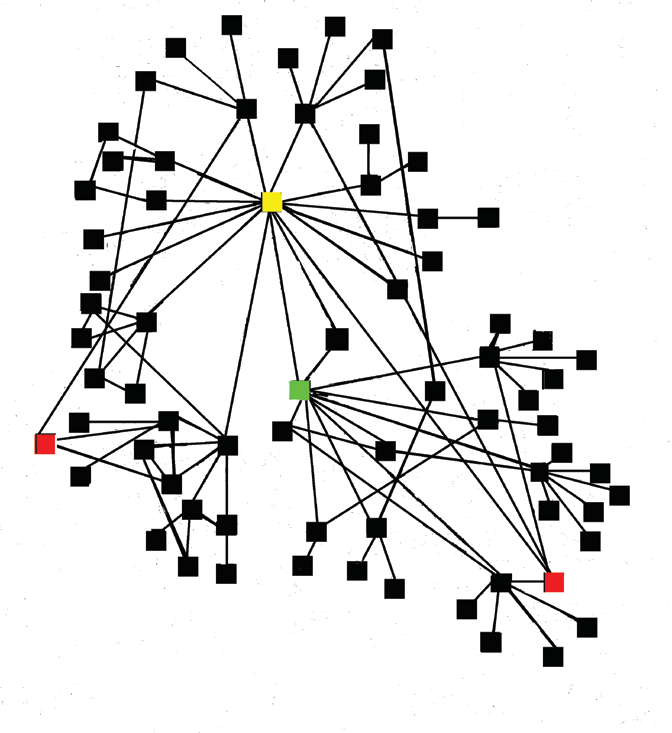
2.2 The SNA process
Figure C3: Flow chart of a typical SNA process
- Step1
Select Sample
Sample must include all people involved in the innovation in different agencies and on different levels
The list is circulated to ensure all relevant people are included
- Step2
Online Questionnaire
Sample completes online survey about who they interact with for decision-making, expert advice, seeking new idea, keeping up to date etc.
- Step3
Generation of SNA maps and charts
Survey results are used to generate maps showing interaction, analyse social capital and identify the different roles individuals may take within the networks
- Step4
Analysis of findings
Analysis of data by consultants using insight and support from individuals involved in the survey who can provide context to the findings
The SNA process is web-based. A sample of informants is selected, and all are asked to complete an online survey. SNA maps and charts are generated from this data, and findings are analysed working closely with individuals involved in the survey to contextualise the results.
Each individual that responds to the survey produces what is called an ‘egocentric’ network – the unique connections emanating from their particular ‘node’. NetForm® then aggregates each unique individual egocentric network into one large (partnership, community or organisational) network. What any one person imagines as ‘their network’ may appear very differently when viewed at a strategic level.
Individuals can then be shown to play different roles:
- Hubs are people who have many direct ties with people; they know everyone. They are shown as yellow nodes.
- Gatekeepers are connected to few people, but a ‘strategic few’. They know the ‘right’ people. They are the green nodes.
- Pulsetakers are connected to many people but not through direct links, like the Hub, but through indirect links. They know the people who know the right people. They are the red nodes.
Figure C4: The network key connector model
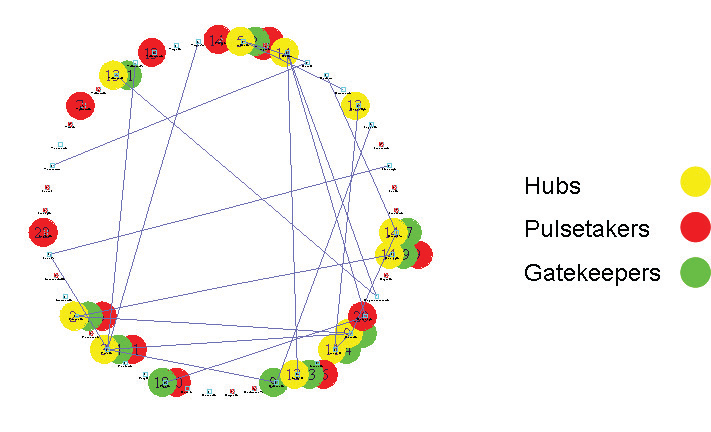
2.3 The ‘seven pillars’ of knowledge
Networks are analysed using the NetForm® software, and key connectors emerge and are identified. Although everyone surveyed will have some connections, individuals in any workplace or structure will be connected very differently. The top five per cent of these are shown as coloured nodes in the analysis.
The particular brand of SNA used by Netform® Social Network Analysis is based on a hierarchy of knowledge and the way key networks of knowledge align in practice. For example, when innovation is not aligned with expertise, this produces a healthy tension. On the other hand, when strategy is not aligned with decision-making this produces a lack of confidence in leaders, which can lead to malaise and disengagement. These and other correlations are the basis of the predictive algorithms from which seven types of networks have been derived. Each network generates the questions which are core to each SNA survey, albeit adapted to different circumstances and needs. The excerpt below explains in more detail how the networks function.
- The Work Network: with whom do you exchange information as part of your daily work routines? The everyday contacts of routinised operations represent the habitual, mundane ‘resting pulse’ of a culture. “The functions and dysfunctions; the favors and flaws always become evident here,” says Professor Stephenson.
- The Social Network: with whom do you ‘check in’, inside and outside the office, to find out what is going on? This is important, primarily as an indicator of trust within a culture. Healthy organisations are those whose numbers fall within a normative range, with enough social ‘tensile strength’ to withstand stress and uncertainty, but not so much that they are overdemanding of people’s personal time and invested social capital.
- The Innovation Network: with whom do you collaborate or kick around new ideas? There is a guilelessness and childlike wonderment to conversations conducted in this network, as people talk openly about their perceptions, ideas, and experiments. For instance, “Why do we use four separate assembly lines where three would do?” Or, “Hey, let’s try it and see what happens!” Key people in this network take a dim view of tradition and may clash with the keepers of corporate lore and expertise, dismissing them as relics.
- The Expert Knowledge Network: to whom do you turn for expertise or advice? Organisations have core networks whose key members hold the critical and established, yet tacit, knowledge of the enterprise. Like the Coca-Cola formula, this kind of knowledge is frequently kept secret. Key people in this network are often threatened by innovation; they’re likely to clash with innovators and think of them as “undisciplined”.
- The Career Guidance or Strategic Network: to whom do you go for advice about the future? If people tend to rely on others in the same company for mentoring and career guidance, then that in itself indicates a high level of trust. This network often directly influences corporate strategy; decisions about careers and strategic moves, after all, are both focused on the future.
- The Learning Network: whom do you work with to improve existing processes or methods? Key people in this network may end up as bridges between hubs in the expert and innovation networks, translating between the old guard and the new. Since most people are afraid of genuine change, this network tends to lie dormant until the change awakens a renewed sense of trust. “It takes a tough kind of love”, says Professor Stephenson, “to entrust people to tell you what they know about your established habits, rules and practices”.
2.4 Generating ‘social capital’ reports
In this context, ‘social capital’ will be held by a relatively small number of key connectors who transmit their knowledge through their trusted relationships. As this information is tacit and not explicit, there is rarely any record or documentation of its existence. It can however be captured by tracking the traces of informal communication using a technique such as SNA which looks beyond people’s perceptions and understandings of what is known.
Analysis of the networks is combined with findings on the key connectors to produce a series of social capital reports. These identify key individuals, who are categorised as:
- leaders – both potential and recognised leaders;
- mentors and mentees – who provide or seek expert advice, professional development or coaching;
- problem solvers – including innovators or implementers; and
- rising stars – individuals who have great potential to be outstanding in their fields.
The contention is that identifying these individuals will help inform and direct organisational development; improve organisational, team and individual performance through improved planning and decision-making; and result in considerable time and resource savings.
An important dimension of networks that must be borne in mind is their density. There needs to be enough connection to be sustainable, however high levels of connection can suggest the existence of a clique or cartel which can block or kill innovation. The 400 case database established by NetForm® over 30 years has determined normative ranges (which are constantly updated with each analysis performed). When network densities fall outside the normative ranges, a software flag is raised prompting further investigation to explore whether there is some form of conflict or collusion.
3. SNA and local social innovation
The experimental case study exercise began with the hypothesis that SNA in general and NetForm® network analysis in particular can be a useful tool in understanding and accelerating innovation. In particular, in how it could be used to explore the intricacies and subtleties of communication networks and the relationships and interactions that may be driving forward social innovation in an area.
The case study findings as well as literature reviews have highlighted the need for both internal and external networks to exist at a variety of levels in order to sustain collaboration. The other case studies carried out through this research exposed different patterns of networks underpinning innovation: in Pittsburgh, for example, strong networks between foundations and third sector organisations were key in stimulating innovation. In Lille, strong networks connected to the Métropole legitimised and strengthened by political leadership were critical in sustaining innovation. In South Tyneside, the strengthening of networks amongst frontline staff to initiate and share ideas was very important in their service transformation.
Analysis of the case studies highlighted the importance of networks, of collaboration, communication and consultation, to create the processes and synergies that are needed for innovation to flow, as illustrated in Figure C5. The hope was that SNA would enable a fuller exploration of the relationships that may facilitate or obstruct social innovation.
Figure C5: Visualising a local innovation system
The diagram illustrates a local innovation system with four hierarchical levels:
- Top Level: Systemic local social innovation (region, city, authority wide)
- Second Level: Sectoral innovation (service, agency, sector)
- Third Level: Frontline innovation (neighbourhood and community-based organisation)
- Bottom Level: Public innovation (individuals, service users, neighbourhoods)
Arrows flow downwards through the levels, indicating "Flow of knowledge learning, networks, creativity, and recognition of what works".
3.2 Frequent two-way communication is critical for creating an innovative organisational culture
The broader literature also stresses the importance of communication. For example, insight into communication networks can also indicate the state of cultural health of a local area, agency or organisation. Also, an innovative organisational culture will tend to include influential boundary spanners or gatekeepers to enable the free flow of ideas between departments and organisations – see Figure C6 below.
A previous NetForm® SNA of community effort in the US illustrates how the SNA process was used to build sustainable innovation and leadership networks in the Philadelphia region, an area that is home to approximately five million US citizens.
Philadelphia was the first capital of the US, the place where Benjamin Franklin led 13 independent colonies in unity against colonial rule. This legacy of rising to the challenge in difficult circumstances has become tarnished in recent history, which has seen rising crime, graft and serial corruption charges against a long line of elected officials.
SNA was used to scan the economic region for its hidden connectors. Two newspapers – previously more known for competition than collaboration - worked together and asked their readers to nominate their ‘hidden leaders’ through a SNA survey. Leading community organisations helped broadcast the message to their constituencies. Five thousand names were suggested and of the five thousand, two hundred names emerged as the top nominees.
Figure C6: Chesbrough’s model of open innovation showing boundary spanners
The diagram illustrates two models:
Closed Innovation:
* A linear process from Research to Development to Markets.
* Firm boundaries encompass this entire process.
* Research projects feed into the Research phase.
Open Innovation:
* A process also moving from Research to Development to Markets.
* Firm boundaries are permeable, allowing external input and output.
* Research projects feed into the Research phase.
* Output from Development can lead to New Market or Current Market.
Figure C7: Networks and connectors in Philadelphia
This figure presents three sections illustrating networks and connectors in Philadelphia across different sectors: Not for profit, Private sector, Government (Gov.), and Academia.
- Section A (top): Shows a template-like representation of network clusters for each sector.
- Section B (middle): Depicts the inter- and intra-expertise network, illustrating connections within and between sectors.
- Section C (bottom): Illustrates the intra-innovation network among the different sectors, showing strong connections within and between not-for-profit, private, government, and academia.
Section B is the lack of connection between government and academia. This prompted a further analysis showing how the connections within each sector work, shown in Section C. Also shown are the locations of the key connectors (shown in yellow, green and red circles, indicating respectively hubs, gatekeepers and pulsetakers).
Section C illustrates strong connections within and between the not-for-profit and private sectors. Further investigation established that the paucity of communication among the two smallest sectors – government and academia – is not explained by the smaller numbers but by the impact of competition for limited resources. However academics did play a significant role in forging the early networks among the not-for-profit and private sectors, the majority of whom were educated in the region and who later returned to Philadelphia with aspirations to ‘make a difference’.
Although it was not established definitively, it was suggested that there was something in the way people were connected early in their college and post-graduate schooling that stayed with them and brought them back to Philadelphia. It emerged that the majority of the connectors were not native to the area, which was an unexpected insight. In the majority of US cities the core connectors linking the most significant networks are native to the city – and tend to exert a paternalistic influence over who is influential in civic affairs. This was not the case in Philadelphia.
It is still unclear what the impact of this exercise is in the medium to long term, or what happens when key connectors are identified and provided with additional opportunity to be connected. A few early examples have emerged of positive impact; whether these are sustainable or not remains to be seen:
- Chris Satullo, the Philadelphia Inquirer columnist, now runs workshops with key connectors on city improvement.
- Groups of key connectors have spontaneously collaborated on a number of city projects.
- Leadership Philadelphia (a long-standing organisation set up to mobilise private sector involvement in civic activities) has develop a new leadership competency model for use in continuing adult education in civic leadership.
- The model has been adapted to teach high school students across the Philadelphia region before they enter college and graduate school about the advantages of ‘connecting’ as leaders, a competency that is currently not taught in traditional leadership courses in public policy and business schools.
4. SNA of one UK socially innovative locality
4.1 The case study
An SNA of a UK local authority which is known for innovation in education was conducted as an experimental pilot. The survey of individuals involved in education was carried out in Autumn 2007. Ninety-two respondents from the private, statutory, voluntary and community sectors completed the survey, including representatives from other local authorities with an interest in the new developments, cross-sector partnerships and some individual residents. This was a 67 per cent response rate.
In this experimental case study, SNA was used to explore the relationships between different stakeholders involved in the change agenda, to identify how informal and formal networks operate, the strength of these networks and the role they play in supporting local social innovation. The questions focused on the seven different networks that are important to the NetForm® approach.
The results have been anonymised so that they may be generalised for broader use. This area is at a relatively early stage in the innovation cycle, however already large amounts of investment have been committed to implementation. It would therefore be expected that networks supporting innovation may show some instability because of their relative newness, and that there may be some anxiety amongst key individuals because of the high exposure to risk.
4.2 The findings
Figure C8 is divided into two sections, A and B. Section A is the generic template showing the layout location of the various stakeholders (local authority in upper left, schools and colleges in upper right; voluntary and community sector, student council and residents are the groups below). Section B displays the two-way ties of innovation identified through answers to the question “whom do you seek out regarding new ideas and novel approaches?”
Figure C8: Networks and connections in the case study
This figure illustrates networks and connections in the case study across various stakeholders, divided into two sections:
- Section A (top): A template showing key connectors (yellow, green and red circles denoting respectively hubs, gatekeepers and pulsetakers) for Council, Schools and colleges, Private sector org., Student Council, Residents, and V and C (Voluntary and Community sectors) and Others. This section outlines the general layout.
- Section B (bottom): Displays the inter- and intra-innovation network across all sectors, showing the two-way ties for innovation.
4.3 Emerging messages
4.3.1 The locality has a high level of networking around innovation compared to other areas
The locality exhibited a high level of networking - compared to other authorities analysed in the UK. Compared to other surveys, a high proportion of people are actively seeking ideas and innovative solutions. This is illustrated by the relatively high density of connection between the local authority and schools and colleges in Figure C9. Figure C10 is taken from another local authority where there is a paucity of innovation.
The presence of good innovative ideas does not necessarily guarantee good networking, but here there is evidence that in this area innovation is well rooted in relationships and networks. However, the existence of good networking does not by itself directly lead to or guarantee an innovative programme or initiative, or the successful implementation of the innovation.
4.3.2 The local authority has strong internal networks for seeking new ideas, and includes many individuals acting as hubs, pulsetakers and gatekeepers
Figure C9: Networks connected to innovation in the locality
Figure C11 shows the internal networks within the local authority. The map indicates that this network is not nascent but consists of significant and mature networking abilities, particularly regarding innovation and new ideas. This is shown in two ways: by the existence of connections (blue lines) between different individuals within the local authority and more importantly by the existence of a significant number of hubs, pulsetakers and gatekeepers identified within the local authority. This included both senior and frontline staff.
The number of hubs, pulsetakers and gatekeepers is critical within this. If an individual is identified as one of the five per cent of key connectors it requires that they are not only directly connected with many individuals but also 'strategically' connected (either directly or indirectly) to other key connected individuals. This form of direct and indirect connection is impossible to 'manipulate' by any one person (largely because people tend to only see their direct connections, not their indirect connections) but arises out of a collective sense of who to trust, or who can be depended on to carry a good idea and make it happen.
The strength of this network is high given the early stage in the social innovation lifecycle (see Figure 1 of the main report). A significant contributing factor to this is likely to be the scale of the changes happening to services.
4.3.3 The local authority and a number of schools are central to innovation networks and are leading the innovation process
The local authority and the schools and colleges form the 'real' network for innovation in the locality. The local authority appears to have strong connections between internal decision-makers and frontline staff which have assisted in and helped to drive innovation.
A consistent pattern across all seven identified networks shown in Figure C12 demonstrates the existence of a core group of individuals including local authority officers as well as a number of head teachers – these are the key figures in all seven networks. In the context of this case study, both the scale of service transformation and the need to manage the risk of a high profile capital programme are likely to be important in explaining the strength of the core group.
Figure C10: Innovation networks at the intra- and inter-levels in a comparable local authority where there is less innovation
This diagram illustrates two sets of network interactions for a local authority. The top set, labelled "Internal networks," shows connections among Generic Orgs, Councillors, Notts CC, MASP, Neighbourhood team, Community reps, Police, Religious reps, MDC staff/officers, Neighbourhood warden, Health, Schools and colleges, CVS/Voluntary/Community, Others, Job Centre+, and Fire. The bottom set, labelled "External networks," shows similar connections, but with some additional blue lines indicating stronger external links.
Figure C11: Networks within the local authority for seeking new ideas
Figure C12: A consistent pattern across all seven networks
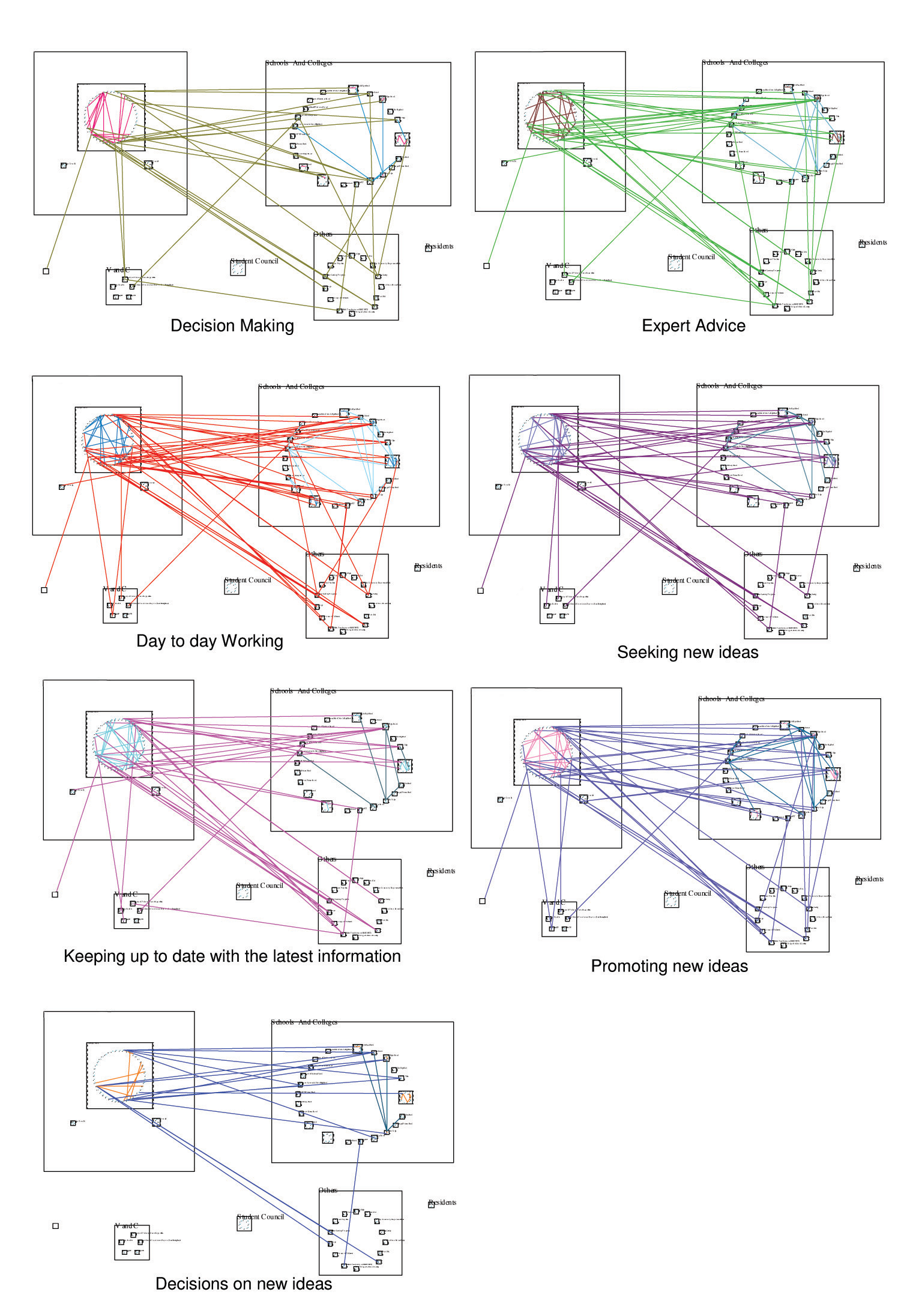
4.3.4 The voluntary and community sector, student council and residents appear to be outside the core networks of influence in the locality
Network analysis shows both the flow of information and ideas within the centre of any agency or partnership, and also indicates how ideas are allowed to flow in from external agencies or individuals. Any core group of individuals must be receptive to external information and ideas but here some vulnerabilities were identified in the case study.
The maps show that voluntary and community sector organisations are not included in identified networks. This suggests that the influence and decision-making power of this sector is limited and that these organisations are not assuming an active role in influencing, sharing and participating in innovation. They were also found to be failing to network well with each other. This could be either because the sector's capacity is weak – because it is being excluded from conversations – or a combination of the two.
In this locality, the two lowest levels of the system (the public and grassroots levels) are also poorly connected to the higher levels. For example, views were sought from members of the Student Council but none completed the survey. This finding is consistent with comparable SNAs of other areas and is probably linked to the weakness of the voluntary and third sector within networks. It is often found in the UK that local authorities 'dominate' the innovation process, and tend to isolate the voluntary and community sector, the sector which is most likely to connect innovation to residents and consumer voice.
The implications of this finding could suggest that the local authority and schools are not exploiting the potential of others to input ideas and suggestions into innovation; that they are missing opportunities to involve the user perspective; and that their ideas are failing to influence all the agencies they should (which could lead to failure to understand the need for change or at worst active blocking of new ideas and initiatives). However it could be that at this stage of innovation they do not actually need to involve service users in order to progress. The finding could become more significant in the future: if some of the current core group leave their current jobs and support for the innovation is not widely embedded in the area, the innovation may come to lack champions and its sustainability may be threatened. It also limits the sources for the new ideas which will be needed to refresh innovation in the future.
It also raises the question of whether there is sufficient 'connected difference' to stimulate fresh thinking in the future.
4.4 Conclusions: the value of the experimental SNA
The SNA of this locality has generated a fuller understanding of the networks and interactions which have driven and facilitated innovation. It has also revealed where there are significant gaps in relationships and networks that need to be overcome to ensure that the input of all the different stakeholders is maximised and that the best prospects are created for the future sustainability of new ideas. It has raised critical questions which can only be answered with the help of the local stakeholders who participated in the survey. This exercise revealed a different level of detail compared with more traditional research and evaluation exercises.
Although the analysis identified a relatively high number of individuals who were actively involved in innovation, and who were using networks to seek new solutions to problems that they faced, this active network was not enabling knowledge and ideas to flow to all members of the locality.
The local authority, as well as a number of schools and colleges, appears to dominate the innovation process. With risky innovation comes the need for strong strategic control, but this approach may limit the extent to which ideas emerge from the frontline and how communities will adapt locally to the new innovations.
Additionally, turnover of elected members and officers may mean that the sustainability of the innovation network over time is fragile. Sustainability would be boosted by spreading innovation out into the broader community of practice, actively involving the voluntary and community sector and the student councils in gathering new ideas as well as disseminating new ideas to the frontline. Unless there is an intervention to change the relationship with other constituencies, innovation will be isolated at the local authority level.
More detailed discussion with agencies in the case study locality will help interpret and understand the implications of the results.
The potential of SNA in furthering the understanding of local social innovation, as well as in maximising and building sustainable innovation by strengthening communication networks is largely untapped. Further research is required to compare SNAs of other innovative localities, exploring, for example, the various stages of innovation. How are ideas developed, winnowed down and matured for the different phases of innovation? Can interventions be designed that take advantage of existing network structures and accelerate the adoption of ideas? A key question is whether comparative studies of local authorities can be developed into a standardised approach that can be scaled up across the UK and compared with the growing body of international experience.
Sources and References
- Allen, T. J. (1986) 'Managing the Flow of Technology' Cambridge, MA: The MIT Press.
- Academy for Sustainable Communities (unknown) 'Case study 6: Urban renewal: Roubaix France. Leeds: Skills for the Future.
- Andrew Carnegie (1889) 'The Gospel of Wealth'. Carlisle, MA: Applewood
- Audit Commission (2002) 'Tower Hamlets Corporate Assessment', London: Audit Commission.
- Audit Commission (2006) 'London Borough of Tower Hamlets Comprehensive Performance Assessment Scorecard 2006', London: Audit Commission.
- Audit Commission (2007) 'Annual Audit and Inspection Letter: South Tyneside Council', London: Audit Commission.
- Audit Commission (2007) 'Regeneration and neighbourhood renewal, South Tyneside Metropolitan Borough Council', London: Audit Commission.
- Barabasi, A.L.(2002) 'Linked: The New Science of Networks' Cambridge MA: Perseus Publishing.
- Boissevain, J. (1974) 'Friends of Friends' Oxford: Basil Blackwell.
- Burt, R. (1992) 'Structural Holes' Cambridge, MA: Harvard University Press.
- Chesbrough, H. (2005) Open Innovation: A New Paradigm for Understanding Industrial Innovation. In: Chesbrough, H. (2005) ‘Open Innovation: Researching a New Paradigm' [online]. Available from: http://www.druid.dk/uploads/tx_picturedb/ds2005-1592.pdf
- Colomb C. and URBED London (2006) 'Making Connections: Transforming People and Places in Europe. Roubaiux, Lille (France) Case Study' (Version 29 June 2006) Draft version. Unpublished.
- COMEDIA (2002) 'From Ordinary to Extraordinary, Transforming South Tyneside's Future.' South Shields: South Tyneside Council.
- DfES (2005) 'Knowsley Pathfinder Description' [online] London: DfES. Available from http://www.dfes.gov.uk/14-19/dsp_pfdetails.cfm?pf=9.
- Doreian, P. (1971) 'Mathematics and the Study of Social Relations' New York: Schocken.
- Euro Cities (2006) 'Liveable Cities, Case Report. Monitoring progress management systems, evaluation: A main issue for sustainable urban management plans of European Cities. Lille:Lille Metropole Communaute Urbaine.
- Freeman, L.C. (1979) Centrality in social networks I: conceptual clarification in 'Social Networks' 1, pp215-239.
- Guardian (2003) 'Chief executive, South Tyneside Councillor' http://society.guardian.co.uk/publicvoices/story/0,,670296,00.html.
- Hage, Per (1973) The atom of kinship as a directed graph. 'Man.' 11, pp558-68.
- Herbison, J. (2006) 'Danielle Reid: Independent Review into the Circumstances Surrounding her Death', Inverness: Highland Child Protection Committee.
- Highland Council (1997) 'Looking Ahead in Highland' policy paper, Inverness: Highland Council.
- Highland Council (2005) 'For Highland's Children 2 Integrated Children's Plan. Summary 2005-2008' Inverness: Highland Council.
- IDeA (2002) 'Local Government Improvement Programme: Visit to Highland Council Report', London: IDeA.
- IDeA (2004) 'Local Government Improvement Programme, Visit to South Tyneside Council Report', London: IDeA.
- IDeA (2006) Journey to Improvement: South Tyneside', [online] London: IDeA. Available from http://www.idea.gov.uk/idk/core/page.do?pageId=5607813.
- IDeA (2006) Journey to Improvement: Tower Hamlets', London: IDeA.
- IDeA (2006) South Tyneside community engagement, [online] London: IDeA. Available from http://www.idea.gov.uk/idk/core/page.do?pageId=5608104.
- IDeA (2007) 'Theme: Promoting financial inclusion and tackling over-indebtedness: South Tyneside High Cost Loan Replacement Scheme', London: IDeA.
- Innovation Briefs (2003) The "Smart Growth" Debate Continues. 'Innovation Briefs.' 14 (3). Potomac: Urban Mobility Corporation.
- Kleiner, A. (2002) Karen Stephenson's Quantum Theory of Trust.'Strategy + Business', i29(4), pp. 3 -14.
- Knowsley Council (2004) 'Knowsley: Transforming Secondary Education', [online] available from http://www.beacons.idea.gov.uk/idk/tio/84230.
- L'Agence de développement et d'urbanisme de Lille Métropole (2006) 'The Urban Regeneration of Lille Metropole. Lille: L'Agence de développement et d'urbanisme de Lille Métropole.
- Library House (2006) 'The Supercluster Question: The Cambridge Cluster Report 2006. Cambridge: Library House Limited.
- Mair, J. and Marti, I. (2006) Social Entrepreneurship Research: A Source of Explanation, Prediction and Delight, Journal of World Business, 41(1), pp 36-44.
- Mitchell, J.C. (1969) 'Social Networks in Urban Situations'. Manchester: University Press.
- Moore B. (2003) 'Silicon Fen – The Cambridge Phenomenon As a Case-History of Present-Day Industrial Clustering', Diebold Institute, Working paper No. 24.
- Newsweek, (1998), 'Where Wired is a Way of Life'.
- Nicholas Falk (2006) 'Learning from Lille and Roubaix: Sub regional planning and the coordination of transport and development.' London: URBED and TEN Group.
- Ofsted (1999) 'Inspection report Knowsley Local Education Authority'.
- Ofsted (2003) 'Inspection report: Knowsley Local Education Authority'.
- Ofsted (2005) 'Education and Training in Knowsley are Outstanding Despite High Levels of Disadvantage in the Borough' [online] available from http://www.ofsted.gov.uk/portal/site/Internet/menuitem.e11147abaed5f711828a0d8308c08a0c/?vgnextoid=b14bcc0eaaf3c010VgnVCM2000003607640aRCRD.
- Ofsted (2005) 'Inspection report: Tower Hamlets Youth Services'.
- Ozawa, Connie P. (2004) 'The Portland Edge: Challenges and Successes in Growing Communities.' Washington: Island Press.
- Porter, M. (1998) Clusters and the New Economics of Competition. 'Harvard Business Review'. Nov/Dec 1998, pp 77-90.
- Saxenian, A. (1994) 'Regional Advantage: Culture and Competition in Silicon Valley and Route128′ Cambridge, MA: Harvard University Press.
- Segal Quince and Partners (1985) 'The Cambridge Phenomenon: The Growth of High Technology Industry in a University Town.' Cambridge: Segal Quince and Partners.
- Social Exclusion Unit (2001) 'A New Commitment to Neighbourhood Renewal: National Strategy Action Plan Report', London: Cabinet Office.
- South Tyneside Council (2003) 'Performing Together 2003-2006′ [online] available from http://www.southtyneside.info/search/tempDocuments/tmp_38373.pdf
- South Tyneside Council (2007) 'Councillor Neighbourhood Champions'.
- South Tyneside Council (2007) 'Regeneration and Resources Scrutiny Committee Scrutiny Commission on External Funding'.
- St. John's Innovation Centre (2006) 'Cambridge Technopole Report: An Overview of the UK's Leading High-Technology Business Cluster.' Cambridge: St. John's Innovation Centre Limited.
- Stephenson, K. (2007) The Community Network Solution in 'Strategy+Business' (4), pp 32 - 37
- Stephenson, K and M. Zelen (1989) Rethinking centrality in 'Social Networks' 1, pp 1-37.
- Stradling, B. and MacNeil, M. (2007) Delivering Integrated Services For Children In Highland: An Overview of Challenges, Developments and Outcomes, Inverness: Highland Council.
- The Forbes Funds (2006) '2006 Tropman Reports: Applied research about the Pittsburgh Region's Nonprofit Sector.' Pittsburgh' The Forbes Funds.
- Tower Hamlets Council (2005) 'Overview and Scrutiny, Youth Service Plan Scrutiny Working Group, London Borough of Tower Hamlets'.
- Tower Hamlets Council (2007) Tower Hamlets' Borough Statistics.
- Tower Hamlets Primary Care Trust (2005) 'Tower Hamlets PCT Public Health Report', London: Tower Hamlets PCT.
- Wasserman, S. and J. Galaskiewicz (eds.) (1994) 'Advances in Social Network Analysis' Beverly Hills: Sage
Appendix D: In-depth literature review
1. What is social innovation?
The term 'social innovation' refers to new ideas, institutions or ways of working that aim to meet social needs or tackle social problems. This might include, for example, new ways of working to reduce poverty or discrimination, or new services and organisations to care for those suffering from illness. Other examples of social innovation include the NHS (a radical new way to deliver health care at the time of its inception), the use of cognitive behavioural therapy (CBT) to treat certain mental health conditions or The Big Issue organisation that produces magazines sold by homeless people.
Social innovations can take the form of a new service, initiative or an organisation, or a radical new approach to the organisation and delivery of services. Both approaches have the potential to spread throughout a profession or sector, like education or health care, or geographically from one place to another.
2. Why do some places innovate?
Some geographical locations appear to exhibit a flurry of socially innovative practices and behaviour, while others seem much less adept at finding creative and imaginative ways to address the same social goals and needs.
Every region, city or neighbourhood possesses a different range of actors and stakeholders who can drive innovation. There may be strong individual leaders who are motivated to achieve social change (such as politicians, business leaders, entrepreneurs). There may also be strong or weak networks of third sector organisations, vocal or organised activists or pressure groups, or strong connections between central and local government.
This pattern has also been recognised in the field of technological and business innovation. Studies such as Canepa and Stoneman's investigation of technological innovation in Germany showed that certain locations foster much greater innovation than others. Synergies can be created among these stakeholders and supported by the combined effect of other factors, such as investment, human capacity and ambition, to produce an environment where innovation can flourish.
Regional and territorial innovation theory tries to explore the reasons why some locations, such as Silicon Valley in California or Bangalore in India, produce large amounts of innovation compared to others. Silicon Valley and Bangalore are both acknowledged worldwide for their success in sectoral innovation and seem to possess a distinctive environment that is able to cultivate high levels of innovation and creativity.
This geographical locus for innovation has fascinated many researchers who have attempted to distil their behaviour to create models and theories that connect environmental factors to the innovation levels an area exhibits. There has been a great deal of recent research on the characteristics that make local economies innovative and the connection between innovation and place. This work dates back to Alfred Marshall's 19th century study of industrial districts. More recently, it includes the work of Michael Piore and Charles Sabel in the eighties, Michael Porter in the nineties, Peter Hall on creative cities and milieux, and the more recent suggestions of figures like Richard Florida. Their work has identified a host of interesting features of dynamic and creative economies – including the roles of intermediary bodies, incubators, universities, finance, creative industries and migrant workers, in encouraging and supporting the emergence of geographical innovation. Other research about innovation and place has identified clustering and proximity as important factors in the concentration and transfer of knowledge in specific locations, such as those found in Silicon Valley, as well as their impact on creating deep pools of specialised labour.
Innovation in a geographical area appears to occur due to a number of individual factors that combine to create an innovative environment.
2.1 Creative cities and innovation
Creative is an adjective that can only be truly applied to a few cities across the world. The concept of the 'creative city' emerged in the eighties from a vacuum caused by the death of industry in many Western cities. Creativity had to be embedded through 'hard' and 'soft' infrastructure, such as the built environment and transport but also education and atmosphere. Landry argues that a new approach to the development of urban space is crucial to the creation of cities in which innovative solutions to problems can be found and where human culture can thrive. He outlines the following principles for good city-making:
- Every city should seek not to compete with those around it but should aim to be the best for the world, meaning that this development must have an ethical and moral foundation.
- Cities should reflect local cultures but also be open to new ideas from outside.
- Users should be involved in the decision-making process (ordinary people can make the extraordinary happen).
- Professionals should learn from other examples but not copy slavishly.
- Projects that make economic sense but also reinforce ethical values, therefore balancing individual and collective needs and desires, should be encouraged.
- There is a need to create an environment where thinking and imagination are present and where tenacity and courage can lead to positive change, i.e. to foster 'civic creativity' or imaginative solutions to public-good objectives.
Landry identifies the characteristics creative cities need to nurture and sustain talent, many of which can be applied to thinking about how places can develop a culture of innovation. He argues that the city must identify, nurture and sustain its talent and must take measured risks. It must have widespread leadership, a sense of destination, determination and the strength to go beyond the political cycle.
The idea of a creative centre has been adopted to some extent by some British cities, such as Liverpool, Sheffield, Manchester and Birmingham, which have attempted to place cultural industries at the centre of their physical redevelopments. Florida identified the need to draw in people from a global skilled class to drive these new industries; he rated cities on a 'gay index' of how cosmopolitan and attractive cities were to gay and lesbian people.
Hall claims that all cities that have enjoyed a 'golden age' have had some things in common. They have all had access to resources in the form of a tax or revenue collection system that has allowed some money to be directed towards the arts. They have also had a dominant social class that has acted as patrons. However, these conditions have not inevitably led to innovation. Hall believes that more important than resources is a spark that arises almost through serendipity – creative people having chance conversations and ideas following from that. This is also an important consideration in thinking about the factors that need to align in order for local social innovation to occur. It is not sufficient for a place to have resources and capacity. Places also need triggers in the form of individuals and events that provide inspiration or vision.
3. Public sector innovation: drivers and enablers
While some of these concepts can be transferred to an investigation of local social innovation, very little work has been conducted specifically about the characteristics of geographical social or public sector innovation.
This body of work demonstrates the growing interest in social innovation within the public sector. A 2007 study of local government innovation in England by the Audit Commission indicates that 43 per cent of local authorities claim to be engaged in a great deal of social innovation practices, whilst an additional 52 per cent claimed to be engaged in 'some' innovation. These findings illustrate an increasing awareness of social innovation in local authorities as a means to meet social needs.
There is an emerging body of research about public service innovation, including recent work by the National Audit Office and the Audit Commission about local government innovation in England, and several academic studies exploring the impact of best practice networks in spreading learning about innovation.
Pressure for innovation in the public sector primarily comes from changing needs in society, not competition as in the private sector. The Audit Commission data indicates that poor performance is an important driver of innovation. English local authorities have a statutory duty to undertake continuous improvement and are much more likely to do so in areas where their provision is poor. This claim is supported by Boyne et al., who identify that poor performance can spur authorities on to adopt 'best practice', and Hämäläinen and Heiskala's study of social innovation, which suggests that the best performing local areas are not necessarily the most innovative.
Aydalot identifies three kinds of innovation: in-house corporate restructuring; the re-energising of old industries by the application of new technologies; and the production of knowledge and its application. Much public sector innovation appears to fall into the latter category.
A number of studies appear to suggest that public or third sector innovation is focused, rather than being a general organisational strategy. Studies found that local authorities innovating in one field were not necessarily innovating in others. This makes sense in that it reduces overall exposure to risk and focuses resources on the most pressing needs.
This finding is reinforced by evidence from studies of innovation in other sectors. Perroux's work identifies that innovation does not happen everywhere at once but fits the pattern he called the 'growth pole', a point in historic time and space when entrepreneurial forces vigorously stimulate economic growth (either an individual firm or an industry). Barton and Kleiner's study of 55 innovative communities found that only a tiny proportion of neighbourhoods in this group were comprehensively innovative, despite the projects in question being initiated and led by organisations from different sectors – 69 per cent initiated by the voluntary/community sector, 22 per cent by the public sector and nine per cent by the private.
Hartley et al. identify that innovation processes in the public sector are unlike those in the private sector, with innovation coming from different sources and through different processes, described as:
- Policy-driven – 'top-down' from central government.
- Organisation-driven – 'bottom-up' meeting needs and expectations of users.
- Professional-driven – 'sideways-in' comparison with other organisations.
- User-driven - groups of users developing and advocating their own innovation.
A wide range of studies by bodies such as the Audit Commission and NAO refer to the factors required to generate innovation in the public sector. These can be summarised as:
- Political crisis or change in leadership.
- Symbolic triggers such as statements of intent, charters, or strategy documents.
- Ambition at the executive level which must then percolate through the whole organisation. Strong leadership is vital to this process.
- Joined-up working which allows staff to share information and understand in more depth the way in which the organisation functions.
- Supporting staff to be inventive and allowing space for creative thinking.
- Strong relationships with councillors, other partner organisations and external agencies.
- Local activists or campaign groups, some likely to be mavericks.
- Good links to users and residents to engage their experiences and opinions.
- A strong awareness of ongoing policy debates in the public sector.
- Research and pilots to test local social innovations.
- Mainstreaming through a culture of determination and aspiration.
- A strategy to embed and sustain innovation.
Hartley et al. describe a specific role for politicians in catalysing public sector innovation. This is reinforced by the Audit Commission 2007 report investigating innovation in public services in which many local authorities described internal pressure from politicians and demands from staff as more influential than external pressures for improvement from central government or regulatory bodies. However, this type of external pressure should not be discounted. It appears to often act as an underlying trigger for innovation and change, which requires internal pressure to act as a catalyst to initiate change.
Other forms of external pressure, such as competition between peers or between local authorities, are also important underlying drivers of innovation. This pressure takes the form of best practice or awards for innovation, which encourage improvement and adoption of ideas from other authorities.
4. Leadership
There is a significant body of evidence about the catalysing effect that strong leadership and charismatic individuals have on initiating innovation and change. This is reflected in the limited evidence about social and public sector innovation.
Much existing academic literature that addresses the effect of leadership on social innovation looks at the role of social entrepreneurs who act as pioneers of socially innovative ideas. An example of this is the recent Nobel Peace Prize winner Muhammad Yunus, who established the Grameen Bank, which uses the model of micro finance to alleviate deprivation in the developing world. In this case, much of Grameen's success relied on Muhammed Yunus's vision, dedication and the strong relationships he has developed with business leaders, government officials, donors, academics and poor villagers.
Strong leadership from individuals pioneering social innovations often features the building of bridges across different sets of stakeholders, facilitating and sustaining the innovation. Leadership that drives innovation is not restricted to single individuals but can also refer to top management's commitment to innovation. An innovative organisation may feature a collective of individuals who prioritise innovation and hence are receptive to ideas, willing to take on risk and embrace change. Such leadership is often able to cross organisational boundaries and stimulate innovation in other such organisations through partnerships and alliances.
A study by the Audit Commission into innovation in local government found that ambition was a key component in driving forward and encouraging innovation. Unfortunately, it is often inefficient change management, poor implementation or inefficient risk management that stifles innovation in an area and creates inertia within an organisation.
There is conflicting evidence about the impact of political stability on a local authority's willingness to take risks. Wejnert suggests that politically unstable authorities may be more risk adverse, whereas a large majority may give a significant mandate for change. However, Walker suggests that long-standing majorities may make authorities complacent.
5. Organisational culture
Innovation is not a straightforward process and is often associated with significant risk. Establishing an innovative culture is crucial in encouraging and fostering innovation and an organisation's structure can affect innovation, by either encouraging or inhibiting the generation and spread of good ideas, as illustrated in the research undertaken by Burns and Stalker in the 1950s who classified organisations as epitomising either mechanistic or organic structures.
looser, more integrated, decentralised, organic formations. Organic structures are recognised as facilitating innovation due to their greater flexibility and stronger communication. Combined with a culture that is receptive to new ideas, this style of working can be a powerful enabler of innovation. This is further supported by Rothwell and Dodgson's research on innovation and firm size, which recognised smaller firms as being much more innovative than their larger counterparts due to their organic nature, which supports a more creative climate for staff to operate in.
A common characteristic of innovative organisations is an 'open' working culture where staff are supported and allowed to experiment, and where management does not universally impose decisions and choices on staff. A degree of risk-taking is an inevitable conclusion to this as developing new ideas will lead to failure in some cases.
Creative staff can be a hugely significant source of ideas and must be provided with the space for creative thinking. Without support from executive level members, good ideas can often 'run into the organisational sand'.
A recent study into innovation in central government found only limited innovation in many departments. The cause was identified as the hierarchical nature of the civil service, which discouraged staff from experimentation, because of fears that failure could affect their careers. Recommendations to improve this situation included supporting staff to be more creative and the civil service becoming more open to risk-taking.
Chesbrough's model of 'open innovation' shows innovation excels when ideas are free to flow between departments and organisations. This has also been shown in much research undertaken about firms that adopt a project-based approach to joined-up working and cross-cutting structures that allow greater flows of information and staff to see a bigger picture, facilitating innovation.
An open approach allows for promising ideas, that might otherwise have been abandoned, to be picked up by others, investigated, and possibly to come to fruition. In Chesbrough's model, communication with external stakeholders is also fundamental in encouraging innovation, as often knowledge gained from external agencies such as competitors, academia and allies is important and hence links with them must be built and maintained. Open innovation also allows intellectual property rights to be used not just to defend ideas but also to make ideas tradable to outside organisations willing to take them further, with a role for intermediaries to provide information, access and finance during this transfer of ideas and products. This model has largely been developed from experience in American hi-tech industries. It is questionable how relevant these ideas are to other types of industries, however, the idea of open innovation is transferable to public sector innovation because of the emphasis on co-production of ideas and learning through best practice.
6. Learning and best practice
An organisation must acknowledge the importance of learning if it is to prevent innovation from becoming an isolated rare event and if it wants to establish a culture of innovative behaviour. Innovation involves both failures and successes due to the large amounts of risk and thus it is crucial to ensure lessons from past practice are captured and not lost as a new innovation cycle begins.
Innovative organisations are characterised by strong communication and effective evaluation of projects, in order to learn from experience and consolidate what has been accomplished.
This is not restricted to learning from within an organisation. Much can be learnt from other organisations and collective learning can also greatly impact social innovation. Regional innovation system theory describes how learning in a cumulative activity occurs through interaction.
There are a variety of studies that explore how 'best practice' is used and adopted in the public sector. Brannan et al. identify 'best practice' and innovation as conceptually two different things, but 'best practice' is often a tool to disseminate innovative ideas and helps prevent local government from 'reinventing the wheel'. Using 'best practice' implies the involvement of a central body to determine relevant examples and coordinate the system. In the UK local government context, the Improvement and Development Agency for Local Government and the Local Government Association play a key role.
Brannan surveyed local authorities about their adoption of 'best practice' in two policy areas, regeneration and community safety. Innovation was most likely in policy areas that had been identified as a priority area for some time. There was also a link to the level of available funding in both highly competent authorities and those with poor records, demonstrating that both a culture of excellence and the 'burning platform' of lack of success can act as drivers for innovation.
The study identified a number of problems with the use of 'best practice' to inform innovation (from most to least problematic):
- Assessing the appropriateness of the example of 'best practice'.
- Judging whether it really was 'best practice'.
- Identifying what 'best practice' is.
- Evaluating it once implanted; knowing where to find 'best practice'.
- Implementing and convincing the local authority to adopt or accept 'best practice'.
In England, central government has instituted the 'Beacon Scheme' (conceived of by Hartley and Benington), which recognises and awards excellence and innovation in local authorities' service delivery, and which aims to encourage the spread of best practice. Experience is shared through National Beacon conferences, open days in each Beacon, learning opportunities such as mentoring and shadowing as well as web materials. An evaluation of the outcomes of this scheme found significant improvements in service delivery and partnership working.
The major finding from the research was that adaptation rather than adoption, or 'graft and grow' rather than 'cut and paste', was central to the success of best practice and that key to this was reciprocal knowledge transfer, customisation of ideas, trust and collaboration with respect for diversity, and face-to-face contact between staff of different organisations.
Two significant boundaries to knowledge sharing are:
- Organisational – individuals may hoard knowledge in competitive situations, and also government policy may inhibit knowledge sharing.
- Professional - professionals tend to interact in silos, and also struggle to share knowledge that is tacit in nature.
7. Networks and people
Collaboration and working with outsiders can be beneficial in generating innovation because it allows greater access to knowledge, capabilities and resources. These benefits are greatest when there is a degree of 'cognitive distance' between the organisations, that is, some level of difference in the way that the two organisations view the situation, as this can provide novel insights.
But such collaboration can also be risky. Where the distance is too great between partners, there can be a complete lack of mutual understanding. The risks associated with collaboration are situations where partners can absorb knowledge and use this to gain an advantage, a process known as 'spill-over'. However, this is less of a risk in the context of public sector innovation. Trust between organisations is important in building meaningful partnerships, but at its most extreme can lead to dependence and blindness towards other organisations or ideas.
For many industries, organisations and companies have tended to cluster in a particular geographical area, most famously the IT industry in Silicon Valley. Historically this was seen as a way to reduce the costs of transferring raw materials and finished products throughout the production process, which is of course more relevant for industrial production than modern 'knowledge' industries. The presence of large companies often encouraged smaller firms that specialised in part of a process or in producing one component to spring up around them and act as satellites.
Investigation into the benefits that clustering can provide to an industry as a whole revealed that in some cases, such as the chemicals industry, it was vital, but that in others it did not provide such significant advantages. Benefits were thought to come from 'spill-over': co-operation – particularly between buyers and suppliers; the availability of a skilled local work force - and in some cases a local specialised education infrastructure and an 'innovative milieu'; and a positive 'buzz' in the local population and among policymakers.
Partnership working, collaboration and joined-up working can greatly spur and facilitate local innovation. The IDeA has reported a trend towards partnership working within the public sector, both on the regional and local level in order to increase effectiveness and efficiency. Greater engagement with the voluntary and community sector has also enabled local government to gain a better understanding of local need and use the voluntary sectors' experience and expertise to meet them. This has also been seen in the growing trend of Councils commissioning certain services to the voluntary and community sector.
Network organisational structure was introduced into parts of the NHS as an alternative to market, or hierarchical systems, because it was thought that they would improve capacity for knowledge transfer.
The move was welcomed by many staff because it reflected how many people had been working informally. However, once formally introduced, the networks grew in a way that was managed and not organic. Research into the success of these changes in the case of cancer treatment found that networks did provide some new opportunities for knowledge transfer. However, the existence of targets and the move towards greater centralisation (and competition to become centres of excellence) resulted in knowledge management being marginal to other considerations. Networks failed to develop a shared epistemology as knowledge management theory suggested they would. Government spending on knowledge sharing is much lower than that for inspection and auditing (£10 million compared to £90 million for local government in 2002). Inspection implies that best practice is known and agreed, but knowledge sharing allows for diversity, innovation and learning through failure.
Government has acknowledged the importance of learning through electronic knowledge transfer and visits, but has not expressed a theory of knowledge management, its strengths and weakness or how networks should be formed and sustained. Currently there is too much dissemination and the 'copy and paste' approach. More needs to be done to 'graft and grow'.
Examples of the introduction of networks in the public sphere are:
- E-government, or electronic government, refers to the use of information technology to exchange information with its citizens and the private sector in order to improve internal efficiency, the delivery of services, and democratic participation.
- T-government, or transformational government, is an initiative propagated by the UK Government with the publication of Transformational Government: Enabled by Technology in November 2005. This report outlines ways to transform public service deliveries and to improve the efficiency of government structures with the use of information technology designed around the citizen.
- Innovation Forum between central and local government.
- Beacon Award schemes for health, schools, local government, central government, police, transport, national parks and waste management.
- NHS collaborations.
8. Resources
Successful innovation requires an organisation to be able to invest resources to bring about necessary change. Innovation is often a time-consuming, labour- intensive and expensive process associated with high levels of associated risk. Private sector organisations with constrained resources are often unable to justify such expenditures and investment when positive returns and improvement cannot be guaranteed. This can create a sense of inertia that prevents innovation.
Much research regarding technological innovation demonstrates there is a direct correlation between the availability of financial resources and the amount of innovation within an establishment. Rothwell and Dodgson's research regarding innovation and firm size cites availability of financial investment as a key advantage to innovation in larger firms. Both Walker and Rogers argue that those with greater resources in terms of finance, personnel, facilities and skills have more potential for economies of scale and greater experience in policy areas that are most responsive to innovation. Research into social innovation has also shown that organisations facing financial constraints are less likely to experiment or adopt new ideas and technologies.
However, a recent study by the Audit Commission suggests that the availability of funding and finance to innovate is not as crucial as widely believed in the context of innovation in the public sector. This research has shown that many English local authorities are innovating in response to problems associated with deprivation, where there is a lack of financial resources but great social need.
In these situations, other resources are enabling innovation such as the availability of skilled staff, or access to local partnerships. Innovation is fundamentally about people and hence an organisation's capacity to innovate is limited by the type and quality of staff within the organisation. An important constraint on innovation is the lack of staff that are consciously invested into the innovation process; in practical terms, given the time and space to think creatively. Research by Saxenian, Porter and Enright has identified clustering and proximity as important factors in the concentration and transfer of knowledge in specific locations, such as those found in Silicon Valley, as well as their impact on creating deep pools of specialised labour. Frank Moulaert has researched territorial innovation in both a private and now more social setting, in order to unravel the reasons behind, and ways in which geographical areas innovate.
Partnerships and alliances are an essential way to overcome capacity restraints. Through working together, organisations can pool resources and dissipate risk. This is of particular importance in the case of social innovation where resources are limited.
However, the availability of financial or human resources does not automatically lead to innovation. Evidence suggests that constrained resources can act as a spur for organisations to think creatively, and much social innovation has been demonstrated by areas and organisations with limited funding and capacity.
NESTA
1 Plough Place
London EC4A 1DE
[email protected]
www.nesta.org.uk
We also have offices in Cardiff, Belfast, Stirling, Dundee and Newcastle-upon-Tyne
Published: January 2008
LSI/08