ACKNOWLEDGEMENTS
Thanks go to Hasan Bakhshi, Juan Mateos-Garcia and Sam Mitchell for their comments on the document. A number of people have been helpful in sharing their knowledge of domains related to this research. Thanks go to Dani Admiss, Rob Ashelford, Assa Ashuach, Haidee Bell, Andy Charalambous, Dominic Davenport, Anne Dye, Eliza Easton, Claire Gott, David Haylock, Sam Jones, Shonagh Marshall, Harry Rich, Michael Takeo Magruder, Ailbhe McNabola, Hannah Stewart and Ana Tiquia. The report should though not necessarily be taken as representing their views.
Nesta is an innovation charity with a mission to help people and organisations bring great ideas to life.
We are dedicated to supporting ideas that can help improve all our lives, with activities ranging from early-stage investment to in-depth research and practical programmes.
Nesta is a registered charity in England and Wales with company number 7706036 and charity number 1144091. Registered as a charity in Scotland number SCO42833. Registered office: 1 Plough Place, London, EC4A 1DE.
www.nesta.org.uk
©Nesta 2016
SUMMARY
Technology has always been integral to art. Developments in oil paints during the Renaissance enhanced painting's realism and allowed painting on canvas making it more transportable. In the 19th century, the camera changed the role of representation in art. In the 20th century, recording technologies, the television and the internet took the performing arts from the stage, into the home and onto the streets. In the 21st century, technologies like 3D printing, the Internet of Things (IoT) and others may lead to equally radical changes - affecting the scope of what is possible and our conceptions of art, and the world, in new and unpredictable ways.
This is of economic as well as aesthetic interest. Technological change can create completely new forms of economic activity and affect existing ones. The creative industries are a major UK employer and are growing faster than other sectors. They are set to become even more important due to their reliance on skills that are resistant to automation. Digital technology is affecting the whole of the creative industries, from commercial business-to-business sectors like advertising and design, through to subsidised arts and culture. It is therefore important for the UK to try and understand what is happening more systematically at the interface of art and technology to inform strategic thinking on future skills needs, economic growth, and other issues of policy interest, such as the geographic makeup of the economy. To contribute to this, the report identifies and quantifies activities that are occurring at the intersection of art and technology in the UK, where these activities are happening and the connections between them.
Analysing and measuring this art-tech activity, however, poses challenges. Activities combining different skills and disciplines are intrinsically hard to study. They can span the boundaries between domains and are less well covered by established data sources such as surveys. Data from the social networking platform Meetup.com provides a way to address this. Meetup allows people to form groups ('Meetup groups) with others that have similar interests. These groups hold physical meetups ('Meetup events') around topics related to their group's theme. The data generated by these Meetup groups offers a systematic way to collect information on what people across the UK are currently meeting to discuss on a range of different topics. Nesta has previously used Meetup data to understand emerging trends in the UK tech sector. The platform's data enables us to assess what topics at the interface of art and technology people are meeting about. Where in the country this is happening? How many people are involved? And to what extent are different areas at the intersection of art and technology linked through people being involved in multiple domains?
There are clear limitations to what can be inferred from Meetup data. This data does not, of course, capture groups that do not use the Meetup platform and will under-represent groups and geographic areas that are less likely to use it. The data is also much less likely to capture relevant activities taking place within institutions such as companies and universities. This matters if activity inside institutions means people feel less need to engage with these topics outside of work or study, resulting in lower levels of activity on platforms like Meetup (although the converse can also be argued - that institutional activities in turn stimulate more activity in the surrounding areas). These limitations aside, the data gives us a readily available and potentially rich source of information to explore activities which would otherwise be hard to measure using traditional data collection methods such as surveys.
The report firstly discusses the general principles used to identify activities at the interface of art and tech, and then how these principles were operationalised to identify groups relating to them in the Meetup data. The findings on the number of activities involved, their geographic distribution, and connection through joint participation are then discussed, before concluding.
The research identifies a number of technologies as being at the interface of art and technology, including both hardware-related technologies such as the Internet of Things, virtual reality and 3D printing, and software-related technologies (for example music production, animation and design software). This is in addition to technology-related activity in the areas of filmmaking, photography, games programming, and wider digital creative activity. Although other geographical concentrations of art-tech activity are identified, the report finds that a high proportion of these activities are, at least in terms of Meetup activity, in London - this is even allowing for the fact that there are high levels of London Meetup activity in general. At a more local level, it is found that makerspaces are an area where artistic skills and new technologies are being combined. There is also evidence that the different activities analysed, while distinct, are connected by people who span the boundaries between the different areas. The research adopts a broad definition of art, although within this there appear to be comparatively limited use of newer technologies in the fine arts. A characteristic of a number of the technologies identified is that they enable greater personalisation and perhaps this will lead to tailored individual experiences being an increasingly important part of the arts in future.
1. THE PRINCIPLES THAT INFORMED THE IDENTIFICATION OF GROUPS AT THE INTERFACE OF ART AND TECHNOLOGY
We are interested in identifying artistic uses of technology that are more likely to be new and innovative, and hence offer growth potential in the future. There is inevitably an element of subjectivity in this, but the following general principles were applied to identify relevant Meetup groups. These relate to the artistic domains involved, the technologies used and the ways people engage with them. How the principles were operationalised in the data analysis is discussed in the next section.
Domains
- A broad definition of art: A broad definition of artistic activity has been adopted including areas like design, fashion, music, computer games and filmmaking as well as the more usual fine art. This recognises the fact that artistic skills are of importance in a host of different activities.
Technologies
- Newer technologies: As most artistic activity involves some form of technology, too general a definition of technology would result in the inclusion of almost any conceivable artistic activity and would therefore not be meaningful. To be included in the scope of the analysis the technology involved should therefore be relatively recent, e.g. traditional artistic tools such as watercolours would not count for our purposes. Alternatively, if not a new technology as such, the technology should be undergoing rapid transition, such as computer software.
How the technology is being used
- Creating not consuming: A connection to some form creative activity is necessary for inclusion in the analysis. On this basis, making computer games would for example be included, but not playing them. Networking groups related to the creative activity, or which bring together art and tech professionals, are though considered for inclusion. This could for example include a creative tech meetup involving web designers, app developers and artists, or a meetup group devoted to learning a particular artistic software package.
- A degree of technical skill is needed to use the technology: Activities should involve a reasonably high level of technical skill to use the technology.
2. HOW THE ART-TECH MEETUP GROUPS WERE IDENTIFIED IN PRACTICE
Using the general principles above, the group information associated with Meetup groups are visually inspected. Each group on Meetup is associated with a mutually exclusive category that records the topic of the group. The Meetup categories inspected as part of the analysis (number of groups in parentheses) were: tech (1699), fine arts/culture (469), photography (223), fashion/beauty (100), career/ business (1634), games (258), music (429) and movies/film (219).
A number of technologies (both hardware and software) and domains related to the interface of art and technology were identified:
- Physical hardware related:
- 3D printing (i.e. where 3D objects are printed from a digital blueprint).
- Virtual reality.
- Internet of Things (i.e. where physical objects have embedded sensors and network connections that enable them to collect and exchange data).
- Digital video and photography.
- Raspberry Pi and Arduino.
- Makerspaces providing access to physical hardware.
- Software, examples of which are:
- Music production e.g. Pro Tools and Ableton.
- CAD design e.g. Rhino and Autodesk.
- Photo editing e.g. Photoshop.
- Creative coding frameworks e.g. openFrameworks and Cinder.
- Graphics technologies e.g. WebGL.
- Games engines e.g. Unity.
- Data visualisation e.g. D3 JavaScript library.
- Domains:
There are also a set of domains considered to be intrinsically related to the interface of art and technology:
- Computer game development.
- Visual effects and animation.
- Data visualisation.
Groups associated with these technologies and domains are systematically identified in the data according to whether their information on Meetup contains words related to these activities (each group on Meetup has a textual description of its activities, and a set of keywords that describe the group's activities which appears under the heading 'We're about:'). These groups are then inspected to arrive at a final list.
We discuss each of the categories in turn, and some of the issues in identifying groups involved with them. The words used to identify the groups are listed in Appendix Table A.1.
2.1 Hardware
Which can be used for exclusively functional purposes as well as artistic ones
A number of the technologies we study have roles that can be purely functional. While functional uses are interesting in themselves, they are considered as outside the scope of this investigation and we therefore adopt techniques to try and identify groups that are more likely to be engaging in art-related activity.
Internet of Things: There are a number of groups that refer to the Internet of Things in their description and keywords. There are many potential uses of such technologies, which may in some cases be purely functional e.g. monitoring central heating or controlling traffic in cities. We therefore focus on those groups that also include art/design related words in their description or keywords.
3D printing, Raspberry Pi, Arduino and Makerspaces: These can have purely functional as well as artistic uses. Again we therefore consider them if there is also a reference to art and design-related words in either their description or keywords. Although not a technology as such, makerspaces are often associated with 3D printing, Arduino and other technologies. Groups that refer to makerspaces in their description or keywords are also considered if they include art or design-related words.
Which has become ubiquitous in an area of artistic activity
Photography and Filmmaking: Digital photography is so widespread, and digital cameras so easy to use, that it is now hard to argue that in all cases this represents a new, or intensive, form of artistic engagement with technology (although of course it can be). Therefore, if there is evidence of photography groups engaging in more sophisticated photo editing activity and being focussed on technology, as evidenced by mentions of Photoshop/retouching/manipulation in their keywords or description then they are also considered. On a similar basis to photography, digital video/filmmaking per se is not enough to be considered, however additional discussion of editing and post-production is.
2.2 Software
Software dedicated to artistic activities: In the areas of music production, animation, games, photography, programming and design there are a number of standard software tools that are used. A list of these software packages is used to identify groups involved with this software.
More general software tools: Standard programming languages (e.g. Python, JavaScript, C++) can have a huge range of uses. These languages are obviously creative tools and certainly can be used artistically. However, they have a vast number of other uses that are not primarily artistic. There are also a large number of Meetup groups associated with web design, and while parts of web design clearly involve artistic aspects, it covers a lot of other areas too. Identifying groups that were more arts related in this context was operationalised by seeing whether the group keywords or descriptions in the tech category, that did not match any of the other areas being analysed, also matched any of the words relating to different artistic domains. This approach is applied to all groups in the tech category on Meetup to capture other technological activity involving artistic activity.
2.3 Domains
Games programming, virtual reality and visual effects: These are considered to be domains that intrinsically combine newer forms of technology and artistic activity. They are therefore considered if synonyms for them are included in either of a group's keywords or description.
Data visualisation: A number of groups have information that indicates they are related to data visualisation. However, upon inspection these groups turn out to be very largely related to data analysis, rather than data visualisation as such. We therefore only treat these groups as in scope if both their keywords and group description contain a reference to data visualisation, indicating a greater focus on this area.
2.4 Finalisation of groups
The number of groups returned based on matching the words related to the different activities is given in Appendix Table A.2. The resulting groups are then manually inspected and further anomalies removed.
A group is excluded if, for example, there are indications that the group contains a word with a potentially artistic meaning, e.g. design but where the activity being referred to is purely functional (e.g. electrical design) or artistic but insufficiently related to technology (e.g. game design where the 'design' relates to board games design). Alternatively, groups are excluded on visual inspection if their level of artistic/tech activity when studied appears to be fairly limited. In addition, a number of other groups not captured by the above classifications but which are considered relevant are included for example hardware based audio-visual tech groups, electronic music production groups that did not mention a specific software and some design groups not captured from the textual analysis.
This process results in 334 groups being identified as operating at the interface between art and technology.
These groups will not capture all UK artistic activity involving technology on Meetup. In particular, there will be groups engaging in art and tech where this cannot be inferred from their Meetup information (false negatives) and groups identified from their keywords or description where in practice art-tech is a small part of their group activity (false positives) e.g. a makerspace where both artists and technologists work, but on separate projects. More generally, ambiguity as to the meaning of keywords, such as design, may lead to groups being incorrectly classified. The approach adopted does, though, try to minimise the number of false positives, thus providing a starting point for understanding the phenomenon.
3. THE NUMBER OF DIFFERENT KINDS OF ART-TECH MEETUP GROUPS
The Table below gives summary information for the resulting 334 groups, the number of the groups that had textual information matching the different activities in the first column on the left and their associated membership numbers. The activities are not mutually exclusive - that is, the same group may be involved in more than one activity. The right-most column shows the other activity that groups which did the activity the row corresponds to was most commonly associated with (for example 22 of the groups involved in 3D printing also involved in makerspaces).
| Activity that the group is involved in |
Number of groups where activity was identified |
Number of members (Members of multiple groups will count more than once) |
Activity that it was most commonly found to be associated with (Number of groups in brackets) |
| 3D printing |
28 |
8,614 |
Makerspaces (22) |
| Makerspaces |
43 |
14,519 |
3D printing (22) |
| Raspberry Pi/Arduino |
18 |
4,979 |
Makerspaces (13) |
| Internet of Things |
15 |
6,503 |
Makerspaces (7) |
| Virtual Reality |
26 |
8,203 |
Games programming (12) |
| Games programming |
65 |
18,886 |
Arts related Software (17) |
| Arts related software e.g. Pro Tools, Maya, Revit |
121 |
64,799 |
Digital photography (65) |
| Data visualisation |
13 |
7,277 |
Visual effect works (1) Arts related Software (1) |
| Visual effects and animation |
27 |
12,399 |
Arts related Software (13) |
| Video/Filmmaking |
22 |
4,503 |
Visual effects and animation (5) |
| Photography |
82 |
50,289 |
Arts related Software (75) |
| Art-related activity in the Meetup tech category not included in the above categories |
44 |
18,681 |
NA |
| Other |
26 |
5,734 |
NA |
| All |
334 The total number of groups |
134,548 |
NA |
Groups involving arts-related software have the largest number of groups overall. They also had the largest number of members. However, many of these groups relate to Photoshop, so in practice there is a substantial overlap with digital photography, the next largest group. After this, in terms of the number of groups and overall membership, comes groups related to games programming.
The art-related activity in the tech category which isn't otherwise captured contains several web-design groups whose information indicated a focus on graphic design. Activities relating to using tech in performance are not clearly identified within the above categories, but included groups relating to audio visual/lighting technology in theatres, the role of technology in storytelling and using YouTube to distribute creative content. There were also a small number of groups relating to fashion and tech, with a particular focus on wearables technologies and innovations in textiles.
To try and categorise the relationships between the different activities we undertake, a hierarchical cluster analysis of the groups' keywords. This approach first takes the set of the most common individual keywords across all the groups and then combines words that most frequently appear together within groups' keywords. This leads to the words being allocated to a smaller set of clusters, which are then combined together again according to which clusters contain words that are most commonly used together. This process continues until all the clusters are merged into a single cluster.
Figure 1 below shows the resulting hierarchical clusters that emerge. The words shown are the most common sets of words across the groups. In the hierarchical cluster analysis the words that appear more frequently together are connected by being on branches joined by the same stem. Photography-related words are found to constitute a cluster that is very distinct from the others, so to make the diagram clearer, they are omitted from the analysis.
FIGURE 1 CONNECTIONS BETWEEN THE WORDS DESCRIBING DIFFERENT KINDS OF ACTIVITY
This dendrogram visually represents hierarchical clustering of keywords found in Meetup groups. It shows how different terms related to art and technology activities cluster together. Key clusters identified are: Virtual reality, Markerspaces and 3D printing, Data visualisation, Digital creatives, Art and architecture, Visual effects and animation, Social media and marketing, Internet of things, Mobile gaming, Game development, and Filmmaking.
The Figure shows that words related to markerspaces and 3D printing and Arduino often appear together. There are also distinct clusters of words related to game development and filmmaking. There are a set of words grouped under the heading of Digital creatives that relate in part to commercial activity, and a distinct cluster of words related to visual effects and animation. That activities may appear distinct in the clusters does not mean that they are technologically unrelated, e.g. game development and virtual reality do have connections, but it does show there tend to be separate Meetup groups related to them. We will examine the connections between groups in terms of them having members in common later in the document.
4. WHERE ARE ART-TECH MEETUPS HAPPENING?
The groups are not evenly distributed around the country. Table 2 below shows the urban areas that have the most groups according to their location information on Meetup.
|
London |
Bristol |
Manchester |
Brighton |
Oxford |
Other |
| Number of groups |
196 |
10 |
9 |
8 |
6 |
105 |
London is by far the largest location of these Meetup groups, accounting for 59 per cent of them. The place with the next largest number of groups, Bristol, accounts for 3 per cent of the groups. A large number of Meetup groups in these areas could though just reflect geographic variations in wider Meetup activity, not in art-tech related activity specifically.
We adjust for this using Location Quotients (LQs), which are calculated by the proportion of all groups in art-tech that fall within a given area divided by the proportion of all groups on Meetup in these geographic areas. The results are shown in Table 3. An LQ of more than (less than) one means that the area has a higher (lower) proportion of groups in the art-tech category than its share of all Meetup groups i.e. there are more such groups than one would expect on the basis of Meetup activity overall. In the final column of Table 3 we also calculate the LQ in terms of the number of Meetup group members i.e. the proportion of the membership numbers that are in art-tech Meetups in an area vs the proportion of all Meetup members in that area as a whole.
The geography we use is Travel to Work areas (TTWAs), which are geographies that capture the commuting area around urban centres. A number of the TTWAs have small numbers of (or no) Meetup groups and smaller still numbers of associated art-tech Meetup groups. LQs based on small sample sizes are very volatile so it is not really meaningful to map them for the UK as a whole. We therefore present location quotients only for those TTWAs with the largest number of art and tech Meetup groups.
| Location quotient |
Art-tech Meetup groups |
Number of Meetup groups |
Art-tech Meetup groups (membership numbers summed) |
Total Meetup group (membership numbers summed) |
Location quotient in terms of members |
| London |
201 |
7,725 |
103,792 |
3,570,916 |
1.1 |
| Bristol |
11 |
311 |
2,471 |
98,863 |
0.9 |
| Manchester |
10 |
476 |
6,332 |
177,396 |
1.3 |
| Brighton |
9 |
380 |
2,618 |
92,819 |
1.1 |
| Cambridge |
7 |
233 |
1,310 |
48,847 |
1.0 |
| Oxford |
6 |
187 |
1,908 |
41,623 |
1.7 |
| Liverpool |
5 |
110 |
1,366 |
28,700 |
1.8 |
| Edinburgh |
5 |
397 |
2,005 |
121,519 |
0.6 |
| Birmingham |
4 |
336 |
749 |
107,242 |
0.3 |
| Crawley |
4 |
108 |
741 |
10,301 |
2.7 |
| Guildford & Aldershot |
4 |
175 |
1,004 |
30,400 |
1.2 |
| Reading & Bracknell |
4 |
213 |
536 |
36,326 |
0.6 |
| Southampton |
4 |
139 |
696 |
19,754 |
1.3 |
| Southend & Brentwood |
4 |
66 |
496 |
8,668 |
2.2 |
Note: The membership numbers presented in this table will count individuals that are members of multiple groups more than once.
London has an LQ of more than 1 which shows that its high number of art-tech Meetups is not simply a reflection of its much larger number of Meetup groups i.e. it still accounts for a higher proportion of art-tech Meetup groups than would expect on the basis of its number of Meetup groups. Analysing the location quotient in terms of the number of group members results in a similar story. Although the correlation is not perfect, areas having a location quotient of more than 1 in terms of the number of groups also tend to have a higher LQ for Meetup members.
Appendix Table A.3 shows that if we examine the groups in the Meetup fine art/culture categories and groups in the separate tech category, then London has both more fine art/culture groups and more tech groups than one would expect on the basis of its number of Meetup groups alone. The high level of art-tech activity is consistent, with London having both more groups related to art and more groups related to tech.
These findings are also broadly consistent with Nesta's previous work on the UK's high-tech and creative economies. A number of the areas of high art-tech Meetup activity identified here (e.g. London, Brighton and Bristol) are also areas we have identified as major employers in the creative or high-tech economies, after adjusting for the size of the workforce. However, there are exceptions to this rule: Edinburgh and Bracknell and Reading, for example, are typically found to have disproportionately high levels of creative and high-tech employment, and yet do not have a disproportionately large number of art-tech Meetup groups. This may though just reflect the sample sizes involved being relatively small.
5. THE RELATIONSHIPS BETWEEN GROUPS AT THE INTERFACE OF ART AND TECHNOLOGY
To understand the connections between groups we look at which Meetup groups are connected by having members in common. We use the group identifiers to obtain a list of associated members of the art-tech groups, extracting data on 85,206 people that are members of them.
If we analyse the members of these groups, we find that 61,468 people (72 per cent) are members of one group only within the art-tech groups; 12,812 people (15 per cent) are members of two groups and 10,926 (13 per cent) people are members of three or more groups.
To analyse the patterns of cross participation, we look at connections among London Meetup groups only. This simplifies the analysis, but also includes the set of groups where there are most likely to be a large number of joint members i.e. in other cities, where the number of Meetups is much smaller, the scope to be a member of multiple groups is necessarily more limited. This analysis complements the cluster analysis in Figure 1 which highlighted the topics that tended to appear together in group keywords, but which will not reflect whether different kinds of Meetup groups are connected by the same people attending them.
We plot the groups with connections between them, where they have more than ten members in common in Figure 2. Ten members in common is in the upper quartile of the distribution of the joint membership numbers between London groups. The network has been coloured with a clustering algorithm, with sets of groups that are more closely connected to each other (i.e. have more members in common) being the same colour. A set of distinguishable, but connected, communities emerge. The chart labels correspond, in general terms, to the kinds of groups in different parts of the network.
FIGURE 2 ART-TECH MEETUP GROUPS IN LONDON CONNECTED BY HAVING MORE THAN TEN MEMBERS IN COMMON
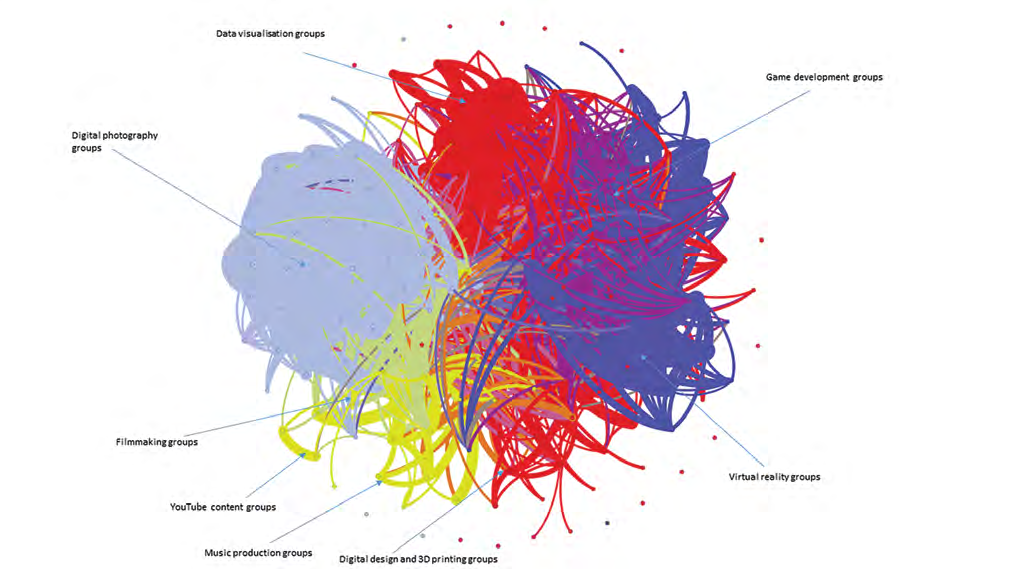
There is a distinct, closely connected, set of groups related to photography. There is another community related to games and virtual reality which have members in common. Between these are groups related to filmmaking, digital design, 3D printing, fashion-tech and data visualisation.
These connections are only capturing the behaviour of the minority of people that are members of multiple groups. Some of these connections will not reflect active connections between groups as it is possible to be a member of multiple groups on Meetup without participating actively in them. Larger groups will also be accounting for more of these connections as they are more likely to have members that belong to multiple groups. Nevertheless the connections between the different groups is suggestive of connection by common interests and, perhaps, common artistic and technical skills due to digital convergence.
6. CONCLUSIONS
Activities involving both art and tech are unevenly distributed around the country
The groups identified on Meetup at the interface of art and tech, are primarily in urban areas, and predominantly in London. Part of the reason for the large number of art-tech meetups in London is that the platform is used much more in London, but the number of London art-tech meetups is still larger than would be expected on the basis of general Meetup use alone.
One of the explanations is likely to be that these activities require a blend of different skills that larger urban areas, due to their greater population and population density, have access to and can combine more easily. London is almost eight times larger than Birmingham, the second largest city in the UK. It is the biggest and most international city in Western Europe, with a population approximately two and half times the size of either Berlin or Madrid, the next largest cities. Previous Nesta research has also shown that London accounts for a large and disproportionate percentage of the UK's employment in creative and high-tech industries, providing the skills one would expect to be behind a lot of activity where art meets technology. Perhaps we should therefore not be surprised at how much London also dominates art-tech Meetup activity.
Activities at the intersection of art and tech are connected by individuals that span the border of several domains
A variety of seemingly distinct domains of art and technology are connected by joint membership of Meetup groups among those groups located in London. Some members of digital photography groups are also members of visual effects and animation meetups, for example. People involved in 3D printing groups can also be members of game meetups. While the analysis does not measure the level of engagement of individuals across groups, the finding perhaps reflects a general trend of integrated artistic and technical skills which is finding expression in a host of domains.
Makerspaces are one of the places where activities that combine art and technology are happening
Although this report does not directly cover activities within institutions, it is striking that one of the places where artistic and technology skills are being combined is in makerspaces. Given the growth in some of the technologies associated with makerspaces, such as 3D printing, and the growth of the maker movement itself, it seems plausible that makerspaces will play an increasingly important part of activities combining art and technology in future.
The comparative absence of newer technologies relating to fine art
While we adopt a broad definition of art, it is though notable how little art-tech activity we have uncovered that is explicitly related to fine art (only 17 of the 334 groups identified were in the Meetup fine art/culture category vs 175 in the Meetup tech category). This may of course partly reflect that Meetup as a platform is not widely used by artists. In the sample of Meetups we study there are 1,699 tech groups compared with 469 fine arts/culture groups, which is consistent with this. This may, however, also raise questions about how widespread are the use of new technologies in fine art communities, and whether this is an area where there are opportunities for more work combining the two.
The technologies highlighted suggest that personalisation is likely to be an ever more important trend in the arts
A characteristic of a number of the technologies examined: virtual reality, the Internet of Things and 3D printing is that they can offer a personalised experience to the individual by allowing it to be influenced by user feedback or enabling direct co-creation. An individual experience is already a characteristic of computer games, and it is arguable that as these technologies become pervasive that they will bring an increased level of personalisation to other domains. The finding raises the intriguing possibility that personalised experiences will become an important part of people's engagement with art.
APPENDIX
Rules used to identify the Meetup groups that did the activity
| Group activity |
Activity identified based on matching: |
Words used for identification |
| 3D printing |
Synonyms for the technology and art/design appearing in keywords or description |
3D printing, cnc, 3D printers |
| Makerspaces |
As above |
hackspace, maker space, makerspace, makerspaces, makers, fablab |
| Raspberry Pi/Arduino |
As above |
raspberrypi, raspberry pi, arduino |
| Internet of Things |
As above |
internet of things, iot |
| Virtual reality |
Virtual reality (or synonyms) mentioned in keywords or description |
virtual reality, vr, oculus, augmented reality |
| Games programming |
Games programming (or synonyms) mentioned in keywords or description |
games programming, games coding, games modding, games development, modding (and singular versions) |
| Arts related software e.g. Pro Tools, Maya, Rhino, Photoshop |
Software packages in keywords (as software packages routinely featured in the keywords this was used to identify these groups) |
unreal engine, unity, frostbite, cryengine, rhino, photoshop, cinder, blender, ableton, pro tools, protools, webgl, autodesk, autocad, d3, maya, renderman, revit, logic, logic pro, cinder, cad, openframeworks, creative coding, katana, modo, zbrush,vray, v-ray, nuke, houdini, 3d studio max, 3ds max, adobe creative suite, pftrack, soundforge, sound forge, archicad, sketchup, cubase |
| Data visualisation |
Data visualisation (or synonyms) in keywords and in description |
data visualization, data visualisation, data journalism, data journalists, data visualisers, data vizualisers |
| Visual effects and animation |
Visual effects (or synonyms) in keywords or in description |
3d modelling, cg artists, vfx, cgi, visual effects, 3d animation |
| Video/Filmmaking |
Filmmaking and additional reference to editing and post-production in keywords or description |
digital video, filmmaking, post-production, editing |
| Photography |
Words related to image manipulation in keywords or description in addition to photography |
photography, photoshop, retouching, manipulation |
| General artistic domain keywords used to check connection with art |
|
art, design, artists, designers, sculpture, fashion, music, musician, architecture, architects, |
| Activity |
Number of groups identified as art-tech (post inspection) |
Number of groups based on matching the art and technology words in the table above (pre inspection) |
Number based on matching technology words alone (no requirement to match artistic keywords) |
Reason for where there is a substantial discrepancy between pre and post inspected number. |
| 3D printing |
28 |
31 |
54 |
|
| Makerspaces |
43 |
97 |
201 |
Many of the groups matching 'makers', but were less clearly tech related |
| Raspberry Pi/Arduino |
18 |
21 |
78 |
|
| Internet of Things |
15 |
26 |
80 |
|
| Virtual reality |
26 |
31 |
N/A |
|
| Games programming |
65 |
92 |
N/A |
|
| Arts related software e.g. Pro Tools, Maya, Rhino, Photoshop |
121 |
137 |
N/A |
|
| Data visualisation |
13 |
17 |
N/A |
|
| Visual effects and animation |
27 |
51 |
N/A |
|
| Video/Filmmaking |
22 |
43 |
N/A |
The technology focus of a number of these groups appeared fairly limited. |
| Photography |
82 |
83 |
N/A |
|
| All (removing duplicates across classifications) |
334 |
|
|
|
|
Fine art/culture category group number |
Fine art/culture LQ |
Tech category group number |
Tech category LQ |
| London |
283 |
1.2 |
994 |
1.1 |
| Bristol |
6 |
0.6 |
56 |
1.6 |
| Manchester |
24 |
1.6 |
69 |
1.3 |
| Brighton |
13 |
1.1 |
26 |
0.6 |
| Cambridge |
5 |
0.7 |
58 |
2.2 |
| Oxford |
6 |
1.0 |
41 |
1.9 |
| Liverpool |
6 |
1.7 |
17 |
1.3 |
| Edinburgh |
12 |
1.0 |
35 |
0.8 |
| Birmingham |
8 |
0.8 |
39 |
1.0 |
| Crawley |
2 |
0.6 |
5 |
0.4 |
| Guildford & Aldershot |
5 |
0.9 |
6 |
0.3 |
| Reading & Bracknell |
5 |
0.7 |
19 |
0.8 |
How quickly are they growing?
Table A4 below shows the year that the art-tech groups were started. Around three-quarters (76 per cent) of the groups were set up in the last three years. By comparison, 82 per cent of Meetup groups in the UK were set up in the past three years, so although this is a rapid rate of growth it is reflective of the rate of growth in the Meetup platform as a whole.
|
2006 |
2007 |
2008 |
2009 |
2010 |
2011 |
2012 |
2013 |
2014 |
2015 |
| 1 |
1 |
2 |
4 |
8 |
8 |
23 |
35 |
45 |
88 |
120 |
Figure A1 shows the growth rates of different groups on Meetup, rebased to 2006 when we have our first Meetup group in the art-tech category.
FIGURE A1 THE GROWTH RATE OF ART-TECH GROUP COMPARED TO OTHER UK GROUP CATEGORIES ON MEETUP (NORMALISED TO 2006, THE FIRST YEAR WE HAVE ART-TECH GROUPS FOUNDED)
This line chart shows the growth rate of Meetup groups founded per year (Normalised to 2006) for 'All groups', 'Art-tech groups', 'Tech groups', and 'Fine arts/culture groups'.
- All groups: Starts at 1 in 2006, grows steadily to approx. 110 in 2015.
- Art-tech groups: Starts at 1 in 2006, grows to approx. 120 in 2015.
- Tech groups: Starts at 1 in 2006, shows rapid growth from 2012, reaching approx. 250 in 2015.
- Fine arts/culture groups: Starts at 1 in 2006, shows accelerated growth from 2012, reaching approx. 100 in 2015.
The chart indicates that 'Tech groups' experienced the highest growth rate, followed by 'Art-tech groups', then 'All groups' and 'Fine arts/culture groups' which show similar, but lower, growth rates compared to 'Art-tech groups' by 2015.
Since 2006, the number of groups in the art-tech category has grown faster than the number of UK groups on the Meetup platform, which has experienced very rapid growth itself, although not as fast as the groups in the platform's tech or fine arts/culture category. It is, though, also true that the number of groups involved is by definition smaller than that on the Meetup platform as a whole, so this growth in absolute terms corresponds to far fewer groups than the increase in total Meetup groups in the UK.
BIBLIOGRAPHY
- Bakhshi, H., Davies, J., Higgs, P. and Freeman, A. (2015) 'The geography of the UK's high-tech and creative economy.' London: Nesta.
- Bakhshi, H., Frey, C. and Osborne, M. (2015) 'Creativity vs Robots. The creative economy and the future of employment.' London: Nesta.
- Bakhshi, H., Hargreaves, I. and Mateos-Garcia, J. (2013) 'Manifesto for the Creative and Digital Economy.' London: Nesta.
- McConnon, N., Bodman, C. and Admiss, D. (eds.) (2014) 'Digital Revolution.' Barbican catalogue.
- Bastian, M., Heymann, S. and Jacomy, M. (2009) 'Gephi: an open source software for exploring and manipulating networks.' International AAAI Conference on Weblogs and Social Media.
- Digital R&D fund for the Arts (2013 and 2015) 'Digital Culture: How arts and cultural organisations in England use technology.' London: Nesta.
- Dunn, N. (2012) 'Digital Fabrication in Architecture.' London: Laurence King.
- Feinerer, I., Hornik, K. and Meyer, D. (2008) Text Mining Infrastructure in R. 'Journal of Statistical Software.' 25(5): 1-54.
- Frieze (2014) 'Art, big data and you.' March 2014, No. 161.
- Government Office for Science (2014) 'The Internet of Things: making the most of the second digital revolution'. London: Government Office for Science.
- Hanna, K. (2016), 'Spaces to think: innovation districts and the changing geography of the knowledge economy'. Centre for London.
- HOLO 1 (2014) 'Emerging trajectories in art, science and technology.'
- Johnston, L. (2015) 'Digital Handmade: Craftsmanship and the New Industrial Revolution.' London: Thames & Hudson.
- Jurka, T., Collingwood, L., Boydstun, A., Grossman, E. and van Atteveldt, A. (2014) 'RTextTools: Automatic Text Classification via Supervised Learning.' R package version 1.4.2.
- Klanten, R., Ehmann, S. and Hanschke, V. (eds.) (2011) 'A Touch of Code: Interactive Installations and Experiences.' Berlin: Gestalten.
- Maechler, M., Rousseeuw, P., Struyf, A., Hubert, Μ. and Hornik, K. (2015) 'cluster: Cluster Analysis Basics and Extensions.' R package version 2.0.1.
- Mateos-Garcia, J., Bakhshi, H. and Lenel, M. (2014) 'A map of the UK games industry.' London: Nesta.
- Mateos-Garcia, J. (2015) 'Using Meetup data to explore the UK digital tech landscape.' Nesta blog.
- McCandless, D. (2009) 'Information is beautiful.' London: HarperCollins.
- Openshaw, J. (2015) 'Postdigital Artisans: Craftsmanship with a New Aesthetic in Fashion, Art, Design and Architecture.' Amsterdam: Frame.
- Reas, C. and Fry, B. (2014) 'Processing A programming handbook for visual designers and artists.' 2nd ed. London: MIT press.
- Reas, C. and McWilliams, C. (2010) 'Form and Code in Design, Art, and Architecture.' New York NY: Princeton Architectural Press.
- Tarrant, A. and Sebestyen, E. (2010) Interview with Robert Hodgin. 'Juxtapoz.' July 2010, No 114.
- Reichardt, J. (ed.) (1968) Cybernetic Serendipity the computer and the arts. 'Studio International.'
- Sleigh, A., Stewart, H. and Stokes, K. (2015) 'Open dataset on UK Makerspaces: A user's guide.' London: Nesta.
- Nesta and Tech City UK (2016) 'Tech Nation 2016.'
- Valli, M. (2010) Interview with Giles Revell. 'Elephant.' Issue 2, Spring 2010.
- Victoria and Albert Museum (2010) 'Decode: digital design sensations.', V&A catalogue.
ENDNOTES
1 Plough Place
London EC4A 1DE
[email protected]
@nesta_uk
www.facebook.com/nesta.uk
www.nesta.org.uk
May 2016
Nesta is a registered charity in England and Wales with company number 7706036 and charity number 1144091. Registered as a charity in Scotland number SCO42833. Registered office: 1 Plough Place, London, EC4A 1DE.