ABOUT INNOVATION UNIT
We are the innovation unit for public services. As a not-for-profit social enterprise we're committed to using the power of innovation to solve social challenges. We have a strong track record of supporting leaders and organisations delivering public services to see and do things differently. They come to us with a problem and we work alongside them to enable radically different solutions that offer better outcomes for lower costs.
www.innovationunit.org
ABOUT NESTA
Nesta is the UK's innovation foundation. We help people and organisations bring great ideas to life. We do this by providing investments and grants and mobilising research, networks and skills.
We are an independent charity and our work is enabled by an endowment from the National Lottery.
Nesta Operating Company is a registered charity in England and Wales with a company number 7706036 and charity number 1144091. Registered as a charity in Scotland number SCO42833. Registered office: 1 Plough Place, London, EC4A 1DE
www.nesta.org.uk
1. MAKING THE CASE FOR RADICAL EFFICIENCY
That Local Authorities are faced with making tough decisions and harsh efficiencies goes without saying. Radical Efficiency represents an opportunity for local authorities to transform public services and create a positive agenda for change whilst money is tight. It is a chance to improve outcomes for users and save money at the same time. The radical efficiency process can be undertaken by any local authority with an appetite to do much better for users, to challenge itself, and to do so in a way that will win executive and political support for radical change.
Innovation Unit and Nesta's Radical Efficiency programme started life as a research project, looking across the globe for examples of innovation that deliver different, better, lower cost services. This international horizon scan did two important things: it proved that much better outcomes for users that deliver significant savings are possible; and it taught us something about how those innovators went about it – and how we could, too.
This booklet is grounded in the evidence we have generated to show that the radical efficiency framework can help generate much better outcomes for users. It is also about the tools and conditions and processes that will allow radical efficiency to be successful in your area.
That evidence comes largely from the Transforming Early Years (TEY)programme, undertaken in partnership with Nesta. This is the most ambitious manifestation of radical efficiency in the UK so far. It turned our international research into an intense sequence of evidence-gathering, design and prototyping activities undertaken over a year. Four of the six authorities involved are projecting average financial savings in year one of their new services of 25%. All are confident that the new service models will allow them to reach many more of the families who need them most. The insights from the process should apply across all services, particularly those where personal interactions are central - including health and social care.
The radical efficiency model offers three key insights about what it takes to develop truly different, better, lower cost approaches:
1. Start by thinking afresh about the nature of the challenge faced by your community before coming up with ideas to help tackle them.
2. Look for and use the resources that are already under your nose – from well-networked people to popular meeting places.
3. Build a new partnership with users in which they drive design, and contribute to delivery of services.
Radical efficiency might begin as a great way to overhaul a particular service. But what it really points to is a new model for local government. Understanding and building a partnership with communities leads to a new balance of risk and responsibility for public services one in which users give more to get more, the ‘community champion' role of local politicians is key, and professionals relinquish some control to ensure service users get what they need and want.
Read on to find out how to get started.
Radical Efficiency model
(see resources for further explanation)
New perspectives on the challenge
Diagram: Radical Efficiency Model
A conceptual model illustrating four main quadrants: New Knowledge, New Users, New Suppliers, and New Resources, with a central core of "New Knowledge" and "New Users". Arrows connect "New perspectives on the challenge" to the top half of the model and "New perspectives on solutions" to the bottom half.
New Knowledge quadrant includes:
* New thinkers: Other sectors, Users
* New knowledge: Uncovering old ideas in new places, Mining existing data, Collecting new data
New Users quadrant includes:
* Non-users
* New 'units' of users
* Community as users
* New user segmentation
New Suppliers quadrant includes:
* Users as co-producers
* New entrants
* Families & communities
New Resources quadrant includes:
* Reduce, Reuse, Recycle
* Digital technology
* Uncover and use existing assets
2. THE SHAPE OF A RADICAL EFFICIENCY PROGRAMME
Radical efficiency is not a panacea, or a recipe book for change, or even a single programme of activities. Radical efficiency is a framework for thinking about the drivers of different, better, lower cost transformation, the sequencing of phases of work and the conditions under which it might be successful.
This section outlines these general principles, and uses the example of the Transforming Early Years (TEY) programme to illustrate what this work might look and feel like in practice.
How to do it
Diagram: How to Do It - Radical Efficiency Programme Flow
A circular flow diagram illustrating the main stages of a radical efficiency programme.
The top arc of the circle represents Building the team. An arrow from "Building the team" points down to CHALLENGE.
Within the challenge phase, there's a box for New Knowledge and New Customers leading to New perspectives on the challenge. An arrow from "New perspectives on the challenge" points towards a series of interconnected rectangular bars moving across the center of the circle.
These bars represent:
* New perspectives on the solution (connected to New Suppliers and New Resources)
* Prototyping
* Embedding and scaling
The final stage is IMPLEMENTATION, at the end of the circular flow.
Building the team
TEY teams included members with a wide range of skills and experience who occupied different levels in the existing hierarchy and represented different services. This was important for balancing representativeness with authority and resources to act; generic with specialist skills; and local authority with other provider perspectives. Team leaders should not be afraid to change teams over time as they learn more about what is required, how committed people are and what is working well.
TEY team members included:
- Children's centre managers, some managing more than one centre
- Directors of children's services
- Researchers
- LA officers working in children's services
- Project managers
- Community activists and volunteers
- Parents, some on the way to becoming community activists and volunteers
As important as formal roles and responsibilities were skills, knowledge and dispositions. Project teams in localities were assembled on the basis of interest and invitation at the beginning of the programme, and so team composition was the 'best guess' that could reasonably be made at the outset of the right combination of skills, experience and perspectives required.
By the end of the programme TEY teams were able to articulate in interviews what skills mix was needed to successfully deliver this kind of service redesign. Their ideal team would be led by a chair who listens and can ‘leave their ego at the door'. It would include people who:
- are emotionally intelligent and understand the pressures that taking part in or being affected by an innovation project like this would mean for colleagues and the community
- can empathise and engage with parents and families
- are risk takers – up for a challenge and open to new ideas
- are energetic and resilient – able to keep up their commitment through turbulent waters
- have passion and vision, and are prepared to hang on to them when things get tough
- are well networked and connected into other services and the community
- are knowledgeable in particular about volunteering, other services and safeguarding.
New perspectives on the challenge
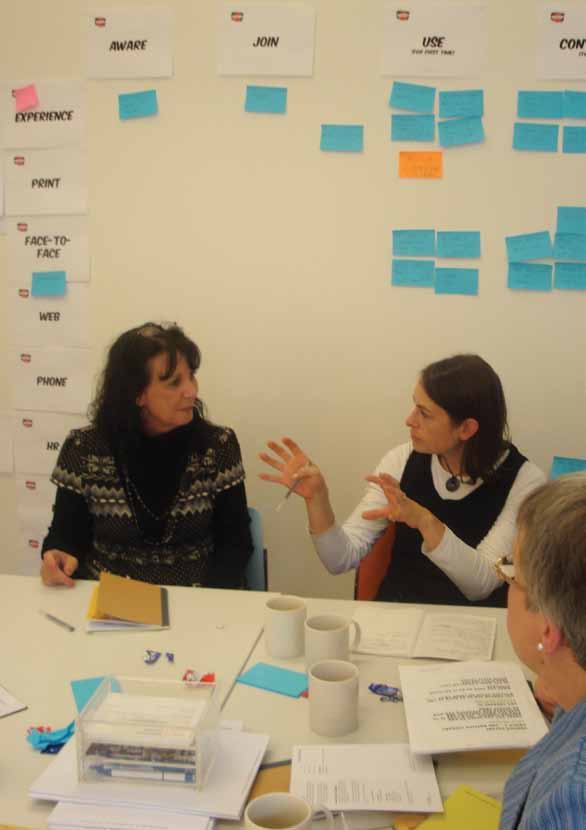
This phase is about asking afresh, questions about what users' lives are really like, what are the aspirations, and the biggest challenges they face? It is about the authentic lived experience of communities – not about a consultation on existing services. It is about reconnecting with users and building a partnership with them. It is open-ended and all about gathering multiple sources of information that can help inform our understanding of a locality. It is hard and unusual work for professionals most used to providing 'answers' at top speed.
There are many tools and approaches that can help generate these kinds of perspectives, including horizon scanning, data mining, interviews and resource audits. You can see the range of activities undertaken in the early years programme below.
Illustration: Ethnography
A small icon depicting a person looking through a magnifying glass, next to the text "Ethnography". This represents a tool or approach for understanding the challenge.
The most powerful tool used within the early years process was a type of ethnography – deep, observational research with people that aims to understand the rhythm and dynamics of their lives. In this case, we trained the teams themselves to undertake the work. Other innovation work uses trained ethnographers to generate high quality content that can be shared easily with others via written documents or by video. The particular power of the early years approach was the personal revelations, and energy for change that it generated in the professionals undertaking the research.
“Lots of things were coming out, like realisations about who is engaging with their services and what their real lives look like.” (Locality Leader)
This initial phase of research and thoughtful reflection was motivating and valuable for all the locality teams. Ethnographic research was experienced by professionals as a means of connecting, or in some cases reconnecting, with their service users. It gave participants real time to build relationships and listen to the issues without passing judgement.
“We had the opportunity to talk with and to hear perspectives from mothers and fathers who hadn't been heard before.” (Locality Leader)
“After being 10 years as an assistant director, I can't remember the last time I sat in a mum's front room and had a cup of coffee. I have so loved it. It took me back to why I became a social worker. We have to look at the problem with a new set of lenses. And have a core belief that families can find their own solutions.' (Locality Leader)
Illustration: Cost Analysis
A small icon depicting three pound signs (£) and three question marks (?) inside a circular border, next to the text "Cost Analysis". This represents another tool or approach for understanding the challenge.
Analysis of the costs of the existing system is also included in this phase. This is still about insights, not answers. Cost analysis at this stage is not about coming to a solution based around where money can be shaved from the system. It is about understanding where money is spent, on what, and getting a sense of its impact. It helps to provide insight into the user experience and into the resources (money, people and buildings) available for possible new solutions. This is not straightforward. Discussions of this kind are relatively uncommon in many areas of local government.
“It was very difficult to get budget data from the council. There were worries about protocols for information sharing, and the specific task of pulling budget information from different teams didn't give much more of an insight. So we made some of it useful and we did costings for individual families then we saw the waste of money, and that was very helpful.” (Locality Leader)
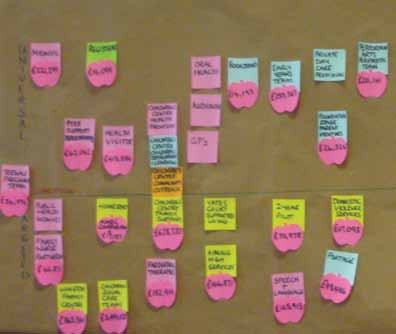
This may be an area where supportive tools are useful. In the early years programme, we co-developed a tool with New Philanthropy Capital to help participants identify their different categories of spend. This should not be an activity that is outsourced. It is not for finance departments. It is for leaders of innovation and their teams to feed this insight into their broader understanding of the work.
Critically, the cost data can then become another way to connect diverse teams users, staff and others – to the reality of the world as it is. It can help stimulate a conversation about what is good about that reality, what is not so good and what needs to change.
Making the most of all these kinds of data requires deep immersion in it by the core team. This might involve a day, two days or more digging into what has been learnt – and ultimately distilling what the big, emerging challenges, opportunities and principles are. This is where great representation of the data is powerful and important. Making the most of it requires people to understand it clearly – and to get a sense of its moral force as well as the facts. Good techniques include visual illustrations, videos of people's stories, mapping and personal testimony.
At the end of this phase, the cumulative impact of the new insights from ethnography, horizon scanning, and resource audit should be two-fold: firstly, senior political and corporate leaders, along with the team (including community members) should have a strong, shared understanding of users' aspirations, the challenges they face, and opportunities to build on; secondly, the whole team, including senior leaders, should have a powerful new energy and momentum that stems from this renewed sense of purpose and belief that they can have a real, positive impact on people's lives.
New perspectives on the solution
New perspectives on the solution are built directly on the priorities and opportunities identified in the previous phase.
They are generated in three main ways:
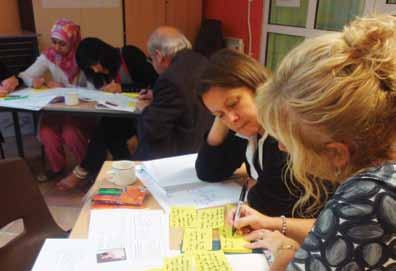
- Firstly, and most importantly, from the design input of users themselves. Service users ensure that any new approach to tackling local challenges is feasible and desirable, and will really work.
- Secondly, involvement of service users unlocks ‘new resources' that can be used to deliver a solution in new ways. They identify community assets, like local meeting points that might be part of a new approach. Their own energy and desire to be involved is the most important resource of all – they become part of the solution, most obviously through volunteering.
- Finally, the horizon scanning undertaken in the previous phase offers another ‘new perspective on the solution'. It helps to test and maintain the radical ambition of local teams as their ideas develop, and prevents a slip back to the ‘status quo’.
There are two key phases to this, both of which can be tackled using a variety of tools.
Illustration: Exploratory Codesign
A small icon depicting hands reaching towards question marks, inside a circular border labeled "Exploratory Codesign". This represents a tool or approach for sharing ideas.
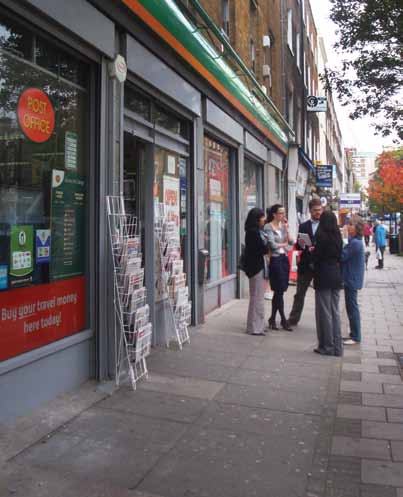
The first is to find ways of sharing emerging ideas with different groups to test their usefulness, eliminate non-starters, and enrich the detail with which they are described. During the early years work, the Innovation Unit design team helped to represent each team's top six ideas as cartoons, which could then be shared broadly throughout the community. Some teams took them out to the playground, or put them in the staff room. Others shared them at community events, or just at the shops.
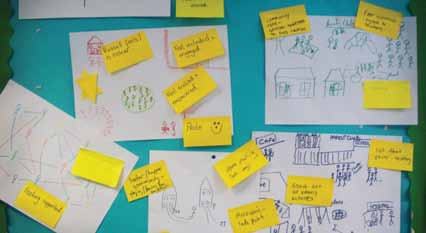
Illustration: Development Codesign
A small icon depicting a gear with a pen, inside a circular border labeled "Development Codesign". This represents a tool or approach for developing a whole picture of the service.
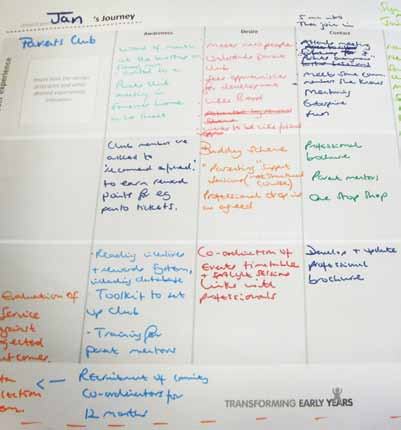
Having narrowed down the ideas, and refined the remaining concepts, the second step is to develop a whole picture of the service a service ‘blueprint’. This requires a detailed specification from start to finish, and from the perspective of everyone involved, from users, to front line staff, and from the back office team to the technologies required to make it possible.
Illustration: Data Mining
A small icon depicting a magnifying glass over a document with lines and a clock, inside a circular border labeled "Data Mining". This represents a concept related to testing.
All of this should be continually tested against the original research into challenges faced. It should also be tested against the evidence base available on work in the sector – what does this tell us about the likelihood of our work having an impact? In the light of this, how might we adjust the idea to maximize its impact? This is in itself a kind of prototyping. We call this 'exploratory prototyping” – testing ideas on paper with the people who will affect, and be affected by them.
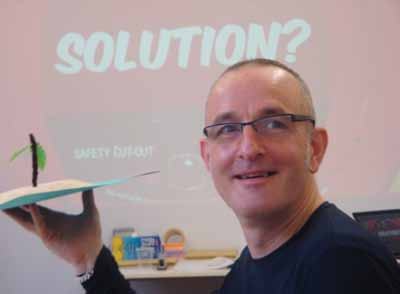
Illustration: Exploratory Prototyping
A small icon depicting a hot air balloon, inside a circular border labeled "Exploratory Prototyping". This represents a concept related to testing.
Prototyping
Prototyping is very simply about testing ideas as quickly and as cheaply as possible. It is about minimising the risk of doing things differently – doing things at a very small scale, or using mock ups, rather than testing ideas for real on a whole service. It challenges the traditional model of ‘decide, plan, implement' by introducing a review element - nothing is every implemented before it has been rigorously tried and tested.
Illustration: Development Prototyping
A small icon depicting a crane, inside a circular border labeled "Development Prototyping". This represents a more specific and in-depth way of testing.
We have already talked about the role of prototyping being ongoing throughout the life of an innovation programme – testing concepts early on. There are also some more specific and in depth ways of testing the details of ideas. These become increasingly important as they take shape. This is sometimes called ‘development prototyping”. Some elements of this might require some expert design help – mocking up a new website, or a welcoming new space for example. But it might equally be as simple as running a tester training session for a new role to see what can be improved. Or working with one family to see what kind of mentoring package might be appropriate for the area.
Fundamentally, this is about a mindset. It is about seeing experimentation as part of the design process and failing early to succeed later. It is about learning from these experiments and building on them. It is definitely about constantly remembering to test ideas and functions with the people who will be using them ultimately.
Embedding and scaling the work
This work is about understanding the context in which you are working – who's involved, where mandate comes from and how change happens.
The most important early element of this is about setting clear expectations for the work. Is the team excited about developing an interesting new model with a small, local service? Or is it about doing work on behalf of the whole early years service in the area, in partnership with the Director of Children's Services from day one. If it is the latter, it should be consciously planned for and designed into the programme.
These early decisions and commitments will shape the work throughout – particularly its communication. When and how are senior staff and politicians involved in the work? When will other service professionals engage in the work and begin examining its possible implications for them? Who leads the work? What is its scope? What is its scale?
Diagram: The Shape of a Radical Efficiency Programme - Full Cycle
This diagram illustrates a comprehensive cyclical process, showing the interconnections and iterative nature of radical efficiency work.
The cycle begins with "Building the team" (top left), which leads to the "CHALLENGE" phase.
CHALLENGE Phase:
* Questions: "What are people's lives really like? What is truly important to them and their communities?"
* Questions: "Who spends what on our cohort? Is there duplication? Does it represent value for money?"
* "What can we learn from innovators around the world?"
* Activities include: Horizon Scanning, Ethnography, Cost Analysis. These rely on "New Knowledge" and "New Customers" and contribute to "New perspectives on the challenge."
An arrow labelled "Following an iterative process" connects the "CHALLENGE" phase back towards the start and also to the "New perspectives on the solution" stage.
New perspectives on the solution Phase:
* This phase incorporates "New Suppliers" and "New Resources".
* It feeds into "Prototyping".
Prototyping Phase:
* Questions: "How will we develop and prototype solutions for new services?"
* This phase leads towards "IMPLEMENTATION" (top right, on the next page).
Supporting Elements Throughout the Cycle:
* "Redefining the team" and "Communicating progress" are shown as dashed lines running vertically through different phases, indicating ongoing activities.
* Embedding and scaling (bottom left) is another key phase connected to the overall cycle. It involves asking: "What is the senior representation or involvement?"
Diagram: The Shape of a Radical Efficiency Programme - Full Cycle (Continuation)
This diagram continues the cycle from the previous page, focusing on the latter stages and the iterative loops.
The "Prototyping" phase from the previous page flows into "IMPLEMENTATION".
Vertical dashed lines for "Redefining the team" and "Communicating progress" continue to run through the process, indicating their ongoing nature. There are arrows suggesting feedback loops and continuous refinement.
Illustrations of people (representing stakeholders and community) are present around the entire arc, indicating their continuous involvement.
Communication and Engagement
When undertaking the complex job of service redesign, teams can find it hard to explain what they doing and creating with others, including those to whom they are accountable. Involving politicians on an ongoing basis is key to their sponsorship. Effective communications are also central to engaging internal stakeholders and service users, who will be critical to the success or failure of plans for implementation. So processes for transforming public services need to include a strategy for communications.
Energy flows
This work is difficult, complex, draining and highly rewarding. Different elements of the process hold their own challenges and can contribute to, or take away from its momentum. The diagram below indicates the common high and low energy moments. One of the most important leadership tasks in this work is to sustain energy throughout the ups and downs.
Chart: Energy Levels Throughout the Radical Efficiency Process
A line graph showing "high levels of energy" and "low levels of energy" on the y-axis, against stages of the process on the x-axis. The line fluctuates significantly, indicating varying energy levels.
Key stages and their typical energy levels:
* new perspectives on the challenge (initial rise in energy, then dip)
* ethnography (sustained moderate energy)
* service design and exploratory prototyping (significant dip, then sharp rise)
* new perspectives on the solution (moderate energy)
* cost analysis (dip in energy)
* development (final rise in energy)
The graph depicts a general trend: initial enthusiasm, dips during detailed analysis and development, and a final surge towards implementation.
3. RADICAL EFFICIENCY IN ACTION IN READING
There are three main ways in which savings are generated through radical efficiency:
- Firstly, services that are shown to have little or no impact are stopped.
- Secondly, new resources are revealed and liberated to contribute to a different, better solution. The most important of these is user energy and involvement generated voluntarily through involvement in developing a new approach that they really believe will work.
- Finally, through prevention. Radical efficiency aims to identify the core of challenges, in order to tackle causes not symptoms. It should prevent crisis.
The work in Reading focused on one Children's Centre in the South Reading area of Whitley to develop and test different, better and lower costs services.
New perspectives on the challenge
Ethnography showed the Reading team that families felt helpless - ‘done to’ by professionals with no confidence in managing alone and low aspirations. They also felt excluded, through feared judgement by professionals and members of their own community. This was coupled with social isolation, fear of living in their community, having no one to turn to and having no where to go.
Light bulb moments
“We had a huge shock when we interviewed 32 families (92 children) and none of them had ever paid for childcare. Many parents are doing part-time jobs but they all use sisters and aunts etc. We just hadn't realised that the white working class culture is such that they don't put their children into paid childcare.” (Locality leader)
New perspectives on solutions
The Reading team realised that the way professionals work reinforced some families' belief that they are not able to make a positive difference to their own children's outcomes. They needed to shift the balance of power from professionals to families. The team is determined that services must be designed and delivered by using volunteers to support a more family-centric service. To realise this, the team developed 'Parents Supporting Parents', where thriving parents from local communities are trained to support families most in need of help. This increases families' social capital and self-esteem, awareness of and take-up of services and enables parents to offer high quality support to their peers.
Piloting
Whitely Children's Centre in south Reading has been piloting the new peer support roles on behalf of all 13 children's centres in Reading. Volunteers contributed 380 hours in total in the first 6 months of implementation. During this time the number of children reached by Whitely Children's Centre increased from 31% to 55%. At the same time there has been a £34,000 reduction in spend – a saving of 34%. This has been achieved through a change in role for professional staff - supporting and training the volunteers rather than doing all the direct delivery. Fewer professional staff are now needed.
Embedding and scaling
Reading are replicating this process and adapting the approach across all of their children's centres - introducing new ways of working over the next 2 years. This will increase the potential for greater savings, higher performance and closer relationships with families and communities. To achieve this, some wider system changes are underway to make it more likely that Reading will be successful in introducing the new service at scale. This includes restructuring the council to reduce the disconnect between adult and children's services and working with registrars to register births in children's centres. In addition they are joining up health and midwifery as well as joining up with probation and the police to better screen and identify vulnerable families.
4. CONDITIONS FOR SUCCESS
From our work on radical efficiency in action, we know that there are things that need to be in place within the council for the project to be successful and sustainable.
In order to lay the right internal foundations for the work, there are some key questions to be answered, including ‘have we got the right team?', and 'do we have sufficient buy-in from key players like council leaders and local community?'.
The grid below is a high-level, internal audit tool to help you assess whether the conditions are in place to undertake radical efficiency work in your council.
| Condition |
Check |
| Belief in the need to do things radically differently to help improve people's lives – that the status quo is not sufficient |
✓ |
| Senior, executive support for and championing of the work |
|
| Political cover for radical change |
|
| Beginnings of partnership with local communities |
|
| Local leader with: |
|
| Time |
|
| Energy |
|
| Belief |
|
| Determination |
|
| Mixed team of: |
|
| Different services |
|
| Different skills |
|
| Empathy |
|
| Mobilising |
|
| Belief |
|
| Different, strong networks |
|
| Willingness to let go and to embrace new possibilities |
|
5. WHAT NEXT?
Some of the skills required to undertake radical efficiency in action vary hugely depending on context and ambition. These might come from within or from outside your organisation. They include:
| Skill/Attribute |
Check |
| Critical friendship - holding innovators to their ambition |
✓ |
| Challenge and support |
|
| Facilitation for key events |
|
| Encouragement |
|
| Synthesis |
|
| Analysis |
|
| Trust with internal team |
|
| Connection to others with similar ambitions |
|
| Insight |
|
| Tools |
|
| User insight and ethnography, |
|
| Community engagement |
|
| Horizon scanning, |
|
| Resource auditing |
|
How you move forward from here will depend on your ambition, your internal capacity and the resource you have to dedicate to developing different, better, lower cost services.
- to help to design a programme of work and identify activities that will work for you
- to help to broker the right conversations internally
- to help to facilitate the work
- to act as a critical friend – offering challenge and support
B. Train your internal strategy team to support the work
- Innovation intermediary helps strategy team to design a suitable work programme – and to build their capacity to repeat the activity in future
- Coach the strategy team through their first application of the work
C. Undertake the work internally, build on existing capacity
- Identify the tools and people internally who are well suited to the task
- Identify a leader who understands and can drive the work
MORE RESOURCES
Nesta...
1 Plough Place,
London, EC4A 1DE
www.nesta.org.uk
Innovation Unit
CAN Mezzanine
49-51 East Road
London - N1 6AH
www.innovationunit.org

