About Nesta
Nesta is the UK's innovation foundation. An independent charity, we help people and organisations bring great ideas to life. We do this by providing investments and grants and mobilising research, networks and skills.
Nesta Operating Company is a registered charity in England and Wales with company number 7706036 and charity number 1144091. Registered as a charity in Scotland number SC042833. Registered office: 1 Plough Place, London, EC4A 1DE
www.nesta.org.uk
© Nesta 2013.
Acknowlegements
We are grateful to the following individuals who have provided us with ideas and thoughts throughout our work in Destination Local to date: Chris Bruno, Dave Harte, Hugh Flouch, Jon Hickman, David Hirschman, Andrew Jackson, Damian Radcliffe, Sion Richards, Judith Townend and Andy Williams.
We would like to thank the Destination Local projects and strategic partners for their help and support during Destination Local, especially during the drafting of this report, as well as our partners at the Technology Strategy Board, and their supported projects. We would also like to commend Innovation Intelligence Group, Kantar Media, Mavens of London and Oliver and Ohlbaum for their contribution to the Programme through their delivery of high quality outputs to tight timescales.
We would like to thank Nesta Fellow Professor Ian Hargreaves and Nesta Associate William Perrin for their thoughts and insights.
Finally we would like to thank our colleagues at Nesta for their support during this phase of Destination Local, especially Hasan Bakhshi and Juan Mateos-Garcia.
1. Executive Summary
Hyperlocal media may be defined as online news or content services pertaining to a town, single postcode or other small, geographically defined community. In this, our interim report, we set out our findings and lessons learnt in the past year from Destination Local, our hyperlocal media programme.
A key component of Destination Local is its practical element. This involved funding the development of mobile-enabled experimental hyperlocal projects around the UK at up to £50,000 each from July 2012.
In addition, we commissioned several pieces of external research including a UK-wide consumer survey to understand the demand for and use of hyperlocal media. We complemented this with a proof-of-concept work which uses consumer search trends to model demand for and use of hyperlocal content.
Given the historic importance of advertising as a means of funding local content, the prevalence of advertising in the business plans of the Destination Local projects, and a lack of robust data, we also commissioned research into local advertising markets, and the potential for advertising to fund hyperlocal media.
The purpose of the interim report is to provide practitioners with some practical recommendations derived from our findings so far. In addition, we also publish some recommendations for public authorities, which can play a significant role in helping to foster civic engagement via hyperlocal media.
This interim report sets out our initial findings from the Destination Local prototype projects. Throughout the report we also draw on evidence from our externally commissioned research and from additional research we have undertaken in-house at Nesta.
Since all of the projects launched between February 2013 and May 2013, it is too soon to carry out a complete evaluation of Destination Local at this time. Much of the data gathered from the prototypes are limited. However, we believe that the evidence gathered to date is representative of issues faced by many hyperlocal media producers and is therefore worthy of publication at an interim stage in order to share lessons for the benefit of the sector.
Understanding how services are being used is important for those seeking to increase the reach and impact of their services
Hyperlocal services may generate relatively little traffic in absolute terms - most of the services we analysed in Destination Local reported around 5,000 or fewer monthly unique visitors. This compares to the millions of visitors associated with some larger media properties. The small volume of traffic to some hyperlocal sites means that traditional industry metrics which include the use of online panels may be less appropriate. Other approaches to measurement which use server data can be used to measure traffic to these sites.
Some services are able to achieve relatively high numbers of users compared to the population of their coverage area, and can also extend their reach through the use of social media, which is a major source of traffic for several of the services. Our analysis of project data suggests that a media-rich service including videos for example, may help to keep visitors on the site for longer. Sites which tended to post multiple content items on a daily basis often had more traffic than those which did not, allowing for a service serving a relatively small population to have a higher number of visitors than some other services serving a much larger population.
Ensuring that websites work well with mobile devices is important given that in general around 30-45 per cent traffic to the project websites in June came from mobile devices (including tablets). For those websites which have been established for several years, our analysis of their traffic suggests that the proportion of mobile visits has increased over time. For example, a mobile version of a service should ensure that users can get access to key content quickly given that mobile users spend less time on average per visit than users accessing the service from another site.
We believe that all hyperlocal services should consider how they collect, analyse and use data, and whether it may also be worth carrying out consumer research to better understand the needs and wants of users. This may be especially relevant for those intending to develop mobile apps given that some projects found it difficult to report on take-up and use of their apps because of technical issues and the granularity of data provided by the relevant app-stores.
The ten projects reported to us that generally mobile apps cost more to develop than HTML5 services, which can run on a broader range of devices than a single 'native' mobile or tablet app. This is especially relevant for hyperlocal services which cover areas with relatively low take-up of smartphones and data plans. Another advantage of using HTML5 is that it does not require approval from platform operators for deployment. Technology has matured to the point that an HTML5 service can do many of the same things as a native app. Despite this, some see apps as being more flexible and more in line with consumer demand – some people expect to find an app when they look among the hundreds of thousands of apps available to download for the major smartphone platforms.
We note that in the US, there is currently much discussion around integrating mobile hyperlocal services with bricks-and-mortar retailing. To date there has been limited integration of Destination Local projects into point-of-sales and payment but willingness to use QR codes, and a lack of distinct legal identity for some hyperlocal services may act as a barrier to this.
Services are continuing to experiment with business models to secure financial sustainability: Starting a printed edition may be one way to do this
At the time of writing, none of the prototype activities by the ten organisations have been able to make a profit on a stand-alone basis.
Advertising revenues were sought by most of the ten services, but selling online advertising to businesses can be difficult, reflecting our previous research which suggests that small local businesses have limited awareness and interest in advertising on hyperlocal websites. In contrast, creating a printed version of the hyperlocal service may help profitability. Projects said that it is easier to sell print advertising and this is consistent with our previous research as well as wider hyperlocal industry trends. A printed edition of a hyperlocal service may also help to market the online service to potential users and drive traffic to the site and/or app. Other projects have tried to experiment with alternatives to traditional online display advertising, such as sponsored content, paid-for notifications, paid-for business listings or video adverts.
While hiring dedicated advertising sales staff may help to grow online advertising revenues, and free up editorial resource, this needs careful consideration given the significant cost involved. Finding the right candidate who understands the local area and can cover their salary cost is important.
The ongoing cost of content is the biggest spend for hyperlocal providers. Technology spend is relatively cheap in comparison. Overall hyperlocal media costs compare favourably to those of traditional media focussed at the town, village and/or postcode level. A volunteer-run hyperlocal website can cost less than £100 a year, though a professional service producing news is likely to be around £30,000 a year or more and may rise more than to £100,000 if several members of staff are employed on a full-time basis.
However, as the projects told us, sustainability is not just about finance. Projects also reported working long hours and finding it a challenge to recruit volunteers – especially younger people.
These challenges to sustainability are not unique to the UK. Since we published Here and Now, several American hyperlocal networks have made cuts to editorial budgets and reduced headcount and one has closed as owners continue to struggle towards profitability.
The Destination Local services generate more than economic value to their shareholders
Our experience to date demonstrates that the Destination Local projects have created value beyond the economic to their shareholders. For example, all provide content to users which may have both social as well as private value, and most of the projects generate content, in addition to or instead of aggregating it. But the relationships that the projects have established with their communities means that the impact of these projects goes beyond providing news and other geographically relevant information. For example:
- Some organisations have used their hyperlocal media activities to engage in direct social and community action, for example, by arranging and co-ordinating responses to public consultations.
- Several projects aim to strengthen local democratic processes, either by providing a direct mechanism to feedback opinion to the local authority, or through their coverage of local politics.
- Projects also supported education and training opportunities. Two organisations work with local colleges, offering students the opportunity to learn about media production and journalism by creating videos for the hyperlocal services. Other projects offer internships or training sessions to young people and adults in the local area.
- By providing a cost-effective means of imparting information to citizens about public services, hyperlocal media organisations may help to make the delivery of public services more efficient.
Lessons and recommendations for practitioners, industry and policymakers
From our programme of practical experimentation and our research, we make the following recommendations based on the lessons we have learnt to date:
- Hyperlocal media organisations should consider partnerships with larger media organisations: Partnerships between larger more established local media companies and hyperlocals (in particular those operating on a not-for-profit basis) may increase visibility and drive traffic to these services. There may also be opportunities for commercial partnerships to provide hyperlocal content to local radio stations or regional newspapers.
- Commercial hyperlocal media organisations should consider forming or joining an industry association. By forming or joining an industry association, stand-alone hyperlocal media organisations have the opportunity to co-operate in commissioning further and ongoing research addressing the current gaps in time-series industry data, such as use of hyperlocal services and local online advertising expenditure. Industry associations could also play a role in making the sector and its opportunities more visible to advertisers, investors and policymakers. The organisation needs to aggregate traffic figures from its membership and encourage site owners to understand and be transparent about their audiences. This will attract potential advertisers.
- We encourage local authorities and other public bodies to engage more fully with the hyperlocal sector. Almost all of the Destination Local projects reported having a relationship with local government, but the quality and level of engagement varied. Local authorities and other public bodies can work with hyperlocal websites to engage in a cost-effective way with residents who may be less likely to engage with the local authorities through other channels.
- The BBC should link from its websites to a broader range of hyperlocal media organisations. By opening its website to more external links to trusted stand-alone hyperlocal services, as well as to websites operated by newspaper groups, the BBC can address concerns about the lack of 'local' news on bbc.co.uk, without needing to make significant new investments in local staff and offices. Audiences would gain through having access to a wider range of more granular content, while the services themselves would gain through increased traffic to their services. This should be achieved as a matter of priority.
- We believe that there is a role for industry and funding bodies such as the Technology Strategy Board to work together to facilitate the development of platforms with the potential to nurture and support hyperlocal services in the UK. While our work to date has enabled us to better understand hyperlocal media in the UK, and that there are many examples of hyperlocal media services producing content valued by its users, there appear to be relatively few examples of UK-developed platforms which support and promote hyperlocal content. While there are global platforms which do host hyperlocal content, there is a risk that advertising revenues which flow to them are leaving the UK's content economy, reducing the sums available for investing in hyperlocal news and other socially valuable services.
2. Introduction
Nesta has defined hyperlocal media as online news or content services pertaining to a town, single postcode or other small, geographically defined community.
While there is already recognition that local media can be a valuable and trusted form of news and information, it was less clear how this emerging type of very local content might fit into the rapidly changing landscape of digitised local newspapers or fare alongside the promise of local, digital television. Might hyperlocal media, with an increasing diversity of authentic voices and an ability to directly engage with very small geographical populations, produce new and sustainable forms of public value?
The landscape is potentially very exciting. New online services can be more geographically specific than ever before, and there is an explosion in the adoption of ‘location-aware' devices. Moreover, the economic costs of running hyperlocal services means that practically anyone who wants to can set up and provide valuable information about where they live or work.
With the launch of its Destination Local programme in March 2012, Nesta and its partners set out to understand the potential opportunities for hyperlocal media in the UK. Our goal is for the UK to have the most advanced public understanding of hyperlocal media and how it might thrive. This includes investigating:
- The demand for and the markets in which hyperlocal media services operate.
- Business models that are sustainable and might support the growth of hyperlocal media services.
- Emerging and future trends.
- Potential private/public investment opportunities.
- What policy interventions might support a strong plurality of hyperlocal media.
To do this, we have taken two approaches. Firstly, Destination Local commissioned and published original research where there was a significant knowledge gap. Local media tends to operate in small and fragmented markets and consequently there was almost no aggregated data about the scale or nature of demand for hyperlocal content or for the size of the advertising markets that might sustain it. Secondly, Destination Local funded a number of prototypes that aimed to assess the potential for technological innovation, especially around mobile and location-based services.
This interim report sets out our initial findings from the Destination Local prototype projects. Throughout the report we also draw on evidence from our externally commissioned research and from additional research we have undertaken in-house at Nesta.
The purpose of the report is to provide practitioners with some practical recommendations derived from our findings so far. In addition, we also publish some recommendations for public authorities, which can play a significant role in helping to foster civic engagement via hyperlocal media.
Since all of the projects launched between February 2013 and May 2013, it is too soon to carry out a complete evaluation of the projects at this time. Much of the data gathered from the prototypes are limited. However, we believe that the evidence gathered is representative of issues faced by many hyperlocal media producers and is therefore worthy of publication at an interim stage in order to share lessons for the benefit of the sector.
Original research
We commissioned three pieces of research from external parties, Kantar Media, Oliver and Ohlbaum and Mavens of London to help address what industry round tables had identified as being gaps in knowledge concerning two critical areas. Firstly the nature of demand for and use of hyperlocal media in the UK; and secondly, the potential for local advertising markets to act as a source of funding for hyperlocal media.
To better understand the nature of demand for and use of hyperlocal media we commissioned a UK-wide omnibus survey from Kantar Media which we believe provides us with a comprehensive view of the reported use of, and attitudes towards hyperlocal media across the UK.
The summary and Kantar's full research piece can be found at:
www.nesta.org.uk/publications/reports/assets/features/uk_demand_for_hyperlocal_media
We complemented this traditional survey approach with a modern technique from Mavens of London, which looks at the online behaviour of consumers through search engine query volumes. We believe that this is the first time that this methodology has been used in the UK to help understand the demand for and use of hyperlocal content.
The summary and Maven of London's full research can be found at:
www.nesta.org.uk/areas_of_work/creative_economy/destination_local/assets/features/understanding_the_use_of_hyperlocal_content_through_consumer_search
Understanding local advertising markets
The size and nature of local advertising markets is a key area of interest for hyperlocal providers. This is unsurprising given that the sustainability and growth of both commercial and not-for-profit media services are based upon, to a greater or lesser degree, their ability to generate advertising revenue.
Despite many assertions, there was little hard evidence about the size, or potential size, of hyperlocal advertising markets in the UK. To address this, we commissioned some work from Oliver and Ohlbaum, one of Europe's leading media strategy consultancies. Their research draws on insights from 20 in-depth interviews with people and organisations active in local advertising markets, discusses the industry data currently available on local advertising, and finally presents the analysis of a survey we commissioned of 1,053 small businesses in seven areas around the UK, which looks at their use of advertising and their awareness and potential of hyperlocal media.
The summary and full research piece from Oliver and Ohlbaum can be found at:
www.nesta.org.uk/areas_of_work/creative_economy/destination_local/assets/features/local_advertising_markets_and_hyperlocal_media
Our work in this first phase of Destination Local provides a strong foundation for further research
While our work in this area is a valuable starting point, we hope that others are inspired by our research. More work is needed to understand the nature of this nascent, but emerging media sector. There is a strong role for both industry and policymakers to come together to aggregate research on audiences, viable business models and successful content so that the social and economic aspects of hyperlocal media are better understood by potential advertisers and investors.
Our findings from our original research over the past year suggest that the hyperlocal sector as a whole is highly valued by audiences. Increases in reach and consumption are being driven by mobile and smartphone usage. Those who consume hyperlocal media are highly satisfied with the services they use. People are more likely to consume hyperlocal media if they are in the ABC1 demographic and/or at certain times of life, such as when they 'put down roots' due, say, to buying a home or when they are starting families. These findings suggest exciting opportunities for hyperlocal media providers seeking to target specific audiences.
However, our research also highlights key challenges concerning sustainability and growth. Oliver and Ohlbaum's report suggests that advertising spend in this area is likely to be relatively small in comparison to traditional media. It is also highly contested, increasingly by centralised technology platforms or by traditional local media businesses moving online. Other forms of successful business models are yet to be established. Consequently, this emerging sector is very fragile, with entrepreneurialism and a willingness to try a range of business models often being the defining traits of success for small, hyperlocal media providers.
It is these opportunities and challenges that we further investigate from the evidence provided from the prototype projects we have supported.
3. Description of Destination Local Prototype Projects
Nesta issued an open call to fund hyperlocal prototype projects in March 2012. It received 165 applications for consideration. They were diverse, and reflected a wide range of business, content and ownership models. From the many applications, we selected ten projects from England, Scotland, Wales and Northern Ireland. Nesta announced the successful projects in June 2012.
Since then, as well as delivering their new services, the projects have also participated in programme workshops and networking events, and have supplied us with qualitative and quantitative data about their projects on a regular basis. This has been invaluable in helping us to write this interim report and we are grateful to the projects for allowing us to share the lessons learnt more broadly.
In parallel and in partnership with Nesta, the Technology Strategy Board also launched a call for location-based technology projects, with the successful applicants joining the Destination Local workshop events. A full list of these projects is outlined in Appendix 1.
Taken as a whole, the portfolio of ten Nesta projects covers a broad range of ownership models, including two local authority-backed services (LocalSay and Locali), commercially run-for-profit services such as the Kentishtowner, a service owned by a newspaper group (Our Town) and services run by the third sector (Local Edge and Papur Dre). The type of service also varies, including one with its own infrastructure (21VC/Loddon Eye) through to a video-centric hyperlocal TV news service (URTV). Our portfolio included services covering a rural area (MyTown) as well as urban (The City Talking/Solomon).
Each of the ten projects takes advantage of modern mobile-friendly technology to deliver the service to its users. All projects use geotagged content and/or advertising. Some projects use native mobile apps, while others have developed mobile friendly HTML5 services, instead of, or to complement a native app. Some projects have developed, or are intending to combine geolocation, geotagged content, and the compass, camera and accelerometer features on smartphones and tablets to offer users an augmented reality user interface. We believe that our ten projects give us an insight into a wide range of technologies relevant for modern mobile hyperlocal services. While some of the technologies, such as the use of GPS, may also be used by location-based services, hyperlocal media services may use these in different ways.
| Name |
Ownership Model |
Area Served |
Approximate population of coverage area* |
Description |
Platforms Available |
| 21 VC/ Loddon Eye |
For-profit |
Loddon and Chedgrave, Norfolk |
3,560 (rural) |
Advertising-funded Wi-Fi hotspot portal integrated with the Loddon Eye online parish news magazine. |
Website (portal to a Wi-Fi hotspot in Loddon) |
| Kentish-towner |
For-profit |
London Borough of Camden |
220,300 in London Borough of Camden (urban) |
Daily news magazine covering Kentish Town, London Borough of Camden and wider north London area with a particular focus on topics including the arts, culture, going-out. |
Website Printed newspaper (monthly) |
| Local Edge |
Not-for-profit |
Leith, Broughton (both in City of Edinburgh) |
Services operate across the following wards in Edinburgh (urban) but do not cover wards in their entirety, meaning the coverage area is smaller than the total populations across all each ward: Greener Leith: Leith (18,500) Leith Walk (25,300) Broughton Spurtle: Leith Walk (25,300) Inverleith (29,639) City Centre (22,340) |
Mobile news apps for the areas of Leith and Broughton in Edinburgh. Content is drawn in from a range of sources. The app also features a local discount voucher function, encouraging users to shop in locally owned shops. |
Separate and established websites for Greener Leith and Broughton Spurtle Mobile apps on Android and iOS (one of each for Greener Leith and Broughton) Monthly printed newspaper (Broughton Spurtle) |
| LocalSay |
Local Authority |
City of Westminster |
219,000 across borough as a whole (Urban) (Service is being trialled in smaller area) |
Local authority app which uses augmented reality (AR) to display information on local decisions such as planning and licensing applications. Users can feed back to the council via a polling function built into the app. |
Mobile app (Android) |
| Locali |
Local Authority |
Borough of Craigavon |
100,000 (urban) |
Local authority information app. The app includes details on council services, contact details for other public services as well as news and information feeds from the council, the local media (such as the local newspaper) and local community groups. Users can also respond to council polls and access special offers from local businesses. |
Mobile app (Android, iOS) |
| MyTown |
For-profit |
Four areas in Powys: Newtown Welshpool Brecon Radnor |
Service coverage areas include the towns and surrounding villages/small towns: Newtown (22,000) Welshpool (25,000) Brecon (35,000) Radnor (34,000) |
Four websites and web apps providing hyperlocal news to towns across Powys. Content is updated daily providing a wide range of news stories including sports and crime. |
Website for each area. HTML5 Web apps currently available for Welshpool and Newtown (accessible from web browsers via an 'm.' mobile domain) |
| Our Town |
For-profit |
Johnstone |
16,800 (urban) |
HTML5 news and information service. |
Website |
| Papur Dre |
Not-for-profit |
Caernarfon |
10,000 (rural) |
Welsh language volunteer community newspaper (papur bro) with website and mobile app. |
Website and mobile app (iOS) Printed newspaper (monthly) |
| The City Talking/ Solomon |
For-profit |
Leeds |
750,000 (urban) |
Online hyperlocal news service for Leeds, with a focus on the under-35 demographic with an emphasis on arts, culture, going out, as well as more generic local news. |
Website (the City Talking) Native apps (to follow) web app (Solomon) Monthly printed edition (The City Talking) |
| URTV |
For-profit |
Helensburgh Annandale (Services also operate in Inverclyde and Ayr among other areas) |
Helensburgh (18,400) Annandale (8,500) |
Online local TV service, including daily news bulletins for each area. |
Web browser iOS app |
Note: 'Website' includes HTML5 websites/services which may automatically adopt the layout to a mobile device. Web apps are HTML5 services which may make use of local storage, allowing some functionality when then device is not connected to the Internet. Scottish ward populations relate to 2001 census.
Source: Projects, census data.
4. Measuring Hyperlocal
In this section we discuss our initial findings on the important issue of measuring and analysing the consumption of hyperlocal services.
Due to the small number of users for hyperlocal services, standard industry metrics cannot always be used
A perceived advantage of online media is that it is possible to monitor usage and engagement accurately and in real time, in contrast to the survey-based methods used for local radio (RAJAR), newspapers (National Readership Survey - NRS) and local TV (in the US, France and Spain).
However, despite the range of audience measurement systems which are currently in use across a range of platforms, there is still no single-source measurement tool which enables audience use of hyperlocal media to be captured across all platforms.
ComScore's Media Metrix (MMX) product uses a combined methodology which tracks all the websites visited in its panels of home and work Internet users, and also combines this with server data from participating publisher websites. The GSMA Mobile Media Metrix product also gives comScore a census view of mobile Internet traffic. Combining these data sources into comScore's MMX Multi-Platform product gives an indication of unduplicated audiences across mobile and PC/laptop access. However, a hybrid panel-server approach may not be so suitable for hyperlocal media given that the audience bases may be too small for the panel-based approach to be robust. We note that UKOM/comScore requires a minimum threshold of visits to a site for it to be counted. This means that it is possible that very small sites may receive regular traffic but remain unmeasured if none of the panel uses the service. This is a major issue for national brands which may otherwise be potential hyperlocal advertisers.
We've therefore concluded that there needs to be a very simple way for hyperlocal services to monitor and demonstrate what audiences they are reaching. Being open and transparent about audience numbers will help increase the confidence of both local and national advertisers to buy media space.
At an industry level, it would be useful to aggregate reach and consumption metrics of hyperlocal services to demonstrate the mass appeal for these types of content across the UK as a whole. This suggests that either existing online industry bodies, such as the Association of Online Publishers (AOP) or the Internet Advertising Bureau UK (IABUK) or an entirely new industry body can play an important role in providing information useful to advertisers.
We required each of the Destination Local projects to submit qualitative and quantitative data to us on a monthly basis. Quantitative data requested each month included details such as monthly unique visitors, page views, as well as app downloads for those services which were developing mobile apps. Although the focus of the Destination Local experimentation is on the use of mobile technologies, we felt that it was important to also collect data on broader aspects of the service, including more the more traditional elements such as standard websites. Other data relating to content production and financial data was also requested from the projects on a monthly basis.
Some of the projects, especially those run at very low cost, or those managing high numbers of volunteers, were not used to capturing and then analysing their data in more than the most basic of ways. One of the first things any media service should be focusing on when considering how to provide a better service, is to allocate resources towards capturing and understanding who is using the service. It is especially important for a hyperlocal service to understand where audiences are geographically located and why they are interested in the service (e.g. what percentage of a service's audiences are residents, diaspora, tourists or workers in an area). Analysing this information will dramatically increase audience insight and help improve decisions on specific content choices, advertising opportunities and where to invest in promotion.
At the current time hyperlocal services may need to consider carrying out their own consumer research in addition to using their analytics
In the current absence of a hyperlocal industry body, hyperlocal media providers should also consider carrying out further primary research to gain greater insight into their use than is possible solely with server-side data. This may include, for example, running on-site polls (which enable demographic data about users to be collected) or a telephone or face-to-face survey in the service's coverage area, which potentially allows for reach, use by demographic group and use to be assessed.
If developing apps, plan carefully for audience metrics right from the start
The experience of the ten projects to date suggests that the metrics available to app owners vary according to the platform used and how the app has been developed. One of the managers of a Destination Local project reported that they had been frustrated with an early app they developed because they found it difficult to get data from the relevant app store about the number of downloads and usage.
The way apps are designed and coded also impacts the type of data which can be collected about app use. For example, while there is no direct comparison of a page-view in an app, trigger points/actions can be coded in to app an to report this event back to the server and hence to the app developer. One project told us that their use of a rapid application development (RAD) tool for their app had resulted in some incompatibilities with their analytics system, meaning that the analytics system failed to recognise the app. As a temporary workaround, the developers forced the analytics system to treat the app as a website, though this meant that certain key metrics such as app downloads and length of time per session were unable to be collected.
Those services developing apps should therefore plan the gathering of metrics carefully into their production process.
5. Performance
This section of the report highlights key metrics from the performance of the ten prototype projects. Since some of these metrics are commercially sensitive, we have anonymised the charts and discussion which follows.
In general, the number of monthly unique visitors to the Destination Local projects has been relatively static, though a few sites have reported upward trends in unique visitor numbers since the start of the programme.
One project (Website A) reported a significant spike in traffic in one month (to over 70,000 monthly unique visitors) in March 2013, with a feature which attracted comment on social networks, and which became prominent to a UK-wide and international audience. This shows that some content while being hyperlocal, may also draw interest from a broader audience. This same project has seen the number of visitors rise over time from the start of the project.
While there is a general trend between population of coverage area and the number of monthly unique visitors, this is not the case for all services which suggests that penetration varies significantly between the projects. In the chart below, websites A–D have a coverage area whose population exceeds 25,000, while E–G have a reported coverage area of 25,000 people or less. Despite this, in some months, website E outperforms site B, which covers a significantly larger population base. However, four of the websites, which include both urban and rural services, report fewer than or up to 5,000 monthly unique visitors.
Figure 1: Monthly unique visitors
A line chart showing monthly unique visitors for websites A through G from May 2012 to April 2013. Website A shows a significant spike in March 2013, exceeding 70,000 visitors, while other websites generally show lower, fluctuating visitor numbers between 5,000 and 20,000.
Source: Analytics/project returns
It is difficult to provide robust figures for penetration, given that a unique visit does not equate to an individual person, and that visits may be made by people living outside the coverage area (see below). However, dividing the total number of unique visits by the population of the coverage area gives an upper bound to the reach of the service, although in reality reach may be significantly lower. In Q1 2013, these 'penetrations' ranged from 2 per cent up to 45 per cent. The rural services tended to have higher reach measured in this way than the sites serving urban communities. This may reflect greater competition for attention from other media serving urban areas, but also suggests that services need to invest more in advertising to reach urban audiences.
We also collected data on those new services which started up in the period of the project. To preserve their anonymity and to allow comparability, the base of this chart is from the launch date up to three months and includes active users (for apps) and website unique visitors (for websites). We note that to date several projects have held 'soft' launches and are planning a more formal launch and marketing campaign in summer 2013. Despite this, there are differences in performance, and some projects have expressed their concern at what they see as the poor performance of their new services — a few projects reported fewer than 100 monthly unique visitors or users at the end of April 2013, despite the service/app being available to the general public. We believe that one project in particular suffered low performance because it required user registration. This backs up our Kantar research which suggests that any form of obstruction to local content is a potential 'put-off' for audiences.
The low performance of some of the projects also highlights the need to effectively market and promote the services. The 'soft launch' of some of the prototypes has not helped audience numbers.
However, we intend to continue to monitor the performance of these brand new hyperlocal services to assess their success over the longer term.
Figure 2: Unique visitors/active users for selected Destination Local services launching during the project
A line chart showing unique visitors/active users for four services (Service A, B, C, D) over three months, starting from month 0. Service A shows significantly higher growth, reaching over 900 users by month 3, while the other services remain below 400 users.
Source: Nesta analysis of analytics data. NB: Traffic may occur prior to month 1 in certain cases due to testing etc.
We note that there is a difference between installing and using an app (something which we were careful to note when designing the survey for our consumer research). Native apps must first be installed from an app store, before being accessed and this may create a barrier to use. Research from the US suggests that on average each smartphone user has 41 mobile apps on their smartphone, but overall use of many of these may be very low. Therefore the installed base of an app may not really represent the number of active users. Again, this suggests the importance of effective promotion of the app and regularly refreshed content in order to encourage users to check the app frequently.
Figure 3: Social media followers and unique visitors in April 2013
A scatter plot showing unique visitors in April 2013 versus the number of Facebook and Twitter followers for several projects. Data points are clustered, with most projects having between 0 and 20,000 unique visitors and 0 to 20,000 social media followers. A few outliers show higher unique visitors (up to 30,000) or followers (up to 60,000-70,000).
Source: Project returns to Nesta/analytics
Google, Twitter and Facebook can increase reach and be critical sources of traffic for hyperlocal websites
Our work with the projects to date suggests that an effective social media strategy is invaluable for increasing the visibility and reach of hyperlocal media services. The organisations developing the ten prototype services have increased their number of Twitter and Facebook followers throughout the duration of the programme, though the relative importance of these social networks in terms of aiding the reach of the hyperlocal service varies. One service, which developed from a Facebook page, reaches over 50,000 people via its presence on Facebook, which is more than twice the average of the number of unique monthly users the service receives.
An analysis of source traffic for the majority of Destination Local project websites suggests that Google, Facebook and Twitter account for significant proportions of sources of visits, though for some of the websites which launched in Q1 2013 (websites 6–10) direct visits (from people typing the address in to the browser) accounted for a significant majority of traffic. Facebook was an importance source of traffic for websites 1, 2 and 4; these are all websites that generate news stories on a daily basis. In contrast, across the sites, Reddit, Wikipedia and the BBC were marginal sources of traffic to the websites.
The Mavens of London research highlighted that www.bbc.co.uk in particular often appears as one of the highest search engine returns for local searches, despite it not having relevant up-to-date content on the service. This may demonstrate how the 'gravitational pull' of BBC Online's search engine rating attracts away audiences that might otherwise visit hyperlocal services. To address this, we believe that BBC Online should be doing more to drive its own audience traffic to hyperlocal services where editorially relevant.
Figure 4: Source of visits 1 January 2013 to 31 March 2013
A stacked bar chart showing the percentage breakdown of traffic sources (BBC, Wikipedia, Reddit, Twitter, Facebook, RSS, Google, Direct/None) for ten different websites (Website 1 to Website 10) from January to March 2013. Direct/None is a major source for Websites 9 and 10, while Google and Facebook are significant for others. Traffic sources vary considerably across websites.
Source: Nesta Analysis based on Google Analytics data. Google refers to Google organic and referrals from Google.com and Google.co.uk only. Facebook includes mobile Facebook. BBC refers to bbc.co.uk. Websites 1-5 were established prior to 1 January 2013; websites 6-10 were launched in Q1 2013
Our previous research found that comparatively few users made use of following people or organisations on social networking websites (11 per cent of hyperlocal media users) or followed people or organisations on Twitter (7 per cent) to get news or information about the immediate area they are in. However, in late 2012 Facebook was the third highest app penetration on Android handsets in the UK, representing a 72 per cent penetration, ahead of Google Maps, but behind Google Search. Engagement with Facebook and Twitter, given the penetration of their apps is an important way of promoting use of these services on mobiles.
We believe that an emerging lesson from our hyperlocal experiments is that social media can be important in increasing reach of a service and driving traffic to websites.
Recognising this, one of the volunteer-led Destination Local projects recommended that the function of content editor should be separate from that of social media co-ordinator, given that combining the role meant that insufficient time was given to engaging with social media users.
A significant proportion of traffic to hyperlocal websites appears to come from outside the geographic area of coverage
We have noted above that understanding the geographic reach of hyperlocal services should be acknowledged as an important tool for hyperlocal providers.
The performance of IP geolocation has improved over time, but measurement still remains more challenging for mobile devices, and traffic locations of users may differ depending on the exact telephone exchange they are connected to and which ISP they use. To assess use of services by geography this we chose two Destination Local websites as examples and analysed their visits over a three-month period according to the visitor's city, as reported by Google Analytics. Given that some localities are too small to register as individual places, locations for each visit were reported as occurring: 1) In the same county; 2) The same region (or nation for Northern Ireland, Wales or Scotland); 3) A neighbouring region (or devolved nation); 4) Being from the rest of the UK and 5) Being from outside the UK. Coding in this way allows for a consistent approach to be taken between projects, though we note that some locations (such as Welshpool) are close to regional/nations borders, meaning a significant proportion of local traffic may be reported as coming from another region.
Figure 5: Examples of visits and page impressions by geography in Q1 2013 – selected hyperlocal services
A stacked bar chart comparing the geographic source of visits and page impressions for "Established website" and "New website" in Q1 2013. Categories include Not specified, International, Rest of UK, Neighbouring Region, Region, and County. For both established and new websites, "County" and "Region" account for large proportions of traffic.
Source: Analysis of analytics
For the two websites analysed, the majority of visits did not come from locations within the same county as the coverage of the service.
In the US, local advertising firm Borrell Associates found that in 2011, looking at a range of local websites, over 30 per cent of site visitors were from outside the local area.
Average session length is highest on a regularly refreshed video-rich service
In addition to looking at measures which reflect the reach of hyperlocal, we also collected data relating to measures of impact, i.e. how users engage with the hyperlocal services. We also look at impact more broadly in Section 8.
Figure 6: Average length of visit (seconds)
A line chart showing the average length of visit in seconds for seven websites (Website 1 to Website 7) from July 2012 to April 2013. Most websites show visit lengths fluctuating between 50 and 250 seconds, with one website exhibiting a peak close to 350 seconds around January 2013.
Source: Analytics data/ project returns
The longest average length of visit was for one of the sites which is relatively video-rich, using a 304 minute bulletin format. This suggests that video can be used to hold and retain attention. In general, the average length of a visit from a mobile device was shorter than from a desktop device, reflecting that users tend to consume content differently on mobile than from desktop devices. In the diagram above, websites 1–3 have a coverage area with a population which exceeds 25,000, websites 4–6 are those serving an area with 25,000 people or less.
We also examined the average visit duration for the projects which launched in the period of Destination Local. For some services these varied considerably on a month-to-month basis, and some services reported very high average session lengths compared to those of the more established service (almost 18 minutes in one case).
This data implies that where resources allow it, hyperlocal services should consider the cost/benefits of using audio and video content to enhance their service and thereby increase consumption.
Ensuring that websites work well with mobile devices is important
The use of mobile devices to access the Destination Local services suggests that where websites are made 'mobile friendly', there is an appetite for users to access hyperlocal content via mobile devices, mirroring broader trends in the consumption of online content.
Overall, between 35 per cent and 45 per cent of visits to Destination Local projects have come from mobile devices including smartphones and tablets. Websites 5, 6 and 7 cover rural areas – their mobile penetration does not appear to be lower than that of the services based in rural areas. Interestingly, the services reporting the highest and lowest proportion of visits from mobile devices were mobile friendly HTML5 apps (websites 9 and 10).
While HTML5 services can be accessed by a range of mobile and desktop-based devices, mobile apps are much more restricted in terms of the number of devices through which they can be accessed.
Figure 7: Proportion of visits from mobiles April 2013
A bar chart showing the proportion of visits from mobile devices in April 2013 for ten websites (Website 1 to Website 10). Proportions range from around 20% to over 80%, with Website 9 showing the highest proportion of mobile visits.
Source: Analysis of analytics data/project returns
And given that many services have launched since January 2013, and others launched not long before the start of Destination Local, it has not been possible to obtain sufficient time series data to look at the trend over a significant time series. However, for those services for which we have time sufficient series data, there has been a clear upward trend in the proportion of visits for both urban and rural sites in the past two years.
Given these findings, and our consumer research which shows that getting a smartphone or tablet has been a factor behind the increased use of hyperlocal media by those who have increased their use of it over the past two years, we believe that it is imperative that providers ensure that their services can be easily accessed on mobile devices.
Figure 8: Proportion of visits from mobiles to selected Destination Local websites May 2011 – April 2013
A line chart showing the proportion of visits from mobiles for Urban 1, Rural 1, and Rural 2 websites from May 2011 to April 2013. All three lines show an general upward trend over the period, with fluctuations, indicating increasing mobile usage.
Source: Analysis of website analytic data NB: For rural 1, an outlier showing 80 per cent traffic mobile in November 2011 has been removed
6. App and Service Development and Technology
This section considers some of the pros and cons of some specific mobile technologies. Understanding the potential and impact of modern mobile technology for hyperlocal media is a key outcome for our practical work in Destination Local, and how the projects intended to use these technologies formed key criteria for the projects we selected for funding.
These technologies include the use of geolocation (via the phone's on-board GPS receiver), HTML5 (which allows dynamic, interactive, content-rich websites which adapt to the desktop and mobile devices), and augmented reality, which in the context of a hyperlocal service, may combine use of GPS with on-board compasses and the device's built-in camera to provide an interactive overlay of geographically relevant content on an image of the immediate locality.
We selected a range of projects using different mobile technologies, for example, Wi-Fi infrastructure (21VC), augmented reality (LocalSay) as well as a mixture of projects some of which use HTML5 but no native app (Kentishtowner and OurTown and the MyTown apps) those developing apps solely for smartphones/tablets (Locali and LocalSay) and others which developed both a website and app presence (Hebe Media, Papur Dre and URTV).
Figure 9: Use of modern mobile technologies by project
A clustered bar chart showing the number of projects using various mobile technologies, categorized by "In planning" (red) and "In service at mid-May" (blue). Technologies include Geotagging, Upload content via mobile device, Content and/or adverts served to users depending on their geographic location, and Augmented reality. Geotagging and Upload content via mobile device are used by the most projects.
Source: Project returns to Nesta
Native apps were generally more costly and took longer to develop than the HTML5 services
Experimenting widely with a range of business models meant that Phase 1 of Destination Local included the creation of new mobile-enabled services from scratch, as well as the upgrade and transformation of existing hyperlocal websites.
The development costs for apps tended to be in the region of £15,000 to £35,000, reflecting differences in the level of complexity in the app and back-end systems as well as the way in which the app had been developed. On average, development of the apps took three months, though this was substantially longer in some cases with some of the more technically complex apps or where the development team was small.
The development costs associated with websites and HTML5 services tended to be lower – ranging from under £5,000, to just over £25,000, again reflecting differences in complexity. One particularly complex HTML5 service was considerably more expensive to develop, at around £80,000. Development time for most of these services tended to be in the region of two to three months.
HTML5 runs on a wide range of devices and does not require approval from platform operators but some see apps as being more flexible and more in line with consumer demand
Several projects reported that they had had internal discussions and debates about whether or not to develop mobile apps instead of or in addition to, an HTML5 service. Some projects said that they did not feel that HTML5 was currently capable of providing an experience akin to that of a native app, while others believed that HTML5's performance is adequate for this, and that it is already a workable alternative to apps.
From my perspective the HTML5 web application provides us with the very widest way of reaching mobiles, whereas native apps have to be commissioned for all operating systems, and within that, different versions of the same operating system.” (MyTown Media).
Recognition of an app versus a modern mobile website was something which we had to consider when developing the survey for our consumer research as it may be difficult for some users to distinguish between modern HTML5 services and apps, in particular if the HTML5 service is launched via a short-cut from the phone's screen.
However, some consumers appear to want apps in addition to an HTML5 service, as noted by the OurTown team in their Destination Local blog post. Therefore, as services launch consumers may come to expect mobile apps.
People love apps... Despite there being little practical difference between our 'web app' and a conventional 'native' app, the single most common question we had from users has been: 'so when are you going to have an app?” (OurTown)
One project (Our Town) decided to adopt HTML5 rather than develop an app after their market research showed that while smartphone penetration in their area was relatively high, take-up of data plans was low, meaning that it was important to have a service which works equally well on desktop and notebook computers as on smartphones and tablets.
Several projects had to use or modify plug-ins to achieve their project goals. For example, one of the projects found that the absence of Welsh language support required development and modification of plug-ins to ensure that the entire service could be provided in Welsh. Another project was able to use a plug-in to offer push notification on an HTML5 service – something which historically only mobile apps have been able to offer. One developer told us that although their use of a rapid application development tool helped to speed up development, its frequent upgrade cycle sometimes resulted in incompatibilities with plug-ins, delaying the project by several weeks.
App store approval processes were also a factor behind the development choices of some projects. Some felt that the requirement to submit apps in advance to app store owners for approval might impact their flexibility in rolling out new versions of the service. Another project cited concerns around policies which govern in-app purchases and revenue share.
The debate between proponents of HTML5 and those who champion native apps is not confined to hyperlocal media. The Financial Times migrated from a native app to HTML5 in 2011 and the FT.com Managing Director recently stated “I challenge anyone to tell the difference between our HTML5 app and a native app. There is no drawback to working in HTML5, and there are lots of advantages.” arguing that the adoption of HTML5 mitigates having to develop and maintain multiple versions of apps. However, the fact that there are now 800,000 apps on Apple's App store, and 600,000 on Google Play suggest that for many developers, apps remain an important way of packaging content to consumers.
We feel that from the evidence of the ten projects, there are cost and time benefits in optimising a hyperlocal service for mobile by using HTML5 as the default solution.
To date there is limited integration of Destination Local projects into point of sales
The Local Edge apps in Leith and Broughton uses QR codes at the point of sale to issue reward 'stamps' to users who shop at local businesses. These are stored centrally and when stamps are redeemed, the merchant just presses a button on the app running on the customer's smartphone. This system avoids the need for a point of sale terminal, and the use of QR codes rather than NFC means that it can be used without merchant equipment and on non-NFC phones. However, another project decided not to progress with reader offers via QR codes after their trial suggested to them that few people actually scanned the codes.
A point of sale discount voucher scheme is also a part of the OurTown service in Johnstone. This system allows merchants to redeem vouchers by putting a unique code into a website.
One project (Papur Dre) allows for in-app and on website purchases for the digital copy of the printed newspaper. To do that, the service is required to integrate with a payment service (Go Cardless) for the processing of payments. They found that some payment services were unable to offer service to them due to the fact that they are neither a charity nor a company. This is a situation common to many not-for-profit community organisations which may have grown up without a distinct legal entity of their own.
More broadly, there has been interest in the investment community, especially in the US, in developing apps and devices that allow smartphones, tablets and other connected devices to be used by merchants at the point of sale. These allow for sophisticated POS terminals at a fraction of the price of dedicated devices, and allow small businesses to accept mobile and online payment systems and may also integrate with loyalty and discount schemes.
Given that our research shows that it is small, independent, locally-owned businesses which are those advertising on hyperlocal media, it is important that any integration between advertising and point of sale promotion reflects this in terms of the cost and complexity of point of sales equipment. However, by linking hyperlocal advertising and promotion to the point of sale through the use of check-ins or vouchers, small merchants may be able to gain a better understanding of the customer base, allowing for more effective advertising and marketing in future. While the integration of location-based or hyperlocal advertising and the point of sale remains nascent for many small businesses, there may be exciting opportunities for hyperlocal content providers to get involved and this may provide an additional way of promoting hyperlocal services to audiences.
The use of free and open-source software (FOSS) allowed developers to use their existing skill sets and use high-performance tools with minimal outlay
The technical expertise of the projects varied – in several cases organisations which create hyperlocal content had partnered with app developers for the Destination Local projects. As the projects mature, these hyperlocal organisations may take on responsibility for management, maintenance and upgrade of the services themselves. An alternative is to have the app development owning an equity stake in the software platform itself, promoting a long-term relationship between third-party developers and content producers.
We note that some projects were delayed due to problems developing the app, and in one case the project was delayed as the party contracted to develop the app's front end and user interface withdrew, requiring the hyperlocal content producer and the app developer to find another supplier.
In contrast, in another project, the team producing content told us that they felt they had enough expertise to carry out day-to-day maintenance of their platform. Where more in-depth knowledge was needed (for example to add new functionality to their service), they bought in the services of a freelance web developer on an ad hoc basis.
Both PhoneGap and the MIT App Inventor are open-source software and free to download and use without further royalty payments. Free and Open Source Software (FOSS) was used by other projects, for example, Herald and Times Group reported using Linux, Apache, MySQL and PHP (LAMP) in the development of OurTown. Other open-source software used by the projects includes Django (a rapid web application development tool for the Python language) and Nginx (a lightweight and high-performance web server). Interestingly, Django was developed for use at a US local daily newspaper. Django is used for hyperlocal services elsewhere, for example Openblock (an open-source hyperlocal news platform).
FOSS has been adapted by major corporations (including international media groups), and is used by them for the development and hosting of online service. The availability of powerful and tested development tools with large networks of peer technical support has enabled smaller developers, including the not-for-profit sector to access these same high-end tools.
In addition to the practical advantages offered by the FOSS, for some hyperlocal organisations (in particular those in the not for profit sector), there may be an added incentive to use it given a possible sense of shared values with the open-source community.
This suggests that the FOSS movement has played (and may continue to play) an important role in making available cheap and powerful tools and platforms for the development of hyperlocal media services.
Where budgets allow, projects should be taking steps to promote the technical sustainability of their services by ensuring that there is a member of staff with at least a basic level of expertise who is able to carry out day-to-day maintenance.
7. Sustainability
Introduction
Sustainability is a key issue for all organisations, including those who create and distribute hyperlocal content and has been a key concern for practitioners and policymakers.
Sustainability is not just about financial performance and profitability – in fact, for some hyperlocal organisations, sustainability may be more about ensuring that enough volunteers have been recruited and that those volunteers are not being overworked. We recognise that all of the projects are concerned with non-financial outcomes, such as better engagement with citizens, holding authority to account or creating better local communities.
However, for commercial enterprises, financial performance, profitability and cash generation are at the heart of the any assessment of sustainability.
As many of these prototype services have only recently launched, we are unable to provide a fully formed view as to the sustainability of the business models being tested by the projects. However at this stage, our findings suggest that stand-alone, independent, commercial, hyperlocal media services are finding profit making to be challenging.
At the time of writing, none of the prototype activities by the ten organisations have been able to make a profit on a stand-alone basis. This reinforces our original research that suggests that the hyperlocal sector is currently fragile, with no one business model established. Indeed, several of the organisations that Destination Local supported are experimenting with a number of business models to crack the challenge of profitability and the key success factor for the most profitable is the energetic entrepreneurialism of the publishers.
These findings are consistent with the broader literature and discussions about the hyperlocal sector, both in the UK and internationally.
Advertising revenues were sought by most of the ten services, but selling online advertising to businesses can be difficult
The majority of Destination Local projects see advertising as a source of revenue. There is relatively limited use made of dedicated local advertising networks, though some services (such as 21VC) do use Addiply. One site owner said that they had tried to use local advertising networks but found it was not worth their while as they still needed to approach local businesses to let them know about their website and of the opportunity to advertise. This experience is consistent with the findings of our survey of small businesses which show that only a minority of the businesses were aware of hyperlocal websites in their area (25 per cent overall), and only a small proportion of these (6 per cent) actually advertised on them.
Many local businesses appear relatively unsophisticated in their approach to online advertising – many are seeking a similar experience to that seen in print
In general, the projects told us that local businesses are relatively unsophisticated in approach to online advertising and are most comfortable with online advertising when it is similar to print advertising. This has influenced the pricing of adverts, which tends to be a fixed amount per advert per month for a given advert size, rather than being priced on cost per click (CPC) or cost per impression (CPM) basis. Several projects reported that their advertisers were concerned at the use of advert rotation by the sites, which cycles adverts and enables sites to carry advertising from a larger number of businesses. Following from print, small advertisers instead expected to see their advert displayed each time the relevant page loaded.
Several Destination Local services have launched business directory type services or small boxed classified adverts – these provide a print-like, low-level entry product which is similar to printed classified adverts. To sell in an economic manner, several projects were seeking to develop their own back-end, self-service options to keep costs down. A challenge was to ensure that these back-end systems were easy to use for small businesses, which often have limited IT and design skills.
Some projects told us that they saw opportunities for targeting users by interest, based on the channels they had signed up to in their service. They believe that this will be appealing to businesses that may be more willing to pay a premium for this type of service.
Print advertising retains its attractiveness for many advertisers – and profitability for hyperlocal services
While Nesta's definition of hyperlocal media is specifically online, and the focus of the Destination Local funding has been around the use of mobile technology, we recognise that printed media continues to play a role as a source of hyperlocal news and information.
During the Destination Local project, two organisations (the Kentishtowner and Hebe's the City Talking) started to publish printed editions of their service. This is an example of a wider trend which has seen other hitherto online-only hyperlocal media organisations launch printed editions.
In addition, several other Destination Local projects have grown out of printed media. For example 21VC/Loddon Eye which has grown out from a parish magazine, Papur Dre (a Welsh language community newspaper) and the Broughton Spurtle, a printed community newspaper for Broughton in Edinburgh.
Several projects told us that it is much easier to sell advertising in the printed edition of their service than on their website and app, so much so that in some cases they have had to turn advertisers away from the printed edition. Interestingly, it is not clear whether these adverts were then also published on the website – suggesting they are specifically seeking a print outlet. One project noted their ability to attract a major brand to advertise was solely dependent on their printed edition – the major brand was not interested in advertising on their website. The experience of many of these projects echoes the findings of our survey of small businesses which demonstrates a higher propensity to advertise at the hyperlocal level in print than online.
In short, at the present time, printed editions appear be more profitable than websites for some services, and thus may act as a subsidy. This does assume that printing and distribution costs are kept low – for example by using newsprint, rather than glossy magazine stock, and by using local shops and cafes and bars as distribution points. The role of print media in promoting sustainability for hyperlocal media should therefore not be ignored.
It should be noted that the experience some of the projects have had with printed publications cannot really be seen to be indicative of the general health of traditional printed newspapers. The printed editions from the Destination Local projects are typically one of two types, neither of which is likely to compete with traditional printed newspapers,
The PDF document does not contain a Table of Contents page. Therefore, the markdown output will begin directly with the first content section.
DESTINATION LOCAL: OUR LESSONS TO DATE
An interim report on Nesta's Hyperlocal Media Programme
even those operating at a small geographic scale. Printed editions of Papur Dre and the Broughton Spurtle can be seen as traditional community newspapers, created by, and for people living in the area, providing a range of community focussed content. In contrast, publications such as City Talking and the Kentishtowner are published monthly and tend to circulate in a wider geographic area and have a particular content focus on fashion, culture and going out rather than on what some have described as ‘hard news’. They also target a particular demographic, younger than that of traditional newspaper readers. Neither type of publication carries the cost of maintaining a traditional newsroom with dozens of journalists associated with traditional newspaper production.
Think carefully about the cost/benefits of hiring dedicated advertising sales staff
Several projects reported recruiting for a member of staff to lead on advertising sales between July 2012 and June 2013, as the owners of some services felt that their time and skills were better suited to content creation, service development and maintenance. The inability to devote more resources to time-consuming face-to-face visits with local businesses was also seen by these projects as a stumbling block to further revenue growth. Recruitment of dedicated advertising sales resource was seen as a major decision by those projects given the substantial increase in fixed costs (an additional several thousand pounds each month) which result from having to pay an additional salary. Several projects reported difficulties in recruiting the right candidate for the role.
The issue of the most cost-effective way of generating advertising revenue is one of the most debated topics in online local media. Lowering cost of sales and transaction costs remain vital goals, not just for hyperlocal providers, but also for the traditional local press. Services such as Addiply give hyperlocal providers one outlet for selling space, but there is little public data available on the success of advertising platforms.
Only one project reported financial donations as a source of revenue
There are limited instances of projects seeking revenues from other sources, including user subscriptions, consultancy donations and grants (beyond the Nesta Destination Local grant).
Only one project (Papur Dre) is seeking to monetise their online service through a subscription model. This is consistent with the findings from our consumer research which suggests that there is only a very limited willingness to pay for hyperlocal content - though the printed edition of the newspaper is paid for rather than being fully advertising-funded, in line with many other papurau bro.
For some organisations which produce hyperlocal content in fulfilment of their broader objectives, it may be difficult to fully ascribe revenues to the hyperlocal service per se. Donations to the organisation may therefore not be a reflection of the willingness to pay for hyperlocal media
Other sources of revenue reported by some projects include grants and public money. For local authority apps, it is possible that these might in future be funded through the councils' communications budget. In this instance, the business case may be more about cost savings in an essential function at the heart of local government, than as a way to raise revenue.
While our consumer survey shows that there is limited willingness to pay for hyperlocal content in the UK, in France J'aime l'info provides a service which allows people to donate to online news services. Services registered with the site include regional/departmental services as a well citywide hyperlocal websites such as the Rue 89 for Lyon and Strasbourg. Services covering smaller geographies are also on the site, such as Dixneufinfo.com, a hyperlocal service covering the 19th arrondissement of Paris. However, it appears that not all listed websites have received donations, despite being on the site for a year or more.
The ongoing cost of content is the biggest spend for hyperlocal providers. Technology spend is relatively cheap in comparison
The largest cost item for the year for the majority of services is content creation, which for the majority of projects was generated in-house. Some services told us that they also on occasion used freelance labour to create content for their services. For those services which have been creating content from scratch throughout the year, staff costs are approximately 70-90 per cent of total reported operating costs over the period. This suggests that some businesses keep other overheads low, for example, by working from home, rather than maintaining offices, though some projects were based in city centre offices, resulting in significantly higher expenditure on overheads.
The cost structure of the projects varies considerably, mainly reflecting that commercially run services incur significant staff costs which are avoided by those operating on a volunteer basis. We note that it is unlikely that those not-for-profit models reporting a surplus would be doing so if they had to pay salaries based on the average wage rates. In other words the value of volunteer labour is a significant hidden subsidy/income to several of the Destination Local projects.
Assuming an average wage of £11.07 hour, the value of volunteer labour varied from around £100 per month (for a single person working an average of two hours a week to create content for the service) through to a volunteer-run project, which reported volunteer working the equivalent of half a full-time employee. Assuming half the median full-time weekly wage of £400 (i.e. £200 per week), this translates into a monthly cost of around £900 a month - several times greater than its monthly surplus. Volunteers were also used by some of the commercial projects.
Figure 10: Operating cost analysis of a commercial news-focussed hyperlocal service
The chart displays a stacked bar graph showing the percentage breakdown of operating costs for a commercial news-focussed hyperlocal service. The categories and their approximate percentages are:
* Content costs: 51%
* Hosting/platform: 5%
* Advertising sales: 21%
* Marketing: 7%
* Overheads: 17%
Source: Nesta estimates based on project returns
We estimate that content creation costs accounts for around half of the ongoing operational cost of a commercial hyperlocal news service
Our cost estimates based on the financial returns submitted to us by the projects suggest that around half of the ongoing operational costs associated with a commercial hyperlocal media service relate to the cost of creating content. This reflects the labour intensive native nature of content creation.
In contrast, platform and hosting costs are generally low across the prototypes, projects reporting operating expenditure of between approximately £60 and £8,400 on a yearly basis. The higher number includes a service with an HTML5 element.
Those services which had developed apps which required an app server generally reported higher annual hosting costs. However, the actual cost of the hosting element from a third-party provider such as Amazon is low. We believe that for up to around 10,000 users, only a single virtual server is required and these can be rented for significantly less than £1,000 a year.
Hyperlocal media costs compare favourably to those of traditional media focussed at the town, village and/or postcode level
The wide range of annual costs reflects the range of business models and content type which can be delivered via an online service. From our discussions with a range of projects, both from within Destination Local and outside, we believe that it is possible to run a video-rich hyperlocal news service for around a minimum of £30,000 a year. The cost of a service increases significantly as additional staff are employed to increase operational resilience and allow for greater resource to be added for advertising sales.
Table 2: The cost of hyperlocal compared to other small-scale media e.g. local TV and community radio
|
Indicative yearly cost ranges |
|
|
For commercial hyperlocal providers, the use of wholesale gives more control over the relationship with users and enables content to be monetised in a more flexible way. For smaller organisations, and those starting out, it may be more appropriate to use a retail platform such as Facebook. Hebe Media's The City Talking started out as a Facebook Group before developing into a stand-alone service which makes use of technology platforms.
In reality, the wholesale/retail distinction is more complex: retail platforms such as YouTube also provide services to hyperlocal websites, such as hosting of embedded videos, and also help to extend the reach of hyperlocal services. Almost all of the Destination Local projects have both a Twitter and Facebook presence which helps to expand their reach.
Participation in an industry association may help to promote the sector and co-ordinate research and policy activity
Several of the commercial Destination Local services said that they would be interested in setting up an industry body for hyperlocal services. Our research suggests that industry associations could play a valuable role in commissioning and sponsoring ongoing research into the demand and use of hyperlocal media. An industry association could also help to co-ordinate the collection of industry data about online hyperlocal expenditure, alongside other online advertiser stakeholders.
Outside the UK, there are several examples of examples of industry associations which represent hyperlocal content producers. These tend to have a strong focus on independently-owned news services; these include Local Independent Online News Publishers (LION), representing just under 100 online news providers who are independent of local newspapers. The geographic criterion for membership is broad - services can be focussed on individual neighbourhoods through to state-wide coverage. In France, the Syndicat de la presse indépendante d'information en ligne (SPIIL) represents local and national online news services which are also owned independently. However, we believe that membership of existing industry organisations such as the Newspaper Society and the Association of Online Publishers may also be relevant for some commercial organisations creating hyperlocal content.
RECOMMENDATIONS FOR PUBLIC BODIES
We believe that local authorities and other public bodies should engage more fully with the hyperlocal sector
All of the projects had some relationship with local public bodies, most commonly the local council. The type of interaction varied between local authorities, though we note that in several cases the relationship was driven by a few key individuals such as particularly interested councillors.
Some Destination Local projects felt that local public bodies are constrained in their interaction with non-official websites and social media.
To provide clarity to local public bodies, we believe that the UK Government and the devolved administrations should provide clear guidance to the bodies under their jurisdiction concerning their online interactions.
Access to local authority data
Councils are an important source of data concerning access to local public services, as well as planning and licensing data, which some individuals may find important.
Our consumer research found that local authority websites and apps were used by 30 per cent of hyperlocal media users, compared to the local newspaper/magazine apps (27 per cent) and local TV websites/apps (26 per cent). Despite this high reach, relatively few users of council websites and apps use them on at least a weekly basis compared to newspaper/magazine or local TV websites, suggesting that people use council websites to access specific pieces of information. This suggests that there is value in local authorities providing news, information and data to other parties, especially where the council is the only practical source or creator of that data.
We believe that local authorities should be given greater flexibility as to where they advertise statutory notices and other communications with their residents
Local authorities should be given greater potential to explore an alternative to the incumbent printed newspaper for the placement of public notices, given their declines in circulation and the increased take-up of Internet access. As our research shows that different demographic groups have different propensities to use hyperlocal media, we suggest that the intended audience of the notice or advert should be taken into account when selecting which medium to place a notice in.
We believe that authority communications are of critical importance to residents, both in helping them to exercise their role as informed citizens in the democratic process but also as consumers of services provided by public bodies such as waste collection, schools and leisure facilities. While services run by (or controlled by) public bodies may provide valuable information to individuals, we also note that these are not replacements for the activities of professional and citizen journalists and hyperlocal media services which seek to hold public bodies to account.
Debates about the publication of public notices are ongoing in countries aside from the UK
More broadly, we note that debates concerning how and where public bodies such as local authorities should advertise, given changes in media consumption patterns, are not restricted to the UK:
- In California, AOL has supported Bill 642 which would allow online only publications to be classed as newspapers of general circulation, allowing them to be used to advertise public notices. Other US States are also considering legislation to modify the requirement that public notices be placed in printed newspapers.
- In France, Spiil argues that paid-for printed newspapers should lose their monopoly on the publication of legal notices - a situation which dates back to 1955.
These debates about access to local authority advertising expenditure are likely to be less significant for the not-for-profit hyperlocal media sector. However, ensuring access to council meetings and council documentation, as well as to personnel at the local authority is important in allowing those services which are focussed on local news and politics, to obtain relevant information, and to hold local public bodies to account.
Consideration should be given as to the role played by online voting and feedback in council decision making
Although council apps with polls are relatively nascent, we believe that the Government should work with local authorities and other public bodies to consider how feedback from these services fits into broader democratic processes such as consultations. We note that issues concerning identity verification and security may need to be addressed before online polls can carry the same weight as more formal forms of feedback to public bodies. However, we believe that there may be a risk that take-up of these new feedback mechanisms may be low if citizens do not believe that public bodies are able to fully take account of their responses via these new communications channels.
The BBC Trust's recent report into the BBC Online and the Red Button service identified the provision of local news as an area for improvement, in particular around the level of 'localness' and frequency of updates offered by the service. We believe that the BBC has an opportunity to address these issues at a low cost and low-risk way to itself through a broader engagement with third-party providers of hyperlocal content.
As discussed above, BBC Online might counteract its negative impact on hyperlocal providers because of its search engine ratings by significantly increasing its click-throughs to hyperlocal services where it is editorially-relevant to do so. It should also consider including well-labelled content from hyperlocal providers.
This would build upon the small-scale experimental work that the BBC has done in this area. It already links to local and regional newspapers, and the now defunct BBC Lleol pages for Wales used to use content from papurau bro. We believe that by linking to trusted hyperlocal services, BBC audiences will be able to access more granular and in-depth content than the BBC could provide alone. Linking to hyperlocal services from www.bbc.co.uk would also increase the visibility of the hyperlocal sector more broadly, improving its sustainability.
While our work to date has enabled us to better understand hyperlocal media in the UK, and that there are many examples of hyperlocal media services producing content valued by it users, there appears to be relatively few examples of UK-developed platforms which support and promote hyperlocal content. While there are global platforms which do host hyperlocal content, there is a risk that advertising revenues which flow to them are leaving the UK's content economy, reducing the sums available for investing in hyperlocal news and other socially valuable services.
We therefore believe that there is a role for industry and funding bodies such as the Technology Strategy Board to work together to facilitate the development of platforms with the potential to nurture and support hyperlocal content in the UK.
HOW MIGHT POLICY HELP?
There is not a 'magic bullet' that policymakers might use to dramatically stimulate the hyperlocal media sector. Nesta's definition of hyperlocal content is deliberately broad and therefore a single policy intervention that might focus on news content is unlikely to be directly applicable to other services.
However, policymakers should recognise the public value that is created from having a sustainable, easy-to-enter media sector that provides skills-training, publishes important local information and holds authority to account. It must be noted that even listings services that do not provide 'hard' news or explicit community engagement are providing public value through their promotion of the arts. Policymakers should consider these emerging services as important as traditional local media - if not more so because of the rapid change in audience consumption of media online.
From our work in this area to date, we have identified the following as potential issues for policymakers:
- Our Destination Local projects to date appear to generate benefits beyond the provision of content to users, for example bringing communities together.
- The market is providing certain types of hyperlocal content. Our research and experience to date shows that information about going out, restaurant reviews and local business directories are being provided on a commercial basis by global and UK-wide platforms. Likewise, the market has delivered platforms which enable hyperlocal content to be shared, such as Facebook and Twitter. While there may be concerns about the market power of these platforms, these concerns are not necessarily specific to hyperlocal media.
- For content such as news, there may be significant concerns about the failure of the market to deliver hyperlocal news of sufficient quantity and quality across the UK as a whole. We believe that further research is needed to map the supply of hyperlocal content (including news) around the UK and how it is consumed by audiences.
While we believe that Destination Local has to date provided much relevant evidence, we call for further research by industry, policymakers and the third sector to take forward, and build upon our research. In particular, further work is required to fully understand whether there is market failure in this area, and the potential interventions which may be appropriate to address these.
THE NEXT PHASE OF DESTINATION LOCAL
Nesta plans to work with all these groups in the future. In particular, the next phase of Destination Local intends to concentrate on:
- Bringing small enterprises together with bigger media players and platforms to explore sustainable ways in which they might collaborate.
- Encourage industry to develop better ways of understanding aggregated data about the sector.
- Working with the Technology Strategy Board to encourage public investment in hyperlocal technology platforms.
- Working with policymakers to develop a framework for thinking about potential market failures and possible policy interventions to ensure that hyperlocal media can thrive.
We feel that by undertaking these activities and by working in partnership with others, the exciting potential opportunities for hyperlocal media can be maximised.
ANNEX 1: DETAILS OF THE TEN DESTINATION LOCAL PROJECTS
21 VC - Loddon Eye
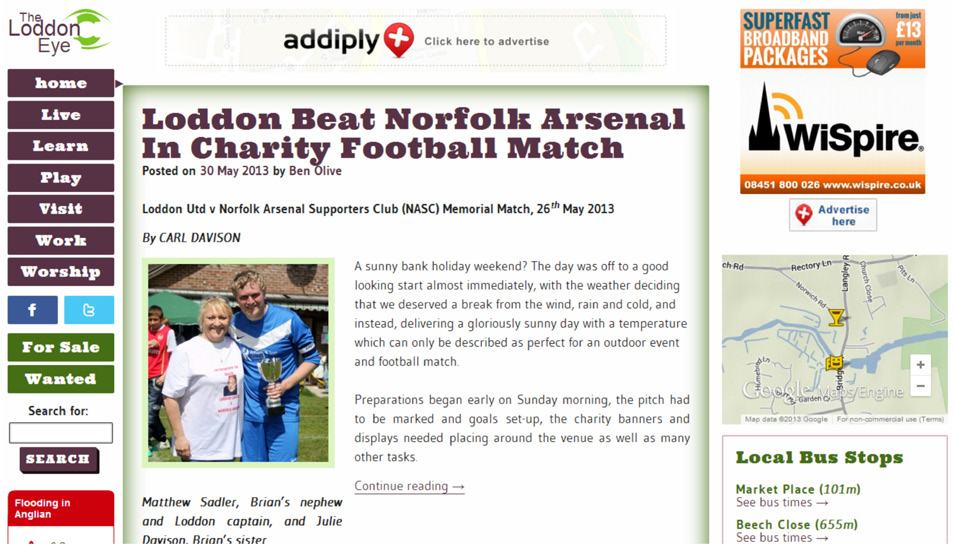
21VC portal
Loddon is a small town in South Norfolk, located on the Norfolk Broads. 21VC is a partnership which draws together the Loddon Eye local news blog and Wi-Fi Internet access to provide users with Wi-Fi hotspots in an area with historically poor mobile and broadband coverage. It launched in May 2013 and uses an advertising back-end provided by Addiply (a hyperlocal online advertising platform, partly funded by the Technology Strategy Board). Internet connectivity is provided to 21VC by WiSpire, which sites wireless broadband hotspots on church towers in Norfolk. 21VC then uses its own equipment to carry this signal to Wi-Fi hotspots installed around Loddon.
The service is designed to appeal to both local residents and holidaymakers visiting the area who wish to access local news and information via their smartphones and tablets. Users log in to the Wi-Fi service via a 21VC portal which carries a range of display advertising and hyperlocal community news from the Loddon Eye. Working with Spanish video technology company Voovio, the platform offers visual 'walk-through' advertising for local businesses.
The project team believes that the Loddon service has the potential to be the first of many similar services combining hyperlocal content and access network infrastructure in the region and around the UK.
The Kentishtowner
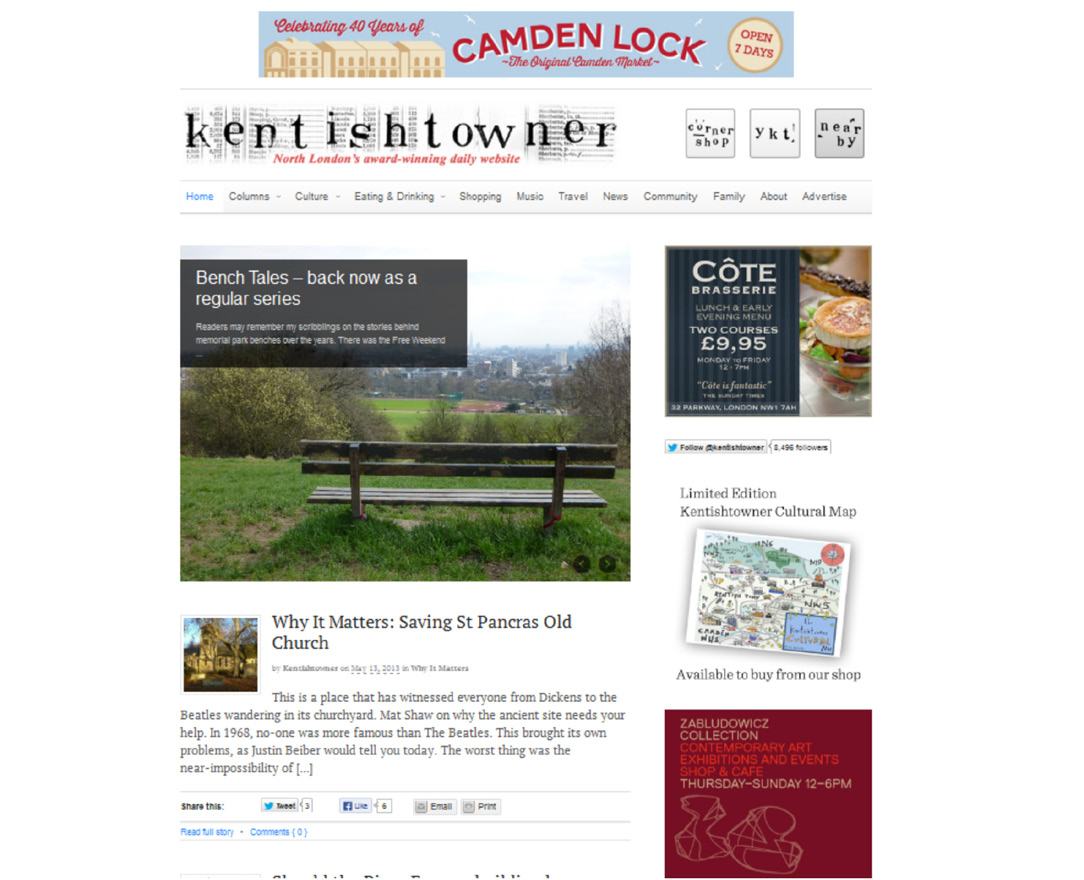 Kentishtowner home page
The Kentishtowner is a daily online news magazine for Kentish Town and the wider London Borough of Camden and surrounding areas of North London. It focuses on people, culture, going out and music in addition to news about the local area and its target audience is younger than that of traditional newspaper readers.
Since launching in 2010, the Kentishtowner has grown from a weekly blog to a daily title and in February 2013, the first printed edition launched. Other editions have followed on a monthly basis and the newspaper is distributed via local bars, shops and cafés. The Kentishtowner's owners have also recently launched (in March 2013) a separate online service for South London called Below the River, covering a geography from Stockwell in the west to Deptford in the east and with dedicated editorial staff.
Using its Destination Local funding, the Kentishtowner developed a geo-aware and mobile adaptive HTML5 service. The Kentishtowner is free to read and is funded primarily by advertising. In addition to traditional display adverts on its pages, Kentishtowner offers advertisers the opportunity to pay for a premium listing in its local directory Nearby pages (enabled by the new platform), which displays geo-aware map-based content and local information. Premium listings allow advertisers to advertise special offers and also allow advertisers to describe their businesses to end users via a short video in Q&A style. Other features include a 'corner shop' where users can buy merchandise, back issues and related products.
Local Edge - Greener Leith and Broughton Spurtle
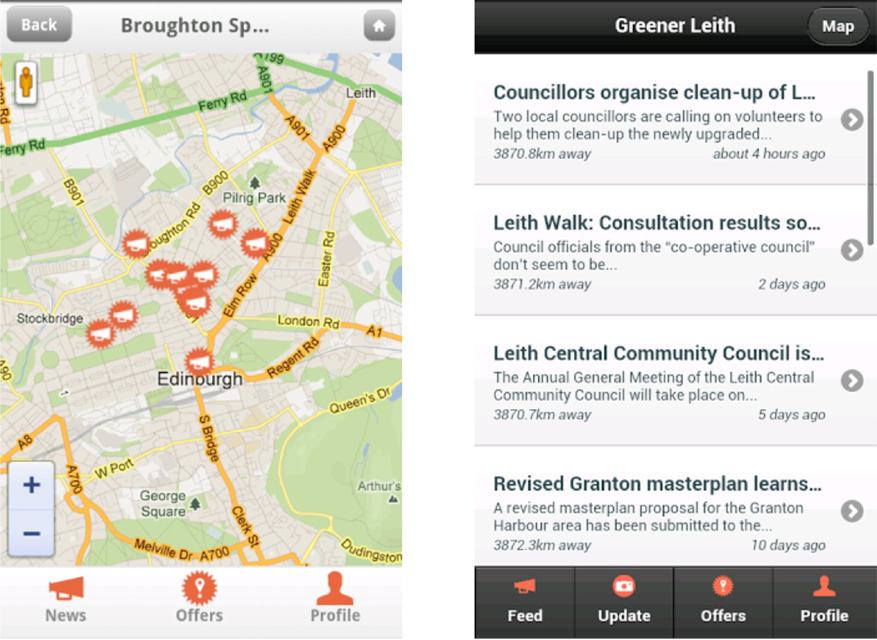 Screenshots of the map interface for the Broughton Spurtle version of the app (l) and the content feed of the Greener Leith app (r)
Although the Kentishtowner is a for-profit service, it is thoroughly engaged with the local community through many of its weekly slots: Why It Matters gives a different person a voice each week, the Tuesday Q&A focuses on someone doing good things locally, and Thursday's Pinboard draws attention to a wide range of activities and happenings. It also engages the community through its Young Kentishtowner initiative with the local Holly Lodge community centre, giving young people the opportunity to be mentored and to publish their own stories on the website.
The Local Edge apps for iOS and Android are hyperlocal news and information apps for the people of Leith and Broughton, two neighbouring areas to the north of Edinburgh city centre. The apps were launched in May 2013 and have been developed by a consortium comprising Greener Leith (a charity that campaigns for the environment in Leith), the Broughton Spurtle, (a not-for-profit community publication covering Broughton) and TigaTag, an app developer. While their participation in Destination Local concerned the development of Local Edge, both Greener Leith and the Broughton Spurtle have existing websites.
Once users have signed-in (users can use their Facebook login details as an alternative), the app provides users with local news from blogs and newspapers, geotagged user-generated content, including citizen journalism in addition to a local loyalty scheme. The main interface consists of a content feed, which can be ordered by location or by time, and users can view their locations on a map. In addition to a content feed, offers from local businesses are also displayed as a feed, and are identified in the map by a blue point. Users are able to comment on items in the feed.
LocalSay
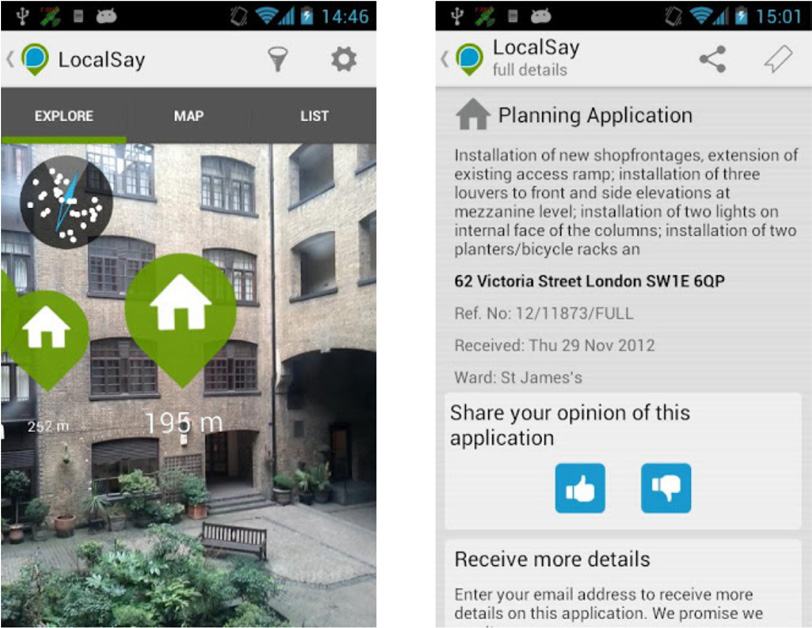 Screenshot of the augmented reality interface (l) and information and voting on a planning application (r)
In line with the philosophy of Greener Leith and the Broughton Spurtle, users who download the apps and register with the service will be able to earn virtual 'stamps' each time they shop with local businesses. These are loaded to the system using a QR code. Once they have earned enough stamps, users can then redeem them in return for a discount at local shops. To do this, all customers need to do is to show the cashier a redemption page on the app on their phone, and the cashier can then press a button in the app to redeem the voucher. There is also the potential to use discount stamps to reward local people for taking part in activities that benefit the community, such as litter clearing.
The project decided to develop separate apps for Broughton and for Leith in part to reflect the strong but distinct identities of the areas. However, the back-end of the app remains the same. This would allow for the project to offer a 'white label' version of the app to hyperlocal media organisations in other areas at a future date. At the time of writing there are no adverts in the app, though this is something which could be added at a later date.
This free to download app developed by The City of Westminster (WestCo) and its partner OTM allows local residents to access a range of information about the local area via their smartphone. The app draws in geotagged content about the area from a range of sources, including XML feeds from Westminster City Council's planning and licensing department. Users view the data in one of three ways - including through an augmented reality (AR) user interface, which superimposes information about local planning and licensing applications on a view of the external environment. Alternatively, users can view data through a map or list-based interface. Users are able to click through from any view to a summary of the application, and for further details, users can request a link by email to the full documentation (by their nature, planning applications are not in a standardised format).
Locali
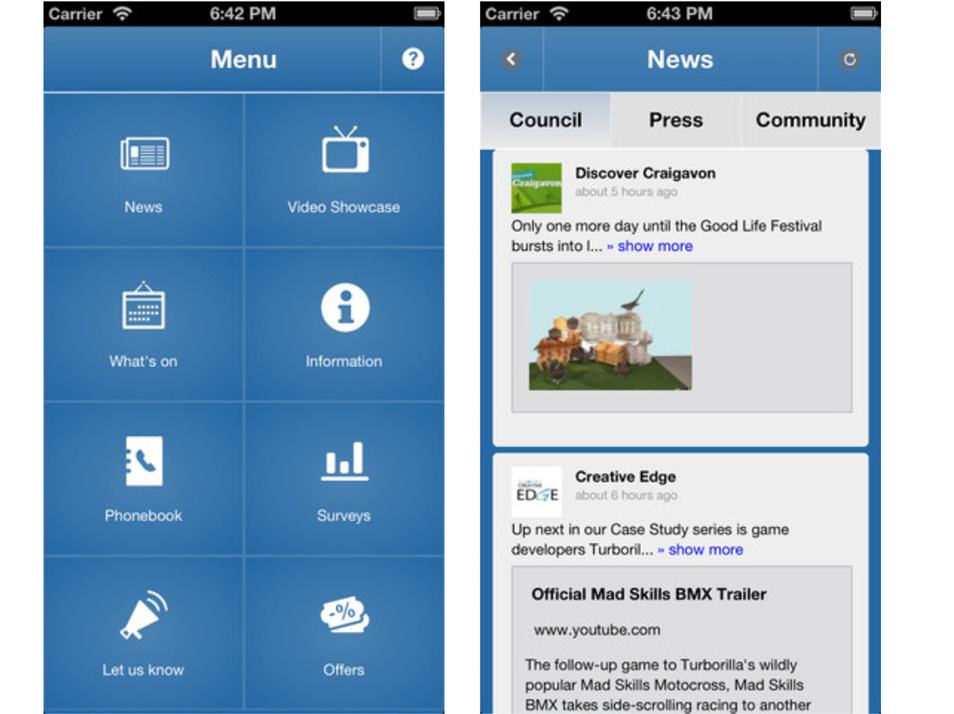 Screenshots of the app's main menu (l) and content feed (r)
Users of the app are able to express their opinion on the applications (or other local issues) via the app's polling function, and results from this are fed back to the council. The app is integrated with Facebook and Twitter. The app displays tweets with a particular hashtag, and users of the app are able to link to their Twitter and Facebook accounts.
WestCo and OTM are trialling the prototype app prior to further development. First they trialled the app with a small group of 13 testers, who also took part in focus groups to understand their local information needs and how they engaged with the app. Further testing is being carried out between March and summer 2013 with a wider group of users to inform the development of future interactions. The app is available to download before the full launch of the service.
Craigavon Locali is a free to download app on Android and iOS for residents of and visitors to Craigavon Borough Council. The app has been developed through a partnership between Craigavon Borough Council, Queen's University Belfast and BNL Productions. The app aggregates RSS and Facebook feeds from a range of pre-approved local organisations, including the council and the local newspaper and places these in one of several genre-themed channels.
The app also provides the contact details of organisations other than the council which provide local services such as schools, libraries and roads. While people often contact the council about these services, in Northern Ireland, responsibility for these falls to other dedicated bodies or the Executive and so the app provides a cost-effective way of routing citizens to the correct organisation.
The app also allows users to respond to informal polls set by the council, and users can also use the app to download details of special offers being run by local businesses. However, as it is a local authority app, the council decided not to monetise the service through display advertising and instead the project partners are considering the potential to offer the app to other local authorities as a 'white label' service for a fee.
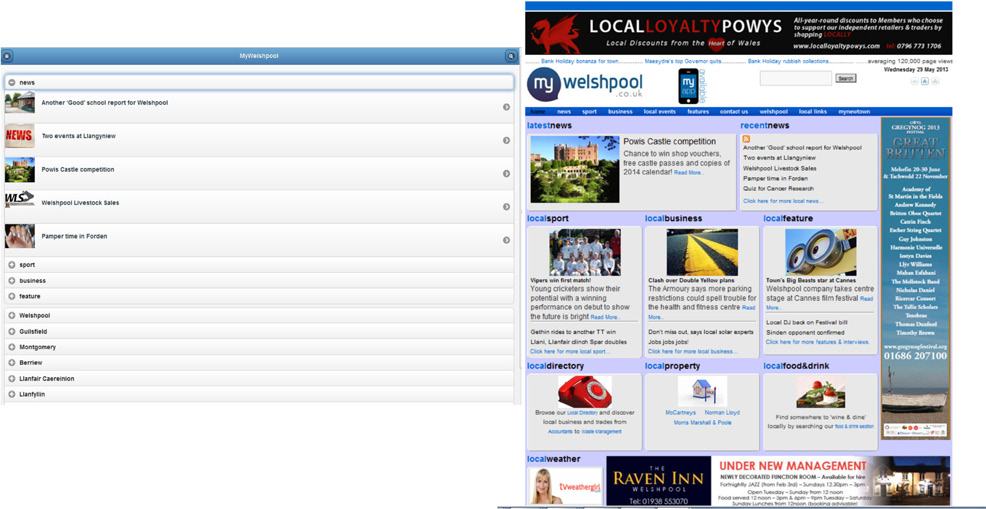 MyWelshpool web app (l) and homepage (r)
MyTown Media provides four hyperlocal news services across Powys in Wales, covering Welshpool, Newtown (both in Montgomeryshire), Brecon and Radnor. While all the areas are in Powys, the individual services serve different parts of this large and predominantly rural county. Each of the four services has a dedicated website, and at the present time an HTML5 web app is available for both Welshpool and Newtown, the development of which was funded by Destination Local.
The My Town mobile apps allow users to get in contact with the editors allowing news stories and pictures to be sent to the team. The apps also include tags for access to more granular content focussed at the village level.
Each of the services has its own professional editor and they compete with the websites of the local newspapers which circulate in parts of Powys and provide a broad range of local news content, including sports and stories about local crime.
The services are free to use for end users and are funded by advertising and sponsorship. The sites offer a range of advertising options from major premium banner ads to smaller business card-sized adverts. Having a Powys-wide network allows MyTown to offer advertisers the option of targeting the entire county or individual areas within the county. Extensive directories are about to be added to all four sites, listing all businesses in the four geographical locations with the opportunity for customers to promote their businesses through listing upgrades. Enhanced listings in these directories will be sold by an external agency on MyTown Media's behalf.
Our Town
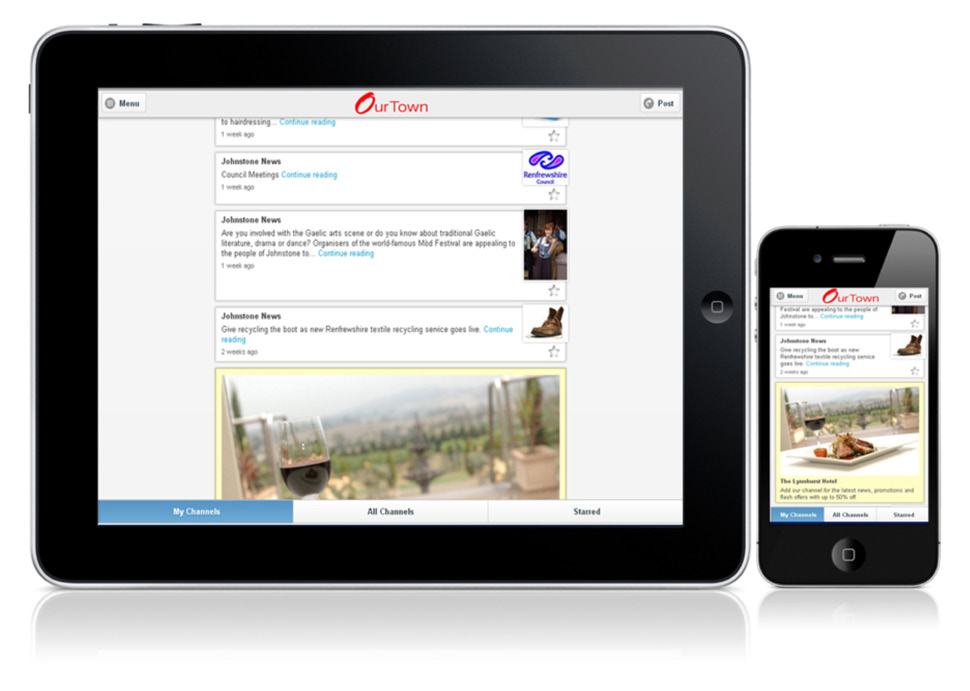 OurTown screenshots
OurTown is a modern HTML5 service for the town of Johnstone in Renfrewshire, in western Scotland. The service launched on 20 February 2013 and is owned by Herald and Times Group, the publisher of the Herald, the Sunday Herald, and the Glasgow Evening Times newspapers. The Group is part of Newsquest, which at the start of 2013 published 186 local and regional newspapers around the UK, accounting for 13 per cent of weekly circulation. Although Herald and Times Group's parent company, Newsquest, operates a network of s1 user generated content community sites in Scotland (including one with coverage of Johnstone), Johnstone does not have a newspaper of its own and has been regarded as being poorly served by traditional local media such as newspapers and radio.
Once a user has signed up and logged into OurTown, they see content aggregated into a range of 'channels' provided by trusted content partners who have registered with the site's owners to provide the service. All users are automatically subscribed to the Johnstone news channel, which draws on news content from the Herald and Times Group. Users are able to subscribe to other channels, including those run by third parties such as local public services (for example the local police force and the local secondary school). The service is about providing information feeds to local people rather than about promoting conversations, therefore the service does not have a user generated content channel. Instead the service can be seen as akin to a hyperlocal broadcast service, as relevant content is pushed to end users.
Papur Dre
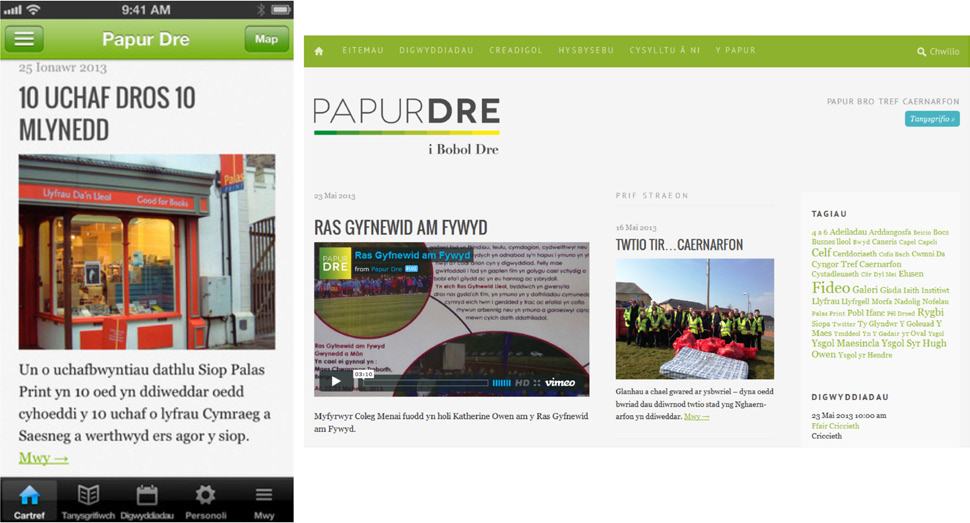 Screenshots of the app (l) and website (r)
The core service is free for all, including local consumers and businesses, but is funded through advertising and charges for businesses to communicate special offers to users. Small businesses are able to pay to communicate voucher discount offers directly to users, and can arrange this through a self-service interface. The system is automated and is designed to be cheaper and more flexible than the discount voucher services offered by Facebook and Groupon. Participating businesses are also able to login to a back-end system to monitor the performance of their offers and redemptions.
Papur Dre is the papur bro (Welsh language community newspaper) for Caernarfon, in Gwynedd, North Wales. Caernarfon is one of the places with the highest proportion of Welsh speakers in Wales. Papur Dre was founded in 2003 after the local commercial newspaper stopped publishing stories in Welsh, and it now has a monthly print circulation of 1,500. It carries a range of news about community events and people within the town, and focusses on the positive aspects of life in Caernarfon.
In Destination Local, Papur Dre, a local production company (Cwmni Da) and a local college (Colleg Menai) came together to develop an app and website and create video content. Around 12 students at Coleg Menai work on content for Papur Dre each month, and each student spends around eight hours a week working on the project. The papur, website and app can draw from a pool of several dozen volunteers who submit stories and articles to the editorial board which produces the paper each month.
The app and websites are free to users to download and offer a limited selection of content, comprising three to five stories from the current edition of the printed newspaper, as well as online only content, including videos. From the website and app, users are encouraged to sign up to a subscription of the digital version of the printed papur in ePUB format at £5 for a year, a discount to a combined print and digital subscription which costs £6 a year for those who live in Caernarfon.
Solomon app and The City Talking web site
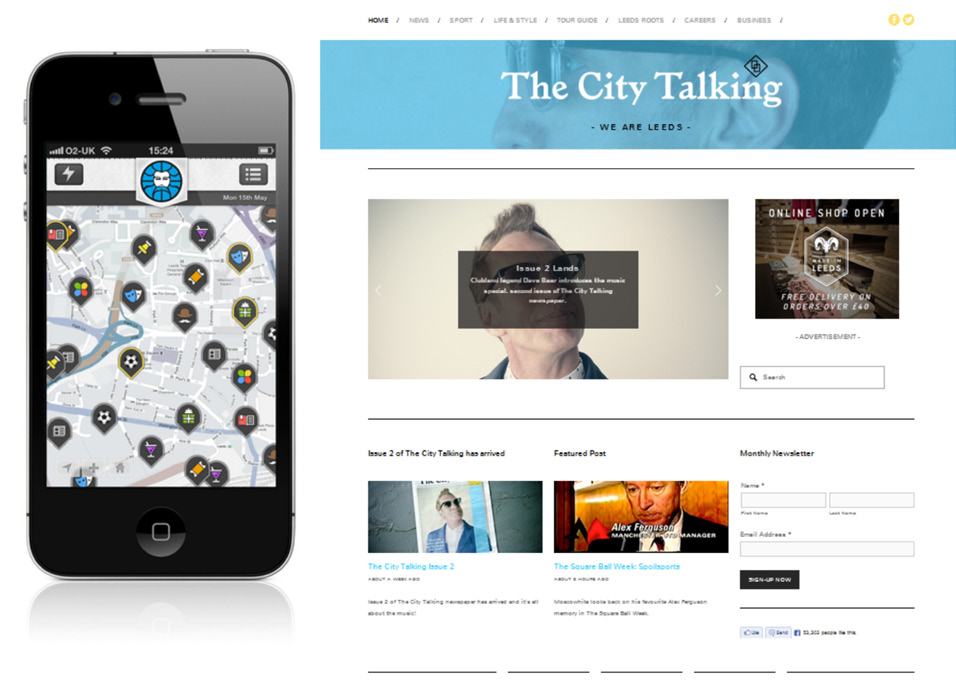 Solomon app (l) and The City Talking homepage (r)
Developed and run by Leeds-based Hebe Media, The City Talking and Solomon are two hyperlocal news and information services for Leeds aimed at a younger demographic than is typically targeted by local newspapers (the under-35 segment).
The City Talking (previously called LOL! Leeds Online) is a hyperlocal news and information website which grew out of a Facebook group founded in 2010. In March 2013, the first printed edition of The City Talking was published, being distributed from around 100 locations such as shops, coffee shops and galleries. These printed editions of the City Talking are thematic and allow for a greater focus on a particular content genre than the website.
Launched as a pilot in May 2013, Solomon is a GPS enabled web app which aggregates hyperlocal content from Leeds from a range of providers (including The City Talking). News stories and other content items are presented as icons on a map-based interface which allows users to see at an instant the place to which content relates.
The City Talking and Solomon are free to end users and are funded through advertising and sponsorship. The printed City Talking newspaper allows Hebe to reach audiences in a physical manner and offer print advertising to businesses which may be reluctant to rapidly move to online advertising. In contrast, Solomon will allow advertisers to advertise to users via their mobile device, allowing geographically targeted adverts and special offers to be sent directly to users.
URTV
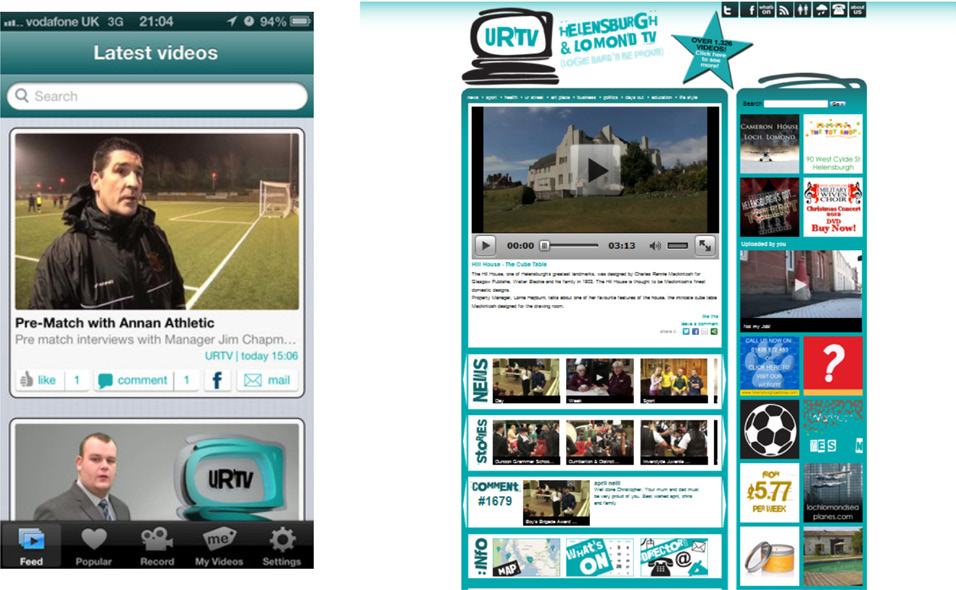 Screenshots of the app (l) and the URTV Helensburgh website (r)
As a boutique media company and creative consultancy, Hebe Media's revenues come from a range of sources including consultancy fees as well as advertising revenues from its hyperlocal service. Hebe intends to use hyperlocal media as an opportunity to diversify and grow its revenue base.
URTV is a network of online hyperlocal video services, currently operating in a range of locations around Scotland including Helensburgh, Inverclyde and Annandale. A key part of its service is a professionally made news bulletin for each area, which is made available early each weekday morning. From our research, we believe that daily news bulletins such as these are relatively rare currently among hyperlocal media services and this forms a key part of the URTV proposition.
URTV is currently available online from the URTV websites and from a location-aware iOS app. In contrast to some other networked hyperlocal services, users register and download a single, geo-aware iOS app. Content relevant to the user's location is then fed to the user.
The networked structure of URTV allows for business models to be tailored to the needs and opportunities in each locality, allowing the network to deliver hyperlocal content while also allowing it to take advantage of benefits which come with scale.
In rolling out the service to locations, URTV partners with organisations active in their local area who provide funding, local contacts and those who may also help to contribute content. For example:
- URTV has formed a joint venture with Annandale Athletic football club to operate a URTV service there. The venture allows the football club an opportunity to engage more closely with the town to help it become a focal point beyond Saturday afternoons, and in return it provided URTV with accommodation in the town. People regard their local team's games as 'must see' content and through the arrangement, URTV is able to cover interviews with the manager and players, as well as coverage of the team playing.
- Local students at Inverclyde college create daily videos for the URTV Inverclyde service as part of their coursework.
ANNEX 2: LIST OF TECHNOLOGY STRATEGY BOARD SUPPORTED PROJECTS
We have worked alongside the Technology Strategy Board throughout the first phase of Destination Local. In July 2012, the Technology Strategy Board announced funding for 11 hyperlocal projects. Since July 2012, we have held several joint events with the Technology Strategy Board which gave the Nesta Destination Local projects the opportunity to meet with the Technology Strategy Board-supported projects. The Technology Strategy Board funded projects were all feasibility studies and the earliest that any of these projects is likely to begin exploitation and commercialisation activities will be August 2013.
Table 4: Summary of the projects supported by the Technology Strategy Board
| Project |
Development of API to allow third parties to access Addiply hyperlocal advertising platform |
| Addiply: A Public API |
Platform for targeted hyperlocal news recommendations |
| TrulyLocal |
Platform for crowdsourced semantic tagging and search of hyperlocal content |
| Termscape: Convergence in Hyperlocal Media through Coordinated Semantic Tagging |
Platform which allows hyperlocal content to add travel time (rather than simply distance) to search functionality |
| Placr: The Travel Time Platform – making local content more relevant |
Research and evaluation of multimedia hyperlocal services |
| Hyperlocal media with FollowThePlace |
Platform for consultations on planning for local decisions at the hyperlocal level |
| YouCanPlan: a hyperlocal mobile web-platform community planning consultation |
Development of mobile-based platform to allow businesses based in business and industrial parks to collaborate with each other |
| Emergent Mobile Technology as the Catalyst for Business Collaboration and Partnership in Business and Industrial Parks |
Platform and API which translates public transport information from multiple sources into news outputs |
| Designing a hyperlocal transport news platform |
Hyperlocal media platform for social landlords and tenants |
| Collaborative remote production processes for location-based smart media creation and distribution by Hyper Local Social Housing Groups and their clients. |
Hyperlocal content platform for accessing open data |
| Next Generation Local Information |
Platform to provide structured authoring, storage and sharing of transcripts of public meetings |
| SPOKE – The Speeches and Statements Knowledge Engine |
|
Source: Submissions to Technology Strategy Board/Nesta For further details on individual projects please see: http://www.nesta.org.uk/areas_of_work/creative_economy/destination_local/assets/features/technology_strategy_board_destination_local_projects (accessed 10 June 2013)
Some of these projects are very much platform plays with very limited or no consumer-facing product. These provide additional capabilities to end user-facing hyperlocal services, through plug-ins or the ability to call on the service via an API, such as the Travel Time Platform. In contrast, some of the other projects provide more of a white-label managed hyperlocal service, often more specialised in nature than traditional consumer-focussed hyperlocal media services, in order to promote collaboration between businesses co-located in business parks, or to improve (and reduce the cost of) communications between social landlords and tenants, whose communications channels have traditionally been paper based.
Given their roles as platforms, their relationships with content providers are of critical importance – including those with national content and consumer brands
The projects report a range of partners in the hyperlocal space and beyond. For example, Addiply is working closely with the Nesta 21VC project along with other hyperlocal media services around the UK, and at least one other Nesta-supported project is using one of the platforms supported by the Technology Strategy Board. However, some of the projects are also forming partnerships with national content and consumer brands seeking to add local geographic functionality to their websites and apps. Platforms may therefore enable large-scale new entry into the market for the provision of hyperlocal content. Other Technology Strategy Board projects are specifically targeting traditional local and regional media providers, including newspapers and broadcasters, offering their platforms to allow them to provide more relevant, more personalised and more localised content to their audiences.
These businesses are seeking to monetise their services through a range of ways
In contrast to the Nesta-funded Destination Local projects, the Technology Strategy Board supported projects are seeking to tap into broader funding and pricing models beyond display advertising. For example, some of the platforms have adopted a pay-per-use model, meaning that each time the hyperlocal service queries the platform, it pays a fee to the platform operator. Alternatively, some platforms charge a commission or an ongoing service licence fee. However, some of the more end user-focussed projects are seeking to monetise through advertising and sponsorship.
ANNEX 3: SECURING THE SUSTAINABILITY OF HYPERLOCAL CONTENT IN WELSH: THE PAPURAU BRO
Papur Dre is one of 52 papurau bro (Welsh language community newspapers) in Wales – printed publications produced by local volunteers normally around ten to 12 times a year. The first papur, Y Dinesydd, was founded in 1973 for the Welsh speakers of Cardiff, and between then and 2006, the number of titles rose to 58, by which time overall circulation was estimated at 82,000 issues each month.
The geographic area served by a papur tends to be either an individual town such as Caernarfon’s Papur Dre or a smaller market town and its surrounding villages such as Lampter’s Y Clonc. These provide a publication in a circulation area which is generally much smaller than those of commercial newspapers. Typically, papurau include a mixture of news, reports of community events such as fêtes or local eisteddfodau, local sports, and coverage of significant life events such as births, marriages and deaths. In contrast with the majority of local media in Wales, the papurau are monolingual Welsh language publications.
After 40 years, the papur sector is facing challenges to its sustainability
The sector receives funding from a range of sources. In addition to circulation and advertising revenues (papurau are often sold by shops in the area in which they circulate), the public sector is an important source of funding. In 2013, the Welsh Government allocated over £85,000 to help support the sector as part of a £3.5 million package of funding to promote the Welsh language, in which 50 papurau each receive between £800 and £1,870 per year. Some papurau also get funding from other public bodies such as local authorities. However, some in the sector have expressed concern that funding conditions for certain bodies may be inappropriate for the sector, for example, a requirement to produce bilingual content which some in the sector see as threatening the sustainability of the Welsh language.
Another threat to sustainability concerns maintaining the volunteer-led model. Sion Richards argues that the unwillingness of younger age groups to engage with the papurau is a key challenge for the viability of the sector and the average age of contributors has risen due to a lack of younger volunteers.
For the papurau, sustainability is about the Welsh language and culture as well as ongoing access to hyperlocal local content
Richards notes the value of locally-produced content in Welsh and cites Huws’ (1996) arguments that the establishment of the papurau helped to promote the visibility of Welsh language and culture as well as knowledge of the language by promoting its use in everyday settings. In this respect therefore, the move to ensure that local Welsh language content is online may be especially acute given the recent decline in the number of Welsh speakers in the language’s traditional heartlands in the north and west of the country.
The Welsh Government sees online Welsh content as of being critical importance to growing use of the language and sees a role for online and offline Welsh language services as a part of the ‘Language Infrastructure’ in its Welsh Language Strategy. It believes that the availability of Welsh content online and use of Welsh in social media as being important for engaging with younger age groups and notes a link between the reading of Welsh by young people and their proficiency in the language. In this regard, access to offline media including books, papurau as well as online content is important.
Content in Welsh is being generated online - but the papur bro sector as a whole has generally retained a strong focus on print
The Welsh language is used extensively online, especially on Twitter, and other platforms including Facebook, YouTube (and a Welsh language version of Wikipedia). However, content in Welsh can be hard to find and there is relatively limited content dedicated to small local areas, though we understand that local/regional sport content in Welsh (especially rugby and rugby clubs) is relatively common. Visibility for Welsh language content on the Internet is therefore a key challenge.
Another challenge for Welsh language content is that creators may prefer to use English in order to reach global audiences. Given their scale and role as aggregators, social media sites may have a role to play in encouraging the use of hyperlocal content in Welsh. This might build on the significant amounts of content in Welsh on Facebook about sports clubs and the alternative music scene. Welsh language platforms such as Maes-e, a discussion forum based around a range of communities of interest, may provide examples of opportunities for hosting hyperlocal content. Other Welsh language services which focus on communities of interest such as farming, may also have geographic dimensions. In addition, Golwg360 is a Welsh language news site covering news in Wales, the UK and internationally.
In contrast, the papurau sector has had a limited online presence even to the extent that today, not all village correspondents may have an individual email address. There appear to be relatively few examples of papurau bro being at the forefront of digital media – and currently many do not have a website. When they do, sometimes the site is used just to host a PDF of the papur rather than take full advantage of the interactive and real-time nature of apps and HTML5 websites.
Papur Dre is one of several papurau which has established an online presence seeking to reach new and younger audiences, while maintaining a printed edition. Other examples of papurau seeking to operate across platforms include Y Clonc, whose website, like that of Papur Dre includes videos. Other examples of Welsh or bilingual hyperlocal sites include Trefuerig.org, a hyperlocal site for the area of Trefeurig, north of Aberystwyth. In this case, the local papur bro Y Tincer is available to download as a PDF from the site.
We believe that there is potential for collaboration in the papur sector, and ways to promote sustainability may include networking, and partnerships between papurau. The sector meets together at least on an annual basis and at the more local level, papurau meet to discuss and share ideas in fora such as the Ceredigion Community Newspapers Forum. We also note that the pan Wales Welsh language news website Gowlg360 is seeking to develop its local content and is working in partnership with some of the papurau bro.
The Welsh Government is encouraging the papurau to expand their services online. In August 2012 at the National Eisteddfod, Leighton Andrews, Minister for Children, Education and Lifelong Learning called on the sector to adopt new forms of distribution to reach new audiences especially those in younger age groups. To this end, the Welsh Government intends to continue to support the papurau bro and to “support work to explore and exploit e-publishing and new ways of accessing written material” and to continue to support Golwg360 until at least March 2014, when this will be reviewed.
Enabled in part by our Destination Local programme, we believe that Papur Dre and their developer partner, Cwmni Da have the potential to play a role in promoting the long-term sustainability of the sector, both through sharing their experiences with others, and also potentially by making the platform available to other organisations.
ENDNOTES
Nesta
1 Plough Place
London EC4A 1DE
[email protected]
www.twitter.com/nesta_uk
www.facebook.com/nesta.uk
www.nesta.org.uk
June 2013
Nesta Operating Company. English charity no. 7706036.
Scottish charity no. SC042833.